Saturday, 5 November 2011

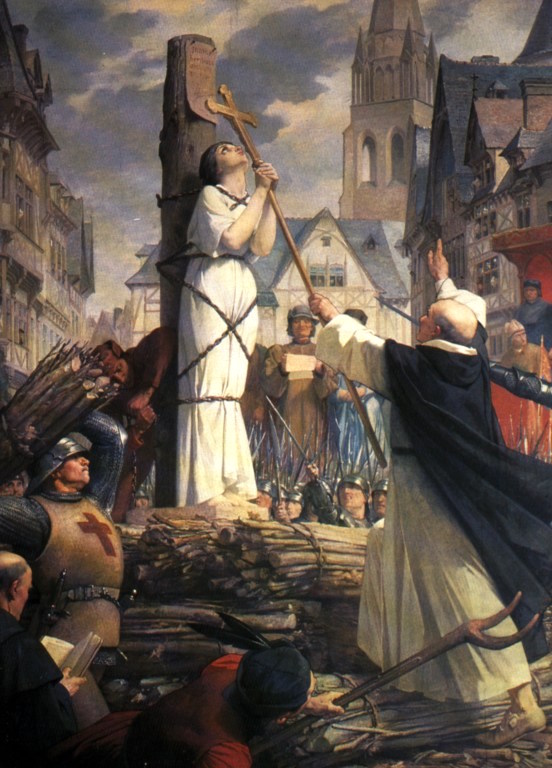
Magnificent Honegger Jeanne d'Arc Barbican

Arthur Honegger's Jeanne d'Arc au Bûcher (Joan of Arc at the Stake) is magnificent. Rarely does an ensemble this size grace the Barbican stage,  but the extravagance was totally justified.  This massive oratorio is amazing, but you can hear why it hasn't been adopted as part of the British choral tradition. It's not because Honegger blames the English for the invasion and Jeanne's death but because it contradicts so many assumptions of what oratorio should be.

Ténèbres, Ténèbres, the London Symphony Chorus intones, but don't expect a solemn Latin Mass. The massed orchestral and choral forces are screaming accusations at the "heretic, sorceress, demon" and then we see Jeanne, (Amira Casar) a small, gamine figure who really does resemble Joan of Arc, her metallic blouse looking like a  shining breastplate. Joan led the defeat of the English at Rheims, and united France under the Dauphin.  But she was just a shepherdess from Domrémy. How could such things be possible?  Joan was a pure spirit, who saw nothing odd about speaking with saints and angels.

Honegger's Jeanne d'Arc is oratorio as psychodrama.  While the trial progresses, Jeanne's mind moves outside the courtroom, back to her youth, her visions and her simple faith in her mission. Signifcantly, Jeanne doesn't sing but speaks, usually unaccompanied.  At times she slips into a kind of Sprechstimme as she dreams about her past. Frère Dominique, her sympathetic confessor, (David Wilson-Johnson) sometimes sing an approximation of plainchant but shifts into speech. The other main roles (Nicolas Dorian and Marc Antoine, playing multiple parts) are taken by actors who can handle unusual demands, such as speaking in "donkey" voices. Otherwise voices come from within the chorus, the crowd of accusers. It's an interesting mix of stylization and naturalism, which fits well with the idea of Jeanne examining her conscience, as she's told to do, even if she doesn't come up with the approved answers. When she says "No", her accusers say "She's saying Yes!". The "Porcus" farce (Paul Nilon) is pretty wry. Despite the grim situation, there's a lot of good humour in this work, which keeps it down to earth. 

Some fascinating musical writing too. As the crowd bay for blood, Jeanne swoons in fear. Perfect moment for ondes Martenot (Cynthia Millar)  to wail above the tumult. Does it suggest supernatural forces good or ill, or does it suggests Jeanne's fear?  A boy alto (Jason Panagiotopoulos) sings a long solo, completely separate from the children's choir, and Jeanne suddenly starts to sing a simple melody when she reverts to reverie.  Honneger employs different rhythms and tempi, which evoke the many cross-currents in the situation, so the orchestra itself seems to be acting as polyphonic chorus. (For more on Honegger's style see my previous posts HERE, HERE and HERE).

Honegger's style in Jeanne d'Arc is almost deliberately cinematic. He cutrs between moods, like a film director cuts between scenes, gradually building up denser images. We hear an approximation of country dance (oddly modern and jazzy, perhaps on purpose), snatches of mock-liturgy. But mostly it's a constant sense of movement between states.  Honneger was an avid cinema goer, closely linked to the French movie world. He wrote the score for Abel Gance's epic Napolean (1927), the most ambitious movie of the time,  a silent which was shown in cinemas with live ochrestra, so he knew the technical demands of writing for film. Almost certainly he would have known Carl Th. Dreyer's The Passion of Joan of Arc (1928) and moved in the same arty circles. Perhaps Jeanne d'Arc (1935) is Honegger's response to the film? It doesn't follow the narrative in the film, and Honegger's Joan is a very different personality, but the idea is intriguing.

Marin Alsop conducted the London Symphony Orchestra, the LSO Chorus, and the New London's Children's Choir. Ten soloists/actors: Amira Casar,  David Wilson-Johnson, Nicolas Dorian, Marc  Antoine, Klara Ek, Katherine Broderick, Kelley O'Connor, Paul Nilon, Jonathan Lemalu and Jason Panagiotopoulos. While the soloists were clear, much of the choral singing was unidiomatic, so even French speakers would have needed surtitles.

No expense spared, for this is a work that needs complete committment. A great pity then that the programme notes were useless. They're cut from something else and pasted into the booklet without context, so there's no actual description of the music or drama, or even an indication of why Arthur Honneger is significant.  Since Jeanne d'Arc au Bûcher is a rarity and so un-English, it deserves a more detailed introduction. Why spend all that money producing a performance when the audience isn't primed to appreciate it?  The focus of the Barbican Joan of Arc weekend seems to be Joan as cultural archetype, symbol of "Women in Leadership", a theme which runs through other events. Many women in leadership are far too busy to get drawn into events like these, but one participant told me they were excellent.  But was Joan of Arc a "woman in leadership"?  She was just following what her voices told her. Today such folk get drugged into silence. As Honegger and his librettist Paul Claudel suggest, when Joan is burnt at the stake, the flames free her from the chains of worldy power games. They're making a parallel with matrydom. "Who lays down their life for others", as it says in the text.

I'll be writing about the film version of Honegger's Joan of Arc by Ingrid Bergman and Roberto Rossellini on Monday. Please come back, as I am doing a series of Joan of Arc (click labels below)

This was one of my top picks for the Barbican 2011-2012 season. For more please read HERE (vocal) and HERE (non vocal).

Friday, 4 November 2011

Sensational Bartók Duke Bluebeard's Castle Salonen Tomlinson DeYoung

Esa-Pekka Salonen and the Philharmonia brought the South Bank Béla Bartók series "Infernal Dance" to a stunning close with Bartók's Duke Bluebeard's Castle. John Tomlinson sang Duke Bluebeard with great authority. The range suits his voice as it is now, and he's a consummate actor and knows the part from years of experience.  Michelle DeYoung sang an uncommonly perceptive Judit, bringing out the way the part changes as the opera proceeds. It's a demanding part vocally, and she handles the extremes with conviction. It was an honour to hear them, both major exponents of this work.

A tale like Duke Bluebeard's Castle is so psychologically complex that it can't be approached with realism. The castle is a major protagonist, which  "speaks"only through music.  It's the focus through which Judit and the Duke interact  Indeed, the castle could be a projection of Bluebeard's soul. The walls are defence mechanisms. They're oppressive, a metaphorical dungeon that cannot be breached. Yet they weep, for they're trying to communicate.

Thus the brilliance of Nick Hillel's semi-staging.  He makes the castle come alive as a presence. He creates it  through huge angular panels that loom above orchestra and singers much as the castle looms over Bluebeard and Judit.  The panels fitted in discreetly during the first part of the programme (Debussy Prélude à l'après-midi d'un faune and Bartók Piano Concerto no 3 with Yefim Bronfman as soloist. At one stage a power brownout threw the platform into semi darkness. Accidental, but enhancing impact). Onto these panels are projected semi-abstract images that convey the spirit of each stage in the narrative. As the story reaches its denouement, some of the panels move apart too, reflecting the final horror. Amazingly sensitive to music and meaning. If ever there was an opera which doesn't support literal "realism" it's Duke Bluebeard's Castle. And Hillel's semi-staging should prove that intelligent staging infinitely enhances operatic experience. Whether a staging is modern or minimal or Regie is utterly irrelevant.  What really counts is how it expresses the opera.

Bluebeard has made a rare foray into the outside world. It's Judit who pursues him, deserting family and home. Like so many women, she intuits his inner depths and thinks its her mission to save him. It's she who chooses to enter. Only part way through the opera, did I realize the meaning of trees silhouetted against a twilight sky with which the staging began. They're thorny, twisted, dangerous. Even before she enters the castle, Judit has a pathological fascination with the forbidden. I also thought of the Oscar Wilde story, The Selfish Giant, where the giant surrounds his tower with a thicket of brambles. Only in that case, the child he tries to lure eludes him. Women are socially conditioned to need to be neeeded, but some problems are beyond human help. Not that that ever stopped brave, idealistic women like Judit. This drama's more universal than some think!

Cogent, concentrated images are projected by film on Hillel's panels - granite textures, drops of water, the idea of blood seeping through to the surface. Solidity and fluidity. It's in the music too. Firm tonality dissolving into ambiguity, dense textures disintegrating into spare lines (listen to the famed Philharmonia harpists). Salonen understands the significance of flux and flow in this opera. Sensuality is hinted at in the richer orchestral passages, for sex is part of the toxic mix at the heart of this strange story. Note how the flute weaves through the darker passages. This feverish eroticism makes the jagged discords even more savage. Although there's little overt action in this drama, the music moves through different tableaux, each distinctly characterized. The door which opens onto Bluebeard's jewel room is depicted by dazzling music. The Philharmonia playing with exaggerated brightness, but Salonen's right. The glow of these diamonds is unnatural. At first Judit is blinded. But diamonds, like granite are hard, and she sees blood seeping through.

As each door is unlocled, the deeper we penetrate. Inside Bluebeard's castle, vast rivers flow, and gardens that thrive without light. Yet there's something good in Bluebeard as well, which might be why Judit was attracted in the first place. The section where Bartók describes Bluebeard's realm is poignant, for he incorporates whispers of folk music to evoke ancient pastoral tradition. It's too easy to overstate folk music in much of his work, but here it's used subtly, not as decoration. Bluebeard's saga probably began in time immemorial. He's a mythic figure. Judit is like Eve in the Garden of Eden, or Persephone entering Hades. Hillel can't stage the panoramic vistas this music hints at, for there's just too much to express, so the panels merely glow in semi-abstract images, so we concentrate on the richness of the score. Again, Salonen and the Philharmonia deliver the surprising warmth of this section and it's riches, far deeper than the treasures the castle has accumulated. In this section, Tomlinson's voice warms beautifully too, showing how Bluebeard is responding to Judit's influence.

But others have tried to reach Bluebeard before."I never want to open the seventh door", cries Tomlinson, (in Hungarian) and the words "never, never" repeat in the orchestra. The scene is so macabre that it's impossible to understand what Bluebeard means when he says his wives have all "become" things like mornings and sunsets, trapped forever im some strange dimension. "But they're still alive!" screams DeYoung, finally realizing the true horror of what might be in Bluebeard's hell. Wisely, Hillel doesn't even try to explain. Now the rock-like panels above the stage disappear, replaced by DeYoung herself in an alcove.  It's moving because we can still see her as human and real, but lost to that part of Bluebeard's soul that wants redemption. Tomlinson's singing now becomes infused with intense sorrow, elegaic in its dignity, even though this may mark Bluebeard's final doom. Tomlinson is singing for Bluebeard. Salonen and the Philharmonia are singing for the castle, for the lost country, for the lost women. Incredibly moving. Get to this production if you can get to Vienna, Dortmund and Paris, where it tours. 

The photo is a chamber in Siroki castle in Hungary, taken by Bathór. Lots more on this site about Bartók, Salonen, the Philharmonia, opera, stagecraft etc. Please explore.

Duke Bluebeard's Castle tours Europe

Don't let the words "multi media or "semi staging" scare you. away. Béla Bartók's Duke Bluebeard's Castle at the Royal Festival Hall is sensationally good. You can hear the broadcast on BBC Radio 3 HERE (online, international and on demand), and of course it's a splendid performance (Esa-Pekka Salonen, John Tomlinson, Michelle DeYoung and the Philharmonia).  But if you missed it live, you've seriously missed something big. This is what opera staging should be - sensitive to score and meaning, expanding musical ideas with visual images. Minimalist? Yes! Spartan? Yes! That's exactly what this story is about. I'll write a lot more tomorrow but in the meantime HERE is a short film clip.

It's touring, too. So lucky people in  Vienna (7th and 8th), Dijon (9th), Dortmund (12th), and Paris (15th November) start booking now!


Thursday, 3 November 2011

No mausoleum - Chailly Beethoven 6 and 4 Leipzig Gewandhaus Orchestra Barbican

There's a sci fi movie about a utopia where medicine is so advanced that no-ones dies unless they choose to. They go into a chamber where they're soothed away with music, sights and senses they find most blissful. One man chooses Beethoven Symphony no 6  What an ideal exit into the unknown, , bathed in the glow of this uplifting, life affirming music.

At the Barbican, London, Riccardo Chailly and the Leipzig Gewandhaus Orchestra performed Beethoven Symphonies No 6 and 4 for an unusual audience. Lots of young children, people under 30 and older folk clearly new to music, most of them absorbing avidly. What an ideal entry into the world of music! Chailly and the Leipzigers represent great tradition, but not a dead tradition. They played Beethoven when Beethoven was new and radical. In fact, he still is, as this Leipzig Beethoven series has proved.

The gruelling month-long tour is drawing to a close, so orchestra and conductor seemed more relaxed on this occasion. So their Beethoven 4th was elegantly paced.  The mysterious beginning emphasized the poise of the second movement, and the two allegro movements crackled with mordant wit. Those cheeky horns, and trumpets and trombones positioned so they blast away at well-mannered strings!

Bruno Mantovani's Upon One Note is built upon the opening B flat of Beethoven 4, which Mantovani calls "questioning". He uses it as an agent provocateur provoking different responses from different sections of the orchestra. Very striking, eventful beginning, contrasting densities. I thought of the "storm" in the Pastoral in the  noisier passages,  though Mantovani's iinterest seems to lie more in the way the smaller themes brush against the big and challenge them.

In Beethoven 6th, the Leipzigers showed why live performance is so much fun. Studio performances may technically be more perfect, but live has a zing even when it's broadcast. (So long live BBC Radio 3 concert transmissions).  Music should not be mausoleum.

This wasn't the most splendid of Pastorals, and the first horn blew a few flats, though he's probably more mortified than anyone else. But he's obviously a very good musician and has been working hard all month. He deserves appreciation. If anything, the deviation from norm made the whole performance seem more spontaneous. Musicians aren't machines, they've got to sound as if they're real human beings making music together. "Together" is the crucial word, for there are three parties to any listening experience - composer, performers and listeners.  What we get from a performance also depends on what we put in.  Some in this audience were clearly rapt, and won't forget their night with Beethoven and the Leipzig Gewandhaus Orchestra even when they're older and greyer.

Wednesday, 2 November 2011

Wigmore Hall Jan - March 2012

One of the many benefits of being a Friend of the Wigmore Hall is that you get a chance at the really hot tickets before anyone else, and that means Natalie Dessay! Completely sold out for public booking, tho' she's not singing arias but mélodies.

Pianists will probably be drooling - Maria João Pires, Nikolai Demidenko, Marc-André Hamelin and Stephen Hough, but this really will be the season for strings and Beethoven strings in particular. A complete series - Duos, trios, quartets, quintets, and supported by in depth study days such as Beethoven and the cello. Leonidas Kavakos, the Florestan Trio and the Belcea feature on the main page but Beethoven string music runs like a thread nearly everywhere else too. And Richard Brautigam plays fortepiano.

Several other good series, like the continung Dvorak series (Bernarda Fink, one of the best in this composer) or the William Byrd sacred  music series that starts March 5 2012 and runs til May 2013. Series like this are an ideal way of getting to grips with a subject because they leave you time to keep delving deeper in your own time - the only way to really learn. Also much depth for the 3 day workshop on Stravinsky A Soldier's Tale followed by a concert (Janine Jansen). Being a Hugo Wolf person, I'm excited about the Hugo Wolf series that starts on 10/1 with Christoph Prégardien and runs over 4 concerts to 2013.

Song highlights include Alice Coote's Winterreise which breaks every "rule" in the book but works, Ian Bostridge and Angelika Kirchschlager, my beloved Florian Boesch, Werner Güra (discovered while only 24 by Bill Lyne), Anna Prohaska and Hanno Müller-Brachmann.

credit : Stephen McKay

More Carl Th. Dreyer - Vredens Dag - music for film

Two evenings round St Joan of Arc this week at the Barbican. First, Arthur Honneger's Jeanne d'Arc au bûcher on Thursday and on Saturday, Carl Th. Dreyer's The Passion of Joan of Arc with soundtrack by Einhorn. I was planning to write on Joan of Arc in music (specifically Walter Braunfel's opera ) and will, but got sidetracked by the role of film in music. But it's relevant because Dreyer's films use music in a very different way to the "Hollywood style", although Dreyer uses different composers in each of his movies.

Dreyer revisits the territory of Joan of Arc in Vredens Dag, (Day of Wrath, 1943) but with a very different perspective. Dreyer's Joan is unequivocally a saint, though she isn't the least bit romanticized. Her beauty is in her faith, shining past the suffering she receives on earth.  In Vredens Dag, and old woman known as Heklot's Marthe (Marthe with the owner Heklots) is burnt at the stake for being a witch, though she comes over as a frightened rather simple minded old lady. In Joan of Arc, Dreyer highlights Joan's tormentors as individuals, albeit in a stylized fashion, as in a medieval triptych. The "action" is in Joan's soul.  In Vredens Dag,  the tormenters are the good folk of a clean living, organized, peacable community. This film is a study of relationships on a group of different personalities. Yet again, Dreyer uses black and white for meaning. This community is austere and conformist. Everything is black and white for them, not only their costumes and spartan taste in decor.

Absalom is the elderly local preacher, who is probably a genuinely good man, within the confines of the system.  He has an extremely young wife, Anne, whom his mother hates with such ferocity that she's more likely to end up in hell than heaven. "This is the house of the old", says Absalom, while Anne withers into desiccation.  Then Absalom's son, Martin, returns. Like Anne, he's repelled by Marthe's murder but they can't object. Soon they fall in love. The "rising of the sap" in nature. Anne is reinvigorated and starts to stand up for herself.  One stormy night, Absalom returns from a storm, saying he's felt the chill of death. Since Anne had wished him dead, now she thinks maybe she has occult powers after all. In this communiuty, if you want anything other than the norm, you must therefore be primed by the devil.

Marthe must be a witch because she keeps denying it, so she's tortured until she proves her accusers right. Flawless logic. No evidence needed. "It's those eyes" says the mother-in-law from hell of poor Anne, whom Absalom married when she was barely a child. (who is the real villain here?) Eyes that Absalom sees as innocent, eyes that Martin sees as mysterious. Since Anne has been brought up in this community, she thinks that she too must be a witch. When Absalom drops dead, mother-in-law accuses Anne of witchcraft and murder. Knowing that she can't hold Martin, Anne has nothing to lose and declares, yes, she's at fault.

Vreden's Dag was made in 1943 whike Denmark was neutral, but surrounded by Nazis, so it's easy to read anti-Nazim protest into the film. But I think that's grossly delimiting. This situation can occur anywhere, any time. Indeed, in the age of the internet it's even easier to stir up mobthink and ignorance.  In Vredens Tag, the locals at least know each other and can doubt, though they don't act. The original story this movie is based on was an apparently true story that happened in Norway in 1623. Bigotry knows no borders. The scary thing is that even the victims are conned into losing faith in themselves.

Back to the music. Glorious "medieval" plainchant marks the opening, where Dreyer shoots an ancient manuscript that introduces the story. But then, silence for the most part. Only atmospheric sounds, like the ticking of clocks, or footsteps. You must be watchful, always alert, just as Anne is. Very occasionally, flourishes of music. When she falls in love, she starts to hum, and there's music when she and Martin have trysts. The compser is Puol Schiebeck (1888-1949), old enough to have studied with Carl Nielsen, yet this score is modernist enough to sound avant garde even today. Listen to the music in the sequence where Anne is thinking of Marthe at the stake. Turbulent cross currents, not obviously disssonant, but deeply disturbing.  Listening to Schiebeck's score, and indeed to Wolfgang Zeller's score for Vampyr (described here with download) I'm less convinced by Richard Einhorn's 1994 Voices of Light, used in the DVD rerelease of Dreyer's Passion of Joan of Arc. But maybe audiences today need film music with their films.

Tuesday, 1 November 2011

Castor and Pollux the song

Castor and Pollux at the ENO (see review) had me listening again to Schubert Lied eines Schiffers an die Dioscuren D 360, the Seaman's song to the Dioscuren, the stars of the constellation which Castor and Pollux turned into.

It is night, on the ocean, and the sailor has no navigation aids other than the stars above. To sea-going Mediterranean cultures, the Dioscuri were strategically significant. So they built grand temples, and carved scupltures like this, now in El Prado. (credit Janos Korom). Symbolically, too, the Gemini represent faith in the guidance of nature.

Schubert's song sets a text by Johann Mayrhofer. the strange, troubled poet with whom Schubert was once close enough to share an apartment. Perhaps Mayrhofer saw in the Gemini an idealized version of himself and Schubert? Later, Schubert dropped him abruptly for reasons we do not know. Mayrhofer, an intense and depressive personality, committed suicide in 1836 by jumping into a river.

Schubert's setting is gentle, for the stars are "mild" and watchful", and bring comfort to those at sea. At sea in every way, too, as Mayrhofer states in the second strophe, "Wer auch fest in sich begründet, Unverzagt dem Sturm begegnet, Fühlt sich doch in euren Strahlen, Fühlt sich doch in euren Strahlen, Doppelt mutig und gesegnet." (full text and translation HERE)

Listen to a recording - Christoph Prégardien is specially good.  The trouble with youtube is that it's only what people upload, which is not the same as what's really out there.

Monday, 31 October 2011

Vampyr - Carl Th. Dreyer


Carl Th. Dreyer's Passion of Joan of Arc (1928) is a masterpiece every serious film buff studies frame by frame. But Dreyer's Vampyr (1932) is equally remarkable. The two films are very different. Joan of Arc is shot with extremely harsh lighting, bleaching out unnecessary detail, so every line and pore in Joan's face is exposed, like she herself is exposed and alone in her torment.  Vampyr, on the other hand, is a study in ambiguities.  What is happening? Who is the vampire, the old man, the old woman or the protagonist himself?

Vampyr is also fascinating because it's a sound movie with a score written by Wolfgang Zeller (1898-1967), one of the most innovative composers of film music when it was still an experimental art. The music for Vampyr ia a lot like the film - tonally ambiguous, mysterious, spare. Single instruments (wonderful brooding cello), merging in and out of a mist (mainly strings). Low rumblings, sudden sharp chords. Listen to the music without watching and it works on you emotionally - very unsettling. Film noir music before film noir existed.

Zeller worked with Walter Ruttmann whose Dadaist abstract films can be seen HERE on this site, and were made to be  shown with live music. (Ruttmann is the creator of Berlin, Symphony of a great City, which you can see in full download with analysis HERE)  Ruttman's credentials as a moderrnist are impeccable, yet he went on to write music fotr the Nazi film The Jew Suss, which I can't bring myself to watch for more than a few moments. After the war, he wasn't blacklisted, so I don't know what his denazification file says. We can't aassume anything. 

In Vampyr, a young man with a butterfly net (important detail) stops at a country inn. Already we know something's not right. A peg legged old soldier sits on a bench, and his own shadow comes down to sit beside him. In the inn, shadows of dancers are seen, and their music can be heard, but they don't exist in the real world, whatever that is. Then there's the star himself played by "Julian West" who looks Indian or something exotically swarthy, quite alien to whatever country the story is set in (anywhere from Northern France to the Baltic). "Julian West" is in fact Nicolas de Günzburg, whose family were Russian Jews, bankers to the Tsar. Günzburg, who financed the film, was supposedly fabulously wealthy but when his father died in 1933, it turned out the family was broke.  So Günzburg goes to New York and ends up editor of fashion glossies.

Watch Vampyr and see how Dreyer uses odd angles, so you're seeing things from odd perspectives. He makes the most of the discipline of black and white, using darkness and light as a palette to paint ideas. Details, like the Grim Reaper on the inn sign, and the peasant with the scythe in the field.  Just as the film seems to develop a narrative, Dreyer throws all into confusion. Julian West sits on a bench in the park, but his shadow gets up. It's so subtle you might not notice until you see his figure is transparent. Then he finds a coffin, and looks in. As the coffin is carried out, you see the treetops, the tower, and hear the tread of dull footseps. Is West now looking out, upwards from within? Watch the final sequence frame by frame. It's the mill, where the doctor, who may or may not be the vampire's helper, gets trapped  Fantastic shots of the machinery, wheels and cogs like infernal mechanisms. The machine grinds flour which suffocates the doctor. Will the bread (the staff of life) be tainted? Meanwhile, West and Léonie, the young girl who is saved from the vampire (whom we never see) are in a boat in a fog. They call out, echoing the doctor's cries. But they cannot hear him, nor he them.
PLEASE see here for Marschner's opera Der Vampyr (nothing like the movie)

Sunday, 30 October 2011

The Dunce Bumps into the Ghost


Chinese Halloween Opera Bouffe! A Halloween movie you won't see anywhere but on a site like this. It's from 呆佬遇鬼, "The Dunce Bumps into a Ghost" (1957). You don't need to speak Cantonese to get it.The umbrella is walking by itself because it's possessed by a ghost. The man in the silk gown 劉克宣 Lau Hak-suen) is a loanshark. He grabs a piece of chicken off the servant but it turns into a joss candle (used in prayers) Then at his banquet the meal turns into paper offerings for the dead. A kid pees into the enamel spittoon, and the ghost empties the pot on the man's head. Then the umbrella comes in and the ghost appears. It's a young woman (紫羅蓮 Tse Law-lin) whom the man has conned and she's come for revenge.

The real star is the incomparable 紫羅蓮 Leung Sing por (1908-81), the "Dunce" of the title. He was a megastar, who sang dozens of opera roles and also made over 400 movies of all kinds. In this one he plays a humble repairer of wax umbrellas to whom the ghostly maiden appears because she needs help nailing the villain, and Leung's character is a nice, honest man. Leung gets to show his comedy skills, and act, and sing! This is a wonderful example of the way Chinese culture embraces a combination of genres: opera, movies, popular song, comedy, spooks, social comment, art and entertainment. In the west, so many barriers between genres.

Leung Sing por becomes the ghost's enabler. No-one can see her, they just see him talking to the umbrella. He helps the ghost cross water (they can't do that on their own) and go to a temple. (During this scene shot on a real village shrine a passerby runs past behind him. It's not in the script, these movies were shot on location, and ordinary people did get caught on camera). The papers he scatters in his path are "ghost money", blessed in the shrine, that give the spirit easy passage. The crooked businessman calls in crooked Daoist exorcists in to catch the ghost. I wish I could find those scenes as they are great folklore. Fancy ceremonies and conga lines of captured ghosts hopping in a line like zombies following the exorcist. But not this time. This lady ghost wreaks havoc!

Saturday, 29 October 2011

Simon Keenlyside in Vancouver

From my friend Barbara Miller - Simon Keenlyside, Malcolm Martineau, Chan Centre for Performing Arts 25 Oct 2011

The lovely 1200-seat Chan Shun auditorium was largely full for this long-awaited recital by baritone Simon Keenlyside and pianist Malcolm Martineau.  I was feeling relieved and relaxed after a short and smooth border crossing that left time for a delicious dinner.  The program was in four sections: Selections from the Rückert and Des Knaben Wunderhorn lieder by Mahler, Butterworth’s first set of songs from A Shropshire Lad, Lieder by Strauss, and finally, melodies by Duparc and Debussy.   At the beginning it was announced that the recital was being recorded  for later broadcast over CBC (this in the context of warning us to be extra good about turning off cell phones, turning pages quietly, and waiting until the ends of sets to begin applause—we couldn’t let all of Canada witness Vancouver’s gaffes) .  It was not specified when this broadcast would take place; interested listeners should presumably check the CBC website.

The artists took the stage and began the Mahler set, which was sung and played well enough but didn’t come completely alive for me.  One big problem was Keenlyside’s distracting mannerisms, often seeming unsure of quite what he wanted to do with his hands, reaching for the piano but not always taking hold of it,  then quickly moving to the lapel of his three-piece suit, bringing both hands together, and at some points taking a handkerchief from his inner pocket and wiping his face. Some of these actions, combined with a few soft high notes being lost below the accompaniment in this set made me wonder whether he might not be feeling well, but if that were the case I don’t think he could have sung the whole recital as well as he did.  At times his gestures expressed the song very well, and he could be very still and attentive during postludes, which made me regret all the more the nervous energy that drove the gestures much of the rest of the time, presumably in the interest of making the lovely sounds he produced.

There were some very nice touches in this set, though.  In addition to Malcolm Martineau’s  ravishing nightingale effect in  “Ich ging mit Lust” and buzzing bees in “Blicke mir nicht in dieLieder”, I admired Keenlyside’s gutsiness in stage-whispering the word “glanzen” at the end of the third line of “Des Antonius von Padua Fischpredigt”. “Liebst du um Schönheit” was beautifully sung, with expressive color contrasts bringing out the words.  The set ended with “Wer hat dies Liedlein erdacht? “, sung with the energy and breath control it requires to sing the long melismas, eliciting an appreciative giggle from the audience at the end.  Overall the set was pleasant to hear but I didn’t feel completely connected with it.  I couldn’t help wondering whether these songs had originally been undertaken in observance of the recent Mahler anniversary rather than from a deep feeling for them on the part of the singer.

This feeling changed dramatically with the next group, George Butterworth’s first set of songs from  A. E. Housman’s  A Shropshire Lad. I always find it interesting when singers feel the need to speak from the stage, to explain their choices, as it were, and Keenlyside chose to do that with this set of “pretty English songs” as he at first labeled them.  I didn’t catch all of what he said (perhaps an incentive to try to pick up the broadcast), but I did hear him say that  these songs are thought of as “War Songs” due to Butterworth’s untimely death in the World War I trenches.  Rather than focusing on the horrors around them, soldiers tend to write about what they miss, which is what all travelers miss, home, pubs, friends, etc., and  Keenlyside  thinks that maybe these songs are “overcoloured by war”. The message I got was that a singer with an international career that keeps him travelling all the time (last night in Vancouver, tomorrow night in San Francisco, each a continent and an ocean away from home) may feel a deep personal resonance with the longings for the English countryside  he hears expressed in these songs.  Now we began to hear wider ranges in vocal color: “Loveliest of trees” began with a quiet, floated sound, the “wise  man” in “When I was One-and-Twenty” had the booming, authoritative voice of an elder lecturing a youth who reacted with a more meditative sound.  The artists took very short pauses between the songs, “Think No More Lad” taken as an attaca after “Look Not In My Eyes”, as if to shut down the dangerous thoughts lurking under the evocation of Narcissus.  “The Lads in Their  Hundreds” was almost chatty in its enumeration of the faces seen at the fair, pausing to ring out with the strength worthy of the largest opera houses on the last word of “the lads that will die”.  A flawlessly executed dialogue between the pale voice of  the ghost/memory of the dead friend and the resonant but uneasy voice of the living narrator gave the needed chill  to “Is My Team Ploughing”, which closed the set and the first half of the program.

The second half opened with the Strauss songs, where Keenlyside’s voice blossomed in the operatic phrases.  The program included the familiar “Das Rosenband” and “Ständchen” (on which every lieder duo seems compelled to make its mark these days, since it closed Strauss sets by both Christianne Stotijn and Measha Brueggergosman, at the recitals I heard last year).But I was more impressed by the floated phrases and strong vocal presence in “Befreit”, and the spookiness of “Waldesfahrt”, which suffered from the disadvantage of having the wrong  text printed in the program.  While the audience was left to try to figure out where in Körner’s poem “Im  Wald, im Wald” the singer was, I put the text aside as soon as I heard the opening line “Mein Wagon rollet langsam” from Heinrich Heine, and watched Keenlyside visualize the impish face at the window of his coach and the creepy feeling it gave him about his love.  In reading scholars’ speculations about why Robert Schumann’s setting of this text was dropped from the final “Dichterliebe”, I saw the complaint that Schumann’s setting lacks precisely this creepiness that Strauss captures, so it was a treat for me to see it expressed so well in Keenlyside’s performance.

The French set that closed the prepared program was beautifully executed. Keenlyside’s voice was particularly effective in the transparent, slightly nasal French vowels, adding a whole new feeling to the program.  Duparc’s “Le Manoir de Rosamonde” was almost fierce in its delivery, setting up the sensuality of “Phidylé”.  Whether the audience believed that the switch in composers from Duparc to Debussy indicated the end of a “set” or because it was so enraptured by the performance of the song, they burst into applause after Phydilé (sorry, Canada, sometimes you just can’t help yourself—I guess you had to be there).  The Debussy songs were among his lighter and more charming ones, beginning with the early  “Nuit d’Étoiles” and ending with the witty “Mandoline”,which closed with an articulated, meaningful look between the accompanist and singer on the final struck note that brought laughter to the audience.

After several curtain calls to acknowledge the standing ovation, the artist at last reappeared with music in the pianist’s hand.  There were four encores in all, the singer’s introductions to them making it clear that they had a great deal of personal meaning to him.  There was again a frisson of the itinerant singer’s possible homesickness when  Keenlyside said that, for him, coming home is coming home to Schubert, and therefore he would sing “Der Wanderer an den Mond”, where the traveler envies the moon for being at home anywhere.  The performance by both pianist and singer was less “folksy” and more legato and even boomingly resonant than I often hear it, and it was particularly poignant to see the singer blow a kiss afterward to the audience member to whom he was dedicating the song.  The second encore was actually announced as two songs in one take.  He explained that he wanted to sing Percy Grainger’s setting of “A Sprig of Thyme” for his cousin, finding Grainger’s folksong settings “not quite as louche as some of Britten’s arrangements.” But prior to that we were treated to a lovely performance of John Ireland’s “Sea Fever”.  Enthusiastic applause continued after these songs, so we were treated to one more encore, Schubert’s  “An mein  Klavier”, which, sure enough, Keenlyside sang to the nine foot Steinway grand piano itself, growing gradually softer and more intimate with each strophe, leaving us with this tender melody in our ears as we made our way through the lovely Chan center lobby to our cars.

Friday, 28 October 2011

Roderick Williams - Sea Pictures???

"I'm not dressed as a mermaid," quipped Roderick Williams. He was singing Elgar's Sea Pictures. Yes! Sea Pictures, mezzo soprano territory, usually heard with full orchestra, but here in the less common piano song version, at the Holywell Music Room, part of the 10th Oxford Lieder Festival. The grand Elgar gestures are still there in the piano part (especially in Sabbath Morning at Sea) but the cycle as piano song is something altogether more immediate and direct. Williams make such a powerful case for Sea Pictures that he raises Elgar's profile as song composer.  This Sea Pictures is so much more distinctive than most of Elgar's other rather more stylized piano songs. At last we might hear programmes of English song with Elgar given due prominence.

Despite its preoccupation with folklore, English song is a 20th century genre, far removed from bucolic pastures. Yet it's not  pretension. Roderick Williams has transformed English song performance practice because he approaches it as music. He's direct, personal and immediate, completely without affectation. He's astounding good technically, lovely burnished timbre, impeccable phrasing. The transpositoin is perfect,  and even when the tessitura leaps, Williams is secure. He communicates as if he's in conversation, telling an interesting story he cares about. "I, the Mother mild" sings Williams, "Hush thee, O my child". We might be thinking Janet Baker, but Williams expresses the spirit of the poem, for Ellfinland exists beyond gender or time. The imagery in these songs is nautical and in some songs the mood is ebullient. But meaning is deeper. "The music seeks and finds me still, and tells me where the corals lie".

Oxford Lieder does rare repertoire well. Until Roderick Williams sang Ralph Vaughan Williams (no relation) Willow-wood, the cycle hadn't been heard since 1903, and was known only to specialists. In 2005, he recorded the version with large orchestra and female choir. The text (Dante Gabriel Rossetti) suggests furtive lovemaking in the woods. In this performance, Williams brought out the unhealthy, even sinister aspects clearly. The orchestral version may be more ambitious, but the piano version is far more expressive.

Charlotte Bray is composer in residence, with three of her works performed at this year's Oxford Lieder Festival.  Her Songs and Sonnets is a key new work, heard here for the first time. The poet is Fernando Pessoa, who turned multiple personality into art form. He's become cultish in recent years because his work is surreal, utterly unique. His perspectives open new dimensions: No wonder he fascinates so many composers. Read more about him here on this site.   In these poems, Pessoa is parodying Os Lusiadas, the Lusiades, the Homeric epic poem by Luis de Camões (1524-80) which is so iconic that it symbolizes Portuguese culture and identity.  Bray's response is interesting. She counteracts Pessoa's florid text with spare, open textures. Often the voice is unaccompanied, and the words declaimed rather than sung. Camões and Pessoa are formidable poets to attempt, so if Bray doesn't focus on structure, her detailed word painting is a reasonable response.

Williams and his pianist, Andrew West, began their programme interspersing songs by Fauré and Duparc with songs by John Ireland. Numerous correlations with the rest of the programme. Exotic images of travel,  songs better known for female voice, even the idea of neurosis if you connect Duparc with Pessoa.

Roderick Williams is perhaps the most original British baritone today, and I do include bigger names, because his voice is so distinctive, and he communicates so powerfully. He 's also adventurous with repertoire. "Next time", he said "I might sing Schumann Frauenliebe und Leben". It has been done before (Matthias Goerne) and brings out new perspectives in the familar cycle. Maybe Oxford Lieder should take him up on his dare.

Read about Roderick Williams in ENO's Rameau Castor and Pollux HERE. It's nice to see Roddy with his clothes on! But he must be covered in bumps and bruises after that production. And read about his Butterworth Complete Songs HERE - amazing !!!!

Sibelius Luonnotar Barbican Oramo

Tonight at the Barbican, Sakari Oramo conducts Sibelius 3 and Luonottar with the BBC SO. This should be very interesting indeed, as the soloist is Anu Komsi,  one of the Komsi twins,well known specialists in unusual and modern repertoire. Each of them has phenomenal range. Although one doesn't need to speak Finnish to sing Luonottar, it probably helps, as it's extremely difficult to sing. Even those who can negotiate its challenges need to connect to its cosmology. This is the primeval creation myth from the Kalevala. It's also seminal in Sibelius's development as composer. If you can't make it to the Barbican, it's being broadcast live and on demand on BBC Radio 3.  Please also read my article on Luonnotar analysing its form and meaning. Video clip included!

For background, listen to this week's series about Finnish Composers before and after Sibelius, as it's quite well researched. Explains a bit why Finland has more musicians per capita than most anywhere else in the world. 700 operas at last count years ago. It also puts modern Finnish composers and conductors into perspective. Of the present generation, Sakari Oramo, Esa Pekka Salonen, the Komsi twins, Magnus Lindberg, Kaija Saariaho all closely networked.

Thursday, 27 October 2011

Chailly Beethoven 1 & 7 Barbican Leipzig Gewandhaus Orchestra

Riccardo Chailly and the Leipzig Gewandhaus Orchestra returned again to the Barbican, London, for the second concert in their Beethoven symphony cycle (read an overview and review of the first concert here). If anything, this performance was better than the previous evening. Tours are wonderful, but take their toll. The Leipzigers are playing 27 concerts in four countries in a month, plus masterclasses, media events and the necessary socializing that is a natural part of the business. Pretty heroic. Listeners have to make allowances. But it's a small price to pay for the sheer joy of live music experienced communally.

Chailly has been stressing Beethoven's modernity and the Leipzig Gewandhaus tradition of performing great music when it was still brand new. This is an extraordinarily healthy approach to music, given the regressive nonsense against modern music in some quarters. Chailly and Leipzig to the rescue!

This Beethoven 7th nipped along as if hardwired into some power source, yet its fundamental elegance shone through. Nicely poised first movement, a fine tension between the lyrical passages, pauses and the glorious forward thrust of the main theme. The allegretto thus unfolds spaciously from firm foundations. The repeated ostinato figures progress as if in procession. Canter into gallop in the presto. Rapid fire ostinato introduces the final movement, which builds up to whip-cracking fury. Yet the Leipzigers are completely disciplined, their energy focussed. Alarums, flying figures and firm, assertive final moments.

Steffan Schleiermacher's Bann, Bewegung mit Beethovens Erster (fixed, moving with Beethoven's First) was a perceptive opener. Schleiermacher's spellbound by innate tension in Beethoven's First, where elegaic lyricism confronts ostinato, the pulse alternately abrupt and sweeping. Stimulating conjunction. These new commissions aren't meant to be heard as stand alone music, so there's no point in sneering that they're not up to Beethoven standard. No one can be, Schleiermacher's piece is an imaginative reaction to Beethoven, and as valid as any commentary.

The Leipzig Gewandhaus Orchestra is off to Paris for the weeked - working - and back in London on Tuesday 1st. This concert is broadcast by BBC Radio 3 on demand. Listen to some of the spoken parts. So read me here on Classical Iconoclast to get things from source. Big grin !

Wednesday, 26 October 2011

Beethoven Chailly Leipzig Gewandhaus Barbican

Triumphant start to Riccardo Chailly's  Leipzig Gewandhaus Beethoven cycle at the Barbican. This is major. It feels like a pilgrimage in reverse, because the Leipzigers are touring, bringing their Beethoven live to audiences in Vienna, Paris and London.

The Leipzig Gewandhaus was founded in 1732, before Beethoven was born, and its permanent orchestra in 1781, when Beethoven was just a boy. To Leipzig audiences, Beethoven himself was once "new music". This orchestra has a fabulous reputation. Nearly everything they do is interesting. When Riccardo Chailly went to Leipzig, some wondered how he'd develop the ochestra's traditional rich, warm sound. But the relationship was a match made in heaven. Together, Chailly and the Leipzigers have produced truly amazing things. They're phenomenal. The new Chailly/Leipzig Gewandhaus full Beethoven Symphony boxed set, just out, should be unmissable, even in a market gorged with Beethoven cycles. It's not on amazon yet, but you can buy copies in the Barbican foyer.

The Leipzig Gewandhaus Orchestra's Beethoven tradition goes back to when Beethoven was a "living composer". This photo shows the orchestra's Beethoven tribute in Berlin in 1952, with Franz Konwitschny. Perhaps being in the DDR preserved the orchestra's musical integrity, as it wasn't subject to commercial influences, but Leipzig has a radical tradition. The protests that started in the nearby Nikolaikirche, supported by Kurt Masur and many members of the orchestra led to the overthrow of repression and the re-unification of Germany. In 1989, a few weeks after the protests, the Leipzig Gewandhaus orchestra made what was then a rare appearance abroad. It was an emotionally-charged experience, for them as well as the audience. I remember them looking up at the Sheldonian around them, their faces lit up with awe. It can't have been the architecture, since there's just as much (or was) in Leipzig as in Oxford. It must have been the sense of occasion. And they were playing Beethoven 3, the "Eroica".

Under Chailly, the Leipziger's Beethoven is heroic, too.  Beethoven's Fifth Symphony is so wonderful that it even sounds good when played by school bands. The Leipzig Gewandhaus Orchestra lifts it into another stratosphere altogether. Chailly's tempi are fast, so the music feels driven as if by metaphysical forces, yet the orchetra is so technically secure that there's no strain whatever. This is Beethoven, exhilarated by the discovery of the new, in music and in the times he lived. Such energy, though I suspect the recording and other performances will be even better. Oddly, the pauses between movements were unusually long, which I don't understand. Chailly was mopping his brow a lot. But if he's under the weather, he's still leagues ahead of most anyone else. In 20 days, Chailly and the Leipzigers have performed 19 concerts - 8 more to go !

This traverse of Beethoven Symphony no 2 was more stately, for it's not as shockingly innovative as the Fifth. The second slow movement here was elegantly structured, emphasizing Beethoven's mastery of form, the bedrock which sustained his audacious ventures into new territory.

The Leipzig Gewandhaus Orchestra performed most of Beethoven's music when it was contemporary, so it's appropriate that it should commission works by present day composers showing their response to his example. Beethoven's Fifth is such a towering phenomenom that it's become part of world culture. Even those who've never heard of Beethoven as composer know his name through Beethoven the Dog movies. Beethoven 5 eclipses all else, so respect is due for Carlo Boccadoro's Ritratto di musico, which held up credibly. Boccadora reimagines the Fifth, focusing on the relationship between strings, winds and brass, but with prominence given to timpani, percussion being a 20th century addition to orchestral colour. It's almost like a jazz combo writ large, with interesting syncopated effects. I particularly liked the solo bass being tapped, not plucked or bowed, the wood producing a nice archaic sound, a reminder of the period instruments Beethoven and the Leipzigers' ancestors would have known.

Tuesday, 25 October 2011

Shocking but not wrong : ENO Castor and Pollux Rameau

One reason why Castor and Pollux hasn't been staged in England is that Rameau is French.  Not because the British are xenophobic (which some are) but because Rameau's sensibility is so very different from what we might assume opera should be. This ENO production, a joint venture with the Komische Oper, Berlin, of Rameau's Castor and Pollux is surprisngly faithful to the real spirit of the opera and its times.

Castor and Pollux is an allegory, that grows not from the plot so much as from the intellectual response of the listener. Hence the formal stylization and long passages of music without dialogue or apparent action.  Little tour de force elaboration in the vocal lines for the sake of show. In Rameau's time, the musical passages would have supported dance sequences, to focus the mind on abstract depictions of the philosophical virtues the plot predicates upon. Don't assume this opera "needs" elaborate costumes that inhibit movement. To Rameau's audiences the abstract sequences were symbolic, more masque than amusement for its own sake. Castor and Pollux is a whole different frame of mind, which we may well have lost in this modern age with its focus on easily digested instant gratification.

Castor and Pollux are privileged men who have every reason to enjoy the pleasures of love and life. But they deliberately choose self-sacrifice for a higher destiny. They become the Gemini, preternaturally bright stars, that guide sailors through the sea. To quote a Schubert song, Dioskuren, Zwillingssterne.... mich beruhigt auf dem Meere, Eure Milde, euer Wachen. Twin Stars, who calm those at sea (in every way) with their watchful calm. They symbolize, no, less, faith despite adversity.

So, take your bearings from the fundamental meaning of Castor and Pollux and the production, shocking as it is, falls into place. Castor (Allan Clayton) and Télaïre (Sophie Bevan) are madly in love, but she's supposed to marry Pollux (Roderick Williams). Pollux's loyalty to his brother is so great that he magnaminously releases Télaïre, whom he loves too, so that she and Castor can be happy. In contrast, Télaïre's sister, Phébé (Laura Tatulescu), is so jealous that she conspires with an enemy to destroy the kingdom, which results in Castor's death.  Like twins, the sisters are dressed as a pair, but their closeness is the cause of the friction. Castor and Pollux  represent sibling love so strong that Pollux is willing to stay in Hades if his brother is saved.

Barrie Kosky's production (designed by Katrin Lea Tag) uses an abstract set but it's minimalist for a good reason as it throws what drama there is into stark, high profile. Although the stage looks bare, each of the panels is textured to reflect light. It shimmers luminously, like starlight. And like starlight, it's beautiful in an understated subtle way. Again, contrast. The huge mound that represents the earth and underworld isn't subtle at all, and quite dangerously angled, as if the singers might suddenly fall to their doom.

The sexual aspects of this production will titillate those who enjoy being scandalized, but there's purpose in that too.  Castor and Pollux is also an allegory on Death and Birth.  The dead Castor burrows into the ground and pops up again, as if the earth were a birth canal. But birth isn't possible without sex. Yet  its grubby aspects serve as counterpoint to the pure, rarified and non-sexual love between Castor and Pollux. If some of the scenes go on too long, that's because the music needs time to make its point. Fortunately, there's a lot of wry humour in the depiction, such as the series of knickers that will never end.  And those who give in to removing their knickers can't move with their clothes around their ankles. The idea, I think, is concealment and revelation. Or not, as they're in the realm of shadows.

The Hades scene was specially striking. All these images come from depictions of the underworld familair to the illustrations of the period. Ghoul masks and even references to Persephone and  Orpheus. The two men (the tall one's wonderful) with headresses of leaves and flowers connect to primeval  fertility magic, completely appropriate to the meaning of this opera. Jupiter (Henry Waddington) and his High Priest (Andrew Rupp) are represented in a way that period audiences would have recognized. As for nudity, anyone who's seen classical art or sculpture shouldn't be surprised.

Christian Curnyn's a leading baroque specialist, and the score was masterfully expressive. Superlative  period performance, highligting the fundamental precision and transparency in the orchestration. Rameau wasn't a music theorist for nothing. Small drums lightly brushed and tapped - absolutely no need for the banks of timpani that verismo would demand.  Exquistely delicate writing for strings, the refinement reflecting images of starlight.  The Gemini twinkle, but they're powerful forces in the firmament. Curnyn's light, but assertive touch was perfect. I didn't like the constant pounding of feet in the first Act, but in a way that underlined the pedestrian nature of the kingdom before the supernatural took hold. I thought of Lully, conducting with a staff, providing extra percussion. At the end,  Sophie Bevan runs round frantically. She represents physical energy, but she's going round in circles, since she has no higher purpose.


The tremolo in Allan Clayton's Castor was resolved as the performance progressed but was fine later. Roderick Willliams' Pollux was perfect, his delivery never forced or excessive, completely in keeping with Rameau's elegant idiom.  He has to do a lot of fighting in this part, rolling and writhing on the ground, which might take its toll as the run continues, but on first night, his singing was superb. Sophie Bevan's Télaïre was wonderful. She has animal magnetism, and youthful vigour: the positive side of earthly virtues. Her singing was clear-toned and pure, true to Rameau's high textures. How maddening Télaïre's purity must have been to Phébé, but Laura Tatulescu's characterization gives a relatively minor role strong impact.

Many things could be tweaked in Barry Kosky's directing, but this ENO Castor and Pollux has merits once you start thinking Rameau's terms.

photo: Allan Clayton and Roderick Williams, credit Alastair Muir, Roderick Williams and Ed Lyon, credit Charlotte van Berckel