Showing posts with label Britten Gloriana. Show all posts

Friday, 4 January 2019

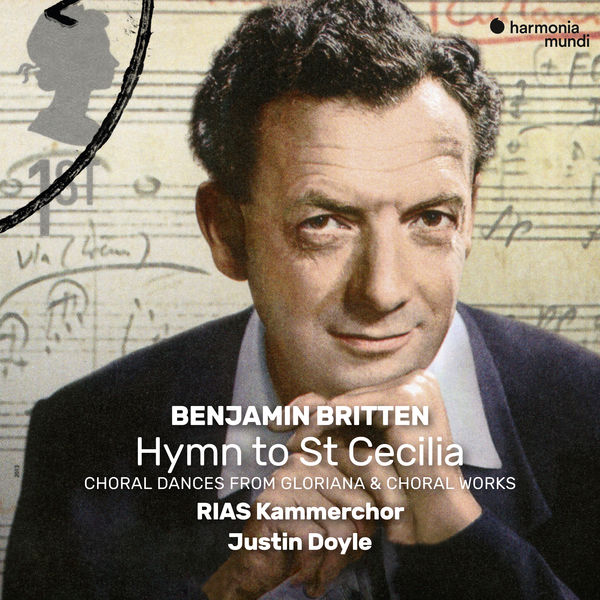
Britten Hymn to St Cecilia and love that dares speak its name : RIAS Kammerchor

Benjamin Britten Choral Songs from RIAS Kammerchor, from Harmonia mundi, in their first recording with new Chief Conductor Justin Doyle, featuring the Hymn to St. Cecilia, A Hymn to the Virgin, the Choral Dances from Gloriana, the Five Flower Songs op 47 and  Ad majorem Dei gloriam op 17. This new release extends RIAS Kammerchor's engagement with British repertoire, established when  they recorded Britten's Sacred and Profane together with songs by Elgar, Ralph Vaughan Williams and Charles Stanford, with former Chief Marcus Creed in 2013.  This new collection is particularly valuable   because it focuses on works Britten wrote at a formative period in his  career which even now is relatively unexplored. 

Britten's Hymn to St Cecilia op 27  is one of the classics of modern choral repertoire. It's not an "easy sing", lines and parts interwoven in inticate patterns.  This hymn had great personal significance for Britten, who was born on St. Cecilia's Day.  It is relevant that this was while he lived abroad : its connections to English polyphonic tradition show where his heart truly remained. St Cecilia was a singer who was matryred for her faith, hence the symbolism implicit in the text, by W H Auden.

"Blessed Cecilia, appear in visions/
To all musicians, appear and inspire/
Translated Daughter, come down and startle/
Composing mortals with immortal fire.
"

This refrain repeats through the three sections of the piece, and are sung in unison, underlining its meaning.  Auden extends the imagery to include Aphrodite, rising full-formed from the sea, and a more obscure reference (possibly from Dante), "around the wicked in Hell's abysses/The huge flame flickered and eased their pain."  Britten picks up on this for the scherzo section, where bright, short phrases flicker, like flames, in quick succession.  The hymn is as much for all artists in times of persecution as it is for the saint, given that Britten was acutely aware of the impact of Nazism on composers and others in the Europe he'd thought he'd left behind. The final section is characterized by "o" sounds and vowels, which resonate, like bells, an aural image emphasized by the sudden descent into solo parts, evoking sacred form.  The RIAS Kammerchor perform Britten's Hymn to St Cecilia so it flows fluidly, the parts so well balanced that they blend without losing clarity.

Britten wrote his Hymn to the Virgin at the age of sixteen, revising it in his early years at the Royal College of Music. Nonetheless it is not juvenilia, but a sophisticated use of double chorus, one singing in  English, the other responding in Latin, creating an echo effect as if the past were resurfacing in the present. In the final verse, the parts divide, singing the text together.

This recording is also valuable because it features the Choral Dances from Britten's Gloriana. The opera is sadly still  misunderstood, and the dances in the Second Act come in for criticism, so hearing them  on their own as a sequence shows their merits. This also demonstrates their role in the opera, which is not to further the obvious drama between Eliuzabeth and Essex but to focus on the Queen and her subjects, and the national interests that made her give up Essex for England. The good folk of Norwich are a symbol of the nation, and their loyalty is genuine. This fits in, too, with Britten's core beliefs in the value of local community : at Aldeburgh, he did more for community music theatre than anyone since the Renaissance.  In contrast, the courtiers who surround the Queen are sycophants and hypocrites.  The courtiers may sneer at the peasants, but the Queen recognizes sincerity. Presumably the new Queen Elizabeth got the message. She was personally fond of Britten  and gave him her support, much to the chagrin of those who thought him an outsider.

In the opera, the Choral Dances also underline the fundamental role of English tradition in Britten's music.  This structure is reminiscent of earlier form, and shows Britten's understanding of style.  The first three dances are a masque within a masque. "Time", "Concord" and "Time and Concord", moving from liveliness to serenity to joy.  The women's voices of the RIA Kammerchor sing "The Country Girls", while the men sing "Rustics and Fishermen", and come together again for the "Final Dance of Homage", here beautifully parted.

Britten's Five Flower Songs op 47 (1950) sets poems by Robert Herrick, George Crabbe, John Clare and an anonymous folk song.  Britten creates a bouquet, bringing together colours in varied combinations. "To Daffodils"  is swift, for daffodils don't linger, while "The Ballad of Green Broom" alternates doughty rhythms with longer, lighter lines, men's voices for the wood, womens for leaves, so to speak, the song ending with a witty flourish.  In "The Succession of the Four Sweet Months" (Herrick) the parts define each month. The parts combine in "Marsh Flowers", strong colours spread along lines that end in a sudden upbeat, and in "The Evening Primrose" stretch the lines so they descend slowly into slumber.

With Ad majorem Dei gloriam (AMDG) we return to Britten from roughly the same period as Ballad of Heroes op 14, the Violin Concerto op 14 and Young Apollo op15, all of which did not receive much attention until later years.  In the case of the Violin Concerto, now regarded by many as a masterpiece, the reason may be that it expressed despair so intense that Britten could not yet process.  The reason for the suppression of AMDG may have more to do with the fact that the solo SATB version can't achieve the colour  a larger ensemble can bring to it.  But there are deeper undercurrents here, too. The texts are by Gerald Manley Hopkins. What drew Britten to these poems of extreme mystical devotion ?  Since Catholic Emancipation wasn't achieved until 1829, and the order itself was suppressed until around that same time,  Jesuit principles of intellect and independence threatened more conservative minds.  Furthermore, Hopkins' poetry was not published until after his death, a sign of humility before God.  Hopkins may have been, for Britten, the quintessential artist as outsider, who endured suppression for the greater glory of his Art.

These songs are difficult to perform, but RIAS Kammerchor carry them off extremely well.  Again, the fine balance between voices creates a lustrous sheen which enhances a mystical sense of rapture. In "Prayer I" ("Jesu that dost in Mary dwell") the voices unite for the last line "To the greater glory of Thy Son : Amen", the last word extended, like a prayer.  Even more beautiful is "Rosa Mystica", where the male voices chant, as if at Mass, the women's voices dancing above the steady pulse of prayer.  The women's voices take up the chant with greater elaboration.  Britten sets "God's Grandeur" with brisk pulsating rthyms from which outbursts of energy emerge, like shouts of joy.   With "Prayer II", a hushed, contemplative mood returns,  the flow of the lines illustrating the image of a fountain linking God and Man. When the men sing "I repent of what I did", the line stands out, emphasizing humility. "O Deus, ego amo te" is a tender love song ; for Hopkins, the object being God, for Britten, perhaps someone human, The word Amen stresses the first syllable so it explodes like a shout.  The Jesuit order was founded by soldiers, and organized on quasi-military lines.  Hopkins writes unorthodox marching rhythms into his poem "The Soldier", which Britten respects, starting with the ejaculatory "YES!" (in capitals in the original poem) For Hopkins, the poem is a celebration of vigour in imitation of Christ.  But Britten, and readers of A E Housman, may read other connotations in the line ".....séeing somewhére some mán do all that man can do,
For love he leans forth, needs his neck must fall on, kiss, And cry ‘O Christ-done deed!".


If man is the image of God, kissing a man cannot be a sin.  In this context, the final song "Heaven-haven" may be a love song, too, and to someone quite specific.  The text is simple and direect, Britten's setting calm, with no fear of the "Love that dare not speak its name" in the words of Lord Alfred Douglas.  Imagine the rage of homophobes and those jealous of Britten and Pears in an era when homosexuality was illegal.  Britten may not have published the songs, but he didn't destroy them, aware that some day they would be understood as a testament.

Sunday, 23 June 2013

Gloriana Royal Opera House Britten's Mock Tudor

Claire Seymour's review of Britten Gloriana at the Royal Opera House is HERE in Opera Today. She wrote the book on Britten's operas - literally. "The Operas of Benjamin Britten :  Expression and Evasion is an authoritative reference work anyone interested in Britten needs to know. So what she says about the opera, and about Richard Jones's production, is worth reading.

"Initially we are confronted with the simple exterior of a theatre. A dignitary paces impatiently beneath the royal crest and flag which adorns the façade, anxiously awaiting the arrival of the royal party; Queen and consort enter, slightly bemused by the cultural offering bestowed in their honour. The ‘fourth wall’ is lifted to reveal an unsophisticated platform; prompter, janitor, curtain hoister and bell-ringer loiter with anticipation in the wings. The orchestral prologue commences, visually illustrated by a perfectly choreographed reverse parade through British monarchical history - faultlessly in keeping with current Conservative-party educational policy - until we arrive at the first age of Elizabethan magnificence and mal-contentment. In a brisk sweep - reminiscent of the gallery of ancestral portraits illuminated by the Prologue to Owen Wingrave - Richard Jones makes a virtue of the opera’s potential cause for irritation - its whimsicality and twee ‘Merrie England-ishness’. "

"Henceforth, all sentimental, mawkish, am-dram naff-ness is viewed through a knowingly ironic filter - which, in fact, perfectly complements the parodies and self-parodies of Britten’s score."

Britten's Mock Tudor carries a punch ! read the whole piece here. 

Friday, 21 June 2013

Bite with humour - Britten Gloriana Royal Opera House

Bright Britten Gloriana at the Royal Opera House. What might Britten really have meant when he celebrated the grand public Coronation of a new Queen with an opera which connects power with illusion?  Played straight, Gloriana might seem yet another ceremonial pastiche flattering the Establishment. But clues to Britten's motives lie embedded in the music. Is Britten, like a Court Jester, the man who tell home truths under the guise of charm ?

"Who threw the gauntlet down ?" asks the Earl of Essex, (Toby Spence) hearing the sound of a joust in the background.  Is Britten throwing us a coded challenge? Instead of looking for himself, Essex relies on others to tell him what's going on. He's a a jealous upstart who rises because he can flatter the Queen.(Susan Bullock). Hence his exchanges are oddly repetitive and unoriginal. Britten is drawing character with such subtlety it might easily be missed. And why is an intelligent woman like Elizabeth I so easily fooled? Britten knew Elizabethan music well. So when he makes Essex sing doggerel, he makes a point. "Quick music is best when the heart, the heart is oppressed. Hallaloo, Hallalay, ha-a-a-a lalayah !" In this context, the long masque and dance sequences take on grim significance. They are circuses for kings, escapist pursuits that lull the public into subservience.

At Court, the aristocrats flatter the "Red Rose" that is the Queen, comparing themselves to "green leaves". In prosperous but provincial Norwich, the locals put on rustic pageantry. Maidens and Swains dance to songs so twee they'd be embarrassing, even for yokels. The long scene at the Guildhall in Norwich can drag but conductor Paul Daniel shows how the details are more significant than the showpieces. A sour trombone groans as the elderly Recorder of Norwich (Jeremy White)  falls as he tries to bow. "Tedious!" sneers Essex. But the Queen puts up with the locals because it is shows like this that maintain her authority. Is the Queen really fooled by flattery? The lavolta is charming, and gives the members of the Royal Ballet something more substantial to dance to. But for the Queen, it's a ruse to make her ladies sweat. Grotesque brass passages suggest disgust and menace. When the rabble erupt onto stage, the music sounds vigorous and direct. Bad news in Ireland is announced in the City before it reaches the court by a Blind Ballad Singer (Brindley Sherratt).  His music is hideous, for he suggests disorder and the collapse of the system. Yet he's also Beckmesser, connecting to the jealousy, pettiness and falsehood in the opera and in the background of its genesis.

Benjamin Britten himself haunts this production. Perhaps it's significant that Paul Daniel also conducted Phyllida Lloyd's film Gloriana (reviewed here). Richard Jones takes up the theme of performance and illusion. We see the mechanics of stagecraft.  Boys carry placards that spell out the places scenes are taking place in. Workmen change props on stage. We see singers stumble over badly positioned steps. Arc lights are positioned in the orchestra stalls. Amateur dramatics? The clumsiness is deliberate. Britten grew up in a world where ordinary people made theatre. At Aldeburgh, he probably did more for community opera than anyone has done since the Middle Ages. Gloriana is an infinitely more sophisticated Albert Herring. We see a figure in silhouette who looks and moves as Britten did.

Ultimately, though, Jones connects to perhaps the darkest theme in the opera, that power is the art of illusion. The Norwich scene is crucial because it shows how ordinary people are complicit in power politics. The "green leaves" the courtiers sing of are translated, literally, into "green leaves" in a wonderfully-staged tableau depicting the kind of village vegetable shows that were once so popular when people grew their own food.  In 1953, people still believed in wartime austerity. The good folk of Norwich line up regiments of marrows, battalions of cabbage. How Britain has changed!  One of the amateur dramatics effects shows a giant pot where missionaries are cooked, small boys blacked up to look like comic book figures from the past. Then we catch glimpses of a real, adult Black man looking on from the wings. Empire is no longer an "exotic distant place" Elizabeth dreams of, but our present.

Susan Bullock sang Elizabeth. This is a role that requires, above all, the ability to project personality. Sarah Walker, a mezzo, carried it off  well for Mark Elder (aged 34!) in 1984, but Britten wrote it for soprano, so the higher timbres cut shriller and more sharply. Bullock was saved the indignity in the scene where the Queen is seen exposed, bald and old. In other productions, this can be shattering drama.  Here the full impact is rather muted. Britten reserves his last irony for the end. "Mortua!" sings Bullock, as Elizabeth faces death. At this critical junction, Elizabeth no longer sings. Bullock declaims, as actress.  Toby Spence sang the Earl of Essex and Mark Stone sang his rival the Earl of Mountjoy. Perhaps there's another subtle Britten dig : none of these roles is a "Big Sing", not even Elizabeth, which showcases the singer's acting skills not her vocal technique. The biggest"sing" is the Blind Ballad Singer  where a good singer has to sound bad !.

Claire Seymour has reviewed Gloriana at the Royal Opera House in Opera Today. Read  HERE. That's authoritative. She's the author of The Operas of Benjamin Britten and an extremely perceptive writer.


The performance on 29th June will be broadcast LIVE online on BBC Radio 3. 

photo: Credit Clive Barda, courtesy Royal Opera House

Thursday, 20 June 2013

Britten Gloriana - Politics as Theatre

Before tonight's premiere of Benjamin Britten's Gloriana at the Royal Opera House, some thoughts on the opera and the politics of performance. ( My review is HERE). The odds were stacked against Gloriana even before its premiere. This was an exceptionally high profile commission, the biggest in British opera history. A new Queen was being crowned, and a new era of hope was dawning. And the commission went to Benjamin Britten then still under 40, and a relative outsider in British music circles. If even Peter Pears wasn't keen on taking second place to a soprano, what were the chances that the opera would be appreciated for what it was? Politics plagued the original production just as it plagued Elizabeth I.

The famous Opera North production, directed by Phyllida Lloyd, is intriguing because it 's not a straight film of the opera but presents it as a film about the making of performance.  It's absolutely valid as an interpretation of the opera. Politics is an extreme form of theatre, where image  means power. Elizabeth puts her personal feelings aside to protect her role as Queen.  This film is a work of art built around a work of art.

It's an important contribution to our understanding of Gloriana and the politics that went on about its reception.  I reviewed the DVD in 2007 for Opera Today. 

 "In the first scene, the Earl of Essex sings about a “chess game” in which the goal is to win the queen. This Queen has to keep ahead of the game, constantly, through stratagem and the illusion of invulnerability. Thus the stage action is woven with scenes from “behind the scenes”, creating the effect of illusion within illusion. Like the Queen herself, Barstow the actress is under pressure to perform. In the opening scene, where she looks wearily into the mirror in her dressing room, while listening to the overture. It’s very moving. Not all singers make good actresses. Barstow, though, is exceptionally good. She’s so convincing that you forget, for a moment, that this, too, is illusion and stagecraft. Her whole performance is a masterclass in opera characterization, and worth studying for its own sake. This Elizabeth is no fool, but watchful and tense, like a coiled spring. Hence the sharp delivery and attack, and the bristling, sharp edge to the voice. When the Queen steals her rival’s dress and dances in it, Barstow spits out her lines savagely, bringing out the menace that underpins the elaborate party games at Court."

"Film creates special new opportunities. For example, in the “Mortua”, when the Queen finally faces her mortality, there are long silences which would not work on stage or recording. Here though, the camera dwells on Barstow’s face which registers intense emotion. Sound, as such, is unnecessary. When she does sing, weakly, the song she and Essex had playfully sung long ago, she sing so quietly and tenderly that the impact would otherwise be lost. Similarly when she’d earlier explained her love for her nation, the camera pans the balconies in the opera house, backstage attendants and so on, as if all the world were listening to those noble, ringing words"

"Just as the film draws out the effort the Queen makes to remain in control, the film shows how much work goes on behind the scenes of a production. Recordings alone can sometimes break the link between listener and performer, so sometimes people focus on recording values rather than on artistic creation. This film is an excellent reminder that it is people who make opera and that it isn’t easy work !"