Showing posts with label Joan of Arc. Show all posts

Monday, 29 May 2017

Joan of Arc, they are calling you !

Today marks the 586th anniversary of the death of Joan of Arc, burned at the stake. This year also marks the centenary of the song Joan of Arc, They are Calling You, used in a Broadway musical. Presumably the show was patriotic, since the United States entered the First World War, on the side of the French, in April 1917.

The composer was Jack Wells, also known as John Barnes Wells (1880-1935), a tenor who appeared in music hall and on early recordings.  He was involved with the famous 1903 production of The Wizard of Oz, though in what capacity, I don't know. A composite recording is available on the market.  This Wizard of Oz is apparently a lot closer to the original L Frank Baum novel than the Hollywood movie with Judy Garland (one of my favourite films of all time).  As music, the song has references to the Marsellaise but sugared up. The song is too naive to represent the fearless Marianne.  Listen to that refrain "Joan of Arc ! Joan of Arc! ".As if she were a boulevardier ! The words are by Alfred Bryan and Willie Weston. The text is such doggerel, it would be offensive if the reality had not been so serious.  But then, that sort of sentimentality was popular taste 100 years ago, and the intentions were sincere.. Please see my numerous other posts on Joan of Arc  (Braunfels, Honneger, Dreyer etc) by clicking on the label Joan of Arc below.

While you are sleeping
Your France is weeping
Wake from your dreams, Maid of France !
Her heart is bleeding, are you unheeding,
Come with the flame in your glance !
Through the gates of heaven, with your sword in hand,
Come your legions to command.

Joan of Arc, Joan of Arc,
Do your eyes, from the skies, see the foe?
Don't you see the drooping fleur-de-lis
Can't you hear the tears of Normandy?
Joan of Arc, Joan of Arc,
Let your spirit guide us through.
Come lead your France to victory;
Joan of Arc, they are calling you !

Alsace is sighing, Lorraine is crying,
Their Mother France looks to you
Persons at Verdun, bearing the burden
Pray for your coming anew
At the gates of heaven, do they bar your way?
Those that passed through yesterday.

Joan of Arc, Joan of Arc........


"

Saturday, 24 September 2016

Gatti Berlin Phil : French Modernism Honegger


"Masterworks of French Modernism", the title of Daniele Gatti's concert with the Berliner Philharmoniker. Debussy La Mer, the key piece that opened new horizons, a magical work which, like the ocean keeps changing, revealing its depths in good performance. "God is in the detail" said Gatti in the interval interview, explaining how the arc of a performance is built upon many layers of detail.  The term "Impressionism" is a tag that's stuck because it does describe the idea of creating a whole made up of tiny cells of pure colour.  Impressionist paintings shocked viewers because they seemed to shine from within, because each stroke of paint seemed to glow with inner light.   Now, perhaps The Shock of The New has worn off with millions of reproductions on coffee mugs, t shirts and so on.  But in music, every good performance is new, an original recreation in its own right.    Daniele Gatti is too good to do routine, and with an orchestra as good as the Berliner Philharmoniker, there was no way this performance would fail.  There are so many brilliant La Mers around that we've all heard better, but also even more that are infinitely worse, and that's something to be glad about in a world where mediocrity is increasingly prized over excellence. Not a "coffee mug" performance by any means, even if the real revelations on this occasion came in Honegger and Dutilleux.

Arthur Honegger's Symphony no 3 and Henri Dutilleux Métaboles have both been part of the Berlin Philharmonic's repertoire for some years. Simon Rattle conducted Métaboles as recently as 2013, with more or less the same musicians.  Although much of Dutilleux's best work lies in miniatures and chamber pieces, Métaboles  is scored for large orchestra.  It flows over five movements each wiuth a distinctive personality : not variations but a series of developments, characterized by meticulous detail - a kind of refined embroidery.  To borrow metaphors from painting, Pointillism, as opposed to Impressionism.  Gatti's approach is softer grained than Rattle's, which may be more authentic but which might appeal to the already converted than to those coming new to the composer.  There is a powerful Dutilleux lobby, so influential that it could demand chapters on Dutilleux in books about Messiaen.  A bit petty, since both composers are very different indeed, and there's no need to play silly status games. Better to absorb the music on its own terms.  A few years ago, I attended a Dutilleux recital at the Wigmore Hall (read more here). The composer, then aged 92, was present, enjoying himself hugely because Jan Pascal Tortelier's father was a close personal friend.  Afterwards, my friend and I had a long dinner, leaving close to midnight. And who should we see but Henri Dutilleux, walking back to his hotel around the block. We waved. He beamed.

Herbert Karajan conducted Honegger's Symphony no 3 (Symphonie Liturgique)  with the Berliners in 1969, so long ago that it's pointless to compare.  Whoever uploaded the performance to YT knew what they were doing by illustrating it with a drawing by George Rouault. Connections to painting again.  No pretty pointillism for Rouault : his work is marked by ferocious dark outlines, defining the images within . The colours in his famous series of paintings of Christ seem to glow like stained glass even though they are oppressed by savage framework, which is utterly appropriate.

Written in the winter of 1945/6, Honegger's piece deals explicitly with the horrors of war, and the challenges of a new era. The Dies Irae with its ferocious outcries, expresses anguish.  Rouault's suffering Christ, depicted in sound.   Honegger, being Swiss was a neutral in occupied France, but no less involved with what was going on around him.  The second movement, De profundis clamavi, is a slow, but not peaceful meditation. What must we do that to counter violence and hate ?  Slower, more amorphous figures, long lines that seem to float on a stream of mysterious detail.  Gatti's unhurried attentiveness works well: we cannot afford to gloss over these complexities. This is the dark soul of the whole symphony.  The movement concludes with intense outbursts from the brass, angular shapes against the horizontal keening in the strings. The last movement, Dona Nobis Pacem, doesn't, however, "grant us peace". Instead, it moves in the form of a solemn procession, lit with violent alarums from brass.  One could visualize a cortege marching at night,  the darkness broken by malevolent flames, whipped by turbulent winds. Obvious connections with Honegger's masterpiece Jeanne d'Arc au Bûcher written in 1938, when Honegger was well aware of the threat posed by Hitler.  Joan of Arc stands up to invaders, but is martyred.  As the flames rise round her, though, she sees visions of saints and angels, and the voices who lead her return at last, taking  her up to heaven. Peace, of a sort, is achieved but only through confronting evil and suffering : no avoidance, no prettying up.  Honegger's Symphony no 3 isn't just a masterwork of modernism but a powerful document of how music can inspire the mind and soul.  Please read my other work on Honegger and especially on  Jeanne d'Arc au Bûcher by following the links below and on the right.

Tuesday, 8 December 2015

No plaster saint : Verdi Giovanna d'Arco La Scala Netrebko Chailly


Verdi Giovanna d'Arco at Teatro alla Scala, Milan, starting the new season. Primas at La Scala are a state occasion, attended by the President of Italy and other dignitaries. This year was even more special because, after a long run of Barenboim and German opera, the focus was on Giuseppe Verdi and on Riccardo Chailly, La Scala's "favourite son", who started his career there more than 40 years ago, mentored by Claudio Abbado.  Chailly has conducted Giovanna d'Arco many times before, but this performance  outstripped expectations : totally committed, utterly magnificent

Giovanna d'Arco is sometimes described as flawed but this performance shows its true worth. The production, directed by Moshe Leiser and Patrice Caurier, deals with the deeper levels in the story. Anna Netrebko is fast making the role her own.  Giovanna isn't a glamour figure, but Netrebko makes the part glow, as if, like the saint, she's transfigured from within. This Joan of Arc is  vividly portrayed, so inspired by her mission that even her father thinks she's possessed by supernatural forces.  No plaster saint, but a personality with depth and conviction, as worthy as any Verdi heroine.

The prologue plays over a stage lit so all we can see is black and white. This forest is a forest of ideas, where nothing is really black and white. Joan of Arc is revered as a saint but was burned at the stake for heresy.. Nowadays, hearing voices would get Giovanna  medicated into stupor.  Invisible voices rouse her. The dark room fills with colour.  From this materializes Carlos VII, (Francesco Meli), a vision of gleaming gold.  The idea of a king appealing to a simple girl thus makes psychological sense. The crowd, however, don't understand. Verdi writes hellfire into the orchestration, whips of sound rising like the flames which will eventually destroy Giovanna's body but not her soul.  Unlike the chorus, Giovanna is paying attention. Carlo's long aria inspires her to rip her nightgown into a makeshift tunic and cut off her hair. Even as baby-faced gamine, Netrebko looks right. And then she sings "Oh ben s'addice questo, Torbido cielo" and we hear Netrebko transform into the saviour of her nation. The set lights up like a medieval church and Netrebko dons the golden armour Carlo was not worthy to wear.

In Act II, Verdi focuses on Giacomo, and on a father's anxieties, even at this moment of triumph. We see the populace, and soldiers in armour, and glimpses of Rheims cathedral, yet we also see Giovanna's bed. For Giacomo, the real drama revolves around his daughter's soul. Patriot as he is, he's a parent above all. The crowds mill round, but for Giacomo (Devid Cecconi) the bed is a symbol.  The bed is also is a consideration which matters in an opera which makes so much of the idea that the king wants to marry Giovanna. Lit with white light, the bed reminds us that Giovanna's soul is pure and will remain forever virginal. Modern minds might detect psycho-sexual complexities in  Giovanna's actions. Perhaps Verdi intuited as much, for he wrote the demon chorus "Fuggi, o donna maledetta", here illustrated by blood-red  monsters with with phallic horns.

Captured, Giovanna, relives her past victories in her imagination. The crowd dress her in gold plated armour, for she is, indeed, protected by the justice of her mission.  Now we see the towers of the Cathedral rise up, and Carlo VII astride a golden horse. But Giovanna is facing death. Soon, though, she divests herself of the worldly glory the armour represents. We see Netrebko again in a simple white shift.

But  Giovanna d'Arco is not  religious or even particularly spiritual.  The plot diverges greatly from what we know of the historical record.  Verdi's librettist was Temistocle Solera, who gave the composer Nabucco and I Lombardi, with their coded references to political liberation.   Giovanna hears the sounds of battle, and only towards the very end dedicates herself to the Virgin Mary (who is, tellingly, a plaster saint in this production). Thus we don't see flames, or a show trial. This isn't the director's fault. Verdi himself  created the final act so it unfolds through a series of dialogues between Giovanna and Giacomo, which could not possibly happen in real time.  Even at this point Giacomo seems more bothered by his daughter's virginity than her imminent death. Vocally, Netrebko and Cecconi bounce off each other so well that literal reality isn't relevant., Instead we have emotional truth, which is far more powerful and closer to Verdi's fundamental ideas. Giacomo comes at last to understand Giovanna's sacrifice, and Carlo VII to respect her for what she's done for France  Then, at last, can Giovanna be released from mortal concerns, and rise up to the skies, vivid blue like the cloak of the Virgin, only brighter, stronger  and more gem-like. 

Photos : Brescio-Amisano, Teatro alla Scala

Thursday, 14 February 2013

Verdi Giovanna D'Arco Full broadcasts

Giuseppe Verdi Giovanna d'Arco broadcast on BBC Radio 3 today, as the BBC Verdi 200 series continues. This is a  recent performance, from Graz,  so chances are vfew have heard it. Don't miss. Maria Agresta sings Giovanna, Jean-François Borras sings Carlo VII, King of France. Carlo Montanaro conducts. Being a fan of Borras, I think this will be good. Listen online for a week.

There are lots of recordings of Verdi's Giovanna D'Arco, so we're spoilt for choice. Last year the Parma production of 2008 was released, but only on Blueray. The earlier Bologna production is readily available and recommended for several reasons. Riccardo Chailly conducts, and Vincenzo La Scola sings Charles VII.  He's wonderful, not at all compromised because he also sang crossover. When an artist is genuinely good it really makes no difference. And even if an artists isn't "that" good, we have no right to complain if they give pleasure to others. La Scola died aged only 53. Although Susan Dunn isn't a specially remarkable Giovanna, another reason for seeing the Chailly/Bologna DVD is that it was directed and designed by Werner Herzog. This is why opera houses commission directors outside the opera world. Some, like Herzog, can translate their skills. As film, Herzog's Giovanna D'Arco is stunning. Watch the scene where the crowd, dressed in masks, parade around carrying candles, singing "Viva, Viva" though we know they're out for Giovanna's blood. The candles look like spikes or staves, a reference to  the armies Joan led into battle, the violence now turned upon her.

Verdi's Giovanna d'Arco has been recorded many times, so if you want audio-only, you're spoiled for choice. For starters : Renata Tebaldi and Carlo Bregonzi with Alfredo Simonetto, from Milan 1951, or Montserrat Caballé and Placido Domingo with Levine (1973). HERE is a link to a full broadcast of the 1996 Royal Opera House production conducted by Daniele Gatti, with June Anderson and Dennis O'Neill. It comes with full libretto, too.

 Lots more on this site on the theme of Joan of Arc in music, film, opera and literature. Some quite unusal, like Honegger (with Ingrid Bergman) and Braunfels. and of course Carl Th. Dreyer's film, The Passion of Joan of Arc

Saturday, 24 November 2012

Braunfels Berlin Jeanne d'Arc

Currently on at the Deutsche Oper, Berlin,  Walter Braunfels Jeanne d'Arc, Szenen aus dem Leben der heiligen Johanna.  (Scenes from the life of St Joan).  (more HERE with production shots). Braunfels is a fascinating composer because he doesn't fit easy categories. He's been posthumously castrated as soft-centred ultra-romantic. But listen to his music without an agenda, and think about the man behind the music, and a much deeper Braunfels emerges.

Braunfel's Joan of Arc is not a comic book retelling of the historic Joan of Arc. To suggest that it's religious is beside the point,  except in a sense that any contemplation on the nature of evil involves ethical thought.  Absolutely not a drama to be staged as comic book piety!

Braunfels places much more emphasis on the male authority figures, and how they deal with violence, faith and evil. Braunfels was a front-line soldier in the First World War. The experience traumatized him. He became passionately anti-militarist.  Szenen aus dem Leben der heiligen Johanna was written between 1938 and 1943, when Europe once again descended into war. The madness was happening all over again. "We are like castaways on a desert island, around which the hurricane continues to rage", he wrote.

By connecting to medieval Christian Europe, Braunfels eschews both totalitarian anti-religion and the kind of nationalism that causes war. Braunfels's libretto, which he wrote himself after reading about Joan's trial, places the context firmly in  a time of crisis. A chorus of villagers cry in panic, Hilfe, Hilfe! As Joan's father later says "An Himmel lohnt drer Brand von tausend Höfen". Johanna, however, is sitting by a tree from which a strange light is shining. Voices tell her that she has a mission. She';s so child-like that she sings a ditty, complete with tra la las. "Denn ein Kreiger, ein Kreiger, soll ich werden".

Braunfels's music is pointedly pure and simple. Single instrumental groups, often solo instruments, swathes of strings and winds suggest flowing movement not decoration for its own sake. Even in the scenes in the royal court, textures are clean, texts conversational. King and knights, portrayed as ordinary men. When Saint Michael appears, he's almost one of their own. For the faithful like Johanna, (and Braunfels), saints are as natural as normal people.

For a more detailed analysis of Braunfel's  Jeanne d'Arc, Szenen aus dem Leben der heiligen Johanna. and its music,please read what I wrote about it last year HERE.  Lots more on other portrayals of Joan of Arc in music (use labels)

If you can't get to Berlin, there is an excellent recording.  It's conducted by Manfred Honeck, with Juliane Banse as Jeanne. Terje Stensvold sings Gilles des Rais, Günter Missenhardt the Herzog de la Trémouille.

Saturday, 17 November 2012

Joan at the Stake, broadcast live

French actress Marion Cotillard plays Joan of Arc in a new production of Arthur Honneger's Joan at the Stake (Jeanne d'Arc au Bûcher) today on medici tv.This will be interesting as the piece requires a very strong personality indeed in the title role. Don't judge the piece by the Barbican performance last year  which was curiously inert despite the magnificence of the score. No wonder people who didn't know the piece didn't like it. A good performance requires a good actress to ignite.....oops. Watch what Ingrid Bergman brings to the part in the 1954 filmed version of Honneger's masterpiece. The brilliant orchestration gets upstaged by her amazing performance. Read more here

Honegger's Jeanne d'Arc is oratorio as psychodrama. In these final moments of Joan's life she thinks back on how she's arrived at the stake. The raging mob screams around her. She's shaven, in sack cloth but for the presence of her Confessor, who doesn't really understand.  But she's not alone for at the criical moment, her voices return, and she's taken up to heaven.  The orchestration is amazing - ondes martenot, saxophone, huge string section. The prelude, added in 1944 during the German Occupation, sets the piece in wider context. This magnificent orchestration frames the role of Joan, She's a simple peasant girl  who does extraordinary things. Significantly, Joan is not a singing part.

Read about Carl Th Dreyers silent movie The S Passion of Joan of Arc HERE, and about  Walter Braunfels Scenes from the life of Joan of Arc, a neglected wonder, HERE. .

Friday, 9 March 2012

Walter Braunfels Jeanne D'Arc, Szenen aus dem Leben der Heiligen Johanna

Walter Braunfels's Jeanne d'Arc, Szenen aus dem Leben der Heiligen Johanna is a much underestimated work. It's eclipsed by the fame of Die Vögel, but Jeanne d'Arc is a masterpiece. Braunfels fought at the front during the First World War. The trauma completely changed his perspectives. Die Vögel is is an early stage in Braunfel's's engagement with the issues of the 20th century. Jeanne d'Arc is in many ways its culmination, politically, spritually and musically.
 
Braunfels started writing Jeanne d'Arc in 1938. He'd been proscribed by the Nazis, and made an unemployable non-person whose music could not be performed in public. Hitler was threatening war, staved off by British appeasement. By the time Braunfels completed the opera in 1943, war had broken out all over again on an even wider scale than the war he'd known. This time his sons were at the front.. The madness was happening all over again."We are like castaways on a desert island, around which the hurricane continues to rage", he wrote.

Braunfels's choice of subject was deliberate. Joan of Arc rallied the French against English invaders. This time France was invaded by Germans. Joan was a powerless girl who stood up to overwhelming forces. Throughout Europe in the 1920's, 30's  and 40's, Joan was a symbol  explored in plays, movies, and music. Braunfels's most direct inspiration was Paul Hindemith's Mathis der Maler, which he heard in Zurich in 1938. By connecting to medieval Christian Europe, Braunfels eschews both totalitarian anti-religion and the kind of nationalism that causes war.

Braunfels's libretto, which he wrote himself after reading about Joan's trial, places the context firmly in  a time of crisis. A chorus of villagers cry in panic, Hilfe, Hilfe! As Joan's father later says "An Himmel lohnt drer Brand von tausend Höfen". Johanna, however, is sitting by a tree from which a strange light is shining. Voices tell her that she has a mission. She';s so child-like that she sings a ditty, complete with tra la las. "Denn ein Kreiger, ein Kreiger, soll ich werden".

Braunfels's music is pointedly pure and simple. Single instrumental groups, often solo instruments, swathes of strings and winds suggest flowing movement not decoration for its own sake. Even in the scenes in the royal court, textures are clean, texts conversational. King and knights, portrayed as ordinary men. When Saint Michael appears, he's almost one of their own. For the faithful like Johanna, (and Braunfels), saints are as natural as normal people.

Braunfels uses a formal structure to frame the narrative, like a  medieval painting. Three main sections, Der Berufung (the summons) Der Triumph and Das Leiden, (Sufferings) unfold. Der Triumph, of course, lasts but a few minutes. It's preceded by a bizarre interlude, after the first Act. The Herzog de la Trémouille steps in front of the theatre curtain and sings a monologue. "When God created the Fool, he, the wisest of all, could be sure that scum (Abschaum) would arise from it". The Duke thinks Johanna is scum, for she leads "Die dumpfe Masse" (stupid masses) "From every hole there now crawls all who were poor, and who, deeply humiliated, long for a 1000 year Reich - troopers, roughnecks, greedy wastrels!". (Landsknechte, Raufbolde, geldsücht'ge Habenichste). Ferocious dark chords, skeletal discords, smoky woodwinds. The vocal part is set with angular extremes. "And I alone" sings the bass, "should be wrong because I don't follow deception and don't give in to urges". Perhaps Braunfels is referring to non-believers who distrust faith and miracles. But the references to the rise of the Brownshirts are so obvious that they can't be ignored.  Anyone who thinks Braunfels was a mindless, dreamy Romantic needs to hear this, and wonder what its upside down morality might mean.

The moment of Johanna's triumph at Rheims with fanfares. At last the music soars as one would expect, but this is no cinematic glory. Braunfels keeps his colours clear, the text simple. "Johanna ! Johanna!" the townsfolk cry, but there's a chill, which prepares us for the nest scene, where at dawn, Johanna is communing alone with her voices. This minor-key stillness seems the true heart of Braunfels's meditation,   We're spared the deatils of Johanna's first imprisonment. Each scene is preceded by a Vorpeil that creates mood, but the one that begins the third act expresses the passage of time. Johanna has been confessed and recanted, yet she's still in prison. Dark rhythms, blasting timpani, trumpets blasting, Johanna's voice ascending shooting up the scale, all sudden, tense moments cut off in their prime.  Distant kin of the jerky bird rhythms of Die Vögel and Die Verkündigung. The Vicar Inquisitor condemns Johanna in a mix of speech and stylized chant. The king and nobles call Johanna  a fraud : their music vaguely like medieval march. Then St Michael appears, a Lohengrin whom no-one can see.

Long, keening lines in the orchestra. We're now at the stake in the marketplace at Rouen. Joan is calm for Saint Michael has told her why she must die. Significantly, now, Braunfels gives Gilles des Rais (Bluebeard) an interesting aria. "Nien, niemals, nein, niemals, so endet das nicht"  He can't believe that the real miracle is Johanna's death, not her escape. Braunfels shows des Rais as sensitive, confused and desperate for certainty, "Gewissheit! Gewissheit! Gewissheit!". Perhaps it was that crisis of faith that drove the historic des Rais into madness and turned him into a mass murderer of innocent children? This is an aspect of the story few explore, but Braunfels does it by implication,  and shows it as.a very 20th century anguish.

The Bishop of Beauvais insists "Mein System war der richtiges!", but the part is written to show the strain on the tenor's voice. Yet again, we hear the bird rhythms of  Die Vögel , and how they function as exclamation points breaking up the vocal line. Not comfortable, soothing or Romantic at all.  In contrast, the deeper, more lugubrious timbre of the Vicar Inquisitor, who shows more sympathy with Johanna. The chorus howls like a mob and in a sudden crescendo, we can hear the flames ignite. Screams and  eerie"smoke" like cadences from the orchestra. Gilles des Rais appears again, his last aria tinged with extreme grief. He sees Johanna as Christ-like, but still can't understand what her death means "Satan, du hast geseigt". Only when the mob discovers that Johanna's heart did not burn do they realize a miracle has taken place. "Wir haben eine Heilige gebrannt" cries the Vicar Inquisitor. By then, though, it's too late.

Braunfels's Jeanne d'Arc, Szenen aus dem Leben der Heiligen Johanna is mock medieval, but like Hiundemith's Mathis der Maler, Hartmann's Simplicius Simplicissimuss, (more HERE) Orff's Carmina Burana and indeed Braunfel's  Die Verkündigung. (more HERE) the medievalism is but a disguise for utterly modern preoccupations.  There's nothing retro or escapist in these pieces. Far too much is made of the fact that fashion changed after the war, and this music didn't get performed.  After the trauma of the Second World War, people were hardly in the mood to deal with reminders of the period, especially when, up to 1989, much of central and eastern Europe was still controlled by the Soviet Union, in direct consequence of the war. Similarly, the "jazz age" and modernity of the 1920;s was a reaction against the trauma of the First World War and the forces that shaped it. As Braunfels would certainly have understood, cultures need periodic renewal..

It's nonsense to blame Schoenberg or modern music for the eclipse of composers like Braunfels. Fashions in music change all the time. No-one forced anyone to write 12 tone, it just opened up new ideas. Berg and Webern wrote in very different styles to Schoenberg.  Composers often seem to disappear after they die for no apparent reason. Schubert, for example, was obscure long after his death, revived sporadically, and the D numbers organized for the 1928 centenary. Even Bach fell out of fashion until Mendelssohn performed him and made sure he was published.

The notion that Braunfels and others were "suppressed" by modern music is as crazy as thinking you can be President if you can see Russia from your backyard. Braunfels and his peers were modern.  There are many kinds of modernity, and hearing them in the context of art, literature and the culture of their time, shows how they fit into place. So why the need to hear them as "suppressed" by modernity?
 
I don't know why only a few minutes of Braunfel's Phantastische Erscheinungen eines Themas von Hector Berlioz (read more HERE) was heard at the Proms. It was as if the composer had been posthumously castrated.  Surely those who love his work should be proud of what he achieved? But until we learn to listen to Braunfels and the composers of his time for what they really wrote, they won't get the genuine respect they deserve.

There's a very good recording of Braunfels Jeanne d'Arc, Szenen aus dem Leben der Heiligen Johanna released late last year on Decca. Juliane Banse sings Johanna (she also sang the lead in Die Verkündigung), Terje Stensvold sings Gilles des Rais, Günter Missenhardt the Herzog de la Trémouille. Manfred Honeck, who specializes in Braunfels, conducts the Swedish Radio Symphony Orchestra. Get it. Extremely good performances, and conducting. Just as it's a good idea to avoid the sloppy molasses LA Die Vögel (Conlon) in favour of the vastly more intelligent, idiomatic 1997 Decca Die Vögel (Zagrosek and a cast who really can sing those high notes) best stick to Honeck with European orchestras.
Please also see the other things I've writte about Joan of Arc in music, film and art, and lots more on Braunfels  

Wednesday, 9 November 2011

Ingrid Bergman in Honegger's Joan of Arc at the Stake

Ingrid Bergman made two movies about Joan of Arc. The first (1948) was directed by Victor Fleming. Any film with Bergman as the star is watchable, but the script (Maxwell Anderson) is wooden, and the production is pretty daft. Shortly after, Bergman met Roberto Rossellini and they had a torrid affair which scandalized Hollywood. But one positive outcome was that together they made serious art movies.

Bergman's second Joan ofArc was Jeanne d'Arc au Bûcher (1954), (Giovanna d'Arco al rogno) a filmed version of Arthur Honegger's oratorio, directed by Rossellini.  It's a very good example of how film can enhance music. Honegger's work is psychodrama as oratorio, and Rossellini understands its context.

The set is minimal, shot against a dark background with small lights like stars. Joan is alone with her confessor Frère Dominic. These are her last moments as she waits by the stake, and Joan is examining her conscience. She's manacled, but her mind roams free.  Honegger deliberately sets her part as speech, not song, to show how simple and vulnerable she is. It may be hard for those used to "ordinary" oratorio to appreciate that this heroine doesn't do heroic grand display. Joan is a heroine because she's pure and humble.

Even dressed in sackcloth, her hair shorn, Bergman radiates. Rossellini doesn't need special effects. Bergman's beauty comes from within. Honegger's narrative, such as it is, unfolds in a series of tableaux, like the Stations of  the Cross in Catholic churches, which people follow stage by stage as they meditate on Jesus's journey of suffering.  Rossellini frames Joan's way to the stake with two deliberately stylized scenes of heaven. Saints float in a sky of primitively painted clouds - the kind of painting you might see in a wayside shrine in the countryside, as Joan might have seen, centuries ago. Saints and angels move in a huge circle, the image of a halo, a crown or of the voices closing in on Joan's mind.

Rossellini understands how Honneger's music works. Each tableau is shown as a vision, opening out of the bare stage on which Joan and Frère Dominic are standing. Moreover, each tableau is shown from Joan's perspective. The judges are seen as animals, as a traumatized girl like Joan might have imagined. Honegger sets their words as comic grotesque, which is perceptive, for Joan didn't understand Latin, the language of the Church. It also underlines her peasant sensibilities, so far removed from the intrigues of state. Rossellini puts masks on his actors, so they look like players in medieval mystery plays, who probably did sing in grunts and squawks.

Honegger describes the camp of the English knights with mock-heroic pageantry. They're playing an obscure card game just like they're playing a game with the French nation. Then Honegger writes quasi-folk dance, and Rossellini shows a group of peasant girls dancing in a circle - as the saints and angels did - and Bergman joins them. "It was so, in my father's house" Joan tells the monk, meaning her earthly father. But Rossellini shoots the scene in a surreal mist and there's a mound behind, like the pyre at the stake. Je vais, J'irai! cries Bergman, for she's already on her way. Rossellini uses a technique where he superimposes Bergman's image over the background so she's partly transparent, between two worlds.  Again,this expresses Honegger's music perfectly, for the composer superimposes different threads of music - the folk song, the pageantry and exquisite crosscurrents of abstract music. It's amazingly daring, sophisticated writing.

The mob (the choir) taunts Joan as she's chained to the stake. Now their singing disintegrates to semi-speak, while Joan sings for the first time. Not a glorious triumphant aria but the folk song the girls sang before. It's so basic that even Bergman and the actresses who play the part can sing it. Honegger is telling us that Joan's an ordinary human being, ennobled not by her deeds but by her faith.  Je ne veux pas mourir! J'ai peur! she sobs, but then the song of the angels returns. Je n'ai pas seule!

Discords as the flame rise and the mob shouts, but the music of the angels wins out. Rossellini shoots Bergman, rising upward through the mists suggested in Honegger's ethereal music, until she joins the heavenly circle in the sky. It's tempting to read Rossellini's love for Bergman into this film, and his anger at the way she was vilified in Hollywood, but I think Jeanne d'Arc au Bûcher stands on its own merits as a superb example of sensitive, musically informed film making.

Lots more on Joan of Arc, art film and music on film on this site and more to come!

Sunday, 6 November 2011

The Passion of Joan of Arc Dreyer - the movie

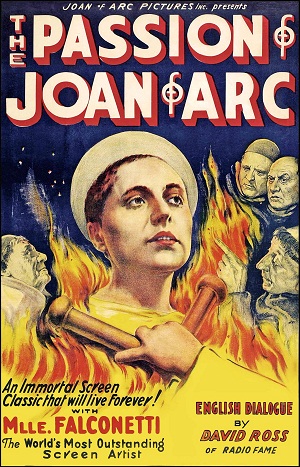
Full download of The Passion of Joan of Arc (1928) directed by Carl Th. Dreyer. Click here to run. This one is SILENT  and over 70 years old, out of copyright in Europe. It's being shown tonight at the Barbican, while Marin Alsop is conducting the LSO in a performance of Richard Einhorn's Voices of Light written in 1999 to accompany the film. If you buy the DVD release you get the movie plus Einhorn.  Personally, I'm inclined towards the silent version. Firstly, silent makes you concentrate on the intensity of the images, almost a spiritual experience, which is what Jeanne is going through in the movie. Secondly, from other Dreyer films, like Vampyr (full download HERE) and Vredens Dag (description HERE) it would seem that Dreyer conceived his movies with minimal sound. Although the Einhorn soundtrack is interesting, it's an add-on and isn't that overwhelming as music.

Joan is played by Renée Jeanne Falconetti, billed as "Mlle. Falconetti" for reasons unknown. She was a stage artiste, so making this film must have been a kind of ordeal, holding a pose for an eternity for the camera, then slowly changing expression so every muscle twitch is recorded. Look at the intense lighting too. At the end of a day's shoot, her eyes might have stopped working and  her brain given her migraines. So maybe Falconetti was a hero, like St Jeanne. For posterity she'll be remembered without makeup, stressed out and her head shorn.

Look at the rest of the cast list. One of the prosecutors is played by Antonin Artaud, theorist of the Theatre of Cruelty. That doesn't mean S&M but the idea that pushing boundaries makes us challenge assumptions. So the connection between Dreyer's intellectual austerity and Artaud's theories goes pretty deep, All the more reason for a silent Passion of Joan of Arc. Sound distracts. Brian Ferneyhough explains his music in terms of Artaud theories. Now, there's a thought - a Brian Ferneyhough soundtrack to The Passion of Joan of Arc. He's good with complex "medieval" polyphony too. You can bet his version wouldn't be anything like Einhorn. I'll be writing more soon on Ingrid Bergman's Joans of Arc, especially her version of the Arthur Honegger Jeanne d'Arc au bucher (Giovanna d'Arco al rogo) directed by her then husband Roberto Rossellini in 1954. When I wrote about the Barbican Jeanne d'Arc, (see HERE) I hadn't seen this film, which is much overshadowed by the famous Bergman Joan of Arc movie made in 1948 by Victor Fleming. The Fleming movie is staightforward Hollywood. The Rosselini film is art. Read about it HERE and come back for more!

Saturday, 5 November 2011

Magnificent Honegger Jeanne d'Arc Barbican

Arthur Honegger's Jeanne d'Arc au Bûcher (Joan of Arc at the Stake) is magnificent. Rarely does an ensemble this size grace the Barbican stage,  but the extravagance was totally justified.  This massive oratorio is amazing, but you can hear why it hasn't been adopted as part of the British choral tradition. It's not because Honegger blames the English for the invasion and Jeanne's death but because it contradicts so many assumptions of what oratorio should be.

Ténèbres, Ténèbres, the London Symphony Chorus intones, but don't expect a solemn Latin Mass. The massed orchestral and choral forces are screaming accusations at the "heretic, sorceress, demon" and then we see Jeanne, (Amira Casar) a small, gamine figure who really does resemble Joan of Arc, her metallic blouse looking like a  shining breastplate. Joan led the defeat of the English at Rheims, and united France under the Dauphin.  But she was just a shepherdess from Domrémy. How could such things be possible?  Joan was a pure spirit, who saw nothing odd about speaking with saints and angels.

Honegger's Jeanne d'Arc is oratorio as psychodrama.  While the trial progresses, Jeanne's mind moves outside the courtroom, back to her youth, her visions and her simple faith in her mission. Signifcantly, Jeanne doesn't sing but speaks, usually unaccompanied.  At times she slips into a kind of Sprechstimme as she dreams about her past. Frère Dominique, her sympathetic confessor, (David Wilson-Johnson) sometimes sing an approximation of plainchant but shifts into speech. The other main roles (Nicolas Dorian and Marc Antoine, playing multiple parts) are taken by actors who can handle unusual demands, such as speaking in "donkey" voices. Otherwise voices come from within the chorus, the crowd of accusers. It's an interesting mix of stylization and naturalism, which fits well with the idea of Jeanne examining her conscience, as she's told to do, even if she doesn't come up with the approved answers. When she says "No", her accusers say "She's saying Yes!". The "Porcus" farce (Paul Nilon) is pretty wry. Despite the grim situation, there's a lot of good humour in this work, which keeps it down to earth. 

Some fascinating musical writing too. As the crowd bay for blood, Jeanne swoons in fear. Perfect moment for ondes Martenot (Cynthia Millar)  to wail above the tumult. Does it suggest supernatural forces good or ill, or does it suggests Jeanne's fear?  A boy alto (Jason Panagiotopoulos) sings a long solo, completely separate from the children's choir, and Jeanne suddenly starts to sing a simple melody when she reverts to reverie.  Honneger employs different rhythms and tempi, which evoke the many cross-currents in the situation, so the orchestra itself seems to be acting as polyphonic chorus. (For more on Honegger's style see my previous posts HERE, HERE and HERE).

Honegger's style in Jeanne d'Arc is almost deliberately cinematic. He cutrs between moods, like a film director cuts between scenes, gradually building up denser images. We hear an approximation of country dance (oddly modern and jazzy, perhaps on purpose), snatches of mock-liturgy. But mostly it's a constant sense of movement between states.  Honneger was an avid cinema goer, closely linked to the French movie world. He wrote the score for Abel Gance's epic Napolean (1927), the most ambitious movie of the time,  a silent which was shown in cinemas with live ochrestra, so he knew the technical demands of writing for film. Almost certainly he would have known Carl Th. Dreyer's The Passion of Joan of Arc (1928) and moved in the same arty circles. Perhaps Jeanne d'Arc (1935) is Honegger's response to the film? It doesn't follow the narrative in the film, and Honegger's Joan is a very different personality, but the idea is intriguing.

Marin Alsop conducted the London Symphony Orchestra, the LSO Chorus, and the New London's Children's Choir. Ten soloists/actors: Amira Casar,  David Wilson-Johnson, Nicolas Dorian, Marc  Antoine, Klara Ek, Katherine Broderick, Kelley O'Connor, Paul Nilon, Jonathan Lemalu and Jason Panagiotopoulos. While the soloists were clear, much of the choral singing was unidiomatic, so even French speakers would have needed surtitles.

No expense spared, for this is a work that needs complete committment. A great pity then that the programme notes were useless. They're cut from something else and pasted into the booklet without context, so there's no actual description of the music or drama, or even an indication of why Arthur Honneger is significant.  Since Jeanne d'Arc au Bûcher is a rarity and so un-English, it deserves a more detailed introduction. Why spend all that money producing a performance when the audience isn't primed to appreciate it?  The focus of the Barbican Joan of Arc weekend seems to be Joan as cultural archetype, symbol of "Women in Leadership", a theme which runs through other events. Many women in leadership are far too busy to get drawn into events like these, but one participant told me they were excellent.  But was Joan of Arc a "woman in leadership"?  She was just following what her voices told her. Today such folk get drugged into silence. As Honegger and his librettist Paul Claudel suggest, when Joan is burnt at the stake, the flames free her from the chains of worldy power games. They're making a parallel with matrydom. "Who lays down their life for others", as it says in the text.

I'll be writing about the film version of Honegger's Joan of Arc by Ingrid Bergman and Roberto Rossellini on Monday. Please come back, as I am doing a series of Joan of Arc (click labels below)

This was one of my top picks for the Barbican 2011-2012 season. For more please read HERE (vocal) and HERE (non vocal).