Showing posts with label Ensemble Correspondances. Show all posts

Thursday, 14 November 2019

A Baroque Christmas Harmonia Mundi - Charpentier Pastorale de Noël

A baroque Christmas from Harmonia Mundi, this year's offering in their acclaimed series. Great value for money - four CDs of music so good that it shouldn't be saved just for Christmas.  Bach's immortal Christmas Oratorio BWV 248 with René Jacobs,  and seasonal works by Corelli, Buxtehude,  Schütz, Rosenmüller and others.  The prize here, though is the Pastorale de Noël by Marc-Antoine Charpentier with Ensemble Correspondances, with Sébastien Daucé, highly acclaimed on its first release just  a few years ago. Daucé and Ensemble Correspondances are among the finest of many very specialists in French baroque. Please read here about their Le Concert Royale de la Nuit, their recreation of the extravaganza with which Louis XIV dazzled his Court. They have also focussed on Charpentier and in particular the Histoires sacrées (Please read more here), which have roots both in sacred oratorio and in the mystery plays of the Middle Ages.  Their performances are outstanding : paragons of the art, presented with stylish flourish. This set is worth purchasing for this superlative Charpentier. 
 
Charpentier's patron was Marie de Lorraine, Duchesse de Guise, an independent woman whose tastes were freer and more informal than those at the royal Court.  In the Pastorale sur la Naissance de Notre Seigneur Jésus-Christ, H. 483, Charpentier adapts the pastoral style into a work of piety, somewhat unusual at the time. Between 1684 and 1686 he created three versions, with different second parts, all of which are recorded together for the first time on this disc.

"The first part of the pastorale is imbued with solemnity", writes Daucé. "The protagonists evoke the condition of humanity, permeated by sin, violence, darkness and death, and, in this state of extreme wretchedness, call for a divine sign bringing light, peace, justice and redemption.". The exquisite balance of voices in the ensembles suggests rapture, and the restrained power of the soloist in "Ecoutez-moi, peuple fidele" suggests emotional authority. Charpentier's instrumental writing is equally meticulous, marking the "contrast between the tenuousness of the recitative and the plenitude of the chorus, and above all of the device of silence".  The instrumental interlude that is the "Simphonie de la Nuit" marks in many ways the spiritual core of the first of the two parts of this Pastorale. A sublime "Paix en terre" completes the first half : voices and instruments in glorious harmony.

The second part of H.483 is a series of vignettes illustrating the Nativity scene.  Particularly attractive is the section "Cette nuit d'une vierge aussis pure que belle", the countertenor line lambent and clear, haloed by female voices. All three second parts follow the same pattern but each section within is different. In version H.483a,"We encounter the naïve and folklike elements which the first part of the work had completely avoided", writes Daucé. "Here the musical gesture draws on the same popular imagery with which painters and designers have always depicted the Nativity scene."  Especially imporessive is "Heureux bergers" for tenor with ensemble. This version ends joyously, voices accompanied by pipes, strings and percussion. "Faisons de nos joyeux cantiques", "Menuet de la Bergère" and " Ne laissons point sans louanges".  There are just four sections in the second part of version H.483b. "Le Soleil recommence à dorer nos montagnes" is contemplative, introducing a more reverential character.  The infant Jesus is addressed as  "Ouy Siegneur" framing the last section which is along as the first three sections put togerther, for it celebrates the "Source de lumière et de grâce".
Also included on the Ensemble Correspondances disc is Charpentiers' Grands antiennes de O de l'avent, (1693) ten anthems, each beginning with the word "O" on the veneration of Advent.

The best -known piece on this set will be Bach's Christmas Oratorio (Weihnachts-Oratorium) BWV 248  with René Jacobs conducting the RIAS Kammerchor and Akademie für Alte Musik  with soloists Dorothea Röschmann, Andreas Scholl, Werner Güra and Klaus Häger, all then at their prime. Recorded in 1997, this performance evokes the spirit of early 18th century Lutheran piety.  In modern times, we're overwhelmed by commercialized Christmas kitsch and consumerist excess, and the banality of the seasonal music that comes with it.  All the more reason then to turn to performances like this which reflect the real values of Christmas, and the promise of hope in dark times.  Strong stuff, but necessary.  The fourth disc on this set is a collection of pieces by Corelli (Concerto Grosso), Johann Rosenmüller, Buxtehude, Heinrich Schütz (Heute ist Christus geboren, Concerto Vocale/René Jacobs), Louis-Claude Daquin, Domenico Zipoli, and Claude Bénigne Balbastre from performances recorded between 1976 and 2004.

Sunday, 20 May 2018

Dazzling Le Concert Royal de la Nuit - London Baroque Festival


Le Concert Royal de la Nuit with Ensemble Correspondances led by Sébastien Daucé, the glorious culmination of the finest London Festival of the Baroque in years on the theme "Treasures of the Grand Siècle". Le Concert Royal de la Nuit was Louis XIV's announcement that he would be "Roi du Soleil", a ruler whose magnificence would transform France, and the world, in a new age of splendour.  It was a statement so extravagant that it stunned the unruly Court into submission. As an artistic manifesto, it set out visions of what music, theatre, visual arts  and dance might achieve. From Le Concert Royal de la Nuit, we can trace the origins of the arts as we know them today, not only in France, but in European culture as whole, with implications so wide that they are still felt today.  Sébastien Daucé and Ensemble Correpondances made an acclaimed recording a few years back,  and have been performing it in semi-staged productions, with dancers. No wonder St John's Smith Square was almost sold out ! 

The original Concert Royal de la Nuit ran over 13 hours,from dusk to dawn, though there were breaks for feasting and rest.  For practical purposes, this version comes in four Veilles (Watches) and 67 individual parts, ending with a Grand Ballet, running around 2 1/2 hours. But what variety ! There are pieces for different groupings from soloist with orchestra to full ensemble, scenes of high drama and moments of quiet contemplation, marking the transition from night to day.   At the beginning, the beating of a single drum, a reminder that the pulse of music is rhythm, and that life itself marches to a rhythm that is greater than any individual.  Despite the glories that are to come,  pastoralism - and war - are never far away.  As King, Louis XIV represented idealized virtues of manliness and refinement, strength and benevolence.  The dances at court were structured displays,  and dance itself a form of physical fitness and mental discipline.  This idea of orderly logic would flow through to design, philosophy, and much more.

But Nature remains present. Like the gardens which Louis XIV would layout at Versailles, nature is contained in defined formal patterns, but in the woods surrounding, nature runs free. A hibou calls (a small archaic pipe) marking the descent into night.  "Languissante clarté", the first Récit, in which The Night reveals herself, a showpiece for Lucile Richardot, who projected the long, flowing legato so it seemed to fill the hall like moonlight. Behind her, murmuring low strings, sussurating like creatures of the night.Richardot   has amazing timbre and range, her voice so expressive that she can "act" with her voice, though here she uses hand gestures reminiscent of those used in drawings of the original performance, an inportant consideration given that Le concert royal was meant to unify visual and aural art.  This was followed by pieces marking the passing of "Hours" (soprano and small groups) and vignettes depicting huntsmen, gypsies and peasants, all well characterized.

The shades of darkness descend in the second Veille, and Venus appears, risen fully formed from the sea. This is a pointed reference to Louis XIV, taking command at the age of 14, throwing off the authority of Cardinals and courtiers. Though the Three Graces sang the praises of Venus, the connections must have been obvious.  Thus choruses of Italians and Spaniards (rivals of the French) praise "unvanquished France", united behind the leadership of  Louis "Le plus Grand des Monarques", as Venus herself declared.  If the Moon symbolizes purity, Hercules symbolizes manly heroism.  The Third Veille is a panorama where countertenor, bass, and male and female voices interact with orchestral interludes, replete with dramatic sound effects (instruments suggesting wind and thunder). The contrast between countertenor and bass  was particularly vivid, performed here with great brio, the orchestra equally animated.  Greek Gods, witches and figures from Antiquity emerge but the real subject is clearly Louis the King. Venus and Juno have extended récits which acknowledge opposition but posit that a strong, benevolent ruler can triumph. The "love" here means love for an absolute King. Also extremely effective, the trio of male voices in the Chorus of Brooks and Breezes,  "Dormi, dormi, o Sonno, dormi".  The last Veille describes Orpheus's entry into the Underworld.  Hero as he is, he cannot defy the laws of Life and Death. Night symbolizes sleep, dreams and submission, to Fate, Time and Nature. Then Apollo appears, promising the retun of "mio figlio", the sun and Spring.

This set the context for the Grand Ballet, where Louis XIV himself appeared,  garbed in golden splendour as the Sun, his headress emanating rays of light."Depuis que j'ouvre l'Orient" the récit of Aurore - beautifully sung and phrased by tenor, "jamais si pompeuse et si fiere......Le Soleil qui me suit c'est le jeune LOUIS". The Chorus, representing the Planets hail the king. Now the orchestra burst forth with full enegy, percussion announcing the triumphal procession of the King into centre stage. The rhythmic energy of these orchestral interludes suggests that Louis XIV was an accomplished athlete - nothing wimpy about that dancing. Hercules and Beauty (baritone and soprano) united to sing of "Altro gallico Alcide orso d'affecto". Cosmic forces indeed! Glorious final chorus, "All'impero d'Amore hi non cederà, S'à lui cede il valore d'ogni deità". The effect must have dazzled the Court of Louis XIV, blinding them into silence. Le Concert Royal de la Nuit marks the start of music, theatre, dance and opera as we know them now, but also marked a turning point in French history.  Ensemble Correspondances have been performing Le Concert Royal  de la Nuit in staged performance, complete with dancers, in recent years (premiering in Caen), so let's hope a miracle happens and we might get to see it in London.  (William Christie and Les Arts Florissants have done a shortened unstaged version but with dancers). Until, then, give thanks and praise to Saint John's Smith Square and above all to the London Festival, of Baroque Music who had the courage to sponsor this remarkable series.  Support their committment and dedication !
Please also see:Painterly Charpentier : Histoires Sacrées 
Ensemble Correspondances Perpetual Night - Early English Baroque 

 Le Poème Harmonique - Lalande Motets - Majesté
Why we ALL Need to save St John's Smith Square  

Friday, 18 May 2018

Painterly Charpentier Histoires sacrées : London Festival of the Baroque

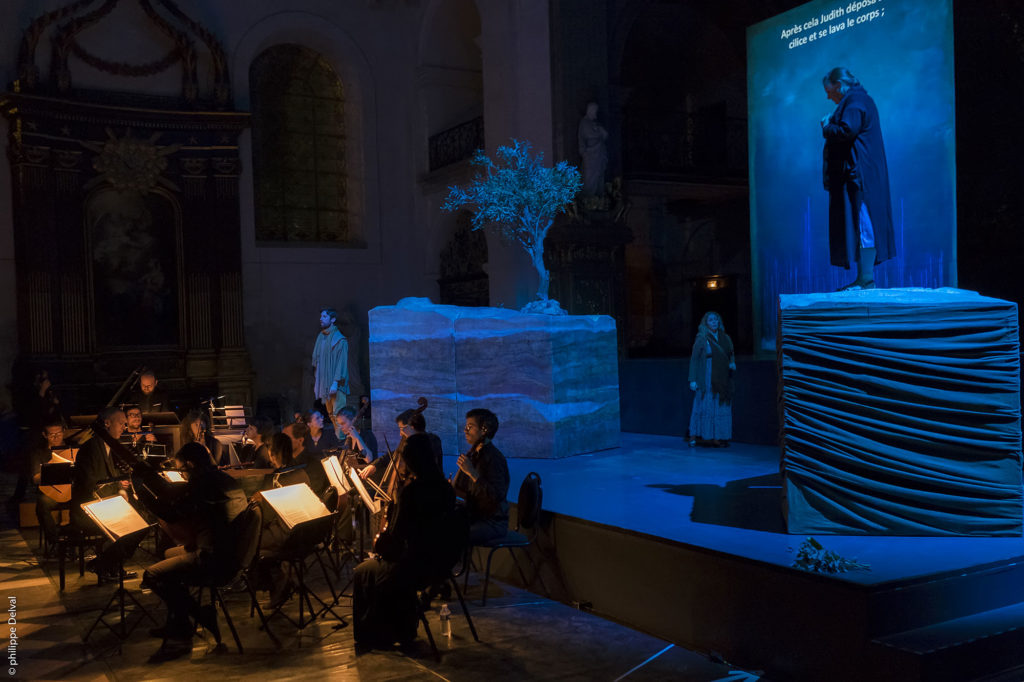
photo: Philippe Delval
Marc-Antoine Charpentier Histoires sacrées with Ensemble Correspondances, conducted by Sébastien Daucé,  at St John's Smith Square, part of the London Festival of the Baroque 2018.  This striking staging, by Vincent Huguet, brought out its austere glory: every bit a treasure of the Grand Siècle, though this grandeur was dedicated not to Sun God but to God.  Religion as theatre : and why not ?  Like the architecture and ornamentation in baroque churches,  devotional art served faith.  Although St John's Smith Square was built in the less florid Northern Baroque style,  Huguet's production transformed it, so it glowed.  It felt as if we had stepped into a painting by Caravaggio or Velázquez.
Charpentier's Histoires sacrées has its roots both in sacred oratorio and in the mystery plays of the Middle Ages. Charpentier's audiences were well versed in biblical and liturgical texts, so they could appreciate these "stories" told with sophistication.  At the heart of this programme were three histoires - Judith ou Béthulie libérée H.391, Madeleine en larmes H.343 and Cécile Vierge et Martyre H.397, framed by Ô Sacrement de Piété H.274 as prelude, Au parfum de tes onguents H.510 as interlude, and Sous l’abri de ta miséricorde H.28 as postlude. This formal structure connects the three central characters, each of them a strong woman : Judith  kills the Assyrian Holofernes who persecutes the Hebrews,  Magdalena sings of her love for Christ and St Cecilia is martyred because she will not renounce her faith.  Their stories are told through dramatic recitative, interspersed with choral and instrumental commentary and spoken narrative.  While Judith's story is the most developed, with many sections and variations, the others have individual character.  Magdalena's relatively short song is introduced by the vocal interlude, which mentions "scented oils", thus enhancing, figuratively, her odour of sanctity.  The section about St Cecilia is bright and defiant, like the flames which devour the saint’s body, but not her soul. Towards the conclusion, the harpsichord, breaking from continuo, sings in joyous cadenza.  
Although the text was in Latin, the stories themselves aren't hard to follow, and the work as a whole is propelled by vibrant musical logic, flowing freely from superb performances by the whole Ensemble Correspondances team.  Modern performances of Charpentier's Histoires sacrées were pioneered some years ago by Gérard Lesni and Il Seminario Musicale but there is still much more in this rich vein to be discovered.  Sébastien Daucé and Ensemble Correspondances present these three histoires with flair, enhanced immeasurably by Vincent Huguet's production. Huguet, who worked with Patrice Chéreau, understands the innate human drama in these narratives, though they may be expressed in stylized form.  Large objects that resemble rockfaces, such as we see in 17th century depictions of biblical scenes, including symbolic olive trees.  The idea that painting, or art, should be "realistic" is actually quite recent, and didn't apply in Charpentier's time.  The simplicity of the sets also means that they can be moved quickly and quietly, without interrupting the flow of  performance.  Colours are added by lighting effects.  Thoughtfully, the designers made use of the configuration of the building itself,  using one of the high windows behind the stage to let light shine in "from above" as so often happens in devotional painting.  As daylight faded to night, nature itself became part of the narrative.  The singer's movements also reflected those in religious painting - hands raised and pointed, directing attention away from the singers as themselves to the stories being told.  Altogether a remarkable experience.  How fortunate we were that  Sébastien Daucé  has brought top quality, cutting edge performance practice to London.  
Please also see:

Le concert royale de la nuit : Ensemble Correspondances, London Baroque Festival
Ensemble Correspondances Perpetual Night - Early English Baroque 


 Le Poeme Harmonique - Lalande Motets - Majesté

Why we ALL Need to save St John's Smith Square