Showing posts with label puppets and circus. Show all posts

Wednesday, 12 March 2014

Handel Rinaldo Baroque Puppets


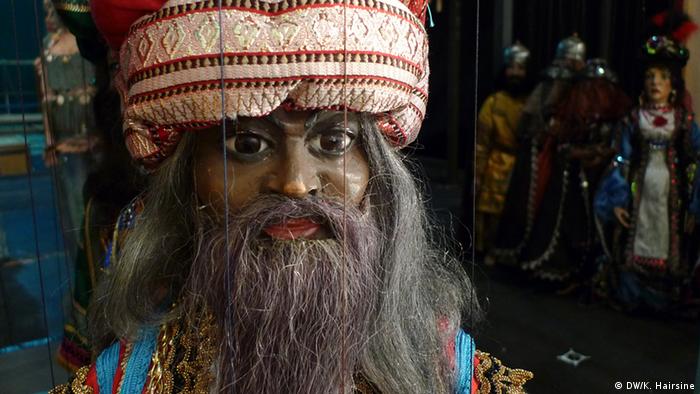
Tickets are now on sale for Glyndebourne's Handel Rinaldo, (read my review here)  But at the Baden  State Theatre in Karlsruhe, a really special Rinaldo staged with puppets! In Baroque times, puppetry was a respected art form.  Baroque marionettes sprang from much older traditions that hark back to medieval street and religious theatre. Wood carving craftmanship, still very significant in many parts of Europe, adapted well to the elaborate Baroque taste for fantasy and extravagance. Kings might experience Baroque spectacles on a grand scale. Through marionette theatres, humbler audiences could enjoy things on a more miniature scale. Puppets aren't real but they're magical, and fun.

This new Rinaldo  has been created by Carlo Colla & Figli is a world-renowned Italian puppet company that has been staging performances of classical tales and plays for more than 200 years. Have a look at their website for photos of their productions and also of their workshops. Puppeteer Paiero Corbella told Deutsche Welle about the painstaking craftmanship behind the tradition. "While the secondary characters have only six strings, the main characters in the production have up to 25 strings. That way, explains Corbella, they can carry out complicated movements such as placing their hand on their brow in a tragic gesture or moving their mouths to mimic the singing. Having this range of movement is important in order to capture the historical traditions of Baroque theater, which is based on stylized, emotional gestures".

This Rinaldo is being performed with the Lautten Compagney, whose conductor Wolfgang Katschner says  "We are combining historical music with a special kind of historical theater - which results in something very magical and beautiful, The marionettes act out the libretto [the opera text] in a very naive, simple manner to magical effect." Read more here.

Lots more on puppets and their use in opera on this site, follow the label "Puppets and circus" on the right

Thursday, 6 February 2014

A Dog's Heart - Lyons

"If satire is your thing you will not want to miss this opera about human testicles grafted onto a dog."

writes  Michael Milenski in Opera Today about Coeur d'un Chien, or A Dog's Heart in Lyon.

"Raskatov made vulgar music (snorts and farts) and he made music vulgar incorporating liturgical hymns and famous old folk songs into the musical flow of his sensational text (the last line of the first act, shouted by the dog transformed into Communism's “new man” is “get fucked!” in the libretto, and “lick my dick” in the supertitles). The composer recognizes that contemporary ears are accustomed to an infinity of musical and random sounds thus he has no compunction in raiding Monteverdi’s recitative, using extreme voices (shrieking higher-than-you-can-imagine sopranos) or making hoarse, coarse sounds through megaphones (the opera ends with sixteen players shouting vowels through megaphones into the faces of the audience. Underlying all this is Raskatov’s basic musical language heard from time to time which seemed to be more or less Webernesquely minimal."

HERE is what I wrote when A Dog's Heart ran at the ENO London in 2010

Tuesday, 24 December 2013

Weimar animation - The Star of Bethlehem

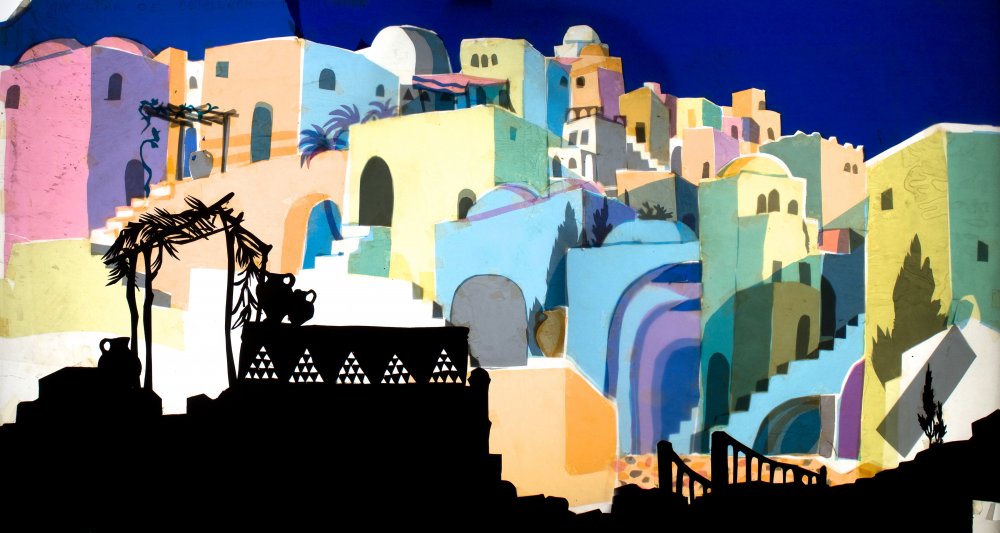
Strikingly modern image - but it's from 1921  It comes from Lotte Reiniger's film The Star of Bethlehem originally made in Germany but best known in the version below, produced in 1953, using the Glyndebourne chorus,  though they aren't listed in the credits. In the early days of film, artists were experimenting with many new techniques, from short stop animations (Meliés, Segundo do Chomo ) to posed shots of insects (Wladyslaw Starewicz), light shows (Walther Ruttmann) and sophisticated fantasy (René Clair) so it was perhaps natural that Reiniger, who worked in avant garde film circles, should turn to the German art of Scherenschnitte which had thrived in the 18th and 19th century, before photography took hold.

Silhouettes and puppets bridge folk art and sophisticated commercial performance. As a child, Goethe had an elaborate toy theatre where he acted out dramas of his own creation.  Silhouettes, puppets and street theatre have roots not only in German culture but also in Turkish, Chinese and Indonesian Wayang. Thus Reiniger's use of Scherenschnitte fuses tradition and modernity, folk tradition and high tech art. .

Lotte Reiniger's Scherenschitte are beautifully executed - look at the lace tracery on the angel's wings - but she adapts the form so the figures move, and can be posed like puppets, and animated for film.  The figures are black, so you see only the outlines: you fill in the magic with your imagination. Early 20th century audiences would have connected the images in this film with silhouettes they'd known from their own childhoods and responded to the magic of memory. Twenty-first century audiences, bombarded with a multiplicity of styles, would do well to ponder the simplicity of Reiniger's art, which uses naive form in a highly sophisticated, non-naive way to recreate a sense of mystery and wonder.

Reiniger and her husband, Carl Koch, were both closely involved with Weimar left wing circles. In 1933, they left Grermany, settling first in France, reaching England in 1949. Reiniger left her archive to the British Film Institute which has released a 2 DVD set of her fairy films. Read more here about how they've been restoring the original The Star of Bethlehem, painstakingly removing the desiccated cellotape that held the cardboard joints in place while filming took place. They are also replacing the long sequence of flying devils which were "considered so scary that they were cut from the American release". Some things, alas, don't change. From the stills in the article quoted above, those demons seem a crucial part of the whole. So perhaps the version below will be replaced by something less sanitized. Also recommended, a documentary made about Reiniger in1970, which is well worth the rental price of £1.

Thursday, 21 November 2013

ENO Satyagraha - puppets with purpose

Why is the ENO Philip Glass Satyagraha in Sanskrit? Why are the intertitles in turgid Victorian prose? What's the point of an opera where words have no meaning? But that's exactly the point Philip Glass is making. Words, in themselves, have no meaning.  What really matters is communication. In his early life, Gandhi wrote in newspapers, endlessly churning out words that had no impact. Once he dropped verbiage for direct action, he changed the world. When he swapped his three-piece suit for a dhoti, he made a statement. Material things and the power structures that rest on them are meaningless. What matters is purity of spirit. The juggernaut of Empire was felled by humble peasants and non-violence.

Philip Glass's music is maddeningly repetitive but once you stop trying to make sense of it, it kicks in. Many cultures employ repetitive chant because it works. Self consciousness and self awareness contradict each other..Chant keeps the body occupied so the soul can run free. Freedom, though, is  a dangerous concept, which is why many resist it, preferring the certainity of social constructs. Loosen up, guys!   Read what I wrote here about Bianca Jagger being sharper than "clever" folk . As has been said by persons wiser than us, it's harder for a rich man to enter heaven. Glass's structure connects to the epic saga of the Mahabharata but you don't need to know that in detail. Millions have got the ancient story without mastering the literature. Perhaps it's best to approach Satyagraha in the same way. Listen past the language of text and music, not to it, and relax.

 Puppets abound throughout this brilliantly theatrical staging by Improbable, Phelim McDermot's innovative company. Puppets are representations, not reality : inaminate objects that don't exist until manipulated by others. The turgid intertitles are claptrap designed to confuse readers. Just like puppets, we should be able to see through them.  Arjuna and his foes from the Mahabarata loom like ghosts in the first act. Giant grotesques loom over Gandhi and his colleagues. But they're just paper. Later the puppeteers dispense with puppets altogether, walking across the stage with strips of transparent tape, gradually creating cats cradles. The sticky filaments could tie them down and choke them, but from the maze they create a vaguely humanoid monster that rises upwards. Once it's served its purpose a puppeteer crushes it, and it becomes, once again, a worthless mess. What a metaphor for the way we are manipulated by the media and by society!

At one point, the chorus sits stretched across the stage, singing hahahahahahaha. They're reading newspapers, expecting the "natives" to wipe their boots, As an image of power, it's very effective. But the joke is on the rich, not the poor. Gandhi showed that humble people don't need to play games. During his lifetime, he knew Tolstoy and Tagore. He inspired Martin Luther King, whom we see in the final act. Gandhi and King were assassinated. Perhaps they were threatening because they represented an alternative to traditional power structures.  As the actor playing King addresses the heavens, Gandhi (Alan Oke) sings a surprisingly beautiful series of songs.  We don't know what he's saying, but he conveys more complex meanings through abstract sound and nuance than words might articulate. Should we shoot Satyagraha down because we don't like its implications?

 Alan Oke has grown into the role over the years. Although there aren't great florid technical displays in this music, it isn't easy to sing. Miss one bar and it falls out of synch. The purity of Oke's voice is ideal for the part, and now, with experience, he imbues his singing with intuitive confidence and dignity. He might be too tall and too pink to be a facsimile of Gandhi, but he creates the idealized personality in the opera. An "athlete of the spirit", whatever that might mean. His avatars, Arjuna (Eddie Wade) and Krishna (Nicholas Masters) are very good, bringing individual character to the roles. Wade's cockinesss is particularly well thought through.

The ENO chorus are in excellent form, so well drilled by chorus master Philip White in Glass's strange cadences that they make the music seem oddly natural. Stuart Stratford conducted: an act of concentration above and beyond the call of duty. Miss one bar or repeat and the whole opera goes awry. To my surprise, I was humming the "tunes" all the way home. Clare Eggington sang Miss Schlesen, Janis Kelly Mrs Naidoo ,with Stephanie Marshall, Nicholas Folwell and Sarah Pring in other roles. I don't know if I could cope with Satyagraha audio-only but live it works, thanks tp  Phelim McDermot, Peter Relton and the Improbable troupe of multi taskers.  Perhaps Glass might have jazzed things up in waltz time, but Improbable and Alan Oke make Satyagraha worthwhile as theatre.

Plenty more on this site about Philip Glass who can be very good (In the Penal Colony) or not as the case might be (The Perfect American) 

photos : Alastair Muir, courtesy ENO

Monday, 7 May 2012

ENO Madam Butterfly - preview, analysis

It's almost exactly seven years since the Anthony Minghella production of Puccini Madam Butterfly premiered at the Coliseum, London for the ENO. Minghella himself has passed on, but this time round the principals are the same. Mary Plazas sings Cio Cio San, Gwyn Hughes Jones sings Pinkerton and thge Puppets of the Blind Summit Theatre will be doing their thing. I caught the production first time round, the first night of the first run.

Madam Butterfly is perhaps even more relevant in our Global Village where cultures and races mix more fluidly than ever before. Minghella’s vision pits Puccini's gloriously Italianate score with the stylization of Japanese theatre. A woman dances with the black clothed figures of the men who manipulate Bunraku puppets. Gradually they tear her obi and it unravels like a river of blood. It’s a great image: woman as puppet, controlled by men. Its violence also hints at the tragedy to come. Bunraku may have a history of love suicide dramas but that’s lost on the average western audience. Fundamentally, Madam Butterfly isn't about Japan at all.

So the "neon Shanghai Tang" colours (as I called them then) of the production are there to entertain. They impart an exotic glow, so the real meaning of the plot is disguised.  Beneath the sentimental cherry blossoms and images of women as dolls, Madam Butterfly is a shockingly brutal story. Pinkerton's a sex tourist, exploiting the power he has to screw a little girl (in every sense of the word). Absolutely to Puccini's credit that he saw through the colonialist values of his time. He had no illusions about the superiority of western culture or Christianity.  Pinkerton is a weak man, supported by gunboats and consuls.  Indeed, it's an anomaly that Madam Butterfly was set in Japan at all, since Japan and Thailand were the only countries in Asia to remain independent and not become colonies. All over Asia and Africa, local populations became second-class citizens in their own countries. As Puccini implies, imperialism does not equate with civilization.

Until westerners stop seeing Madam Butterfly as a portrait of Japan, they're not going to deal with the real issues, which are only too relevant today. While it's no longer acceptable to sneer at blacks, Jews, women or gays, Asians (yellow, brown or olive) are fair game. Unconscious racism exists, and sadly among people who should know better. Perhaps it's ignorance, or fear, but it won't be eliminated until people stop making assumptions, and allow that just maybe, Asians know what they're doing, and western mores don't always apply.

Nagasaki, where Madam Butterfly is set, was an "international" port from the 16th century, where western influences reached Japan and from which Japanese esxports reached Europe. It's interesting that Puccini shows that Cio Cio San isn't merely a passive plaything. Long before Pinkerton arrives, she's already aware of the west and swallows the myth of western superiority since she thinks that through Pinkerton she'll get a new life. When she realizes her dreams were delusion, she kills herself. Anyone who has seen Japanese horror movies Takashi Miike’s Audition or Hideo Nakata’s Ring will be familiar with the idea of traumatized young women who are quite capable of hiding ferocity under a demure mask. Cio Cio San fights back, though she ends up hurting herself. You could read 20th century Asian history as a response to colonialism. Certiainly, Japanese modernization inspired other countries in Asia, many Asian leaders studying the Japanese model. Ironically, the Japanese succeeded in ridding Asia of colonialism, though not quite in the way they intended. (the photo show Tamaki Miura, a Jaoanese singer in a Japanese production of Madam Butterfly in 1922)

What troubles me about this production is the portrayal of the child Sorrow. He's shown as a puppet with a skull for a head. These days child protection laws work against having real children in  roles like this, late at night. Hence puppet. But is Minghella telling us that the child is just another puppet in a wider game? In the opera, his role is to be the innocent, loving being who inspires love from everyone, even in Mrs Pinkerton. So why should he be portrayed as an ugly miscreant? Are mixed race people somehow not human? (click on photo to enlarge).

Conversely, Minghella confirms how important this non-speaking part is to the whole story. What is to happen to this boy, taken from his environment and raised in a monocultural society where he'll always be an outsider? Given US racism towards Asians well into our generation, there would not have been a happy ending. All over Asia and Africa, there were huge mixed race communities, bridging cultures. Thousands of real life Madam Butterflys and certainly not all products of prostitution. Ironically, Japan was one of the few places where there weren't big mixed race communities. Nowadays there are lots of first generation mixed marriages, and also lots of Asians growing up in non-Asian environments. It may be fashionable to think that heritage doesn't matter, but I'm not so sure. So enjoy Madam Butterfly at the ENO and think about the wider context.
LOTS on this site about Nagasaki, Japanese and Chinese culture, Chinese stereotypes, modern Asia, cross culture, Puccini and Madam Butterfly. Please use search labels.


Monday, 10 January 2011

Bangkok Butterfly - NOT a review but

Everyone's been reviewing the new Madam Butterfly set in Bangkok where Cio-Cio San is a ladyboy. I won't, because reviews are irrelevant. Much more interesting is the very phenomenom of small  scale pub opera. OperaUpClose is part of the completely alternative scene where conventional opera values don't count. So instead of churning out yet another "review", I'll ponder what this means.

Pub theatre has been happening forever - even before Brecht (who himself was reviving an old Munich genre). Like pub music, it's direct and unadorned. Usually it's pretty awful, but there's nothing like a bored, drunk audience for a reality check. Cliques exist, but not crowds of fawning luvvies massaging each other's egos and eyeing an MBE.

What pub opera means is that people who love opera - and the making of opera - have a chance to get out there and do what they love. Performers need to perform like fish need water and birds need air. It's not so much how "good" they are but how their enthusiasm communicates. The very act of performance helps performers grow and learn. Most of the people involved in OperaUpClose  have to juggle their lives round so they can take part. But they do it because they care. That kind of committment I respect.

What OperaUpClose offers is a much grittier, experimental experience. Puccini's been adapted with a new, minimal orchestration (Danyal Dhondy) for piano, viola and oboe.  No room for luscious wallowing, but what's left counts. The viola screams tension as Butterfly begins to realize she's been dumped. One player (Dhondy himself) but he has to be effective, and is. The melodies are less prominent, but this is hardly a drama about feelgood harmony.

The back room at The King's Head, Islington, sits less than 100, and the new text is in English. Diction wasn't a problem, but there were many in the audience following the libretto in the programme. Another thing about small scale opera. It reaches audiences who know nothing about opera at all. Personally I'd prefer a synopsis rather than libretto, so people listen and engage to the basic drama. The rest will follow.

Because pub opera is so low budget, the mind is concentrated on essentials. Instead, think things through from scratch. What's the opera about? How does it work, dramatically and musically? How can we use what resources we have in the best way?

Puccini's idea that geisha were bought like furnishings was more fantasy than reality. The Bangkok sex trade is only too real and destructive. Adam Spreadbury-Maher and his team of designers and producers have thought about the dynamics of exploitation. The transvestite angle is good. Making Butterfly a man emphasizes the delusional aspects of her personality. Even Puccini acknowledged that Butterfly was an obsessive who though the world should go her way. Ladyboys don't get that way by accident. This one (Laura Casey, Margaret Cooper, Mariya Krywaniuk) has a "history". Pinkerton's just the last straw. The idea fails, though, to make much sense of the rationale for the adoption, on which the denouement pivots. OTOH, Puccini wasn't realistic either - no way would an American  couple bring back a non-white child in 1904. Not fair on the kid, either. A male Butterfly also makes Pinkerton (Stephen Anthony Brown, Mario Sofronio, Randy Nichol) even creepier. What does he really want the child for? Making him a pilot's a mistake - pilots don't stay away long and would get fired if their employers found out. Is London ready for Gary Glitter as Pinkerton? That would really be shocking, but apt.

Even if you pay £300 at the Royal Opera House, you might not get perfection. In any case, what you get connects to what you put in yourself. Notice how many people are involved. Three sets of primaries, lots of understudies as cover. Everyone chips in, multitasking. It's a co-operative learning process.  Some of the singers had to learn a new skill - puppetry! This puppet's much simpler than Complicite's dog in A Dog's Heart but his hands are real hands. The singers aren't singing, but they're acting with their hands. It's moving, in every sense. That's why I enjoyed OperaUpClose. It's a continuing process of learning and developing. And that involves the audience too.

The production runs until 23 January.

Sunday, 21 November 2010

ENO A Dog's Heart - Review

In this era of safe, timid opera, A Dog's Heart at the ENO might just be the tonic to liven things up. It's guaranteed to provoke extreme reactions. From Complicite and Simon McBurney, we couldn't expect anything less.

Mikhail Bulgakov's novel  The Heart of a Dog disturbed the Soviet authorities so much  they banned it for 60 years  The plot's seditious. Professor Preobrazhensky (Steven Page) is an eminent surgeon who adopts an abused mongrel from the street. The professor's apartment is a haven in a world that's disintegrating all round.  Everyone is scavenging to survive. Dog eat Dog, "Something's not right here" thinks the dog, hardly believing his luck. The Professor rejuvenates his patients by transplanting animal organs into them. Now, he wants to create a New Man from a dog.  Dog made Man becomes Poligraph Poligrafovich Sharikov (Peter Hoare) a beast, slovenly, venal and brutal. (Please read a more detailed synopsis HERE)

With a plot as surreal as this, don't expect conventional opera or theatre. All art is an expression of how an artist responds to something. We're there to listen to someone's point of view, however outrageous. A Dog's Heart is a new opera, yet we can still come to it carrying baggage about what things "ought" to be, Yet the whole plot plays with the idea of species, genre and gender bending.

For a start it wasn't written in the usual way. Alexander Raskatov, the composer, worked with Simon McBurney and Complicite from the start so music, text and action are symbiotic. Raskatov's music isn't demanding so have no fears on this score. Its bark is worse than its bite. The presence of several big name composers in the audience is no indication of Raskatov's status in the avant garde. He's best known for completing Alfred Schnittke's Ninth Symphony. What he does do well is link music to text.


Because Sharik/Sharikov is an unstable chimera. so too is his music, constantly wavering in pitch  and volume, the vocal line unnaturally distorted. He's unnatural, after all, at any moment threatening to change form. He has two voices, one ostensibly "pleasant" (countertenor Andrew Watts) and one   "unpleasant" (soprano Elena Vassilieva, a "dramatic soprano"). On film, Sharik/Sharikov isn't hard to create but live theatre presents  unique challenges. No actor could shape shift that quickly or effectively. Hence the puppet dog, created by Blind Summit the cutting edge puppet company. Like Sharik, the puppet is manipulated into different forms, constantly changing. At one stage one puppet version is discarded for another. But realism is hardly relevant here,

Singers double in different parts. It's disconcerting as you recognize a voice but can't recognize the persona. But that's the story. Characters come and go, adding to the sense of instability, throwing the idea of narrative askew. Unless you know the plot already, it's confusing. But in real life, none of us really know the plot, either.

What this production misses is the strong political context of the original. Shvonder (Alasdair Elliott) and his agitators are reduced to ciphers. In theory that's valid because the basic drama is the Professor's Faustian misuse of knowledge, but the revolutionaries, grubby as they are, add dramatic tension. On the other hand, if the production were more overtly political, the pervading surrealism would be lost. What McBurney and Complicite emphasize instead is the fundamental idea of existential instability. They create the Professor not as a loner but as a representative of another mass, not as grubby as the proletariat, but no less certain of their Rights. The scene where the Professor explains himself to his peers (see photo) is very well done - this mob have white coats but they're also barking demented.

Similarly, McBurney downplays the incident where Sharikov unplugs the tap in the toilet and floods the apartment.  It's a powerful metaphor, but difficult to stage. Here, it's a weakness that adds nothing to the drama. Perhaps it should have been left out altogether, like some of the  minor incidents, like the Professor''s patients. Interesting as they are they aren't central to the drama. McBurney does, however, extend other elements in the plot in subtle ways. Dr Bormenthal (Leigh Melrose)  is seen meticulously typing up his reports, oblivious to the basic madness of their subject. Sitting at his desk, he's propelled across the stage from side to side the way old fashioned typewriters leap when you press return. Maybe that's lost on audiences brought up on PCs, but it's a good idea: Man as Machine, like Dog as Man. Similarly, Zina the Maid (Nancy Allen Lundy) becomes a big part. She shrieks, leaps and jitters. Woman as Puppy, just as disruptive as Sharikov the dog, which is perhaps why he tries to mate with her. On a deeper level, Zina is the "new woman" that appears in the novel, a hybrid that threatens the oligarchy the Professor and his peers maintain. Or isd she a comment on shallow modern society,? (Excellent performance despite the part being mad).

ENO's A Dog's Heart has its flaws, but its energy is a purgative for stodge. The anarchy of A Dog's Heart is an antidote. This is what ENO does best, shaking up complacency, freeing new ideas. A Dog's Heart is by no means Great Art but it's irreverent and fun, and better than much else on offer.

Photos Copyright : Stephen Cummiskey, courtesy ENO, details embedded.
Please read my other posts on A Dog's Heart the Movie and A Dog's Heart Preview

Friday, 19 November 2010

A Dog's Heart - the movie

Brand-new opera A Dog's Heart starts at the ENO on 20th. Please see my preview HERE. The opera is based on a novel by Mikhail Bulgakov, written only 8 years after the Russian Revolution. It was a time of surprising liberality because the new order didn't, as yet, clamp down on new ideas in society, literature, film, etc. Nonetheless Bulgakov's The Heart of A Dog was so seditious it went underground until officially unbanned in 1987. Perhaps it says something about the Soviet Union that the novel was filmed the very next year for Lenfilms, Moscow, directed by Vladimir Bortko.

Atmospherically shot in sepia, like an antique print, it grounds the drama in 1925, discreetly bypassing the universal relevance. It's a good starting point though, because so much of the film depends on understanding the background. A snow-covered street, shot from ground level. Gradually voice emerges - the thoughts of the dog, which is why the shots are dog-level. Everyone's scavenging in these desperate times, "dog eat dog" you could quip.

Professor Preobrazhensky is an eminent surgeon, who lives in an old Tsarist mansion, now gradually being taken over by squatters authorized  by the new authorities. They pull up the parquet for firewood, the electricity's unreliable, everything's slowly falling apart. The Professor dines in elegant surroundings and still has the clout to ward off Shvonder and his Management Committee who represent the new order. The Professor adopts the dog and feeds him kielbasa. The Professor's speciality is interspecies transplant which was actually popular pseudoscience in the 1920's - monkey glands as viagra for example. Rejuvenation by extreme measures - a metaphor for the grand Soviet Experiment. 

But you can't take the dog out of the man. Post-surgery Sharik gets poshed up as Poligraf Poligrafovich Sharikov. The name means "polygraph" a nonsense name chosen by a dog asserting his identity. He wrecks the house, tries to rape the maid, generally runs amok till he takes up with Shvonder and his gang of bullies. Then he gets a job in pest control. "You're so good at rounding up stray cats", say his mates. "It's in my heart", says Sharikov. Now that Sharokov has power and is armed with a gun, he's dangerous.  Not because he is pals with Shvonder. "The real horror is that he now has a man's heart, not a dog's,", says the Professor, "the rottenest heart in all creation".

Bortko's Heart of a Dog is full of quirky period details that will have Russians howling with delight. But it's a wonderful film anyone with wit can enjoy if you like subversive satire. The actor who plays the dog even looks jowly, like a mutt. At the ENO, A Dog's Heart is an entirely new work, scored by Alexander Raskatov and dramatized by Simon McBurney, both of them new to opera, though McBurney's work with Complicite, the innovative theatre ensemble, is legendary. The film is excellent background, but go to the Coliseum expecting something completely different to the film. Who knows what this latest transformation  might be?

Monday, 15 November 2010

ENO A Dog's Heart Preview

"It's a kind of Frankenstein, but with a twist", says Simon McBurney, of the opera A Dog's Heart opening this week at the ENO, London.

A homeless mongrel is saved from the street, but is operated on by a mad scientist who turns him into a man. But the New Man doesn't turn out quite as planned. So he's turned back into a dog. Alexander Raskatov's A Dog's Heart is based on a 1925 novel  by Mikhail Bulgakov. The implication is that social engineering doesn't work any more than species engineering,. More radically, the story of A Dog's Heart relates to the nature of man and beast. You can read the novel or watch a Russian film, complete with English subtitles in full on Youtube. The film's atmospheric and shot in sepia to look antique,  but the story transcends time and place.

A Dog's Heart is worth seeing because it's a joint production with De Nederlandse Opera,  premiered at the Holland Festival in Amsterdam in June 2010. The Holland Festival is innovative, but its standards are extremely high, so we're truly fortunate that the ENO is bringing productions like this to London. There isn't anything quite as progressive in this country at the moment.  Co-productions with De Nederlandse Opera, the Vlaamse Opera and the Bayerische Staatsoper, Munich could transform the ENO's status as a European house.
 
Simon McBurney has known Pierre Audi, the Holland Festival Director, for years. McBurney's creative team Complicite are innovators, too. They don't do bland, boring or safe. This production was created through hands-on involvement by the composer and members of the cast, so it's quite different from bringing in a director with no opera background to style a standard work. It seems to be evolving through realtime experience.

Theatre fans flock to Complicite productions like A Disappearing Number and Shun-kin, so perhaps opera fans are now in for a treat. Because the story is surreal, it lends itself to surreal treatment. Look at the Dog in the photo - he's a puppet created by Blind Summit who created the child in ENO's classic Madame Butterfly (Minghella)  That child upset me because it was so bizarre, but that was probably the intention, for the child - like the Dog - is manipulated by others, a puppet in every sense. In the opera, the Dog has three different voices, reflecting different aspects of its nature. "What is better, a good dog or a bad man?" asks the composer, Alexander Raskatov.

In Amsterdam, Sergei Leiferkus sang the leading role, with Martyn Brabbins conducting. Here's a link to the review in the NY Times which describes the music, a combination of Russian chorales and "a mock lugubrious quality" which underlines the satire. Whether the music's the attraction or the tale itself, I don't know, but this looks like superlative theatre.  Complicite and theatre fans could be drawn to opera by A Dog's Heart. And opera fans should pay attention to the stagecraft. Despite the subject it may not be too squeamish though there's "blood". It's satire, after all.

The cast in London are also very strong. Stephen Page, Leigh Melrose, Andrew Watts, Peter Hoare and others, specialists in contemporary music. Gary Walker conducts. Performance-wise this should be good. From what I've heard so far the music isn't difficult or demanding, so if the word "modern" scares, it's not a big issue here.

I have no idea what I'm going to think about A Dog's Heart but I'm pretty certain of one thing : it's going to be challenging. Much more interesting than yet another revival of something dull which is the safe option in these straitened times. So going to A Dog's Heart is an act of faith. It runs for 7 performances –20, 22, 24, 26, 30 November 2 December at 7.30pm and 4 December at 6.30pm
There's a pre-show talk, too, on 20 Nov. For details, see the ENO site.

And here's a wonderful clip from De Nederlandse Opera :

Photos : credit De Nederlandse Opera, Monika Rittershaus

Friday, 26 February 2010

Satyagraha ENO Glass 2010 London - review

Please note a proper formal review will shortly appear in Opera Today which will be different to these - pithier ! It's a good site, please visit as it's crammed with repertoire commentary and downloads.

Philip Glass's Satyagraha at the English National Opera, at the Coliseum, London, proves that modern minimalism can be extraordinarily moving. The secret is to open your soul, as Gandhi did, when he searched the Baghavad-Gita for inspiration.

Glass's repetitive cadences vary little, so you worry that the musicians will get RSI. Yet listen carefully, and the repeats vary in microtones, gradually shifting gears into different cadences. This unrushed monotony is as natural as breathing. Hindus chant the word "Om" endlessly, until the vibration enters their bodies, allowing their minds to float, beyond consciousness. So it is with Glass's music, informed by other and older traditions than western music.

Once you break free of any dependence on conventional musical form, Glass's strange, hypnotic cadences start operating on you with you hardly being aware. Your focus shifts inwards, beyond outward form. There was exceptionally idiomatic playing from the ENO orchestra, conducted by Stuart Stratford. When the orchestra took their bows, parts of the audience went wild with enthusiasm. Clearly an audience that knows new music, or accepts it on its own terms. Satyagraha is the biggest selling contemporary opera the ENO has produced, and possibly the best.

The text is in Sanskrit, which most people, including Indians, don't understand. This is deliberate because what Gandhi discovered was that words and meaning aren't the same thing. Hence the scene from the epic myth of Arjuna. The hero's enemies are puppets, men with sticks who crumble when moved. Scene titles appear, like chapter headings in books, but what unfolds on stage isn't narrative. Tolstoy and Tagore appear in panels above the stage. You don't really need to know who they are: the idea is that you'll want to find out more, later, when you're "outside the box" of the performance.

There are so many amazing images in this production that it's hard to take them all in at once. Some are striking, like the giant puppets that descend menacingly on Gandhi, corralled by bigots singing hahahaha. Others are elusive, like the fish which materializes in the second act. It doesn't matter if we don't get them all. Like words, images are hints of meaning, not meaning in themselves. Rarely have I ever seen a staging that expresses the spirit of an opera so well. Because Glass's music is so unusual, and his text obscure, staging in this opera is even more important than usual. Phelim McDermott, Julian Crouch and Improbable and their team have created a theatrical masterpiece which is sensitive and well-informed.

The staging is so atmospheric that the simple clean lines of the Third Act come as quite a shock. Gandhi sits front stage while a man ascends a ladder. The reference is Martin Luther King. who adapted the principles of Satyagraha to the Civil Rights Movement. At the premiere in 2007, I thought this act was too abrupt a change from the sepia-tinted mystery that had gone before, and that the image of King waving to the clouds was contrived, as if designed for American audiences who might not care who Gandhi was. Since then, Barack Obama has become President, espousing similar non-violent methods. No government in the world has coped with the global meltdown or the war in the Middle East. Yet somehow people expect Obama to have solved all that and more in barely a year. Reading some of the hate directed at him makes you remember that we haven't really "reached the mountain top".

On the other hand, the spareness of this Act hones in on Alan Oke as Gandhi. Perhaps it's significant that until this stage in the opera, Oke sings with an ensemble or remains relatively quiet. Now he's centre focus. He sings two extended "arias", the first with its references to "athletes of the spirit" who hold steadfast unto death. The second is more lyrical for he's expressing transcendence. Oke has matured into the part, and is singing with greater depth and dignity than three years ago. He's in his element now. You don't need to know the exact words he's singing, because he conveys their sense with such conviction. Also more comfortable, in the role of Miss Schlesen, is Elena Xanthoudakis: some lovely flights of lyrical beauty. This production is musically even better than before, superb performances all round. Photo credits : Alastair Muir/ENO Please note, these photos are COPYRIGHT and used with permission

Wednesday, 24 February 2010

Glass Satyagraha ENO preview

See REVIEW above !
After experiencing Koyaanisqatsi twice, I thought I was inoculated against Philip Glass. However, a friend, who knows the opera insisted that Satyagraha was different, and good. Since my friend's tastes are more conservative than mine, it was a recommendation to act on. We went to the 2007 premiere at the Coliseum. He was absolutely right: Satyagraha is amazing! The ENO production, directed by Phelim McDermott, was streets ahead of the Stuttgart production my friend had enjoyed before.

Satyagraha doesn't sound promising in theory, because it's sung in Sanskrit and Glass's repetitive monotones drone on shapelessly. But for once, that's the whole point, that words alone are meaningless. Real change is brought about when people think and act. The story is set in Mahatma Gandhi's youth, when he still believed that conventional, middle class ideas could change things. While he lived in South Africa, he was a facsimile of the British middle class intellectual, agitating through the press, hoping thus to change the entrenched colonial system.

His big breakthrough came when he switched to direct action. By swapping his tweed three-piece suit for a simple cotton loincloth, he was making a truly radical statement: you don't change the power structure by playing its own games. So no more pamphlets and newspapers, no more polite posturing. The Empire wasn't going to budge an inch. "Satyagraha" means firm conviction in one's beliefs, not pitting violence against violence, but changing the way people think on a much deeper level. It's still a radical approach, and applies today and to many aspects of life.

That's why in the ENO production shreds of newsprint fall from the skies, tying the stage up in knots. Indian peasants couldn't read, but they knew what their livelihood came from. Textile mills in Northern England prospered, marginalizing traditional Indian commerce. Gandhi's battleground was boycotting Manchester and supporting cottage industry in Indian villages. In iteself, that's no big deal, but it symbolizes a truly radical shift in the power structure. So that's why Philip Glass's libretto's in Sanskrit. You have to let go of "words" in order to reach deeper, intuitive understanding. But as the saying goes, "it's easier for a camel to go through a needle's eye than for a rich man to enter Heaven" - ie you've got to ditch the material to reach the spiritual. So Gandhi with no possessions other than his begging bowl brought down the might of the British Empire.

Gandhi's inspiration came from Ancient Sanskrit texts. Appropriately in this production, a primeval battle scene is enacted by gigantic puppets, evoking the juggernauts of Indian tradition. They tower over the stage, and are extremely elaborate and detailed. They are meant to “shock and awe” . But puppets they are, however formidable. As the puppeteers step down from their stilts, the giants disintegrate, and we see that they are hollow constructs made by ordinary men.The image is extremely powerful, and important, because it captures the soul of Gandhi’s struggle.

Moreover, the puppets are made of newsprint. The printed word was important, and Gandhi’s journal Indian Opinion was widely read. Throughout this production, images of newsprint appear – banners of paper, as if fresh off a printing press, papier maché creations, images of newspaper headlines superimposed on the backdrop. The images appear relentlessly but ultimately, words alone are meaningless. “Action”, says Gandhi, is a form of “spiritual exercise”. The Satyagraha movement revolved around simple living, focused on idealistic communes where humble tasks were shared by all, regardless of race or status. Later in the opera, as the movement gains momentum through strikes and civil action, festoons of newsprint are torn to shreds, the debris swept away by bands of actors with small brooms – just like peasants in India. Even more striking is the scene where the stage is criss-crossed with what seem to be shining ribbons of light, carefully woven into a maze-like pattern. It’s visually stunning, but the lines are then revealed as sticky tape, transparent but impossible to unravel.

Even Glass’s minimalist technique seems to work in this particular context. The very repetitiveness of it means that a listener doesn’t need to focus on every note. Instead, the imagination can float “over” the notes, so to speak, the better to concentrate on meaning. It’s very similar to Buddhist chanting where single sounds are repeated over and over until they blend into the subconscious, freeing the mind from temporal concerns. It’s not a technique unique to Buddhism, of course, but it works. On closer examination, though, Glass’s music is surprisingly natural, rather like the normal rhythm of breathing. Accordingly, the vocal parts, while demanding, are not forced. Indeed, some sections are quite beautifully lyrical, such as the long aria (if you can call it that) for Gandhi in the Final Act.

In the final act, cadences rise ever higher, “climbing a ladder” aspirationally, just as the Martin Luther King character does on stage. It’s also tricky music to perform, as missing a bar, or fluffing a note would disrupt the organic flow.

Once word gets round that Glass is not to be feared, this production will be appreciated for what it is. I sincerely hope so, because its complicated philosophic content may well be more difficult for audiences to cope with than Glass’s music per se. But it’s an excellent production and deserves to be a hit. Photo credits : Alastair Muir/ENO Please note these photos are copyright and used with permission

Saturday, 31 October 2009

Ultimate Baroque Arne Artaxerxes Linbury


This Royal Opera House production of Thomas Arne's 1762 masterpiece Artaxerxes is Ultimate Baroque, its magnificence designed to shock and awe. Baroque is hyperbole. It's meant to defy reality: artifice as "extreme art". In a sense, the baroque is stunningly modern because it embraces the idea that things don't have to be literal or even logical to stir the soul.

First surprise: the Orchestra of the Classical Opera Company sits on stage in a brightly lit, white pit. they're wearing white too, which dazzles in the darkly shrouded Linbury Studio at the Royal Opera House. Gradually your eyes adjust, and from the shadows emerges a truly magnificent golden throne, not like any story-book European king's throne but an intricate golden web, 5 metres high. It references the golden thrones in Egyptian pyramids -Tutankhamen meets the Peacock Throne of ancient Persia. It even looks like a chrysalis, or elaborate butterfly wings. Many of the singer's costumes refer to insects, too, beetles of all kinds from Artabane's metallic thorax to the wide jackets the other singers wear which open out like wings over their trousers.

The costumes (by Johan Engels) are amazing. They look vaguely 18th century yet are made of Japanese brocade and silk, lime green, neon pink, electric blue, colours that rarely exist in nature, with samurai-like shoulderpads and helmets. At once hyper-European, but with a distinctly alien, exotic flamboyance. This is the true magpie spirit of the baroque, an age when Europe discovered that worlds existed beyond anything they'd imagined. It didn't matter if the influences were Japan or Persia, as long as they were exuberant and hyper-real.

The servants are mysterious, some wearing samurai helmets, but often simply swathed in black, like ninjas. This could be a reference to bunraku, the Japanese theatre tradition where puppets "act", manipulated by black-clad puppeteers, meant to be semi-invisible. It could be a comment on how formal and stylized life in Court circles might have been. When the singers collapse emotionally, they fall back, supported by the "ninjas" who become symbols of dark, inexpressible feelings.

The costumes may be hyper-real and the set minimalist, but that reflects the plot. It's so convoluted it's not easy to follow even if you've read up on it. Artaxerxes's father Xerxes is asassinated by Artabanes, father of Arbaces, Artaxerxes's best friend. Both young men are in love with each other's sisters. Father frames son for the murder but son is so pure that Dad confesses the truth. Now Artaxerxes is king he can banish his regicide future father-in-law and all's well. Musically, it's surprisingly spare too, almost chamber-like, instruments simply doubled for volume.

Some of the arias are familiar even though the opera is pretty much unknown. Perhaps it was a kind of "numbers opera" to showcase popular stars. Hence bravura moments where a single word can be held over 12 or more measures, so the audience can wonder at the singer's superhuman powers, even if the music isn't all that inventive.

Very good singing all round. Christopher Ainslie's Artaxerxes wasn't so extreme as some countertenors can be, so he didn't shake the balanceof the ensemble but convinced as an intuitive young man who doesn't do ruthless. Caitlin Hulcup's Arbaces was so convincing that you had to remind yourself she was a mezzo. Elizabeth Watts's Mandane, and Andrew Staples's Artabanes were solid. Steven Ebel's Rimenes was striking, his stage presence mature beyond his actual age.

But Rebecca Bottone's Semira was outstanding. Tiny as she is, she sings and acts with such intensity that it seems to shake her frame. It's Semira who challenges everyone, and it is she who doesn't accept that Arbaces is a killer. Left to his own devices the poor fellow is a bit of a wimp, despite being sweet. Bottone's passionate portrayal was so strong that she was worth watching even when she wasn't singing. Why she was the only person in the cast dressed like one of the puppets hanging in Marsala Zone? I don't know. Semira is a powerful general's daughter not a peasant, and she's pretty hot - Rimenes fancies her and she's going to be queen when she marries Artaxerxes.

This was a new performing edition by Ian Page, who conducted and wrote additional music for the recitatives. Duncan Druce write the wonderful finale, where all the cast sing before the golden throne. The original recitatives and finale were destroyed in a fire in 1808.

Having seen this, I'm now keen to hear the Classical Opera Company and Ian Page in their forthcoming series of Handel Operas at Kings Place in December. Read HERE about it. The Handel opera won't be staged, so much of the amazing impact of this Artaxerxes will be lost. On the other Handel works fine in concert performance.

To read more about Arne and Artaxerxes, read Tim Ashley's article, which is the best and most informative. You can hear sound samples of the opera on the Hyperion site They've got the only full recording. I've written a lot about baroque art and its non-western influences so please follow the links at right on "baroque" and "Macau" or click HERE, HERE and HERE. These are just first thoughts, a more formal piece is here in Opera Today with production picture.

Thursday, 24 September 2009

Breugelland - thoughts on Le Grand Macabre ENO


Ligeti's Le Grand Macabre is what he called an "anti-anti-opera" so thinking in opera terms doesn't work so well. Ligeti conceived it as a way of filling a perfomance space with anything that would have dramatic impact - theatre with music and many other things rather than music-theatre. La Fura dels Baus's production at the ENO is a very good realization of the composer's basic concept.

Pity the concept is so much of its time in many ways. Like Sergeant Pepper's Lonely Hearts Club Band (Peter Blake for the Beatles) everything possible pulled together at random, the impact being the diversity. Personally I'd cut the Black and White Minister dialogue because it's daft, but it is so central to the whole that cutting it won't work. Cosmic panoramas don't have to be perfect in all parts.

The idea goes back forever though : Ligeti and Ghelderode deliberately invoked Breugelland, the spirit of chaos and infinitely detailed panoramas. Click on the image to enlarge. It's Breughel's The Triumph of Death - see the figure of Death on his mangy horse ? That was the image behind the original production. In the ENO production, Death is a fat man on a plastic bubble horse: but again this is perfectly in keeping with the Breughel/Bosch concept where all assumptions are overturned and made ironic. The whole medieval concept of feast and famine, extremes of excess and deprivation, moments where pleasure is frantically seized from the relentless progress of death.

Think Carmina Burana, with less singing. Click HERE for another Breughel image, a companion to the Triumph of Death. It's The Battle between Carneval and Lent. The people are feasting before Lent and austerity sets in. How do they know they might not be dead when Lent ends? So they party while they can.

So La Fura dels Baus also brings out other very important aspects of the chaotic mindset behind this opera or whatever you call it. "Eat, drink and be merry, for tomorrow you die!" Hence the grim, brutalist sex, not for the sake of reproduction but as momentary distraction from death. Thus too the giant woman with the stale Big Macs in her lonely room, and the fixation on body parts and functions. These are in the script and in Bosch and to a lesser extent in Breughel. Look at the image of Bosch HERE and see just how seriously obscene medieval art could be. There's a person admiring himself in a mirror, but the mirror is a monster's behind! So the giant on stage at the ENO is a metaphor, its very hugeness a comment on the small-scale frantic activity all round it.

Friday, 18 September 2009

Humour and horror - Le Grand Macabre ENO

Extreme theatre! A massive female figure fills the whole stage at the ENO for Ligeti's Le Grand Macabre, in this amazing production from La Fura dels Baus (Alex Ollé). The giant woman is a miracle of motors and pulleys, engineering transfigured as art. She's obviously not alive, but she moves, following the action. She takes on whatever is projected onto her, changing with light from woman to man, ageing, decaying, turning into a skull. She's solid enough to support actors crawling over her yet seems to disappear into starlight or clouds when the lighting's right. Her body opens to reveal secret caverns. She's so wonderful you're mesmerised.

"A dress rehearsal for the end of the world" wrote Michel de Ghelderode whose original play inspired Ligeti's "anti-opera". Le Grand Macabre is an apocalyptic vision after Hieronymus Bosch, Theatre of the Absurd at its most picaresque. Nothing is supposed to make sense, all logic overturned. So lovers Amando and Amanda (Frances Bourne and Rebecca Bottone, both women) wear their muscles outside their skin. Nekrotzar, note the nameplay (Pavlo Hunka) is the all powerful figure of Death, who rides a plastic bubble horse while wielding a scythe.

There's lots of action, for this is Breughelland, teeming with busy figures. Venus (Susanna Andersson) slides down from the ceiling, and later appears as singing stormtrooper. Lots of deliberately unerotic sexual shennanigans - Astramodars (Frode Olsen) and his wife Mescalina (Susan Bickley), she of the conical size ZZ bra cups. The Black Minister (Simon Butteriss) and The White Minister (Daniel Norman) exchange playground obscenities in alphabetical order. Piet the Pot ((Wolfgang Ablinger-Sperrhacke) is a down to earth drunk. Prince Go-Go (Andrew Watts, the countertenor) portrays a sad Elvis impersonator, his naivety no match for the evil plotters around him. There's even a recreation of Michael Jackson's Thriller dance routine to keep the chorus and actors on their toes.

It's wildly madcap, lots of fun if taken on its own terms. This audience certainly got the mood, for there was lots of laughter. This production is so inherently dramatic that it "is" the opera, and the giant woman very much one of the characters. The difficulty with Le Grand Macabre, though, is that it's not easy to marry humour with horror. Some of Ligeti's humour is pretty asinine anyway, without the saving grace of shock, but there's a lot more darkness and despair in his music than this production dwells on. On the other hand, human nature being what it is chooses levity over grim surreality any time.

In the Second Act, where Ligeti writes longer musical passages without narrative, Baldur Brönimann got reasonably idiomatic playing from the orchestra. Nonetheless this isn't Ligeti at his most subtle, and most of the audience were there for the show not the music. Since this production had so much going for it its sheer inventive energy was compensation for the relative lack of musical bite. Nothing to scare away Those Who Fear New Music. This was so good that it will stick in the memory : for once, it will be good to listen to a recording (ideally Salonen) allowing La Fura del Bas's incredible images come to life again in your imagination. You can hear the music again, but you'll never see another production quite like this !

Yet Le Grand Macabre isn't, ultimately, macabre. Death, too, is overturned. Prince G0-Go is arrested because he isn't dead. Piet, Astromodars and Mescalina return to life and carry on as before. Nekrotzar is defeated and doesn't come back. Instead a shrunken puppet version appears, inside the giant woman's stomach. Then the giant's features bloom again, colour returning to her cheeks, and she smiles. She's remarkably realistic now, so it's quite frightening seeing her eyeball to eyeball if you're sitting upstairs. The giant woman's image grew out of a film at the very beginning, where a woman seemed to be dying of a heart attack, which for me made the idea of her "dead" body being subject to indignities rather painful to watch, even though the concept goes bach to Bosch (look at the painting below) . Seeing the actress who plays her in the film taking applause later was reassuring, but begs the question : what shambles of an existence has she returned to? Which is perhaps the point - we can't assume everything's back to normal, whatever normal "is".

Please see the podcasts on the ENO site and the review on Opera Today with production pix. Very fun !

Saturday, 15 August 2009

Existential angst and puppet invasions

Puppets are subversive. They may be carved of wood but like most human beings, they only come to life when their strings are pulled. Egads! Puppets are sinister. An old sock can come alive when someone shoves their hand up it and talks squeaky. Some kids were scared witless by Shari Lewis (for those who remember the 50's kid show) . Puppets come with dementedly jolly jingles, rictus grins and implied menace. If the fairy can make Pinocchio into a "real boy" can real boys be turned into marionettes?

Perhaps that's why puppets have existential angst. They remind us that we too are toys that can be manipulated by others. So puppets pack a punch when it comes to theatre. For thousands of years story tellers have used puppets to illustrate their art. Unreality is part of the magic. So when puppets invade theatre and music, they add extra dimensions.

This week Philip Glass's new symphony had its premiere at the Proms. Nice, because it works the way Buddhist chant works, creating a state between consciousness. On the other hand, you wish there was something to look at to concentrate the mind. That's perhaps why his Satyagraha at the ENO was brilliant. The repetitive music evoked the relentless struggle of India's ground-down masses. But the puppets! Huge, towering marionettes who walked like giants, acting out the ancient sagas of Hindu gods. They injected a whole new level into the opera, expanding its meaning. Gandhi was a little man but what he achieved was heroic. That memorable production was created by Improbable, a truly innovative theatre group that combines puppets, circus, athletics, and visual images. So much potential, so many possibilties. Theatre, opera and music directors take note - Improbable is a fantastic resource.

Even more recently, we saw how circus skills can save an unstageable opera like Saariaho's L'Amour de loin. Read about that HERE.

And now, Monteverdi's Return of Ulysses gets the puppet treatment at the Edinburch Festival. The singers will be shadowed by huge puppets, operated on sticks like Indonesian wayang where puppets enact ancient sagas. The puppeteers are Handspring Puppet Company. This Ulysses has been seen in France, Belguim, New York and Luxembourg. Read about it HERE with photos and production shots.

"While working on Ulisse I had occasion to take my five year-old nephew for a chest x-ray. The child was stood at the machine and positioned using a video screen next to the x-ray machine. On the video screen you could see the moving skeleton of the child, the incredibly fine and fragile collarbones, the thin pylon of the spine and in the jaw not just the child’s teeth, but also the adult teeth still on the bone, waiting to erupt." says the designer, William Kentridge. Read the whole article, it's very detailed and different. Baroque is fantasy, the ultimate union of artifice and illusion, referencing myth and human concepts. So Monteverdi and puppets could be made for each other.

Coming up next : Birtwistle's The Mask of Orpheus at the Proms. The one original performance, in 1986, was staged with puppets: parallel figures shadowing the spoken and sung roles. Birtwistle's Punch and Judy is about puppets, the strange British idea that children should be entertained by scenes of domestic violence and police corruption. Puppetry as a tool for evil indoctrination. That's why the opera upsets me so much. That's what Birtwistle was trying to show. Watch this space.