Showing posts with label Schumann Robert. Show all posts

Friday, 12 June 2020

Roderick Williams - defeating cultural apartheid in Lieder, Wigmore Hall


Roderick Williams sings Schumann Frauen-Liebe und Leben at the Wigmore Hall with pianist Joseph Middleton, highlight of an unusual programme Williams calls "Woman's Hour" because it features Lieder that highlight the lives of women.  As Williams says, Lieder aren't necessarily gender-specific, but works of imaginative expression.  So composers and poets were male, but that didn't stop them from caring about how women might think or feel.  The idea that songs should be rigidly classified as male or emale is cultural apartheid, a regressive demeaning of the very values of humanity that Lieder, and indeed the whole Romantic movement, stand for.

Towards the end of the last century, Schumann's Frauen-Liebe und Leben came in for flak from some Lieder fans, thereby ruining it for female singers who risk being attacked for being "anti-feminist" if they like it.  But surely serious Lieder fans should have known better.  Nineteenth century women may not have had equal opportunities but they were human beings with feelings, and even  now, women who chose love and marriage are not traitors to their sex.  Hating Frauen-liebe und Leben says more about the haters than about the music.

Adalbert von Chamisso (1781-1838) was a progressive by the standards of his time, a man of the world and open minded, and a friend of Madame de Staël who was no Handmaid's Tale.  In these poems, Chamisso describes a young woman as she matures and develiops her identity. She becomes strong enough to handle being on her own.  Schumann, too, was not repressive. He knew that Clara was the top celebrity pianist of her time, forging a career without the support of managements and modern PR teams. She'd fought her father in court for the right to marry. Not the sign of a shrinking violet.  She was the breadwinner, continuing to work long after Robert's death. Though neither she nor Robert knew it at the time, Frauen-liebe und Leben was almost prophetic. Schumann's setting is delicate but it's not "effeminate", but rather reflects tenderness and intimacy.

When Matthias Goerne did a programme with  Frauen-liebe und Leben and Wagner's Wesendonck Lieder some audiences went apoplectic, but again that says more about themselves.  It's always easier to hate something different than take it on board.  He did this programme at the Wigmore Hall in 2006 where audiences in general know what Lieder is about and aren't threatened by any deviation from recieived wisdom. He revealed the innate beauty of these works, and the fundamental dignity of human expression.  If Lieder fans (or self styled Lieder fans) can't cope with that,  they desreve to stick with kitsch and schlock.  

Williams and Middleton extended to programme with Lieder by Schubert and Brahms, also portraits of women with feelings and minds of their own, and Clara Schumann's Liebst du um Schönheit, which is pleasant enough but proves the case that some women can decide for themselves where their true talents lie. 

Sunday, 22 September 2019

John Eliot Gardiner, LSO - Schumann, the Early Romantic

Sir John Eliot Gardiner conducts Schumann's Symphony no 2 in C major, Op. 61 (1847) and Symphony no 4 in D minoir (Op 120) with the London Symphony Orchestra, now available on the LSO label. In the past few decades, there has been a sea change in the reception of Schumann's music, particularly of the later works and of the symphonies. Schumann died young, just as Wagner's reputation was in the ascendant, a factor colouring public reception. Imagine if Schumann had lived to counterbalance Wagner ?

In more recent decades, there has been a sea change in Schumann reception,  based on a greater appreciation of the composer's influences and the aesthetic of his time. This focuses on Schumann's individuality and true originality, his later works and the symphonies benefiting from more sensitive performance practice.  Gardiner's approach highlights the energy in Schumann, deriving from the values of individuality and freedom that characterized the Early Romantic period.  At the Barbican, Kristian Bezuidenhout. playing a pianoforte from 1837 by Sébastien Érard, with leather hammers covered in felt, very similar to the instrument Mendelssohn used, demonstated sounds that affected the compositional process.  "There is a textural topography to these instruments" he said "Every register has a characteristic voice....moving from bass to tenor, and above, where the piano sounds similar to the harp".  Hence the brighter, livelier textures, and "singing" lines, agility and flexibility that characterize the approach which Gardiner and more recent conductors value in Schumann.

Here Gardiner presents Schumann's symphonies framed in the context of his Overture to Genoveva (Op 81, 1850) which Schumann started writing in 1847, around the time that his  Symphony no 2 in C major (Op 61, 1847) was completed. The original folk tale on which Genoveva is based dates back to the Middle Ages. Indeed it’s the basis of stories like Snow White ! In legend, Genoveva lived in the forest, protecteda by animals and by her virtue. Significantly, though, Schumann rejected the medieval concept, choosing instead to base his opera on Friedrich Hebbel’s more psychological drama, published only four years previously. Schumann wanted a “modern” take on the story, possibly exploring a new form of music theatre, as he was doing with works like Die Paradis et das Péri and Szenen aus Goethe's Faust.  As Hebbel said “Any drama will come alive only to the extent that it expresses the spirit of the age which brings it forth”.  Gardiner creates the inherent drama in the piece and its very non-Wagnerian transparency.  The glowing colours build up like a chorale, then into the themes in the opera, before the final fanfare, in the way that successive proscenia in a theatre add depth to a flat stage.

In Schumann's Symphony no 2 Gardiner shaped the brass, without stridency, the "brassiness" muted and dignified, integrating well with the bassoons, winds and strings. How poignant the horns and winds sounded, evoking Nature, hinting at the forest imagery so close to the heart of the Romantic imagination.  The Scherzo is particularly animated, notes seeming to fly in fiendishly complex patterns, though sharply defined.  A delicate yet purposeful Adagio, Gardiner bringing out details  which reminded me of the strange enchantment in Mendelssohn's A Midsummer Night's Dream.  A brave, afffirmative last movement, undercut by the moody bassoon from the Adagio, which Schumann told a friend was the point at which he heard his "half sickness" calling him.  Nonetheless, the composer had a "special fondness"  for this strange melancholy, which infused even the happiest moments of his life. Wisely, Gardiner understands why serene passages mix with quirky moments : smoothing them out would diminish the personality in the music, and in the composer himself.

For Schumann's Symphony no 4, Gardiner chose the original 1841 version rather than the published version of 1851.  The first version was panned by critics at the time, while the revision, more audience-friendly, proved more popular.  Given Gardiner's emphasis on Schumann's originality, this was a wise choice.  The raw energy in this performance is thrilling - Schumann without censorship, so to speak.  In the first movement, andante moves swiftly to allegro, ending with emphatic punch, makingthe transition from major to minor in the Romanza even more unsettling. The oboe-cello melody may be a form of love song  since this was Schumann's Liederjahre, a period of happinesss and creativity, after years struggling to win Clara.  Here, it feels shaded by melancholy, echoes of  Dichterliebe mixing joy with anxiety, the violin melody offering tantalizing hope. In the Largo, magnificent long lines are briefly interrupted by brisk dotted rhythms, before low timbred brass signals change.  The dichotomy of long chords and brisk notes is resolved in a vivid Allegro vivace, which here marches, then hurtles exuberantly to a flourish.  In the live concert, Gardiner didn't pause between movements, so the symphony flowed freely, connecting themes giving shape to the whole, as inspired as Schumann must have felt in that year in which his creative powers surged without restraint. Gardiner has performed and recorded Schumann's symphonies many times,  and this latest release, with the London Symphony Orchestra shows how well they respond to his dynamic approach.    

Thursday, 2 May 2019

Julian Prégardien - Schumann Dichterliebe : an imaginative bouquet

Julian Prégardien and Éric Le Sage were preparing to record Schumann Dichterliebe op 48 when they heard of a new edition for Bärenreiter-Verlag by Hansjörg Ewert, based on Schumann's original autograph score, where the four lieder omitted by Schumann from the printed edition are included in the
appendix.  Since Dichterliebe op 48 is such a classic, which they're certain to perform in the future, this was an opportunity to examine how Schumann's ideas developed between early manuscript and final publication.  Prégardien, like his father Christoph, has always had the knack of exploring established repertoire from new perspectives, so approached the opportunity cautiously,  retaining the much-loved sixteen-song cycle , but extending the programme with songs, duets and piano pieces to create "an atmosphere around the cycle....as a prologue and epilogue".  The  result is an attractive and imaginative bouquet, "mit Myrthen und Rosen, lieblich und hold", to borrow an image from from Liederkreis op 24/9. This is a programme for Schumann connoisseurs, since some of the choices are not as well known as Dichterliebe, but its charm should appeal to any thoughtful listener. 

In this edition of Dichterliebe, the textures are lighter, well suited to Prégardien's pure, clear tenor and Le Sage's fortepiano, allowing a performance that feels more intimate and unstudied than would usually come over in a modern concert hall.  Prégardien and Le Sage are almost certain to perform the standard Dichterliebe in future, so the true value of this recording is the sensitive way in which this version is enhanced by the other pieces around it, a true tribute to both Robert and Clara Schumann.   For the "prologue", Prégardien and Le Sage are joined by Sandrine Piau for the duet "An die Nacht" from the Spanisches Liederspeil op 74  (1849).  The voices are beautifully balanced, suggesting the harmony the Schumanns would have enjoyed in the happier periods of their marriage.  Robert's song is followed by Clara's Three Romances op 11/2 : the piano being her distinctive voice as much as it was his.  Le Sage's Blüthner from 1856 has a warm, natural tone and is played with fluid grace.   The ballad "Die Löwenbraut", Drei Gesänge op 31/1, to a poem by Adelbert von Chamisso, tells the tale of a girl and a tame lion, friends from childhood who must part when the girl gets married.  Maddened by grief,  the lion reverts to beast and kills the girl before he, too, gets shot.  A strange drama, but expressed with conviction by Prégardien and Piau.

Two settings of the folk poem "Wenn ich ein Vöglein wär", one by Robert (Drei Zweistimmige Lieder op 43/5, the other by Clara. The first is a deceptively simple round for two voices, done here with great delicacy. The second is more conventional Lieder, the voices in unison.   Robert's "Aus den Hebräischen Gesängen" (Mein Herz ist schwer) (Myrthen op 25/15), offers much darker contrast,  setting the mood for Dicheterliebe with its contrasting, complex imagery.   Prégardien's "epilogue" after Dichterliebe flows smoothly, with "Kurzes Erwachen" (Sechs Frühe Gesänge WOO 21/4), "Sängers Tröst" (Funf Lieder und Gesänge op 127/1 and two of the three Romanzen op 28/1 and 2) with Éric Le Sage . Pulling the programme together, "Mein Wagen rollet langsam", (Vier Gesänge op 142/4, where the pianoforte line flows, contrasting the steady pace of the wagon with sparkling inventions that express the good humoured banter in the vocal part.

Friday, 29 March 2019

Matthias Goerne : Schumann Liederkreis op 24, Kernerlieder

New from Harmonia Mundi, Matthias Goerne and Lief Ove Andsnes : Robert Schumann : Liederkreis op 24 and Kernerlieder.  Goerne and Andsnes have a partnership based on many years of working together, which makes this new release, originally recorded in late 2018, well worth hearing. It's a good companion piece to Goerne's Schumann Lieder with Markus Hinterhäuser, also from Harmonia Mundi, with settings of Lenau, Eichendorff and more esoteric poets (Please read more about that HERE). Goerne has been singing Schumann since his youth. He sang Schumann and Schubert in his earliest performaces at theWigmore Hall, London. The art of Lieder is so personal that it's not surprising that an artist's priorities might be performance rather than recording, so this is a good chance to capture Goerne's art on disc  His recording of Dichterliebe  with Vladimir Ashkenazy, released in 1998, remains a favourite.  I'm also very fond of his Schumann with Eric Schneider, with whom he recorded his groundbreaking Schubert Die schöne Müllerin. 


Heinrich Heine's subtle ironies inspired in Schumann settings of great quality: like Dichterliebe op 48, Schumann's Liederkreis op 24 is a masterpiece. With "Morgens steh' ich auf und frage"it begins on a note of hope, the piano line bubbling busily, expressing hope and impatience.  There are advantages to hearing this with Goerne's dark timbre. Lighter voices sometimes sound too innocent : the depth in Goerne's voice reminds us that not all dreams come true. Thus to the resolute firmness of "Es triebt mich hin und estreibt mich her" where Andsnes shapes the piano line with greater tension, and Goerne alternates confidence with tenderness, as if the poet is forcing himself to be cheerful.  This highlights the pathos of "Ich wandelte unter den Bäumen". the birds understand sorrow. Thus the piano line where lyricism is overcome by penitential stillness. In "Lieb' Liebchen" Heine connects the lover's heartbeat to the sound of a carpenter pounding nails into a coffin : a macabre image, hardly a promise of joy.  Again the haunted quality in Goerne's voice brings out inner meaning. The piano line in  "Schöne Wiege meiner Leide", lilts like a cursed lullaby, but the vocal line surges upwards, as if buoyed up by the same resolution that informed the start of his journey. The tenderness with which Goerne sings "Lebewohl, Lebewohl" suggests resignation.  But yet again, this might be a mask. The forcefulness of Andsnes's playing and the magnificence of Goerne's phrasing indicate much greater turbulence. With "Warte, warte, wilder Schiffman", this is a masterful interpretatiom.  We cannot hear the lovely "Burg und Bergen schaun herunter" without remebering what came before. The steady pace of "Ich wandelte unter den Bäumen" now returns, intensified, as if the coffin the carpenter prepared in "Lieb' Liebchen" is now being used in solemn procession.  "Mit Myrthen und Rosen" evokes images of flowers, symbols of Spring and of Love, but also of death.  Goerne's voice becomes gentle, as if purified.  If in life the poet hasn't found love, his art will live on. 

Justinus Kerner (1785-1852) was a Swabian medical doctor, interested in the wilder shores of therapy in his time, when ideas like magnetism, mesmerism and the occult weren't excluded. Imagine how he and his contemporaries would have embraced psychology!  Schumann's Kernerlieder op 35 (1840 is a true cycle, more than a  random collection of songs, and in recent years has come to be appreciated as equal to the other works of Schumann's Liederjahr. The cycle begins with the violent "Lust der Strumnacht", invoking storm, winds and heavy rain, through which a mysterious traveller makes his way. Listen to the savage "s" sibilants whipping the song forward to its adamant one-chord conclusion. Somewhere trapped inside the second strophe is the image of lovers snatching a golden moment - indoors - who want the storm never to end. "Bäumt euch, Wälder, braus, o Welle, Mich umfängt des Himmels Helle!" Already Schumann creates the almost schizoid extremes of mood that characterize the cycle. This turbulence gives way to "Stirb' Lieb’ und Freud" in which a man observes a woman transfixed by religious ecstasy. She's young but wants to renounce the world, to become one with the Virgin Mary. Beautiful as the image is, it's unnatural to the man, who now can never speak of his love. The tessitura suddenly peaks so high that some singers scrape into falsetto, which is why the Kernerlieder are more safely performed by tenors who can do the sudden tour de force transition with relative ease. Peter Schreier mixes purity with ardent protest - wonderful. It's more of a strain for baritones. Fischer-Dieskau recorded it only once, as did Hermann Prey. However, when Matthias Goerne, with an even lower timbre, sings it he shows how the contrast between dark and light is integral to meaning. The high pitch isn't merely a way of imitating the young girl's voice, but a cry of pain from a man in the shadows, seeing the girl illuminated by rays from a Heaven he can never attain. As the last notes fade, Schumann throws us back into the maelstrom..

In "Wanderlied", the protagonist enjoys golden wine (a recurring symbol in this cycle) but this moment of rest is soon blown away by the dynamic opening line, "Wohlauf! noch getrunken den funkelnden Wein!" Wherever he might find himself, he doesn't belong. Again, the minor key of 'Du junges Grün, du frisches Gras!' throws us out of kilter. The protagonist admires fresh shoot of grass, but he'd rather be under them than alive. The lyricism in the piano part is deceptive. Similarly, the rolling, circular figures in 'Wär' ich nie aus euch gegangen' belie the intense regret in the text. These two songs function like a prelude to the magnificent  "Auf das Trinkglas eines verstorbenes Freundes". The canon-like melody has a grandeur that raises it above a mere drinking song. It has an elegaic quality, suggesting an organ in a cathedral – linking back again to the mood of "Stirb' Lieb’ und Freud”. Its long lines demand exceptional skill in phrasing, for it ponders the mystery of the relationship between the living and the dead, and along the way reflects the composer’s love of “Gold der deutschen Reben!”– at these lines there is a touching modulation which is sustained through the grandeur of “Auf diesen Glauben, Glas so hold!” A spider has wound its web round the long-dead man's wineglass. Again, Schumann forces the singer's voice way up his register. suggesting heights and distances the living cannot reach. The very spookiness in this song elevates it to another plane. This song doesn't come at mid point in the cycle for nothing.

For a moment, Schumann retreats into the relatively conventional "Wanderung", and the delicacy of "Stille Liebe", but notice how the soft, rolling figures from "Wär' ich nie aus euch gegangen" should keep us from being lulled. Thus, "Frage" emerges like a prayer: a miniature whose quiet tone disguises its key position in the cycle. The protagonist is now the one who is mediating on the stillness which the young nun and the departed friend have achieved. With "Noch" the pace slows deliberately, so the last phrase "in arger Zeit ein Herz mit Lust?" shines upwards.

The final "movement" in the Kerner Lieder begins with "Stille Tränen". It's not unlike "Stille Liebe", but much richer and more assertive. Goerne's voice opens out, the piano part is firm and resonant. The sleeper has woken from a night of tears, to a morning of heavenly blue skies. Is the protagonist starting to wonder "Dass du so krank geworden?". The final song is, to me, one of the finest in the repertoire. It is marked “noch langsamer und leiser” (than the previous song)., rising barely above a mellifluous, perfectly controlled half-voice, so one has to pay attention to every syllable. The poet rejects the comfort offered by nature, and affirms that only death will release him “…aus dem Traum, dem bangen, Weckt mich ein Engel nur.” The quiet lines, with the lovely slight pressure on “Engel”suggesting a caress. The invisible wings of an angel? Whatever the source of this mystery it offers kindness and the hope of ultimate release. Has the protagonist at last found that elusive inner repose Listen to the contemplative pace of the piano, each note separated by silence, like a heartbeat. What a contrast with the turbulent "Lust der Strumnacht" ! The cycle has come round full cycle.

Friday, 8 February 2019

The Wit of HIP : J E Gardiner, LSO Schumann series, Barbican


John Eliot Gardiner conducted the London Symphony Orchestra in the third concert of their Schumann series at the Barbican Hall, London.  A coherent programme - Carl Maria von Weber Overture to Euryanthe, Mendelssohn Concerto for violin and piano (Isabelle Faust and Kristian Bezuidenhout) building up to Schumann Symphony no 3 (The "Rhenish"). This is what "historically informed performance " means: understanding music as music, in context and on its own terms.  Respecting the composer as far as possible, not smothering him with a fire blanket of audience expectations.  Nothing wrong with expectations formed in the 1950's and 60's for something to put on the brand new turntable. But there's so much more to music than that. Gardiner shows how fresh and vital Weber, Mendelsssohn and Schumann can sound, nearly 200 years after they were "new".

Weber's Overture to Euryanthe began with vivid attack. The early Romantics were fearless, exploring audacious new ideas.  There's nothing timid about the opera Euryanthe. Indeed its bizarre plot makes it almost impossible to stage (fire-breathing dragons, long before Wagner). All the more reason we must appreciate the technical limitations with which Weber created the drama. Natural horns : reminding us of a time when people hunted in order to eat, where Nature represented danger. That the strings have to try harder is the whole point !  The solo violin melody reminds us how vulnerable mortals are against the unknown, yet bravely they persist. That also justifies the practice of getting the musicians to stand while playing. It's not novelty. The sound is subtler and more human.  Modern audiences need to get over being conditioned to very late performance practice and much larger forces and respect what went into the music in the first place. Conductors stand throughout a performance, and if Gardiner, who is 75, can do it, most players can. The greater freedom of movement comes through in greater freedom of expression, and greater engagement between members of the ensemble, who seem to listen to each other more than they might do otherwise.

That aesthetic of chamber communality also informs Mendelssohn 's Double Concerto for Piano, Violin, and Strings in D minor, MWV O4 (1823), where the LSO were joined by Isabelle Faust and Kristian Bezuidenhout.  Mendelssohn was just fourteen when he wrote this, but its restraint connects to his background and to the influence of his grand-aunt Sarah Levy, a musician whose recitals championed the music of Bach.  Bezuidenhout played a pianoforte from 1837 by Sébastien Érard, with leather hammers covered in felt. "There is a textural topography to these instruments" said Bezuidenhout in an interview before the concert, which is well worth listening to on the replay of the livestream here, because he demostrates with examples. "Every register has a characteristic voice....moving from bass to tenor, and above, where the piano sounds similar to the harp".  Mendelssohn worked so closely with the instrument that Bezuidenhout believes that it shaped his compositional processes, allowing him to experiment with what the instrument could offer.  Hearing the Érard did make a diffrence. Textures were lighter and livelier, colours brighter and more nuanced.  Faust's playing (a 1724 Stradivarius) picked up on the greater freedom and vivacity,  which in turn extended to the orchestra.  Altogether a unique experience, further proof that well-informed performance practice can be revelation.

A vigorous Schumann Symphony No. 3 in E-flat major, Op. 97,(1850). Given the central position of song in Schumann's ouevre, his sensitivity to poetry and visual images and his very personal identification with the Rhine, it is wise not to underestimate the programmatic aspects of this symphony, even though this might not appeal to modern assumptions about what a symphony should be.  Indeed, one could suggest that Schumann's Third inhabits a place from which we can consider his search for new forms of music theatre, evolving from oratorio Das Paradies und die Peri  (Op 59, 1843) (please read more here) to Genoveva (1848)  (read more here)  an opera that is more Weber than Wagner.  Is Schumann 3 music theatre in symphonic form ?  Hearing it in the context of Weber and Mendelsson, who didn't write opera but wrote incidental music of genius,  we can hear how the drama in this symphony affects interpretation.

Gardiner's period approach reflects German Romantic music theatre before the revolution that was Richard Wagner.  Here the colours glowed, evoking the magic of the worlds of Weber, Mendelssohn and Singspiel tradition.  Not all magic is malevolent,. This last of Schumann's symphonies was inspired by an interlude of great happiness, when Robert and Clara took a holiday along the Rhine, both of them acutely aware of its symbolism and place in  Schumann's songs, such as "Berg’ und Burgen schaun herunter" from Liederkreis op 24, and the verse, from Heine :

"Freundlich grüssend und verheißend
Lockt hinab des Stromes Pracht;
Doch ich kenn’ ihn, oben gleißend,
Birgt sein Innres Tod und Nacht.!"


Gardiner and the LSO articulated the sparkling figures in the opening movement so they flowed , like a river, sunny but with darker undercurrents hinted at in the strong chords in the second theme, and the quieter passages in its wake. This coloured the second movement, suggesting the scherzo qualities behind the surface. There are echoes of folk dance, evoking the vigour of peasant life, but Schumann doesn't tarry. Bassoons, horns and trumpets called forth, the movement ending on an elusive note.  The movement marked "Nicht schnell" was gracefully poised: as an intermezzo it connects the happiness of the Lebhaft movement with what is to come. The solemn pace of the fourth movement marked "Feierlich" may describe a ceremony the Schumanns witnessed in Cologne Cathedral, but its musical antecednts can be traced to other sources, such as the song "Im Rhein, im heiligen Strome" from Dichterliebe.  The size of the cathedral, and the reverberations within it are suggested by the figures (trombones, trumpets, bassoons) which stretch out as if filling vast spaces. With Gardiner's clear textures the motif suggesting a cathedral organ was very distinct.  Whateverv the movement may or may not mean, the muffled horns and brass fanfares evoke a power that is very far from the insouciant quasi-folk tunes that have gone before.  Yet Schumann concludes not with gloom but with a reprise of the sunny Lebhaft, the emphatic chords even stronger than before, this time lit up by a glorious fanfare, the brass shining above the strings below. The very image of the Rhine surging past towering mountains.

On Sunday 10th February, Gardiner and the LSO will do their last concert in this Barbican Schumann series, with Schumann's Symphony no 1 and the Manfred Overture (tickets here)  To read about their first concert, with Schumann Symphony no 2 in C major op 61 (1847) and the Overture to Genoveva with Berlioz Les nuits d'été, please read HERE.

Sunday, 9 September 2018

Wigmore Hall Opening Gala - Boesch, Martineau, Heine and friends


To mark the start of the Wigmore Hall's 2018/19 season, Florian Boesch and Malcolm Martineau in a characteristically thought-provoking programme of songs to poems by Heinrich Heine, by Robert Schumann, Franz Liszt and Robert Franz.  From Boesch and Martineau, you can always expect the unexpected, but done with intelligence and insight. So I'll start with the end,  and the encore, which Boesch introduced as being like those endless but addictive Brazilian TV soaps where relationships go round and round forever.  Robert Schumann's Ein Jüngling liebt ein Mädchen, standard repertoire, but rarely heard with such originality.  Heine's mischevious wit came to life as Boesch sang, his eyebrows arched in disbelief as he counted the different permutations on his fingers.
"Es ist eine alte Geschichte, 
Doch bleibt sie immer neu;
Und wem sie just passieret,
Dem bricht das Herz entzwei
".

But back to the beginning of the recital where Boesch and Martineau sang nine songs to poems from Heine's Lyrisches Intermezzo.  Had the point of the programe not been evident beforehand, the songs might have come as a shock, since these weren't the familiar texts to Schumann's Dichterliebe but settings by Robert Franz (1815-1892).  The two men were contemporaries.  Schumann praised Franz's first songs while he was a music critic for Die Neue Zeitschrift für Musik.  Hearing Franz's settings of the same texts that Schumann set highlights the difference in their compositional styles.  In Franz's Im wunderschönen Monat Mai (op 25/5 1870), the piano part is ornate, suggesting floral imagery, while Schumann's version emphasizes the declaration of love.  Schumann responds to the irony in Heine, whereas Franz softens the more sarcastic edges.  The strong definition of Schumann's Im Rhein from Dichterliebe (op 48, 1848) suggests the power of the river and cathedral, contrasted with "meines Lenbens Wildnis" : the poet hardly dares speak of lost love. In Franz's version, (op 18/2 1860), "die Augen, die Lippen, de Wanglein" glow radiantly.  The suppressed fear in Schumann's Allnächtlich in Taume gives way to sadness in Franz. Schumann represents Romanticism with its sense of individualism and the unconscious, while Franz represents Romanticism in more Beidermeier discretion.  Franz, like many other composers of the period, such as Carl Loewe or Franz Lachner, and many others, are important because they remind us of the many different seams in the Romantic imagination

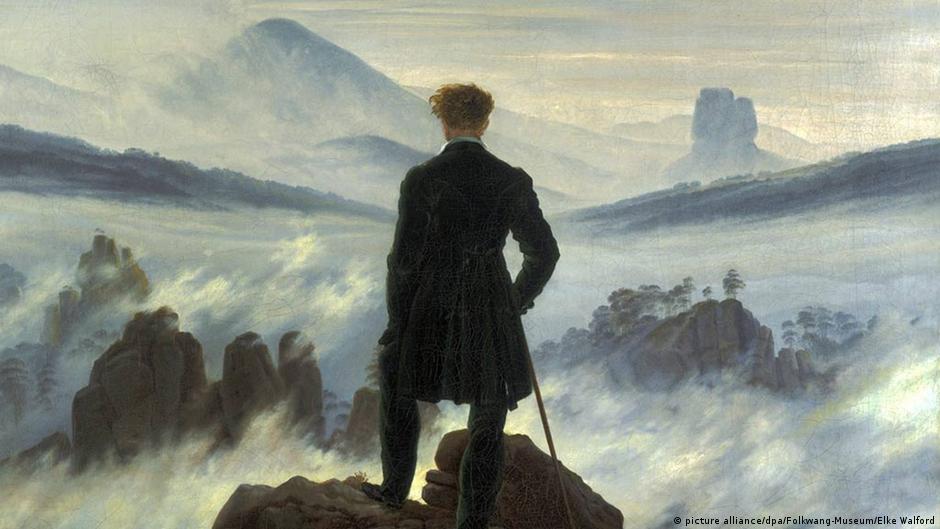
Yet another strand of Romanticism, with an intermezzo before the songs of Franz Liszt, Schumann's Abends im Strand (op 45/3 1840) ; the very image of paintings by Caspar David Friedrich where tiny figures on shore watch ships sailing to unknown places.  Ardent figures in the piano part suggest excitement, and the vocal part rises wildly at the phrase "und quaken und schrei'en" before retreating from adventure to the gentility of the last verse  where "endlich sprach neimand mehr".

Boesch and Martineau continued with Liszt's Heine settings, including Ein Fichtenbaum steht einsam (S309/1 1860), Du bist wie eine Blume (S287 1843-9). In Liszt's Im Rhein, im schönen Strome (S272/1 1840) the piano line depicts the rolling flow of the river, which gradually gives way to more sparkling figures illuminating the last verse which mentions the lost beloved, then ends in reassuring repeated motif.  Martineau shone, and Boesch's dignified phrasing added solidity.

The high point in this set was Loreley (S273/2 1856) in one of the finest performances of this song I can remember.  Liszt creates textures in the piano part which suggest the sparkling waters, the word "loreley" embedded  wordlessly, over and over.  The delicacy with which Martineau played showed why this song is so often performed by women. But Boesch has the skills to carry it off even more convincingly.  He sang the first verses with tender restraint, creating a sense of wonder : the protagonist is, after all, not the loreley herself but a mortal wondering why the tale is so tragic.  He sang the lines "die luft ist kühl" so quietly that a ghostly chill seemed to descend, and even negotiated the tricky sudden ascent to higher range on the word "Abendsonnenschien".  Martineau played the second phase of the song to bring out the lyrical, golden warmth with which the loreley seduces.  Boesch's voice seemed to glow on the words "Die schönste Jungfrau sitzet" growing with strength and volume, evoking the power of the "wundersame, gewaltige Melodie", leading logically into the next section of the song where the seamen  are seized "mit wildem Weh", and hurled to their deaths.   Rumbling turmoil in the piano part, Martineau unleashing the fury in the waves, enhancing Boesch's darker timbres as he sang, emphasizing out the menace and horror.  This created a wonderful contrast with the last section of the song, where the gentler melody returns, as the river becomes calm once more. Now not only the motif "loreley" repeats but whole phrases, gradually retreating into a serenity which we now know will last only until the next doomed sailor appears.

Boesch and Martineau capped this wonderful Liszt Loreley with an equally impressive Schumann Belsazar (op 57, 1840). They have done this song on numerous occasions, but this performance was exceptional, Boesch relishing the inherent drama but doing it with such naturalness that it didn't feel forced. Theatrical as the scene is,  Heine's telling of the story is human.  Martineau played the rippling figures evoking the high spirits of the party in the palace, the lines flowing like wine.  "Es kirten die Becher, es jauchzten die Knecht" sang Boesch with robust vigour.  This matters, for it is drink that makes the King bold enough to curse Jehovah. Boesch's timbre is elegantly regal and his words rang forcefully : "Ich bin der König von Babylon !" Martineau's piano spakled : a last moment of fizz before the mood descends into hushed fearfulness.  A sinister chill enetred Boesch's voice, his words measured and carefully modulated, his "t"'s as sharp as knives.  Great insight, for that very night Belsazar gets stabbed to death.

After this immensely rewarding first half of the recital came a selection of Schumann's Heine settings, including Die beiden Grenadiere (op 49/1 1840). vividly characterized and muscular, and three Lieder from Myrthen op 25 , Die Lotosblume, Was will die einsame Träne and Du bist wie eine Blume. showing Boesch at his sensitive best.  Trägodie (op 64/3 1841) a song in two contrasting parts. Lover elope in hope, but their dreams are doomed. The songs are neither Heine's nor Schumann's finest, so they depend more than usual on good performance. Boesch and Martineau did them so they felt like real people, rather than maudlin figures as in some less accomplished hands I've heard.  Boesch and Martinaeu gave a very good account of  Liederkreis (op 24 1840) with some extremely interesting high points.  Warte, warte wilder Schiffmann suits Boesch's masculine physicality, while Berg' und Burgen schau'n herunter brought out something even harder to achieve ; exquisite, well-defined nuance, for this is an almost bi-polar song and poem. A boat sails merrily on the sunlit river, but above loom mountains and castles, realms of death and night.  "Oben Lust, im Busen Tückern, Strom du bist der Liebsten Bild!"  In comparison, Mit Myrten und Rosen is full-hearted joy, though it, too, is haunted by a Heine kick in the tail, which Boesch and Martineau brought out with subtlety.  Liederkreis can often be the crowning glory of a recital, and this one was good, but the first half of this programme was so unusual and so brilliantly done  that this time, for a change, Liederkreis took second place.

Saturday, 21 July 2018

Prom 8 Discoveries - Morfydd Owen and lively Schumann


Morfydd Owen's Nocturne in D flat major (1913), at BBC Prom 8 at the Royal Albert Hall, should transform perceptions about Welsh (and British) music history.  Thomas Søndergård conducted the BBC National Orchestra of Wales, who premiered its first modern premiere last year, though this performance was far more accomplished.  Owen left some 250 surviving scores by the time of her death at the age of 26, of an extensive range including works for large orchestra, chorus, chamber pieces  songs and works for stage.  To this day, Owen's tally of prizes awarded by the Royal Academy of Music remains unrivalled.  Though she was not part of the male English Establishment, Owen needs no special pleading.  Her music stands on its own merits, highly individual and original.  Her work was published in the Welsh Hymnal when she was 16, before she graduated from Cardiff and moved to London, where she moved in Bohemian, arty circles with the likes of D H Lawrence, Ezra Pound and Prince Yusupov, one of the conspirators who assassinated Rasputin.   A "new woman" she was also independent and had a second career as a singer, hence her fluency in writing for voice.  Unlike far too many supposedly "lost" composers, Owen's legacy was substantial. Her reputation doesn't rest on sentimentality or gender alone, but on the hard evidence of her music itself.

The Nocturne is sophisticated and highly original, which compares well with much else written at the time.  A mysterious woodwind melody calls forth, answered by the strings. The line is is illuminated by tiny bright woodwind fragments, before the main theme is developed into poignant song. Again the strings respond, lit by swathes of brighter winds and harps.  Highly atmospheric yet formally structured, this Noctune now eneters a second, more expansive theme which moves with great assurance towards a magnificent crescendo which suddenly shifts to more urbane, lively motifs. If this is a tone poem about night, it's not somnolent but filled with incident and detail.  Yet another theme develops, this time led by violin. gradually tension builds up : strong, assertive chords not quite ostinato lead to yet another theme, like a lyrical dance for solo woodwind, garlanded by strings and harps.  Such deftness of design, such precise orchestration, and such beauty. All packed into barely half an hour, but unhurried and clear of purpose.  

Owen's Nocturne reminded me of Debussy Prélude à l'après-midi d'un faune and even possibly of Stravinsky, whose work Owen would have known, given her interest in what was happening in Paris and Russia. Yet its serene confidence is highly distinctive : Owen most definitely had a voice of her own, though she was only 22 when it was completed.  BBC NOW should make this Nocturne part of their standard repertoire and explore more of Owen's unique and fascinating music.  Please also read my other two articles on Morfydd Owen  :  Talent has No Gender and Portrait of a Lost Icon.  (which is about the groundbreaking recording of her songs. Both include liniks to Tŷ Cerdd, pioneers of Owen's music and of other Welsh composers.

Unfortunaterly the BBC's obsession with artificial themes yet again obscured the music.  The tag "Youthful Beginnings" is pretty meaningless in itself, hence the need to include pieces by Lili Boulanger and early Mendelssohn and Schumann, which otherwise don't cohere as a programme.  Boulanger and Morfydd Owen were almost exact contemporaries and died young, but that's where the similarities end. Though Boulanger won the composition prize at the Prix de Rome aged 19 - no small achievement - she didn't leave as much as Owen did. Again, perfectly fair enough, everyone develops at different rates.  D'un matin de printemps and D'un soir triste are delightful if somewhat slight, but her reputation was bolstered vigorously by her sister Nadia and her followers.  These pieces are heard fairly frequently (last November with John Storgårds)  because programme planners need to fill agendas about gender.  Owen's music speaks for itself  regardless of reputation.

Bertrand Chamayou was the soloist in Mendelssohn's Piano Concerto no 1 in G minor, which was  balm to listen to. No special pleading needed.  Whatever his sex and age, Mendelssohn had a unique musical personality which makes his music distinctive.  Søndergård concluded Prom 8 with Schumann's Symphony no 4 in D minor, in the version dating from 1841. This was his glorious Liederjahre when a stream of masterpieces burst forth unstemmed. It's not the work of an immature composer, but rather of one who has so much to say that he needs to get it down quickly. This version instead of the better known 1851 revision has merit.  The orchestration is freer and more spontaneous, textures brighter and livelier.  Søndergård understood why it matters that the four movements flow one into the other. They're so full of inventive spirit that it would be wrong to hold them back to make them "neat".  Great energy, even moments of quirky humour.  Low brass and winds blast, almost in parody of stolid ostentation. A vivacious climax, wittily and succintly achieved.  This version of Schumann's symphony is hardly unknown but how refreshing and vital it felt in this performance! 

Monday, 16 April 2018

Christoph Prégardien Wigmore Hall


Christoph Prégardien at the Wigmore Hall, welcomed return of the perennial favourite of Wigmore Hall audiences. Prégardien and Julius Drake began with Carl Loewe’s Der Nöck (op 129/2, 1857) one of the most lyrical Lied by any composer, in a genre rich with beauty,  to a poem by August Kopisch.  Beside a tumbling waterfall, a water sprite plays his harp, enchanting the torrent so it hangs suspended in mid air, the vapours forming a rainbow halo. Circular figures in the piano part suggest tumbling waters. Prégardien breathed into the long vowel sounds in the refrain so they rolled. The flowing refrain evokes both the song of a nightingale and of the harp, symbols of song.  But suddenly the magic is broken when humans draw near. The waves roar, the trees stand tall, and the nightingale flees, until it’s safe for the Nöck to reveal himself again.  Prégardien and Drake paired this Der Nöck with another setting of the same poem which is driving me crazy because I can’t identify it, though I can’t place without having to look it up.

So omnipresent is Schubert’s Erlkönig that Carl Loewe’s Erlkönig (Op 1/23 1818) might seem to pale in comparison.  But it really isn’t bad on its own terms.  Loewe emphasizes the word “Knaben”, which Prégardien sings sensually : perhaps Loewe understood the subtext better than Schubert did, even if the song isn’t a masterpiece. Loewe’s “true” Erlkönig in any case is Herr Oluf, or even Edward, both songs of disguised sexual anxiety.  Loewe also wrote another song, Der spaete Gast Op. 7 Nr. 2 to a poem by Willibald Alexis (Georg Wilhelm Heinrich Häring 1798-1871), an “alternative” Erlkönig. Read more about that here  

More spooky events in Robert Schumann’s Belsatzar op 57 (1846). This time the scene is a grand party in a palace, but an unseen hand writes a curse on the wall.  Prégardien’s singing was restrained, creating the drama is growing tension, holding back rather than bursting out. The last line was all the more chilling because it was delivered with understated calm. “Belsazar ward aber in selbiger Nacht von seinen Knechten umgebracht”.  A quick return to water spirits with Franz Liszt’s Die Loreley, S273 (1843).  Though Liszt is now established in the Lieder canon, his songs reflect his greater interest in pianistic expression.  Where Liszt write a lovely part describing the tumbling waves, the setting of the vocal line is rather more laboured.  Fortunately, Prégardien’s artistry injects convincing elegance.

Schumann’s genius as a composer to poets is demonstrated by his Liederkreis op 39 (1840) to poems by Joseph Freiherr von Eichendorff, written the same year as his Liederkreis op 24 to poems by Heinrich Heine.   Two very different poets, two very different ways of settingb text.  Although Schumann, Heine and Eichendorff were more or less contemporaries, Eichendorff mined a vein more attuned to early Romantic values, where folk wisdom, albeit idealized, still  had much to offer.   Songs liie Waldesgresräch and Im Walde deal with mysteries of the forest, the forest being code word for what we’d now call the subconscious. Like all good Romantics, Eichendorff was an explorer. Songs like Fruhlingsfahrt and Der frohe Wandersman show that  Eichendorff was fascinated by wilder shores even while he praises domesticity. Though genuinely devout, his homilies are talismanic, for he intuits that creativity can be dangerous. An artist is driven by something greater than his own free will.  Happy Wanderer? No way.  Prégardien’s timbre is darker these days, but artistry grows with experience. 

Monday, 12 March 2018

John Eliot Gardiner LSO Schumann Berlioz

John Eliot Gardiner, photo Sim Canetty-Clarke

The start of a major Schumann series with John Eliot Gardiner conducting the London Symphony Orchestra at the Barbican: Schumann Symphony no 2 in C major op 61 (1847) and the Overture to Genoveva with Berlioz Les nuits d'été, soloist Ann Hallenberg. Gardiner is one of the great Schumann conductors of our time, so the LSO are right on the mark, choosing him to head their Schumann series, which began with this concert, continues on 15th March and into 2019.  A major series, whose importance cannot be overestimated.  Perhaps we can hear Schumann all the time, but rarely at this level of excellence.

Gardiner's  approach to Schumann is inspired by a deep understanding of the composer's aesthetic.  It's a mistake to assume that period-informed performance means period instruments  It has much more to do with understanding the composer's idiom and practices which might enhance performance dynamics. The LSO doesn't use period instruments, but achieves werktreue effects by other means.  The players didn't sit down to play but instead stood up throughout.  Immediately, you could hear  the difference.  You'd need cloth ears not to notice, even if you didn't know "why". Because the players were closer together, the sound was more concentrated, achieving volume without having to force the instruments, the sound projected from a few feet higher than usual,  intensifying the interaction between players and podium. Chamber-like sensititivty, in a large (ish) ensemble. The musicians could move freely, flexing their bodies naturally, without the rigidity that comes from sitting down. This flexibility flowed through to the music, which felt direct and spontaneous, textures bright and clearly defined.  Gardiner's Schumann is agile and alive, revealing the composer's true originality.


Gardiner preceeded Schumann's Symphony no 2 with the Overture to his opera Genoveva, which he began at around the same time as he wrote the symphony. The connections go deeper.  The original folk tale on which Genoveva is based dates back to the Middle Ages. Indeed it’s the basis of stories like Snow White, for in legend, Genoveva lived in the forest, protected by animals and by her virtue. Significantly, though, Schumann rejected the medieval concept, choosing instead to base his opera on Friedrich Hebbel’s more psychological drama, published only four years previously. Schumann wanted a “modern” take on the story. As Hebbel said “Any drama will come alive only to the extent that it expresses the spirit of the age which brings it forth”. The Overture sets the stage, introducing the themes that will be developed more fully in the opera. It's marvellous, but listen to how it zooms into a chorale, and then into the opera proper, rather like successive proscenia in a theatre add depth to a flat stage. Schumann's doing dramatic perspective with music.

Schumann's Symphony no 2 begins with another brass chorale, which  here came over without stridency, the "brassiness" muted and dignified, integrating well with the bassoons, winds and strings. How poignant the horns and winds sounded, evoking Nature, hinting at the deep sources of the Romantic imagination.  Moving from sostenuto to allegro, Schumann then creates a wild scherzo where notes seem to fly in fiendishly complex patterns, though the themes are sharply defined.  Schumann 2 is unusual, because it mixes serene passages with oddball quirks. The last movement is sublime, but it's undercut by the moody bassoon from the Adagio, which Schumann told a friend was when he heard his "half sickness" calling him. Yet he had a "special fondness"  for this strange melancholy , which infused even the happiest moments of his life. Who but Schumann could have written Dichterliebe as a wedding gift after having struggled so long to win Clara from her father?

Throughout this symphony there are oblique references to Bach and especially to Mendelssohn whose Midsummer Night's Dream music casts a magical glow on the Adagio.  The assertive, affirmative confidence of the final movement seemed to come straight from the spirit of Beethoven. 
Genoveva and Lohengrin both premiered in the summer of 1850. Wagner disparaged Schumann, as he disparaged Mendelssohn (Schumann’s hero). Since Wagner’s opinions were influential, Genoveva has been eclipsed, and most late Schuman undervalued because it doesn't fit the Wagner ethos  But  Schumann’s ideas on music and music drana stem from sources earlier than Wagner, and might have developed an alternative path had he continued writing after the age of 45.

Between Schumann's Overture to Genoveva and his Symphony no 2,  Berlioz Les nuits d'été op 7 (1841). Gardiner is also a great Berlioz conductor : remember his Damnation of Faust last year ? (read my piece here).  The immediacy of Gardiner's style adds punch to  the song cycle, enhancing dramatic tension.  Ann Hallenberg was a good soloist, not especially French, but in the context of a Schumann series, that's perfectly apt. 

This concert was also broadcast live, part of the LSO live initiative. This itself is news, since it enables the LSO to reach international audiences online who might not otherwise be able to attend concerts, even when the LSO goes on tour.  This particular concert seems to attracted less than the number who logged in for Bychkov's Mahler symphony no 2, but that's fair enough. Mahler is box office, while Schumann and particularly up-market Schumann is more esoteric. It will be interesting to see what the next live stream draws on April 11th (Mahler 10, Simon Rattle, Michael Tippett The Rose Garden)  The economics of livestream are hard to measure.  This concert reached about as many as would be seated in the Barbican, but will continue to attract viewers on Youtube for a longer period. The knock-on effect should also be felt in CD/DVD sales. Long term, streaming enhances the profile of the orchestra, and reaches a wider public.

Tuesday, 28 November 2017

Andrè Schuen - Schumann Lieder and Ladin Song


Schumann Lieder with Andrè Schuen and Gerold Huber  Note accent grave, not  agui. He's not French but Ladin, from the Dolomites in South Tirol. Remember, because he's very promising indeed and we should be hearing a lot from him.  He's still only 33, but the richness and  depth in his lower register is quite splendid. Nice definition, too.  Nice looks, which will help on stage ! I missed his Wigmore Hall recital last year but now he features on a BR Klassik concert, recorded last week in Munich.   Schumann  12 Lieder nach Gedicten aus Justinius Kerner op 35 and Fünf Lieder,op. 40 to start the programme and Schumann 6 Gedichte und Requiem, op. 90 to end, framing five songs in Ladin, of which more later.

Though Schumann's Kerner Lieder are a true cycle, in the sense that they're more integrated as a whole than might at first appear, they also pose challenges. Right from the start, in  Lust der Strumnach,  Schuen launches into the storm-tossed turbulence. "Regen schauert, Stürme brausen", he sings, defiantly, the darkness in his timbre bringing out the darkness that lies at the heart of this cycle. Almost schizoid extremes of mood characterize the traverse, notes lie very high and very low. This turbulence even rumbles beneath Stirb'  Lieb’ und Freud”!  in which a man watches a novice transfixed by religious ecstasy. The tessitura suddenly peaks so high that some
singers scrape into falsetto; very few can manage the sudden tour de force transition with relative ease.  Schuen is strained, but nearly all singers are, too : nothing wrong with that in principle, since this represents a scream of anguish. The woman is renouncing the world, the man condemned to living death.  In
Auf das Trinkglas eines verstorbenes Freundes', the canon-like melody has a grandeur that raises it above a mere drinking song. It has an elegaic quality, suggesting an organ in a cathedral – linking back again to the mood of Stirb'   Lieb’ und Freud”. Its long lines demand exceptional skill in phrasing, for it ponders the mystery of the relationship between the living and the dead, and along the way reflects the composer’s love of “Gold der deutschen Reben!”– at these lines there is a touching modulation which is sustained through the grandeur of “Auf diesen Glauben, Glas so hold!”A spider has wound its web round the long-dead man's wineglass.  Again, Schumann forces the singer's voice  way up his register. suggesting heights and distances the living cannot reach.  but Schuen carries it off very well.

The five songs in Schumann's Fünf Lieder, op 40 are a test of Schuen's dramatic skills.  The first two songs, Märzvielchen  and Muttertraum,  are relatively gentle, but the third, Der soldat, is sheer horror.    A man loves another more dearly than anyone else in the world, But what's happening ? His friend is being executed.  The beloved isn't a girl but a man: and we don't know the full circumstances.  Psychologically, this is a disturbing song, despite the steady march pace.  In comparison even Der Spielmann Op 40/4  might seem conventional since it connects to ancient traditions. The set ends with Verratene Liebe , which dances merrily, but describes cosmic betrayal. The stars steal the lovers’ kisses and throw them away. Freudians might detect sexual anxiety.

South Tirol was once ruled by Austria, and now by Italy. History has not been kind, and tensions still run high. All the more reason that those who know and love Ladin culture need to preserve and promote it.  There are variant dialects, blending German, Italian and Ladin heritage.  Knowing Macau, and having Romansch-speaking Swiss friends, I can relate to that !  Many outsiders know some famous figures of the region like Luis Trenker (see more HERE) and Max Tosi, but there are many other significant figures.  

In this recital, Schuen sang three songs by Felix Dapoz (b 1938), Ben dante mile steres, A la net and Alalt al oi.  The first is strophic, almost prayer-like. The second is altogether more upbeat, with a jaunty piano line  and recurring refrain "Viva, viva Liberté!".  Nos salvans by Jepele Frontull is tender and nicely paced, and Salüæ dal frostì by Lipo Verginer, art song with echoes of folk song.   Schuen’s sincerity and obvious love for these songs and what they stand for, warms them and makes them beautiful in their own way.  I can imagine Schuen doing good things with Hugo Wolf Italiensiches Liuederrbuch. 

Schuen and Huber followed the Ladin songs with Schumann Sechs Lieder op 90.  The first song, Lied eines Schmeides , has gentle but purposeful rocking rhythms which work well with the Ladin songs.  In Die Sennin, Schuen again reveals a gift for lyricism. "Schöne Sennin, noch einmal" he sings, brightly, but his voice dims sensitively for the critical lines "Wenn dich Liebe fortbewogen, Oder dich der Tod entzogen."  One day, the girl will be gone, but the mountains will remain, remembering her songs.  We're being prepared for the melancholy in Der schwere Abend . In the Requiem, though, Schumann turns to elegy. Schuen's voice rises carrying the long, heroic lines.  Rolling figures in the piano part, but firm resolve in the vocal line. 


Andrè Schuen - photo Guido Werner 2017 Kunstler Sekretariat am Gasteig

Sunday, 12 November 2017

Schumann Liederkreis op 39 Florian Boesch Wigmore Hall


Robert Schumann Liederkreis op 39 ((1840) with Florian Boesch and Justus Zeyen at the Wigmore Hall, London.  In Liederkreis op 39 Schumann sets the poems of Joseph von Eichendorff, so very  very different to Heinrich Heine, whose poems formed the basis of Liederkreis op 24.  Eichendorff was both idealist and pragmatist, an aristocrat who helped create the Prussian public system, the first and most comprehensive government school system, open to all, regardless of wealth or status.  One of the principles of Romanticism, derived from 18th century ideas, was the concept of the purity of Nature and of those who lived in harmony with it.

Joseph, Freiherr von Euchendorff

Though Eichendorff,  Heine and Schumann were contemporaries  - living poets being set by a living composer, "new" works" in every sense - Eichendorff's aesthetic harked back to earlier ideas of pastoral innocence. Liederkreis op 39 is beautiful because it harks back to an earlier period of innocence,  closer to the naturalism and sense of wonder captured in the folk-like wisdom of Brentano and Arnim's Des Knaben Wunderhorn.  Songs  like Waldesgresräch connect to the supernatural enchantment of Das klagende Lied, where the supernatural overlays human experience.  "Du weiss nichts, wer ich bin", sang Boesch, not imitating the voice of a maiden so much as expressing an innocent's frustration with mortals who don't understand.  The Lorelei has lived forever, but  the hunter hasn't a clue. This wonderful song hovers between two worlds.  Throughout the cycle, there's always something beyond, glimpsed yet not explicit.  In Auf einer Burg, an old knight has been waiting so long in his mountain fastness that he's  turned to stone.   Hence the minor key in ths song. Yet meanwhile, in the valley, peasants are getting married : life goes on and renews, though the knight might turn to dust.  The same theme arises in Im Walde, where the happy procession disappears   into darkness. ""und mich schauert's im Herzengrunde". Boesch's voice growled "Herzengrunde" , suggesting unspeakable horror. Though  Eichendorrff's world evokes the past it doesn't cling to it.  The cycle ends with Frühlingsnacht .The moon, the stars and the woods tell the poet that change is coming and, with it, new hope.  Whatever the poet may dream of, "Sie ist Deine, sie ist Dein". 

Like all good Romantics, Eichendorff relished the unknown. Songs of wandering were songs of alienation, a concept earlier periods had few means of articulating. But songs of wandering also remind us that there are worlds we don't know, which might be beyond our comprehension.   Nothing insular about Eichendorff, whose frontiers were of the mind.  Boesch was at his best in songs like In der Fremde ("Aus der Heimat hinter den Blitzen rot") and In der Fremde ("Ich hör' die Bächlein rauschen") with its haunting refrain "Ich weiss nicht, wo ich bin", bringing out the internal musical connections in this cycle, offten missed when it's done like a series of songs,  The refrain "Ich weiss nicht wer ich bin", for example, connects to the Lorelei's cry "Du weisst nichts, wer ich bin".  Though Eichendorff and his peers didn't use the vocabulary of modern psychology and alienation, they understood the concepts.  It was wonderful hearing Boesch singing Liederkreis op,39, but get the recording, just out on Linn Records. Please read more here. Though I wrote more about the Mahler songs, that's only because  Boesch has done lots of Schumann, and relatively little Mahler.

Before Schumann';s Liederkreis op 39 Boesch and Zeyen presented four Schubert songs on themes of wandering, In Walde D708, Auf der Brücke D853, Der Pilgrim D794 and Der Schiffer D536. They also did five Hugo Wolf songs to poems by Eduard Mörike, Begenung, Auf ei altes Bild, Denk'es o Seele!, Schaflendes Jesuskind and Gebet.  One erotic, one supernatural, three ostensibly though not quite religious and one so disturbing that it’s in no category.  Justus Zeyen has played with Boesch before, but his style is loud, more suited to Quasthoff than to the subleties of Boesch. Nonetheless, he showed how the piano part in Liederkreis op39 is more spare than in Liederkreis op24, in keeping with the restrained sensibility of the poems.

Wednesday, 1 November 2017

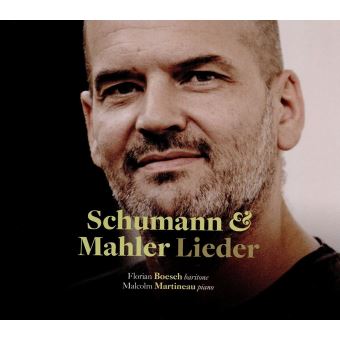
Schumann & Mahler Lieder Florian Boesch - a must for Mahler

Schumann and Mahler Lieder with Florian Boesch and Malcolm  Martineau, now out from Linn Records, following their recent Schubert Winterreise on Hyperion.
From Boesch and Martineau, excellence is the norm. But their Mahler Lieder eines fahrenden Gesellen takes excellence to even greater levels. Although I've heard dozens of performances over the last 40 years, this took my breath away. I've been playing the songs over and over, getting so much from it. Boesch's voice is a thing of wonder - such richness, such beauty, - yet fluidly natural, free of mannerisms and self consciousness. When you listen to Boesch, you're  not listening to "a performance" so much as being drawn into the music itself,  experiencing it in a profoundly personal way.

Mahler's Lieder eines fahrenden Gesellen were particularly personal works for Mahler himself. He wrote the texts himself and set them with a very short period: hence their spontaniety. This is very much a young man's adventure. so youthful vigour is central to interpretation.  Martineau plays the first bars of "Wenn mein Schatz Hochzeit macht" which repeat, like tentative but brisk footsteps into the unknown.  Note how steady Boesch's voice is as he joins in, for the protagonist is to undergo a wide range of conflicting emotions as he proceeds on his journey. When Boesch sings "Fröhliche Hochzeit" , for example, the "ö" trembles, as if to emphasize sarcasm.  The protagonist has been alone, weeping in his "dunkles “Kämmerlein". When Boesch repeats the word a second time, he shades it to evoke the darkness and all that it implies.  This intensifies the contrast in the second part of the song with its joyful outburst.  Boesch's voice glows as he sings the lyrical "Blümlein blau! Verdorre nicht!

Vöglein süß!
". We can almost imagine the protagonist's lungs swelling, taking in the clean air. Like the bird, the protagonist will make his mark on the world by singing.  Not whining, to make a bad pun.  Martineau's playing is lyrical, too, suggesting the bird, singing alongside the singer.  "Zikuth, zikuth" sings Boesch  with utter simplicity, for the bird represents nature and innocence. For a moment, though, "Singet nicht! Blühet nicht!" and the poet retreats into himself, voice and piano gently muting. But not for long. The pace quickens, the piano line suggesting an energetic hike.  Lilting passages move and flutter. We're on the open meadows."Ei du! Gelt? Guten Morgen! Ei gelt?" Note the  rhythms. Boesch and Martineau keep the tone light. The bird is cheeky but it’s also chirpy. Sparkling piano figures lead into a new, more serene mood, where lines stretch smoothly, held for several measures, as if basking in Sonnenschein.  Yet again, the protagonist retreats, the piano line decelerating breaking into single notes "Nein ! Nein !" sings Boesch, with quiet resignation. "Ich hab' ein glühend Messer" heralds a sudden mood change.  Mahler's contrasts suggest stage drama, perhaps a hint that the protagonist thinks he needs to talk big to make a point. Significantly, the bluff doesn't last : the protagonist moves on.  But to what? He lies under a linden tree, whose perfume was reputedly narcotic.  The music becomes lullaby, gentle rocking patterns in voice and piano. For a baritone who has great heft when he needs it, Boesch  can do soft and tender extraordinarily well.

Will the protagonist wake refreshed or will he die ?  In Das klagende Lied, Mahler's hero rests under a tree, and gets a message from his dead brother. But in Schubert's Winterreise the hero realizes that there are no easy answers. He must keep searching.  So whither the wayfaring lad? "Alles, alles, Lieb und Leid, und Welt, und Traum".  The connections between Lieder eines fahrenden Gesellen and Mahler's Symphony no 1 are obvious. But the piece is a breakthrough because Mahler is embarking on a journey in music and metaphysics that might never end.  In 1885, in  Lieder eines fahrenden Gesellen, we already glimpse Das Lied von der Erde and even the Tenth Symphony looming into view.  Boesch and Martineau are Lieder specialists,deeply immersed in the aesthetic that inspired Romantiuc poetry, painting and music, and have created whole programmes on the theme of Romantic Wanderer.  Please see my review of their recent Wigmore Hall concert here. Boesch has also recorded a Wanderer disc with Roger Vignoles. Like the wanderers of the early Romantic period, Mahler, "Dreimal heimatlos", channels that questing spirit though his music is very different to Schubert's.

Surprisngly, Boesch and Martineau have done relatively little Mahler, but they are Lieder specialists, and this, I think, gives them an edge over some singers whose background might be more geared towards opera  and less intensely intimate genres.  Fundamentally Lieder is an inward genre where sensitivity and emotional intelligence are paramount.  With their extensive experience in Schubert and Schumann, Boesch and Martineau can bring that Lieder sensibility to bear in Mahler, and , perhaps even more significantly, an understanding of the early Romantic roots behind Lieder and behind the folk traditions collected by Brentano and von Arnim for their volume Des Knaben Wunderhorn. Thus this Lieder eines farhrenden Gesellen  is one which even seasoned Mahler listeners should take the time to listen and absorb.  Mahler's symphonies, even past the Fourth, connect to the Wunderhorn background.

Also on this recording, an excellent Schumann Liederkreis op 39, which Boesch and Martineau have done together many times   This version's excellent.   Regular Boesch and Martineau fans will be delighted, because Linn recordings are audiophile quality.  Listeners coming in for the Mahler are in for a serious treat !  Schumann, too, drew on the spirit of the Romantic wanderer, so hearing Schumann and Mahler together enhances our appreciation of how two very different composers approached the same concepts. In Liederkreis op 24, Schumann set Heinrich Heine, more worldly and cynical than Joseph Freiherr von Eichendorff  whose poems inspired Liederkreis op 39.  A wise choice oin the part of Boesch and Martineau, since Eichendorfff's poems are closer to the naturalism and folk wisdom of Wunderhorn. There are wanderer sings, like In der Fremde ("Aus der Heimat hinter den Blitzen rot") and In der Fremde ("Ich hör' die Bächlein rauschen") with its haunting refrain "Ich weiss nicht, wo ich bin".  But there are also songs like Waldesgresräch which connects to the supernatural enchantment of Das klagende Lied, and songs like Frühlingsnacht where in darkness the poet recalls lost love, but is cheered by nightingale song and the fresh blooms of Spring. The themes of Lieder eines fahrenden Gesellen ! 

This recording isn't long (47 minutes) but it's packed with good things and worth every cent.  Three songs from Schumann's Lieder und Gesänge aus Wilhelm Meister op 98a, for example,  which Boesch and Martineau have done live several times in recent years.  Wie nie sein Brot mit Tränen aß, Wer sich der Einsamkeit ergibt, and An die Türen will ich schleichen.  Schumann's settings aren't as omnipresent as those by Schubert and Hugo Wolf, but they are every bit their equal, contemplative and - dare I use a naughty word these days - "intellectual".  Wilhelm Meister is a tortured soul, and an exile who will never find peace, but he sings on, nevertheless, though  he's forever doomed to wander.  Nothing pastoral, but also very much in the Romantic spirit of psychological discovery.  

Wednesday, 4 October 2017

How to kill Robert Schumann

Robert Schumann Szenen aus Goethes Faust  conducted by Daniel Barenboim,  marking the re-opening of theStaatsoper Berlin on the Unter den Linden, Berlin, after years of  renovation. Last time I was there, Hans Werner Henze was in the audience - how time flies ! This time, though, the performance was livestreamed on the Staatsoper Berlin website.   (Please see here about the Open air Beethoven 9 concert)  Schumann's Szenen aus Goethes Faust isn't an opera in the conventional sense, so choosing it to start an opera season was a brave choice indeed. Would the Staatsoper Berlin pull it off ?

Schumann';s works for music theatre don't get the respect they deserve because Schumann died young, eclipsed by Wagner and Verdi and by French Grand Opéra.   But if we approach Schumann on his own terms, and from the perspective of Mendelssohn, Weber and the Singspiele tradition, his work for the stage comes into its own.  What a great opportunity this would have been to present Schumann as man of the theatre in a distinctively German tradition.   Musically this was good - Barenboim, René Pape and Roman Trekel all in good form, with good support. But the production was a joke, and not a funny one. A Cataclysm of Corny Clichés !

Schuman pointedly made it clear that he was setting scenes from Goethe's Faust as opposed to writing a piece which unfolds as dramatic narrative.  The son of a Leipzig bookseller assumed quite rightly that his audiences knew the story, just as Mendelssohn's audiences knew the Bible.  So  Schumann's Faust isn't like Boito's Mefistofeles or Gounod's Faust but a strange hybrid that owes much to oratorio.  Even Berlioz The Damnation of Faust holds together better as semi-opera.    Jürgen Flimm's production with designs by Markus Lüpertz is overkill.  It will appeal to those who think that opera exists to be looked at, without musical and emotional connection.  The Frock Coat and Crinoline crowd !  Barrie Kosky fans who are fooled by superficial appearances, and don't think beyond.

The stage is dominated by two tall figurs whose purpose is to add verticals to the generally flat horizontals.  Perhaps the figures represent Faust and Mephistofeles, or Good and Evil, but they don't contribute much.  At times, a hollow box appears on stage. These stage within a stage boxes are a good idea, which is why they pop up so often in the theatre. They focus attention on what's important, distancing the action from what is happening elsewhere. Here, though the biox is just a box, a toy theatre at best, which at least is a nod to early 19th century performance practice, which is valid enough.   But we've long outgrown painted flats but wooden acting was what we got here. No disrespect to the singers but to the direction. Stylized gestures and poses can be used effectively but here there didn't seem much purpose.   Gretchen (Elsa Dreisig) and Marthe (Katharina Kammerloher) are cliché maidens, the sprites and demons comic book caricature, the choirs nuns in cartoon wimples.

Goethe populates the Second Part with allegory : Doctor Marianus and Pater Profundis, for example, and the tale becomes metaphysical fantasy.  Thus it's perfectly natural for the singers to sing two "parts" but the parts aren't continuations of the drama that went on before.  The logic behind some of this staging might seem to grow from this duality, which Schumann  (and later Mahler) respected enough not to tamper with.  Translating it into visuals is tricky.  Pape and Trekel are shadowed by non-singing actors, again a stage device which can work fine sometimes, but here was confusing.  Pape and Trekel spend a lot of time changing costumes, which is OK, but not particularly necessary. Though the presence of choirs and multiple solo voices fills up the stage, too much busy-ness also distracts.  Stefan Herheim can get away with great detail, but his details are thought through and co-ordinated to meaning. Here we just had a lot of a lot.  Schumann's Szenen aus Goethes Faust is fascinating, even though London critics don't get it.  But I reckon this staging won't help much. Pity, since the singing was good and Barenboim conducted with great style.  I loved the dialogue - so important to full realization, especially Gretchen am Spinnrade, recited, as Goethe wrote it, delivered with poetic feeling.