Showing posts with label film early. Show all posts

Wednesday, 16 May 2018

Der Rosenkavalier, with a twist - Orchestra of the Age of Enlightenment

The Orchestra of the Age of Enlightenment back at the Queen Elizabeth Hall tomorrow (17/5) with Der Rosenkavalier, but with a twist. Not the opera but the film suite.  What film suite ? Richard Strauss wrote for the movies ? Yes !  In 1926, Robert Wiene, who had directed The Cabinett of Dr. Caligari , made a version of Der Rosenkavalier with the enthusiastic support of Richard Strauss himself.   Dr. Caligari  pioneered the Expressionist aesthetic.And   there was Richard Strauss, if not quite in the vanguard, certainly sympathetic.  This should come as no surprise, since he wrote Salomé. Elektra and Die Frau ohne Schatten. Nuts to the notion that Strauss was sugar and cream.  Wiene’s film was screened at the Dresden Opera House, where the original opera itself had premiered fifteen years before, underlining the connection between opera and the new art form of cinema.  Wiene's Der Rosenkavalier wasn't an "opera movie" in any modern sense of the word. It wasn't a film of the opera but a work of art in itself, with the opera as starting point.  Works of art exist for themselves : there's no law that they have to set originals as given, any more than that art should be history.  Please also see my article from 2012, Gay Salomé the 1923 silent movie based on the Salomé storyn that inspired not only Strauss but many others. 

The plot loosely follows the novel from which Hugo von Hofmannsthal  derived the libretto, with extra scenes like the battlefield on which the Feldmarschall rides to victory and an opera bouffe in a small theatre, where the principals watch their dilemma being acted out. Obviously, the music for the opera would not fit. In any case, what would be the point in a silent movie? Instead Strauss wrote a new soundtrack, based on an orchestra of 17 parts, which mixed extracts from the opera with snippets from  other works  including Arabella, Burleske, Till Eulenspeigel and  Also sprach Zarathustra. 

He  threw in bits of Wagner and Johann Strauss for further effect. Strauss himself conducted the blend live while the movie screened. How would today's opera snobs react?  They take themselves too seriously, methinks, because the Silent Rosenkavalier is a heady cocktail of good film and fun. It captures the savage satire while dressing it up with visuals so frothy they border on excess. This in itself is a dig at the materialistic culture that values frills, yet turns fresh young women into commodities in a cynical marriage marketplace. Swoon at the wigs and acres of lace, but this is no costume drama.

 
The technical film values are very high, as one would expect from the director of Dr Caligari (full download here) and Genuine the Vampire (more here). Scenes are carefully planned so they seem like tableaux in some elegant object of art, designed to distract from the grubbiness around it.  The Marschallin's boudoir suffocates in luxury: one imagines that any man kept like this would lose his masculinity. For all her wealth, the lady isn't happy. She sighs and uses exaggerated gestures and poses: Wiene is satirizing popular theatrical excess. Baron Ochs wears embroidered silks but is a boor. He somersaults, arms and legs akimbo like a broken puppet. Later, when Octavian challenges him to a duel, he collapses  though he's barely been scratched. The camera pans close up on his face and then his mouth, wide as a grotesque sculpture. We can almost hear the screaming.

The scenes where the Men of Property and their lawyers work out the marriage contract are brilliantly done. Backgrounds dissolve into darkness, so the rococco filigree of the costumes and wigs frame faces whose features twist in angular contortion. Outside, in the garden,
gigantic gryphons five metres high tower over the party goers. In contrast, the actress who plays Sophie expresses her personality with
great sensitivity. Sometimes she looks like a nine year old, too naive to take in what's happening. Her jutting chin and turned up nose indicate her petulance.The rich folk cram into a tiny theatre in the Mehlmarkt to watch a play about "the Proud Father and his humiliation",
narrated in rhyming folk poetry. The Marschallin plans a masked ball. Great crowd scenes. Mystery letters direct Octavian and the Field
Marshal (straight from the battle) to meet a woman in the grotto of Diana, Goddess of the Hunt. The last reel of the film is missing but the
inconclusive ending isn't a problem. We know what's going to happen. The last frame shows the little black boy, with his plumed turban,
drawing a curtain and gesturing silence. 
 
The Orchestra of the Age of Enlightenment is conducted by Geoffrey Paterson with Thomas Kemp as arrtistic director and Charlotte Beament, who will be singing Strauss songs.   The South Bank has been doing silent movies with sound for decades (Think Carl Davis) but this time the music is autentic original and there's no film, as such.  Use your imagination or watch the silent movie, which has been screened several times in recent years.  I wrote my article Rosenkavalier bei Caligari in 2014. But the OAE performance should make us think, about Strauss, and his interests in the avant garde and the idea of film as art form.  Me ? I'll be at St John's Smith Square for  Charpentier Histoires sacrées with Ensemble Correspondances, directed by Sébastien Daucé and Vincent Huguet.

Monday, 17 February 2014

Silent Rosenkavalier bei Dr Caligari

A silent version of Der Roskenkavalier by the director of The Cabinet of Dr Caligari. In 1926, Robert Wiene made a version of Der Rosenkavalier with the enthusiastic support of Richard Strauss himself. The film was screened at the Dresden Opera House, where the opera itself had premiered fifteen years before. It wasn't an "opera movie" in any modern sense of the word. 

The plot follows the novel from which Hugo von Hofmannsthal  derived the libretto, with extra scenes like the battlefield on which the Feldmarschall rides to victory and an opera bouffe in a small theatre, where the principals watch their dilemma being acted out. Obviously, the music for the opera would not fit. In any case, what would be the point in a silent movie? Instead Strauss wrote a new soundtrack, based on an orchestra of 17 parts, which mixed extracts from the opera with snippets from other works  including Arabella, Burleske, Till Eulenspeigel and  Also sprach Zarathustra. He  threw in bits of Wagner and Johann Strauss for further effect. Strauss himself conducted the blend live while the movie screened. How would today's opera snobs react?  They take themselves too seriously, methinks, because the Silent Rosenkavalier is a heady cocktail of good film and fun. It captures the savage satire while dressing it up with visuals so frothy they border on excess. This in itself is a dig at the materialistic culture that values frills, yet turns fresh young women into commodities in a cynical marriage marketplace. Swoon at the wigs and acres of lace, but this is no costume drama.

The technical film values are very high, as one would expect from the director of Dr Caligari (full download here) and Genuine the Vampire (more here). Scenes are carefully planned so they seem like tableaux in some elegant object of art, designed to distract from the grubbiness around it.  The Marschallin's boudoir suffocates in luxury: one imagines that any man kept like this would lose his masculinity. For all her wealth, the lady isn't happy. She sighs and uses exaggerated gestures and poses: Wiene is satirizing popular theatrical excess. Baron Ochs wears embroidered silks but is a boor. He somersaults, arms and legs akimbo like a broken puppet. Later, when Octavian challenges him to a duel, he collapses  though he's barely been scratched. The camera pans closeup on his face and then his mouth, wide as a grotesque sculpture. We can almost hear the screaming.

The scenes where the Men of Property and their lawyers work out the marriage contract are brilliantly done. Backgrounds dissolve into darkness, so the rococco filigree of the costumes and wigs frame faces whose features twist in angular contortion. Outside, in the garden, gigantic gryphons five metres high tower over the party goers. In contrast, the actress who plays Sophie expresses her personality with great sensitivity. Sometimes she looks like a nine year old, too naive to take in what's happening. Her jutting chin and turned up nose indicate her petulance.The rich folk cram into a tiny theatre in the Mehlmarkt to watch a play about "the Proud Father and his humiliation", narrated in rhyming folk poetry. The Marschallin plans a masked ball. Great crowd scenes. Mystery letters direct Octavian and the Field Marshal (straight from the battle) to meet a woman in the grotto of Diana, Goddess of the Hunt. The last reel of the film is missing but the inconclusive ending isn't a problem. We know what's going to happen. the last frame shows the little black boy, with his plumed turban, drawing a curtain and gesturing silence.

Sunday, 26 January 2014

Chaliapin Ivan the Terrible rare screening

Feodor Chaliapin, the legendary bass in a silent movie? That's no contradiction in terms, because Chaliapin is a brilliant actor in the grand manner, even when he doesn't sing. The film "Ivan the Tterrible (1915) receives a rare screening on 30 January at the Pushkin House in Bloomsbury Square, London. The restored version was originally seen in Moscow in 2001, but this version has new English subtitles, specially created by film and music historian Paul Fryer.

The film is well worth seeing because it's the closest we can get to early opera performance practice. Obviously, no sound. Nor is it a "filmed opera" like the DVDs we get today. Instead, it's an attempt to reproduce on silent film something of the operatic experience. The title "Ivan the Terrible" is a bit of a misnomer, since the film was based on Nikolai Rimsky-Korsakov's The Maid of Pskov. "Ivan the Terrible" is better box office. Besides Ivan was one of Chaliapin's signature roles: his presence was the draw. Indeed, the idea for the film came from his supporters, who understood how the power of cinema could preserve performance and bring opera to new audiences.  Nowadays it is fashionable to sneer at "crossover" musicians, but until only very recently, many crossed genre. There's lots on this site on Richard Tauber's adventures in cinema, and on music for film by serious composers like Hans Eisler.

Ivan the Terrible folows the plot of The Maid of Pskov so faithfully that it can be watched withoiut sound or subtitles, as long as you're familiar with the opera. Princess Olga of Pskov is in her garden, hearing lurid tales of Ivan's destruction of Novgorod.  The staging is very art nouveau, sculpted lines with a "river" of shining white light in the background. It looks as if it's painted backdrop. Scenes are shot on diagonal horizons, to create a contrast of dark and light. Even the scenes shot in the open air are stylized rather than naturalistic. The acting is similar, designed perhaps to semaphore meaning to audiences up in the galleries of a theatre. In silent film, actors also need to ham because the medium was so restricted.  Cinematographers hadn't quite mastered verité or the art of close-up.

Chaliapin  really had presence. In still photos, we don't realize just how tall he was and how he must have dominated the stage. Later, Chaliapin appears in a coat of armour with a peaked helmet which makes him look like a giant. He beats up Matuta who has captured Olga, and takes her with him to his camp. He has a secret.  He won't hurt Olga. though he rages theatrically on his throne. The battle is a nice crowd scene, shot economically on the same small set/area by the "river" from different angles. In the confusion, Olga is killed. Her lover, Tucha, a stock Romantic hero in breeches, falls over her body weeping, then scrambles down tyhe same steep slope most of the other characters have slid down before him, and drowns in the river. Chaliapin, maddened by grief, wanders down a diagonal path, and wails over a locket, revealing that he was the lover of Olga's mother, and is her father.  Ivan's not terrible, at all.

Please see here for a complete download and review of Chaliapin in the 1933 film Don Quixote with music by Jacques Ibert and Maurice Ravel. Chalapin sings in that, gloriously parodying his stage persona. If I have time I'll write about Sergei Eisenstein's Ivan the terrible, with music by Sergei Prokofiev. In the meantime, a full download of Eisenstein's Alexander Nevsky, another Eisenstein movie, from 1937.

Tuesday, 9 July 2013

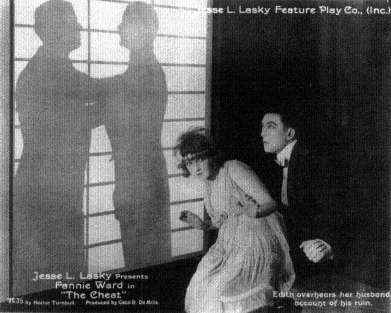
The Cheat 1915 - hypocrisy and dishonesty


Oriental Villain burns brand onto White Woman! Even today the subject would be sensitive. Racial prejudice, violence. Exotic, erotic aliens. The Cheat (1915) is shockingly prescient even now, a hundred years after the film was made. Modern audiences can't hide behind the illusion that things have really changed.

"Haka Arakau, a Burmese Ivory King to whom the Long Island smart-set is paying social tribute" is played by Sessue Hayakawa, (1889-1973) the first non-white to have a major film career. That in itself is telling. Not until Bruce Lee did Asians get to play important dramatic leads that didn't pander to stereotype. Arakau is seen using a Chinese incense burner to heat a branding tool to burn his seal onto ivory idols: the alien making his mark, in every sense. Because he's immensely wealthy, he doesn't get sidelined like nearly every other non-white in a era where race laws nullified reinforced prejudice. Arakau can switch from "oriental" to sophisticated western gentleman in elegant dinner jacket. He's threatening because he doesn't conform to stereotype.

Edith, a socialite, flirts with Arakau, even though inter-racial relations were illegal, and she's married as well. Not a nice lady. Her husband Richard teeters on the edge of bankruptcy but she can't stop spending wildly and showing off. She steals money from a Red Cross fund raiser to help her husband on a money making venture. Edith borrows from Arakau to cover the misappropriation, with the implication that she'll sleep with him in return.  She slips into the inner rooms of Arakau's home. There's a struggle. He coat slips off, revealing her naked shoulders. It's not very clear what's happening until Arakau grabs his branding iron and pushes it into her flesh. She falls to the ground: even then it's not completely clear how she feels. She doesn't scream, but gasps ambiguously. Then she picks up a gun and shoots him, also in his shoulder. Branding iron and gun: both symbols of sexual penetration.

Richard tells the police that he shot Arakau. The truth is too dangerous. The grid of the shoji screen is now reflected in the shadow of the bars in a prison cell. Edith, hardly in fear of being raped or attacked, goes to Arakau. He's reclining in bed, and she leans close to him. Note the hands that don't quite touch. She wants to bribe him to drop the case. "You can't cheat me twice", he says. "It's in the hands of the law". But he concurs with Richard's story. At last Edith is spurred to tell the truth. She rips her clothes off in front of the courtroom and displays her scar. This scene alone is quite shocking, given the proprieties of the time. Mayhem. The crowd attacks Arakau and Richard is freed. It's not very clear but Arakau seems to be arrested by the police. Better than than get lynched by the mob, I guess. Despite her duplicity, Edith is a "heroine". Who are the "cheats" here?

Apart from Hayakawa's dignified performance, the acting in this film is exaggerated, even by the standards of the time. Perhaps the direction is a further clue to meaning. Edith is the fake, Arakau has integrity even though he assumed she would sleep with him if she couldn't repay the loan. The director was Cecil B De Mille. Four years later, D W Griffiths made Broken Blossoms, on a similar theme of dishonesty, sexuality and racism, (read more here). Significantly, Griffiths used a white actor in yellowface for his later movie, defusing some of the impact.  De Mille couldn't confront racism head-on, but disguised it under a story audiences then - and now - take at face value. How modern audiences read The Cheat tells us a loit about racism today. Some will assume that Arakau gets what he deserves, since he's a foreigner and doesn't "know his place". Others will read the film as something much more disturbing and brutally honest.

Friday, 5 July 2013

Silent Wagner 1913 wryly intuitive biopic

Is that Richard Wagner conducting? "Silent Wagner" is a remastering of a 1913 film made to celebrate Wagner's centenary.

A hundred years on, it's even more fascinating because the actor, Guiseppe Becce, is a dead ringer for Wagner himself. He's short and scrawny but moves with nervous energy. Perhaps Wagner, who had massive chips on his shoulders, moved with that punchy combativeness. In the scenes where Becce's Wagner squares up to the enormously tall Ludwig II (Ernst Reicher) we can sense something of the unspoken personal dynamic between them. Wagner's a chancer, getting his own at the aristocratic Big Guy. No historian can ever quite suggest this, but Becce has the intuition of a true method actor.

Becce (1877-1973) was also a musician and composer, who worked with  Arthur Nikisch and Ferruccio Busoni. He was a big name in German cinema. Before sound, he conducted live orchestras  who played during screenings. He was involved with The Cabinet of Dr Caligari (1920). For the Wagner biopic, he wrote an original score. When sound movies came in, Becce did very well. He wrote and conducted the music for Pabst's Geheimnisse der Seele, Reifenstahl Das blaue Licht, Ekstase, numerous classic Bergfilme. Becce was extremely important in the evolution of German cinema. It's unfair that the remastering calls the film "Silent Wagner" because it obliterates Becce's contribution. He must have written the music with wry humour: scenes from the operas pop up throughout the film with hilarious effect.

The script's a bit dodgy, lingering too long on Wagner's youth, leaving the Cosima years to the last 20 minutes. Cosima was alive and still truculent when the film was made, so perhaps the director, Carl Froelich (a huge presence in later in German cinema), was diplomatic to shy away from detail. "Cosima" appears in  brief shot, holding a suitcase, gesturing that she's come to serve her Master. Minna is excoriated. "Wagner" throws her out, suggesting that he was single before he met Cosima. All we see of their relationship is a flashback to a shot of Siegfried awakening Brünnhilde on her rock. Somehow I don't think Wagner would have exclaimed "Das ist keine Mnn !" This film is more tongue in cheek than meets the untutored eye. Ooops, wrong choice of metaphors.

But the period detail is breath-taking. Elaboate sets, suggesting how over-stuffed and claustrophobic period interiors might have been.  There are scenes with tiny, cramped theatres. The actors move stiffly in "actorly" poses. Yet even this tells us something. Was Wagner moving away from the stylized kitsch of the past? Cosima would not have liked that. Nor would she have liked seeing Meyerbeer who appears, tall and confident. Cosima would, however, have liked the scene where she's presented to Ludwig II surrounded by children who have mysteriously appeared. The boy who plays Siegfried Wagner sports a blond bouffant - must be a wig!
 
The composer sits at his desk, or plays a lumpy antique piano. "Ghosts" appear : Beckmesser, Eva and then Hans Sachs. Presto! Opera complete! Ludwig II visits Wagner in Switzerland, arriving in a boat, preceded by a swan. Wagner reads his Nibelung poems to polite Swiss burghers. Mathilde Wesendonck falls decorously for the artist, with a chaste kiss. Getting a shot of Bayreuth must have been easy enough, but the film uses state of the art technology (for 1913) to show Wagner on his deathbed in Venice. He's visited by apparaitions : Parsifal, Brünnhilde, Sachs, Walter with his harp. If this film is approached in modern cinematic terms, it's hard  to take. But appreciate it for its wry insights and provocative humour, and delight in the way it revises the Wagner story. There';s a scene where Becce plays Wagner in a bathtub, which is fair enough. But the film lingers lovingly on his naked body, discreetly lit from behind a screen.  When he emerges the towel he's wearing keeps threatening to slip off. That's a clue that this isn't reverent hommage, but "Wagner revealed".

 It's also important as a record of the evolution of German film, given that those who made it were to become leading figures in the business. And it also suggests the links between opera and film. Cinema was another form of "high art", treated with respect.


Friday, 23 November 2012

Silly Skeleton Symphony


Earlier this week I was writing about Benjamin Britten's A Simple Symphony and Walt Disney's early Silly Symphonies.  So here's The Skeleton Dance from 1929 which is so good that it should be part of everyone's heritage. We should be brushing up on cartoon history with the Philip Glass opera The Perfect American coming up at the ENO next year.

UB Iwerks was the artist. He was an early friend of Disney's and co-created Mickey Mouse. Iwerks split from Disney for a while, and later returned, but did many other things besides animation. The music was by Carl W Stalling who later went on to write Loony Tunes and Merrie Melodies for Warner Brothers. The animation is innovative, and the music matches it perfectly.  Listen to the mad mazurka at 4 minutes, where a skeleton uses femurs to  play xylophone on a spine. Anyone who thinks music can't be fun is nuts.