Showing posts with label Britten Billy Budd. Show all posts

Saturday, 27 April 2019

Britten Billy Budd, ROH reviewed by Claire Seymour

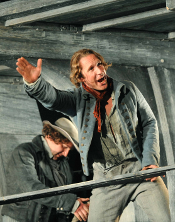
Jacques Imbrailo as Billy Budd, Royal Opera House -  Photo: Catherine Ashmore 2019

Benjamin Britten's Billy Budd at the Royal Opera House with Jacques Imbrailo, Toby Spence and Brindley Sherratt, thoughtfully reviewed by Claire Seymour who wrote the book The Operas of Benjamin Britten : Expression and Evasion (2007) .  Read the full review here in Opera Today - seriously good analysis of an opera which is anything but just a jolly jig. 

"Director Deborah Warner, whose production of Billy Budd (a co-production with Madrid’s Teatro Real and Rome Opera) is the first for twenty years to grace the stage of the Royal Opera House, seems to be in accord with the views that Benjamin Britten expressed in a 1960 radio interview. For, it is Vere’s moral dilemma which dominates her interpretation. She makes no attempt to, as Britten’s librettist E.M. Forster put it in The Griffin in 1951, tidy up Vere’:........."

"The homoerotic sub-currents of both Melville’s novella and Forster’s libretto remain submerged in Warner’s production, and it is the opera’s religious allegory which is brought to the fore. There’s no doubting the answer to Vere’s desperate questions in the Prologue: “Who has blessed me? Who has saved me?” Just as Warner, in interview, described Claggart as a “fallen angel”, so this Billy is unambiguously seraph-like. Forster noted (in The Griffin) that some critics had surmised that Billy’s ‘almost feminine beauty’ and ‘the absence of sexual convulsion at his hanging’ indicate that Melville intended him as a ‘priest-like saviour’, but while he professed to have striven to emphasise Billy’s masculinity and ‘adolescent roughness’, Forster couldn’t resist portraying Billy’s hanging as a Christ-like sacrifice.

Read the full review here in Opera Today - seriously good analysis 

Wednesday, 28 August 2013

FANTASTIC Billy Budd Prom 60 Davis

Astonishingly good Benjamin Britten  Billy Budd, Prom 60, from Glyndebourne. Definitely BBC Prom of the Year, it's THAT good. Exceptionally powerful performance all round, even in the minor parts. Not a weak link, and Andrew Davis conducts one of the most vivid, intense performances ever.  Musically,  this 2013 revival leaves the 2010 original for dead on every count. What a pity Glyndebourne invested so much in filming 2010. It's this 2013 version that should be preserved for posterity. Glyndebourne (and the BBC Proms) should figure out ways of making this available, because there will be huge underground demand.

Jacques Imbrailo's Billy Budd completely redefines the opera. Captain Vere has spent a lifetime trying to figure out what Billy meant. Strictly speaking, Billy Budd is about Captain Vere and his dilemmas.  If anything, this time Imbrailo's even better because he's developed more aspects of Billy's personality. Imbrailo is unique. Quite likely no-one else will ever create the role as perceptively as this. We'll probably go back to straightforward Beautys or Thomas Allen Billys, but Imbrailo has shown us what Vere might mean when he spies a ship in a vision  and "knows where she's heading".

Starry Vere lives in the realm of the intellect, thinking in terms of Greek allusion. Billy's a creature of instinct who lives so much in the present that he's overwhelmed by the gift of hard biscuit even when he's about to die. Thetre's another Billy inside which he doesn't reveal, even perhaps, to himself. Notice the delicate lyricism that Imbrailo gives lines like "Nights, I was a-dreaming under the sea", even when evil surrounds him

Fundamentally Billy is a good person, but the stutter traps him when he needs to speak. He strikes out instinctively and kills.  Somewhere deep inside Billy, there's a volcano  "I'm strong, and I know it, and I'll stay strong" A comic book action man doesn't need to remind himself. Imbrailo's Billy makes us realize that Billy's goodness hasn't come as easily as we might think. This Billy is mortal, and all the greater for that because he's no plaster saint. When Imbrailo sang "Through the port comes moonshine astray”, I could hardly breathe, I was so moved. Imbrailo suggests some unknown pain in Billy's past. He does not want to die. But he faces what's coming to him with transcendant grace.

After Billy dies, the orchestra explodes, rumbling with menace, as if the very universe were muttering "Mutiny, Mutiny" like the men. Andrew Davis conducts with surprising ferocity, emphasizing the savagery beneath the notes. Billy Budd is an opera of protest, most certainly not a jolly sea shanty. Orchestrally, Davis's Billy Budd is close to the cosmic violence that Daniel Harding conjured up. We don't need to "see" the sea. It's everywhere in the music. Like the intrigues aboard ship, the sea's moods are deceptive and subject to sudden, radical changes. When fog descends, an eerie inertia descends on the Indomitable, trapped in a miasma of ominous chords. When Davis conducts the battle engagement, the cross-currents in the music reflect not only the high-adrenalin confusion of war but also barbarism.

Mark Padmore gives the finest performance of his career, sacrificing elegance for psychological truth. He takes much greater risks, so they bristle and cut. Vere is neither weak nor effete. Only an "English tenor" can really create that sense of horror that haunts Britten's innermost psyche. Padmore will hate me, but he's sounding more like Ian Bostridge than ever, but to good effect. That takes courage. Full credit to Padmore. John Mark Ainsley, in 2010, was just too angelic.

The other great revelation of Davis's Billy Budd is Brindley Sherratt. Sherratt's background in oratorio must help, because he sings Claggart as if he were a force oif evil of truly Biblical dimensions. Sherratt's Claggart slithers malevolently like the Serpent in Eden. "I will destroy you" Sherratt growls, as if he were the Devil himself. "His name is", Sherratt tells Padmore "Billy Budd", spitting out each syllable with poisonous precision. Not every bass can sing with such lethal clarity. Like Imbrailo's Billy, Sherratt's Claggart will be the stuff of legend for years to come.

Listen to the broadcast on BBC Radio 3 here and pray that it will be available in some form forever. Please also read Claire Seymour;s review of the Glyndebourne Festival production. She's the person who wrote the book on Britten's operas..

Tuesday, 13 August 2013

Billy Budd Glyndebourne 2013

Claire Seymour (author of he Operas of Benjamin Britten) reviews Glyndebourne's Billy Budd. From what she says, this time Jacques Imbrailo's charismatic Billy had good support from Brindley Sherratt's Claggart and Mark Padmore's Captain Vere. Read the whole piece HERE.

Sunday, 11 August 2013

Glyndebourne Billy Budd revisited

Britten's Billy Budd is being revived at Glyndebourne. Eveyone loves this production, directed by Michael Grandage, because it's so straightforward. Assuming, of course, that Billy Budd is a straightforward sea shanty about life on the ocean wave. Perhaps productions like these are popular because they castrate the opera and minimize its more disturbing meanings. Like Tim Albery's 1988 production with Thomas Allen, Grandage's Billy Budd could have been made for pre-watershed TV costume drama, where brutality, sodomy and moral contradictions have no place.  It's very dark and claustrophobic, which is true to the opera, but the emphasis is on Billy, not on Captain Vere, whose dilemmas should really be central.

Glyndebourne's Billy Budd will be immortal, however, for Jacques Imbrailo. He is so exceptionally perfect in the role that he outshines everything else. His portrayal is so charismatic that he shifts the whole balance of the opera from Vere to Billy. Imbrailo glows, as if lit by inner light. He's like a beacon in that fetid, prison-like underworld below decks.  Sometimes the role has been played as if it's a cipher, for no-one really knows where Billy is "coming from". Captain Vere has spent decades trying to figure him out, without success. Imbrailo, however, inhabits the part so fully that he turns the opera on its head. Imbrailo's Billy exudes genuine goodness and purity, borne of deeeply intuitive conviction. “Through the port comes moonshine astray” isn’t the usual lyrical magic but a kind of spiritual apotheosis. “I’m strong, and I know it, and I’ll stay strong!” Imbrailo’s “Beauty” isn’t a passive “Baby” but an assertive force of life.

Imbrailo's Billy is also deeply sympathetic. Imbrailo understands the psychological importance of Billy's stutter. Vere is intellectual. Billy, on the other hand, is instinctive, physical, direct. Imbrailo lives the part in his body. No makeup can turn his face red so quickly, no costume can create the tense, twisted coil of his frame. Imbrailo’s Billy is musically astute, as stammer is integral to Britten’s music. The mutiny, in Billy Budd, is in the music. So echoes of Billy’s stammer burst out in recurrent staccato in the orchestra, disruptive protests against the rigidity of naval life. The sailors don’t mutiny, but Billy’s stammer comes to affect the rhythms in other voices, even Claggart’s. Like Billy, Britten expresses himself in abstract sound, rather than relying on words alone. Orchestration as protagonist. In Billy Budd, Britten shows why he didn’t need to write symphonies.

Claire Seymour, author of The Operas of Benjamin Britten, will be reviewing it in Opera Today.  I was at the premiere in 2010, which is also available on DVD and will be broadcast this year in cinemas and online. 

Read the full review from 2010 HERE. 

Tuesday, 10 July 2012

Billy Budd gay subtext ?

Last month I wrote about the gay subtext in Benjamin Britten's Billy Budd. " A homosexual story". Note the quotation marks, read the context.

Now all over the web, there;'s discussion of Billy Budd and homoeroticism. Read Parterre Box's piece "Closet Drama", especially the comments, which are very pertinent. Sure there's a gay subtext in Billy Budd. But it's one-dimensional to think that's the whole story. No wonder the "London correspondent" can't get the opera. Britten's music expresses moree than the text implies.

The thing about Billy Budd is that it's a  dilemma, like the fog that descends on the Indomitable and stops it moving ahead. If the answers were easy, why does Captain Vere spend the rest of his life agonizing about what Billy meant?  Neither Vere nor Britten were coy. The Navy was notoriously "Rum, sodomy and the lash". That's why they had to pressgang sailors. Which is why Billy, who likes the open seas, stands out.  But that says nothing about his sexuality. He isn't the hero of this opera, not even a hero at all. He simply "is", which is why everyone projects onto him. Only a truly exceptional singer like Jacques Imbrailo for Glyndebourne can really develop the part, and his interpretation was that Billy represented goodness in its purest form, which few people really understand. That's why Billy is "Beauty". His sexuality is immaterial, for his world is above the decks and the infernal hull, up the top of sails, in the (relative) freedom of wind and sky, and he's happy just to be who he is, without much complication.

The Navy is an institution which predicates on regulation, mindlessly enforced. Captain Vere follows rules, so Billy dies. He knows, and Billy knows, and the men know, that Vere as Captain can break rules but doesn't. So he grows old, unable to find peace. The seamen don't revolt because they, too, are institutionalized.  Novice suffers because he's beaten so badly he can't walk. Once he was clever but now his dreams of a better life are lost and he becomes a snitch. He's one of Britten's numerous innocents, destroyed by the sick world around him.
 
Benjamin Britten knew a lot about institutions that brutalize those within them. One day, perhaps, someone will stage Billy Budd in a minor public school, with teachers as officers and boys as seamen. Also remember that Britten was a pacifist, and also one of the first people to enter Belsen Bergen after it was liberated. And, while Billy Budd was being written, Senator McCarthy's witchhunts were raging, affecting many who Britten knew. No way is Britten going to miss out on the brutal nature of institutions and the cruelty they generate. Billy Budd is a critique of society. Captain Vere is the hero of this drama because he's the one who faces up to the fact that he could have made a difference but didn't. Miss the fundamental moral dilemmas in this opera and we might as well watch Popeye the Sailor Man, which is a damn sight more brutal than it seemed when we were kids.

We wail and rage at directors who latch onto one detail in an opera and miss the wider picture. It's not a crime. But until we ourselves know an opera well enough to understand its complexities, we're doing the same thing.

Saturday, 30 June 2012

"A homosexual story" Gerald Finzi on Billy Budd

A quotation from Diane McVeagh's biography "Gerald Finzi : his life and music" (p.210 )

"The first performance of Britten's Billy Budd was broadcast on December 1st. Gerald realized it was unfair to judge a broadcast of a stage work, but the music struck him as almost worthless though brilliantly presented, (his wife) Joy noted in the journal, "there are some exciting things such as the battle, and the sailors' pseudo-shanty, and many novelties, even novelties of banality, but he feels him to be the Meyerbeer of this age.... Rubbra phoned up between the acts completely exasperated by it." Finzi wondered how the world could take seriously "as a profound work a piece of flimsy mysticism covering a homosexual story" 

"In fairness", continues Joy Finzi, "G feels that there may be some deficiency in himself that makes him unable to appreciate opera as a whole because he found Bliss's The Olympians an unsatisfactory work and VW's Pilgrim's Progress a failure - in this case perhaps production"

As McVeagh mitigates, Finzi may not have heard much Meyerbeer, but was repeating the received wisdom  almost universally prevalent in the post-Wagner world. She also notes that the Finzis might have been interested in modern opinions of Billy Budd.. Finzi's ideas were by no means unusual. His assessment of the Bliss and RVW operas is relevant too since he knew both composers well. The British just didn't "do" opera  between Handel (who was German) and Britten.

It's important to respect what Finzi said, because he reflected the mainstream of British music at the time. Finzi at least followed what Britten did: RVW could afford to ignore, and as Joy Finzi noted, Edmund Rubbra seems to have disliked Btitten even more intensely. Finzi also picks up on the meaning of Billy Budd  much more perceptively than some modern observers and stage directors. Although homosexuality was illegal then, he was not prissy. He doesn't think it's a public subject but he's not demanding that BB be purged. Finzi's comments are interesting too because they are first hand. Britten was not as overwhelmingly famous as he is now. And Finzi's sharp enough to realize Billy Budd isn't a jolly maritime frolic.

Britten was not "British" in the sense of following the values of most other British composers of his time. Finzi was able to recognize that what Britten was doing was new, and that it was hard for him to follow. An honest appraisal. Ironically, Britten and Finzi shared a common fascination with Tudor and Stuart music, Finzi being one of the first and most serious collectors of Stuart poetry. His entire library has been preserved as a research archive..

Read Diane McVeagh's biography (details here) and Stephen Banfield's Gerald Finzi : an English Composer.  Until this fundamental dichotomy in British music is understood, Britten's place in British music won't be understood. With the Britten centenary on us, there will be media pressure to turn Britten into a "Little Englander". Resist, because it does Britten no justice, not the non-Britten mainstream of British music. Please do not use this material without acknowledging Diane McVeagh or myself.

The photo shows the church at Ashmansworth, a few yards from the Finzis' front door. It would be inappropriate to use metres!  The church is 12th century, and survived the Reformation because it was so remote. The Finzis were closely connected to it, and are buried there.

Tuesday, 19 June 2012

ENO Britten Billy Budd review

The ENO has a hit on its hands with its new production of Benjamin Britten's Billy Budd, now on at the Coliseum, London. Visually it's striking. Like the seamen, we're trapped in the claustrophic hold of the warship, "lost in the infinite sea". David Alden is sharp enough to know that Billy Budd isn't colourful costume drama.

Yet the moral dilemma Captain Vere faces in 1797 isn't black and white. It's so complex that he spends the rest of his life agonizing about what he might have done. Only when he understands what Billy means can he find deliverance. The Indomitable goes into battle stations but is defeated, not by the French but by nature itself and its envoloping mists. Indeed, against the wild forces of nature, the 'Indomitable' isn’t indomitable; it’s vulnerable, and can be destroyed by fate as capriciously as Billy himself is destroyed.What is the mystery at the heart of this deliberately opaque, emotionally reticent drama?

Why does Britten write music that churns and changes like the ocean itself?  Through the orchestra, the ocean takes centre stage, turbulent and intense. Huge crescendos build up like mighty waves, but even more impressive is the undertow of dark, murmuring sound that surges ever forwards. Above this, currents flowed diagonally across the orchestra, first violins flowing to brass and basses and back, just as ships lurch back and forth. You could get seasick if you focussed too hard, but that is the point, for Britten is showing that the “floating world” aboard ship is unsteady, far removed from the certainties of dry land. Just like the enveloping mists, all points of moral reference are hidden. The stark  monochrome of this set (designer Paul Steinberg)  is excellent, but it isn't enough on its own. 


Billy Budd is metaphysical. There are numerous levels of meaning. Captain Vere is stymied because he can't interpret meaning. So it's up to a director to have vision, and to inspire the singers to express the complex nuances so fundamental to this drama. All this cast is experienced, and capable of responding to a much more intense approach. Kim Begley is a superlative character singer.  But he isn't called upon here to bring out the full character of Captain Vere. He's dressed in a white suit, like God, but Britten's written huge contradictions into the part. Vere is as vulnerable as his ship itself. He's a brave man but crippled by uncertainity and guilt. If he was godlike and confident he wouldn't be tortured by self doubt. Begley is luxury casting, but isn't asked to develop the more anguished side of Vere's personality. 

Unlike Captain Vere, Billy Budd seems a straightforward character who doesn't question anything. Yet why is he so compelling that the crew adore him? Why is Vere fixated? Why is Claggart so discomforted by his presence?  This is a frighteningly difficult role because whoever sings it must convey things which Billy cannot say. It needs exceptional acting skill. Benedict Nelson sang Demetrius in the ENO Midsummer Nights Dream (see review here) but a role like that is no preparation for Billy Budd.  Nelson tackles Through the port comes moonshine astray carefully, but doesn't convey the extremely subtle way Britten writes contradiction into the aria. This is Billy's battle, but like Vere, he knows he can't win it when fate is against him. Billy loves life too much to lose it , but he sees goodness in small things, like the piece of hard biscuit Dansker brings him. Perhaps the secret lies in the personality of the singer, which is why Jacques Imbrailo seemed to radiate a truly transcendant goodness when he sang Billy Budd at Glyndebourne. Nothing can prepare a singer for a performance like that, and no-one should be expected to compare.

Matthew Rose sang a solid Claggart. He certainly looks the part, especially with pallid makeup, and has the ability to imbue the part with unhealthy menace. But here he's not called on to express the unclean sexual aspect of the role. Yet if he did, it might distort the production. The whole naval system is corrupt, based on brutality and abuse. Even Vere and Billy are complicit because they're part of it.  I cringe whenever I hear the Novice sing about having been "clever" until he was press ganged, because it shows how the system brutalizes decent people. Nicky Spence managed to make his Novice a strong portrayal, and deserved the applause that greeted him at curtain call. 

Great cameos by Duncan Rock (Donald), Gwynne Howell (Dansker)  and the chorus, here well directed and blocked.  Unfortunately, the long horizontals on stage mean that much of the singing projects into the wings, its impact lost. Britten writes great variety into this music, but the quirkiness is underplayed. When Mr Redburn and Lieutenant Ratcliffe talk about the French, the exchange can be both comic and disturbing, for it shows how stupid those in authority can be. Here, however, the sharpness is muted,  Jonathan Summers and Henry Waddington singing correctly, but without the savage satire Britten's trying to point out.  

The navy is institutionalized, and David Alden emphasizes the conformist monotony of life aboard ship. It's valid, and might have made Vere's questioning all the more distressing had the idea been followed through. Given the genteel politeness of David Alden's concept, it would not have been appropriate for Edward Gardner to have conducted with more lethal passion. This is a good production for anyone new to Britten and to Biilly Budd because Paul Steinberg's set focuses on the essentials. But ultimately, it holds fire and doesn't engage with the darkest aspects of the opera any more than the Indomitable engages with the French.  Billy Budd is a very dark and complex opera. It might be possible to direct a production where the true horror is exposed but it would make audiences as anguished as Captain Vere. That's simply not viable. 

Please see my other pieces on Benjamin Britten, especially The Prince of the Pagodas, currently at the Royal Opera House. 

photos copyright Henrietta Butler, courtesy ENO

Britten Billy Budd ENO background

Bernjamin Britten's Billy Budd at the ENO Coliseum last night. Anyone can have an opinion. The real skill lies in trying to analyse why. FULL REVIEW HERE.  First, though, the building blocks on which I've arrived at my reactions.

What is this opera about?  Billy Budd isn't so much about Billy Budd as about Captain Vere, with whom the opera starts and ends. Captain Vere can't find peace until he can understand what the events of 1797 meant.  His dilemma "is" the central and absolute drama of the entire piece. "My life's broken. It's not his trial, it's mine, mine. It is I whom the Devil awaits". So what kind of man is Captain Vere? .

Billy Budd was written during the McCarthy era with its hysterical witch hunts. It is significant that the libretto makes more of the political paranoia of 1797 than Herman Melville made in the original story, for it is pertinent to the "danger" the ship and its crew are in. It's not the Rights of Man so much as the right of individuals to be what they are in repressive situations.  Britten was emotionally reticent, knowing it could be dangerous to be too open, unsafe to be candid. When Billy's feelings get too much for him, he clams up, too, stammering instead of speaking. Claggart just happens to get in the way when Billy explodes. 

Britten's writing for Vere is the most complex in the whole opera, for he is its true centre. The men  don't call him "Starry Vere" for nothing. He spouts Scylla and Charybdis. He might as well be speaking in code as far as his men are concerned. Even his officers are so limited that they can't speak of the French except in dismissive babble. Sun readers, perhaps? Like Billy, "Starry" Vere's natural habitat is way up above the decks, and the hold where Claggart reigns unchecked. The seamen revere Vere but he's not by any means a god-like figure. He's crippled by the very sensitivity that makes him a civilized man. I keep thinking of Ian Bostridge's Captain Vere, acutely aware and self-questioning. Anyone can rush into battle. A good leader doesn't do vainglory. It takes much more courage not to need to win at all costs. Ian Bostridge's Captain Vere battled with the moral enemies that are at the heart of Britten's opera. More than most anyone else, Bostridge captures the wild inner spirit of Britten's music and brings out its savage beauty.

Billy is a counterpart to Captain Vere, but on a much more instinctive level. 0ne of Britten's innocents, doomed because purity itself is doomed by fate itself, rather than by the actions of others, He's had more than his share of unfairness in life, yet he doesn't dwell on disappointment.  Even when he faces death, he thinks about food.  Thus Dansker's act of kindness nourishes him more than hard biscuit alone would do. Perhaps it's a coping mechanism, so he can avoid difficult emotions, but it works for him.  He's not stupid. Where does Billy's faith in life come from? He's not a Jesus figure, as some have suggested, because he's much too down to earth.  What is the vision he imagines  as he sees "Through the port comes moonshine stray".?  “No more looking down from the heights to the depths !” he sings, “I’ve sighted a sail in the storm…I see where she’s bound for.”  When Jacques Imbrailo sang Billy Budd at Glyndebourne (review here)  he seemed to radiate goodness, so natural and genuine that he seemed to generate a kind of luminous life force. Perhaps Captain Vere finds deliverance when he realizes that he doesn't have to explain or justify anything, but simply have faith in the workings of fate. 

The most electrifying Billy Budd recording is by Daniel Harding, with the London Symphony Orchestra (read more about that here). Here the ocean is a protagonist, every bit as much as the singing roles. Indeed, against the wild forces of nature, the 'Indomitable' isn’t indomitable; it’s vulnerable, and can be destroyed by fate as capriciously as Billy himself is destroyed. Through the orchestra, the ocean takes central stage, turbulent and intense. Huge crescendos build up like mighty waves, but even more impressive is the undertow of dark, murmuring sound that surges ever forwards. Above this, currents flowed diagonally across the orchestra, first violins flowing to brass and basses and back, just as ships lurch back and forth. You could get seasick if you focussed too hard, but that is the point, for Britten is showing that the “floating world” aboard ship is unsteady, far removed from the certainties of dry land. Just like the enveloping mists, all points of moral reference are hidden. “Lost in the infinite sea”, sings Captain Vere, a refrain that recurs repeatedly, in voice and in the orchestra.

Friday, 21 May 2010

Star born thru stutter - Glyndeboune Billy Budd - Imbrailo

Star born through stutter?  It's immediately obvious that Jacques Imbrailo's Billy Budd at Glyndebourne is extraordinary.  His stammer is more expressive than words could ever be.. The cannons don't get to shoot the Frenchies, Vere cannot resolve his conflicts,  but inarticulate Billy overcomes huge obstacles and gets things done. He pays the price for inadvertently killing Claggart, but no-one else stops Claggart's brutality (even if it's only til the next bully appears). Captain Vere's paralyzed by conscience, trapped in the fogs of scruple. Billy's instinctive, physical, direct. Imbrailo lives the part in his body. No makeup can turn his face bright red, no costume can create the tense, twisted coil of his frame.

Imbrailo's Billy is musically astute, as stammer is integral to Britten's music. The mutiny, in Billy Budd, is in the music. So echoes of Billy's stammer burst out in recurrent staccato in the orchestra, disruptive protests against the rigidity of naval life. The sailors don't mutiny, but Billy's stammer comes to affect the rhythms in other voices, even Claggart's. Like Billy, Britten expresses himself in abstract sound, rather than relying on words alone. Orchestration as protagonist. In Billy Budd, Britten shows why he didn't need to write symphonies. 

Significantly, in this new production directed by Michael  Grandage, what stands out most in Billy's star aria, "Through the port comes moonshine astray" isn't the usual lyrical magic but the phrase "I'm strong, and I know it, and I'll stay strong !"  Imbrailo's "Beauty" isn't a passive "Baby" but an assertive force of life.

Yet central to the whole opera is Captain Vere's dilemma. He's spent a lifetime trying to understand what Billy meant. What is  "the love that passes understanding"?  In this production, Vere  recedes almost into the background. This is certainly no "Starry Vere" with his head in the clouds, thinking about Scylla and Charbydis. He's not "Everyman". Instead, here he's "one of the boys", anonymous, Even among the officers he doesn't wear a hat.  In the scene where Billy is hanged, he's seen as an old man in a dressing gown, as still as a statue among the teeming crowd of sailors.  Grandage is making a valid point, but this neuters Vere's position. In this scene, Vere is still Captain, very much a part of proceedings, hamstrung as he is by his quandary. John Mark Ainsley sings beautifully, as he always does, but this production doesn't make full use of his potential.

If Vere's pivotal role is underplayed,  Claggart, in this production, is developed into a finely nuanced personality. Philip Ens makes Claggart twitch with sexual tension. Like the mists that trap the ship, and the haze that shrouds the stage, this Claggart oozes poison so pervasive that just hearing Ens makes one feel unclean- he's a great actor. How did this Claggart come to be who he is? This portrait of warped sexuality is almost too awful to contemplate. Britten wrote such venom into the part it's not surprising that people cope better with one dimensional Claggarts, but the loathing is there in the score. Whatever Britten may have done with boys, he wasn't a Claggart.

This is an extremely dark production, in all ways. Definitely not a cheery sailor story! Christopher Oram's set is claustrophobic. We're inside the bowels of the ship, not on deck, and certainly not up on the foretop.  You can almost smell the fetid air, and feel the cramped, damp chaos. Psychologically, this is astute, but becomes oppressive in itself.  "Farewell to the Rights of Man" might have sounded more poignant if we'd "seen" the bright hope of the other ship in some way. Later, soldiers in brilliant red and white uniforms appear. They're a delight to the eyes, but distract from the grimness of what's happening. The real brightness in this opera is Billy, and this transfiguration. The set is also not flexible, despite intelligent use of lighting (Paule Constable), and works less well after the First Act. Also, the protracted tying of the noose within sight of the
condemned man seemed excessive. The music at this point is so amazing, that we should be listening, not watching.

This was Mark Elder's first Billy Budd. He conducted the London Philharmonic Orchestra so the strong undercurrents of Britten's music flowed well. In a production as dark as this, though, more sharpness of attack would have captured the edginess in the music, but Elder understood the recurrent "stammers" well. Dulled, pounding thrusts, as instinctive and direct as Billy's stutter.

"Rum, sodomy and the lash" don 't really fit in with Glyndebourne's elegant, summertime ambience, so it is no surprise that it's taken 60 years to become part of the Festival.  But it's a measure of Glyndebourne's artistic integrity that this particularly brutal production is done at all. This Billy Budd will be revived  many times. The theatre at Glyndebourne is small, but the Festival reaches out all over the world , to a much bigger audience through broadcasts and DVD releases.Hopefully, if they film this Billy Budd, they'll do it with Jacques Imbrailo, who is so good that his star is very definitely in the ascendant.

A more polished version of this will appear shortly - with photos! - in Opera Today. Please see my other pieces on Billy Budd and Benjamin Britten - lots! Use the search facility and labels on the right. And special thanks to the friend who took me and bought me dinner!!!!

Friday, 26 September 2008

New BILLY BUDD Britten Harding LSO Bostridge Barbican

Brand new recording of Britten's Billy Budd. Daniel Harding conducts the LSO at the Barbican. This performance changed the whole way I listen to Billy Budd. Previously it wasn't a favourite as performances usually take the "talking heads" approach to the voices and action. But this performance is radically different. It makes a compelling case for Billy Budd as symphony, an orchestral work that uses voices to extend its impact, not "opera" in the usual sense of singers against a backdrop. Suddenly, Billy Budd is revealed as extremely sophisticated musical writing, where the real action is hidden in the orchestration, not what's happening with the actors. Captain Vere's dilemma "is" the central and absolute drama of the entire piece. "My life's broken. It's not his trial, it's mine, mine. It is I whom the Devil awaits". This opera isn't even about Billy, but about how people respond to difficult ethical situations.Billy Budd was written during the McCarthy era with its hysterical witch hunts. Britten was no fool.. It is significant how much he makes of the political paranoia of 1797, for it is pertinent to the "danger" the ship and its crew are in. Britten was emotionally reticent, knowing it could be dangerous to be too open, unsafe to be candid. So Billy stammers incoherently where he could save himself with clear explanations. Similarly, Captain Vere pulls back from the brink when he could have intervened. Billy Budd is an allegory where Britten expresses unfathomably deep emotions without revealing them except to those sensitive enough to listen.Harding’s emphasis on the orchestra is thus psychologically as well as musically astute. Here the ocean is a protagonist, every bit as much as the singing roles. Indeed, against the wild forces of nature, the 'Indomitable' isn’t indomitable; it’s vulnerable, and can be destroyed by fate as capriciously as Billy himself is destroyed. Through the orchestra, the ocean takes central stage, turbulent and intense. Huge crescendos build up like mighty waves, but even more impressive is the undertow of dark, murmuring sound that surges ever forwards. Above this, currents flowed diagonally across the orchestra, first violins flowing to brass and basses and back, just as ships lurch back and forth. You could get seasick if you focussed too hard, but that is the point, for Britten is showing that the “floating world” aboard ship is unsteady, far removed from the certainties of dry land. Just like the enveloping mists, all points of moral reference are hidden. “Lost in the infinite sea”, sings Captain Vere, a refrain that recurs repeatedly, in voice and in the orchestra.

This ship is in full sail, you can feel the wind and see the open horizon. This is an important to the narrative, because it reflects the sense that supernatural forces are propelling Billy and Captain Vere inevitably towards their fate. More subtly though, this also expresses something about why Billy loves being up high in the foretop, riding the rigging, high up on the mast. He’s such a free spirit that even death cannot extinguish him. That’s why, perhaps, that he moves ahead, always forward, instead of dwelling on past sorrows. “No more looking down from the heights to the depths !” he sings, “I’ve sighted a sail in the storm…I see where she’s bound for.” It's not for nothing that Britten starts the opera with Vere reflecting on the past and ends with him being liberated, at last understanding what Billy meant.
Britten has been Harding’s speciality since he was in his teens, when he was conducting the Britten Sinfonia. Most of his career has been spent in European circles, where Britten’s music is perhaps less performed than in Britain, but this is an advantage because it makes his approach feel so individual. He has also worked with the LSO and with Bostridge for over 12 years, so the partnership is deeply rooted. Hence the vividness and cohesion in this performance. Take for example the Battle sequence, which bristled with vigour and alertness. There, extreme tension built up in the orchestra, instruments and voices traversing the music in stark staccato, and disciplined formation. Everything seems to be going on at the same time in different directions, voices interjecting, solo instruments leaping into prominence, the choir at full blast. Yet it’s all clearly defined and distinct. To stretch the maritime metaphor a little further: a conductor is like the captain of a ship and there are many reasons why precision gets results. Conductors, like captains, don’t waffle aimlessly and confuse their players, but lead their crew purposefully into action.
One of Harding’s particular strengths is his ability to focus on the fundamental direction of whatever music he conducts. Thus he understands the Battle in the wider context of the opera: jus as the men are about to board the French ship, mist descends and the French escape. The excitement builds to fever pitch but descends into anti-climax. Nothing is resolved. It’s another parallel to Captain Vere’s dilemma, when he pulls back from saving Billy even though he knows in his heart that he could /should do so, if only he dared.


Britten's writing for Vere is the most complex in the whole opera, for he is its true centre.
The men call don't call him "Starry Vere", for nothing, and the "God Bless you, Starry Vere" chorus is beautifully transcendant. Like Billy, his natural habitat is way, way above the decks and hold where Claggart and his brutish bullies reign. Britten has him spouting about Scylla and Charybdis, for he's educated, an intellectual, someone who thinks and makes moral judgements. In contrast, the other characters, even Billy, merely act and react without much mental process. Captain Vere represents the finer part of mankind, capable of seeing beyond and above the immediate. Ian Bostridge is a perfect Vere, tortured and intense, utterly aware of the portent of what he must do. Even in old age, he can't find resolution until he realizes that each man is ultimately master of his own fate, and Billy's choice, so beautifully expressed in the song Through the port comes moonshine astray, was a vision Billy could live by and die with, whatever Vere might have done. Nathan Gunn's Billy at first bothered me because his voice is so light : yet why not ? Billy is a symbol, an ideal, and is a counterpart to Vere on a less sophisticated level. This performance showed how he, too, is 0ne of Britten's innocents, doomed because purity itself is doomed by fate itself, rather than by the actions of others, That's why Vere gets deliverance. Billy Budd deserves its place in the pantheon of Britten's most profound work.GET THIS RECORDING !