Showing posts with label Verdi. Show all posts

Sunday, 24 March 2019

Don Carlos, Paris - Jonas Kaufmann star production


At last - Verdi Don Carlo from L'Opéra de Paris, with Jonas Kaufmann,  Elina Garanča, Sonya Yoncheva, Ludovic Tézier, Dmitry Belosselskiy, Ildar Abdrazakov, conducted by Philippe Jordan, 2017 directed by Krzysztof Warlikowski on arte.tv.  Highly recommended on all counts.  Absolutely wipes the floor on the Royal Opera House (Italian version)  production from 2013 (please read more here).  The more he sings Don Carlo, the better Kaufmann gets into the soul of the character. Here he's supported by a wonderful cast, and superb direction from Jordan and Warlikowski.  Note, I said "direction" from conductor as well as director, because opera is Gesamtkunstwerk : everything operates together to enhance the drama.  If it was just about singing, we wouldn't need opera at all, and line singers up doing scales for comparison.  Unfortunately it takes a bit of thought to figure out how and why a production works as a whole. So much easier not to think !  You can't expect perfection every time, and shouldn't, but this one fires on all cylinders.

Stunning singing, not only from the soloists but supports and chorus, unusually inspired because they seem to be thinking about why and how the drama works.  Perhaps this is what gives this production the edge : everyone' engaged.  Verdi's Don Carlo is a tragedy, human beings trapped in situations they cannot resolve, no matter how privileged they might be.  Not for nothing Don Carlo and Elizabeth de Valois meet in a forest. Freudian symbolism before Freud, extended by the images of horses frozen in immoboility, not living beings.  Don Carlo's collects cuttings from newspapers to learn where he's supposed to stand in the game. He wears a cricket top, but isn't yet a player.  This idea of games and strategems runs throughout the production, for very good reasons. Realpolitik rules, not  human feeling. Religion intensifies the rigidity : the church plays games with souls and minds. Everyone's forced into rules not of their own making. Hence recurring images of walls, some solid, some tantalisingly transparent, like bars in a cage. Prisons with pretty decor are still prisons.

From the libretto, we know that Elizabeth senses her marriage as death.  She can trust no-one, and must be constantly on guard. Hence the image of the women as fencers, dehumanized, forced to be constantly alert.  A typical Warlikowski meme but a good one. This is the backdrop to the relationship between Elizabeth and Don Carlos, underlining the tension and fear that suppresses their natural instincts.  Hence the sub plots with Rodrigue, Marquis of Posa : who dares stand up for the oppressed, and with the Princess Eboli, who misinterprets signals.  Philip II reads the signals right, but his solution, forced on him by the church, is extreme. Only in death can there be justice.  No surprise that the bust of Charles V looks aghast !  He's learned the hard way that mortal status means nothing.  The death of Don Carlos is depicted in a black and white film image like the newspapers he studied in his youth. (Please read my piece Psychological Thriller on Ernst Krenek's Karl V, a completely different opera, but with similar ideas)   

Friday, 15 December 2017

Verdi Otello Bergen Philharmonic - Gardner Skelton Moore Lynch


Verdi Otello livestream from Norway with the Bergen Philharmonic Orchestra conducted by Edward Garner with a superb cast, led by Stuart Skelton, Latonia Moore, and Lester Lynch (full list here) and four choirs, the Bergen Philharmonic Chorus, the Edvard Grieg Kor, Collegiûm Mûsicûm Kor, the Bergen pikekor and Bergen guttekor (Children’s Choruses) with  chorus master Håkon Matti Skrede.   The Bergen Philharmonic Orchestra was founded in 1765, just a few years after the Leipzig Gewandhaus Orchestra : Scandinavian musical culture has very strong roots, and is thriving still.   Tucked away in the far north, Bergen may be a hidden treasure, but, as this performance proved, it's world class.

Otello is one of Stuart Skelton's signature roles.  He's matured into the part, singing with even morer depth and richness than before, negotiating the range fearlessly, for Otello is a hero who has  achieved great deeds.  Significantly though, a storm is brewing in the orchestra as he arrives in Cyprus in triumph.  Skelton sang that "Esulate" like a roar, like a lion pre-emting danger.  But what was most striking about Skelton's portrayal was its subtlety.  His Otello is a man who has confronted overwhelming obstacles all his life and has no delusions about apparent success.   When he does find the love he needed so much, his inner insecurities prove his undoing.  His tragedy is that he's a good man, destroyed by those more venal than himself.  "Fuggirmi io sol non so!"  After Otello has killed Desdemona, Skelton's singing is coloured by such sincerity that, despite the crime, Otello is, for his last moments alive, revealed in his true nobility.

Skelton's Otello proves that make-up has nothing to do with artistry.  We see the "real" face of Otello and feel his emotions direct.  Blacking-up has been anathema in Britain and most of Europe for decades, and it should be.  Blackface reinforces the idea that people are defined by outward    appearance  It may not have been racist in Shakepeare's time, but it is now. .Otello is an outsider, as is clear in the plot and in the music. No-one should need a caricature Darkie to understand the opera.  So Bergen deserves absolute respect for giving us a white Otello and a black Desdemona - people are people, and equal, whatever the colour of their skin.

Latonia Moore is beautiful, in every sense. Her voice is lustrously pure.  She creates Desdemona as a  halo that glows with spiritual light, which is much more to the point of the opera.  Desdemona  is an almost visionary personality who sees the innate goodness in Otello and who is prepared to sacrifice herself for love. A soul sister of Gilda and Violetta Valéry.  Moore is also sexy, suggesting Desdemona's love of life. The natural sensuality in her voice intensifies characterization, for Desdemona, like other Verdi heroines, isn't virginal though her moral strength elevates her saint-like self-denial.  In the first Act, Moore was surrounded by the children's choruses,  all of them looking, and sounding, angelic.  One young girl looked like she had stars in her eyes - no wonder she was looking at Moore with genuine fondness.  Though the staging was minimal, it serves to enhance Moore's artistry, Her dialogue with Hanna Hipp's Emilia was lucidly intimate. Curtains and bed linen don't create personality : good singing does. Incidentally Hanna Hipp sang Emilia at the Royal Opera House. I first heard her in student productions at the Guildhall School of Music and Drama. She's good.

I was looking forward to Lester Lynch's Iago, too, after his Lescaut in Baden-Baden, where he achieved a hugely impressive dynamic with Eva-Maria Westbroek. The pair interacted so well that  they really felt like brother and sister, sparring and flirting.  Manon wasn't the only rebel in that family.  As  Iago, Lynch generated similar energy, his voice curling with menace, key words darting forth with venom.  Yet again, there's no reason why Iago "has" to be any particular race. Scumballs lurk anywhere.

This Bergen Otello is hard-hitting and emotionally secure,the orchestra playing with vigorous élan. A clean "northern" Otello (staging by Peter Mumford) and no worse for that. Otello is universal. It's not Mediterranean, nor Italian, nor Shakespearean but human drama, for all times and places.

Monday, 16 October 2017

Jonas Kaufmann Tenor for the Ages the Hagiography

+
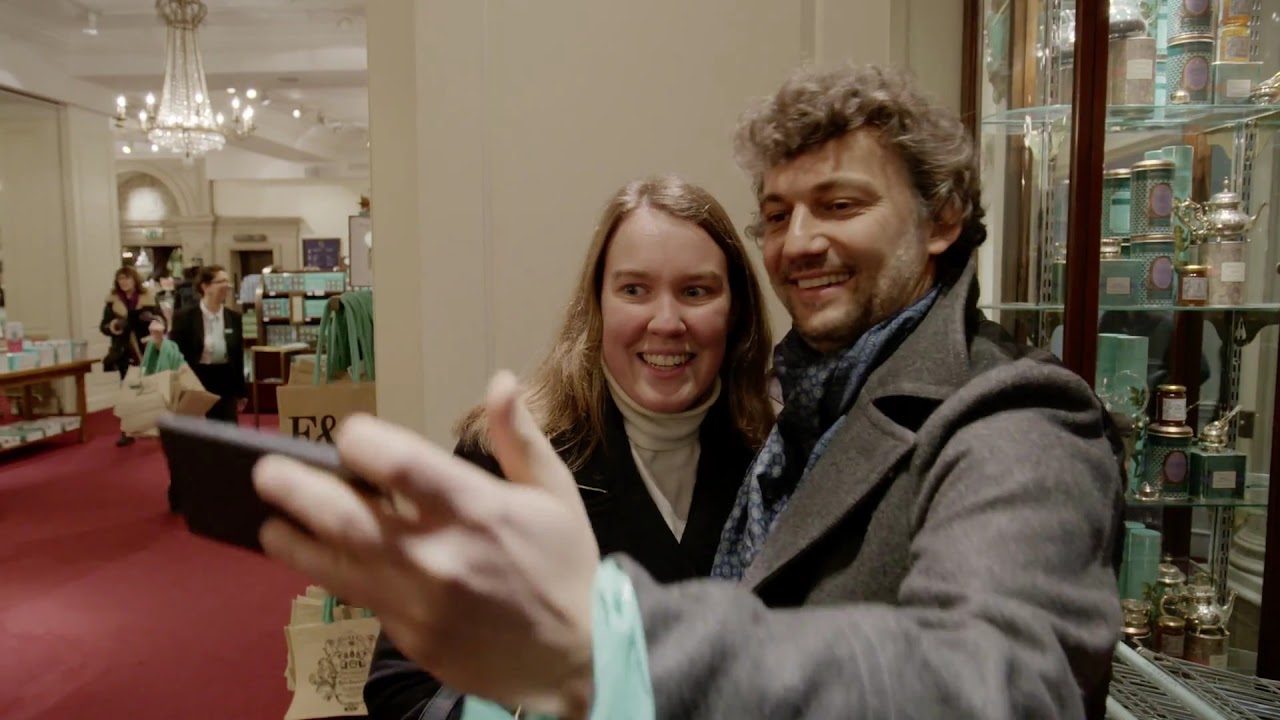
One giant selfie ! Jonas Kaufman Tenor for the Ages, hagiography not documentary. The Curse of Celebrity.  It's not JK's fault.  When marketing hype takes over, the artist becomes Commercial Product, his art incidental by-product.  Kaufmann truly is one of the greats. "A singer who thinks" as Antonio Pappano "with matinee idol presence". Absolutely. We're incredibly lucky to have JK, he's more than just a singer.  But this film, by John Bridcut, is  embarrassing, catering to a market that thrives on hype.  So, love JK, don't love the promo video.
True fans love the artist, and love the art. They don't bitch if he cancels even if they lose money because they understand voice and don't expect singers to deliver like machines.  They aren't obsessives who push themselves above all else,  it's not good for  mental health.  JK is so charismatic that his personality is magnetic, which is something to celebrate.  Nothing wrong with being sexy, either.  But knicker throwing is daft, and the media types who play it up are cynical manipulators, who care more for clicks than quality.
It was good to see the dressing rooms at the Royal Opera House again and recall the buzz that goes into making a production.  Antonio
Pappano's enthusiasm is always fun. And it was good to hear the clips of the Vienna Tosca where things might not have gone to plan.  JK is a genuine artists whose love for repertoire spurs him on to new challenges.  Taking JK to Aldeburgh struck me more as a thing than a serious attempt on JK's part to take on Peter Grimes. But who knows ? JK has the intelligence to realize that it's always prima the repertoire, and how it can be explored. Sadly not many get that  Please read my piece on  JK's Mahler Das Lied von der Erde. No-one is so expert that they know everything and don't need to learn.  But a lot of the script seemed geared towards the mantra that art can't be taken seriously.. 

 Thank goodness that the show was followed by real opera,  Verdi Otello at the Royal Opera House, good enough to convert anyone to the genre if they care enough to listen and pay attention.  Here is a link to the thoughtful review in Opera Today of the live performance. Please read and enjoy. The range lies low, so it suits JK well : If his interpretation wasn't macho, so what ?  Otello's a much more complex figure than macho man. Delicious singing !

.  

Tuesday, 8 December 2015

No plaster saint : Verdi Giovanna d'Arco La Scala Netrebko Chailly


Verdi Giovanna d'Arco at Teatro alla Scala, Milan, starting the new season. Primas at La Scala are a state occasion, attended by the President of Italy and other dignitaries. This year was even more special because, after a long run of Barenboim and German opera, the focus was on Giuseppe Verdi and on Riccardo Chailly, La Scala's "favourite son", who started his career there more than 40 years ago, mentored by Claudio Abbado.  Chailly has conducted Giovanna d'Arco many times before, but this performance  outstripped expectations : totally committed, utterly magnificent

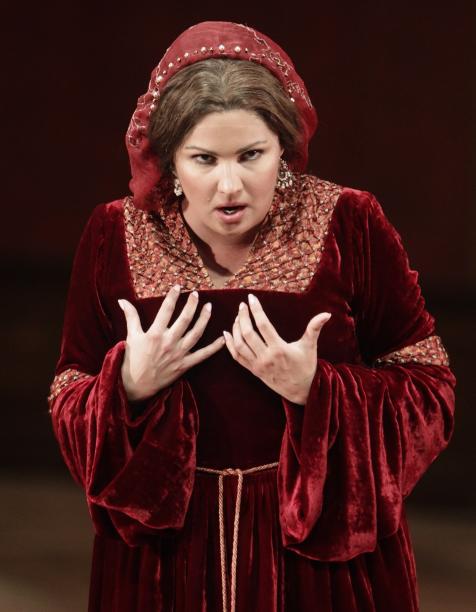
Giovanna d'Arco is sometimes described as flawed but this performance shows its true worth. The production, directed by Moshe Leiser and Patrice Caurier, deals with the deeper levels in the story. Anna Netrebko is fast making the role her own.  Giovanna isn't a glamour figure, but Netrebko makes the part glow, as if, like the saint, she's transfigured from within. This Joan of Arc is  vividly portrayed, so inspired by her mission that even her father thinks she's possessed by supernatural forces.  No plaster saint, but a personality with depth and conviction, as worthy as any Verdi heroine.

The prologue plays over a stage lit so all we can see is black and white. This forest is a forest of ideas, where nothing is really black and white. Joan of Arc is revered as a saint but was burned at the stake for heresy.. Nowadays, hearing voices would get Giovanna  medicated into stupor.  Invisible voices rouse her. The dark room fills with colour.  From this materializes Carlos VII, (Francesco Meli), a vision of gleaming gold.  The idea of a king appealing to a simple girl thus makes psychological sense. The crowd, however, don't understand. Verdi writes hellfire into the orchestration, whips of sound rising like the flames which will eventually destroy Giovanna's body but not her soul.  Unlike the chorus, Giovanna is paying attention. Carlo's long aria inspires her to rip her nightgown into a makeshift tunic and cut off her hair. Even as baby-faced gamine, Netrebko looks right. And then she sings "Oh ben s'addice questo, Torbido cielo" and we hear Netrebko transform into the saviour of her nation. The set lights up like a medieval church and Netrebko dons the golden armour Carlo was not worthy to wear.

In Act II, Verdi focuses on Giacomo, and on a father's anxieties, even at this moment of triumph. We see the populace, and soldiers in armour, and glimpses of Rheims cathedral, yet we also see Giovanna's bed. For Giacomo, the real drama revolves around his daughter's soul. Patriot as he is, he's a parent above all. The crowds mill round, but for Giacomo (Devid Cecconi) the bed is a symbol.  The bed is also is a consideration which matters in an opera which makes so much of the idea that the king wants to marry Giovanna. Lit with white light, the bed reminds us that Giovanna's soul is pure and will remain forever virginal. Modern minds might detect psycho-sexual complexities in  Giovanna's actions. Perhaps Verdi intuited as much, for he wrote the demon chorus "Fuggi, o donna maledetta", here illustrated by blood-red  monsters with with phallic horns.

Captured, Giovanna, relives her past victories in her imagination. The crowd dress her in gold plated armour, for she is, indeed, protected by the justice of her mission.  Now we see the towers of the Cathedral rise up, and Carlo VII astride a golden horse. But Giovanna is facing death. Soon, though, she divests herself of the worldly glory the armour represents. We see Netrebko again in a simple white shift.

But  Giovanna d'Arco is not  religious or even particularly spiritual.  The plot diverges greatly from what we know of the historical record.  Verdi's librettist was Temistocle Solera, who gave the composer Nabucco and I Lombardi, with their coded references to political liberation.   Giovanna hears the sounds of battle, and only towards the very end dedicates herself to the Virgin Mary (who is, tellingly, a plaster saint in this production). Thus we don't see flames, or a show trial. This isn't the director's fault. Verdi himself  created the final act so it unfolds through a series of dialogues between Giovanna and Giacomo, which could not possibly happen in real time.  Even at this point Giacomo seems more bothered by his daughter's virginity than her imminent death. Vocally, Netrebko and Cecconi bounce off each other so well that literal reality isn't relevant., Instead we have emotional truth, which is far more powerful and closer to Verdi's fundamental ideas. Giacomo comes at last to understand Giovanna's sacrifice, and Carlo VII to respect her for what she's done for France  Then, at last, can Giovanna be released from mortal concerns, and rise up to the skies, vivid blue like the cloak of the Virgin, only brighter, stronger  and more gem-like. 

Photos : Brescio-Amisano, Teatro alla Scala

Tuesday, 10 November 2015

Verdi's ironies : a thoughtful Force of Destiny, ENO


At the ENO Verdi The Force of Destiny last night someone remarked: "What pretty tunes! Why can't the show be cheery?" Perhaps that's the measure of audiences today, but, quite inadvertently, this stabbed through to the heart of what Verdi might have intended. The music in the Overture surges, as a screaming protest at La forza del destino - relentless fate - a folly which destroys individuals, families, whole nations.  Yet in the midst of this carnage, the Fate theme dances seductively. Is it a "pretty tune" or something disturbing?

Is Verdi telling us that appearances deceive?  The Marquis of Calatrava (Matthew Best) hates Don Alvaro with an irrational fury because Don Alvaro (Gwyn Hughes Jones)  is a half breed. Identities constantly change. Don Carlo (Anthony Michaels-Moore) impersonates a student. Don Alvaro becomes Friar Raffaello. Leonore (Tamara Wilson)  becomes a mysterious hermit but chooses a male monastery. Delusion dominates, not reason.  Don Carlo has been hunting a half breed for years but whern he meets his soldier friend, he doesn't notice ? So much for blind prejudice.  He's obsessed to psychotic extremes even though he doesn't actually know what really happened, or care enough to find out.  The monk, too, collude in delusion, too cowed to wonder why the hermit must be shielded. They're obeying orders. Like soldiers, like Don Carlo, like the racist Marquis, they get caught in the lockstep of doing as they're told, without thinking for themselves.

What is war itself, but delusion on a grand scale? Preziosilla (Rinat Shaham) isn't a simple
gypsy.   Her very first words are "Viva la guerra" . She whips the crowd into bloodthirsty frenzy. Yet as a war widow and a teller of fortunes, she ought to know better. She has a pretty name but a malevolent, almost demonic presence. Wars don't happen without folks like this.  Verdi didn't, I think, write the part to give a bit of tacky local colour. In la forza del destino, the delusions of society are complicit in its destruction.  Even the Church, which distributes alms but not the genuine piety that Jesus taught, "Love their neighbour as thyself". When Friar Melitone (Andrew Shore) tells a woman tthat she could solve her problems by having fewer children, he's being realistic. In Verdi's time, such sentiments would have been even close to blasphemy for they suggest that God doesn't control fate, butb that human beings have responsibility, too.  Melitone has a mellifluous name but it's not ironic like Preziosilla's. He is not a villain but the voice of reason. Suffering is wrong, it should upset us.

Calixto Bieito's La forza del destino is deeply perceptive because it addresses the fundamental forces whch shape what we might call destiny, but which might lie in the human psyche  and an almost Nietzschean will for evil. His Spanish Civil War references are relevant, though probably lost on English-speaking audiences. In any case, they're fairly generic. The focus remains on the Calatrava mania for mindless vendetta.   So we don't see Don Carlo stab Leonore ? She dies because she's caught up in the emotional barbed wire of the craziness around her. By sacrificing herself, she redeems Don Alvaro. Her actions thus break the cycle of selfish, obsessive hatred which has really destroyed the proud house of Calatrava.

The set, designed by Rebecca Ringst, is very effective - Spanish-style facades, seen in strange angles, their underpinning revealed. Video projections (Sarah Derendinger)  suggest what Don Alvaro,and Leonore might have been as children, developing their backstories more than the libretto does, but extend our appreciation of the characters. A little girl draws crazy circles with a mechanical hand: Leonore didn't love Don Alvaro enough to run from her father when she had the chance.

This ENO Force of Destiny moves on to the Met as La forza del destino, which is perhaps why it's fairly muted, and includes a cast of Americans and honorary Americans like Anthony Michaels-Moore. Tamara Wilson created the part of Leonore well, nice warm roundness in her voice, emphasizing the savagery of her fate. Gwyn Hughes Jones sang Don Carlo  even more persuasively. His voice is a treasure, and he has great acting skills, No surprise that he's an ENO favourite, and a reason why the ENO, with its programme of supporting singers with an English (or Welsh) background is to be welcomed. So Wilson and Hughes Jones are generously proportioned? So are their voices, which is what opera is about. It's theatre, the art of imagination, not legally binding documentary. In any case, the theme of feast and fasting runs throughout the opera. Leonore and her father are at dinner when he gets killed. Friar Melitone feeds the starving, though not enough to make them whole. In the monastery, Leonore and Don Alvaro pray and fast but they will not solve their problems until they find spiritual resolution.

If opera should merely be a collection of pretty tunes, then a drama about hate, war and madness  should merit pretty staging.  But Bieito's production deals with the drama and the irony that runs throughout.  Bieito's La Forza del Destino isn't pretty though it's not outrageous. But anyone genuinely interested in Verdi, and the ideas and emotions that motivated him, will do well to learn from this production.

Thursday, 8 January 2015

Why I love the ROH Un ballo in maschera

"At last" said a man in the audience at Verdi Un ballo in maschera at the Royal Opera House, "a production there's nothing to boo about" though, pf course, some sections of the audience like getting incandesant with hate, and would feel cheated if they didn't get that rush of livid adrenaline.  Most of us, however, go to opera because we might learn something about art itself.  At first, I could hardly believe my eyes, seeing 19th century stagecraft and semaphore acting to match. The man sitting beside me fell asleep. I wanted to join him. Then it dawned on me that that was exactly the intention.

Katharina Thoma got slammed for her Glyndebourne Ariadne auf Naxos because it was too demanding. "We British don't like intellectuals,"someone said at the time. So this time, she gave the audience the bog standard they claim to love.  Or did she, really?

This production appeals to those who think opera must be as literal as possible. But  what if art exists to stimulate our minds, and to make us think and feel more deeply about life?  Is art a commodity that can be consumed, like fast food, or does it exist for its own sake? Throughout history, true artists have often been innovators. Now, mass audiences hold sway: people don't want truth but the confirmation that their version of truth cannot be challenged.  So, on the surface, this Un ballo gave a large part of the audience just what they wanted – no ideas, no perspective. Conversely, an even larger part of the audience was numbed into disbelief. Could anything outside the Met be quite that mindless? While seeming to pander to the anti-intellectual wing of the opera world, Thoma makes a good case for opera with ideas.

A good director once told me, always think of characters, how they came to be where they are and why they feel as they do. The libretto and score, in this case, give precious little to go on, though a lot could be made of the relationship between Riccardo and Renato. And why is Oscar a trouser role ? Maybe the old production with revealing yellow skin-tight pants was saying something significant!  Why do supposedly rational people need to consult soothsayers? Many questions. Dramatic interpretation gives clues to answers. But oh, no, we don't like ideas and, above all, not German ideas. So in this Un ballo, we get a supposedly ideas-free experience.

As I watched, I enjoyed seeing the dynamic between Joseph Calleja and Dmitri Hvorostovsky They were singing the right words, but were playing themselves, not their roles. There's a difference. Both are perfectly capable of inhabiting characters but here they were being stage personalities having a good time interacting with each other. Art about the making of art!  So the staging with its archaic painted screens was making a statement: this is drama, not realism.  At least this production had nice colours unlike the last one, which Rupert Christiansen  rightly called "ugly and obtuse". At least we didn't have the horror of blackface extras pretending to be voodoo slaves, which has been done in the past. Whatever the synopsis says, the opera isn't about Boston, even long ago.

Thoma's Un ballo in maschera connects to theatre traditions of the past, not just in the physical sets and park-and-bark acting, but in its references to French grand opera, which still dominated Europe at the time Verdi was writing. The libretto is an adaptation of a score written by Eugene Scribe for Daniel d'Auber only 25 years before.  Hence the Gothic Camp of the midnight scene, which references the taste of the time for crypts, funerary marble and dancing corpses. Thoma didn't invent the soothsayer, who is in the libretto, and looks like a witch in most productions, including the one by Calixto Bieito, where she looks exactly like Rebekah Brooks, though the staging precedes the News International scandal).  Oscar appears in a costume from the "wrong" period, another link to stagings of the past. As I've mentioned, a very odd character indeed.Small photo shows Pavarotti and an Oscar of his time.

There are two more performances to come at the Royal Opera House. This is such refined satire that I wish I could manage to go again. Please read my review of the premiere of the ROH Un ballo in maschera  HERE. "Tales from the Crypt"

Photo of Joseph Calleja, copyright C. Ashmore 2014, courtesy Royal Opera House

Friday, 19 December 2014

Tales from the Crypt - Un ballo in maschera, Royal Opera House


Verdi Un ballo in maschera at the Royal Opera House  - a masked ball in every sense, where nothing is quite what it seems. On the surface, this new production appears quaint and undemanding.  It uses painted flats, for example, pulled back and forth across, as in toy theatre. The scenes painted on them are vaguely generic, depicting neither Boston nor Stockholm, where the tale supposedly takes place. Instead, we focus on Verdi, and on theatre practices of the past. In other words, opera as the art of illusion, not an attempt to replicate reality. Take this production too literally and you'll miss the wit and intelligence behind it. Although the designs may seem retro, it is as conceptually radical as  any minimalist "modern" production. What it demonstrates is that good opera lies not in external decoration  but in creative imagination.

This Un ballo in m,aschera also works extremely well because it places full focus on the singing. The drama unfolds through a series of showpieces, providing the singers with opportunities to display their skills. It's perfect for artists like Joseph Calleja  and Dmitri Hvorostovsky,  both of them highly charismatic personalities. They created Riccardo and Renato as convincing characters, but, perhaps even more unusually, ctreated a powerful dynmaic between themselves as artists.The bond between them felt personal and energizing, and went far further than  good singing. They seemed to be challenging each other with evident glee.  One star turn after another, carried off with exuberance.  Calleja's natural warmth suffused his portrayal of Riccardo, adding elements of good nature and good humour, which go a long way in overcoming the weaknesses in the plot. Calleja doesn't need to act in a naturalistic fashion: he makes you feel that under the costume beats the heart of a sturdy, ardent Maltese tenor.

This is very much a "singer's opera" so the other parts are strongly cast.  Liudmyla Monastyrska. sang Amelia, over whom Riccardo and Renato fall out. There isn't much character development for the part in the libretto, so Monastyrska fills it out with the feminine timbre of her singing.  Serena Gamberoni, as Oscar, Riccardo's page, was impressive. She replaced Rosemary Joshua, who is unwell, but has put her own individual stamp on the role, When Gamberoni sings the "laughter" passages, her voice sparkles with agility and energy.  Anatoli Sivko sang Samuel and Jihoon Kim sang Tom.  It's interesting how little background detail the score gives about the parts, but  Siv ko and Kim sang with such clear conviction that the roles had genuine conviction. They felt like parrallel versions of Renato and Riccardo. Marianne Cornetti sings Ulrica, a delicious part that must be fun to sing. .

Katharina Thoma directed Richard Strauss Ariadne auf Naxos for Glyndebourne in 2013. Read my analysis here.  On a superficial level, this Un ballo in maschera and Ariadne auf  Naxos might seem very different, but Thoma is far too adept to be doing a sudden change of style. Ariadne auf Naxos is a satire on the making of an opera, juxtaposing the "reality" of the players and the opera they are contracted to take part in. In Un ballo in maschera, Thoma balances  the "reality" of cast and staging with  the way they are used to create performance. The acting is somewhat stlylised by modern standards, but that fits the meticulously archaic use of stage equipment. At one point, stagehands fold up the flats we've just been admiring: art and artifice at once.  This studied theatricality pays off brilliantly in the scene where Amelia goes to the graveyard to consult Ulrica, the soothsayer. This is a glorious bit of Gothic High Camp, with graves, urns, weeping willows and statues that come alive and dance.  Verdi's libretto was an adaptation of a play by Eugene Scribe. Hence the similarity to Scribe's libretto for Meyerbeer Robert le Diable. Horror movies entertain when they're so bad, they're good. Part of the fun is the frisson of implausibility.  After the performance, I bumped into someone whose taste in opera is impeccable. He was delighted: "Funny, yet not offensive". Thoma's Un ballo in maschera is a lot more subversive  - and thoughtful - than meets the eye. But is satire over the heads of the audience ?


Photos : Catherine Ashmore, courtesy Royal Opera House

Wednesday, 15 October 2014

Plácido Domingo Verdi I due Foscari Royal Opera House

"Why should I go to hear Plácido Domingo" someone said when the Royal Opera House Verdi I due Foscari was announced.  There are very good reasons for doing so. First, Plácido Domingo is an icon. Even past his prime, he has such presence that he can present a role with style. When he does retire, we can look back and say we were there.  Secondly, Francesco Foscari is a role that doesn't present extreme vocal demands. Domingo didn't go much out of range. Foscari is an old man, worn out by tragedy and the intrigues of state. Sounding pinched and dry is part of the character. Domingo knows how to marshall his reserves. At the end, the old man rages against the city and the fates that have destroyed him. Mellifluous sounds would be inappropriate. Domingo sings with such intensity that it feels like a statement. We shouldn't shaft old Doges because they aren't what they were, any more than we should shaft Father Figures like Plácido Domingo. The Council of Ten might be ungrateful, but I, for one, treasured his performance.

Domingo's presence in Los Angeles honours the city, just as a great Doge would have honoured Venice. That's perhaps why the Royal Opera House brought this production to London, so we could enjoy Domingo once again in a role he can still achieve well. The narrative is bleak and sombre. There aren't all that many flashy "big moments" for Antonio Pappano to whip the orchestra into full Verdian glory. The set (designs by Kevin Knight, with costumes by Mattie Ulrich) thus serve to distract from the opera itself. We delight in the gorgeous jewel colours that show Venice at its gaudy best.  But the gem is flawed. The city is rent by vicious intrigue. The Doge is destrotyed in a way that would hurt the most: his last son is accused, exiled and dies. It's not a pretty story. Still, we can fantasize, like the crowds in the piazza watching the circus acrobats and fire-eaters doing their tricks. What a brilliant metaphor! Even at this early age, was Verdi making oblique statements?

Wonderful atmospheric lighting by Bruno Poet, whose lighting suggests mists descending on the city, enveloping it in gloom. Most of the effects are created by video projections. so the set travels well. Just as the invention of electric light changed opera, video allows infinitely greater possibilities than, say, painted flats.  The art comes in using technique well. Here, though,  we see a backdrop of waves, which might have been exciting in Los Angeles, but London audiences would recognize as the backdrop to Birtwistle's The Minotaur. Numerous other projections onto cloth, which seem to be done by fairly basic oil and water washes projected onto cloth. The giant face of the Lion of Venice doesn't do as it's told. Maybe there's a very subtle truth in that but the production isn't quite that deep. The projections dissolve as the cloth is lowered, clumsily, into a hole in the floor. Apart from the nice costumes, the production feels minor house. Thaddeus Strassberger, an American, is director, but there's not much direction as such. The singers strike am-dram theatrical poses, but since the production revolves entirely around Plácido Domingo, there's probably little need to develop the other roles as drama.

Vocally, Maria Agresta's Lucrezia Contarini.was the high point of the evening.What a pure, clean voice, capable of passionate conviction. Agresta and Francesco Meli, who sings Jacopo Foscari, provided the vocal colour otherwise in short supply, in an opera that depicts a harsh, repressive regime.  When Agresta and Meli sang their final duet, the opera came to life. That said, though, Maurizio Muraro, singing Jacopo Loredano, member of the Council of Ten, impressed with the authoritative richness in his voice. The other members of the Council,and the rows of women in white, priests, servants and so on, operate anonymously, which is perhaps right, but Muraro's Loredano has power and individuality. So, yes, go to this I due Foscari, for Plácido Domingo, around whom it's all been created.

Photos :Catherine Ashmore, courtesy Royal Opera House, details embedded. 

Thursday, 21 August 2014

Anna Netrebko Il trovatore Salzburg

Interviewed by Austrian TV just before her performnac as Leonora in Verdi Il Trovatore at Salzburg, Anna Netrebko says "Leave me alone!" She's made up and costumed just before curtain call and the interviewer asks her auf Deutsch about the difficulties of the role. "That's why I need to concentrate in this hour, I don't need lots of people around." But she's gracious and smiles and gives the guy something for the camera.

Singing Leonora "is difficult because it needs such a range, and several styles, over two octaves, from a light coloratura to almost mezzo soprano. So it's better that I can concentrate  and be careful with my vocal technique."  In this production she plays two roles, a woman in a  museum and Leonora. "This is a good idea. It has a modern twist and it looks very beautiful aesthetically and it doesn't disturb the music, which is the most important thing of all."

When Netrebko was younger she used to draw and paint. She would still do so if she could but she's just too busy. "No time, no inspiration - if you have no inspiration, then it's mmmmmmm" she smiles.  Watch the production on medici TV here.


Monday, 31 March 2014

Royal Opera House 2014-15 season analysed


The Royal Opera House's 2014-15 season is a good balance of artistic venture and business savvy. London must be doing something right with sales running at 96% capacity and HD broadcast attendance running neck and neck with live performances. When opera houses and orchestras seem to be imploding elsewhere, it's worth taking careful note of the ROH strategy.

Seven new productions in the main house, plus others in the Linbury Studio, mixed with regular revivals.  In tough times, it's easy for houses to play safe but that is not good for the long term health of the arts. The Royal Opera House thus offers a well-planned balance of familiar and new

Shock! Horror! the new season opens in September not with a glizty gala but with something truly provocative - Mark Anthony Turnage's Anna Nicole. Not only that, but with prices max £25. The catch is students only but that's a positive. It will get the kids into the house on their own terms with their own peers.  BRILLIANT idea. No doubt there will be spoilsports who think young people shouldn't be exposed to four-letter words, but that's patronizing. Kids are sharper than they get credit for. Do-gooding "outreach" means zilch if you don't trust kids to think for themselves. What happened to Anna Nicole was obscene and Turnage tells it like it is. Although I didn't like it at its premiere Anna Nicole grew on me the more times I heard it. I'm going again and taking a whole bunch of under 30's. Read more HERE.
 
Other revivals include Der fliegende Holländer with Bryn Terfel, Adrianna Pieczonka  and Andris Nelsons - definitely not to be sniffed at! Terfel is also singing his signature Dulcamara in Donizetti L'elisir d'amore. I'm also looking forward to Tristan und Isolde with Stephen Gould and Nina Stemme in the greatly misunderstood Christof Loy production, the first ROH production to face orchestrated booing. Booing is intimidation, the denial of artistic expression. But I guess those who get their kicks from bullying will be out in force. Read my "More tradition than meets the eye" HERE and  HERE.

 Very exciting fare for those who like interesting repertoire:

1. Umberto Giordano Andrea Chénier with Jonas Kaufmann, making his role debut. Any role debut with Kaufmann is big news, and he can probably do this notoriously difficult part better than anyone else in the business these days. This opera isn't standard rep because it's hard to pull off without ideal singers but with this cast (Kaufmann, Eva-Maria Westbroek and Željko Lučić) the ROH will probably leave the Met's current production for dead. Antonio Pappano conducts  He's been  confirmed Music Director "at least" until the end of the 2017 season.

2  Karol Szymanowski's Król Roger with Mariusz Kwiecień . The music in this opera is ravishingly beautiful, expressing the love that dares not tell its name. It's a fabulous opera but its depths aren't often plumbed as deeply - and disturbingly - as they could be. Kwiecień pretty much "owns" the part of Król Roger, the king hypnotized by a beautiful, mysterious stranger. I can't imagine Kwiecień being coy.  Kaspar Holten directs, which I think bodes well. 

3 Rossini Guillaume Tell, is one of the hallmarks of Antonio Pappano's career : Listen to his recording with his Rome band, the Accademia di Santa Cecilia.  He's bringing the same soloists to London - Gerald Finley, John Osborn and Malin Byström. We are in for a treat. This is another opera that's not easy to stage but will be directed by Damiano Michieletto. This is the French version of an opera by an Italian  It's not so much "about" Switzerland (which has French, Italian and German -speaking communities) but about freedom, the essence of creative art..

4  Verdi I due Foscaro . "Maybe", says Pappano, "not one of Verdi's finest works but important because it deals with an elderly father, who's seen a lot about life". Which may suit Plácido Domingo at this stage of his career - life imitating art. Francesco Meli sings the son and Maria Argesta (handpicked by Pappano in Italy), sings the son's wife.

5 Kurt Weill/Bertolt Brecht The Rise and Fall of the City of Mahagonny.  Kasper Holten says he wants to do a lot more operas from the first part of the 20th century, which should be really interesting. What lies in store in future years ?  A Janáček project, he hints. Possibly more? Rupert Christiansen complained that there was too much Italian repertoire and no Russian. So what, I thought. We can't have everything all the time.  We've had Lady Macbeth of Mtensk, The Tsar's Bride, Tsar Saltan and Eugene Onegin. This year we have Król Roger (in Polish) , decidedly "East" German Brecht and Weill and Czech/Moravian Janáček to come. Mahagonny is an excellent choice because it's quite flamboyant by Brecht standards, with big choruses and bizarre situations. John Fulljames should bring out its subversive anarchy well. 

6. Verdi Un Ballo in maschera. with Calleja, Hvorostovsky, Monastryka and Serafin. Worth going to for the singing alone. The director is Katharina Thoma, so be prepared for erudite, intelligent  dramaturgy. She does not dumb down: we're well advised to study the score as carefully as she does. 

7. Mozart Idomeneo with Matthew Polenzani, conducted by period specialist Marc Minkowski, in his debut at the Royal Opera House - hooray ! Director is Martin Kušej whose work in Zurich sticks in  my mind. Should we expect feathers?

 8. Philip Glass The Trial (based on Kafka) - specially commissioned for Music Theatre Wales, with which the ROH has a long and fruitful partnership . Lots on MTW and Glass on this site - please explore).

9. Harrison Birtwistle The Cure, a co-commission with the Aldeburgh Festival, with support from the London Sinfonietta, paired with Birtwistle's The Corridor, which I heard at Aldeburgh a few years ago.

10. The Royal Opera House's role in promoting British opera should not be underestimated. That's MUCH more important than promoting Russian opera! The ROH is also presenting David Sawer's Rumplestiltskin (read more here)  and The  Lighthouse Keepers.  Sawer is emerging as a genuine talent, so don't miss this double bill when it reaches the Linbury next year. This is a joint ROH/BCMG venture. Don't underestimate the importance of these partnerships.

11. Monteverdi L'Orfeo at the Roundhouse. This is significant because it links ROH's stagecraft expertise with the Roundhouse's extensive work with students and young people, which I've written about in some depth here.


photo of Pappano and Holten, : Johann Person, photo of Eva Maria Westbroek : Bill Cooper

Wednesday, 9 October 2013

Verdi 200 Birthday BBC Radio 3

Giuseppe Verdi's 200th birthday tonight.  Celebrations have already started.

On Monday (with five days still to listen) Don Carlo from Salzburg with Jonas Kaufmann and Anja Harteros. Although the performance took place only a few weeks ago, it is so good that it's already spoken of as being one of the classics. Read my review of the filmed broadcast.

More Kaufmann and Harteros  in Il trovatore from Munich, on Saturday. .Sacrilegious thought : how similar this plot is to Fidelio! But that only goes to show, yet again, that good ideas can transport freely.

Anna Netrebko on Thursday, in Verdi's  Giovanna d'Arco, also from Salzburg. This opera is one of my favourites because I like Joan of Arc (and have been doing a series on her various incarnations in music and film).  Read more about another performance of Giovanna d'Arco HERE.

Throughout this week, Verdi will fill BBC Radio 3's afternoon slot at 1400, and "Composer of the Week". Also various talks and studies, some more promising than others. The BBC has, in fact, been broadcasting Verdi all year as part of the Verdi 200 series. Nearly every opera and non-operatic work has been or will be broadcast online. The Proms were a bit of an anomaly but also not so surprising when you really think about it. Good Verdi needs to be done very well indeed, and costs money, and good Verdi stagings don't come cheap, and there's a lot more Verdi around than Wagner. Besides, I'm glad that the BBC Proms splashed out to the max with Wagner. It was much more fun than if they'd timidly spread themselves too thin.

Friday, 6 September 2013

Calleja Xian Zhang Verdi Tchaikovsky Prom 72

Joseph Calleja, perennial favourite, made BBC Prom 72 one of the hottest tickets in the whole 2013 season. And how he delivered, gorgeously ! But this week's furore about Vasily Petrenko's views on women will shift emphasis in the press to the conductor, Xian Zhang. More about her below, but first, Calleja and his singing. . 

Calleja's voice glowed with richness, enhanced by his intuitive, natural gift for drama.  Interesting repertoire, too. "O dolore ! Ed io vivea" from Attila, where he shaped the legato so smoothly he made it sound easy. Wonderfully judged crescendi at the end. Then, "À toi que j'ai chérie" from Les vêpres siciliennes. Calleja's so thoroughly Italianate that  it was hard to tell he was singing in French, but he conveyed meaning clearly enough. Although the Italian version of the opera is well known, this was a reminder of why any true Verdian will want to hear it in the original French and performed in idiomatic French style. This October, the Royal Opera House is presenting Les vêpres siciliennes. with a superlative cast, headed by Bryan Hymel. Calleja and Hymel have very different voices, but Hymel has no equal for the clarion purity of his idiomatic French.
Calleja was back at his best with 'O inferno! ... Sento avvampar nell'anima'  from Simon Boccanegra and 'O fede negar potessi' from Luisa Miller.After these stunning arias, he could relax a bit and let Verdi do the work. Everyone, but everyone, loves La donna è mobile, and Calleja sang it with a flourish. This was a BBC Prom. This time, we didn't need the callous menace with which the Duke of Mantua tosses the song off in the context of the opera. It was enough that we were in the presence of Calleja, in glorious form.

Xian Zhang conducted the Orchestra Sinfonica di Milano Giuseppe Verdi (Laverdi). Despite its name and home town, it's not, strictly speaking, an opera orchestra. Founded in 1993, its repertoire is broad and wide ranging. Xian Zhang conducted La Bohème at the ENO in London in 2007 with mixed results (review here) but  five years on, she seems more assured. The Overture to La forza del destino has great dramatic impact, for that's the nature of the piece. The 'Triumphal March' from Aida was less triumphant, rather too polite and restrained. But at the Proms, we don't need to be reminded of the barbarism with which the Egyptians conquered their enemies.

The real challenge came with Tchaikovsky's Manfred Symphony. It's a huge beast, nearly an hour long, full of extremes. It was inspired by Byron's poem Manfred which tells of a hero confronting supernatural demonic forces in a cosmic struggle that takes place in the Alps. In Byron's time, the Alps symbolized danger, the vastness of nature dwarfing humankind. Schumann's Manfred is Romantic in the true, wild Germanic sense. Tchaikovsky, however. was Russian and a man of the ballet, so it's important to stress the more lyrical side of the symphony as Zhang does. Refined string playing, suggesting mists perhaps, or the babbling of mountain springs? Her attention to detail allowed us to appreciate the vernal elements in the score - woodwinds like birdsong - that make the second movement so magical.

In the third movement, she defined the dances with vigour: mountain folk are made of tough stuff, and so, too, I suspect is Xian Zhang. So the Allegro con fuoco was appropriately bizarre, sounds crashing against each other as if the earth itself was imploding,"fire" pouring forth from the rapid rivulets of sound.  The finale was grand indeed, the organ heralding a new, uplifting mood.

It's very ironic that Zhang should have conducted Tchaikovsky's Manfred at her Proms debut. Guess who conducted it in 2010? Vasily Petrenko! That performance was exceptionally vivid. Good as she is, Zhang isn't quite that good, but it's NOT because she's a woman. Conductors are different because they're individuals. They're not defined by their anatomy. All this fuss about female conductors is irrelevant. We shouldn't be making a fuss of Zhang because she's a woman. That would be demeaning. We should be making a fuss of her because she's good. Maybe not mega world class, let's not get carried away, but good. Watch the TV broadcast on BBCTV4 so you can see the interaction between the orchestra and conductor. None of the players seem distracted by "erotic" thoughts. They are musicians, their minds are on the music.
 
photo of Xian Zhang credit : Nora Roitberg

Monday, 22 July 2013

Viva Verdi Pappano Prom 12

Antonio Pappano's Viva Verdi! Prom 12 gave Verdi's non-operatic work the attention it deserves. It was much more stimulating than yet another opera, which we can hear any time. The Quatro Pezzi Sacrae (Four Sacred Pieces) are a special occasion. The Accademia Nazionale di Santa Cecilia, Rome (Academy of St Cecilia) always brings out the best in him. Pappano is the kind of guy who gets  excited about his enthusiasms, but the Accademia seem to share his passions. They share the same sense of adventure and stylish panache. There's a lot to be said for orchestras that don't play the same blockbusters all the time. And, dare I say it, they're Italian. Style is in their genes. 

Verdi wasn't pious. But he knew the role of religion in Italian culture, and what the Virgin Mary might symbolize. Church and Theatre aren't really so very different in Catholic Italy where pageantry and display are an inextricable part of the liturgy. The Chorus of the Accademia sang the Ave Maria with panache.While the piece (which dates from 1889) might seem conventionally reverent one wonders if it's really Church music at all. The lines move with sensuous grace, and the singers intone "Maria!" letting the vowels elide.

With the Stabat Mater (1896) we hear Verdi in more characteristic mode. . Dramatic opening chords that dissipate in beautiful descending lines,  pulled forward by surging dark strings. Suddenly the tempo changes. Trumpets sound. A dizzying climax. Then, instead of action, Verdi gives us contemplative pianissimo. The trombones call. One hears "footsteps" in the music, visualizing a large ensemble on stage, moving en bloc. Flutes flutter upwards. Bassoons, celli and low strings suggest downward movement. Christ's soul rises to the heavens, while his body hangs limp on the Cross.
Exquisitely luminous singing from the ladies of the Accademia chorus for the Laudi alla Vergine. Glossy textures, but strong underlying form. 

The Te Deum, though was the highlight. The male voices sang quietly, then orchestra and choirs exploded in a blaze of glory, which Pappano tightly reined in. He showed how Verdi builds up the excitement to bursting point.  Quiet reverential passages suggested anticipation, alternating with moments of expressive relief. Trombones cried out, and the chorus sang "Tu Rex gloriae, Christe."  A soprano sang out triumphantly. Then at last the tension was released in an ecstatic explosion of glory The moment is brief and unsentimental. Verdi has made his point.

Verdi's only String Quartet arranged for string orchestra was vividly played but as music,wasn't particularly distinctive. Maria Agresta sang the short Ave Maria leading up to an extremely intense Libera Me, in the first setting before it became incorporated into the Requiem, which has featured at the Proms on 22 previous occasions. This was a very vigorous, energetic reading which suggested that the "freedom" here wasn't strictly spiritual. 

This Prom can be heard on BBC I player HERE for 7 days online. It will be broadcast on BBC Four TV on 15th August. By delicious co-incidence, that's the Feast of the Assumption of the Virgin Mary. 

Thursday, 11 July 2013

Macbeth, Blackheath Halls

Macbeth on the Heath, Blackheath Halls, that is. Blackheath is a shining example of how good community-based opera can be when it's done well. It helps that this local community includes professional musicians and singers, whose expectations are higher than elsewhere.  Many community operas are written to involve the community and children in particular : a noble ideal, which grows the long term audience. Blackheath, though, can tackle operas written for more sophisticated resources. The secret, I think, is to understand the core essentials in a work and do it well.  ".....electing for a ‘Gothic minimalist’ approach to the staging allowed the well-known story - played in the round - to unfold directly and without distraction."

The emphasis then is on the singers. A few really good leads (Miriam Murphy, Matthew Rose,
 Quentin Hayes) and a well-led cast, and there you go !  Claire Seymour was at Blackheath Halls for Verdi's Macbeth. She write about it in Opera Today (click link for full review and cast) 

She adds "This community project was launched and is driven by the passion and invention of General Manager, Keith Murray. In this ‘age of austerity’, such ventures are undoubtedly a long way down funding bodies’ list of priorities, and it takes considerable energy and commitment to get a project like this off the ground, let alone to attain such tremendous standards of professionalism year upon year. For the members of the adult and children’s choruses, the experience will have been immensely edifying and invigorating, and perhaps for some, life-changing."

Friday, 7 June 2013

Les Vêpres siciliennes changes at ROH

The Royal Opera House has announced a change of choreographer for next season's Les Vêpres siciliennes. This production would have been a highlight of the season because it would have brought together both the Royal Opera House and the Royal Ballet plus stars from the Danish Ballet, with which Kaspar Holten had connections in Copenhagen. They've been looking for a major collaboration like this for years. It would have been spectacular.

Verdi's Les Vêpres siciliennes would have been an ideal vehicle because it centres round a long ballet which is integral to the opera. The music itself is glorious. Verdi's Four Seasons might not be as famous as Vivaldi's but it's extremely well known - it's even on Youtube.  You can't have half an hour of abstract music in an opera, and the ballet reflects the composer's original intentions. If we care about Verdi, we need to hear more than the usual blockbusters. In this Verdi centenary year it's good to focus on Verdi's music in wider context.  One of the top Proms this summer will be Viva Verdi on 20/7 where Antonio Pappano will conduct an unusual Verdi programme.


"There will still be a strong element of dance in the production, however no longer featuring Artists from The Royal Ballet, The Royal Danish Ballet and students from The Royal Ballet School", says the ROH press release. The new choreographer is André de Jong. 

Being a music person, I don't know much about the dance background but Judith Mackrell, a dance critic does. Read her article here.  The choreographer who is leaving is a well-known dancer Johan Kobborg, the partner  of Alina Cojocaru, who announced recently that she's leaving the Royal Ballet at the end of the season.  Dancers don't have long shelf lives and need to make the most of their careers and good for them.  According to Mackrell,  Kobborg is "about to turn 40 and while still a dancer of intelligence and style, he's at the age when the range of his repertory has inevitably begun to diminish. He's also begun focusing on choreography – with a handful of short ballets to his name and a new production of Giselle" in New Zealand. 

"The Royal haven't ignored Kobborg's skills, commissioning his perfectly pitched production of August Bournonville's La Sylphide back in 2006. But the opportunities for him to create new work for the company are very limited. Already the Royal has its resident choreographic triumvirate (Wayne McGregor, Christopher Wheeldon and Liam Scarlett) to accommodate, along with Alastair Marriott, Kristen McNally, and a new generation of choreographic associates. Faced with such a crowded marketplace, it's not surprising that Kobborg is looking for projects elsewhere, and would ideally like the chance to direct a company."

When the Royal Ballet and the Royal Opera House merged, there were those who said that it would be hard to balance the two halves of the house at Covent Garden. Perhaps they were right.

Friday, 24 May 2013

Verdi Falstaff at Glyndebourne

"Laurent Naouri’s Sir John is imposingly wide of girth — thanks to an impressive fat-suit — and generously resounding of voice. His authoritative bellow vanquishes complaints from his snivelling underlings; with beguiling tone, he serenades and courts the ladies. There is no doubting his haughty bumptiousness and Naouri emphasises his essential aristocratic dignity. But, at times this Falstaff is overly curmudgeonly, aggrieved that others do not recognise his ‘nobility’ — an anachronistic note in 1950s England — and his irritability and crabbiness do not endear him. Naouri is light on his feet, despite the prodigious abdominal encumbrance, and can neatly execute a dainty flounce. But, while the voice is sweet and enticing, this Falstaff lacks a certain wicked sparkle in the eye and the debonair charm that might win a feminine heart regardless of his physical decrepitude. Falstaff should be both dignified and vulgar, both arrogant and aware of his own coarseness and comic crassness — he should laugh at himself, so that we can laugh with him."

"Part of the problem is Jones’ uncharacteristic lack of attention to comic detail and gesture; there are a few neat touches — the faux leave-taking courtesies of Ford and Falstaff, the obsequious pleading for forgiveness of the perfidious Bardolfo and Pistola, the tidal wave which bursts through the Fords’ front window when Falstaff tumbles from the window ledge and belly-flops into the Thames — but most of the audience laughter was prompted by the surtitles rather than the stage action itself...."

Read the FULL REVIEW here in Opera Today

Monday, 6 May 2013

Verdi Don Carlo Royal Opera House London

Is it possible to upstage Jonas Kaufmann? Kaufmann was brilliant in this Verdi Don Carlo at the Royal Opera House, London, but the rest of the cast was so good that he was but first among equals. Don Carlo is a vehicle for stars, but this time the stars were everyone on stage and in the pit. Even the solo arias, glorious as they are, grow organically out of perfect ensemble. This was a performance that brought out the true beauty of Verdi's music.

Act One started a little tentatively. Perhaps it takes time for the drama to unfold and Kaufmann knew how much was yet to come. His pacing was deft: when he needed to stun, his voice rang out with ferocious colour. This was a Don Carlo one could imagine defying the Spanish Empire, its violence and tyranny. His vocal authority was matched by physical energy. Kaufmann embodies the part perfectly. His interactions were outstanding. His voice balances well with Anja Harteros (Elisabetta) and Mariusz Kwiecień (Rodrigo), and he allowed the duets and trios to work seamlessly. No big name ego dominance.
 
Verdi  prepares us from the start for the turbulence that will meet Elizabeth of Valois. Even before she leaves home, Elisabetta experiences extreme changes of mood within a compressed period of time. Anja Harteros delineates these intense feelings deftly, without exaggeration, so they arise naturally from her singing.  When she bids goodbye to the Countess of Aremberg (Elizabeth Woods), Harteros sings as though she were bidding farewell to life itself.  Indeed she is, for Elisabetta is now alone, trapped in an alien world. Harteros creates Elisabetta with such conviction that she dominates the drama even when she is silent. Her presence is felt even when others are singing about her. When Harteros sings "Tu che le vanità", we feel that Elisabetta has reached valediction, after a long and tortured journey. She sings of Fontainebleau and her brief day of happiness so tenderly that the agony of "Addio, addio, bei sogni d' or, illusion perduta!" becomes truly overwhelming. Harteros and Kaufmann have taken these roles before together. Here, in London, they achieved transcendence.

Ferruccio Furlanetto was equally outstanding as Philip II. His years of experience in the part give him authority. Verdi writes the part to reflect the personal austerity for which the historical Philip II was known. A solo cello introduces his big aria "Ella giammai m'amò", emphasizing the King's loneliness., despite the trappings of wealth and power around him. Later, violas and basses extend the mood of melancholy. Furlanetto sings with force, but with colour and tenderness. Because he makes us feel the man beneath the public persona, we realize that the tragedy involves Philip as well as his wife and son. Furlanetto makes us realize that the king is just as much trapped by the system as they are. "Beware the Grand Inqusitor!" he cries, for the Grand Inquisitor is perhaps the only truly evil character in this opera.

Verdi introduces the Grand Inquisitor with music that exudes menace. Slow, low rumbling sounds, suggesting a snake slithering, oozing poisonous slime. Eric Halfvarson was indisposed with a cold, but this didn't affect his singing. The Grand Inquisitor is supposed to sound diseased.  "Did God not give his only Son to save the world ?". Theology is twisted for evil purposes.

Mariusz Kwiecień  was a clean voiced, muscular Rodrigo, and a perfect complement to Kaufmann's Don Carlo. The dynamic between them is very good: they're both relatively youthful and fresh. This similarity is important, for it reinforces the tragedy, and the theme of sacrifice. When  Kwiecień sings Rodrigo's last aria, "Per me giunto è il di supreme", he infuses it with warmth and love, so it connects with Elisabetta's farewell to life.

One of Béatrice Uria-Monzon's signature roles is Carmen, so when she sang the Pricess of Eboli, she brought a Carmen-like sharpness to the role, which was entirely in order. Her Veil Song was a showpiece, but the song is a mask, since the princess's true feelings are also hidden behind a veil. When she realizes her mistakes, her personality disintegrates. When  Uria-Monzon sings of the convent, she suggests the horror of living death.

Dusica Bijelic sang a sprightly Tebaldo. Even the Flemish Deputies made an impact greater than the size of their parts: extremely tight ensemble, yet individually characterized. Robert Lloyd sang the apparition of Carlo V credibly. The Royal Opera House Orchestra and chorus, always excellent, were on even better form than usual.  Verdi is Antomio Pappano's great strength. He's inspired towards a highly individual but vivid reading which emphasizes dramatic detail. He's also a singer's conductor, who lets voices breath, as we heard so admirably.

This would have been an almost perfect Verdi Don Carlo, but is lamentably let down by the production. Originally directed by Nicholas Hytner and revived this time by Paul Higgins, it was first seen at the Royal Opera House in 2008.  The designs (by Bob Crowley) feel outdated, serving little dramatic purpose. Huge expanses of space are filled with grids of holes. Perhaps these represent windows, walls or even the spying eyes that are ever present in tyrannical regimes. If the image had been developed well,  it might have enhanced the paranoia that runs through this opera. Instead, the image lies inert,  like a weak joke endlessly repeated.  In the scene where the ladies of the court listen to the Veil Song, there's a wall of red plastic cubes which look like they've descended from Legoland for no obvious reason. 
 
The greatest weakness of this Don Carlo was that the staging missed the deeper, more challenging levels of the opera.  The monastery of Yuste is depicted by the tomb of Charles V with the name "Carlos" engraved in huge letters so they can't possibly be missed.  Charles V, the Holy Roman Emperor, renounced his power and retreated into the monastery where he died ten years before the Revolt of the Netherlands.

Opera isn't history. But when a composer like Verdi adapts history for art, there is a reason. In this production, the political aspects of the story are downplayed. Even the asceticism of Charles V and Philip II is sacrificed to decorative imperative, although the words " addio, bei sogni d' or, illusion perduta!" pertain to more than Elisabetta. This is the kind of production that gives modern staging a bad reputation. Yet because it's comic book cute, it's probably popular. Staging is much more than decor. Like every other element in a production, it should contribute to meaning and drama, rather than distract. A cast of this exceptional quality deserved better.

A longer version of this review with full cast details will appear in Opera Today. 
 Photos : Catherine Ashmore, courtesy Royal Opera House

Monday, 1 April 2013

Verdi Nabucco Royal Opera House

"Gli arredi festivi giù cadano infranti, Il popol di Giuda di lutto s'ammanti!". Verdi's Nabucco at the Royal Opera House respected the spirit of the opera. The people of Judah are in mourning. The Overture is heard against a simple backdrop, focussing attention on the music, and not on the "false idols" of decorative frippery. In this time of crisis, the people concentrate on the fundamentals of their religion.  In this production, we concentrate on the fundamentals of the opera : on Verdi, and on his music. We listen to the orchestra, contemplating what the Temple means. When the chorus gathers and bursts into song, the impact is explosive.

This production, a joint venture between the Royal Opera House and Teatro alla Scala Milan, is strikingly perceptive in musical terms. This staging takes its cue from the invisible images in the orchestration. Daniele Abbado, the director, observes how Verdi contrasts large form against detail. The people of Judah worship a single, austere God, not multiple false idols. The director, Daniele Abbado, observes how Verdi builds the concept into his orchestration.  Just as solo instruments are heard at critical moments in the drama, .individual voices stand clear against the background of massed chorus,. This contrast runs throughout the opera. Abbado's staging reflects musical form : densely concentrated choruses, principals  weaving in and out of the mass. When the crowd parts, and Leo Nucci's Nabucco emerges, the effect is humbling.  The King of the Babylonians is supposed to be all-powerful, but the God of Judah strikes him down. Nabucco isn't divine, but human.

Leo Nucci has been singing Nabucco for decades. It is a privilege to hear him sing it again in this musically-informed production, where we can concentrate on his true artistry. He's no longer young, but neither is Nabucco. Nucci brings out the depth of personality in the role. Babylon is a violent kingdom, and Nabucco sanctions savagery. It's statecraft, after all. He plays a political game of public bluff, placing the crown on his head to assert authority.  Nucci is small of stature, but his voice commands authority. Wisely, in this staging, he's costumed in ordinary clothes, stressing the private side of his character, highlighting his misery and his love for his daughter.  Nucci can create the role through his voice, and Abbado, who respects the drama in the music, lets him do so. When Nucci sings "una lagrima spuntò" he suggests that the madness is the first stage in a journey towards redemption, which culminates in the superb Act Four arias.

Forceful, impressive  performances from Marianna Pizzolato and Ludmyla Monastryrska as Fenena and Abigaille respectively. The women represent dual personality, which Verdi emphasizes in his showpiece writing for the parts. The drama is in the music, the stage directions in the score fairly circumspect.  Vitalij Kowalijow sang Zaccaria with great intensity. His High Priest is a force to be reckoned with, inspired as he is by his profound faith. Andrea Caré sang Ismaele. Robert Lloyd sang the High Priest of Baal. Two singers from the ROH Jette Parker Young Artists Programme, Dušica Bijelic and David Butt Philip sang Anna and Abdallo. Young as they are, they have great promise, justifying the investment that's being put into developing them.

Nabucco, though, is nothing without the choruses. As always, the Royal Opera House choruses, directed by Renato Balsadonna were excellent. Because they weren't required to flaff about "acting", we could cherish their singing. "Va, Pensiaro" was staged so simply that we could listen to the way the voices blended like instruments in an orchestra.  Pure, clean light shone from above, truly "ove olezzano tepide e molli, l'aure dolci". Much effort went into getting balances and positions right. These choruses, and the orchestral playing around them illustrated the meaning of this opera.. The gods of Babylon are hollow structures that cannot endure. The Hebrews survive together because they have  higher, nobler ideals.

Verdi's writing is so inherently dramatic that in some ways, the plot is just a frame for a powerful expression of spiritual values. In this case, the religion is Judaism, but the plight of the Hebrews would have had relevance to the Italy in which Verdi lived, fractured as it was by faction and foreign rule.  Abbado's Nabucco is well informed, true to the wider context of Verdi's music and ideas.
 
This Nabucco won't please audiences who need to follow graven images. There isn't much  bloodthirsty violence, and some details are hard to follow. But that's all the more reason to appreciate what Abbado and conductor Nicola Luisotti are aiming at: a staging based on the music itself.  Even the colours in the staging reflect the subtlety in the orchestration. We don't see black and white but gradations of shades within the spectrum. Far too often, productions are slammed because some people resent a director having an opinion other than their own. But there is no such thing as non-interpretation in performance. Even when we read a score, we are "interpreting" the way the notes relate to each other, and making unconscious decisions about meaning. Sometimes productions are extremely interventionist but popular because they fit assumptions shaped by convention. Such is the hold false gods have on us.  All the more reason, I think, we need to appreciate productions like this which highlight the music and its inherent drama, and connect us to the composer and the ideals he believed in.


A full review with cast list to come in Opera Today
Photos : Copyright Catherine Ashmore, Royal Opera House