Showing posts with label Delius. Show all posts

Saturday, 2 July 2016

BBC on the Somme Delius Requiem, In Parenthesis and more


Like poppies sprouting from ravaged farmland, the centenary of the Battle of the Somme  has yielded a crop of music.  Some healthy plants,  some weeds. Frederick Delius's Requiem was the culminating point of last night's commemorative concert with the BBC National Orchestra of Wales conducted by Adrian Partington.  Delius's Requiem was dismissed in its own time, even by his strongest advocates. We can hear why: it's not pastoral, not Requiem-like  and quite un-English. In the triumphant confidence that followed Britain's victory over Germany, Delius's vision of Nietzsche must have seemed a bizarre anachronism.  Perhaps now we've seen what happened to Europe, and to Britain, in the century that followed, we can better appreciate its quirky iconoclasm.  Partington let the piece unfold on its own terms. The Mass of Life fits more easily into grand choral tradition, but the Requiem is wilder and crazier, less prolix and more focused.  Although there are several classic recordings of Delius's Requiem, this one comes at a time when we can better appreciate its context, and value its individuality. Mark Stone sang with forceful conviction, yet also managed to suggest the wayward edginess that makes this piece so individual.  With its shimmering chromatics, the finale suggests a Debussy New Dawn, reminding us how cosmopolitan Delius really was.  Even the instrumentation harks forward - celeste, harp and glockenspiel.   Perfectly appropriate, given that this Requiem is more about the future than the past.  Incidentally, check out Mark Stone's recordings of the complete songs for voice and piano HERE  and HERE.

Also on Partington's BBC NOW concert, Butterworth's A Shropshire Lad Rhapsody,  Albert Roussel  Pour une fête de printemps, Herbert Howells' beautiful Elegy for String quartet, Viola and Orchestra.  (Philip Dukes, soloist). and the slow second movement of Gordon Jacob's First Symphony, written in memory of his brother, killed in 1916.  Jacob (1895-1984) conducted this movement himself at the Three Choirs Festival in 1934. It's hard to judge anything by a fragment like this, but the piece is worth hearing  as part of a wider programme in memorial.   Howells'Elegy, for example, sounds even more distinctive in comparison. 

Also yesterday a concert of choral songs by Parry, Gurney, Holst, W Denis Browne, Cras  and Reger with the BBC Singers conducted by Paul Brough. Two new pieces too, Colin Skinner's Before Action, setting a poem by William Noel Hodgson,who was killed on the first day of the battle of the Somme, and David Bednall's Three Songs of Remembrance.   The BBC also re-broadcast earler concerts such as Arthur Bliss Morning Heroes -with Andrew Davis (my review here) and Cecil Coles Behind the Lines  with Martyn Brabbins (my review here) 

Tonight the BBC broadcasts Iain Bell's In Parenthesis.  You can watch the full video here on Opera Platform.  Everything about this new opera presses the right buttons - it's topical,  it's patriotic, since it sets a poem by the Welsh composer  David Jones who fought in the First World War, and it's non-demanding, despite the subject.  Guaranteed to attract funding and commissions.  Except that, as music and as drama it's not very good.  Jones's poem is mystical and elegaic . Could one do justice setting The Waste Land as narrative?  The opera doesn't much engage with insight, but unfolds in a series of numbers, much like a musical. A bit like Oh what a Lovely War without  punch.  It does  however do what it says in the title "in parenthesis" , nice punctuation but blank between the brackets.


Friday, 2 November 2012

Paul Spicer - Ireland Delius part songs

When Paul Spicer conducts English choral music, it's worth paying attention, because he's one of the finest interpreters in the genre. Siva Oke's SOMM label has just released the first major collection of part songs by Frederick Delius and John Ireland. Paul Spicer directs the Birmingham Conservatoire Choir in performances that will be hard to surpass.

This weekend, the Royal College of Music is hosting a major symposium on John Ireland (read more HERE). Ireland taught at the RCM and left an impact on English music. Speakers include Paul Spicer, Bruce Philips, April Frederick,. Recitals, too, and masterclasses. What a pity the conference clashes with the Oliver Knussen Sendak operas at the Barbican! But this reassessment of Ireland is timely. His songs, like Sea Fever and The Vagabond , have always been part of the repertoire, but his part songs are less well known. Indeed, he wrote very few after his mid 40's.

Yet Ireland's songs show character. In Heraclitus,(1924),  Ireland embeds the idea of a man mourning his dead friend into the very fabric of the song."They told me, Heraclitus, they told me you were dead".  High male voices lead, shadowed by low. "For death. he taketh all away, but them (memories) he cannot take". The low voices rumble, as if they were ghosts. Ireland deploys voices as he might deploy instruments in an orchestra. Beautiful parting in songs like Immortality (1942) where the vocal parts intertwine attractively. Ireland sets text imaginatively. In The Hills, written for the Coronation in 1953, key words leap gleaming out of the text : "golden", "flowers", "sun","enduring", so when the last lines return to a mood of calm repose, images of brightness light the darkening timbre.

Ireland was one of relatively few British composers with whom Benjamin Britten consorted.  Perhaps they shared a common interest in Elizabethan poetry. The charm of The Peaceful Western Winds (1896) written when Ireland was still a student, lies in its uncomplicated simplicity. Choruses of "cuckoo, cuckoo" in Spring, the sweet spring (to Thomas Nashe), and tinkling laughter in The Laughing Song (William Blake) suggest innocence determined to triumph. Three carols, Adam lay ybounden, The Holy  Boy and A New Year Carol reflect this steadfast belief in prelapsarian purity.

It's interesting to hear John Ireland's part songs together with those by Frederick Delius. Delius almost seems to be subsuming text and meaning in some of these part songs in order to create a wash of impressionistic colour. As abstract sound, they are attractive, as if Delius were using voice as a form of instrumentation. The voices of the Birmingham Conservatoire Choir ring cleanly. By keeping textures so clear, Spicer makes them sound like a carillon of bright, shining bells.  Indeed, the finest songs in this collection are wordless vocalise.  In Two Songs to be Sung of a Summer Night on the Water, a glorious swathe of "ahhhhh....." is followed by a tenor soloist singing "la la la", vaguely reminiscent of a nursery rhyme. It's a tone poem for unaccompanied voices, more effective than I can describe. Similarly, Delius sets Tennyson's The Splendour Falls on Castle Walls, emphasizing the "echoes, answer, echoes, dying, dying". There's a market for music like this when it's done with such finesse.  Refined and very calming. More details on the SOMM site.

Wednesday, 26 September 2012

Dangerous thoughts Delius A Village Romeo and Juliet

Ronald Corp conducted Frederick Delius A Village Romeo and Juliet at the South Bank.with Christopher Maltman, Andrew Shore and others. I didn't go since I'm out five nights of seven this week. But it would have been interesting. Like most of my generation, I learned Frederick Delius A Village Romeo and Juliet from the recording with John Shirley-Quirk, Robert Tear, Benjamin Luxon, and the John Alldis Choir. The Royal Philharmonic Orchestra was Beecham's orchestra and they would have imbibed his approach. This recording is the classic for this reason: Beecham defined Delius as a British composer for many generations. But did Britishness strangle Delius interpretation?

Significantly, Delius did not set Shakespeare's Romeo and Juliet, but Gottfried Keller's late nineteenth century Germanized version, Romeo und Julie auf dem Dorfe, where the poet deliberately changes the lovers' names.  Delius was well read and almost certainly knew of Keller's novel Der grüne Heinrich, and of the poet's reputation as a radical rebel. That's what drew Hugo Wolf to Keller, even earlier. So bang goes the idea that A Village Romeo and Juliet is no more than pastoral, English nostalgia.

Delius was international. For him, Bradford might have felt claustrophobic. After living among the natives in Florida, he spent his life in France. Had he not contracted VD he might have stayed among the racy, cosmopolitan set in Paris.  A Village Romeo and Juliet was written in 1901, at the height of Empire. Delius was colonized, just as the rest of the world was colonized. Delius could be appropriated as a doughty rejection of Wagner, Strauss, Debussy and them foreigners. To this day, British music circles still bear the mindset of Eric Fenby. For some, being British is more important than being artistic. So poor Fred is remodelled as British Bucolic.

In Keller's Romeo und Julie auf dem Dorfe, there are no grand Italian backdrops. Sali and Vreli are the children of peasants feuding over land that doesn't belong to them. No genial Friar Laurence. Instead the sinister Dark Fiddler, doomed by his illegitimate birth. He's a warning that lovers should not stray from the straight and narrow of orderly Swiss life. He's also a fiddler, which in German mythology equates with the Devil, our old Freund' Hein. Or is he a version of Goethe's Wilhelm Meister, with violin not harp, forced to live on the margins of society because of some dark deed in his past? The photo shows Wicus Slabbert singing the part (more details here)

Opposed by their parents, Sali and Vreli need to escape. "Here we cannot stay" sings Sali, "I know another place". The bells triumph, timpani routing the dissolution. The Walk to the Paradise Gardens is usually heard on its own, out of contect. Hearing it as part of the whole opera completely changes its meaning. When a lone violin is heard apart from the tutti, do we hear it as pretty detail or as the Dark Fiddler, hovering in the background?  The Paradise Gardens is a dissolute tavern where the Fiddler and other lowlifes sing of "Freedom". Sali and Vreli are heading to Paradise, but not quite as blissfully as one might think. Shimmering strings, plateaux of pure sound. Eventually, the lovers head down a river to their deaths. Think Wagner. Is A Walk through the Paradise Gardens downstream from Siegfried's Journey down the Rhine? "The children love, their parents hate, and nobody knows the end" sings the Dark Fiddler. Sali and Vreli committ suicide by drowning in the depths.

Is this a sentimental opera? As a fantasy of happy yeomanry, maybe. But Sali and Vreli are alpine peasants, they live tough lives and don't faff about. This completely changes the tone of the opera. Can A Village Romeo and Juliet be heard as a precursor to Franz Schreker's Irrelohe? (more here).  Is Delius writing a strong-minded moral parable? Like the Dark Fiddler, Sali and Vreli must pay for the sins of those before them, but they chose to do so of their own accord. Romeo and Juliet died because their fancy plans messed up.

Delius's  A Village Romeo and Juliet isn't grand opera, quite the contrary. Although choruses predominate, the choirs represent simple peasants. Its uncompromising moral rigour simply does not suit elaborate theatres like the Royal Opera House, which is why I wasn't the least bit surprised when ROH decided against staging it. It's being done next year at Wexford, where the smaller scale will suit it better.

lots more on Delius and British music on this site

Thursday, 16 August 2012

Delius Prom 43, Paris and beyond

From Juliet Williams, on BBC Prom 43 and more: "As this anniversary year unfolds, Delius' contribution to music has been marked with his works featuring in opening concerts both at the BBC Proms (Sea Drift) – where his Songs of Farewell will appropriately feature in the Last Night too – and at the Edinburgh Festival (Mass of Life). (Review HERE) An important exhibition related to the composer's life is being shown in the ground floor corridor of the Albert Hall throughout the Proms season this year.

"This week also saw the Proms performance of the rarely heard nocturne, 'Paris: the Song of a Great City', given by the Royal Philharmonic under its chief conductor Charles Dutoit (Prom 43). This is another important work in understanding this composer and his work: firstly, it is a pivotal transition from his early to his mature oeuvre, and secondly it is a musical portrait of a city where the composer spent twelve years - a significant part of this life, significant also to him as it was where he met his wife. The work aims to capture the different sides of this city's personality and life. It opens with a sly, suggestive, jazz-referenced entry by woodwind, hinting at nightlife in the French capital, then broadening to offer a whistling wander in the Parisian streets. The composer's characteristic colouring becomes more apparent. Around seven minutes' into the work, it perhaps loses its way a little, before rallying forces to pick up tempo and suggest the grander, formal aspect of the city, the capital and seat of the establishment. Around twenty minutes in, this grandeur and pomp fades suddenly, to be replaced with quiet strings until building again, coda-like to a climax.

"If this performance sounded a little 'thin', this reflects the difficulty which the Albert Hall acoustic can have for delicately-textured works. The work itself, although enjoyable is at times intrinsically lacking in cohesiveness, a recurrent issue for Delius which results in the shorter, more compact works perhaps being his most successful. Devotees of Delius' music and those following the anniversary celebrations closely should also note that there is a significant new production of his A Village Romeo and Juliet at this year's Wexford Festival. A Walk to the Paradise Garden, an extracted piece of incidental music from this opera, was delightfully performed by the BBC National Orchestra of Wales at the BBC Proms on 31st July(Prom 23), for me the highlight of an evening of English 20th century music, notwithstanding the brief duration of that piece. However, Summer Night on the River, probably my ultimate favourite of this composer's works, has been conspicuous by its unseasonal absence from the considerable prominence given to him generally. It is, though, to receive a performance alongside the also very enjoyable On First Hearing the Cuckoo In Spring by the Northern Sinfonietta in the excellent acoustic of the Sage Gateshead on Sat 10th November."
photo : Alejandro Diaz-Caro 
Coming up next L Alberto Cavalcanti's Rien que les heures (Nothing but time) - a day in the life of Paris, an important film from 1926. If you like Berlin : Symphony of a Great City (1929) (follow link to full downlaod) you'll like this. Cavalcanti worked with Ruttmann. 

Saturday, 11 August 2012

Delius A Mass of Life - Edinburgh Festival

The Edinburgh International Festival trumps the BBC Proms with Frederick Delius A Mass of Life.  This year's Proms have been big on massed choirs and Masses and on Delius, but Edinburgh has pulled off perhaps the biggest of them all.  Performances are rare because Delius wrote for huge forces. Juliet Williams was there. Please see her full review in Opera Today.

After hearing Leonard Bernstein's execrable Mass, deeply offensive on every level, and James MacMillan's dull, but at least sincere  Credo, Delius's A Mass of Life is a far better experience. Indeed, its flaws make it more human. Which one could never say about Bernstein's self-indulgent ludicrousness. (Let's pray Nico Muhly doesn't even try.)  Tonight, another "real" Mass, Berlioz's Grand Messe des morts, also rarely performed.  Here is what Julie has written about Delius's Mass in Edinburgh :

"It is not often one thinks (The Usher Hall)  may be on the small side, but the piece opened with an effect which I can only describe as a 'wall of sound', a joyous blast surging out. This forceful opening broadens out into first an introductory recitative for male voice, with musical accompaniment of a sparkling character, calling to mind a brook running through a forest; and then a 'dance scene' to which all soloists contribute in turn, together with chorus. These, arguably the highlights of the performance, both strongly recall the soundworld of Mahler.

There is then a sudden shattering of the sunny mood, as night falls on this scene, and the hero cries, 'Woe is me' and confronts his own mortality. Here the change of mood was perhaps gradual rather than sudden, not quite having the dramatic tension which would have drawn out the change of mood with immediacy. The melancholy became much more apparent only later in this fourth scene, when in contemplating impending death, Zarathustra is tortured by visions of a spider spinning its web around his corpse." Please see her full review in Opera Today.


Saturday, 14 July 2012

Maximum Impact First Night of the Proms 2012

MAXIMUM IMPACT for the First Night of the BBC Proms 2012. My review of the First Night of the Proms 2013 is here.  Big choirs, big orchestras, Four big name conductors and the cream of British composers. No flag waving, except for someone waving an Olympics flag to upstage things. It was a sorry sight, since the BBC Proms stand for everything the paranoid, sponsor-obssessed Olympics are not. Fortunately thousands in the Royal Albert Hall and listening on the net/radio  had their minds and ears on less squalid things. Glorious music, glorious Britishness in the finest sense, genuine, sincere pride. Listen to the interval commentary on i-player which describes the difference between a plodding Land of Hope and Glory and the much more sophisticated version we heard tonight, freer and more positive. My mother was a destitute refugee liberated from camp in 1945, who attended the Last Night of the Proms in 1946. For her it was an overwhelming, cathartic experience which banished sufferings past in a blaze of genuine Hope and Glory. This Coronation Ode shows that bigots can't hijack the idealism Elgar and his contemporaries must have felt 110 years ago. Utterly stunning performance led by Edward Gardner. . Listen and read more about the cast HERE

What does being British mean, after all. Frederick Delius's UK connections were so tenuous that he'd fail the Immigration test questions. Born German, he left Bradford as soon as he could get away, fathered a child with a Florida black woman, partied in Paris and paid homage to Grieg in Norway, and wrote music that recalls Debussy. But "British" he became because the nation needed an icon. And when British music circles have heroes, they're fanatical about them. Delius Sea Drift is for me beautiful as abstract music, since I find the poem mawkish even though it's by Walt Whitman. Fortunately Bryn Terfel gives it vigorous, even gruff treatment which lifts it above sentimentality and gives it extraordinary power. Boyo Delius works well! Mark Elder conducted the BBC Symphony Orchestra and Chorus.

Elgar's Overture Cockaigne (In London Town) is a regular Proms perennial, but it was good to hear  Roger Norrington's warm hearted, lively account, perfectly in tune with the good natured Coronation Ode. Martyn Brabbins conducted Michael Tippett's Suite for the Birthday of Prince Charles, which fitted the mood of optimism at the time the Prince was born. God Save the Queen, Long May She Reign!  Even to age 116. Couldn't they have chosen something to praise a woman who has done more for the monarchy than anyone else? Including Princess Diana, who deserves much more attention than she's had this Jubilee year. Mark Anthony Turnage Canon Fever (note one "n", it's a pun) was a reminder thast British music is alive and well. Much quirkier and original than he's been for a while. Some First Night Fanfares disappear without a trace. This one will stay fresh.

Speaking of Britishness, the Olympics and British music, there was some discussion on the BBC Proms site, which I can't track down (might have been pulled). Someone objected to having Beethoven 9 at the Proms on the opening night of the Olympics, because Beethoven wasn't British. "Would the Germans have played British music at the 1936 Olympics opening?" someone asked.  But Beethoven transcends national borders. Alle Menschen werden Bruder. That's the real spirit of the BBC Proms and should be of the Olympics, too.

Friday, 16 March 2012

Edinburgh International Festival 2012 - Big on Baroque

As regular readers have seen Scotland has a special place on this site! So a look at the 2012 Edinburgh International Festival. It's not quite as eclectic this year, but equally esoteric, with a strong emphasis on the baroque.

The Big Event, on opening night 10/8, is Frederick Delius  A Mass of Life. It's billed as "one of the grandest choral pieces ever written" (well?) and is so rarely performed that even snotty Sassenachs should head north for it. (though it's almost certain to be broadcast on BBC Radio 3). Note, it's a "mass of life" not "for" life because it's based on Nietzsche not on Christianity per se. Andrew Davis conducts the Royal National Scottish Orchestra. This is Delius's biggest and most dramatic moment - read lots more about him on this site.

Stick around for Janáček The Makropulos Case. It's a new production, from Opera North, but being heard first at Edinburgh, and only later tours ON's usual cities, so this is a big deal, too. It gives Opera North international, high profile coverage. Who knows, we might even get it in London, where the last few ON productions did not get critical acclaim. Ylva Kihlberg sings Emilia Marty, Richard Farnes conducts and Tom Cairns directs. Wagner Tristan und Isolde too, with Ben Heppner and Jennifer Wilson, but this isn't a "first" like the Opera North Janáček but one which will premiere in Cardiff with the Welsh National Opera.

By far the biggest highlight, though, will be Marc-Antoine Charpentier David et Jonathas. William Christie and Les Arts Florissants and a  superb mainly French cast (Quintans, Charbonneau) almost guarantee this will be an artistic triumph. Staged by Andreas Homoki, it's a new production, jointly commissioned with the Aix en Provence Festival, Opéra Comique, Théâtre de Caen and Teatro Real. Tristan und Isolde and The Makropulos Case  may be popular but real opera devotees will red letter Charpentier and Christie 17-20/8.  Certainly, I'd rather top quality something I don't know than ordinary familiar. Les Arts Florissantes are also doing another very special concert on 19/8 with excerpts from French baroque operas - Lully, Rameau, Charpentier but also Grabu and Cambert. Down south, the Royal Opera House is reviving 19th century French opera : prepare by coming to terms with French baroque.

Philippe Herreweghe will bring the Orchestre des Champs-Élysées and Collegium Vocale Ghent to Edinburgh on 20/9 in a programme built around Bruckner's Te Deum. Plenty more for baroque fans. Philippe Pierlot and The Ricercar Consort will gve two concerts of English baroque - Blow, Purcell, Byrd and Tye. Voice people will head for the recital with Blaze, and Mena, also on 20/8 (presumably daytime and evening with Les Arts Flo, which makes a short trip feasible)  David Daniels is doing a  baroque recital on 29/9 and Iestyn Davies on 18/9. Countertenor Paradise! Harry Christophers and The Sixteen are doing Purcell King Arthur on 27/8.

Vladimir Jurowski brings the London Philharmonic Orchestra to Edinburgh on 14/8. Designed around Rachmanininov's The Bells, it includes rarities by Myaskovsky, Schedrin and Denisov. It's a much more adventurous programme than most of what we've heard at the South Bank, so again it's one Londoners could learn from.

The backbone of the Festival will be visting orchestras like Ivan Fischer and the Budapest Festival Orchestra, Franz Welser-Möst and the Cleveland Orchestra (Lutoslawski). No prizes for guessing who'll feature in this year's Proms! Londoners probably won't flock to hear Gergiev and the LSO or Salonen and the Philharmonia because we can hear them all the time. But much more interest in Scottish specialities like the excellent Scottish Chamber Orchestra (Ticciati). Also, Scottish composer Craig Armstrong's opera The Lady from the Sea.

Of even greater interest to Londoners, (alas, we're insular) are the chamber operas. Huw Watkin's In a  Locked Room and Stuart Macrae's Ghost Patrol  form a double bill, to be heard in Edinburgh from 30/8 then at ROH2 in London from 27/9. Also, James Macmillan's Clemency. This was a joint venture between the Royal Opera House (Linbury) where it premiered in May 2011, the Scottish Opera, and the Boston Lyric Opera. Notice the links between the different companies and also with Music Theatre Wales (joint proiducers of the Watkins/Macrae double bill). Anyone who's been paying attention to the content of the new Royal Opera House programme will have picked up on the pattern - co-operation, joint ventures, cross fertilization. This is a good way to go in difficult times. The ROH is miles bigger than all the others, but ivory tower is not nearly as creative as working with lively independents. Incidentally, Peter Maxwell Davies, honorary Scotsman's early opera The Lighthouse is coming to ROH2 in October. That premiered at the Edinburgh Festival in 1980. Entirely coincidentally, it's about events in a lighthouse, but not quite like Armstrong's The Lady from the Sea.

Read more on the Edinburgh International Festival's website. Public bookings start 24/3.

photo copyright  2005 David Monniaux

Friday, 3 February 2012

Delius 150th anniversary, Royal Festival Hall

London's Royal Festival Hall was packed to the rafters, with standing room only, for a concert marking the 150th anniversary of the birth of Frederick Delius. It also marked one of the the rare visits of Sir Andrew Davis to the UK, in an all-English repertoire where he would be very much at home. Soloist as well as conductor would have been a draw for the capacity audience, Julian Lloyd Webber was the cellist in Delius' concerto for that instrument.

This work – which immediately preceded the interval – in fact showcased Delius at arguably his least  English, bringing out instead a more obvious comparison (as mentioned on this site before) with Debussy than with the other English composers sharing the programme. It is in fact a rather nebulous and enigmatic work which is not without some difficulties; it could be argued that ideas are introduced which are never fully developed but remain unresolved. Certainly it lacks the easy satisfaction for the listener of the popular orchestral miniatures such as Summer Night on the River or On First Hearing the Cuckoo in Spring. However the opportunity to enjoy the warm and lyrical playing which distinguishes Lloyd Webber's performance more than made up for the challenges of this rarely-heard work.

It was preceded by another very enjoyable performance, an absolutely faultless account of Vaughan Williams' The Lark Ascending. Andrew Davis struck just the right balance between a limpid tone and keeping a sense of movement in the piece, so that the lark soars, but effortlessly and gracefully. Violin soloist was the Philharmonia's leader, Zsolt-Tihamer Visontay.

The second half saw two English sets of variations; Delius being presented in his most English mode, Brigg Fair, a setting for orchestra of a folk song collected in Lincolnshire by the composer's friend Percy Grainger (whose music also features on the forthcoming Stone Records disc). This fundamentally pleasant and likeable work though was perhaps rather overshadowed by an excellent account of Elgar's Enigma Variations which followed it, a work where Andrew Davis was on very firm territory.

Expect plenty more Delius in this anniversary year: the Cello Concerto is to be repeated with the same performers at the Theree Choirs Festival at Hereford, interestingly programmed alongside Debussy's La Mer, and with Sea Drift later in the week. Other works will be included in the Cheltenham Festival and a commemorative event at Cheetham's School of Music in Manchester, where a special feature will be a concert in St George’s Hall, Bradford, Delius’ home town.

From Juliet Williams

Wednesday, 25 January 2012

Delius Royal Festival Hall Sunday

Sunday 29th January for Delius at the South Bank, with an important AFTERNOON concert at the Royal Festival Hall, with the Philharmonia Orchestra conducted by Andrew Davis. Julian Lloyd Webber will play Delius's Cello Concerto, which I always associate with Jacqueline du Pré, though Lloyd Webber loves it dearly and is its current high profile champion. Heavy competition: Ralph Vaughan Williams The Lark Ascending, one of the most sublime pieces of music ever, indescribably alluring. Zsolt-Tihamér Visontay, soloist.

Delius is also up against Edward Elgar, the Enigma Variations with its expansive sweep of invention. Interesting contrast with Delius Brigg Fair - an English Rhapsody. That's based on a fragment of an old folk tune sung by Josph Taylor to Percy Grainger at Brigg in Lincolnshire around 1906. The recording lasts only 30 seconds and is grainy, given that it was recorded live in the field, using the technology of the time. Grainger made an arrangement of it which was a great success. Taylor was taken to London to hear Grainger's version in 1910 and is said to have said, "that's my song?" (For more, read Georgina Boyes The Imagined Village, revised and reissued in 2010).  Delius's Brigg Fair makes no pretensions. It's a lyrical fantasy on the spirit of Englishness, very much in keeping with what he learned from Edvard Grieg and the idea of Norway. 

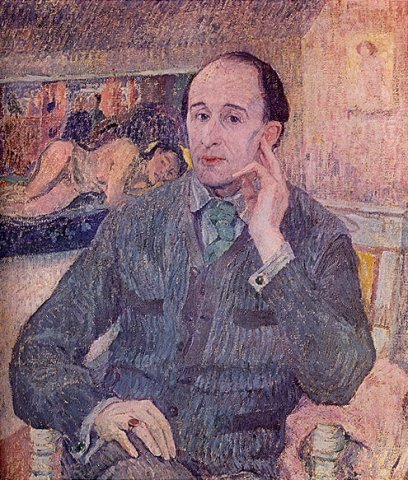
Whatever Englishness may be, for Delius was thoroughly international. His contact with rural English yokels was limited: quite possibly he was more intimate with black Americans (there's a rumour that he had a mixed race daughter). The painting above was by his German wife Jelka, done in their home in France. But Beecham's passionate promotion created Delius as "English" and that's how we've come to hear him. Delius and Debussy were born the same year, 1862, both  will be having anniversaries. It would be fascinating to hear Delius compared to Debussy. There's a new recording of Delius piano music (Paul Guinery) which will be reviewed here. It's part of a major traverse around Delius rarities by Stone Records. The complete Delius Songbook (piano and voice) is reviewed HERE and HERE.  Me? I'm going to the very important  Lieder recital at the Wigmore Hall at exactly the same time, Sunday, but might find a way to get both concerts covered. Keep reading!

Monday, 9 January 2012

Delius Complete Songbook 2 Mark Stone

"English music? I don't know what that is", Delius said to Eric Fenby, who very nearly aborted his self-appointed mission to help the composer. But Delius was right. Music is rarely "nationalist"and Delius himself was international.  Mark Stone's recording of the Complete Delius Songbook series is a valuable contribution to Delius studies as it includes perfomances of lesser known works and new translations, many by Stone himself.

Listen to the first volume in this series, which I reviewed HERE, where Stone and pianist Stephen Barlow perform Delius's earliest songs. Grieg's music expressed an aesthetic significantly outside the European mainstream.  The purity of Norwegian landscape was a metaphor for independence and creative renewal. Delius learned from Grieg not merely the trappings of "Scandinavian" culture, but the concept of individuality.  In this second volume in the series, Delius sets Danish, French and German poets, but the style is his own.

Included in this new disc is a piano song version of the Nietzsche setting, Noch ein mal, O Mensch, Gib acht!, which in 1904/5 became part of Delius's A Mass for Life.  A version for solo voice, chorus and orchestra was written six years before the song but the version here was found among the composr's papers after his death. It's undated, but possibly predates both other forms. Jelka Delius said it was the earliest version of all. The melodic line is already clear, surprising calm, unlike Mahler's more intense setting in his Symphony no 3. Mark Stone's deep baritone gives gravity.

Delius wrote four more Nietzsche songs around 1898, possibly sketches for large scale works, though they were published decades later as independent songs.  Stylistically they connect to A Mass for Life, but they're much stronger musically. Each is a miniature, yet powerfully felt. Although the subject matter is completely different to A Village Romeo and Juliet, completed in 1899, perhaps Delius is thinking in terms of dramatic, declamatory song? Certainly Stone's delivery suggests this. He's an opera singer and brings to these songs much more colour than some of the other songs on this disc can support. The five settings of poems by Verlaine depend more on heavy pedal rather than elegance.

Delius is more in his own element, if that's defined by watercolour lightness of touch in the paler tones of the other songs in this collection.  Two groups of songs from the Danish, eleven early songs and other individual pieces. With Autumn, Dreamy Nights, Summer Nights on the sea shore and Summer Landscape we're in that quiet, watchful mood that Delius so often evokes. It's as if time is standing still as the composer meditates on the moment. Below is Silken Shoes, an "expression" as Mark Stone says in his erudite programme notes "of the exquisite...nature of the beloved. Delius uses rising triplets throughout to underline the triumphant nature of this song...and comes to a warm, satisfied ending". Buy the recording DIRECT from Stone Records, or thru the usual sources.

Monday, 28 November 2011

Ken Russell - 1927-2011

Ken Russell could not "pass away". He died peacefully in his sleep on Sunday  after a series of strokes which would have felled a lesser man long ago. And he died with a smile on his face. Earlier this year he gave an interview during a break from hospital. Cheerfully drinking wine and living life to the full. 

His son Alex has asked, "Please play some music as a prayer for Ken to hear in Heaven". Alex's first choice  was Berlioz Grande symphonie funèbre et triomphale.I'm trying to think of something. Mephisto Waltz ?  Symphonie fantastique? Something quixotic, but which reflects Ken's irrepressible love of life. Strangely my favourite Ken Russell was Song of Summer about Eric Fenby's encounter with Delius. It comes from the same period as Women in Love and The Devils, at the height of the Swinging Sixties, but is completely different. It's a film that shows how deeply sensitive Ken really was. Delicate, thoughtful nuances, you could feel how Fenby felt in the presence of his hero. So maybe the music I'll choose is

Friday, 22 July 2011

Complete Delius Songbook part 1 Mark Stone

Frederick Delius spent most of his adult life outside Britain. His influences were European rather than parochially English. His parents were German, and he was a native German speaker. Culturally he was a citizen of the world. What, then, makes Delius an “English composer”?

The Complete Delius Songbook is another ambitious project from small, independent company Stone Records, who gave us the first George Butterworth Songbook (see review HERE) and the new Hugo Wolf Mörike Songbook. (review HERE). Such enterprise deserves respect. This disc is the first in a two-part series which will include songs published only in the last few years, and some in new singing translations.

Unlike many British composers, Delius used non-English texts extensively. He was, of course, a native German speaker and learned enough Norwegian to socialize and attend plays. Indeed, of the 61 Delius songs for voice and piano that survive, many are settings of Norwegian poetry. Delius was close to Edvard Grieg, so would have been acutely aware of Grieg’s settings of Bjørnstjerne Bjørnson, and indeed of alternative settings of the same poems by Emil Sjögren, Halfdan Kjerulf and others.

Bjørnson was a contemporary of Grieg and Ibsen, one of the great figures whose championship of Norwegian values and language created a distinct Norwegian identity, making way for eventual independence. He wasn't an antique figurehead, and certainly no bucolic rustic. Even Ole Bull, from whom Grieg learned so much, was far more than a country fiddler.

Delius learned to write original music with the spirit of purity inherent in folk music, rather than transcribing traditional singers as Percy Grainger did. Hence, the charm of Delius's Seven Songs from the Norwegian (RT V9) lies in their utter simplicity. Grieg sets the same poems with much greater subtlety, the piano part deliciously pristine.  On this disc, Mark Stone sings "Twilight Fancies" or "The Princess looks forth from her maiden bower" with utter sincerity, so when his voice reaches a crescendo on the word "soar", it's a nice contrast with the understatement elsewhere. Stephen Barlow, the pianist, is appropriately discreet and restrained.

Delius settings are "modern" in the sense that they evoke the spirit of Jugendstil or the Art and Crafts  Movement. They are totally of their time. This CD also includes the even earlier and sparer Five Songs from the Norwegian RT V/5 and The Eleven Early Songs - Norwegian (RT V/2). 

Delius's grounding in this pure aesthetic extends to his settings of English verse. Shakespeare's It was a lover and his lass has been set so many times that it's almost become a cliché for quaint folksiness. Nowadays, it would take guts to set "a hey and aho and a hey nonino". Similarly, it would be hard to avoid twee in "cuckoo, jug-jug, pu-wee, too wittawoo" as in the Thomas Nash setting. But Delius writing during the First World War would have had quite different connotations. Stone and Barlow deliver without affectation.

Delius doesn't have the melodic gift of  Ralph Vaughan Williams or Gerald Finzi''s affinity with Tudor and Stuart poets, but his approach is sincere - "Arts and Crafts"  honesty. Percy Bysshe Shelley's poetry, however, doesn't naturally lend itself to simplicity. Delius's Three Songs  RT V/12 (1891) to Shelley are more conventionally "Victorian".  In Love's Philosophy, Barlow shapes the elaborate piano part which lets Stone's voice emerge at the critical moment, "if thou kisst not me?".  These songs are more "polished", like sophisticated parlour songs, but Delius's earlier purity is more distinctively individual.