Showing posts with label BBC Proms 2014. Show all posts

Sunday, 14 September 2014

Benignly British - Last Night of the Proms 2014


Last Night of the BBC Proms 2014. Thousands were there, having fun, and thousands more at open air Proms all over the country. I was at Otello at the ENO – new production by David Alden. I'll write about that in a few hours, please come back – it was good! The real Last Night of the Proms was  a thrilling Beethoven Ninth with the Leipzig Gewandhaus (reviewed here)  So the Last Last Night of the Proms is Silly Season, a time to unwind and ham things up.

Sakaro Oramo in tails and a Union Flag waistcoat!  And Malcolm Arnold to set the right tone of doggedly British dottiness. The BBC Singers, The BBC SO Chorus, the BBC SO and conductor Sakari Oramo joined forces for Arnold's Peterloo Overture. "I felt again the passion of a great nation burning...the libertine philosophers no longer held sway, ". New words, methinks. At least Arnold had a sense of humour. Havergal Brian didn't and many others won't. 

I loved the BBC camera work, the scene shot from way up in the dome. Literally, "off the wall". Sakari Oramo hams things up with a demented grin. Wow, he's a natural TV persona. Some real music in the mix – Janine Jansen playing Chausson Poème with a straight face, and a rarity – Richard Strauss's Taillefer, a mini-oratorio about a peasant following William the Conqueror to "Eng-ger-land".  Strauss sending up Grand Oratorios and Mock Medieval Tradition.

Roderick Williams sang Rule Britannia. In recent years this feature of the Last Night has been camped up so much that there's no more room for novelty. Williams took a radically different approach. Previously he'd joked about waving a Jamaican flag. Perfectly reasonable – where would Britain be without West Indians and their descendants? At one stroke, the Proms would connect to millions of people otherwise excluded form the sometimes belligerant jingoism of the past. On the other hand, Williams is sharp enough to understand thast such a gesture might be patronizing, Much, much better that Williams chose sincerity, idealism and conviction.  His eyes shone. No gimmick, no jokiness, but absolute faith in,meaning  For me, one of the great things about Britain is that immigrants can become somebody, hard as it might be. That's what inclusiveness is really all about.

Sakari Oramo is  a natural party animal and born communicator. He takes his coat off to reveal  a Finnish flag on the back of his waistcoat.  But in his speech he addressed serious issues. "Music isn't just about knowledge and technical things, it's about love and appreciation.... Music is history, it's culture, it's a universal language to those who are open to it. It's science, it's geography, it's physical education. It develops insight. It's therapy for those who need it. Music is a wonderful high speed dual carriageway to the human mind and innermost emotions" 

Last year there was a big fuss because Marin Alsop was the first female conductor to conduct a Last Night. But so what? One person's self-congratulation means nothing when millions of women (and men) around the globe struggle simply to stay alive. Being a conductor is not only irrelevant in the wider scheme of things, but reinforces the idea of western supremacy, Far from promoting  feminism, it set the cause back,  This year's LNOP with its non-grandstanding,  gentle good humour could do a lot more in terms of bringing people together.

Saturday, 13 September 2014

Leipzig Gewandhaus Orchestra Beethoven 9 Prom London


The Last Night of the Proms is a wonderful party, but for music lovers the Real Last Night of the Proms is the night before, with Beethoven' s Symphony no 9. No music more symbolic of the Proms ethos than this wonderful symphony. This year, the Leipzig Gewandhaus Orchestra did the honours. This was a very special Prom indeed, for Leipzig's Beethoven tradition is even more glorious. The Leipzig Gewandhaus Orchestra has been doing Beethoven since Beethoven was "new music" and a living composer.

What a sense of occasion and what a rewarding performance! The famed "golden" sound of the Leipzig Gewandhaus Orchestra came vividly to life. Alan Gilbert was vindicated, too. I've heard this orchestra do this symphony twice live with Riccardo Chailly. Gilbert's approach was less dynamic, but he had a steady feel for the way the structure of the symphony builds up. Like a series of progressive waves, oddly enough like the "marches" in Mahler Second/Mvt 1, but much better defined here.  Gilbert's approach is quiet, rather than boisterous, but this in itself brings out the strengths of this orchestra. Such control from the double basses and lower strings - it's not at all easy to hold lines so long barely above the volume of a whisper. Incredibly beautiful. Wow, can the Leipzigers play! Muted, glowing, and full of meaning: Beethoven is slowly revealing a miracle, which unfolds from (controlled) chaos.

Superb singing, yet again. The Leipzig Gewandhaus Choir , the Leipzig Opera Chorus and  Leipzig Gewandhaus Childrens's Choir sing with the same rich resonance as the orchestra with which they  are associated.  The sound is something special. The London Symphony Chorus must have enjoyed working with them. Even better, the soloists. Dimitry Belosselskiy's voice rang out powerfully, commanding rapt attention in a packed Royal Albert Hall.  Steve Davislim equally impressive. I adore this singer, who can sustain phrases almost beyond human possibility, and make them float, seemingly without effort. We can't see his lungs but we can hear his total mastery oif technique. On this occasion he was putting his heart into his words: absolutely stirring, the clarity of his timbre shining, just like the brass behind him. Davislim's lyrical, too, creating the sense of quirkiness that worked extremely well with what was happening in the orchestra. To Beethoven Turkish troops with their pipes and drums, must have seemed wildly exotic. The Leipzigers , refined and lush as they are, defined the jaunty rhythms we've heard so often we take them for granted, without noticing why they're there.

"Deine Zauber binden weider,
was die Mode streng geteilt:
Alle Menschen werden Bruder,
Wo den sanfter Flugel weilt"

Absolutely, it matters that Beethoven is referring to exotic strangers, including them in the community. The word "Freude", (Joy) recurs repeatedly, but what kind of "joy" is it that intoxicates with such exhilaration? This joy has the power to break down divisons, even in war zones. For Beethoven, perhaps it was music. An orchestra epitomises that kind of shared commtment and focussed purpose.  
And so the Leipzig Gewandhaus Orchestra showed its soul.  Leipzig has always had liberal political traditions. Felix Mendelssohn was one of its great conductors. When the Nazis pulled down Mendelssohn's statue from outside the Gewandhaus building, the mayor of the city tried to protest. In 1989, thousands of East Germans fled west, provoking a crisis in the DDR. The protests that started in the nearby Nikolaikirche, supported by Kurt Masur and many members of the orchestra, led to the overthrow of repression and the reunification of Germany.
A few weeks after that, the Leipzig Gewandhaus came to Oxford, to the Sheldonian At that stage, we still thought the Soviets might march in, as they'd done before, so the occasion was extremely charged, emotionally. 

On the Real Last Night of the BBC Proms this year, the mood was happier and more relaxed - Freude in every sense. How glorious it felt - orchestra, choirs, soloists, conductor all on the same page literally, performing their hearts out. The choruses wore red and black - pretty meaningful - and the instruments glowed gold, bronze and silver.  in the background  turquoise and sapphire lighting, and a beam highlighting the bust of Sir Henry Wood, who helped create the Proms. He's long dead, but if he could sing, he'd be joining in too!

Nowadays it's fashionable to call for the end of the BBC. Sure it does bad things, but where would we be without it? Consider.

Friday, 12 September 2014

Leipzig Gewandhaus Orchestra Mahler 3 BBC Proms London


(For my review of the gorgeous Leipzig Gewandhaus Beethoven 9 Prom  Gilbert redeemed please see here).  Because Riccardo Chailly was scheduled to conduct the Leipzig Gewandhaus Orchestra in Mahler's Symphony no 3 at the BBC Proms, (Prom 73), tickets sold out within hours. All my friend could get were pricey seats in a box in the Grand Tier. The Leipzigers and Chailly are so good and their Mahler so distinctive that the cost seemed a good investment.  The acoustic in the Grand Tier really is good, though you can hear every cough and dropped booklet resonate around the building. Perhaps that's why I didn't feel entirely bad about Alan Gilbert replacing Chailly at short notice (Chailly broke his forearm). The sound quality meant that details were finely formed, and the very quietness in some passages indicated thoughtful engagement with some of the ideas in the symphony.

Like Mahler's First and Mahler's Seventh, the Third can take a variety of interpretations, from the black, haunted humour of Horenstein,  to the blazing sunshine of Abbado, to the vigorous mountaineering of Rattle, and the exceptionally poignant Welser-Möst at the Proms in 2005.  I also have a soft spot for Eugen Szenkar's  recording, made soon after the war with musicians who hadn't been able to play Mahler for 20 years. If you want a Mahler as street fighting man, that's worth hearing (and quite valid since Mahler's politics were leftist). My gut instinct is that Gilbert has something interesting to say, but perhaps not on this occasion and not with the Leipzig Gewandhaus Orchestra. That's much more than can be said of some other conductors.

"Pan erwacht: Der Sommer marschein ein", Mahler described the huge first movement in his original drafts. Pan, the god of wild open spaces, mountains., music and sexual danger. Perhaps the "marches" here aren't literal, pastoral rather than urban or  military, but what matters is the progression of ideas giving rise to a relentless series of forwards movements.  Mahler worked on this symphony in the Salzkammergut, where valleys and lakes are hemmed in, almost claustrophobically, by huge mountain ranges. Mahler, a keen hiker (and rider of early mountain bikes)  would have understood mountains as challenges to be conquered in the brief Alpine summer. The First Movement can be read as a panorama of peaks, each opening out to new vistas, pushing towards a resolution that might ultimately be spiritual transcendance. Thus the "panpipes" in the horns and the winds, and the significance of off-stage brass: something invisible is pulling the symphony, and the listener ever higher and further away from an earthly plane.

When Chailly conducted the Royal Concertgebouw Orchestra the fit wasn't quite so good, because the Amsterdam orchestra had its own great Mahler tradition. But when Chailly moved to Leipzig, to conduct the Leipzig Gewandhaus Orchestra, with even older traditions (though not in Mahler),  the magic worked perfectly right from the start, vindicating Donald Mitchell's high praise for him. The Leipzigers are famed for their warm, golden sound, which fits perfectly with Chailly's strengths. I hate using national labels but they might explain why the Leipzig Gewandhaus Orchestra and Alan Gilbert don't have quite the same chemistry. Throughout the First movement of this Prom, it felt as though the Leipzigers had their own approach to Mahler (nurtured by Chailly) while Gilbert is an American conductor.

The all-important brass entries seemed odd, as if the players were following some instinctive volition, rather than following Gilbert. His signals were pretty straightforward, but these players are so good they can almost conduct themselves. Gilbert didn't define the "marches" or the mountains" quite as monumentally as they can be done. Rather, he stressed the quieter passages, as if creating an aubade of aural texture. This is perfectly valid for it connects to the idea of dawn and regrowth : the hunter dies, but the animals go on. Gilbert's attention to detail brought out the bird song and hushed, chirping sounds in the undergrowth. Those kukkuks, the flute melodies,  the hushed murmuring strings  and hints of Mahler song: very Des Knaben Wunderhorn. I kept thinking of Messiaen. The formative years of Gilbert's career were spent in Lyons, where Nagano laid the foundations of another distinctive European tradition. But Gilbert works in New York, where he has to blend in with expectations there.  So Gilbert falls between different stools, so to speak. But he's much more interesting than many other conductors. I suspect, one day, he'll find his niche and get the respect he's due.

Gerhild Romberger
As the performance continued, the match between conductor and orchestra tightened. There were many very good moments , especially in the Misterioso, and the final section blazed with warmth and a sense of fulfilment. The Leipzig Gewandhaus Orchestra is so wonderful that just letting them get on with what they're good at would have worked better in a high-profile gig like the Proms. But full credit to Gilbert for trying to do his own thing, Maybe he will, soon, and shake up an orchestra without the sumptuous stature of the Leipzigers.

The most perfect part of the evening for me was the singing. It usually is, but this singing was wondrous. Gerhild Romberger was superb: not flashy, but self effacing and all the more convincing for that. She let the rich resonance of her voice command attention, and it filled the vast barn that is the Royal Albert Hall. Her "O Mensch" felt truly plaintive, as if she were weeping for the death of the old world and giving birth to the new. The eerie woodwind twining around her voice sounded like an instrument from the ancient past.  The Leipzig Opera and Gewandhaus Choir (women's voices) and Leipzig Gewandhaus Children's Choir (delightful Bim-bams) provided support almost as lustrous as the great orchestra they work with so well.

NEW DELIGHTED to report that Beethoven Symphony no 9 went extremely well!  I've heard Chailly conduct Beethoven 9 with this orchestra twice live. Brilliant! Alan Gilbert isn't Chailly but he's vindicated. Excellent sense of build-up in the first movement, pinpointing details which will emerge later in the symphony. How do the double basses play as quietly as that?   A freer and more sponatneous performance altogether - Gilbert and the Leipzigers meshing together well.  Orchestras at this level know what they are doing when they choose a conductor. Dimitry Belosselskiy magisterial in the bass part. Steve Davislim astounding - he can string phrases out without seeming to need space to breathe.  As he sang, I noticed how the jauntiness of his part was matched by the jauntiness in the music around him. The "Turkish" pipes and drums, perhaps? If I have time I'll write more.

Tuesday, 9 September 2014

The Cleveland Orchestra Welser-Möst Brahms Proms London


The Cleveland Orchestra, with Music Director Franz Welser-Möst, made a most welcome return to the BBC Proms at the Royal Albert Hall.  Are the Clevelanders the best orchestra in the United States today? Their two Proms certainly made the case. Superlative finesse and poise, generated by genuine musicality.  The classical music world is international these days. Thanks to the internet, anyone, anywhere can listen to the best on offer. Orchestras can't rest on their laurels but must offer something unique. The Cleveland Orchestra is world-class, thank in no small part to Welser-Möst and his exacting standards. When orchestras and opera houses are imploding all round, Cleveland should be proud of what it has.

Classical elegance, too,  in the way the two programmes dovetailed : Brahms Symphonies no 1 and 2, preceded by Brahms Academic Festival Overture and Tragic Overture. Classical elegance is a much underrated virtue. Far too often  noise, bluster and commercialized tat substitute for well-crafted sensitivity. Welser-Möst and the Clevelanders evoke an aesthetic very much attuned to the values of 19th century Austria. This Brahms Symphony no 1 in C minor, op. 68 reminded me of Mozart, such was its freshness and clarity. This approach gives Brahms greater respect than the usual clichés about Beethoven. Brahms was very much an original in his own right, not Beethoven manqué. Such was the purity of this performance that I thought of Brahms the composer of chamber music, songs and works for piano. The larger themes thus felt like a natural development, a totally Brahmsian resolution, as personal as Ein Deutsches Requiem or the Alto Rhapsody. The ghost of Wagner towers so heavily over European music that it's salutary to hear Brahms as the pure soul of German and Austrian tradition. Perhaps that was the point of starting with the  Academic Festival Overture. Brahms, with his droll, down-to-earth groundedness, isn't Wagner or Beethoven, but himself.  [One of the big wars in music history was Wasgner versus Brahms. Maybe Wagner won since so many now expect to hear Brahms with a Wagner flavour. But Brahms  entire symphonic output adds up to one Wagner opera, and Wagner's non opera output pales in comparison with Brahms. All the more treason .that Welser-Möst's Brahms deserves respect]
 
Welser-Möst and the Clevelanders created Brahms Symphony no 2 in D op 73 with a similar sense of style. Brisk, agile playing created a sense of freedom  - no buttoned-up regression here!  The darker timbres in the second movement  suggested sensuality or mystery, rather than malice, adding nice resonance to the final movement's heady con spirito. Glorious brass playing - Cleveland's famed showpiece is alive and well.  What wit to pair this symphony with the growling Tragic Overture. creating a vivid contrast.  In August (Prom 53)  Iván Fischer conducted the Budapest Festival Orchestra in Brahms Symphonies no 3 & 4.  Usually Fischer is very impressive, but that performance sounded oddly subdued, almost as if Brahms was being submerged under the weight of much later performance practice.  Welser-Möst and the Cleveland Oirchestra presented Brahms with much greater flair, showing why Brahms's originality stunned Arnold Schoenberg, one of his greatest admirers.

Between the Brahms pieces at these two Proms, the Cleveland Orchestra played Jörg Widmann, Flûte en suite  and Teufel Amor. Widmann is very well known in London, as composer, clarinettist and brother of Carolin Widmann the violinist. Flûte en suite was written for the Cleveland Orchestra's principal flute, Joshua Smith. It's delightfully whimsical, allowing Smith to display his virtuosity, while maintaining good-natured common sense - a very Brahmsian touch. Widmann plays with the idea of Bach counterpoint, balancing soloist with orchestra. At the end, Bach takes over, with a direct, extended quote from Bach's Badinerie, as if Bach has won through after all. In lesser hands, the joke might fall flat, but Smith and the Clevelanders understand the humour.  Widmann's Teufel Amor unfolds with darker portent. It's filled with brooding incident, narrating a story without words. A good new direction.

[Further to a private discussion, I think Brahms symphonies aren't "box office" esp not without the accretions of saccharine syrup many people expect.  Furthermore two matching programmes might make artistic good sense but audiences don't necessarily want art. The Clevelanders might have nmade more money doing Copland or whatever but I respect them for choosing artistic good values]

Monday, 8 September 2014

English Sprechstimme : Walton Facade Prom

Calling Facade: an Entertainment the creation of William Walton is a bit unfair. The music in the piece comes primarily from Edith Sitwell's bizarre texts where meaning is subservient to the strange syntax and rhythms of the spoken word.  In this version of Facade, Walton's contribution serves as understated background   Everything in Facade predicates on the text, which isn't illustrated like song, and not even sung or spoken in a normal way, but in a kind of English Sprechstimme.

Everything rests on the innate musicality of the Speakers. At the Cadogan Hall in Proms Chamber Music 8 we had Dame Felicity Palmer and Ian Bostridge. They were a formidable partnership, She a Grand Dame with plummy tones that express the type of English Grand Dame whose like we may never see again. He, immersed in Britten (who adored Sitwell) and the wilder shores of British imagination. Facade isn't spoken, like speech. It's declaimed so the very nature of language is inverted  as musical form. There's something so deep and so hidden in Facade that that it's very title is a hint. "Jai'seul la clef de cette parade sauvage". Sitwell's inspirations might have been Rimbaud and Apollinaire, though she's not quite as incandescant. She's English,  after all, and more genteel. In early performances, the performers hid behind a curtain painted with a Grecian face, transmitting the words through a hole, rather like a Grecian oracle. Or, one might dare say, like the Wizard of Oz through an emerald palace. The speakers spoke through a Sengerphone, as pictured above, which would have further disguised and dehumanized the voices. That's Edith Sitwell herself in the photo. 
 
Bostridge did poems where extreme agility and rapid fire diction create jaunty staccato. Crisply defined word endings, sharp "d"s and "t"s, delivered deadpan: Sitwell didn't want soppy sentimentality. Yet Sitwell's Neue Sachlichkeit masked great sadness. An abused, awkward child, she hid behind strange costumes and affectation, as if the mask - the facade - of eccentricity could mask the pain within. Bostridge's perfect poise let just enough of Sitwell's singularity through so we could feel the person behind the arch cleverness. What a coyly secretive language English can be. Bostridge ever so subtly emphasized the silent "h" in words like "when" and "where" Even the way he clipped words like "room" to "rhum" as repressed,  upper class Englishmen still do, suggested meaning beyond the obvious play on words. 

Dame Felicity did poems where longer lines allow words to pop up like images in the subconscious. Once could analyze the words, like people do with Bob Dylan lyrics, but it's better I think to focus on the play of sounds within words, and the deliberate dissociation of fractured images. Hence the exoticism,, which constantly throw the listener off track. There are images of Spanish grandees ("mouldy" men with young brides) and Cockney couples whose accents Palmer mimics with great verve. We're in the world of Rimbaud's Les Illuminations, though Walton's music is far less inventive. In this version of Facade, Walton's contributions are subtle: jazz riffs on saxophone, which would have seemed much more daring and avant garde in the early 1920's then they do today, and sultry woodwinds. Even the Hornpipes suggest images hidden from plain view. And oh, that gorgeous Sir Beelzebub where both speakers and the orchestra dance in mock heroic glee. 

Before Walton's Facade, members of the Nash Ensemble, conducted by John Wilson, played Shostakovich's Four Waltzes (Op 97c) in a transciption by L Atovmyan. Delightfully cheery and cheeky.

Sunday, 7 September 2014

Bach St Matthew Passion Rattle Berlin Prom


Peter Sellars's Bach St Matthew Passion Prom with Simon Rattle and the Berliner Philharmoniker can't have been anyone's top pick of the season because it's been done so many times and in so many places since first produced five years ago. There's a DVD and a relatively recent performance on the Berliner Philharmoniker Digital Concert Hall with much the same cast as we had in London.In principle, there's absolutely no reason Bach Passions should not be staged.  Strict Lutherans didn't do theatre, but theatre is very much part of Christian tradition. Latin  Masses were mystical, artistic experiences. Modern masses put the emphasis back on what Christianity means, rather than thrills like flowers, statues and incense.

There's also no reason why Bach Passions shouldn't be reinterpreted in new terms. That said, it depends on what  the new terms are. I'm no fan of Peter Sellars's self-indulgent, often maudlin stagings which say more about him than about the music he's staging (which is fair enough).  Since I've seen the production several times I wasn't going to rush out to the Royal Albert Hall.  This isn't Sellars's worst. It's  relatively austere and moving in a simplistic way, which  might appeal to some. A friend did, however, go last night.  Here's his review ! 

Saturday, 6 September 2014

Stravinsky Rachmaninov Rattle Berlin Phil Prom

Surprisingly symphonic - Igor Stravinsky's Firebird (L'oiseau d'or) with Simon Rattle conducting the Berliner Philharmoniker. BBC Prom 64. What a pleasure it was to hear this familiar music played with such elegance and grace! Although The Firebird was written too be danced to, this performance was a reminder that it is also very fine pure music.  Rattle and the Berliner Philharmoniker dispelled memories of the more raucous suites, concentrating instead on the inherent beauty of the piece. Strictly speaking, music for ballet needs to follow the human body, and the physical capacities of dancers. As an orchestral piece, the music moves in a very different way because instrumental musicians spread the effort between them. With Rattle and the Berliners, The Firebird could breathe on its own, revealing its strange, exotic mysteries at its own pace.

Rattle preceded Stravinsky's Firebird with Rachmaninov's Symphonic Dances (1940) which wasn't actually written to be danced to. The Symphonic Dances are an exercise in memory. Rachmaninov was re-imaging the Russia of his youth through the splendour of the ballet. Quite probably the work could be choreographed, but its pulse is fundamentally symphonic.

While Rachmaninov re-images Russian ballet, Stravinsky's Firebird was written for the Ballets Russes. By pairing the two pieces, Rattle emphasizes the Firebird's fundamentally orchestral origins. Six years ago to the very day, Vladimir Jurowski conducted this full Firebird at the Proms, pairing it with Rimsky-Korsakov's opera Kashchey the Immortal. (more here)   Rattle's Firebird dances, but with abstract sounds. The "dancers" are instruments, who create impressions of dance in the imagination.

The strings pivoted en pointe, percussion suggested bright, golden colour. The Berliners are such good players that they make the music move as if it were a physical force, sliding and turning with exquisite grace.  While Jurowski's Firebird emphasized the savagery of Russian myth (ie the ogre), Rattle's Firebird emphasized its idealistic magic. The woodwind melodies rose sensuously from a swathe of shining strings: exotic, mysterious and seductively tantalizing. This Firebird  flew free from the original fairy tale, soaring onto an altogether more elevated, esoteric stratosphere. The woodwind and violin  melodies sounded exquisitely poignant: so perfect in its beauty that it broke my heart, knowing that it couldn't last.

Rattle didn't need to milk up the inherent drama. The Berlin Philharmonic are so good that they respond well to understated conducting.  Rattle isn't Gergiev. That's not a value judgement, since both their approaches are valid. Rattle's dynamics aren't extreme, but they're atmospheric, creating a Firebird of great sensitivity and depth. When the woodwinds theme returned for the last time, warmed by strings and harps, it felt like a kind of apotheosis, a transcendance Mahler would have been pleased with.

Listen to Rattle and the Berliners  in this same programme in their 2014-15 season opener on the Berliner Philharmoniker Digital Concert Hall.  The Prom performance is more relaxed but equally enjoyable. Such is the magic of the Proms and the Royal Albert Hall!

For their encore, Rattle and the Berliners played the Intermezzo from Puccini Manon Lescaut,the opera they performed at Baden-Baden (reviewed by me here)

Wednesday, 3 September 2014

Singapore Symphony Orchestra Prom 61 Zhou Long


The presence of Andreas Haefliger should have alerted audiences to BBC Prom 61 with the Singapore Symphony Orchestra, conducted by Lan Shui. Haefliger played Zhou Long's Postures, which he premiered in July in Singapore. Zhou's Postures may not be newly written, but it's genuinely new music. It's not radical avant garde but it's very imaginative and tightly written. Zhou studied in the US with Chou Wen-chung, who himself studied with Edgard Varèse. Indeed, Professor Chou is perhaps the world authority on Varèse and a respected composer in his own right. With credentials like this, Zhou stands out from the large number of Chinese-born composers working in the west. For one thing, he doesn't write pastiche. His music subtly acknowledges his roots but doesn't become a substitute for genuine originality. 

Zhou Long's Postures begins with brisk attack,  Haefliger defines the first theme, capturing the wild angular rhythms with  great alacrity. This first movement refers loosely to the tribal shamans of North China who wear fierce masks and dance rituals to appease evil spirits. Hence the demonic character of the music - imagine peasants stamping their feet into the earth. Think Varèse, but more ebullient.  Zhou is definitely his own man. This gives way to lighter dotted rhythms which seem to sparkle - is rain falling at last on the bleak North China plains. Raindrops, dancing feet and the sound of bells.

In the second movement, "Piano Bells", high flutes play a plaintive melody which soon evolves into something much more unusual. Expressive, fast staccato lines, percussion, bizarre circular figures for brass. Dark-hued bells, multitudes of light, bright bell sounds reverberate. Haefliger played delicate sections then single notes like the tolling of  a bell marking the passage of time.  Interesting sliding elisions in the strings. and longer moments of lyrical beauty. Rushing angular rhythms return, as Haefliger plays " Piano Drums". The "dance" theme returned, fast and flowing. Zhou's Postures packs dozens of imaginative ideas into the space of +/- 25 minutes, but his sense of structure is so firm that one never loses sight of the vibrant overall arc. For all its exuberance, this is a very disciplined work. That's what"gong fu" actually means – "application" or dedicated concentration. The concept applies to all things, not just to martial arts. It's a pity that the broadcast cuts off the final moments. But how refreshing to hear "real" new music in an otherwise dull season.

The Singapore Symphony Orchestra and conductor Lan Shui are very good, much better than some of the other orchestras we've heard this year and that includes some who can't be deprecatingly dismissed as "global".  The BBC used to bring American orchestras to the Proms, but the orchestral scene in the US is not what it was. The Cleveland Orchestra on Sunday Prom 68  are perhaps the best these days, thanks to Franz Welser-Möst. It doesn't matter what an orchestra's home turf is as long as they're well motivated and willing to take artistic risks. 

The Singapore Symphony Orchestra also did the Overture to Glinka's Ruslan and Ludmilla and Rachmaninov Symphony No. 2 in E.  The performances were more straightforward, briskly executed. Between 1917 and 1957, Chinese orchestras were greatly influenced by Russian musicians, But that hasn't applied for nearly 60 years. Why it would apply to an ultra modern metrpolis like Singapore at all, I'm not sure. I'm old enough to remember when a Singaporean conductor dominated an orchestra further north, who had a thing for strong personalities.

Monday, 1 September 2014

Electrifying Elektra Goerke Bychkov Prom

Electrifying Strauss Elektra at BBC Proms 59 = Semyon Bychkov, Christine Goerke. Amazing on radio asnd even more so live. Indeed, this was one of those rare occasions when you can say, in awe, "I was THERE!". The Royal Albert Hall is a huge barn of a hall.  Six thousand seats placed round a hollow space that rises upwards, culminating in a dome that used to suck up sound until they added those space-age acoustic baffles.  But there's nothing like a Royal Albert Hall Prom. The atmosphere is so intense that the excitement must communicate to performers. If they've not overwhelmed (understandably) they can be challenged to give the performances of their lives.

Yet, despite the size of the Royal Albert Hall, Semyon Bychkov conducted an Elektra so full of intelligent detail that the vast cavern of the building seemed to burst with colour and incident. The BBC SO aren't normally an "opera" orchestra, so perhaps they were responding to Elektra as dramatic orchestral music. Bychkov made the music move, almost as if it were an invisible demonic force. Agamemnon has long been dead, yet his ghostly presence hangs heavy over those he's left behind. In Charles Edwards' production (read my review here) the dead king hovers over proceedings like a shadow. Bychkov's intense, impassioned conducting suggests the psychic havoc the king must have unleashed in his time. Perhaps the savage, pathological genes Elektra and Orestes carry came from him  Their lust for revenge goes far beyond filial love. Maybe Clytemnestra killed him because he wasn't a nice man.

Add caption
Soon after Elektra starts singing, the "dance" theme  bursts out. Dance in this case is a form of madness. Bychkov conducted the circular rhythms so we could feel the obsessiveness percolate. Savage climaxes, the strings screaming and stabbing. The axe lies buried underground but "sings" through the orchestra. Strauss builds maniacal laughter into his music, and  even  the unearthly bright stare some schizophrenics exhibit. Woodwinds played sensually but with morbid undertones. Bychkov's ear for detail is musically informed but also psychologically true. Someone complained that the ROH production wasn't "palatial" or elegant. But for Strauss, and for Bychkov, this palace is a prison of the soul. Andris Nelsons was brilliant at Covent Garden last year, but Bychkov works with the dynamic of the Royal Albert Hall to bring out subtleties often missed, like the parody of waltz and "family values". In the final dance, Bychkov highlights the percussion,  with its intimations of the organized violence of a military society where women like Elektra (or Clytemnestra) can't act other than through men.The lushness of this instrumentation is deceptive. Like the palace, it's poisoned. The savage last chords made me think of Wozzeck.

Christine Goerke has created so many Elektras in recent years that she probably owns the part these days. Her voice is richly resonant, shading into mezzo territory, which allows a remarkable range of emotional expressiveness. Elektra's a killer part, forcing the voice up to the extremes, torturing technique, but Goerke delivers. She's not afraid to let the role dictate the way she sings. When she recognizes Orestes, her voice rises to near-scream, then softens into tenderness. How long it must have been since Elektra felt safe enough to feel human kindness, Goerke's voice warms yet still carries memories of pain.  Through Goerke, we glimpse what Elektra might have been. At the Royal Albert Hall, Goerke displayed a new dimension to her artistry. She wasn't giving an "opera house" performance but enacting the role in such a way that she filled the massive auditorium, not with amplified voice but with amplified personality. Truly remarkable: in all these years of Promming, I can't remember any singer taking control of the RAH like this. She made an impact that felt strikingly personal, up close and human, as if the distance her voice carried meant nothing, and we were one-to-one with Elektra in her isolation.

This warmth in Goerke's voice was paralleled by Gun-Brit Barkmin's Chrysothemis. Little sister wants marriage and babies, not death   Yet the firmness in Barkmin';s timbre, and the assertive confidence in her delivery  brings out the underlying strength in the role. We need to hear more from Barkmin. ROH take note! Chrysothemis is no Barbie Doll image of womanhood. Although Justin Wray is creditted as stage director, there wasn't any evidence of directing (other than use of lighting) until the final scene when Goerke and Barkmin embraced each other. Subtle, but significant.

Much-loved Dame Felicity Palmer sang Clytemnestra, receiving much applause. Although her voice is beginning to show its edges, Palmer's experience in the role paid dividends. When she sang about her fears, she made the chaaracter sympathetic. Cold-blooded killers don't fear bad dreams or, for that matter, fall for toy boys.  Johan Reuter sang Orestes, with Robert Künzli as Aegisthus. Katarina Bradić , Zoryana Kushpler, Hanna Hipp, Marie-Eve Munger, Iris Kupke, Miranda Keys as the maids and their overseer, Ivan Turšić as a young servant  and Jongmin Park as Orestes' tutor completed a fine line-up.

Strauss Elektra Prom 59 - part ONE, part 2 follows

My review, as pronised, is HERE.  Richard Strauss Elektra, BBC Prom 53 – an amazing experience!  Semyon Bychkov, Christine Goerke, Felicity Palmer and a cast who could hardly be faulted.  Christine Goerke "is not one of those Elektras who start the opera as demented and raddled. From the opening she projected youth and a certain rapture in the vocal line. Only gradually did you come to realise that this young woman was unhinged. Goerke had a way of smiling to herself which told volumes. What was refreshing about her performance was that, though certainly a very big sing, she did not seem to need to attack every single phrase. There was some profoundly poignant moments and this was one of the most sympathetic Elektras I have heard in a long time."

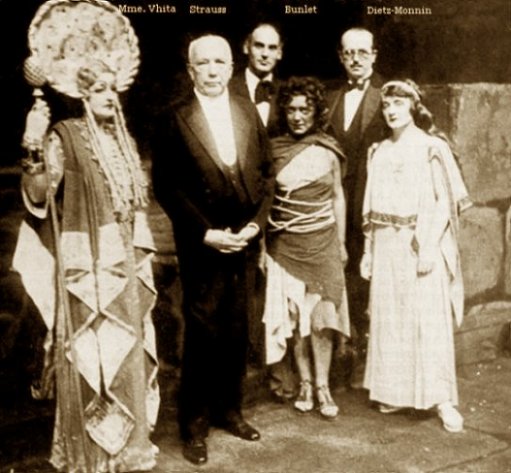
Please read the full review in Opera Today HERE  I'll be writing too about the experience – for an experience it was! The Royal Albert Hall is a vast cavern, but Goerke filled it  so well that she made Elektra feel close up and personal.  Read my review here.Photo above shows Strauss at the premiere. Note costumes. That Clytemestra's not authentic period  Greek!

Operas we can hear in an opera house anytime, but this was no ordinary performance.  I loved the Royal Opera House production in September 2013 (which I reviewed HERE), and so did just about everyone else. I saw the previous  ones too, but 2013 was by far the best.  Goerke and Andris Nelsons, go figure. When this production is revived again, do not miss it as  it's very intelligent and very passionate, which is perhaps why some didn't get it in 2008.

Sunday, 31 August 2014

Stemme's stunning Salome Prom 58

Stunning Nina Stemme Strauss Salome Prom 58.  Full review in Opera Today by Robert Hugill

"The problem with Salome (written in 1905), is that though premiered barely a century ago it dates from an era of different performing styles. Dramatic sopranos had voices which were more lithe, more narrow in focus. Orchestras were generally quieter, with narrower bore brass and gut strings, and the orchestral sound a lot less dense. Production values were more forgiving, Audiences didn't generally worry about whether the heroine looked 16. But early sopranos in the role would probably sound a lot younger, to our ears. Nowadays, both singers and directors frequently move the character into maturity."

 "The remarkable thing about Nina Stemme's account of the title role was the wonderful brightness and freshness that she brought to the vocal line. Singing with a lovely, fluid sense of line, this was a singer who really did link this music to the Strauss of the songs and the later operas. There wasn't a screamed note the whole evening, and she seemed to be able to encompass the whole role whilst preserving focus and flexibility. As Brünnhilde, Stemme does not have a huge voice compared to some of the Brünnhildes of the past, but this is an advantage as Salome.She both looked and sounded young. From the moments of her first entry (throughout she was off the book, and fully acted), it was clear that this was a petulant, selfish teenager. Salome's naivety and inexperience came out in Stemme's voice and her body language. It was wonderful to see and hear the way petulance gave way to desire and more; the typical teenager reaction of becoming obsessed with something you are not allowed to have." 

Read the full review here in Opera Today.
At left, Astrid Varnay's Salome in bra size 60LLL

Saturday, 30 August 2014

Triumphant Mahler 2 Harding Prom 57


Triumphant! An exceptionally stimulating Mahler Symphony No 2 from Daniel Harding and the Swedish Radio Symphony Orchestra, BBC Prom 57 at the Royal Albert Hall.  Harding's Mahler Tenth performances (especially with the Berliner Philharmoniker, read more HERE) are pretty much the benchmark by which all other performances are assessed.  Harding's Mahler Second is informed by such an intuitive insight into the whole traverse of the composer's work that, should he get around to doing all ten together, he'll fulfil the long-held dream of "One Grand Symphony", all ten symphonies understood as a coherent progression of developing ideas.

Pierre Boulez used to speak about the importance of trajectory, that is, the sense of direction that drives a symphony. Even the first bars zinged with purpose: Harding setting the trajectory in motion right from the start. When Bernard Haitink conducted this symphony at the Proms in 2006, he chose tempi so slow that it was hard for his orchestra to sustain the line, suggesting the approach of death.  Harding's tempi are less extreme, but equally purposeful.  He emphasized the inherent  tension between forward-reaching  lines and tight staccato, suggesting  that a powerful transformation is underway even in the presence of annihilation. Harding showed how Mahler's themes of transcendance and renewal were in place even at this point in his career.  The tension Harding creates suggests the power of what is to come, even when it's curtailed, temporarily, by death. If this is a funeral procession, it operates on many levels. The pastoral woodwinds might suggest happy memories of the past.  Quiet, purposeful pizzicato, like footsteps, lead into savage brass climaxes, creating the sense of hard-won stages on a difficult ascent. Perhaps we can already hear the "mountains" in Mahler's Third Symphony, rising ever upwards.

 Then the sudden, anguished descent into silence. The Luftpause which follows is very much part of meaning, "inaudible music" during which one might contemplate the finality of death. Harding sat on a chair, head bowed. Instead, the Royal Albert Hall ushers let in dozens of latecomers, totally destroying the moment of reverence. Someone needs to tell the staff that Luftpauses are not intervals.

The second movement  began with gleeful energy, leading into lyrical Ländler themes, which will recur again through many symphonies to come. Although this movement is marked "Nicht eilen", it should be leisurely rather than slow, for something positive is stirring. Perhaps we begin to hear the Pan theme for Mahler's Third, as summer marches in. Harding took particular care to bring out the life force in the third movement, Des Antonius von Padua Fischpredigt, an illustration of which stands in Mahler's composer hut.  Like Dionysius, St Anthony is drunk. Perhaps the song is used to indicate the futility of words, which is rather droll, since in this symphony Mahler begins to use voice as part of his orchestral toolbox.  Harding might be more taken with the inherent energy in the leaping figures which suggest the movement of fish, leaping upwards, and swimming away. Exuberant playing here, the passages undertaken with great agility.

Perhaps it's included to illustrate the futility of words, but the liveliness of the writing suggests energy and escape from the sombre mood of the first movement. Harding led his orchestra into a glorious climax: summer is marching in, underlined yet again by the exuberant Fischpredigt allusion to leaping fish. 

 Excellent use of offstage trumpets and trombones, even if some sounds went slightly awry. These sections aren't merely for show, since they illustrate cosmological meaning. Harding's musicians may have to run up and down a lot, but by doing so they literally connect earthly reality with the promise of Heaven. This isn't the "Resurrection" symphony for nothing.  Angels blow horns and trumpets, as do Alpine herdsmen and farmers. Mahler's making connections on all levels. Very possibly, we might think ahead to Mahler's Fourth with its cataclysmic burst of energy. What thrust Harding got from his players, trumpets leading! Processional footseps yet again, this time confident and assured. Having shown us how near we are to the summit, Harding and his orchestra descended once more into quiet reverence. The trumpet solo, calling from the highest reaches oif the Royal Albert Hall, seemed to glow forever, like a sunset. The hushed voices of the Swedish Radio Choir and the Philharmonia Chorus were so well blended that their impact was enhanced: an image of vast panoramas and repose, from which Christianne Stotijn's voice rose with dignity. 

Aufersteh'n, ja aufersteh'n wirst du, Mein Staub, nach kurzer Ruh!  Stotijn, Kate Royal, the choruses and orchestra united in a blaze of glorious sound. Crashing cymbals, the klang of metal on metal and a thunderous timpani roll cut short much too soon by an audience too excited to hold back any longer.

Please see my other posts on Mahler, especially Mahler 3 and also my many posts on the BBC Proms

Thursday, 28 August 2014

Red herrings - why the BBC drops new music

An article popped up in the Guardian just before 6 pm today, titled "Why does the BBC assume its audience won't like new music?" It deals with the fact that Harrison Birtwistle's Sonance Severance has been dropped from the BBC TV 4 broadcast of Prom 33. Hang on! Before jumping on the sackcloth and ashes bandwagon, try a bit of common sense.

First, Birtwistle's piece is only three minutes long, dates from way back and isn't a particularly crucial part of his output.  The really important part of this Prom broadcast is Lutoslawski's Concerto for Orchestra, a  significant milestone in modern music. Not knowing who Lutoslawski is, would be a much greater scandal.

Second, it's taken the Guardian a while to twig onto the story, which I first ran on 11th August, titled "Why the Proms musical apartheid on BBC TV?" The Guardian uses almost the same title, but my piece is more detailed. Read my article in full here. 

Third, let's think critically  If we really care about new music, we should be looking not at TV but at the new music being performed in the first place. BBC TV4 is a generalist channel,  it's not aimed at cutting edge. It's like blaming Aldi for not stocking Beluga caviar. TV coverage of the Proms this year hasn't been as good as it used to be for various reasons, but that's a separate issue.

If we're going to talk about new music, at least we could understand what new music is. The two composers Daniel Barenboim featured in his Prom were pleasant enough, but won't change music history. They deserve credit, but shouldn't be used as footballs in a game they're not  playing.  The real crux of the matter is why the BBC needs to programme music that's too  bland to be original.  I've written a lot about the poor quality of new music this season many times, so search this site. By dropping some of the "new" music from TV, the BBC is doing some composers a huge favour.

Why is this year's "new" music so dull? The Proms audience is the biggest audience in the world. The bigger the audience, the higher the number of those who think they can't cope with what they don't know.  Because the BBC (and the arts in general) are under attack for being "elitist", they have to conform.

The trouble with art is that it's created by artists, not marketers. I don't believe that audiences are necessarily anti-innovation.  But public opinion is shaped by the media,  by politicians who play people off each other and, alas, by an increasingly vocal minority who espouse the musical equivalent of the Westboro Baptist Church. If we genuinely care about new music, the real issue we should be addressing is not red herrings like BBC TV4 but much wider issues..

Seoul Philharmonic shines Prom 55 Chung, Wu Wei


When Unsuk Chin's Šu (2009) for sheng written for Wu Wei premiered in London at the Barbican in 2011, it didn't work for me at all.  I wrote then  that "overall the music didn't develop the possibilities beyond the initial novelty"  of this remarkable instrument, and "Wu's playing is assertive and full bodied but I'm not sure how far he's stretched as an artist by this material"  (read my full piece here which has background on the sheng and on Wu Wei, the soloist). But at BBC Prom 55, when Myung-Whun Chung conducted the Seoul Philharmonic Orchestra, the piece was transformed. What a difference a sympathetic orchestra makes!

Chung and his orchestra intuitively understand the context.  Šu isn't so much a concerto in the usual sense as an orchestral expansion of the instrument.  Wu Wei plays a modern version of the ancient instrument, The "modern" Sheng is much bigger, often 36 pipes as opposed to the traditional 17. Playing so many reeds by fingers alone would be difficult, so modern Shengs are keyed for ease of operation. Range is bigger, volume is bigger, many more musical possibilities. Just as in the west, composers had to write new music for new instrumental and performance styles. There's a whole genre of modern Chinese music that's different from traditional folk idiom, but also from western form. Wu Wei's instrument  is so unique that it's inspired many composers to write for him. He's fascinating, exploring the myriad nuances and possibilties with such poise that one almost forgets how difficult the instrument is to play.

Unsuk Chin adds her characteristic panoply of eccentric instruments and jokey asides, but Chung fundamentally lets Wu Wei lead, so  Šu evolves like a solo work with embellishments.  Apart from ceremonial music, Chinese music wasn't orchestral  in the western sense  but closer to chamber forms. Chung understood the balance. in favour of soloist, allowing the main line to flow smoothly without slipping into the eddies.  Sheng legato is amazing, and Wu's masterful circular breathing creates wonders. Yet the instrument is also oddly percussive, so Wu can shape staccato riffs  and jerky rhythms.  This is modern music, and not uniquely Chinese, but greatly invigorating. For an encore Wu followed with an arrangement of his own, based on a traditional folk melody. Wu's variations on the basic melody displayed his instrument's versatility. Pipa or flute or voice might be more plaintive,  but the sheng is robust and confidently inventive.

Although the BBC is making a big deal about global orchestras this season, the Seoul Philharmonic is in an altogether more elevated league than many of the others. It's world class, so good that it can easily stand on its own merits, and should get the credit it deserves. Korean musicians  (and singers) dominate orchestras and opera houses all over the world. In Korea, classical music  isn't a niche but part of mainstream life and national identity. (Read my article on Jihoon Kim's Korean recital here).  Please also see my posts on orchestrations of Arirang.  Western politicians who complain that classical music is elitist should address the collapse of music education instead of slamming arts organizations that produce good work.  The German concept of Bildung applies in many Asian countries. English speakers just don't comprehend. With the large pool of musicians in South Korea, Chung is able to choose players of an unusually high standard.

The Seoul Philharmonic Orchestra don't quite have the panache of  Chung's other orchestra, the Orchèstre Philharmonique de Radio France, but what they do have is the sensitivity to create refined, diaphanous textures. This  La Mer sparkled.  Shimmering lustre, balancing the darker undercurrents.   This Tchaikovsky Symphony No. 6 in B minor, 'Pathétique' also impressed. Altogether a satisfying Prom with an orchestra we should hear more often (other than on recordings). 

Sunday, 24 August 2014

Komsi Oramo Prom Russian (and other) Fairy Tales

Wonderfully evocative!  In BBC Prom 49, Sakari Oramo conducted the BBC SO showing how exotic dreams and magical tales still inspire creative art.  The soloist was Anu Komsi, Oramo's wife and twin sister of Piia Komsi, both coloraturas with such remarkable range that they've inspired several works written specially for them.. Although this Prom was billed "Russian Fairy Tales" it could well have been billed as a showpiece for Anu Komsi's exquisite singing. .

Ravel's Mother Goose Suite (Ma mère l’oye)  created the perfect mood. Lustrous, shimmering textures, sparkling with light and delight. Fairy Tales are beautiful, but strictly speaking they're wasted on children. As Bruno Bettelheim demonstrated decades ago,  fairy tales deal with the subconscious, and are a lot darker than they're made out to be.  Beneath the gossamer in Ravel's music lie details which suggest something more sinister. Hollow-sounding woodwinds, brass like the call of hunting horns. Could the high-pitched violins suggest pain and longing?  Do the horns suggest hunting, or death? Why is the princess of the pagodas, Laideronnette, supposed to be ugly? No answers.  In this magical realm answers mean less than dreams.

In Jukka Tiensuu: Voice verser (2012?),  Anu Komsi's voice operates like a magical force of nature. Her tessitura is so high it seems almost unearthly, and her projection so powerful that her voice seems to stretch into infinity. High winds and strings cry out, like high-flying sea birds.  Strings form elliptical sounds like waves.  Immediately I thought of Sibelius Luonnotar (more here) where the voice represents the primeval being who created the universe, after swimming for centuries in an endless ocean. When Komsi's voice switches from extended legato to sudden staccato, she makes gasping sounds that could be Luonnotar giving birth to the earth, stars and skies. Yet for all this extreme virtuosity, this is a quirkily humorous piece which  suggests play and joyful interaction between singer and orchestra. This is music with wit and and spirit, proving that "new" music can be fun and spark the imagination. We can also hear why so many are in love with Komsi's voice. She's technically superb but can also convey warmth and feeling.

Amazingly, Komsi recovered her voice after the interval, to sing Karol Szymanowski's Songs of a Fairy Tale Princess. Komsi and Szymanowski could have been made for each other. Both favour tessituras so high that that they seem to defy gravity.  Much of Szymanowski's output created parts for violin, where only the best violinists can sustain extended lines at the top of register. Komsi makes great feats sound easy. Szymanowski's fantasy was far more than lush reverie.  In the years before 1914, he visited the Middle East and North Africa, fascinated by the exotic sounds he heard. Like many composers in his time, Szymanowski was searching for alternatives to  western tradition.  There's nothing tame about this ulullating legato, these strange leaps up and down scales.

 In the first song, The Lonely Moon, the phrases cry out like imams calling the faithful to prayer, designed to carry over vast distances.  Perhaps this is intentional, for the mood suggests longing, reaching out towards something that can never be grasped. The trills and melismas in The Nightingale allow Komsi's voice to flutter like a bird trying to escape its cage. In The Song of the Wave, Szymanowski catches the idea of surging movement, sparkling arpeggiatos dancing over rolling rhythm. The ocean is beautiful, but the sailor might drown.  Whether the singer is lover or Nereid hardly matters. Szymanowski wrote the songs for voice and piano in 1913 orchestrating  the three above in 1933 when he'd rediscovered Poland and modernism. At this Prom we hear Sakari Oramo's new orchestrations for the three other songs,  sensitively  in keeping with Szymanowski's style yet sympathetic to the uniquesness of Komsi's voice. Infinitely better than the pointless, unidiomatic orchestration of Butterworth Andrew Manze used in his Lest We Forget Prom last week.

To complete this evening of exotic dreams, Rimsky-Korsakov Sheherazade. Yet again Oramo weaved his magic. The BBC SO played with great beauty, not disguising the little dark details that conceal what Sheherazade will be faced with if she can't spin more tales of fantasy.

Saturday, 23 August 2014

Ilan Volkov Iceland Symphony Orchestra Tectonic Classics Prom


"Classical tectonics" - strange name for Ilan Volkov's Prom 48, but pretty good for a Prom featuring the music of Iceland.  A friend of mine loved Iceland because he said it was like no other place on earth. Most of the country is uninhabitable and closed off completely in winter. The people are fiercely independent, yet close knit. They formed one of the world's first consultative democracies.  The landscape seems bleak until you realize it's constantly changing. Lava and magma and emission of gas and water, volcanoes and earth movements, steam in the air that freezes. Time seems ambiguous, too, he said. Sagas and tales of ancient heroes haunt the land, my friend says, even though no-one talks about it.

Landscape as metaphor for music. Haukur Tómasson's Magma operates on multiple levels at once, distinct ideas operating separately and together, moving forwards with unstoppable force. This is  new music anyone can access if they use their imaginations. It borrows the majesty of the earth itself and transforms the emotions generated in us into abstract form.

Jón Leifs' Geysir added to the magic.  Needless to say, you could listen and imagine geysers bursting from the bowels of the earth, and so on. Liefs has a cult following because his music is strikingly modern and yet emotionally vivid. Around 10 years ago BIS issued most of his published music, including the wonderful Hekla. It's extraordinarily atmospheric, but also works as abstract music because it's very well crafted and sophisticated. Think of  Harrison Birtwistle's Earth Dances and his shifting tectonic plates of sound. Click here for a link to Hekla and to my 2011 post on Harpa Hall, home of the Iceland Symphony Orchestra. .

When Ilan Volkov became Chief Conductor of the Iceland Symphony Orchestra in January 2011, i wrote "Iceland punches bigger than its size". Iceland might be small but it has vision. The world banking crisis began in part in Iceland, but the country sorted out much of the mess in a way Britain and the US probably wouldn't dare. When Volkov went to Iceland, he did himself, and the country, a world of good.

Volkov seems an ideal choice too since he's adventurous and innovative,  sympathetic to ideals, yet also the kind of conductor who works well with musicians who might not have the polish of, say, the Berliners and Viennese. More power to the Icelanders for that. Their Beethoven 5th might have been pretty ordinary but they sounded like they were enjoying themselves. The Borusan Istanbul Philharmonic Orchestra at the Proms was decidedly rough technically, but they played with verve and obvious engagement and carried much of the audience with them for that very reason. The same cannot be said of some of the other international orchestras this season, some of which were so dull that even world famous conductors couldn't resuscitate them. .As the OAE slogan goes "Not all orchestras are the same".

Schumann's Piano Concerto in A minor was played by Jonathan Biss. This was infinitely more rewarding than the Bernard Rands Concerto for piano and Orchestra last week, which might well take the prize as the least new piece of new music this year against formidable competition, from composers living and dead.  Thinking of Leifs and formidable landscapes, Sibelius's Symphony no 7 is so original and so tightly crafted that it says so much in 17 minutes that even Sibelius might have been daunted to top that. 

Friday, 22 August 2014

Illuminating Britten War Requiem Nelsons CBSO Prom

Andris Nelsons conducted Benjamin Britten's War Requiem at Prom 47. Nelsons' War Requiem with the City of Birmingham Symphony Orchestra in Birmingham is legendary, but the Royal Albert Hall is a unique setting. It illuminates even relatively straightforward performances, like Bychkov's on 11/11/13 more here)  But whatever the reason, Nelsons' Prom Britten War Requiem was exceptional. You can never say "the finest ever" but this came close. Wh ? I think because Nelsons brought out its fundamental musicality. The War Requiem carries emotive baggage, which is perfectly valid, but Nelsons emphasizes its musical depth, making its impact even more powerful.

"Kleenex at the ready… one goes from the critics to the music, knowing that if one should dare to disagree with ‘practically everyone’, one will be made to feel as if one had failed to stand up for ‘God Save the Queen' " said Igor Stravinsky. He had a point, for the image we get of the 1914-18 war is distorted by media emphasis on the Western Front. Stravinsky knew that what happened on the Eastern Front was arguably far more catastrophic. Famine, ethnic cleansing, the rise of Bolshevism and the collapse of the Old Order.  "Which war, whose requiem?" as Ian Bostridge wrote in A Part of History: Aspects of the British Experience of the First World War (Continuum, 2008) . Can a piece commissioned to commemorate Coventry tell us about Dresden, Stalingrad, Nanjing, Hiroshima and the Holocaust?  Nelsons' magisterial account connected the War Requiem to the ages, and made it timeless. Exceptionally good choral singing (concert master Simon Halsey) and playing made this a Prom to remember.

The long chords of the organ thundered into endless resonance, searching infinity. Shimmering brass, and the bright, younger voices of the BBC Proms Youth Choir: a Requiem Aeternam that truly felt eternal.  "What passing-bells for these who die as cattle? " comes as a shock. The brutality of Wilfred Owen's imagery emphasized by the quiet menace of the tolling bells in the orchestra.  Trumpets led forward, dazzling in their brightness, percussion at once beautiful and brutal, in telling contrast. For whatever reason, mankind is seduced by war.  Hence, perhaps, the contrast between "bugle" and solo flute, and the first appearance of the soprano.. The elegance Nelsons draws from his players and singers is far more unsettling than straightforward dissonance.The swirling counter-rhythms in the chorus  further shake us from our bearings. Nelsons defined the critical descent into silence from which the soprano (Susan Gritton) rose. Lovely back and forward rhythms, yet chilling, for they suggest the swaying of a body being carried on a stretcher. "Move him into the sun " thus felt surprisingly physical, even earthy, for Owen's poem refers to clay and the fields unknown soldier might have tilled. The poem, however, is titled "Futility" for the sun's rays cannot revive the dead.

What "offering" is this Offertorium?  jaunty rhythms like a mad folk tune from the ancient past. This sets the context for the "Abraham and Isaac" passage, where Toby Spence and  Hanno Müller-Brachmann sang together, victim and killer bound in an unclean pact.  We're in the trenches but the weight of  Biblical forces bears down. "Half the seed of Europe, one by one" is destroyed. Nelsons marks the silences between each repeat, so the portent sank in fully .

The Sanctus refers to the sacrament of consecration. Bell sounds rang out, as in the most holy moment in the Mass. Susan Gritton's voice shone on the word "Sanctus", but also picked up on the "medieval" decoration Britten wrote into the part, not always observed so cleanly. From cataclysmic tumult to all-illuminating transfiguration. All the forces Nelsons had at his command united in a glorious pinnacle of overpowering brightness. Truly, "after the blast of lightning from the east, the flourish of loud clouds, the Chariot throne".

In the Agnus Dei, Britten quotes Owen's "At a Calvary near Ancre" which mentions a wayside calvary with the image of a crucifix and priests whose proud faces are "flesh-marked by the Beast". How few conventional performances recognize the irony!  Britten's sympathies are not with the Church. This Libera Me was driven by powerful forces indeed. Gritton's voice marked the choppy, deliberately breathless excitement which culminated in a glorious  crescendo.  Insistent tappings in the orchestra, machine-gun staccato deployed with purpose, mixing death and transition. A transformative Liberation indeed. We've passed through Owen's "profound dark tunnel"  (a reverse of birth) into a new , strange plane of existence where earthly enmities have no meaning. Listen to the quiet drone behind Spence's voice on the rebroadcast,  it's very atmospheric. The baritone's final words need no accompaniment. Müller-Brachmann intoned the words "I am the enemy you killed" so it felt personal. At the culmination of his War Requiem, Britten brings back the youthful chorus, the blending of orchestra, organ, massed voices and soloists suggesting a glorious rebirth, a bright new tapestry looking forwards. This time, when we hear the bells and the words "Requiem Aeternam", we are on another plane.  Best Prom of the 2014 season so far!

Please explore my other posts on Britten and Britten's War Requiem on the BBC Proms and on war. More on this site about Britten than any non-dedicated site

Please also see Claire Seymour's review in Opera Today

photo of Andris Nelsons : Marco Borggreve

Tuesday, 19 August 2014

Bells and Guns : Rachmaninov Tchaikovsky Stravinsky Gardner Prom 43


Blockbuster Prom 43, sure to be seared into the memory of all who were there. Queues round the block, punters turned away in droves. Tchaikovsky's 1812 Overture s such a showpiece that it usually gets played at open-air events, complete with fireworks. the presence  of "Sexy Ed", the charismatic Edward Gardner, and the prospect of big band massed choirs and big orchestras - no wonder the Royal Albert Hall was packed to capacity.

 Musical considerations give way to sheer spectacle when it comes to the 1812. Fortunately the ghost of Sir Henry Wood and his high standards still pervades over the Proms. Hence we heard the original version with massed choirs. The BBC SO Chorus and the Crouch End Chorus balanced volume with finesse, not something easily achieved by party-piece outdoor performances. They were wonderfully hushed and reverential, creating a  suitably "Russian" atmosphere, against which the brass, percussion and cannonades seem all the more shocking.  Only at the Royal Albert Hall can  this combination of circus and music be carried off quite so well.

Rachmaninov's The Bells needs similar extravagance. Edgar Allen Poe’s original poems were substantially changed in the Russian translation of The Bells but that doesn’t matter. Rachmaninov got enough from the translation to create a new, original work that would be one of his favourites. Artists need creative licence: in The Bells, Rachmaninov creates a distinctive landscape, each scena regulated by different kinds of bell sounds. Perhaps the Russia he remembered was like that, where the rhythm of life  was accompanied by the bells of the Church, by folk festivities and so on.  Silvery sleigh bells give way to wedding bells,.Winter turns to Spring. Stuart Skelton (another good reason for catching this Prom) sang the tenor part, and Albina Shagimuratova the part of a happy bride, or perhaps, by extension, a future Mother Russia with dreams of fertility and renewal. But then something goes horribly wrong . In the presto third movement, the bells sound alarm, Do we hear flames and destruction in that dangerously wild orchestration? The choral parts were sung with discipline: even in crisis, the peasants stick together. Stillness, muffled drumbeats. then Mikhail Petrenko's powerful voice intoned, the choruses following as if in procession in his wake. Click on photo below to enlarge. It's Ilya Repin's Religious Procession at Kursk, later the scene of the biggest tank battle in world history. 

Sad woodwinds created pathos, and the sense of real wind blowing away what had gone before . Much will always be made of the techniques with which Rachmaninov creates sounds that sound like bells but are illusion. Upright piano played percussively, perhaps a very private joke coming from a virtuoso soloist turned composer. In this centenary year, our perceptions are coloured by what we know happened to Rachmaninov's Russia after he wrote the piece in 1913. Perhaps that's why, in later years, Rachmaninov would look back on The Bells as a favourite, a sort of musical icon preserving a world irrevocably changed.

Although this Prom was billed as "Russian", Gardner's style isn't  "authentically" Russian.  (I'm thinking of Svetlanov's  recording of The Bells)  National identity doesn't define art. Baiba Skride played the violin inStravinsky's Scherzo fantastique and his Concerto for Violin in D with such feeling and elegance that it didn't really matter whether Stravinsky was Russian or French or a dispossessed Russian living in America. His music is universal, stylish, whimsical and fiendishly difficult at turns.

Please keep visiting my site, always something different. Tonight Britten's War Requiem Andris nelsons - bound to be good. Please see the numerous posts Ive written on Britten War requiem (and on Britten)

Lest We Forget Prom - RVW Butterworth Stephan Kelly Manze BBC SSO


 "They carry back bright to the coiner the mintage of man, The lads that will die in their glory and never be old." 

 A E Housman was writing about handsome farm boys going off to the Boer War. Maybe he was more concerned with the loss of their physical beauty but Prom 42 "Lest We Forget"  with Andrew Manze and the BBC Scottish Symphony Orchestra reminded us of the lost music which the three younger composers featured in this concert might have produced.

Roderick Williams sang George Butterworth's Six Songs From a Shropshire Lad.  He never disappoints. He sang with the commitment and heroism the occasion of a keynote Prom warrants. I've written extensively about George Butterworth, (read more here) so I'll just comment on the version  we heard here. It's not strictly Butterworth but a modern orchestral adaptation. Butterworth wrote two separate pieces based on Housman's verse, one for voice and piano and an entirely orchestral version, A Shropshire Lad: a Rhapsody. where the themes are reiterated. Maybe piano song doesn't work so well in the Royal Albert Hall, but it would have been wiser to pick the orchestral piece. Much as I adore Roderick Williams, I think we need to appreciate Butterworth for more than his songs. When there is enough authentic Butterworth around, can't we "honour the fallen" by  using the man's own work?

Butterworth's orchestral A Shropshire Lad would have worked better with the rest of the programme too, especially with Rudi Stephan's Music for Orchestra no. 2 (1912, rev. 1913), Stephan's breakthrough piece which won him a publisher and a lot of favourable attention. It's superb. It's full of interesting ideas, crafted together with flair: definitely a distinctive voice. Listen to the rebroadcast : this isn't recycled retro but intelligent and highly original, reflecting the creative ferment of Secession Munich, and possibly the "modern" Germany of Weimar art and, film and literature. Stephan might have given Alban Berg (also a serving soldier) a great deal to think about. Stephan is definitely on the radar in Germany. There are no less than three recordings of his opera Die ersten Menschen on the market. I'll write about that when I have time - please come back.

In contrast, Frederick Kelly's Elegy for Strings was written in memoriam Rupert Brooke. Kelly is also remembered because he was born in Sydney of Irish parents and served in Gallipoli, and is thus a figure in Australian music history. It's a lovely, elegiac piece with a good violin part, but without the character of Stephan and Butterworth.

Ralph Vaughan Williams was too old to fight in the frontline but served in an ambulance unit, experiencing bombardment knowing he'd have to go out and pick up the carnage. Vaughan Williams's Symphony no 3 "The Pastoral"  may be "about " landscape in an abstract sense, but it's even more about the strange, new landscape of the trenches. Ancient farms and villages were flattened, pitted with craters like the moon. The terrain still hasn't recovered.  RVW's ambiguous swirling tonality suggests psychic dislocation. This isn't "cowpat school", though you can "feel" the mud. It's far more unsettling.

RVWs 3rd is a companion to his 2nd, the "London" Symphony, dedicated  to and inspired by George Butterworth, so hearing the 3rd at this Prom was particularly poignant. Andrew Manze and the BBC SSO  gave a dignified account. An excellent "distant" trumpet, and nicely defined references to typical RVW themes expressing nostaglia and, well, Sensucht,  and loss. Unusually, Manze used a tenor, Allan Clayton to sing the vocal part. A male voice is probably more appropriate in the circumstances  and RVW knew his Bible well enough to know that angels were often men. The trumpet can be diffuse, since RVW was remembering a real trumpeter playing in the landscape. But the dead and dying were all too present. Clayton's "manly" tenor rang out loud and clear. No, we must not shy from the reality of war. There's violence in the crescendi, and folk tunes pop up as  ghosts. Perhaps the voice, like the violin part, loosely reminiscent of The Lark Ascending, is reminding us that life, and nature, will soar upwards from the ruins.