Showing posts with label Britten. Show all posts

Wednesday, 10 June 2020

Night Mail 1936 - Art and covert socialism


Available now on BFI player, Night Mail, the pioneering documentary produced by the General Post Office film unit released in February 1936.  It's fairly unique, a factual documentary about train services,but it's lifted out of this into the realm of art, by its sensitivity to the subject. Real railwaymen and postal workers, not actors : nothing faked. It's an idea that connects back to the futurism of the 1920's and 1930's and even further back to to William Morris's concepts ideas of art and socialism as continuum.  Mail sorters are seen putting letters into pigeonholes : repetitive rythmic movements which streamline the process, their movements almost balletic.  Then, look at the trains themselves - engines puffing, pistons moving, travelling in orderly, organized lines across the country.  Much more than mundane mechanical process ! Even the sound of steam rushing through the chimneys and the banter of the workers sound like music. The Postal Special is so efficient that letters and parcels posted in one area can be sorted and bagged on the train within half an hour.  On this orderly efficiency, rests the prosperity of industrial Britain.  Night Mail was created to boost the morale of low paid workers, but also as public relations. On this orderly efficiency rests the prosperity of industrial Britain.

Night Mail is "industrial poetry" so it's perfectly apt that it should end with poetry and music.  W H Auden's poem captures the rhythms of  machines and men, working in unison, while opening out to the world beyond - letters of every kind, from all over the world, communicating human stories of every kind.  Th very young Benjamin Britten picked up on this context, his music replicating the lines of the text to brilliant effect.  Produced and directed by Harry Watt and  Basil Wright,  this film is also influenced by Alberto Cavalcanti who had made Rien que les heures (Nothing but time) - a day in the life of Paris, from 1926,  not unlike WaltervRuttman's Berlin : Symphony of a Great City (read more here). Very much in the spirit of futurism and creative modernity.  Sadly, some things don't change. Cavalcanti was poised to head the GPO film but was cut off as he wasn't British. He returned to his native Brazil, then returned to Europe, East Berlin and France.

Wednesday, 22 April 2020

Morbid Lullabies : ballads, folk song, art song and creative vision

Thomas Rawlinosn The Ballad Singer

What "is" folk music ? Since the term didn't even exist until the 20th century it's wiser to understand how popular music evolved over the centuries. Quite possibly the Greeks sang ballads of some form, and certainly in medieval Europe they were extremely  common.  Norse and Icelandic sagas are an extended form of ballad. The rich had their troubadors, the poor had itinerant musicans who performed at fairs, market-days and gatherings.  Ballads are possibly the oldest form of vernacular music, since they're portable and can be performed anywhere with or without instruments. Moreover, they're strophic, so they're to remember and to adapt  to changing situations and individual variations.  By their very nature, oral traditions evolve and change - they can never be rigidly confined to authoritarian categories. That's what keeps oral tradition alive !

In Western Europe, ballads and songs were collected from very early on. Chaucer included some in The Canterbury Tales and there are references in other literary works.  By the 18th century ballads were big business, printed on broadsides and  displayed for sale on the streets, and collected in published books. The genre made its way into more formal literary circles - Goethe and Schiller wrote ballads, too.  Ballad form entered the classical music mainstream in the wake of Early Romantic fascination with an idealized, Arcadian past, and with the interest in wild places and "non-civilised" ways of life.

Ballads are an integral part of "folk" music. Music travelled between different regions adapting to new locations.  Printed texts and oral tradition existed in symbiosis, each form adapting and influencing the other.At the end of the 19th century, a song might hve morphed over many generations. Gottfried Herder wrote a poem based on a gruesome Scottish ballad, which Carl Loewe set as Edward, Edward. Gradually the song morphed and changed, and connects to the Country and Western hit Knoxville Girl (Please read more here).  The idea that folk song can be separate from human development is an artificial modern construct.  Basically, there's no such thing as dogmatic gold standrad.

One ballad I'm particularly fond of is The Trees They Grow So High, which may or may not be a 16th/17th century Scottish ballad.  Though it comes in different variations, it tells the tale of an arranged marriage between a child and an older woman. The protagonists aren't poor, (the kid goes to school) so it might have been a transaction for money and status.  Trees grow high but the boy, who marries so early is killed aged 18. "Cruel death put an end to his growing". Ralph Vaughan Williams recorded this in the field.  In his version, the woman  begs her father not to marry her off, but her father seems to think the boy's some kind of trophy.  Yet the woman seems OK with this and accepts  widowhood and single-parent status.  But it's a horrible tragedy. Perhaps, over the centuries before it was collected, the song was cleaned up so it wouldn't disturb conventional mores.

Since oral traditions vary all the time, depending on performer and circumstances, it's perfectly natural that they should evolve further when approached by artistic minds. Britten's version of the song, from the beginning of 1942, addresses the tragedy more directly.  The piano part is lyrical, lilting lines suggesting vernal freshness, making the text all the more poignant.  The loss of innocence, for both partners in the marriage, and for the orphaned infant :  characteristic Britten. "Growing, growing  (intoned wth tenderness) as I  watch over his child,while he's growing".  Though the song is understated, gentle and rhythmic, like the rocking of a cradle, the suppressed motions are quite horrific when you think about them.

Another good example of how a song can adapt accordingbto the vision and creativity of a composer.  W B Yeats called Down By the Salley Gardens "An Old Song Re-Sung", quite specifically his own version of a song he heard  was W B Yeats's attempt to capture the spirit of a ballad he heard an old woman sing to herself in County Sligo.  in the ballad, a man recounts a long lost love who "bade me take life easy, just as the leaves fall from the tree, but I being young and foolish, with her did not agree ". It's a song of loss and nostagia with a mysterious, otherworldy quality. In Britten's version, the piano part begins tentatively, as if anything too forceful might breaknthe spell, later, it affirms the vocal line with richness and depth, as if the lovers are reunited in spirit.   Ivor Gurney's version is even more "art song". The voice leads from the start, the line curling tenderly, "When I was young and foo-o-olish and now am full of tears".  Nothing whatseover crude and "folksy" here.  And in any case, we can't assume that Yeats’s old lady was either, though she seems to have been a poor peasant.  Both Britten’s and Gurney's settings are ravishingly beautiful, so delicate that that they capture the gossamer fleeting feel of the monment.   They're very different, too : but that's what art is about : creative vision adapting to individual responses.

Saturday, 30 November 2019

Britten Peter Grimes - Skelton, Gardner, Bergen Philharmonic Orchestra


Britten's Peter Grimes at the Royal Festival Hall with Stuart Skelton, Edward Gardner conducting the Bergen Philharmonic Orchestra. Exactly the same cast (except for the Boy apprentice) in London as at Bergen in May 2017. What an outstanding performance that was ! How does London compare ?

When "Sexy Ed" Gardner left the ENO for Bergen, many of his fans wept openly, but it was a wise move on his part, since, until that time, his career had been relatively insular. He needed to branch out, both in terms of international exposure and in terms of repertoire. And the Bergen Philharmonic, one of the oldest orchestras in Europe, needed livening up.  A match made in Heaven?

Bergen is sounding better than it has in years, much sparkier and classier, without losing a distinctive flavour.  The cast list was superb - possibly one of the best that can be put together at present - so no surprises there. But what impressed me even more was the Bergen Philharmonic. This Peter Grimes seemed to come to them intuitively: they don't at all have an "English" sound, but that's all to the good.   Though Britten was an Englishman through and through, his music is far too individual to fit pigeonholes.

This Peter Grimes sounded like a force of Nature, surging like a storm blowing across the North Sea. You could feel the pull of the ocean in this playing.  The Bergeners seem to connect  instinctively to how unseen forces might control destiny, just as nature controls tides, winds and waves. Seamen, like Grimes, understand these things, or they don't survive. Grimes doesn't survive, but what happens to him is more than the pettiness of a small provincial community. When he sails out alone, and tips his boat, he's offering himself in a kind of sacrificial atonement.  He may have been abused himself as a boy, forced into a trade he might not have chosen.  His music suggests that there's a sensitive, poetic side to his personality he may have had to repress, even had other choices been open to him.
Skelton's been singing the part so long and so well that  he can convey Grimes's personality in myriad nuances. But with the Bergen Philharmonic around him, it's as if the Furies themselves were swirling about him, invisible to us, but in his head.  His "Now the Great Bear and Pleiades" was beautiful, but his long Act Three monologue was haunted, he and the orchestra observing the subtle, but important, changes as Grimes's mind begins to unravel. Now we know why Ellen Orford sets such store in knitting. She needs control, every bit as much as Mrs Sedley and Auntie do in their own ways. Ellen isn't as nice as she thinks she is.  Notice how Britten writes Grand Opera parody into her music, when she decides to shelter the child from Hobson the carrier. On some level, Ellen is a diva, a heroine in her own mind, trapped in a small town with no prospects, like everyone else in this claustrophobic community.  Giselle Allen sings well, but Ellen is, like Grimes, illuminated by the music around her. Because Peter Grimes was Britten's first mature opera, and probably Britain's first mature opera, too, it's tempting to think of it primarily as an opera.  But the orchestral writing is magnificent and highly inventive: not for nothing that the Sea Interludes work so well as stand-alone.  Britten knew the music of his time, and the operas of Alban Berg in particular, where orchestral passages shape the narrative.  In Peter Grimes, the orchestration is huge in comparison to Britten's later works, knitting  the opera together, in a sense.  The swells and surges are huge, but not significantly fulsome in the way that, say, The Flying Dutchman is cataclysmic.  Britten, being English, is too polite. Not all that many detect the way Britten used quirky humour to subvert convention.  But it's there, all right.

Please read my numerous pieces on Peter Grimes, and on  Gloriana HERE and on Albert Herring HERE. Britten is oblique : his targets don't know when they're being got at. Gardner "gets" Britten, so he brought out the undercurrents.  Perhaps there is prostitution in places like Aldeburgh, but it's pretty discreet.  The music in the pub echoes American dance-hall music, which Britten knew from his sojourn in America, and would have included for a purpose. Peter Grimes isn't really set in 18th-century or even 19th-century Suffolk, whatever the origins of the tale.  Auntie, her customers and her Nieces sell out, but Peter Grimes is the one character who doesn't lose his integrity, warped as he may be. Grimes doesn't do games. And so he has to die.

Gardner and the Bergen Philharmonic players are magnificent in the big surging swells. Wonderful percussion, the timpani rumbling like thunder.  Thor, beating his hammer. And why not? The Vikings roamed the North Sea.  Their genes must be part of coastal DNA. Baleful horns, moaning bassoons.   But the quieter passages were even more revealing. Britten observed the world around him. We can hear "star" music andd delicate diminuendoes that glow like phosphoresence over the water at night, or the sparkle of light on a Sunday morning. Outstanding playing from the lead violist, who got a well-deserved curtain call on her own. Beautiful harp playing,and strings that kept together smoothly enough, while still sounding individual and lively, like the choruses, where the variety of voices adds vividness to the impact.

Saturday, 23 November 2019

Britten Death in Venice, McVicar, Royal Opera House

photo: Catherine Ashmore, Royal Opera House

Benjamin Britten's Death in Venice in a new production by David McVIcar, at the Royal Opera House, reviewed HERE in Opera Today by Claire Seymour who wrote the book Benjamin Britten and his operas. The Royal Opera House isn't the ideal venue for an opera like Death in Venice, which is why it's usually done in smaller houses, as indeed most of Britten;s operas are, given their intense "inwardness".  Gloriana is the exception, not the rule, but even that work is infinitely better when it's understood as an opera-within-an opera,  its powerful message hidden from those who listen only on the surface.

Doing Death in Venice at ROH involves re-thinking scale and perspective. At Covent Garden, McVicar can contrast the grandeur of Venice with its decay and corruption.  Nothing is grand in a city of plague! Aschenbach, the quintessential outsider, comes thinking he'll find inspiration, but it is the beauty of Tadzio that he's drawn to, and that eventually contributes to his death.  Deborah Warner's production for the Met and ENO was popular because it emphasizes the surface glamour, exactly the opposite of what Britten intended.  That says more about audience taste than about the opera itself.  So it's good to read Claire Seymour's analysis in full.


"The tremendous achievement of McVicar, his creative team and a superb,
extensive cast, is to simultaneously portray the mythical aura of the city
of Venice and present a disturbing portrait of a psychology laid bare. The
naturalism of the 1910s setting and the astonishingly detailed realism of
Vicki Mortimer’s designs are intruded by the surreal, the grotesque and the
demonic. The result for Aschenbach is catastrophic.
"

"McVicar, Mortimer and lighting designer Paul Constable exercise masterly
control of these two intersecting energies, capturing in form and flux both
the wretched reality and the mythic grandeur of Venice. A prevailing
darkness is punctuated by sudden illuminations of light. The golden glow
that greets Aschenbach when the Hotel Manager reveals the glorious view
from the window of his room, for a brief moment bathes the drama in hope.
But, elsewhere, for all the vivid colour that Apollo’s sunrays reveal, the
Lido often seems to shimmer with a secret sickness. When the vista opens to
reveal the glistening teal waters of the limitless sea, the easefulness
that the brightness offers is tempered by a thick, unmoving green glow. The
sky above is cloudless, but it is muted by a patina of soft grey or pink
flush.When Aschenbach arrives by gondola through the swirling mists, we can
almost smell the pungency - what he later describes as a “sweetish
medicinal cleanliness, overlaying the smell of still canals
”.

Thursday, 21 November 2019

Benjamin Britten in wig, squirming


On Benjmin Britten's 106th birthday, a photo from one hundred years ago. It's easy to spot the future composer - the kid in the silly wig.  He's playing Tom in a production of Charles Kingsley's The Water Babies, staged by his pushy mother (the woman holding him).  Presumably this was twee, in the fashion of the day.  You'd be squirming, too.

Friday, 18 October 2019

Mark-Anthony Turnage Refugee, Allan Clayton Britten Nocturne

Allan Clayton, courtesy Maestro Arts

Mark-Anthony Turnage Refugee (for tenor and orchestra) with Allan Clayton, the Britten Sinfonia conducted by Andrew Gourlay, premiered last month now broadcast on BBC Radio 3.  Five movements, four with texts - Emily Dickinson These Strangers (1864), Benjamin Zephaniah We Refugees (2000), WH Auden Refugee Blues (1939) and Brian Bilston Refugees (2016). Five vignettes (the fourth movement is orchestral) together forming a diverse collage. For refugees are everywhere - human history is shaped by mass population movements of one kind of other.  Being a refugee is not normal but is the norm.

The first section (Dickinson) is brief - a single verse.  Brief orchestral fanfare raises the curtains, so to speak, for the Benjamin Zephaniah poem, (full text here). "I come from a musical place where they shoot me for my song". Turnage's settings arealmost theatrical, for each verse is a drama encapsulating many tragedies. "Nobody’s here without a struggle, And why should we live in fear. Of the weather or the troubles? We all came here from somewhere.".  Auden's Refugee Blues is more savage. Urban and urbane, showing that even in supposedly civilized societies, evil reigns. "Say this city has ten million souls,Some are living in mansions, some are living in holes:Yet there's no place for us, my dear, yet there's no place for us"  Since Brexit, Britain has changed. Now all that matters is The Will of the People, a slogan Auden would have known all about.  Auden himself is attacked in some newspapers for being too arch and too intellectual.  So much for his being one of the greatest poets of 20th century Britain. Auden's lines curl languidly, but each word drips poison : elegant subversion, way above the heads of Brownshirts and their one track minds. Turnage's setting reflects the bluesy ambiguity that gives the poem such power ; jazz musicians, cabaret artists, gays, Jews, blacks, leftists, non-conformists, the Weimar Auden knew so well.  It's also natural Turnage territory, given his background.  (Oddly enough the poem was also set by Elisabeth Lutyens). The fourth movement sets no text, but no words are needed. This is Turnage's own voice, a tone poem which says what words cannot say. Bristling with nervous energy, it's pugnacious and irrepressible.  A mournful melody, with hollow percussion, introduces the final movement.  The mood is desolate, Turnage's setting almost post-apocalytic. Woodwinds wail, string sounds hover like smoke.  In Bilston's poem people object to outsiders ("scroungers, we need to see them for who they really are"), but he is not on that side. Nor is Turnage. "Oh, do not tell me they have no need of a hand", sings Clayton, his pitch taken up by a cor anglais, ringing pure and clear.

Oliver Knussen's legacy lives on:  his influence on British music and musicians is profound. Knussen's  Songs without Voices (1991/2) . Songs without voices?   Their subtlety frees the listener who is freed creatively to "hear" in the imagination, becoming part of the creative process.  For me, the quiet stillness of Fantastico (Winter’s Foil)  suggests the pale light of winter and the way one's breath become visible in cold air. I visualize the long outward reaching lines in Maestoso (Prairie Sunset) translated into long, horizontal vistas. In the third song Leggerio : The First Dandelion , the stillness is shattering. In the final song, Adagio: Elegaic Arabesques, the cor anglais leads, delineating elegant patterns.well thought programming.

Britten was an outsider too, escaping the fascism sweeping Europe in his time : no-one really emigrates for fun. Fortunately he could return to his roots and destiny.  As a child, Oliver Knussen discovered Britten's Nocturne (Op 60, 1958). Knussen must have been an unusually perceptive child, responding instinctively to musical undercurrents which many adults still can't comprehend. (the animal sounds probably helped).  The scope is ambitious - eight very varied settings by Shelley, Tennyson, Coleridge, Middleton, Wordsworth, Owen, Keats and Shakespeare - put together with structural cohesion that's panoramic in scale though scored for only seven instruments and soloist. The ensemble is unobtrusive, commenting on and extending the vocal line. The voice part itself seems to reflect the sounds of an instrument, twisting and shape shifting, like an exotic oboe or clarinet, weaving and curling. The effect is like a seamless dialogue between human and non-human sounds, absolutely of the essence in  texts that address strange, otherworldy concepts where things might not be what they seem to be.

"On a poet's lips I slept/Dreaming like a love-adept"  is just the starting point as we enter this phantasmographic journey "Nor heed nor see, what things they be;But from these create he can Forms more real than living man, Nurseling of immortality!" - the word "nurseling" twisting and turning, very different from the cadence of normal speech. In the second song, we encounter the Kraken, a monster that sleeps in the ocean depths in "ancient, dreamless, uninvaded sleep" until summoned by the bassoon, which lumbers and coils like the mythical beast, aroused. As he rises to the surface, wind instruments evoke "bubbles". But the kraken dissolves as he reaches light,. the last word "Die" is clipped, strangled mid-note.  The third song describes a young boy, alone beguiled by the night. The lines of the text curve, round and round : almost circular breathing for voice. The effect is claustrophobic.

"Midnight's bell goes ting, ting, ting, ting"  a pause betweeen each"ting" so the ensemble murmurs around it. Dogs howl, but the nightingale sings "twit, twit, twit" and the nibbling mouse goes "peep, peep, peep, peep". Britten plays with this text to enhance the individuality of each creature's expressiveness. The “mew, mew, mew” of the cats is plausibly feline, yet also surreal. Indeed, it  reflects the bizarre setting of the word"be-au-u-teous boy" in the previous song, suggesting that the doomed boy may be prey, to be hunted down.  Here this had me thinking of the young Knussen, and of the composer grown up, but still fascinated by "Where the Wild Things Are".

The fifth, sixth and seventh songs form an internal group. Ominous drumrolls introduce "But that night, when on my bed I lay", where the voice projects, like a trumpet, as if the protagonist were trying to be brave. The ensemble rises around him,with hard staccato chords. The final cry "Weep no more!" may be cried in vain. In the setting of Wilfred Owen, "She sleeps on soft last breaths" the drumstrokes are muffled like a heartbeat, a clarinet calling in the background.  The pace is steady,like breathing, but the voice and its wind counterpart curve long lines.  Peace is an illusion.  When the voice falls silent, the ensemble continues, murmuring without words, "The Kind Ghosts" of Britten's title.The Shakespeare sonnet "What is more gentle than a wind in summer" dances gaily, but what is Britten's intent? When the sleeper wakes, will the nightmare end ?  The ensemble surges, menacingly, the voice ending on a very high note, held as silence falls.  Britten's Nocturne  is such a strange beast that interpretation is tricky.  Peter Pears's instrument wasn't beautiful but he intuited Britten's possible meaning. The English tenor voice, which Britten understood so well, is unique in that it can express otherwise inexpressible undercurrents that lie hidden beneath the words and sounds. A most idiomatic performance from the Britten Sinfonia, Allan Clayton and Andrew Gourlay, capturing the claustrophobic inwardness that makes this masterpiece still so disturbing for some listeners. 

Friday, 27 September 2019

Vladimir Jurowski : Britten (Julia Fischer), Tchaikovsky, Knussen LPO

Vladimir Jurowki and Julia Fischer with the London Philharmonic Orchestra in Beijing, March 2019


We'll miss Vladimir Jurowski when he moves on from the London Philharmonic Orchestra, after 18 years, 11 of these as Principal Conductor. Jurowski is a man who thinks deeply, creating programmes that are more than the sum of their parts, often venturing into repertoire off the beaten track.  This concert at the Royal Festival Hall brought together Oliver Knussen (Scriabin Settings), Benjamin Britten (Violin Concerto) and Tchaikovsky (Symphony no 6, the "Pathétique") 

Knussen's Scriabin Settings (from 1978) have recieved many performances over the years, most recently at the Knussen Memorial at Aldeburgh in June. Based on Scriabin's late miniatures for piano for small ensemble, Knussen's arrangement extends the colours without sacrificing transparency. Despite the chamber-like forces, "Désir" hints at what massed strings might sound like : an intriguing whisper, stirring the imagination.  High, bright winds weave filigree patterns in "Nuances", leading seamlessly into "Caresse dansée" where the tones are darker and more sensual, leading to the livelier  "Feuillet d'Album".  In "Enigne" the flute danced brightly before the elusive conclusion. Though Scriabin is the muse, Knussen's Scriabin Settings are true Knussen territory : whimsical, open-hearted and aphoristic.


Julia Fischer was the soloist in Britten's Violin Concerto op 15, 1938-9.  The introductory lines here were elegant, a brief moment of serenity before the agitato, where angular figures were underlined by percusion, suggesting gunfire.  Spain had fallen to Franco, supported by the Nazis. To an anti-fascist like Britten, and many others,  exile must have seemed the only hope for civilization.  The Violin Concerto is a scream of anguish, so intense that  it has affected reception.. It takes courage to write a deeply uncomforting statement like this.  Perhaps only now can we appreciate its place in the canon of major works by a composer for whom cruelty and the loss of innocence were moral crimes. While the second movement begins vivace, the mood is bittersweet, Fischer recognizing the importance of the tight, tense pizzicato contradicting the sweep of the strings. Fischer platyed the long, meandering lines with melancholy, intensifying the contrast with the turbulent animando, where brass and timpani dominate.  Nonetheless, the violin breaks free, true to itself,  fast paced passages flying at high tessitura, above the darkness around it :  hollow wood, the violin beaten like percussion, as if it were a folk instrument in a far away homeland, before a cadenza that soared above murmuring brass, the orchestra muted so it felt deliberately distant.  Jurowski delineated the passacaglia so it felt like an anthem, undaunted and austere, rising (like the violin) ever upward.  Thus fortified, the violin could reprise something of the confidence with which the piece began, Fischer playing with steady assurance, the orchestral strings like a chorale behind her.  From the orchestral strings, a suggestion of guitars : the ghosts of the dead in Spain, rising again, led by the violin, marching quietly onward. Listening to the Violin Concerto, perhaps we can already hear Britten confronting the fundamental bleakness of the human condition, from which there is little escape.

By pairing Britten's Violin Concerto with Tchaikovsky's Symphony No. 6 in B minor, Op. 74, Jurowski highlighted the more disturbing aspects of the symphony.  Because it's heard so often and sometimes receives performances that don't do it justice, the depth of its pathos aren't always done with the commitment that Jurowski brings to its interpretation.  Wonderful colours, too, in the orchestral playing, enhancing the complex, shifting moods.  The pulse in the third movement flowed with purpose, the march aspects defiant, like a march to the scaffold, undertaken without fear or regret.  In the final movement a surging undertow grew in power, long string lines stretching as though the composer wanted to savour them for as long as possible before silence descended. 

Wednesday, 10 July 2019

Terrific, terrifying Garsington Britten Turn of the Screw

Ed Lyon (Peter Quint) and Leo Jemison (Miles) in Garsington Opera’s The Turn of the Screw. Photograph John Snelling
 "Terrific, terrifying" writes Claire Seymour, who wrote the book on the operas of Benjmain Britten.  "One might describe Christopher Oram’s set for Louisa Muller’s new production of The Turn of the Screw at Garsington as ‘shabby chic’ if it wasn’t so sinister......."

"There are no ‘boundaries’: the interior and exterior of Bly diffuse into one another, trickling and infusing deceptively, like the waters of the lake that lap at the forestage shore, where Miles insouciantly sails his paper boat. The open space is, at first, sparsely populated - just a few abandoned children’s toys: a tricycle-rocking horse, a toy theatre, a hoop-and-sticks, the chalky remnants of a game of hopscotch. Innocent pastimes in which we see the children, Flora and Miles, indulge during the instrumental interludes in which the ‘screw’ theme is twisted ever tauter and tenser.  Progressively, though, the shadows deepen and stretch: illumined by guttering candles, a grand piano casts an imposing silhouette which dances disturbingly with the black forms of human figures, a school desk, as the shores of the lake shatter, and a black pool edged with crooked, crumbling paving stones forms: a stagnant, poisonous pit."

Please read the full review here in Opera Today   If only there were more reviewers who could write as informatively, and analytically as this. 

Wednesday, 3 July 2019

Aldeburgh tribute to Oliver Knussen - Britten Nocturne

Oliver Knussen : photo Clive Barda

Oliver Knussen and Aldeburgh : indelibly connected.  Knussen's presence hovers forever over Aldeburgh.. Like Britten, Knussen started young,. At the age of ten, he was introduced to Britten who was impressed by the lad's interest in adventurous music. Knussen was instrumental in carrying on the mission of Britten and Pears,  under the mantle of the Britten Pears Foundation which provides support for composers and performers.  This is Britten's true legacy : bringing together creative minds in a supportive environment, stimulating the development of generations of musicians.  The Aldeburgh Music Festival is just a two-week celebration of work that goes on all year round.  Knussen dedicated so much to helping others that his own career as composer was sidelined, but his legacy lives on, too, in the way the Britten Pears Foundation has shaped modern music.  This is the heritage that's being honoured by the creation of the Knussen Chamber Orchestra (professionals working together with students ), who gave the first of two concerts at this year’s festival in Knussen's memory., conducted by Ryan Wigglesworth (one of many Britten Pears Foundation beneficiaries).

No single concert could ever do justice to Knussen and the depoth of his interests, but this was a good introduction.  From Knussen's Four Late Poems and an Epigram of Rainer Maria Rilke, (1988) the song Gong, where the unaccompanied voice flows like a solo instrument, at once exotic and elusive.  The word "gong" rings each letter resonating, the way the sound of a gong continues to reesonate after the initial stroke has ended.  A perfect memorial to Knussen and his altruistic ideals. Claire Booth sang. Like Jane Manning, who commissioned the piece, Booth worked closely with Knussen and understands his idiom. It flowed seamlessly into Stravinsky's Septet (1953) for seven instruments - three blown instruments (clarinet, bassoon and horn)and three plucked (violin,  viola and cello), a piano moderating and supporting the groups. This connected to Knussen's Scriabin Settings (1978) which adapt Scriabin's late miniatures for piano for small ensemble, extending the colours without sacrificing transparency : very "Knussen" too,  one composer listening to another with respect.  Then  Toru Takemitsu's How Slow the Wind (1991). Knussen and Takemitsu were very close, both sharing an appreciation for precisely formed miniatures - almost haiku - where light shines through delicate washes of colour.  This is music based on nuance : selflessness achieved through sensitivity.  Takemitsu's influence in Knussen inspired Knussen's O Hototogisu (2017) which employs a fairly large ensemble (23 players plus two soloists) yet has the feel of something intimately observed. In this case, the sound of the hototogisu, a Japanese cuckoo, symbol of spring but also of the next world.  Poignant, given it was Knussen's last complete work before his sudden death last summer.  The flute (Karen Jones) sings alone, unaccompanied except for restrained percussive effects, as if it were being heard, unseen, in natural surroundings. Other atmospheric sounds create an ambiance from which the soprano (Claire Booth, the dedicatee) sings, her voice chirping and trilling,  like a bird.  More "atmospheric" percussion - single notes, low rumbling lines - entice the flute - hitherto facing away from the ensemble - to interact with the voice, which develops long, keening lines in imitation of the flute.  Profoundly beautiful.

This concert ended with Schubert Symphony no 5, Schubert being one of Britten's favourite composers -  but for me the highlight was Britten's Nocturne ( Op 60, 1958) with soloist Mark Padmore, which inspired Knussen as a child.  What would a child know of  the mysteries of the night, especially of the subconcious and metaphysical ? But Knussen must have been an unusually perceptive child, responding instinctively to musical undercurrents which many adults still can't comprehend.  This is a  difficult piece and highly unorthodox. The scope is ambitious - eight very varied settings by Shelley, Tennyson, Coleridge, Middleton, Wordsworth, Owen, Keats and Shakespeare - put together with structural cohesion that's panoramic in scale though scored for only seven instruments and soloist. The ensemble is unobtrusive, commenting on and extending the vocal line. The voice part itself seems to reflect the sounds of an instrument, twisting and shape shifting, like an exotic oboe or clarinet, weaving and curling. The effect is like a seamless dialogue between human and non-human sounds, absolutely of the essence in  texts that address strange, otherworldy concepts where things might not be what they seem to be.

"On a poet's lips I slept/Dreaming like a love-adept"  is just the starting point as we enter this phantasmographic journey "Nor heed nor see, what things they be;But from these create he can Forms more real than living man, Nurseling of immortality!" - the word "nurseling" twisting and turning, very different froim the cadence of normal speech. In the second song, we encounter the Kraken,  a monster that sleeps in the ocean depths in "ancient, dreamless, uninvaded sleep" until summoned by the bassoon, which lumbers and coils like the mythical beast, aroused. As he rises to the surface, wind instruments evoke "bubbles". But the kraken dissolves as he reaches light,. the last word "Die" is clipped, strangled mid-note.  The third song describes a young boy, alone beguiled by the night. The lines of the text curve, round and round : almost circular breathing for voice. The effect is claustrophobic.

"Midnight's bell goes ting, ting, ting, ting"  a pause betweeen each"ting" so the ensemble murmurs around it. Dogs howl, but the nightingale sings "twit, twit, twit" and the nibbling mouse goes "peep, peep, peep, peep". Britten plays with this text to enhance the individuality of each creature's expressiveness. The “mew, mew, mew” of the cats is plausibly feline, yet also surreal. Indeed, it  reflects the bizarre setting of the word "be-au-u-teous boy" in the previous song, suggesting that the doomed boy may be prey, to be hunted down.  Here this had me thinking of the young Knussen, and of the composer grown up, but still fascinated by "Where the Wild Things Are".

The fifth, sixth and seventh songs form an internal group. Ominous drumrolls introduce "But that night, when on my bed I lay", where the voice projects, like a trumpet, as if the protagonist were trying to be brave. The ensemble rises around him,with hard staccato chords. The final cry "Weep no more!" may be cried in vain. In the setting of Wilfred Owen, "She sleeps on soft last breaths" the drumstrokes are muffled like a heartbeat, a clarinet calling in the background.  The pace is steady,like breathing, but the voice and its wind counterpart curve long lines.  Peace is an illusion.  When the voice falls silent,  the ensemble continues, murmuring without words, "The Kind Ghosts" of Britten's title.   The Shakespeare sonnet "What is more gentle than a wind in summer" dances gaily, but what is Britten's intent? When the sleeper wakes, will the nightmare end ?  The ensemble surges, menacingly, the voice ending on a very high note, held as silence falls.  Britten's Nocturne is such a strange beast that interpretation is tricky.  Peter Pears's instrument wasn't beautiful but he intuited Britten's possible meaning.  The English tenor voice, which Britten understood so well, is unique in that it can express otherwise inexpressible undercurrents that lie hidden beneath the words and sounds.  When Ian Bostridge had this in his regular repertoire, he could bring out the depths that make an idiomatic performance so rewarding.  Padmore has done it many times, too, but he's sometimes too genteel. 

Saturday, 27 April 2019

Britten Billy Budd, ROH reviewed by Claire Seymour

Jacques Imbrailo as Billy Budd, Royal Opera House -  Photo: Catherine Ashmore 2019

Benjamin Britten's Billy Budd at the Royal Opera House with Jacques Imbrailo, Toby Spence and Brindley Sherratt, thoughtfully reviewed by Claire Seymour who wrote the book The Operas of Benjamin Britten : Expression and Evasion (2007) .  Read the full review here in Opera Today - seriously good analysis of an opera which is anything but just a jolly jig. 

"Director Deborah Warner, whose production of Billy Budd (a co-production with Madrid’s Teatro Real and Rome Opera) is the first for twenty years to grace the stage of the Royal Opera House, seems to be in accord with the views that Benjamin Britten expressed in a 1960 radio interview. For, it is Vere’s moral dilemma which dominates her interpretation. She makes no attempt to, as Britten’s librettist E.M. Forster put it in The Griffin in 1951, tidy up Vere’:........."

"The homoerotic sub-currents of both Melville’s novella and Forster’s libretto remain submerged in Warner’s production, and it is the opera’s religious allegory which is brought to the fore. There’s no doubting the answer to Vere’s desperate questions in the Prologue: “Who has blessed me? Who has saved me?” Just as Warner, in interview, described Claggart as a “fallen angel”, so this Billy is unambiguously seraph-like. Forster noted (in The Griffin) that some critics had surmised that Billy’s ‘almost feminine beauty’ and ‘the absence of sexual convulsion at his hanging’ indicate that Melville intended him as a ‘priest-like saviour’, but while he professed to have striven to emphasise Billy’s masculinity and ‘adolescent roughness’, Forster couldn’t resist portraying Billy’s hanging as a Christ-like sacrifice.

Read the full review here in Opera Today - seriously good analysis 

Friday, 4 January 2019

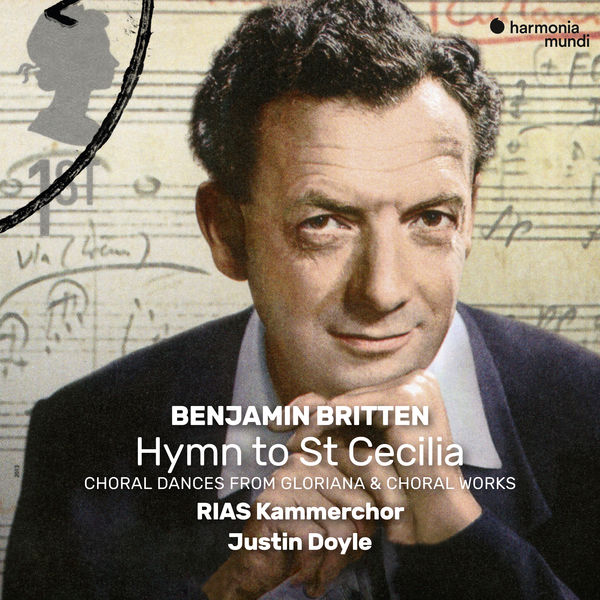
Britten Hymn to St Cecilia and love that dares speak its name : RIAS Kammerchor

Benjamin Britten Choral Songs from RIAS Kammerchor, from Harmonia mundi, in their first recording with new Chief Conductor Justin Doyle, featuring the Hymn to St. Cecilia, A Hymn to the Virgin, the Choral Dances from Gloriana, the Five Flower Songs op 47 and  Ad majorem Dei gloriam op 17. This new release extends RIAS Kammerchor's engagement with British repertoire, established when  they recorded Britten's Sacred and Profane together with songs by Elgar, Ralph Vaughan Williams and Charles Stanford, with former Chief Marcus Creed in 2013.  This new collection is particularly valuable   because it focuses on works Britten wrote at a formative period in his  career which even now is relatively unexplored. 

Britten's Hymn to St Cecilia op 27  is one of the classics of modern choral repertoire. It's not an "easy sing", lines and parts interwoven in inticate patterns.  This hymn had great personal significance for Britten, who was born on St. Cecilia's Day.  It is relevant that this was while he lived abroad : its connections to English polyphonic tradition show where his heart truly remained. St Cecilia was a singer who was matryred for her faith, hence the symbolism implicit in the text, by W H Auden.

"Blessed Cecilia, appear in visions/
To all musicians, appear and inspire/
Translated Daughter, come down and startle/
Composing mortals with immortal fire.
"

This refrain repeats through the three sections of the piece, and are sung in unison, underlining its meaning.  Auden extends the imagery to include Aphrodite, rising full-formed from the sea, and a more obscure reference (possibly from Dante), "around the wicked in Hell's abysses/The huge flame flickered and eased their pain."  Britten picks up on this for the scherzo section, where bright, short phrases flicker, like flames, in quick succession.  The hymn is as much for all artists in times of persecution as it is for the saint, given that Britten was acutely aware of the impact of Nazism on composers and others in the Europe he'd thought he'd left behind. The final section is characterized by "o" sounds and vowels, which resonate, like bells, an aural image emphasized by the sudden descent into solo parts, evoking sacred form.  The RIAS Kammerchor perform Britten's Hymn to St Cecilia so it flows fluidly, the parts so well balanced that they blend without losing clarity.

Britten wrote his Hymn to the Virgin at the age of sixteen, revising it in his early years at the Royal College of Music. Nonetheless it is not juvenilia, but a sophisticated use of double chorus, one singing in  English, the other responding in Latin, creating an echo effect as if the past were resurfacing in the present. In the final verse, the parts divide, singing the text together.

This recording is also valuable because it features the Choral Dances from Britten's Gloriana. The opera is sadly still  misunderstood, and the dances in the Second Act come in for criticism, so hearing them  on their own as a sequence shows their merits. This also demonstrates their role in the opera, which is not to further the obvious drama between Eliuzabeth and Essex but to focus on the Queen and her subjects, and the national interests that made her give up Essex for England. The good folk of Norwich are a symbol of the nation, and their loyalty is genuine. This fits in, too, with Britten's core beliefs in the value of local community : at Aldeburgh, he did more for community music theatre than anyone since the Renaissance.  In contrast, the courtiers who surround the Queen are sycophants and hypocrites.  The courtiers may sneer at the peasants, but the Queen recognizes sincerity. Presumably the new Queen Elizabeth got the message. She was personally fond of Britten  and gave him her support, much to the chagrin of those who thought him an outsider.

In the opera, the Choral Dances also underline the fundamental role of English tradition in Britten's music.  This structure is reminiscent of earlier form, and shows Britten's understanding of style.  The first three dances are a masque within a masque. "Time", "Concord" and "Time and Concord", moving from liveliness to serenity to joy.  The women's voices of the RIA Kammerchor sing "The Country Girls", while the men sing "Rustics and Fishermen", and come together again for the "Final Dance of Homage", here beautifully parted.

Britten's Five Flower Songs op 47 (1950) sets poems by Robert Herrick, George Crabbe, John Clare and an anonymous folk song.  Britten creates a bouquet, bringing together colours in varied combinations. "To Daffodils"  is swift, for daffodils don't linger, while "The Ballad of Green Broom" alternates doughty rhythms with longer, lighter lines, men's voices for the wood, womens for leaves, so to speak, the song ending with a witty flourish.  In "The Succession of the Four Sweet Months" (Herrick) the parts define each month. The parts combine in "Marsh Flowers", strong colours spread along lines that end in a sudden upbeat, and in "The Evening Primrose" stretch the lines so they descend slowly into slumber.

With Ad majorem Dei gloriam (AMDG) we return to Britten from roughly the same period as Ballad of Heroes op 14, the Violin Concerto op 14 and Young Apollo op15, all of which did not receive much attention until later years.  In the case of the Violin Concerto, now regarded by many as a masterpiece, the reason may be that it expressed despair so intense that Britten could not yet process.  The reason for the suppression of AMDG may have more to do with the fact that the solo SATB version can't achieve the colour  a larger ensemble can bring to it.  But there are deeper undercurrents here, too. The texts are by Gerald Manley Hopkins. What drew Britten to these poems of extreme mystical devotion ?  Since Catholic Emancipation wasn't achieved until 1829, and the order itself was suppressed until around that same time,  Jesuit principles of intellect and independence threatened more conservative minds.  Furthermore, Hopkins' poetry was not published until after his death, a sign of humility before God.  Hopkins may have been, for Britten, the quintessential artist as outsider, who endured suppression for the greater glory of his Art.

These songs are difficult to perform, but RIAS Kammerchor carry them off extremely well.  Again, the fine balance between voices creates a lustrous sheen which enhances a mystical sense of rapture. In "Prayer I" ("Jesu that dost in Mary dwell") the voices unite for the last line "To the greater glory of Thy Son : Amen", the last word extended, like a prayer.  Even more beautiful is "Rosa Mystica", where the male voices chant, as if at Mass, the women's voices dancing above the steady pulse of prayer.  The women's voices take up the chant with greater elaboration.  Britten sets "God's Grandeur" with brisk pulsating rthyms from which outbursts of energy emerge, like shouts of joy.   With "Prayer II", a hushed, contemplative mood returns,  the flow of the lines illustrating the image of a fountain linking God and Man. When the men sing "I repent of what I did", the line stands out, emphasizing humility. "O Deus, ego amo te" is a tender love song ; for Hopkins, the object being God, for Britten, perhaps someone human, The word Amen stresses the first syllable so it explodes like a shout.  The Jesuit order was founded by soldiers, and organized on quasi-military lines.  Hopkins writes unorthodox marching rhythms into his poem "The Soldier", which Britten respects, starting with the ejaculatory "YES!" (in capitals in the original poem) For Hopkins, the poem is a celebration of vigour in imitation of Christ.  But Britten, and readers of A E Housman, may read other connotations in the line ".....séeing somewhére some mán do all that man can do,
For love he leans forth, needs his neck must fall on, kiss, And cry ‘O Christ-done deed!".


If man is the image of God, kissing a man cannot be a sin.  In this context, the final song "Heaven-haven" may be a love song, too, and to someone quite specific.  The text is simple and direect, Britten's setting calm, with no fear of the "Love that dare not speak its name" in the words of Lord Alfred Douglas.  Imagine the rage of homophobes and those jealous of Britten and Pears in an era when homosexuality was illegal.  Britten may not have published the songs, but he didn't destroy them, aware that some day they would be understood as a testament.

Wednesday, 31 October 2018

Britten Ballad for Heroes, Gurney Gloucestershire Rhapsody, Bliss Morning Heroes

W H Auden and Benjamin Britten
 Benjamin Britten Ballad for Heroes, Ivor Gurney Gloucestershire Rhapsody and Arthur Bliss Morning Heroes with David Temple conducting the BBC Concert Orchestra and the Hertfordshire Chorus in Watford last week, broadcast on BBC Radio 3. An excellent programme since these pieces aren't as well known as they should be, though they are hardly unknown.

Britten's Ballad for Heroes Op 14, 1939  for example. When I first heard the piece seven years ago (Ilan Volkov BBCSO, Barbican) I didn't understand it, but gradually it's grown on me. The disparity between the poetry of W H Auden and the doggerel of Randall Swingler is a problem, but Britten uses it with a certain degree of irony. Auden is an intellectual : Swingler a man of action (a Communist) but not so good with words. Auden opposes fascism, while Swingler's solution is to fight with more violence. Yet they trundle along together, with unison chorus and marching orchestra  The contradictions in the piece provoke, just as the situation did. Therefore the piece is about a lot more than a simplistic conflict between pro and anti war. It should be noted that the Spanish Civil War ended in April 1939, with the triumph of the fascists and their Nazi allies, so the piece (which premiered at the end of April 1939) isn't about going to war so much as a realization that war alone cannot defeat the forces of evil.  The title is "Ballad for Heroes", not "Ballad of Heroes", for the cause the heroes fought for had been crushed so cruelly that  it was hard not to envisage the eventual triumph of Hitler, who enjoyed a lot more support, even in Britain, than some will now admit.  Despite the annexation of Czechslovakia, and the Nuremberg Race Laws,  Britain supported a policy of Appeasement.  When Chamberlain announced "Peace in Our Time"  there were many for whom the slogan rang false.  Appeasement, for better or worse, encouraged Hitler rather than curbed him, which is why so many despaired. It is unfair to fault Britten for leaving in April 1939 since Britain was at peace.  There are many ways of opposing war and the mentality behind it. War was only declared on 3rd September 1939 because Germany invaded Poland, not because of the regime itself. 

Thus the funeral march which runs through the Ballad for Heroes, with a solemn relentless tread. The chorus intones brief lines, alternating with the orchestra, replicating again the idea of  different forces being yoked together in common cause.  A mood of greater urgency and alarm is introduced by dizzy  figures in the orchestra (wonderful writing for winds) replicated in the wayward vocal line, Strident machine gun staccato, wild dissonance, surging lines lit by flashes of woodwind light.  "A world of horror!" Then suddenly the tenor (Ben Johnson)  emerges, uncovered and alone.  His lines curl and snarl with menace.  ""....and the guns can be heard across the hills like wa-a-aves at night". You could imagine his face contorting when he sings of "the stench of violence".   The vocal writing here is sophisticated, spiralling diminuendos, words stretched and twisted in a style Britten would use later, in the Serenade for Tenor, Horn and Strings and much more.  "Hear, you numberless Englishmen, to remind you of the greatness here among you, ......to fight for peace and for truth!" words rather cogent given the context of the those months between the annexation of Czechoslovakia and Austria, and the outbreak of war.  

Ivor Gurney's Gloucestershire Rhapsody was written between 1919, on Gurney's return from the battlefield, and 1920, shortly before he was incarcerated in a psychiatric hospital, where he died 15 years later.   Although  it was generally assumed that Gurney's late works were incoherent and unplayable,  Gurney scholars Philip Lancaster and Ian Venables have edited them for performance, revealing their true value.  The expansive lines soar, with an almost Elgarian spirit. One might imagine Gurney inhaling the fresh, pure air of Gloucestershire,  and the exhilaration of being able to roam in his beloved countryside. So very different from the horrors of the trenches!  Gurney's doctors believed that he was better off in hospital, but, when a friend smuggled in a copy of a map, Gurney traced his old hiking routes with  his fingers, as if re-living what he had lost. This background is relevant, for this performance seems infused with a spirit of freedom, of endless open horizons and limitless possibilities.

This "open vista" approach to the Gloucestershire Rhapsody may connect to Gurney's own hopes for the future. Significantly, the piece starts with the same first bars as Richard Strauss Also sprach Zarathustra -  a dramatic opening, but with a twist.  Gurney deliberately wanted to counteract "The Prussians" and what they stood for. Understandable for a man who served throughout the war, though Strauss wasn't fond of “Prussians" either, being Bavarian. The horns give way to a pastorale evoking the Gloucestershire countryside, with its rolling hills and spacious panoramas.  To Gurney, past and present connected in seamless flow. The ghosts of prehistoric hunters, Romans, medieval farmers, depicted in a bucolic dance theme. "Two thousand centuries of change, and strange people".  An ostinato section suggests both the heavy march of Time and the men of Gloucestershire marching innocently to slaughter on the Somme.  Gurney said that what kept him going in the trenches was the thought of commemorating these men in poetry and music.  A short, chaotic "war" section then gives way to a beautifully expansive theme, which might evoke a glorious dawn after a night of horror. It's Elgarian in its glory, but also Gurneyesque.  In this new dawn, though time moves on, Nature returns, and possibly heals.  The recommended recording is on Chandos's CD British Tone Poems, conducted by Rumon Gamba.

Arthur and Kennard Bliss
Morning Heroes (1930) isn't neglected but performances are rare because it’s hard to pull off a symphony on this scale. Much depends on the narrator, who has almost as much to do as the orchestra. Fortunately  the narrator here was Samuel West who narrates on Andrew Davis' s recording with the BBC SO for Chandos. The title "Morning Heroes" comes from  the final movement where three different poems are quoted, Now, Trumpeter, For Thy Close (Robert Nichols), Spring Offensive (Wilfred Owen) and Dawn on the Somme (also Robert Nichols), which graphically describe the landscape of a battlefield, specifically the slaughter of the First World War in which Bliss and his brother Kennard served. Kennard, like millions of others, East as well as West, perished. Morning Heroes isn't a requiem in the religious sense but describes the experience of war in a direct and unsentimental way. War isn't a game, it's not “entertainment".  In these poems there's enough inherent drama to make a point without theatrical excess.

Morning Heroes starts with the Iliad, where the Trojan hero Hector returns as a ghost. The symphony begins with a long quotation describing Hector taking leave of Andromache, his wife. "Would you leave your children orphans, your wife a widow". The refrain in the chorus acts as a whip, goading the heroes to further sacrifice. Bliss follows this first movement with the turbulent "The City Arming". Are the populace so caught up in bloodlust that they forget
the human toll ? The third movement, "The Vigil", is based on Walt Whitman's  Vigil Strange I Kept of the Field One Night and his By the Bivouac's  Fitful Flame. Whitman's verse isn't easy to set as its flow doesn't lend itself to music. Wisely,  Bliss uses spoken narration, augmented by chorus, singing the lines so they seem to sweep like flames whipped by wind. Orchestrally, this is perhaps the most expressive moment. The brief return to the Iliad, which follows, is thus put into context, like a look back on values one might no longer share. When the final movement returns to graphic depictions of the Somme, the connection is made between wars long past and more recent. Resolution, of a sort comes, where the chorus sings, followed by a wonderful but brief figure for oboe, and a brief resurgence of the pounding motif from the beginning. Muffled percussion, muted brass, the mens' voices singing with restraint, as if heard from afar, the women's voices almost spectral.  Yet again the orchestra up, martial music cloaked with menace. Yet a wayward melody emerges and the voices grow stronger and at last, a measure of serenity at the end.    


Friday, 7 September 2018

Still misunderstood : Britten Paul Bunyan ENO


ENO Studio Live at Wilton's Music Hall for Benjamin Britten Paul Bunyan in a new production.  Please read Claire Seymour's review in Opera Today. Nearly 80 years after it was written  this opera is still beyond the comprehension of many. Forget the folk story altogether : "From homespun culture manufactured in cities, Save us, animals and men"  W H Auden's not being arch.  If we don't see "homespun culture manufactured in cities" for the sham it is, we don't deserve anything more than fake and kitsch.  It's origins are more Weimar political cabaret, a genre which W H Auden and Christopher Isherwood knew first hand, and which Britten understood.  The nearest precedent is Brecht and Weill's Threepenny Opera. Paul Bunyan is not a musical. It is episodic because it depicts a society where attention spans aren't long enough to take on big ideas, or see the bigger picture behind the show.  Paul Bunyan is savage, biting satire, a wail of protest against materialism, vulgarity and the desecration of precious ideals.  Paul Bunyan doesn't appear in the opera for a very simple reason: he's a myth !  Larger than life, he represents an ideal that can never perhaps be attained.  It isn't about America at all, and attempts to present it one-dimensionally trivialize it, creating the very banality it so passionately abhors. The clumsiness of some of the musical writing in Paul Bunyan is in fact artistic licence. Parts of the piece sound corny because what they depict is corniness. Perhaps Britten is demonstrating the truth in Auden's phrase "From the accidental beauty of singalongs, Save Us, animals and men".

Paul Bunyan needs to be understood on its own terms and in the context of Britten's creative development.  It connects first and foremost to Our Hunting Fathers, premiered in May 1936, written when Britten was only 23, a work which still suffers from the hysteria unleashed against it in some quarters.  Our Hunting Fathers is a work of striking originality.  The text for "Hawking for the Partridge" is by Thomas Ravenscroft (1588-1635), Two other texts are anonymous, from the same period, and the rest are W H Auden , one adapted by him from an earlier source.  Like Elgar's Sea Pictures, there's nothing specially unusual in mixing texts, as Britten was to do in other works, including The War Requiem.  In the case of Our Hunting Fathers, the mock Tudor casing serves as a disguise for intense anguish.  Again, Auden's experiences in Weimar Berlin are relevant.  He knew only too well what the rise of Hitler meant, and where the conformity of mob rule and militarism could lead. Significantly, the cycle was completed after the Nuremberg Race Laws were promulgated (September 1935). Our Hunting Fathers represents one of the very few early protests against the Nazi regime.  Britten's pacifism ran deep, and from a very early age, and went far beyond his connection to Auden.  Paul Bunyan, like Our Hunting Fathers is cryptic code. The messages repeat in non-vocal works like the Violin Concerto and Sinfonia da Requiem. And in the less stellar Ballad for Heroes (read more here)
If Paul Bunyan isn't a hymn to kitsch Americana, what is it? In the opening chorus, the singers sing that the Revolution has turned to rain. Management/staff relations in the logging camp are better organized than in many real life businesses. Britten and Auden were well aware of Brechtian  dialectics and the political music theatre of their period, and this has some effect on the stylized, almost agit prop narrative. However,  Paul  Bunyan springs from a much deeper groundswell of pain and disillusion. Britten, Pears and Auden left Europe, hoping to find a new world uncontaminated by the strife of 1930's Europe. Britten's sojourn in America was comfortable, but he picked up on the darker sides of the America Dream. In Paul Bunyan, ancient forests are felled, the wood used for houses and railway tracks. "Progress" moves further west, and with it, conformity, gentrification and hypocrisy. "From patriotism turned to persecution, Save Us, animals and men". Peter Grimes and Billy Budd describe the fate of men who fall foul of bigots and mobs. Britten, Auden and Pears were well aware how J Edgar Hoover was hunting down "subversives". McCarthy's witch hunts would have come as no surprise. Like Peter Grimes, Paul Bunyan and Babe are too big for their boots in a world where pettiness rules.
So, what of the ENO Paul Bunyan ? Please read Claire Seymour's review in Opera Today HERE. As she says, it doesn't appear to deal with the savage irony that is so central to the piece.   Maybe the world still isn't ready for grown-up thinking.  It took the London media a long time to to get Mark Anthony Turnage's Anna Nicole.  Although Paul Bunyan was written for students, I think it either needs students with political nous and passion (no longer a given these days) or a professional cast and team.  It's not just the quality of performance that counts but the commitment behind it.  One Paul Bunyan that did work was the English Touring Opera production which came to the Linbury in 2014. Please read my review of that HERE.

Thursday, 22 March 2018

Anna Clyne, Benjamin Britten Violin Concerto : Oramo BBCSO

Britten and Menuhin, 1955

 Sakari Oramo conducted the BBC SO at the Barbican last night : Anna Clyne and Benjamin Britten   Two British composers, one a distinctive new voice, the other represented by a work which  in recent years has found its true place in the canon.  Heard together with a particularly fresh, vernal Beethoven Symphony no 6, this made a satisfying evening.

This was the UK premiere of Anna Clyne’s This Midnight Hour, first heard in Paris in 2015.  Quality, in Anna Clyne’s case, gets her ahead, not her gender.  She’s so original that the patronizing tag “female composer” is an insult. What is “female” music anyway. This Midnight Hour is ambitious work on a grand scale, though compact and precise.  Rushing figures fly forwards, quite ferociously, leading to a passage of surprising clarity.  Very rich sounds - especially the low strings - suggest dense textures, carefully defined.  From moments of near-silence,  pounding figures push forward, aletrnating with sudden lyrical passages. Winds and brass blow ellipses that seem to probe space.  Two staccato thunderclaps, and the music swirls into fast paced turbulence, whipped by ellipses of high-pitched woodwinds. More combinations of quietness and explosive staccato, then a long passage of almost Romantic lushness, evoking the sounds of Spain. A long-held single note (bass trombone), evolves into nocturnal fanfare.  A sudden crash on timpani, an abrupt end, like an exclamation point.  Later I realized that this is a reference to a poem by Juan Ramón Jiménez which Clyne was responding to.  “La musica; mujer desnuda,corriendo loca por la noche pura!” (The music: a naked woman, running madly in the pure night) . Apparently there are also references to Baudelaire’s Harmonie du soir (“Le violon frémit comme un coeur qu’on afflige,”), but This Midnight Hour was impressive even if I didn’t get that other level. There's no rule, whatsoever that poems have to be set word for word !

Although Britten didn't join the International Brigades in Spain, he believed passionately in their cause and was traumatized by Franco's victory.  Heartsick, Britten feared that Europe would become engulfed in fascism, and needed to get away. His Violin Concerto is a product of that period of intense despair.  Britten and Pears left Britain in April, 1939, when war seemed far away, and returned at some danger during hostilities to help the war effort as non-combatants. Those who have never heard his Violin Concerto may have thought him a coward but do not realize that it takes moral courage to write a deeply uncomforting statement like this.  Perhaps only now can we appreciate its place in the canon of major works by a composer who thought more deeply about society than most.

From a hushed string introduction, the violin (soloist Vilde Frang) rose, against an understated but ominous background of percussion and brass. Despite the lyricism of the violin line, the idea of war lurked, with menace.  Hollow pizzicato suggested agitation.  The second movement has the character of nightmare scherzo, a battery of strings, brass and percussion battling with the violin, which remains detached. Oramo shaped the tumult carefully bringing out the huge, angular blocks of sound, booming bassoons,  spikey details in the strings, rumbling drums, creating contrast with the violin. In the cadenza, Frang's pristine style lit up the dizzying diminuendo : not a defeat so much as "tactical withdrawal".  In the passacaglia, descending notes from the brass moved in careful procession. Now the violin line was haunted by other strings, mumuring as if heard from afar. Eventually an anthem builds up, the brass no longer against the soloist, but leading forwards.  Tense, brittle figures suggested gunfire, but the violin remained uncowed.  A particularly full-throated tutti section,  almost a chorale, violin and orchestra united in common cause.  From the strings, a good suggestion of guitars : the ghosts of the dead in Spain, rising again, led by the violin, marching quietly onward.

A truly "pastoral" Beethoven Symphony no 6, unusually fresh and vernal, which worked well in connection with Britten's Violin Concerto. Perhaps the storm wasn't as overwhelming as usual, but the sense of revitalization Oramo found after it more than compensated.  After the storm, the peasants are revitalized.  Like the fallen in Spain, they will not be defeated. 

Monday, 30 October 2017

The Dark Tower - Britten on the Radio

Blythburgh Tower - photo Roger Thomas
The Dark Tower, radio drama from 1945, with texts by Louis MacNeice and music by Benjamin Britten, at Orford Church near Aldeburgh and now on BBC Radio 3.  How we appreciate something new to us says as much about ourselves as it does about what's being experienced.  My friend said, "Quite the best radio drama I’ve heard for a long time” since it's much classier than most radio dramas.  Radio Drama is a curiously English tradition : maybe you need to be immersed in the period culture it reflects.when postwar paranoia bred conformity, and people obeyed the voices emitted from the small box set  which connected households to the wider world.  My friend grew up in postwar Britain when ration books were recent memory, and the wartime mindset of insularity and unquestioning obedience still prevailed.  Since I didn't, I had to get over that cultural barrier first. But I'm glad I made the effort.  What you get depends on what you put in!

The introduction, recorded by Louis MacNeice for the original broadcast on 21st January 1946, gave me the creeps   Such emotional manipulation and doublethink! MacNeice claims he doesn't know what the story's about but he's kidding. He sneers at Reithian values at the BBC but gladly took the money.  Equally culpable.  That kind of deviousness springs from negotiating a world where lies mean more than truth. The very point of The Dark Tower, where everyone’s caught up in games of deceit.  Who's manipulating whom, and why ? Do they ever twig ? People who grow up being manipulated end up abusing others, without knowing why.  Beneath the archly stylized text, there's human feeling, however distorted.

Part of the reason The Dark Tower succeeds is Benjamin Britten, whose music operates on much deeper levels.  It's music on its own terms, far more complex than sound effects illustrating words.  Wonderfully sour passages, which throb menacingly. The Dragon is present even in Roland's childhood.  The Trumpet exists almost as entity, evoking ideas which words cannot express.  My friend thought of Pelléas et Melisande and its unearthly symbolism. As music, The Dark Tower works rather well - pity about the dialogue, some of which is dated. Blind Peter, for example, is a cartoon emigré. But people get screwed up in other places too, like boarding school, Oxbridge, the Church and the military.  Even in the romanticized Englishness of Robert Browning's Childe Roland to the Dark Tower Came. What happened to Blind Peter could happen here, too. 

Compare The Dark Tower to Owen Wingrave, written for TV and broadcast in 1971, when TV was still a relatively new medium, and the media hadn't decided that culture wasn't for the masses.  The original film now feels dated, like Hammer Horror, since so much is made of the costumes and of the set. Get away from that leaden literalism, though, and Owen Wingrave is a much finer work than is sometimes assumed.   Please read HERE what I wrote about the TV Owen Wingrave some years back, There have been at least two new productions in recent years, one with Jacques Imbrailo singing the title role.  Like so many of Britten's other works, such as Curlew River  and the Church Parables (also heard at Orford)  Owen Wingrave works much better presented as stylized music theatre, closer to the spirit of medieval mystery plays than TV costume drama.  It could even  lend itself to sensitive staging, reducing the sourness of the text. 


Thursday, 7 September 2017

Jurowski's Pillars : Stravinsky, Shostakovich, Britten Prom


Stravinsky and Shostakovich with Vladimir Jurowski and the London Philharmonic Orchestra. This Prom was typical of Jurowski's genius for intelligent, musically astute programming : Stravinsky's Funeral Song at one end, and Shostakovich Symphony no 11, two pillars,  with Britten's Russian Funeral as supporting buttress, with Prokofiev's Violin Concerto no 1 in D between them. When even Vladimir Putin worries about planetary catastrophe we should need to think how and why we got into a world where some people admire nutcases with nukes.

Stravinsky's Funeral Song was revealed in December last year in St Petersburg, where it had lain undiscovered for over 100 years.  For more background and its significance, please read my article Lost No More : Stravinsky Funeral Song.  Gergiev conducted that performance in a superlative programme connecting Stravinsky with Nicolai Rimsky-Korsakov, whose funeral it marked. These connections are important, because the piece on its own is so short that its impact won't be appreciated out of context.  Gergiev linked it to Rimsky-Korsakov The Legend of the Invisible City of Kitezh and to Stravinsky's The Firebird, a wonderfully unified concept, which Jurowski is doing too at the Royal Festival Hall in February 2018, in a slightly different programme. Mark your calendars.   Combining Stravinsky and Rimsky-Korsakov is musically litterate and satisfying, but for this performance, Jurowski had to fulfil the rigid Proms diktats about dates and nationalism.

Before the Shostakovich symphony, though, Jurowski programmed Benjamin Britten's Russian Funeral (1936), which sets the hymn "You fell as Heroes" commemorating the massacres of the protesters of 1905, which Shostakovich was to incorporate into his Eleventh Symphony in 1957. Earlier this Proms season, we heard Britten's Ballad of Heroes, which has long been misunderstood because listeners can't get past the idea that being anti-war doesn't preclude protest in other forms. The ballad was written after the Spanish Civil War - it's not a call to battle, but a mark of respect for those killed and a protest against oppression. Please read my piece on it HERE.   Hearing Britten before Shostakovich in this context emphasizes the idea of universal struggle against oppression, wherever it might happen, or when. 

 Stravinsky's Funeral Song is about one man and highly personal, while Shostakovich's Symphony no 11 marks the death of multitudes. In 1905, people were massacred on the streets of St Petersburg. Twelve years later, the Tsar was overthrown for good.  Thus the scale of the piece, which not only marks the deaths of 1905, but also the end of Old Russia and the beginning of the New.  Thus the mute stillness of the First Movement "In the Square of the Winter Palace" with its ominous rumblings, and trumpet calls, which gave way to the the more abstract "soaring" theme, rising above the frozen ground, so to speak, as tension gradually rose with percussion defining a  staccato growl.  . Perhaps we can imagine the walls of the palace looming in the solid rising figures but these could also symbolize impenetrable forces of repression.Against these, the winds of change  blow when the strings fly into action, screaming in swirling, wayward lines.   Jurowski's sense of form keeps the scene in sharp definition.

Jurowski conducted with military precision,  contrasting the violence of the attack and the chaos it sliced through.  Thus the eerie silence from which the Funeral Elegy emerged : people are lying dead, but their voices will be heard above.  If anything, Jurowski's control was even more impressive here, allowing the strings and winds to wail, without compromising into insincere sentiment.  Utterly justifying  the connection between this symphony and Stravinsky's Funeral Song.  A magnificent finale, where the angular repetitions march forwards with ferocity.  Though Jurowski, by  nature, is a gentle person, he can be intensely passionate when he needs to be, as truly spiritual people often are.  Where once the soldiers marched on the people, the people now march forth in triumph.  Fanfares can be banal, but Jurowski's clear minded intelligence doesn't degenerate.  The heart of this finale isn't the noise, but the quiet cor anglais and bass clarinet themes. Eventually the Elegy returned, the tocsin bells tolling  clearly above the tumult.  the music breaks off suddenly - the struggle isn't over.  La lutte continua ! everywhere and at all times. Including the present.  

Between the two pillars and supporting buttress of Jurowski's programme, Stravinsky's arrangement of Song of the Volga Boatmen and Prokofiev: Violin Concerto No 1 in D with  Alina Ibragimova, ratherb diluting the overall impact, but that's the Proms for you.