Showing posts with label Honneger Arthur. Show all posts

Wednesday, 9 January 2013

Les misérables - the music not the musical

Yet another movie version of Victor Hugo's Les misérables! The saga could have been written for cinema, given its sprawl and extreme drama. Barricades and underground sewers are a bit beyond most normal staging. But it's perfect for film.

There's the 1925 silent Les misérables, which runs for six hours. I've seen only extracts, which is maybe just as well.  Then there is the 1934 sound film, directed and written by Raymond Bernard, which runs only 4 and a half hours. This has been restored and is available on DVD  It's faithful to the original novel,  with direct quotes and strong, pungent characterisations.  And the music was written by Arthur Honegger of whom there is a lot on this site if you search.

Honegger's score for Les misérables is vivid without being over hysterical like some film music. The story was powerful enough to support the action, so the music works as music and sounds good even without the visuals. Audio alone, some movie music cloys to the point of vulgarity. Honegger's Les misérables works as music.  With a basic knowledge of the story, you can fill in the narrative, but Honegger's music unfolds like a symphonic poem in its own right. Plus, it runs less than an hour.

Saturday, 17 November 2012

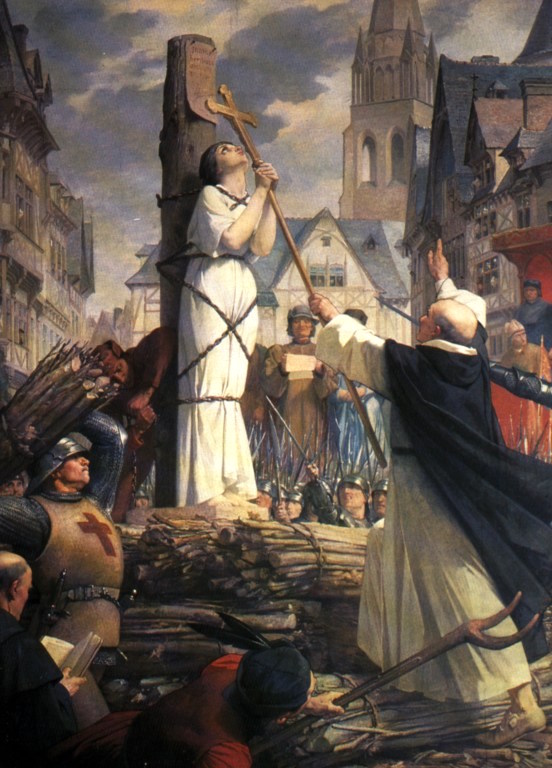
Joan at the Stake, broadcast live

French actress Marion Cotillard plays Joan of Arc in a new production of Arthur Honneger's Joan at the Stake (Jeanne d'Arc au Bûcher) today on medici tv.This will be interesting as the piece requires a very strong personality indeed in the title role. Don't judge the piece by the Barbican performance last year  which was curiously inert despite the magnificence of the score. No wonder people who didn't know the piece didn't like it. A good performance requires a good actress to ignite.....oops. Watch what Ingrid Bergman brings to the part in the 1954 filmed version of Honneger's masterpiece. The brilliant orchestration gets upstaged by her amazing performance. Read more here

Honegger's Jeanne d'Arc is oratorio as psychodrama. In these final moments of Joan's life she thinks back on how she's arrived at the stake. The raging mob screams around her. She's shaven, in sack cloth but for the presence of her Confessor, who doesn't really understand.  But she's not alone for at the criical moment, her voices return, and she's taken up to heaven.  The orchestration is amazing - ondes martenot, saxophone, huge string section. The prelude, added in 1944 during the German Occupation, sets the piece in wider context. This magnificent orchestration frames the role of Joan, She's a simple peasant girl  who does extraordinary things. Significantly, Joan is not a singing part.

Read about Carl Th Dreyers silent movie The S Passion of Joan of Arc HERE, and about  Walter Braunfels Scenes from the life of Joan of Arc, a neglected wonder, HERE. .

Thursday, 23 February 2012

Gothic resistance fighter - Walter Braunfels Die Verkündigung

Walter Braunfels was one of the more important German composers of the early 20th century, related to Ludwig Spohr and connected to Pfitzner, Furtwängler, Bruno Walter, Hindemith and others. His opera Die Vögel was the flagship of the Deutsche Grammophon Entartete Musik series, so popular that it's now almost standard repertoire. He was even featured (briefly) at last year's Proms. So why sin't Braunfels known even in these circles?

His Die Verkündigung (op50) was broadcast last week, a performance last year from Munich Radio Orchestra conductd by Ulf Schirmer. It was an important event, for Braunels was connected to Munich's artistic circles, and the only recording of Die Verkündigung has been out of print for years.

The new Munich Die Verkündigung is fascinating. It's very lively. Juliane Banse sings the heroine Violaine, a  taxing part where the tessitura leaps upwards suddenly from nowhere and has to fly. I've been following her for years: this is one of her best performances ever. Robert Holl and Hanna Schwarz sing her parents, and Janina Baechle her sister Mara. Adrian Erod sings Jakobaus, to whom Violane is betrothed, and Matthis Klink sings Peter von Ulm the Leper.

Peter von Ulm builds great cathedrals, but contracts leprosy. In a gesture of kindness, Violane kisses him, but the kiss is misinterpreted, and Jakobaus drops Violane. Eight years pass. It's Xmas and it's cold. Br Br Br the townsfolk recite in mock stylized wit, while "medieval" bells and drums sound and dog latin seems to be spoken. Peter is back and he's cured, "with the skin of a child". Mara is holding her dead daughter. Violane holds her while Mara reads the Christmas story. The child breathes again but now her eyes are blue like Violane not dark like her mother. Mara throws Violane into a ditch, but she's rescued. At which point, father returns from pilgrimage and the truth about the kiss is revealed. Violane has taken on Peter's illness and promptly dies. A lot more dramatic than it sounds, and brightly written. (the semi-spoken sequence is brilliant). There are even references to  Die Vögel in the jerky staccato rhythms, and lovely off-key horns..

The opera is based on a medieval miracle play, but curiously, it's not overly religious, even though Braunfels and the playwright, Paul Claudel, were both extremely devout Catholics. Indeed, on strictly liturgical terms, Die Verkündigung is blasphemy for it's about an ordinary woman who can raise the dead and cure the sick. God is not involved, though the Virgin Mary is implicated.  But maybe that's the point, for you don't have to be a saint to do miracles.

Notice when the opera was written - 1933/5 - when Braunfels' career was strangled by the Nazis. Die Verkündigung is about faith and the power that good people have to overcome evil. Claudel also wrote the play which Arthur Honegger set as Jeanne d'Arc au bûcher, also in 1935. (read more here and here).And Braunfels wrote another opera, Jeanne d'Arc (Szenen aus dem leben  der heiligen Joihanna) between 1939 and 1943. In retrospect, his "inner exile" is clear.

It's significant, too, that Braunfels adapts Claudel's play,written in French, to German  and to an unequivocally "Germanic" pseudo-medieval style, complete with long spoken passages. The sort of thing the Nazis admired, without understanding the true meaning of medieval piety. K A Hartmann was to do much the same thing in his Simplicus Simplicissimus.
Please read lots more about Braunfels on this site - more on this genre here than any other!

Wednesday, 9 November 2011

Ingrid Bergman in Honegger's Joan of Arc at the Stake

Ingrid Bergman made two movies about Joan of Arc. The first (1948) was directed by Victor Fleming. Any film with Bergman as the star is watchable, but the script (Maxwell Anderson) is wooden, and the production is pretty daft. Shortly after, Bergman met Roberto Rossellini and they had a torrid affair which scandalized Hollywood. But one positive outcome was that together they made serious art movies.

Bergman's second Joan ofArc was Jeanne d'Arc au Bûcher (1954), (Giovanna d'Arco al rogno) a filmed version of Arthur Honegger's oratorio, directed by Rossellini.  It's a very good example of how film can enhance music. Honegger's work is psychodrama as oratorio, and Rossellini understands its context.

The set is minimal, shot against a dark background with small lights like stars. Joan is alone with her confessor Frère Dominic. These are her last moments as she waits by the stake, and Joan is examining her conscience. She's manacled, but her mind roams free.  Honegger deliberately sets her part as speech, not song, to show how simple and vulnerable she is. It may be hard for those used to "ordinary" oratorio to appreciate that this heroine doesn't do heroic grand display. Joan is a heroine because she's pure and humble.

Even dressed in sackcloth, her hair shorn, Bergman radiates. Rossellini doesn't need special effects. Bergman's beauty comes from within. Honegger's narrative, such as it is, unfolds in a series of tableaux, like the Stations of  the Cross in Catholic churches, which people follow stage by stage as they meditate on Jesus's journey of suffering.  Rossellini frames Joan's way to the stake with two deliberately stylized scenes of heaven. Saints float in a sky of primitively painted clouds - the kind of painting you might see in a wayside shrine in the countryside, as Joan might have seen, centuries ago. Saints and angels move in a huge circle, the image of a halo, a crown or of the voices closing in on Joan's mind.

Rossellini understands how Honneger's music works. Each tableau is shown as a vision, opening out of the bare stage on which Joan and Frère Dominic are standing. Moreover, each tableau is shown from Joan's perspective. The judges are seen as animals, as a traumatized girl like Joan might have imagined. Honegger sets their words as comic grotesque, which is perceptive, for Joan didn't understand Latin, the language of the Church. It also underlines her peasant sensibilities, so far removed from the intrigues of state. Rossellini puts masks on his actors, so they look like players in medieval mystery plays, who probably did sing in grunts and squawks.

Honegger describes the camp of the English knights with mock-heroic pageantry. They're playing an obscure card game just like they're playing a game with the French nation. Then Honegger writes quasi-folk dance, and Rossellini shows a group of peasant girls dancing in a circle - as the saints and angels did - and Bergman joins them. "It was so, in my father's house" Joan tells the monk, meaning her earthly father. But Rossellini shoots the scene in a surreal mist and there's a mound behind, like the pyre at the stake. Je vais, J'irai! cries Bergman, for she's already on her way. Rossellini uses a technique where he superimposes Bergman's image over the background so she's partly transparent, between two worlds.  Again,this expresses Honegger's music perfectly, for the composer superimposes different threads of music - the folk song, the pageantry and exquisite crosscurrents of abstract music. It's amazingly daring, sophisticated writing.

The mob (the choir) taunts Joan as she's chained to the stake. Now their singing disintegrates to semi-speak, while Joan sings for the first time. Not a glorious triumphant aria but the folk song the girls sang before. It's so basic that even Bergman and the actresses who play the part can sing it. Honegger is telling us that Joan's an ordinary human being, ennobled not by her deeds but by her faith.  Je ne veux pas mourir! J'ai peur! she sobs, but then the song of the angels returns. Je n'ai pas seule!

Discords as the flame rise and the mob shouts, but the music of the angels wins out. Rossellini shoots Bergman, rising upward through the mists suggested in Honegger's ethereal music, until she joins the heavenly circle in the sky. It's tempting to read Rossellini's love for Bergman into this film, and his anger at the way she was vilified in Hollywood, but I think Jeanne d'Arc au Bûcher stands on its own merits as a superb example of sensitive, musically informed film making.

Lots more on Joan of Arc, art film and music on film on this site and more to come!

Monday, 1 August 2011

Knussen's devious Nature Puzzles Castiglioni Prom 19

Oliver Knussen is one of my main Proms highlights every year because he's just so much fun! BBC Prom 19 on 29/7 no exception. Honegger, Frank Bridge, Berg, Castiglioni and Debussy? Ollie's trademark is the wit with which he puts programmes together, often so they work on several different levels,, like an intricate puzzle. This takes brains. So catch this Prom on BBC Listen again til Friday.  On radio, you get to hear Knussen talk as well. It's an education. He puts on a bumbling persona, but inside, there's razor-sharp intelligence and formidable understanding of repertoire.

Listen to what Knussen says about Honneger's Pacific 231. Please follow this link to the original film of Pacific 231 made in 1949. Knussen's conducting the same notes but the piece sounds quite different because he's making a connection with the rest of the programme. This piece isn't "about" trains, as Honegger himself said. It's also a study in parallel perceptions of tempo. When you speed along in a train, the landscape seems to whizz past. But in fact the landscape barely moves. Honegger's writing the musical equivalent of optical illusion.

"Modernist Pastoral" says Knussen, reinforcing the idea with Honneger's Pastorale d'été. "An alpine pastorale", says Knussen, "with yodels". Knussen's either clairvoyant or he knew that the BBC Proms this year would include alpine fantasies like William Tell. (Honegger's Swiss).  It doesn't matter. What's interesting here is the way Knussen brings out the keening, soaring legato, so the piece seems to open upward and outward. It feels "observed" and organic. So it falls into place with Debussy's grand La Mer and Frank Bridge's delicate There is a Willow grows aslant a Brook. All three very different pieces, but all tone poems. Since there's lots of Frank Bridge maybe Knussen has an inside track.

Pairing Frank Bridge and Alban Berg? That's a challenge but Knussen pulls it off. Bridge's There is a Willow grows aslant a Brook. seems idyllic on the surface, but was written with the image of Shakespeare's Hamlet Ophelia in mind. Ophelia floats along a limpid brook. But she's dead. Those shimmering surfaces are like the "haze" that rises from Honegger's summer meadow. "This piece plays itself", says Knussen of Bridge. Listen as the textures become more dense and low woodwinds introduce chill. Not a mindless reverie at all. Was this where Britten learned how to put poisoned innocence into music?

And so to Berg's Der Wein. In its "prison de verre" the wine calls out, beguiling the drinker to lose his inhibitions. Rich, luscious orchestration, appealing to those who'd like to rebrand Berg as a New Romantic, and write Schoenberg out of history. But, as Knussen points out, the pitch is a tad too low for sopranos to feel comfortable, creating danger and discomfort. Claire Booth's voice isn't opulent like Jessye Norman's but she brings out the tense vulnerabilty at the heart of this set of songs. Like Lulu.  Der Wein can be heard as a study of parallel realities, coded secrets and intricate symmetries. Berg and Knussen have a lot in common!

From wine in verre to Inverno in-ver, Niccolò Castiglioni's 11-part contemplation.  Titles like "Flowers of Ice", "Winter", "The Frozen Lake". Is Castiglioni nature painting? Extremely hgh pitches. Sharp, sparse textures, sudden flurries where tempo shatters the line. Sounds we've become used to associating with ice, snowflakes, frozen planes of water, even bells heard from a distance.
Inverno in-ver is airconditioning in sound. The BBC Proms should bring it back each summer when the Royal Albert Hall swelters. 

Yet Castiglioni frequently writes pitches almost too high for the human ear, and often relies on minimalist orchestration favouring percussion, or strings, or piano (Castiglioni's instrument)  used as percussion. Modernist tone poem this may be, but there's more to it.  Note the last three segments, "Silence", "An old Adagio" and "ll rumore non fa bene. Il bene non fa rumore" (Noise does no good. The good makes no noise). For me the essence of Castiglioni's music for me is this "still, small voice of peace", more powerful than bluster.

"Castiglioni's like Vivaldi, pitches rising higher and higher with each passing century" quips Knussen. The comparison is apt, for Castiglioni's music feels eternal, transcending time and place. Knussen is one of Castiglioni's big champions, so he gets an amazingly  idiomatic performance from the BBCSO! Single chords stretched so they oscillate, single notes precisely applied. Inverno in-ver is exqusitely beautiful. I've been playing this over and over on repeat, it's so fascinating and inventive. Read more about previous London Castiglioni concerts HERE.

"Lots of moistness in this programme", says Knussen, " brooks, lakes and La Mer".  But the connection goes deeper. "Ravel blends", says Knussen, "Debussy superimposes". Debussy's textures move because they are transparent. Knussen keeps them clean and pure, so the effect is crystalline. Maybe some would prefer an interpretation with more glamour, but Knussen's La Mer connects to the rest of this programme - lines that cross and co-exist, themes deftly defined. Impressionist painting revolutionized art because the colours weren't smudged and seemed shocking modern. That's why Debussy's called an Impressionist. Castiglioni is a Debussy in his own way, even more so than a new Vivaldi.

Friday, 21 January 2011

Barbican 2011-2012 Opera and vocal

That's Einstein on the beach. Note the natty pose, the shorts and his darling sandals!  The Philip Glass opera Einstein on the Beach  is a joint production between the Barbican, de Nederlandse Opera (big recommendation) and others. High profile, but tickets don't go on sale until April 2011 though the performances aren't til May 2012 - and look at the prices! (which is why you want to get in while cheap seats exist).

Gergiev conducts Wagner Parsifal with the Mariinsky on 3 April 2012, concert staging, which might be OK, and one night only. Nothing like Haitink, I suspect. He's conducting Stravinsky Oedipus Rex on 15/5 which he does wonderfully and The Soldiers Tale and Renard two days before - a good package, I think. Weber, Der Freischütz 19-21 April might be interesting but a real must is Louis Langree Mozart La Clemenza di Tito on 22/2. Excellent cast - Schade, Garanca, and the Deutsche Kammerphilharmonie. The Barbican is well suited to intimate opera, as this year's current baroque opera series demonstrates. They: should play to this strength by doing more.

Lots of wonderful choral works, the best being Szymanowski's Song of the Night, I think, with Boulez on 8th May, but lots of competition.  One of this year's Total Immersion Days features Arvo Pärt, so we can be sure of divine harmonies. Simon Keenlyside sings in Mendelssohn's Elijah on 7/3/12 with the Britten Sinfonia. Gerald Finley in Walton's Belshazzar's Feast and Bostridge in Britten's War Requiem. Other opera, too, such as Opera North's Tchaikovsky Queen of Spades and Jonathan Harvey's Wagner Dream, during the Harvey total Immersion. This was featured at the Holland Festival some years ago, mixed reviews. Lots of other vocal treats - recitals by Hvorostovsky, Borodina and Andreas Scholl.

But there are more things that really shouldn't be missed, not because they're starry, but because they're rare. First, on 4/11, Arthur Honneger's dramatic oratorio from 1935, Joan of Arc at the Stake, (Jeanne d'Arc au bucher), then on 6/11, music to accompany Carl Th Dreyer's 1928 movie The Passion of Joan of Arc. It's an amzing film, thought lost for many years. It pre-dates his spooky Vampyr (1932) but in some ways it's more innovative with its dramatic angles and close-ups. Marin Alsop conducts.

Also a must will be Anton Dvořák Jakobin (The Jacobin), complicated plot, rarely performed. If anyone can carry it off and make it convincing, Jiří Bělohlávek is the man. He chooses his singers well and doesn't compromise. Since the performance isn't til 4th February 2012, there'll be lots of time to prepare beforehand. Just because bookings open so early, there's no compulsion to buy everything at once. There is so much going on in London all year that the detailed Barbican programme is a boon. You can organize your diary around it and prepare by listening and learning in advance. PLEASE SEE my summary of the Barbican 2011-2012 ORCHESTRAL programme.

Monday, 29 November 2010

Risør at the Wigmore Hall Honneger Stravinsky

This weekend, the Risør Festival came to the Wigmore Hall, London. Sunday night's concert was the most intriguing because it showed the characteristic  Risør touch - eclectic repertoire, unusual ways of hearing familiar works, and above all, an unusally intelligent approach to programming. That's what you get when serious performers get together to play for each other. Please follow this link to read the review in Bachtrack (highly recommended listing site)

"Because Risør is a festival for musicians, it's adventurous.......
Stravinsky's Rite of Spring. Not the ballet, but a version for keyboard here heard on two pianos with Leif Ove Andsnes and Marc-André Hamelin. The austerity concentrates the mind, focusing on the basic structure of the music......."

Ralf Wallin's Under City Skin "described as a way of hearing things on different levels, seeing archetypal myth beneath the grim reality of a cityscape. Hence the "footsteps", sounds that move forwards and backwards, from different angles. It's deliberately disorienting, especially at the Wigmore Hall where we're conditioned to hearing from only one dimension. The result is that there's a constant battle between what we recognize as conventional music and this strange disembodied counterpoint. It's a good way of shaking up auto pilot listening. Risør does counterpoint in the widest meaning of the term......"

"Arthur Honneger's Symphony no 2 for string orchestra and trumpet. Austere, spartan restraint, but also the clarity you get on a chill morning, when there's little background distraction. Yet Honneger contrasts the elegance with strange, wailing themes, "smeared" notes which counterbalance the formality. Is it an incantation, or a cry of anguish? Hearing Honneger after Stravinsky focuses the mind on the idea of ritual as means of placating fate and cosmic dangers. Significantly, Honneger was writing in 1940-1. The references to Bach confirm the idea of faith (of any type) in times of tribulation. Counterpoint again! In the third and last movement, Vivace non troppo - presto, a trumpet materializes in an archway, usually closed off, above the platform. Trumpets symbolize angels, of course, but musically this is powerfully effective. The strings aren't alone. Their chorale-like theme is reinforced by the deeper and more strident tones of the trumpet, playing in parallel".

Sunday, 28 November 2010

Arthur Honnegger Train Man


Tonight at the Wigmore Hall, Arthur Honneger's Symphony no 2. But first the complete film of Honneger's Pacific 231. It's a study in forward movement created by steady tempi that resembles the orderly chugging of a vast machine, slowly changing gears.  Gradually the gravitas lightens, as the huge mass takes flight. Perhaps the high wind instruments suggest, well, wind, and speed. Perhaps the brass resembles the whistling of  a train?  The idea of parallel themes also suggests wheels in formation, moving independently, but in conjunction. Or railway lines, which start in a condensed huddle but spread out as the line heads out into open country.  Honneger's music was conceived as abstract music, but Pacific 231, because of its title, now means locomotives as well as locomotion. Honneger himself conducts in this 1949 film by Jean Mitry.

"Ce film n'est pas un Documentaire. Soutenues par de bruits qui nous sont familiers puis intiment liées à la musique suivre se proposent seulement de créer une ambiance"