Showing posts with label Angelika Kirchschlager. Show all posts

Thursday, 1 February 2018

Schubert's Birthday, Wigmore Hall : Angelika Kirchschlager


At the Wigmore Hall, Schubert's birthday is always celebrated in style. This year, Angelika Kirchschlager and Julius Drake, much loved Wigmore Hall audience favourites, did the honours, with a recital marking the climax of the two-year-long Complete Schubert Songs Series.  The programme began with a birthday song, Namenstaglied, and ended with a farewell, Abschied von der Erde.  Along the way, a traverse through some of Schubert's finest moments, highlighting different aspects of his song output : Schubert's life, in miniature.

A beautiful Namenstaglied D695 (1820), where the lines rock gently, almost more lullaby than Lied.  it was written for one of Schubert's friends, Josefine Koller,  who wanted to sing it to please her father.  Not many singers can do artistry without artifice, but that genuine sincerity is one of Angelika Kirchschlager's great strengths.  She can create youthful freshness like no-one else with the agility and purity of her timbre, yet can also warm that sweetness with a promise of innocent sensuality.  In the context of those times, it was accepted that child-like beauties would grow into women, hopefully fulfilled by love. In reality, of course, things don't always work out right, so even happy Lieder can be haunted by a sense of unease. Thus Frühlingsglaube D686b (!820, Johann Ludwig Uhland)  All things change, but, importantly, "Das Blühen will nicht enden". So have faith in Spring, for change is also endless renewal.  In Geheimes D719 (1821, Goethe), a young person learns that love isn't easy, but in Im Frühling D882 (1826) the artist yet again finds solace in hope. Ironically, that song sets a text by Erst Konrad Friedrich Schulze (1789-1817) whose obsessive love for two sisters wasn't romantic, as the love existed only in his mind.  Bei dir allein ! D866 (?1828, Seidl), Lambertine D301 (1815 anon) and Am Bach im Frühling  D361 (?1816, Franz von Schober) combined well, as did the next set Ganymed D544 (1817, Goethe), Wiegenlied D489 (1816 anon). But with In der Mitternacht D464 (1816 Johan Georg Jacobi), a sense of doom intrudes, preparing us for Erlkönig D328 (1815, Goethe) that masterpiece of Gothic horror. Since it sits fairly low, it's usually the preserve of male voices. Kirschschlager, however, made it work, since, for a change, we could hear it from the perspective of the terrified child.

Schubert himself blossomed early, reaching peaks early in his youth, dying before autumn set in.  Gesang der Norna D832 (1825, Walter Scott) and Romanze zum Drama Rosamunde D797/3b (1823 Helmina von Chézy) connected to other genres Schubert was interested in,  followed by more classic Lieder.  Songs like Suleika I D720 (1821 Goethe) and Suleika II D717 (1821 Goethe) are Kirchschlager specialities, which suit her ability to create girlish charm tinged with tragedy. Her self confidence renewed, she sang with the warmth and sincerity that is her forte. Wigmore Hall Schubert Birthday concerts are far too high profile to cancel unless you're in extremis, which Kirchschlager was not. But Wigmore Hall audiences know Kirchschlager so well, and have heard her so often over the years, that we appreciate what she does. Singers are not machines. We understand the Liederabend ethos. Singers are singers, not machines. In Schubert's time, people didn't demand CD perfection, they cared about the singers as human beings. It's the Liederabend ethos.  Kirchschlager and Drake rewarded us with  classics like An den Mond D259 (1815 Goethe),  Der Jüngling an der Quelle D300 (?1815 Johan Gaudenz von Salus-Seewiss), and  Der Wanderer an den Mond D870 (1826 Seidl).

Finding joy in art, Schubert seems to have made light of his troubles,  but we cannot help but ponder what might have been in his soul.  Listening to Der Unlückliche D 713 (1821 Karoline Pichler) we can perhaps glimpse intimations of something beyond conventional Romantic morbidity.  Yet the song responds to gloom by speeding up and pushing forwards: "Du hast geliebt", and later "Zerrissen sind nun alle süssen Bande". At moments, Drake's pounding forcefulness serves good purpose.  In Lied des Florio D857/2 (!825, Christian Wilhelm von Schütz), we return to calm, "erst mit Tönen sanft wie Flöten".  But this sleep is poisoned.  Here Kirchschlager was at her peak again, with beautiful timbre and phrasing.  The recital ended with Abschied von der Erde D829 (1826) The text comes from a play, Der Falke, written by teenage poet Adolf von Pratobvera von Weisborn as a gift to his father.  Strictly speaking it is not a Lied at all.  The voice part is declamed, not sung, against a piano backdrop. As the last song in the Wigmore Hall complete Schubert song series, it's an extraordinarily moving moment. We remember that Schubert died in his prime, his voice silenced before its time, the piano lingering to remind us of its loss.


This review also appears in Opera Today

Tuesday, 21 January 2014

Kirchschlager Thibaudet Liszt Brahms Wigmore Hall

A dream team with a dream programme : Angelika Kirchschlager and Jean-Yves Thibaudet at the Wigmore Hall.  Kirchschlager and Thibaudet have been working together from very early on in their careers. Her voice is warm and natural, ideal for Brahms,  He is a superb Liszt interpreter. What could be more perfect?

Ominously the recital started late. Performers of this calibre are so professional that almost nothing throws them off stroke. But performers are human, too, affected by things an audience might know nothing about. Kirchschlager is a natural communicator, whose unique capacity to connect with her audience has made her deservedly a perennial favourite. When she missed an entry, she smiled and started again, winning the audience over with her sincerity. I couldn't fault her, since I wasn't feeling well either and missed most of the Brahms set.  No problem, though. We hear her at her best so often and will do so again soon (13/2 Joseph Marx).

In Franz Liszt's songs , the piano sings. These aren't Lieder so much as songs for piano accompanied by voice. His transcriptions of Schubert, for example, are so elaborate that they overwhelm the purity of Schubert's expression. "Spring flowers pressed and gilded", someone once said.

 In Über allen Giopfeln ist Ruh (S306/2 1859) Thibaudet played the opening chords so they seemed to levitate, so by the time Kirchschlahger sang "Gipflen" we were already on the mountain top, The contemplative lines suggest the stillness in the air. Goethe's punchline, however, is in the final strophe "warte nur, balde ruhest du auch".  Schubert's setting of this text, Wanderers Nachtlied D768, employs a similar single chord  progression, but his song is shorter and more direct, imnlpying death rather than repose.

Liszt's piano version of Am Rhein in schönen. Strome (S272/2 1855) is exquisite, the piano song version more restrained. Both glory in fluid lines that suggest flowing water. Dancing notes suggest sunlight playing on the waves. But the poem is Heine, It's not the river he's concerned with but a painting of the Virgin Mary in Köln Cathedral, whose eyes, lips and cheeks remind the poet of physical love. Thibaudet's notes sparkle, and Kirchschlager emphasizes the sensual vowels in "Wänglein". Schumann's setting of the text is ferocious , the voice attacking from the very first bar. In Liszt, we rejoice in the scenery and the lovely high tessitura in "freundlich hineingestrahlt"

Liszt respond well to the bitterness in Heine's Vergiftet singt meine Lieder  (S289 1844-9).. Thibaudet made the piano snarl turbulently. In contrast, the lines in O Liebe  so lang du leiben kannst ( S298/2 1845) curl curvaceously, clinging to the phrasing in the poem (Ferdinard Freiligrath). The piano part is beautiful, though relatively restrained, the voice leading. This is a song that fits Kirchschlager's timbre perfectly.It's almost Brahmsian.  She expressed its meaning well.

Thibaudet played a lovely Consolation no 3 in D (S172 1844-50) but the highlight of the evening was Die Drei Zigeuner (S320 1860)  The poem, by Nikolaus Lenau, describes three gypsies amusing themselves. This gives Liszt a chance to have fun, creating a kind of miniature theatre piece. One gypsy plays a fiddle, another a cimbalom and the third lazily smokes a pipe. It's a surprisingly dramatic piece because Liszt imitates the instruments and writes nice "smokey" figures to suggest how laid back the gypsies are. The text doesn't mention a woman, but Kirchschlager's humour and sensuous delivery created an invisible fourth gypsy. Perhaps there is a tambourine in those, circular piano rhythms ?The relative folksiness in the poem brings Liszt closer to the spirit of Volkslieder, bringing us back to Johannes Brahms.

Friday, 3 January 2014

January at the Wigmore Hall

Back to real music at the Wigmore Hall in January! On Saturday all day, Apartment House presents an eclectic programme. Interesting, even though I don't know any of the works featured I might go.

Absolutely unmissable is Matthias Goerne's recital on 7/1, with Lief Ove Andsnes. Amazingly challenging programme mixing Mahler songs with Shostakovich's Suite on verses of Michelangelo Buonarroti. Goerne's approach to both composers is highly original and perceptive. Definitely an event for serious fans of song and good repertoire. It's been sold out for months.It could tie in well with the four-part Wigmore Hall series on Russian music with Roy Stafford which runs each Thursday this month.

EIGHT TOP CONCERTS IN A ROW! Angelika Kirchschlager and Jean-Yves Thibaudet do another very strong Brahms and Liszt programme on 20/1. The very next day Christoph Prégardien and  Michael Gees do an interesting programme which mixes big names like Schubert and Wolf with less well known contempraries like Loewe and Franz Lachner, whom Prégardien has done so much to promote. Search this site for more on Lachner.Very interesting baroque and early music, too. On 22nd  La Nuova Music presents Francesco Conti's 1732 opera Issipile prepared for the Hapsburg court. Top soloists, which will make the evening very worthwhile indeed. And on 23rd the acclaimed Jack Quartet performs Ferneyhough, Anderson and others. On 24/1 Sara Mingardo sings Venetian baroque, and on 25th the Nash Ensemble, with Latonia Moore, Kim Cresswell and Roderick Willliams do American songs (Barber, Ives, Copland, Gershwin) - probably way above the usual. Luca Pisaroni sings Beethoven, Reichardt and Brahms with Wolfram Rieger on 26th and on 27/1 Florian Boesch sings Schubert and Wolf with Malcolm Martineau. I might also go to Mauro Peter's debut on 28/1 and to Classical Opera Haydn/Mozart on 30/1. That's ten recitals in eleven days, or eleven if you include Peter Grimes at the ENO on 29th. . I can't even contemplate the chamber music recitals, and other things that otherwise would be very tempting. I might as well camp on the pavement.

Wednesday, 25 December 2013

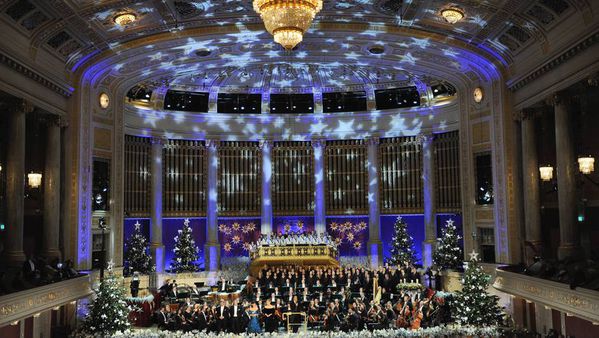
Christmas in Vienna 2013 viewing link

Angelika Kirchschlager, Ursula Langmayr (replacing Anna Prohaska), Luca Pisaroni and Joel Prieto in this year's Wiener Konzerthaus "Christmas in Vienna" broadcast (link here). This annual concert is a treasure because it's a complete antithesis to the formal stodge we normally get at Xmas, and also refreshingly different to the famous Neujahrskonzerts at the Goldenersaal at the Musikverein. You can also tell, by the number of women and blacks on the platform that it's the ORF Radio Symphonieorchester Wien not the Wiener Philharmoniker. The audience turns up in normal clothes, just as the shepherds turned up at the stable in Bethlehem.

The opening shots show the soloists and conductor Erwin Ortner put gifts under a simple Xmas tree,  while the boys of the Wiener Sängerknaben pretend to snatch them away. Of course it's staged - but it's good humoured and full of charm.  Musical values, though, are extremely strong. Bright trumpets announce Adeste Fidelis, soloists, choir and orchestra celebrating together. 

Angelika Kirchschlager is in her element. She always sings beautifully, but here she seems much more relaxed and spontaneous than she might be in a more pressurized recital. Maybe her children are listening, and she knows it.  When she and Luca Pisaroni sang Englebert Humperdinck Weihnachten, they gave the simple song the human, personal warmth it needs. The voices of the Wiener Sängerknaben rang out like angels as they stood in the golden balcony above the choir and orchestra. 

Glorious Bach, of course, (nice trumpet) but also Ariel Ramirez "Gloria" from Missa Criolla (12964) which combines South American folk instruments with conventional orchestra and singers. The folk musicians wear red ponchos - quite a showpiece - and Prieto sang with them in the small upper stage balcony. The piece suited Prieto well, and he sang with concentrated focus.  Pisaroni and Kirchschlager showed the comic side of their talents with "Baby, it's cold outside". They were classy, and stylish. Prieto and Langmayr duetted with "Let it snow". Neither can sing in English, but it didn't matter, they conveyed the mood. Then, Vienna's own contribution to the Christmas repertoire, Franz Xaver Gruber's Stille Nacht, Heilige Nacht. Magical ! Watch it again HERE.

Earlier today on Arte TV, a version of Monteverdi Poppea. Not the full Monty, but Rock Baroque. The very fact that European rockers can engage with Monteverdi is quite something. Anglo rednecks, I suspect, would sneer at the very thought. It wasn't my thing but it was good to hear that these musicians were prepared to engage with new/old ideas and create anew. More than can be said for many who think they know better. Later tonight, Marc Minkowski conducts Berlioz - should worth staying up for. 
 

photo : ORF Ali Schafler (not 2013)

Sunday, 12 June 2011

Aldeburgh Britten Rape of Lucretia Kirchschlager

Limited internet access just yet so I'll be brief,  but major news!  Last night at Aldeburgh, Benjamin Britten's Rape of Lucretia. Astounding performance, conducted by Oliver Knussen who understands Britten's deep inner quirkiness. Britten was never "Establishment". Snape is surrounded by reed beds. An outside observer might assume that they look orderly and tame, like soft grasses. But venture in and nothing is as it seems. Reeds are tough, they're used for building. They grow in marsh which is neither land nor water. Myriad wildlife - birds, insects, animals you won't find elsewhere. And through the reed beds at Snape continue on through the  whole delta to Aldeburgh and beyond.

So too with Britten. He's spikier, tougher, rougher than one might think, and the undercurrents in his work flow in murky, mysterious ways.  The orchestra was the Aldeburgh Festival Ensemble, thirteen hand-picked musicians,  top players from big-name orchestras.  Knussen's quirky too, in a different way, but that helps him access the more disturbing currents in Britten that perhaps reveal more about his art.  Knussen  highlights the dark murmurings, the shimmering harp and violins.  Vocal parts merge with orchestral. Britten opera isn't like conventional opera,  the dramatis personae grow from the music, rather than from the narrative as such. Hence the Male and Female Chorus, which comment, fill in background, and expresses what the characters cannot say. Britten's drama isn't naturalistic, but stylized. It isn't simply because Britten's writing quasi-Greek (Early Roman) narrative.

This emotional opaqueness is very much Britten's personal signature. As a man and as an artist, he shielded his deepest sensitivities. Clubbable he wasn't. Thank goodness! But that is also why The Rape of Lucretia is dismissed by those who don't realy understand Britten's work.  He was fascinated by early forms of music, seeking means oif expression that weren't 19th century verismo. Hence Midsummers Nights Dream and Gloriana, for example where form itself becomes integral to meaning. Britten uses structure as an emotional cloaking device. Penetrate the code, as Knussen does, and The Rape of Lucretia makes even more sense. Lucretia  is yet another Britten innocent, destroyed by the venality of the public world. This rape isn't erotic but a weapon of political aggression.

Ian Bostridge and Susan Gritton sang the Male and Female choruses. Both excellent, but Bostridge was outstanding. He can be very variable, but when he's inspired like this, he's transformed.  No-one , not even Peter Pears, intuits Britten's inner conflicts like Bostridge does.  His voice seems to hover, suggesting cryptic nuances beneath the surface. His voice curls and twists, slithering along the arch, stylized lines, so the sharp, crisp consonants cut into the legato. Diction as drama. This duality expresses the quirkiness of Britten's way of disguising emotion behind studied reserve.

Britten's female characters aren't often particularly feminine, but Angelika Kirchschlager brings out Lucretia's vulnerability so well that the horror of what happens to her is heart-rending. Kathleen Ferrier's Lucretia created the mould, but Ferrier's personal vulnerabilities were never far from the surface. She was statuesque but not a statue. Kirchschlager doesn't look quite so imposing, but she expresses her emotional strength with a combination of gentleness and firm modulation.  She feels like a real woman, in contrast with the male-oriented power politics of the world around her. Kirchschlager's Lucretia is an uncommonly prescient understanding of Britten's psyche.

Non-staging concentrates minds on the music, which in Britten is so much a part of the drama that it's clear why he didn't worry too much about writing symphonies per se. In his opera, the orchestra functions as part of the narrative. Male, female and orchestral choruses, one might say.  Excellently focussed,  Claire Booth in fine form as Lucia; Hilary Summers not at her best, but still better than many.  Christopher Purves sang Collatinus, Benjamin Russell Junius and Peter Coleman-Wright Tarquinius. When Christopher Maltman did the role ten years ago, he did it naked. Marvellous sexual malevolence, like a wild animal.  Coleman-Wright instead develops Tarquinius's inner animal, for his Etruscan origins make him an outsider in the competitive, macho world of new Rome.

This production moves on the Holland Festival in Amsterdam next week, and then on to the Grand Théatre de Luxembourg. It was also as being recorded, so let's hope it's released on CD, as well as the broadcast on Radio 3.  This performance is a landmark in Britten interpretation, so it needs to be heard.  Longer review to come when I can use 2 windows at once.
PS !!! A reader just told me that there is a very rare recording on Amazon - Britten's Rape of Lucrezia Borgia ! Sure enough, click on the link. Imagine.....

Sunday, 7 November 2010

Kirchschlager Wigmore Hall Mendelssohn Lachner


Angelika Kirchschlager and Malcolm Martineau at the Wigmore Hall showed what real Lieder singing should be : intelligent interpretation, intense focus on meaning. Of course Lieder can be enjoyed on a superficial level as pretty sound, but there's infinitely more to the genre. There are celebrities of whom it's said that opera fans think they're Lieder singers, and Lieder fans think they're opera singers. Not so Kirchschlager, who is superlative in both genres.

This was an unusual programme, far more difficult to carry off than might seem in theory.  Instead of going for surefire hit material, Kirchschlager and Martineau chose material that showed how fertile German song writing was in the decade 1830-40. These are most certainly not "Victorian parlour songs" since they were written for sophisticated, intellectual audiences who often knew the composers and poets well. Fanny Mendelssohn gave regular recitals at home, which often were attended by the liveliest minds in Berlin, and were so popular that the house was extended to cope with their guests. Salons like these were the normal way artistic people converged. The Schubertiades were not unique.

Felix Mendelssohn's songs about Spring are gloriously ecstatic, Frühlingstrunknen Blumen, spring-intoxicated flowers, not merely decorative but a metaphor for vibrant new life after a hard winter. Kirchschlager's voice rises lithely, then dips sensuously round words like Nun muss sich alles, alles wenden. All things must change and winter will return, but Mendelssohn embraces the moment of energy. Kirchschlager's perception brought out the link between the Spring songs and the second set of Mendelssohn songs. Auf Flügeln des Gesanges, for example, is sensual. Then a real stroke of good programme planning. In Neue Liebe, the queen of the elves appears and smiles enigmatically. Is it new love, or death?

This reinforces the meaning of Franz Paul Lachner's Die badende Elfe. Most people have heard of Lachner in connection with Richard Wagner, who ousted him  from Munich. His song cycle Sängerfahrt op 33 dates from 1831-2 when he still lived in Vienna. While Lachner was influenced by Schubert, whom he knew personally, Lachner's songs evoke earlier traditions,
for example, the songs of Carl Zelter who introduced to Goethe the young Felix Mendelssohn. Since there'll be more Lachner at the Wigmore Hall next month, please see what I've written about Lachner's Sängerfahrt HERE 

There are some wonderful songs in Lachner's
Sängerfahrt, though Kirchschlager sang only four, probably wisely as some don't suit female voice, but how beautifully she created them ! Die badende Elfe came vividly to life, Martineau playing arpeggiations that sparkled like water and light. Kirchschlager's timbre is clear, bright, almost trembling with excitement. A man spies a water nymph bathing in the moonlight. Since the poem is by Heine, expect deeper meanings. Kirchschlager shapes the phrase "Arm und Nacken, weiss und lieblich" sensually. What's turning the poet on is implicit, especially since Lachner wrote the songs for his bride-to-be. Pure, chaste but erotic.

As Kirchschlager said, it's hard to forget Schumann's Dichterliebe settings of Im Mai and Eine Liebe, but she did Lachner more than justice. I've heard three versions of these songs and thought I knew them well, but Kirchschlager's a revelation.  Her lucidity eclipses all else. Martineau's playing, too, convinced me that modern piano isn't necessarily a bar to freeing the energy in these songs. Explicitly Schubertian elements in Die einsame Träne might sound derivative, but Kirchschlager sings it with conviction. The "falling tears" in the piano part work well because Martineau is light of hand and pedal.

Three of the Fanny Mendelssohn songs heard here come from her Op 1. They're not early works, but the first published, which was  a daring act for a woman of her status. She was a pianist rather than a singer, so her songs give Martineau a chance to bring out their best qualities. In Schwanenlied, for example, slow, graceful movement, and the ending dissolves mysteriously. The poet's Heine, whom Fanny met and disliked,  but the song captures the foreboding behind the shining surface. On the other hand, in Warum sind denn, die Rosen so blass, she replaces Heine's Leichenduft (stink of a rotting corpse) with the word Blümenduft (scent of flowers).

Kirchschlager and Martineau also chose Carl Loewe's setting of the Chamisso poems Schumann made immortal in Frauenliebe und Leben. Here, Kirchschlager filled lines like die Quelle der Freudigkeit with such warmth that even the most fervent feminist could not doubt its sincerity.  Martineau made much of the almost Brahmsian richness in the piano part, particularly lovely in An meinen Herzen. Since Brahms was at the time only three years old, it's an indication of how significant Loewe was, and why the music of this decade, 1830-40 is underestimated.

Loewe's songs are vivid and imaginative. Two songs from Vier Fabbelieder op 64 (1837) gave Kirchschlager a chance to show what a vivid character singer she can be, combining her opera experience with true Lieder singing. Der Kuckkuck uses the same Wunderhorn text that Mahler would set fifty years later. Thanks to Kirchschlager, Loewe's cuckoo is funnier, even if the donkey cry, Ija ! Ija! isn't quite so obvious. More of a challenge was the long strophic ballad, Der verliebte Maikäfer  (Glow worm in Love). A  foppish glow worm courts a fly but is too vain to see she can't stand him. Nice growly sounds to create the lumpen bug, light sharp sounds for the fly. The punchline comes at the end, when the story changes - two (human) lovers about to fool around at night. The story's complicated, but Kirchschlager's diction is so clear that meaning comes through even if you don't know German. This is where her experience shows. She acts through her voice, expressively, never losing the sharp wit beneath  the charm.


This concert was being recorded for future broadcast and hopefully for Wigmore Hall's own label release. A must for anyone seriously interested in Lieder. 

HERE is the full version in OPERA TODAY.


.Photo: Nikolaus Karlinsky

Sunday, 14 June 2009

Bostridge trades fey for Kray - Dreigroschenoper


Ian Bostridge traded his fey haircut for a slicked-back Kray brothers look, complete with wrap-around dark glasses in this Dreigroschenoper at the Barbican 13.6.09. Bostridge’s lean frame was just right for Macheath, the sleazeball who always manages to slip away uncaught. MacHeath oozes, like slime, his lines replicated in saxophone and slide trombone. So Bostridge’s lounge lizard characterization was very apt, menace concealed by an air of impenetrable elusiveness. Mackie gets away because he conceals himself, like so much implicit in this opera.
Dreigroschenoper (Threepenny Opera or 3d Opera) was first performed as part of the agit prop cabaret world of Brecht and Weill’s Berlin. The 1931 recording and subsequent film (rather too naturalistic) has defined its performance history. It made Lotte Lenya the iconic Weill personality. Dozens of singers have colonised the image since then, as if Lenya’s rough voice was a licence for bad singing. Certainly Brecht and Weill used actors rather than singers in those early years, because they were poor and their politics meant they wanted to reach audiences in clubs, not opera houses. It’s a “Beggar’s Opera” after all. But therein lies the contradiction that makes the piece so interesting. It masquerades as cabaret theatre, but it’s actually quite sophisticated musically. Just as Brecht turns the 18th century John Gay play on its head, Brecht turns musical genres upside down. The rousing Finale is a Bach Chorale in disguise. This performance was conducted by HK Gruber who also sang Peachum, “the poorest man in the world” who is also The King of the Beggars (another contradiction). Gruber can do sardonic irony better than anyone else, so his approach to 3dO is in a whole other league from the usual straightforward “entertainment” mode. Beneath the cute tunes, Brecht’s message is savage: all the world’s a stage and a mad one at that. So Gruber ropes in Klangforum Wien as his “orchestra”. They are one of the best contemporary music ensembles around and can do “difficult” anytime. Here they are playing banjos, guitars, saxophones and rinky tink piano. And Vienna's Chorus sine nomine, who can do perfect pitch enough to sing with tuning forks, get to do “backing vocals”. Proof of this musically astute approach are the soloists. Luxury casting this: Angelika Kirschlager sings a brilliantly saucy Jenny, slinking like a snake, a perfect partner to Bostridge’s louche Mackie. Dorothea Röschmann’s usual sweetness is here laced with poison – she can act as well as sing. In this performance Polly sings Seeraüber Jenny, not Jenny herself. This works well, because it adds another level of musical cross-dressing More good performances from Florian Boesch as Tiger Brown the dodgy cop and Cora Burggraaf as his daughter, Hanna Schwarz as Mrs Peachum, a coloratura foil to Gruber’s burlesque Peachum. His lines are half speech, half ham, so having a proper singer as his wife is a telling contrast. There’s plenty of proof as to the value of proper voices in Weill. Lotte Lenya was the Tracey Emin of her time, and a sledgehammer persona was probably needed to bring Weill success on Broadway. If the public persona of Brecht and Weill was a caricature, their real message could be packaged in a less overtly political way. In the former East Germany, socialism wasn’t scary, so there was nothing to prove or defend. Thus the DDR Weill performance tradition diverged from the Lenya model. Weill and Eisler were performed by “real” singers like Gisela May and, of all people, Peter Schreier, consummate Mozartean, Bachophile and Liedermeister. These are the recordings to seek out. You can actually hear the words, enunciated with the same precision as there is in the writing. Because Lenya dominated the western market, we’re been persuaded that hers is the only way to do Brecht, and we’re rewarded by pop stars and amateurs who are fun, but not necessarily best placed to reveal the real Weill. Further proof still: here is a clip of a singer doing Seeräuber Jenny in 1931, in French, and almost exactly at the same time as Pabst was filming 3dO in Germany with Lenya, who significantly sings one song only. Margo Lion worked in cabaret but she could actually sing. Lenya scores though for shock value quirkiness.
And even more proof. The ensemble work is extremely tightly written, and takes dexterity to carry over with panache. Especially good was the Kanonen-song, where Bostridge and Boesch bounce off each other with military precision. Here’s a clip of Ernst Busch (as Mack) and Kurt Gerron as Tiger Brown (in military gear). Wonderful – Busch’s sharpness and quick wits serve him well. He’s almost unrecognizable in smooth suit and bowler hat, but that’s the man who spent the war in Nazi KZ’s.

Tuesday, 9 December 2008

The glorious Angelika Kirchschlager

Tonight the divine Angelika Kirchschlager sings Hänsel in the ROH Hänsel und Gretel ! It's a role that could be made for her. She has a personality as vivacious as her voice. Over the years, it's been lovely to watch her develop from an ingenue to a major star, yet what's always come over in interviews (and her singing) is her naturalness and sincerity. Life hasn't been a fairy tale for her, to use the cliché. But fairy tales in reality are pretty grimm. So maybe like their heroines she's grown from the experience. Certainly Kirchschlager is lovable and such a pure, luscious voice ! Her Mélisande last year was deeply thoughtful. Clad in scarlet, she brought out the erotic danger in the part few dare express quite so clearly these days. Pity about the rest of the staging, which didn't develop the concept. Maybe another production ! Here is a link to what she said last week with Simon Thomas :

http://www.musicomh.com/classical/features/kirchschlager_1208.htm