Showing posts with label watts Andrew. Show all posts

Sunday, 4 November 2018

Stravinsky - The Rake's Progress : Jurowski LPO

Stravinsky's The Rake's Progress, latest in Vladimir Jurowski's Stravinsky series at the Royal Festival Hall with the London Philharmonic Orchestra.  Given that Jurowski's Rake's Progress at Glyndebourne is a classic, this semi-staged concert performance was an excellent opportunity to revisit the piece, focusing more acutely on the opera as music. This was an excellent performance, orchestrally, bringing out the restraint in Stravinsky's orchestration,  not so much "neo-classical" as baroque. The harpsichord (Helen Collyer) was positioned between orchestra and soloists, reinforcing baroque sensibilities and the notion of opera as moral allegory.  Although W H Auden wrote the libretto, his reference was Hogarth's series of paintings The Rake's Progress (1732-4), and the series of etchings printed for mass circulation in the following years, from which David Hockney drew his inspiration for that iconic Glyndebourne production. Thus the stylization in the opera, playing with many concepts on many levels, at once black and white yet ambiguous.  Auden's text is elegantly convoluted, its literary eloquence deliberately masking the horror in the story, so those who'd prefer not to think past the hard, brittle surface may come away thinking that it's arch comedy.  And laughs there are, but not always nice. What might seem moral just might not be : everyone in this opera is compromised in some way, apart from Baba The Turk, who is, significantly, the outsider.

Matthew Rose reprised the role of Nick Shadow as he did in 2011, adding also the Keeper of the Madhouse, which was a wise choice, since arguably, Nick Shadow, like the Circus Master in Alban Berg's Lulu , pulls the strings in a zoo where people are animals.  Toby Spence sang Tom Rakewell, with Sophia Burgos as Anne Trulove, with Clive Bayley reprising the part of her father.  Andrew Watts, standing in  at 24 hours notice as Baba the Turk, almost stole the show, however, with a camp but extraordinarily sensitive interpretation of the role.  Kim Begley sang Sellem the Auctioneer and Marie McLaughlin sang Mother Goose. The stage platform was arranged so that the orchestra and chorus (London Voices) were close to the back wall, leaving a lot of empty space in front, to give the singers room to move (rather than teetering over the edge as is usually the case). But this, combined with the surprisngly non-capacity audience, muffled the singing to some extent, to the disadvantage of the less-dominant voices. Rose carried the performance through most of the First Act, but Watts's entry seemed to galvanize proceedings.   Perhaps the echo in the hall worked against clear diction, other than from the principals , as some in the audience complained, which was a pity since Auden's texts are poetry, to be savoured even without Stravinsky's coiling lines, stretched vowels and spiralling cadences, oddly reminiscent of Benjamin Britten, whose work Stravinsky must have known by 1951.

Tom's descent to debauchery is conventional enough - shades of Faust and Mephistofeles here, and in the card game towards the end, of Stravinsky's The Soldier's Tale, and even sly allusions to Tannhäuser and Venusberg - all of these part of the cavalcade unfolding on many levels and many forms.  But where does Baba The Turk fit in with this Faustian adventure ? What kind of creature is she/he and how does she/he change the narrative ?  She/he's first heard of when Nick Shadow shows Tom a broadsheet from a travelling show she stars in.  He's aghast but Nick taunts him "For he alone is free, who chooses what to will and wills his choice as destiny".  So  Tom marries her to prove he's free, but ends up more tied than before.  Although the role is often taken by a woman, (Patricia Bardon, who was originally scheduled, has done the part very well many times before), having a countertenor adds extra frisson, in addition to underlining the baroque connections.  Baba's a bearded lady, and exotic as all "Turks" are supposed to be.  Watts appeared, spotlit and veiled,  mincing in stilettos, transforming the opera and performance.  Wonderfully, flamboyantly androgynous ! 

Everyone else in these proceedings scams everyone else in some way, even Anne Trulove, whose "love" isn't truly altruistic since she plays games of social convention.   But Baba's on the level, giving up fame and fortune for a wastrel like Tom.  All the others treat each other like commodities: Sellem the Auctioneer might sell objects, but these objects are symbols of lives gone wrong, people making money from the misfortunes of others.  Even Baba becomes an object. "Old wives for sale".   Tom winds up in the madhouse, babbling about Venus  (Tannhäuser and creativity in the guise of woman). The opera resolves, like Don Giovanni, with a moral, where the main characters tell what they've learned.  " All men are mad; all they say or do is theatre" (Baba)  and "Beware, young men who fancy you are Virgil or  Julius Caesar : Lest when you wake, you are only a rake". (Tom). And even Nick Shadow who acts like he's in control, but isn't. "Many insist I do not exist. At times I wish I didn't". 

Thursday, 26 January 2017

Aldeburgh Music Festival 2017

The roof at the Britten Studio, Snape

The 2017 Aldeburgh Music Festival marks 70 years of the festival, and 50 years at the Maltings. How time flies. Roger Wright has been Executive Director since September 2015, and management has gone from strength to strength.  This year, there's no Artistic Director as such, though there's a team for Artistic Planning. Snape is now a thriving centre with grand plans.

This year's keynote opera is Britten's A Midsummers Night's Dream, keynote of the first season at Snape, which premiered at Aldeburgh's Jubilee Hall in 1960.  The staging will be directed and designed by Netia Jones, so look forward to an imaginative presentation.  Her staging of Oliver Knussen's Sendak operas, Where the Wild Things Are and Higgelty Piggelty Pop! were brilliant - read more about them HERE.  A Midsummer Night's Dream is magical, ideally suited to  transformation by lighting effects and video  illusion. This could well be the best Aldeburgh opera staging in years.    Soloists include Iestyn Davies, Sophie Bevan, and Matthew Rose.  Ryan Wigglesworth conducts. Tickets will disappear fast - Friends booking starts today, public booking on 7th February.  Don't wait.  On 22 June, there's a screening of the Hollywood film version with music by Erich Korngold, on which please read more HERE. 

La Voix Humaine (15th to 17th June), Poulenc's setting of Cocteau's monodrama, a tour de force for solo soprano, here performed by Claire Booth. Intriguingly, this will take place "in a private house near Snape", a suitably atmospheric setting, in a semi-staging by David Pountney. Another must! Again, please read more HERE.  Britten's "Vaudeville" The Golden Vanity, a morality tale about an outsider at sea, gets a rare outing on 17/6, heard with Britten's The Ballad of Little Musgrave and Lady Barnard  and other new shorts, performed by Camblata, young adult male voices of the National Youth Choir.

Countertenors and Benjamin Britten, who brought the voice type back into prominence. Andrew Watts features at this year's Festival, with Olga Neuwirth's Maudite soit la guerre, A Film Music War Requiem (UK premiere) with other Neuwirth pieces with the London Sinfonietta  on 10/6 followed by Hommage à Klaus Nommi, a "song cycle like no other – an anarchic, neon-lit encounter between Purcell, Weimar cabaret, bubblegum pop and The Wizard of Oz" and "A Countertenor Song Book" on 12/6 featuring works by Bach, Handel, Olga Neuwirth, Colin Matthews, Tippett, Torsten Rauch and Raymond Yiu.  More Neuwirth throughout this year's Festival, enjoy.

The City of Birmingham Symphony Orchestra visits Aldeburgh again, this time with Mirga Gražinytė-Tyla in two conerts on 17th and 18th June - Beethoven 3, Stravinsky Petroushka, Tchaikovsky, Britten and Jorg Widmann. The man himself is playing clarinet (Mozart) with the Belcea Quartet on 10/6. Oliver Knussen's O Hotortogisu receives its world premiere on 23/6 with the Birmingham Contemporary Music Group, hopefully with Knussen himself at the baton, together with another new work by Harrison Birtwistle, Chorales from a Toy Shop, and pieces by Stravinsky and Jo Kondo.

Plenty of choral music this year, with Vox Luminis,  EXAUDI and others, including a programme with music by Nishrat Khan. The highlight could well be Vox Luminis Purcell King Arthur on 22/6.  As always, lots of baroque and early music, Lieder and piano music - Pierre-Laurent Aimard, Piotr Andrewski, Huw Watkins and others. The closing concert will be Britten Billy Budd, from Opera North, with Roderick Williams, Alan Oke and Brindley Sherratt.

Quicklink to the programme booklet HERE.

Monday, 9 March 2015

Tight and taut : Unsuk Chin Alice in Wonderland Barbican London


Unsuk Chin's Alice in Wonderland  returned to the Barbican, London, shape-shifted like one of Alice's adventures.  The BBC Symphony Orchestra was assembled en masse, almost teetering off stage, creating a sense of tension. "Eat me, Drink me". Was Lewis Carroll on hallucinogens or just  good at channelling the crazy world of the subconscious?   Unsuk Chin's take on Carroll, with David Henry Hwang's libretto, emphasizes the madcap mania of the original, where nothing is what it seems and Reason is Irrelevant. This Alice in Wonderland is anything but prim.  It's zany, anarchic and subversive, and also hilariously funny.

With her music, Unsuk Chin builds ambitious architecture, vast grand edifices that stun by their sheer scale. This new version, with Netia Jones's semi-staging and Lloyd Moore's re-orchestration, reveals the strong, basic structure, releasing its manic, kinetic energy.  Jones's direction and designs buzz with wit and colour. Video (Lightmap and Netia Jones) is good at depicting impossibilities, like the vanishing Cheshire cat and his enduring grin. The interplay between video and reality is so good that it's quite unsettling, which amplifies meaning.  The illustrations are by Ralph Steadman: no trace of twee. When the Mouse (Christopher Lemmings) is condemned,  the crowd shout "Disneyfy him!" A fate worse tha death.

Kent Nagano conducted Unsuk Chin's original score in Munich eight years ago, but not all houses have such resources. Thus Los Angeles Opera commissioned a version that's easier to carry off and tour. Lloyd Moore is sensitive to the spirit of Chin's original. By reducing the number of players, especially in the strings, the inherent liveliness in the music is liberated. The choruses (BBC Singers, Tiffin Boys Choir)  are still big, though not quite the 40-60 singers specified in the original  The emphasis is thus on the quality of Chin's instrumentation rather than sheer volume. Chin has a passion for imaginative use of unusual instruments. The score employs "kitchenalia" which means just that - alarm clocks, wind chimes, tweet and crackles and pops. Vivid combinations, such as when the violins  are plucked, extending the sound of the mandolin. In Scene Two, The Pool of Tears, the image of water is created by celli and basses, bowed with maximum depth, creating a drone that's both mournful and mysterious. The Caterpillar sings, wordlessly. He, whose very existence depends on changing shape and form, is represented by a single instrument, the bass clarinet, which, oddly enough, looks like a metal caterpillar. Baldur Brönnimann conducted the BBC Symphony Orchestra. He's a new music specialist,. alive to the quirky possibilities this music offers.

Unsuk  Chin's vocal lines are counter-intuitive to syntax, often also running counter to the orchestra. Text turns to tongue twister. Yet again, that's part of the concept of shape-changing instability.  It's not easy to carry off well, though.  Rachele Gilmour sang Alice in Los Angeles, which is perhaps why she was cast again in London. Andrew Watts sang the White Rabbit, Badger and March Hare in Munich and in LA, and is perhaps the most important countertenor in his field, and the most experienced. He was divine, capturing the jagged edges of his parts with demented aplomb, not only with his unique voice but also with his body language. His White Rabbit camps along, prissily wiggling his large rabbit behind: totally in character. A tour de force.

Marie Arnet's Cheshire Cat was sung with spirit and spice. Perhaps the cat knows that the way to survive in this crazy world is to grin, even when all else fades.  Jane Henschel was in superb form. Her Queen of Spades was gleefully wicked, laced with shrill but well controlled vitriol, and she made it sound like fun.  Dietrich Henschel sang the Mad Hatter, using the metallic tension in his voice to good effect. Impressive Christopher Lemmings Mouse, Dormouse and Invisible Man. Stephen Richardson, a British stalwart, sang the King of Hearts, while the other smaller parts were taken by American singers, from the LA production: Andrew Craig Brown, Rafael Moras and Nicholas Brownlee.

This concert will be broadcast on BBC Radio 3's Live in Concert on Saturday 11th July at 7.30 pm and available for 30 days after broadcast on the BBC Radio 3 website and BBC I Player Radio

This review also appears in Opera Today, where there is also a review of the Munich production. Please see my other posts on Unsuk Chin and on new music and stagecraft

Unsuk Chin Alice in Wonderland Munich and thoughts thereon

Tonight, a brilliant new version of Unsuk Chin's Alice in Wonderland at the Barbican, London. My review is HERE..

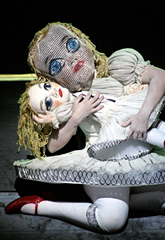
Meanwhile, a link to the review in Opera today of the original production, in Munich in 2007.  Opera Today is an excellent source of background material. This review is informative and  useful. The opera was originlly created for Los Angeles, but didn't eventuate, so the Bavarian State Opera took it on instead, conducted by Kent Nagano and directed by Achim Freyer. A film of this production was shown at the Barbican's Unsuk Chin Total Immersion some years ago. It's the one where the characters are dolls with giant see-through heads. transparent heads. When Alice realizes it's all a scam she removes hers. "Off with their heads!" in every sense. I liked the Freyer production a lot, but was less impressed by the music.

This time round, at the Barbican, my views have changed again .What a difference! The new semi-staging, by Netia Jones, and the new orchestration, by Lloyd Moore, reveal the true depths of this opera. Unsuk Chin's good at building vast grand edifices.  Created for Los Angeles and premiered there last year, the new production clarifies the strong internal structure. The music emerges as an elegant puzzle , rather like one of M C Escher's architectural conundrums, where stairways connect or don't connect, and corridors lead to dead ends or new beginnings.

A lot like the concept behind David Henry Hwang's libretto, where Alice enters a surreal world where nothing makes sense, and every assumption is turned on its head. Or "Off with it! " as the Queen might scream. Much zanier than Lewis Carroll, though it makes one wonder what he was drinking and eating. Not, most thankfully, Walt Disney's Alice in Wonderland. Indeed, when the Mouse is condemned, he's sentenced to be "Disneyfied", a fate worse than death.  This time round, the energy is far more manic, and far more surreal.  I loved the crazy humour in the instrumentation (another Unsuk Chin trademark)  Last time round, there was a family complaining that this wasn't the Alice in Wonderland they'd taken their kids to see. This time there was a warning "Not recommended for under 12's". Conversely, perversely, I think under 12's would respond positively to the anarchic ,mayhem.  Pity the show started at 7.30, not, as originally planned, at 7. which meant it ended very late.  By the time most people commuted home, it was way past bedtime.