Sunday, 3 January 2016

New Year New Music Stockhausen Hymnen


New Year New Music! Hooray for BBC Radio 3 starting 2016 with a celebration of Karlheinz Stockhausen!  The party started on New Year's Day itself with a unique broadcast of Hymnen, part from the original tapes made for WDR and a performance a few weeks ago conducted by Wolfgang Lischke  with the London Sinfonietta, the RAM Ensemble, the Manson Ensemble and Sounds Intermedia. The broadcast is available in stereo and also surround sound, but you should also use your imagination, which is very much part of the creative process.  I've heard Hymnen  live in a concert hall, but its freakiness works better I think, in a kind of isolation chamber where you aren't inhibited by the presence of "normal" people. This time  I listened alone, in the dark, to get the full surround-sound experience, and what a blast it was!

The title "Hymnen" refers to national anthems, which Stockhausen collected, mixing and changing the sounds so they form a vast universe of strange, conflicting harmonies. At around the time Hymnen was written, I used to play around with long and shortwave radio, switching stations in and out, in many different languages, some being deliberately jammed by others.  People forget what the Cold War was like, but that context does bear heavily on what Hymnen might be about.  Maybe I was preordained to understand Hymnen as a composite of soundwaves beamed off our planet by aliens in Outer Space. The star Sirius, of course, in Stockhausen terms.  Absolutely pertinent on New Year's Day when people watch fireworks displays in succession all over the globe and singing Auld Lang Syne, in a strange dialect hardly anyone actually speaks.

And so we hears snatches of Deutschland Uber Alles but do not necessarily pick up on the negative context which would have borne so heavily on Stockhausen and his generation. We hear it as Haydn, knowing that the text was written in 1841 when nationalism was something positive. Similarly the strains of the Horst Wessel Lied are "cleansed", rendered neutral as noise, meaningless without power. So we hear God Save the Queen and the Internationale, but the real message is that things get distorted, and one anthem is intrinsically  no more important than the next. We also hear objets trouvées, street sounds from China, and horns that quack like cacophonic singing ducks. We also hear snatches of Stockhausen himself talking, recorded by accident and unplanned which also informs meaning. all blended into a kind of inter-stellar cosmos of electronic and instrumental sound. In "Region 4", Hymnen reaches outwards, words and long screaming sounds projected as if communicating endlessly into space.

Stockhausen is this week's Radio 3 Composer of the Week

Luciano Berio Sinfonia "For the unexpected is always with us"

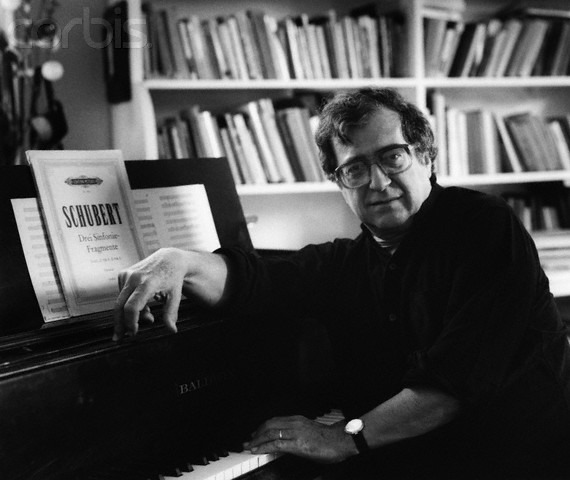
Luciano Berio, right,  with Schubert.  An apt point on which to start discussing Berio's Sinfonia (1968), a key work of modern times.  Today I watched again Frank Scheffer's film A Voyage to Cythera, which was ground breaking on first release. It remains fresh and challenging sixteen years later, an absolute must for anyone interested in the way artists absorb influences to enrich their own creative imaginations.  There are composers who do pick and mix, (one whom I shan't name) -- a symphony in one style, an opera in another, but being derivative is a dead end. Beware plagiarism, almost inevitably the mark of mediocrity. 

Good composers internalize and learn. Cythera  in mythology was the home of the goddess of renewal and  regeneration.  Thus the film starts with shots of a strange primordial-looking landscape out of which arise strains of Mahler’s Symphony no 2, a "Resurrection" in the deepest sense.  Berio's Sinfonia is no mere collage but a  strikingly original new work that defies conventional ideas of what a symphony "should" be.

Berio describes the Sinfonia  as an "internal monologue" which makes a "harmonic journey". It flows, like a river, bringing in its wake the streams and springs which have enriched it, adapting them and changing them, surging ever forwards towards the freedom of the ocean.  Like Mahler himself, Berio was cerebral. Berio is seen in his study, surrounded by scores and books, with a model ship on display. Riccardo Chailly, also highly focused and erudite, talks about Stravinsky and Schoenberg, who, in their different ways, progressed the direction of modern music. Composers don't operate in "schools".  Schoenberg's great achievement was to opens tonality outwards so others could develop things further.  In Sinfonia, there are references to at least 15 different composers, some quite subtle. There's a  quotation from Don, the first movement of Boulez's Pli selon Pli (fold upon fold).  It's a "gift"  from one master to another, both of them fascinated by multi-dimensional levels and perspectives, ever-changing flurries and eddies.  Incidentally one of the best recordings of the Sinfonia was conducted by Boulez, who relished the wit.

"For the unexpected is always upon us"  as a phrase rings out clearly, illuminating the deliberately obscurantist miasma of the text, partly based on Samuel Beckett, though there are also phrases from
Claude Lévi-Strauss, the anthropologist of myth. The style is often almost conversational.  so you're drawn into what's being spoken, only to be confronted by something elusively confusing. You navigate, as on the rapids of a river, by paying attention and being intutitive,. Take nothing for granted:  meaning operates on many levels.  Once I heard an anecdote about someone who built a formidable machine that could invent music, electronically.  Along came Berio, who twiddled a few knobs and buttons and created something genuinely interesting.  He made real music by not being too up himself.

Berio had a quiet sense of humour. When he quotes Mahler's Des Antonius von Paduas Fischpredikt (read more here) , he knows the fish don't understand and will keep fighting. Perhaps Berio knew that some folk would never "get" Sinfonia, but so what as long as a few do.  Traditionally -- if that's a word which can apply to someone as lively as Berio -- the texts have been semi-spoken at odd pitches, using tuning forks and impossibly clipped British accents, which adds to the sense of quixotic unreality. At the end, the performers name and thank each other -- reality playing tricks with art. No performance of Berio's Sinfonia is ever quite the same, and you get something different each time.  "For the unexpected is always upon us".  

Thursday, 31 December 2015

Deceptive New Year's Eve


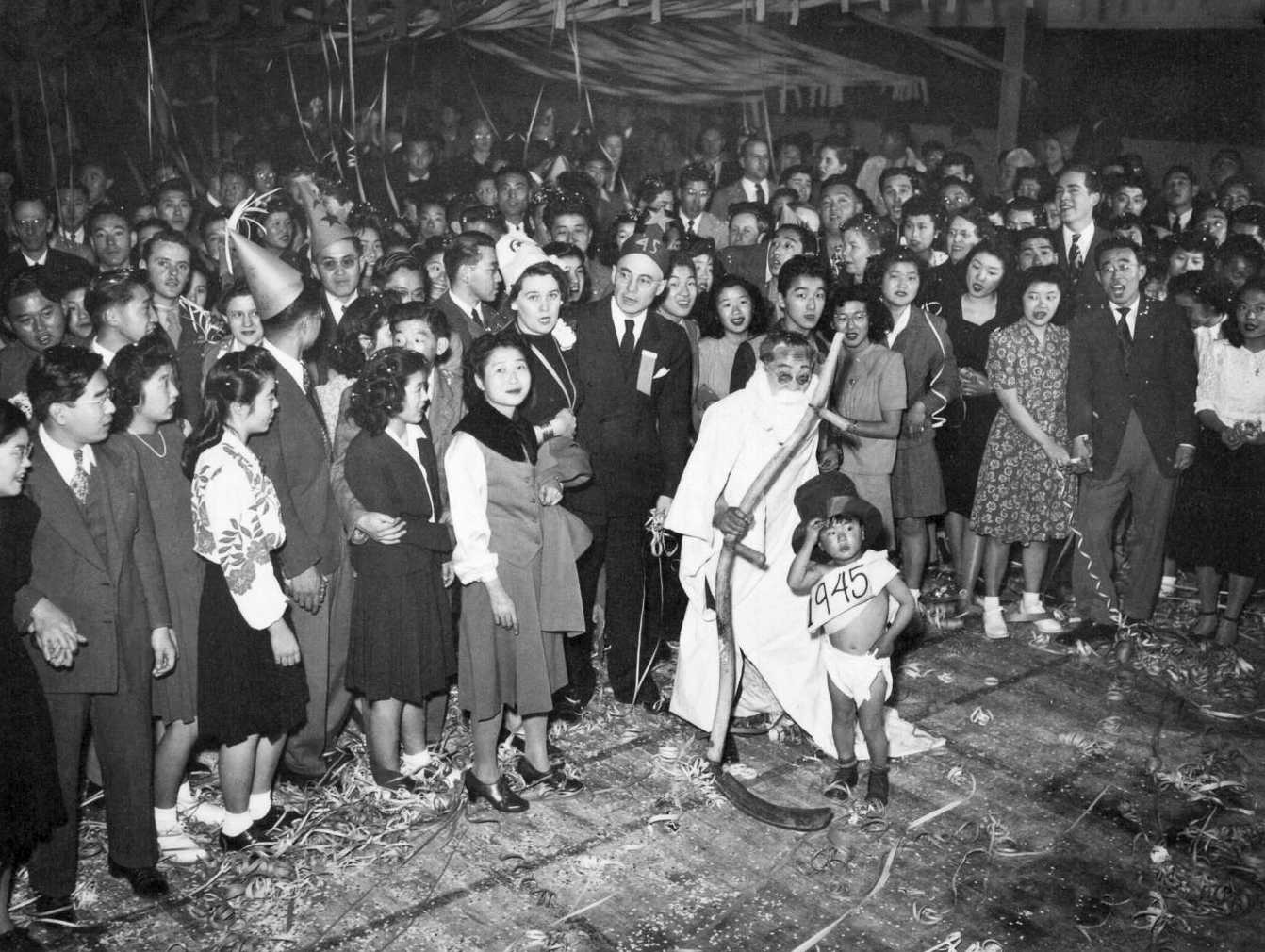
Japanese Americans celebrating New Year's Eve, 1944-45. Out with the old year, in with the new. Everyone's dressed up, looking good. But remember the date. It's wartime.  These people are in an internment camp, locked up because they're "enemy". Albeit a good camp, where the staff are decent peiople and join in.  Moral: don't judge by surface appearances, don't hate.

Wednesday, 30 December 2015

Florian Boesch - BR Klassik videostream recital


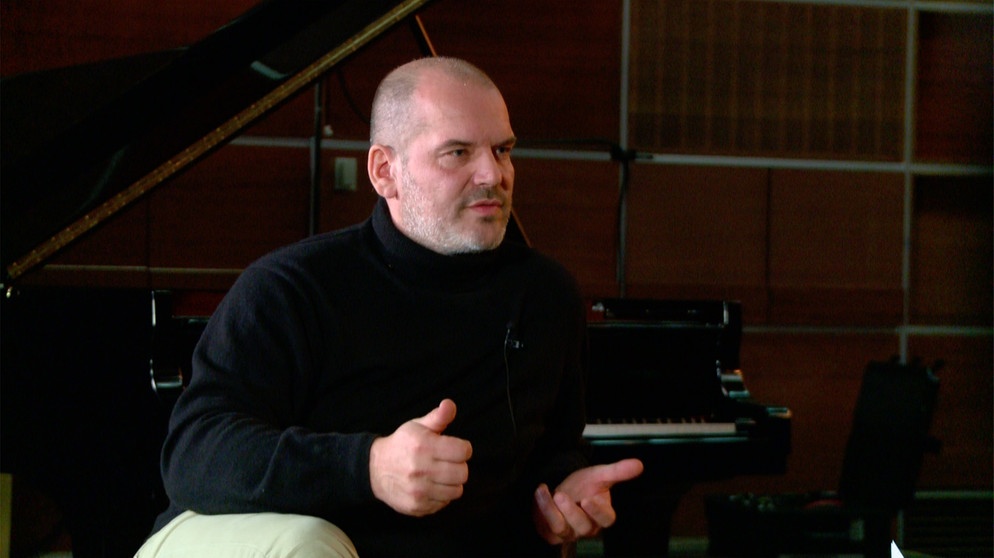
From BR Klassik, a video of a recital by Florian Boesch and Martin Martineau.  It's a superb performance, of course, but it's also an unusual opportunity to watch how Lieder specialists approach their art.  Filmed in one of the small studios in the radio station building, the focus is unusually intimate and focused. Only at the Holywell Music Room, Oxford, do listeners get this close to performers, so close that the recital feels like personal interaction.  What a thrill it is to look inside the piano, as a singer does, and see the strings vibrate, the music physically quivering into life.

The audience, presumably invited, are paying attention, even though the seats look uncomfortable and some of the repertoire was difficult. For this is what makes Lieder unique. It's not "background entertainment", but intellectual engagement. The poet's ideas and emotions are conveyed by composer and performers and processed through sensitive listening. Not at all a passive spectator sport !

These days when the very word "intellectual" is a swear word, we need to remember the social history of Lieder. Opera as we know it now didn't really exist. People would go to the theatre for a good show, with music. Mozart "is" intellectual, but there's no reason why we can't just sit back and enjoy. Singspeile and more earthy entertainment were pretty much the norm, even for Beethoven, whom I can't even imagine doing showtunes.  That's why Rossini and Donizetti seemed so revolutionary. There was Schubert, raised in Italian as well as German tradition, trying to figure out how to write opera and never quite succeeding.

Socially, too, Lieder reached an intellectual audience. Most of the poets Schubert set were near contemporaries, often men whom he knew personally. Poetry absolutely is at the heart of the genre, and poetry means ideas. At Liederabends. people would flirt, and eat and chat, but they came for the mental challenge of hearing poetry translated into song. Kind of like a literary salon, with music.  While there's lots of strophic ballad in the genre, its highest points are reached in durchkomponierte art song.

Boesch and Martineau chose a challenging programme, quickly launching from the famous Der Wanderer D489 to Amphiaraos D166. There's no way you can get this song without a basic appreciation of Greek myth, though the forceful chords evoke powerful, if doomed, heroic resolve. The poet was Theodor Körner, who actually did die a hero, fighting Napoleon with the Lützower Jäger.  Boesch and Martineau did this song at the Wigmore Hall a few weeks before the Munich recital (read more here). This later performance was even more ferociously intense, bringing out the the structural progressions in the song so well that I rushed to read what Graham Johnson wrote about it.

As in London, they followed this with Gebet wäjhrend der Schlacht D171 and then straight on to the declamatory ballad  Die drei Sänger D329 1815. Schubert loved setting these sagas, though they are hard to carry off well without the communication skills Boesch and Martineau possess. Schubert didn't complete the song, so Boesch recited the rest of the poem so we could imagine what might have been. Then, on to Waldesnacht D 708 and Der Gott und die Bayajadere D 254, which Boesch sang with Graham Johnson at the Wigmore Hall at the start of the WH's complete Schubert song series. (read more here)   Again, being in a small studio and so close up made the experience even more intense. Boesch and Martineau created the lilting lines so they sounded exotic, even dance-like, evoking the fabled India of Goethe's imagination. For all its loveliness, this song isn't that easy to do. Boesch and Martineau bring out the sumptuous beauty in it, but also the turbulent anguish of the Bayadere ( a dancer) who sacrifices herself for love.

Three Liszt settings, Ein Fichtenbaum, Vergiftet sind meine Lieder and Loreeley.  Lovely piano parts, for Liszt was a pianist and "spoke" through the instrument rather than picking up on the bitterness of Heine's irony.   Boesch, however, compensated by articulating the words expressively, emphasizing the inner poetry. Watch his face as he sings, and listen to how he emphasizes meaning. .Then on to Schumann, also a pianist and married to one of the greatest pianists of her time.  Fantastic piano lines, and in Aufträge op.77, No.5  a fiendishly fast-paced, tongue-twisting, lyrical vocal part. Humour is part of its drama. At the end, Boesch burst into a huge grin.  The melancholy Meine Rose flowed gently, and Herzeleied Op 107/1 was lusciously plangent. 

These prepared us for a masterful set of 3 of the 9 songs from Lieder und Gesänge aus 'Wilhelm Meister', Op.98a, Wie nie sein Brot mit Tränen aß, Wer sich der Einsamkeit ergibt, and An die Türen will ich schleichen.  Schumann's settings aren't as popular as those by Schubert and Hugo Wolf, but they are every bit their equal, with firm, contemplative and - dare I use a naughty word, "Intellectual". Boesch and Martineau delivered them with dignity and conviction so strong that one could almost feel the presence of the Harper warning us through his strange poetry. 

Two Schubert encores, Nachtviolen and Heidenröslein,, just as at the Wigmore Hall. . This latter is so ubiquitous that some think its folk song, but it isn't. It's Goethe.  Again, listen carefully to Boesch as he sings, pointedly stressing the subtle violence. The youth trifles and kills the rose but she fights back with its thorns. "Röslein sprach: "Ich steche dich,/ Dass du ewig denkst an mich/ Und ich will's nicht leiden."  Before antibiotics, you could die if a scratch became infected.  But the song switches quickly back to cheery insouciance and femininity which we know isn't as innocent as it may sound. Watch Boesch's expressions. Yes, this is a humorous song, though it packs a lethal punch!

Monday, 28 December 2015

The Song of Malaya ; a song for the displaced


Tse Lo lin (紫羅蓮) died this week aged 90.  Song of Malaya (馬來亞之戀) (1954) was one of her most famous movies, for which she also wrote the script. The film is much more than a romance in an exotic locale. It deals with issues like the traumatic dislocation of war, the identity of overseas Chinese, and the moral and cultural obligations of an individual to society.  An extremely beautiful film and very moving. Tse also founded and managed the production company. She was then only 30 years old - quite an achievement for any young actress, anywhere.

Tse was caught up in the Japanese occupation of Hong Kong, and forced to participate in the high-profile film the Japanese Army made to commemorate their victory. It is an important historical document, since it was begun within weeks of the fall of Hong Kong on December 25th 1941, when the city was still scarred by battle. Re-enactments were filmed as accurately as possible, on location, with the supervison  of officers who had taken part. Tse played a small part as a local girl, but was most certainly not a collaborator. She was smuggled out in considerable danger, rejoining other members of the Hong Kong film industry who had regrouped as exiles in Free China. China had been at war with Japan since1931. Shanghai and Canton had been conquered. The biggest mass migration in history occured when around 25 million people became refugees,trekking from the coast to the Himilayas.  The charismatic  actor Ng Chor Fan already was a figure in the anti-Japanese resistance, having been an activist since the early 1930's, making patriotic movies and organizing refugee relief. Chinese cinema always has had a social and moral conscience.

In The Song of Malaya (aka Love in Malaya), Tse plays Yuk-kin, a girl who has lost her homeland and family in the war, and travels to Kuala Lumpur, searching for her father who had emigrated years before. Since Malaya had also been occupied by the Japanese, the background of social upheaval hangs heavily on the film.  Tse arrives in Malaya,  excited by the strange new surroundings, but she's dispossesed. Luckily, she's taken in by kind local Chinese, some of whom had been in Malaya so long that they had acculturated as Malay. She meets and is attracted to Mr Wong (played by Cheung Wood Yau) who runs a school for the Wah Kiu (overseas Chinese) so they can learn Chinese and understand their identity in a multi-cultural society.  He's from China, too, and, like Tse, has lost all contact with his family and native region.  Eventually, Tse meets up with her father, (played by Ng Chor Fan) who is now a westernized businessman with a Wah Kiu wife (Mary Man Lee) who wears sarong kebaya and acculturates Malay. Imagine the tensions.

Tse goes to live in Singapore with her Dad and finish her education. Her father's associate, Mr Cheung (played by Cheung Ying), falls in love with her and wants to marry her. Below, in the clip, we can see Tse sing about Malaya, new hopes and dreams and of friendship between Wah Kiu and  China-born. Watch the dynamic between her and her audience. She waves at Schoolteacher Wong, who waves back at her. But things are not to be. Wong's wife and son come out of China, but Wong dies, and presumably they're destitute again. Tse marries Cheung, and they plan a round-the-world honeymoon. But Tse knows where her destiny lies, and Cheung is a good man. So they use their money to continue Wong's mission to provide a good education for the Wah Kiu.

Tse, the woman, not the character, was deeply religious and stopped making movies in the mid-1960's  to raise a family. Her marriage ended early in divorce, and she moved to Seattle, bringing up her daughters.  So she, and they, became Wah Kiu, like millions of other Chinese who have emigrated and live often outside their roots. Not refugees like Tse's character in the movie, but displaced people who forge new identities. I wish The Song of Malaya could be released again because in some ways it's even more relevant now. In the second clip, which mixes the intro with short clips from the film, the scene at the building site is symbolic.The cranes work well, but the peasant hauls soil in a wheelbarrow. Together they build a channel for a river.  Hence, integration and commitment, not anomie.


Thursday, 24 December 2015

Christmas 1915


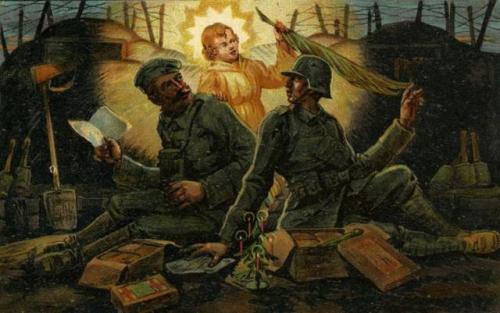
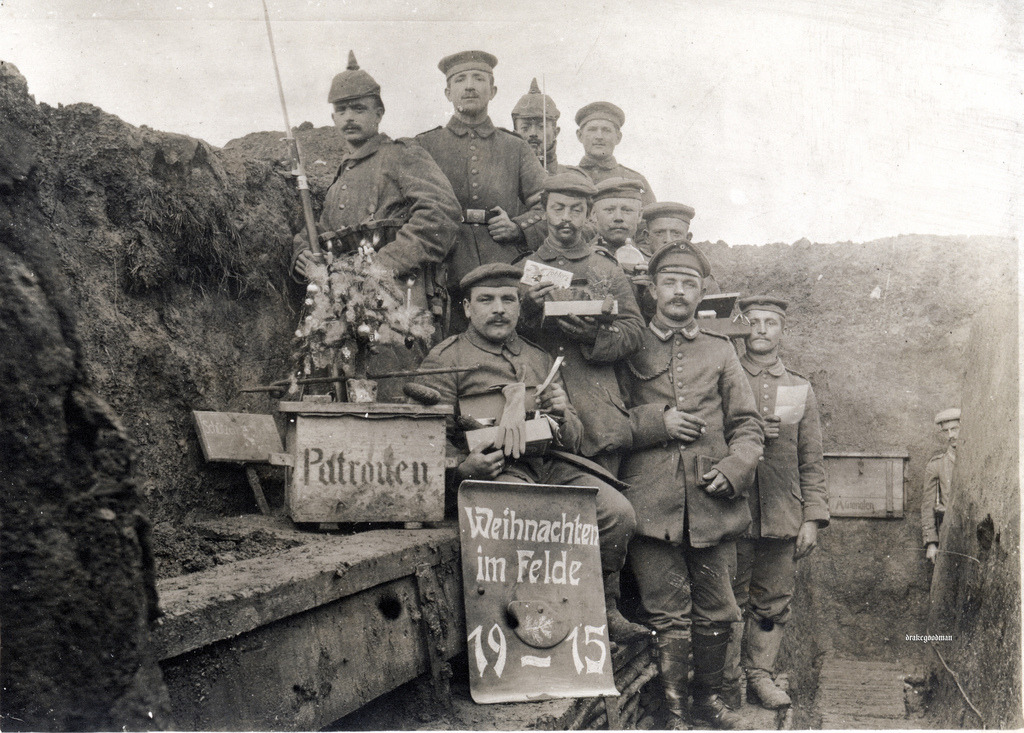
One hundred years ago today, the "ChristmasTruce" when both sides in the trenches stopped fighting, for a while. The event of 1915 is very well documented. Something similar also occurred on the Eastern Front.

I wish it could be said that ordinary people could change the course of events, but we now know, even better than before, how the media shapes and controls how people think. With the internet, social media and mass, often uninformed communication, it's harder than ever to escape media manipulation.


The War on Christmas ?

What's with this "War on Christmas" business?  If  your faith is so weak that it's threatened by what other people do or don't do, then maybe it's time to  question what one really believes in.

Jesus said "love your neighbour as yourself."So, goodwill and forbearance to all, even to those who prefer hate.

The pic shows Krishna, the Hindu god, as an infant. 


Monday, 21 December 2015

Wigmore Hall saves Christmas

At this time of the year the transport system closes down - cancellations, roadworks, traffic jams, possible bad weather, insane crowds in the West End......   No wonder the music business goes into hibernation at this time of year. There's no serious music at the South Bank until 22nd January (Calleja)! Unless you like Dudamel (though there's a solitary piano recital). The Barbican wakes up from Raymond Gubbay on 9th January with Pelléas et Mélisande, but having heard Rattle conduct it with the Berliner Philharmoniker at the Philharmonie, I don't think the LSO at the Barbican will top that.

The Wigmore Hall closes after 23rd December and reopens 27th, though the last pre-break concert, with Ensemble Correspondances, presents 17th century French Noël. On Monday 28th, the celebrated Max Emanuel Cencic (photo at right) sings Hasse and Vivaldi with Armonia Atenea.  I'm tempted because he's wonderful.  I first heard him live in recital  when he was 17 years old, after he left the Vienna Boys Choir.  Previously, I'd heard him as a 12-year-old treble singing Mahler Symphony no 4. His voice never really broke, and he trained it so he could keep singing male soprano repertoire. Thirty five years later, he's a countertenor with immense range and style. I've already booked tickets for New Years Eve at the Wigmore Hall with Andrew Carwood and the Cardinall's Musick – British choral music – Britten, Warlock, Howells, Holst, Moeran, RVW and Gerald Finzi.

The Wigmore Hall's first big Monday afternoon concert on 4th January features Benjamin Appl. He's very young but extremely promising (read more about him by searching this site). Appl is singing Schumann, Wolf and Brahms with Graham Johnson, no less. What a good way to start the new year!  The Wigmore Hall complete Schubert song series continues on Wednesday January 6th with two concerts, both with Graham Johnson. Birgid Steinberger, Daniel Johannsen and Benjamin Appl sing Schubert's "Gothic Songs of Horror",  seldom heard live, while Christopher Maltman sings later in the evening. The Schubert Song series continues with a very interesting programme on Monday 11th with Luca Pisaroni and Wolfram Reiger - don't miss this! Pisaroni has an intuitive understanding of the Lieder genre,  and a warm, Italianate timbre which suits these songs exceptionally well.  Do not miss!

Plenty more chamber music, early music and recitals, including the ever-lively Royal Academy of Music Song Circle (Jan 17) and then Classical Opera does a  Mozart evening with Louise Alder and Benjamin Hulett. By then, the Barbican is back to normal programming but the South Bank has a week yet to go.

Sunday, 20 December 2015

Kurt Masur and Leipzig, his greatest achievement.


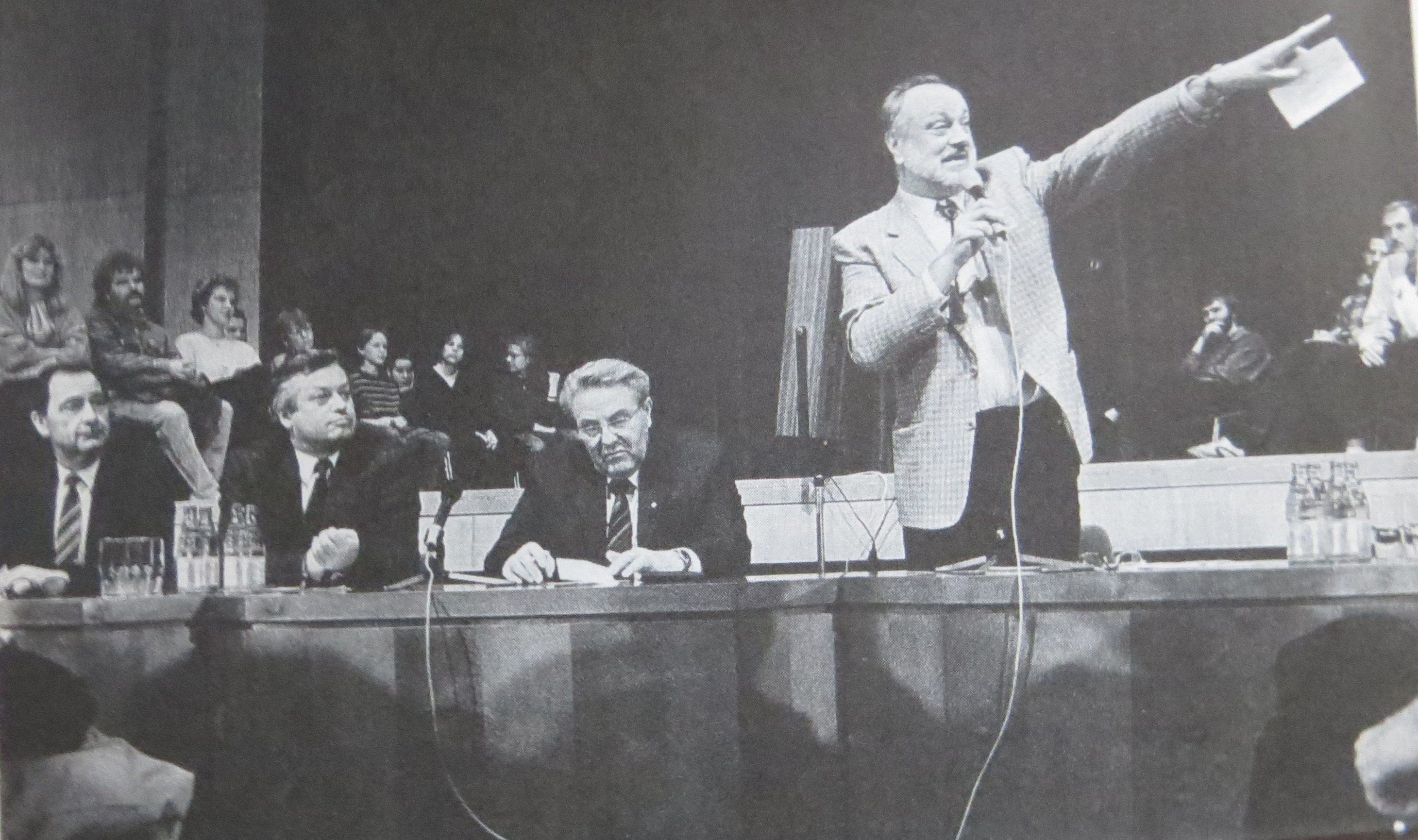
Kurt Masur has died, aged 88. Masur was much, much more than a conductor. He transformed his city, his nation and the world. Would Germany be united today without the movement that led to the fall of the Berlin Wall? Would the Iron Curtain still hold sway? The cataclysmic events of 1989 were only 26 years ago, but seem to have been forgotten, by too many.  To truly honoure Masur, we need to appreciate Masur the man, and what shaped him.

Masur was born in Brieg (Bryzg) in Lower Silesia, once part of Germany, now part of Poland.  That might mean nothing, but it's this background of war, ethnic cleansing and exile that affects people.  Christoph Eschenbach was traumatized, but he was only 5. Masur, who was 18,  could understand.  Masur's career was built on the rock-solid foundations of German Democratic Republic music-making. In the DDR, the traditions of German music remained resolutely untouched by what was happening elsewhere. The regime was repressive, but it also resisted capitalist pressure, maintaining a superb music education system, which supported the industry so it could do what it did best, without having to cave in to the commercial forces of a new era where recordings started a new mass market dictated by public taste.  What we think we know is shaped by market forces.  Harnoncourt's response was to go back to the roots (read more here). Masur and the East German tradition were "at" the roots.. Masur conducted the Dresden Philharmonic Orchestra from 1955 to 1972, with breaks between, and conducted the Leipzig Gewandhaus Orchestra from 1970 to 1996.  These two great pillars of the German tradition remained pure and largely intact. So Masur's repertoire was standard Austro-German, like Thielemann's after him? Better that conductors should do what they love best.

The city of Leipzig has been a centre of German culture and idealism for centuries.  Consider its "favourite sons" among them Bach, Schumann and Mendelssohn. It also has liberal tendencies. When the Nazxis tried to rip out Mendelssohn's statue outside the Gewandhaus, the Mayor stood up to them. So when protests for freedom began in early 1989, Leipzig was at the heart of things.  Masur attended meetings at the Nikolaikirche, and stood with the thousands  who marched through the streets. Just as Furtwängler made a statement conducting Beethoven to make Goebbels squirm, Masur played Beethoven as a symbol of liberty and freedom.   In 1956 and again in 1968, the Soviets silenced protest by sending in tanks.  The Nikolaikirche movement's emphasis on non-violence grew from very realistic awareness of danger.  Just as Sibelius brought the world behind Finland against Russia,  Masur and the Leipzig Gewandhaus Orchestra used their prestige to galvanize support invoking moral authority.

A few weeks after the "revolution" of October 9th, the Leipzig Gewandhaus Orchestra went on tour. At the time, we worried that they wouldn't be allowed out in case they defected.  When they walked onto the platform at the Sheldonian in Oxford, the audience began to cheer as a gesture of appreciation. The orchestra seemed visibly moved. Masur let them take in the solemnity of the moment for as long as possible, before launching into an impassioned evening of Beethoven.

Barely two years later, Masur left the Leipzig Gewandhaus Orchestra for New York.  In London, we got to know him well, when he was Chief of the LPO during the first decade of the millennium, while simultaneously heading the Orchestra Nationale de France and guesting elsewhere. So much for the nonsense idea that conductors should only manage one orchestra at a time.  A friend  said Masur was "too foursquare", but another said that it was his DDR heritage, which puts other tastes into perspective. ie not Bernstein or Karajan.  Masur went on to many things after Leipzig, but Leipzig will always be central to his legacy.  It is sad that it has taken Masur's death to alert the world that he had a huge career long before he went to the west. 

Here is a a link to the best and most comprehensive obituary. Extremely well written, by someone who knewe the subject well. Once newspapers used to employ serious professionals to do these things, and update them when the subject died. In this case, the un named writer seems to have stopped about 10 years ago because the info on London and Paris is sketchy and seems to have been filled in by someone else, as some other parts like the first paragraphs.  But it gives an excellent and personal insight,

Below a clip of Masur conducting the Leipzig Gewandhaus Orchestra at the Nikolaikirche.(not 1989)

Saturday, 19 December 2015

Stalin's Little Helpers


Courtesy of a friend, vintage greetings from a happy surveillance society! And why Stalin ? Because he used Lenin as a front, like the kid with a mask. That's the thing about art in a totalitarian state - read the runes !\The kids are in mid 20th dress but how pinched and miserable they look ! The girl on the left looks like she's on trial  Little babushka looks like she wants to kill. . I didn't think we needed tp point this out, we've all heard Shostakovich.

You better watch out,
You better not cry,
You better not pout,
I'm telling you why:
Santa Claus is coming to town!

He's making a list,
And checking it twice,
Gonna find out who's naughty or nice.
Santa Claus is coming to town!
He sees you when you're sleeping,
He knows when you're awake.
He knows when you've been bad or good,
So be good for goodness sake!

He sees you when you're sleeping,
He knows when you're awake.
He knows when you've been bad or good,
So be good for goodness sake!

Thursday, 17 December 2015

London's new concert hall - the wider perspective


Plans for a new, world-class concert hall for London reach a further stage, with the approval of funds for a more detailed business plan.  Even before the initial feasibility study was made,  there were strong indications that the new hall would be connected to the Barbican, on the present Museum of London site. So the news isn't really "news" .  However, now that more details are emerging, it's time for more analysis.

Since the new hall will cost £278 million (at least), the public and media will be up in arms protesting.  Serious music isn't taken seriously enough in this country, so already there's opposition from many quarters. More worrying, though, is the opposition from within the industry itself, riddled as it is with balkanization and special interests. What we really need is a coherent national arts policy that deals with things from an international perspective.

London doesn't exist in a vacuum. It is a key part of the global arts ecology. Mess London up and it impacts on the world. Should we care? Yes, because the arts are also part of the economy and play a huge part in maintaining Britain's political credibility.  Britain is still perceived as a civilized nation thanks to its  progressive, generous cultural heritage

 For decades France had no real national arts policy, but the new Philharmonie has dramatically changed things. The Philharmonie is a stunning building with superb acoustics, and back-up facilities. It's so good that it could well revitalize the French arts industry all over, not shifting the balance so much as opening up new possibilities all round.  Paris was once the heart of  European culture.   Berlin has always been way ahead, part of the German-speaking musical ecosystem, to the extent that the Austro-German tradition eclipses the French contribution to music in many minds. This is what London is really up against. Stop swimming and you sink.

London's new concert hall won't, one hopes, be just another concert hall, but a genuinely innovative facility designed for the next 100 years. Sure, London has lots of venues but small venues like the Wigmore Hall, Milton Court, etc, serve niche audiences.  The South Bank was a flagship sixty-five years ago, but it's now overcrowded, its artistic purpose drowning under under other priorities.  A Philharmonie-type venture would be altogether in a different league.  It would be world class, attracting musicians and visitors from all over the world.  The arts market is now global. Listeners are as likely to be in Ulan Bator as in Pontypridd. One  huge international community linked by the internet and telecommunications, which render obsolete the boundaries of space and time. If you stop swimming, you sink. Britain's got to keep pace.

So the new centre will cost  £278 million?  Compare that with Boris Johnson's Olympicopolis, partly funded by the Smithsonian but also requiring £141 million in government funds, in theory offset against a supposed £2.8 billon income.  It's basically just another college site with museum attached.  At least the new concert hall would be something genuinely different, as opposed to another way of milking the Olympics' so-called legacy.  Keeping Boris happy is one thing, but what about the overall impact ?  Governments have a way of discovering money, as we've seen in the sudden decision to fight another, possibly unwinnable, war in Syria.  As Churchill supposedly said, what would be fighting for if we didn't have the arts? Bombs make enemies, culture wins friends.

Capital projects always attract funding, for various reasons, but it's also false logic to assume that the money could be better spent on  existing facilities. A sudden injection of funds like that that would be reckless, without a great deal of careful planning. You don't just divvy up goodies willy nilly.  As for austerity, the reasons behind that are ideological, not financial.

 Could the money be used towards music education?  But music education isn't just schools and music colleges.  Excellence in performance is in itself an important form of education. It raises standards and expectations, which, long term, also expand opportunities.  Music education was eroded long ago, by successive governments and a public that thinks of education as vocational training.  Besides, everyone is, or should be, learning all the time, but listening and experiencing the best on offer. You can't separate education from performance.

So the next stage in the process will cost £5 million?  Better that money be spent on good planning, like working out the acoustics, a business model, transport infrastructure and so on, rather than making mistakes that would cost more to fix in the long run. From what I've read so far, some ideas seem OK and others much less so, like the idea of listening pods (why not stay home?) and the lack of front  and back-of-house facilities, which could prove fatal.  Abandoning the Barbican is all very well, but is it actually suited to jazz and world music ?  The South Bank does that, diluting its committment to classical music.  What happens to the BBC SO and the BBC source of revenue ? What about the LPO, the Philharmonia, the London Sinfonietta and the OAE ?   The Paris Philharmonie builds upon existing arts ventures, eg IRCAM, and provides a home for many orchestras. Like all big projects, it was controversial, but it's worked. A good new centre needs to be flexible enough to allow for the future. Short-sighted savings are foolish. Remember the decision to keep the M25 narrow.

The new concert hall for London is big and will take years to come to fruit. Instead, the level of debate is so low that some think it could have been dashed off to bring Simon Rattle back to London (where I suspect he'd like to be anyway). The project is so big that it needs sophisticated evaluation, pro and con.  But while we have arts thinking that predicates on piecemeal and special interests, I don't know how that will come about.

Photo : By Acabashi (Own work)

Wednesday, 16 December 2015

Tulip Face - Schumann Das Paradies und die Peri


Robert Schumann Das Paradies und die Peri  (Op 59 1843) in a recent performance from Paris on BBC Radio 3 (starts around 12 mins). This is an excellent performance, as clear and lucid as the diamonds and star-studded Heavens that light up the imagery in Thomas Moore's saga Lalla Rookh (1817)  upon which Schumann based his oratorio.  Jérémie Rohrer, who conducts the Orchestra Nationale de France (ONF), is one of the young generation of French conductors whose background in baroque provides strong foundations for their approach to other repertoire: lucidity, intelligence, and an absence of self-indulgent waffle. In other words, respect for the composer and the period, whatever instruments might be employed.  These values are important in Die Paradies und das Peri because they highlight the clarity of Schumann's conception. Rohrer is definitely worth listening to, even if you're used to Gardiner and Harnoncourt.

Be wary of the BBC description, though. Das Paradies und die Peri is not rare, nor religious. There are many recordings and Simon Rattle has conducted it live frequently. But its position in Schumann's output and in music history is still misunderstood.   I first encountered the piece when John Eliot Gardiner led a Study Day into it  at the South Bank. It was "new" to many then, and, to be frank, I couldn't get it at all, despite Gardiner's insights. It's surprisngly radical, and doesn't fit into neat categories. Compared with Schumann's Lieder and piano works, it's huge. Consider Schumann's Szenen aus Goethes Faust which he began working on a year after Die Paradies und die Peri, and continued to work on as he began Genoveva (Op 81 1850) and also the Requiem (Op 148 1852). Schumann could turn poems into song cycles on a grand scale. What might he have achieved if he had not succumbed to illness and died so young?

Then there's the overwhelming influence of Wagner, whose Die fliegende Holländer premiered in Dresden in 1843.  Modern approaches to opera are defined by Wagner and Verdi, but Schumann represents an alternative. Both Schumann and Wagner owe huge debts to Carl Maria von Weber, but both were heading off in new directions of their own.  Schumann's dramatic work may have been eclipsed in the past, but it needs to be re-assessed.

Die Paradies und die Peri is also seminal because it shows the depth of Schumann's engagement with literary sources. Even for the son of a Leipzig bookseller, Schumann was exceptionally well read and up to date on the latest literary trends. Moore's Lalla Rookh developed the fashion for orientalist fantasy, which intrigued the Romantiker imagination, opening up new horizons  and  alternatives to  western European constraints. The Generic East implied unparalleled extremes, and emotions too wild for Christian convention.  Lalla Rookh is One Thousand and One Arabian Nights on acid. Moore was an opium addict, like Thomas De Quincey and, later, Charles Baudelaire. Nothing like a bit of dope to break inhibitions.  Nonetheless, the literary style of Lalla Rookh is itself utterly relevant. It is written in an exaggerated, verbose style so highly perfumed that it's almost unreadable now, but that was part of its original appeal. Exotic names and words pour forth in hallucinatory frenzy, creating a haze of soporific delights.  How thrilling these references to strange, obscure places, people and objects to readers who had no idea of the real East, or Asia or Africa for that matter.  It was enough that the words sounded wonderful, and, significantly, musical on their own terms."Lalla Rookh", incidentally means "Tulip Face" which was a compliment in times when tulips were prized imports from distant lands. 

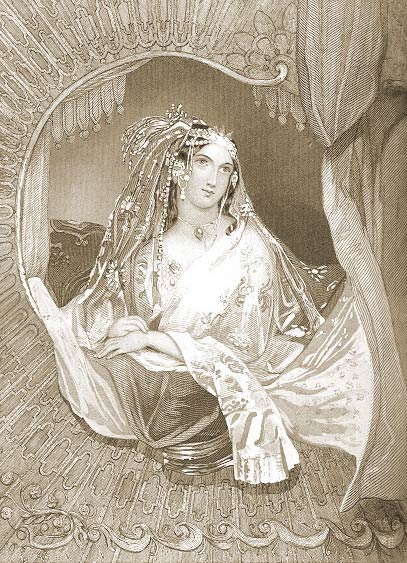
If anything, Schumann plays down the text so it flowers in his music.  The peri flits freely  between Egypt, Africa,  Syria ^the land of roses", "Cashnere (Kashmir) and other places including "Peristan" (the land of Peris?) and ends up by the throne of "Alla" surrounded by non-Islamic lotus blooms.  but Schumann's music is thoroughly German. Some figures, especially in the choruses, evoke the sturdy rhythms of Der Freischütz or even Der Vampyr, but the general style is distinctively Schumann. The solo vocal parts rise out of the orchestral ensemble as if they were glorified instruments.  The Angel, for example, is often seated between the chorus and the orchestral,players, so her voice shines forth from above the soloists.  Read more about what i've written in the past about Die Paradies und die Peri  HERE and about Genoveva HERE.  .And don't forget the excellent Rohrer performance available for roughly two more weeks.  And also Paul Dukas La Péri - poeme danse (1912) which follows, illustrated in the top photo. .