Friday, 3 March 2017

No tourists - John Eliot Gardiner Chabrier Debussy BRSO

Sir John Eliot Gardiner with the Symphonieorchester des Bayerischen Rundfunks at the notorious  Gasteig in Munich last week. Gardiner isn't getting any younger, but he's greatly loved. Every opportunity to hear him live is worth cherishing. This time he conducted Emmanuel Chabrier and Claude Debussy.  A delightful programme, elegantly constructed.  Playful, even, sparked with Gardiner's characteristic wit.  Setting the scene,  the concert began with Chabrier's Overture to Gewendoline,  (1886), much better known than the opera itself. Gwendoline is a fantasy on early medieval Britain, set in an Anglo-Saxon village being raided by Danes. The opera wasn't a huge success, neither comic nor grand enough for Parisian taste, yet not over the top enough for Wagnerian audiences.  Nonetheless, it probably deserves revival these days, when the ideal of unified Europe is under threat. Much better Chabrier's civilized if slightly dotty romance than the rumblings of nationalist extremism.  Perhaps in those sweeping strings, we can imagine the swelling waves of the North Sea, and winds blowing the Vikings ashore. Mock medievalism in glory: neither mayhem nor pillage on the horion.The winds suggest Tristan und Isolde, and the finale explodes, trumpets and trombones ablaze, and giant crashing percussion. True MGM richness!

Rather more elegant, Chabrier's Suite Pastorale (1888) orchestrating four of the composer's 10 Pièces pittoresques (1881)   Gardiner's lightness of touch was ideal : these pieces charm because they're light and aphoristic.  Then the Fête polonaise from Chabrier's opera Le roi malgré lui. (1887).   It's not kitsch  "Polish", though the last movement is part waltz and part polka, almost a parody of Vienna and the Johann Strausses.  But it's echt Chabrier.  Gardiner and the BRSO executed the piece stylishly,  the scherzo-valse executed with vivacious flair. Last year, Chabrier's L'étoile was staged at the Royal Opera House. Chabrier's idiom doesn't fit into neat operatic categories. Its warm hearted, unpretentious cheerfulness expresses itself in a taste for absurd whimsy. The key to understanding L'étoile was, I think, understanding his orchestral music, and his ironic style.  So if the opera didn't go down well with London audiences that says as much about them as it does about Chabrier.  Thus, Chabrier's "greatest hit" España (1883). A delicious performance, like a tourist's memory of an ideal holiday in Spain. The strings whirr like strumming "guitars" and flamenco rhythms add spice.  And, like a tourist fantasy, it doesn't last.  In this case, six minutes!

Chabrier's "travelogues" complemented Debussy's Images, in the sense that the most famous section, Ibérica, has a Spanish context. Gardiner began, though, with the Rondes du Printemps.  Rounds: hence the cyclic feel of the piece, reminiscent of the "waves" in La Mer, written at roughly the same period, the folk melodies flowing like undertow.  Gardiner followed this  with Gigues  to reinforce the idea of abstract form as opposed to pictorial colour.  True, Ibérica incorporates features that might evoke Spanish flavour, but it is also a "round" in itself, being made up of three inner sections, the outer two inspired by abstract form.The core, Les parfums de la Nuit is mysterious. Its beauty needs no ostensible title.   Listen to the rebroadcast of this concert here on BR Klassik.

Wednesday, 1 March 2017

Morgen kommt der Aschermittwoch

Ernst Hanfstängl (1840 Dresden 1897 Capri) Aschermittwoch aus unserer Rubrik
Am Aschermittwoch ist alles vorbei, die Schwüre von Treue sie brechen entzwei Von all deinen Küssen darf ich nichts mehr wissen Wie schön es auch sei dann ist alles vorbei Trink auf die Freude, denn heut ist heut das was erfreut, hat noch nie gereut fülle mit Leichtsinn dir den Pokal  Karneval, Karneval - Jupp Schmitz, popular song from the 50's.

Ash Wednesday is an important day in the liturgical calender.  Palm cRosses which marked the previous Holy Week are burned, preparing the way for the next, but the symbolism goes deeper.  "Dust to dust, ashes to ashes". So much for the vanities of this material world . We're all going to end up in smoke. Which is why Easter matters: it offers hope and some form of meaning.  In medieval  tradition, fasts were broken by feasting, drinking and excess. "Eat, drink and be merry while you can"  Because good times may not come again.  So excess and wild abadon are haunted. When you wake with a hangover, you know about Hell.  Perfect material for Heinrich Heine.


Dieser Liebe toller Fasching, Dieser Taumel unsrer Herzen,
 Geht zu Ende, und ernüchtert Gähnen wir einander an! 
 Ausgetrunken ist der Kelch, Der mit Sinnenrausch gefüllt war, 
Schäumend, lodernd, bis am Rande; Ausgetrunken ist der Kelch. 

Es verstummen auch die Geigen, Die zum Tanze mächtig spielten, 
 Zu dem Tanz der Leidenschaft; Auch die Geigen, sie verstummen. 
 Es erlöschen auch die Lampen, Die das wilde Licht ergossen 
 Auf den bunten Mummenschanz; Auch die Lampen, sie erlöschen.

 Morgen kommt der Aschermittwoch, Und ich zeichne deine Stirne 
Mit dem Aschenkreuz und spreche: Weib bedenke, daß du Staub bist.

(This lovely Fasching, this wild frenzy of our hearts. It's ending. Sobering up, we yawn at one another.  The cup's drained empty, which once intoxicated - foaming, flaming, overflowing the brim.  The violins are silent that once led the merry dance. (reference to the Devil)  The lamps are out, too, which gave light in the darkness for merry Mummenshanz (masked and costumed clown figures) .  Tomorrow it is Ash Wednesday and I'll mark your forehead with a cross of ash.  And whisper : Woman, think on it : You, too, are dust)

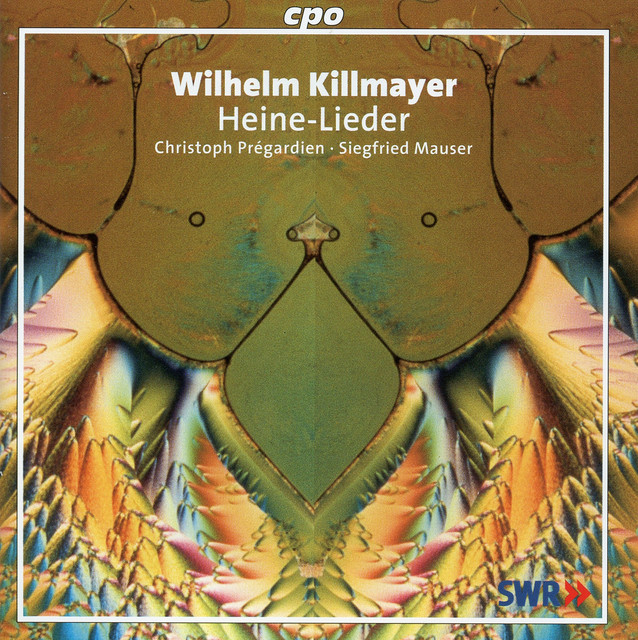
As far as I know this poem has only ever been set as a song once, by Wilhelm Killmayer, mentor of Wolfgang Rihm, part of Killmayer's eclectic and highly original traverse through Heine.  The piano introduction pounds, throbbing like a violent headache.  The vocal lines rise and break off suddenly into silence. The piano comments only in brief staccato flashes. A passage suggests a violin, playing in memory., and the vocal line is circular, like in a dance  The pace slows down, as f unwinding voice and piano alternating. The last strophe is striking. Like liturgical chant, it's dignified but plaintive, like an echo from the medieval past.  Killmayer substitutes the word "Menschen" for "Weibe". The last line is chant. Two phrases:  : "Mensch' bedenke"....."dass du Staub bist!"  Then the piano tolls single chords, like a funeral bell.  Get the CD here (Prégardien, Mauser)  and the score from Schott.

Tuesday, 28 February 2017

Goethe's März Lied

Es ist ein Schnee gefallen, 
denn es ist noch nicht Zeit, 
daß von den Blümlein allen 
wir werden hoch erfreut. 
 Der Sonnenblick betrüget
 mit mildem falschem Schein, 
die Schwalbe selber lüget,
 warum? Sie kommt allein! 
Sollt ich mich einzeln freuen, 
wenn auch der Frühling nah? 
Doch kommen wir zu zweien,
 gleich ist der Sommer da! 

Goethe

 Snow has fallen. It's not time yet for flowers to bring cheer.  The sun's rays seem mild but they're a trap.  Even the swallow is cheating. Why  Because he comes on his own !  When Spring is so close, could I ever be happy on my own  ?  Yet when the two of us are one, it will be Summer.forever.

Monday, 27 February 2017

Revolution : Russian Art and Eisenstein


At the Royal Academy of Arts, London, the exhibition Revolution : Russian Art : 1917-1932 runs until 17th April.  "This far-ranging exhibition will – for the first time – survey the entire artistic landscape of post-Revolutionary Russia, encompassing Kandinsky’s boldly innovative compositions, the dynamic abstractions of Malevich and the Suprematists, and the emergence of Socialist Realism, which would come to define Communist art as the only style accepted by the regime."

"The Revolution That Changed Everything" - watch the RA Video on the website -it's short but good.  There will be discussions on the role of art under state control and weekend course on  the effects of revolution on Russian art.  The overthrow of the Tsar was just a beginning. Several revolutions were taking place all at once - political, social and artistic. For a moment, Russia was the vanguard of  progressive innovation.  Futurist ideas inspired new approaches to visual art, music, film and literature.  Lots of interesting issues arising. What is "the Art of The People" ?  What is propaganda and what isn't ?  Does it depend whose side you're on ? Most provocatively, who are "The People" ?


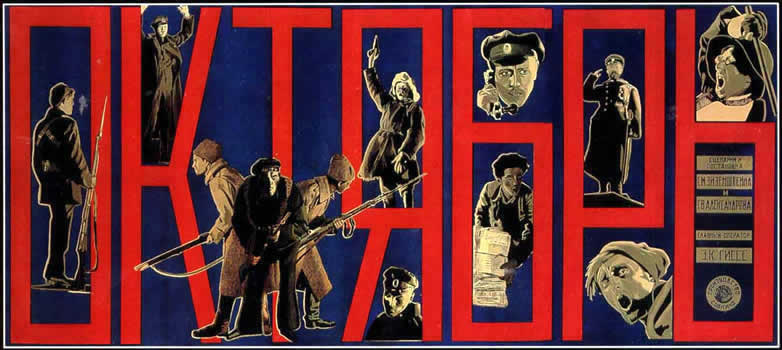
A good time to revisit Sergei Eisenstein's October : Ten Days that Shook the World (1927) reflecting on ten years of revolution.  Dmitri Shostakovich wrote the soundtrack for the re-issue of the film on the 50th anniversary of the October Revolution. The narrative is straightforward, told with broad brush directness. But whatb Eisenstein does with the story is turn it into a work of art.  A statue of the Tsar is seen outlined against the sky. It's torn down by diagonal ropes.  A crowd cheers, arms raised heavenwards. Scythes are seen, en masse. Close ups of soldiers faces, grinning, then suddenly, we're in an ornate palace, with elaborate mosaic floor tiles. Cut to angular shots of heavy machinery, to images of starving children dwarfed by huge columns of stone, to shots of a crowd waiting, at night for a train. "Ulyanov ! It's him !"

Diagonals fill the screen, shaking up flat, "natural" order.  Flags and banners wave, crowds march, individuals lost in orchestrated movement.  Gunshots are fired. Suddenly the tightly packed march disintegrates, figures running wildly across a huge city square.  Cannons, horses fall to the ground, crippled.  The gates of a huge bridge open, magnificent abstract lines : but a horse is impaled in the machinery.the modern age versus the past, in one horrific image. In a palace, the Provisional government  gathers. Officials walk up and down grand staircases, pre dating the works of M C Escher.  Hurried footsteps, leading nowhere. When the words "For God and country" appear in subtitles, we see, not Orthodox depictions of God but alien Gods - primitive sculptures, Buddhas, Gods so primitive and atavistic that they can't be identified. Tanks arrive to crush the revolution. What we see are rolling tracks, machines of destruction  terrifying because they are impersonal.  Close ups of guns and individual bullets : the proletariat will fight back.

The bridge across the Neva is raised again,  but a ship- with four, impressive funnels. We see sailors, and cadets marching, as the massive gates of an imperial palace are pulled shut.  A  half naked woman cavorts on the billiard table of the Tsar.  What's going on ?  Through a collage of images,   Eisenstein recreates the tension and uncertainity that people must have felt in the upheaval.  This is cinematic technique as art, not unlike the fractured visuals of Cubist painting.

The Bolsheviks mobilize. Eisenstein shows images of hands operating telegraph machines, of armed men rushing up and down staircases, men with bayonets. swathed in smoke.  A ravaged looking woman looks up at a marble sculpture : without explicit dialogue, is Eisenstein suggesting the idea of redemption through the high ideals that art can symbolize ?  Or something completely different ? Because the nature of art is not necessarily specific, but the opening up of possibilities. Foir all we know, that's why Stalinists needed conservative "realism". where no-one needs to think.

The army declares for Bolshevism: a forest of bayonets. Wheels are turning, the machine surging ahead.  Machine gun clips fire, and cannons, in such rapid sequence that the images hardly have time to register.   Troops swarm into the palace, ascending the marble staircases : we can "hear" the sound of their boots in short, sharp images.  The Revolution is won ! we see the faces of clocks mark the moment, in Petrograd, in Moscow, around the world.

Weimar Shanghai - who was McGinty ?

Who was McGinty ? A postcard from Shanghai 100 years ago. Shanghai was a boom town, a thriving metropolis rivalling New York, London and Berlin.  Yet only 50 years previously, it had been a fishing village on  a riverbank.  Shanghai came into existence, after the Second Opium War. It was never a colony, though foreign nationals enjoyed extra-territorial rights.  Rumours had it that there were signs in parks that read "No Chinese and no dogs!".  Yet Shanghai was the first "world city" of the 20th century, with booming industries, a gateway between the vast interior of China and the world.  The city thrived from the influx of cheap immigrant labour and local adaptation to modern industrial methods.  Extremes of wealth and of poverty, of sophistication and feudal tradition, albeit for peasants dispossessed and dislocated from traditional social networks.  Weimar Shanghai !

So who was McGinty ?  His name's generic, bestowed with irony by foreigners, and somewhat deprecating, since Irish people weren't given much respect either, in those days.  There he stands in evening dress, with top hat, tails and cigar.  But is he a worldly, privileged man about town ?  Or was he some poor peasant orphan, dressed up to amuse  night club patrons, whose experience of "real" Chinese people was strictly limited.  The McGinty's of this world have ever existed, as dwarves in royal courts, or freaks in circus shows, mocked and patronized, like performing pets. Yet what characters they must have been, to stand up to prejudice and often cruelty, to make some sort of livelihood despite the odds being stacked against them.  So when I found McGinty, I wanted to honour him, whoever he might have been, however he might have ended up.  Not forgotten by me !

Please also see my piece on Franz Schreker's Die Gezeichneten. Alviano Salvago is a nobleman, rich, talented and intelligent, yet gets screwed by the world around him, because he's different. McGinty would have understood. 


Saturday, 25 February 2017

Song Cycle within Song Symphony : Goerne, Mahler Eisler

A song cycle within a song symphony - Matthias Goerne's intriuging approach to Mahler song, with  Marcus Hinterhäuser, at the Wigmore Hall, London.  Mahler's entire output can be described as one vast symphony, spanning an arc that stretches from his earliest songs to the sketches for what would have been his tenth symphony. Song was integral to Mahler's compositional process, germinating ideas that could be used even in symphonies which don't employ conventional singing. Goerne's programme was structured like a symphony, through which songs flowed in thoughtful combination, culminating in the Abschied from  Das Lied von der Erde, revealed as a well-constructed miniature song cycle in its own right.  Goerne is more than a superb singer. He's a true artist who illiminates the musical logic that underlies Mahler's music.
Song is the voice of the human soul. With remarkable consistency, from beginning to end, Mahler's music poses questions about the purpose of human existence in the face of suffering and death, Nearly always, transcendance is found through creative renewal.  Thus this programme began with Der Tamboursg'sell (1901), so well known that it symbolizes the whole Des Knaben Wunderhorn collection of songs. The drummer boy is young but he's being marched to the gallows, for reasons unknown. "Gute Nacht, Gute Nacht!"  Goerne's tone rumbled with chilling darkness, as if haunted.  Das irdische Leben (1892-3) followed, paired with Urlicht, in the piano song version, though it's better known as part of Mahler's Symphony no 2, sung by an alto. This was a thoughtful pairing. Das irdische Leben isn't just about child neglect, but opens onto wider issues like the nurturing of artists. In Urlicht, the protagonist refuses to be turned away, determined to reach its destiny. The song occurs at a critical point in the symphony, where the soul has passed through purgatory and is heading towards resurrection. In Goerne's programme, it is halted, temporarily, though we know there will be resolution. These first three songs thus form a kind of prologue for what is to follow.
Goerne has been singing Mahler for decades, though he hasn't recorded much, which is a loss to posterity as his Mahler is deeply thought through and perceptive.  He's been singing Hanns Eisler even longer, since he grew up a child star in the DDR where Eisler's childrens' songs were well known   He recorded Eisler's German Symphony op 50 (1957) with Lothar Zagrosek in 1995.  Eisler's German Symphony is a song symphony, an "Anti-Fascist Cantata" setting poems by Brecht and Ignazio Silone. Goerne's recording of Eisler's Hollywood Songbook in 1998 is a masterpiece, easily eclipsing all others.and still remainsthe classic.  At the Wigmore Hall, Goerne combined two specialities into a well-integrated whole, the Eialer songs functioning as middle movements expanding the themes in the Mahler songs.

Eisler wrote Hollywood Liederbuch while in exile in Hollywood, pondering on the nature of German culture and identity during the cataclysm that was the Third Reich.  Although Eisler is often colonized by pop singers, these songs are serious art songs and include settings of Hölderlin and Heine and really need to be heard with singers like Goerne who can handle the tricky phrasing and vocal range with the understated finesse they need.  These are songs of existential anguish, expressed obliquely because the pain they deal with is almost too hard to articulate.  For this recital, Goerne chose songs set to some of Brecht's finest poetry, like Hotelzimmer 1942 where Brecht describes neatly arranged objects. But from a radio blare out "Die Seigesmeldungen meiner Feinde". Goerne flowed straight into An den kleinen Radioapparat, reinforcing the connection between the two songs so they flowed together as one larger piece.  The piano parts are written with delicacy, suggesting the fragility of radio waves and the vulnerability of life itself.

Brecht, like Eisler, was a refugee, fleeing from persecution.  After this first group of Eisler songs, Goerne placed Über den Selbstmord. The contrast was shocking. The mood changed from suppressed  anxiety to outright horror. Goerne brought out the surreal malevolence, his voice rasping with menace. "Das ist gefährlich". The song is a deliberate reversal of Romantic imagery - bridges, moonlight, rivers - and sudden, unplanned suicide. Goerne sang the last phrase, letting his words hang, suspended  "das uberträgliche Leben"....coming to a violent sudden end on the word "fort".

A brief respite when Goerne recited lines from Blaise Pascal, which Eisler set with minimal coloration to the Brecht Fünf Elegien, refined miniatures about daily life in Los Angeles, where everything seems normal.  Three more songs of poisoned "normalcy"- Ostersonntag, Automne californien and In die Fr
ühe before a return to the grim reality of  Der Sohn I and Die Heimkehr.  Then again Brecht and Eisler overturn Romantic nostalgia. "Vor mir kommen die Bomber, Tödlicher Schwärme" and a horrific parody of a Homecoming hero.  The songs in the Hollywood Liederbuch can be presented in any order, but Goerne arranged them here in a pattern which suggests deceptively light andantes cut short by brutal scherzi. 

Mahler's Das Lied von der Erde progresses from frenzied denial to transfigured acceptance, expressed through a series of very distinctive songs.  In this performance, context came from the songs that had come before, widening the panorama.  Bethge's texts evoke China a thousand years past. Once again, many face what Brecht and Eisler went through. Hearing the Abschied in this context is uncomfortable, yet also uplifting, for it reminds us that the grass will grow again. Hearing the Abschied for piano also makes us focus on the structure of the song, and the way it, too, develops in a series of distinct stages, like a miniature song cycle, like Das Lied von der Erde itself,  "wunderlich im Spiegelbilde".

The orchestral Das Lied von der Erde predicates on the tension between tenor and alto/mezzo, a typical Mahler contrast between unhappy man and redeeming female deity, but as a stand alone, the Abschied lends itself perfectly well to other voice types. Goerne thus resurrects the Abschied for baritones, connecting the songs of passage, whether they be passages through death or domicile.  The message remains the same. The darker hues in Goerne's voice suggest strength and solidity,  values which emphasize the earthiness of the imagery in the text.  He sings gravitas yet the high notes are reached with grace and ease. At the moment he's singing particularly well, better even than when he recorded Eisler's Ernste Gesänge in 2013, also with songs from the Hollywood Songbook.  Marcus Hinterhäuser's playing was exquisite, so elegant that he made the piano sound like pipa or erhu, revealing the refined, chamber music intimacy in the song that the orchestral versions don't often access.  Although the piano/voice recording with Brigtte Fassbaender, Thomas Moser and Cyprien Katsaris has been around for years, there's no comparison whatsoever. At times I thought Hinterhäuser might be playing a new, cleaner edition of the score, since his playing was infinitely  more beautiful and expressive. I suspect he's just a much better pianist, and he and Goerne have worked together a lot in recent years. As Hinterhäuser played the long non-vocal interludes, Goerne was visibly following the score, listening avidly. That's how good Lieder partnerships are made.  As Goerne sang the last "Ewig....ewig...."  I couldn't bear for the music to end.
you might want to read more :

Schubert Winterreise staged Aix, Goerne, now out on DVD
Brahns exults ! Vier ernste Lieder Goerne Eschenbach
Mahler early songs, orh Berio, Goerne
LOTS and lots on Mahler, Eisler, Lieder and  Goerne, please explore
 This review also appears in Opera Today

Thursday, 23 February 2017

More than a sum of parts : Jurowski, Berg, Denisov, Shostakovich

Vladimir Jurowski, Patricia Kopatchinskaja, London Philharmonic Orchestra,  photo : Sven Lorenz, Essen

Vladimir Jurowski and the London Philharmonic Orchestra with Patricia Kopatchinskaja presented Alban Berg's Violin Concerto.  Kopatchinskaja, Jurowski and the LPO recorded Stravinsky's Violin Concerto and Prokofiev's Violin Concerto no 2 nearly four years ago, and the disc is a best seller, for good reason. Sine Berg's Violin Concerto is perhaps even more popular, the prospect of  hearing it with Kopatchinskaya, Jurowski and the LPO at the Royal Festival Hall was hard to resist. Hopefully, it will be released at some stage. In the meantime, listen to the repeat broadcast on BBC Radio 3

But this concert was also memorable because it connected Berg's Violin Concerto with Edison Denisov's Symphony no 2 and Shostakovich's Symphony no 15. Jurowski has a genius for devising programmes that are greater even than the sum of their parts.  Anyone can put a programme together; very few can do so on this level.  Please read my review of  Jurowski's Kancheli, Martinů and Ralph Vaughan Williams concert.  This evening's inspired combination drew out the  more esoteric levels from all three pieces, absolutely justifying  the theme "Belief and Beyond Belief". Although so much about South Bank marketing is gimmick, Jurowski's "Belief and Beyond"  is genuinely well thought through, and adds considerable depth to this year's series of LPO concerts.  By no means is the term Belief limited to conventional, organized religion.  The concept of Belief  informs the whole way we respond to the human condition, even when we don't believe in fixed concepts.  Jurowski's programmes relate to much wider ideas of spiritual and intellectual questioning.  Comic book rigidities go against the grain of creative expression.

Edison Denisov's Symphony no 2 (1996) is typical Jurowski territory: stretching boundaries. Although Denisov lived under Stalin, Khrushchev and Brezhnev, he didn't conform. His perspectives were modern and international. He learned from Debussy, Messiaen, Boulez and Stockhausen and eventually was able to move to Paris, where his music was supported by IRCAM.  Denisov's Symphony, written after he'd moved to Paris, inhabits a world of shimmering almost micro tonality,  sounds blending yet separate, like fluids of different densities flowing together. The voice of a violin emerges from the complex confluences, then  a group of low winds, then a murmur of bassoons and a rumble of percussion.  Swirling figures, very high tessitura, creating forward thrust, broken by staccato cross-currents. Harps and gunfire, I thought.  Savagely angular discords, and the music stops dead. Perhaps literally. Denisov was seriously ill  and passed away six months later.  On the broadcast, Jurowski says there's a quotation from a bassoon solo in Tchaikovsky's Pathétique,  transposed for double bass.

In programmes as esoteric as Jurowski's, it's wise to beware of clichés. Following the obvious idea that Berg's Violin Concerto represents Manon Gropius who died aged 16, South Bank marketing plays up the "Memory of an Angel" aspects of the piece. But Berg, being Berg, is cryptic, hiding behind surface appearances. Kopatchinskaja reminds us of Albina, Berg's secret love child, whom he never really knew. Listen to Kopatchinskaja sing the Carpathian (not Austrian) folk song Berg quotes in the piece! Her singing voice is sweet and bird like, which enhances what the piece represents.  When she plays, she defines the part with strong, affirmative poise. The melody is bittersweet, yet undaunted, even when the orchestra storms around her.  Disquieting shapes in the violin part and crashing chords in the orchestra: this isn't  dewy-eyed sentimentality but something far more profound.  Tonality hovers on the point of breaking and then dissolves, when no more can be said.  The quote "Es ist genug", is a reference to Bach. Jurowski understands that Berg, even at his most passionate, uses structure with the clarity of a mathematical mind. Puzzles and patterns are integral.  Hence the innate  power of this piece, and this very strong performance.

Shostakovich's Symphony no 15 starts with exuberance, rushing forward into quirky march with references to Rossini's William Tell.  Is Shostakovich thinking of military oppression or slyly satirizing music for the movies? Perhaps both, for this symphony is in many ways Shostakovich's memoir.  Was he a puppet in an insane toy shop, or was he pulling  strings?  The poignant Adagio might be a reflection, but, like Berg, Shostakovich can be enigma.  The single chord progressions suggests isolation, yet the violin takes up the pattern, leading the orchestra in a dance that is deflated by  typical Shostakovich raspberries.  Though the protagonist may be alone, he's surrounded by other voices.  The orchestration lets many individual instruments have their moment.  This symphony might be an ironic parody of film, unfolding in different scenes, with quotations from Shostakovich's own work and others.  Thus the dramatic chorale of percussion, complete with crashing gongs.  Yet the underlying melody flows, its way lit by unearthly celesta and xylophone.  A thoughtful performance,  highlighting the many individual sections in this excellent orchestra. Definitely a concert that was more than the sum of its parts.

Monday, 20 February 2017

Lady Macbeth of Mtsensk is back !


Welcome return of Shostakovich Lady Macbeth oif Mtsensk with Eva-Maria Westbroek and Christopher Ventris,  conducted by Mariss Jansons, available for a limited time on Opera Platform. All good stagings connect to the music and ideas in an opera but in this famous classic, from 2006,   Jansons' conducting is so powerful that the physical settings seem to dissolve in the abstraction so the music dominates. This production (Martin Kušej, Dutch National Opera, Amsterdam)  won't please those who think opera "must" be decorative, but it's an excellent example of how abstract musical ideas can find visual expression.  The violent staccato and dissonaces in Shostakovich's score come alive, bristling with tension and violence. In orchestral passages, the stage disappears in a thunderstorm of flashing bright lights against darkness, replicating the angularity in the score. You wouldn't want to be prone to seizures.

 Lady Macbeth of Mtsensk is not a decorative opera. It's a savage cry of protest, against the oppression of women, against closed-minded communities, against repression of all types.   Staccato passages scream and low brasses and winds moan with baleful malevolence. Even while Katerina lives in comfort, chill winds from Siberia blow invisibly around her.  The Ismailov business is built on tight control. When then workers are left to their own devices, they break into mob violence.  The rape scene comes almost right at the beginning - violence against women symbolizes weakness, not strength. Real men don't need to beat up on others to get ahead. Shostakovich's testosterone thrusts are indictment, not glorification. These men are scum because they can't be men in any healthy way. In the libretto, it's clear that Sergei fancies Katerina because she stands up to bullying.  Trolls  aren't constructive: they need to destroy because they can't create.  Zinovy Borisovichs is impotent but he's a good man. He doesn't play games.  Hence  the bittersweet anti-romance in the cocky flute melodies round Sergey and the distorted bombast in  Boris Timofeyevich's music.  Thus, too, the maddening, circular rhythms when the mob intrude, thrusting in every direction.  The solo violin, in contrast, suggests demented resolve.  And so  Boris dies in slow diminuendo.  The crowd scenes are meticulously choreographed, suggesting a kind of orchestrated turmoil. 

Nothing much seems to happen in the long orchestral passage in the second act, but the music functions as an invisible backdrop. As we watch Jansons conduct, we can "hear" the events which are unfolding after Boris's death.   Katerina's still in a box, trapped in a frame without walls, yet there's strange beauty in the orchestration, suggesting wide open spaces, small, twinkling figures shining like starlight.  The staccato now trudges grimly forward.  The scene where Boris's ghost curses is shrouded in darkness, so we pay attention to the elusive violin melody. Although Westbroek and Ventris spend time groping each other in their undies, there's more desolation here than lust.  Zinovy lies dead, out of sight. Shostakovich's music for the police officers is brilliantly malevolent, underlining the anti-authoritarian message implicit in the opera.  When the police invade the wedding, Jansons conducts the multiple cross-currents with clear definition. No partying for Sergey and Katerina.  We're off to Siberia. Now the whole cast are stripped to their undies. Everyone's exposed. If the chant of the chorus sounds vaguely like religious chant, there may well be a reason for that.

Jansons' conducting was matched by the high standards of singing. Westbroek "owns" parts like this. When the Royal Opera House did Lady Macbeth of Mtsensk in 2004, Katarina Dalayman sang the part very well, but on balance I think Westbroek's hapless earthiness extends characterization. In London, Ventris exuded sexual magnetism, effectively stealing the show. Unfortunately in this Amsterdam production, filmed two years later, he's not called on to do much.  It's a wasted opportunity since he can do the role extremely well when called on.  Anatoli Kotsjerga sings Boris. Kušej's production isn't nearly as visual as Richard Jones's production for London.  Without Jansons, Westbroek and Ventris, I wonder how effective it would be? Yet it's been revived several times since 2006.  So it's nice to hear the original again. (It's been on DVD for ages.)


,

Sunday, 19 February 2017

Prostitutes, chamber music and recording

 
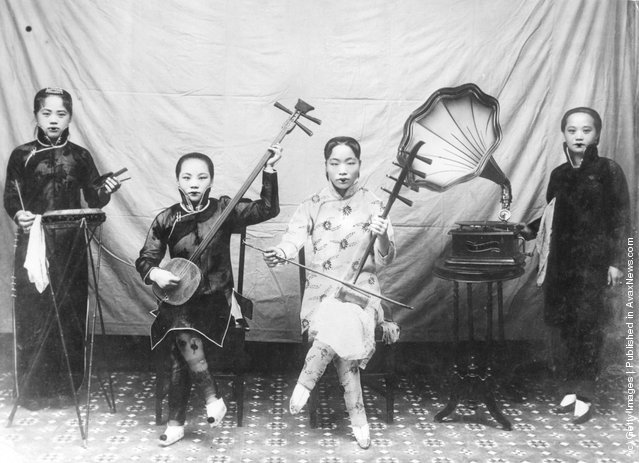
Traditional Chinese singing girls, who used to make music in teahouses, brothels, etc. But look ! A gramophone player ! This would date the photo to the first decade of the 20th century, when  such things were still such a novelty that people would pay to listen to sound coming from a machine.  So these enterprising girls found a way to draw the punters while giving themselves a break from singing and playing.  Recording technology came early to China. There are quite a few cylinders of Beijing opera stars singing popular arias.  From the style of their clothing, (unusually high collars) these girls come from North China. Their feet are tiny - possibly the result of footbinding that fell out of favour after the 1911 revolution.  Generally footbinding was a middle class thing,  which suggests that these girls were "bought" as infants in order to be trained as prostitutes. (though "prostitution" in that context was a mix of different services, like geishas don't just do sex)

The recording below is a Gaisberg cylinder from 1902, in Cantonese dialect, but there exist Beijing-made recordings from 1905-1908 made for the Chinese market


Friday, 17 February 2017

Britten and Pears in Hong Kong


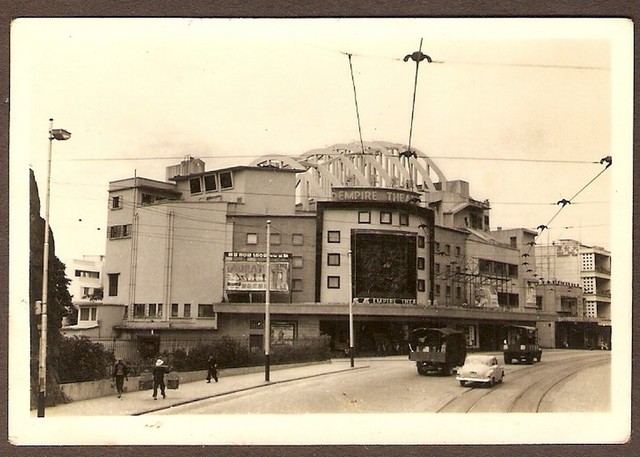
The Empire Theatre in Hong Kong, where Benjamin Britten and Peter Pears did a gig on 3rd February 1956. The programme included songs by Dowland, Purcell and Schubert, and Britten's Seven Sonnets of Michelangelo, plus Britten's folk song arrangements.  On the 6th, the Governor of Hong Kong, Sir Alexander Grantham, invited Britten and his party to,lunch at Government House. In the afternoon, Britten and Pears visited the studios of Radio Hong Kong, where they were inteviewed and gave a short recital,which was recorded, and is available below.

On the 7th February, they gave another recital featuring Schumann Dichterliebe "in the private house of a curious man" as Britten wrote the following day to a friend. Britten's friend and travel companion, Prince Ludwig of Hesse, wrote about the concert "at the unpleasant finance manager's home. The clever and really very nice governor and his petite wife were also there. One cannot get rid of the feeling that the sinister nabob had harnessed famous English artists and  foreign royalty in order to lure the important governor into his den"  Somewhat bitchy, perhaps ?  Grantham was not a particularly pleasant man, but the visitors weren't in a position to judge the local situation.  There's no indication who the"finance manager" was, whether he was a government official, a businessman or even British.  That might be relevant.  Since Britten and his party spent much of their time in Hong Kong in the company of the governor, it's possible that they would have been influenced by his views.  Colonial society was, to put it mildly, "stratified".

The Empire Theatre, built in 1952, was built to state of the art standards, with  huge steel buttresses, (see pic above) and decorated in Shanghai art deco style, with important Shanghai architects and artists (the mural is amazing)  The owner was Harry Odell, the local impressario, who had himself come from Shanghai.  In 1957, the Empire was closed and re-opened as the State Theatre which became a Hong Kong landmark.  Recently, it was shortlisted as a heritage site for preservation.

Please also see my piece on Britten and Pears in Macau

Thursday, 16 February 2017

Winterreise : a parallel journey

Matthew Rose and Gary Matthewman Winterreise: a Parallel Journey at the Wigmore Hall, a recital with extras.  Schubert's winter journey reflects the poetry of Wilhelm Müller, where images act as signposts mapping the  protagonist's  psychological journey.  Pathetic fallacy, through art, articulates complex emotions.  Often there is more truth in poetry than in straightforward prose.  Each image stimulates a response from the protagonist: visuals are so integral to this cycle that it's perfectly reasonable that Winterreise has inspired so many different presentations.  As we listen, we reaffirm  the connection between Nature and art.

Matthew Rose's recording of Schubert Winterreise for Stone Records in 2012 is greatly admired. The authority in Rose's bass added savage grandeur, evoking the idea of a grand soul, brought down by fate.  His Schwanengesang, also from Stone Records, is also rewarding. Live performance is subject to so many factors. A singer's instrument is his body, subject to the vicissitudes of life.  So no single performance is be-all and end-all.  Even though there were technical problems in the delivery, Rose is never boring. He's a born communicator, and those who know his voice and work hear things in context.  Gary Matthewman gave Rose sensitive support. Winterreise is so well known that iy can be a pleasure to follow the pianist. Very accomplished playing, with many good moments. Matthewman's pedalling let the piano sing. At the end of "Der Leiermann", the reverberations of the piano lingered, haunting, in the silence. A wonderful image, so true to meaning.

Because Winterreise lends itself so well to imagery, there have been numerous  performances where visuals have added to impact.  Some have been works of art in themselves, enhancing understanding and opening out new perspectives.  For example, Ian Bostridge's Dark Mirror, a staging of Hans Zender's homage to Schubert at the Barbican, London, with Netia Jones's video projections drawing out disturbing depths. Please read my review here.   And Matthias Goerne's Winterreise with pianist Markus Hinterhäuser at the Aix en Provence Festival with a background of projected images designed by Sabine Theunissen, directed by William Kentridge (Please read my review here).  This included an image of the notorious "Hanging Tree" of the Thirty Years War, connecting the trauma of German history to the birth of the Romantic revolution.  Schubert's Winterreise is so profound that it's pointless to decry interpretation. What matters is the nature of presentation.

This performance was illustrated by Victoria Crowe's paintings of winter, created over a 40-year period.  Some of these, like the picture of a huge oak tree, bereft of leaves, against a blue background, were immediately familiar since they were used in the booklet for Rose and Matthewman's Winterreise recording for Stone Records. While some of the illustrations used were inspired by Winterreise, others had different origins,which perhaps explains why some connected to the songs better than others did.  Crowe's work can be eerily beautiful, like the flowers springing from the ground, drafted with great skill. The crows in the painting used for "Die Krähe" hung awkwardly, a fault of the mechanical means of projection, rather than the quality of the image itself.  Whatever technology was used, it wasn't particularly effective, doing no justice either to the music or to Crowe's art.  Although Winterreise is so well known, many in the audience were immersed in the printed text, rather than paying attention. This performance deserved more attention.  

Wednesday, 15 February 2017

Spiked potion - Frank Martin Le vin herbé WNO

Frank Martin Le vin herbé starts today at the Welsh National Opera in Cardiff before going on tour.   From the synopsis, you'd think it was Tristan und Isolde, Martin's Le vin herbé is spiked, with a twist.  Martin's oratorio profane is an alternative to the extremes of Wagnerian excess.  Martin, a Swiss national, could hardly have been unaware of what was happening in Germany, and of the Nazi appropriation of Wagner. Le vin herbé represents a completely different antithesis to the Tristan und Isolde cult and to the aesthetic of Third Reich Bayreuth.

Martin had been reading Le roman de Tristan et Iseult, a 1900 romance by French medievalist Joseph Bédier, who based his work on early French sources of the legend, striving to "eradicate inconsistencies, anachronisms, false embellishments,and never to mix our modern conceptions with ancient forms of thought and feeling". By "modern", Bédier meant 1900, when Bayreuth's version dominated public taste. Martin's Le vin herbé is restrained, the very simplicity of its form connecting to the aesthetic of the Middle Ages.
 
Martin doesn't write pastiche medievalism though.  Le vin herbé is scored for chamber choir and orchestra, so the palette is clean and pure, "modern" in the sense that Martin was writing in the late 1930's, when many French and German composers used medieval subjects as metaphors for modern times. Martin  used dodecaphony to open up and refine tonality, and add subtle lustre and mystery.  The role of the choir is important. Just as in a Greek Chorus, the choir comments on events, creating distance from the frenzied fevers of the  herbal concoction which Tristan and Iseult imbibe. In a departure from medieval form, the choir sings in unison, not polyphony, so the words they sing are part of the drama rather than decoration for decoration's sake. Soloists sometimes sing alone, sometimes with the chorus, and chorus members sing solo parts. It's as if the voices emerge and retreat into background tapestry.

There are only eight instruments in the orchestra, all strings (3v, 2va 2vc cb) with piano. Just as the voices emerge from the choir, solo instruments emerge from the opera at critical  moments; the contrabass and celli reinforcing  Tristan's part. The cantilenas for solo violin are exquisite, operating as an ethereal extra voice, commenting without words. The piano provides a measured counter to the fervent, passionate heartbeat when the strings surge in unison, marking the moment when Iseult and Tristan drink the potion and fall in love. Martin was working on Le Philtre before he even received a commission for the full work.

Tristan and Iseult are joined together in a drugged state, beautiful but ultimately fatal. They run off to live in the forest of Morois,where King Marke find them but spares them. Tristan escapes and after three years in a foreign land marries the evil Iseult of the White Hands. He's injured in battle  by a poison-tipped lance. Now the piano tolls like a bell, and the violin melody soars as if it were stretching across the seas in search of Iseult, mounting frenzy in the orchestra and chorus, and Iseult bursts in with a wild "Hélas ! chétive, hélas !",  the strings swirling around her turbulently.  Tristan is dead but Iseult lies down by Tristan "body to body, mouth to mouth".  We don't get a Mild und Liese, but there's some mighty fine writing for the orchestra and other voices. In an Epilogue, the choir sets out the moral of the story,  perhaps when the effects of the drug wear off, Tristan and Iseult find the true meaning of love. "Puissant-ils trouver ici consolation contre l'inconstance,  contre l'injustice, contre le dépit,  contre le pein, contre tous les maux d'amour"

Martin's Le vin herbé is by no means a rarity. There was a major staging last year, in Berlin, with Anna Prohaska.  There are two recordings. the first from 1960 with the composer himself at the piano, and more recently, the recording with Sandrine Piau, with the RIAS Kammerchor conducted by Daniel Reuss: both indispensable, and both very different. How the WNO production will compare, I don't know.

Le vin Herbé is very different from Martin's larger-scale works like Golgotha and Der Sturm, but it is an insight into an important but neglected period in music history. Understand Le vin herbé and you get a key into Poulenc, Honegger, Hartmann, Orff, and Braunfels.  It also connects to the literature and visual arts, including film, of the time. I discovered Frank Martin by sheer accident, hearing Die Weise von Liebe und Tod des Cornets Christoph Rilke (1942/3) another "medieval" piece with a modern twist.  Please read my other posts on Wagner Tristan und Isolde,  especially "More tradition than meets the eye" and THIS about the Christof Loy Tristan und Isolde at the Royal Opera House. There's much more to the opera than fake medieval costumes.Think about characterization, and the characters as human beings in a dramatic setting.

Monday, 13 February 2017

Jonas Kaufmann Barbican £435 ? Sex or art ?


Jonas Kaufmann's Barbican residency, London  Tickets sold out months ago, despite being priced way beyond average. High prices are fair enough for JK, Karita Mattila, Eric Halfvarson and Tony Pappano, but for the piano recital with Helmut Deutsch ? Viagogo advertised one ticket for the last concert at £435, though I've heard a rumour that prices on the black market were much higher.  This is indecent, it's nothing to do with art.  Which raises interesting questions.  Was the series artistic endeavour or celebrity binge ? Or both ?  Why not?  Nothing JK does is "ordinary". Some of my friends, true devotees, travelled for thousands of miles to attend, and had a wonderful time.  Experience of a lifetime!  Most of my friends opted for the Wagner concert, a wise choice, since hardly anyone does Siegmund better than JK, and Mattila was, by all accounts, even more impressive.

The first concert was much less interesting since Kaufmann's done similar programmes before, including at the Wigmore Hall.  Kaufmann's timbre is  quite Italianate, with luscious depth, ideally suited to Britten's Seven Sonnets of Michelangelo  op 22.  Much better than Peter Pears, who sounds like he's singing an alien language. Kaufmann makes the songs breathe sensual richness. Kaufmann's done the Schumann Kerner Lieder op 35 several times, too, as recently in London as 2015.  Nothing obscure about these songs !  Again, they suit Kaufmann's voice. In one of the songs  Stirb'  Lieb’ und Freud”! , a man observes a woman transfixed by religious ecstasy. Beautiful as the image is, it's unnatural to the man, who now can never speak of his love. The tessitura suddenly peaks so high that some singers scrape into falsetto, but no chance of that with Kaufmann, who has the range, and has the technique to make it easy.

It doesn't matter if listeners don't know the songs or who the poet was : the important thing was to pay attention and figure out why Kaufmann likes doing them.  Unfortunately some of the London press tends towards fashion victim. This is a shame, because that does JK no favours. The better audiences understand what he does, and why, the better they'll really value him, but with a press that values hype over substance, how do listeners learn ?.  Schumann's Kerner Lieder are by no means obscure, or difficult to follow.  Think about those images of gold, wine, mystery, lusciousness : JK all over, and making the most of the smoky undertones that make his voice unique.  Read HERE for more about the Kerner Lieder. 

Kaufmann's last concert could well be the most interesting of all, because he's doing something really different, Strauss Vier letzte Lieder, which were written for soprano.  Songs change when they're transposed to a different kind of voice, but there's nothing controversial about that, in principle.  So what Kaufmann will do with them is fascinating. They have been done by men before, even by baritones. But again, I think Kaufmann has the range and stylishness to convince. Moreover, presenting Vier letzte Lieder in the context of other Strauss, and together with Erich Korngold's Schauspeile Overture and Elgar's In the South, also makes a difference.  Again, even if these works are new the challenge is to listen, and appreciate how hearing things in context influences the experience.   Alas, the concert was cancelled at the last minute ! 

There's another concert Feb. 16th 2018, where Kaufmann will sing Hugo Wolf  Italienisches Liederbuch with Diana Damrau.  Tickets reaching £160 !  Again, a wise match between material and voice. Each of these songs tells a little story. While they aren't "operatic", they withstand operatic treatment better than most Lieder.  Kaufmann's voice and Damrau's balance very well, so it's hardly surprising that they've done these songs together before.  Although the Barbican Hall isn't ideal for piano song, it's not bad.  Fischer-Dieskau and Schwarzkopf sold out the Royal Festival Hall when they sang Hugo Wolf, sixty years ago. The RFH is bigger than the Barbican and in those days had a dead acoustic. In the end, it's the quality of listening that counts. 

So Jonas Kaufmann's a sex god ?   Real fans also love him for his art. And for many of us, that's WHY he's so darn sexy !


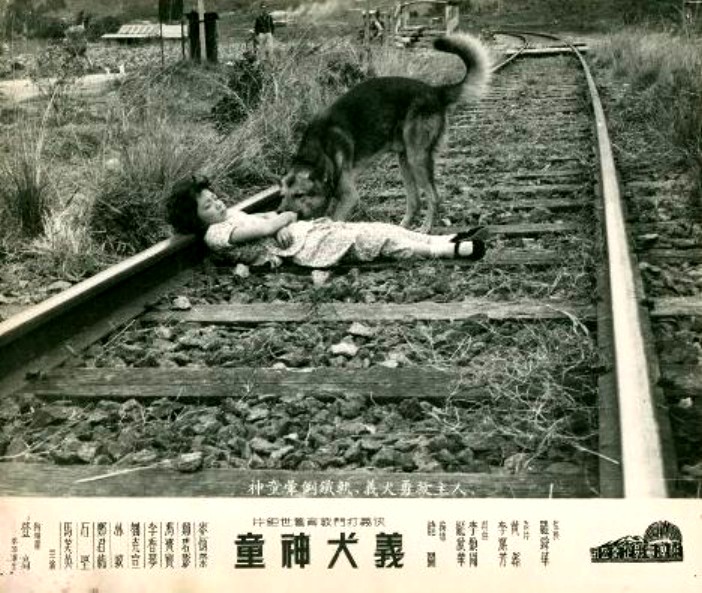
Movie Star Dog meets Wagner


How generations of Chinese kids learned western classical music without any hassle.

Sunday, 12 February 2017

Nicolai Gedda, moving personal tribute


Wonderful, moving tribute to Nicolai Gedda (1925-2017) by Nils-Göran Olve. Infinitely better than most media memorials. Well worth sharing !  Below, a clip of Gedda singing Janácek The Diary of One who Disappeared, in 1984.

During his long career, Gedda sang almost annually in his hometown Stockholm: at the Royal Opera 1952-1992, in concerts and in smaller venues until around 2000. I heard him regularly from around 1960 when I was 12: The Duke, Cavaradossi, Lensky, Hoffmann, Lohengrin, Gustav III (aka Riccardo) and Kristian II (in Naumann’s Gustav Vasa) are the parts I remember offhand, but also many recitals, Swedish Radio recording of Pelléas (in Swedish), orchestral concerts, and stray appearances in benefits. He lived here and in Switzerland and seemed very willing to participate when asked. He also was consulted by many singers. One told me how Gedda had helped him a lot through his very thorough knowledge of vocal technique, but almost intimidated him by showing how to sing some high note which gave the student – an established singer – difficulties. Gedda was past 80 and had not warmed up his voice, but struck the key on the piano and just sang the note. On the other hand, he was said (and claimed himself) to be shy, and his third wife (from 1997) was rumoured to protect him, so none of the Friends associations in Stockholm managed to invite him for a meeting. He once promised personally to come to the Folk Opera Friends, who gained a lot of new members who wanted to attend when they announced it. But it was cancelled – his wife rang up and said “sorry” a few weeks ahead.

People I know claim that he was “ready” as a singer already at age 22 or 23, although the voice then was much smaller. He made his famous debut at the Stockholm Opera in early 1952 when he was almost 27 – an age many tenors are making international debuts – but made up for that by being picked up by Walter Legge of EMI (and Schwarzkopf’s husband) the same year, and starting the enormous series of recordings that would go on for 50 years (if we include his late cameo parts). This was the age when so much was recorded for the first time, and Gedda was dependable, versatile, read music well and knew languages. He had a mixed background and spoke Swedish, Russian and German already as a child, also singing publicly from music (and not only by ear) as a boy soprano. His recordings (also due to the singers and conductors he collaborated with) will remain references for as long anyone cares about this repertoire. I don’t think he was loved by his Swedish audience in the way Jussi Björling and, in a different way, Birgit Nilsson were. Jussi’s national songs are still part of the “Swedish soul” and Birgit’s appearances on talk-shows, telling her stories and laughing loudly, get an occasional airing on TV. (Her artistic greatness is more difficult to fathom from her recordings.) 

Gedda’s personality was more aloof, and his voice and interpretation struck many as “studied” and “technical”. In a way they of course were, and from around age 40 he developed a huge range of vocal colours. Watching him sing in later years, especially in concert, you saw his body working from the toes up, sometimes swaying a bit, and the volume of the sound grew a lot during the first 10 or 15 years I heard him. But he retained his high Russian-style mezza voce to the end. In younger years he was quite good looking and tall for a tenor, not a spontaneous great actor, but different from many in his position he would always give the impression of throwing himself into what the director asked from him.

Nils-Göran Olve