"Tradition ist nicht die Anbetung der Asche, sondern die Bewahrung und das Weiterreichen des Feuers" - Gustav Mahler
Wednesday, 5 December 2018
Monday, 3 December 2018
Stanford The Travelling Companion :New Sussex Opera
Charles Villiers Stanford The Travelling Companion, with the New Sussex Opera at Cadogan Hall. Good performances but less than ideal opera. "Stanford’s The Travelling Companion is melodious if not very memorable. One senses that Stanford had the weapons in his arsenal to produce an excellent opera but failed to get all guns firing at the same time. That said, the large audience at Cadogan Hall were loud-voiced in their praise and appreciation. We should be grateful to NSO for giving us the chance to hear this opera which undoubtedly has merits and appeal." Please read Claire Seymour's review here in Opera Today.
Sunday, 2 December 2018
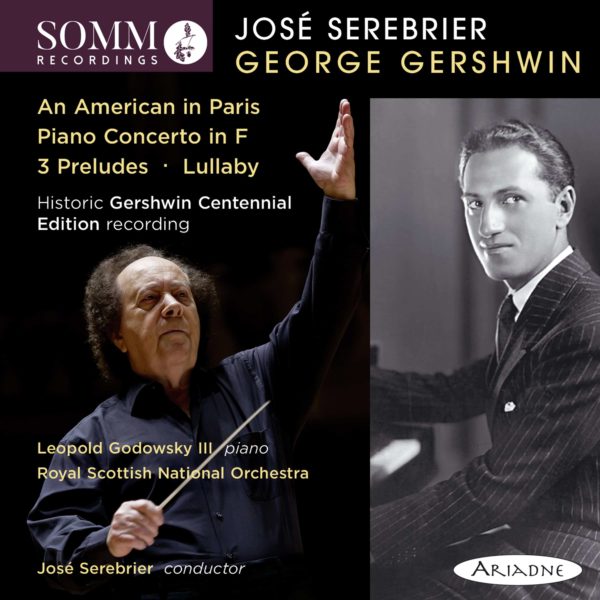
José Serebrier 80th birthday tribute - George Gershwin
Congratulations to José Serebrier on his 80th birthday ! He's a conductor who occupies a unique place, mentored by Leopold Stokowski and George Szell, always independent and open-minded. Please read more about him in this article here. A most interesting personality! So let's celebrate with this historic Gershwin Centenary Edition recording from SOMM where Serebrier conducts the Royal Scottish National Orchestra in Gershwin's An American in Paris, Three preludes and Concerto in F for Piano and Orchestra, featuring Leopold Godowsky III, Gershwin's nephew.
The public image of George Gershwin these days is coloured by his sucesss on Broadway and the use of his music in Hollywood, but in the 1920's Gershwin was part of the avant garde. The premiere of Rhapsody in Blue in February 1924 was attended by Stokowski, Rachmaninoff, Fritz Kreisler and Walter Damrosch, who was keen enough to offer Gershwin a commisson which resulted in the Piano Concerto in F, with Gershwin himself as soloist, in Carnegie Hall in December 1925. Gershwin was a true original, one of the first to appreciate jazz as serious music, incoporating the sounds of modern, urban America for the concert hall. George Antheil's Ballet méchanique (1926) was then known only in Paris. Edgard Varèse's Amériques (1921) and Hyperprism (1922/3) were pioneering works, way ahead of their time. Significantly, both were premiered by Stokowski in 1926, 1924 respectively, followed by Arcana in 1927, all this long before Copland and Bernstein. It is in that context that Gershwin's place in modern music is now being re-assessed. Please read more here about the University of Michigan Gershwin Initiative and the on-going new critical edition of his opus. .
Serebrier's interest in Gershwin and in American music goes back to his childhood. At the age of fourteen, he organized a concert of fellow music students, attended by the then President of Uruguay, a high profile event, covered in the newspapers at the time. Sereberier conducted Gershwin, Edgard Varèse and Charles Ruggles who even now are "new music". Too young to have formed preconceptions, the young players were carried away by Serebrier's enthusiasm. That freshness has rarely dimmed, as these performances indicate. Serebrier's Gershwin descends from "source" to speak, from an original approach to the scores themselves, not from the popular image. Thus this vivid interpretation of An American in Paris which captures the excitement Gershwin felt when he discovered Paris when it was the cutting edge centre of innovation. The introduction swaggers with the confidence of a young man on an adventure. Brashness gives way to galumphs (bassoons, tuba, trombones) the walking pace leaping with joy. In the second section a tentaive mood is soon brushed away by the exuberant theme led by different saxophones : a fanfare for the New World, the instrument itself invented a few decades before. The famous "Blues" motif curls sensuously, the strings around it expansive. Homesickness doesn't last long though: Paris has absorbed jazz on its own terms. Thus the sassy trumpets and saxophones, and the playful syncopation. When the "walking" theme returns, it is underlined by percussion. An animated final section, with crashing cymbals, and taxi horns (employed earlier by Varèse) and a bittersweet conclusion. The new edition of the score, premiered recently, is sharper, but on this recording, made in 1998, Serebrier gives the standard edition a very fine reading.
Gershwin's Piano Concerto in F is, in comparison, more conventional, though the distinctively Gershwinesque strings give it character. Serebrier brings out the spikey tension in the introduction, which is answered by the piano, (Leopold Godowski III) developing a smoother line. The second movemnent is a nocturne that grows more intense as it proceeds. Serebrier shapes the finale, marked molto agitato - con brio. so it seems to burst with suppressed energy. Alexander Glazunov was present at the premiere, in December 1928, Damrosch having sensed a Russian context to the concerto. But it is woth noting that Serebrier is one of the finest Glazunov conductors, and has recorded the complete symphonies with this orchestra, the Royal Scottish National, and with the Russian National Orchestra.
Gershwin's Three Preludes were originally planned as an extended series of piano pieces, of which only three were published. On this recording, we hear Serebrier's transcription for orchestra. The piano still dominates, the orchestra extending and enhancing the line. Serebrier is also a composer, whose first symphony impressed Stokowski so much that the older conductor invited the younger to join him as an Associate with the American Symphony Orchestra. Although Gershwin's Lullaby, written when he was only 20 for a Broadway comedy, is little known. Serebrier orchestrated it at the request of Leopold Godowsky III. The new orchestration respects the repeated phrases, colouring them without overpowering what is effectively a miniature. It is included in this recording becaause it reflects the lullaby in the second Prelude.
Saturday, 1 December 2018
Internal Landscapes : Bax, Vaughan Williams - Brabbins, BBCSO
Martyn Brabbins conducted the BBC Symphony Orchestra. at the Barbican in Ralph Vaughan Williams Symphony no 4 and Arnold Bax November Woods A good combination which had the potential to yield interesting insights in musical terms. So why does BBC Radio 3 management need to market this as "Remembering World War I" ? Neither piece has anything to do with war. Alas, BBC R3 seems hell bent on prioritizing non-musical agendas over music, to meet non-musical targets. Long term, this policy of dumbing down destroys real musical understanding. Better to treat audiences as adults who aren't afraid to think or listen.
Both Vaughan Williams's Fourth Symphony and Bax's November Woods are explorations of ideas that aren't so easy to put in prose : "internal landscapes" so to speak, that find expression in sounds and musical form. November Woods (1917) isn't about forests per se but forests as metaphors for emotion It's worth quoting Bax's (non-symphonic) poem Amersham, as the programme book does :
Storm, a mad painter's brush, swept sky and land
with burning signs of beauty and despair
And once rain scourged through shrivelling wood and brake,
And in our hearts tears stung, and the old ache
Was more than any God would have us bear.
Here the musical forces were in the fore, the orchestra voicing whatever inner storm Bax might have sought to address. The introduction seems to surge and strain, driven by fast-flowing strings, lit by flashes of woodwinds and harp, darkened by violas, celli, oboe and bassoons. A theme energes, first from cor anglais, then more boldly by horn and then oboe and cello : a duality which could suggest many things, but is part of the very conception. Themes cool and warm, creating flux, but there's no easy resolution. The coda was hushed, mysterious, open-ended. November Woods is much more "modern" than you'd expect, connecting in this sense to other works of the period.
![]() |
| photo : Jules Barbieri |
More brass in the second movement, marked andante moderato, but this time more restrained, the strings of the BBCSO murmuring en masse, from which the woodwind line rose, moving ever upwards. A sense of unease : tense pizzicato creating a fragile though regular beat. The flute melody, exquisitely played, had a poignant quality: painfully alone but unbowed. Wildness returned with the third movement, brass pounding, trombones creating long zig-zag lines. For a moment the tuba leads a trio with grunting bassoons. The term "scherzo" means "joke" but the humour here is darkly ironic. This colours the sprightly theme which follows : it's not escapist. With the figure I called "My God and King" the overwhelming thrust of the first movement returns, angular dissonances flying in all directions, clod-hopping ostinato suggesting grotesque horror. Again, no resolution, no easy answers. Perhaps we can guess why RVW dedicated it to Bax.
The contrast with the intensity and sheer musical quality of Vaughan Williams's symphony put Cheryl Frances-Hoad's Last Man Standing into place. This is a big work, running as long as the symphony, and was served up with lighting effects, props and a shower of objects which might be poppies, and co-ordinated dresses for composer and text writer. The piece was specially commissioned to mark the 1914-1918 war. But there is a lot more to war than pretty images. Much of the problem lies in the text, 15 verses on aspects of life in the trenches, by Tamsin Collison. Frances-Coad's setting illustrates well but is more sound effects than music. Entertaining enough, and certainly not mentally or emotionally challenging. But war is not entertainment. and never should be trivialized. We know, or should by now know, what it was like in the trenches, but no sign here of any reflection or personal insight. The baritone soloist, Marcus Farnsworth, did his best, as did the orchestra, but this piece bore all the signs of music-made-to-order. Millions died and suffered in the Great War, which re-shaped the whole world. To what avail ?
Thursday, 29 November 2018
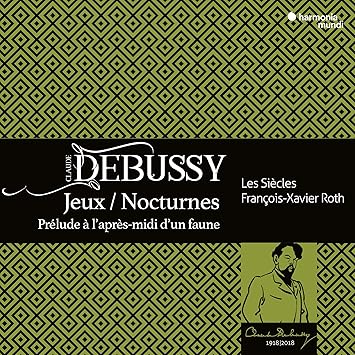
Harmonia Mundi Debussy - FX Roth Les Siècles
An extremely fine performance of Jeux, Roth and Les Siècles playing with the tightly-focused poise this piece needs in order to capture the energy of strategy and exchange. In Jeux the game is, ostensibly, tennis. Or is it ? Two young people are fooling around, but suddenly a ball is thrown onto the court, changing the game. Strange, quivering chords, suggesting tension. Rays of brightness, throwing the darkness into menacing contrast. In musical
terms, this means constant flow between points, patterns crossing and recrossing, staccato contrasting with freewheeling liveliness. Like
Boulez, Roth marks the sense of "listening". The players on this court have to be alert and reespond. Perhaps the wild, tantalizing line represents the mysterious ball. Whatever, it has energy and purpose,
unlike the players when they came onto court. At last a blaze of horns and rising energy in the music. Are they players being "illuminated" ? Suddenly, tantalizingly, the music ends. Instead of closure in the conventional symphonic sense we're left to think for ourselves. I love Jeux because it's open ended and "modern". There may be dangers ahead, the understated wit in the piece suggests adventure, not doom. This performance is good because Les Siècles is grounded in the fundamentals of the baroque, where dance underpinned music : thus the importance of clarity, precision and physical energy.
In the Nocturnes, Debussy seems to illustrate a seascape. The movements have programmatic titles - Nuages, Fêtes, Sirènes - but as always, good music is more than literal depiction. Waves keep changing shape and position, thus the concept of constant change, figures moving and shifting in myriad ways. In an ocean, motion is controlled by invisible forces, like tides and wind. Thus the concept of musical form which might suggest undercurrents and ideas behind surface appearance. Roth and Les Siècles shape the first two Nocturnes emphasizing the intricate detail beneath the broad sweep, for these details are like the "brushstrokes" in painting. But it is in the third Nocturne, Sirènes, where Debussy breaks in even more innovative form. The women of Les Cris de Paris, vocalize, singing abstract sound instead of words. The shifting patterns, nuances and tones create the concept of a horizon that keeps moving and changing, with infinite variety. From these wonderful cross-currents and multiple textures, the borders of tonality are beginning to fade.
Though we hear it so often, it's bracing to remember that Prélude à l'après-midi d'un faune broke new ground in 1889. Informed by a century of pschological insight, we can interpret the meaning of the central image. The fawn is a wild creature who acts on instinct, defying social restriction. Through symbolism Mallarmé could express emotions too dangerous to be openly expressed. Prélude à l'après-midi d'un faune grows from a tradition of allegory that goes back to the Greeks. Debussy's music defies categories. Its chromatics stretch tonality, at once rich, yet clean and pure. Think of fin de siècle art with its curving forms, representing an aesthetic of freedom. Like the fawn, the flute line moves and turns senusously, explicitly erotic. In Vienna, Freud had yet to formulate his ideas on dreams and the subconscious. In the French-speaking world, the symbolists (as early as Baudelaire) were already there. François-Xavier Roth and Les Siècles bring out the fundamental purity in the piece. Much of the beauty of the piece lies in its mysterious ambiguity and the multi-level interaction between the flute and lower-voiced winds, strings and harps. The flute represents Pan, the fawn his disciple. This in itself is symbolic, for in ancient Arcadia, lone musicians sing in landscapes where the rules of society do not apply. Here, the flute stood out, highly individual, enhanced by but not overpowered by the luxuriant background, lush strings and resonant winds. Roth and Les Siècles are aware of the "classical" as well as modern allusions in this remarkable work : the horns are natural, gently muffled as if heard from a distance. An important reminder that the fawn will be hunted down and killed. Prélude à l'après-midi d'un faune is not at all "romantic" Beneath the exotic surface lurks danger. The Prélude lends itself to dance because it flows gracefully, yet is also lucidly disciplined : keynotes of French style since Lully and Rameau.
Please also see my review of François-Xavier Roth and Les Siècles in Ravel for Harmonia Mundi. and Pablo Heradas Casado Debussy with a Le Martyre de saint Sébastien but where Prélude à l'après-midi d'un faune is nowhere near as well performed as on this new Roth/Les Siècles disc.
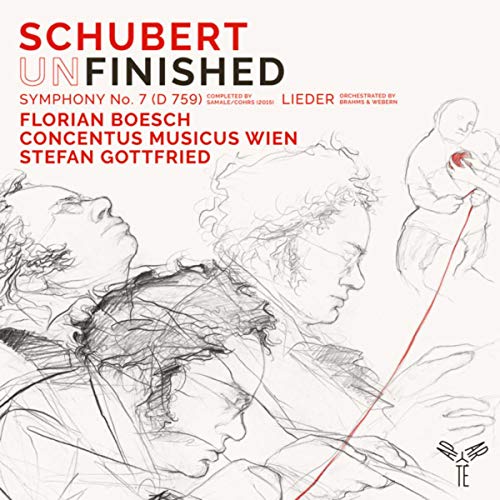
Schubert Unfinished - Concentus Musicus Wien, Florian Boesch
Anton Webern's orchestrations of Schubert Lieder date from 1903, very early in his career, and are of interest because they show how Webern approached the adaptations with restraint. They are faithful to the purity of Schubert's idiom, perhaps teaching Webern the virtues of understatement : nothing like the elaborations of Franz Liszt ! "Tränenregen" from Die Schöne Müllerin supports the vocal line with delicate strings, woodwinds and chamberpipe organ murmuring when the voice is still, replicating the refrain in the piano part. "Der Wegweiser" from Winterreise is equally hushed, providing a contrast to Brahm's darker orchestration of Schubert's Memnon D541, to a text by Mayrhofer. Just as the character of a poem affects its setting, an orchestration should reflect the song. Thus Brahms's orchestration of Schubert's Geheimes D719 is lighter and livelier. Goethe's poem describes playful flirtation, hence the good humour in Schubert's and Brahms's approach. "Ihr Bild" from Schubert's Schwanengesang is a setting of Heinrich Heine, also very distinctive. It draws from Webern almost funereal low timbred horns and brass, assertive but never dominating the vocal line. Boesch rings out the final words "Und ach, ich kann es nicht glauben, Dass ich dich verloren hab’!" like a cry of anguished recognition, for the painting is all that remains of the beloved, who is dead. The anthem-like solemnity of Webern's orchestration shows his sensitivity to the poem and to the song. It is one of the highlights of the whole disc.
Schubert's Gruppe aus Tartarus D583 sets a text by Friedrich Schiller, and is highly dramatic. Brahms's orchestration matches its forcefulness, ascendant figures with hunting horns and long trombone lines, and an almost Beethovenian climax, followed by brief, potent postlude. Schubert's tender Du ist der Ruh D776 is complemented by Webern’s graceful orchestration.
Drafted in 1821, Schubert's manuscript for what is known as his seventh symphony exists in sketch form, with a melody line and bass and counterpoint underneath. All four movements of the 7th were drafted, but he only orchestrated the slow introduction and the first 110 bars of the first movement. setting the piece aside before working on his opera Alfonso und Estrella. There also exists an autograph draft of a complete third movement (Scherzo, D 759/3),with the opening bars orchestrated., to which Samale and Cohrs have added a brief trio to create a third movement. They also suggest that it is possible that the first entr’acte from Schubert’s incidental music to Rosamunde (D 797/1), dating from the same period, was intended to serve as the symphony’s Finale. This movement, lasting almost four hundred bars, is also in B minor, and it bears many noticeable similarities to the symphony. Indeed, there are motivic relations that link both the Scherzo and the entr’acte with the symphony’s first two movements. Over the past 150 years, there have been several attempts to complete this symphony. This version, first performed by Concentus Musicus Wien in 2014 and conductor Stefan Gottfried is gracefully paced and good listening.
Wednesday, 28 November 2018
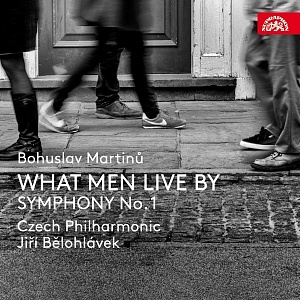
Bohuslav Martinů - What Men Live By, Jiří Bělohlávek Czech Philharmonic
It is also significant that The Miracle of Mary, written in Paris in 1936, reflected interest at that time among many composers, such as Arthur Honegger's Jeanne d'Arc au bûcher (please read more HERE), which Martinů would have known of, and Walter Braunfels's Die Verkündigung (Please read more HERE) which he would not have known, or even Carl Orff's Carmina Burana (1935-6). At a time when Europe was facing the rise of extreme nationalism that used medievalism for legitimacy, Martinů and his peers’ adaptation of medieval form served a radically different purpose. Therefore, it is a mistake to assume its lack of success was caused by its being deemed old-fashioned, when it in fact represents a significant thread in European music, which critics at the time might have missed. In any case, by 1955, it could not have been lost on audiences that the composer himself was in exile and could not easily return to his homeland. What Men Live By is simple, but not naive, a very sophisticated work despite its cheerful lightness: it’s a chamber oratorio sparsely but deftly scored, which benefits from Bělohlávek's sprightly touch.
Distinctively Czech themes run throughout the piece, notably in the introduction, which begins with a pipe organ, its melody taken up by pipes and then drums in jolly mock-medieval procession. Martinů's What Men Live By tells the story of Martin Avdejic, a lonely old cobbler who lives in a basement, where his window on the world allows him to see only the feet of those who pass by. Ivan Kusjner sings Martin, his deep baritone suggests a down-to-earth working man. The chorus (Martinů Voices) surround him with ethereal harmonies. Martin has almost given up on life. A sorrowful solo violin plays, as Martin's lines are solemnly intoned, the choir repeating his words, like a response in church, the pattern reflected in the balance bewteen the two Narrators, Josef Špaček (spoken) and Jaroslav Březina (tenor). A vision appears, embodied in the voice of the alto Ester Pavlů, who tells Martin that she will visit him the next day. A very Bohemian sunrise, with horns, pipes and jaunty strings. Zig-zag piano lines suggest the street outside Martin's workshop, full of busy people rushing past. Though he's waiting for his special visitor, he welcomes in old Stepanovich (the bass Jan Martiník) and gives him shelter from the snow. Martin spots a woman (Lucie Silkenova) shivering in the cold, holding a baby. Martin gives her a warm coat and cradles the child. "Surely it was He, himself, who sent me to you!", she sings. The chorus returns, singing as joyfully as pealing bells. An old woman ( Ester Pavlů) is in the street, selling apples. A boy (Lukáš Mráček) playing harmonica (heard in the orchestration) steals one and runs but Martin stops work and chases him. The old woman wants to call the police. Martin asks the old woman to forgive the child, and she does. She once had seven children but now she's all alone. The boy then helps the old woman carry the sack and they walk off happily, to the sound of the harmonica. A rustic chorale prepares us for the finale. Martin goes to bed, disappointed but in the darkness he spots the people he'd met during the day. The alto and soprano join to sing the words of the Visitor Martin had been expecting. " In as much as ye have done to one of the least of these my brethren you have done it unto me,” the last two words haloed by the chorus. The radiance in the last moments may suggest that Martin is borne up into Heaven.
Although What Men Live By might seem simple, Martinů emphasized the pitfalls of performing it without understanding its purpose. "The technical hurdles include the fact that the singer should not sing as is customary today (but) he should 'preach' and edify, striving to make the text moere expressive. By and large these days, instead of a melody one hears something like uauauauaua, imbued with 'affection'" (possibly translation error for 'affectation'). "That would not be good", he continued. "It should be sung like a folk song devoid of pathos. I think that the text itself is beautiful and so it does not need to be in any way enhanced". Fortunately Bělohlávek and the Czech Philharmonic understand the Bohemian folk sources so thoroughly that they capture the free-spirited vigour in the piece, as far as one can get from stuffy "churchiness". The text is in English, written by Martinů himself, so Bělohlávek's soloists, not being native English speakers, have strong accents. But this is is in fact an advantage, because their accents emphasise the fundamentally Czech nature of this music and also the non-realism which Martinů was trying to achieve. They are all top-rank experienced singers, not students, and understand the idiom properly. As I was listening, I thought of the stylization of medieval mystery plays, where directness of message mattered most, without any pretence of verismo and over-colouring. This also connects to the clarity of the orchestration, simple figures and single instruments used for maximum effect. On this disc What Men Live By is paired with Martinů's Symphony no 1 which is a good choice, since the symphony begins with a striking ascendant theme which complements the finale of What Men Live By. As Aleš Březina writes in his notes, "it should be pointed out that the avant garde composers in interwar Paris, where Martinů lived and worked from 1923 to 1941, set up their own aesthetic criteria in opposition to Late Romantic music.....while in the USA, symphonic music enjoyed great popularity". Martinů, who had no income other than royalties from earlier work, was glad to accept a commission from Serge Koussevitsky. The composer had some difficulty in proceeding, but, once he was satisfied with that introduction, the rest of the symphony flowed. Bělohlávek conducted all the Martinů symphonies in London with the BBC Symphony Orchestra, which are available on CD. He had planned to record them again with the Czech Philharmonic, but his illness intervened. On the basis of this performance, that series which never came to pass would have been outstanding. Though here it is an add-on to the much rarer What Men Live By, it is a recording to be cherished.
Monday, 26 November 2018
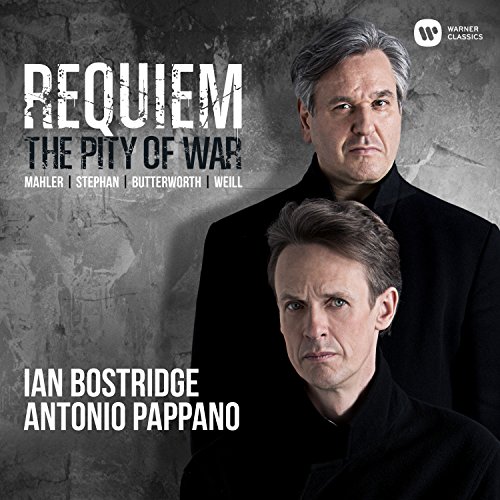
Requiem : The Pity of War - Bostridge Pappano
"Requiem: the Pity of War with Ian Bostridge and Antonio Pappano. The inspiration came from Benjamin Britten's War Requiem, which Bostridge has done numerous times. Britten's War Requiem," he writes "seems to express in art Winston Churchill's notion of the 1914-18 conflict as the initiator of the 20th century's own Thirty Years War" since it spans the First and Second World Wars, blending the poetry of Wilfred Owen, poet of the trenches and the spirit of reconciliation that motivated the commission marking the rebuilding of Coventry Cathedral. Thus the quotation from Owen, "My subject is War, and the Pity of War". "How might one reflect the experience and significance of the conflict" writes Bostridge "in a song recital ?". The answer might be this excellent programme, with interesting repertoire choices and approaches to more familiar material. Bostridge and Pappano, whose partnership is long and fruiful, are doing this recital live at the Barbican Hall on December 5th. The recording, from Warner Classics, is now available, well produced with good illustrations.
Bostridge and Pappano begin with George Butterworth's Six Songs from A Shropshire Lad, perhaps th best known English song cycle with a connection to war, given that Butterworth was killed in the Somme in August 1916. Housman's poems were published in 1896 : the war they pertain to might be the Boer War, or colonial wars, but the connotations are not specifically military. They deal with more generalized concepts of youth and death, impermanence and loss. Even though Butterworth collected folk song, a quasi-folk song approach doesn't necessarily apply. Bostridge and Pappano demonstrate an art song approach, which may at first seem unsettling, but works on a more esoteric level In "When I was One and Twenty" the last words "'tis true, 'tis true" are held open ended, suggesting possibilities beyond text. If the dynamic lines in "Look not into mine Eyes" are more extreme than usual, this emphasizes the unease that lies behind the poem : the lad "that many loved in vain" does not reveal himself, to anyone. "A Jonquil, not a Grecian Lad". "Is my team ploughing" feels decidedly supernatural.
This disc is worth getting, though for a superlative performance of Rudi Stephan’s song cycle Ich will dir singen ein Hohelied. Stephan was an extremely promising composer as his best-known works, the two Musik für Orkester in einem Satz attest, his opera Der ersten Mensch being a prototype of Expressionist music theatre. The six songs in this cycle, to poems by Gerda von Robertus (1873-1939) inhabit a world much closer to aesthetics of the period when exoticism was heightened by an awareness of the dangers of the subconcious. The poems are terse aphorisms, Stephan's settings concise. The nearest equivalent might be Alban Berg's Altenberg-Lieder, also from the same period (1911-12) In "Kythera", "Der Rosen Düfte liebeatmend schwingen in welchen Weilen" while the sound of aoelian harps drifts from afar. The setting floats gently, held sotto voce. In "Pantherlied" the piano line ripples, suggesting pent-up animal energy. The text in "Abendfrieden" is little more than a series of broken phrases which Stephan uses to create a song so delicate that it seems to hover in stillness. This oscillation occurs also in individual words like "Sonnenfeuer" which need careful shaping, but Bostridge captures the right vulnerabilty. "In Nachbars Garten duftet" describes a linden tree, which shivers "dammerlauschig kühl". Yet this is no pastoral. Lovers embrace, but why do the poet's eyes "overflow in burning pain"? The song is as magical as a song by Hugo Wolf, but with a kick in the tail. The mood of secrecy continues in "Glück zu Zweien" where "in the hubbub of the crowd, we found the silence of shared feeling". The vocal line stretches and curls, twining like "Zwei Könige wir, die finden das Reich ihrer Einsamkeiten". Throughout this cycle, tension has been building up, which finds release in the final song "Das Hohelied der Nacht". Yet again Stephan observes the fragmented nature of the phrases, using them to proceed rapidly to the last line "Du küsst es mir vom Munde", which rises like a cry of sudden triumph. These songs are miniature masterpieces and are done reasonably often, but Bostridge brings out the inner musical logic better than anyone else, with his intuitive feel for meaning and the curling, curving timbre of his voice. Incidentally, Stephan died in strange circumstances. The night before he died, he could not sleep, surrounded by the agonized cries of the wounded all around. In the early hours of the morning, he stood upright in his trench at Tarnopol in Galicia on the Eastern Front, and shouted "Ich halte es nicht aus!" and was promptly shot by a sniper. He was barely 28.
From the sophistication of Rudi Stephan to the relative straightforwardness of Kurt Weill's Four Walt Whitman Songs. Bostridge varies the marching rhythms in "Beat ! Beat ! The Drums" with articulation that twists in protest. If "Captain ! My captain !" is a strophic ballad, "Come up from the Fields, my Father, there's a letter" is dramatic, delivered here with appropriate portent. The military antecedents of "The Dirge for Two Veterans" are impeccable. Gustav Holst set this text ("The Last Sunbeam") in 1914, and it was also set by Vaughan Williams (in Dona Nobis Pacem). Weill wrote these songs after Pearl Harbor, when the United States joined the Second World War. Like Britten's War Requiem, they help this Bostridge and Pappano programme bridge two World Wars.
Three songs from Mahler's Des Knaben Wunderhorn conclude the programme. Again, these are not folk songs, but art songs. Significantly, the songs chosen here are ghost songs, which suit a singer who is a superlative Peter Quint. In "Revelge", skeletons march through a town at night, and "Der Tambourg'sell" is a death knell, Pappano's piano "drumming" as Bostridge's voice rises to near-scream before descending to the low rumble of the refrain "Gute Nacht". Best of all, though, is "Wo die Schöne Trompeten blasen" where Bostridge and Pappano capture the spookiness that pervades the song even before the girl knows what's going on. She, too, will die before the year is over.
Friday, 23 November 2018
Thursday, 22 November 2018
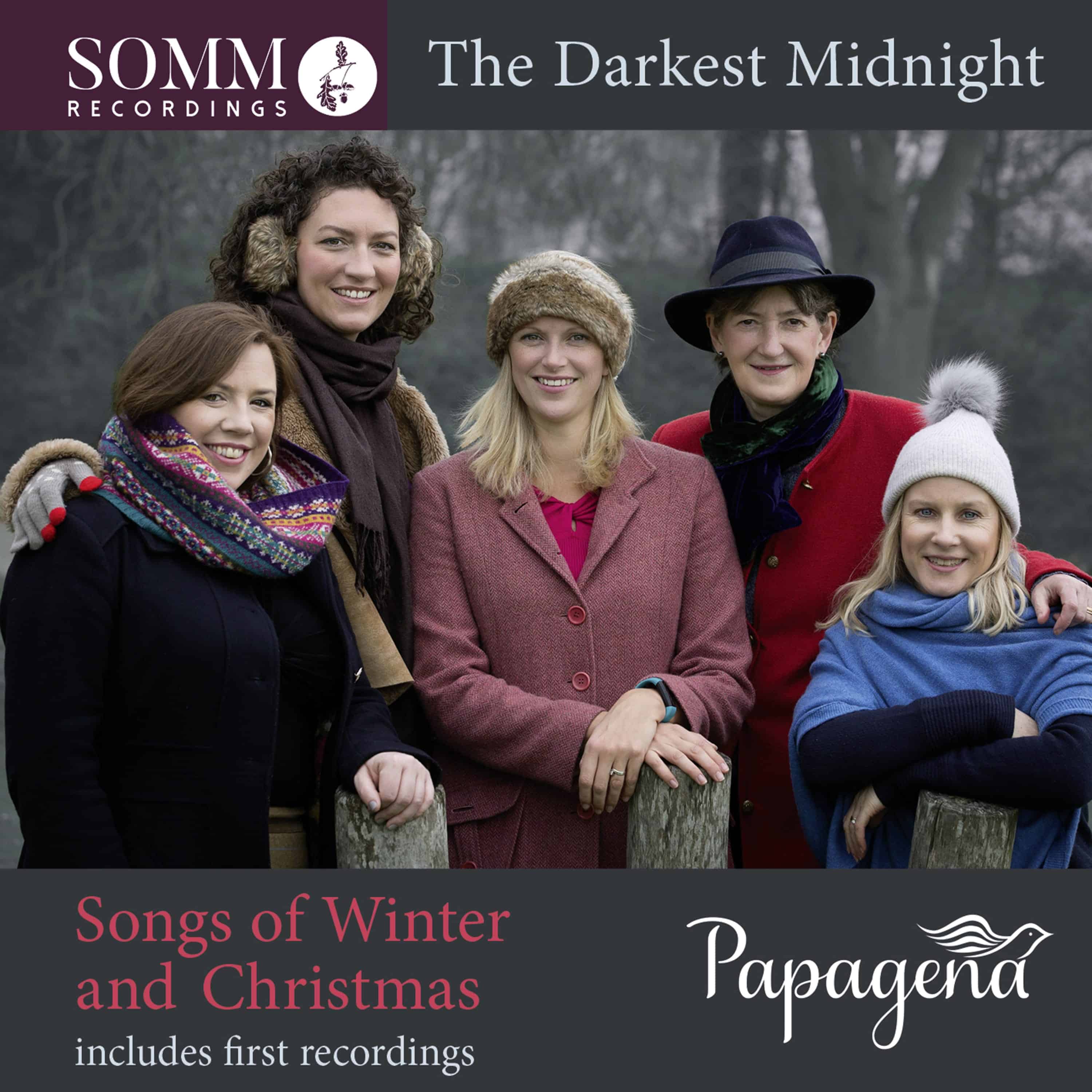
Darkest Midnight - Songs of Winter - Papagena SOMM
Darkest Midnight : Songs of Winter and Christmas - an eclectic collection of acapella songs on the theme of winter - with Papagena, a delightful offering for the Christmas season from SOMM Recordings : so enjoyable that you could listen at any time of the year. With Papagena, there are “No props, no microphones, no gimmicks, just five stunning voices“ who “explore the wealth of music from medieval times to the present day”. Their programmes “defy pigeonholing, drawing richly on traditional folk music and women's working songs as well as classical repertoire and new work commissioned for women's voices, many arrangements made by members of the ensemble. This disc is a rewarding purchase, even if you don't mark the season as a religious festival, but appreciate winter as a time for wonder and good music for its own sake.
Don eiche ud im Beithil (I sing of a night in Bethlehem) is a traditional Irish song with a text by a 16th century Archbishop of Armagh. Here it is heard in an arrangement where the voices blend in radiant polyphony. The sopranos (Elizabeth Drury, Abbi Temple, Suzzie Vango) sing with the purity of trebles, while the altos (Suzie Purkis and Sarah Tenant-Flowers) add warmth and richness. Part lament, part ballad, Maria durch ein Dornwald ging (Mary walked through a wood of thorns) is ideally suited for women's voices, given that it describes the trials of the Virgin Mary, walking through a forest of thorns, which suddenly blossoms as roses because she's carrying the infant Christ – a sacred work song for women, from the Middle Ages ! How refreshing it is to hear the Christmas story told from Mary's perspective ! In Nowell, tidings true there be come new, the voices are accompanied by a simple drum, as medieval songs often were. The text honours “A clean maiden and pure Virgin”. The singing is so delicate that it seems to cast a glow. Exquisite stillness in O Jesulein zart, where the altos sing in rapt adoration, cradling the sopranos.
In John Tavener's setting of W B Yeats' A Nativity, the lines stretch, the unison clear and shimmering. The balance of voices in Shchedryk (Hark How the Bells) creates a refrain with the effect of silvery bells pealing in harmony. Ballulalow is an arrangement made for Papagena of a 16th century Scottish song itself based on a poem by Martin Luther. The main melody is surrounded, like a halo, by tones as pure and bright as light shining through stained glass. Then Papagena springs a surprise – a song by Joni Mitchell, The River, transformed as if it were a modern carol. The alto sounds like Joni Mitchell, only more sophisticated and refined, though she captures the feisty irony that is part of Mitchell's style. Det lisle banet (the Little Child) is a traditional Norwegian ballad that tells of a farmer who leaves a fox in charge of his geese. But the fox kills them. In compensation the fox must make “soulgifts” to the farmer's child. A strange, unworldly parable told with dramatic effect. A single drum beats, at first slowly, then more insistently, adding a note of tension to the women's voices which keen as if they were recounting a primeval saga. There is much to listen to on this recording, which is much more than “Christmas listening”.
Wednesday, 21 November 2018
My Lord has Come - Christmas with Ardingly College - Stone Records
College, Sussex, one of the earliest schools in the Anglo-Catholic tradition of the Church of England, with director Richard Stafford. Thus the inclusive character of the music on this recording. Stone Records Christmas offerings are usually a delight, usually livelier than much of the surfeit that floods the commercial market at this time of the year. Stone Records Christmas offerings make gifts that keep on giving pleasure year after year. One of my favourites is Deck the Halls (A Swedish Christmas) Please read more HERE.
Tuesday, 20 November 2018
Wolfgang Rihm Requiem-Strophen, world premiere recording Mariss Jansons
The world premiere recording of Wolfgang Rihm's Requiem-Strophen (2015/2016) with Mariss Jansons conducting the Symphonieorchester des Bayerischen Rundfunks and the Chor des Bayerischen Rundfunks with Mojca Erdmann, Anna Prohaska and Hanno Müller-Brachmann, from BR Klassik NEOS. Rihm is perhaps the most prominent living German composer, so his engagement with the Requiem form is significant, particularly as
he deals thoughtfully with the issues of life and death which any true requiem should address. This Requiem is secular but very spiritual and sincere, more so than many that just borrow the form. It is austere, yet lucidly beautiful, and deeply felt. It is strongly structured, fourteen sections in four parts with an epilogue, like an interlocking puzzle, with interconnecting themes and internal patterns. The orchestration is concise, nothing frivolous, nothing wasted. The word “Strophen”means verses, but it's used here not just because the piece uses verse, but because this provides yet another level of meaning, reflecting the formal internal procession of the piece through different stages : a true Mass in the deepest sense.
Rihm's Requiem-Strophen begins, not with the blaze like the Angel of Death at the end of Time but with the cry of an oboe, a more “human” voice. Significantly, it is cradled by the two female soloists, singing not in unison, but in harmony. “The oboe never starts a sentence”, writes Brachmann, “it always answers, just as every Requiem is a reaction to that which is unalterable – a person, with whom we shared our life, is no more”. The oboe is also a reed instrument, wordlessly reflecting the parable from Isiah which serves as text in the Initial. “Omnis caro faenum” (All flesh is grass, and all, its loveliness is like the flowers of the field), which must die, but may set seed. This carries through to the rest of the First Part, where the oboe's low timbre is extended by the slow beats of muffled percussion – a funeral march - the chorus and later the soloists singing long chromatic lines, lit by calls from muted brass and a string instrument, being plucked in a deliberately unsettling discord. The Kyrie offers a note of hope, though it is brief and operates like a reiteration of the first section.
Three Sonnets from Michelangelo form the framework of the Second Part, In the first sonnet, bright sounding brass announce the entry of the bass soloist (Hanno Müller-Brachmann) singing of the inevitability of death. The text is Michelangelo, transcribed by Rainer Maria Rilke. This is a pointed reference to Shostakovich (Please see my piece on Shostakovich Sonnets of Michelangelo here). This requiem is ameditation, too, on artists and the role of art in a nihilist civilization that seems hell-bent on self-destruction. Thus the ominous murmurings in the orchestra as the Psalm (De profundis clamavi ad te Domine) begins, and the elliptical lines of the chorus,which stretch forth then break off suddenly yet keep returning, wave after wave. As the lines become firmer, individual instruments in the orchestra awaken and join in. This structure reiterates the words of the sonnet “Des Todes sicher, nicht der Stude wann, das leben kurz und wenig komm ich weiter”. The second Sonnett (“VonSünden voll, mit Jahren überladen”) begins with a sudden crash,soon retreating to a smooth string line behind the bass, intoning with intense depth, his voice rising very high on the words “….hin, Wo sich die Seele formt” as if trying to reach upwards. The last line “und mach ihr sicherer die Wiederkehr” repeats the ellipse employed before, which is further replicated by a reprise of the Psalm, this time again subtly varied, though the stop start rhythm is retained. Typical Rihm patterns within patterns ! Just as the Kyrie provided a bridge between the First and Second Parts of Rihm's Requiem, Sonnett II (“Schon angelangt ist meines Lebens Fahrt”) draws the Second Part together as a coherent whole, as well as leading into the Third Part.
The chorus sing Rilke's Der Tod ist groß wir sind die Seinen in what is effectively a Libera me. This first section of the Third Part contains a strophe within a strophe, the choral part interrupted by a dramatic interlude executed with spartan simplicity – sinle notes of hollow, beaten percussion, repeated in succession before the chorus returns, not singing but chanting the word “Libera me”, and then, after a silence interrupted briefly by percussion, the blunt words “de morte”. Nothing else – no “aeterna”. Where does the liberation in this Requiem come from ? The female soloists (Erdmann and Prohaska) who were largely silent during the Second Part return in the Lacrimosa, their lines intricately intertwined. The Missa pro defunctis surges through Rihm's Requiem-Strophen like an underground river, resurfaces as a reminder that, however new the music, what it represents is beyond time. Thus the Sanctus, the holiest point in any Mass, where Rihm weaves the text in elaborate patterns, single words and parts of words repeated creating depth of texture. “Hosanna in excelsis” emerges in a blaze of chromatic radiance, even though it follows the pattern of stop and start that is the pulse of this requiem. “Der Tod ist groß“ returns too,accompanied by percussion, alternately full throated and quietly hollow. Rihm's Requiem-Strophen reaches its conclusion in the present, so to speak, with a Fourth Part that begins with a Lacrimosa based not on liturgy but on Der Tod, a poem by Johannes Bobrowski published in 1998. This poem, like the Rilke poem, was quoted briefly in the First Part of the piece. This Lacrimosa is scored for the two female soloists,yet again singing complex cross-harmonies, this time with an extended interlude for orchestra and choir, where turbulent chords replace the hollow percussion in the First Lacrimosa, This interlude surges forwards, wiping away what has gone past, preparing the way for the Lacrimosa of the Missa pro defunctis intoned, in Latin, by Müller-Brachmann. His final “Libera me” rings out before he falls silent and the voices of the choir ring out around him, like an angelic chorus. At last, in this Agnus Dei, the protagonist has found peace, of a sort. The words “Dona nobis Pacem” are divided into fragmented patterns, but warmed by the refined writing for voice, the words have radiance.
Is there an afterlife in Rihm's meditation on life and death ? His Requiem-Strophen concludes with an Epilog, using the text of Hans Sahl's poem Strophen, published in 2009. The poem itself is elliptical, phrases repeated with slight variation, so it lends itself perfectly to Rihm's approach. “Ich gehe langsam aus der Welt heraus in eine Landschaft jenseits aller Ferne”…..and what I was and am and will stay forever, “zeht mit mir ohne Ungeduld und Eile, als war ich nie gewesen oder kaum”.(Go with me without impatience as if I had never been or hardly was). The soloists are in repose, but the choir sings on, serenely, and the orchestra rises to new heights. The ebb and flow and stop start pulse remains, its significance revealed. The pulse of an individual human body might cease, but others continue to beat and will do so in bodies as yet unborn. Rihm, like Schoenberg before him, has always acknowledged his appreciation of Johannes Brahms, whose German Requiem is an obvious model, though Rihm's idiom is uniquely his own. Rihm's Requiem-Strophen is therefore much more than a generalized Requiem but also a tribute to artists, poets and composers who have gone on before, and an inspiration for creative minds in the future.
It's worth getting this recording on disc rather than online, because the CD includes an almost poetic essay CD by Jan Brachmann on the philosophy behind it,describing Rihm's discussions with George Steiner. “Intellectual” should not put anyone off, even in these days when critical thinking is treated as thought crime : all sentient human beings should have the capacity to listen and learn. Nonetheless, it is not at all difficult to approach Rihm's Requiem-Strophen on a musical and emotional level.
Monday, 19 November 2018
Hubert Parry : Twelve English Lyrics vol III SOMM
Because Parry's songs specifically address English art poetry, they mark a departure into new territory which would later be developed by composers like Vaughan Williams and others who sought out folk tradition and by by composers like Finzi, who addressed Tudor, Stuart and Restoration poetry. Notice Parry's term “English Lyrics”, focussing on English as a language. Parry's outlook was progressive, alert to contemporary European influences, which is no demerit, given the extremely high quality of 19th century Austro-German music. Effectively, he was the father of modern British music. Please read more here about Volume I in this series (settings of Shakespeare and 17th and 18th century poets) and about Volume II (where Parry sets poets of the 19th century, close to his own time, not unlike the way that Schubert, Schumann and others set Goethe and Heine.
My heart is like a singing bird dates from 1909, and was written for the soprano Agnes Hamilton Harty, (wife of the pianist Hamilton Harty). The lines fly and soar - like a songbird - and Sarah Fox's clear, lyrical singing does it justice. The text is Christina Rossetti's A Birthday. Extending the imagery, The Blackbird, If I might ride on puissant wing and A Moment of Farewell. The first is relatively straightforward but its very simplicity evokes the folk song adaptations that became popular in the Edwardian period. A Moment of Farewell, (to a poem by John Sturgis) however is more sophisticated with an elaborate, rolling piano line, (pianist Andrew West) evoking the “buoyant emotion” of a “bird flying far to the ocean”. With The Sound of Hidden Music, Parry is writing art song as fine as any German composer’s. The piano introduction flows elegantly, almost caressing Sarah Fox's lines. Although the poem, not specially adept, is by Julia Chatterton, unknown today, Parry's response lifts it well above the ordinary. The memory of “things of life that touch the heart are things we cannot see” warm the spirit in winter. It was signed on his 70th final birthday in 1918, inscribed with the words “Slowly and with deep feeling”. This was to be his last birthday, and final completed song. There is some evidence that he did not think he would live out the year, and indeed, he died some months later.
Just as Schubert set poems by people he knew, Parry chose poems by friends who meant a lot to him, which tells us much of his humane and caring personality. Nine of his seventy-four English Lyrics (eight included in this collection) are settings of John Sturgis, Parry's classmate at Eton and fellow student at Oxford. Like Parry himself, Sturgis was able to switch to art from business. Through the Ivory Gate describes a vision of a dead boyhood companion. “No friendship dies with death”, sings Roderick Williams, whose style of direct communication makes the song feel personal. A Stray Nymph of Dian, another Sturgis setting, describes a Grecian nymph, and draws from Parry a more declamatory approach. A Girl to her Glass is flirtatious, while Looking Backward is not melancholy – not a Parry characteristic – but thoughtful. Grapes is boisterous, as befits a paean to Bacchus. “Grapes, grapes, grapes beyond all measure!” sings Williams with good humour.
Alfred Perceval Graves, an Inspector of Schools, was well known in Victorian times. “I am weaving sweet violets, sweet white violets” sings Williams in A Lover's Garland. Parry's setting is elegant, reflecting the classical reference to “Heliodora's brow”. At the Hour the Long days Ends in lesser hands than Parry's might have veered close to parlour song, but he treats it with dignity. Graves's poem The Spirit of the Spring, with its references to Taunton town and archaic words like “maund” (a unit of weight) is quaint in an artificial way – he was no Housman or Hardy – but Parry, like Schubert, could elevate less than ideal verse with good musical setting.
The rather better poetry of Langdon Elwyn Mitchell inspired Parry to greater heights. Nightfall in Winter captures a sense of enveloping darkness. The piano plays single notes in succession, suggesting the steady coming of night, cold and frost. “The clouds obscure the sky with gloom”, sings Williams, his voice rising upwards for a moment before settling back into somnolent mood. Mitchell also wrote the text for From a City Window, one of Parry's best-known English lyrics. “I hear the feet below”, sings Sarah Fox, as West plays the bustling piano part, “(which) go on errands bitter or sweet whither I cannot know”. A long pause, for rumination before the second verse, “A bird troubles the night” evoking “vague memories of delight”. Another, shorter, pause before the final strophe “And the hurrying, restless feet below, on errands I cannot now, like a great tide ebb and flow”. A strikingly modern song, with its urban context and sense of unknown possibilities, the bird a symbol of longing yet disquiet. Although Parry's Twelve Sets of English Lyrics have been recorded before in various forms, this series from SOMM is a landmark because it presents the complete collection, together with good notes and good performances, establishing Parry's role as the pioneer of modern English song.
Saturday, 17 November 2018
Insights into Schreker's compositional processes
Ekkehard, Schreker's op 12 from 1902-3 is a symphonic overture. That no opera eventuated hardly matters : it's a tone poem on an operatic subject, a hybrid not unlike Richard Strauss's Don Juan, from the same period, though Schreker's individuality is detectable even at this early stage in his career. Based on a novel popular in the mid 19th century, Ekkehard tells the story of a 10th century monk from St Gallen, who is brought from his monastery as a teacher for a duchess, but falls passionately in love with her. Thus the grand opening chords, horn calls evoking the grandeur of the vision ahead. This theme alternates with a quieter motif which might represent the monk, or his awe at arriving at the palace. Thunderous timpani, crashing cymbals, brass fanfares remind us that the splendour the monk sees around him is built upon military might. A passage for organ, reflecting Ekkehard's true background, is soon overwhelmed by a fierce march, possibly a march into battle. Ekkehard's infatuation is doomed. The overture draws to a close with sadder, darker motifs as Ekkehard returns once more to the mountains. This overture deals with ideas that Schreker would go on to develop with greater sophistication in Der Geburtstag der Infantin and even in Die Gezeichneten : the use of medievalism as cover for modern concerns, the concept that true art isn't based on mass values and above all the contrast between exterior beauty and inner corruption.
The Phantastische Ouverture op 15 (1904) shows how Schreker, in his mid-twenties, was seeking orchestral possibilities from the starting point of drama. There is no programme to this overture. The opening motifs are drawn with ominous power, soon undercut by fast moving, fragmentary figures which hurtle forwards. A new motif emerges, also animated but more sustained, sweeping confidently to the conclusion, where bell-like peals herald exuberant chords.
With Vom ewigen Leben, Schreker has proceeded to different territory. This started as two songs for voice and piano, completed in 1922. Five years later, Schreker orchestrated them into a coherent whole. The texts come from Walt Whitman's Leaves of Grass, used in German translation. The first section, "Wurzeln und Halme sind dies nur" is delicate, silvery percussion mirroring the soprano's high timbre, complemented by strings and restrained woodwinds. The silvery textures blend into the woodwinds of the second part, "Das Gras", where flutes and clarinets circle the soprano (Valda Wilson). This section is nearly three times as long as the first, with extended orchestral interludes. The sophistication of the orchestral writing makes this a true “orchestral art song” much greater than the sum of its parts.
Cinema was the new art form of the 20th century, growing from drama, opera and music. It was as if Wagner's concept of Gesammstkunstwerk had been made possible by new technology. The connections between music and film were clear. Silent films were accompanied by live performance. Many early art films, such as Berlin Symphony of a Great City (1927) used a musical framework on which to pin a non- narrative, semi-symphonic structure. Berlin was one of the most important centres of art film, where masterpieces like The Cabinet of Dr Caligari (1921) were produced. It was natural that creative artists like Schreker would have recognized the connection between film and music . Like Alban Berg and others, Schreker understood the potential of cinema, and the significance of new sound technology. Indeed, Schreker and Schoenberg were in regular contact on the subject of music and film, and in January 1929, Schreker, a Director of the Berlin Academy of the Arts, became responsible for the music section of the new German Society for Sound and Vision. Hanns Eisler, Schreker's contemporary, wrote the first major theoretical work on music for film, and made a good living writing film music without sacrificing art.
Schreker's Vier kleine Stücke fur grosses Orchester (Four little sketches for large orchestra) (1930) is therefore a response by the composer to a new genre, not much different to the way he wrote overtures as experiments for opera. They should not be dismissed as “late works” simply because the composer died three years later, but as the work of a composer still brave enough to explore. Turning to film was not a diminution of his powers but rather a continuation of what he'd done before, but in a new direction.
Schreker's Vier kleine Stucke fur grosses Orchester demonstrates the way in which music could be used to advance drama and work with visuals. Each of these sketches is short but vivid, evoking a mood or emotion to intensify the images shown on screen. Dialogue in silent films was limited, for obvious reasons reduced to minimal intertitles, and voice technology still fairly primitive that “talkies” killed many silent actors, and early film music largely songs and interludes. Timoroso (marked zugend) is not timid so much as tentative, a curtain raiser promising wonders to come. Violente (marked hestig, ungestum) is flamboyant, its zig zag rhythms exotic, setting the scene for “oriental” adventure films so popular at the time. Incalzando (marked Eindringlich) casts haunting mystery, with lines that could adapt to a variety of situations where characters might need to pause for thought. Gradevole (marked Gefallig) alternates dance-like energy with serenity, which again could be adapted to different scenes. Emphatic timpani !
Just as Schreker's Vorspeil zu einer Drama (1913) led to Die Gezeichneten, the Vorspeil zu einer Grossen Oper (Memnon) (1933), Schreker's last completed work, might have been a working model for a truly “grand” opera. We shall never know. In Greek mythology, Memnon was a great warrior, a god king from Ethiopia (ie an outsider like so many Schreker heroes) who came to the aid of others but was killed. Thus exotic sounds, woodwinds imitating Arabic pipes set the scene, strings weaving sensually above a steady pulse which may suggest the tread of a camel caravan. The pace is broken by dissonant chords, ushering cross-currents of sound weaving in different directions. Dramatic, yet disturbing. Though harps introduce a calmer but still oriental mood. The “caravan” motif attempts to return, but is swept back by wild, flying turbulence, underpinned by undertones of almost brutal percussion. Dark, brooding colours emerge, against which lyrical moments seem plaintive, though they persist. Swirling themes, rising perhaps like dust off the desert or distant smoke, are undercut by ominous rumbling. Horns call, and the orchestra surges, before suddenly breaking off and falling silent. Given that this Vorspeil was written effectively in exile, when the Nazis were hounding out “degenerate” modern composers, Schreker didn't have a chance. Vorspeil zu einer Grossen Oper (Memnon) was premiered in March 1958 by Hans Rosbaud, champion of new music, for SWR in Baden-Baden so it is rather moving that SWR sponsored this new recording.
Please also read my other posts on Schreker and on the music of the Weimar period, including Walter Braunfels, Hanns Eisler, Zemlinsky, Schoenberg, Suppressed Composers, Weimar and other silent film etc etc