Monday, 9 July 2018

BREAKING NEWS? Oliver Knussen has died ?


Unconfirmed news just in, without corroboration, that Oliver Knussen is no longer with us. A shock, as he was awarded another honorary doctorate from the Royal Academy of Music on Friday.  So I hope and pray it isn't true. Ollie is a phenomenom - more than a composer, conductor, teacher - an all-round inspirational figure who makes things happen. A monumental figure, in every way.

So, to quote his Songs for Sue "Is it true, dear Sue....."  The question is followed by silence, as if
an answer were expected, but we know it will never come. It’s poignant without being maudlin. With shrill   staccato, the piece opens, xpressing tension, but the orchestration flows tenderly, in circular figures towards a kind of calm stasis. The rounded figures felt like abstract depictions of an embrace. This image reflects too in the intimate instrument doublings. This isn't so much a group of separate songs as a curving arc of sound and feeling. Silences, here too, are part of the structure, like white spaces in a watercolour, extending the music into the imagination. As a meditation on someone loved who has passed beyond the physical, these voids are not empty, but charged with memory.Indeed, there is an almost Ligeti-like stillness in the orchestration,the unadorned vocal line subtly enhanced by hollow, metallic and otherworldly sounds which express a sense of desolation. The poem, by Emily Dickinson, is full of corny lines like “as quiet as the Dew – she dropt as softly as a star”, but Knussen shapes the line with dignity.

I cannot believe, I do not want to believe. So if it isn't true, at least Ollie will know how much he is loved. There is more on this site about Ollie and the music he loved than in most places, so please follow the labels below for more

Friday, 6 July 2018

Vindicated ! Herheim Glyndebourne Pelléas et Mélisande - screw the Golauds!

Christina Gansch, Christopher Purves, John Chest : Photo Richard Hubert Smith

At Glyndebourne for Debussy Pelléas et Mélisande, an opera that operates on many levels at once.  Symbolism, for goodness sake, not literalism !  Towers, tunnels, pools, movements upwards and downwards. Sex, obviously, but also violence and disorder rumbling not far below the surface.  Blinding heat and impenetrable darkness,  extremes that mirror and contrast.  In a dense forest (itself a symbol) Golaud is out hunting (killing animals).  Why is a man of his position alone in the middle of nowhere ? And who is Mélisande, and what's she doing?  Debussy's music is ambiguous yet beguiling, tonally elusive, leading us ever deeper, til we're almost as hypnotised as the characters acting out the mystery.  Nothing in this opera is straightforward, so it's ideally suited to a director like Stefan Herheim, whose forte is multi-levelled  detail.  This Pelléas et Mélisande  deserves careful attention, since it's psychologically perceptive and, like so much of Herheim's work, explores concepts of art, repression and creativity.  It's as good as anything that might be seen in a bigger house  and ought to be on DVD for repeat listening.

Usually all we see of the Organ Room at Glyndebourne is the window, which appears right stage. Now we see it from a different perspective,  modelling the logic of the narrative.  But it's a mistake to assume that this production is "about" Glyndebourne and the Christie family. Like so much in the opera, appearances are deceptive,  designed to divert the unwary. So, for starters, get past the obvious symbolism.  The family business is theatre: they know that art is not reality TV.  Getting too caught up in the Glyndebourne allusion is a mistake. Herheim likes the 19th century from whence came Romanticism. Remember his Parsifal for Bayreuth ? Just as Pelléas et Mélisande is not a shallow opera,  Herheim's production is anything but superficial.  In the first scene, deep chords emerge from the orchestra, as resonant as an organ.  The huge upright pipes dominate the stage, but are they a symbol for Golaud (Christopher Purves), the big man in Allemonde, who thinks mainly in terms of his own organ and needs. Again and again, Mélisande (Christina Gansch) says "Ne me touchez pas!" but he's not a guy who connects to anyone but himself, like so many one-dimensional bullies.  From purely practical considerations, the organ serves a structural foundation, as did Hans Sachs’s desk in Herheim's Der Meistersinger von Nürnberg.  (Please read what I wrote about that HERE) 

Assume that Mélisande is meek and mild, and you're on the wrong track.  She's the supposedly passive vector whose presence unleashes havoc all around her.  Like a Lorelei, she's an elemental spirit, perhaps as old as Time. Herheim combines beginning and end : Mélisande's "body" is seen on her deathbed, while she sings. Past, present and future converge. The baby is cradled by others, implying that the cycle will be reborn. "C'est au tour de la pauvre petite.", as wise old Arkel (Brindley Sherratt)  will sing at the end.  So it's no problem seeing the dead Pelléas moving or the dying Mélisande singing as she once was, in the forest.  That "is" the story.  

It's also a mistake to assume that  Pelléas et Mélisande means just Pelléas and Mélisande.  Golaud and Pelléas (John Chest) are brothers with the same roots, but are mirror opposites, interacting with Mélisande in their different ways : not inseparable. Herheim's focus on Golaud is important because it connects to the deeper psychological levels in the opera.  Though warned, Golaud brings Mélisande to Allemonde where she awakens in Pelléas feelings that are at once child-like and dangerous.  It's no accident that Pelléas and Mélisande see three blind men by the grotto.  His first comment is telling. "Oh! voici la clarté! ".  Then "ce sont trois vieux pauvres qui se sont endormis... .. Pourquoi sont-ils venus dormir ici?"   There has been a famine in the countrysiude, but perhaps there's been an emotional famine in the palace, from which Pelléas might now be waking.  The images of drought and clear water, oppressive sunshine and darkness, noon, and damp, underground caves in the libretto and in the music are there for a reason.  Herheim suggests this by showing the blind men as empty easels, on which Pelléas seems to be painting invisble pictures, mirroring the portraits of the past on the castle walls.  Is Pelléas a prototype artist, who can see what philistines like Golaud cannot see ?

Golaud puts Pelléas's eyes out so he "becomes" a blind man.  Destruction is Golaud's way of expressingn what he cannot articulate.  Listen to the brutal menace in the music. We see Golaud sodomise Yniold. That's what bullies do. They think in power, humiliation and self-gratification. The organ, again.... Herheim uses a soprano (Chloé Briot) in the role, partly because sopranos are easier to cast than trebles, but also because this connects to violence against women in macho society. This is also in the score. In this production the women who come to Mélisande on her death bed look like Victorian maids, but they may well represent ancient female rituals attending birth and death.  When Yniold's hat falls off, revealing her long hair (like Mélisande's), we recognise her as part of that alternative culture.  That's why Golaud cries out on the appearance of the women "Qu'y-a-t'il? Qu'est-ce que toutes ces femmes viennent faire ici!".  He ought to be able to recognize regular castle staff, but these he cannot comprehend.  Casting an adult women also moderates the horror an audience might feel imagining a real child getting raped.  But it isn't just women who are Golaud's targets.  Significantly, he leads Pelléas into the caves beneath the castle, damp and dark, like vaginas. When Yniold goes looking for his ball he spots Pélléas lying blind - silenced - on stage, his bottom raised upwards, facing the audience and lit by a spotlight.  "Oh! cette pierre est lourde..." sings Yniold.  Yniold can't find his ball, and even the sheep are still. "Berger!" he cries "Pourquoi ne parlent-ils plus:?"

And who is Arkel? Is he a benign figure of authority, or is he implicit in the slow devitalization of Allemonde and its ruling house ?The desiccation   didn't happen overnight. The ancestor portraits on the castle walls look down, impassively, a bit like Arkel himself.  After all, Arkel is quick to comfort Golaud. Mélisande doesn't judge him either, but she may well know that she's the Lorelei he tried to possess.  And Geneviève (Karen Cargill), the Doctor (Michael Mofidian), Shepherd (Michael Wallace), and the factotums in the castle ? Extremely good ensemble work, the groups of actors operating in unison, not as individuals. Bullies win when in systems where no-one stands up to them. Christopher Purves and Brindley Sherratt provided the ballast in this cast, two very strong personalities, mirroring and contrasting with each other.  Glyndebourne singers and choruses are much better than most country house and seasonal productions  but the economics doesn't run to some of the international megastars who often sing Pelléas and Mélisande.  Robin Ticciati conducted the London Philharmonic Orchestra and Nichilas Jenkins directed the Glyndebourne chorus.  If the orchestral playing was more raucuous than refined (apart from the key flute, harp and woodwind parts which symbolize Mélisande) that didn't detract too much.  Herheim and his dramaturge Alexander Meier-Dörzenbach created an unusually perceptive Pelléas et Mélisande which really needs to be seen again so its insights and details might better be appreciated. 

And as for the ending ?  Actors dressed  as a Glyndebourne audience wander into the room, like tourists gaping, oblivious of the psychic drama that has taken place, Utterly obtuse, like critics who can't see beyond their own egos.  The whole point of this opera is the questions it raises.  Symbols exist as clues to meaning, but meaning will always elude those who don't think.  In general Glyndebourne audiences are sharp - I overheard a group baying blood against Brexit - but the London media are a pack of Golauds.


Pelléas et Mélisande deals with uncanny events and layers of reality and non-reality. Srrangely enough, that's exactly what happened to me and my partner when we attended.  We arrived early and could hear Brindley Sherratt practising his scales from somewhere high above. Wow, did his voice carry ! He's been unwell, but being a pro, he soldiers on.  Basses who can act with their voices go on til they reach old age. Sherratt certainly has character, and Arkel benefits from  Sherratt's personality.  Each year, I count the sheep on the hills above  Glyndebourne. This year's heatwave has turned the fields white, revealing the chalk beneath the surface.  No grass, no sheep grazing. Just like the heat which paralyzes Allemonde. "Where are the sheep?" my partner said.  Quick as a shot "Maintenant ils se taisent tous..."  Driving back after the show on the B2192 to Lewes, our car was hit by a deer who jumped suddenly into the road. We had no time to brake or react, and couldn't stop because there was so much traffic, going too fast on the bends.  The deer might have ben hurt but it darted off. Our car had a bump : not a minor impact. But why did the deer jump, heading towards the wall on the other side of the road with a  steep cliff below ?  Who knows why, anymore than Mélisande materializing suddenly in the forest.  Perhaps Golaud is right  "Ce n'est pas ma faute". What is "la verité, la verité" ?


Tuesday, 3 July 2018

Véronique Gens Wigmore Hall, Gounod, Massenet, Duparc, Hahn, Offenbach


Véronique Gens is a much-loved regular at the Wigmore Hall, generally focusing there on Mélodie and Chanson, despite her formidable reputaion in more esoteric French repertoire.  Will London ever be ready for full  Belle Époque opera ?  Or even full Baroque opera ?  In France she's the doyenne of French style.  Gens starred in Niobe, regina di Tebe and La Calisto at the Royasl Opera hopuse but we don't really get enough of her live.  (Thank goodness for recordings !)   So we're lucky to have her at the Wigmore Hall with regular pianist Susan Manoff.  Gens is sounding as fresh and lustrous as ever : a gorgeous recital, perfect balm for a sticky summer evening. 


Gens and Manoff began with Gounod, whose 200th birthday is celebrated this year, with lots of new performances and material.  Listen specially to the opera Dante (more here) sponsored by Palazzetto Bru Zane, and for a briefer sample of her opera tableaux, listen to her wonderful collection Visions (HERE) and its companion Néère, with familiar Duparc, Hahn, and Chausson mélodies.   Gens and Manoff began with a spirit of adventure, the breezy Gounod Où voulez-vous aller? the last lines lit with coloratura ebullience. Subdued refinement in Le Soir, quietly fading to silence, and  lovely piano line in O ma belle rebelle.  In Gounod Sérénade the piano line ripples while the voice creates decorative trills evoking the sound of possibly Alpine calls.  "Ah! Dormez, dormez ma belle... dormez dormez toujours!" It's a berceuse, setting a text by Victor Hugo, the music cradling the lines in gentle,rocking motion.  Gosh, how I love this song, which is, fortunately,  a Gens staple which she's done many times. A poised Mignon and an exuberant Viens, les gazons sont verts, almost literally breathing fresh air. 

Another serenade, in Lamento by Edmund, Prince du Polignac was sensual, like a serenade on a lute, with the air of something alien and exotic, possibly a guitar, evoking romantic Southern climes. The last line, though is the punchline, the timbre suddenly dropping on the words "un ange amoreux". It's a love song for someone dead, in "la blanche tombe,

Où flotte avec un son plaintif

L'ombre d'un if
?" The text is Théophile Gautier. 
Massenet's Chant provençal describes a girl so pure she doesn't know her charms.  The piano part protectively with its tinkling brightness shields Gens's delicate vocal line. True innocence is harder to portray than extravagance but Massenet makes it sound effortless.  And thus to Massenet's Élégie, where simplicity gives way to almost operatic declamation.   Good programming : the songs in this section heard together form a coherent arc, complemented by Massenet's Nuit d'Espagne, which picks up the idea of lute/guitar serenade. 

After the interval, Henri Duparc and Reynaldo Hahn, representing a generation later than Gounod and Massenet,. Duparc's Chanson triste, La vie antérieure and Extase all beautifully expressed by Gens and Manoff who have performed them together many times.  But in the context of this evening's recital, what stood out was Lamento, where Duparc sets the same Gauthier text that inspired Edmund Polignac, but chooses different stanzas.  Duparc doesn't need mock guitar serenade, since he focuses more on the mournful meaning of the poem.  Gens declaimed with elegant dignity, Manoff  creating the dark, rumbling piano lines.  Good programming is important! Someone recently told me that he hated concerts because he couldn't concentrate solely on what he wanted to hear, but yow ! That's the whole point of a recital, putting things together in a way that enhances them all.   

Three songs from Reynaldo Hahn Le rossignol des lilas, Mai, and Les cygnes, ideally suited to the innate purity of Gen's style, With Infidélité and Rêverie she could display more depth and richness of tone.  As always fidelity to meaning makes all, the difference. Gens understands why the emotions in the poem (Gautier) are understated rather than overt.  A change of mood to conclude, with  songs from Offenbach's Six Fables of La Fontaine, La laitière et le pot au lait, Le rat de ville et le rat des champs, La cigale et la fourmi and for the first encore, Le corbeau et le renard.  Offenbach  replicates la Fontaine's long almost prose like lines, lively phrasing bringing out the sting in their tales.  Gen's gift for precise diction and clarity paid off handsomely.  For a second encore,  Gabriel Fauré's Le rose d'Ispahan, one of the loveliest songs in the entire canon, deliciously fragrant in this performance.  A third encore : Reynaldo Hahn's Néère. 


 . 

East meets West - LSO St Luke's Friday

Eclectic recital this Friday (6/7) - East meets West with LSO String Ensemble at Jerwood Hall, St Lukes.  Raymond Yiu's  And Nights Bright Days (2017) with LSO's Principal Flute Gareth Davies, the dedicatee. "Inspired by the dreamlike poetry of Tang Xianzu, the piece shifts and transforms as it unfolds, echoing the dreams it is built around."  This will also be the premiere of Yiu's new work Butorflēoge.  Read about his The World was Once All Miracle with Roderick Williams and Sir Andrew Davis and the BBCSO HERE and about his Symphony with Sakari Oramo at the BBC Proms 2015 HERE.  Yiu is an interesting and inventive composer - this should be good.  Also on this eclectic programme, Haydn Cello Concerto no 1 (first movement) with Li Wei Qin, and Xiaogang ye's Poem of China, framed by Tchaikovsky's Serenade for Strings (first and fourth Movements). Lee Reynolds conducts. The concert starts at 8pm (when it will be cooler) with time after to party.

BOOK HERE     

Monday, 2 July 2018

Bye-Bye Berlin - classy Weimar with true jazz feel

Weimar Berlin has been evoked in music, film and literature so often that it takes real originality to recreate the Zeitgeist with fresh insight.  Fortunately, this new recording Bye-Bye Berlin from Harmonia Mundi does just that  and more, combining lesser known pieces with the better known, presenting them with proper musical sophistication. This disc is worth getting because it's much better quality than most.  Marion Rampal, Quatuor Manfred and Raphaël Imbert have worked together for many years creating a style where top quality musicianship matters without sacrificing the subversive, louche spirit of Weimar and the Jazz Age.

Youkali comes from Maria Galante, a play based on a novel by Jacques Deval, for which Kurt Weill wrote songs and incidental music. The heroine is a prostitute who works South America, an exotic context to match the sensually swaying lines.  Erwin Schulhoff's Chanson follows, from his Cinq Études du jazz (1927) arranged for chamber ensemble.  The stylishness of these musicians shines : players adept in classical technique with an idiomatic feel for jazz.  The fourth movement from Schulhoff's First String Quartet is equally accomplished.  Paul Hindemith's trascription for chamber ensemble of Wagner's The Flying Dutchman is animated, more good humoured satire than serious horror, in keeping with the defiant wit of Mischa Spoliansky's The Lavender Song.  No-one should be forced to conform ! Nein from Hanns Eisler's Kammerkantate no 6 is followed by the Langsam movement from Kurt Weill's String Quartet in B minor (1918). Between them, famous Brecht/Weill  like Die Moritat von Mackie Messer, and Barbara-Song, and Brecht/Eisler songs like Solidarltätslied, which works rather well as art song and I saw many friends from Eisler's The Hollywood Liederbook.  Two songs by Friedrich Hollaender from the film A Foreign Affair,  The Ruins of Berlin and Black Market take us to the postwar period.  Hollaender's most famous song  Falling in Love again from the film The Blue Angel, made immortal by Marlene Dietrich. To conclude, an art song with a jazzy feel, Die Nachtigall from Alban Berg's Seben Frühe Lieder.

Friday, 29 June 2018

Schoenberg Gurrelieder : Salonen Philharmonia, Royal Festival Hall


Schoenberg Gurrelieder at the Royal Festival Hall, with Esa-Pekka Salonen, demonstrating how well the Philharmonia Orchestra has absorbed Schoenberg's idiom. A blazing performance, formidably dramatic, executed with stunning assurance.  Salonen has made his mark on the Philharmonia, through in-depth explorations of the 20th century repertoire he loves so well. After their first Gurrelieder with him in March 2009, I was at an airport where many of the players were talking excitedly about Gurrelieder and the way Salonen worked with them.   Musicians can be blasé (at least on the surface), but these players were genuinely enthusiastic. And they didn't know that I was listening in !

The deep surging undercurrents in the Prelude, lit by bright sparkling figures, seemed almost to vibrate.  Well-defined the strings, harps and horns introduced the dream-like mood, textures gradually build up in sweeping arcs, string lines swelling and heaving.  Perhaps Schoenberg had in mind Tristan und Isolde, or Siegfried's journey down the Rhine. Either way, vast cosmic forces are being invoked.. Or can we hear echoes of Verklärte Nacht writ infinitely larger ? Schoenberg then  introduces the mortals, King Waldemar (Robert Dean Smiith) and Tove (Camilla Tilling).   The parts are tricky to cast, since Schoenberg, in his youth, pits the singers against huge orchestral forces.   Yet voice along doesn't create a part.  Simon O'Neill, for example, doesn't have a pretty voice but more than compensates with artistry and insight.  Waldemar was anti-hero enough that he dares curse God : a Flying Dutchman of sorts. Dean Smith didn't quite have the heft or gift for characterization, so this Waldemar came across in milder form, though the music  around him roared with passion.  Tilling created a refined Tove,   her lines soaring gracefully, serving the part well.  Few Tove's are truly "wunderliche" but Tilling is attractive, as gentle as a dove. Tove is silenced, but the Wood Dove takes her place.

The Wood Dove, a much stronger personage than Tove,  is an Erda  figure, who sees all, and the mood is almost incantation.  .  Michelle DeYoung was ideal,  her rich timbre enhanced by sombre dignity.  The recurring line "Weit flog ich....."  rose forcefully from the surging undercurrents, bringing out the rhythmic flow.  Every good performances helps us think more about the music.  This time I was pondering how the Wood Dove's music might resemble Sprechstimme.  A pity that the "Herrgott ! Herrgott!" part didn't have quite the impact in the Royal Festival Hall as it could have. The front oif that stage sucks voices into the void even if you've got a voice-friendly seat.  On the BBC Radio 3 broadcast, Dean Smith's can be heard with better balance.  In the orchestra, however, the "Herrgott!" chords were magnificent, executed so they seemed to have a metallic quality, like hammerblows striking stone. 

A haunted, baleful  introduction to the final part, when the orchestra seemed to explode with the horror of the apocalyptic vision being described.  Trombones wailed, percussion rumbled, strings evoking a sense of wind and wildness. Waldemar and his doomed knights are riding theough the sky.  Another excellent cameo with David Soar's Peasant. The firmness in Soar's timbre suggested that even a doughty peasant can be so shaken that he must bolt his door and pray.  The Philharmonia Voices were augmented by the male voices of the Royal Academy of Music, the Royal College of Music, the Guildhall School of Music and Drama and the Trinity Laban Conservatoire of Music and Dance.In the relatively small space of the Royal Festival Hall, the impact could have been overwhelming, but under the direction of Aidan Oliver,  what came over was clarity, not sheer volume. Good articulation, the "Holla!"'s wild, the sudden descent into near silence  chilling.  Yet again, the orchestra set the scene. The strings surged, then opened out to strangely disturbing calm, the woodwinds adding quirky menace.   Despite the turbulence around him, Waldemar is alone.

Thus the spooky interlude before Klaus-Narr sings, cloaking the part with surreal horror.  Wolfgang Ablinger Sperrhacke is one of the finest "Character" singers in the business, so this cameo, like Michelle DeYoung's Wood Dove, was a major highlight.  Ablinger-Sperrhacke captured the strange, disjointed rhythms in the part extremely well, the "fool" easily the match of the orchestra.   Perhps Waldemar is the fool, still obsessed by ."Ich und Tove, wir sind eins", oblivious to his predicament.   Thus the brooding in the orchestra before the male choirs returned, textures subdued yet uncowed.  "Ins Grab! Ins Grab!"  A particularly good Wild Hunt of the Summer Wind,  tubas booming, let by high winds, with chamber-like delicacy in the playing.   The role of the Speaker is usually cast with a singer whose voice is past its bloom, but whose musical instincts are still strong enough to declaim with Sprechstimme intonation.  Some of the great singers of the past have done the Speaker so he/she feels like a ghost from the past, revived, like Waldemar and his Knights, a thoughtful insight. Barbara Sukova is an actress with musical nous,  whose voice is still fairly youthful, so her Speaker was different, closer perhaps to Klaus-Narr commenting on the spectres, as opposed to being one of them, which is perfectly valid.  A blazing Seht die Sonne! and the audience in the Royal Festival Hall went wild.  In orchestral terms, this was an outstanding Gurrelieder,  Salonen and the Philhrmonia delivering with insight and understanding. 

Wednesday, 27 June 2018

Dangerous Liaisons - Dance and Music - OAE Lully Rameau

Dangerous Liaisions with the Orchestra of the Age of Enlightenment at the Queen Elizabeth Hall.   Joined by  Les Corps Éloquents (Hubert Hazebrouq, choreographer, Irène Feste and Romain Arreghini, the OAE surpoassed even their own high standards, demonstating the link between music and dance in the French baroque. More than 40 extracts, primarily from Lully and Rameau, were chosen to form a highly original compilation, unfolding in thematic sequence : Idyllic Delight, Seduction, a Ballet des Fleurs, Vexation, Loss and Despair, Frolics and Mischief, with Reconciliation, the happy ending.   It's quite an achievement to put together more than 40 disparate extracts so they flow together naturally, yet with much variety. Like Le Concert Royal de la Nuit, (more here) this cohered well, an excellent summary of style and content.   Much admiration is due to  the OAE's Principal Flute Lisa Beznosiuk, who curated this with the support of an OAE team and Hubert Hazebroucq, who choreographed the dancing in period style.  This was also an exercise in French declamatory song style, with period (not modern) pronunciation, so credit is due, too, to soloists Anna Dennis and Nick Pritchard.  Conducted by John Butt, the OAE were in vivacious form : a delightful two and a half hours which passed all too quickly.

Like a prologue to a drama, the OAE began with Lully's Overture from Le Triomphe de L'Amour , followed by six miniatures, four from Lully's Thésée (1675)   "Aimons tout nous y convie, on aime ici sans danger".  Notice the archaic language, which did mater, since it complemented the stylized, idealized sentiments in the text, and in this context reminded us that the world of the baroque needs to be understood on its own terms. Thus the dancing, very different to what we take for granted today.  Like the art of fencing, dance prepared young noblemen with skills much needed in Court cicrles : physical fitness, mental discipline, alertness to strategy and form and an awareness of elegant presentation.  Thus the stances - hands and feet held at angles, foot positions which would have developed formidable muscles, enabling the dancer to control his position until he was ready to execute swift, decisive changes.  The formal patterns of dance also reflected concepts of social and cosmic order, the individual functioning as part of an emsemble.
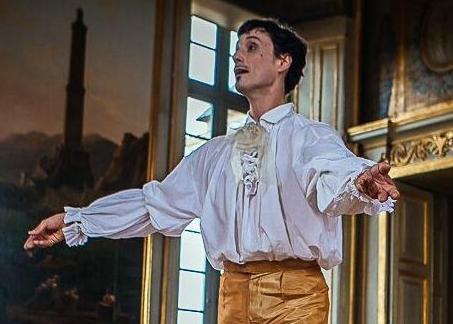
Hazebroucq's choreography is based on extensive archival research but also on the relationship between dance and music, so fundamental to the baroque aesthetic.  Lully didn't conduct with a staff for nothing : he was (literally) beating time, creating a percussive foundation for music that was made to be moved to.  Hence the vigorous rhythms and exuberance, at times reminiscent of military marches and fanfares. Period instruments pack an earthy punch, horns and percusssion evoking  instruments  from even more archaic times, complementing the baroque fascination with classical antiquity.  The stringed instruments, plucked or bowed, added variety and character, sometimes providing continuo, or embarking on flights of inventiveness.  Seeing the dancers move in close relation to the music enhanced understanding of the musical logic. 
Thoughtfully, this Liaisons Dangereuses (like the novel that is told in letters, not narrative), interleaved an extract from Lully's Les Noces de Village (1663),between the pieces from Lully's Thésée. Philinte and Climene are idealized shepherd and shepherdess, more personable than  the more stylised, abstract evocations of love in Thésée. This also served to show that court dance, even when inspired by pastoral fantasy, was not folk dance but far more sophisticated.  The second section, "Seduction",  combined extracts from André Campra's L'Europe Galante (1697) and Lully's Le Bourgeois Genthilhomme (1670),, the vaguely "Spanish" allusions adding exotic spice, to the dancing as much as to the music.   In the Interlude, a "Ballet des Fleurs" , the dancers enacted an allegory in which three figures interact as lovers and rivals, eventually finding reconciliation. This is an allegory in music, too, combining Gavottes and Airs sourced from Rameau's Les Indes Galantes and Lully's Atys (1676), allowing the dancers ample room for elegant, intricate pattterns of movement.  The section "Vexation" was based on Lully's Armide (1686), where the sorceress Armide tries to seduce Renaud.   Anna Dennis was particularly impressive in this splendid role with Nick Pritchard her foil,  dancers in black, the orchestra conjuring up a storm..

The section "Loss and Despair" began with the Prelude from Charpentier's Orphée descendant aux enfers (1684) setting the scene.  An extract from Lully's Ballet royal de la Naissance de Venus (1665)  prepared the way for Orpheus "Tu ne la pendras point, hélas, pour me le rendre"  and Proserpine's "Courage Orphée, étale ici les plus grands charmes", also from Charpentier's La descent d'Orphee aux Enfers depict the Underworld. But love itself does not die. Venus (Anna Dennis) sang "Amiable Vainqueur" from Campra's Hésione (1700), neatly connecting the Orpheus legend with a tragédie en musique  wth characters from other parts of classicl mythology.  "Love that is strong enough can "Désarmer le Dieu de la Guerre: le Dieu de la Tonnere" evoked by the wind machines, crashes of percussion and baleful brass in the orchestra.   After the tumult, fantasy and fun.  From Rameau's Platée (1745) a satire, and a parody from Jean-Joseph Mouret's Les Amours de Ragonde (1714) . In the former, the gods squabble, causing invertebrates and mortals to fall in unrequited love. In the latter, couples end up mismatched. Colin, who ends up wed to his would be mother in law sings mock peasant dialect "Je ne songeons qu'uà bien aimer, je rougirions d'être volage".  Warped humour, the opposite of idealized courtly love, but an opportunity to see the dancers imitate folksy jigs and "exotic" dances.  But all is resolved in the final tableau, Reconciliation.  Eglé and Mercury  sort out their differences in a dialogue from Rameau's Les Fêtes d'Hébé (1739) and Calatée, Mercure, Zoroaster and Amelite sort out theirs in Rameau's Zoroastre (1739).
Please also see

Rameau  Zaïs HERE. (Anna Dennis, Orchestra of the Age of Enlightenment
Rameau Pygmalion and Anacreon danced HERE (OAE, danced by Les Paisirs des Nations),
Rousseau Le Devin de Village HERE (Hubert Hazebrouque, choreographer)
and much else

Tuesday, 26 June 2018

Happy Birthday, Claudio Abbado, 85


Happy Birthday, Claudio Abbado, who would have been 85 today - still young, still productive, still blazing new trails.  To celebrate, I'm listening to the Lucerne Festival performance of Mahler Symphony no 2, the stuff of legend !

Sunday, 24 June 2018

Rattle's Valediction : farewell as Chief in Berlin (listening link)


Simon Rattle's farewell concert as chief Conductor of the Berliner Philharmoniker livestreamed Thursday,  now audio-only on Deutschland Kultur til 26th June. Mahler Symphony no 6,  chosen because that was what they did in their first concert together some thirty years ago. In the sixteen years that Rattle has been Chief Conductor , the Berlin Philharmonic has developed and grown.  They're sounding wonderful.  Harding has been doing Mahler 6 since he was in his early 20's and over the years, his approach has deepened. This "farewell" with the Berliners was a valediction.   Nuts to assume that this symphony is "tragic" because of its name tag The third hammer blow emphatically does not fall !  As nearly always in Mahler resolution is not defeat but a kind of liberation. 
Forcefulness right from the start, the marching pace confidently defined. From this the more esoteric theme emerged, strings suggesting new, distant horizons.  Dichotomy matters in Mahler, and Rattle gets the way the composer layers different concepts of texture and motion. Magnificent surge led by the strings, evoking warmth and perhaps, memories of a happy past, punctuated by the march.  Thus the quirky shrillness that creeps in, for the march is (like so much in Mahler) almost grotesque, since time does not stand still, however much we might regret.  The richness in the Berliner's playing emphasizes the beauty of life, enhanced by the "sparkling" near silence that follows and the return of the "horizons" theme and plaintive violins and winds.  A good sense of struggle between what the march symbolizes and the sassy freedom it attempts to suppress, and a vigorous conclusion to the first movement, intensifying the poignant tenderness of the Andante.  Many of the Berlin musicians are consummate soloists and Rattle highlights the finesse of their playing  This is a gorgeous orchestra, and Rattle makes the most of what they can do.  Shimmering, mesmerizing beauty, so lovely you could almost weep.  Yet deeper timbres take over, propelling the movement forward : alas, we cannot linger !  The last moments gleam, phrases stretching out like the last rays of a golden sunset before darkness sets in.
Thus the vigour in the scherzo with its "screams" and sharp outbursts against the surge.  Yet in the quieter passages, the pulse remains strong, the heartbeat regular.  When the elusive "dance" appears it's like a reiminder that better times haven't been in vain, even though the groaning basses and bassoons might demur.  Again, Rattle defines the themes well, bringing out their mysterious interplay.  Thus we can follow the logic of the trajectory,  where all the strands are drawn together in the Finale.  Every sound contributes to the whole, nothing wasted, nothing lost in this powerful conception, and withn the Berliners, everything works, perfectly. Everyone talks aboutb the hammer blows as they are sheer theatre, but the cowbells matter, too. As the "clouds" of darkness draw in, the pace slows so we can take in the enormity of what they might represent. Then suddenly the symphony ends with an emphatic flourish.  We might expect the finality of death but Mahler lets  the ending hang.  It's not "over" when it ends.
A wonderful performance and very individual.  An orchestra is a business like any other, and Rattle's leadership has built upon Abbado's legacy.  Karajan may have been made conductor for life, but that's not necessarily a healthy situation, for any organization.  Better that Rattle's built on Abbado's legacy, where musicians count, not just the boss man, and where the enjoyment of music for its own sake is fundamental, and open to all.  What  Rattle brought to Berlin was his enthusiasm and his sheer love of music, and a solid track record of orchestral development. (which is why London wants him so much).  . Every Chief symbolizes a new era, and in the last 16 years, the Berlin marque has expanded and grown.  What of the future ?
 

.

Thursday, 21 June 2018

Seven Little Fooks

Seven Little Fooks (七小福)  a reference to folklore tales about seven kids who bring good luck.  In this case, a group of boys being trained in Beijing opera.  But they are refugee kids in a community of exiles : in the south, their northern origins don't mean much. Gradually they grow up and find work in Hong Kong kung fu movies. This is a film about their teacher, Master Yu Zhangzong, struggling to maintain his art in a world that doesn't care.  An exquistely filmed movie, sensitive to changing social nuances. Essential viewing, even for those who know only kung fu, since Chinese opera is the root from which martial arts grew. To understand kung fu, and Chinese culture itself, you need to know the world of Chinese opera. But this is also a very personal story, based on real people and real memories.  Clue : the eldest boy is nicknamed "Three Hairs". Translate that as Sammo and realize it's Sammo Hung who still carries his nickname though he's famous today. And who is "Big Nose" ? The now ubiquitous Jackie Chan, a bigger star than many in Hollywood.  In the movie Master Yu is played by the adult Sammo Hung,  who has won many awards, but must treasure this, since he's portraying the man who shaped him.  So Seven Little Fooks, (directed in 1988 by Alex Law Kai chui) is about real people, caught up in an era of unprecedented change. Evocative music by Lowell Lo Koon-ting.

It's December 1st,1962, when much of Hong Kong was stilll pre-war tenement, houses built on terraces, where people share communal spaces, like the neighbour, a tailor, who works in the yard and can't stand the sound of the kids singing.  A new boy arrives.  "Can I do cartwheels all day and not study?" he asks. "Then I'll sign for ten years!", he squeaks. His mother's crying,  but it's best for him, though the contract she seals with her thumb print (she's illiterate) is severe. If kids die in training, no questions asked.  That was the traditional way.  Notice the kid's name is Chan Kong-sang, which means Chan "Born in Hong Kong", marking his parents brief respite after 20 years of struggle in war-torn China.  He's now Jackie Chan.  And so the kids learn tthe basics of Beijing opera, as much physical fitness and gymnastics as opera in the western sense. That's why they neeed to start young to be flexible.  The school is very old style. The kids live communal and have shaved heads like kids in the North used to do. The local kids mock them, singing a rude song which the subtitles don't translate ("baldies, baldies, butter up your butts"). The kids give a performance but Big Nose fell asleep. The audience walks out "They've gone home to the radio" scolds Master Yu - the radio and big theatres being where top quality operas were done : small troupes can't compete.  So they get beaten with canes.  Mrs Chan comes to bathe the kids - no plumbing - and knows he's been beaten. But he says "Don't cry". Opera school is tough but the kids think they're freer than the ones in regular school, chanting by rote.   When Master Yu goes out the boys march into town to collect charity rice. On their way back they clash with the fancy kids and there's a brawl.   The taunt "Four eye'd boys, blind as turtles!" (meaning kids with glasses). Ponder that detail, it's important.  Wandering far from home, they need to get back by bus, but haven't any money so they con the driver and later escape without paying.  Watch them use their opera athletics to escape from the top deck !

Meanwhile Master Yu and his friend Uncle Wah chat in a teahouse. They trained together as boys themselves, in Beijing. "Rain or snow, we'd get up early and train". For what ?  Few make it big in opera. Wah works as a stuntman and stand-in for stars.  Bruises and broken ribs "Thirty years of good luck, thirty years of bad" quotes master Yu. "And then you're dead" says Uncle Wah. To cheer him, Master Wu starts singing, in the middle of the tea house, and Uncle Wah  gets his dream, to sing again, for a public.  When Master Yu gets home, the Cantonese tailor confronts him because  the opera boys punched his kid.  Master Yu holds his ground and defends his kids. Tailor and Opera master swap insults : scholars are too weak to work, too proud to beg : actors are prostitutes.  Another witty retort not in the subtiles "Chicken piss!". But when the Lunar New Year comes, they all celebrate together. 

Gradually the boys grow up, doing shows in proper cinemas. They also discover girls. Big Nose tries to impress by rotating a pot on his head, but modern girls are more interested in guitar bands.  One day, the leader of a Cantonese female troupe asks for help, since Beijing boys are much better at gymnastics. Master Yu doesn't have modern social skills either. He wants to buy the female troupe leader a "western" birthday cake, but none of the traditional bakers do that. He has to travel all round town until he finds one. Alas, the inscription says "Happy 70th, Grandad!. So Master Yu can't read!  It's extremely bad luck, since the Grandad it was baked for died that morning..... Master Yu isn't the only one  not up with the times. The Tailor can't understand modern fashion. His son "borrows" for Big Nose  the fancy togs his Dad's made for western customers and the two go out together. But the girl prefers the nerdy tailor's son who can "sing Beatles" as the girl's kid brother says. "You Beijing opera types no-one wants". Big Nose goes back, dejected but he's missed a show. Sammo substituted for him, but Master Yu beats him for covering up Big Nose's disobedience and kicks him out of the troupe. Sinc it's been his life, he has nowhere to go.

But business isn't going well and the troupe is dissolved.  Sammo reappears crestfallen and is  welcomed by Uncle Wah.  Master Yu goes to Uncle Wah's movie studio to get work for the boys.  He's forced to cut up a group photo so their heads can go on the register. Uncle Wah, who has been working as a stuntman for years, is getting old and has too many accidents.  He blows his last chance and suddenly goes insane, climbing up into the roof space in the studio, mad with grief, re-enacting opera scenes. An amazing scene. Master Yu climbs up and starts to sing an aria from The Emperor and the Concubine, where the Emperor has lost his,kingdom, but his concubine remains loyal.   For a moment, Master Yu and Uncle Wah are back to be stars again, singing together. Uncvle Wah thinks he's an opera star again. then he's taken away in an ambulance.

Master Yu calls his boys together. He's spent 40 years in opera. Success or not, he's given it full committment.   The school is closed, the house is being demolished and the boys are starting out onn their own paths. so now he'll retire, abroad. He releases the tortoise he's kept for seven years to hold up his bed, feeding and watering it . Its back is strong and it it still knows how to walk.   Master Yu boards the ship, that's taking him away, forever.  "You persevered 40 years and so will we" says Big Nose. "Sammo look after them !" the master's last command.  When they're gone he looks at the gift they've left. A white paper fan with what look like scribbles. But when the folds are aligned the squiggles spell out 七小福, Seven Siu Fooks.  Below a photo of Master Yu who lived to a grand old age and his boys, now grown men.

PLenty moire on this site about Chinese movies, Chinese oopera and music, especially Cantonese. THis ius the only site in Englishwhich does these subjects from a wider social perspective.

Monday, 18 June 2018

Haunted Arabia - W Denis Browne

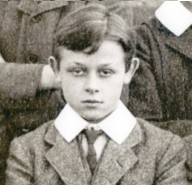
W. Denis Browne (1888-1915),  as a schoolboy at Greyfriars, Leamington Spa.  This photo might sum him up better than the usual photos of him in uniform, for his last music was written in June 1914. Almost exactly a year later, he would be killed at Gallipolli.  In this photo his youthful spirit  is captured forever, gazing wistfully but unafraid.  Browne went on to Cambridge and later studied with Busoni. He heard Stravinsky, and was impressed enough by The Rite of Spring and Petrushka to embark on his own ballet, never completed.  Today he's best known for a handful of songs, particularly To Gratiana, Dancing and Singing to a poem by Richard Lovelace (1617-1657).  Though that song is well represented on recordings,  most of the other songs are less well served.  I wish there were better versions on record of Arabia, for example, Browne's last completed song, which I've heard live in much better performance.

Arabia is an adventurous piece which seems to reach out, exploring new musical territory.  The poem, by Walter de la Mere, describes "the shades of Arabia, where the Princes ride at noon, 'mid the verduous vales and thickets under the ghost of the moon". The piano part moves with mysterious deliberation, firm single chords separated by silence, allowing the voice to ring out. The idea  might be to suggest a voice reaching over vast expanses. Not expanses of desert, though, but a "vaulted purple" where "flowers in the forest rise and toss into blossom against the phantom skies".  Warm breezes seem to propel the second verse, "Sweet is the music of Arabia" each line infused by gentle, swaying rhythms.  The vocal line rises high, and the piano part changes, suggesting the plucking of "strange lutes" that "ring loud with delight.......in the brooding silence of the night". Despite the beautiful sounds around him, the poet is haunted by someone, something others cannot see. "Stll eyes look coldly upon me, cold voices whisper and say "He is crazed with the spell of far Arabia, they have stolen his wits away". Not a romantic reverie ! Thus the jumbled images of moon and noon, of feverish, unhealthy imagination.  Ideal territory for the kind of English tenor who can express archness and horror behind luminous limpidity. Not straightforward at all. 

Sunday, 17 June 2018

Hommage à Gounod 200th birthday


Today marks the 200th birthday of Charles Gounod celebrated in Paris last night by Palazzetto Bru Zane. Look HERE at the programme ! and watch it again HERE on arte.tv.  Excerpts from many of his operas, and Olivier Latry performing an improvisation for organ.  Gounod's reputation has expanded greatly : so much more to him than Faust (which is pretty brilliant).  PLEASE READ THIS IMPORTANT PIECE FROM PALAZETTO BRU ZANE who have done so much to expand knowledge of the composer and his repertoire.  Please see also HERE my review of the most recent Gounod rarity, his last oratorio Saint François d'Assise.  A new recording of Gounod's mélodies is being released soon, which I'll write about shortly

Thursday, 14 June 2018

Magical Ravel Ma mère l'Oye. Le Tombeau de Couperin - FX Roth Les Siècles

François-Xavier Roth and Les Siècles Ravel Ma mère l'Oye, coupled with Le Tombeau de Couperin with Shéhérazade between them, latest in Les Siècles's Ravel series for Harmonia Mundi which began with their Daphnis et Chloé, so exquisitely beautiful that it remains by my desk for frequent listening.  This new disc focuses on two main works initially published for piano, but conceived with potential for orchestra. "To orchestrate, for Ravel" said Emile Vuillermoz, was to "exploit the colour of the istruments , to atch their timbres, to vary and nuance them down to the slightest detail, without ever losing sight of the overall balance". Ideal for Roth and Les Siècles whose forte is clarity and exqusite clarity, clean jewel-like sparkle enlivened by a feel for the passionate imagination that inspired the composer.  Ma mère l'Oye may have been written for children, but its magic is so strong that adults. too, can be drawn under its spell. With Roth and Les Siècles you don't get "kid stuff".  Indeed, the more sophisticated the players, and the more sensitive the listener, the stronger the sense of enchantment.

This performance of the full 1912 ballet version of  Ma mère l'Oye is almost too exquisite to be earthbound,  though it bristles with energy.  The first notes of the Prelude suggest the pipes of Pan, the switrl of flutes, the movement of some mysterious creature. Winds blow, and dizzying strings - spinning wheels - hypnotize us into reverie so we can dream, like the Beauty, sleep in the forest. More shivers and shimmerings, as the Beauty awakes to meet the Beast. the woodwinds sing,  and the lower strings growl : suggesting the Beast whose form is brutish but his soul refined.  In this mysterious realm (tender strings) lives too Le petit Poucet who is small and frail (birdlike woodwinds) but outsmarts the Ogre.  Magical harps, tremulous woodwinds evoke the even more exotic kingdom of Laideronette. Percussion in "oriental" patterns, as angular as the shape of pagodas, building up to elegant, though wistful melody.  Laideronette and her serpent friend are under a spell.  Roth and Les Siècles alternate slow and more agitated passages enhancing the flow. The Apothéose, in the jardin féerique is delicate, yet magnificent.

Thus to Shéhérazade, ouverture de féerie (1898). Although this was to have been part of an opera,  Roth and Les Siècles bring out the tightness of its structure, demonstrating the strength of its design, as purposeful as a ballet. Though Stravinsky would not have known it (it remained unpublished until 1975),  this performance is so well-defined that the piece feels like a prototype for something Diaghilev might have considered for the Ballets Russe.

Roth values the importance of structure in French repertoire, evolving as it did from the baroque, where elaborations are built upon firm, disciplined foundations influenced by dance and formal patterns.  Thus Ravel's Le Tombeau de Couperin, in his four movement orchestration, premiered in 1920. Thus the piece is as much an hommage to French style as a a series of memorials to Ravel's friends who died in the 1914-1918 war.  A vivacious Prélude, with the oboe as lithe and athletic as a creature of the forest (an unexpected link to Ma mère l'Oye). The dance origins of the Forlane are even more evident , a forlane being a folk dance form from Italy which Couperin adapted.  Hence the sprightliness, every "step" in the music sharply articulated and vibrant.  The Minuet is more formal but equally well  presented.  This is what period inspired performance means, not instruments per se but an understanding of repertoire itself.  The Rigaudon here is particularly impressive, combining elegance with boisterousness, and a tinge of sadness. Oboe and strings interact, two voices entwining like partners in a dance, or the two brothers Ravel knew, who went cheerfully to war and were promptly killed, by the same shell.  

Buddha behind Barbed Wire