Thursday, 8 November 2018

Elgar The Music Makers Spirit of England Andrew Davis, Chandos

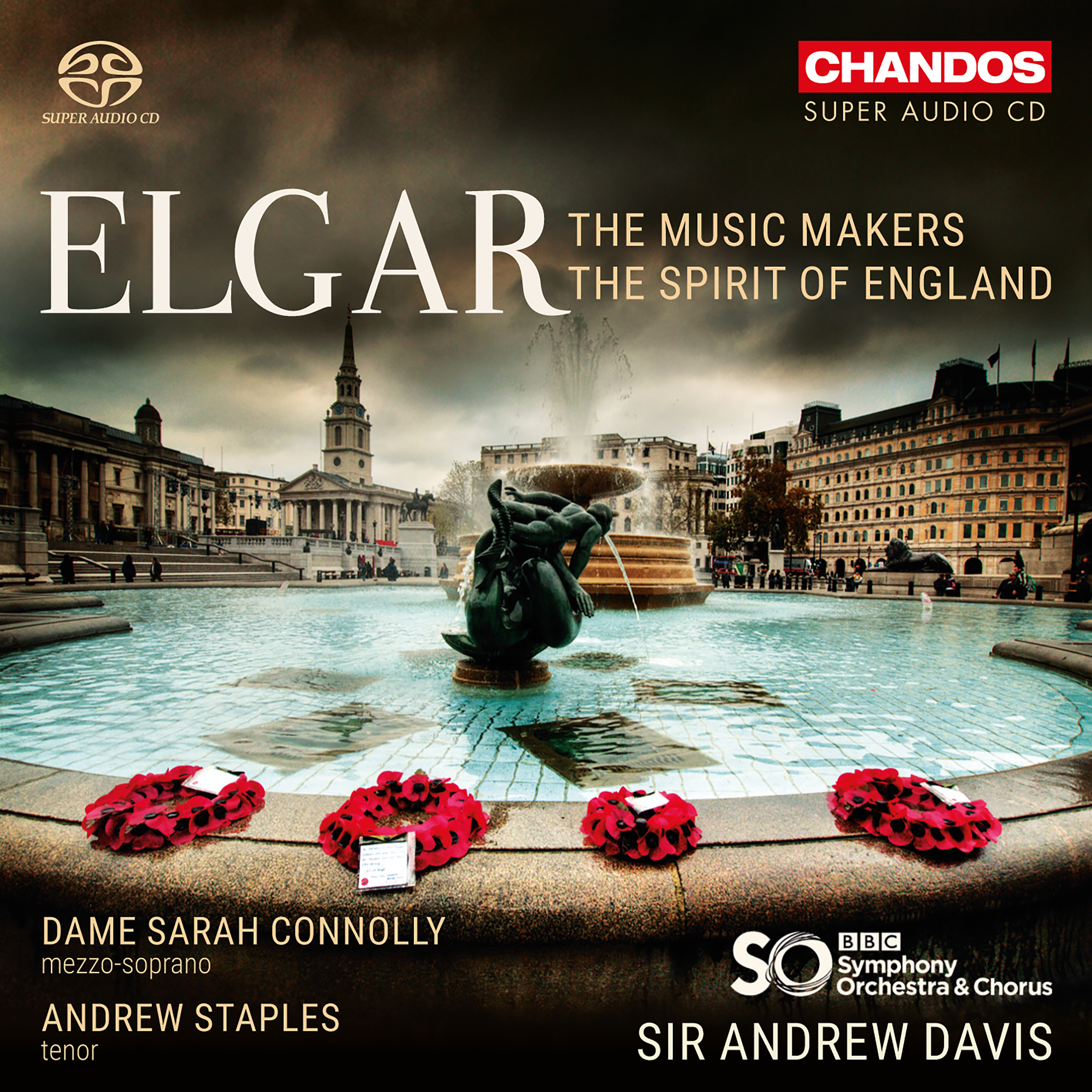
Andrew Davis conducts Elgar The Music Makers and Spirit of England Op 80 with the BBC Symphony Orchestra and Chorus with Sarah Connolly and Andrew Staples for Chandos, juxtaposing Elgar's private and public faces.

Elgar's The Music Makers op 69  premiered in July 1912, but had been long in gestation. Elgar knew of Arthur O'Shaughanessy's Ode when he was in his twenties, when he was isolated, scraping a living as teacher, organist and conductor of the very limited orchestra at Powick Asylum, not far from his home, with no obvious prospects. Thirty years later, his status solidly established,  might he portray himself in this piece, just as he had portrayed his friends in the Enigma Variations, incorporating references to his own music, not so much for their own sake but because, as he wrote, they expressed "my sense of the loneliness of the artist". Despite his success and acclaim, Elgar identified creativity with alienation. Artists are "dreamers of dreams, Wandering by lone sea-breakers, And sitting by desolate streams; World-losers and world-forsakers, On whom the pale moon gleams".  The slow orchestral introduction gives way to a more forceful section, where the chorus bursts forth  "One man with a dream, at pleasure. Shall go forth and conquer a crown; And three with a new song's measure Can trample a kingdom down."   The orchestra surges in full flow, but animato fades to più lentoOnly halfway through does the contralto (Sarah Connolly) emerge, heralded by harps. "They had no vision amazing.....no divine foreshowing Of the land to which they are going:" The music makers proceed towards uncharted territory with calm assurance.  Yet again, tranquility gives way to con fuoco and back to lento.  Ironically, it is the chorus, not the soloist who sing of "dreaming and singing, A little apart from ye." as if isolation is still too uncomfortable to sing about without ensemble, despite the confident crashing chords in the orchestra and raised voices.  A quiet transition to the finale, when the mood rises again, Connolly singing forcefully. "Great hail! "  The artist shall "teach us your song's new numbers; And things that we dreamed not before: Yea, in spite of a dreamer who slumbers, And a singer who sings no more."  Though the soloist fades to stillness, the chorus continues to hold the line.
Elgar's Spirit of England  op. 80 (1915-17) is so powerful that it draws you into its glorious self confidence  even though we now know where jingoistic bluster can lead.  But for a moment we are spellbound by the sheer extravagance of the piece.  Drums roll, strings surge and the BBC Symphony Chorus explode.  Andrew Staples's voice rises heroically above the wall of sound. "Spirit of England, go before us !" The orchestral writing sets a pulse which supports the chorus, where male and female voices sing alternating lines. This creates an interflow suggesting vast, turbulent forces. Staples shaped the magnificent line "We step from days/ of sour divison/ into the grandeur of our Fate", each key word meticulously articulated, the last word "Fate" ringing out like a clarion.  Staples’s enunciation was sharp, consonants crisp, much more idiomatic than the other three tenors I've heard in this piece in recent years. The English tenor style, at its best, brings out the edge in the language hinting at hidden undercurrents : what really is the unshakeable soul of "divinely suffering man"?   This does matter, since Elgar may well have seen the circumstances more acutely than did the populist poet. A male voice captures an edge of anguish and pain, while female voices express the more conventional Boadicea approach.
In contrast to the first section "The Fourth of August", the second section "To Women" is more restrained.  While the tenor line was integrated with chorus and orchestra, it now stands almost alone. Phrases like "like a flame" and "boundless night" fly upward from the line, Staples emphasizing them with flourish.  A melancholy violin passage introduces a much darker mood.   "For the Fallen" is a funeral procession but proceeds forward with relentless surge, Davis marking the throbbing undertow in the orchestra. The choral line with its clipped, almost staccato tension, evoked, perhaps gunfire.  The woodwind figure, followed by low-timbred strings, was particularly moving. "We shall remember them", sang Staples, his voice carrying above the chorus and orchestra.  "To the end, to the end, they remain".

Wednesday, 7 November 2018

Cultural Crimes

Chop Suey - a dish that doesn't exist in China. The word is a direct transliteration of 雜碎  which means miscellaneous left overs, randomly thrown together.  The story is that white folks approached Chinese railroad workers in California, wanting their food. So they got some. "What’s this dish?" . "Jaap sui".  The idea of CANNED leftover scraps is cultural  crime. Kind of explains some things.

Tuesday, 6 November 2018

Stanford Mass Via Victrix premiere, Partington, BBC NOW.

Charles Villiers Stanford's Mass Via Victrix, resurrected and edited by Jeremy Dibble, with Adrian Partington conducting the BBC National Orchestra of Wales.  This world premiere will get a lot of attention since Stanford has become fashionable in recent years, so it's sure to be well received.   Completed in December 1919, it is  inscribed with the Latin translation of a line from Psalm 66, "Transiverunt per ignem et aquam et eduxsisti in refrigerium",  which means "We went through fire and through water; But You brought us out to rich fulfillment.". Since Stanford and his contemporaries knew their Bible well, it is worth reading the psalm in full. (link here)  because the psalm is not a hymn of mourning but a song of triumph.  

Even more pointedly, the psalm is about power  that cannot be questioned.  "How awesome are Your works! Through the greatness of Your power. Your enemies shall submit themselves to You" And "He rules by His power forever; His eyes observe the nations;Do not let the rebellious exalt themselves".  Which is fair enough as God is omnipotent, but soldiers killed in battle, no matter how heroic they were, are men, not gods : they cannot be conflated in the same terms.  So savage was the 1914-1918 war that everyone had some connection to those who were killed, maimed or bereaved, and by 1919 it would have become obvious that the configuration of Europe was irretrievably changed. Many had been mourning for years. 

It is not enough to take this Mass at face value. The title is explicit "Via Victrix" - the "Way of the Victor".  This is no personal expression, but a public statement  taking pride in the idea that Might is Right.  Perhaps that's why the piece didn't fit the mood of those post-war years, when millions were numb with grief,  with no taste for the bullying belligerence that led to war in the first place.

Stanford's Mass Via Victrix is a Mass, more or less following the format established long before the Reformation.  Religion does not come into it as a means of musical expression : many composers who have written Requiems weren't devout and no doubt a good few were only Christian by social convention.  Stanford would certainly have known  Brahms German Requiem.  Because Msses operate in sequence they provide internal structure and colour.  Introits are processionals,  Dies Iraes are turbulent, Sanctus's are reflective, Pie Jesu's are plaintive.  And the ultimate goal is always the same : redemption.  Thus variations are built into any Mass, obeying the shifting liturgical balance.  Stanford follows the form faithfully, alternating outbursts of volume with moments of restraint.  Each section is elaborately orchestrated, maximizing impact and drama,  making the piece impressive. Ultimately, though, a Requiem recognizes that man is mortal, and that God alone brings victory over death.  Humility is of the essence !  Not that that has hindered some much loved Requiems, full of ego and show.  I don't think we should assume either way that bluster and piety are incompatible.  Stanford must have been very pleased with himself.  The assertive certainities of this Mass are comforting to live with in our modern world, which seems to be growing infinitely more divisve and extreme.  Perhaps the popular mood has shifted again, as it did in the years after 1918, and the time has come for a Mass Via Victrix, as long as you are on the right side.  As music, Stanford's Mass Via Victrix is rousing stuff,  easy to march along with, and should prove popular, triumphalist or not, though one should caution against calling it a major masterpiece.  Certainly, a performance executed with gusto, from Partington, BBC NOW and soloists Kiandra Howarth, Jess Dandy, Ruairi Bowen and Gareth Brynmor John. 


Frederick Septimus Kelly's Elegy for Strings, In Memoriam Rupert Brooke provided an interesting counterpoint : achingly poignant and sincere, the smaller ensemble and tight orchestration allowing  intimacy.   Although Maurice Ravel's Le Tombeau de Couperin may have been included in this programme to extend the war memorial aspect to France, the piece is more than a set oif portraits of departed friends.  It is every bit as much a homage to French style, and to the vigour of the dance forms defining it.  The programme began with Ernest Farrar's Rhapsody No 1 "The Open Road" , Op 9 (1908). Ostensibly the connection is that Farrar, who was killed in the Somme after having survived Gallipolli, was a student of Stanford, but so was practically everyone else. Farrar's piece is very original,  imbued with a free-wheeling spirit.Vaguely  Scottish cadences suggest wide open spaces,  away from constrained civilization.  What might Farrar have gone on to had he lived ? Would he, like Ralph Vaughan Williams, have continued his musical adventures exposed to the brave new world of Ravel et al ?


Monday, 5 November 2018

Wilfred Owen, Dunsden Green - a personal memoir


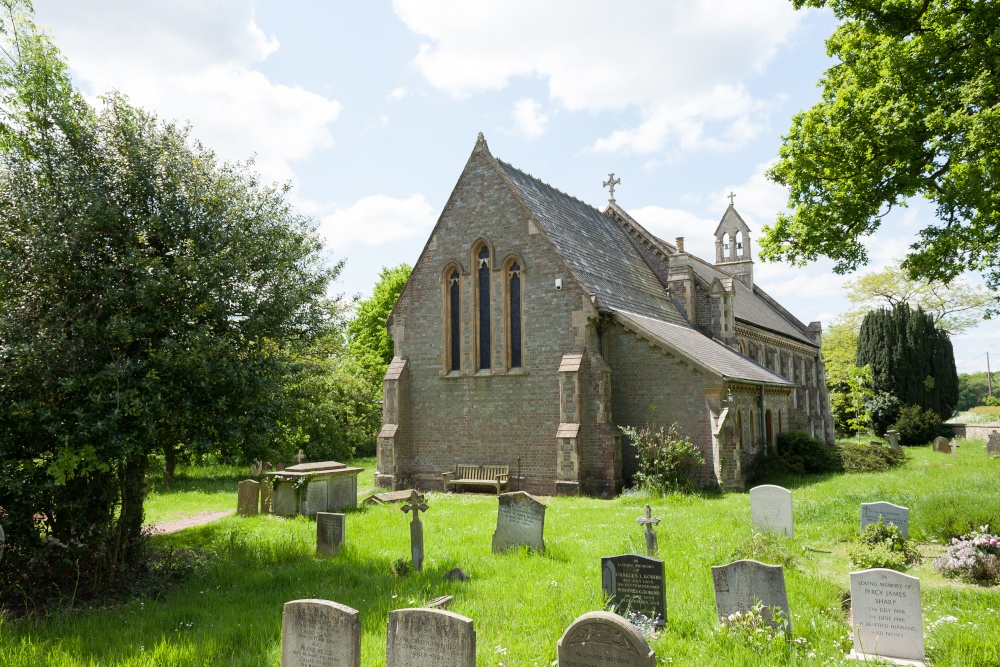
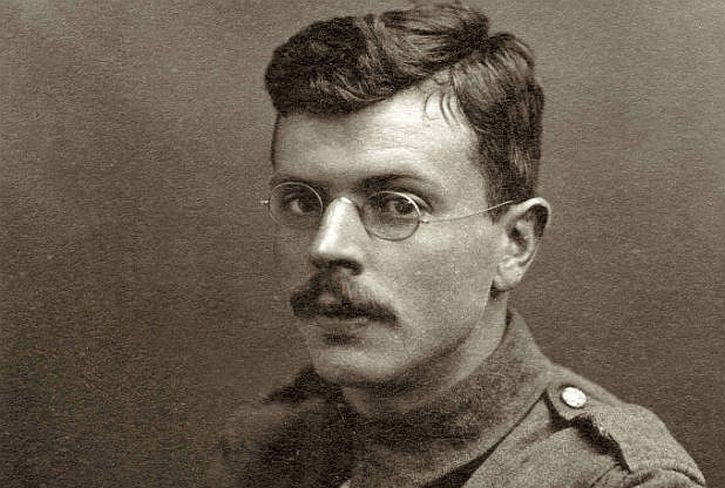
Wilfred Owen died 100 years ago, but his poetry has made him immortal.  But what shaped Owen's personality, and his singular art ? Unlike Siegfried Sassoon, who recognized Owen's potential when Owen was a gauche nobody, Owen didn't come from an elite background.  Owen's parents were not well off, not poor but not secure. After many years moving from place to place they ended up in a two-up two-down Victorian terrace, now facing a downmarket shopping mall on a rough estate.  Nonetheless, for years the tenants hung hanging baskets outside, a display so colourful that the houses were a local landmark.  Owen's parents and sister are buried in All Saints Church in Dunsden Green, (pictured above) a few miles away, where Owen served as lay assistant to the Vicar from 1911 to February 1913.  That connection must have meant a lot to them.  Inside the Church, there's a memorial plaque on the wall in Wilfred's honour. 

Owen himself might not have been quite so genteel. Though the Vicarage where he stayed was luxurious (it's a local landmark, too), many of the people of the parish were desperately poor, living in overcrowded hovels, employed seasonally, often insecure. Disease speads quickly when people are overworked and underfed.   Owen used to visit  these tenements and must have been well aware of the contrasts between the Vicar's life and the lives of those in his parish.  Whenver he had the opportunity, he'd walk miles into town, visiting a bookshop for "modern" literature, different fare no doubt to what was in the vicar's library.  The route he walked is pretty much as it was then, despite the traffic. Until recently, you could still see painted signs on buildings advertising hay and coal.  The hovels are now renovated,  some of them weekend homes for the rich from London. The thatched pub at Binfield Heath, which Owen would have known, but was probably not allowed to visit, dates from 1300 and served travellers taking sheep and cattle to market. 

On 15th October 1912, one of the villagers, John Allen, set off to a new job in Maidenhead :  a  step up in the world, away from rural slums.   Full of hope and anticipation, the family loaded up a horse cart with their belongings and set off to their new life.   On the way to Playhatch, the road becomes extremely steep : even in a modern car, you notice the gears change.  A huge sofa - a status symbol - shifted and tipped the cart over, killing Mrs Allen and her daughter. The Allens are buried in the chucrhyard at All Saint's, too. Owen assisted at the funeral. This shook whatever faith Owen might have felt in the church, and in the social order.  It compounded an emotional crisis, which he resolved by getting as far away as possible, to France, where he had no connections.  And so,Owen's distinctive personality was moulded, long before the trenches and the Somme.  Below, the  poem he wrote about the Allens's tragedy,  Deep Under Turfy Grass. 
Deep under turfy grass and heavy clay 
They laid her bruisèd body, and the child 
Poor victims of a swift mischance were they, 
Adown Death’s trapdoor suddenly beguiled.
I, weeping not, as others, but heart-wild, 
Affirmed to Heaven that even Love’s fierce flame 
Must fail beneath the chill of this cold shame. 
So I rebelled, scorning and mocking such 
As had the ignorant callousness to wed 
On altar steps long frozen by the touch 
Of stretcher after stretcher of our dead. 
Love’s blindness is too terrible, I said; 
I will go counsel men, and show what bin
The harvest of their homes is gathered in.
But as I spoke, came many children nigh, 
Hurrying lightly o’er the village green; 
Methought too lightly, for they came to spy
Into their playmate’s bed terrene. 
They clustered round; some wondered what might mean 
Rich-odoured flowers so whelmed in fetid earth; 
While some Death’s riddle guessed ere that of Birth. 
And there stood one Child with them, whose pale brows 
Wore beauty like our mother Eve’s;whom seeing, 
I could not choose but undo all my vows,
And cry that it were well that human
 Being
And Birth and Death should be, just for the freeing 
Of one such face from Chaos’ murky womb, 
For Hell’s reprieve is worth not this one bloom.
 

The real end of the 1914-1918 war

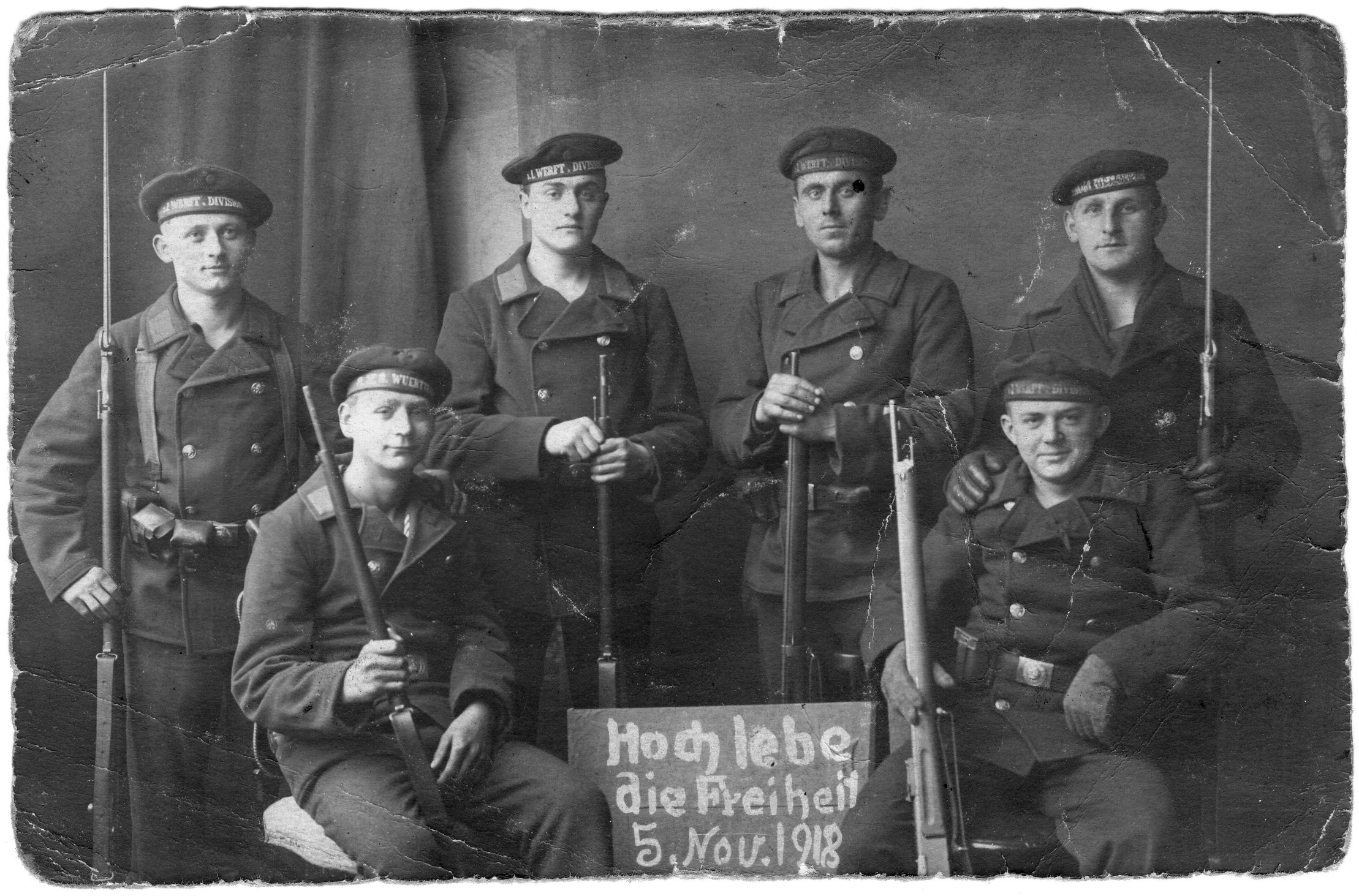
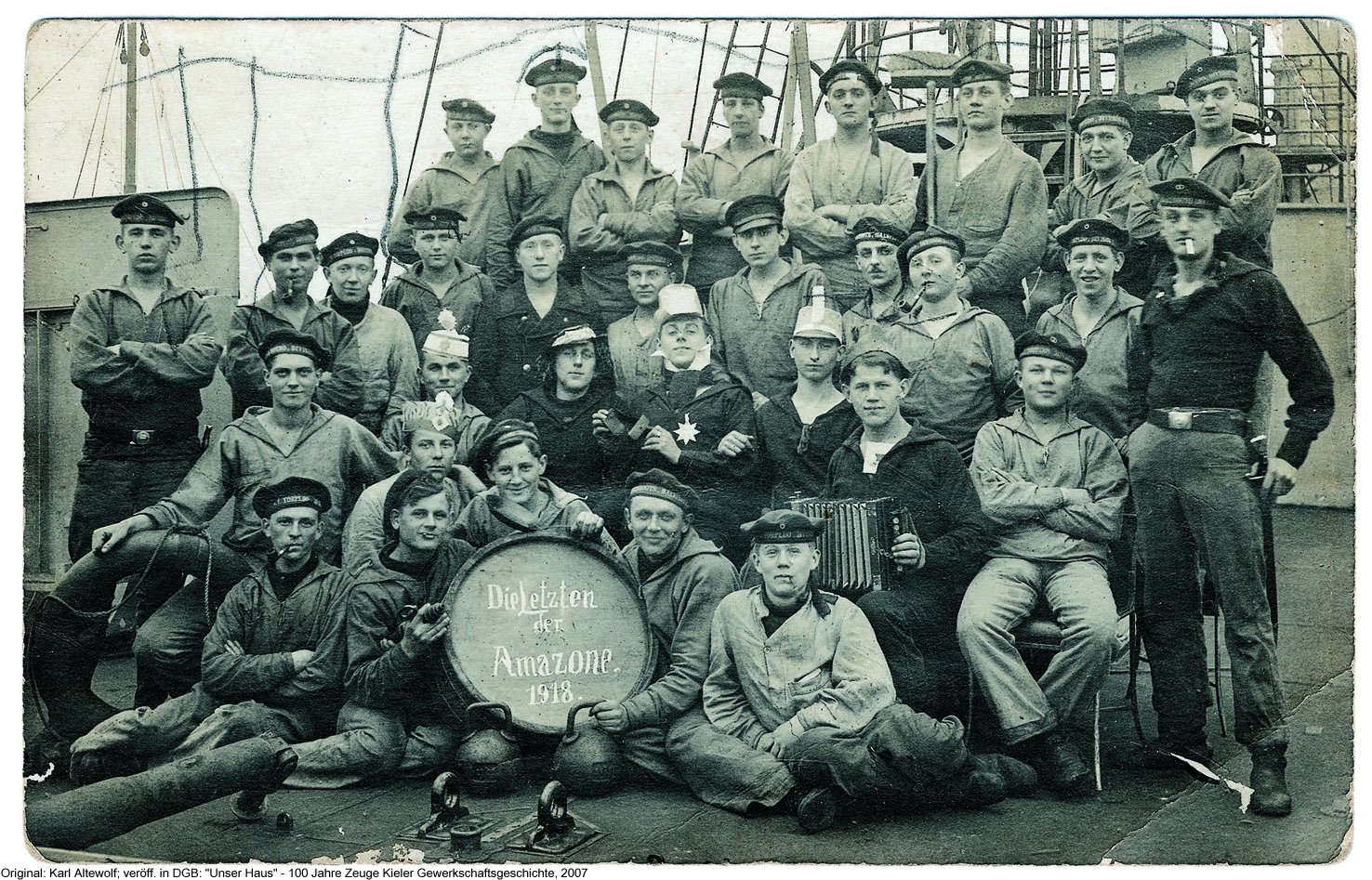
 100 years ago, sailors in the German Navy mutinied against the Kaiser.  Another Revolution begins. The 1914-1918 war didn't end in "victory" but in collapse.


Sunday, 4 November 2018

Stravinsky - The Rake's Progress : Jurowski LPO

Stravinsky's The Rake's Progress, latest in Vladimir Jurowski's Stravinsky series at the Royal Festival Hall with the London Philharmonic Orchestra.  Given that Jurowski's Rake's Progress at Glyndebourne is a classic, this semi-staged concert performance was an excellent opportunity to revisit the piece, focusing more acutely on the opera as music. This was an excellent performance, orchestrally, bringing out the restraint in Stravinsky's orchestration,  not so much "neo-classical" as baroque. The harpsichord (Helen Collyer) was positioned between orchestra and soloists, reinforcing baroque sensibilities and the notion of opera as moral allegory.  Although W H Auden wrote the libretto, his reference was Hogarth's series of paintings The Rake's Progress (1732-4), and the series of etchings printed for mass circulation in the following years, from which David Hockney drew his inspiration for that iconic Glyndebourne production. Thus the stylization in the opera, playing with many concepts on many levels, at once black and white yet ambiguous.  Auden's text is elegantly convoluted, its literary eloquence deliberately masking the horror in the story, so those who'd prefer not to think past the hard, brittle surface may come away thinking that it's arch comedy.  And laughs there are, but not always nice. What might seem moral just might not be : everyone in this opera is compromised in some way, apart from Baba The Turk, who is, significantly, the outsider.

Matthew Rose reprised the role of Nick Shadow as he did in 2011, adding also the Keeper of the Madhouse, which was a wise choice, since arguably, Nick Shadow, like the Circus Master in Alban Berg's Lulu , pulls the strings in a zoo where people are animals.  Toby Spence sang Tom Rakewell, with Sophia Burgos as Anne Trulove, with Clive Bayley reprising the part of her father.  Andrew Watts, standing in  at 24 hours notice as Baba the Turk, almost stole the show, however, with a camp but extraordinarily sensitive interpretation of the role.  Kim Begley sang Sellem the Auctioneer and Marie McLaughlin sang Mother Goose. The stage platform was arranged so that the orchestra and chorus (London Voices) were close to the back wall, leaving a lot of empty space in front, to give the singers room to move (rather than teetering over the edge as is usually the case). But this, combined with the surprisngly non-capacity audience, muffled the singing to some extent, to the disadvantage of the less-dominant voices. Rose carried the performance through most of the First Act, but Watts's entry seemed to galvanize proceedings.   Perhaps the echo in the hall worked against clear diction, other than from the principals , as some in the audience complained, which was a pity since Auden's texts are poetry, to be savoured even without Stravinsky's coiling lines, stretched vowels and spiralling cadences, oddly reminiscent of Benjamin Britten, whose work Stravinsky must have known by 1951.

Tom's descent to debauchery is conventional enough - shades of Faust and Mephistofeles here, and in the card game towards the end, of Stravinsky's The Soldier's Tale, and even sly allusions to Tannhäuser and Venusberg - all of these part of the cavalcade unfolding on many levels and many forms.  But where does Baba The Turk fit in with this Faustian adventure ? What kind of creature is she/he and how does she/he change the narrative ?  She/he's first heard of when Nick Shadow shows Tom a broadsheet from a travelling show she stars in.  He's aghast but Nick taunts him "For he alone is free, who chooses what to will and wills his choice as destiny".  So  Tom marries her to prove he's free, but ends up more tied than before.  Although the role is often taken by a woman, (Patricia Bardon, who was originally scheduled, has done the part very well many times before), having a countertenor adds extra frisson, in addition to underlining the baroque connections.  Baba's a bearded lady, and exotic as all "Turks" are supposed to be.  Watts appeared, spotlit and veiled,  mincing in stilettos, transforming the opera and performance.  Wonderfully, flamboyantly androgynous ! 

Everyone else in these proceedings scams everyone else in some way, even Anne Trulove, whose "love" isn't truly altruistic since she plays games of social convention.   But Baba's on the level, giving up fame and fortune for a wastrel like Tom.  All the others treat each other like commodities: Sellem the Auctioneer might sell objects, but these objects are symbols of lives gone wrong, people making money from the misfortunes of others.  Even Baba becomes an object. "Old wives for sale".   Tom winds up in the madhouse, babbling about Venus  (Tannhäuser and creativity in the guise of woman). The opera resolves, like Don Giovanni, with a moral, where the main characters tell what they've learned.  " All men are mad; all they say or do is theatre" (Baba)  and "Beware, young men who fancy you are Virgil or  Julius Caesar : Lest when you wake, you are only a rake". (Tom). And even Nick Shadow who acts like he's in control, but isn't. "Many insist I do not exist. At times I wish I didn't". 

Saturday, 3 November 2018

Polish Independence BBC SO - Elgar Paderewski Szymański Lutosławski


Celebrating Polish Independence Day in advance, Paderewski, Szymański and Lutosławski with the BBC Symphony Orchestra conducted by Michał Nesterowicz at the Barbican and on  BBC R3. To start, Edward Elgar's Polonia  op76 (1915), a statement of hope, written at a time when Poland didn't yet exist except as part of the Austrian and Russian Empires. It blends themes from Chopin and Paderewski in a mix of grand orchestral music, mazurkas and marches with quotations from Mazurek Dąbrowskiego, the Warszawianka and other Polish patriotic songs. Though Polonia might not be Elgar premier cru, it's a showpiece, good for occasions like this, reminding  us that the  connections between Britain and Poland go back a long way. In this wave of post-Brexit racism, we must recognise that Poles are not "the enemy" but very much part of the community.  Thousands of Poles escaped to Britain, either from pogroms in Russia or from other suppression, after 1914, after 1939 and since the fall of the Iron Curtain. Polish immigrants are the biggest European minority in this country, and form the backbone of the economy in all sectors.  British music has been enriched by Poland, not just through greats like Chopin and Liszt but by the integration of composers like Szymanowski,  Lutosławski, Panufnik and others into the DNA of modern British performance practice.
Elgar's Polonia was dedicated to Ignacy Jan Paderewski so fittingly, it was followed by Paderewski's Piano Concerto in A minor op 17, premiered in 1889 by Hans Richter, who was close to Elgar and to Parry.  The soloist here was Janina Fialkowska.  A dramatic opening gives way to an allegro at times expansive and serene, the piano's rippling figures complemented by emphatic chords in the orchestra.  The second movement is romantic, with  lovely parts for violin and cello. The finale is rousing.  Like the composer himself,  it's appealing, though maybe not material for virtuosic celebrities. Like  Polonia it is a gesture which needs to be heard.
A meatier second half, with Paweł Szymański (b 1954) Fourteen Points-Woodrow Wilson Overture,and the biggest modern Polish composer of all, Witold Lutosławski.  Szymański's piece, a new commission, is a meditation on the ideas in Woodrow Wilson's visons of a newe age in the aftermath othe old order.  The 13th section refers to the creation of an independent Polish nation.  This music is not literal by any means, taking themes and re-arranging them in more open-ended ways.  It is thoughtful music, not showy, but rewards attention for those with minds open to possibilities.  A good opening for Lutosławski's Symphony no 1 which evolved gradually in stages in wartime conditions.  During this period the whole world seemed in upheaval. The symphony feels like a search, exploring new territory, the first movement tense and hostile, even though it's marked allegro guiosto.   Despite the circumstances in which it was created, the symphony is clasically shaped in four movements, the orchestration precise and beautifully detailed. An excellent performance from Michał Nesterowicz and the BBCSO.  (please see here for my piece on Lutosławski's Derwid songs)

Thursday, 1 November 2018

Shostakovich Michelangelo Songs : Goerne, Honeck, Finnish Radio Symphony


Manfred Honeck conducted the Finnish Radio Symphony (Radion Sinfoniaorkesteri) in Shostakovich Suite on Verses of Michelangelo Buonarroti op. 145a (Matthias Goerne, soloist) and Mahler Symphony no 1 livestreamed on Finnish Radio's Areena HERE. Goerne has been singing these Shostakovich songs for years, most recently in the voice and piano versions (with Andsnes, Schhmalcz and Trifonov) so it was good to hear him sing them again with full orchestra, which he's also done, and in the full eleven-song version.

Brooding strings and percussion introduced the first song Istina (Truth) in which Michelangelo states the need for an artist to have integrity, whatever his lords or patrons might prefer to hear. The authority in Goerne's delivery, his timbre as solid as the rock which Michelangelo the sculptor turned into art.  Thus the contrast with the sensuality of Utro (Morning), where the poet describes his lover's golden tresses, garlanded by flowers. Michelangelo's sculptures are so vivid that they seem to pulse with life. Fingers press, making indentations on the marble as if it were living flesh.  Beneath the smooth surface, these sculptures seem to throb as though muscles and blood vessels throbbed within.  thuis the exclamation "What, then, would my arms do" inviting the viewer/listener into the physical experience.  A flute introduces Lyubov (Love) suggesting intimacy, elusive piping figures suggesting lightness, even whimsy, in contrast to the darkness in the vocal line.  Beauty grows when it unites with the heart, and becomes immortal.  Michelangelo, being an artist, lives eternally in the works he left behind.  And so to the expansive long lines in Razluka (Separation) which express distances, in time and in space. The poet cannot live without love, and dies, leaving the memory of his devotion as a pledge. Goerne's voice softens to tender near sotto voce, as if cherishing the miracle of creation, the last phrase held so it floated into stillness.

In Gnev (Wrath) the mood changes, and the orchestra seems to flare up : violent chords, with sharp edges, trumpets, bassoons and trombones : a very masculine rage, ideally suited to the ferocity Goerne can express when needed. The text refers to the way Christ's message is distorted and abused. Chalices are turned into swords and helmets and Christ's blood sold like a commodity in the marketplace.  And thus to Dante, whose visions of heaven and hell inspired great literature, but who was forced into exile, "for his splendour blazed too brightly for common eyes", as Goerne declaims in the next song Izgnanniku (In exile), the curving vocal lines lit by metallic percussion, timpani and baleful low brass and strings.  The orchestra swells, then falls silent around the singer, and surges again like a chorus.  Goerne sings the last line tenderly : "No  man equal, or greater was ever born".  Christ and Dante, visionaries, persecuted for what they believed in. The sharp dissonances in Tvorchestvo (Creativity) suggest hammerblows : the sculptor doggedly chipping away. Alarums and crashing cymbals, shining brass and winds, and metallic bells, suggesting the triumph of art over base material.  In Night (Noch') Strozzi marvels at a statue: can the angel be stone, if she seems asleep ? A somnolent postlude to Stnerf (Death), where the strings seem to pulsate, like a human body at rest, trumpets calling as in nightwatch.  In Bessmertie (Immortality), the poet reflects. Through what he has created, the artist lives on, his art inspiring those who understand his work.  The piping flute duet of Lyubov (Love) returns : love is a force of life, brightly carrying on the torch.  Goerne's voice grows firm and full, buoyed up by conviction. Powerful chords in the orchestra, a moment of stillness broken by staccato suggesting the hammerblows in Tvorchestvo (Creativity).  Since Goerne hasn't recorded Shostakovich's Suite on Verses of Michelangelo Buonarroti this performance from Helsinki with Honeck should be treasured.  As a bonus, there's an interview with him on the broadcast where he speaks about the piece. 

An enjoyable Mahler Symphony no 1 from Honeck and the RSO. What a good orchestra this is ! There are connectiond that could be made between Shostakovich Suite on Verses of Michelangelo Buonarroti and Mahler's First Symphony. Indeed Goerne has a programme in his repertoire which deals specifcally with the connections between Mahler's Early Songs and this particular set of Shostakovich songs. Please read more HERE, it's good.  For example, the idea of Titans, which gets sneered at because the tage was not used by Mahler himself. But Mahler and his contemporaries knew their classics better than modern audiences do. They would have known about the race of Titans who were very strong, but venal, and were supplanted by proper Gods. Base material turned into art, just as Michelangelo would have done.  Not in this performance though which emphasized the Spring like aspects of the symphony and its youthful spirit 


Wednesday, 31 October 2018

Britten Ballad for Heroes, Gurney Gloucestershire Rhapsody, Bliss Morning Heroes

W H Auden and Benjamin Britten
 Benjamin Britten Ballad for Heroes, Ivor Gurney Gloucestershire Rhapsody and Arthur Bliss Morning Heroes with David Temple conducting the BBC Concert Orchestra and the Hertfordshire Chorus in Watford last week, broadcast on BBC Radio 3. An excellent programme since these pieces aren't as well known as they should be, though they are hardly unknown.

Britten's Ballad for Heroes Op 14, 1939  for example. When I first heard the piece seven years ago (Ilan Volkov BBCSO, Barbican) I didn't understand it, but gradually it's grown on me. The disparity between the poetry of W H Auden and the doggerel of Randall Swingler is a problem, but Britten uses it with a certain degree of irony. Auden is an intellectual : Swingler a man of action (a Communist) but not so good with words. Auden opposes fascism, while Swingler's solution is to fight with more violence. Yet they trundle along together, with unison chorus and marching orchestra  The contradictions in the piece provoke, just as the situation did. Therefore the piece is about a lot more than a simplistic conflict between pro and anti war. It should be noted that the Spanish Civil War ended in April 1939, with the triumph of the fascists and their Nazi allies, so the piece (which premiered at the end of April 1939) isn't about going to war so much as a realization that war alone cannot defeat the forces of evil.  The title is "Ballad for Heroes", not "Ballad of Heroes", for the cause the heroes fought for had been crushed so cruelly that  it was hard not to envisage the eventual triumph of Hitler, who enjoyed a lot more support, even in Britain, than some will now admit.  Despite the annexation of Czechslovakia, and the Nuremberg Race Laws,  Britain supported a policy of Appeasement.  When Chamberlain announced "Peace in Our Time"  there were many for whom the slogan rang false.  Appeasement, for better or worse, encouraged Hitler rather than curbed him, which is why so many despaired. It is unfair to fault Britten for leaving in April 1939 since Britain was at peace.  There are many ways of opposing war and the mentality behind it. War was only declared on 3rd September 1939 because Germany invaded Poland, not because of the regime itself. 

Thus the funeral march which runs through the Ballad for Heroes, with a solemn relentless tread. The chorus intones brief lines, alternating with the orchestra, replicating again the idea of  different forces being yoked together in common cause.  A mood of greater urgency and alarm is introduced by dizzy  figures in the orchestra (wonderful writing for winds) replicated in the wayward vocal line, Strident machine gun staccato, wild dissonance, surging lines lit by flashes of woodwind light.  "A world of horror!" Then suddenly the tenor (Ben Johnson)  emerges, uncovered and alone.  His lines curl and snarl with menace.  ""....and the guns can be heard across the hills like wa-a-aves at night". You could imagine his face contorting when he sings of "the stench of violence".   The vocal writing here is sophisticated, spiralling diminuendos, words stretched and twisted in a style Britten would use later, in the Serenade for Tenor, Horn and Strings and much more.  "Hear, you numberless Englishmen, to remind you of the greatness here among you, ......to fight for peace and for truth!" words rather cogent given the context of the those months between the annexation of Czechoslovakia and Austria, and the outbreak of war.  

Ivor Gurney's Gloucestershire Rhapsody was written between 1919, on Gurney's return from the battlefield, and 1920, shortly before he was incarcerated in a psychiatric hospital, where he died 15 years later.   Although  it was generally assumed that Gurney's late works were incoherent and unplayable,  Gurney scholars Philip Lancaster and Ian Venables have edited them for performance, revealing their true value.  The expansive lines soar, with an almost Elgarian spirit. One might imagine Gurney inhaling the fresh, pure air of Gloucestershire,  and the exhilaration of being able to roam in his beloved countryside. So very different from the horrors of the trenches!  Gurney's doctors believed that he was better off in hospital, but, when a friend smuggled in a copy of a map, Gurney traced his old hiking routes with  his fingers, as if re-living what he had lost. This background is relevant, for this performance seems infused with a spirit of freedom, of endless open horizons and limitless possibilities.

This "open vista" approach to the Gloucestershire Rhapsody may connect to Gurney's own hopes for the future. Significantly, the piece starts with the same first bars as Richard Strauss Also sprach Zarathustra -  a dramatic opening, but with a twist.  Gurney deliberately wanted to counteract "The Prussians" and what they stood for. Understandable for a man who served throughout the war, though Strauss wasn't fond of “Prussians" either, being Bavarian. The horns give way to a pastorale evoking the Gloucestershire countryside, with its rolling hills and spacious panoramas.  To Gurney, past and present connected in seamless flow. The ghosts of prehistoric hunters, Romans, medieval farmers, depicted in a bucolic dance theme. "Two thousand centuries of change, and strange people".  An ostinato section suggests both the heavy march of Time and the men of Gloucestershire marching innocently to slaughter on the Somme.  Gurney said that what kept him going in the trenches was the thought of commemorating these men in poetry and music.  A short, chaotic "war" section then gives way to a beautifully expansive theme, which might evoke a glorious dawn after a night of horror. It's Elgarian in its glory, but also Gurneyesque.  In this new dawn, though time moves on, Nature returns, and possibly heals.  The recommended recording is on Chandos's CD British Tone Poems, conducted by Rumon Gamba.

Arthur and Kennard Bliss
Morning Heroes (1930) isn't neglected but performances are rare because it’s hard to pull off a symphony on this scale. Much depends on the narrator, who has almost as much to do as the orchestra. Fortunately  the narrator here was Samuel West who narrates on Andrew Davis' s recording with the BBC SO for Chandos. The title "Morning Heroes" comes from  the final movement where three different poems are quoted, Now, Trumpeter, For Thy Close (Robert Nichols), Spring Offensive (Wilfred Owen) and Dawn on the Somme (also Robert Nichols), which graphically describe the landscape of a battlefield, specifically the slaughter of the First World War in which Bliss and his brother Kennard served. Kennard, like millions of others, East as well as West, perished. Morning Heroes isn't a requiem in the religious sense but describes the experience of war in a direct and unsentimental way. War isn't a game, it's not “entertainment".  In these poems there's enough inherent drama to make a point without theatrical excess.

Morning Heroes starts with the Iliad, where the Trojan hero Hector returns as a ghost. The symphony begins with a long quotation describing Hector taking leave of Andromache, his wife. "Would you leave your children orphans, your wife a widow". The refrain in the chorus acts as a whip, goading the heroes to further sacrifice. Bliss follows this first movement with the turbulent "The City Arming". Are the populace so caught up in bloodlust that they forget
the human toll ? The third movement, "The Vigil", is based on Walt Whitman's  Vigil Strange I Kept of the Field One Night and his By the Bivouac's  Fitful Flame. Whitman's verse isn't easy to set as its flow doesn't lend itself to music. Wisely,  Bliss uses spoken narration, augmented by chorus, singing the lines so they seem to sweep like flames whipped by wind. Orchestrally, this is perhaps the most expressive moment. The brief return to the Iliad, which follows, is thus put into context, like a look back on values one might no longer share. When the final movement returns to graphic depictions of the Somme, the connection is made between wars long past and more recent. Resolution, of a sort comes, where the chorus sings, followed by a wonderful but brief figure for oboe, and a brief resurgence of the pounding motif from the beginning. Muffled percussion, muted brass, the mens' voices singing with restraint, as if heard from afar, the women's voices almost spectral.  Yet again the orchestra up, martial music cloaked with menace. Yet a wayward melody emerges and the voices grow stronger and at last, a measure of serenity at the end.    


Monday, 29 October 2018

Superb Hubert Parry Symphony no 4 Rumon Gamba Chandos

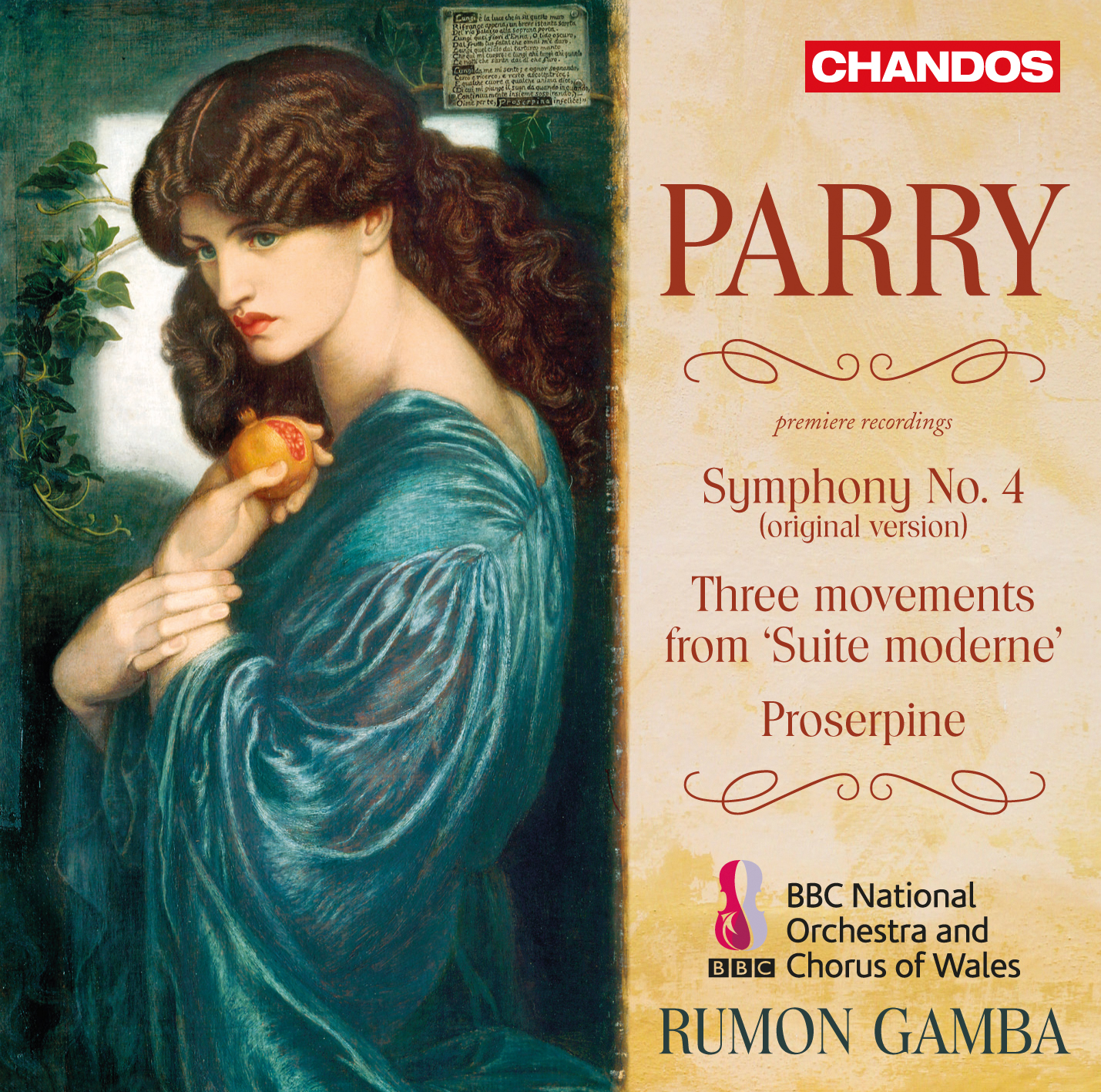
From Chandos, Sir Hubert Parry's Symphony no 4 in E minor ,with Prosperine and movements from Suite Moderne. This performance, with Rumon Gamba conducting the BBC National Orchestra of Wales, is outstandingly vivid, eclipsing Matthias Bamert's 1989  performance, also for Chandos, which remains the only other readily available recording of this symphony.  But what also makes it special is that it is Parry's original version, based on the score conducted by Hans Richter, Parry's great friend, on 1st July 1889.  This performance is so convincing that it makes a case for the original, which critics found too difficult to follow after the relatively sunny Third Symphony.  In 1909, Parry revised the piece extensively, retaining ideas from the first, second and last movements, composing much new material and replacing the original Scherzo in A minor with a completely new movement  in in G major.  We can only hope that Chandos will commission a recording of the 1909 version from Gamba in the future, to enhance the comparison.  Gamba isn't a conductor who courts celebrity, but he's an excellent musician who gets results that deserve celebrity status.

From the first bars, Gamba's attack is forceful, emphasizing the strength of the Doric theme.  The  passage leads to nine other sections, which move swiftly ranging from animato to sweeping largamente, Gamba revealing the tight structure behind the restlessness and constant change in the long development. The brief intermezzo serves as a transition to the third movement marked Lento expressivo with a short interlude between the first and second sections.  Jeremy Dibble, who edited this version, describes its "lyrical pathos" thus : "The diatonic richness of the slow movement's first idea is classic Parry in its treatment of dissonance and sonorous string texture, and the falling sequences and double suspensions of its closing bars seem palpably prophetic of Elgar." (who, incidentally was in the audience for the premiere). "And while the light hearted second subject attempts to assert itself, it is the noble generosity and poetry of the first idea that prevails.". Parry may have amended the Scherzo but its freshness and dance themes led him to re-arrange it for piano duet.   The Finale is dramatic, working out the tension between dance and march, including  "an unexpected and arresting shift to D major at the centre".  The strong theme of the first movement returns in the Finale but the movement concludes with confident assurance. Parry would attach titles to the later revision to symbolize stages in search of self discovery.  His summary was to be "Finding the Way".

Hearing Parry's Symphony no 4 (1889) with three movements from his Suite Moderne (1886)  highlights the composer's progressive ideas.  Initially concieved in symphonic form, Parry uses an Idyll, a moderato in C major in place of a more conventional Scherzo. Yet Scherzo it is, a lively jest, hunting horns and dance figures alluding to Arcadia, followed by an even gentler Romanza as slow movement.  There's something stylishly "modern" (ie late Victorian) in its expansive self-assurance. Significantly, Parry was supportive of Elgar from a very early stage. These two movements were placed between a Ballade (not included here)  and a Rhapsody with three sections in seven and a half minutes, reminiscent of the long development in the first movement of Symphony no 4.  This complements Parry's only ballet Proserpine (1912) for orchestra and chorus, based loosely on a poem by Percy Bysshe Shelley where maidens gather flowers in a sunlit meadow, unaware that Proserpine will soon be kidnapped and forced into marriage by Pluto, doomed to spend half the year in darkness underground. So much for Arcadian innocence !

Please see my other posts on Hubert Parry and on British music. Please join my Hubert Parry page on FB

Saturday, 27 October 2018

Svatý Václav (St Wenceslaus) Czech icon in film

At the Barbican, Sunday 28th October, commemorating the 100th anniversary of the declaration of the Czech Republic, a rare screening of the film Svatý Václav (St Wenceslaus), patron saint of Bohemia.  The film was a grand scale spectacular, planned to mark the 1000th anniversary of the assassination of the King on 28th September 935. Hence two national holidays 28th September and 28th October.  Given that the saintly King Vaclav symbolizes Czech identity in so many ways why did the film fall into obscurity, only to be revived fairly recently ? It's not easily available to buy, so catch the 2010 screening in Prague  (no translation -you have to pay attention !) with the original orchestral score by Oskar Nedbal and Jaroslav Křička,or go to the Barbican where it will be accompanied by singers and musicians from Cappella Mariana, the Prague-based early-music ensemble specialising in medieval polyphony.  

Directed by Jan Stanislav Kolár, Svatý Václav is made in a cinematic style similar to Fritz Lang's saga Die Nibelung (1924) (Please read my summary here) so expect stylized acting and costumes, which in fact have their own non-naturalistic charm.  This suits the treatment, part based on historical fact, part on legend, which, given what Vaclav means to the Czech nation, is even more potent.  The film opens with a shot of a fortified castle on a hill : the home of King Bořivoj (played by the director himself) and Queen Ludmily who are baptised as Christians in 873.  As we know from Lohengrin, Christianity was by no means a given in that era.  While hunting in a forest, Prince Vratislav meets Drahomíra, who rides horses like a knight and throws spears like a hero. She's not a Christian but converts to marry him. When their son Vaclav is born, grandmother Ludmila snatches him away at birth and brings him up properly devout.  Vaclav and his brother Boleslav and sister Přibyslava grow up happily in the castle, built like a stockade from whole logs from the surrounding forests.  People dance, sing and trade with foreign merchants, but Vaclav likes praying before a cross of stone.  Even when he's helping in the kitchen, the boy prays so fervently that he burns dinner.  Not surprisngly Drahomíra, estranged from her children, plots revenge, and Ludmily is strangled to death, with her own scarf.  When he hears of his grandmother's death, Vaclav goes into action against the pagans, banging a giant cymbal as a call to arms. Panoramic shots of knights lined up on ridges above the plains, scores of footsoldiers running through valleys, trumpeters blowing horns that look like mammoth tusks.   

Vaclav also has to battle with Germans, led  by Heinrich der Vogler, whose helmet is emblazoned  with the black wings of an eagle, a metre high.  The Germans are fomidable - proper chainmail, bigger horses, but the Czechs hold their own.  Vaclav is injured, but survives. Eventually he captures Heinrich's son (rather effeminate, in this film) but instead of killing him, restores him to his father in exchange for peace.  The Czech knights are welcomed into the German court and presented with holy Christian relics.  Meanwhile Boleslav is plotting, aided by sympathisers of the old order and Drahomíra's old friend, the giant Košvan.  At a feast in the castle, pipers pipe and dancers make merry. Mead is poured from goblets, but Boleslaw plans to poison his brother. A blind harpist sings a ballad about a King showing his sons that a sheaf of staves cannot be broken, though each staff on its own can break.  When the King dies, the brothers fight and are themselves killed by enemies   Boleslav listens and pours away the poison.  Vaclav raises his chalice and prays.  He embraces Boleslav and leaves.  On the battlements, Vaclav stands alone, in th night breeze. Radmilo, Košvan's daughter, realizes that’s how saintly Vaclav might be. Boleslav is racked with anguish but doesn't stop Košvan's assassins from cornering Vaclav at the gate of the castle and killing him.  A storm blows up, so fierce that the killers are driven away. Vaclav's body rests in state.  Suddenly, the Drahomíra appears and weeps over the martyred Vaclav.  Boleslav is declared King but she blocks his path. "Matko!" he says (mother).  A glowing crucifix appears, like a miracle,  over Vaclav's corpse. Boleslav cries for forgiveness. (I think, I don't read Czech)  Svatý Václav is actually a very good movie, even without  the patriotic and religious context.  Definitely recommended.  

Please also see my other posts on cinema in this period, Czech and Weimar. For example:
 Erotikon - the drama Janacek didn't write
The White Plague - Hugo and Pavel Haas
and lots more on Hugo Haas's later work

Thursday, 25 October 2018

Semyon Bychkov : Czech Philharmonic Orchestra international tour, London


Is the Czech Philharmonic Orchestra entering a new era ?  In London at the start of a new international tour,  Semyon Bychkov, new Chief Conductor, led the Czech Philharmonic in a concert featuring Smetana and Dvořák, with Alisa Weilerstein. This concert was very high profile indeed, attended by the great and the good, as if it were a state occasion, markingb the 100th anniversary of Independence. And indeed it was, since the Czech Philharmonic is unique, with a distinctive persona.  Part of the reason it is so unusual is because its traditions are rooted in Czech culture, from which Czech music has grown, as if language translates into music. The orchestra doesn't frequently tour : if you want to hear them other than on recordings or broadcast, you need to go to the Rudolfinium,  and absorb the whole context.  This, of course, isn't always practical,  and in a digital age, any orchestra's potential audience is world-wide.  So it's logical that the Czech Philharmonic should be reaching out.  Before Bychkov was appointed last year, the announcement stated that the choice would depend on "publiku, nahrávacím společnostem, zahraničním pořadatelům i k ministerstvu kultury".ie the public, recording companies, foreign organizations and The Ministry of Culture. Perfectly valid, since Czech culture and music is a vital part of world heritage.  The question is how this will affect the orchestra's core values and artistic soul. Whatever model the Czech Philharmonic adopts for its outreach should, accordingly, be individual, rather than borrowing from what might work for other orchestras. What we love about the Czech Philharmonic is the very fact that it is not polished or celebrity-focussed. The market should rise to its standards, not the other way around.

Britain embraced Czech music very early on. In 1884, Dvořák himself conducted his Stabat Mater and Symphony no 6 at the Three Choirs Festival. Janáček visited London in 1926, and re-dedicated his Sinfonietta in honour of Rosa Newmarch.  Only ten years later Vítězslava Kaprálová, aged only 22, was invited to London to conduct her own Military Sinfonietta with the BBC Symphony Orchestra, a work which pays direct homage to Janáček, at a time when Czechoslovakia was being threatened by the Nazi regime. The bonds between Czechslovakia and British culture grow deep.  So it was a surprise that the start of this tour should take place in the Duke's Hall at the Royal Academy of Music, with a capacity of only 350, rather than, say, the Royal Festival Hall which seats 3000.  In the US, the Czech Phil is playing Carnegie Hall.  Nonetheless it was an opportunity for students of the RAM to join the Czech Phil on stage and play together : symbolic and educational value, reflecting Bychkov's position as Professor of Conducting, which he takes so seriously that he's conducted the RAM orchestra at the RFH. Thus a suitably festive Overture to Bedřich Smetana's Bartered Bride joyously free.
Bychkov began the Czech Philharmonic's 2018-2019 season in Prague with Antonín Dvořák's Symphony no 7 in D minor op 70, paired with Luciano Berio's Sinfonia but for the start of this tour, complemented it with Dvořák's Cello Concerto in B minor, Op 104 with soloist Alisa Weilerstein, who shot to fame when Daniel Barenboim chose her when he returned to Elgar's Cello Concerto, so closely connected to Jacqueline du Pré.  She's more mature now, and brings that greater refinement to Dvořák : well shaped legato, at turns sensuous and demure, well integrated with the orchestra around her.  The orchestra, though, stole the show, playing with the distinctive timbre that is their trademark : horns that call and breathe without being brassy,  strings that swell and vibrate with genuine emotion, winds that sing as freshly as forces of Nature.  The Adagio seemed to glow, the restraint of the cello enriched by the fullness in the orchestra, but the Finale impressed because it was so thoughtfully shaped.  

A rewarding Dvořák Symphony no 7 in D minor op 70. Again, the characteristic richness and depth of the Czech Philharmoniuc came to the fore : the idiom is in their DNA so to speak. Thoughg this is sometimes called the "London" symphony its impulses are altogether more personal. Interpretation grows through an understanding of the composer and his work as a whole.  Thus the Allegro maestoso unfolded purposefully, its stately progress defined with assurance. Dark as this symphony may be, it's clear-sighted, the destination never in doubt.  A heartfelt coda.  The Hussite hymn theme echoed in the second movement was subtle. It doesn't need over-statement, but it informs the Scherzo that follows the lyrical moments between.  The motif that resembles dance wasn't frivolous, but an acknowledgement of the rondo-like tightness with which the symphony as a whole is constructed.    A very strong Finale, arrived at through an understanding of the structural logic.


Wednesday, 24 October 2018

SOMM Remembrance - Choral music by Ireland Holst Parry Elgar

From SOMM, In remembrance, marking the end of the 1914-1918 war, choral music with organ accompaniment by Ireland, Holst, Parry, Elgar, Fauré and Venables  with the Chapel Choir of the Royal Hospital Chelsea, conducted by William Vann. In pride of place, Sir C Hubert Parry's Jerusalem, so deeply embedded in the British national consciousness that it has taken on new life as an icon of popular culture, adopted and adapted to many different situations. The text, by William Blake, is visionary, but its meaning is subtle "And was Jerusalem builded here, Among these dark Satanic Mills?". For Blake, writing in the Industrial Revolution, the answer was "not yet". "I shall not cease from Mental Fight, Nor shall my sword sleep in my hand, Till we have built Jerusalem in Englsnd's green & pleasant land".  The piece was commissioned by an organization set up in 1915 to raise morale.   The version on this reciording is Parry's original, premiered at Queen's Hall in March 1916, with 300 volunteer singers accompanied by organ, (here played by Hugh Rowlands), not the more famous orchestration made by Sir Edward Elgar in 1922.  The emphasis in this version is on the unison choir, and the balance of male and female voices, an important consideration given that Parry was soon disillusioned by the growing jingoism of the Fight for Right movement and pointedly withdrew his support.  By then the song had been taken up by the Women's Suffrage movement, of which Maude Parry was a member. Parry was delighted, "I wish indeed that it might become Women Voter's Hymn", he wrote, "......and having the vote ought to diffuse a good deal of joy, too."


This Jerusalem is thus positioned between the words from the Bible, and a text associated with the outbreak of the 1914-1918 war.   In Greater Love Hath No Man, Johnn Ireland sets the crucial phrase for solo baritone (Gareth Brynmor John), "that we, being dead to sins, should live unto righteousness". Ireland was writing in 1912, before the onset of war, when the sacrifice meant Christian sacrifice. Jesus died for all men (and women) regardless of place and time.  For the Fallen, reflects the way the message adapted after the impact of war.  The piece was written in 1971 by Dougas Guest (born 1916).  Though much of Laurence Binyon's original is belligerent, Guest, who served in the Second World War, sets only one verse, placing emphasis on the sombre, humbling line the words "We shall we remember them".

Sir Edward Elgar's setting of They are at Rest, to a text by John Henry Newman, is an elegy marking the ninth anniversary of the death of Queen Victoria, while O Valiant Hearts by Charles Harris, a friend of Elgar, is a postwar reflection on loss. I Vow to thee, My country is Gustav Holst's adaptation of Jupiter in The Planets as the anthem. Its serenity links earthly death with concepts of eternal life, on another plane.  Holst's Ode to Death is heard here transcribed for choir and organ (James Orford), as is Gabriel Fauré's Requiem in D minor arranged by Iain Farrington.   Ian Venables's Requiem Aeternum  (2017) completes the set, a timely reminder that death is a part of the cycle of life.
Please also see my review of Earth & Sky - choral works by Ralph Vaughan Willaims, also conducted by William Vann, for Albion Records.

Tuesday, 23 October 2018

Piotr Beczała - Italian and Polish Art Song Wigmore Hall

Piotr Beczała - photo Anja Frora
Can Piotr Beczała sing the pants off Jonas Kaufmann ? Beczała is a major celebrity who could fill a big house, like Kaufmann does, and at Kaufmann prices.  Instead, Beczała  and Helmut Deutsch reached out to that truly dedicated core audience that has made the reputation of the Wigmore Hall : an audience which takes music seriously enough to stretch themselves with an eclectic evening of Polish and Italian song.

The two parts of the programme reflected two aspects of Beczała's artistic persona. As an opera singer, he has sung in Italian, German, French,  Russian, Czech and Polish.  The Italian songs  he chose for this occasion showed the dramatic possibilities in art song - art song for opera singers, vehicles for technique and expressiveness.  The programme began with three songs from 36 Arie di stile antico by Stefano Donaudy (1879-1925), a Sicilian contemporary of Puccini's, which were taken up soon after publication by singers like Caruso and Tito Schipa.  Beczała's crisp diction made Freschi luoghi, prati aulenti sparkle, contrasting well with the darker O del mio amato ben. Followed by  four songs from 8 rispetti by Ermanno Wolf-Ferrari (1876-1948). Although Ottorino Respighi wrote operas, he also composed a substantial body of orchestral and chamber music.  The songs on this programe thus represent an approach to art song which favours the more private, personal medium of voice and piano. The songs of Paolo Tosti (1846-1916)served as a bridge between Donaudy and Wolf-Ferrari and Respighi.

The second part of the programme focused on Beczała's Polish roots. Throughout his career, he has made a point of promoting Poland's rich musical heritage.  He sang The Shepherd in Karol Szymanowski's Król Roger in the 2003 Warsaw production, and has also done many of the composer’s songs for male voice.  For this Wigmore Hall recital Beczała chose Szymanowski's Sześć pieśni (Six Songs), his op  2, completed when he was still a student, aged 18. Significantly, all are also settings of living poets, contemporaries of the composer.  Although Szymanowski was to make his name as a cosmopolitan sophisticate, these songs show that his Polish identity went deep. The texts here were by Kazimierz Przerwa-Tetmajer (1860-1940) . Przerwa-Tetmajer was both a nationalist and modernist, given that Secessionism and Symbolism were forces for renewal, all over Europe.  Each of these poems is brief, but the imagery is so concentrated that meaning is left deliberately elusive. The first two songs, in a minor key, are autumnal, but the strong piano part suggests resolve. In both songs, rise the image of a woman who may no longer exist. With the third song,  We mgłach (In the Mist) the vocal line curves mysteriously, like the mists and streams in the evening cool.  What's happening ? "Bez dna, bez dna! bez granic!" sings Majzner, (No bottom, no bottom, without borders!).  In dreams, the poet hears mysterious voices calling . In the last song, Pielgrzym, the line rises, swelling with hope. "Gdziekolwiek zwrócę krok, wszędzie mi jedno, na północ pójdę, czyli na południe", (Everywhere I turn, from the north I will go south)   Immediately one thinks of the Persian Song of the Night in Szymanowski’s Symphony no 3 and in the Shepherd in the opera Król Roger whose singing changes the King's life.  

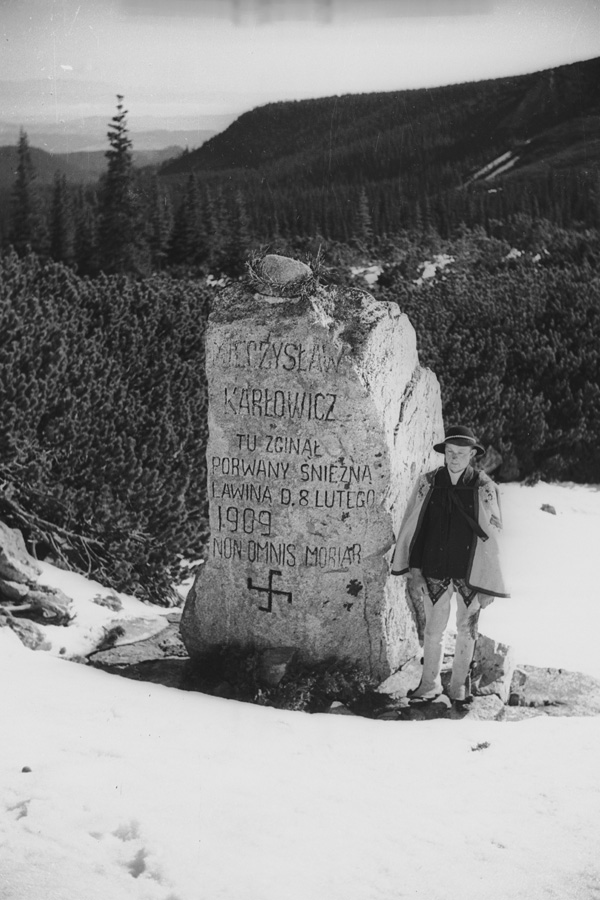
Mieczław Karłowicz (1876-1909) and Szymanowski were influenced by the Young Poland movement, a literary and artistic aesthetic not dissimilar to the Secession in Munich and Vienna, but with specifically nationalist elements.  Pointedly, Beczała and Deutsch paired the early Szymanowski songs with Karłowicz's settings of poems by the same Kazimierz Przerwa-Tetmajer . Indeed, both set the same text,  Czasem, gdy długo na pół sennie marżę (Sometimes when long I drowsily dream) which describes a strange, disembodied voice, heard in a dream. "I do not know if this is loive, or death, that sings" .  The piano part in Karłowicz's version is particularly sophisticated, suggesting perhaps Liszt or Chopin, though the style is distinctiely fin de siècle.  In Na spokojnnym, ciemnym morzu (On the calm, dark sea)  (op3 no 4 1896) the poet imagines sinking into oblivion. "Let me revel in Nothingness".  In recitals, reading the text while listening is not a good idea. You might get the words, but you cut yourself off from nuance and musical truth. Much, much better to concentrate on singer and pianist and use your intuition. Because Beczała and Deutsch are so very good at what they do, intuitive listening was surprisingly accurate.  The moody piano part suggested strange dissonance, and the edge in Beczała's voice suggested psychic anomie. The stillness in  W wieczorną ciszę (In the calm of the evening) (op3 no 8) is ominous.  Again, the poet disassociates from the world. perishing "in the dark emptiness".  The Przerwa-Tetmajer texts are so surreal that they evoke very fine expression from Karłowicz.   Ironically, the composer died young,  killed while skiing in the mountains.

Also from Karłowicz's op 3 are the songs Przed nocą wieczną (Before eternal night) and Zaczarowana królewna (The Enchanted Princess) settings respectively of Zygmunt Krasinski and Adam Asnyk, receiving relatively more straightforward treatment from the composer, but as evocatively performed by Beczała and Deutsch. Beczała has appeared in several Polish operas, including Stanisław Monicuisko's Halka and Straszny dwór  (The Haunted Manor) - please read about that here.  After the intensity of the very beautiful Karłowicz songs, the Monicuisko songs were rather more down to earth.  Monicuisko (1819-1872) reflected an earlier aesthetic than that of Karłowicz : more nationalistic, closer to Smetana than to the world at the turn of the 20th century.  Thus robust songs about sweethearts and spinning wheels, complete with atmospheric piano figures, and Polna różyczka so vividly sung by Beczała  that it was instantly recognizable as a setting of Goethe's Heidenröslein, without needing translation.  Then  Monicuisko's Krawkowiaczek (The Krakow Boy) who fools around but loves only Halka.  For an encore, another wonderful Karłowicz  song The Golden years of Childhood.  "It's my favourite" said Beczała : almost as well crafted as the Przerwa-Tetmajer songs but warmer and cheerier.

Saturday, 20 October 2018

The Amazing Adventures of Leopold Stokowski

Stokowski and Vaughan Williams, 1956
Time to appreciate Leopold Stokowski, whose many merits are obscured by negative reactions to his flamboyant showmanship, his exaggerated Slavic accent and his willingness to have fun with music, making zany transcriptions and appearing with Mickey Mouse in Fantasia.  Toscaninni, no slouch himself at self-promotion, might have been sniffy, but rivalry sometimes plays a part in assessments.  I like Stokowski's transcriptions - at least he was honest, as opposed to conducting his own take on things.  And what's wrong with bringing millions of kids, all over the world, to classical music via Disney ?  At the moment, I am on a Stokowski listening kick, impressed by his dedication to music.  

The name "Leopold Stokowski" was absolutely authentic.  He was registered at birth as "Leopold Anthony Stokowski" in the district of All Souls in Marylebone in 1882,  His father was Kopernick Leopold Boleslaw Stokowski, a cabinet maker, and his mother, Anne Marie Moore,  was born in Northampton.  They seem to have been Church of England. Leopold was a choirboy and, after studying at the Royal College of Music, worked as an assistant to Sir Henry Wolford Davies at the Temple Church in the City.  In 1905, he moved to the US but didn't really lose his English roots, conducting more British repertoire than one might assume. He conducted Elgar's Symphony no 2 in Cincinatti in November 1911 - just six months after its premiere in London, conducted by the composer himself.  New music, hot off the press ! He also conducted the Enigma Variations, and Holst's The Planets, also new at the time, Ralph Vaughan Williams and Walton's Belshazzar's Feast only three years after its UK premiere, when Walton still had the reputation of being avant garde.  All his liife, Stokowski was open-minded, and alert to what was interesting in musical terms, regardless of whether it was popular.   He was instrumental in bringing Charles Ives to prominence, conducting Ives's Symphony no 4, then considered unperformable, even by the composer himself.  He even arranged a nationwide broadcast . Imagine that happening on TV these days, in our supposedly enlghtened times when "intellectual" and  "creative"  are terms of abuse.  Later, his protégé, José Serebrier, recorded the piece in London, using Stokowski's principles of orchestral preparation.  Please read more HERE about the relationship between Stokowski and Serebrier, which endured until Stokowski's death. Just the account of how they met is fascinating. In many ways, Serebrier continues Stokowski's legacy, and desrevs similar respect.

At some stage, possibly under the influence of his first wife, the pianist Olga Samaroff, Stokowski adopted a "slavic" persona.  Samaroff was in fact born Lucy Hildenlooper in Texas, but in those days having an exotic background helped create careers. Whether real Russian or Polish people could see through the pretence didn't matter.  Nowadays such things would trigger counter-terrorist and money laundering systems.  By 1940, however, Stokowski was well established and able to tell the US census that he was British born, though he shaved five years off his true age.  Eventually, he moved back to Britain five years before his death aged 95. He's buried in East Finchley. 

Throughout his life, Stokowski remained interested in music that was innovative and stretched the mind.   Like so many other musicians - Debussy, Stravinsky, Benjamin Britten, Messiaen - he wa fascinated by non-western form and travelled to Asia in 1927-8.  He spoke coherently about Asian music and conducted Aaron Avshalamov's Hutungs of Beijing (1931) in 1935, presumably having met the composer.  Although the piece describes cluster housing in old Beijing, it's not a cultural hybrid but western music with oriental spice, delightful, but not authentic.  About 25 years ago recordings were made of Avshalamov's major works, which I received from a friend who was a neighbour of the composer who returned to the US in 1947.  Much more adventurously, Stokowski conducted the work of Hidemaro Konoye (1898-1973). Konoye was a bona fide Prince, a scion of the Fujiwara Clan, which goes back 1500 years and is closely associated with the Imperial Household. His brother was Prime Minister of Japan.  Konoye trained in Europe, studying with Franz Schreker, Karl Muck and Erich Kleiber. He was a friend of Wilhelm Furtwängler and Richard Strauss, he conducted the Berlin Philharmonic and founded the New Symphony Orchestra of Tokyo (now the famous NHK Symphony).  They made the first ever recording of Mahler's Symphony no 4 in 1930, one of the first to use the then new electric technology.So much for the idea that Mahler was unknown til the 1960's.  Stokowski conducted Konoye's Etenraku (1931) three times in 1935 with the Philadelphia Orchestra. What the audience and orchestra made of it, I don't know, as it is genuine gagaku music, orchestrated for western instruments. Gagaku was an aristocratic genre, heard mainly in court circles, never "populist".  But it is a fascinating piece, listen to a clip HERE, conducted not by Stokowski but by Ryusuke Numajiri. who's probably more idiomatic. Perhaps Stokowski knew Konoye who was extremely well connected. Stokowski conducted in Japan several times during Konoye's lifetime. Konoye, incidentally, was arrested and imprisoned by the US when he was leading a group of Japanese musicians back to Japan after the war, which they'd spent in Germany. Technically "enemy" though they weren't involved in atrocities.