Showing posts with label Berg Alban - Wozzeck. Show all posts

Tuesday, 29 August 2017

Puppets? Yes! Wozzeck Matthias Goerne Salzburg


Alban Berg's Wozzeck  at Salzburg, with Matthias Goerne, with Vladimir Jurowski conducting the Vienna Philharmoniuc Orchestra, at last on medici.tv.  Goerne's done the role many times in the last 20 years or so, so his approach is authoritative, with searing intensity, so expressive that you almost flinch.  But flinch you should, since that's what makes for a good Wozzeck. When my son went to his first Wozzeck, he heard some in the audience chuckling. "What!" he gasped in exasperation, "If you can come out of this opera without feeling  disturbed, there's something wrong with you". For Berg's Wozzeck is the epitome of Expressionist Angst, a psychodrama that unfurls in multi-level complexity.  It is a howling scream of outrage against a system that dehumanizes and destroys all involved.  Not just Wozzeck, or Marie, but the regimented (in every way) world around them.   Everyone in this opera is a puppet of some kind,  manipulated by some unseen, invisible force beyond their control.

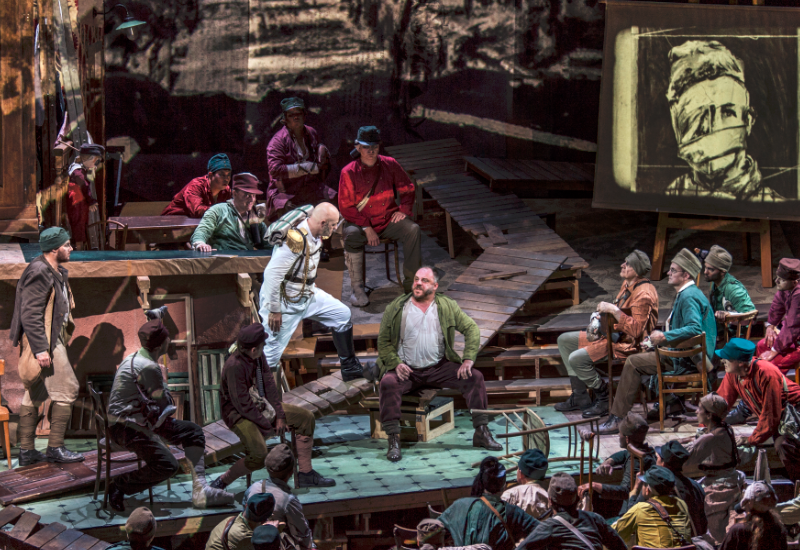
William Kentridge's production was created for the Haus für Mozart, a relatively small, performing space, which must magnify the impact.  On film, however, the physical darkness overwhelms. It's not easy to watch, but well worth the effort because Kentridge's reading is highly perceptive.  The abstraction of the set is disconcerting. It's as if we were within an infernal machine, where things are regulated by clockwork: odd angular planes, horizontals and diagonals, myriad tools and mechanisms.  The Captain is seen, taunting Wozzeck from above.  He's wearing a ceremonial hat and red uniform, his arms waving like a wound-up toy. Gerhard Siegel spat out the words "Haha! Haha!" with maniacal savagery.  So he's not being shaved?  Wozzeck (Matthias Goerne)  is seen bent over, grinding away.  Then you realize why the Captain's cloak is blood red.  Parallel realities, psychological truth.

Berg was writing at a time when psychological theories entranced the public imagination, and cinema was quick to capitalize on its ability to present multiple-level visual and emotional effects.  Berg, a keen movie goer,  incorporated new ideas into his score. The orchestral interludes operate like curtain changes, keeping the action swift even when drastic changes of scene are taking place.  Wozzeck exits whatever room he's been in with the Captain, into a maze of shadows, the path ahead of him narrow and skewed in zig zag form - an image which could come straight from a 20's silent movie.   Suddenly we're in the surreal world of the reed beds, where Wozzeck and Andres (Mauro Peter) are collecting reeds for fuel. The contraptions on their backs are the kind of baskets used by woodcutters in the past, which incidentally resemble straitjackets. Though we don't see the reedbeds, we sense they're there on either side of the narrow path, waiting to suck the men in and drown them. The orchestra growls ominous menace, timpani pounding, the gloom lit by will o' the wisps of high woodwind, suggesting surreal spirits.  Goerne's voice rises spookily from the darkness "Still, alles still, als wäre die Welt tot!"

The orchestra heralds another change of scene:  Marie is glimpsed, alone with her child, here seen as a puppet. And why not? Berg portrayed the child as nameless, unformed without a voice of his own, an observer of horrors who will quite possibly grow up to act out the dehumanization around him all over again.  The puppet wears a gas mask, and the puppeteer the uniform of a field nurse.  It's utterly relevant, since Berg experienced horrors in a military hospital during the First World War. The system was sick, the hospital palliative, not focused on cure.   There are many who object to the employment of a real child in the part, but there's something wrong with the kind of viewer who doesn't want a kid to witness sex.   Why not get angry about the fact that millions of kids grow up abused and neglected in reality all round us?  Perhaps Wozzeck grew up in such conditions. The cyclical nature of Berg's idiom makes it clear that cycles go on, unbroken, like the palindromes in the music.

The Drum Major (John Daszak) fascinated Marie (Asmik Grigorian) and Margret (Frances Pappas) because he seems to embody another, more glamorous world than their own. Yet he, too, is a puppet, strutting and marching in formation.  Though Marie loves her child and tries to amuse him with songs, she can't break out of the pattern of inept parenting she probably experienced herself.   Goerne's voice with its rich depth suggests more warmth and basic decency than the role strictly speaking provides, but this household isn't Happy Families.

Kentridge's staging suggests how Wozzeck seems to live his life struggling between one box and another.  Goerne sits passively while the Doctor ( Jens Larsen) prods and pokes him in the name of crackpot science. "Ah....." sings  Goerne, his voice almost rising to falsetto, suggesting pain and muffled protest.  Interestingly, Marie cries almost as shrilly before she succumbs to the Drum Major.  Moments later, she's singing fairy tales, as if nothing's happened.  The puppet, however, expresses pathos, crumpling into immobility, like a child shutting out trauma.  The Doctor and the Captain converse, but they, too, are in a psychic hell of delusion. Officers, but still puppets acting out roles they can't otherwise fill.  In comparison, Wozzeck is sane. "Man könnte Lust bekommen, sich aufzuhängen! Dann wüsste man, woran man ist!" sings Goerne, but the Captain and doctor think it's a joke.

A momentary glimpse of another puppet-child, dressed in white like the Drum Major, marching while the men in the barracks carouse.  Yet again, Berg contrasts horror with mindless banality: boozy drinking songs and the cry of the Madman  (Heinz Göhrig) the first to sense blood.   Fabulous ensemble singing - Goerne's voice rising above the ghostly sounds in the chorus.  The confrontation between the Drum Major and Wozzeck is brutal, trumpets blazing, staccato percussion, like gunfire. 
Grigorian's tiny, her voice more shrill than most Maries, so in comparison with Goerne, she's like a fragile child.  He towers over her, like a father figure, a chilling image, suggestingb that both of them were brutalized, too, in the past.  Two tiny figures in a vast landscape oif abstract black and grey with flashes of red light, like thunder (in recognition of Berg's original stage directions). The "curtain" falls in a cataclysmic scream in the orchestra, horns ablaze.   But Goerne dominates, in every way, singing with exceptional character, better even than in the past.  "Das Wassser ist Blut ! Blut!"  The Doctor and Captain, yet again, retreat in denial.

Atmosopheric playing from the Vienna Philharmonic, decidedly "more" than a Strauss orchestra. Jurowski's years of experience as an opera conductor pay off well. The harsh dissonance and swirling strings scream horror, yet also elegy.  At last we see some semblance of scenery, but it's not natural. The pool shines, but it's surrounded by broken uprights. Is it a bomb crater filled with rain and mud?  Magnificent, malevolent video projections to match the intensity in the music. One screen shows a figure - neither male nor female - relentlessly walking.  Thus Berg ends with the song "Ringel, Ringel, Rosenkranz, Ringelreih'n!"  It is a round, yet another typically Bergian palindrome. The children's voices sound innocent but the message is sinister.  The puppet child rides a hobby horse, as mentioned in the libretto, but this time, it's made from a crutch.  The children's voices are heard from offstage. "Du ! Deinn Mutter ist tod!" they cry, cruelly. The puppet is truly alone trapped in his own dimension.  He listens, then bends his little head desolate and crestfallen.,  He may be made of wood, but he has more humanity than most of the other characters in this bleakest of operas.
--------------------------
William Kentridge | Stage director, Luc De Wit | Co-stage director,Sabine Theunissen | Stage sets,
Greta Goiris | Costumes, Catherine Meyburgh | Video editor, Urs Schönebaum | Lighting, Kim Gunning | Video operator

Matthias Goerne | Wozzeck, John Daszak | Drum Major, Mauro Peter | Andres, Gerhard Siegel | Captain, Jens Larsen | Doctor, Tobias Schabel | First Apprentice, Huw Montague Rendall | Second Apprentice, Heinz Göhrig | Madman, Asmik Grigorian | Marie, Frances Pappas | Margret
Salzburger Festspiele und Theater Kinderchor, Wolfgang Götz | Chorus director, Concert Association of the Vienna State Opera Chorus, Ernst Raffelsberger | Chorus director

 Vienna Philharmonic Orchestra, Vladimir Jurowski | Conductor

Sunday, 12 June 2016

Wozzeck with brains : Florian Boesch Markus Stenz


Alban Berg Wozzeck from  Amsterdam last week, Markus Stenz conducting, with Florian Boesch, an outstanding Wozzeck. Boesch's characterization reveals great insight. This Wozzeck is far more complex than a nobody, so browbeaten that he becomes more animal than man. That's a perfectly valid approach, and one which lends itself to surprising psychological development. Wozzeck is "the common man" but the common man isn't necessarily mindless, or psychotic (as Wozzeck might well be).  The natural majesty in Boesch's timbre lends itself to a portrayal as powerful as a force of nature.  The intensity in his voice suggests great strength, pressures building up like magma, held in check by hard geological forces. When the tectonic plates fissure, Wozzeck explodes. When he kills, the murder is more to do with himself than with Marie.  At the end we hear "Ringlien, Ringlein, Rosenkranz". Are cyclic forces destined to come round again? Or have we learned through the process of listening, that the insanity of the Doctor and the Captain is an excuse for evil ?

Boesch's Wozzeck is powerful, too, because he can suggest the fragility in Wozzeck's mind, its fundamental fractures audible in the quiet moments as in the outbursts.  When Boesch sings Wozzeck's brief moment of self assertion " Wir arme Leute......Geld ! Geld!", his voice takes on a steely edge though the lines are delivered with leaden resignation.  Even the Captain picks up that Wozzeck is "eine guter Mensch.... Aber er denkt zu viel, das zehrt."   The Drum Major and Marie just act: Wozzeck in his confused way is trapped by his thoughts. Boesch's Wozzeck thinks, for sure, since intelligence is the hallmark of Boesch's style.  He's a man for whom being superficial would be a moral affront.  In the scene where Wozzeck and Andres are cutting reeds in the bog, Wozzeck sees mushrooms.  Boesch sings with rapturous, though strange  beauty: to Wozzeck, the mushrooms are supernatural miracles.

In his own inarticulate way, Wozzeck is an artist, who can intuit things others cannot see. He's loyal to Marie though she's not too bright,  her emotional range limited to formulaic homilies.  The snatches of pseudo folk song and the "jaunty" choruses are there for a purpose, but not, I think, to suggest pastoral innocence.  Perhaps they are Berg's way of saying that "romantic" escapism is a form of servility which fools "poor people" into accepting their lot.  Berg's writing is too precise, and structured so deliberately that the strictness of the symmetry is very much part of meaning.  This music operates like an invisible mechanism, controlling the narrative just as circumstances control the people trapped in the isolated garrison. Hence the tight discipline of Stenz's conducting. The Radio Filharmonisch Orkest play dance with tense, bristling energy. Marches and dances are exercises in formation. Let the momentum slip and things fall apart.

Boesch and Stenz first did Wozzeck together in 2011 in Cologne, from which the photo above was taken (copyright Bernd Uhlig) so there's an electricity between them that animates this concert performance so it feels like drama.  The dynamic is so strong that I hope they'll be doing further full productions.  In Amsterdam last week,  Nathan Berg sang the Doctor, a role he's done before and does extremely well. Berg's voice crackles with menace. His words may seem rational. The character clearly is not.  Thomas Piffka sang the Captain, Asmik Grigorian sang Marie, Endrik Wottrich the Drum Major and Peter Tantsits Andre.

Also available at the moment is Wozzeck from Zurich, conducted by Fabio Luisi with Christian Gerhaher in the title role. Last October, Luisi brought this to London in concert performance, with Leigh Melrose stepping in. Please read my review here. . Luisi was new to Wozzeck, but conducted brilliantly: proof that technical excellence allows great freedom of expression.  The Zurich production has a very good cast (wonderful Doctor/Captain) and a much better Marie) but the staging doesn't help. In principle, the idea is OK : a puppet theatre with the singers as puppets. In practice, that means wooden acting. The singers become caricatured stereotypes.  Gerhaher in particular becomes a cipher. Gerhaher in particular becomes a cipher, the portrayal too anonymous to compensate for a voice which is a bit of the generic side for a role as quirky as Wozzeck. 

Saturday, 3 October 2015

Devastating Wozzeck Fabio Luisi Zurich Opera Leigh Melrose


Zurich Opera brought Alban Berg Wozzeck to the Royal Festival Hall, London . Fabio Luisi conducted Philharmonia Zurich and a very good cast in a concert performance. With all pretence at staging removed (apart from natural good acting)  we could focus on the sheer musical audacity of Berg's writing, and pick up on the processes the music employs to create the drama. Wozzeck describes  a whole community caught up in  insane delusions. Wozzeck is at the vortex,  but his story began long before, and will certainly continue.

Luisi's Wozzeck felt like a tightly twisted knot, building up tensions that reflect the maze-like inner complexities in the score,  What a viscerally physical performance! The orchestra played like athletes, very strong men (and women) pulling the knot tighter with spirited, energetic playing, prickling with suppressed violence. "Eine Apoplexia cerebri" sings the Doctor (Lars Woldt), terrifying the Captain (Wolfgang Ablinger-Sperrhake). Our brains could explode at any time.

In the very first scene, Wozzeck (Leigh Melrose) is shaving the Captain. "Langsam, Wozzeck, langsam". The orchestra zings with the sharpness of a razor.  We know what will happen to Marie. Even more trenchantly, Luisi brings out the details that connect this indoor scene with the wild moor. Wozzeck and Anders (Mauro Peter) are harvesting reeds, another mechanically repetitive process, but Wozzeck sees visions of mushrooms. Luminous string playing, suggesting the surreal unnatural glow. The moon hangs heavily throughout the opera,  aurally present, though only Wozzeck can see it. The Doctor makes Wozzeck eat only beans. The trombones emit bursts of flatulence. The Doctor goes apoplectic when Wozzeck can't contain his natural impulses. "O meine Theorie", Ablinger-Sperrhacke sang with demented glee, spitting out the final word "Unsterblich", so it cut like a knife.  Theories, controls, regulation: the hallmarks of OCD. Luisi showed how the larger scenes with chorus are not "pastoral". The music moved with a kind of mechanical madness. These peasants are dancing like puppets on strings, their minds dulled with alcohol. No wonder the Drum-Major (Brandon Jovanovich) seems, to Marie (Gun-Brit Barkmin), like a vision of finer things. But Luisi makes sure that the music around the Drum Major is pointedly bombastic. Luisi particularly excelled in the scenes where the chorus, soloists and orchestra were all involved, all playing on slightly different levels - subtly but unnervingly discordant.

Leigh Melrose sang Wozzeck with a day's notice. Like Ablinger-Sperrhacke, and Woldt, Melrose is one of the great character singers in their voice types. This makes a huge difference in a role like Wozzeck, whose lines are muted, as cowed and repressed as the character himself. Wozzeck isn't even an anti-hero, he's been so brutalized that he's almost more animal than man. Singing Wozzeck isn't like singing any other role.  Christian Gerhaher was originally scheduled to sing the part. No-one will ever forget Gerhaher's first Wolfram, which glowed with divine purity. Significantly, Elisabeth chose Tannhäuser. Was Wagner making the point that there's much more to art than beauty? "Wir arme Leute"  sang Melrose, in one of Wozzeck's few moments of articulation,  "Wenn ich ein Herr wär', und hätt' einen Hut und eine Uhr und ein Augenglas und könnt' vornehm reden, ich wollte schon tugendhaft sein!"  But poor folks like Wozzeck pee on walls.  Melrose has an instinctive understanding of Wozzeck's almost feral inability to conform to social niceties. His grittiness created a Wozzeck that worked well with Luisi's approach to the opera.

In the final scenes, Berg creates invisible curtains of sound that conceal what we might see on stage, but speak powerfully in abstract sound. Wozzeck is silenced, but  the orchestra screams in outrage. The Doctor and the Captain recognize the sounds as groans, but do not respond. The children tell Marie's son that her body is lying in the open. He can't respond, for his is a silent part. What little we do glimpse of him  lies in what Wozzeck sings about him, and the way the child cowers to escape trauma.  Consider that, when the children go back to their games. "Hopp hopp, Hopp hopp", as if nothing has happened. If you can leave a good Wozzeck unmoved, you become sucked into the cycle of cruelty, like the Doctor, Captain and the cruel children.

This review will appear in Opera Today. Performance photo : Belinda Lawley

Friday, 1 November 2013

Devastating Wozzeck, Royal Opera House 2013

Devastating Alban Berg Wozzeck at the Royal Opera House (2013). I took my (adult) son for a "youth perspective". When we left, he was in a turmoil. "But that's because it was such a good opera", he said, "You can't walk out of that and not be affected".  He got Wozzeck the way Berg would have approved. As Berg himself said, "No one in the audience...... gives any heed to anything but the vast social implications of the work which transcend by far the personal destiny of Wozzeck".

Wozzeck is a stunning Total Work of Art. Those long chords that blast out as Wozzeck dies are  ferocious howls of protest,  timpani pounding the message home. It is NOT right that  people should be humiliated and misused. The Doctor gets pleasure from hurting people, even his erstwhile friend the Captain. "Wozzeck is nuts but at least he's moral", said my son, "but the Doctor is evil, and gets away with it because no-one stands up to him". This opera is so tightly structured that themes interlock and intertwine, moving, as my son said, "like a giant Rubik's Cube". The production, by Keith Warner, with designs by Stefanos Lazaridis, is exceptionally close to the music and meaning  Every detail connects to something in the score. It's an astonishingly perceptive realization. When Wozzeck crawls into the tank and dies, he floats like one of The Doctor's gruesome specimens (incidentally connected to infants and women's diseases). He looks like a foetus in its amniotic sac.

Throughout the opera, the Child (Sebastien Wright) has been a passive observer. "Just like Asbo kids on sink estates", said my son. "No-one gives a darn what they see". He noticed how The Doctor peers like a voyeur as Marie and the Drum Major fool about, brutally. "But Wozzeck", said my son, "He's the only one who thinks it's wrong to let kids see such things". Wozzeck ties the kid to his bed so he won't follow. But the child breaks free, of his own will, and contemplates Wozzeck's corpse. Marie fought back, too. Her own father didn't dare belt her when she reached ten. What do we think when we see her watch what's happened to Wozzeck? Immerzu, immerzu? Or have we learned something in the process? Read a few more of my comments on the staging here and Claire Seymour's review in Opera Today, to follow.

Mark Elder conducted. In 2002, Antonio Pappano gave a Romantic reading, not entirely inappropriate.  In 2006, Daniel Harding nailed the music more idiomatically, with an electrifying mix of passion and horror. Elder is between the two, probably more palatable to people coming new to Alban Berg and scared of modernity, which is perfectly valid. I enjoyed this a lot orchestrally but was less enthused by the uneven quality of the singing.

This present revival boasts an all-star cast, with Simon Keenlyside, Karita Mattila and John Tomlinson, guaranteeing box office success. Wozzeck, however, isn't a star vehicle opera. It's so tightly integrated that  you can't  isolate the singing in the way that you might in, say, Rossini, where arias are interchangeable. Everything predicates on drama and meaning. The values of conventional,opera do not necessarily apply. Less glamour and more gutsiness, perhaps?

Simon Keenlyside has done many Wozzecks, and is technically strong (and physically, too). But he's so elegant and gentlemanly that he doesn't really do the lowdown and dirty, feral side of Wozzeck's personality, Wozzeck's almost more beast than man until after Marie's murder. Suddenly he becomes articulate (though still inept), and starts to reason rather than simply react. Then, Keenlyside's virtues came into play, and he sang in perfect character.

Karita Mattila had divine high notes for "Heiland!" in the scene where she prays. But Marie is rough trade and Mattila is a diva, in the best sense of the word.  Even more so than Keenlyside, Mattila is too  ladylike to get to grips with Marie's animalistic side. Katarina Dalayman, in 2002, created a vibrant, pugnacious and decidedly sexual Marie. Mattila is too poised, and self-aware. John Tomlinson's Doctor was unsteady, his performance redeemed by his acting, and the role itself, which is a tour de force even greater than Wozzeck's. Arguably, though, The Doctor could sound dehydrated. Tomlinson convinced because he showed how the Doctor's soul had shrivelled, cut off from the refreshing life force that keeps the peasants and soldiers going,  Gerhard Seigel and Endrik Wottrich were excellent, but the Captain and Drum Major cannot hold the show. Perhaps the problem was an approach that was too close to operatic mores. Sprechstimme, for example, deconstructs the idea of"good singing"  In Wozzeck it helps create surreal alienation. When it's muted, the impact's lost.

The Royal Opera House choruses are usually superlative, but they could have been less refined and more raucuous. Their folk songs are the embodiment in music of the life force which the Doctor wants to sterilize. Like the Narr (Robin Tritschler) the ditties might sound dotty but they serve an important dramatic function.  Marie and her friends and the dancers in the inn are sustained by their link to a more primitive form of expression. .

But who am I to quibble? As my son said, "Who cares if the singing isn't perfect? It's only part of the story. This opera is fantastic. It works as a whole package". Words of wisdom.

Photos : Catherine Ashmore, courtesy Royal Opera Jouse (details embedded)

Thursday, 31 October 2013

Wozzeck on Halloween - Royal Opera House


"The function of a composer is to solve the problems of an ideal stage director" wrote Alban Berg in 1927. "My intention was to give to the theatre what belongs to the theatre. ….. "No one in the audience, no matter how aware he may be of the musical form….. gives any heed to anything but the vast social implications of the work which transcend by far the personal destiny of Wozzeck. This, I believe, is my accomplishment."

Click here to my review of Berg Wozzeck at the Royal Opera House, 2013. 

Berg knew the technical limitations of stagecraft in his time, but he also knew that, in Wozzeck, he had written something radical that transcended time. For him the opera’s message was paramount : his aim was to confront the audience and make it think. This most cerebral of operas received perhaps its most intuitive interpretation in the groundbreaking Keith Warner production at Covent Garden in 2002, of which is being revived this season. The original production was controversial because it was so thought provoking and challenging. In the last few years its been discussed so often that its insights are now better understood, and the opera’s multi level complexity even more appreciated.   Matthias Goerne, a veteran of four major productions of Wozzeck prior to 2002, and a man passionately intrigued by the opera, created the idea of Wozzeck floating lifeless in the glass cube near the end. It was, as Warner said at the time, a flash of inspiration no director would dream of suggesting. It expresses Berg’s central beliefs so vividly that any new solution to the staging will be haunted by the idea of Wozzeck silently confronting the audience, forcing them to address their complacency.

For who is Wozzeck ?  is he no more than a PTSD squaddie who kills his partner, as in the ENO Wozzeck, a piece of blatant Über-Regie which delighted audiences because it neutralized the darker implications of the story. Or is he just a pawn in a wider game, as Berg suggests ? Wozzeck's not even an anti-hero, but a hapless lout who kills because he can't think articulately. But who are the real villains ? Berg knew about military organizations (and hospitals) from first hand experience.  He didn't admire authoritarian systems. Note how the Doctor wails "O, meine Theorie!". His crackpot theories override science, logic and common sense but no-one questions. Theory above reality! Classic sign of obsessive compulsive disorder, which Berg himself might have suffered from to some extent. All that numerology and those cryptic mazes....;but Berg was "sane" because he could see where real evil lay..

Keith Warner's Wozzeck at the Royal Opera House tonight, is infinitely more perceptive. The stage is clinical, oppressive lights and sterile surfaces. Glass cases contain relics of "normal" life. Wozzeck's visions of mushrooms and organic matter thus take on greater significance.  Here life is neutralized. The Doctor is  a control freak whom no-one questions. The Captain is his enforcer, the men of the garrison fodder for the Doctor's experiments. Thus the Drum Major becomes a symbol of rude, vivid life though he's uncouth. Marie fancies him as a way out of her dreary existence. Wozzeck, trapped on all sides, can only react with violence.

The influence of film on Berg's music can't be under estimated. The Doctor may have origins in The Cabinet of Doctor Caligari (1921) where "madness" must be locked up. But who is the madman - doctor or patient ? When Wozzeck drowns in the lake, many productions depict the scene in red, as Berg suggested, in line with the idea of blood which runs through the opera. On the other hand, Berg was not dogmatic, and in any case, blood no longer flows in Wozzeck and Marie because they are dead. It's enough that the moon is red, and the wate rin the tank is, too. Naturalism isn't essential, as the photo above shows. It's the 1931 production where the set show stylized trees, with "human" faces. The Doctor and the Captain hear Wozzeck's last struggles for life, but deliberately refuse to acknowledge any reality other than their own. In Warner's production, Wozzeck becomes another exhibit in the Doctor's mad scientist laboratory. He floats, apparently lifeless like an embryo in amniotic fluid. It's a powerful metaphor, and also links to the Child, and to Berg's penchant for symmetry.At the premiere, few knew how the effect was created, so felt horrifyingly dangerous - as so it should ! Wozzeck should not offer comfort.

 Wozzeck is an excellent choice for Halloween.  And like the festival, it's a lot more subversive than you'd think.

Tuesday, 24 April 2012

Fantastic ENO season 2012-2013 TOP PICKS

Fantastic new ENO season for 2012/13! The most adventurous in years, totally justifying the Outstanding Achievement Olivier the ENO received for "breadth and diversity" of its programme. This is such an amazing season. Full schedule on the ENO site here. Not all the goodies are obvious! So, my top picks below, with explanations why.

Walt Disney changed the world.  One of the many highlights of the ENO's fantastic new season 2012-2013 will be Philip Glass's The Perfect American, a surreal exploration of Disney's imagination.  Opera is fantasy, so Disney's a great subject. Since there was a lot more to Disney than cartoons, the story could be good. The production is by Phelim McDermott whose brilliant puppets and set made Satyagraha genius theatre. (Read more about that here and here). Walt Disney the opera won't come round til next June, but book as soon as you can. Tickets will be gold dust.

The new ENO season starts with fantasy, too. Bohuslav Martinů's Julietta, based on the Paris Opéra production which Edward Gardner fell in love with. If it can inspire him like that, it sounds good. It's a gorgeous opera, last heard in London with Magdalena Kožená, conducted by Jiří Bělohlávek. (more about it here) Listen to the recordings, and catch the magic. This production's directed by Richard Jones, who won the Olivier Award for best director.

Even more daring - the ENO takes on Ralph Vaughan Williams The Pilgrim's Progress (from 5/11) staged for the first time since its premiere in 1951. It's not an "easy" opera,  and needs a director who understands stylized allegory. The reason that this will be important is the choice of director, Yoshi Oida. Oida is astoundingly sensitive. His Britten Death in Venice was exceptional. (read more here). It ran within a month of the ENO Deborah Warner Death in Venice. Two drastically opposite approaches.Warner's was high on glossy fashion shoot glamour, Aschenbach relegated to the sidelines in every way. Oida's approach was psychological, with Aschenbach foremost, action happening around him and in his mind. Although Aschenbach thinks he's a disinterested observer, in fact, he's caught up in his own fantasies. Oida shows Venice as a mirror of Aschenbach's mind. Claustrophic walls, dank, dangerous waters, a place where everything's nebulous.  Deep in every sense. Exactly the spirit of the music.
 
Oida was chosen to stage Britten in Aldeburgh because his Britten track record is exemplary. Back in 1989 he stunned Aix-en-Provence with his Britten Curlew River. It's preserved on DVD, watch it if you can. He's an inspired choice for The Pilgrim's Progress, which needs a director who understands stylized allegory. Kill for tickets to this, though it will be nothing like the ENO Riders to the Sea which was so literal the music wasn't able to speak. Oida is spiritually as well as musical astute. If anyone can make The Pilgrim's Progress work as theatre, it's Oida. Martyn Brabbins conducts, another reason why this will be a must.

Calixto Bieito? -- the tabloids might scream. Get past the shock value, for Bieito is a very serious director. In his Carmen (from 21/11) he shows the gypsies as marginalized underclass, utterly relevant to modern Europe. In Barcelona (read what I wrote here), it dealt with migrant workers and the "colonization" of Catalunya by foreigners. In London, the focus will shift to more British concerns. Maybe the tabloids will be right. Incendiary stuff ! But these are issues we can't blank out.  Bizet was right on the mark. What's more, Ruxandra Donose is singing Carmen - she's magnificent.

Even more shocking, Peter Konwitschny comes to London! This will have the tabloid mind set foaming at the mouth, especially as he's directing Verdi La Traviata. "My Traviata", he says in the promo video, "is short". And to the point. Ten years ago he did a Meistersinger that confronted the German audience with the implications of the final act. To this day I remember what Tim Ashley wrote then (find it here). Violetta is a strong personality, as she has to be in her profession, but she also trumps Papa Germont at his own game. There are levels and levels in this opera that are rarely touched. Read what Tim Ashley said of Konwitschny's La Traviata in Graz last year here,

The ENO's always been good with baroque. Christopher Curnyn, who conducted an excellent Rameau Castor and Pollux (review here) last year is conducting Charpentier's Medea ifor the ENO in  February, in a new production by David McVicar. Lots of Charpentier around these days, it seems,  and David et Jonathas (William Christie) features in Edinburgh and in Paris later this year. 

More baroque too - Handel's Julius Caesar (from 1/10) in a "fresh, theatrical" new staging by Michael Keegan-Dolan, who brought us the ENO Rite of Spring. He's a choreographer (hence the ballet) so it will be interesting how he makes a Handel opera move. Strong cast - Lawrence Zazzo, Anna Christy and Christian Cumyns, specialist conductor.

Another adventurous new production, Michel van der Aa's The Sunken Garden, in the Barbican Theatre (not the Coliseum) in April.  It's a joint venture between the Holland Festival , the ENO, the Barbican, Toronto and Lyon. Van der Aa's works have been heard in London several times before, so he's not unknown so much as misunderstood as he mixes music and singing with theatre and film. Pierre Audi respects him highly. Together they did a fascinating concert called Liebestod which creatively re-imagined Alban  Berg's relationship with Hanna Fuchs-Robettin (review here). That was conceptual but not too difficult, definitely worth hearing again. If we ever get the chance! The Sunken Garden is an "occult mystery film opera" with Roderick Williams, who also sang in van der Aa's Before Life at the Barbican (see review here) and will be singing in The Sunken Garden.  Roddy, as he's affectionately known, is grossly undervalued. he's easily the first choice English baritone in modern repertoire (and in other repertoire too - remember his Pollux?

Many revivals like the Magic Flute, Don Giovanni, and a new production of Wozzeck in May, conducted by Edward Gardner (no singer details yet). Lots more interesting things to emerge as time goes by.

photos courtesy Getty Images and ENO
photo of Yoshi Oida copyright  Victor Pascal
A more formal version of this will appear soon in Opera Today

Tuesday, 18 May 2010

Hugues Cuénod sings Wozzeck

......or rather, The Captain. And in Italian. But once you get your head around Tito Gobbi as Wozzeck, you appreciate Cuénod's hyperbright singing. This Captain really is lit by the "unearthly glow of madness", preternaturally high pitched and brittle. Listen to that machine gun staccato ha ha ha. The laugh of a psycho.. This Captain is madder than Wozzeck, madder than the Doctor, but he holds a position of authority and orders others about.  It's Rome, 1954, and Cuénod is only 52, in his prime.

Tuesday, 13 October 2009

More Wozzeck Keenlyside Salonen South Bank

Two more reviews of last week's performance at the South Bank with Keenlyside, Dalayman, Salonen and the Philharmonia. These two dovetail, focusing on different aspects of the event. Please read HERE and HERE. Musically, though, the performance was brilliant !

Friday, 9 October 2009

Salonen Wozzeck Keenlyside - first thoughts


Alban Berg's music is so visual that a semi-staged performance of Wozzeck could be a great chance to watch the music unfold. Under Esa-Pekka Salonen, the Philharmonic Orchestra played vividly, as if inspired by the patterns, fogs and mazes in the music. Their performance was exceptional: better almost than the stunning Gurrelieder earlier this year (Read about that HERE and HERE), especially part 2 as the CD is out now)

Wozzeck demands great orchestral forces, so the singers were squashed into barely a metre between the orchestra and the Royal Festival Hall's platform edge. Since so much in Wozzeck relates to being squashed, marginalized and oppressed, it might have been possible to turn disadvantage to good dramatic effect. Perhaps that was asking too much as this production, directed by Jean-Baptiste Barrière, wasn't much focussed on meaning or, for that matter, on the opera itself.

Behind the orchestra was a huge screen on which a kind of film was projected. Berg and cinema go together well, as I've written many times on this site, but form is not enough. Had the projections been properly designed the idea might have worked. Instead we had a random series of oil on water transparencies, purposeless colourwashes transposed on soft focus close-ups of the singers. It's a psychedelic trip, but to where? A red orb fills the screen in the third Act, representing the red moon, but it has little dramatic impact in context with what has gone before.

The action takes place in a garrison, cut off from the real world. Why? Berg hated the pettiness of military discipline. The army in Wozzeck represents illogical rigidity, rules that mean nothing in themselves. It doesn't actually matter what the men wear, what matters is how the idea is conveyed. These soldiers looked worryingly comfortable, like public schoolboys in casual dress. Simon Keenlyside's natural elegance and grace is just too civilized for Wozzeck, no matter how well he sings the role. He's capable of fully inhabiting a role, given the right direction, but here he wasn't called on to be anything "but" Simon Keenlyside in khaki chinos.

Katarina Dalayman has created the role many times, so we know she's capable of making Marie a complex and intriguing personality. Here she wasn't called on to fill out the dramatic demands, so her characterization was featureless, through no fault on her own.

Margret (Anna Burford) was dressed like a Sloane, hair perfectly combed with diamante band. Maybe the costume is supposed to say something but it's not clear how it relates to what we know of her in the libretto: she's sassier than Marie, which is maybe why she wears scarlet but everything about her hair and demeanour say otherwise. Again, a good singer not called on to show her true mettle. Similarly, Peter Hoare as the Captain and Hubert Francis as the Drum Major could have been supported by dramatic direction equal to their vocal abilities. As for Hans-Peter Scheidegger's Doctor, there's more to the part than a rictus grin and a stethescope.

In the end. Marie's child appears immaculate in emerald green silk pajamas. He enters following a processsion of children (much older than himself) dressed in black, like a cortege. This sudden formalism contrasts with what's gone before. What does it mean? Are the silk pajamas meant to suggest a different future for the boy? We don't really know, but from the score, it's clear he's in a difficult situation,. A visual image needs to be supported by other things. In the absence of anything to reinforce what the silk pajamas may suggest, chances are the boy will end up just like Wozzeck, "Ringel, ringel Rosencranz": Berg's indicating a ring, a circle, repetition.

While Berg is portraying disordered minds, his music isn't disordered or disorganized. Indeed, what gives it its power is the tension between extreme order and wildness, between OCD-type compulsiveness and derangement. Semi-staging can be powerful, since concentration increases intensity. This was more decor than drama and might have overwhelmed but for the tenacity of the singers and the superb, uncompromising brilliance of Salonen and the Philharmonia. Indeed, they were playing so vividly, that you could hear how well Berg characterizes solo instruments, the soloists functioning like individuals in a drama of sound. Plenty of "opera" in the orchestra to watch if you want.

Subsequently, I've been wondering about why, given that this concert was the last in the Vienna City of DXreams series, why they didn't choose a designer with a track record in Viennese theatre history ? Vienna 1900-1930 (the theme of the series) was a time of major innovation in theatre arts and design - Alfred Roller etc. -but this seems to have been completely overlooked for whatever reason. What a lost opportunity this series has been, in the sense that it could have been genuinely informative and enriching. Musically, though, Salonen and the Philharmonia delivered the goods.

The performance was recorded and will be broadcast on BBC Radio 3 at 7.00pm on Thursday 15 October. Do listen! Please also read about aboutt the Wozzeck film from Hamburg which I wrote about earlier. These are "first thoughts" though, written after a long, hard day. HERE is the final version, written for a stage oriented readership in Opera Today.

Tuesday, 6 October 2009

Wozzeck the movie Hamburg 1970

This filmed version of Wozzeck is unique. In the 1960's Hamburg State Opera had an ambitious project, combining top quality art film with opera. The resulting films were shown on TV but it wasn't a huge financial success and the experiment wasn't repeated quite in the same way. But now we have DVD and the films have come into their own.

There isn't anything quite like this Wozzeck, filmed like a proper film noir, outdoors and on location in the North German marshes. No way can any opera staging even dream of bringing this level of reality onto the stage! Yes, because this is art film it's not literal but extremely poetic. Mists hang over the marshes, you can feel the penetrating cold and damp, just like in the music. When the singers sing, their breath turns to steam, like the enveloping fog around them.

The fields where Wozzeck and his friends cut reeds are real reed beds, geometric rows that stretch without end. This connects in a very deep way to the opera, where Berg makes so much of formula, patterns, obsessive theories and crackpot alignments. The film brings alive the mix of strict rigidity and distorted, awry angles that the music expresses.

The town, too, comes alive in an amazingly vivid way. It's shot in a genuine old garrison town, but not in a flat literal way . The town looms out of nowhere from the flat plains. It's built like a crazy maze, with ramparts, odd staircases, streets that curve and twist: all cramped and jumbled. We know it's an old fort, but when the Captain and the Doctor scuttle through rtiginous angles, their crazy world comes real. Again, the music expressed as visual image.

Marie's hovel is simple, bare, mould on the walls. Somehow she's turned this hole into a home. No wonder the earrings represent things she never dared hope for. Filming also allows intimate close-ups: the kid becomes a real person, not a cipher, which is important to the meaning of the opera but can rarely be realized on stage. for practical reasons. And the soidiers and tavern scene - Berg's patterns choreographed!

Berg's "curtains" of music are played against extremely powerful images. On the marsh, land and water blend : no firm ground. The murder takes place against a backdrop of blackened trees, reflected in the water. It's like a complex, abstract pattern, another of the crazy mazes, even though you know that these are real trees, real water, real light.

Then the final scene which has defied dramatization since the opera was written,. Berg suggested that a red light might rise from the ground, but he himself recognized that future directors would find better ways of bring the music and ideas to fulfillment. Here, we're back in the maze of marshes where nothing is quite what it seems. Wozzeck runs along a path overhung by menacing branches, like claws reaching out at him. Then he walks into a clearing, where light draws him intio the water. He shouts "Blut ! Blut!"but as the text clearly states, he's there to wash it away. The Doctor and the Captain approach in the fog. When they turn away, the music rises over shots of the marshes, the earth, the bare branches of trees and into the sky before returning to the water. Fantastic, shoicking panorama, to match the music. And in the end, the kid runs round in circles on his little toy horse "Hopp, hopp". It's gut wrenching.


This film - and others in the series - prove that realism does not mean literal. The scenes may take place on location, but they're interpreted through the camera so they match the music and emotions. The whole series is available now in a boxed set, better value than getting the films as they were released earlier individually. Toni Blankenheim is a wonderful Wozzeck, looks the part - he can really act. Marie is Sena Jurinac, Gerhard Unger and Hans Sotin are Captain and Doctor. In small roles are stars of the future - Kurt Moll and Franz Grundheber! It's conducted by Bruno Maderna, extremely well, better than the singing I think. Artistic Director was Rolf Liebermann and director for film Joachim Hess. This DVD is worth getting because they don't make opera movies quite that way anymore.