Showing posts with label Britten - Paul Bunyan. Show all posts

Friday, 7 September 2018

Still misunderstood : Britten Paul Bunyan ENO


ENO Studio Live at Wilton's Music Hall for Benjamin Britten Paul Bunyan in a new production.  Please read Claire Seymour's review in Opera Today. Nearly 80 years after it was written  this opera is still beyond the comprehension of many. Forget the folk story altogether : "From homespun culture manufactured in cities, Save us, animals and men"  W H Auden's not being arch.  If we don't see "homespun culture manufactured in cities" for the sham it is, we don't deserve anything more than fake and kitsch.  It's origins are more Weimar political cabaret, a genre which W H Auden and Christopher Isherwood knew first hand, and which Britten understood.  The nearest precedent is Brecht and Weill's Threepenny Opera. Paul Bunyan is not a musical. It is episodic because it depicts a society where attention spans aren't long enough to take on big ideas, or see the bigger picture behind the show.  Paul Bunyan is savage, biting satire, a wail of protest against materialism, vulgarity and the desecration of precious ideals.  Paul Bunyan doesn't appear in the opera for a very simple reason: he's a myth !  Larger than life, he represents an ideal that can never perhaps be attained.  It isn't about America at all, and attempts to present it one-dimensionally trivialize it, creating the very banality it so passionately abhors. The clumsiness of some of the musical writing in Paul Bunyan is in fact artistic licence. Parts of the piece sound corny because what they depict is corniness. Perhaps Britten is demonstrating the truth in Auden's phrase "From the accidental beauty of singalongs, Save Us, animals and men".

Paul Bunyan needs to be understood on its own terms and in the context of Britten's creative development.  It connects first and foremost to Our Hunting Fathers, premiered in May 1936, written when Britten was only 23, a work which still suffers from the hysteria unleashed against it in some quarters.  Our Hunting Fathers is a work of striking originality.  The text for "Hawking for the Partridge" is by Thomas Ravenscroft (1588-1635), Two other texts are anonymous, from the same period, and the rest are W H Auden , one adapted by him from an earlier source.  Like Elgar's Sea Pictures, there's nothing specially unusual in mixing texts, as Britten was to do in other works, including The War Requiem.  In the case of Our Hunting Fathers, the mock Tudor casing serves as a disguise for intense anguish.  Again, Auden's experiences in Weimar Berlin are relevant.  He knew only too well what the rise of Hitler meant, and where the conformity of mob rule and militarism could lead. Significantly, the cycle was completed after the Nuremberg Race Laws were promulgated (September 1935). Our Hunting Fathers represents one of the very few early protests against the Nazi regime.  Britten's pacifism ran deep, and from a very early age, and went far beyond his connection to Auden.  Paul Bunyan, like Our Hunting Fathers is cryptic code. The messages repeat in non-vocal works like the Violin Concerto and Sinfonia da Requiem. And in the less stellar Ballad for Heroes (read more here)
If Paul Bunyan isn't a hymn to kitsch Americana, what is it? In the opening chorus, the singers sing that the Revolution has turned to rain. Management/staff relations in the logging camp are better organized than in many real life businesses. Britten and Auden were well aware of Brechtian  dialectics and the political music theatre of their period, and this has some effect on the stylized, almost agit prop narrative. However,  Paul  Bunyan springs from a much deeper groundswell of pain and disillusion. Britten, Pears and Auden left Europe, hoping to find a new world uncontaminated by the strife of 1930's Europe. Britten's sojourn in America was comfortable, but he picked up on the darker sides of the America Dream. In Paul Bunyan, ancient forests are felled, the wood used for houses and railway tracks. "Progress" moves further west, and with it, conformity, gentrification and hypocrisy. "From patriotism turned to persecution, Save Us, animals and men". Peter Grimes and Billy Budd describe the fate of men who fall foul of bigots and mobs. Britten, Auden and Pears were well aware how J Edgar Hoover was hunting down "subversives". McCarthy's witch hunts would have come as no surprise. Like Peter Grimes, Paul Bunyan and Babe are too big for their boots in a world where pettiness rules.
So, what of the ENO Paul Bunyan ? Please read Claire Seymour's review in Opera Today HERE. As she says, it doesn't appear to deal with the savage irony that is so central to the piece.   Maybe the world still isn't ready for grown-up thinking.  It took the London media a long time to to get Mark Anthony Turnage's Anna Nicole.  Although Paul Bunyan was written for students, I think it either needs students with political nous and passion (no longer a given these days) or a professional cast and team.  It's not just the quality of performance that counts but the commitment behind it.  One Paul Bunyan that did work was the English Touring Opera production which came to the Linbury in 2014. Please read my review of that HERE.

Friday, 21 February 2014

Britten Paul Bunyan ETO Linbury London review

The English Touring Opera's Paul Bunyan.makes an excellent case for Britten's most misunderstood opera. When it premiered in 1941,  audiences couldn't figure it out. If anything, modern audiences are even less likely to get Paul Bunyan, accustomed as we are to gung-ho feelgood depictions of Americana, such as Rodgers and Hammerstein's Oklahoma!, Aaron Copland's  Appalachian Spring, cowboy movies and TV. "From homespun culture manufactured in cities, Save us, animals and men"  HERE is a link to Claire Seymour's exceptionally penetrating review, in Opera Today. She wrote The Operas of Benjamin Britten, tye standard reference.

Paul Bunyan is a heroic myth, not reality. Fundamentally the piece isn't about Americana at all, and attempts to present it as such only damage its reputation.  Paul Bunyan needs to be understood on its own terms and in the context of Britten's creative development. Fortunately, the ETO production minimizes kitsch and maximizes meaning.  A professional cast is used, lifting standards way above well-meaning amateur earnestness. Conducted by Philip Sunderland, the score is revealed in all its gawky glory but without mawkish easy laughs. Liam Steel directs, using a set designed by Anna Flieschle where the  human qualities of the opera come into greater focus. The "Trees" in the Prologue were shown as simple planks of wood. The Blues Singers aren't camped up, nor are the hard-working labourers in the camp trivialized by being dressed up to look like animals.

Sunderland also doesn't indulge in cute for its own sake. Here, we could hear snatches from Peter Grimes in embryo, such as the slithering snake-like bassoons, and the way lines stretch along the range of voices in the chorus.  The all-important "wood dove"theme was played with suitable menace. Just as Siegfried is led into the forest by a wood dove, we  in the audience are being beguiled, led into a forest of dreams. Britten employed this Siegfried/ Wood Dove imagery in his The Sword and the Stone (1939), written for children. (read more here)  In Paul Bunyan, he resurrects it for grown-ups, with even more punch.
 
This being a "numbers musical" with a big cast, the kind of character development we might expect in normal opera doesn't really happen. But there is enough innate pathos of roles like Hel Helson and Johnny Inkslinger to give the opera depth. Superlative singing and acting from Wyn Pencarreg and Mark Wilde respectively, expanding the parts with utterly convincing dignity. We feel Henson's pain as he's taunted by nightmares mocking him for being less than a Nordic Hero. Henson doesn't articulate, but Pencarreg can express much more than is in the text. Helson is a counterpart to Paul Bunyan (Damien Lewis) both of them men from a different, more primeval era. Tiny (Caryl Hughes),  Hot Biscuit Slim (Ashley Catling) will move to Manhattan and Johnny Inkslinger to Hollywood, but Paul, Babe the Blue Ox (imaginitively depicted by a man under a blue blanket), and Helson don't belong in a polluted, commercialized world.

All the numerous cameo parts and choruses were deftly sung and blocked, keeping the pace lively even in the Second Act where the inventiveness in the music starts to pall  Britten had written "popular music" such as the Cabaret Songs (to poems by Auden) so satirical pastiche came easily to him. The many numbers like the Lumberjacks Chorus, The Quartet of Swedes, the Cook's Duet and Tiny's Lament rattle off cheerily but in such profusion the second half of the operetta starts to feel forced. For all its faults, Britten learned a lot from Paul Bunyan. The Christmas Party, for example, suggests the feast in Albert Herring, a much bleaker opera than most realize (read more here). The clumsiness of some of the musical writing in Paul Bunyan is in fact artistic licence. Parts of the piece sound corny because what they depict is corniness. Perhaps Britten is demonstrating the truth in Auden's phrase "From the accidental beauty of singalongs, Save Us, animals and men".

If Paul Bunyan isn't a hymn to kitsch Americana, what is it? In the opening chorus, the singers sing that the Revolution has turned to rain. Management/staff relations in the logging camp are better organized than in many real life businesses. Britten and Auden were well aware of Brechtian  dialectics and the political music theatre of their period, and this has some effect on the stylized, almost agit prop narrative. However,  Paul  Bunyan springs from a much deeper groundswell of pain and disillusion. Britten, Pears and Auden left Europe, hoping to find a new world uncontaminated by the strife of 1930's Europe. Britten's sojourn in America was comfortable, but he picked up on the darker sides of the America Dream. In Paul Bunyan, ancient forests are felled, the wood used for houses and railway tracks. "Progress" moves further west, and with it, conformity, gentrification and hypocrisy. "From patriotism turned to persecution, Save Us, animals and men". Peter Grimes and Billy Budd describe the fate of men who fall foul of bigots and mobs. Britten, Auden and Pears were well aware how J Edgar Hoover was hunting down "subversives". McCarthy's witch hunts would have come as no surprise.  Like Peter Grimes, Paul Bunyan and Babe are too big for their boots in a world where pettiness rules.

Paul Bunyan is a stylized vision of  "a Forest, full of Innocent Beasts. There are none who blush at the memory of an Ancient Farm, None who hide beneath dyed fabrics a Malicious Art ".

"It is a Spring morning without benefit of young persons. It is a sky that has never registered weeping or rebellion.............It is America. But Not Yet. 

WANTED: Disturbers of Public Order,. men without foresight or fear 

WANTED:  Energetic Madmen, those who have Thought Themselves a body large enough to devour their dreams 

WANTED: The Lost, those Indestructibles whom Defeat can never Change. Poets of the Bottle, Clergymen of a Ridiculous Gospel, Actors who should have been Engineers, and Lawyers who should have been Sea Captains. Saints of Circumstance, Desperados, and Unsuccessful Wanderers and all who can hear The Invitation of The Earth. America, youngest of her daughters, awaits the Barbarians in marriage"

photos Copyright Richard Hubert Smith

Cast List : Conductor Philip Sunderland, Paul Bunyan Damian Lewis, Jonny Inkslinger Mark Wilde, Hel Helson Wyn Pencarreg, Tiny Caryl Hughes, Hot Biscuit Slim Ashley Catling, Sam Sharkey / Andy Anderson Stuart Haycock, Ben Benny Piotr Lempa, Fido Abigail Kelly, Moppet Amy J Payne, Poppet / Moon Emma Watkinson, Western Union Boy Matt R J Ward, John Shears / Blues Singer Adam Tunnicliffe, Cross Crosshaulson / Farmer Matthew Sprange, Blues Singer / Crony Johnny Herford, Blues Singer / Crony Henry Manning, Jen Jenson / Crony Maciek O’Shea, Pete Peterson Simon Gfeller, Goose / Wind Hannah Sawle, Goose Lorna Bridge, Goose / Heron Annabel Mountford, Blues Singer / Squirrel, Helen Johnson Beetle Susan Moore, Young Tree / Boy Emily-Jane Thomas

Thursday, 13 June 2013

Britten, Paul Bunyan and the Idea of America

"It is a Spring morning without benefit of young persons. It is a sky that has never registered weeping or rebellion.............It is America. But Not Yet. 

WANTED: Disturbers of Public Order,. men without foresight or fear 

WANTED:  Energetic Madmen, those who have Thought Themselves a body large enough to devour their dreams 

WANTED: The Lost, those Indestructibles whom Defeat can never Change. Poets of the Bottle, Clergymen of a Ridiculous Gospel, Actors who should have been Engineers, and Lawyers who should have been Sea Captains. Saints of Circumstance, Desperados, and Unsuccessful Wanderers and all who can hear The Invitation of The Earth. America, youngest of her daughters, awaits the Barbarians in marriage"

Announces the Narrator in Benjamin Britten's Paul Bunyan, the opera Britten wrote in America. The words ring out with the false theatricality of a "Wanted" poster in the Wild West. The words are framed by a woodwind melody that might evoke birdsong in a virgin forest. But note its sour tone. This is no Wood Dove. Paul Bunyan may not know fear but he's no Siegfried.

Paul Bunyan is a curious beast. Sometimes it sounds like a parody of a Broadway musical, even less rugged than a Hollywood western. The rhyming couplets are deliberately faux-naive. Britten is Tourist in the Redwoods.  He's not even attempting realism. America, or the idea of America symbolized by the Paul Bunyan myth, meant something different to him from the America that surrounded him when he went there in April 1939, before the outbreak of war, when Britons still believed that Chamberlain could hold Hitler at bay. Britten haters use his sojourn in America to attack him for being unpatriotic, ignoring the fact that he returned at some danger to himself and joined the war effort in other ways than by fighting. So what was Britten searching for when he went to America?

Paul Bunyan isn't a very good opera. Indeed, it's perhaps the worst music Britten ever wrote, even taking into account his juvenilia. But it is worth studying to give insight into Britten's creative development.  For years I've been praising Our Hunting Fathers, arguably Britten's first great masterpiece. It's so raw and passionate that it's hardly surprisng that its premiere in 1936 was met with polite incomprehension. The good burghers of Norwich weren't ready for That Sort of Thing. So, in America, Britten tries to engage with the ideal of America as Arcadia The hokiness is artistic licence. Paul Bunyan is a stylized vision of  "a Forest, full of Innocent Beasts. There are none who blush at the memory of an Ancient Farm, None who hide beneath dyed fabrics a Malicious Art ".

Britten didn't find that nirvana in America. He suffered a debilitating illness of some kind, almost certainly connected to creative and psychological turmoil. Almost certainly it was not merely physical, nor, as Paul Kildea suggests, the onset of syphilis. Significantly, Britten resolved the crisis when, in Escondido, California, he read George Crabbe's The Borough, and rushed back to Aldeburgh and to Peter Grimes.

Please see my other pieces on Britten. More Britten on this site than anywhere else, and original stuff too !

Thursday, 6 June 2013

Multiple Britten this week

The Aldeburgh Festival starts this weekend, and of course, is packed with Benjamin Britten . He never intended it to be a festival about himself and certainly not a festival of "British music" but in this his centenary year, we should be pushing out the boat. Or perhaps I should use different terms, in view of Peter Grimes....

See HERE for my summary of this year's Aldeburgh Festival. The highlights are important although this year some of the performances are geared towards the "Britten industry". On the other hand, Britten believed that music should be accessible, so perhaps the "anniversary year" side effects might not be as negative as they too often are.

Peter Grimes opens the Aldeburgh Festival on Friday and Sunday at the Maltings, Snape. Steuart Bedford heads a worthy cast. Claire Seymour, who wrote the standard reference book on Britten's operas will be reviewing for Opera Today. She's very astute. Keep reading! Friday's concert is being broadcast live  on BBC Radio 3 at 7.15.

Much more unusual will be  Peter Grimes on the Beach, a unique realization of the opera enacted outdoors, on the beach at Aldeburgh. This could be very good, as open air performances have been a feature at Aldeburgh for many years, and they know how to do these things well. That's not til 17th June, around when the Church Parables will be heard.

This week's Britten actually started last night at The Guildhall School of Music and Drama with Owen Wingrave. GSMD productions are always lively and Owen Wingrave is the kind of opera students can really get their teeth into,. Should be good. Further performances on 7th, 10th and 12th.

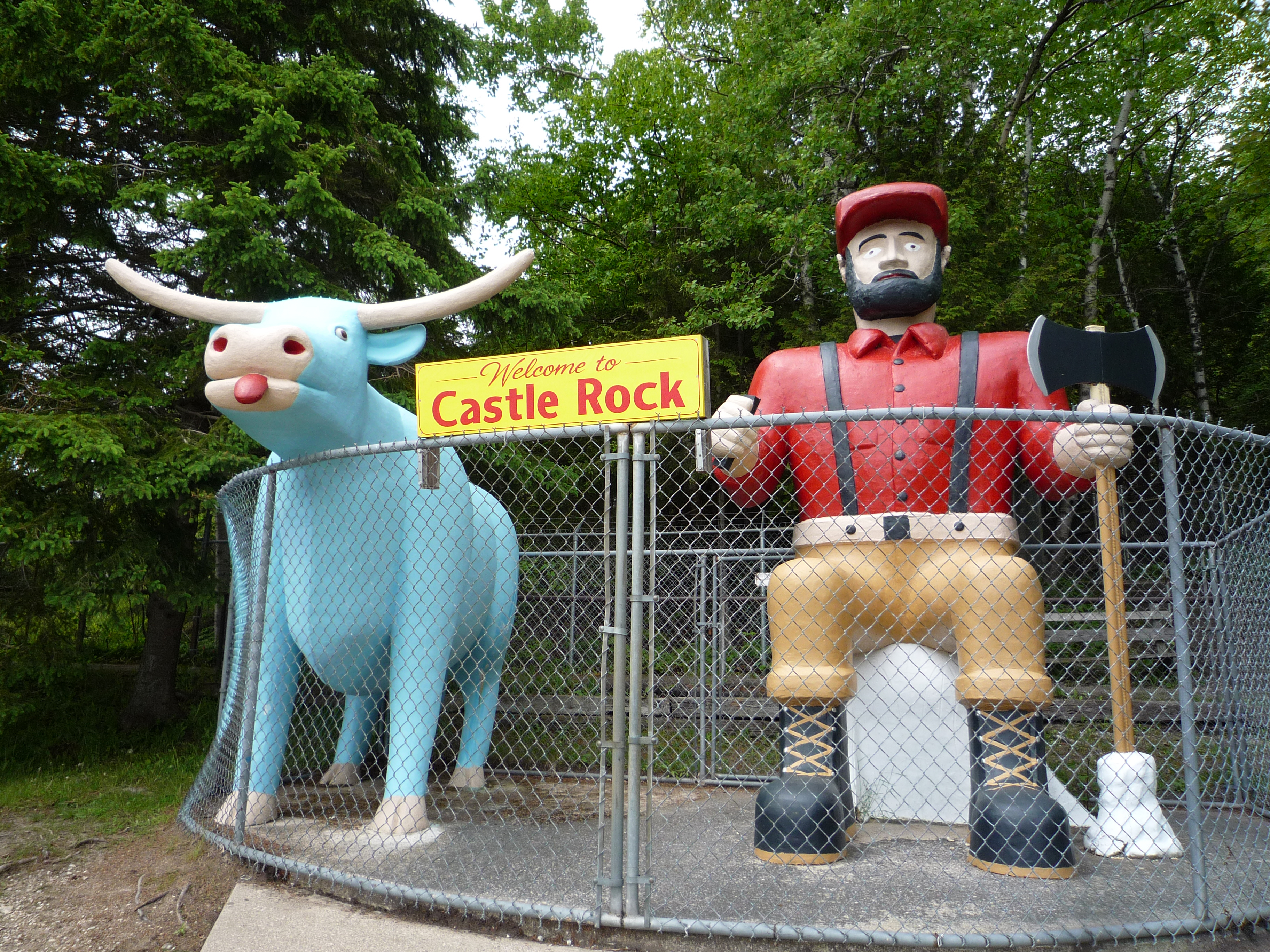
Today, Paul Bunyan on BBC Radio 3, available online for a week. This is conducted by Richard Hickox for the Royal Opera House in 1999, when ROH used Sadler's Wells for medium sized productions. The photo above (by Ellin Beltz) shows Bunyan and Babe the Blue Ox in the Bunyan park in Klamath, California. See the man in the corner to get a idea of size ! The park is nestled within a forest of giant Redwoods, so you really feel the grand scale of nature. My son went when he was a toddler, and raved about it for months.