Showing posts with label Audi Pierre. Show all posts

Sunday, 4 May 2014

ENO Thebans Julian Anderson scores for English opera

The English National Opera's Julian Anderson Thebans at the Coliseum, London, absolutely justifies the ENO's mission: opera, in English, and of national significance. Anderson is one of the most influential figures in modern British music. He's always written with a distinctively "visual" personality, translating concrete images into abstract music (Read my article Julian Anderson - visual composerThebans may be his first official foray into formal opera, but he's been heading towards it for years.

"Is this a contemporary opera?" asked someone in the audience. A good comment, since "isms" are irrelevant to art.  Greek tragedy is universal because it deals with concepts that transcend time and place. Its very power comes from abstraction.  Frank McGuinness's text distils the essence of the drama in a spartan (oops) way Anderson can tell the story through his music. Orchestrally, Thebans is so vivid that  I closed my eyes during the First Act to better absorb how the drama was being told by  the orchestra, and the interplay between orchestra and voices. Massive towers of sound suggest the relentless Fate that will destroy Oedipus and his issue. Pierre Audi's staging, with Tom Pye's designs,  reflects the music extremely well.  Strong horizontals against towering verticals giving form to the structure in the score. The choruses are very well blocked, their movements reflecting the movement, and the tension in the music. Towers filled with rock loom over the stage: Antigone, Oedipus's daughter, will be entombed alive in an insane, sterile parody of the womb of the Earth.

Edward Gardner conducts with savage but tightly controlled ferocity. Gardner chose Anderson's Symphony for his high-profile Barbican concert nearly ten years ago, tellingly combined with Walton's Symphony no 1.  He understands Anderson, and his place in British music. Gardner shows how Anderson's textures are created.  Gardner is wise to expand his portfolio and seek further challenges in orchestral repertoire. He could perhaps be the "British" conductor of choice, with a new, distictive approach.

The powerful blocks of sound that create such impact are not crude monoliths  but built up in  carefully delineated levels of density. Anderson knew Gérard Grisey and Tristan Murail. He knows how microtones operate. I also thought of Harrison Birtwistle, specifically  Earth Dances, where tectonic planes of sound are shaped by layers of smaller fragments.  Birtwistle's syyle is strikingly organic, as if it grows naturally from great depths. Audi's staging again reflects this musical concept. In the Second Act, The Future, lights shine through the towers of rock, highlighting the invisible gaps behind solid objects (probably styrofoam). The lights suggest fire, perhaps volcanic forces rising from the bowels of the planet. Antigone defies oppression. She is the "light" that leads Oedipus who has gouged out his eyes.

The Second Act, which tells her story, is exceptionally well written, worthy of being staged on its own as a stand-alone. A second interval after a 20 minute act would normally kill an opera, but in this case feels necessary: you need to escape the intensity. The writing for the choruses is also very good indeed. Anderson sings in choirs himself. Like Greek choruses, Anderson's chorus pronounce judgement. From way up at the top of the auditorium, the choruses explode, augmented either in numbers or electronically: the effect is overwhelming, yet the voice types are not muddled.

In this powerful Second Act, music and visuals glow black, white, indigo, red and gold. This intensifies the desolation at Colonus, the portal of Death. The music becomes sepulchral. At times I caught echoes of plainchant. The devastaion is all the more harrowing because we have just seen how the curse on Oedipus outlasts his death.

Roland Wood sang Oedipus. He has been unwell for some weeks, so we didn't hear him at full capacity, so all the more respect to him. I hope he doesn't harm his voice by pushing it for this premiere, important as it is. Julia Sporsén sang Antigone. Lyrical beauty doesn't necessarily come into this role, so Sporsén created the strength in the part well. Peter Hoare's Creon was superb, helped by the oddly sensual passages Anderson writes for the part. Creon's monolgue in Act Two is disturbingly enticing. Anderson also uses countertenor for good effect, so Christopher Ainslie singing connected to baroque style while also suggesting the surreal intervention of Theseus.  The whole Oedipal saga  circulates around Jocasta, though she's swiftly despatched fairly early on.  Anderson gives Susan Bickley a good aria, and Audi's costume designer Christof Hetzer further illuminates the past by dressing her - alone - in royal blue.

Thursday, 2 May 2013

Powerhouse ENO 2013/14 season analyzed


The Powerhouse fights back! ENO's 2013/14 season suggests we're back to the days when the ENO was London's edgiest opera house. Ten productions new to London next year- that's around one every three weeks. How can they manage that? By linking up with the liveliest houses in Europe, and bringing in the sharpest talent. This is the kind of creative vision that could kickstart a new Powerhouse era.

One huge coup - Pierre Audi! Audi returns at last to London  after 30 years. This is major news because Audi transformed British theatre in the 1980's with the Almeida Theatre. A whole generation has grown up not realizing how radical the Almeida years were, and how it sparked off the ENO's finest years. Peter Brook, David Hare, Harrison Birtwistle, Mark-Anthony Turnage, Steve Reich, the London Sinfonietta: everybody but everybody was part of the buzz. Audi went on to run De Nederlandse Oper,  and later The Holland Festival. His 1999 Amsterdam Wagner Ring is still one of the most striking productions ever. Amsterdam is one of the most exciting music places in Europe and admirably managed, too.

Audi is directing the world premiere of Julian Anderson's Thebans, a saga based on Greek tragedy with a libretto by Frank McGuiness. A brief piece from the Thebans, "Harmony" will be the first item on the First Night of the BBC Proms 2013. Anderson was himself a singer and writes music that's very visual. Anderson's a Proms regular, both on stage and in the Arena. In May 2007, Ed Gardner conducted Anderson's Symphony at the Barbican, in his first high profile concert after being appointed ENO Music Director. So expect good things from the ENO Thebans, and book tickets early though it doesn't start until May 2014.

Here are the other new productions :

Beethoven Fidelio, (from September) directed by Calixto Bieito. whose very name strikes terror into the hearts of those who think that only they know what the composer intended. Yet those who really engage with his work realize that it is quite reasonable. Bieito's Carmen, for example, in a watered down version for British audiences, was a big box office success at the ENO -- one of the big hits of the ENO last November, (reviewed  here and here) which proves ENO audiences are smarter than the reactionary crowd think. Bieito's Fidelio  was first done in Munich in 2010 with Jonas Kaufmann. We'll get Stuart Skelton, who's good and  the production is well worth seeing. Bieito's "prison" is a labyrinth of the mind - click photo to enlarge. Despite his reputation for bums, Bieito is a very deep thinker with a strong politcial conscience, ideal for an opera like Fidelio, which is not meant to be pretty.

Johann Strauss II Die Fledermaus (from September). This is a joint production with the Canadian Opera Company. Here's a link to the COC website with many photos. It looks off the wall! But lots of fun, which arguably is what Strauss II was on about. The director is Christopher Alden, who says "Fledermaus will be fun! It’s a famous, beloved piece and not just because of the totally brilliant and inspired music or that it’s a frivolous New Year’s Eve entertainment, but it’s a wonderful story with great characters and situations.......... It has a lot to say about society, relationships and marriage".

Mozart The Magic Flute, (November) directed by Simon McBurney, whose Complicité brought us A Dog's Heart (reviewed here) which was such theatre-of-genius that the music didn't matter. With Mozart, McBurney has much more to work on. You need magic in the Magic Flute, and Complicité does magic better than most.  This is a co-production with De Nederlandse Opera, Amsterdam, and the Aix-en-Provence Festival : excellent credentials.

Verdi Rigoletto (February 2014), also a Canadian Opera Company production directed by Christopher Alden. It's set in Verdi's time, not Renaissance Mantua, but those who rage that this isn't "historical" should remember that if contemporary stagings were good enough for Shakespeare, they should be good enough for anyone else. And the Met's Las Vegas Rigoletto didn't cause the skies to fall. Another big plus on this one is Quinn Kelsey, the best of all American imports the ENO has brought us. He sang in the original, so should be well settled by the time the show reaches London.

Handel Rodelinda (February). This is major news, because it's the first product of a new relationship between the ENO and the Bolshoi. London gets first dibs. This is the first ever Handel Opera for the Bolshoi, which is quite remarkable, but they'll be getting the best:  Christian Curmyn conducts, and the cast includes John Mark Ainsley, Iestyn Davies and Rebecca Evans. Director is Richard Jones.

Mozart Cosi fan tutte (May 2014) will be done in English because it's the ENO, but not in an ordinary translation. Instead, it's a new text by poet Martin Crimp (Into the Little Hill, Written on Skin). This will be moving on to the Met in NY, which has had a partnership with the ENO for several years (Eugene Onegin and less successfully Two Boys). Ryan Wigglesworth conducts, Katie Mitchell directs.

Berlioz Benvenuto Cellini (June 2014). The ENO is making a big splash with this because it's Terry Gilliam. Presumably the Monty Python crowds will lap this up and box office receipts will clear what's left of any deficit. His Damnation of Faust was entirely based on himself, rather than the opera, the music or composer, yet was wildly popular, proving that self indulgent "Regie" is loved by the masses as long as they don't have to think or listen. .

Bizet The Pearl Fishers (June 2014). Not, strictly speaking, entirely new, but revamped to make more of the breath-taking sequences where bodies "swim" bathed in undulating blues and greens. I loved this production (directed by Penny Woolcock) first time round and would be thrilled to see it again. This time, Sophie Bevan sings Leila, so even if we don't get Quinn Kelsey again, it will be worth hearing, too.

Thomas Adès Powder Her Face (April 2014). New production, new performance space. Joe Hill-Gibbons directs this modern chamber opera classic in AMBIKA P3, a space for contemporary art at the University of Westminster, "converted from the vast former subterranean concrete hall of the School of Engineering, Baker Street". Photos show exactly that, but I can well imagine the story set in that context. The Duchess did not do worse than the men around her yet the society around her was brutal and rigid. The ENO has been using alternative performance spaces outside the Coliseum for years, and for very good reasons: some operas are better suited to smaller scale. If only the Royal Opera House could find a middle sized external theatre and retire the Linbury for all but the smallest shows! 

Jonathan Belper composer/Matthew Barney director River of Fundament. This is based on Norman Mailer's novel Ancient Evenings, describing the journey of a soul after death, a subject which probably lends itself best to a film/music theatre project.

REVIVALS ! Back by popular demand, classic and much loved productions of Philip Glass's Satyagraha (which I want to see for the fourth time), Puccini Madame Butterfly (Minghella) and  ,  Britten Peter Grimes (the luminous David Alden production and the return of Stuart Skelton))

Statistics: the ENO announced financial figures that show the company to be in better shape than the doomsayers would have.  I hope so, because the ENO is critical to the cultural good health of this country. What it does is unique. It also links London to what's happening internationally, which is good long term.. Also good news is that schemes like Opera Undressed have brought in new audiences, a large number of whom planned to come back again.  This year's new scheme is a sort of "ticket lottery" where you're guaranteed a £20 ticket (in the gods) but might get lucky and be upgraded to somewhere in the orchestra stalls (usually £100 plus).  It's a much better business model than selling tickets off for a song at the last moment, and reminds us in the audience that we can't take cheap seats for granted.

Wednesday, 6 February 2013

Bullseye ! Rossini Guillaume Tell Amsterdam


Giacomo Rossini's Guillaume Tell hits the bullseye at de Nederlandse Opera in Amsterdam! Here is a link to the review by Jim Sohre in Opera Today. Pierre Audi directs - always a sign of intelligent stagecraft. "With a visually beautiful and dramatically honest staging, Netherlands Opera has made as compelling a case as I would imagine possible for Rossini’s grand opera Guillaume Tell. For starters they have gifted us with a cast that could hardly be bettered (and vocal excellence is always a great place to start)."

Nicola Alaimo sings the title role, and John Osborn  sings Arnold. Osborn sang the role in  London in a concert performance in 2011 (reviewed HERE )

"Guillaume Tell is a co-production with the Metropolitan Opera, whose public generally likes their scenery Alpine-kitschy and cuckoo clock ‘realistic.’ At this Dutch premiere at least, the audience embraced and cheered this striking and original imagery, totally winning stagecraft, and top tier musical execution."

Read more about Rossini's Guillaume Tell (which I adore) HERE (Full download with libretto) 

Saturday, 13 October 2012

Welsh National Opera British Firsts

Five year series of "British Firsts" at the Welsh National Opera, starting summer 2013, thanks to a £2 million gift from the Getty family, (who are also connected to Garsington Opera at Wormsley)

David Pountney, WNO's Chief Executive and Artistsic Director, says "This series gives us an extraordinary opportunity to re-engage with contemporary opera writing and to transform our perceptions of new music. We hope to dispel the misconception that modern opera is either moribund or incomprehensible to our audiences."

" Nothing could be further from the truth. There is a massive amount of creative energy in the artform and new works are constantly being created all over the world. we can enjoy modern music and modern opera as part of our normal cultural life, just as we enjoy modern cinema, television, books or fashion. It will open the doors to the landscape of the new."

Exciting news, which should shake things up, but nothing dangerously radical. Two of these operas are well known, albeit not in full UK productions.  Jonathan Harvey's Wagner Dream (scheduled for summer 2013) was first heard in 2007 at De Nederlandse Opera. Pierre Audi directed: best possible premiere. When it reached the Barbican in London in January 2012, (semi staged), it was the hottest ticket in town, generating much excitement. Colin Stuart Clarke, a Jonathan Harvey devotee, wrote a thoughtful review for Opera Today, more sympathetic than most. "The vast stretch of Harvey’s available compositional resources was impeccably utilised. Tonal sections made great effect (a lullaby, for example) and yet did not jar in the slightest, instead appearing as just one element in the composer’s palette. The music shares with Wagner’s an ability to take the listener out of temporal time into the composer’s expanded time, and, as with Wagner, the time spent experiencing this piece seemed somehow telescoped, as one became intimately involved with the events and their musical realisation. One one level it felt as if we had been there years; on another, it was a mere moment."

In 2017, WNO will be doing Unsuk Chin's Alice in Wonderland. This, too, was premiered in 2007, in Munich. It was screened at the Barbican London last year. The DVD has been available since 2008. Just as Alice was curious, the opera is curious. Absurdity and silliness can mix well, as Lewis Carroll showed. Chin is highly regarded in some circles, but I felt Alice was too self-indulgent as opera, but was wholly redeemed by Achim Freyer's direction. Alice wears a huge mesh head and meets other giant talking heads-in-boxes. A new edition of the opera was prepared by British composer Lloyd Moore for a US production in 2012. I'm not sure which version we'll hear in Cardiff, but I'm hoping for a tighter orchestration.

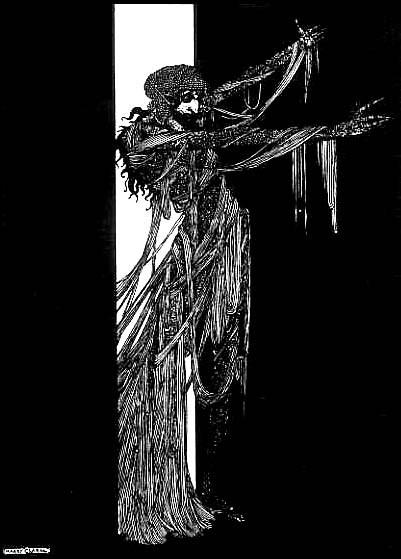
More intriguing might be the Edgar Allan Poe double bill directed by David Pountney in 2014. Claude Debussy’s unfinished one-act opera The Fall of the House of Usher has been orchestrated by Robert Orledge, using additional material from sketches left by Debussy. It will be heard with Gordon Getty’s Usher House. Both will be presented in San Franciscxo in 2015. The picture right is Harry Clarke's illustration from an early French edition of Poe's poem.

Quietly under-publicized is Richard Ayres' Peter Pan, planned for 2015. Ayres (b 1965) is a significant British composer but better known in mainland Europe - which is so often the case. Peter Pan is a joint commission between the Komische Oper Berlin, Stuttgart Opera and WNO, which indicates its potential. Peter Pan might well be the surprise hit among these "British Firsts". We shall hope!

photo credit : Thomas Duesing

Saturday, 19 March 2011

Berg Lyric Suite decrypted - Audi, Amsterdam Sinfonietta Barbican

This wasn't just another concert. It was Liebestod, a truly unique exploration of Berg's Lyric Suite. Berg's piece is a compelling work, whose mysteries were only revealed about twenty years ago when the composer's letters to his lover Hanna Fuchs-Robettin were released. Both were married, and the relationship was fraught with secrecy. Berg's letters are so expressive that they lend themselves well to staging. Hence Liebestod, created as a Gesammstkunstwerk in its own right by Pierre Audi and Janine Brogt for the Amsterdam Sinfonietta and ECHO, the European Concert Hall Organization.

Berg was obsessed by cryptic messages, numerology and ritual patterns. Cross-references are planted everywhere as clues, both musical and literary. Audi's Liebestod is a surprisingly effective navigation aid through Berg's psyche. It looks backward to Berg's formative influences, and forwards, towards a new synthesis betwen music and abstract film in Michael Van de Aa's Up-close (2010)

Berg saw parallels between his love for Hanna and Wagner's relationship with Mathilde Wesendonck and Wagner's creative sublimation through Tristan und Isolde. Doomed love, redeemed only through death or art. Berg is so specific that he uses the Tristan chord in the Lyric Suite as a deliberate hint at its deepest meaning. Audi doesn't simply preface the Prelude from Tristan und Isolde but uses an arrangement for an all-strings chamber orchestra (Adrian Williams). The music's familiar, but heard in a new way. Textures are starker than in full orchestration but this sharpens the sense of strangeness. The ensemble churns, adrift of its orchestral bearings, but that expresses the sense of psychic dislocation which connects to Berg's other music, like Wozzeck and Lulu.Now you can really hear the first violin (Candida Thompson) calling out to the first viola. When the Tristan chord appears, it seems distorted as if heard in a dream. Yet the relationship in the notes is the same, it's the instrument that's changed. We're in Berg territory as much as in Wagner.

The actor Jeroen Willems emerges on stage as the last notes of the Prelude fade into the beginning of the Lyric Suite. He hums the music, making the connection seamless. He holds a wine glass, a reference perhaps to Berg's song cycle Der Wein and also the "Wine of the Solitary" Berg reads of in Baudelaire. He quotes Berg directly. "Have you noticed that our initials intertwined are also the first and last notes of the Tristan theme? Hanna Fuchs and Alban Berg, HFAB...B-F-A-B flat." Then you hear the viola play it and the meaning is painfully clear.

Again, it's the Lyric Suite but not quite as we're used to. This time, instead of four instruments, it's arranged for larger forces (partly by Berg himself in 1928, the rest by Theo Verbey in 2005). This balances the intensity of the spoken passages and emphasizes the extreme "madness" Berg speaks of. Words and music intertwine, too, though the music isn't as abstract as might seem. "Darling Dodo is there in the pulsating C-C of the viola, Munzo in a motif with a Slav tinge...". You could read Berg's letters and listen to an ordinary performance, but in Audi's Liebestod the effect is dramatically vivid.

The extracts are also extremely well chosen and presented with musical insight. It covers Berg's fascination with numbers and secret portents, the course of the affair, and the significance of the quotation from Zemlinsky's Lyric Symphony. Publicly, Berg dedicated the Lyric Suite to Zemlinsky, but privately he made it clear that the real dedicatee was his "Distant Beloved" (yet another cross-reference). Then, when you hear the quotation in the Adagio appassionato in movement 4, it's strikingly poignant. "Du bist mein Eigen", unspoken and unstated.

"But you must understand that this music is in a ceaseless process of becoming, never 'is'", writes Berg. Just as Berg absorbs Wagner and creates something of his own, so his music inspires others. Michael van der Aa's Up-close experiments with images of mirrors, distorted and converse. The soloist, Sol Gabetta, plays her cello yet also interacts with the actress in the film. The actress, Vakil Eelman, looks like Gabetta from behind, but when she turns round, her face is haggard and etched. It feels like she's carrying the "madness" of ages, which Berg spoke of. Van de Aa's music murmurs and wails, like the forest Eelman is seen wandering through. A modern day Ewartung? Eelman copies what looks like a periodic table, and operates a strange machine whose purpose is unclear. A symbol not so much of mad science but the kind of emotional alchemy obsessives like Berg adopt to order their lives.

As stand alone music Up-close would work quite well. It's more coherent than After Life last year at the Barbican, But hearing it outside the context of Audi's Liebestod has a purpose. What Van der Aa is doing is integrating music and visual images in a deliberately provocative way. Music is supposedly "abstract", but as Berg has made clear, worlds of allusion and meaning can be embedded within. Film is usually more explict, but Van der Aa's film is non-explicit, in the way dreams are. Clues eveywhere as to meaning, but deliberately no answers. You're thrown back, once again, to the Lyric Suite and to Berg's mysterious conundrums. You're disoriented, because you've lost your bearings. And you're back to the beginning of Liebestod too, adrift on an ocean of strange emotions, and back to the spirit of Berg's music.

PLEASE go to Bachtrack for a formal version of this review. Bachtrack is a wonderfully useful interactive source of performances live and in the cinema, in the the UK, in Europe and the US.