Vladimir Jurowski's programme at the Royal Festival Hall proved that intelligent musicality can reach people as well, if not better than, the celebrity gimmicks so popular these days. Jurowski simply stood in front of the audience, speaking in a quiet voice. "This programme is about the dignity of those oppressed and the triumph of the human spirit". (or words to that effect). The concert should be heard, he suggested, as a whole entity culminating in Beethoven's
Fifth, rather than a series of disparate parts.
We all know Beethoven. This was a new challenge, to listen through colorations filtered through a new context, and to develop our own sensitivity to the issues involved. Conceptually, this was sophisticated. Conventional wisdom assumes that "ordinary" people are too stupid to respond to new ideas. Thus the obssession with celebrities, dumbing down and "explaining" things in over-simplistic terms. It's counter-productive. "A little knowledge is a dangerous thing", goes the saying, for it inoculates people with prejudices. Instead, Jurowski treats audiences like sensible people who can listen for themselves and draw their own conclusions.
Thanks to the generosity of Deutsche Bank, who sponsor tickets for those who don't normally go to concerts, there were a lot of people in the audience for whom this was a new experience. Would they be scared off by Schoenberg? Fortunately they hadn't swallowed the myth that Schoenberg is too "difficult" though he's been dead 60 years. Many of them responded to what Jurowski said, and listened with fresh ears, experiencing the "mega-symphony" as a response to universal human conditions. That, all said and done is what music is. All the fuss made about clapping between movements, appropriate dress, youth participation etc is sideshow. Concerts are not about behaviour or social function, but about music, above and beyond all. Everything else falls into place as long as you listen.
This audience was most definitely listening, and emotionally engaged from the start. It wasn't relevant whether they knew
Fidelio as opera or not. It was sufficient that they realized that
Fidelio is about political prisoners. Listening to the drama in the music, they could use their own imaginations. The performance didn't matter so much as the way it stimulated the audience to think about human suffering. Most of us, thankfully won't have to live through that first hand. Ultimately that is the purpose of art: to make us more sensitive, and make us think of lives othetr than our own.
Wisely, Jurowski chose three items in the English language for the core of the programme, so the audience could understand without filter. Lord Byron's poem, on which Schoenberg's
Ode to Napoleon is based, uses florid, impenetrable text. References like "Corinth's pedagogue" and "Thou, Timur, in his captive's cage" are closed to those without a classical education. But then dictatorships are opaque, so it's psychologically true. Schoenberg sets the text unadorned, recited in quasi
Sprechstimme, in this version with string orchestra and pianist (Catherine Edwards). Robert Hayward conveyed meaning through the intensity of his gestures.
Schoenberg's
A Survivor from Warsaw is much more visceral because it's so direct. "
I cannot remember everything....." intones the narrator. "
But I have no recollection how/ I got underground/ to live/ in the sewers of Warsaw/ for so long a time". Jurowski moderates his natural tendency for lyricism with stark angular rhythms, intensifying the psychic dislocation of this extreme situation. Hayward is an opera singer but the art requires the intensity of an actor. He obviously knows German, but the shouts of the Nazi guards are better delivered with more bite. Jurowski gets the LPO to create savage staccato. temi almost spinning out of control as the guards march the men off to the gas chamber. You could analyse this music in terms of serial rows, but it works just as well to listen emotionally, hearing the repetitions as manic obsessive. Structural form serves musical feeling. The Gentlemen of the London Philharmonic Choir had been seated behind the orchestra all evening. Now they rose and the chorus "Sh'ma Yisroel" exploded like a miracle, transcending the grimness that had gone before. This is the "
grandiose moment when they all started to sing as if prearranged, the old prayer that they had neglected for so many years".
Luigi Nono's
Julius Fučík was semi staged (Annabel Arden) which is valid, for it connects to Nono's opera
L'Intolleranza. This simple staging referenced the photographs we've seen of the 1961 production. Above the orchestra, a projection of a cloister which seems curiously serene given the subject. Fučík was a Communist, arrested and murdered by the Nazis. Scraps of writings he made in prison were collected after his death and published as
Notes from the Gallows. Ironically, Fučík's oposition to one form of totalitarianism was co-opted by another. The book received saturation coverage in Communist circles. Yet the reason the book is so powerful is perhaps its message of hope.
An anonymous Voice (Malcolm Sinclair) dominates at first, the orchestra oppressively brooding. Surprisngly idiomatic playing from the LPO. I'd never thought of Jurowski as a Nono conductor, but he approaches this music with instinctive passion. Then, quietly, Omar Ebrahim as Fučík takes control. No matter how he was humiliated, Fučík was not destroyed. "Winter prepares man for its rigours as it does a tree". If a man loves life, he cannot be diminished even if he's beheaded. "Remember me, not with sorrow, but with precisely that joy with which I always lived". Ebrahim barely has to raise his voice, so powerful is his characterization. Now the image of the cloister makes sense. Read more
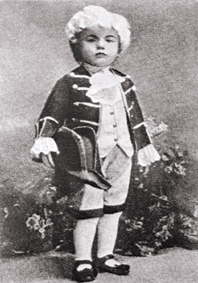
here about what I've written about Julius Fučík, including a baby picture)
From out of Nono's
Julius Fučík the famous first bars of Beethoven's
Fifth Symphony arise. The power of this symphony can be dimmed by over-familairity, but how it shone here in the context of Jurowski's programme! The driving tempi, the scurrying whips of string and brass, absolute confidence in certain triumph. The symphony can bear many different interpretations, but here Jurowski brought out its energy and vigour - the spirit of human dignity that triumphs over all odds.
photo credit Roman Gontcharov, IMG