Showing posts with label war. Show all posts

Friday, 14 February 2020

On the 75th anniversary of the bombing of Dresden - Dresdner Requiem - Rudolf Mauersbeger


Dresden Kreuzchor in the ruins of the Kreuzkirche, August 1945 (Bundesarchiv)

As dawn broke seventy-five years ago, the people of the City of Dresden woke to scenes of unimaginable destruction.  On 13th-15th February 1945, 1300 British and American bombers unleashed some 4000 tons of incendiary bombs on the City of Dresden.  Tens of thousands were killed outright, hundred of thousands more displaced, their lives changed forever.  Though the city was a transport hub, its destruction wasn't simply strategic. Its annihilation was symbolic. Saxony represented German culture at its finest, not just Dresden alone but Leipzig, Meissen, and the  wider region. Architectural treasures, literature, history and music. Ultimately it wasn't just Dresden that suffered but world heritage. Heinrich Schütz (1585-1672) was a Dresdner, during the Thirty Years War, protected by the Court of Saxony.  Bach lived and worked in Leipzig : not for nothing that he was championed by Mendelssohn, who conducted the Leipzig Gewandhaus Orchestra and by Robert Schumann, born in Zwickau.  Wagner was born in Leipzig and found early fame in Dresden. Richard Strauss was remembering the opera house and the Staatskapelle Dresden in his Metamorphosen. Many things we should not forget, but we remebering Dresden makes us value so much of what has been lost, not to be retrieved.

The number of first hand witnesses is shrinking fast. Peter Schreier died at Christmas.  During the war years, the boys were safe in lodgings outside the city but were, understandably, frightened. In December 1944, Rudolf Mauersberger (1889-1971), for decades the Kreuzkantor of the Dresdner Kreuzchor, wrote his Weihnachtszyklus so they could sing and cheer themselves up. Please read my article about Schreier and his importance in the continuation of vocal traditions which emphasize emotional and spiritual engagement : always more challenging, intellectually, than "market forces". Rudolf Mauersberger's Dresdner Requiem RMWV 10, 1947 revised 1961.  Mauersberger (1889-1971) was, for decades, a driving force behind the Dresdner Kreuzchor, deeply immersed in its musical heritage, so the Requiem is a heartfelt cry of anguish. I've been planning to write about it for years, but it's too painful, but maybe now I must confront it.  There are clips of Schreier singing the part in 1949 (see below) but the best known full recording was made in the Lukaskirche in October 1994, Matthias Jung conducting the Dresdner Kreuzchor.  The orchestration is deliberately spartan, in the Lutheran tradition, with organ and celeste and percussion (bells sounds, knocking wooden sounds, drum rolls), restrained trumpet and winds.. It was issued to mark the 50th anniversary of the bombings, with a dedication written by Roman Herzog, the President of the Bundesrepublik Deutschland.

Introducing the Dresdner Requiem is Mauerberger's Wie liegt die Stadt so wüst RMWV 4/1,part of the Chorzyklus Dresden, first perfomed in the bombed out ruins of theKreuzkirche in August 1945- see photo above, where the audience is standing, wrapped in heavy coats. "How lonely sits the city that was full of people.....From on high He sent fire into my bones He made it descend. Is this city, which was called the perfection of beauty, the joy of all the earth? "  On this disc, it's followed by a brief sound recording of the great bells of the Kreuzkirche ringing in their glory. Heard together, they're very moving.  The Dresdner Requiem proper starts in a relatively conventioibal liturgy - an introit, antiphon, psalm and antiphon, but the use of three choirs, one at the altar, another "echo choir", at a distance, and a third Hauptchor (tutti) for deeper resonance gives the piece spatial aspects which intensify meaning. Interplay is significant, too, between larger and small sub groups, and the plaintive alto soloist, between older and younger singers, suggesting constant change and spiritual searching.  In the Kyrie, the choirs call en masse for mercy but the Epistel introduces a more personal theme : "I heard a voice from Heaven saying.....Blessed are the dead who die in the Lord....that they might rise from their labours", echoed by the Graduale, where the younger, more ethereal voices ring out in their purity.

The Transitory marks even sterner stuff. "Es ist ein Kurz und mühselig Ding um unser Leben".  Our names will be forgotten  with the passing of time and no-one will remember anything we did, Our lives will blow over like the last vestige of a cloud...thus he who comes to his grave, comes not from it again.....Therefore I will not restrain my mouth, I will speak in the anguish of my spirit, I will complain in the bitterness of my soul.....you will seek me, but I shall not be".  No maudlin comfort here but something infinitely tougher.  The Altarchor and Echochor offer a measure of relief, but first one must deal with grim reality.  In the brief Tod, the choirs  proclaim "Wer will Gott lehren, der auch die Hohen, richtet !". some die at ease, some in bitterness, but both turn to dust, consumed by worms. this is the context of the Evangelium, "Ich bin die Auferstehung und das Leben" the belief that conquers fear even in the flames of the Dies Irae.  Thus "nach dir streck' ich die Hände, zum Zerknirschten, Herr, dich Wende, o gib mir ein selig Ende!" and the peace that follows.  Yet the full force of retribution is yet to come. The section "Der Herr hat seine Hand gewendet", its portent fortified by percussion and brass, is particularly powerful,, its text is dramatically vivid : God has given full vent to his wrath and consumed by the foundations of a great city. Its towers are destroyed, the people crushed, selling treasures for food. Mankind offers nothing : only faith. does. For those who lived through Dresden and many other horrors, such images would have been all too real.

The intricate garland of  prayers, Sanctuses, hosannas and chorales which follow, build up gradually to a vision of divine redemption,  all the more glorious because they have been won after brutal struggle.  In the Vorspel and Chorale the congregation joins the choirs, all singing "Mit Jubelklang, mit instrumenten schön auf Chören ohne Zahl", the percussion ringing like muted church bells.  The Agnus Dei is heartfelt : faith isn't easy, it's achieved from deep within.  In the De profoundis the alto solo sings almost alone, the choirs hushed behind him. If God can hear this fragile voice, God can hear all.  The choirs and congregation join again for the finale Chorale,the organ leading. At last "Lass sie ruhen in Freiden. Amen". Not triumphant, not cocky but humble and sincere.  

Thursday, 6 June 2019

Squandering the heritage of D-Day

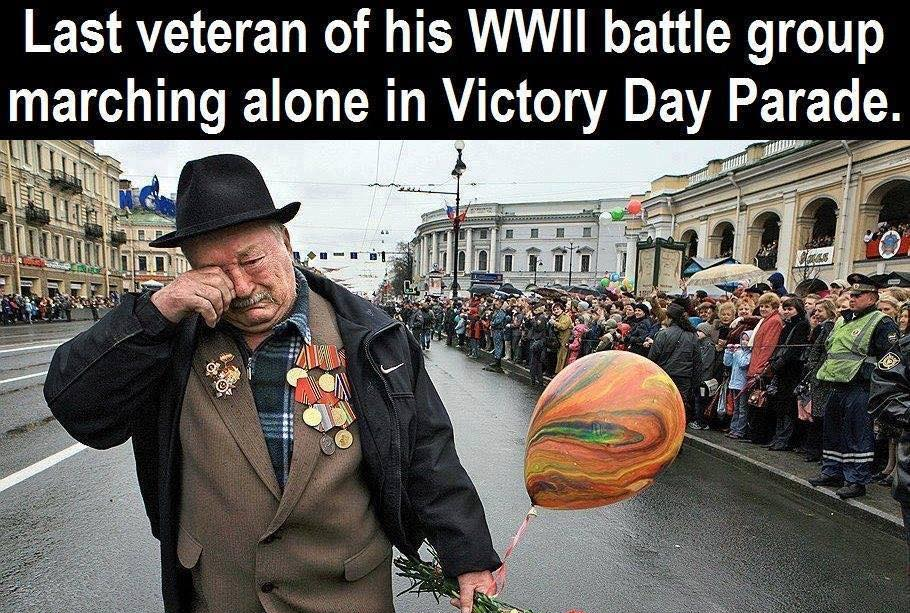
What does D-Day comemorate? It opened a new front in the struggle against Hitler and led to the collapse of his regime.  The reason I've picked the photo above is not to trot out insincere homilies, like certain public figures but to show respect for the millions who suffered, all over, not only in battle, not only in 1939-45.  If we really care about the past, we need too learn from what went wrong in the first place.  The photo above swept the media a few years ago, and was used as a scare tactic, with the slogan "Why am I alone here? " to manipulate people by guilt. The photo was in fact  taken in St Petersburg in 2007 by Alexander Petrosyan.  He wasn't abandoned : the streets are lined with people in support.  The man was old, struggling to keep up with his comrades ahead of him. (Please see here for the snopes fact check).   How easy it is to twist public opionin ! As Hermann Göring is alleged to have said at the Nuremburg War Crimes Trials "All you have to do is tell them that they are being attacked and denounce the pacifists for lack of patriotism and for exposing the country to danger. It works the same way in every country". Whether or not he actually said that, I don't know but it does address the way people can be fooled into rash action, often against their best interest.  But have we learned ? As world leaders gather to mark D-Day, fact is that some of them came to power exactly because they figured a way of fanning hysteria and hate.

To honour the millions who died, we need to think about the causes of war in the first place. 1939-45 was in many ways a continuation of 1914-1918, which itself was a rematch of 1936-7, 1870 and 1807-1814, and possibly more.  In 1945 the difference was that people realized that one way to avoid war was for people to work together for peace.  From this grew Nato and eventually the European Union.  The last 75 years have seen a cessation of hostilities longer than Europe has seen in centuries. That doesn't mean that there won't be conflicts, but it's still better than war.  Instead we now have populism which thrives on mass hysteria. Not long ago there was an attempt to  make Christians think there was a "war on Christianity". It turned out that that was being spread by right-wing extremists, including the AfD. They were resurrecting a meme popular in the Cold War.  Then, the targets were Communists, but extremists have no scruples : their targets can switch at any time.    Good people need to stick together to stand up to rising extremism of all kinds.  Divide and Rule works, all too well.  Instead we have a world where the tactics that got Hitler to power are getting people into power who might make Hitler seem small fry. Modern technology could mean  media manipulation on a scale greater than we can imagine. The stakes are higher, too.  The evil have everything to gain by playing people against each other. But like turkeys voting for Christmas, the masses are easily fooled.  . Please read the article in the New York Times by Roger Cohen "The Donald thinks D-Day is all about Him"

Monday, 24 December 2018

UNIQUE Christmas greeting from Uncle Nick


Utterly unique - a Christmas card drawn in the Prisoner of War Camp in Sham Shui Po, during the Japanese occupation of Hong Kong, sent to some of his family. The artist is Nick Jaffer,  Private, Service number 3177, in the Hong Kong Volunteer Defence Corps, seeing action in Wong Nei Chong Gap, where 60% of some units were wounded or killed, including his brother-in-law, William Markham.  In 1943, he was shipped to Japan with many other prisoners and worked in a coal mine in Sendai.  He was born in Shanghai on 29th October 1908 to Abdul Hamoned Jaffer and Kulsoom Jaffer, who were"Chinese Parsees", Parsis who had been settled in China for many generations.  In the POW records held by the Commonwealth War Graves Commission, he's listed as "Persian". This proved to be an advantage as the Japanese considered him technically Indian and gave his wife Indian rations, which were more generous than for Chinese people. Since she didn't eat Indian food, she swapped ghee and spices for extra rice.  His father died before the war and his mother died in the Red Cross Rosary Hill Camp for dependents of HKVDC POWs, during the occupation.  But at least she saw her grandson, born in 1942.  Prewar, he'd worked for Thomas De La Rue (security printers) and after the war worked for NCR in Singapore, when they still made cash registers.  He was a dashing man, very debonair and creative. That's why he was a Camp artist, constantly drawing, painting, and taking part in the social activities the prisoners organised to keep up their spirits.  The drawing above looks just like him ! He accumulated a huge cache of drawings, which were borrowed by someone in the 1960's and never retuned, which almost broke his heart.  He loved travelling, well into later life, and died in his 90's.  

Sunday, 16 December 2018

Massacre at Christmas


On 25th December 1941, Hong Kong surrendered to the Japanese. The Japanese had been at war with China on and off for fifty years.  For ten years they'd been sweeping through China : battle-hardened troops with a formidable military machine behind them.  Manchuria fell, then Shanghai, then Nanjing, then Guangzhou (Canton). British military strategists, to their credit, were realistic. They monitored what was going on, careful to preserve neutrality in the war between China and Japan, though they knew, as Churchill himself was to say, that there was "not the slightest chance " of  Hong Kong holding out.  Read Franco David Macri : Clash of Empires in South China (2012, 512pp)

The photo above was taken at the fort at Saiwan, overlooking the Lei U Mun strait, a few days before the first Japanese attack on 8th December (coinciding with Pearl Harbour).  It took four days for the Japanese to take the territory, seen in the hinterland. Notice how small the area is.  From this position, the men would have been able to watch the battle unfolding across the water and see where bombs were falling in town beyond. For a few days there was an impasse. A small island without resources cannot withstand a siege : no-one, not even the Japanese, wanted another Nanjing.  The war changed everything, for China and for Hong Kong : we're still feeling the effects today.  Many communities dispersed forever.  Hundreds of millions displaced : the biggest refugee crisis in modern times.  Millions and millions of individual tragedies. This is just one incident of many, many others, but it  is reasonably well documented since it was described in the War Crimes Trials in 1946-7.

In the photo we see the 5th AA unit of the Hong Kong Volunteer Defence Corps. Notice the chair, for the British officer in command. Like so much else in colonial administration, Volunteer units were organised along racial lines. There were separate units for British  and Europeans, for Chinese and for the Macanese community. The 5th AA seems to have comprised a combination of men who for various reasons didn’t fit other categories, so most of these men knew each other socially from before the war. The week before the Japanese invasion began they had been on exercises with the other Volunteers in the New Territories, within sight of Japanese lines across the border.

At midday on Sunday 7th December, the local radio station broadcast the order for mobilisation. The 5th AA had to report for duty by 6pm that evening. Gunner John Litton drove Gunner Algernon Ho in his car. They lived next door to each other in Tytam, near the reservoir. Litton, though only seventeen years older, was in fact Ho’s uncle. Gunner Manuel Ozorio finished a family Sunday lunch, waving to his brother as he left, “Don’t worry, I’ll look after your friends!” His brother, being crippled, was unable to join up with the rest of their crowd, and envied them. Had he been able-bodied, he too would have shared their fate. While the fighting was in progress on the mainland, 5th AA was “shifted around other sectors, 2 days in Stanley, 2 days at Saiwan Fort”. Saiwan Fort was an old Victorian fort, a series of gun emplacements around a main building on high ground. It overlooked Lei Yu Mun Pass, the narrowest stretch of harbour, so close that the men could see across to the mainland with their field glasses. The hill opposite was Devil's Peak, scene of the bitterly fought last Indian stand on the mainland.  Then, on the night of 17th/18th December, a Japanese officer (a swimming champion) swam alone, across the bay, in darkness, to reconnoitre a suitable landfall. across the narrow strip of sea seen above, and the final onslaught began.

That night, unkniwn to the men in the fort, the Japanese landed in force, crossing the strait on small rafts and logs. They struck land at North Point, not far from where 5th AA were stationed.  Late on the afternoon of the 18th, the unit had received artillery fire, which continued without a break until late evening. It was an unusually dark night. Even had there been a moon it would have been obscured by the thick smoke from burning oil installations, and from ships blazing in the harbour. They could see light, from fires, in the direction of the city. Many of the men had homes and families in the vicinity of the fires, but had no way of knowing what was happening in the town.  And these were men with no illusions about what had happened in Nanjing and elsewhere. What they felt, as they sheltered from the relentless bombardment in the fort, has not been recorded, but one can speculate. These men still had the optimism of youth, and war might have seemed something of an adventure, for it was so different from their settled, sheltered lives. Brought up in a world where people still had faith in the British Empire, they may even have believed that somehow the Empire would come to their aid, perhaps in the form of reinforcements from China.  A Goumindang Army division was in the vicinity, but even if they'd have saved Hong Kong,  the political implications were controversial, to say nothing of the logistics.

At 2200 hours they heard shots from close quarters. This was the first indication some of them had that the Japanese had landed. Suddenly, a hand grenade was thrown in from the door, wounding two men. Some were able to escape at this point, including Sergeant  David Bosanquet, who was later able to escape Hong Kong altogether and go into Free China. Shortly afterwards, they heard some voices shouting “Surrender, Save you” in broken English. “Sergeant” George Bennett told his men to fix their bayonets and try to force their way out. Several men did get out, but three were killed on the spot. The men then went back into the tunnel below the main gun site where they had been positioned and shouted that they would surrender, and the Japanese told them to come out. Of the 40-odd men, and, intriguingly, some women, possibly servants (for this was Hong Kong where life without domestic staff was unthinkable), who had been in the fort that day, only 29 remained. They came out in single file.

At one stage, one of the survivors saw a Japanese whom he took to be an officer because the man had a long Japanese sword. It made an impression on him, because that was the first time he’d seen a Japanese sword; he would see many in the years to come. The men were then taken to a pillbox several yards away. One of the Japanese took a pack of cigarettes from someone and smoked them while he searched the prisoners. The Japanese had torches, but didn’t use them. Perhaps the light from the cigarettes was sufficient in that small and very crowded pillbox. Fountain pens, watches, even belts were stolen. Only a few of the Japanese took part in the search. Afterwards, they sat smoking while the others guarded their prisoners with fixed bayonets. Two or three hours passed. It was well after midnight when the men heard a shout.

Gunner Chan Yan Kwong, one of the survivors, describes what happened next. “A semi circle was formed by the guards obstructing the doorway. A loud voice in English was then heard saying that we were free and could leave the pillbox, one by one. However, we were all bayoneted… the bayonet just scratched my abdomen from left to right and the point came out from my clothes, struck my wrist, causing great bleeding”.No more than seven Japanese were involved in the actual bayoneting, though Chan sensed that there were others watching nearby. Gunner Martin Tso Him Chi was perhaps the fifteenth man to come out. Only then did he realise what had happened to the men who had gone before him. Bayoneted across the abdomen from his stomach to his chest, he lay pretending to be dead. He said he thought the sentries were by then tired so they were not as thorough as they might have been earlier. He could see in the light from a fire from a burning ship in the bay the bodies of his comrades: Gunner Kwok Wing Chueng, Gunner Poon Kwong Kuen, Gunner Algernon Ho, Bombardier T N Lau and Gunner Tsang Kai Pan. He saw the last man to be killed, Ting Ping Kwan, try to avoid being bayoneted by pushing up his arms and legs, but Ting died, too.

Then the Japanese came up and battered the bodies with rifle butts and threw them into a pit near what had been their kitchen. Tso, who had been covered by his comrades’ bodies, managed to roll down the slight slope so he fell against the kitchen wall. Tso and Chan lay, separately, among the bodies, listening to the sound of dying men “crying out for God, mother and water” as Chan described, but they thought that the guards were still around. Chan thought he saw soldiers stationed on the horizon. Only later he discovered that they were straw effigies. Gradually the groaning stopped. Tso said that he managed to survive by crawling out to get water and picking biscuits from the ground. He moved a corpse to cover himself when he got back to position, since he didn’t know where the Japanese might be. After several days Chan heard the sounds of looters coming to comb the battlefield, so he crawled to the dugout, hid and removed his uniform. As he was about to leave, he heard a sound from the pit and whispered “Is there anybody alive?” Only Tso answered.

Tso and Chan made their way home. Chan lived in Shaukiwan, not far from the site of the massacre. Tso lived in Causeway Bay a few miles farther on, but on the way home he met a party of Japanese and was forced to do coolie work. The next day, in pain and weak, he made his way to a Catholic church in Shaukiwan where Reverend Father Shek dressed his wounds and looked after him.

Studying a list of the men who were killed at Saiwan sheds light on the community they came from. The survivors, Tso and Chan, had studied at Diocesan Boys School, an old Hong Kong institution, together with many of the men who were killed – the bodies they saw were not strangers but men they’d known since childhood, with whom they’d played cricket and football. Tso escaped into Free China and became a banker in Guangzhou after the war. In this second photo, see him in his nice western suit.  But he's standing by the pillbox where the massacre took place. He's not posing : it's an official photograph taken by the investigators ofvthe War Crimes Commission.  After the trial, Tso took the relatives of some of the men who had been killed back to the site for private mourning. This was an act of courage and kindness on his part, as it was the first time he had been back, alone.  One of those relatives, Eric Peter Ho, brother of Algernon Ho and nephew of Henry Litton, told me years later how Tso was so overcome by emotion that he could hardly proceed. Tso died young, but left a very talented son who later won a scholarship to study in the US.

A few of the other men, remembered : Debonair Ernest Fincher had been famous for cricket and swimming parties. Algernon Ho, known to his intimates as “Algy” had that summer graduated from university, and was working as an accountancy trainee at Wong, Tan & Co, the only firm of Chinese chartered accountants in Hong Kong at the time. Litton, Ho, William Edward Broadbridge and Andrew Zimmern (all related) were members of prominent and talented Eurasian families who played an important part in Hong Kong affairs. Peter Ulrich, (third photo) a charismatic and athletic German Eurasian, had been the outstanding pupil of his graduating year, winning academic honours for La Salle, a new, but innovative, Jesuit school. He had in fact started teaching there.  He was such an exceptional character that people were talking about him in awe for decades. After the war, his parents were living in Bangkok.  Ozorio and Francis Oswald Reed were Macanese who’d grown up in Kowloon Docks, occupied by the Japanese, and later carpet bombed by the Americans in 1944-5, so flattened that you could stand at the shore and look through to the horizon on the other side. Only one of the large Reed family would survive the war. Gunner A Bakar was probably of mixed Chinese and Indian ancestry, his family long-term Hong Kong residents.  Chan Yan Kwong, who was 20 at the time of the massacre, went on to become a merchant after the war and remained in Hong Kong. The scars from his wound remained for the rest of his life. He displayed them in court when he gave evidence in the war crimes trials after the war.
Ernest Paterson, whose mother was Spanish, was an undergraduate at Ricci Hall, Hong Kong University. His face smiles out at us from a photograph of the University Science Club, taken  a few weeks before. On one side next to Ernie is my Dad, aged 20. They were best friends. My Dad had been crippled in his teens, which is why he could not be a Volunteer like his brother and friends, but ironically that saved his life. On the other side of my dad is Stanley Ho, who would later become the billionaire gambling tycoon of Macau ! and behind them is Oswald Cheung, later SOE, the first Chinese Queen's Counsel, and Member of the Legislative and Executive Councils.  Of the whole group  only Stanley Ho is still alive. This fourth photo comes from David Matthews and Oswald Cheung : Dispersal and Renewal : Hong Kong University During the War Years, 1998, 508pp)

Cheung Wing Yee, Poon, Litton, Reed, George Donald Stokes, Tsang and Joseph Nelson Wilkinson left wives and young children. The only man truly alone was Edgar Wallace Bannister, who had long left his parents, far away in England. With these men died a microcosm of the pre-war Hong Kong world they’d known. These men were among Hong Kong’s best and brightest, the hope of their communities, and, in one dark, moonless night they were destroyed.

Those who carried out the massacre were never identified. They weren't officers, and it wasn't a premeditated crime but basic thuggery. In the confusion of the battlefield, it was impossible to tell for certain which unit was where at the time.   More than twenty years ago, I decided to find out for myself what had happened, and uncovered the war crimes file in the National Archives at Kew.  In the file, there was an envelope, sealed since 1947. But the story was more or less public domain, since it had been reported in the newspapers, Trying to open the envelope, I inadvertently tore it, since it was securely bound into the file. No one had opened the envelope, or set eyes on the photograph, for nearly sixty years. I felt most truly humbled, but it genuinely felt like someone was willing me to be the person to lay eyes on the documents after so many years.

List of men in 5th AA battery listed as killed by the Commonwealth War Graves Commission
Sgt 3834 Edgar Wallace Bannister, 28

Gnr 4571 A Bakar

Gnr 2235 William Edward Broadbridge, 34

Gnr 4134 Chan U Chan

Gnr 4840 Cheung Wing Yee

Bdr 4225 Ernest Francis Fincher

Gnr 4239 Algernon Ho, 21

Gnr 4317 Kwok Wing Chung,

Gnr 4186 Leung Fook Wing, 26

Gnr DR/53 John Letablere Litton, 38

L Bdr 4505 Lau Hsin Nin

Gnr 4198 Manuel Heliodoro Ozorio, 24

Gnr 4861 Ernest Manuel Paterson, 18

Gnr 4188 Poon Kwong Kuen,

Gnr 2798 Francis Oswald Reed, 28

Gnr 4798 George Donald Stokes, 31

Gnr DR/9 William E. Stone

Gnr 4189 Tsang Ka Pen

Gnr 4614 Albert Ulrich, 24

Gnr DR/72 Peter H. A. Ulrich, 25

Gnr DR/31 Joseph Nelson Wilkinson

L Bdr 4268 Andrew Zimmern
Altogether it is believed that about 28 men were killed in this incident, including several men from 7th AA Battery, Royal Artillery, who were temporarily assigned to the unit.
L Bdr George Bennett, 26

Sgt Reginald Edmund Coughlan

L Bdr Kenneth Henry Macdonald

Gnr William Rhoden

Gnr George Robert Ward

Monday, 5 November 2018

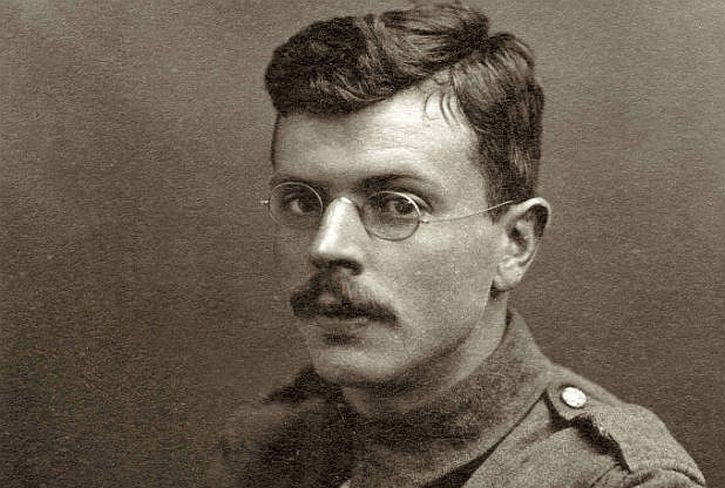
Wilfred Owen, Dunsden Green - a personal memoir


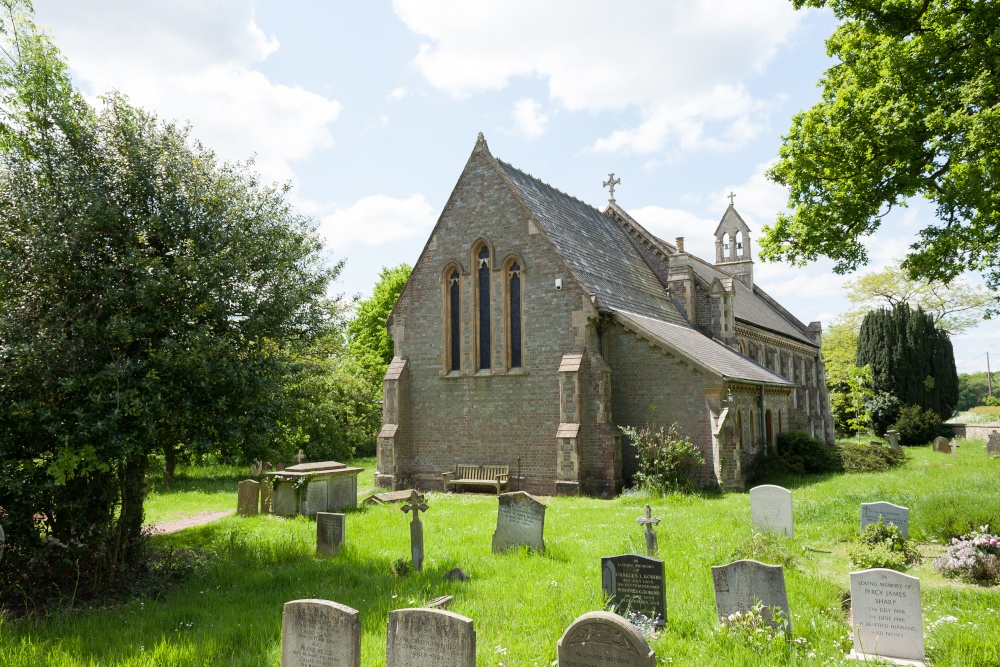
Wilfred Owen died 100 years ago, but his poetry has made him immortal.  But what shaped Owen's personality, and his singular art ? Unlike Siegfried Sassoon, who recognized Owen's potential when Owen was a gauche nobody, Owen didn't come from an elite background.  Owen's parents were not well off, not poor but not secure. After many years moving from place to place they ended up in a two-up two-down Victorian terrace, now facing a downmarket shopping mall on a rough estate.  Nonetheless, for years the tenants hung hanging baskets outside, a display so colourful that the houses were a local landmark.  Owen's parents and sister are buried in All Saints Church in Dunsden Green, (pictured above) a few miles away, where Owen served as lay assistant to the Vicar from 1911 to February 1913.  That connection must have meant a lot to them.  Inside the Church, there's a memorial plaque on the wall in Wilfred's honour. 

Owen himself might not have been quite so genteel. Though the Vicarage where he stayed was luxurious (it's a local landmark, too), many of the people of the parish were desperately poor, living in overcrowded hovels, employed seasonally, often insecure. Disease speads quickly when people are overworked and underfed.   Owen used to visit  these tenements and must have been well aware of the contrasts between the Vicar's life and the lives of those in his parish.  Whenver he had the opportunity, he'd walk miles into town, visiting a bookshop for "modern" literature, different fare no doubt to what was in the vicar's library.  The route he walked is pretty much as it was then, despite the traffic. Until recently, you could still see painted signs on buildings advertising hay and coal.  The hovels are now renovated,  some of them weekend homes for the rich from London. The thatched pub at Binfield Heath, which Owen would have known, but was probably not allowed to visit, dates from 1300 and served travellers taking sheep and cattle to market. 

On 15th October 1912, one of the villagers, John Allen, set off to a new job in Maidenhead :  a  step up in the world, away from rural slums.   Full of hope and anticipation, the family loaded up a horse cart with their belongings and set off to their new life.   On the way to Playhatch, the road becomes extremely steep : even in a modern car, you notice the gears change.  A huge sofa - a status symbol - shifted and tipped the cart over, killing Mrs Allen and her daughter. The Allens are buried in the chucrhyard at All Saint's, too. Owen assisted at the funeral. This shook whatever faith Owen might have felt in the church, and in the social order.  It compounded an emotional crisis, which he resolved by getting as far away as possible, to France, where he had no connections.  And so,Owen's distinctive personality was moulded, long before the trenches and the Somme.  Below, the  poem he wrote about the Allens's tragedy,  Deep Under Turfy Grass. 
Deep under turfy grass and heavy clay 
They laid her bruisèd body, and the child 
Poor victims of a swift mischance were they, 
Adown Death’s trapdoor suddenly beguiled.
I, weeping not, as others, but heart-wild, 
Affirmed to Heaven that even Love’s fierce flame 
Must fail beneath the chill of this cold shame. 
So I rebelled, scorning and mocking such 
As had the ignorant callousness to wed 
On altar steps long frozen by the touch 
Of stretcher after stretcher of our dead. 
Love’s blindness is too terrible, I said; 
I will go counsel men, and show what bin
The harvest of their homes is gathered in.
But as I spoke, came many children nigh, 
Hurrying lightly o’er the village green; 
Methought too lightly, for they came to spy
Into their playmate’s bed terrene. 
They clustered round; some wondered what might mean 
Rich-odoured flowers so whelmed in fetid earth; 
While some Death’s riddle guessed ere that of Birth. 
And there stood one Child with them, whose pale brows 
Wore beauty like our mother Eve’s;whom seeing, 
I could not choose but undo all my vows,
And cry that it were well that human
 Being
And Birth and Death should be, just for the freeing 
Of one such face from Chaos’ murky womb, 
For Hell’s reprieve is worth not this one bloom.
 

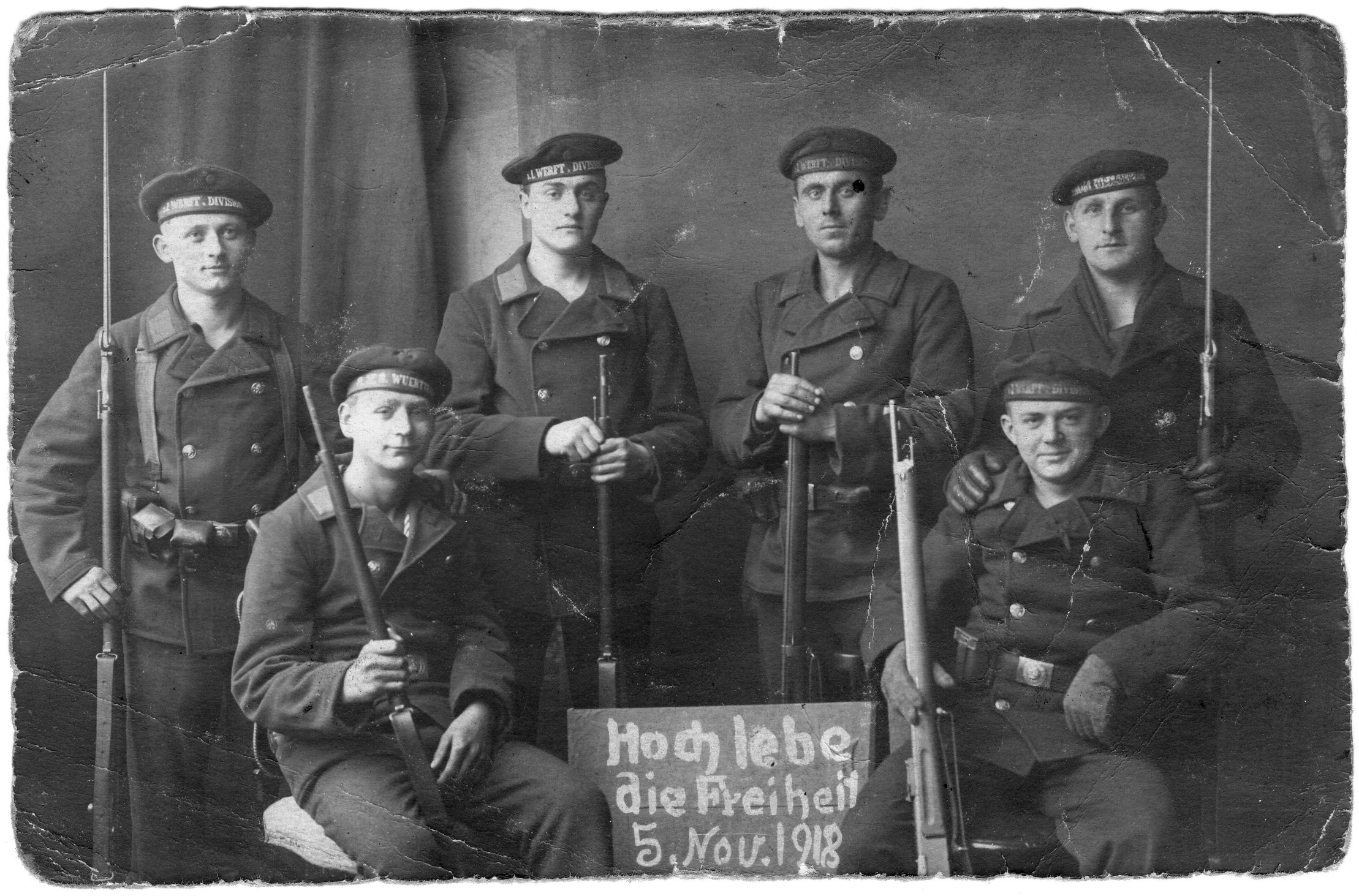
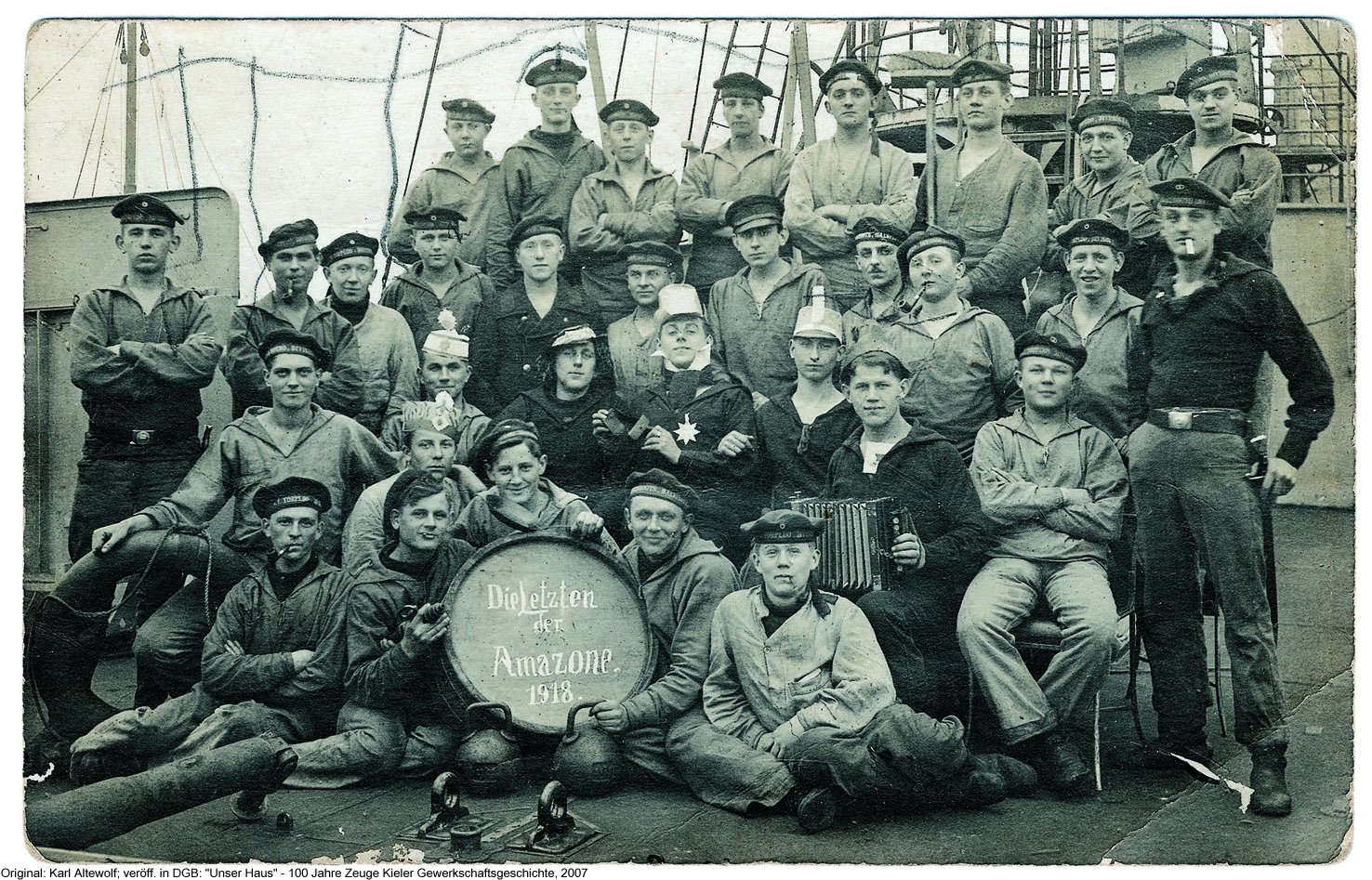
The real end of the 1914-1918 war

 100 years ago, sailors in the German Navy mutinied against the Kaiser.  Another Revolution begins. The 1914-1918 war didn't end in "victory" but in collapse.


Wednesday, 31 October 2018

Britten Ballad for Heroes, Gurney Gloucestershire Rhapsody, Bliss Morning Heroes

W H Auden and Benjamin Britten
 Benjamin Britten Ballad for Heroes, Ivor Gurney Gloucestershire Rhapsody and Arthur Bliss Morning Heroes with David Temple conducting the BBC Concert Orchestra and the Hertfordshire Chorus in Watford last week, broadcast on BBC Radio 3. An excellent programme since these pieces aren't as well known as they should be, though they are hardly unknown.

Britten's Ballad for Heroes Op 14, 1939  for example. When I first heard the piece seven years ago (Ilan Volkov BBCSO, Barbican) I didn't understand it, but gradually it's grown on me. The disparity between the poetry of W H Auden and the doggerel of Randall Swingler is a problem, but Britten uses it with a certain degree of irony. Auden is an intellectual : Swingler a man of action (a Communist) but not so good with words. Auden opposes fascism, while Swingler's solution is to fight with more violence. Yet they trundle along together, with unison chorus and marching orchestra  The contradictions in the piece provoke, just as the situation did. Therefore the piece is about a lot more than a simplistic conflict between pro and anti war. It should be noted that the Spanish Civil War ended in April 1939, with the triumph of the fascists and their Nazi allies, so the piece (which premiered at the end of April 1939) isn't about going to war so much as a realization that war alone cannot defeat the forces of evil.  The title is "Ballad for Heroes", not "Ballad of Heroes", for the cause the heroes fought for had been crushed so cruelly that  it was hard not to envisage the eventual triumph of Hitler, who enjoyed a lot more support, even in Britain, than some will now admit.  Despite the annexation of Czechslovakia, and the Nuremberg Race Laws,  Britain supported a policy of Appeasement.  When Chamberlain announced "Peace in Our Time"  there were many for whom the slogan rang false.  Appeasement, for better or worse, encouraged Hitler rather than curbed him, which is why so many despaired. It is unfair to fault Britten for leaving in April 1939 since Britain was at peace.  There are many ways of opposing war and the mentality behind it. War was only declared on 3rd September 1939 because Germany invaded Poland, not because of the regime itself. 

Thus the funeral march which runs through the Ballad for Heroes, with a solemn relentless tread. The chorus intones brief lines, alternating with the orchestra, replicating again the idea of  different forces being yoked together in common cause.  A mood of greater urgency and alarm is introduced by dizzy  figures in the orchestra (wonderful writing for winds) replicated in the wayward vocal line, Strident machine gun staccato, wild dissonance, surging lines lit by flashes of woodwind light.  "A world of horror!" Then suddenly the tenor (Ben Johnson)  emerges, uncovered and alone.  His lines curl and snarl with menace.  ""....and the guns can be heard across the hills like wa-a-aves at night". You could imagine his face contorting when he sings of "the stench of violence".   The vocal writing here is sophisticated, spiralling diminuendos, words stretched and twisted in a style Britten would use later, in the Serenade for Tenor, Horn and Strings and much more.  "Hear, you numberless Englishmen, to remind you of the greatness here among you, ......to fight for peace and for truth!" words rather cogent given the context of the those months between the annexation of Czechoslovakia and Austria, and the outbreak of war.  

Ivor Gurney's Gloucestershire Rhapsody was written between 1919, on Gurney's return from the battlefield, and 1920, shortly before he was incarcerated in a psychiatric hospital, where he died 15 years later.   Although  it was generally assumed that Gurney's late works were incoherent and unplayable,  Gurney scholars Philip Lancaster and Ian Venables have edited them for performance, revealing their true value.  The expansive lines soar, with an almost Elgarian spirit. One might imagine Gurney inhaling the fresh, pure air of Gloucestershire,  and the exhilaration of being able to roam in his beloved countryside. So very different from the horrors of the trenches!  Gurney's doctors believed that he was better off in hospital, but, when a friend smuggled in a copy of a map, Gurney traced his old hiking routes with  his fingers, as if re-living what he had lost. This background is relevant, for this performance seems infused with a spirit of freedom, of endless open horizons and limitless possibilities.

This "open vista" approach to the Gloucestershire Rhapsody may connect to Gurney's own hopes for the future. Significantly, the piece starts with the same first bars as Richard Strauss Also sprach Zarathustra -  a dramatic opening, but with a twist.  Gurney deliberately wanted to counteract "The Prussians" and what they stood for. Understandable for a man who served throughout the war, though Strauss wasn't fond of “Prussians" either, being Bavarian. The horns give way to a pastorale evoking the Gloucestershire countryside, with its rolling hills and spacious panoramas.  To Gurney, past and present connected in seamless flow. The ghosts of prehistoric hunters, Romans, medieval farmers, depicted in a bucolic dance theme. "Two thousand centuries of change, and strange people".  An ostinato section suggests both the heavy march of Time and the men of Gloucestershire marching innocently to slaughter on the Somme.  Gurney said that what kept him going in the trenches was the thought of commemorating these men in poetry and music.  A short, chaotic "war" section then gives way to a beautifully expansive theme, which might evoke a glorious dawn after a night of horror. It's Elgarian in its glory, but also Gurneyesque.  In this new dawn, though time moves on, Nature returns, and possibly heals.  The recommended recording is on Chandos's CD British Tone Poems, conducted by Rumon Gamba.

Arthur and Kennard Bliss
Morning Heroes (1930) isn't neglected but performances are rare because it’s hard to pull off a symphony on this scale. Much depends on the narrator, who has almost as much to do as the orchestra. Fortunately  the narrator here was Samuel West who narrates on Andrew Davis' s recording with the BBC SO for Chandos. The title "Morning Heroes" comes from  the final movement where three different poems are quoted, Now, Trumpeter, For Thy Close (Robert Nichols), Spring Offensive (Wilfred Owen) and Dawn on the Somme (also Robert Nichols), which graphically describe the landscape of a battlefield, specifically the slaughter of the First World War in which Bliss and his brother Kennard served. Kennard, like millions of others, East as well as West, perished. Morning Heroes isn't a requiem in the religious sense but describes the experience of war in a direct and unsentimental way. War isn't a game, it's not “entertainment".  In these poems there's enough inherent drama to make a point without theatrical excess.

Morning Heroes starts with the Iliad, where the Trojan hero Hector returns as a ghost. The symphony begins with a long quotation describing Hector taking leave of Andromache, his wife. "Would you leave your children orphans, your wife a widow". The refrain in the chorus acts as a whip, goading the heroes to further sacrifice. Bliss follows this first movement with the turbulent "The City Arming". Are the populace so caught up in bloodlust that they forget
the human toll ? The third movement, "The Vigil", is based on Walt Whitman's  Vigil Strange I Kept of the Field One Night and his By the Bivouac's  Fitful Flame. Whitman's verse isn't easy to set as its flow doesn't lend itself to music. Wisely,  Bliss uses spoken narration, augmented by chorus, singing the lines so they seem to sweep like flames whipped by wind. Orchestrally, this is perhaps the most expressive moment. The brief return to the Iliad, which follows, is thus put into context, like a look back on values one might no longer share. When the final movement returns to graphic depictions of the Somme, the connection is made between wars long past and more recent. Resolution, of a sort comes, where the chorus sings, followed by a wonderful but brief figure for oboe, and a brief resurgence of the pounding motif from the beginning. Muffled percussion, muted brass, the mens' voices singing with restraint, as if heard from afar, the women's voices almost spectral.  Yet again the orchestra up, martial music cloaked with menace. Yet a wayward melody emerges and the voices grow stronger and at last, a measure of serenity at the end.    


Sunday, 5 August 2018

Hiroshima - the scarier scenario we face today


Seventy three years ago today, a bomb fell on Hiroshima.  Many official reasons why, such as ending the war and saving the lives of POWS. Whatever, the war did end and Japan is not militarily aggressive.  But consider the Bomb in wider geo-political terms. Who was the enemy who needed to be stopped.  Soviet troops occupied Eastern Europe, including Germany and Austria.  What was to stop them pouring into North China and Japan ? Tensions between Russia and Japan went back long before the first Russo-Japanese war in 1904-5 when the Japanese decisively crushed the Russian Navy at Port Arthur and at sea.  Amazing,considering that Japan had been feudal and rural barely 50 years before, and that the Russian fleet was state of the art, as powerful as the British Navy. 

Territories like Sakhalin are still disputed today. So what was to stop a Russian surge against defeated Japan, thus threatening the US, Britain and the whole balance of power in the Pacific ?  Not for nothing did the US send thousands of elite Marines to North China after 1945.  Ostensibly, they were there to supervise the withdrawal of Japanese troops and support the Goumindang Government. But North China was a stronghold of the Chinese Communist Party who were dependent on the Soviet Union.   At least the CCP had the sense to split with Russia as soon as they could (1957)

Wars are not waged by direct means alone. Another lesson we can learn from Hiroshima, and one scarily relevant today.  With Putin, we see an upsurge in aggression not just through coventional means, as in Syria, but by technology and its ability to reshape the way we think. Destroying democractic societies from within, spreading fear and ignorance, controlling key stooges to overthrow their own heritage, the masses easily persuaded.  Why bother with bombs when you can use "the people"against themselves?


Wednesday, 13 December 2017

Nanjing Massacre - 80 years on


On 13th December 1937 began the six weeks massacre of Nanjing (Nanking) in which as many as 300,000 Chinese were murdered. That doesn't take into account the many others injured, those who died later of wounds and other suffering, those traumatized, left orphaned, forced into exile.  And Nanjing was just one of many incidents in the 14 years of Japanese occupation. Consider and ponder.  

Friday, 10 November 2017

Für den Graben, Mutter, für den Graben.


Mutter, wozu hast du deinen Sohn aufgezogen?
Hast dich zwanzig' Jahr mit ihm gequält? 

Wozu ist er dir in deinen Arm geflogen,
und du hast ihm leise was erzählt? 
 Bis sie ihn dir weggenommen haben.
Für den Graben, Mutter, für den Graben.

 Junge, kannst du noch an Vater denken?
Vater nahm dich oft auf seinen Arm.
Und er wollt dir einen Groschen schenken,
und er spielte mit dir Räuber und Gendarm.
Bis sie ihn dir weggenommen haben.
Für den Graben, Junge, für den Graben. 
Drüben die französischen Genossen
lagen dicht bei Englands Arbeitsmann.
Alle haben sie ihr Blut vergossen,
und zerschossen ruht heut Mann bei Mann.
Alte Leute, Männer, mancher Knabe
in dem einen großen Massengrabe. 
Seid nicht stolz auf Orden und Geklunker!
Seid nicht stolz auf Narben und die Zeit!
In die Gräben schickten euch die Junker,
Staatswahn und der Fabrikantenneid.
Ihr wart gut genug zum Fraß für Raben,
für das Grab, Kameraden, für den Graben! 
Werft die Fahnen fort!
Die Militärkapellen spielen auf zu euerm Todestanz.
Seid ihr hin: ein Kranz von Immortellen -
das ist dann der Dank des Vaterlands. 
Denkt an Todesröcheln und Gestöhne.
Drüben stehen Väter, Mütter, Söhne,
schuften schwer, wie ihr, ums bißchen Leben.
Wollt ihr denen nicht die Hände geben?
Reicht die Bruderhand als schönste aller Gaben
übern Graben, Leute, übern Graben 
Kurt Tucholsky (1890-1935) 
Mother, for what have you brought your son up? What have you done for him in 20 years ? Why has he flown from your arms, and you've gently reared him?  Until he was taken from you to the trenches. Mother, for the trenches. 
Young man, can you yet think of your father? You father who held you often in his arms and gave you a penny to spend and played Cops and Robbers with you.  Until you were taken away from him, to the trenches, Lad, to the trenches.
Over by the French buddies lay the English worthies, mown down together man by man.  Old guys, men in their prime, kids, all in a single mass grave. 
Don't be proud of Orders and Medals ! Don't be proud of  wounds and of time !  You were sent to the trenches by the Junkers, mad governments and greedy merchants of war.   You're now food for ravens. For the trenches ! Comrades ! For the trenches !

Chuck out the flags ! Military bands are playing your Dance of Death. There you have a wreath of immortelles. That's the thanks you get from your country.

Heed the death rattle and the groans. Over there stand others, fathers, sons, trying hard, like you to scrape a living. Don't  you want to help, them ?  the hand of brotherhood is the finest gift. Better than graves, folks, better than graves.

Friday, 7 July 2017

7/7/37 - a world event unmarked in the west

7th July 1937 - 80 years since the  start of the Japanese invasion of China.  The "Marco Polo Bridge Incident or 七七事變 is a hugely important anniversary, prelude to the massacre of Nanjing, the conquest of Shanghai and the war in the Pacific.  Luguo Bridge (as it's known in Chinese) was strategic because it's so close to Beijing, the symbol capital, though the seat of government had been moved to Nanjing by the Nationalists just ten years before.  Manchuria  was invaded in 1931, but 7/7/37 was an attack on the core of the nation.  Chinese from all regions took part in the resistance in the North. Eventually, the war moved South, too, precipitating one of the largest mass population upheavals in world history. No-one in China remained unaffected.  Effectively 7/7/37 marked the start of a cataclysm that's engulfed China for decades, its repercussions still being faced today. Mao and the Communist Party, for starters. To understand the present, it is absolutely essential to understand the past, and from the perspective of those who experienced it.  Nowadays it's fashionable to think in simplistic terms. There are some who'd even deny the impact of the Opium Wars. Imagine the situation reversed.  But the present doesn't exist in a vacuum. Identity is reshaped, distorted and revised, but the broader the perspective, the less likelihood of getting boxed into corners. Polarization is the enemy of truth.  Thus the more we learn, the better we can interpret.


Sunday, 7 May 2017

Cold Nights - a refugee saga


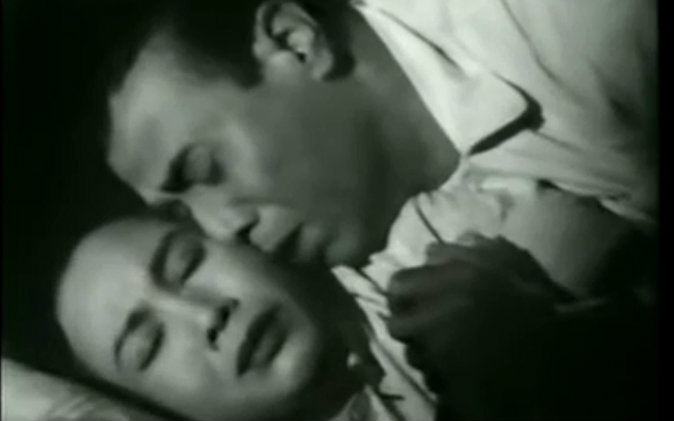
Cold Nights (寒夜) a novel from 1947 by Ba Chin (巴金) (1909-2005) describes the impact of the biggest mass migration in modern history, when tens of millions of  refugees trekked across China, refusing to remain under Japanese occupation, a saga of human endurance that needs to be appreciated in the west.  Ba Chin's famous trilogy Family, Spring and Autumn (1933-40) is a classic of modern Chinese literature, confronting the injustices of traditional feudal society.  Given the background, Cold Nights  is equally panoramic, though the family in this case is small.  Wong Man Suen  and Tsang Shu San are modern, progressive-thinking intellectuals who went to university and might have had careers ahead, had the war not intervened. Cold Nights is even bleaker than the Family Trilogy since it doesn't conclude with hope. Though Cold Nights is set in Chongqing, the seat of Free China, it was made into a Cantonese movie in 1955 by a cast and crew who were themselves refugees, who suffered similar traumas first hand.  Not at all a typical "war movie".  Tsang Shu San is played by Pak Yin, (1920-1987) while Wong is played by Ng Chor Fan (1910-1993) who in real life was the leader of the refugee film community exiled from Hong Kong. 

The film begins with an air raid, sirens screaming, people running terrified through crowed streets, shells dropping all round. Chongqing was subject to the most severe aerial bombardment, not surpassed until Germany and Japan were flattened a few years later, and the targets were civilian.  Wong Man Suen realizes that the bombs have hit his home, and rushes home to find the house empty.  Hundreds have been killed, but luckily his mother and son have escaped.  A flashback to the past : a much younger Wong wakes, alone in bed. A letter arrives. It's from his wife Shu San. After seven years of marriage, she's leaving him.  He thinks back still earlier, when he, she and their friends Tang Pak Ching and Mok Man Ying were college students, both couples deeply in love. They graduated, but while Wong was buying a wedding ring for Shu San, the city of Hangzhou was bombed. In wartime conditions, it took them months to travel back to Wong's home. Their son was born en route.  But Wong's mother was furious. Wong phones his wife at the bank where she works.  They meet in a smart café, where the windows are taped up for safety in bomb blasts.  "I'll have tea" he asks, "I'll have coffee" says she. The reason she's leaving is the way his mother has treated her.  "And you", she adds "have been ground down by her, too".  In the soundtrack we hear the song On the Songhua River, which refers to war, refugees and social disruption (Read more about the song here)

Wong meets up with his old university friend, Tang Pak Ching, also a refugee. Tang's wife had a miscarriage but couldn't get to hospital when the streets were blocked in an air raid. "She held my hand and cried my name", he sobs, And then she died. "This war, it's so cruel". The four college friends from former days are now three. Wong starts drinking. Shu Shan is disgusted that he's fallen so low.  She carries him home, though, but his mother blames her. In his delirium, Wong cries "I love you, Shu San, don't leave me". He's becoming ill (tuberculosis). She loves him, too, so she stays but his mother is worse than ever.  Shu Shan's still working at the bank - she's the breadwinner - and her boss wants her to move with him to Lanchow.  She tells him no, but Wong, not realizing that the boss has ulterior motives, urges her to go.  He goes back to his old office, but his colleagues treat him as a pariah because he's infectious. "But we've been friends five years" he cries. A friend arrives with some money his friends have raised as a gift. But he's been fired by the boss.  "In wartime, that's how things are" explains the friend.  But mother flies in a rage. Wong, in his grief, blames himself. He loves Shu San but has failed her. He's also failed his mum, who put him through school and looks after him and his child.

Wong gives Shu San a wedding ring - as he wanted to do years earlier, before things went wrong.  Ironically, she's leaving in the morning. She's brought a huge sum of money for medical bills, which she's got from her boss . She's resolved to move, though her heart is not in it.  She tells Wong it's only a short separation but he knows better. ""I will return, in a year, or two, or three, but I will return". "And I will wait", he adds. In the dawn, they part. They look at their child, sleeping beside grandma. "Tell her I don't hold a grudge". A tear rolls from the old mother's eyes.

Although it's cold and Wong is sick, he goes out, to the café where he and Shu San had been together. "I'll have tea" he tells the waiter "and a coffee, for her".  But there's no-one there. The Songhua River song is heard again, quietly.  Another air raid. We see fighter planes  anti-aircraft guns, wardens and refugees.  Wong sees his old friend Tang Pak Ching in the crowd, but his friend cries "Tang Pak Ching is dead". His mind has gone, maddened by grief.  Bombs rain down and Tang is killed before Wong's eyes.  Eventually, the newspapers announce, the war is over.  A big parade in the streets, with lanterns, drums, firecrackers  and a lion dance.  The procession passes Wong's house but by now he is so sick he's almost delirious.  He gasps "Shu San" and collapses.

A rickshaw arrives. Shu San has come home.  But a neighbour tells her that Wong died, on 3rd September - the day Peace was declared.  The neighbourhood buried him locally.  Shu San sits at Wong's grave sobbing. She's worn his ring all the time she was away "Why didn't you wait for me ?". It's now the 100th day since Wong's death, so grandmother and child have returned to the grave for ceremonies.  Forgiveness: all three will return to the native village.

Sunday, 25 December 2016

1916 Hanukkah Germans, Armenian Christians


German troops at the front 1916

Armenian Christians, Christmas 1916, in the midst of the Armenian Genocide
Read more HERE

Tuesday, 20 September 2016

Art Song that became an icon : On the Songhua River

Billboards in North China in 1947 juxtaposing two realities: consumer fashion goods on one side, and an ad for the film On the Songhua River on the other.  Passers-by are rushing past. They don't know that Communism is just around the corner. The film On the Sungari River (the old westernized name for the Songhua) was made almost immediately after the Japanese surrender in North China, almost literally before the embers had finished burning on the battlefield, which gives the film a poignant authenticity few movies attain. It is certainly not to be dismissed as mere propaganda.  Real people lived in real times like this. We must not forget.

A young girl called Niu-er lives in a village, lovingly depicted by the camera. Suddenly strangers appear: soldiers on horses, brutalizing peasants into submission. It is September 1931, and the Japanese have invaded. Fourteen years of war will follow, tens of millions will become refugees, China will never be the same again. Niu-er's parents are murdered (the killing of the mother particularly distressing). The girl and grandfather flee, but soon grandfather dies, entrusting Niu-Er to a lad from their native area, "You're going to have to marry one day", says the old man "so make the most of it". Eventually Niu-er's husband finds work in Japanese-operated coal mines, under notorious conditions of slavery. This mineral wealth was why the Japanese invaded North China. The area is still the powerhouse of modern China's industrial economy.  There's an accident, many miners are buried underground.  Posters appear, inciting rebellion, but many of the peasant workers are illiterate. The guards break up the demonstration but the workers fight back, though they're helpless against guns.  Some of the miners, including Niu-er and her husband, escape into the snow, to be rescued by partisans. In the final scene, the partisan band walks along the Songhua River, no longer frozen but carrying floes of ice swiftly out to sea.

The film is based on an even more famous song "Along the Songhua River" (松花江上) an art song by composer Zhang Hanhui, (1902-46) Biography in film here, which immediately became a smash hit, immortalized now as a patriotic song, heard in many manifestations, and still extremely popular today. How many art songs enjoy that success? The song of course isn't political, as it expresses emotions felt by Chinese on all sides of the political divide, Nationalist and Communist. It pops up in many forms, including the movie Cold Nights starring Ng Chor Fan and Pak Yin (Read more here)

" My home is on Songhua River in the Northeast. There are forests and coal mines. There are soybeans and sorghum all over the mountain. My home is on Songhua River in the Northeast. There are my fellow countrymen and my old parents. 918, 918, since that miserable day, September 18, 9 18, since that miserable day, I've left my homeland, discarded the endless treasure. Roam, Roam, the whole day I roam inside the Great Wall. When can I go back to my homeland? When can I get back my endless treasure?"

Hence the chorus "918, 918" a date engraved on the consciousness of many generations, being the start of the 1931-45 war.  Below two contrasting versions:

Thursday, 1 September 2016

Berge in Flammen : Mountains in flames


Berge in Flammen, Mountains on Fire -  Bergfilm, art film, and war film, conceived and directed By Luis Trenker (1892-1990).  You'd think, from English language media, that 1914-1918 happened only on the western front. Not so! Millions died on the eastern front and in the south, in the Alps. All the more reason for watching Berge in Flammen, set in the Dolomites during the war of attrition that ran almost non stop from 1915 to 1917.  Imagine, trenches in mountains way above the snowline,dug into permafrost, cut off from supply lines.

Largely filmed on location,  the camera crew were themselves  skilled mountaineers - some of these shots would have been technically difficult to carry off.  Yet Berge in Flammen is an astonishingly beautiful film, a symphony of high peaks, snowfields and rockwalls,  shot from dizzying, expressionist angles.  Nature as poetry, dwarfing the silly battles below.  Global warming and safety regulations probably mean that films like this can't be made again. In any case, the South Tyrol depicted here is largely memory, but that, too, is a reason for seeing this film and appreciating its message. Not for nothing is this film bilingual, and those involved in the making thereof, a mix of Germans, Austrians, Frenchmen and Italians. Very much the "can do" camaraderie of the mountains. Some of the camera crew were not only climbers but also actors.

An idyllic beginning. Florian Dimal (Luis Trenker) and Arthur Franchini (Luigi Serventi) help each other up a rockstack.  They're free climbing, using only ropes, no helmets, no fancy modern gear.  But in the valley below, the church bells ring, It's August 1914. Franz Josef, the Emperor, has announced war. Florian and Arthur end up on different sides. Fantastic shots of life in underground caves and trenches tunneled through metres of snow.  Rickety ladders up steep slopes. Constant bombardment and with that, rock falls. Not many "special effects" in this filming. When the men trek through snow up to their hips, they're not acting. Bergfilme audiences knew about mountains and the technical aspects of climbing . 

Machine guns on precipices, hand grenades thrown by men clinging to ledges. Barbed wire and frozen bodies.  A sentry goes snow blind in a storm, frozen to the sandbags he was guarding. At one stage an officer with binoculars watches the action. The man at his shoulder is shot by a sniper. The officer keeps talking, unaware that his companion is dead.  Soldiers scale vertical cliffs, using mechanical drills to place explosives or maximum damage.  It doesn't take much to set off an  avalanches .And avalanches happen all the time. Most Bergfilme include shots of skiers in mass formation, but those here are particularly impressive because the men wear white coats with hoods, moving like apparitions.  The snowfields on glaciers are as spectacular as the cliffs and peaks.

Meanwhile, Florian's village has been occupied by the Italians.  Florian's home is billeted but the soldiers friendly. "Farina!"  says an Italian. "Mehl" says Pia, Florian's wife.  Florian is sent out alone, in secret on reconnaissance.  But he can't stay.  Crawling back up to the summit, during an enemy barrage, he's shot at by his own men, though is saved. The fortress is dynamited :  the whole peak explodes.  Twenty years later, Florian and Arthur (from Rome) ascend the mountains again, over the old battlefield. A vista of the Twin peaks of the Dolomites. They sit happily, together, no need for words.  The soundtrack, incidentally is very good, as modern as the cinematography.  The composer was Giuseppe Becci.


Thursday, 4 August 2016

George Butterworth 100 years ago today


One hundred years ago today, George Butterworth was still alive. On 5th August 1916, his body lay dead on a battlefield in the Somme.  He was leading a party of men on a sortie up Munster Alley, when  shortly before 4.45 am on 5th August 1915, he was shot in the head. The best authority on Butterworth remains Michael Barlow's biography "Whom the Gods Love" and this is the one to get. Barlow's book is an invaluable source, much of it  drawn from family letters (now in Oxford)  and material at Cecil Sharp House. Curiously, though, there's little in his book on Butterworth's war record, since he relied on papers collected by Butterworth's father.  So 15 years ago, I went to the War Office archive thinking his details would be easy to trace. Then  I hit a brick wall. No Lt. Butterworth! No wonder Barlow was stymied

Next step, then, was to go to the list of medals, which are meticulously documented.  There, I found that Butterworth had enlisted as "Kaye Butterworth!"   He'd only been awarded one Military Cross, not three, but that's still an important achievement since MC's are not handed out except in exceptional cases.  Although I didn't have time to access the main regimental records, which aren't in London, I did find the original War Diary of Butterworth's Regiment. War diaries are moment to moment records of what was happening in battle, written down verbatim as the action was happening.  They're sent to higher command behind lines so the generals can follow what's happening on the front line, while action is still in progress. In 1914-18 field communications weren't what they'd be today. Sometimes these diaries are written on scraps, sometimes in pencil and sometimes they're stained with mud and darker substances.  And here is what I found :

2.53 sent following message to Lt Butterworth at B Company "Send a strong bombing platoon up Munster Alley to hold and block". Note owing to our artillery shelling our front line Lt Butterworth cannot have received this message until after 3.45 am
3.40 received from Lt Clarke "we must have reinforcements at once...the men I have got are being kept there by revolvers". 3.41 gave Lt Batty message for Lt Butterworth to reinforce Munster Alley with one platoon at once.
4.19 Forward observation reported that our party at Munster Alley was being heavily bombed but we were apparently holding our own. 4.43 (Brigadier sent 25 men from another unit to relieve)
4.45 Lt Butterworth killed.
Casualties 5th August : Lt G S Kaye-Butterworth, Lt N A Target killed, 2nd Lt Rees
and Batty wounded. Other ranks : 4 killed. 18 wounded, 3 shell shock, 5 missing. 
(Note: the unfortunately named Lt Target featured in the Diary many times. He seems tto have been a charismatic fellow who had been awarded a Military Cross in June. He was much admired by the Brigadier and the man who wrote the diaries. Butterworth would have known him too.)
Plenty on Butterworth on this site, please explore.  Including

A Jonquil not a Grecian Lad - Butterworth Songs (Roderick Willliams)  

The  photo at the top shows the officers of the 13th Durham Light InfantrThe man circled is supposed to be Butterworth.It's possible since we know the Kinora films and Morris dancing stills that Butterworth was short and self effacing. Below, Butterworth second from left, in 1912.


Monday, 18 July 2016

Spaniens Himmel - Chinese volunteers in the Spanish Civil War


This week marks the beginning of the Spanish Civil War in 1936, the Overture to the Second World War. The war in Spain was an international war, though contained in a relatively small space, since both sides in the conflict were backed by support from abroad.   The International Brigades are extremely well known, since they attracted so many artists, thinkers and idealists from all round the world, including black Americans.  Less well known, though, is the involvement of some 100 Chinese volunteers.

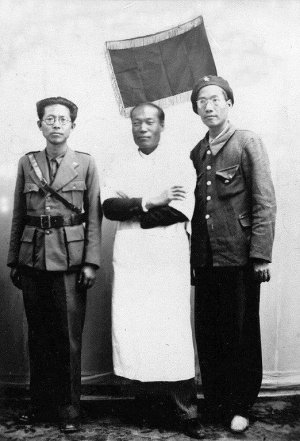
The three men in the photo are Xie Weijin, Lui Huan feng and Zhang Ji, proudly standing in front of a Spanish banner.  Lui, who was born in 1890, came from Shandong in North China, which supplied many of the 150,000 men who were hired to work on the western front in the First World War.  Nearly all those men were peasants signing up to escape dire poverty at home, with no concept of life in the west. In France, their graves fill whole cemeteries.  Most did not return.  Read China and the Great War : China's pursuit of a new national identity and internationalism by Xu Gouqi (2005) the classic work, details here. Highly authoritative, the best in the field.  Men from Shandong are tall and sturdy: in photos and films taken on the western front, we can see them wrestling and doing feats of strength like lifting weights, grinning for the camera.

But by no means were the Chinese volunteers in Spain all dislocated peasants. Zhang Ji, for example, born 1900 in a wealthy family in Hunan, had gone to the US, graduating from the University of Minnesota in 1923.  Like so many others in the Depression, he became disillusioned with capitalism, and went to Spain with other Americans, joining the International Brigades.  Zhang was last heard of in Hong Kong at the start of the second wave of the Japanese invasion.

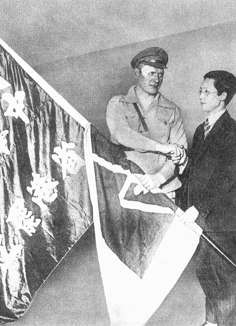
Xie Weijin(谢唯进 b 1899, Sichaun, died 1968, Sichaun) was involved with the waves of strikes and conflicts that erupted in South China between 1925 and 1927, which paralyzed the region, jeopardizing western business interests and their political hegemony.  In the brutal suppression that followed, Xie fled to Berlin, where he was photographed with Ernst Thälmann, head of the German Communist Party with a banner showing the support of the workers of Hong Kong and Kowloon, who had played an integral part in the General Strikes in the Guandong region. Please read more about him here. 

The Comintern, under an agent codenamed Borodin, were involved in the 1925-7 uprisings, though they were very much a Chinese response to specifically Chinese situations. But we can see why Xie looks quite comfortable the in his Republican uniform and pointed cap. Xie served in the Austrian Brigade as a machine gunner until he was shot in the leg.  It's possible that he may have known Hanns Eisler's elder brother, an Austrian who had been a Comintern agent in China in the 1920's. After Franco defeated the Republicans, Xie was imprisoned in a notorious camp in France, before returning to China where he served in the elite Chinese Air Force before falling victim to Mao's purges.  Irony, indeed.

A similar fate lay in store for Bi Dao wen (Tio Oen Bik), a Chinese doctor from Java,who was involved with the "Spanish doctors",a group of medical personnel who came from places like Hungary, Germany, Poland and Austria, who, being socialist and often Jewish, couldn't return home after Hitler. . Bi eventually went back to Java where he seems to have been killed in Suharto's massacres of Chinese people in Indonesia.  Read more here on recent research.  There's another study of the Chinese in the International Brigades from 2004 which I haven't read.

Nearly 20 years ago, I found a file in the British military archives about these men and women, who became stateless since they couldn't very well return home after Spain since they were socialists and often Jewish, too.  One of my uncle's friends  (Dr Gerald Abraham) was still around at that time, in his 90's, so I asked him about them.  He knew them personally !  He was the only son of wealthy Jewish family long resident in Hong Kong, but on graduation from HK university, didn't go into practice like the rest of the class. Instead, he volunteered to serve in China with the Quaker medical unit.  (Friends Ambulance) Given the difficult conditions at the front in China from 1938, that was a  baptism of fire for a young man who'd only until then known comfort. But all the more honour to him.  Thanks to him I traced the Friends Ambulance Unit in China, who were very unfairly treated and hounded out of China for not being neutral ! But neutrality is the Quaker way, and non violence. In China, the "Spanish" doctors were dispersed, going where needed. Some joined the Communist underground, others the Chinese Nationalist Army, against the Japanese. At least two ended up in Hong Kong after the war. My uncle's friends, doctors who'd started out in Roumania.  Small world.

And, as ever, Ernst Busch tells us like it was. Below, a clip from a live performance when he marks the date "July 1936" and sings Mamita Mia, merging into the anthem Thälmann,Kolonne, aka Spaniens Himmel, (composer Paul Dessau) with its refrain

Die Heimat ist weit, doch wir sind bereit.
Wir kämpfen und siegen für dich: Freiheit! 
(Our homeland is far away, but we are ready to serve :  we fight and will win for you, Freedom !)