 |
| Chou Wen-chung |
Showing posts with label chinese culture. Show all posts
Showing posts with label chinese culture. Show all posts
Saturday, 26 October 2019
Chou Wen-chung : the passing of a true Man of Culture


Sunday, 19 May 2019
Second Farewell to Cambridge Xu Zhimo

The poem is beautiful because it's so subtle. It begins with the lines on which it will end "Quietly I now leave the Cam, gently waving farewell to the western skies where a golden willow stands, like the bride of the sunset." The tree is rooted and will not leave, enduring after the poet is gone. Its branches dip over the river where rushes and duckweed throng, moving in the river's flow. Suddenly a vision : in the dappled waters and weeds, Xu sees a rainbow, shimmering as if in a dream of purity and promise. If only he could be like these weeds, But he moves on, poling his punt towards the fields beyond, not returning until the skies are lit only by stars and moonlight. But the images of silence return : on this evening, even the crickets are still, and do not sing. So "I leave as quietly as I came. I am quiet, gently flicking my sleeve, taking with me not even a wisp of cloud". The reference to the sleeve is significant. Though Xu and his friends usually wore western dress, the poets of the past wore traditional garments with wide silk sleeves, so refinement was built into their slightest movemnent. In this tiny detail, Xu connects past to present, Cambridge to China. The deeper levels of the poiem address impermanence. The cloud, for example, cannot be "taken" because it is immaterial. The flow of the river cannot be stopped, even though for a moment one can enjoy the pools and eddies. The poet is quiet, because silence suggests that time is standing still : any sound might break the spell. Yet there's so much sadness : when the poet arrived, he changed nothing, and when he leaves without changing what he loves so dearly.
Though Xu died young, his legacy is immense. His poetry is immortal, but he also transformed the role of poetry in modern China. He adapted traditional form, using vernacular as well as scholarly form. In his personal life, he was also progressive and forward-thinking. The women in his life were emacipated New Women, from a generation inspired by the reform movements of the time. One of his lovers was Lin Huiyin (林徽因). Ironically, she was turned away from architecture at a US university because she was female. Eventually she qualified, and with her husband Liang Sucheng (林徽因) pioneered the study of ancient Chinese architecture, their expertise used in urban planning and restoration. Xu's affair with Lu Xiaomen (陆小曼) scandalized Chinese society as both were married to other parties at the time. Lu, too, went on to be a well known artist. This background helps to explain the image of the willow tree as bride. Xu was not against marriage, but a passionate believer in the ideals of love. In Chinese culture, marriage means children, continuation and the future. In Cambridge willow and river belong together in symbiosis. Because the poet cannot change that, he has to move on.
Xu's Farewell to Cambridge is so evocative that it's inspired many musical settings, nearly all of them Chinese. A few years back, Cambridge commissioned a setting by John Rutter, which wisely retained the Chinese text : it's quite an achievement for the singers of King’s College Choir to learn to sing in Mandarin.
Monday, 4 February 2019

The Year of the Pig

Feast your eyes but cannot eat - ultra realistic roast pig cushions to mark the Year of the Pig
Sunday, 9 December 2018
Prostitute as Cultural Warrior
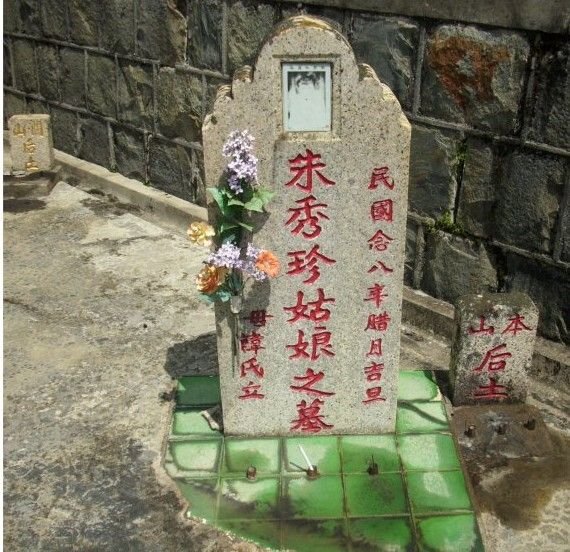
 花影恨(Fa Yin-hun) (1917-1939) was the flower name of Zhu Xiu shen (朱秀珍) (Chu Sau Chun)
orphaned young, forced by poverty to work in tea houses and/or brothels in Shek Tong Shui, the historic quarter of Hong Kong, where tea houses, theatres and restuarants were centred. The women sang and told stories : prostitution being only one form of entertainment. The area is now ultratrendy. Although brotels were banned in 1931, laws don't stop people doing.things. Fa was kept for a while by a patron, but didn't lose her ties with the other women. In 1937, the Japanese invaded China, taking Shanghai and later Guangzhou (Canton). Fa Yin-hun decided to contribute to the war effort and refugee aid by organizing 58 other songstresses in a singing competition, raising money from their clients. Shame on those men who couldn't do it themselves ! On 20th November 1939, Fa attended an opera where Ma Tse Tsang starred. He was an iconic figure who transformed Cantonese opera and culture : idolized by many to this day. Please read more about him a, his wife Hung Sin Nui and his worthy successor Sun Ma Tse Tsang on this site, using the search facility. That night, Fa went home and sent her maid out to get midnight snacks, which people often do. When the maid came back, she found Fa dying from ingesting opium. Taken to Queen Mary Hospital - then the most modern and advanced hospital in the region - she died, aged only 22. Why did Fa take her life ? She had prestige from her fund raising efforts, and had talent and good looks. In her suicide note, she wrote of despiar. Whatever she could or could not have achieved the circumstances of her situation stacked the odds against her.
Wednesday, 15 August 2018
The Song of the Phoenix : artistic integrity in tricky times

The Song of the Phoenix (2016)(百鸟朝凤) was the last film completed by Wu Tian Ming (吳天明), one of the seminal figures in modern Chinese cinema. Although the film is titled "The Song of the Phoenix" for western release, a more accurate translation of the title would be "A Hundred Birds and One Phoenix",which is more literary and also reflects what the film is about : the imperative of integrity, in art. The film is a lovingly observed evocation of traditional rural life in North China in times of change. Although the script is based on a novel by Xiao Jiang Hong, the name of the young apprentce is Yu Tian Meng (游天鸣) not so far different from Wu Tian Ming, who was exiled after the Tian An Men massacres, but allowed to return after the later reforms. "A Hundred Birds and One Phoenix " also reflects the aesthetic of the souna, the ancient blown instrument played by Old Master Jiao San Yie, who learned from many generations of masters before him. The souna evokes the sounds of Nature, especially the cries of birds in the fields, reedbeds and mountains in the area, and thus has cosmological significance. Thus its use in communal occasions, such as weddings and funerals, as well ss private reflection.
.
A father and son, from ther "Earth" village trudge up to Jiao San Yie's house in "Water" village. The father wants his son to learn the souna, but the Master isn't impressed, and the boy doesn't want to stay. Father beats son in frustration. Son is furious, but comforts father when he falls and is hurt. Later, the Master says that was the moment he decided to take the boy on, since his actions displayed emotional depth and strength of character. The Master makes the boy suck water up a long reed. This trains lungs and mouth muscles, but it's also mental discipline. Learning also involves living: helping in the fields, visiting family, marvelling at things like fireflies. After many months the younger apprentice Lan Yu gets to actually play the souna, but Tian Meng doesn't. Dejected he returns home and overhears his father talking proudly of him, so he goes back to the Master. Eventually he starts to play, too.
Part of the training means observing Nature, listening and learning from wild birds, imitating their songs on different sized souna. Eventually the boys are able to follow the master's troupe, and learn the cultural context. At a rich man's funeral, the Master's eight man band is hired, but the master won't play the Song of the Phoenix for any price. it's only for persons of exceptional moral value, who are not necessarily the rich and powerful. At last the Master decides to appoint his successor. before the assembled villagers, he explains. In twenty years, he's trained many good players but technical skills are not enough. A souna master must have the ability to move people : it is responsibility and heritage. He holds up the golden souna handed down from master to master for six generations. It's more than 300 years old. Then he hands his legacy to Tian Meng who's so shocked he can barely take it in. Poor Lan Yu, who was technically the better player. Artistry can't be measured by technique. Lan Yu later understands that Tian Meng got the accolade because he was a more determined personality.
Tian Meng takes over the business of the troupe, leading the other (older) players. They do a gig at the wedding of Tian Meng's schoolfriend, who's struck it rich. The Master recounts days when the troupe would be given gifts like wine, and ceremonial chairs But Tian Meng knows his hosts weren't interested in the music, only in money. Times are changing. Tian Meng's band plays at another wedding, where the family's so rich they hire a western band, electric guitar and pop singer. Tian Meng, supported by the Master, retaliates by playing a souna tune, but the western band drowns them out with the Radetsky March. The local wide boys beat up the souna players and smash the Master's ancient souna. there's no work now for traditional bands, and the players have gone on to other jobs. Even Tian Meng's mother scolds him and tells him to get a proper job. Chief Dou of Fire Village dies . Though deaf in life, he wanted a souna band. The Master shames some of the old troupe to return, because the dead elder was a war hero and good man, and starts to play the Song of the Phoenix, but stops because he's unwell.
 The Master has lung cancer, but it's too advanced to be treated. People from the government want Tian Meng to go to Xian to record souna music for posterity. Coughing in pain, the Master insists that Tian Meng do so. So Tian Meng heads to the city and meets Lan Yu, who's now a construction worker, married to Tian Meng's sister. Life's easier in town, but Tian Meng hears a lone souna player, begging for tips, and knows what he has to do. When Tian Meng goes back, the Master is dead, buried in a mound grave. Now, Tian Meng plays the Song of the Phoenix, the sound of the souna singing out from the grave site, over the mountain, into the valley and river which the Old Master had loved so dearly. No-one is there to listen, apart from the Master's faithful dog (who used to carry meals to him as he worked in the fields) An incredibly moving performance. The eulogy isn't just for the master but honours the whole souna heritage and the culture behind it.
 Wednesday, 1 August 2018

Thursday, 21 June 2018
Seven Little Fooks

It's December 1st,1962, when much of Hong Kong was stilll pre-war tenement, houses built on terraces, where people share communal spaces, like the neighbour, a tailor, who works in the yard and can't stand the sound of the kids singing. A new boy arrives. "Can I do cartwheels all day and not study?" he asks. "Then I'll sign for ten years!", he squeaks. His mother's crying, but it's best for him, though the contract she seals with her thumb print (she's illiterate) is severe. If kids die in training, no questions asked. That was the traditional way. Notice the kid's name is Chan Kong-sang, which means Chan "Born in Hong Kong", marking his parents brief respite after 20 years of struggle in war-torn China. He's now Jackie Chan. And so the kids learn tthe basics of Beijing opera, as much physical fitness and gymnastics as opera in the western sense. That's why they neeed to start young to be flexible. The school is very old style. The kids live communal and have shaved heads like kids in the North used to do. The local kids mock them, singing a rude song which the subtitles don't translate ("baldies, baldies, butter up your butts"). The kids give a performance but Big Nose fell asleep. The audience walks out "They've gone home to the radio" scolds Master Yu - the radio and big theatres being where top quality operas were done : small troupes can't compete. So they get beaten with canes. Mrs Chan comes to bathe the kids - no plumbing - and knows he's been beaten. But he says "Don't cry". Opera school is tough but the kids think they're freer than the ones in regular school, chanting by rote. When Master Yu goes out the boys march into town to collect charity rice. On their way back they clash with the fancy kids and there's a brawl. The taunt "Four eye'd boys, blind as turtles!" (meaning kids with glasses). Ponder that detail, it's important. Wandering far from home, they need to get back by bus, but haven't any money so they con the driver and later escape without paying. Watch them use their opera athletics to escape from the top deck !
Meanwhile Master Yu and his friend Uncle Wah chat in a teahouse. They trained together as boys themselves, in Beijing. "Rain or snow, we'd get up early and train". For what ? Few make it big in opera. Wah works as a stuntman and stand-in for stars. Bruises and broken ribs "Thirty years of good luck, thirty years of bad" quotes master Yu. "And then you're dead" says Uncle Wah. To cheer him, Master Wu starts singing, in the middle of the tea house, and Uncle Wah gets his dream, to sing again, for a public. When Master Yu gets home, the Cantonese tailor confronts him because the opera boys punched his kid. Master Yu holds his ground and defends his kids. Tailor and Opera master swap insults : scholars are too weak to work, too proud to beg : actors are prostitutes. Another witty retort not in the subtiles "Chicken piss!". But when the Lunar New Year comes, they all celebrate together.
Gradually the boys grow up, doing shows in proper cinemas. They also discover girls. Big Nose tries to impress by rotating a pot on his head, but modern girls are more interested in guitar bands. One day, the leader of a Cantonese female troupe asks for help, since Beijing boys are much better at gymnastics. Master Yu doesn't have modern social skills either. He wants to buy the female troupe leader a "western" birthday cake, but none of the traditional bakers do that. He has to travel all round town until he finds one. Alas, the inscription says "Happy 70th, Grandad!. So Master Yu can't read! It's extremely bad luck, since the Grandad it was baked for died that morning..... Master Yu isn't the only one not up with the times. The Tailor can't understand modern fashion. His son "borrows" for Big Nose the fancy togs his Dad's made for western customers and the two go out together. But the girl prefers the nerdy tailor's son who can "sing Beatles" as the girl's kid brother says. "You Beijing opera types no-one wants". Big Nose goes back, dejected but he's missed a show. Sammo substituted for him, but Master Yu beats him for covering up Big Nose's disobedience and kicks him out of the troupe. Sinc it's been his life, he has nowhere to go.
But business isn't going well and the troupe is dissolved. Sammo reappears crestfallen and is welcomed by Uncle Wah. Master Yu goes to Uncle Wah's movie studio to get work for the boys. He's forced to cut up a group photo so their heads can go on the register. Uncle Wah, who has been working as a stuntman for years, is getting old and has too many accidents. He blows his last chance and suddenly goes insane, climbing up into the roof space in the studio, mad with grief, re-enacting opera scenes. An amazing scene. Master Yu climbs up and starts to sing an aria from The Emperor and the Concubine, where the Emperor has lost his,kingdom, but his concubine remains loyal. For a moment, Master Yu and Uncle Wah are back to be stars again, singing together. Uncvle Wah thinks he's an opera star again. then he's taken away in an ambulance.
Master Yu calls his boys together. He's spent 40 years in opera. Success or not, he's given it full committment. The school is closed, the house is being demolished and the boys are starting out onn their own paths. so now he'll retire, abroad. He releases the tortoise he's kept for seven years to hold up his bed, feeding and watering it . Its back is strong and it it still knows how to walk. Master Yu boards the ship, that's taking him away, forever. "You persevered 40 years and so will we" says Big Nose. "Sammo look after them !" the master's last command. When they're gone he looks at the gift they've left. A white paper fan with what look like scribbles. But when the folds are aligned the squiggles spell out 七小福, Seven Siu Fooks. Below a photo of Master Yu who lived to a grand old age and his boys, now grown men.
PLenty moire on this site about Chinese movies, Chinese oopera and music, especially Cantonese. THis ius the only site in Englishwhich does these subjects from a wider social perspective.

Monday, 7 May 2018
Sad songs of the Li People

黎歌 - Song of the Li People (also known as Farewell Song) - an award winning film from 2011, which honours ethnic diversity in China. The first scene is straight ethnology, shot from real life. An elderly Li woman in traditional dress sings a traditional song. The film then cuts to the sound of a man singiung a traditional call, which echoes across mist covered mountains and rivers How beautiful that scenery is ! The Li people inhabit an autonomous region around Guangxi and Hainan on the tropical coast of south west China. Although they are believed to have migrated from further east in ancicent times, they have a distinct language and culture. To this day, there are just under 2 million , though many, like others in China, have migrated to larger cities. This movie is thus a record of Li culture and of social change. Though the pace is sedate, that allows lots of music and shots of scenery, which are very much part of the story - beautiful cinematography.
A small boat putters along the river It's operated by A Dong, a village youth. Though it's the prefered form of transport for the locals, the outside world is not so far away. Danmei scrapes a living selling tack to tourists but she's such a good singer of traditional Li song that she's sought out by Lao He, an ethnomusicologist. Life in the village isn't easy and many villagers have already gone to work in the city. Danmei is reluctant. "In Guangzhou", she says, people "despise those who can't speak Cantonese". Rather topical. Danmei uses a laptop to look up Guanzhou , but her friend, who's lived there and grown hard, says "No matter how nice it is, it's not our place". Nonetheless, Danmei and A Dong plan to elope and look for work. They haven't enough money but he buys her an "expensive" dress in the nearby small town.

If you like this, you might like Frühlingsglaube the movie 立春 where a singer loves schubert so much that she wants to dedicate herself to art. Things don't work out so easily, but she finds her vocation in another way.
Saturday, 10 March 2018
Melon Soup, served in a carved melon

Not my pic, but too good not to share. Soup made of winter melon, mushroom and herbs, served in a carved, hollowed out melon, base made out of melon too.
Tuesday, 6 March 2018
Muhai Tang Shanghai Chinese Orchestra, Philharmonie de Paris

Muhai Tang and the Shanghai Chinese Orchestra have been touring Europe in a series coinciding with the Chinese Lunar New Year. Their concert at the Philharmonie de Paris is now online on the Philhamonie site. This is serious Chinese classical music, extremely well done, light years ahead of the sort of kitsch you get on TV and in some movies. Chinese opera dates back some 700 years, pre-dating western opera. Traditionally Chinese music was chamber music for private self-cultivation or folk/popular music for entertainment. Even opera orchestras were relatively modest, the emphasis on poetry, acting and singing. Large-scale Chinese instrument orchestras are relatively new, going back around 100 years. But consider that western orchestral tradition didn't come into its own until the late 18th century, and the extreme cultural differences that had to be overcome, it's quite some achievement how distinctive Chinese classical orchestras can be. All the pieces on this programme are modern works, adapting traditional themes and instruments, effectively creating an original new genre. Muhai Tang, like many of his players, is well versed in western music as well as in Chinese, which adds extra richness to performance. So listen to this concert, and watch it, too, because the filming is musically well informed, with close up focus on playing techniques you'd never see so clearly in concert hall conditions. You can focus on tiny, delicate sounds, like a single string reverbrating in near silence, and see instruments like the Chinese piccolo, triangle and snakeskin drums.
Appropriately, the programme began with Harmony, by Wang Yun Fei, featuring three Sheng players, followed by Wang's even more impressive Black Bamboo for long bamboo flute, pipa and erhu. The large flute has depth and volume, suggesting the gravity of bamboo trunks, whose wood is so strong that it can be used to build ships and houses. The lightness of the pipa and erhu suggeest movement and flexibility, even a sense of gentle swaying movement, familiar to anyone who's ever seen bamboos bending in the breeze. More imagery in Spirit of Chinese Calligraphy (Luo Xiaoci, orchestrated by Xie Peng), with zheng soloist Lu Shasha. A small bamboo flute calls, introducing the zheng, this one with magnificent depth and vigour. In the west, the term "calligraphy" means ornamental writing, but in Chinese culture calligraphy is an artistic form of expression. Brush strokes "speak": swift, sure figures moving rapidly across paper after a period of contemplation. Lu's playing is graceful and forceful, contrasted with the call of a small banboo flute. My friend's mother's calligraphy was firm and independent, resembling kapok trees, whose strong lines and angles are majestic, and whose fleshy red flowers spring from bare branches. Spirit of Chinese Calligraphy is abstract, but you can hear the individuality and decisiveness in the flow.

During the Qin dynastic period (221-206 BC), a concubine sacrificed herself to give courage to her Emperor in wartime. This story of love and duty is so powerful that it's inspired literature and opera. Here we heard an adaptation for modern Chinese orchestra which captures the drama. Its ferocity suggests the saga of non-stop warfare from which the first dynasty in recorded Chinese history emerged, and its majesty suggests the splendour of the imperial court and the love affair that led to tragedy. Three main figures form the core : pipa, jinghu and large Chinese drum. Around them the tumult of full orchestra, complemented by westen woodwinds, celli and basses. The pipa often resembles the sound of a human voice, so its cry is plaintive against the turbulence. More esoteric, Caterpillar Fungus (Fang Dongqing) arranged for an ensemble of mixed plucked strings including pipas, different types of zheng and qin (large moon shape bodied lutes). Percussive effects are made by beating hands on wood. The fungus grows on caterpillars and kills its host, though it has curative powers for humans. Part worm, insect and plant, it is mysterious. Thus the music is hybrid, with a character that could be adapted for western strings.
The Butterfly Lovers Concerto, based on one of the most famous legends in Chinese literature, was written in 1959 by He Zanghou and Chen Gang. Here we heard an adaptation for erhu with soloist Ma Xiao hu, which I think makes it sound more natural than the better known version for western violin. The erhu duets with the western cello, the "lovers" who cannot meet until released from mortal life. The zheng suggest airborne flight, the Chinese flute the idea of birdsong. Dancing Phoenix (Huang Lei) features the suona a high pitched horn. Soloist Hu Chenyun calls out, from behind the orchestra, duetting with a small mouth organ : song bird and strident phoenix in a forest of strings, winds and drums, until the souna takes off with a long protracted call, the orchestra strutting in its wake. Imagine if Messiaen had heard this !
Three "Landscapes", The Silk Road (Jian Jiping), Moonlit Lughou Bridge Before Dawn (Zhoiu Ziping) and Wedding Celebration from Tan Dun's Northwest Suite, the first and last spiced up with regional colour, such as the evocation of Muslim music, are eclipsed by the middlepiece where shifting textures and tempi create a sophisticated tone poem. Long serene lines mark the beginning, flowing string figures suggesting the movement of water and a thousand years of traders approaching Beijing. Drums and cymbals announce a wilder, freer section whose zig zag lines could suggest the sounds of Beijing opera. The theme then develops into a majestic swaying crescendo broken by plaintive solo erhu, played by the Shanghai Chinese Orchestra Leader. Then suddenly it breaks off, in silence. (The attack on the Lughou Bridge marked the start of the 1931-45 invasion when tens of millions were killed and made refugees. )
Liu Changyuan's Lyrical Variation for the orchestra is even more sophisticated : a deep throated flute sings a long melody agaisnt a backdrop of quietly brushed percussion. The western double basses play distinctively "Chinese" sounds which merge seamlessly into the Chinese strings. A very strong sense of structure, percussive blocks alternating with keening legato (Chinese brass and winds). Erhus, being small, can play dizzying fast tempi. Members of the orchestra shout echoing the drums. Near-cacophony, from which another strong, swaying rhythmic line emerges Kong Zhixuan's Flying Bees displays the virtuosity of Chinese instrument technique : Rimsky-Korsakov's The Flight of the Bumblebee at manic speeds, changing direction and volume non-stop. What might seem mad frenzy is in fact very carefully paced precision. Ding Long's erhu leads the orchestra : sheng, ruan, qin and a single small muffled drum join in. Almostjam session syncopation, played with the ease that comes from true mastery.After that dynamism, a return to more "traditional" chamber music arranged for large orchestra, in Huang Yijun's Blooming Flowers and Full Moon. Muhai Tang gets the Paris audience to beat time : the rhythmic pulse of Chinese music is never far away. Western composers would do well to study Asian music, which offers its own aesthetic, with a structure based on rhythm and intervals, and a surprising amount of inventiveness. Oddly enough, Tang often looks like Beethoven, if you can imagine Beethoven beaming and benevolent. (Please see my piece on Debussy and the influence of gamelan at the Philharmonie recently, and my other pieces on Chinese music, film, culture and history, following the labels below).
Thursday, 15 February 2018
Kung Hei Fat Choy - Donald the Dog
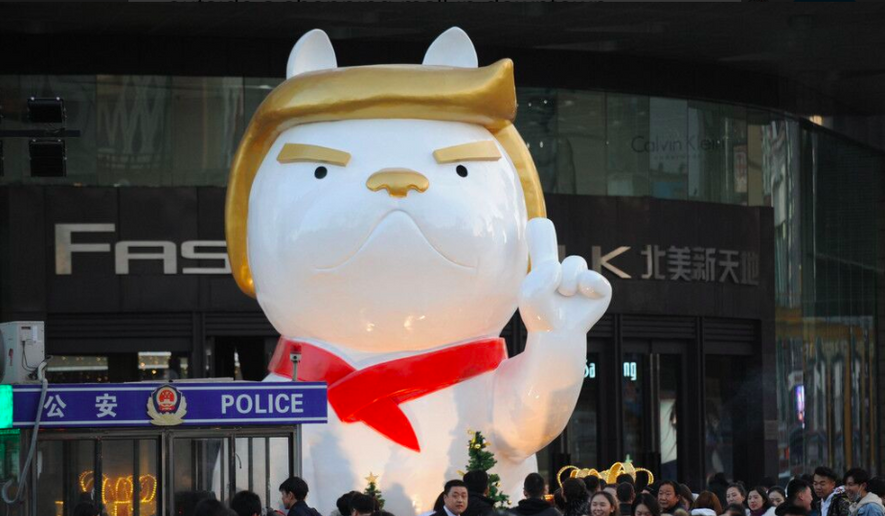
Kung Hei Fat Choy ! Welcome to the Spring festival, start of the Lunar New Year, Friday 16th February, this year. This is the biggest celebration of the year, when families get together from all over the country and the world. Everyone feasts. To attract good fortune for the New Year, people display flowers and fruit and "lucky" objects like calligraphy and brightly coloured ornaments. Since this year is the Year of the Dog in the Chinese zodiac, a lot of the ornaments depict dogs. Whole stalls selling toy dogs - soft toys, balloons, dancing toys and stuff for kids. I even saw someone "walking" a toy dinosaur, with wheels in its legs. Above, a Dog who's been on the streets in Shanxi province for quite a while. Political commentary ? Aha ! Although people born in the Year of the Dog are generally loyal and trustworthy, those born as "Fire Dogs" in the more detailed 60-year zodiac have problems. Like dogs, they obey and are controlled by others. They like money and comforts but don't manage them well. And in matters of love, they are, well, like hounds. Of course this doesn't apply to everyone, but..... !
Tuesday, 31 October 2017
Candy or Cholesterol ? Halloween Sausage
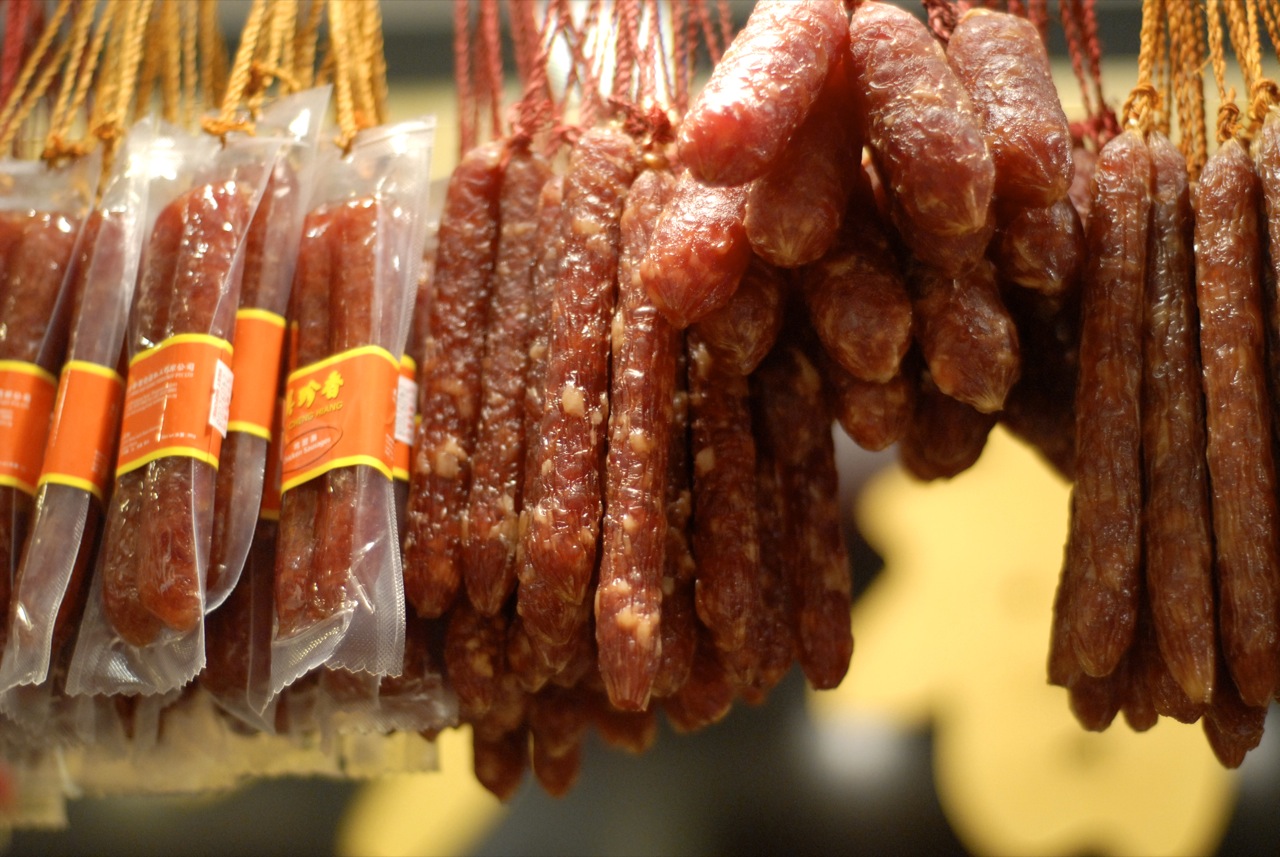
Why have Candy when you can have Cholesterol ? For Halloween, a tasty treat that will send you to the grave if you eat too much. But what a tasty way to go ! Lap Cheong ( 臘腸) a sausage you can eat all year round, but mostly in winter. It looks like salami but you have to cook it or it's like leather. Always sliced at a diagonal angle, to ensure maximum exposure of the insides, and minimal casing. Never coin shaped : that's indigestible. Ideally cooked over rice, as it steams, so the fat leaks into the rice and makes it fragrant. And greasy ! Or stir fried with vegetables (preferably strong flavoured greens like Chinese mustard) or added to stews and hotpots. A little goes a long way, but adds a distinctive flavour which addicts savour. Lap cheong comes in many varieties, including liver and blood but the tastiest are pork with a bit of spice. In the past, they were prized for high fat content: "Pick a good one with lots of white", said my grandma. In the past, though, people didn't eat much, or often, so high fat was actually good for them. If you were poor, one sausage could feed a whole family. But even as a kid, I'd nibble the meat and discreetly leave the lumps of fat aside. Not that it did me any good. Nowadays lap cheong is healthier, and the ratio of fat to meat lower : Diet Lap Cheong ! Canadian lap cheong is popular because the meat's tastier and the fat content as low as possible yet still authentic.
Saturday, 8 July 2017
Music Interflow - Hong Kong Music Series SJSS

Starting the Hong Kong Music Series in London, Music Interflow- a Dialogue of Two Cultures at St John's Smith Square. Presented by the Hong Kong Arts Development Council, the series shows what Hong Kong has achieved, in a city with a thriving creative community. This concert, organized by Professor Lo King-man, demonstrated the varied influences which have gone into making Hong Kong a uniquely vibrant artistic force. Hong Kong has a lot to be proud of! In Britain, people's ideas about Hong Kong are shaped by western media, so this Hong Kong Music Series is important. The two major highlights are yet to come - Beyond the Senses,Chinese chamber music as music theatre (Read preview HERE) and Datong : the Chinese Utopia, an opera that examines the modernization of China through the lives of 19th century reformer Kang Yu-wei and his feminist daughter. British audiences owe it to themselves to pay attention.
Professor Lo King-man (pictured in the middle above) has been one of the great figures in the Hong Kong arts scene for five decades. He was Director of The Hong Kong Academy for Performing Arts, the equivalent of the Royal Academy of Music, the Royal College of Music and the Guildhall School put together. Under his leadership, the Academy introduced degree programmes, and specialist schools including one for Film and Television, a major industry in Hong Kong and source of the New Wave in modern Chinese cinema. He also set up the Centre for Chinese Traditional Theatre Studies In Hong Kong, music education is part of the school system, and standards are extremely high. Thus the Academy for Performing Arts is built on strong foundations. Now retired from the Academy, Professor Lo is Artistic Director of Musica Viva, an organization supporting performance.
Music Interflow began with six pieces by Hong Kong composers written for Chinese instruments. Tradition adapted for concert hall, capturing the sense of personal imagination that is so much a part of Chinese chamber music. Some pieces were for ensemble, some for soloists, Xu Lingzi's Guzheng particularly impressive. Clarence Mak's Meditation on Mount Jingling inspired a dizzying virtuoso display showing the potential traditional instruments can provide in terms of colour and expressiveness. A strikingly original piece. Doming Lam is another great figure in Hong Kong music, his place in Hong Kong music represented by his Three Night Songs of Li Bai, an early work, where the piano line is western, but the vocal line is Chinese. Read more about Doming Lam and Clarence Mak HERE. Appositely, three Britten Songs, followed, arranged for two voices and piano. Britten was fascinated by non-western music while still in his thirties. Perhaps his awareness of norms beyond the western canon animated him as a composer: he represents a new. and highly individual thread in British Music. Britten and Pears did spend time in Hong Kong but weren't able to experience Chinese music in the community it came from. Things didn't happen that way in 1956. Significantly, Doming Lam Three Night Songs of Li Bao dates from almost the same time, in 1957. Imagine the Music Interflow if society had been different. Read my article Britten and Pears in Hong Kong. Also see Britten : The Prince of the Pagodas.
Equally eclectic was the second part of the programme. Six Miniatures of Yin and Yang (Meilina Tsui): Western music but with a distinctive Chinese personality. Yet more unusual perspectives: Holst's Venus and Jupiter, from the The Planets, transcribed for two pianos. "Yin" and "Yang" in an entirely western context! Just as the concert had begun with Chinese chamber ensemble, it ended with western chamber ensemble with Frank Bridge's Three Idylls for String Quartet and Ottorino Respighi's Il tramonto, with a setting of Shelley's The Sunset in Italian. Superb singing from Carol Lin (in sparkling gown in photo above). The piece is dramatic, like a miniature opera, where multiple moods are portrayed in the space of roughly 15 minutes. A tour de force. Lin floated the word "O" so it felt eternal, as it should, but even better was the elegant richness of her singing in the tender, lyrical passages that make this piece so moving.
Performers featured : Mary Wu (piano), Nancy Loo (piano) Alexander Wong (piano), Xu Lingzi (guzheng), Carol Lin (mezzo), Colette Lam (soprano), Ho Siu-cheong (dizi), Chan Pik-sum (erhu), Zheng Yang (violin), Wei Ningyi (violin), Chris Choi (viola) and Xu Ting (cello)
Composers featured: Tsui Wai-lam, Lui Man-shing, Chan Man-tat, Meilina Tsui, Doming Lam and Clarence Mak, Holst, Britten, Frank Bridge and Respighi
Please see my other pievces on Chinese music, Chinese movies, Chinese historyand on Hong Kong. This is one of the very few sites which covers Chinese culture and arts in English. And I cover a lot on British music, especially Britten.
Sunday, 7 May 2017
Cold Nights - a refugee saga
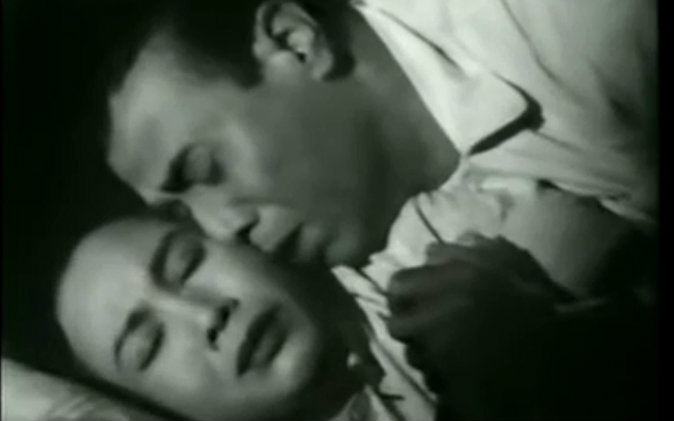
Cold Nights (寒夜) a novel from 1947 by Ba Chin (巴金) (1909-2005) describes the impact of the biggest mass migration in modern history, when tens of millions of refugees trekked across China, refusing to remain under Japanese occupation, a saga of human endurance that needs to be appreciated in the west. Ba Chin's famous trilogy Family, Spring and Autumn (1933-40) is a classic of modern Chinese literature, confronting the injustices of traditional feudal society. Given the background, Cold Nights is equally panoramic, though the family in this case is small. Wong Man Suen and Tsang Shu San are modern, progressive-thinking intellectuals who went to university and might have had careers ahead, had the war not intervened. Cold Nights is even bleaker than the Family Trilogy since it doesn't conclude with hope. Though Cold Nights is set in Chongqing, the seat of Free China, it was made into a Cantonese movie in 1955 by a cast and crew who were themselves refugees, who suffered similar traumas first hand. Not at all a typical "war movie". Tsang Shu San is played by Pak Yin, (1920-1987) while Wong is played by Ng Chor Fan (1910-1993) who in real life was the leader of the refugee film community exiled from Hong Kong.
The film begins with an air raid, sirens screaming, people running terrified through crowed streets, shells dropping all round. Chongqing was subject to the most severe aerial bombardment, not surpassed until Germany and Japan were flattened a few years later, and the targets were civilian. Wong Man Suen realizes that the bombs have hit his home, and rushes home to find the house empty. Hundreds have been killed, but luckily his mother and son have escaped. A flashback to the past : a much younger Wong wakes, alone in bed. A letter arrives. It's from his wife Shu San. After seven years of marriage, she's leaving him. He thinks back still earlier, when he, she and their friends Tang Pak Ching and Mok Man Ying were college students, both couples deeply in love. They graduated, but while Wong was buying a wedding ring for Shu San, the city of Hangzhou was bombed. In wartime conditions, it took them months to travel back to Wong's home. Their son was born en route. But Wong's mother was furious. Wong phones his wife at the bank where she works. They meet in a smart café, where the windows are taped up for safety in bomb blasts. "I'll have tea" he asks, "I'll have coffee" says she. The reason she's leaving is the way his mother has treated her. "And you", she adds "have been ground down by her, too". In the soundtrack we hear the song On the Songhua River, which refers to war, refugees and social disruption (Read more about the song here)
Wong meets up with his old university friend, Tang Pak Ching, also a refugee. Tang's wife had a miscarriage but couldn't get to hospital when the streets were blocked in an air raid. "She held my hand and cried my name", he sobs, And then she died. "This war, it's so cruel". The four college friends from former days are now three. Wong starts drinking. Shu Shan is disgusted that he's fallen so low. She carries him home, though, but his mother blames her. In his delirium, Wong cries "I love you, Shu San, don't leave me". He's becoming ill (tuberculosis). She loves him, too, so she stays but his mother is worse than ever. Shu Shan's still working at the bank - she's the breadwinner - and her boss wants her to move with him to Lanchow. She tells him no, but Wong, not realizing that the boss has ulterior motives, urges her to go. He goes back to his old office, but his colleagues treat him as a pariah because he's infectious. "But we've been friends five years" he cries. A friend arrives with some money his friends have raised as a gift. But he's been fired by the boss. "In wartime, that's how things are" explains the friend. But mother flies in a rage. Wong, in his grief, blames himself. He loves Shu San but has failed her. He's also failed his mum, who put him through school and looks after him and his child.
Wong gives Shu San a wedding ring - as he wanted to do years earlier, before things went wrong. Ironically, she's leaving in the morning. She's brought a huge sum of money for medical bills, which she's got from her boss . She's resolved to move, though her heart is not in it. She tells Wong it's only a short separation but he knows better. ""I will return, in a year, or two, or three, but I will return". "And I will wait", he adds. In the dawn, they part. They look at their child, sleeping beside grandma. "Tell her I don't hold a grudge". A tear rolls from the old mother's eyes.
Although it's cold and Wong is sick, he goes out, to the café where he and Shu San had been together. "I'll have tea" he tells the waiter "and a coffee, for her". But there's no-one there. The Songhua River song is heard again, quietly. Another air raid. We see fighter planes anti-aircraft guns, wardens and refugees. Wong sees his old friend Tang Pak Ching in the crowd, but his friend cries "Tang Pak Ching is dead". His mind has gone, maddened by grief. Bombs rain down and Tang is killed before Wong's eyes. Eventually, the newspapers announce, the war is over. A big parade in the streets, with lanterns, drums, firecrackers and a lion dance. The procession passes Wong's house but by now he is so sick he's almost delirious. He gasps "Shu San" and collapses.
A rickshaw arrives. Shu San has come home. But a neighbour tells her that Wong died, on 3rd September - the day Peace was declared. The neighbourhood buried him locally. Shu San sits at Wong's grave sobbing. She's worn his ring all the time she was away "Why didn't you wait for me ?". It's now the 100th day since Wong's death, so grandmother and child have returned to the grave for ceremonies. Forgiveness: all three will return to the native village.
Sunday, 26 March 2017
New Life for an Old Pagoda


When Pak Yin's mother hears her daughter is pregnant she resolves to return home. It's Ching Ming, a festival where people sweep graves, to honour their ancestors. The old lady is thus acknowledging her place in the system of continuing generations, while also respecting the future. She's made clothes for the new baby but doesn't want to bring bad luck by being sick in her daughter's home. Because the pregnancy isn't going well, the mother understands why it's bad luck to see her daughter. She takes her leave, weeping, while her daughter sleeps, knowing they will not meet again in this world. Wonderful acting, yet again, from Wong Man Lee who played the mother in Parent's Heart with Ma Tse Tsang, which I wrote about here.
Mad with grief, Yee So (played by Mui Yee), walks out of the Cheng gardens, filled with spring blossom, and hangs herself in the pagoda. Serious bad fung shui. Mei (Pak Yin) finds the body and faints. The LoTai Yeh tells Ping that his wife is dead and that he must remarry. Ping burns offerngs at what he thinks is Mei's grave, but the sound of insane laughter rings out. The truth must be told. Mei isn't dead. She's been imprisoned in the pagoda and has gone raving mad. Ping enters the dilapidated pagoda and tries to save Mei, but she doesn't recognize him. She climbs further up the pagoda,. The Old Grandfather arrives, with men and torches., but Ping refuses to leave Mei. She falls, and he carries her body out, defying his father. The old system with its rigid superstitions has caused too much tragedy. Ping sails away in a junk to a new, unknown future. The pagoda is seen against the skyline. Maybe the "immortality" it represents means new life, elsewhere.
The film is shot with great detail - architecture, costumes and plants, and has an excellent soundtrack (traditional Chinese music). The outside shots of the pagoda were done on site, but the internal shots in a studio. My father used to take us to Ping Shan, where we visited the real life pagoda, which in those days was still remote in a fung shui position, separated from the village by fields and canals. One evening, at dusk, bats flew out as we approached. Nowadays, it's cleaned up and restored as a heritage site, in the centre of the new, prosperous city around it. Perhaps the movie was right ! Heritage is people, not material objects in themselves. We learn from the past and retain the good, exorcising the bad. But if we don't learn, we might make the same mistakes.
Monday, 13 March 2017
Sacrifice of an Opera Singer

One of the finest Cantonese movies ever made, and one which deserves to be in the canon of world cinema, Parents Heart (父母心) starring Ma Tse Tsang (,馬師曾) (1900-1962), the paramount actor and opera singer of his era. As a young man, Ma was a megastar, galvanizing Cantonese opera, so significant that there's no equivalent in the west. In Parents Heart, he plays a former opera star reduced to poverty by social change. Watch this movie and learn a lot about the art of Cantonese opera, since performances are built into the narrative expanding the drama. The film is also a study of Chinese values, but it's a universal story. It's so sensitive, and so emotionally true that sometimes the intensity is hard to cope with, but its message is extraordinarily powerful. What keeps us going when life is too hard to bear ? Love, art, aspiration and hope : utterly relevant for all. Yet it's lost to western audiences, because it's not in English but needs an awareness of cultural background.
The title credits play out against a curtain on which two masks are placed, one smiling, one in tears : symbols familiar to all but here distinctively Chinese. Next we see neon signs : modern theatres and nightlife. Opera has fallen on hard times, having to compete with movies and westernized entertainment. The character Ma plays was once extremely popular but now he's reduced to playing in half empty, rundown theatres. Nonetheless, we're treated to a superlative performance -a masterclass in Cantonese rhythmic singing, a bit like Sprechstimme, but improvised and inventively spontaneous. Listen to the phrasing patterns, and the imaginative variations on basic tunes. Ma plays a scholar but suddenly breaks in to a march. "Quit fooling around" sings an actress "You're supposed to be singing" Great as the performance is, the show is closing and the opera troupe breaking up. So when Ma answers "These days, it's foreign things that count" you realize that his march isn't just improvisation but a cry of protest. Notice how the percussion clappers used to punctuate singing continue on after the show has ended and Ma relaxes with his friend Wong Chow San. The clicks suggest mounting tension. Gradually the background music turns to western orchestral (Sibelius) as in many "modern"dramas, but the point is made.
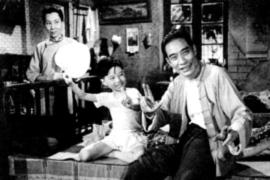 Ma goes home with the pittance he's made but his wife (Wong Man Lei) bursts into tears. She's on the verge of a breakdown. Wong's performance is frighteningly well observed, and the way she and Ma interact is sensitively played. Ma plays with his younger son Wai Tsai, but in the process is also teaching the kid the rudiments of opera improvisation and movement. The boy is played by Yuen Siu-fai, who also appeared in Father and Son, read more here) The elder son, Ah Kuen has been studying abroad but comes back on vacation. He's played by Lam Kar Sing of whom more HERE. Ah Kuen immediately notices that something's wrong with his mother, but both parent keep up pretences. Although Ma is broke, he loves his boys so much he wants to protect them. He takes them out for a meal and buys the younger one a toy monkey. Little Wai Tse wants to be like Dad and sing opera : another chance for play disguised as teaching.
 Proud of his Dad, Ah Kuen invites his friends to the theatre. Once Ma was a star, now he's reduced to humiliating bit parts. Watch the way he does acrobatic back flips, though! Though Ma is dressed as a lion clown, his expression is heartbreaking. Ah Kuen realizes that his parents are broke. He can't bear to take the money his father gives him for school. Ma bursts into tears : for his son, he'd sacrifice anything. "I don't want you to end up like me, you need an education to set you up for life". Unlike many stage stars and opera singers, Ma was a natural in close-ups, acting with great nuance and subtlety.
Ah Kuen can't get a job because he has no experience, so sneaks back to school but leaves the money with his mother. With the money, Ma redeems the opera costumes he'd pawned and starts busking on the streets. A big come down from the past, but better than starving. Yet again, this is an opportunity for Ma to demonstrate the art of Cantonese opera. A long sequence of skits in which he plays roles which are both theatre and "reality", for example a sad clown cheered by the thought of having children. Meanwhile Mother becomes ill. Another well acted scene in which Ma and Wong face her death with mutual respect and tenderness. After she dies, there's a long shot of Ma in the now empty house, looking at photographs of the family in happier times. Back on the streets busking,there's a wonderful vignette in which Ma plays a beggar who sees a gold ingot, which is grabbed by a succession of other players "No mercy in this world" sings Ma. eventually Ma becomes unwell and loses his voice, permanently. "If I can't sing,how can I live!" he cries.


Sunday, 19 February 2017
Prostitutes, chamber music and recording
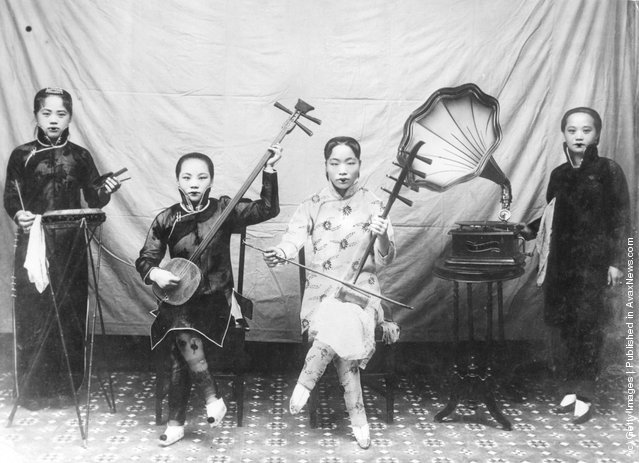
Traditional Chinese singing girls, who used to make music in teahouses, brothels, etc. But look ! A gramophone player ! This would date the photo to the first decade of the 20th century, when such things were still such a novelty that people would pay to listen to sound coming from a machine. So these enterprising girls found a way to draw the punters while giving themselves a break from singing and playing. Recording technology came early to China. There are quite a few cylinders of Beijing opera stars singing popular arias. From the style of their clothing, (unusually high collars) these girls come from North China. Their feet are tiny - possibly the result of footbinding that fell out of favour after the 1911 revolution. Generally footbinding was a middle class thing, which suggests that these girls were "bought" as infants in order to be trained as prostitutes. (though "prostitution" in that context was a mix of different services, like geishas don't just do sex)
Saturday, 28 January 2017
Decoding Chinese New Year
 Today, the first day of the Lunar New Year, heralds the Year of the Rooster. Let's hope it's not a cock-up like last year. To bring good luck, people surround themselves with auspicious images, like plum blossom branches, tangerines, and calligraphy. Symbolism everywhere ! Fish, fruit, boats and babies - all harbingers of prosperity. But sometimes the symbolism can be more subtle, particularly in situations where being oblique is safer than being direct.
 The poster at left shows infants carrying a jade object. It was made soon after the overthrow of the Qing Emperors in 1911. The jade object is a ju-i, a sceptre carried by monarchs, symbolizing power. The phrase "holding the ju-i" means taking responsibility. So when the toddlers, symbolizing hope, hold the sceptre, the message is "celebrate the new Republic". A hundred years ago, illiteracy was common, so learning was spread through folk arts like this, with symbolic meaning. New Year posters are a kind of narrative tracking the dreams of ordinary people, mostly poor and disadvantaged. Fat kids mean there won't be famine, multiple babies mean that some, at least, will survive. When little girls are depicted, as well as, or in place of boys, the message is the New Woman, a symbol of modern China and equal rights. Later still, the infants are shown holding cars, spaceships and radios, new symbols of modernization and prosperity. Of course there are propaganda elements, but for ordinary people such things meant hope. Nowadays people are so materialistic that they forget how things might have felt from the perspective of the poor.

Sadly this poster must have been made before the Red Guards demanded the abolition of all culture. "Smash the Olds" was their slogan, the denial of the past, and all learning, to serve the political agendas of their present. "Alt facts" before the term was invented. Some things don't change, east or west.
Tuesday, 10 January 2017
Imperial princes, building snowmen

Winter scene in the Imperial Palace, Beijing : click on the photo and move your cursor to enlarge to appreciate the detail. The original scroll was three metres tall, painted with meticulous detail. It was painted by Giuseppe Castiglione (1688-1766) aka Lian Shi Ning 郎世寧;. Castiglione came from an aristocratic Italian family but became a Jesuit missionary and was sent toi China , arriving in 1715. In line with Jesuit practice, he immersed himself in Chinese culture. Unlike other missionary groups, the Jesuits believed in winning hearts and minds, however long that might take rather than conversion by force. Castiglione served at the courts of three emperors of the Qing dynasty, the Kanghsi, Yongzheng and Qianlong. emperors. Using Chinese materials, Castiglione painted in a blend of Chinese and western styles. He did portraits of his emperors seated on their thrones in formal Chinese style, but also posed in more western ways. His portrait of the Emperor Qian Long for example, shows the monarch astride a horse, almost exactly as if he were Louis XV, his almost exact contemporary. Indeed of the two, Qianlong probably outshone Louis. In the painting above, we see the imperial children, playing in the palace gardens, like kids would do anywhere. They're building a snowman. But being young princes, their snowman is a Chinese lion.
Subscribe to:
Posts (Atom)