Showing posts with label Vogt Klaus Florian. Show all posts

Monday, 11 June 2018

Outstanding Parsifal-aware Lohengrin Royal Opera House

Klaus Florian Vogt and Thomas J Mayer, copyright Tristram Kenton, Royal Opera House
Wagner Lohengrin at the Royal Opera House.With some of the finest Lohengrin, most experienced specialists in the business - Klaus Florian Vogt,  Andris Nelsons and Georg Zeppenfeld - this was guaranteed to be an overwhelming musical experience.   Outstanding richness and depth in the orchestra,  with the scene on the Scheldt materializing in the music with such dramatic power  that anyone, even the most anti-war, could believe, for a moment in what was later to be called the "First Reich".   Horns and trumpets blazed from all round the Royal Opera House building, most appropriately from the Royal Box itself, bringing a vast, invisible army into the semi-civilized confines of an opera house. "Für deutsches Land das deutsche Schwert! So sei des Reiches Kraft bewährt!". 

Brabant is in turmoil, but only part of a wider struggle of cosmic proportions.  Heinrich der Vogler might have been a real person but Lohengrin is opera, not history.  For Wagner, Lohengrin isn't "just" a war story but the continuation (in advance, given that Lohengrin came before Parsifal) of a struggle between pseudo-Christianity and demonic forces.  If Lohengrin descends (somehow) from Parsifal, then Ortrud and Telramund connect to Klingsor and Kundry, their sexes reversed.  Hence the paranoia that underlies this opera and its strange, mystical resolution. And in times of extremist hysteria, the individual is suppressed. Elsa needs a super-hero, but when she gets one, he turns out not to be quite the man of her dreams.  The people of Brabant are conformists, easily swayed. Not so different from the modern world.  So it's nonsense to call David Alden's production "updating" or even semi-Third Reich. Grandiose manias, grandiose buildings and monotone masses have gone together since the dawn of history.

Thus the Prelude, conducted by Andris Nelsons with sublime purity, so the sounds seemed to shimmer with ethereal light. If Nelsons can do richness, he's even better at creating subtle atmosphere. Gradually, the mists give way to light, and the drama can begin. The King listens to Telramund's accusations and Elsa's strangely inert defence. But  lo ! Alden's staging (sets Paul Steinberg, video Tal Rosner, lighting Adam Silverman) creates the entry of the Saviour (for that is what Lohengrin is).  Huge, dark ripples projected over the stage suggested the movement of waves, concentric circles stretching outward, with flashes showing the wings of a large flying bird.   In this opera, it is not the swan boat per se that counts, but the imagery of water, and the theological connotations thereof. Again, think Parsifal.  The pettiness and intrigure of Court wiped clean away by the appearnce of the champion.

Significantly, Lohengrin is first seen with his back to the audience, his voice projecting to the back of the stage, intensifying the sense of mystery.  This is an interpretive insight, for Lohengrin isn't here "for" Elsa but for an unknown higher purpose.  Veiling Klaus Florian Vogt's magnificent voice in this way also serves to stress the character's innate humility. Unlike kings and intriguers, Lohengrin is above petty power games.  When Vogt turned round, his voice grew with the strength that comes from absolute confidence. "Ein Wunder ! Ein Wunder!" indeed.  Vogt has done Lohengrin so many times over the last 20 years (including with Nelsons)  that his voice should be familiar to all, but yet again, I was astonished by its flexibility and beauty.  Almost superhuman purity, so natural and unforced that it seems to come from within., not merely from technique. This is true artistry. Vogt is a Lohengrin for the ages: How blessed we are to hear him. 

Lohengrin spares Telramund, who confronts Ortrud, who set him up in the first place. The relationship between Ortrud and Telramund suggests the relationship between Klingsor and Kundry, this time the dominant partner female rather than male (though Klingsor isn't male any more). Ortrud is the last of the ancient house of Radbod, Telramund drawn to her by his greed for power, though he blames her when he fails. They  are important characters, not quite as secondary as they might seem, so deserve the attention they are given in this production.  Thomas J Mayer is a good Telramund, and  Christine Goerke is a magnificent Elektra amongst many others: particularly good in roles where the character is strong and proactive, if misunderstood.  Ortrud is forced by fate into dangerous measures.  We're not supposed to like Ortrud but Goerke develops the part so we can sense the woman behind the monster, sensuality behind piercing steel, her voice her sword.  Elsa always takes centre stage, but Ortrud is a far more complex personality, and needs singers like Goerke who can express the depths in the otherwise thankless part.  To some extent, sexuality is involved, as so often in Wagner.  Telramund had wanted to marry Elsa, but married Ortrud instead, and sex is very much part of their alliance.  But more pointedly, why does Lohengrin, a pure knight, want to marry ? The big bed, the wedding songs etc hint at the procreative purpose of marriage. Maybe it's convenient that Elsa asks the forbidden question  and needs to know who he really is. Like his father, Lohengrin doesn't follow through but returns to his higher mission.  Gottfried, the true heir of Brabant, will arise again at the end of the opera, resurrected from the non-dead without much explanation.

The entry into the bridal chamber was introduced with such vitality by Nelsons and the ROH Orchestra that the staging, for once, did intrude. With music as gloriously performed as this, there was no need to distract by having actors run in between the seats. In the orchestra stalls, where we were seated, it was annoying and would probably have been missed by anyone further above.  Jennifer Davis sang Elsa at short notice in place of Christina Opolais (who's getting divorced from Nelsons). In the Second Act, she showed her mettle, singing with more volume and colour than she had in the First Act. While she doesn't have the depth of, say, Annette Dasch or Anna Netrebko, two fairly recent Elsas with robust personalities, she's still young and will develop over time.  In this Third Act, in the bridal gown, Davis's good looks expressed the part impressively.  Vogt looked genuinely protective, the luminosity of his singing taking on warmth andmasculine  tenderness.   As Elsa became more petulant, Lohengrin became more alarmed, and in Vogt, we could hear heartfelt regret.  Telramund breaks in - symbolically breaking the hymen in this staging - Lohengrin impaling him on his sword, handed to him by his bride. (Lest anyone query the imagery, it's in the plot).

Significantly, Wagner immediately moves the action back to  the armies assembled on the banks of the Scheldt, the conflict between East and West taking precedence over personal tragedy.  Earlier above I described the phenomenal impact of the musical introduction to this scene.   Nelsons led the orchestra with such intensity that the musical logic carried all before it. Whatever questions may be embedded in the plot,  "Wir geben Fried und Folge dem Gebot!", just as Wagner intended.   Intensity of a different, otherworldly kind, when Lohengrin explains what is about to happen. Vogt has sung "Im fernen Land" many times, and, if anything, his delivery glows with maturity. We forget that it's a "hard sing" testing range and heft, but Vogt illuminated it as if transfigured., yet still tinged with human suffering. The conjuction of Lohengrin, Parsifal and Christ may be theologically way off beam, but in Wagnerian terms, it's perfectly apt.  The King in this opera isn't a fighter, but a judge, almost a Pilate figure, hence the excellent characterization by Georg Zeppenfeld, delivering with real authority. No glitz and gold, but a man of depth.  Notice, neither Wagner's Heinrich nor Lohengrin are men of impulsive violence. Toward the end, Vogt walked quietly to the back of the stage.  Gottfried appeared, and Nelsons ended the performance with a magnificent final coda.

Cast and conductor made this a memorable experience, but the production itself will be worth reviving because it’ss well thought through and true to meaning. Infinitely more  conducive to inspired performance that the old production where the singers were trapped in dalek suits. 

Monday, 10 July 2017

Abendstern Tannhäuser - Bayerische Staatsoper Munich


Wagner Tannhäuser at the Bayerische Staatsoper, Munich,  with Klaus Florian Vogt, Christian Gerhaher, Anja Harteros and Georg Zeppenfeld, conducted by Kiril Petrenko.  That the singing was brilliant is no surprise, since these singers are so familiar that what they do isn't "news", though I'll write more later.  What was a surprise was the staging, or rather the thought that went into the dramaturgy.  The Overture seemed to make no sense at all. Venusberg represents unbridled sexual excess. Wagner's description is unashamedly explicit - Sirens are bathing - naked - in waters pouring from a cave hidden by cliffs, lit in lurid flesh tones. A vagina !  Modern audiences couldn't cope. Yet here we saw maidens in Grecian garb, as elegant as marble figures.  An Abendstern Venusberg? "Wie Todesahnung, Dämm'rung deckt die Lande,umhüllt das Tal mit schwärzlichem Gewande". Venusberg aping Wartburg? Upside down, I thought, at first.  But maybe that was the point. Venusberg and Wartburg represent opposite poles. Venusberg symbolizes sex, creativity, and life: Wartburg symbolizes denial and death. Which, in fact, is more "pure"?  Thus the Cupids around Venus's couch are unformed blobs of flesh: a shocking image, but again that might be the point.  Venusberg is tainted. Tannhäuser needs to get away if he is to develop.  

In Tannhäuser, Wagner develops his ideas on the role of art in life. Tannhäuser is a precursor of Walter von Stoltzing, the two Siegfrieds and Parsifal, who don't spring fully formed from the start.  Hence the Sirens at Venusberg, firing arrows, an image that doesn't make sense til we journey a while with the production.  If you don't know what you're shooting at, don't shoot! You might just be wrong. Wagner's heroes start out thinking they know everything. They only grow when they learn to learn.  Nothing wrong with that, as Wagner shows.  In our own time, when anti-intellectual populism prevails, Wagner's message is frighteningly prescient.  Like the Knights of the Grail, the Knights of Wartburg are aggressively insular, blocking out ideas other than their own, resenting dissent.  Tannhäuser could have an easy life playing their games, but he chooses not to, striking out on his own. He searches for truth whatever the forces against him. And Elisabeth sides with him, sacrificing herself.  Tannhäuser may never unlock his Grail, but redeems himself because he has vision. For Wagner, religion "is" art, so the quest for artistic integrity can never end.   An artist seeks enlightenment, not playing to the crowd.  Thus the Grail Knights desiccate until they learn compassion. What will happen to Wolfram and the Minnesingers of Wartburg with their sterile dreams and inhibitions? An insular community based on denial, and hatred of women in particular, isn't conducive to creativity. 

The best Tannhauser I've ever heard live was Johan Botha (read my tribute here)   Klaus Florian Vogt comes pretty close: two voices of exceptional beauty and purity.  In fact, I can't think of any time when I haven't loved what Vogt's done, even outside opera.  Fortunately, the action in this production was understated  - "Abendstern" stillness - so we could savour the voice and its subtle nuances.  Vogt's voice is glorious, but he can convey Tannhauser's weariness, suffering and, at last, humility."0 Wolfram, der du also sangest, du hast die Liebe arg entstellt!"  and later "Hör an, Wolfram, hör an! Inbrunst im Herzen, wie kein Büsser noch sie je gefühlt, sucht' ich den Weg nach Rom"  When Tannhauser sings like that, Wolfram is eclipsed.  Even in small, trelatively unobtrusive moments, Vogt excels: "Heilige Elisabeth, bitte für mich! "  The voice is luminous, Vogt;'s face glowing as if lit from within. . 

Christian Gerhaher is the Wolfram of choice these days, after his  astonishing breakthrough in the part seven years ago.  He's had his ups and down in recent years, so it was good to hear him back on form here: much better than in Vienna in 2015 though not quite as astounding as in London.  I've been listening to him since he was young and unknown, nearly fifteen years ago and have his first CD.  He's an opera fan's idea of a Lieder singer, better in opera than in art song, though it would be nice if he'd broaden his repertoire.  I'd like to hear Matthias Goerne as Wolfram in the alternative cast, with a darker, more mysterious timbre.  Anja Harteros we hear a lot of live, too.  So what if she doesn't do the Met ? The European market is huge, the population's coming up to 750 million.  Rich as her voice is, there's a sensitivity to her singing that suits houses like Munich and London (ROH capacity 2200). She's an unusual Elisabeth, but interesting. Elisabeth's a strong, independent-minded person who stands up to the bullies in her community.  Harteros's Elisabeth is no warrior. Her weapon is prayer. Hence the air of humility which Harteros brings to the part expand characterization, and makes the role even more sympathetic.  Georg Zeppenfeld, another much-loved regular, creates a forceful Hermann, Landgraf von Thüringen.  Unlike Wolfram and the other Knights, The Landgraf is decisive: a Gurnemanz, a leader among conformists.  Elena Pankratova's Venus was full-throated and voluptuous. As always, minor parts and chorus at the Bayerische Staatsoper are wonderfully cast.

Kiril Petrenko conducted. The Overture and other orchestral passages were written to accommodate dancers, so a certain amount of rhythmic liveliness is in order, In many productions, the dancing is much more exuberant : Venus hosts orgies, and her sirens dance in order to seduce.  Petrenko's tempi were on the slow side, more langorous than orgasmic, but coolness works better with the "Abendstern" imagery, and the idea of the Moon. (Wagner would,of course, have been familiar with Goethe and his relationship with the Duchess of Weimar.)  The orchestral playing was well judged and rather elegant, again matching the marble and silk stylishness of the staging.  I would have liked more punch in the Pilgrimage music to emphasize themes of movement and physical travail.  Still, in music as good as this, there's plenty of room for interpretation.

Excellence from Munich is pretty much the norm. What's "news" is the staging,. It's controversial because it's not simplistic, and can be unsettling. Lots of stylized symbolism and abstraction, but also a lot of detail to reward careful observation.  Plinths with key words like "Kunst" spell things out to make things clear.  Amidst the sterile orderliness, a glass case with squirming, indistinct objects, like trapped life forms.   Rocks are seen, from which gold can be extracted - a metaphor for Tannhäuser's development as man and artist. The Minnesingers seen wrapped in white, like nuns and curtains like shrouds. This is by no means as strange as it seems, since they are a mystical order, vowed to purity and self denial.  To Wagner and to Tannhäuser, asceticism is living death, a rejection of creative growth.  The Minnesingers don't know what they're missing because they block out the world.  That's why they're so scared when Tannhäuser praises Venus.  Tannhäuser and Elisabeth sing to each other in front of tomb-like structures with the names "Klaus" and "Anja" carved thereon. An interesting if quirky way of reinforcing the idea that art is an act of creative imagination, made by living people. 

The director, Romeo Castellucci, is new to me. He seems to do a lot of theatre work, hence perhaps the formal, stylized abstraction of the designs, costumes and lighting.  Much more intriguing, though, is the thought that clearly went into the dramaturgy, by Piersandra Di Matteo and Malte Krasting. Opera is more than ear candy. Especially opera by Wagner, for whom ideas, drama and the human condition were inextricably linked.  These days the word "concept" is used as a swear word, but all it means is joined-up thinking, connecting different ideas, examining things from different perspectives. Di Matteo and Krasting understand how the music connects to ideas, and how this opera connects to Wagner's other work and even extra-musical concepts like classical antiquity. The staging is a lot closer to the libretto than meets the eye.  Tannhäuser is allegory, a fantasy, a work of art about art.  How else does a medieval German hook up with a Greek Goddess? And as Tannhäuser discovered, an artist needs to create to live, to keep learning and keep developing.  He chose the more difficult path to Rome. The Pope didn't understand, but too bad.  His loss, not Tannhäuser's.

Thursday, 25 August 2016

Durch Mitleid wissend - Bayreuth Parsifal 2016


Wagner Parsifal at Bayreuth: always a place of pilgrimage. But would Wagner himself have prefered po-faced reverence or thought-provoking engagement?   Wagner didn't do "pretty pictures". Of all his oeuvre, Parsifal is the epitome of an ideas-opera, where abstract concepts are central to the action. It is a medieval mystery play, writ large.  But what abstract concepts?  Religiosity or true religion? Formula or genuine faith?  Parsifal has acquired a veneer of  religiosity because audiences assume that an opera with Good Friday music and semi-religious symbols must somehow be "Christian". Yet the theology of Parsifal is thoroughly unorthodox. The Grail concept pre-dates Christianity and lives on in legends with marginal connection to what we know of the Early Church. The Knights Templar did exist but were ruthlessly suppressed. And that's even before we get to Klingsor and Kundry.  Take Parsifal at face value, and miss its true challenge. 

Controversy! Parsifal with Muslims! Uwe Erik Laufenberg's new production for 2016 confronts received wisdom, so at first it shocks. But as with many new ideas, deeper consideration yields insight. The Knights Templar were a military order, created to drive Muslims out of the Holy Land.  So much for "Love thy neighbour as thyself".  Jesus wouldn't have been a part of this community. Connecting Parsifal to Islam is not nearly as scandalous as it might seem. In these times of hate, ignorance and intolerance, we need to rethink fundamentals and second-hand assumptions. Again and again, Wagner writes "Durch Mitglied wissend...."  ("Through Compassion, knowledge".) Images of water and purity, not bloodshed.  The Grail Community inhabit a desert, in every sense, bereft of replenishment.  Under this lovely marble dome, amidst rubble, they lie on stretchers, dying of thirst.  A light shines and a young boy appears, as does a realistic swan.  Kundry (Elena Pankratova) quietly cradles the living child, Gurnemanz (Georg Zeppenfeld) cradles the dead bird, raging at Parsifal (Klaus Florian Vogt).  A small detail, but one which speaks volumes.

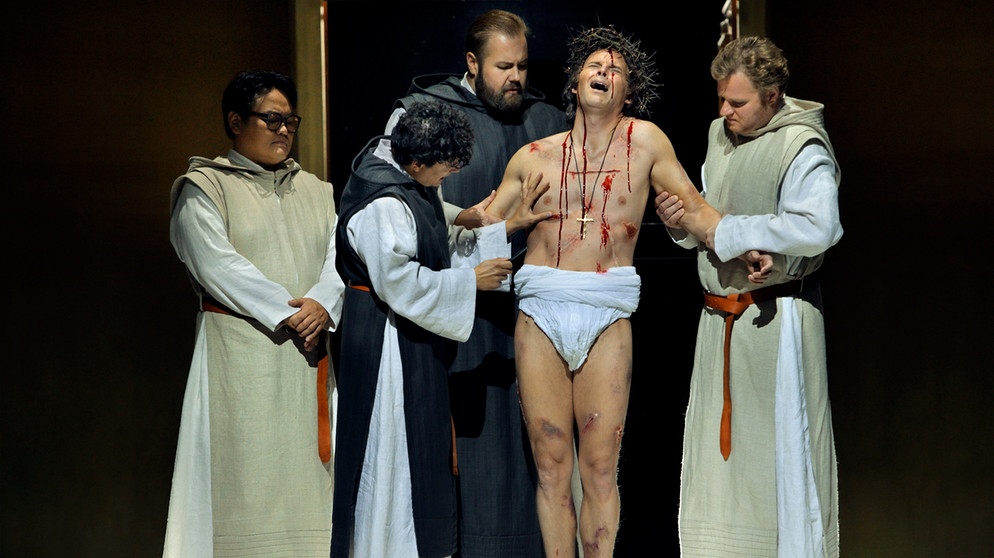
Amfortas (Ryan McKinny), fortified, appears as Christ Crucified, with a crown of thorns, arms outstretched. Amfortas is the son of Titurel (Karl-Heinz Lehner) , a semi-supernatural figure, but mortal.  Titurel's disembodied voice booms from above the stage. But what do his words mean "Muss ich sterben, vom Retter ungeleitet?" If Parsifal the saviour, who is he who is his father?  Parsifal is fascinated by who his mother might have been, but isn't much bothered by his father.  Who is Klingsor, one wonders? Whether one believes that Jesus was God made man to save the world, that is the fundamental precept of Christianity.

It's not Muslims who could be discomforted by this approach to the opera, and understandably so, too. But Laufenberg's interpretation comes from the opera itself.  How does  Parsifal (first seen with a quiff) become entranced by the faith that the Grail Community believe in, even in their own flawed way?  I don't know how this is shown on stage, but in the film of the production, the long orchestral transit is illustrated by a depiction of the universe, with stars and planets: Extremely beautiful, very profound. Although the Parsifal bells are overwhelming, they fit wonderfully with this cosmic panorama.  The Bayreuth Festival Orchestra was conducted by Hartmut Haenchen. Amfortas enters a glowing, light-filled bath.  The Knights, dressed as monks,  partake of the chalice (a Grail), in which wine has been transubstatiated into the blood of Christ.  Yet there's something very spiritual about this scne, lit in silvers and pastels. The monks embrace in fellowship. Parsifal, sitting among them, absorbs the mystery. No wonder he spends the rest of his life trying to come back.


In Act Two, the "church" is transformed into an Islamic palace, the walls decorated with blue and white tiles, a pool in the background, a symbol of the Islamic concept of Paradise as a place with cooling water.  A figure dressed in white, his mouth gagged, sits while Klingsor (Gerd Grochowski) rages.  It's Amfortas, forced  into watching his past re-enacted. Klingsor, like so many demagogues, is obsessed by what he claims to hate. Against a background of crucifixes, he holds a crucifix and rants. Psychologically telling - Klingsor wanted to be like God, but is a loser.  His realm is delusion. The Flower Maidens are seductive, but they're not real.  Burkas (symbols of oppression) transform to semi nudity.  Just as the Grail Knights hate women, so does Klingsor, which makes Kundry's role in this opera so critical. Parsifal enters, as a commando: another provocative image these days when we see armed intruders of all types on the news.  As Kundry attempts to seduce Parsifal, Amfortas and Klingsor watch from the shadows. Realizing how Amfortas received his wound shakes Parsifal to his senses.

The overture to Act Three is illustrated by a film of a pool, with palm fronds in a misty haze, a subtle but deliberate reference to Palm Sunday and what happens thereafter.  Is Kundry in hijab, or is her headcloth the kind many women the world over wear? Is Gurnemanz in monastic robes, or does his waistcoat resemble that of a man in the Middle East?  A gunman in black breaks in, but Gurnemanz welcomes him as a guest, for it is a Holy Day. The gunman plants a cross into the ground. It's the long-sought spear that caused Amfortas's wound.  Wonderful acting from Georg Zeppenfeld, who portrays Gurnemanz as a mellowed old man who cries at the thought of Titurel's death.  I was rather less convinced when the set opened out to a vista of forests and waterfalls, with dancing nymphs - the Flower Maidens made pure? - but in a production with many other good ideas  a misfire like this is forgivable.  In any case, Wagner;'s stage directions refer to to a Quelle, grasses and Blume auf den Auen.  Mitglied !

This tender, almost domestic interlude serves to highlight the power of the Mittag music. Through rising clouds we spot the visage of Richard Wagner with a wry smile, and then see a marvellously clear shot of a church bell, while the Parsifal bells ring out.  Then we're back with the monks. Amfortas opens Titurel's coffin, but all that's left is dust. "Mein Vater". "Ein Mensch, wie alle" as Gurnemanz had earlier described him. Parsifal brings forth the spear, diguised as a cross.  Vogt's voice rings forcefully, but clear and luminous,  haloed by the orchestra.   Vogt is wonderful, the Parsifal of our times. "Oh! Welchen Wunders höchstes Glück!", his voice rings up as he holds the spear, which he then places in the coffin.  Amfortas removes his cricifix and throws it into the coffin. You can see why many would be discomforted by this, even they could cope otherwise. The monks and other men join in - possibly Muslims, wearing tunics and caps - placing precious objects beside the spear. Literally "burying the hatchet". This, not baptism. or any specific Christian rite, is the Höchsten Heiles Wunder! Erlösung dem Erlöser! 

This new Bayreuth Parsifal might take some time to get used to, but it's well worth the effort since it's true to the libretto and to the deeper meaning of the opera.  It's not Christian. Mitglied is universal.  It also marks a new departure for Bayreuth, burying at least some of the bigotry of the past. 

Sunday, 31 January 2016

Korngold Die tote Stadt Vogt Nylund Eiche Marzena Diakun


Erich Korngold's Die tote Stadt in Paris last night. The principals, Klaus Florian Vogt, Camilla Nylund, and Markus Eiche have been doing this opera together for at least five years, in many cities and usually with Mikko Franck as conductor. The photo above comes from the production by Kasper Holten which is rather good. Those who've been following this cast on their progress of Die tote Stadt across Europe will have had a good idea of what to expect, and the performance delivered well. A very enjoyable evening!

Mikko Franck was unable to appear last night, so the Orchestre Philharmonique de Radio France was conducted instead by Marzena Diakun. The OPRF chose Franck as their chief conductor because he's wonderful. Together they're a formidable team.  Franck has chronic health problems, so they're also wise to support him with an an interesting alternative conductor in  Marzena Diakun  Read more about her HERE.   Die tote Stadt is a challenge to conduct, predicating as it does on an unsettling dichotomy between lush chromatics and something more disturbing.The music is so beautiful that it can hypnotise. Paul is a psychological vampire, feeding on necrophiliac obsession. But it's not healthy!  His friend Frank recoils in horror.  Perhaps it's significant that the roles of Frank and Fritz are taken by the same singer, for Marietta and the theatre troupe jolt Paul back into the real world.  It's not hard to read the undercurrents. Julius Korngold was a domineering father who perhaps expected to shape his son in his own image. Erich didn't rebel outright, but did his own thing resolutely, marrying a woman his father didn't like, and moving to America not as an exile but because he saw where his destiny might lie. Father and son jointly wrote the libretto for the opera, under a shared pseudonym, but it's pretty clear who holds the real balance of power. Paul goes forwards, not back.

A conductor can luxuriate in the luscious Old Vienna harmonies, but ultimately almost Expressionist tensions propel the music forward. We hear the bells of Bruges toll, ominously, as if the city and its traditions were falling down on Paul, as if to suffocate him. But the finale with its brave, bold cadences suggests that Paul is waking from the psychic fog that envelops his mind.  Diakun is good - she'd hardly have that job if she wasn't - and though she's no match for Metzmacher, Franck and others, she knows that Die tote Stadt isn't regressive, but modern. Please also see my other posts on Korngold, including Into the Soul of Erich Korngold, written just over seven years ago. 

Saturday, 26 April 2014

Lohengrin Wiener Staatsoper Klaus Florian Vogt


"Lass zu dem Glauben dich bekehren: Es gibt ein Glück, das ohne Reu! " sings Elsa von Brabant, confronting Ortrud. At this point, Eva's love for her mystery Knight is so pure, that she asks no questions. Happiness, with no regret or doubt. But then she goes on to grill her bridegroom, and all falls apart. Why shouldn't a girl know who she's getting into bed with? Why is the secret so extreme that Lohengrin must reject this great love for Montsalvat? Wagner Lohengrin at the Wiener Staatsoper was live screened last night. and should, hopefully be available in the archive. Watch it if you can, because it's very thoughtful indeed, and links Lohengrin to Parsifal on many intriguing levels.  Plus the singing - Klaus Florian Vogt is divine and conductor Mikko Frank reveals sonorous, disturbing mysteries in the score.

The motto "Es gibt ein  Glück" appears on the drop cloth, and later in a painting on the back wall of the set, much as in the way mottos - and hearts - appear so often in traditional German settings.  Heinrich "der Deutschen König", with his Saxons and Thuringians, has come to Brabant, then one of the Frankish lands. Dressed in fustian and Lederhosen, they present an image of German-ness at once domestic and militaristic.These men are in armour, though their uniform, their buttoned-up jackets suggesting repressed violence and conformity, much more effectively than flashy mock medieval coats of armour or neo-Nazi brownshirts. Thus Elsa (Camilla Nylund)  in her white shift seems painfully exposed. Ortrud (Michaela Martens) girded in metal-studded velvet is every inch a warrior. Telramund (Wolfgang Koch) is a convincing leader but also compromised and world-weary. When Lohengrin appears, he's in a white shift which billows like the wings of a swan. It's a provocative reference to the way Parsifal wandered into the Grail community. Director Andreas Homoki uses costume to amplify character. As the balance of power shifts, Elsa and Lohengrin dress up while Ortrud dresses down.

The simplicity of the set focuses  attention on the singing and on the dynamics between singers. The folkloric setting also emphasizes the divison between men and women, another subtle counterpoint to the misogynist world of Montsalvat. The women of Brabant know their place in society but support Elsa. The chorus in the wedding is delightfully lyrical. The staging once again evokes the image of a swan. In the prologue, Nylund held a swan while she played with her brother: clearly it's a symbol of purity and innocence. Yet swans are mute until they die. Homoki hints at levels of interpretation but keeps them elusive. Later, when Lohengrin prepares to take his leave, Vogt is seen writhing on the ground, his body twitching like a dying bird. His acting is extraordinarily moving, suggesting pain and regret. "Es gibt ein Glück, das ohne Reu!" resounds, unspoken, in memory. 

Camilla Nylund's voice is pure, and the clarity of her diction suggests underlying strength of character. Nylund's Elsa interacts well with Michaela Marten's Ortrud.  Neither of them are exaggerated stereotypes, both feel like real women caught up in an extreme situation. Wolfgang Koch's Telramund is no monster : the softer inflections in his voice suggest a man trapped almost against his will. Günther Groissböck's Heinrich der Vogler is cleanly assertive - we can savour the interplay between tenor, baritone and bass and ponder even more hidden levels of meaning. Detlev Roth makes the Herald feel much more part of the proceedings than usual. Altogether, this Lohengrin feels deeply human and all the more compelling for that reason

But as I said earlier, Klaus Florian Vogt is divine.  He has created the role  numerous times, yet manages to make this portrayal sparkle with freshness and individuality. In his Act Three dialogue with Nylund's Elsa, Vogt's voice becomes powerfully intense: is this the battle he has been sent to be tested for? Saving Elsa from the court of judgement was easy in comparison. When Vogt sings In fernem Land, his voice seems to radiate a spiritual quality.  His voice softens for a moment on the words "meine Lieber Schwan" then moves on ever more refined, as if he's reaching apotheosis. [His performance moved me so much that I haven't stopped wondering about the role. Have the Grail Knights, despite the intervention of Parsifal, continued in their old ways ?  Whoever his mother is, has Lohengrin been sent to learn the errors of blind faith and obedience without question?]  After listening to this Vienna Lohengrin, I listened again to the recent Munich and Milan  Lohengrin with Jonas Kaufmann. Kaufmann fans will want to kill me, but Klaus Florian Vogt (whose range is higher)  is in an altogether more elevated league.