Showing posts with label Wagner - fliegende Hollander. Show all posts

Monday, 9 January 2017

Der fliegende Holländer Madrid Kwangchul Youn


Wagner Der fliegende Holländer from the Teatro Real in Madrid, with Kwangchul Youn as Daland, Samuel Youn as the Dutchman, Ingela Brimberg, Nikolai Schukoff, Kai Rüütel and Benjamin Bruns,  conducted by Pablo Heras-Casado, recorded live 23/12 and now on Culturebox, To read about the visionary Kasper Holten Flying Dutchman at the Finnish National Opera, please click HERE

The presence of Kwangchul Youn and Samuel Youn (not related) made this performance particularly moving. Kwangchul Youn is an Elder Statesman, a Wagnerian of commanding presence and great depth,  while the younger Samuel Youn represents the next generation.  In the context of this opera, this role reversal brought added piquancy to the inter-relationship between The Dutchman and Daland,  The Dutchman has roamed the seas for hundreds of years, and in the process has learned things no mortal should eperience. Daland, with his fixation on worldly goods, cannot comprehend the metaphysical.  What will happen to Daland after he loses his daughter, his greatest treasure?  Will he learn from the Dutchman that there are things in this world and beyond that matter more than status and success.  One measure of really good performances is their ability to generate deeper insight into the meaning of the opera.  Youn and Youn did this themselves by the dynamics between them without changing a word and without help from the staging.  That's true artistry, and it lifts this performance well above routine. 

It's a fallacy that performances need to be ranked: the vast majority are neither very very bad nor very very good  Only pseuds "need" to rank things. It's much more important to identify the good and less good within a performance.  This one was an interesting mix. Kwanchul Youn carried the show; Samuel Youn complementing him well,  There were some very good cameos indeed, especially Kai Rüütel as Mary, so distinctive that her voice alone commanded presence, though she was costumed in unflattering drabness.  She made me understand why Wagner, who didn't waste time on triviality,   made the part significant.  Mary is a leader, not a conformist, and protects Senta though Senta lets down the other women because she doesn't work  As I listened to Rüütel 's firmly assertive yet womanly singing, I thought of Mary and Martha in the gospel of St Luke.  Martha works hard, while Mary dreams.  But Mary focuses on spiritual ideals. When Senta (Ingela Brimberg) clings to the portrait  of the Dutchman, she hopes to save him from his fate, A rather bigger responsibility than spinning. In this production, Rüütel is seen polishing a light casing, then opening it uo to reveal a light bulb.  Such a telling detail!
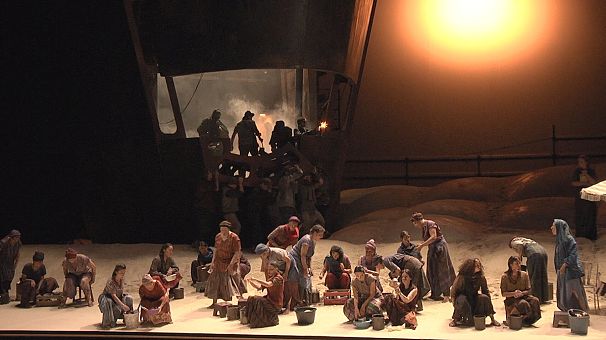
This production, by Alex Ollé and La Fura dels Baus premiered in 2014 in Lyon, and bears the hallmark of the Fura dels Baus style. Massive structures, dwarfing the characters but providing dramatic visual impact, which in an opera like  Der fliegende Holländer is fundamental, for the Dutchman's ship is much more than a ship. It looms over the villagers like a malign presence. Like the storm it's a creation from hell, not a normal part of Nature.  Daland and his men are seen walking down an extremely steep ladder whose steps are so far apart they probably won't meet industrial safety standard.s The singers seemed to descend with uncertainity, and for good reason: they are in a dangerous situation. A compartment high above the stage is lit to reveal the Dutchman's crew, high above the mortal plane. 

In another typical Fura dels Baus touch, the designs by Urs Schönebaum and  Alfons Flores are monumental but simple, detail added by changes of light and video projections. These are ideally suited to an opera like this where scenes like the storm and the ghost ship are hard to stage by conventional means.  These waves, and the flashes of lightning, were so vivid that they were discomforting. Exactly as they should be, in dramatic terms. Some scenes were less successful, such as the depiction of the women in vaguely Indian or Middle Eastern garb. There's no reason why the action needs to take place in Norway, or Scotland, or wherever, but there's not a whole lot of point transposing it somewhere largely irrelevant except, perhaps, to bring in the idea of the women working on the beach, close to the sea like their menfolk.   The party scene worked rather better, since the singers and chorus "danced" with formalized gestures, the men  enacting movements like launching sails, and the women more fluttery gestures, like spinning.  In contrast, the ghostly sailors don't do anything: they just stand still, apart from one another, lit in mysterious blue.  Like Senta, separate from her peers, thinking, instead of working.

The final scene was particularly effective : demonic shifts of light and texture, obscuring normal boundaries of form,  the undulating sand dunes disintegrating in images of the sea, reflecting the turbulence in the music. Senta puts her hand into the sand, then covers her face in white, powdery paste so that she ends up looking like the Dutchman.  A wonderfully ambiguous ending: Senta's body seems to dissolve in the sea, if it is the sea, or something more demonic. Is the Dutchman redeemed, or is Senta's sacrifice in  vain?  Pablo Heras-Casado conducted enthusiastically. If the brass sounded a bit strange, and the percussion hollow, that worked well in connection with meaning.

Wednesday, 25 November 2015

Der fliegende Holländer 1841 Theater an der Wien


From the edgy, innovative Theater an der Wien, a new production of Wagner Der fliegende Holländer which will have some screaming. But the joke is on them. For one thing, it's set in Scotland, not Norway, which might discomfort those who think the first line of a synopsis is sacred writ. No Daland, but Donald, no Erik, but Georg. In the first part of the 19th century, Scotland symbolized a kind of generic wilderness on the edge of civilization, where extreme situations could happen. Hence the Romantiker notion of Scotland that runs through Lucia de Lammermoor, through the craze for Ossian and later Sir Walter Scott. Even Mendelssohn was caught up in the quest. This Scotland as romanticized prototype. Significantly, Wagner himself relocated the plot to Norway.

This production is based on the Ur-edition, edited by Bruno Weil  some 15 years ago, which Wagner wrote in Paris in 1841, before  the premiere of the opera in Dresden in January 1843. Weil  recorded this version in 2004, and it has been done several times in small houses, as an internet search can reveal.  This Theater an der Wien production is in another league, and gives it the high-profile exposure it deserves and adds immensely to our understanding of Wagner's creative processes.  There are other differences. Senta's ballade "Trafft Ihr das Schiff" is transposed  upwards, which gives it a more fragile quality, and some familiar details in the orchestration are less prominent, though the recurring Steuermann theme shines nicely. Because I'd been busy before the broadcast, I hadn't checked the cast, and assumed this was the normal Dresden version. But within minutes it was obvious that it was not, since it's sketchier  sketchier and more tentative. No chance that it will ever be more than an insight, rather than an alternative.

We're confronted by a bleak grey wall. But then, so is Senta,  who isn't happy with conventional society, but fixates on the portrait of a demonic figure who sails the oceans under a curse. Taking a piece of chalk, the woman writes the word Erlösung on the wall. Graffiti as a gesture of rebellion. Erlösung means redemption, which would become a familiar meme in Wagner's dramas, but also means a way out of a dilemma. In a corner, away from the greyness, a man sits, putting on makeup before a brightly lit mirror.  He's a dancer. Why dance in  Der fliegende Holländer? Why not, if the opera was originally conceived for Paris? In an opera which predicates on surreal states of consciousness, the dancer reminds us that there are presences we can't initially comprehend. Don't rush to judgement.  When the village parties, the sailors from the ghost ship materialize as dancers.  It's an extremely effective coup de théâtre.


Samuel Youn sings the Holländer with great presence.  Youn's Holländer is no big mean brute, but a surprisingly sympathetic personality.  When he rejects Senta's sacrifice, the nuances in Youn's voice suggests the heartbreak the Dutchman feels. For a bass baritone, Youn's voice is surprisingly agile, which can be an advantage. Ingela Brimberg sings Senta, Lars Woldt sings a superbly snarky Donald, and Bernhard Richter sings Georg. Manuel Günther sang the Steuermann.   Ann-Beth Solvang sang Mary, her chorus of women (the Arnold Schoenberg Choir)  shown as choristers, quite appropriately.

I don't know who the main dancer is, but he's good, his athletic physicality particularly effective when he and his colleagues are dancing the Holländer's crew. They're athletically physical, more like demons than ghosts, which is a valid perspective.  "They don't need to dance with girls" the villagers sing, and  sure enough one of the trio of dancers is a man dressed as a woman. Not quite the Three Graces.  Marc Minkowski conducted Les Musiciens du Louvre Grenoble. They use period instruments, as Weil did in his recording, but here the playing is much more vigorous, even pugnacious, reflecting Minkowski's strong-minded style.  Olivier Py directed, with atmospheric designs by Pierre-André Weitz. Watch the "ship" emerge, in the form of a huge, shining metallic skull.  When the ,Holländer's sailors come on land, all hell seems to break loose.  Skeletons are seen dancing: it's a trick of light, for the dancers are holding the bones against their bodies. If, until now, the set has been gloomy - what would one expect in such a tale - now the stage is lit with garish greens, blues and reds. We're not in rural Norway now.  The Dutchman heads to sea, almost swallowed in waves, created from shiny black rubber, billowing with air from below. Below, as in Hades.  Senta "jumps in". No happy ending here, but all the more dramatic for that. At the very end the grey wall returns. This time, however, the woman writes "Ewartung". Hope at last.

Monday, 20 May 2013

Wagner 200 BBC Radio 3 birthday specials

Wagner's 200th Birthday is Wednesday 22nd. How he would have enjoyed the fuss and expected nice presents! Too often anniversaries are an excuse for sloppy programming, but BBC Radio 3 seems to be doing something useful. Here is a link to this week's schedule. It's quite a good introduction to the composer and the man.

Donald Macleod's "Composer of the Week" focuses on Wagner's early Romantic influences, a subject dear to my heart. MacLeod's Composer of the Weeks are sometimes very good and I think this is a new one we haven't heard. He will be shedding "light on Wagner's lesser known, early operas, created under the spell of such diverse influences as the German Romantic operatic tradition of Weber, the "bel canto" style of singing of Bellini, and French Grand Opera of the 1830s. Donald Macleod presents excerpts from Wagner's earliest opera Die Feen, his sunny, Italian-esque Das Liebesverbot, and the 'black sheep' of Wagner's output: his vast operatic spectacular Rienzi - which he later virtually disowned."

Most of the recordings being broadcast are familiar, but there are a few rarities, like Wagner's  arrangement of Beethoven's Choral Symphony and his Piano Sonata. Missing is the Urfassung edition of Der fliegende Hollander resuscitated in 2004, with no Erik, no Daland and no Norway!   This edition shows how Wagner was influenced by popular taste in his time. Rossini probably got there first with La donna del lago (which I'm at tonight). Then Donizetti Lucia di Lammermoor in 1835 and much else. At least Mendelssohn had the guts to hike through the country and see it first hand instead of relying on Walter Scott and Ossian. Since there was no tourist industry in Mendelssohn's time, he really was engaging with the locals and living fairly rough. So much for Wagner thinking Mendelssohn was effete. Perhaps one of the reasons we're not hearing the pre-Edition of DfH is that the only recording is pretty hokey. An edition is not a production. Productions we can see any time but an Urfassung is unique. The Ur-edition is being produced three times this summer in Germany, so who knows, a new recording might come about.

Many of us switch BBC Radio 3 off completely after 10 pm when music turns to chat. This week the chat is rather more elevated. At 22.45 the Essay will present a series on Wagner's philosophers, Wagner and German idealism. Roger Scruton, AC Grayling, Christopher Janaway, Michael Tanner and John Deathridge are the speakers.

Sunday, 16 December 2012

Terfel steals show - Zurich Der Fliegende Holländer London

There are some who believe that opera is "only" about singing, and nothing else. They would have loved this production of Wagner Der Fliegende Holländer at The Royal Festival Hall, a concert performance of the current production at Opernhaus Zürich. Bryn Terfel, Matti Salminen and Anja Kampe, all of them veterans.

This is only Bryn Terfel's third Dutchman, but the part comes so naturally to him that we can already imagine him as one of its great interpreters  "Die Frist ist um", sang Terfel, instantly transforming the atmosphere. Terfel isn't predictable. When he's inspired, his performances are electrifying. When he's unenthusiastic, he coasts. On this occasion, we heard Terfel justify the whole performance.

Terfel knows the Royal Festival Hall, its acoustic and its audience. He gauged his performance to suit. This Dutchman was intimate, even personal, far more complex than the brutish Dutchman he sang in the 2009 Royal Opera House production. The quieter passages were created with delicate balanced mezza voce."Mein Schiff ist fest", he sings, but shapes the second phrase more tellingly.  "... es leidet keinen Schaden". The ship is strong, but its captain is a damaged soul. This Dutchman doesn't bluster. Terfel shapes  phrases with sensitive nuance, sometimes singing with extreme pianissimo. Opera house dynamnics don't often favour this fine gradation, so Terfel uses the auditorium to his advantage. Sometimes it felt like having a one to one connection with the Hollander. Terfel makes us hear the human being behind the demonic persona, and that's where the real drama lies. This is the Dutchman Senta intuits behind the gloomy portrait, whom no-one else can perceive.

The evening started fitfully, the overture interrupted by the arrival of latecomers. Perhaps the conductor,  Alain Altinoglu, was aiming for a vaguely period sound, for this is very early Wagner, premiered twelve years after Meyerbeer's Robert le Diable, and seven years before Robert Schumann's Genoveva. We're so used to hearing full bodied mid 20th century approaches to Wagner that we can lose context. This wasn't a period performance, however, and in any case period performances can be vividly gutsy. At one point I tried to count the number of musicians in the orchestra, to account for the thin textures and lack of overall thrust. There were almost as many singers in the choirs as musicans in the orchestra.  Perhaps the spareness reflected the stark minimalism of Andreas Homoki's staging (see production photos here)  though that staging could support a much more savage interpretation. Orchestrally, things picked up in the second half, but by that stage my ears were tracking little but the singing.

Anja Kampe sang Senta in both the Royal Opera House productions (more here). Then, she was an excellent foil to Terfel's taciturn Dutchman. When Terfel creates an utterly more revealing Dutchman, the balance shifts. Kampe's Senta now has striking big notes, the energy transferred from creating character to creating grand singing.  It's perfectly acceptable, but for me there's always more to opera than voice alone.  More intriguing was Liliana Nitikieanu, whose lusciously warm timbre suggested a Mary with a lot more personality than Senta, possibly even more sensual, but less given to Senta's anguish.

Matti Salminen is a force of nature, always fascinating even when his voice shows strain. He didn't seem well, clinging to the podium, but he still created a convincing Daland. I'd been looking forward to hearing Marco Jentsch's Erik, because he was a very promising Walter in Glyndebourne's 2011 Meistersinger (more here), but he pulled out, replaced in London by Martin Homrich. Homrich was adequate, if dry, suited to more conventional performances than this one, dominated as it was by Terfel's unusually fine characterization. Fabio Trümpy as the Steuermann, was a discovery. He's a Zürich local boy, and sings in the Ensemble there. His clear, bright voice was another revelation of the evening - we must hear more of him.

photo : Nick Step

Tuesday, 18 October 2011

The Flying Dutchman - Ava Gardner?

Wagner Der fliegende Hollander starts tonight at the Royal Opera House. (Please see my review HERE) But here's another Flying Dutchman but not as we'd know it. The music isn't Richard Wagner but Alan Rawsthorne, a combination of lurid technicolor and stiff upper lipped Britishness.

What's more the Senta character is Ava Gardner, and she gets to sing the arias, too. Indeed, she plays the Dutchman as well, wandering through life unable to love, though her beauty drives men mad. "The measure of love is what one is prepared to give up for it". So a man throws his precious racing car over a cliff, another committs suicide. But she doesn't care.

This Flying Dutchman is set in sunny Spain, so the film can work in a long, implausible reference to Carmen and matadors. Spain is also warm enough that Ava gets to swim stark naked out to the mystrerious yacht in the bay. Onboard she meets The Dutchman, who paints portraits instead of being in one. He paints her! It's James Mason. Bizarrely, the Daland character is an archeaologist who's found a manuscript supposedly written by the real Flying Dutchman in the 17th century, who killed his wife (Ava) thinking she was unfaithful. Hence the curse.

Then the movie turns from Wagner to Carmen. Montalvo the matador is Ava/Senta/Carmen/Pandora's ex, so we get to watch a long drawn out scene in the bullring, where he gets killed, not Carmen. Montalvo had tried to kill the Dutchman, so he's Escamillo and Don José in one. Meanwhile Ava/Pandora/Senta realizes that she loves the Dutchman so much that she'll give up her life for him. She dumps the Erik character (the racing driver) she's about to marry and swims out to the yacht. That night, a demonic storm. Next morning, two bodies wash up on the beach.

Interestingly, this movie was made just before Ava Gardner became a major star. She was a Southern belle, but dusky enough to play exotic characters rather than the Bette Davis type. Rumour has it that Ava passed for white, but wasn't. Hooray again for people who break out of racial stereotypes!