Showing posts with label Orchestra of the Age of Enlightenment. Show all posts

Sunday, 23 December 2018

Festive Bach Christmas Oratorio : Orchestra of the Age of Enlightenment SJSS


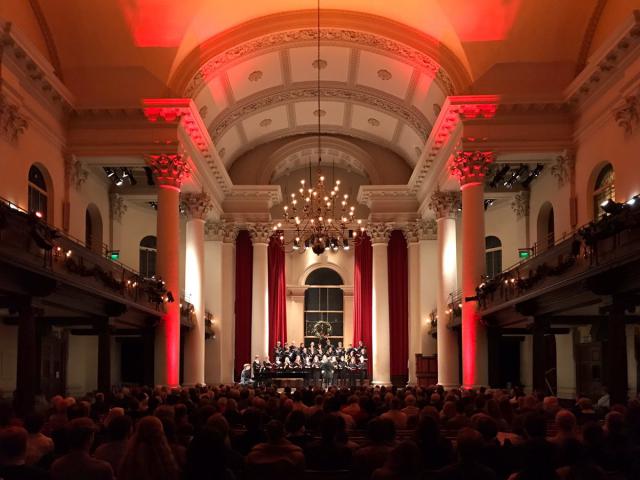
Festive Bach Weihnachts-Oratorium (Christmas Oratorio) BVW248 at St John's Smith Square with The Orchestra of the Age of Enlightenment conducted by Stephen Layton, with the Choir of Trinity College, Cambridge, and soloists Anna Dennis, Helen Charlston, Gwilym Bowen, and Matthew Brook.  Wonderful to experience it at St John's Smith Square  at Christmas, once a baroque church, now one of the most celebrated of vanues for baroque and early music.  The lights of the chandelier were reflected in the window behind : a magical optical illusion. The auditorium was lit in gold and red.  During the performance a door was opened so light shone in from the back of the hall as well as from the front.  If this was an accident, it was a happy one.  Going home along the Thames by the Embankment increased the impact still further.

The Orchestra of the Age of Enlightenment  - who are incapable of doing dull - felt freer and livelier  in this joyfyul atmosphere.  A punchy opening : natural horns and drums creating a suitably rustic ambience. Christ was born in a stable, to a refugee mother fleeing from persecution   Forget that, and miss the whole point of the Nativity.  The audacity of the concept : God Made Man  ! "Jauchzet, frohlocket! auf, preiset die Tage" A miracle has happened. If we don't feel excitement, there's something wrong with us, whatever we believe, be excited.  Hence the value of period performance, where unsophisticated instruments are played with energetic verve,  creating music which, however divine, never loses a human touch.  The brighter, lighter textures of period instruments sparkle at faster tempi, further enhancing the sense of adventure. For singers, this means greater emphasis on diction and clarity.  For singers of the calibre of the Choir of Trinity College, Cambridge, this presents no problems.  You don't get to sing at this level unless you're very good, and most of these singers have come through top level youth ensembles. The Oxbridge style matters, too, giving the singing youthful freshness and enthusiasm that comes from the heart.  In Part II, "The Adoration of the Shepherds", the mood is more contemplative. Layton brought out gentler rhythms, evoking the rocking of a cradle :gentle rapture. "Ach mein herzliebes Jesulein, Mach dir ein rein sanft Bettelein".

The voices became hushed,  soloists blended into the chorus.


The Evangelist is a tenor (Gwilym Bowen), higher voices in the baroque are associated with heroes.  The "English tenor" Fach has its roots in the ardent rapture of the sacred oratorio, where sincerity is of the essence, beauty lies in the ideas being expressed not independent thereof.  The Evangelist is haloed by cello, bassoon and continuo.  The purity of the concept of the Nativity is further highlighted by the restraint of Bach's orchestration.  Soloists are supported with the addition of other instruments: oboe d'amore forr the alto, trumpet and extra violins for the bass.  The larger orchestra comes into focus when the voices are employed in larger combinations. In this performance, the occasion being Christmas, we heard Parts I, II and III with Part VI, where all four soloists participate, in accord with chorus and orchestra. Again, the mood is worshipful, but not subdued, despite the more restrained tempi, for the miracle of the Nativity has come to pass. 

Wednesday, 2 August 2017

Handel Israel in Eygpt William Christie Prom

Handel's Israel in Egypt with William Christie and the Orchestra of the Age of Enlightenment at the Proms in the Royal Albert Hall, a performance space big enough to create the sense of occasion that made the oratorio a favourite with 19th century audiences.  The first recording, made at the Crystal Palace Exhibition in 1888 with 4000 voices, is hard to listen to, but even with modern technology one wonders what a chorus of thousands would have sounded like  in the circumstances.  Fortunately, modern performance practice emphasizes quality, not quantity. William Christie and the Orchestra of the Age oif Enlightenment are Handel specialists par excellence.  Even by their high standards this was wonderful. Period inspired practice highlights the music itself, illuminated and remade anew. This performance seemed to glow, the voices ringing pure and clean, the orchestra alert and alive.

Sombre, regular drum rolls "raise the curtain" to the drama,f or Israel in Egypt is a drama, despite the Biblical context.  The choral writing in the First Part unfolds like a grand procession: note the phrases in the text, repeated in succession, suggesting massed forces. No need for a cast of thousands: Handel's already written panorama into his score.With the Choir of the Age of Enlightenmnet, we can hear the individual voices in the crowd. An important consideration, since much of the beauty of the piece depends on the blending of voices,and patterns in the musical line. When the chorus then explodes in uniso -  "Come ! Come!"-  the effect is highly charged.  When the clear, piping solo voice emerges from the tumult, it's extraordinarily moving. The voice is pure, yet vulnerable, like the young, isolated Joseph, perhaps, and the spirit of the people of Israel, in exile, yet uncowed.  When the chorus returns, a single horn is heard, unaccompanied. Again, the beauty and validity of period instrumentation.

If Part 1 is a deeply felt, personal Requiem, Parts 2 and 3 are, as William Christie says in the interval broadcast, "Hollywood. We're essentially creating a vast fresco of plagues, and also the extraordinary exit of the Jews from Egypt. So it's a travelogue, as big as anything Cecil B De Mille could have created."   The second part begins with a recitative, the tenor Jeremy Budd describing the new, brutal Pharaoh who "turned the waters into blood", that last word pronounced with theatrical emphasis.  Then the aria for counter tenor, Christopher Lowrey: "blotches and plagues, on all man and beast". Florid decorative lines, gruesome subject.   Zingy, zig zag lines from the strings, underpinned by timpani and brass, vividly evoking magnificent forces.  Another sudden switch: the choir sing in hushed tones.  Darkness falls on the land: high male voices contrast with low basses.  The zig zags become ostinato, the voices matching forcefully.  A soprano enters, strings dancing around her. This extended lyrical interlude suggests that, despite the violence surrounding, purity will triumph.  The parting of the waves of the Red Sea, no less, even now in the age of cinema and computer-aided design not an easy task to achieve,  And Handel does it with sound. Vigorous playing from the OAE, and technicolor singing, gently fading into serenity.

Israel has now escaped Egypt: Part 3 is celebration. "The Lord is my Saviour" sang  the sopranos (Zoë Brookshaw and Rowan Pierce), the first of a series of lovely set pieces followed by an extended  trio of male voices (Jeremy Budd, Dingle Yandell and Callum Thorpe). In the choral passages, the balance between male and female voices was particularly impressive, the temporary hush broken by blinding light of the second section, which then elides into finely parted cells where single voices intertwined, itself followed by an energetically rhythmic sequence in which each different voice group sings in unison, garlanded around each other.  Christopher Lowrey's solo aria stood out.  Passages decorated by flurries displaying technique need to be kept clear like this.  Part of the beauty of baroque style is fluidity and translucent clarity of line. The use or non-use of vibrato s in itself a red herring, seized upon by those who don't get the aesthetics of style.  Again, the waters of the sea part and the miracle is recalled in recitative, the striking song of the soprano and the heady excitement whipped up by choir and orchestra,  Gosh, I love the sound of period percussion, so earthy and "human".  And so Israel and Egypt ends as it begins, with drums: the three parts, each so distinctive, are inextricably united.
 

Sunday, 21 May 2017

Glyndebourne Cavalli Hipermestra - bizarre but pointed


Glyndebourne and baroque opera are almost synonymous. Indeed, the modern revival of interest in the baroque owes much to Glyndebourne and its values of eclecticism and excellence. Francesco Cavalli's Hipermestra was an ideal start to the 2017 season. Cavalli operas, like La Calisto and L'Oromindo, are so well known that they're almost standard repertoire, but Hipermestra is so obscure that this production is only the second since the original premiere in 1668.  With William Christie conducting (and acting) and Cavalli specialist Emőke Baráth singing the title role, this Glyndebourne first is unmissable. Get to it while you can.  Graham Vick's staging, with sets by Stewart Nunn, is audacious, but then, that was the spirit of the baroque age, when Europe was discovering new worlds, in every sense. Cavalli's penchant for sex, cross-dressing and double entendre make Hipermestra an anarchic riot.  Stay home if you're timid, but there's nothing timid about Cavalli.

The plot alone is so bizarre that only fools could mistake it for reality. A prophecy warns Danao, King of Argos, that he'll be killed by his son-in-law. His solution? To marry his 50 daughters to the 50 sons of his brother Egitto, and get the brides to kill their husbands on their wedding nights.  What Freud might have made of that, who knows?  Nonetheless the girls are so gullible that they widow themselves willingly, without question. Except for Hipermestra, who has the hots for Linceo, and he for her. Dad isn't pleased and puts her in prison.

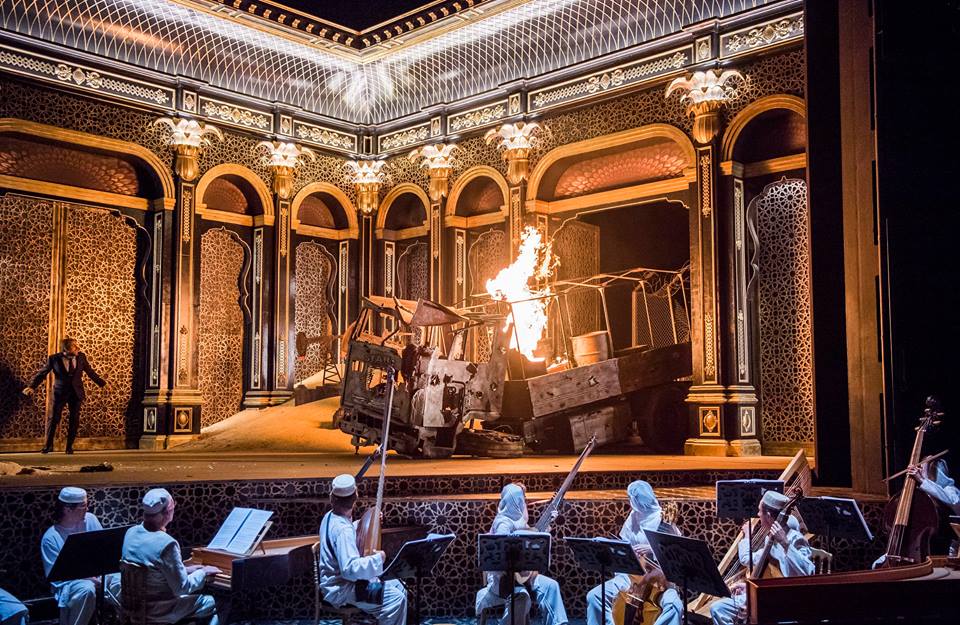
Although the plot is implausible, music makes it art. The ensemble, nine members of the Orchestra of the Age of Enlightenment, were seated in front of the stage, which was decorated with an arch of pink balloons.  The mass wedding at Argos is kitsch, but the music is not.   Quietly, a figure in white joins the team: William Christie dressed anonymous, conducting from the keyboard, in full view.  Throughout this production, musicians appear on stage, blending with the proceedings. Violinist alone, then with violist, then two theorbos of different kinds, and later, Christie himself arising from the stage machinery, interacting with the singers before scrambling down to the pit.  Integrating music with drama in this way is sophisticated, conceptually, but Glyndebourne audiences are sharp enough to understand that opera is theatre, not reality TV!  Musicians should be seen more often, for without them, opera would not be what it is.

Whatever Argos is, it's a place where extreme ideas are made possible by extreme power. Hence the oil rigs and ostentatious consumerist extravagance of the palace made possible by wealth, and the barbed wire that keeps people under control.  The allusions to Arab and/or Central Asian oligarchs may be offensive to some, but are aimed at the rulers, not the people they rule.   Thus is set the context for the wars that explode after Linceo escapes and takes his revenge on Danao, blaming Hipermestra.  Eventually, the whole region is destroyed. So much for wealth and power, when it is exercised by stupid people.  Linceo blames Hipermestra for infidelity,  Arbante and his minions stir confusing sub-plots,  Hipermestra wants to die and Linceo thinks she's dead.  Everyone making assumptions without checking facts.  That's the point of bthe plot and sub-plots: life is confusing if you don't stop and think, before jumping off (literaslly, in Hipermestra's case).

Hipermestra is a whole lot more relevant than one might assume.  The mayhem in the plot is a simile for what goes on in real life, even when people don't have 50 daughters and sons to marry off all at once. In the end, as in all good fairy tales,  everything works out, but a whole lot of people have been hurt in the process.  This is an observation that would not have been lost on Cavalli's original audience in times when monarchs had absolute power, without checks and balances.  Hipermestra is comedy, but also satire.

Emőke Baráth, as Hipermestra, is divine.  Most of the opera circulates around her, and she has the biggest role, and the longest monologue. As one of the other characters  remarks Hipermestra "goes on and on", but Baráth is so good that you enjoy every moment, though Cavalli takes his time to make a point.  Baráth is a good comic actress, singing a superb Helen of Troy in Elena (Il rapimento d'Helena) at Aix-en-Provence a few years ago.  Raffaele Pe sang Linceo, switching from lover to killer, and back.  Ana Quintans, a Glyndebourne favorite, sings Hipermestra's loyal maid Elisa.  Benjamin Hulett sings Arbante - yes, sex and violence are very Cavalli ! Renato Dolcini sings Danao, Anthony Gregory sings Valfrino. David Webb sings Arsace and Alessandro Fisher sings Delmiro/Alindo.  Special honours to Mark Wilde who sings Berenice, the camp but sinister drag queen.  It's not a comic role, though it has to be played for laughs. Berenice has gone through many husbands, however she/he disposed of them. Part witch, part victim, the part serves to remind us that in extremist power structures, women and the powerless (ie gay men) get kicked around and misused.  Cavalli had censors to fear. We don't, thankfully, as long as we have intelligent audiences like those at Glyndebourne, who appreciate that opera involves ideas, feelings, and creativity. .

and here's Claire Seymour in Opera Today : Danao is Libyan ! that explains the oil, and the despotism


Thursday, 9 April 2015

Three Choirs Festival Hereford 2015


The full programme for the 2015 Three Choirs Festival, this year at Hereford, has been announced.  Many juicy nuggets and surprises, reflecting Artistic Director Geraint Bowen's  lively approach to this unique and ever-developing Festival. This year, the combined choirs of Hereford, Worcester and Gloucester will be joined for the first time by the Orchestra of the Age of Enlightenment,  supplementing now regular visitors like the Philharmonia Orchestra. The OAE will be able to expand the Festival repertoire in imaginative directions.

As always, the "big" events in the Cathedral form the foundations of the Three Choirs tradition. This year's first evening concert, on Saturday 25th July, features Elgar's Dream of Gerontius, (Please read more here).  Sarah Connolly. Peter Auty and Neal Davies, with Geraint Bowen conducting the Philharmonia. I recommend going early to Hereford, to take part in the Opening service (Purcell and Handel), because Three Choirs is more than just a music festival; it is also a celebration of religious faith, which defines the whole spirit of the Festival. Go, whatever God you adhere to, because faith and hope connect all religions.  Plus, you'll be able to attend Roderick Williams' afternoon recital "Song of the Hero". Williams will be singing Elgar's Sea Pictures for baritone and piano - unusual, and surprisingly powerful. It's been in his repertoire for some time (e.g. at the Oxford Lieder Festival). He'll also be singing lesser-known songs by Vaughan Williams and Howells and a new commission by Rhian Samuel. This is an important concert, and will be broadcast on BBC Radio 3. (date unknown)

On Sunday 26th July, Olivier Messiaen Turangalîla-Symphonie - a truly spectacular celebration of life, love and nature. , not something which one might associate with staid English church traditions, but a deeply felt, spiritual work, nonetheless. Messiaen was extremely devout, and an organist, who played at Mass almost every day for many decades.  It will be interesting to hear how the symphony fills the space in this Cathedral. Certainly, the sound of the ondes martenot will carry well.  Jac van Steen conducts the Philharmonia with Steven Osborne (pianist) and Valerie Hartmann-Claverie (ondes martenot).

"Requiem for 500 years"  on Monday 27th, a good concert of very early music with the Orlando Consort, followed by a talk on Agincourt, the decisive battle which separated England from France, 700 years ago. This is Arthur Bliss Day, too, with a rare performance of his Morning Heroes, a song symphony from 1930, in memory of Bliss's brother who died in the Great War. It's narrated by Samuel West, and conducted by Andrew Davis. On Tuesday "Three Centuries in one afternoon", continuing the theme of historical context, and Bach St Matthew Passion in the evening. On Wednesday, we move forward to 1715, with a concert built around Vivaldi The Cuckoo, wildly popular in England at the time, performed by Italian baroque specialists La Serenissima. In the evening, Beethoven Missa Solemnis. At Dore Abbey, Roy Strong presents "Poets and Princes" an entertainment on the English Monarchy, followed, ironically, by a talk on the Jacobite rebellion. The keynote concert that evening will be Carl Neilsen's Hymnus Amoris, coupled with William Mathias (d 1992) Lux Aeterna. Verdi Requiem on Friday night. The Festival concludes with "The Gathering Wave" a community participation event. Lots more - plays, talks, visits, chamber concerts - peruse the programme, looking for the hidden gems.


Wednesday, 5 November 2014

Opera Rara Les Martyrs Donizetti Elder OAE


Eagerly anticipated, Opera Rara's Donizetti Les Martyrs delivered magnificently, confirming yet again Opera Rara's reputation for pioneering lesser known treasures in the repertoire. Although Les Martyrs is not unknown (there are several recordings), Opera Rara presented a new critical edition by Dr Flora Willson of King’s College, Cambridge, which restores the opera’s original French text (Eugène Scribe)  and reinstates numerous musical passages that have not been heard since its premiere in 1840.  Les Martyrs, revealed in all its glory, is a brilliantly dramatic work, combining the delights of Italian bel canto with the exhilarating audacity of French grand style. This performance, conducted by Opera Rara's music director, Sir Mark Elder, was  so good that it whetted the appetite for a fully staged production, ideally in a house large enough to give the  spectacular treatment it merits.

In 2015, Glyndebourne Festival's gala opening night present Donizetti's Poliuto, written for the Teatro San Carlo in Naples in 1838 but which was promptly banned by the King of Sicily, who objected to the depiction in popular theatres of a subject from Christian history. French audiences could cope with religious subjects being treated as opera. The libretto in both operas was based on a play by Corneille, written two hundred years previously. Donizetti, aware that Paris was the sophisticated centre of the opera world in his time, promptly revised Poliuto and created Les Martyrs. incorporating most of the original but adding elaborate divertissements for ballet, extending the overture, and creating grand choruses and  flamboyant new solos for the tenor and soprano. 

Even by their usual very high standards, The Orchestra of the Age of Enlightenment were in wonderful form. In the Overture, Donizetti defines the main themes which run through the opera, martial "Roman" motifs contrasting with gentler passages which later connect to love and Christianity.The Romans, like the Devil, get the most striking tunes.  Elder and the OAE magnified the dramatic impact of the score by placing horns in a box, and trumpeters arrayed above the rest of the orchestra, which played with ferocious dynamism. Period performance isn't meek.

In Act One, the Christians are cowed, operating in secret, dissidents against an overwhelming regime. When the Governor Félix announces an all-out purge, Brindley Sherratt sang with such profound authority that his voice echoed throughout the Royal Festival Hall. It was as though the might of the whole Roman Empire was behind him. A terrifying star turn, guaranteed to stun listeners into submission. Later, Sherratt showed Félix's gentler, more human side, but the impact of this first passage lingered on. Towatrds the end of the opera, the Romans mass in all their pomp and glory. "Dieu de tonnere.......Maître du monde". sang the choruses, with forcefulness that belied the small number of singers. Thirty years before Verdi, Donnizetti is writing choruses that wouldn't be out of place in Aida.

But as we know, the Christians win. Michael Spyres sang Polyeucte,  the leader who becomes an outcast, choosing faith over the material values of society. Utterly relevant, nearly two millennia later. Spyres was a hero himself. Quite possibly, he was somewhat under the weather, as his voice didn't ring with the bell-like ping the part needs ideally, but he paced himself well, and made the notes that mattered. The killer aria, "J'irai" is, thankfully, near the end, and he hit the sudden leap up the scale with such fervour that it felt he'd been injected with a burst of energy from some superhuman power. Absolutely correct in context, as Polyeucte at this point has resolved to defy the world and die for his god.  One thing that can be said in favour of concert performances is that singers can risk their voices for a single, wonderful moment without having to worry about the rest of the run. 

Joyce El-Khoury sang Pauline, Polyeucte's wife. Her part is blessed with some very beautiful moments, some decorated by superb writing for the two harps, passages which had the ethereal quality of light: divine light, perhaps, because Pauline has to choose against her father, her faith and her place in Roman society. El-Koury (who impressed in Opera Rara's Donizetti Belisaro) negotiated the elaborate trills and passagework that create Pauline's feminine sensibility. Pauline's a very strong personality, though (think about her Dad) so one might, ideally, want more characterization; bel canto is, after all, good singing.

Sévère, Pauline's former beloved, was sung by David Kempster. Sévère is a Roman hard man and hero, but his love for Pauline is so great that he wants to save her. Kempster moderated the force in his singing, creating convincing compassion. Clive Bayley sang Callisthènes and Wynne Evans Néarque, who, at the end, sang beside the chorus, as if among the angels, flanked by the OAE trumpeters.  Les Martyrs is written with elegant symmetry. The solo parts, duets and ensemble are neatly patterned, as if the singers were dancing with their voices. 

Photo : Russell Duncan
See also Robert Hugill's review in Opera Today.

Friday, 10 October 2014

Rameau Anacréon danced - Orchestra of the Age of Enlightenment


"Flying the Flag/L'Amour" ,the catchy title of the Orchestra of the Age of Enlightenment's  Rameau programme at the Queen Elizabeth Hall. The title concealed the treasures within, two rarely-heard Rameau pieces, Pigmalion and Anacréon. True to the spirit of Rameau's aesthetic, which lies in dance, the performance was realized by dancers from Les Plaisirs des Nations (choreographer Edith Lalonger). Both pieces are miniatures, far less exuberant than masterpieces like Castor et Pollux but for that very reason, we can appreciate the basis of Rameau's distinctive style. 

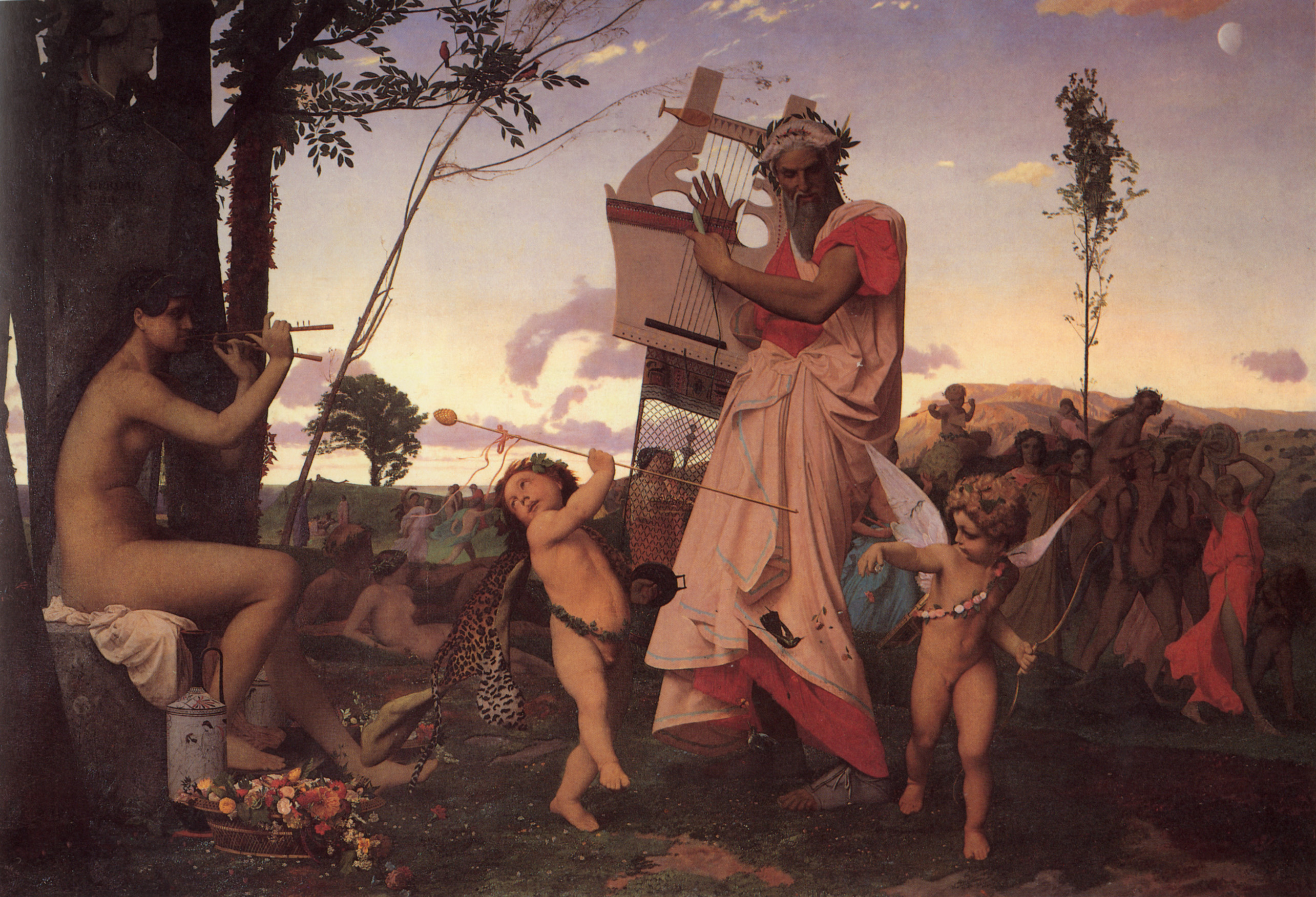
Anacréon begins with a simple flourish : two coiled valveless horns (one possibly a genuine antique) evoke the kind of Arcadia which artists of the classical period delighted in painting. The horns are followed by high woodwinds, intensifying the dream-like atmosphere of ancient Greece seen through 18th century French imagination.  In this landscape, Gods, mortals and animals frolic, in idealized fantasy. Chloé (Anna Dennis) and Batile (Augustin Prunell-Friend) cautiously declare their love for each other.  However, Chloé is about to marry the famous poet Anacréon (Matthew Brook). She quite likes him but he's too amorous.  Rameau's audiences would have cackled, since they had enough classical education to know that Anacréon, though revered, was a drunk and a lecher.  Rameau suggests Anacréon's earthiness with lines that descend in almost ostinato: an old roué drooping because he's in his cups.  "Regnez, Regnez" sings Matthew Brook, like the god Bacchus, the lord of misrule. "I live in the moment" he sings. Instead of the deep reflection one might expect from Wagner, or the florid intensity of Verdi,  Rameau's Anacréon watches the dancers do their routines, and thus satisfied, lets Batile and Chloé find true love. Augustin Prunell-Friend sings Batile's long showpiece, which consists mainly of the lines "Let fly, arrows of love, into our souls" but is so beautifully decorated that it makes perfect sense. (The photo above is a 19th century French painting of Anacréon,with his lute with a hairless Pan and cupids - try staging that now)

The parade of dancers thus operates as plot device, which wouldn't be quite so obvious on audio-only recording. Why are the dancers dressed (vaguely) as Turks or Hindus?  Baroque audiences were fascinated by exotic cultures. If people from strange places could do strange things, then why not have them inject another level of fantasy into the proceedings?  Pan the god appears, half-man, half-goat, complete with little red horns like the devil.  Pan was the god of music, but also of sensuality and dangerous wild spaces. Bacchus appears, too, an old man with a wreath of grapevine.  Gods, men and animals mix in joyous confusion : anything can happen in the creative imagination. In Anacréon, we can see, in germ, the exuberance and creative good humour William Christie found in Les Indes Galantes, Les Paladins and Hippolyte et Aricie  The true, adventurous spirit of the age!

Williams and the OAE aren't quite in that league of brilliance, but they performed  a new edition of Rameau's  1754 version of Anacréon, compiled by Dr Jonathan Williams, who conducted. Their recording of this "new" Anacréon is the first in the market.

In April this year, Williams and the OAE performed Rameau's Zaïs, also danced by members of Les Plaisirs des Nations. Please see my review HERE.  Pigmalion dates from 1748, as did  Zaïs, but the plot's even thinner.  It's a metaphor fpor the power of artistic imagination. This isn't necessarily a disadvantage, since it means we can focus on the structure and on the role of dance. Pigmalion (Daniel Auchincloss) is a sculptor who has fallen in love with a Statue (Katherine Manley). Pigmalion's lover, Céphise (Susanna Hurrell) calls on the gods for help.  Unfortunately, L' Amour (Venus, sung by Anna Dennis) feels sorry for Pigmalion and turns the statue into a woman.  Everyone's happy, except Céphise, who disappears.  Rameau writes a rollicking good chorus singing about the joys of love. Is it ironic that a composer so given to energy and movement would write a piece where the love interest is an inanimate object? Again, the sheer vivacity of the music  makes anything seem possible.  Three dancers depict the Three Graces, artistic creations born like the Statue fully mature and whole..Although in classical art, the Three Graces, and most statues were shown naked, or semi-naked in Grecian drapes,  Nudity might have been authentic but Rameau and his audiences used their imaginations. The Three Graces appear in outfits which would have been contemporary in Rameau's time, and Katherine Manley wears an evening gown.

Most of the action happens not in sung text but in abstract music. Sequence after sequence of dance figures: I lost count after ten. These probably illustrate specific dance forms, some pastoral, some lively, some almost militaristic.  The patterns in which the dancers move reflect the patterns in the music, as if the abstract forms in music are being made visible. For all his exuberant effervescence, Rameau was a superb craftsman. His Traité de l'harmonie réduite à ses principes naturels  was one of the first great treatises on the theory of music. Rameau's mind reflected the clarity and precision so dear to the Enlightenment.