Showing posts with label Czech Republic. Show all posts

Wednesday, 28 November 2018

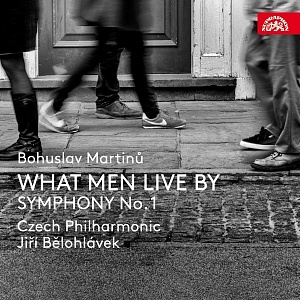
Bohuslav Martinů - What Men Live By, Jiří Bělohlávek Czech Philharmonic

World premiere recording from Supraphon of Bohuslav Martinů What Men Live By (H336,1952-3) with Jiří Bělohlávek and the Czech Philharmonic Orchestra from a live performances in 2014, with Martinů's Symphony no 1 (H289, 1942) recorded in 2016. Bělohlávek did much to increase Martinů's profile, so this recording adds to the legacy, and reveals an extremely fine work.  What Men Live By is an adaptation of Leo Tolstoy's Where Love, God Is (1885) though the composer borrowed the title from a different Tolstoy story.   At its first full performance, by students at Hunter College in 1955, critics heard it was "a profoundly Christian opera" but did not understand its context. That was not the composer's intention.  He wrote to  a friend in Brno comparing it to his earlier works based on medieval miracle plays, such as The Miracle of Mary , emphasizing that "it must not be performed 'pathetically' but joyously. That is why it is called an opera-pastoral. The text tempts one to adopt a serious and grave approach yet that was not what I planned. For me, it is a blithe work, and the listener must not perceive it as a religious moral (guidance) but has to feel joy".

It is also significant that The Miracle of Mary, written in Paris in 1936, reflected interest at that time among many composers, such as Arthur Honegger's Jeanne d'Arc au bûcher (please read more HERE), which Martinů would have known of, and Walter Braunfels's Die Verkündigung (Please read more HERE) which he would not have known, or even Carl Orff's Carmina Burana (1935-6).  At a time when Europe was facing the rise of extreme nationalism that used medievalism for legitimacy, Martinů and his peers’ adaptation of medieval form served a radically different purpose.  Therefore, it is a mistake to assume its lack of success was caused by its being deemed old-fashioned, when it in fact represents a significant thread in European music, which critics at the time might have missed.  In any case, by 1955, it could not have been lost on audiences that the composer himself was in exile and could not easily return to his homeland. What Men Live  By is simple, but not naive, a very sophisticated work despite its cheerful lightness: it’s a chamber oratorio sparsely but deftly scored, which benefits from Bělohlávek's sprightly touch.

Distinctively Czech themes run throughout the piece, notably in the introduction, which begins with a pipe organ, its melody taken up by pipes and then drums in jolly mock-medieval procession. Martinů's What Men Live By tells the story of Martin Avdejic, a lonely old cobbler who lives in a basement, where his window on the world allows him to see only the feet of those who pass by.  Ivan Kusjner sings Martin, his deep baritone suggests a down-to-earth working man. The chorus  (Martinů Voices) surround him with ethereal harmonies.  Martin has almost given up on life. A sorrowful solo violin plays, as Martin's lines are solemnly intoned, the choir repeating his words, like a response in church, the pattern reflected in the balance bewteen the two Narrators, Josef Špaček (spoken) and Jaroslav Březina (tenor).  A vision appears, embodied in the voice of the alto Ester Pavlů, who tells Martin that she will visit him the next day.  A very Bohemian sunrise, with horns, pipes and jaunty strings.  Zig-zag piano lines suggest the street outside Martin's workshop, full of busy people rushing past. Though he's waiting for his special visitor,  he welcomes in old Stepanovich  (the bass Jan Martiník) and gives him shelter from the snow.  Martin spots a woman (Lucie Silkenova) shivering in the cold, holding a baby.  Martin gives her a warm coat and cradles the child. "Surely it was He, himself, who sent me to you!", she sings. The chorus returns, singing as joyfully as pealing bells.   An old woman ( Ester Pavlů) is in the street, selling apples. A boy (Lukáš Mráček) playing harmonica (heard in the orchestration) steals one and runs but Martin stops work and chases him. The old woman wants to call the police. Martin asks the old woman to forgive the child, and she does. She once had seven children but now she's all alone. The boy then helps the old woman carry the sack and they walk off happily, to the sound of the harmonica.  A rustic chorale prepares us for the finale.  Martin goes to bed, disappointed but in the darkness he spots the people he'd met during the day. The alto and soprano join to sing the words of the Visitor Martin had been expecting. " In as much as ye have done to one of the least of these my brethren you have done it unto me,” the last two words haloed by the chorus.  The radiance in the last moments may suggest that Martin is borne up into Heaven.

Although What Men Live By might seem simple, Martinů emphasized the pitfalls of performing it without understanding its purpose. "The technical hurdles include the fact that the singer should not sing as is customary today (but) he should 'preach' and edify, striving to make the text moere expressive.  By and large these days, instead of a melody one hears something like uauauauaua, imbued with 'affection'" (possibly translation error for 'affectation'). "That would not be good", he continued. "It should be sung like a folk song devoid of pathos. I think that the text itself is beautiful and so it does not need to be in any way enhanced". Fortunately Bělohlávek and the Czech Philharmonic understand the Bohemian folk sources so thoroughly that they capture the free-spirited vigour in the piece, as far as one can get from stuffy "churchiness".  The text is in English, written by Martinů himself, so Bělohlávek's soloists, not being native English speakers, have strong accents.  But this is is in fact an advantage, because their accents emphasise the fundamentally Czech nature of this music and also the non-realism which Martinů was trying to achieve. They are all top-rank experienced singers, not students, and understand the idiom properly. As I was listening, I thought of the stylization of medieval mystery plays, where directness of message mattered most, without any pretence of verismo and over-colouring. This also connects to the clarity of the orchestration, simple figures and single instruments used for maximum effect. On this disc What Men Live By is paired with Martinů's Symphony no 1 which is a good choice, since the symphony begins with a striking ascendant theme which complements the finale of What Men Live By.  As Aleš Březina writes in his notes, "it should be pointed out that the avant garde composers in interwar Paris, where Martinů lived and worked from 1923 to 1941, set up their own aesthetic criteria in opposition to Late Romantic music.....while in the USA, symphonic music enjoyed great popularity". Martinů, who had no income other than royalties from earlier work, was glad to accept a commission from Serge Koussevitsky. The composer had some difficulty in proceeding, but,  once he was satisfied with that introduction, the rest of the symphony flowed.  Bělohlávek conducted all the Martinů symphonies in London with the BBC Symphony Orchestra, which are available on CD. He had planned to record them again with the Czech Philharmonic, but his illness intervened. On the basis of this performance, that series which never came to pass would have been outstanding.  Though here it is an add-on to the much rarer What Men Live By,  it is a recording to be cherished.

Saturday, 27 October 2018

Svatý Václav (St Wenceslaus) Czech icon in film

At the Barbican, Sunday 28th October, commemorating the 100th anniversary of the declaration of the Czech Republic, a rare screening of the film Svatý Václav (St Wenceslaus), patron saint of Bohemia.  The film was a grand scale spectacular, planned to mark the 1000th anniversary of the assassination of the King on 28th September 935. Hence two national holidays 28th September and 28th October.  Given that the saintly King Vaclav symbolizes Czech identity in so many ways why did the film fall into obscurity, only to be revived fairly recently ? It's not easily available to buy, so catch the 2010 screening in Prague  (no translation -you have to pay attention !) with the original orchestral score by Oskar Nedbal and Jaroslav Křička,or go to the Barbican where it will be accompanied by singers and musicians from Cappella Mariana, the Prague-based early-music ensemble specialising in medieval polyphony.  

Directed by Jan Stanislav Kolár, Svatý Václav is made in a cinematic style similar to Fritz Lang's saga Die Nibelung (1924) (Please read my summary here) so expect stylized acting and costumes, which in fact have their own non-naturalistic charm.  This suits the treatment, part based on historical fact, part on legend, which, given what Vaclav means to the Czech nation, is even more potent.  The film opens with a shot of a fortified castle on a hill : the home of King Bořivoj (played by the director himself) and Queen Ludmily who are baptised as Christians in 873.  As we know from Lohengrin, Christianity was by no means a given in that era.  While hunting in a forest, Prince Vratislav meets Drahomíra, who rides horses like a knight and throws spears like a hero. She's not a Christian but converts to marry him. When their son Vaclav is born, grandmother Ludmila snatches him away at birth and brings him up properly devout.  Vaclav and his brother Boleslav and sister Přibyslava grow up happily in the castle, built like a stockade from whole logs from the surrounding forests.  People dance, sing and trade with foreign merchants, but Vaclav likes praying before a cross of stone.  Even when he's helping in the kitchen, the boy prays so fervently that he burns dinner.  Not surprisngly Drahomíra, estranged from her children, plots revenge, and Ludmily is strangled to death, with her own scarf.  When he hears of his grandmother's death, Vaclav goes into action against the pagans, banging a giant cymbal as a call to arms. Panoramic shots of knights lined up on ridges above the plains, scores of footsoldiers running through valleys, trumpeters blowing horns that look like mammoth tusks.   

Vaclav also has to battle with Germans, led  by Heinrich der Vogler, whose helmet is emblazoned  with the black wings of an eagle, a metre high.  The Germans are fomidable - proper chainmail, bigger horses, but the Czechs hold their own.  Vaclav is injured, but survives. Eventually he captures Heinrich's son (rather effeminate, in this film) but instead of killing him, restores him to his father in exchange for peace.  The Czech knights are welcomed into the German court and presented with holy Christian relics.  Meanwhile Boleslav is plotting, aided by sympathisers of the old order and Drahomíra's old friend, the giant Košvan.  At a feast in the castle, pipers pipe and dancers make merry. Mead is poured from goblets, but Boleslaw plans to poison his brother. A blind harpist sings a ballad about a King showing his sons that a sheaf of staves cannot be broken, though each staff on its own can break.  When the King dies, the brothers fight and are themselves killed by enemies   Boleslav listens and pours away the poison.  Vaclav raises his chalice and prays.  He embraces Boleslav and leaves.  On the battlements, Vaclav stands alone, in th night breeze. Radmilo, Košvan's daughter, realizes that’s how saintly Vaclav might be. Boleslav is racked with anguish but doesn't stop Košvan's assassins from cornering Vaclav at the gate of the castle and killing him.  A storm blows up, so fierce that the killers are driven away. Vaclav's body rests in state.  Suddenly, the Drahomíra appears and weeps over the martyred Vaclav.  Boleslav is declared King but she blocks his path. "Matko!" he says (mother).  A glowing crucifix appears, like a miracle,  over Vaclav's corpse. Boleslav cries for forgiveness. (I think, I don't read Czech)  Svatý Václav is actually a very good movie, even without  the patriotic and religious context.  Definitely recommended.  

Please also see my other posts on cinema in this period, Czech and Weimar. For example:
 Erotikon - the drama Janacek didn't write
The White Plague - Hugo and Pavel Haas
and lots more on Hugo Haas's later work

Sunday, 11 February 2018

Life-affirming Smetana Má vlast : Jiří Bělohlávek

Prague Spring Festivals have always had more than musical significance, since they commemorate Czech nationhood.  In 1948, and again in 1968, they had political meaning.  Smetana's Má vlast , perhaps the most powerful expression of Czech identity in music, has opened the Festival for 65 years. Thus, when Bělohlávek conducted it in 2014, it represented much more than an opening of a new season.  Bělohlávek had returned to the Czech Philharmonic Orchestra after the years of tension when he had been forced to resign. His passionate dedication to Czech repertoire helped restore the orchestra to its glories and to reaffirm the country's unique musical character.  Thus, in honour of Bělohlávek, who died suddenly in May 2017, Decca has released that legendary performance on C D, in pristine sound quality.  Bootlegs do exist, but they don't measure up.  But this release is a major event in terms of performance. It is outstanding, powerfully played and inspired by truly intense passionate commitment.

Smetana's  Má vlast has inspired numerous good recordings, so many that comparisons would be invidious.  It is such a remarkable piece that it repays serious listening, over and over again.  Like so many before him, Bělohlávek conducted Má vlast many times during his career, but  only the Supraphon recording from 1990 has been
commercially available. This new recording outclasses that, treasured as it will remain.  But recordings are only snapshots in time, and time moves on.   This recording thus captures an important moment in Bělohlávek's fertile later career, and in the Czech Philharmonic Orchestra's heritage.

The Vlatava is landscape, yet also a metaphor for Bohemian history.  The first movement of Má vlast is titled Vyšehrad referring to the ancient castle on an outcrop on the river, reputedly the original Bohemian settlement.  On this recording, the harps are played with particular lustre, beautifully lucid yet also firm and assertive, an important detail, since they represent an ancient bard, who lives on in the spirit of music.  The settlement still exists (Smetana is buried there) but time, like the river, moves onwards. Thus the harps also suggest flowing waters. By the time we reach the second movement Vlatava, the river is in full flow, constantly refreshed from mountain sources, growing in strength and volume as they pass through the land.  Horns are heard, evoking the past, and forests, and suggestions of dance, evoking not only folk tradition but also a sense of circular, swirling movement.  Hence the liquid pace  Bělohlávek achieves, energetic but graceful, and the repeating flourishes, leading to the expansive section, then slowing down then rising again, refreshed, significantly, by the harps.

The movement Šárka is mythic and Z českých luhů a hájů (From Bohemia's Woods and Fields) descriptive, but in musical terms these serve to enrich the overall shape of the saga, much in the way that a river is fed from different streams and different sources.  Here the orchestra bristles with character. The triumphant march-like figures capture the defiant, amazon-like  spirit of the  female goddess, who will not be conquered.  Note the moaning bassoons, trombones and winds.  Bělohlávek defines the clean textures of the fourth movement with naturalness and ease, so when the horns announce the expansiveness in the middle section, the affirmation feels vigorous, but without malevolence. This prepares us for the darkness in the next movements,Tábor and Blaník.

Tábor was a Hussite fortress, under seige and eventually defeated in violent massacres.  Thus the quiet, tense introduction, developed through brass and timpani, which grows bolder as the hymn emerges.  This is the Hussite anthem Ktož jsú boží bojovníci (Ye Who Are Warriors of God).  Massive, angular chords loom upwards, suggesting danger, and determined defiance.  The rocky fastness of Vyšehrad in even more turbulent times. The Hussites may be no more, yet their spirit, like the spirit of the bard and of Šárka, remains steadfast. Bělohlávek builds up a firm structure, so the hymn theme emerges fragile but undefeated, faith representing the spirit of freedom. As the movement draws to a close, quieter chords glow, like embers in ash.  Delicious celli and strings, and a climax that's taken up, resurgent in the final movement Blaník.We still hear the rushing "footsteps" of the angular chords, but the mood here is quieter and more serene, as if something more eternal  exists half hidden from hearing.  The reference is to St Wenceslaus, patron saint of Bohemia, who lived long before the Hussites, whom legend says will return to save the nation in its hour of need.   Smetana was writing at a time when the Hapsburgs ruled: not quite as extreme a situation as 1938,1948 or 1968, but still a time of occupation.  Má vlast is inextricably linked to cultural context, but it also works in purely musical terms. As the riotous, lively finale suggests, the spirit of freedom the river and its history represent will live again, joyful and revitalized.

Tuesday, 20 June 2017

Monumental Dvořák:Stabat Mater Bělohlávek Czech Philharmonic Orchestra

The spirit of Jiří Bělohlávek, who died on 31st May, hangs over this new release of Dvořák Stabat Mater, though this recording was made in April 2016.  The piece was one of Bělohlávek's favourites,  and was played in his honour at the Czech Philharmonic Orchestra's memorial to him at the Rudolfinium, Prague, last Sunday. Although Bělohlávek made at least three recordings of this cantata, this performance reflects a lifetime's devotion to Dvořák and to the cause of Czech music.  It is a monument,  profound and greatly moving.  

"Stabat Mater" refers to the image of Mary, contemplating  Jesus, dying on the Cross.  Intense anguish, yet also reverence,  The introduction to the long first movement begins with strings, winds and horns, their lines ascending heavenwards. The theme "Stabat Mater" emerges in the orchestra at an early stage, before the voices join in. The pulse suggests the pulse of a human body. Yet, despite the intense anguish of grieving, the movement is serene.Almost from the outset, we have been reminded of resurrection, the triumph of eternal life over death. Thus the repeating ebb and flow in the music suggests a process of gradual movement.  Structurally, the Cantata resembles a kind of sculpture, the long and important first movement providing a foundation for the nine subsequent movements, the last reflecting the first on a smaller scale.  This important first movement provides the foundation for the other nine shorter movements.  Dvořák, who was devout, may also have had in mind the Novena sequences of prayers said in private silence, often devoted to the Virgin Mary Thus the fundamental mood of this piece is devotional, even serene. We all know the Pietà of Michelangelo, and how the cool, pure strength of marble forms a bedrock over which fine details can be carved.  Bělohlávek's approach was sculptural, in the sense that he showed how form and structure expressed meaning.  Beautiful playing from the Czech Philharmonic Orchestra, who have this music's soul.  Monumental, yes, but very personal and moving.

The Rudolfinium, empty after Bělohlávek's memorial
These firm foundations illuminated the voices. Michael Spyres's tenor rang like a clarion : "Stabat Mater, dolorosa", soon joined by the womanly voices of Eri Nakamura and Elisabeth Kulmann.  Jongmin Park's bass added burnished ballast.  Gradually then the quartet and choir sections give way to more defined sections for choir or choir and soloists. The Prague Philharmonic Choir are excellent - a pity that Bělohlávek could not have brought them to London, though our own BBC Singers and Symphony Chorus are superb.  In the final movement, though, all voices are united, the orchestra with them.  "Quando corpus morietor, Fac, ut animae donetur, Paradisi gloria!". the chorale "Amen" a garland of glory.  Yet note the ending, where solo instruments again ascend upwards, the last "Amen" glowing with warmth.

Please see my tribute to Bělohlávek here with lots of links.