Showing posts with label dance. Show all posts

Sunday, 17 March 2019

Rameau Hippolyte et Aricie - Staatsoper unter der Linden


Jean-Philippe Rameau Hippolyte et Aricie at the Staatsoper unter den Linden Berlin, staged last November, now on arte.tv. with Simon Rattle conducting the Freiburg Baroque Orchestra.  When Hippolyte et Aricie was premiered in 1733, it was considered radically inventive.  Baroque tastes were extravagant. Louis XIV, Le Roi Soleil, and his successor, Louis XV,  epitomized the aesthetic: audacity, not gentility,
vigour, not timidity.  Rameau and his audiences were so well versed in classical antiquity that they didn't need character development in the modern sense, and had no problems with symbolism and stylization.  The plot, as such, is allegory as much as drama, more poetry than narrative. 

At the premiere last year, this production, directed by Artletta Collins, wasn't well received, critics judging by surface appearances. So there are mirrors, mists, shadows and beams of light ? That's pretty much part of the plot. Diana is the goddess of the night and of hunting (ie strategems),  Diana doesn't like sex so when her protégée Aricie falls in love,  Destiny has to intervene to ensure that Hippolyte and Aricie can get together and restore Natural Order.   Get that and everything else falls into place. The sub-plot of Phèdre and Thésée ties in with that too, since Phèdre's obsession with her stepson isn't natural, nor orderly.  So Ólafur Elíasson's sets and costumes look "space age" ?   Why not, when extraterrestial beings like Gods interact with men and women? fantasy and imagination, not literal realism.  Modern audiences, conditioned by TV, need to adjust to this very different approach to art, to appreciate it on its own terms.  When Glyndebourne did Hippolyte et Aricie with William Christie - someone whose Rameau credentials cannot be challenged - many complained because the production wasn't abstract enough. (Please read more about that HERE).  

Significantly, Collins, who directed, is also a choreographer, so this production reflected dance in the widest sense - movement, dancers moving in ensembles that shifted shape and patterns. Again, the principles in the plot and in the music itself, at once formal and free spirited. The dancers more or less occupied the background, creating a backdrop of ever-changing rhythm, while the singers dominated centre stage.    That baroque sense of unity and order prevails too in the way the singing seems to grow organically from the music. No leitmotivs as such ! Excellent cast - Anna Prohaska (Aricie), Magdalena Kožená (Phèdre),Reinoud Van Mechelen (Hippolyte), Gyula Orendt (Thésée) and Peter Rose (Pluton), with Simon Rattle conducting the Freiburg Baroque Orchestra.  Prohaska and Van Mechelen were outstanding, their voices expressing personality.  Rattle and the Freiburgers  have good rapport: this orchestra has a very individual sound, which Rattle makes the most of.  I neither loved nor hated the visuals but they made a lot more sense than they got credit for.  But thanks to Rattle and the Freiburgers, and to the singers, this Hippolyte et Aricie came to life as music.

Tuesday, 26 July 2016

Les Indes galantes Munich - dance and intelligence


Rameau's Les Indes galantes is shockingly audacious, defying boundaries of time and place with exuberant high spirits.  William Christie's staging with Les Arts Florissants (Andrei Serban 2004) is so stunning that all other contenders are dazzled by its glory.  But Sidi Larbi Cherkaoui's production at the Prinzregententheater Munich, via the Bayerisches Staatsoper and BR Klassik, rose to the challenge, staging it with a different perspective, while also remaining true to the adventurous spirit.  If anything, this new approach confirms Rameau as visionary.  First, be prepared for a surprise.

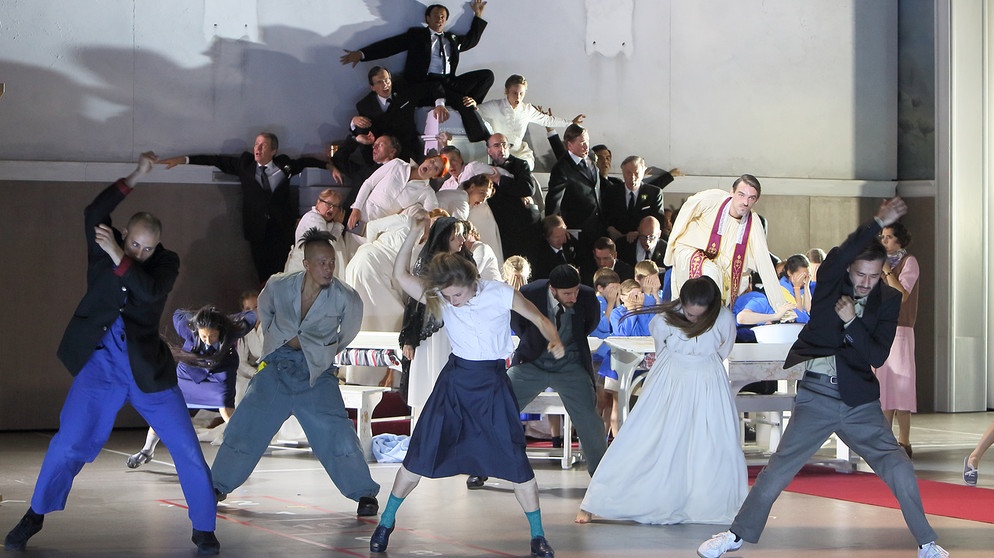
What are Hébé, L'Amour and Bellone doing in a schoolroom?  But in a classroom, kids learn about the world. And Les Indes galantes is about the world, and universal themes of life and love. Hébé  (Lisette Oropesa) is the "nice" teacher confronted by an apparition in drag. Will Hébé's charges be confused by Bellone, his trumpets and rousing cries of "La Gloire vous appelle" ?  Goran Jurić in travesti isn't exaggerated, though hardly comforting, for he represents opposing systems.  This Prologue, (dramaturges Antonio Cuenca and Miron Hakenbeck)  reaches much deeper than the nudity in the Laura Scozzi production for Christophe Rousset and Les Talens Lyriques in 2014, since it deals with the tensions that underlie the plot, or rather non-plot, reminding us that Les Indes galantes is allegory: entertainment to engage the mind as well as the senses.  Rameau's audiences, versed in the classics, weren't stupid.  In idealized allegory, conflicts are resolved by L'Amour (Ana Quintans).

Brilliantly, the idea is followed through in each of the four Entrées and in the ending, unifying the whole, bringing out connections. The world, after all, is "one", whether you're French, Spanish, Greek, Inca, Turk or Native American.  For example Osman  (Tareq Nasmi) appears in a long tunic over trousers. Not non-European attire, but in these xenophobic times, "alien" outfits suggest danger, even more so, perhaps than they did in Rameau's time. Bellone cross-dresses, parodying the usual trouser-role meme, and pretty much the whole Entrée of 'Les Fleurs' predicates on mistaken identity.  The message is clear: don't judge by superficial appearances.

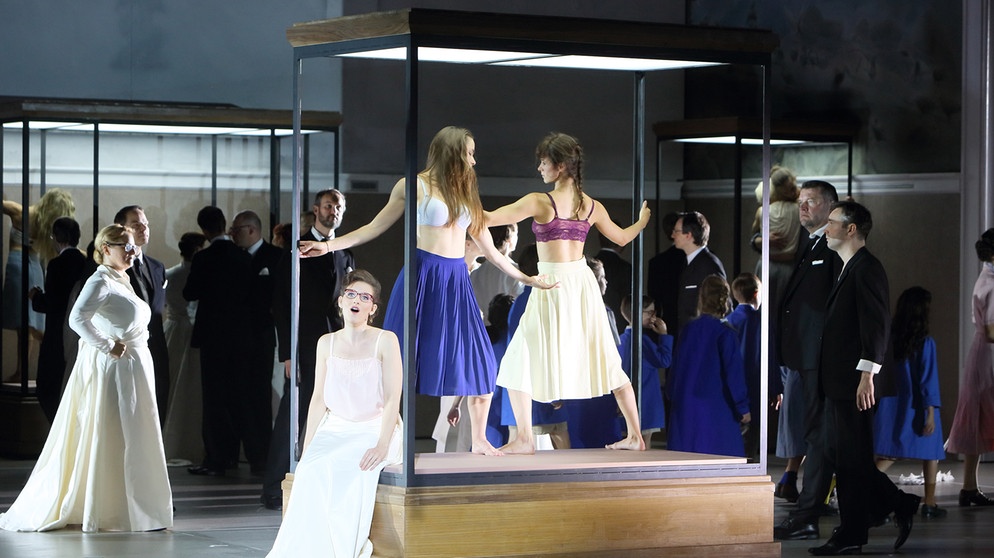
Dance is absolutely integral to Rameau, so this new production is valuable, too, in its emphasis on movement as abstract expression.  In 'Le turc généreux'  singers and dancers move in and out of structures which resemble display cases.  Slave traders? People treating each other as objects of consumption ? Image or reality? The lustful Turk turns out to be the good guy after all, uniting Émilie (Elsa Benoit) and Valère  (Cyril Auvity) so they can go home, where they belong. Despite their differences, Osman and Valère are mates. "Au plus parfait bonheur il a droit de prétendre, Si la vertu peut rendre heureux"
    
In 'Les incas du Pérou', Anna Prohaska is magnificent as Phani, singing with smouldering intensity, conveying with her voice the conflicts  she must feel betraying her heritage for love. So Huascar (François Lis)  is a Catholic Priest and not an Inca High Priest? Again, it's not robes that make a man malevolent.  We don't need Inca kitsch to remind us that priests of all types are fond of invoking divine retribution on those who question.  And symbols like the sun and blood sacrifice occur in many religions.  Think on that when blaming the Alien Other.  Husacar thinks he has an exclusive hotline to God. "Triomphe soliel" was delivered with suitable fire and brimstone. The volcano explodes but even more explosive was the interpretation. This 'Les incas du Pérou' drew its power from the potent, provocative ideas inherent to the plot.  Rameau might not have dared question the Church publicly, but a whiff of revolt rumbled in the background. exploding in the Revolution which came only 50 years after the opera's premiere.

Dance also brought out the deeper levels of 'Les Fleurs', without resorting to prurience or bad taste. The "Flowers" here are the secluded women oif the harem, waiting to be plucked.  Thus the stylized hand and foot gestures, nodding heads and swaying gestures, Middle Eastern dance sublimated.  Tacmas (Cyril Auvity ) loves Zaïre (Ana Quintans) the slave of Ali (Tareq Nasmi ) who is loved by Fatime (Anna Prohaska).  There would have been practical reasons for Rameau to employ the same small group of principals, but interplay of familiar voices also contributes to the sense of disguised identity. The correlation between singing and dancing was particularly lively.   Flowers are fertilized by butterflies, which shift-shape, and whose fragile beauty soon fades. The beautiful "Papillon" aria was exquisite, made even more so when followed by the image, shot from above the stage, where the dancers move in formation, swaying awkwardly like the segments of a caterpillar.  The sub-themes of renewal which connect the apparently disparate parts of  Les Indes galantes are subtly depicted by minor details of cleansing and replenishment which come to blossom fully in 'Les Fleurs'.  Sidi Larbi Cherkaoui's choreography is so vivid that it evolves into directoral thinking, much more effectively than some theatrical directing translates into opera.

Perhaps symmetry comes naturally to a dancer, but the staging of the Final Entrée, Les sauvages connected beginning to end with poise and elegance,  We returned to the "classroom", which isn't at all a bad metaphor for the innocence of childhood, and the idealized simplicity of "natives" living in harmony with Nature.  The wonderful "Forêts paisibles".  Ivor Bolton doesn't conduct with the vivacious finesse of William Christie or even with the flair of Christophe Rousset, but his Handelian solidity works well with the down to earth physicality of Cherkaoui's choreography.  The excellent singing and dancing more than compensate. Cherkaoui's interpretation gets to the soul of Les Indes galantes with great intelligence and sensitivity.  We need more of this, especially in these times.

Sunday, 12 April 2015

ENO Tansy Davies Between Worlds


Tansy Davies Between Worlds at the ENO at the Barbican, London, confirms yet again the ENO's unique position in British cultural life.  Davies is a highly original, very distinctive composer. Between Worlds suggests great potential. It's her first venture into opera, building upon her orchestral style, interesting for that very reason. Everyone knows the events that took place on 9/11, so literal narrative would be crass.  We don't neeed to see planes crash. Many of the victims were trapped in darkness, not knowing what was happening outside. In Between Worlds, we get just that.  It's not an opera in the usual sense, but a meditation on the emotions people might have felt, lost in that claustrophobic limbo from which there was no way out but death.

Those who died trapped were ordinary human beings, facing an unimaginable trauma. Grand arias would be inappropriate. Real people don't play to the gallery, especially in such circumstances.  Bombastic gestures are for terrorists.  Davies concentrates instead on the fragile lines of communication between the inner and outer worlds:  phone connections that break up, messages that don't get through, signals that fail when they're most needed   In this opera, the orchestra sings what cannot be expressed. Wailing sounds suggesting sirens, creating anxiety, all the more disturbing because they sound muted and distant.  Ticking, tense mechanical sounds, beating staccato like the very pulse of the Earth.  A Birtwistle connection exists, though Davies's music, of course, sounds nothing like Birtwistle.  For me,  Tansy Davies's music has always felt sculptural,  as if she's working with physical, architectural forms.  In Between Worlds   she uses fragmentation: myriad tiny sounds that deliberately don't cohere, but en masse form vast walls. The Twin Towers were beautiful monuments of glass, defying the elements, but they couldn't withstand the attack. Those who remember 9/11 will recall the clouds of rubble and dust, waves of paper fluttering down from wrecked offices, and bodies falling, to be smashed into pieces. Listening to Between Worlds as a purely audio experience  will be an experience, As music, it's extraordinarily subtle.

Davies's vocal lines are stratospheric, reflecting  the idea of "looking upwards" to survive . This timbre causes probelms for many in the cast, apart from Andrew Watts, the Shaman, for whom a realm beyond mortal existence is normal territory. Although he's dressed in a business suit, his keening, legato seemed to float into space. Much of Manhattan was built by Native American construction workers, riding the girders way above the streets, turning empty nature into concrete. The Shaman is fantasy, of course, but brings a deeper level of meaning.  When Watts sings, one hears something of eternity, which fits in nicely with Davies's quotes from early music and hymn. The downside is that this stratospheric timbre is hell to sing.  Most of the rest of the cast is challenged.  Psychologically, this is true. The lines  break up frequently, like broken signals, and feel  like strangulated screams, words caught mid-flow in choking gasps.  Not at all easy on the ear, but perhaps it shouldn't be, in the circumstances. But focus on the music in the orchestra, conducted by Gerry Cornelius. This is an opera where abstract sounds tell the story, with beauty, dignity. and sensitive imagination. 

The stage is divided into three separate spheres. Andrew Watts, alone, at the very top, the chorus in darkened space below. In the centre, five key figures whose "ground" is perspex, and transparent, as if they're in suspended animation.  The figures are symbolic of Everyman, so there's no great need for in-depth characterization. It's enough for us to know that the Realtor (Clare Presland) has to divide her time between being a mother and an executive, and that the Younger Man  (William Morgan) is scared of heights: we feel for them as human beings.  The closest we get to conventional aria is when The Young Woman (Rhian Lois) sings of love. It's a wonderful vignette, celebrating lesbian choice -  good for librettist Nick Drake and Davies!  Eric Greene sings the Janitor, a role that sits more easily in range, Phillip Rhodes sings the Older Man, a relatively conventional figure.  Susan Bickley sings The Mother. Deborah Warner directed, Michael Levine designed the set, which underlined the fragility of being "between worlds".

Special mention should be made of the dance sequence towards the end, choreographed by Kim Brandstrup. A man's body floats helplessly suspended, supported gently by a sylph-like female dancer, in a kind of reverse pas de deux.  The image suggests vulnerability, as well as gentleness. Eventually the male figure flies upwards, finding release. The music behind this sequence is beautiful, expressing deep meaning without the use of words. What was striking about 9/11 was that those killed sent messages of love, not hate or revenge, but that, alas, has been lost in transmission in our more divided, violent times.

Between Worlds is so unusual that's it's bound to shake up some. It might take time to settle, I think it proves how much creativity and talent there is in Britain, and why it should be supported. The ENO is in a unique position because it supports original work in the English language, and does so with a quirky liveliness that appeals beyond the narrow confines that give opera  a false elitist image.Scrapping the ENO in favour of small-town runs of, say, The Barber of Seville, just doesn't make sense, long term. The ENO's contribution to British art cannot simply be measured in accountant-speak.