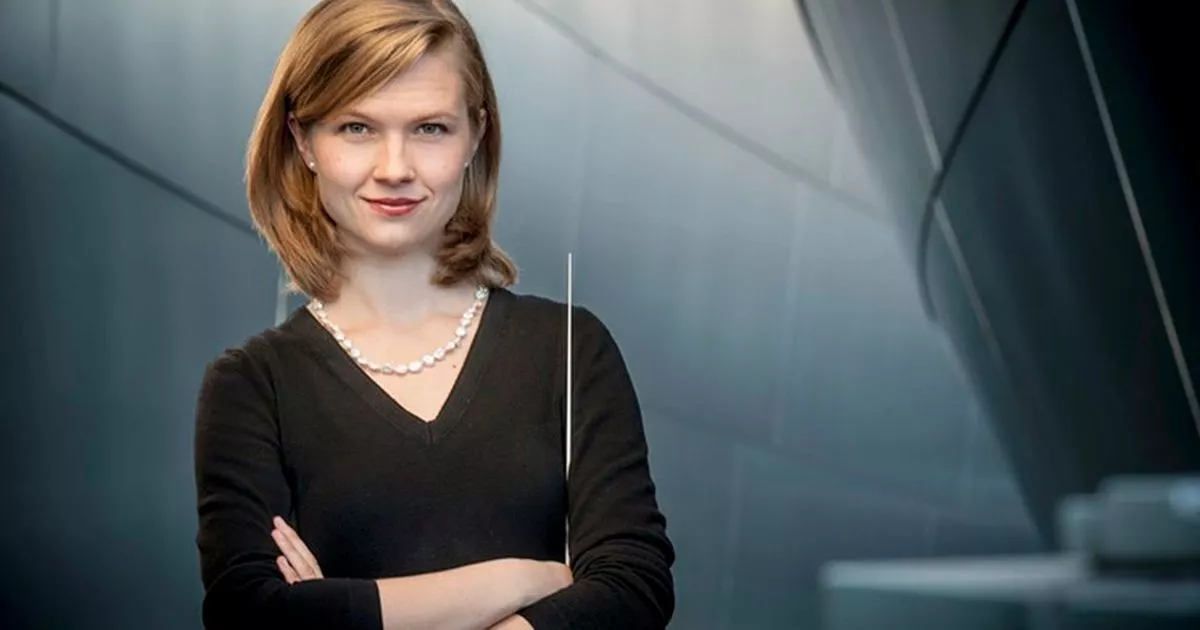
Showing posts with label CBSO. Show all posts

Sunday, 16 June 2019

Mieczysław Weinberg Symphony no 21 "Kaddish" Gražinytė-Tyla, Gideon Kremer, Kremerata Baltica

At last on CD, Mieczysław Weinberg's Symphony no 21 "Kaddish"  (op 152, 1991) with Mirga Gražinytė-Tyla conducting the City of Birmingham Symphony Orchestra, and Gidon Kremer and the Kremerata Baltica,  from the acclaimed live performance, part of the in-depth CBSO Weinberg series in November 2018. The symphony is a deeply personal statement. Weinberg witnessed the Holocaust first hand. He survived, though millions didn't, including his family.  Yet its musical qualities are such that they make it a milestone in modern repertoire.   Though the symphony does get performed and has been recorded once before, this performance is exceptionally idiomatic as it is made by the finest specialists in the field, Gidon Kremer and Kremerata Baltica, supported by Gražinytė-Tyla and the City of Birmingham Symphony Orchestra, in top form.  With these impeccable forces, it is unlikely that this performance will be surpasssed for some time. This belongs in every collection, Weinberg-focused or not.

The combination of chamber orchestra, soloists and large orchestra is fundamental to structure and meaning. Embedding the ensemble and soloists within the orchestra shapes highlights individual voices against a wider background. In the apocalyptic tumult of the Holocaust, personal utterances must not be overlooked. This also extends  the forces Weinberg can bring to bear in this panoramic landscape. "It is hard to string this bow", said Gražinytė-Tyla of the interaction between ensemble and orchestra. "The reason is that long passages are dominated entirely by a solo voice and various chamber ensembles while the gigantic orchestral apparatus of almost 100 musicians sits on the stage" resurfacing at different points.

The Largo opens with  the plaintive sound of Kremer's violin, singing, poignantly, alone. Weinberg could be referencing many sources - the role of violinists in Eastern European culture, community fiddlers as well as trained virtuosi.  On an autograph manuscript, Weinberg quoted the title of Mahler's song Das irdische leben where a child cries out for bread, but is ignored, and dies. There are also quotes from Chopin's Ballade no 1 in G minor, op 23, further anchoring the Polish context in which Weinberg grew up. With muffled timpani, darker forces enter. There are moments when Kremer deliberately hardens the tone. But the violin soars upward, supported by the strings in the orchestra, before being silenced by a single, harsh drumstroke. The violin resumes reaching a very high tessitura above the steady pulse in the orchestra, before quietly subsiding as the orchestra shapes tranparent, ethereal textures. The Allegro molto shatters any illusion of peace. This is graphic music. Ferocious chords and turbulent cross-currents, interrupted by "gunfire" (percussion) and sudden, sharp outbursts of violence. The Largo is built around a chorale-like anthem.  Tense, quiet passages alternate with more expansive motifs.  Kremer's violin re-emerges, bold, klezmer-like figures taunting strident, low-voiced brass.  The Presto is manic, screaming alarums and  madcap grotesquerie. Yet Kremer's violin will not be stilled, its melody restrained but uncowed. As it fades, the Andantino rises, single notes plucked on violin, answered by the orchestra.  This section is exquisite, executed with great poise, a reminder of  civilized values.

In the Lento, the panoramic landscape of the Largo is redrawn. The violin is plucked, quietly, against a wash of high-pitched  winds - winds suggesting movement and change - bells ringing against ostinato discord, and a soprano voice is heard, singing a wordless plaint. The soprano is Gražinytė-Tyla herself, who trained as a singer and came from a music background.  She knows how to carry a line, and the purity of her tone fits perfectly with what the voice might signify.  The part is substantial and quotes passages that Kremer and the other soloists had played before.  At moments her voice deepens richly before soaring upwards before the piano (Georgijs Osokins), clarinet (Oliver Janes), violin (Kremer) and double bass (Iurii Gavryliuk) return, the ensemble raised from the dead, so to speak, reunited with Gražinytė-Tyla's song, growing with even greater affirmation than before. The symphony ends with a mysterious  glow in this extraordinarily sensitive performance.  This is a symphony of such multi-layered depth and subtlety that it rewards attentive listening.

Weinberg's Symphony no 2 op 30 (1946)  may have been written closer to the time the events described in Symphony no 21, but traumas like that need time to process. In any case, Weinberg had to contend with Stalin and the Soviet authorities. Written for string orchestra, the textures are lighter, Gražinytė-Tyla conducting the Kremerata Baltica so the lines flow gracefully. The part for solo violin dominates, leading the ensemble forth.  In the Adagio the violin takes flight. The higher strings follow but are met by a hushed section for lower strings. The Allegretto is lively : brightly poised and nicely defined.

Friday, 15 February 2019

Mirga Gražinytė-Tyla : Peer Gynt and other choral stars


Edvard Grieg's Peer Gynt a choral blockbuster ?  Mirga Gražinytė-Tyla conducted Grieg's full incidental music to Ibsen's play with the City of Birmingham Symphony Orchestra, showing how the choral sections make a difference to the way the drama is received.  Peer Gynt is so well-known through extracts that the original context is lost.  Not a fjord in sight, except in a metaphorical sense. Peer Gynt isn't a hero. Ibsen's original as a Leseopera, an opera to be read and meditated upon, not "just" entertainment. He satirized aspects of Norwegian mentality in the period when the country was a colony of Denmark.  Peer's adventures are fraught with danger, supernatural as well as physical, The innate tension between moments of beauty and wildness creates a dynamic which is fundamental to interpretation.

Gražinytė-Tyla's approach brought out the power that lies beneath the surface : a vivid reading, bristling with energy.  Not for nothing does Grieg's wedding procession end with ferocious chords. Peer disrupts proceedings and gets kicked out for fighting.  Thus the first chorus with its almost primitive savagery : the subconscious being released.  Congratulations to the CBSO chorus (chorus master Julian Wilkins) showing their metttle. Indeed, this whole programme focusssed on choral music though no doubt the media will think in more simplistic nationalist terms. Thius does matter, since Gražinytė-Tyla has a choral background and is in an ideal position to build on CBSO's reputation for choral music of all kinds.

Having established the drama, Gražinytė-Tyla could focus on the interplay between expansive lyricism and more unusual forms, from the "barbarism" of the Hall of the Troll King to the exoticism of the Arabian dances.  In the Abduction of the Bride, the chorus led into Ingrid's Lament with soloist Klara Ek, and the Death of Åse prepared the way for Solveig's Song : both expressions of love and loss.  In Peer's Homecoming, the CBSO played with strong definition so the obvious imagery (a ship on the sea) seemed enhanced by forces beyond Nature. The Whitsun hymn, sung right afterwards, indicates that this conflation of inner and outer worlds is no accident, but central to meaning. Peer lives in the world of the imagination, feckless until he comes to appreciate true values.  Thus the finale, when Klara Ek, the soloist, the chorus and orchestra come together in glorious balance.

The programme began with neither conductor nor orchestra but with the City of Birmingham Youth Chorus in Esa-Pekka Salonen's Dona Nobis Pacem (2010) a five minute a capella miniature. Salonen plays with chords and textures, the three words of the text repeated in undulating cadence, the last notes held until they dissolve in silence.  Because it's so minimal, careful modulation like this is of the essence.  The freshness of these young voices connected well to Einojuhani Rautavaara's Cantus Arcticus: Concerto for Birds and Orchestra, where recorded bird song replaces chorus.  The orchestra reacts and responds, gradually coming into its own : long, searching lines, suggesting distance, flutes singing together as if they were birds.  A cello sings, its melody enhanced by the cries of birds.  For a moment, the orchestra falls silent, "listening" to birdsong before embarking on long, surging lines that expand, flutes in full flight, low voiced winds adding depth, until the music disappears beyond audibility.  These two pieces combine extremely well.  In both cases the performers must be listeners, sensitive to the subtlest nuance.

Back to more conventionally choral chorus with Jean Sibelius's Rakastava (The Lover), op 14 (1912).  More thoughtful programming from Gražinytė-Tyla, the minimal accompaniment reflecting the delicacy in Salonen and Rautavaara. The men's voices dominate at first - the cycle was originally scored for unaccompanied male voice -  but the women's voices enter with brighter, brisker figures until both reach parity.  Yet again the value of sensitive singing, hushed but precise.  Sibelius En Saga op 9  (1892) was also played well, (great solo moments !), Gražinytė-Tyla conducting with the clarity that brings out structure and detail. 

Monday, 3 September 2018

Andris Nelsons Mahler 3 Boston Symphony Orchestra Prom London


With Prom 67, Andris Nelsons returned to the Royal Albert Hall, London with part of his old band, the CBSO Chorus and CBSO Youth Chorus, and  his current band, the Boston Symphony Orchestra, in a superb performance of Mahler Symphony no 3 in D minor.  Like all organizations whose strength is the people within, orchestras need motivation and leadership.  The BSO sounds transformed since their last visit to London in 2015 (please read more here), and infinitely more alive than their previous visit eleven years ago. The brass and celli in particular sound rejuvenated.   Warming up for this Prom, I'd been listening to the Leipzig Gewandhaus Orchestra where Nelsons is now Chief Conductor, marvelling how the brass there sounds golden and resonant, rarely "brassy".  There's a lot of brass in Mahler 3 but it's not a symphony where brassiness or flash exists for its own sake. Nelsons understood why the brass sections matter and how they contribute to the whole symphony in context.  In any case, bringing some of the Leipzig glow to any other orchestra is quite an achievement.

This was an excellent Mahler 3 because it was sensitive, respecting the subtitles which Mahler used as a kind of scaffolding as he built the symphony.  Notice those titles : "What the Flowers in the Meadow tell me", "What the Animals in the Forest tell me" and "What the Angels tell me". Flowers, animals and angels can't speak:  you have to listen on a much deeper level to understand.  Thus Mahler withdrew the "scaffolding" so audiences would have to pay proper attention.  In a world where muzak values are replacing music values, this is even more pertinent.

The first movement in itself is as long as some entire symphonies, but Nelsons understands the inner structure, which progresses in peaks and planes. Again and again, trumpets lead forward, percussion marking emphatic endings, yet the second theme emerged quietly, heralded by muffled timpani.  Very airy-sounding violin and woodwind figures lit the way for the return of the "march" theme, where trombones added darker colours.  Yet quieter details mattered, like the hushed diminuendo before the whirlwind of woodwinds,  livening the brisk marching pace.  Now,  sassy, sweeping brass made joyous entry.  "Pan awakes", revealing vast panoramas full of promise. The horn call, though, was more restrained, appropriately, for in the mountains, horns are designed to reach over long distances. Thus the solo violin, gentle pizzicato, and harps suggesting perhaps the human world beneath the horizon.  A well shaped "wild descent", and a moment to reflect before the next "peak"  where percussion and brass interacted : a march though not a funeral march other than in the sense of marking the end of the first stage in this journey.   Thus the muted "marching" celli and strings, and the expansive flourish that followed. 

After this invigorating first movement, the sweetness and delicacy of the second made complete sense.  Again and again in Mahler images of meadows in summer recur as symbols of happiness, won after struggle or remembered during struggle. Mahler was a man who hiked and biked and knew the rhythms.  A nice perky start to the third movement, the woodwinds imitating birdsong, a direct quote from the Wunderhorn song Ablösung im Sommer ("Kuckuck ist tod!") . The posthorn, heard from afar, might evoke many things, such as distance, or the inevitable change of time.  Yet no lingering, Nelsons keeping the pace exuberant, so the return of the distant posthorn felt  suitably poignant, the orchestra an afterglow before the finale, where the brass led a hurtling climax.

This set the mood for the mysterioso movement.  "O Mensch, gibt ach !" sang Susan Graham.  "What Man tells me", might be an eternal cycle of suffering and rebirth. "Tiefe, tiefe Ewigkeit!".  Graham's timbre is lighter than many others, some of whom bring out the Herculean Earth Mother depth in the song, but this works well with this more lively interpretation of the symphony, introducing the glorious highlight of the fifth movement.  Excellent interplay between the voices of the City of Birmingham Symphony Chorus and Youth Chorus, and Miss Graham, which reflects to some extent the interplay between brass and percussion in the first movement.  The Youth Chorus’s voices were exceptionally fresh, the bimm bamm's ringing with angelic purity.

Whatever the final movement may signify, its long lines stretch into the distance : the strings and brass doing what the post horn did earlier but now present directly within the orchestra.  The jaunty march at the beginning of the symphony gives way to what might seem serenity, but may be  more complex.  Again the brass lead the orchestra into crescendo, suggesting that the march remains, operating as a pulse behind the swathes of orchestral colour.   The brass again called forth, percussion crashing : a wonderful moment of near silence from which the solo voice of the violin sang clean and clear.  The finale an anthem of confidence, repeating like the march that went before, and ending with emphatic timpani-led tutti.

And here is the finest review I've read anywhere in years ! Marc Bridle, the best in the business ! Please follow THIS LINK

Sunday, 1 October 2017

Mahler 4 with 3 Trebles - Gražinyte-Tyla CBSO


Mahler's Symphony no 4 concludes with "a child's view of Heaven". Not with a grandiose statement, but with a song about food! The child's so young and so innocent that his view of the world goes no further than what's for dinner. When its tummy's full, it will drift to sleep, satisfied, untroubled by the images of death all around.  So much for the idea that Mahler performance should be neurotic, selfish excess. Understand this movement and symphony and you have a key to understanding Mahler's work as a whole.  Last week, Mirga Gražinyte-Tyla did M4 with three trebles from the Trinity Boys Choir with the City of Birmingham Symphony Orchestra : an historic occasion so unique that it's a wonder that hardly anone paid attention.  Let's hope that the performance was recorded because hearing it might contribute a lot to how we hear Mahler and interpret his work.

Although there must have been thousands of performances over the years, sopranos have dominated, with the exception of a few mezzos and even fewer trebles or boy sopranos.   Good practical reasons: the part poses challenges of technique and interpretation, and is substantial enough to require great stamina.  Adult singers - at least the good ones - can bring out the nuances of meaning and sing with the radiance the part requires. Even good child singers struggle, and a sensitive conductor has to hold the orchestra back so as not to overwhelm the kid.  But children's voices have a very special quality which could work very well indeed in terms of expressing the ideas behind the symphony.  So how to overcome the physical limitations of child singers ?  Mirga Gražinyte-Tyla's solution - three trebles, supporting each other  Brilliant idea ! The boys support each other so no-one is exposed for long, and together they form a stronger response to the orchestra.  Gražinyte-Tyla was a choral singer herself, so she understands the practicalities of performance.

Using trebles is much more than a question of liking boys.  Des Knaben Wunderhorn wasn't a book for children but it engages with an aesthetic where sophisticated concepts were dealt with in simple, direct terms.  Freud and Carl Jung would connect childhood experience to adult behaviour in psychology, and Bruno Bettelheim  would extend Jung's ideas on archetypes into the study of "The Uses of Enchantment". Des Knaben Wunderhorn, (the book) with its connections to folk wisdom and the private sphere, is thus much more subversive than one might assume

Trebles are part of the European choral tradition. For many, joining the Church was an escape from poverty and hardship. And thus to the Romantic era, when the stranglehold of Church and State on art was swept away by greater emphasis on individual expression. Even now, in Europe, being a treble can be a path to a good education. In Europe, talented kids win scholarships to schools with elite choirs, rather like footballers in the US  get into Ivy League universities. So I cannot agree that trebles are twee or kitsch. They stand for a very great tradition.  Some people are disturbed by the sweetness of their sound, but that says more about the insecurities of those who don't get the genre than about the genre itself.  All men were boys once, what's scary about that?

Then there's the inherent fragility of the voice type. No-one stays a treble forever, By the time a boy is mature enough to handle bigger parts, his voice might break at any time.  In the case of Mahler's Symphony no 4. that adds extra meaning.  The child who is singing is dead. Sunny as the symphony can be,  it's haunted by the spectre of death, of children and animals being led to slaughter.  Again and again, in Mahler's metaphysics, death is conquered by some more powerful force, be it nature or spirituality or the creative impulse.  For a while, in the 60's, Mahler interpretation was coloured by Alma's view of Mahler as grovelling neurotic, but now, thanks to Prof Henry-Louis de La Grange and to the music itself, we ought to know better.  The child in M4 stands for Mahler himself, full of wonder, and indeed for ourselves, especially in this cynical post-truth world.

There is no way trebles will ever become common practice. The CBSO used singers from the Trinity Boys Choir, one of the top choirs in this country.  In the past, singers from the Wiener Sängerknaben and the Tölzer Knabenchor have done the part : seriously elite, by no means the average church choir.  Even they have struggled, and they're the pinnacle.  A lot also has to do with the sensitivity of the conductor. It is not enough to stick a kid in front of an orchestra like a novelty. Both Bernstein's trebles didn't get the support they needed because they were added like extras on interpretations that didn't reach the subtle depths of the symphony.  Allan Bergius and Helmut Wittek sang some very beautiful passages but their singing wasn't integrated into the whole approach.  They weren't performing monkeys, they deserved better.  Anton Nanut's M4 with 11 year old Max Emanuel Cenčić on the other hand was more sensitively thought through, Nanut restraining the orchestra so the delicate purity of Cenčić's unusually high soprano felt extraordinarily moving.  That's what the symphony is really all about !  So those of us who couldn't get to Birmingham for Gražinyte-Tyla's CBSO Mahler 4 with the three trebles will have to keep dreaming of what might have been.
Please see my other posts on Mahler 4 plus loads more on Mahler and his period.

Tuesday, 22 August 2017

Beethoven or Gerald Barry ?


 Prom 50 should have been one of the top picks of the season, with Mirga Gražinytė-Tyla and the City of Birmingham Symphony Orchestra.  Beethoven and Stravinsky......but Gerald Barry ?   Beware any composer who repeatedly compares himself to Beethoven. Even in self-parody, a joke taken too far stops being a joke, but a sad display of The Importance of Being Earnestly Self Important.  No doubt there will be many who'll fall over themselves being clever and flatter Barry for this latest jape (of many). But methinks, it's pretentious tosh. 

Barry's Canada was inspired by a spur of the moment thought, while being held up at an airport in Canada, which he equates with Fidelio, Beethoven, Idealism, Liberty, Oppression and so on, and throws in an extra lick about surveillance society to boot. Gee, clever !  Canada has nowt to do with  much at all unless you like slam bang wham and repeated words and phrases.  Once, Beethoven stood for something. Now in this post-truth universe where anything goes as long as you can get away with it, we get what we deserve.  Barry, not Beethoven.. Kudos to Allan Clayton and to the band, and  to whoever directs Barry's career.  But of course, what do I know?

H K Gruber used to play The Fool but Gruber was genuinely creative and maniacally inventive. Because he wasn't fooling himself. So the Prom audience and performers laughed. But now all laughs are what they seem. Thus perhaps the need for Beethoven-lite, a Symphony no 5 that breezed along merrily, and why not for a change? After Barry, Beethoven can't compete. Fortunately, in the first half we had Beethoven's Overture "Leonore" no 3 and Stravinsky Violin Concerto no 2 with Leila Josefowicz, expressively played. Her encore was Esa-Pekka Salonen's Lachen verlernt - Laughing Unlearnt - which playfully juggles repeated phrases, but which is genuinely witty.

Thursday, 18 May 2017

CédricTiberghien Saint-Saëns, CBSO Franck Rachmaninov


At the Symphony Hall, Birmingham, Karina Canellakis made her debut conducting the City of Birmingham Symphony Orchestra. Given that orchestra's knack for finding exceptionally good young conductors to liven up the stable, this concert deserved attention.  Canellakis was a violinist with the Berlin Philharmonic's junior ensemble, the Orchester-Akademie, where she became a protégé of Simon Rattle, like Dudamel and others before. His agents, Askonas Holt, have taken her onto their books, which should launch her career very nicely. In 2014 she stepped in for Jap van Zweden in Dallas.  This concert with the CBSO is so far her highest-profile European gig, broadcast on BBC Radio 3.

César Franck's Le chasseur maudit is a show stopper, almost guaranteed to blast audiences out of their seats.  It's inherently dramatic. A fanfare of horns announces a hunt: but no ordinary, pastoral hunt.  Percussion rings out, suggesting the tolling of church bells in the distance.  This Sunday, though, the Huntsman's off to the woods instead, killing animals.  The tale goes way back in European folklore. Think, for starters, Goethe's Die wandelnde Glock, set by Loewe, and Schoenberg's Gurrelieder and much else Gothic and demonic. Thus the piece ends with a loud sudden bang. It's not a rarity: I last heard it live barely 18 months ago.  It's effects come from its being pictorial: not a great deal of musical imagination needed. Thus it needs more punch in performance to compensate, and here needed more vivid character.

Another surefire crowd pleaser: Rachmaninov's Symphonic Dances op 45, also vividly pictorial.  It's as if we see dancers swirl before us, as if in an elusive dream.  Certainly, in this performance the dreamlike quality prevailed,  but there are darker, more nightmarish depths to the piece.  That repeated pounding motif and its quieter echo, can be disturbing.  Towards the end of his life, Rachmaninov was looking back on a lost world, and a life spent in exile, sometimes in creative impasse.  The waltzes can seem haunted. The violin plays alone, for a reason.  The horns can be strident, and the winds can  be sinister.  But for all we know, Rachmaninov might have been writing to soothe himself. The CBSO is a such a good orchestra that it can convince whatever it does.  So, perhaps the fluid smoothness had purpose.  An undemanding though enjoyable performance. Picturesque music sometimes plays itself, though it works best when better thought through.

The highlight was Camille Saint-Saëns Piano concerto no.5 in F major Op.103 (Egyptian) (1896) with Cédric Tiberghien.  Much is made of the "Egyptian" aspects of the piece, since it was written in Luxor, but it is fundamentally an example of Belle Époque syncretism.  For men of Saint-Saëns's generation, European civilization was the height of progress, and that civilization encompassed the world.  Napoleon's conquest of Egypt differed from the British conquest of India, just as French and British colonialism followed different models.  The French fascination with "The East" was long standing : think Les Indes galantes, where the "natives" are Frenchmen in disguise.  Or Lakmé, or The Pearl Fishers.  

Ultimately, Saint-Saëns Piano concerto no.5 is far more than picturesque travelogue. It's not "light music". It's a work of  bold musical inventiveness and originality.  Perhaps that's why the piano part is so strong : the soloist as pioneer, very much the leader. Tiberghien faces the fearsome technical challenges : arpeggios fly with faultless confidence and elegance, and the frequent changes of imagery flow naturally.   Like the Nile, with its confluent tributaries!  Vaguely Arabic motifs blend into harmonies that are "modern" and European. Thundering passages suggest constant flux,with swirling diminuendos and passages of flamboyant brilliance. Nothing backward here, though the references may come from things remembered.  Tiberghien played with highly individual flourish.  Perhaps his enthusiasm invigorated the orchestra, who were playing at their best at this point in the concert.

Thursday, 17 November 2016

Mirga Gražinyte-Tyla : Mahler CBSO Birmingham


Mirga Gražinyte-Tyla conducted the City of Birmingham Symphony Orchestra in Mahler Symphony no 1, Haydn Symphony no 6 and the premiere of Raminta Šerkšnyte's Fire.  Mahler's First is often a measure of a conductor, lending itself to many very different approaches.  Gražinyte-Tyla's Mahler 1 was striking. The first chords rang out confidently : nothing tentative here. Although the "growing shoots" in this symphony are fresh and new,  they spring from a life-force so powerful that they cannot be curbed.   While not rushing, the orchestra soon gets into its stride. By the time the pounding figures come we're definitely "on our way". When the flute called out, it seemed to glisten, shining as if moist with dew.  The phrasing in the next section was delicately defined, so lucid that a very minor fluff in the playing stood out more than it might otherwise, but no matter.  In Lieder eines fahrenden Gesellen, a finch calls out "Ei du, Gelt!". (Isn't it a lovely morning).  So the young man's been jilted, but he gets over it by going on a morning hike, engaging with nature.  In this performance, I was surprised how beautifully the idea of "bells" infused the notes - the bluebells in the text singing invisibly, like their scent in the sunshine. Thus,the first of many crescendi in the symphony, flowing naturally, and with joy.  "Ei du, Gelt!". The timpani danced merrily, a subtle suggestion of Ländler physicality.

The Second Movement began gently, respecting the quotation "Auf der Straße steht ein Lindenbaum" from the last song of Lieder eines fahrenden Gesellen.  Reputedly, the scent of a linden tree is narcotic. The protagonist no longer worries, for all will be well. The music softens. "Alles, Alles ! Lieb und Leid, und Welt, und Traum".  But reverie is torn apart by sudden outburst.  Gražinyte-Tyla pushed the orchestra on, wildly wayward figures sweeping forth., giving way to more complexity.  Instead of Ländler, a much more sophisticated, mysterious waltz.  Again, the resolution is crescendo, horns and  trumpets leading the march forwards  The flickering, probing figures in the first movement resurface. The overall mood became darker, angular whips of sound suggesting tension. Gražinyte-Tyla carefully  shaped the run up to the final explosion, so it emerged gloriously, growing as a natural outcome from what had been building up before. A refreshing, invigorating performance,  clean without exaggeration, extremely well thought through.  

The City of Birmingham Symphony Orchestra are superlative musicians, but what makes them distinctive as an orchestra is their sense of individuality.  They instinctively manage to choose Music Directors who have similar flair. This orchestra doesn't get "directed" so much as it grows, symbiotically,  with the conductors it likes best. Thus the inspired choice of Haydn's Symphony no 6 (Le Matin) with which Haydn established his rapport with the orchestra of the court of
Esterházy.  This performance gave the CBSO players chances to sparkle, as individuals, cohesion coming, I think, from mutual communication. Plus, the concepts of dawn and light connected beautifully to Mahler 1 and the symbols of Spring and renewal therein. Perhaps that's why I was so drawn to the flutes and flying strings.

The programme began with a new work, Fire by Raminta Šerkšnyte, and ended with an encore from Jonas Švedas (1908-71), both Lithuanians, like  Gražinyte-Tyla herself. 

Sunday, 28 August 2016

Sensational chemistry ! Mirga Gražinytė-Tyla CBSO Abrahamsen Tchaikovsky


Mirga Gražinytė-Tyla and the City of Birmingham Symphony Orchestra  in a truly sensational Prom 55 at the Royal Albert Hall, an occasion which those of us lucky enough to have been there will not forget. The CBSO is unique. Its members have an uncanny knack for picking relatively unknown conductors and growing with them.  They picked Simon Rattle as Music Director when he was 25, Sakari Oramo at 31, Andris Nelsons at age 30, and now Mirga Gražinytė-Tyla, also 30.  This symbiotic relationship between orchestra and conductors makes the CBSO what it is: a very different dynamic from the usual way orchestras are run.  In each case the orchestra shaped the conductor as much as the conductor shaped the orchestra.  This close relationship - like family, some say - is fundamental to understanding the orchestra and, indeed, its conductors, who carry the CBSO imprint with them just as much as the orchestra developed duringn their stewardship. The CBSO is easily one of the Big Five in British music, and absolutely world class.  Mirga Gražinytė-Tyla has a lot to live up to, but from this Prom, it's clear that she has what it takes.

Just as Rattle, Oramo and Nelsons are utterly individual and distinctive, Mirga Gražinytė-Tyla is very much her own person. She's so petite that the official BBC photographer had a hard time getting her in the frame, dwarfed as she was by all around her. But, as so often, looks mislead. Gražinytė-Tyla is an unusually athletic conductor, her face as animated as her body, yet every movement she makes is purposeful.  Her tiny hands flutter but communicate with such authority that the whole orchestra seems transfixed.  Excellence at the level the CBSO has reached doesn't come about by accident.  Good music deserves nothing less.

The Overture to Mozart's The Magic Flute sparkled: clean, shining brass, vivacious winds, strings whizzing along with manic brio. So expressive that the spirit of the opera - and its composer - seemed to materialize. Magical, yes, but also with diabolic fervour.  In the opera, Tamino is tested. Sarastro  is no cuddly father figure.  Thus the discipline in the CBSO's playing underlined the moral resolve that lies at the heart of the Singspiele, which is by no means a pretty bit of fluff.  Being a Freemason in Mozart's time was secretive and rather sinister. Gražinytė-Tyla's background lies in vocal music. Like Nelsons, she could achieve great things if she did opera.  To my delight, she announced plans on the radio rebroadcast for a concert performance of Mozart Idomeneo in a future CBSO season.

Hans Abrahamsen's Let Me Tell You was commissioned for Barbara Hannigan, who has performed the piece many times since its 2013 premiere with Andris Nelsons and the Berlin Philharmonic Orchestra. It's had so much exposure that it's become a celebrity star turn, which distracts from its considerable musical qualities.  Abrahamsen's greatest popular hit is ironically, a bit of an anomaly.  At roughly 35 minutes, it's longer  than all the vocal music put together that Abrahamsen has written in his long and productive career.  The words are those of  Shakespeare's Ophelia, who was torn between her love for Hamlet and her grief at the death of her father. As she sings, she falls into a brook and drowns.  Thus the long, limpid lines that suggest flowing liquids,  circular figures that suggest the vortex that will drag Ophelia to the depths   The ethereal qualities of Hannigan's voice give her singing an unworldly strangeness that is at once crystal clear and elusively opaque.   The voice is  disembodied, like the wind and brass instruments that form the core oif the piece. If Hannigan were an instrument she'd do circular breathing.  Sudden flights upward and turns of pitch. Syllables fragment and reform, like droplets of water reflected in light - wonderfully delicate textures created by harp, celeste, and percussion with tubular bells and tiny wooden objects scraped and beaten, making sounds like grasses blowing in the wind. Sounds of nature, too subtle and too elusive to identify.

Let Me Tell You is in many ways not a song sequence at all but another of Abrahamsen's intensely detailed soundscapes like Wald and Schnee.  "Music is pictures of music", Abrahamsen once said. "That is a strong underlying element in my world of ideas when I compose - as is the fictional aspect that one moves around in an imaginary space of music. What one hears is pictures - basically, music is already there."   In Let Me Tell You, Abrahamsen collaborated with Paul Griffiths, the author and music historian, whose books on modern music are still, after 30 years, still the best informed. In comparison, The Rest is Noise is Reader's Digest. For me, Abrahamsen's music is magical and full of wonder. The CBSO has a thing for Abrahamsen, too. Earlier this year, Ilan Volkov conducted Abrahamsen's  Left, alone. (read more here)

Gražinytė-Tyla and the CBSO concluded with Tchaikovsky Symphony No 4 in F minor. Everyone knows that, or thinks they do, which is why it's important to always keep listening.  The mark of a good conductor is whether he or she cares enough about the music to find something special about it. Routine performances can be the death of art. Tchaikovsky's Fourth is a highly dramatic work, almost schizoid in its juxtaposition of sweet lyricism and heartbreaking crescendi.  This was an exciting performance, but exciting because it blazed with the excitement that comes from excellence. I used to hang out with theoretical physicists who could wax ecstatic about elegant theorems.   There are many different ways of feeling emotion. I was thrilled by this performance, bursting as it was with vivacious joy and energy, all the more exciting because it was executed with such natural poise.

Bottom photo: Roger Thomas

Friday, 29 April 2016

Visions of Wonder Debussy, Abrahamsen, Mahler 4 CBSO Volkov


Child-like visions of wonder and excitement : a potentially brilliant concert from the City of Birmingham Symphony Orchestra with Ilan Volkov. Hans Abrahamsen's Left, Alone was the big draw, the premiere of a major work by an extremely significant composer, noted for his inventiveness and  individuality. Left, Alone is a return to Abrahamsen's creative roots, far more characteristic of his style than  Let me Tell You, which may be his Valse Triste, popular but not typical of his music. I hope he gets paid better than Sibelius did.  Abrahamsen isn't the sort of composer you associate with smash hits.  He's hardly ever written for voice. He doesn't need to. "Music is pictures of music", he once said. "That is a strong underlying element in my world of ideas when I compose - as is the fictional aspect that one moves around in an imaginary space of music. What one hears is pictures - basically, music is already there."

Abrahamsen's music listens, as a child listens, with purity and wonder.  It's alert to the kind of quiet detail that gets missed in a world of white noise and bluster. A child doesn't need to prove anything to anyone. He or she can marvel, without precondition.  One of my friends hated Abrahamsen's Schnee (2007) because it "feels like watching snow fall", but for me that's precisely what I love about Abrahamsen.  Buddhists believe that the path to wisdom lies in divesting oneself of Self and the need to control. Abrahamsen's music examines sounds from different angles and, importantly, through silence, the antithesis of mental muzak 

In Abrahamnsen's Left, Alone the concept "the sound of one hand clapping" is uniquely realized.   Ravel's Concerto for the Left Hand was written for Paul Wittgenstein who lost his right hand in war.    Perhaps it carries the memory of a lost limb, as often happens to amputees. Abrahamsen's piece feels, however, like an exploration of something entirely imagined. Left, Alone moves through a series of six vistas, dark rumblings on the lower keys to bright outbursts in the orchestra. Single notes on percussion blocks tempt the piano forth. At first the piano sounds tentative, as if exploring space. A surge of strings from the orchestra, then a long passage of semi-silence. In fact there are several, passages of semi-silence, each one different, so you have to pay attention. Eventually the piano finds its voice, stabbing exuberantly at the keys, the whole orchestra  animated in support. Having thus found itself, the piano can return to quietude. Single notes are played, repeatedly. A huge arc of sound from the orchestra, a frenzy of sparkling notes: piano, percussion, winds and strings together. The pace intensifies, bubbling along cheerfully.  Not having a right hand is not funny, but the protagonist triumphs, nonetheless. Alexandre Tharaud was the soloist.  Preceding Left, Alone was Abrahamsen's orchestration of Debussy Childrens Corner. The connections are clear: six vignettes unified by playful imagination.

 In theory, this sense of childlike wonder should have animated Mahler's Symphony no 4, but for me, it largely fell flat. Volkov and the CBSO were brilliant in the first part of the programme, playing with vivacious good spirits.  Maybe they'd enjoyed themselves too much.  Volkov's métier is new music, and the CBSO relish adventure. They've done Mahler 4 often enough  that they can probably coast through and usually (not always) still sound good.  There were problems with the brass, and the timpani felt unusually heavy handed, as if they were playing a military march, which is fine in Mahler but not in Mahler 4.  Volkov says "only when you play the whole piece through the last movement makes sense, dynamically and musically". We can't put much store in a soundbite like that, but it did have a bearing on this performance.

The final movement refers to the brightness of heaven, and happiness so dazzling that even St Ursula, the warrior, bursts out laughing while her murdered acolytes dance. It is by no means a "cheerful" symphony because the child singing is dead. The voice sounds vulnerable, but in Heaven, it cannot be hurt. Unlike the child in Das irdisches Leben it will not be suppressed.  The dead kid is full of wonder because it's experienced a miracle. The sleigh bells in the first movement are there for a purpose. Sleighs were a mode of transport in difficult conditions, pulled along by the physical strength of horses.  Hence the need for tightness of ensemble and vigorous energy.  Mahler's first movements aren't usually overtures summarizing what is to come, but the first stage in a journey.  Mahler's markings Bedächtig. Nicht eilen and In gemächlicher bewungen. Ohne hast don't in themselves mean slowness but more a kind of transition from the "life" of the first movement to the afterlife of the finale.  If the music lingers, it's to suggest a reluctance to leave a happy past. In some ways, Mahler is saying goodbye to his Wunderhorn years and moving on.  There are many ways to interpret this symphony but it does need a structured point of view.     

Sunday, 3 April 2016

Nicholas Collon CBSO Mahler 10 Webern Brahms


Nicholas Collon conducted the City of Birmingham Symphony Orchestra in Mahler 's Symphony no 10, or to put it more accurately Deryck Cooke's third Performing edition of Mahler's manuscript. Although it might seem redundant to point out that Mahler didn't complete the symphony, that basic fact is fundamental to any interpretation.  Performance practice , and the evaluation thereof, has to deal with its very open-endedness. No one knows what Mahler would have done, had he lived, but one thing is clear. He was looking forwards, not backwards.

When he was working on the Tenth, the parameters of his life had been overturned. He had left Vienna acrimoniously, he'd been betrayed by his wife.  Literally, he was in new territory.  With all his previous symphonies, he had broken new ground. So whither the 10th?  Mahler famously said "My time will come". Perhaps "the time has come" now for Mahler's Tenth.  Prof Henry-Louis de la Grange's monumental work has demonstrated just how intellectual and progressive Mahler really was. Far from being the maudlin neurotic Alma portrayed  in her memoirs, he was a man keenly aware of what was going on in the world around him, mentally disciplined and unconventional. This has profound implications for performance practice.In the case of Mahler 10, there simply isn't any received wisdom.  We are fortunate that Alma's embargo saved us from highly interventionist approaches coloured by factors other than deeper knowledge of the composer and his mind. 

The CBSO has an unerring instinct for picking exceptional conductors, with whom they develop stimulating  relationships.  It's a bold and very creative philosophy.  From what I've heard so far of Chief Conductor designate Mirga Gražinytė-Tyla, she could do great  things. Their instincts seem to pay off, too, with Nicholas Collon.  He made his name with the Aurora Orchestra , the lively chamber ensemble. Although I personally haven't heard him conduct large orchestras, he's worked with the CBSO before: now we can hear why.  This Mahler 10 wasn't conventional but all the more rewarding for that, since good performance should stretch our understanding of the repertoire.

The Adagio glowed with connotations of Tristan und Isolde, which Mahler always made a point of conducting in Vienna, and particularly poignant in the context of this symphony.  The interplay of the two principal themes was well defined, against a surging backdrop. With his keen ear for the pulse of Nature, perhaps Mahler was intuitively evoking the ocean which he'd crossed, physically and emotionally. The themes though elegant seem to stalk each other: lovely as the music is, it's undercut with the chill of sharp, shrill almost staccato figures, eventually rent asunder by blazing dissonance.  The pastoral theme which emerges grows more refined and more distant. 

At first, I couldn't understand Collon's approach to the first Scherzo, where the jagged edges  seemed more frantic than demonic.  On re-listening, however, it clicked. It allowed more emphasis on the Purgatorio, which may well have been the heart of the symphony, though it's so brief, and on the more complex second Scherzo.  On the title page of the second Scherzo, Mahler writes “The Devil is dancing it with me! Madness, seize me … destroy me! Let me forget that I exist, so that I cease to be.” But a careful observer will note that Mahler then adds “dass ich ver ….” (so that I ….) and trails off without completing the idea. It’s a preposition, but this whole work is a kind of preposition.  Collon's first scherzo thus felt like the first stage in a journey, further focusing attention on whatever might have been the ultimate goal of the symphony.  

In this Finale, Collon and the CBSO  connected the end with the beginning,  thoughtful symmetry connecting to the duality in the Adagio.  The hollow drumbeats in this  "Fireman's Funeral" were chilling, but the theme resembles the poignant pastoral theme in the adagio. It resolves itself in another dissonance, which yet again dissolves into upward, searching arcs, more and more rarified til the symphony reaches a kind of sublimation.  We don't know where Mahler would have gone, but this ending leaves the horizons open, and  free. 

This concert began with Webern, Six Pieces Op 6 in the chamber transcription, the first version of which was written around the time of Mahler 10 though Webern, for obvious reasons, didn't know that.  Schoenberg, Berg and Webern were fascinated by Mahler, and there are many good reasons behind this programme. Incidentally, Boulez discovered Mahler and Webern at roughly the same period, long before he recorded either. Also included was Brahms Four Songs for Women's Voices Op 17 (1862). There aren't many pieces in which a chorus is accompanied by two horns, a harp and nothing more. This minimalist accompaniment sets the voices off surprisingly well. The CBSO Youth Choir did the honours, singing with angelic brightness.  Their accents were English, not German, but I didn't mind at all, since that added to the slightly surreal atmosphere of the settings, which are strange, but in a nice way. 

Thursday, 4 September 2014

Beethovenfest Bonn livestream Andris Nelsons

BEETHOVENFEST BONN LIVESTREAM

7.9.2014 um 19 Uhr live aus der Beethovenhalle Bonn mit dem City of Birmingham Symphony Orchestra und Andris Nelsons

Mit den Beethoven-Symphonien 1, 2 und 3 (»Sinfonia Eroica«) beginnt am 7. September der Beethoven-Symphonien-Zyklus mit dem City of Birmingham Orchestra und dem Dirigenten Andris Nelsons beim Beethovenfest Bonn. An vier aufeinanderfolgenden Abenden wird das Orchester alle neun Beethoven-Symphonien chronologisch aufführen. Dirigent Andris Nelsons: »Ich verstehe die Chronologie als eine Art Reise. Wir bleiben Beethoven auf den Fersen, durch die Höhen und Tiefen seines Lebens hindurch. Und wir stellen uns den Höhen und Tiefen unseres eigenen Lebens. Darum geht es

7th September (Sunday) at 1700 European time (1800 GMT) livestream from Bonn - CBSO and Andris Nelsons  Trailer HERE (with listening link)

Thursday, 16 August 2012

3 More Years! Andris Nelsons CBSO

Andris Nelsons, the charismatic conductor of the City of Birmingham Symphony Orchestra, has renewed his tenure on the basis of an annual rolling renewal from the 2014/15 season onwards.That means at least three more exciting years.  Rejoice! Since his appointment, he and the Orchestra have created many 'once in a lifetime' performances such as Wagner's Lohengrin and the 50th Anniversary performed of Britten's War Requiem in Coventry Cathedral.(this can still be heard and watched on thespace). The CBSO says "Over the summer, Andris and the CBSO will be appearing at some of the most prestigious European festivals, including their residency at the Lucerne Festival with the CBSO Chorus. Highlights in the 2012-13 season include Mahler's momentous Resurrection Symphony, Wagner's romantic opera The Flying Dutchman and a Beethoven cycle which features all of the great composer's symphonies." Next Tuesday, 21/8 Nelsons conducts the CBSO at the Proms (Glinka and Shostakovich)

 For full details visit www.cbso.co.uk.

photo: Marco Borrgrave

Wednesday, 4 April 2012

Nelsons out of CBSO Gerontius

Andris Nelsons isn't conducting Elgar Dream of Gerontius in Birmingham and at the Barbican on 12th and 14th because his littler baby daughter has been taken ill. It's obviously not a minor matter. Audiences are sympathetic because no conductor can concentrate 100% in situations like that (not nice men, that is). A child is far more important than a concert. In any case, Edward Gardner will be stepping in (Gerontius is hardly rare repertoire). Toby Spence is out too, replaced by Robert Murray. So all good wishes to the baby, to Nelsons and to his wife Kristine Opolais, the soprano.


Tuesday, 27 March 2012

Andris Nelsons Baby Crisis

News flash from City of Birmingham Symphony Orchestra: "The Baton may have switched, but the Orchestra plays on".  What's happened is that Andris Nelsons had to pull out an hour before the scheduled concert in Dortmund last week. His 3 month old baby daughter was taken to hospital In Riga. It's clearly not something trivial, as Nelsons won't be back til next  month.  The baby's mother is Kristina Opolais, a sensational Madama Butterfly at ROH last year, who must have been 4 months pregnant at the time, though the audience didn't know. All orchestras have contingency stand-bys, and  Associate Conductor Michael Seal stepped in, and the concert and tour proceeded. So much respect to Andris Nelsons, who has his priorities right.