Showing posts with label Gurney Ivor. Show all posts

Wednesday, 22 April 2020

Morbid Lullabies : ballads, folk song, art song and creative vision

Thomas Rawlinosn The Ballad Singer

What "is" folk music ? Since the term didn't even exist until the 20th century it's wiser to understand how popular music evolved over the centuries. Quite possibly the Greeks sang ballads of some form, and certainly in medieval Europe they were extremely  common.  Norse and Icelandic sagas are an extended form of ballad. The rich had their troubadors, the poor had itinerant musicans who performed at fairs, market-days and gatherings.  Ballads are possibly the oldest form of vernacular music, since they're portable and can be performed anywhere with or without instruments. Moreover, they're strophic, so they're to remember and to adapt  to changing situations and individual variations.  By their very nature, oral traditions evolve and change - they can never be rigidly confined to authoritarian categories. That's what keeps oral tradition alive !

In Western Europe, ballads and songs were collected from very early on. Chaucer included some in The Canterbury Tales and there are references in other literary works.  By the 18th century ballads were big business, printed on broadsides and  displayed for sale on the streets, and collected in published books. The genre made its way into more formal literary circles - Goethe and Schiller wrote ballads, too.  Ballad form entered the classical music mainstream in the wake of Early Romantic fascination with an idealized, Arcadian past, and with the interest in wild places and "non-civilised" ways of life.

Ballads are an integral part of "folk" music. Music travelled between different regions adapting to new locations.  Printed texts and oral tradition existed in symbiosis, each form adapting and influencing the other.At the end of the 19th century, a song might hve morphed over many generations. Gottfried Herder wrote a poem based on a gruesome Scottish ballad, which Carl Loewe set as Edward, Edward. Gradually the song morphed and changed, and connects to the Country and Western hit Knoxville Girl (Please read more here).  The idea that folk song can be separate from human development is an artificial modern construct.  Basically, there's no such thing as dogmatic gold standrad.

One ballad I'm particularly fond of is The Trees They Grow So High, which may or may not be a 16th/17th century Scottish ballad.  Though it comes in different variations, it tells the tale of an arranged marriage between a child and an older woman. The protagonists aren't poor, (the kid goes to school) so it might have been a transaction for money and status.  Trees grow high but the boy, who marries so early is killed aged 18. "Cruel death put an end to his growing". Ralph Vaughan Williams recorded this in the field.  In his version, the woman  begs her father not to marry her off, but her father seems to think the boy's some kind of trophy.  Yet the woman seems OK with this and accepts  widowhood and single-parent status.  But it's a horrible tragedy. Perhaps, over the centuries before it was collected, the song was cleaned up so it wouldn't disturb conventional mores.

Since oral traditions vary all the time, depending on performer and circumstances, it's perfectly natural that they should evolve further when approached by artistic minds. Britten's version of the song, from the beginning of 1942, addresses the tragedy more directly.  The piano part is lyrical, lilting lines suggesting vernal freshness, making the text all the more poignant.  The loss of innocence, for both partners in the marriage, and for the orphaned infant :  characteristic Britten. "Growing, growing  (intoned wth tenderness) as I  watch over his child,while he's growing".  Though the song is understated, gentle and rhythmic, like the rocking of a cradle, the suppressed motions are quite horrific when you think about them.

Another good example of how a song can adapt accordingbto the vision and creativity of a composer.  W B Yeats called Down By the Salley Gardens "An Old Song Re-Sung", quite specifically his own version of a song he heard  was W B Yeats's attempt to capture the spirit of a ballad he heard an old woman sing to herself in County Sligo.  in the ballad, a man recounts a long lost love who "bade me take life easy, just as the leaves fall from the tree, but I being young and foolish, with her did not agree ". It's a song of loss and nostagia with a mysterious, otherworldy quality. In Britten's version, the piano part begins tentatively, as if anything too forceful might breaknthe spell, later, it affirms the vocal line with richness and depth, as if the lovers are reunited in spirit.   Ivor Gurney's version is even more "art song". The voice leads from the start, the line curling tenderly, "When I was young and foo-o-olish and now am full of tears".  Nothing whatseover crude and "folksy" here.  And in any case, we can't assume that Yeats’s old lady was either, though she seems to have been a poor peasant.  Both Britten’s and Gurney's settings are ravishingly beautiful, so delicate that that they capture the gossamer fleeting feel of the monment.   They're very different, too : but that's what art is about : creative vision adapting to individual responses.

Wednesday, 31 October 2018

Britten Ballad for Heroes, Gurney Gloucestershire Rhapsody, Bliss Morning Heroes

W H Auden and Benjamin Britten
 Benjamin Britten Ballad for Heroes, Ivor Gurney Gloucestershire Rhapsody and Arthur Bliss Morning Heroes with David Temple conducting the BBC Concert Orchestra and the Hertfordshire Chorus in Watford last week, broadcast on BBC Radio 3. An excellent programme since these pieces aren't as well known as they should be, though they are hardly unknown.

Britten's Ballad for Heroes Op 14, 1939  for example. When I first heard the piece seven years ago (Ilan Volkov BBCSO, Barbican) I didn't understand it, but gradually it's grown on me. The disparity between the poetry of W H Auden and the doggerel of Randall Swingler is a problem, but Britten uses it with a certain degree of irony. Auden is an intellectual : Swingler a man of action (a Communist) but not so good with words. Auden opposes fascism, while Swingler's solution is to fight with more violence. Yet they trundle along together, with unison chorus and marching orchestra  The contradictions in the piece provoke, just as the situation did. Therefore the piece is about a lot more than a simplistic conflict between pro and anti war. It should be noted that the Spanish Civil War ended in April 1939, with the triumph of the fascists and their Nazi allies, so the piece (which premiered at the end of April 1939) isn't about going to war so much as a realization that war alone cannot defeat the forces of evil.  The title is "Ballad for Heroes", not "Ballad of Heroes", for the cause the heroes fought for had been crushed so cruelly that  it was hard not to envisage the eventual triumph of Hitler, who enjoyed a lot more support, even in Britain, than some will now admit.  Despite the annexation of Czechslovakia, and the Nuremberg Race Laws,  Britain supported a policy of Appeasement.  When Chamberlain announced "Peace in Our Time"  there were many for whom the slogan rang false.  Appeasement, for better or worse, encouraged Hitler rather than curbed him, which is why so many despaired. It is unfair to fault Britten for leaving in April 1939 since Britain was at peace.  There are many ways of opposing war and the mentality behind it. War was only declared on 3rd September 1939 because Germany invaded Poland, not because of the regime itself. 

Thus the funeral march which runs through the Ballad for Heroes, with a solemn relentless tread. The chorus intones brief lines, alternating with the orchestra, replicating again the idea of  different forces being yoked together in common cause.  A mood of greater urgency and alarm is introduced by dizzy  figures in the orchestra (wonderful writing for winds) replicated in the wayward vocal line, Strident machine gun staccato, wild dissonance, surging lines lit by flashes of woodwind light.  "A world of horror!" Then suddenly the tenor (Ben Johnson)  emerges, uncovered and alone.  His lines curl and snarl with menace.  ""....and the guns can be heard across the hills like wa-a-aves at night". You could imagine his face contorting when he sings of "the stench of violence".   The vocal writing here is sophisticated, spiralling diminuendos, words stretched and twisted in a style Britten would use later, in the Serenade for Tenor, Horn and Strings and much more.  "Hear, you numberless Englishmen, to remind you of the greatness here among you, ......to fight for peace and for truth!" words rather cogent given the context of the those months between the annexation of Czechoslovakia and Austria, and the outbreak of war.  
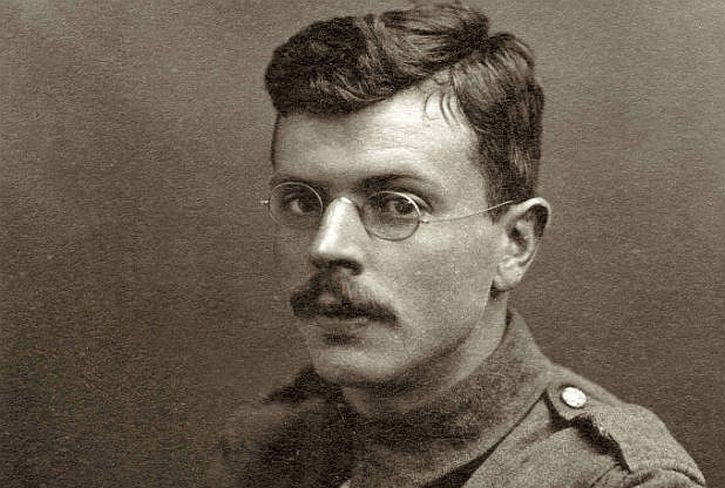
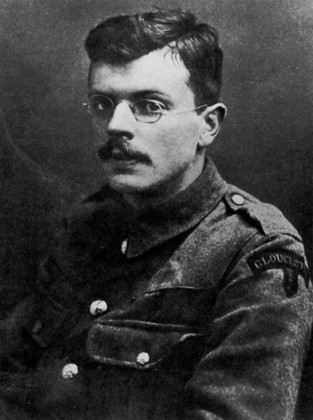
Ivor Gurney's Gloucestershire Rhapsody was written between 1919, on Gurney's return from the battlefield, and 1920, shortly before he was incarcerated in a psychiatric hospital, where he died 15 years later.   Although  it was generally assumed that Gurney's late works were incoherent and unplayable,  Gurney scholars Philip Lancaster and Ian Venables have edited them for performance, revealing their true value.  The expansive lines soar, with an almost Elgarian spirit. One might imagine Gurney inhaling the fresh, pure air of Gloucestershire,  and the exhilaration of being able to roam in his beloved countryside. So very different from the horrors of the trenches!  Gurney's doctors believed that he was better off in hospital, but, when a friend smuggled in a copy of a map, Gurney traced his old hiking routes with  his fingers, as if re-living what he had lost. This background is relevant, for this performance seems infused with a spirit of freedom, of endless open horizons and limitless possibilities.

This "open vista" approach to the Gloucestershire Rhapsody may connect to Gurney's own hopes for the future. Significantly, the piece starts with the same first bars as Richard Strauss Also sprach Zarathustra -  a dramatic opening, but with a twist.  Gurney deliberately wanted to counteract "The Prussians" and what they stood for. Understandable for a man who served throughout the war, though Strauss wasn't fond of “Prussians" either, being Bavarian. The horns give way to a pastorale evoking the Gloucestershire countryside, with its rolling hills and spacious panoramas.  To Gurney, past and present connected in seamless flow. The ghosts of prehistoric hunters, Romans, medieval farmers, depicted in a bucolic dance theme. "Two thousand centuries of change, and strange people".  An ostinato section suggests both the heavy march of Time and the men of Gloucestershire marching innocently to slaughter on the Somme.  Gurney said that what kept him going in the trenches was the thought of commemorating these men in poetry and music.  A short, chaotic "war" section then gives way to a beautifully expansive theme, which might evoke a glorious dawn after a night of horror. It's Elgarian in its glory, but also Gurneyesque.  In this new dawn, though time moves on, Nature returns, and possibly heals.  The recommended recording is on Chandos's CD British Tone Poems, conducted by Rumon Gamba.

Arthur and Kennard Bliss
Morning Heroes (1930) isn't neglected but performances are rare because it’s hard to pull off a symphony on this scale. Much depends on the narrator, who has almost as much to do as the orchestra. Fortunately  the narrator here was Samuel West who narrates on Andrew Davis' s recording with the BBC SO for Chandos. The title "Morning Heroes" comes from  the final movement where three different poems are quoted, Now, Trumpeter, For Thy Close (Robert Nichols), Spring Offensive (Wilfred Owen) and Dawn on the Somme (also Robert Nichols), which graphically describe the landscape of a battlefield, specifically the slaughter of the First World War in which Bliss and his brother Kennard served. Kennard, like millions of others, East as well as West, perished. Morning Heroes isn't a requiem in the religious sense but describes the experience of war in a direct and unsentimental way. War isn't a game, it's not “entertainment".  In these poems there's enough inherent drama to make a point without theatrical excess.

Morning Heroes starts with the Iliad, where the Trojan hero Hector returns as a ghost. The symphony begins with a long quotation describing Hector taking leave of Andromache, his wife. "Would you leave your children orphans, your wife a widow". The refrain in the chorus acts as a whip, goading the heroes to further sacrifice. Bliss follows this first movement with the turbulent "The City Arming". Are the populace so caught up in bloodlust that they forget
the human toll ? The third movement, "The Vigil", is based on Walt Whitman's  Vigil Strange I Kept of the Field One Night and his By the Bivouac's  Fitful Flame. Whitman's verse isn't easy to set as its flow doesn't lend itself to music. Wisely,  Bliss uses spoken narration, augmented by chorus, singing the lines so they seem to sweep like flames whipped by wind. Orchestrally, this is perhaps the most expressive moment. The brief return to the Iliad, which follows, is thus put into context, like a look back on values one might no longer share. When the final movement returns to graphic depictions of the Somme, the connection is made between wars long past and more recent. Resolution, of a sort comes, where the chorus sings, followed by a wonderful but brief figure for oboe, and a brief resurgence of the pounding motif from the beginning. Muffled percussion, muted brass, the mens' voices singing with restraint, as if heard from afar, the women's voices almost spectral.  Yet again the orchestra up, martial music cloaked with menace. Yet a wayward melody emerges and the voices grow stronger and at last, a measure of serenity at the end.    


Friday, 17 March 2017

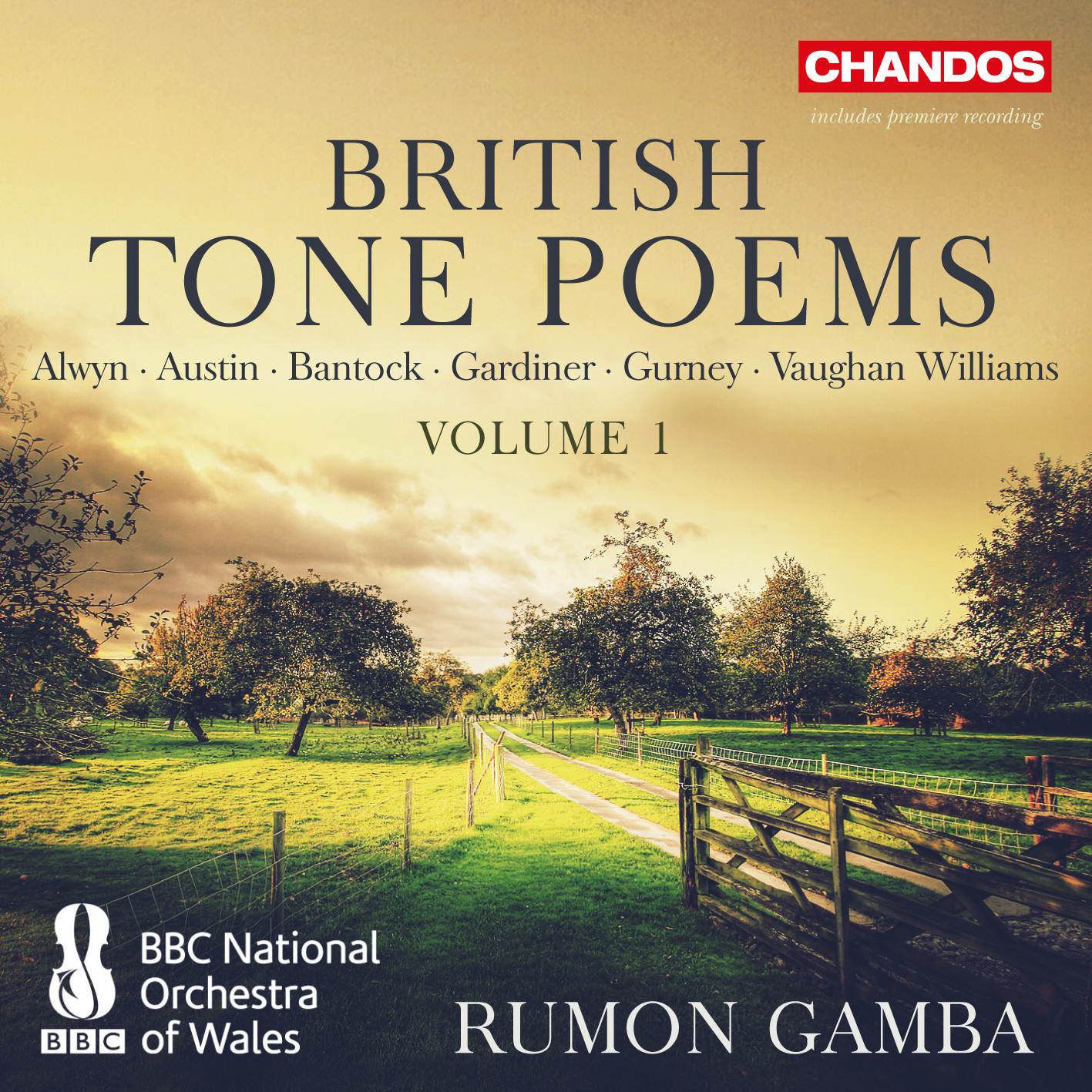
Chandos British Tone Poems Vol 1 - Rumon Gamba Gurney Gardiner

First in a new series of recordings of British orchestral repertoire, British Tone Poems vol 1 from Chandos, featuring Ivor Gurney's Gloucestershire Rhapsody, with Rumon Gamba conducting the BBC Nationl Orchestra of Wales."What Gurney orchestral music?" one might have asked some years ago, since until only very recently, Gurney was primarily known for his songs for voice and piano  Fortunately, from manuscripts in the Gurney archives, three "new" pieces have been prepared for performance, the Gloucestershire Rhapsody, The Trumpet and the superlative War Elegy, which received its BBC Proms premiere in 2014 (Please read what I wrote about that here).

Gurney's Gloucestershire Rhapsody was written between 1919, on Gurney's return fro the battlefield, and 1920, shortly before he was incarcerated in a psychiatric hospital, where he died 15 years later.   Although  it was generally assumed that Gurney's late works were incoherent and unplayable,  Gurney scholars Philip Lancaster and Ian Venables have edited them for performance, revealing their true value.  This new recording for Chandos with Rumon Gamba and the BBC NOW is significant because it's the first formal recording, recorded  in Cardiff in September 2016. It's much more polished than the earlier recording on the BBC's own budget label of a Glasgow concert in 2012, with David Parry and the BBC NOW. Gamba lets the music breathe: one might imagine Gurney inhaling the fresh, pure air of Gloucestershire,  and the exhilaration of being able to roam in his beloved countryside. So very different from the horrors of the trenches!  Gurney's doctors believed that he was better off in hospital, but, when a friend smuggled in a copy of a map, Gurney traced his old hiking routes with  his fingers, as if re-living what he had lost. This background is relevant, for this performance seems infused with a spirit of freedom, of endless open horizons and limitless possibilities.

This "open vista" approach to the Gloucestershire Rhapsody may connect to Gurney's own hopes for the future. Significantly, the piece starts with the same first bars as Richard Strauss Also sprach Zarathustra -  a dramatic opening, but with a twist.  Gurney deliberately wanted to counteract "The Prussians" and what they stood for. Understandable for a man who served throughout the war, though Strauss wasn't fond of "Prussians" either, being Bavarian. The horns give way to a pastorale evoking the Gloucestershire countryside, with its rolling hills and spacious panoramas.  To Gurney, past and present connected in seamless flow. The ghosts of prehistoric hunters, Romans, medieval farmers, depicted in a bucolic dance theme. "Two thousand centuries of change, and strange people".  An ostinato section suggests both the heavy march of Time and the men of Gloucestershire marching innocently to slaughter on the Somme.  Gurney said that what kept him going in the trenches was the thought of commemorating these men in poetry and music.  A short, chaotic "war" section then gives way to a beautifully expansive theme, which might evoke a glorious dawn after a night of horror. It's Elgarian in its glory, but also Gurneyesque.  In this new dawn, though time moves on, Nature returns, and possibly heals.

This disc also features new recordings of Frederic Austin's Spring, William Alwyn's Blackdown, Granville Bantock's The Witch of Atlas  and Ralph Vaughan Williams's The Solent  – refreshing readings that do not duplicate previous versions, and together form a very useful, coherent collection: a traverse through the British landscape, in sound.  Also included is the world premiere recording of Henry Balfour Gardiner's A Berkshire Idyll.  A sparkling Adagio lit by harps leads to a woodwind melody developed further by violins, with expansive legato.  The second section is tranquil yet agile. Firm, exuberant chords dance confidently into an andante where a solo violin takes up the melody, which is then shadowed by darkness, from which the theme re-emerges. into an adagio quasi andante,  resolving opposing moods in peaceful harmony. The piece was inspired by Ashampstead, which is still rural, though it's just north of the M4 and just south of the main road from Reading to Oxford.  Perhaps the terrain preserves it. As music, A Berkshire Idyll preserves a dream of peace, which was to be shattered the year after it was written by the declaration of war. Gardiner had studied in Frankfurt, so possibly was more affected than might be obvious. He ceased writing music in 1925, though he lived happily thereafter - no tragic Gurney, he.  A Berkshire Idyll is beautiful and will live on.  Gardiner died only in 1950 : his grand nephew is Sir John Eliot Gardiner. 

Monday, 7 November 2016

An inhabited Landscape : Ivor Gurney

 "An inhabited landscape", Ivor Gurney and his sensitivity to the human landscape around him, past and present. He was observer of the human legacy of place and time.  Philip Lancaster, Gurney scholar, gives a lecture at the British Academy HERE,  He describes Gurney's inspirations and motivations, with illustrations from readings from Gurney's poems and performances of Gurney's songs. Although the sound quality isn't good, the lecture itself is excellent, so persist, because this is a very significant contribution to Gurney studies. The lecture also sheds light on why Gurney went to war and what it meant to him. New material here, too.  For example, Lancaster goes into detail about Gurney's late work, with its epic vision.

Wednesday, 10 December 2014

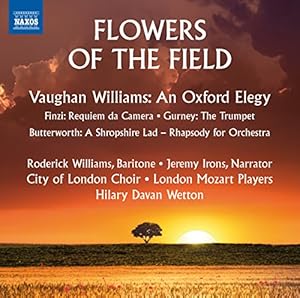
Flowers of the Field - Gurney Finzi Butterworth RVW

"As for man, his days are like grass; As a flower of the field, so he flourishes", so goes Psalm 103. This new recording, Flowers of the Field  connects composers affected by the 1914-1918 war, but it's real significance lies in its featuring the world premiere recording of Ivor Gurney's The Trumpet and of Gerald Finzi's Requiem de Camera. 

Ivor Gurney was gassed at Passchendaele, and spent the last 20 years of his life in and out of mental  hospitals. The Trumpet was written in 1921 but remained unpublished and unperformed until 2007. Here we hear the edition reconstructed by Gurney scholar Philip Lancaster with full orchestration, which received its Three Choirs Festival premiere in 2010, which I was privileged to attend.  Read Philip Lancaster on the genesis of the piece HERE.  Gurney used a poem by Edward Thomas, killed in Arras in 1917, whose work he had set previously. The song begins with a resolute "Rise up! Rise up!", the City of London choir singing as one voice with forceful attack. It's a curious poem. Does the trumpet  refer to the trumpet of modern battle or to the trumpet that marks the beginning of the End of Time in the book of Revelation? Gurney emphasizes the word "Scatters" in the phrase "as the trumpet blowing scatters the dreams of Man".  Unlit stars, dew and the traces of lovers must be scattered in this strange new dawn. Percussion pounds, and the full orchestra surges. The choir cries out, unequivocally "Scatter it, Scatter it!". The clarity of the setting reflects the image of  "that clear horn"  and "the air that has washed  the eyes of the stars". No maudlin sentimentality here, but clear-sighted fervour. "Arise! Arise!" the choir sings. After Armageddon, the past will be erased, the dead will rise from their graves in a new era of hope.

Strictly speaking, the premiere recording of Gerald Finzi's Requiem de Camera was conducted by Richard Hickox nearly ten years ago, but in a different  performing edition by Philip Thomas, made in 1990. This version is edited and completed by Christian Alexander. Hilary Davan Wetton conducts the London Mozart Players with idiomatic depth.  The Reqiuem de Camera (1924) is an ambitious piece in  four sections. An orchestral prelude leads to an extended choral setting of a poem by John Masefield  "How still this quiet cornfield is tonight". The text doesn't explicitly mention context, but the original poem was titled August 1914. Although this is very early Finzi, we can already hear how he would go on to be influenced by images of English landscape and history, and the passage of time.  Wetton, who has conducted a great deal of English choral music, gets the City of London Choir to sing with nicely hushed tones: silence is of the essence.  The same mood of timelessness prevails in the section for baritone (Roderick Williams) and orchestra: "Only a man harrowing clods".  Finzi dedicated the work to Ernest Farrar, his tutor, who was killed on the Somme in 1918, but I think it's a mistake to overstate the idea that the Requiem connects musically to Butterworth or to Gurney (whom Finzi championed). It is far more relevant to assess its relevance to Finzi's own later work, and to his songs and choral pieces. It's not as sophisticated as Intimations of Immortality, but contains, in germ, the spirit of Finzi's future greatness.

On this disc we can hear Butterworth's A Shropshire Lad – Rhapsody for Orchestra and, more of a rarity, the complete Ralph Vaughan Williams An Oxford Elegy, with Jeremy Irons as narrator. The Oxford Elegy is based on a poem by Matthew Arnold about a scholar who runs away to learn from gypsies.  He could be any man who disdains academia for real life experience: I don't think we should make too much of its connection to Oxonians who went to war, since it was written 1946-9 in the wake of a much more gruesome war.  Oddly enough, its connection to George Butterworth isn't mentioned in the booklet notes, a surprising omission in a compilation based on 1914-18. Butterworth and Vaughan Williams were so close that RVW might have not developed as he did without the influence of Butterworth, who pushed RVW creatively, and for whom RVW dedicated his Symphony no 2 "London" in 1913.

Please see my numerous other posts on Gurney, Finzi, Butterworth and RVW (use labels below)

Monday, 4 August 2014

Ivor Gurney War Elegy Prom 20

Will Ivor Gurney at last receive the recognition he is due? His War Elegy received its Prom premiere at BBC Prom 20. Gurney's poetry is so well known that it's even taught in schools. so you'd expect that there might be a ripple of interest in the print media. Did millions die to make the world a safer place for Kiss Me Kate and War Horse?

Gurney's War Elegy is fascinating because it moves as a processional. The music seems to approach from a distance. Long, surging lines suggest  forward thrust, percussion pounding like a savage metronome. How grand those long lines seem, and yet so sad. They give way to a more contemplative mood. A solo woodwind plays an elusive melody that soars upwards until it merges with the strings in a new, fuller theme which itself ends when the horns enter. Darker undercurrents make their presence: basses and cellos pick up the "march" the prercussion had earlier defined. Yet again, the full orchestra leads forwards, trumpets and horns in command. Gurney's very structure incorporates  relentless forward movement. Wave after wave, tutti and spareness. Eventually the music rises to a grand crescendo, but cut through with sharp brass calls.: not quite disssonant but enough to dispel comfort. Perhaps this is the heart of the piece, where Gurney is making his point. Soon after, the music recedes, as if those who marched past us for a moment have vanished, pulled away beyond our hearing.

Gurney was only 30 years old when he wrote the War Elegy, yet it is a singular advance on what he'd written before. He's best known for his song settings, so one might ask:   "What Gurney orchestral music?"  as Ian Venables prefaced his talk at the Three Choirs Festival in 2010.  (more here).  In the disruptions of Gurney's life, unpublished manuscripts went missing. Fragments remain, though, and now the Gurney Archive at Gloucester is being carefully mined by Venables (himself a composer), and Philip Lancaster. It's now known that Gurney wrote quite a bit, including two symphonies, and even planned an opera based on  J M Synge's Riders to the Sea, whose theme is also the relentless progression of death.  Read more here about how Venables and Lancaster worked on Gurney's War Elegy.

Gurney's A Gloucestershire Rhapsody and the War Elegy were written around the same time, and completed in 1921, but the War Elegy is much more sophisticated as music, and much more emotionally charged. What might Gurney have heard if he hadn't been incarcerated during the later 1920s and 1930s when so much was happening in musical Europe? His was an original mind, not necessarily one to follow safe convention. I've been listening to Gurney's War Elegy repeatedly (link here) because on the night of the Prom I was in Worcester for the Three Choirs Festival (more here). Just as well. At home I can cry quietly for what we lost in the tragedy of Gurney's life.

Martyn Brabbins conducted the BBC SO. He conducted the Philharmonia in 2010, so he's a bit of a Gurney maven. Prom 20 also included Sally Beamish's The Singing (2006)  a concerto for accordion, played by dedicatee James Crabb. Accordions and bagpipes operate in the same way, but bagpipes make savage music. Crabbe's accordion playing beautifully evokes the horror of the Highland Clearances, ethnic cleansing in the British Isles, not really so long ago. For an encore, he played a transcription of a Rameau piece for harpsichord. Accordions are much under-rated.

Brabbins also conducted William Walton's Symphony no 1. Nice performance, without the turgid shallowness that has put me off the piece for years.