Showing posts with label Africa. Show all posts

Sunday, 22 March 2020

Prince Nico Mbarga and his Sweet Mother

A few years back  someone did a "life satisfaction" survey and Nigeria came out tops. Despite the poverty and disorder !  People chase material wealth but where do real values come from ?  Back in 1976 Price Nico Mbarga wrote Aki Special, an instant hit fusing  West African music from the time with traditional styles. His introduction expresses things which might explain how some people retain good values despite the chaos of  the world around them.

"This life is wonderful, but don't be proud because you have it, it comes from God" (ie fate)  "Almighty" he sings after a short pause "Pickin-o good-o, if you get, if you no gettem.... . "Money is good-o, money good-o, we know, if you get, but don't laugh, many people no get's...but if you no gets, make you no cry, first time is the best. Opportunity comes but once in this world. Who knows tomorrow, my friend? Nobody knows tomorrow...."

Prince Nico Mbarga (1950-1997) didn't make any money from his hits, not even from his Sweet Mother the all-time iconic African classic because the business model there is different.  Though records sell, they;re often pirated copies and artists don't necessaruily get royalties. Sweet Mother was played everywhere and adapted naturally into many cultures, since it captures the spirit of women who keep society going, no matter what. Strong women suffer, but they aren't selfish.  For sure women are oppressed and don't have equal opportunities, but their values keep the world going. In Africa, women do everytrhing - farming,  business, child care etc  and still somehow they carry on.  Prince Nico didn't live cocooned in luxury. Born in Ikom in Nigeria, he lived in Cameroon, where his father came from, at 17 was forced to leave start all over again in Nigeria, where his mother came from.  He stayed in Ikom more  or less permannetly, not being a model husband or father, but middle class western values do not apply to everyone.  At the age of 47, he was killed in a motorcycle accident.

Sweet Mother begins with a swanky guitar riff - very 70's ! - but the words are down home  traditional.  "Sweet Mother, I never forget you, the way you suffer for me - yeah, yeah. When I get get cry, my mother go carry me, she says, my pickin-o, stop, stop, so you no cry again-o".  "You can get another wife, you can get another husband, you cannot get another Mother, so "

A friend said. "Pickin-o means child in West African pidgin, and may come from the Portuguese pequeno. Prince Nico was very family oriented, so to him having children was maybe more valuable than having money."

 
Please read Sami Kent's article HERE,which is by far the best researched and informative of all, written by someone whose perspective is not western but African, which makes all the difference. 

Monday, 6 March 2017

Secret History : The Ghana Freedom Song

Ghana Freedom is a cult song, known to most Ghanaians under the age of 60 through the recording by E T Mensah made for Ghana's independence in 1957. The tune is irrepressible, but the story behind it is even more irrepressible than most  realize. This is a scoop for African history!  In 1977, one of the regular readers of this blog unearthed papers in Colonial Office Archive to explain the mystery.

He found a clipping from The Morning Telegraph, a Sekondi newspaper, dated 5 February 1952, which states "As an expression of solidarity between Africans of the Gold Coast and people of African descent in the West Indies, Trinidad calypso singers, headed by George Browne have composed a calypso called Freedom for Africa. The new dance song is dedicated to the Honourable Dr Kwame Nkrumah, Prime Minister and Chairman of the Convention People's Party, popularly known as the CPP" ..... "the background music is provided by African drums  played by two Gold Coast Natives, Alfred Payne of Accra and Kofi Mensah of Cape Coast. The calypso has an attractive tune and should be popular among dancers as well as among supporters of the CPP". Here are four of the eight verses::


From his Ussherfort Cell, where they bolted the doors so well,
Nkrumah made his clarion call, and the people voted him one and all.

Chorus : Freedom, freedom is in the land, Friends, let us shout, Long live the CPP! Which now controls Africa's destiny. 

They called us all the verandah boys, they thought we were just a bunch of toys, But we won the right to vote at midnight hour, came out of jail and took power.

With Appiah  the ambassador, Casely Hayford the barrister, 
these two gentlemen did quite well, they got us out of the jailhouse cell.

The British MP Gammans was rude, by his dog in the mangerish attitude, 
But like the ostrich we know that man can go bury his head in the sand

Apparently several thousand records of the song were to be made and shipped to Africa, but the Colonial Office probably wasn't pleased. In those days, The Crown Agents held a monopoly of all government business and locals weren't supposed to act independently. So if a colony grew cotton, it had to buy cotton textiles from Manchester, via the CA.  In a minute preserved in CO554/595 dated 5th January 1952, officials are discussing the activities of men like "Mr Appiah of WASU" (Joe Appiah of the West African Students Union).  Making mass copies of a recording which criticized the government would not go down well. No-one really knows what happened to the first pressing of Ghana Freedom, but quiet words may have been said in London, where the master tapes were. Colonialism was sinister and pernicious, even though there were many good idealists, like Selwyn Selwyn-Clarke and Stafford Cripps whose daughter Peggy married Appiah. Their son Kwame Anthony Appiah was professor of philosophy at Princeton and now has a chair at New York University.

The recording is "lost" as far as can be ascertained. Maybe someone has a copy somewhere? George Browne, aka Young Tiger, was also quite a character- here's his obit.

Fortunately, E T Mensah took up the cause. His song Ghana Freedom is the unofficial national anthem, even sixty years later. So the words "Toil of the brave and the sweat of their labours, they have brought results"remind us that independence wasn't an act of kindness on the part of the British.  Africans, Indians, Pakistanis and Malays died in order that the idea of freedom would be recognized. Democracy is a responsibility we must honour. Don't take it for granted ! It is not a game.

ET was a qualified pharmacist who worked for the government by day and had a huge career in hilife music at night. As he rose higher, he played less until his retirement, when he went back to hi life. In the months before his death, he was interviewed on TV about the events of 1957. He was then old and sick, but still he remembered the words to the song. 

We are "all" Ghana when we celebrate freedom. Nkrumah's government collapsed: Chaos often follows independence, especially where democracy has been so long suppressed that people don't  know how to deal with it. But the principle stands : all people have the right to self determination. These days we're facing a retreat from the very concept of democracy, when electors place their faith in demagogues. Extremism is not democracy. Real democracy comes when people take their rights seriously enough to think, evaluate and question. So democracy isn't "orderly" ? Consider the alternative.


Saturday, 9 August 2014

The Forgotten Soldiers of Empire


If you do only one thing to remember the First World War do this : watch David Olusoga's powerful documentary Martial Races on BBC i-player (link here)  This opens up a whole new dimensions which many British people know nothing about. We're never going to appreciate the magnitude of 1914-1918 until we appreciate its world-wide significance.

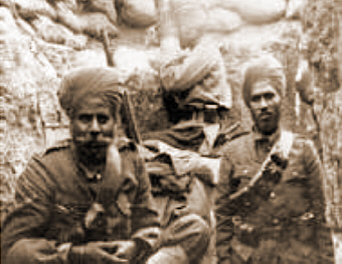
Did Empire save Britain and France? Could they have won the war without using colonial nations?  A million African, Indian, Black American and Chinese people took part, some fighting front line in the trenches, others supplying the back-up labour without which no army can survive. Hundreds of thousands died, and each man left behind a family and a community. These men didn't march off to war cheering. They were not volunteers, but men trapped by circumstances. In Africa and Asia, people were so poor that men would join up from sheer desperation.  Many of the Africans were rounded up by agents and chained. Slaves, not jolly volunteers fighting for a cause.

These men were simple peasants who didn't know much past their own villages, far less about the world. Thousands had never worn shoes in their lives. Suddenly they had to wear heavy, ill-fitting army boots and live in damp trenches.Nowadays even in remote areas people have TV, internet and mobile phones, even a smattering of education. A hundred years ago, these peasants might as well have been rocketed into space, so alien was the environment they found themselves in. Even now there are dozens of different language groups in Africa and Asia. A hundred years ago men from diffrerent villages might not speak the same dialect. Suddenly they're all thrown together, with hardly anyonen to talk to.

The concept of  "Lesser breeds" underpinned Imperialist thinking. The West didn't colonialize for love. Social change and modernization were side effects, not goals. Olusoga reads from British Army records which describe the different communities of the Indian subcontinent as if they were breeds of dogs or horses. Unpleasant as these things are, we need to acknowledge them if we're  to move on.

1914-1918 was a world war, with global causes and global consequences. It came about in many ways as a continuation of colonial rivalry. The British and the French grabbed colonies first, excluding the Germans, Japanese and Americans.  1914-18 didn't happen because some Serb shot an archduke. In the Middle East, the Germans (and their allies the Turks) were struggling with the Russians and British for control of oil fields. Then, as now. And so the British and French used their "resources" in the form of human fodder.

Olusoga's documentary is meticulously well researched and presented. This is the kind of exceptional high quality that the BBC was once known for. Most of this material is well documented in academic circles, but there's  material here that's never been seen in public before. Olusoga makes it human and personal.  To understand our present we need to understand our past. This series is very, very important.

Thursday, 5 December 2013

Monday, 4 June 2012

The Mighty Fontonfrom

From my friendly West African music buff reader here is a clip of The Mighty Fontonfrom - large drums used by royal courts in Akan-speaking Ghana. This clip shows the funeral of an important king.You might also like King Bruce welcoming Queen Elizabeth to Ghana in 1959, Adventures with a balafon and Ewe drumming.

Sunday, 3 June 2012

5 million Ghanaians will go gay

"This is the day, 5 million Ghanaians will go gay. Queen Elizabeth and Prince Philip will be here that special day. We'll drink and dance the whole day and put on kente fine [Ghanaian woven cloth] on that Thursday 12th November 1959."

Chorus : "May God bless this fine Thursday, when all Ghana will go gay. Elizabeth we love you, akwaba wa wa too [Ashanti welcome] "

"Seven long years we waited since Co-ro-na-tion, to Canada and then Nigeria, she brought jubilation. Now hear the drummers thumping on the mighty fontonfrom, the Queen has come at last to Ghana from United Kingdom,"

"With one accord we welcome you to Ghana. The people are rejoicing, from  Axim to Bolgatanga. From our leader Dr Nkrumah to the lowest in the land We all join this song of love, we know you'll understand. "

The song is by King Bruce and The Black Beats, a big Ghanaian highlife band. King Bruce (1922-98) was well educated and spent several years in London, returning to Ghana where he became a senior civil servant. John Collins, an authority on West African music (who also plays in highlife bands) interviewed King Bruce about his dual careers.

"At first the opposition from my employers came in hints. Then in 1967 the opposition came in black and white as a result of a letter I received from the government. It was from the head of the Administrative Civil Service and they told me that I had now got to the stage where I was due for promotion from assistant to full principal secretary and that the only thing that stood in my way was my dance band playing. So I had to decide whether to continue playing or accept promotion. I replied that I had commitments to play up to Easter 1968, but that from April and thereafter I would comply with the undertaking and wouldn't play in public anymore. .....I was very much annoyed because I had always believed that it was the actual playing in a band that sharpens your faculties and brings new ideas. When you sit down doing nothing you don't create new music. So the ban on my playing hurt me very much as I had to sacrifice a lot to play music and had always wanted to pursue it and make something out of it." 


Thursday, 26 April 2012

Si j'etais blanche

"I'd like to be white. It would give me such joy if my breasts and thighs changed colour". Listen to the full song HERE. Immediately, Josephine Baker gets to the nub of what white folks thought of blacks.  Read this excellent analysis of the song by Anna Biller here. Even the dolls little girls play with enforce the idea that white is the only way to be. "Et je disais à l’air accablé, me croyant toute seule brune au monde". But as Anna Biller points out, the girl in the song subtly turns things round in her own favour

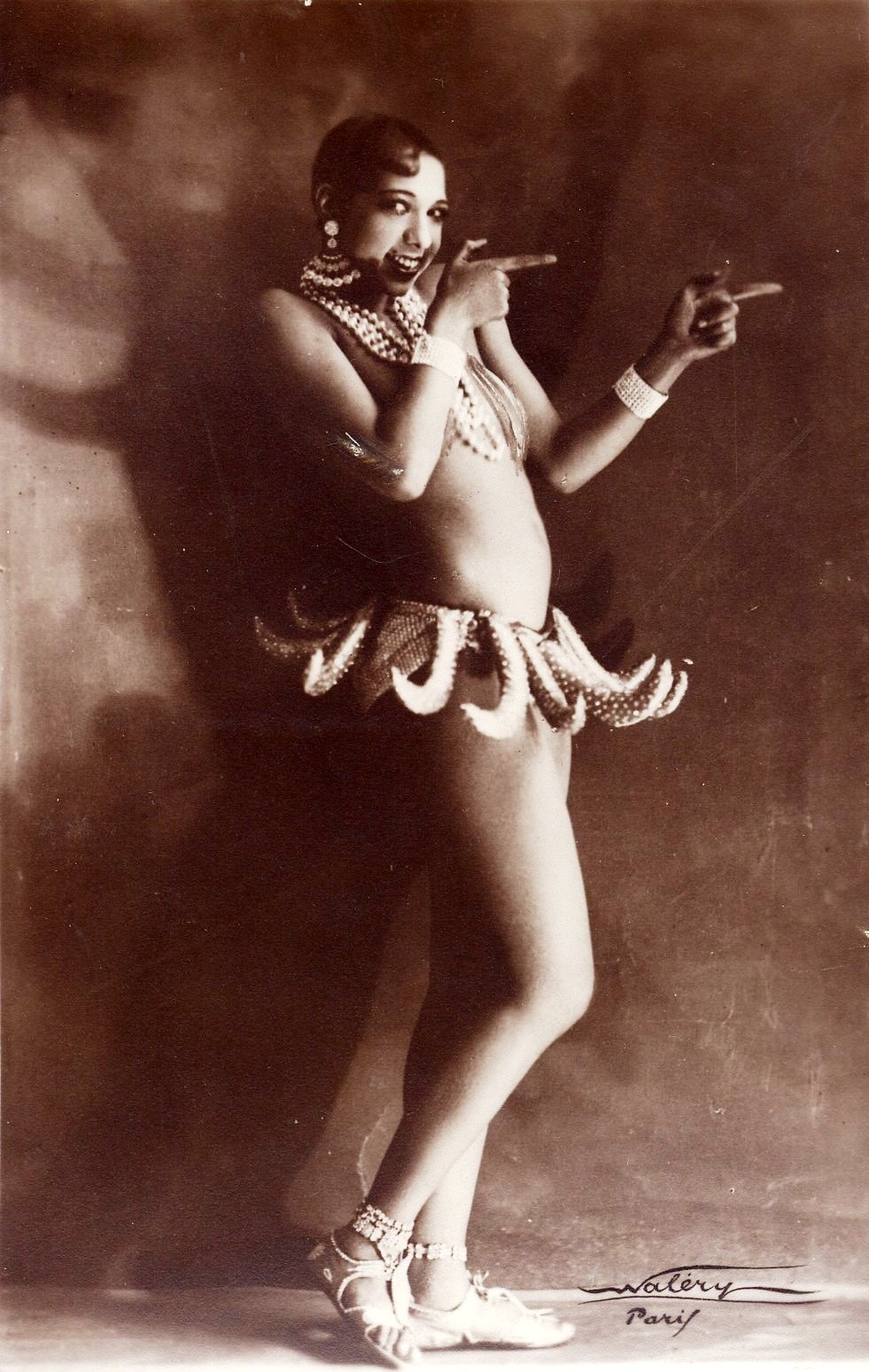
Josephine Baker confronted assumptions about race, class and orientation. In the photo, she's wearing her famous banana outfit which of course moved tantalizingly as she danced. Note the fingers pointing and the banana imagery! The show was set in a fake jungle, a metaphor for the Dark Continent where forbidden, erotic things happen, and white people don't really rule. What a frisson fancy Paris society would have felt as she gyrated on stage while they sat, "civilized" in starched tight collars.

Josephine Baker was part of the cultural revolution that reached Europe from the mid 19th century. Diaghilev and the Ballet Russes, Pierre Loti, the  Impressionists, Debussy, Ravel, Picasso and his friends collecting African art.  (British colonialism was very different). Non-western cultures showed Europeans that other forms of experience were valid. Without non-western cultures, the west might not have become "modern". The whole imperialist world model we're supposed to follow is upside down.

There's perhaps more on this site than most elsewhere on the dialogue between western and non western cultures. Lots on non western culture and on cross-culture issues and stereotypes, particularly as expressed in music and early film). For example, see this, a proper Cantonese opera but a satire on Viennese operetta !

Below is Josephine Baker dancing in 1927. So energetic, so angular, nothing like the way white women danced then. Nor like black American women either, I suspect, who were finding their own way ahead (see my post on Within Our Gates ). But the spirit of the Jazz Age freed up inhibitions and let people express themselves in new ways.  It's no coincidence that the best book about Josephine Baker was written by Patrick O'Connor, the music critic whose speciality was French music and opera. He was too secure to need to sneer at crossover. How the horizons of music writing have narrowed since he's been gone. (read more about him here).

Friday, 2 December 2011

Aki, nobody knows tomorrow - Prince Nico Mbarga

A few years back  someone did a "life satisfaction" survey and Nigeria came out tops. Despite the poverty and disorder !  People chase material wealth but where do real values comre from ?  Here's  a classic from Nigeria from 1976.

"This life is wonderful, but don't be proud because you have it, it comes from God" (ie fate)  "Almighty" he sings after a short pause "Pickin-o good-o, if you get, if you no gettem.... . "Money is good-o, money good-o, we know, if you get, but don't laugh, many people no get's...but if you no gets, make you no cry, first time is the best. Opportunity comes but once in this world. Who knows tomorrow, my friend? Nobody knows tomorrow...."


Prince Nico Mbarga (1950-1997) also wrote Sweet Mother the all-time iconic African classic.  But he didn't make money from it.  In  Africa, that song was played everywhere and adapted naturally into the culture, since it celebrates the central values of motherly love. Strong women, who suffer, but give everything for  their children. Ordinary people, not the values of corporate greed.  Prince Nico didn't live cocooned in luxury. Born in Ikom in Nigeria, he lived in Cameroon, where his father came from, at 17 was forced to leave start all over again in Nigeria, where his mother came from. age3d only 47, he was killed in a motorcycle accident.  When I originally wrote this post in 2011, I didn't know much about him except what I learned from a good friend and regular reader who's familiar with West Africa and West African music. He explained at the time what the words in Sweet Mother mean. "Pickin-o means child in West African slang, and may come from the Portuguese pequeno. Prince Nico was very family oriented, so to him having children was maybe more valuable than having money." One really freaky thing is that my father's family nickname was Pepino, an adaptation of that same word, tho' my dad had no connections to Africa. A shared universal culture, where some values are greater than material power ?

Since I first wrore this post, much more new information from Sami Kent who,in 2017 visited Ikom in Nigeria,where Prince Nico was born and where his people still live. It's wonderul read, with plenty of background, so please visit the site !

Tuesday, 18 October 2011

Mixed Britannia BBC


This song makes me weep. It's so specific that it seems like it's about a real woman. She's half African, half Norwegian, went to Cambridge, acculturates white. But her feelings do not count.  She can "can never get away from the fact, if you're not white you're considered black". It's a calypso by Lord Kitchener, from around 1950 when mixed race was much less common than now. The man assumes the woman is acting superior because she doesn't fancy him. Years later when Lord Kitchener sang the song in Jamaica, he made it even more sexist, as if the woman was doing a crime for choosing not to sleep with him. At least calypso songs deal with race issues openly. But why should any woman, or any person, be defined by race?

Currently there are several programmes on the BBC about race issues. George Alagiah's Mixed Britannia must have taken ages to make because it's extremely well researched and outstandingly well made.They've uncovered completely new material, which has lain unnoticed in the archives and needs to be publiicized. Like the "Eugenics" movement which tried pseudo-scientific measurements of "mongrels" as mixed race people were called in those days. Someone must have realized where such things led, as they were quietly phased out after the Nuremberg race laws in Germany.

That didn't stop vindictive racism. As soon a WWII ended some bright spark had the notion of rounding up Chinese in Liverpool and shipping them back to China. The men were rounded up in the street, like animals,  and put on board a waiting ship. Many of the men werre long established UK residents, and had wives and families, but weren't allowed to make contact, or collect their belongings and papers. So hundreds of women and around 1000 children thought they'd been suddenly deserted, and never found out what happened..

If the men did make it back to China (they may have been dumped in India), the country was still in chaos, millions of refugees, destitute and homeless. Ironically many of these men would have worked for the British navy and merchant navy, where thousands of Chinese were enrolled, a huge proportion killed serving the British war effort.

Fortunately most normal people are sane. But racism is alive and well, for too many have vested interests in fuelling hate. The recent riots showed just how skewed assumptions really are.  Far Right white gangs attacked the police, immigrants gave their lives to defend their neighbourhoods, and  looters were most colours and classes. So programmes like Mixed Britannia are vitally important, to remind us that race is packaging, it isn't the person within. 

Please also see my posts on race issues, under labels like Africa, Chinese stereotypes, social issues etc. Watch the full movie Within Our Gates here too, the earliest known movie by a Black American that confronts things like lynching and exploitation. Also full download of Broken Blossoms, and a critique of Piccadilly, the Anna May Wong film much lauded by the BFI as progressive. The more I think about that film, the more offensive I think it is, but its appeal to Chinese outside Chinese culture is genuine, and needs to be analysed. You might also like this piece on Ghana Freedom, which mentions George Appiah, whose marriage to Stafford Cripps's daughter Peggy features in the second Mixed Britannia episode. Theirs wasn't the first high profile mixed marraige. My mole in FCO archives told me about the Govt of South Africa protesting mixed marriage in Britain, threatening to quit the Commonwealth. There are thousands of other stories waiting to be told. Like, a Colonial Police Officer held prisoner in a Japanese camp wants to marry. Under colonial rules he needs his commanding officers' approval.  They're all prisoners in the Japanese camp too but they forbid the marriage because the fiancee can't prove she has no mixed blood. Of course she can't. She's Eurasian. This is April 1945, right at the end of the war, but these colonials don't twig that the world's changed. Imagine what the Japanese thought. (and the irony still rankles with non whites today)

Friday, 24 June 2011

Madam Butterfly in real life.

Strictly speaking, Madam Butterfly isn't "about" Japan. Japan is an exotic context, building upon Europe's fascination with things oriental. This fascination with alternatives to mainstrean western culture had a huge impact on the development of western music and art. To Puccini's credit, he took the trouble to find out as much as he could about Japan even though there are things in the opera which aren't historically accurate. It tells little more about real Japanese society than Gilbert and Sullivan. The important thing is that Puccini is psycholgically accurate.

Moreover, Puccini picks up on the basic premise of imperialism that that some cultures are "superior" and have a right to exploit others. Lt. Pinkerton is the ultimate colonialist. For him, the east gives him the freedom to behave in a way he wouldn't dare at home. Ther locals don't matter, nor their culture. They exist for his own use, not as themselves. In the end he takes Butterfly's child, denying her her one comfort and identity as a mother, and foisting a perpetual reminder onto his new wife that she wasn't the mother of his first child. Sexist creep. Few, however, question the assumption that the child might be better off in America. But the fact is that the US was a racist society. Ask blacks and Native Americans. Orientals were seen as The Yellow Peril, almost as non-humans, and a threat to white values. In parts of Canada and the US, intermarriage was forbidden by law. Mixed race kids didn't fit in. So the idea that Pinkerton is somehow redeeming himself isn't true. He's an imperialist who thinks that non-white cultures are inherently inferior, so taking the kid is a further insult.  Any cross culture adoption is fraught with issues, but a man as insentive as Pinkerton will probably never learn. He's even more of blind bigot than the opera portrays.

Non-western cultures were a lot more enlightened than the Pinkertons of this world then and now realize. The Japanese, for example, absorbed change readily. Much of Japanese culture stemmed from China. In the 16th century, hundreds of thousands converted to Christianity. It wassn't just the introduction of Portuguese guns and cannon that interested them. Then the revolution of the Meiji, when Japan transformed from feudal to modern within a few years. The Japanese even adopted colonialism, assuming that if the west could demand concessions from China, so could they. They were nearer, after all, and needed the natural resoures. One of the ironies of the Second World War is that it took the Japanese invasion to end western control of China. Obviously core values don't change but Japanese culture's a lot more adaptive than many.

But not all colonials were Pinkertons. British India isn't typical because British society was exported wholesale. Prior to the arrival of Memsahibs and the High Raj, people mixed. Millions of Madam Butterfly situations that weren't necessarily exploitive, as the number of Anglo-Indians and Luso-Indians indicate. People are people ! From the shores of Africa to the shores of Japan, hundreds of mixed race communities, which developed their own identity and sub-culture. First-generation mixed race had something to turn to, even if it was never easy being different. (that's why anyone who mknows Asia will know there was never, ever an ur-Butterfly).

A while back, there was TV documentary in which a British actor traced his origins. He'd assumed his ancestress in what is now Ghana, was exploited, but it turned out that she was a prosperous businesswoman who'd had a family with a Dutchman. He didn't abandon her and left money in his will to his children. Millions more stories like that, all over Asia and Africa. As one Eurasian super achiever told me, "We have to try harder because we have to prove ourselves". Fundamentally, it's just not true that mixed race situations are prostitution arrangements doomed to failure. That's "colonial thinking" implcitly assuming the inferiority of "lesser breeds" (as they were actually called once) . Obviously there were horrible things, because that's the way the world is. But the idea that non-whites are vaguely inferior, persists. Even now mixed race communities are dismissed by those who think in simplistic black and white terms (sic). It's a throwback to colonial racism, even if it's completely unconscious. Mixed race sub cultures are  important because they show the way ahead in a world that's becoming increasingly mixed. Trouble is, they're not studied properly because they don't fit easy classification.

Click on photo to enlarge. Plenty more on this site about cross culture, yellowface, Japan, mixed culture and stereotypes.

Friday, 10 June 2011

The secret history of the Ghana Freedom Song

Ghana Freedom is a cult song, known to most Ghanaians under the age of 60 through the recording by E T Mensah made for Ghana's independence in 1957. The tune is irrepressible, but the story behind it is even more irrepressible than most  realize. This is a scoop for African history!  In 1977, one of the regular readers of this blog unearthed papers in Colonial Office Archive to explain the mystery.

He found a clipping from The Morning Telegraph, a Sekondi newspaper, dated 5 February 1952, which states "As an expression of solidarity between Africans of the Gold Coast and people of African descent in the West Indies, Trinidad calypso singers, headed by George Browne have composed a calypso called Freedom for Africa. The new dance song is dedicated to the Honourable Dr Kwame Nkrumah, Prime Minister and Chairman of the Convention People's Party, popularly known as the CPP" ..... "the background music is provided by African drums  played by two Gold Coast Natives, Alfred Payne of Accra and Kofi Mensah of Cape Coast. The calypso has an attractive tune and should be popular among dancers as well as among supporters of the CPP". Here are four of the eight verses::


From his Ussherfort Cell, where they bolted the doors so well,
Nkrumah made his clarion call, and the people voted him one and all.

Chorus : Freedom, freedom is in the land, Friends, let us shout, Long live the CPP! Which now controls Africa's destiny. 

They called us all the verandah boys, they thought we were just a bunch of toys, But we won the right to vote at midnight hour, came out of jail and took power.

With Appiah  the ambassador, Casely Hayford the barrister, 
these two gentlemen did quite well, they got us out of the jailhouse cell.

The British MP Gammans was rude, by his dog in the mangerish attitude, 
But like the ostrich we know that man can go bury his head in the sand

Apparently several thousand records of the song were to be made and shipped to Africa, but the Colonial Office probably wasn't pleased. In those days, The Crown Agents held a monopoly of all government business and locals weren't supposed to act independently. So if a colony grew cotton, it had to buy cotton textiles from Manchester, via the CA.  In a minute preserved in CO554/595 dated 5th January 1952, officials are discussing the activities of men like "Mr Appiah of WASU" (Joe Appiah of the West African Students Union).  Making mass copies of a recording which criticized the government would not go down well. No-one really knows what happened to the first pressing of Ghana Freedom, but quiet words may have been said in London, where the master tapes were. Colonialism was sinister and pernicious, even though there were many good idealists, like Selwyn Selwyn-Clarke and Stafford Cripps whose daughter Peggy married Appiah. Their son Kwame Anthony Appiah is professor of philosophy at Princeton.

The recording is "lost" as far as can be ascertained. Maybe someone has a copy somewhere? George Browne, aka Young Tiger, was also quite a character- here's his obit.  E T Mensah, who made the recording that filled the gap left by Young Tiger's song, is even more fascinating. He was a qualified pharmacist who worked for the government by day and had a huge career in hilife music at night.


Saturday, 30 October 2010

Son of Ingagi full download


A  different movie for Halloween! All black production, scripted and conceived by songwriter Spencer Williams (1889-1965). Hence the snappy dialogue, especially in the scenes where Nelson the Attorney (played by Williams himself) tussles with Dr Jackson ("Hello my friend!" "You're not my friend, you're my lawyer!") and processes the old lady's will for 5 dollars.

Because US cinemas were segregated, there was a whole specialist market for black films. Williams was sharp enough to know that black people wanted horror movies like anyone else. And why should explorers in Africa be a white monopoly? Hence too the positive images of black professional people, police chiefs etc. and the aspirational young couple, Robert and Eleanor Lindsay.

And indeed the central character Dr. Jackson (Laura Bowman) who is a doctor of science and has been to Africa. She also happens to have a lab in her dining room where she mixes up a test tube with a formula that will do good for humanity. "Not that humanity's been good to me", she snaps. She wears Victorian clothes and has "never been in a motor vehicle and won't start now" which may date her to be about 80 in 1940. Anyway, she knew Eleanor Lindsay's natural father who was younger than she, but whom she loved and lost. She did medical work in Africa, and brought back treasures from her many travels, such as a gong from Singapore which she uses to summon up another memento, a gigantic ape man who lives in a secret cellar.

He's N'gina, son of Ingagi, whoever he may have been. Possibly he's half man, half gorilla, which makes you wonder why Dr Jackson's so maternal to him?  Dr Jackson's rich, too, and has gold hidden in the house.

The gold brings out the crooks, including Dr Jackson's conman brother Zeno and Lawyer Nelson, who tries to con the couple out of the house Dr Jackson left them when she died.  Then the plot turns to comedy as the dopey Detective Bradshaw is assigned to stay in the house while murders happen and an apeman wanders about about. Hilarious! Bradshaw is a parody of the venal Stepin Fetchit fool who usually represented blacks in white media. Of course he's a crook too, but an opportunist, who hands the sacks of gold to the Jacksons. "Oh", they cry as their house burns down. "There goes our furniture, our clothes!" When they get the sacks of gold, they cry "Furniture! Clothes! New House!"

This film was made quickly and to a budget, so it's certainly not great art. But it's sharper than the average B movie, given its background. Spencer Williams was an all-round talent, who wrote hits like Basin Street Blues and settled in London. Good businessman too, spotting the market for race movies. Director credited is Richard Kahn and producer is Alfred Sack of Sack Studios. Presumable white and Jewish financiers? Williams's racy spirit pervades much of the film. Enjoy the song sequences by The Toppers, a guitar and falsetto-led group. Ironically I think the only white guy actually in the film is N'gina the mixed species from Africa. Men over seven feet tall are treasured whatever their race.

Movies like this contrast with the films Paul Robeson starred in. They had higher production values and bigger budgets, but Robeson was typecast to represent what white people expected blacks to be. At best noble but doomed and never equal. Race films, and the race music recording industry were a form of apartheid but at least with Williams we can glimpse something irreverent and irrepressible.

Friday, 9 April 2010

More Africa at the British Museum

 The Ife Bronzes at the Kingdom of Ife exhibition (read here and here) is fantastic - get to it, even if you don't normally do visual art. It's important because it shows a completely different way of thinking about art history and cultures. It inspired my friend who loves Africa to take me to the regular British Museum African gallery.

Africa is a huge place with many completely different cultures, so squeezing its art into one small gallery is a bit frustrating. Imagine if all European art, from Lapland to the Azores, from Iceland to Turkey, from prehistory to the present was all crammed together on one room. But that in itself shows how little the west understands non-western cultures.

Because Africa is so diverse, in theory it's not a bad idea to arrange the gallery on themes like textiles, woodwork, pottery etc, so you can see the range of different styles.  But it's a bit like a jumble sale. This exquisite ivory piece depicts a mother goddess. It was made in the great empire of Benin 500 years ago. photo credit It's odd to see her several feet from a mass-produced modern T shirt.

It's good to see "modern" nonetheless, because it shows that art thrives in modern cultures too. One striking exhibit is a chair made from guns. After the war in Mozambique ended, people were encouraged to exchange their guns for farm tools - swords into ploughshares. Because Africa isn't wealthy, people reuse things in inventive ways. So there's a "tree" made of metal and a video of how it came to be made. Once the Museum of Mankind (now sadly defunct) did a whole exhibition of African "recycling" showing how creative ordinary  people can be.

But it is frustrating if you want to find out more about the amazing wall of bronze plaques, each depicting vivid scenes.  They were obviously important to the people who made them as they're crafted with great skill and detail. There are about 1000 of them, and apparently they can be read as a saga, rather like an infinitely more sophisticated version of the Bayeux Tapestry. photo credit   Yet they're a mystery as no-one knows how to decipher their meaning. (Click on the photos to enlarge)

That's the paradox about museums. Because the public sees them as tourist attractions, they have to cater for everyone, and for mass taste, so they can't really do comprehensive or penetrating. Not long ago there was a protest about moving the V&A's musical instruments to the specialist Horniman Museum. While I've no time for the V&A's fad for trendiness, the point of museums is that they exist to protect the objects in their collections. Museums exist for research, conservation and education. What's on display is only ever the tiniest fragment of what exists. We may not know "now" what things are, but if they're not cared for they won't be around for someone to interpret in the future. And displays change all the time, which is why it's good to revisit museums regularly, not simply as tourists.

Thirty years ago I visited a huge exhibition about Benin at the Museum of Fine Arts in San Francisco. Nothing like it had been seen on that scale in the US before. It was magnificent, because Benin was magnificent. A whole bunch of schoolkids were being shown round. They came in antsy and fidgetty, because that museum wasn't the kind of place kids from the slums hang out.  Luckily, they had a good curator.  He explained what Benin was, and how much respect it was due. The kids were wonderstruck, their eyes wide  with amazement.  They walked into that exhibition as punks, but they walked out confident and happy.  Benin taught them that African culture and history is something we all can be proud of.

It's relevant for classical music, too. All this fuss about making it "accessible" implies that people are incapable of dealing with complex things. Those SF ghetto kids went to a serious, non-dumbe-down exhibition, and had no problem getting what it meant.

Friday, 12 March 2010

Kingdom of Ife : African sculpture at the British Museum

Kingdom of Ife: African Sculpture is currently on at the British Museum. Go - some of these figures have been brought over specially from Nigeria, where they're usually kept in pride of place as part of African heritage.

These sculptures easily compete artistically with anything in the west. They represent kings and gods, but, unlike Greek and Roman pieces, they present them in a strikingly intimate, human and individual way. Even Michelangelo marbles pale against them, for these are real people, not allegories. In comparison, even Renaissance marbles look prettified and indirect. Western artists focus on the beauty of the body : The Ife depict the beauty of the spirit. Perhaps that says something about the nature of kingship in Africa, perhaps not, but theses cultures are unique.

Ife figures are so realistic, that being with them is an eerie experience. You know they are inanimate objects, but you feel they could breathe, speak or move at any moment. How can we be sure that as we're watching them that they're not watching us?

No wonder they're reputed to have supernatural powers, like the seated man from Tada who was ceremonially taken and washed in the Niger. He's extremely famous, from photos. Live he seems surprisingly small, given his iconic reputation, but he's so intense, he seems superhuman.

The Kingdom of Ife started around 800, and still remains today. These sculptures date from 1100-1500. This was a sophisticated and prosperous nation. Technically these bronzes are so well made that there is nothing quite like them elsewhere. There are sculptures in bronze, copper, stone and terracotta, and smaller objects like votives, spear heads etc, showing that the bronze heads weren't a fluke, but came from a long tradition.

As design icons, they're amazing. For some unknown reason, many of the faces are striated vertically - nothing like scarification, but more elegant and stylized. These lines create a distance between the object and viewer but also accentuate the muscles and curves so they're even more tactile. The holes drilled in some heads may have been made so headresses and fake hair could be attached.


Look at the detail on the King in the photo. He's wearing elaborate symbols of royalty and wealth. Look at that neckplate, festooned with carnelian beads. Another kingly figure holds a horn which may have held medicinal potions. One of the women wears an elaborately woven headress, complete with jewels. These figures are meant to awe you with their regal presence. Yet the most moving are the simplest, depicting the ruler as an ordinary person, emanating serenity, calm, goodness.

Besides the amazing heads, there are other objects. Beautiful stools, for example, carved in a surprisingly modern free form. There's a flatfish of old granite, hardly carved at all. Yet in its simplicity and abstraction, it "feels" like a huge, lugubrious flatfish, lying in the river bed.

There is a lot to see in this exhibition, so take your time and make more than one visit. You'll come away with a completely different perspective on world art. Please read more
HERE. Please reads Waldemar Januszak HERE

Tuesday, 23 February 2010

British Museum - Ife African bronzes


On 4th March a new exhibition opens at the British Museum, Kingdom of Ife: sculptures from West Africa. Ife was a powerful nation that existed in what is now Nigeria 700 years ago. This culture produced bronze sculptures so beautiful and naturalistic that they seem alive. Indeed, their haunting authority has meant they were revered as icons by the Yoruba people.

The story of Ife is shrouded in mystery. There were several extremely advanced civilizations in Africa before the European era, quite unknown to the west, even now. Sculptures like these were made by people with sophisticated artistic values, technology and the means to invest in objects like these. As a small child I used to dream about the "lost kingdoms" of Africa, albeit seen through the distorted image of Rider Haggard and Tarzan comics. The reality of places like Ife, Benin, Zimbabwe, and Nubia is even more remarkable.

And if the story of Ife is amazing, so is the story of how these bronzes ended up in the British Museum. Looted from the Yoruba people by adventurers, real-life Indiana Jones. Even Wole Soyinka, who won the Nobel Prize, gets pulled into a smash and grab raid to return a stolen bronze to Africa. This exhibition should be exciting, an antidote to the omnipotence of the west. HERE is an extremely well written, inspiring article from the Financial Times. Great photos ! PLEASE note, there's another post on this subject HERE. Although this is a classical music site, it's got a lot on African culture and history (and other art exhibitions eg baroque art V&A)

Wednesday, 17 February 2010

Steve Reich, eat your heart out! Ewe drumming


Eat your heart out Steve Reich! These are ordinary village kids in Ghana just having fun. They are so young yet look how they respond to the music and how subtle and natural their gestures are. And with each plateau in the drumming, the kids pick up on the different rhythms. Then each set builds up to an elaborate, intricate dance, and then back to pairs again. Thank the Ewe people, from whom Steve Reich learned about drumming in the first place. Watch the baby who's already picking up the moves, though he's barely 2.

Sunday, 7 February 2010

Kinshasa Symphony premieres in Berlin


Le seul Orchestre Symphonique de RDC à Kinshasa
Uploaded by pollux91. - Watch more music videos, in HD!On 17th and 18th February, the film Kinshasa Symphony premieres at the Berlinale, the 60th Berlin International Film Festival. Hopefully that will give the documentary the publicity it deserves because it's a wonderful project. The film (by Claus Wischmann and Martin Baer) is subtitled "Symphonie im Grossstadt-Slum", which, if you've seen Berlin Sinfonie der Grossstadt, makes sense.

"Kinshasa Symphony" shows how people living in one of the most chaotic cities in the world have managed to forge one of the most complex systems of human cooperation ever invented: a symphony orchestra. It is a film about the Congo, about the people of Kinshasa and about music."

The Congo isn't a wealthy place. Basics westerners take for granted (like electricity) don't come easy, and life's a struggle. Yet these musicians are so dedicated that they find time to practise nearly every day. They make their own instruments! No one can justify a million pound Strad here. They also make their own uniforms and share scores with each other. Yet they persist. The Kinshasa Symphony is the only orchestra in central Africa. People in the west have no idea how tough life can be in other places. I can't say how much I admire these people for their dedication. We in the west could learn something from them about true values.

Please read about the project HERE. It's a good cause. I hope the news will be picked up in the western media and the film shown around the world. Please pass this clip on. These people deserve respect.

Thursday, 4 February 2010

Adventures with a Balafon


A balafon is a type of African xylophone. They come in all sizes. There are even huge "orchestral" versions played by three men together at one time. They're made from slats of wood cured and hardened for pitch, then strung together. Usually, large gourds are added below the slats for extra resonance. They're played with hammers. Here's a link to African Safari, a guide to African xylophone culture - several video and sound clips of different types.

Balafons and xylophones are common in central and west Africa, but this photo was taken in Johannesberg in the 1920's (look at the audience, click to enlarge for detail). The version in this photo is unusual because the instrument's been adapted so the man can play it lying down. Maybe he had a bad back. This instrument's small and portable so maybe he was a travelling musician.

Another story about balafons : Olivier Messiaen wanted to experiment with one in the late 1940's. He'd recently had the usual father-son scrap with Boulez, who, by way of making peace, tracked down a good balafon (quite a large one) and carried it across Paris and up into the organ loft at La Trinité. The source of this story is Pierre-Laurent Aimard who heard it first hand from Messiaen himself, who was thrilled and delighted.

African Xylophones from Adam Martyn on Vimeo.

Sunday, 20 December 2009

Paul Robeson in Africa Sanders of the River


This film, Sanders of the River, (Alexander Korda – can be viewed full screen) shows colonialism at work in Africa in the 1930's. Colonialism is when people from far away Know Better and can treat natives like stupid children. Even if the motives are benevolent, it's still demeaning. Colonies may no longer exist, but "colonial" values prevail, especially in an increasingly monocultural world dominated by anglophiles. It's not that people don't mean well, it's just they don't know much or care. Tourists who think foreign countries exist mainly as places to get blind drunk in are just one of many types of "new" colonialists. So, cringeworthy as this film is, it still stands as a warning.

Paul Robeson plays a feckless African who Sanders uses to placate the locals. It's embarrassing to see him being demeaned as a "coon". But Robeson didn't sell out. We can turn that embarrassment on itself, by seeing the film as a document of society as it was, not as it "should" be. If a proud, talented Rutgers man can be humiliated because he was black, we should feel indignant that he should have been forced to do such things. At least he gets top billing, above Leslie Banks as Sanders.

He's magnificent, anyway, and what a powerful booming voice - pity he didn't do Russian basso roles. Besides, he's a serious hunk. Look at his muscles, revealed by a leopard skin loincloth - complete with tail - and when he wiggles his behind! The songs are pastiche, but there's a lot of interesting "archive footage" asd the movie was shot in part on location in the Congo. The chiefs and members of the "Acholi, Sesi, Tefik [sic= Efik], Juruba {sic = Yoruba], Mendi and Kroo" nations of East and West Africa participated as extras. hence the vivid dance scenes and processions. It's surprising how well they take to acting. Whether the routines were staged or original, it doesn't really matter, this is history captured as it was 70 years ago. There are wonderful scenes of the bush and the river, too, hippos swimming, giraffes, plains full of animals. So the movie has lasting value despite the plot.

Besides Robeson, there's another black star, Tony Wane, who plays the rebel chief Mofolaba. Who was he ? His accent's pukka Oxbridge and his presence is charismatic. Had he been white he'd have had a big career. There's also a very faint gay subtext (white guys).

Anyway enjoy the movie if you're snowed in and there's nothing on over the holidays. Lots more on this site about Africa, multiculture and black music. And more movies.
TOMORROW : stagings of Winterreise ! ballet, theatre and others !

Saturday, 11 July 2009

Ghana Goes Gay For Obama

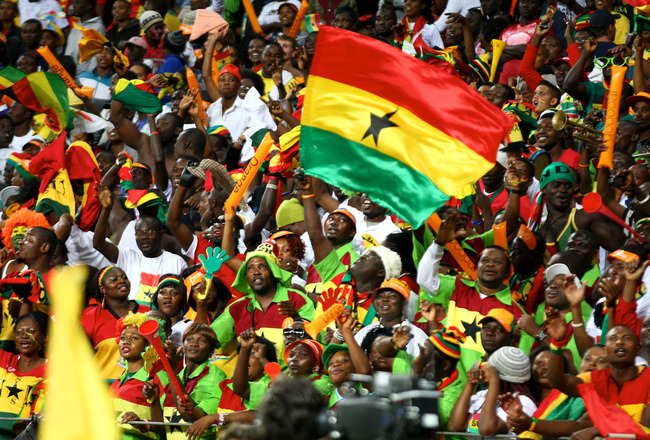
Ecstatic crowds greet President Obama in Ghana. Ghanaians are ebullient and "go gay", as they used to say in the 1950's, when they have something to celebrate. And they've got lots to celebrate. Ghana was the first sub-Saharan nation to gain independence. It's one of the more prosperous countries in Africa, with good standards of education, health and security. So it's not surprising that Ghana´s musicians have been writing songs of welcome ("akwaaba" in the Twi language) for President Barack Obama, and for what he represents beyond himself. For the most prominent of these, Blakk Rasta's "Barack Obama" click here and then on "barak obama" button on the web page)

Obama is not the first head of state whose visit to Ghana has been celebrated by Ghanaian musicians. Bill Clinton and George W Bush seem to have been given a miss, but when Queen Elizabeth II and Prince Philip visited in November 1959 Ghanaians "went gay" with King Bruce & The Black Beats´ track "The Queen´s Visit".

Yet what Ghanaians are celebrating has world significance. It is symbolic because it connects the people of all Africa with those in North and South America, and the Caribbean, whose ancestors were taken as slaves. When Michelle and his daughters visit the old slave fort, it will be a spiritual akwabaa, homecoming, for millions who never returned.
But the visit is equally important as an expression of the diversity of cultures around the world which have sprung from the African diaspora. Where would North American music be without jazz? Or Brazilian culture without African influence? Or the Caribbean, and Black Britain ? There is an African sensibility that spans regional divides.

This song "The Birth of Ghana" was recorded in London in November 1956 by Lord Kitchener. The name's wryly ironic. This isn't Lord Kitchener of Khartoum, the imperialist, but a Trinidadian calypso star who lived in postwar London, as did Kwame Nkrumah. So non-West African musicians were involved in the celebration of Ghana´s independence.
This clip is a classic example of the important crossovers in styles and personnel between black musicians from the Caribbean and Africa in London in the 1950s so carefully documented in the four-part "London is the Place for Me" series of CDs issued by
Honest Jon´s Records.
Nkrumah was, of course, a passionate advocate of Pan-Africanism. So it's wonderful to mark the Obamas' visit to Ghana with this song. Watch out in the video for snaps of Nehru, Nasser, Sukarno and WEB DuBois. The post-colonial era was full of idealism. Nkrumah would be proud of what modern Ghana has achieved.
Ghanaian popular music has often touched on social issues or noteworthy political events. In the 1950s the highlife pioneer ET Mensah and his band celebrated the Ghanaian independence struggle and its heroes with "Ghana Freedom" in 1957 and Kwame Nkrumah´s pioneering attempts at pan-African union with "Ghana-Guinea-Mali", another song popular at the time.

Linking popular music with political comment did not always come easy: when the government got wind of the fact that "Ghana Freedom" name-checked among the heroes of independence politicians who were in opposition and out of favour with Nkrumah´s Convention People´s Party, Decca was forced to pull a run of 10,000 discs (big sales were to be expected in West Africa) and its engineers did a hasty edit, deleting the offending sections.
(Selections of ET Mensah and King Bruce were re-issued on the RetroAfric label a few years ago and are stil available at http://www.retroafric.com/