Showing posts with label Roth Francois Xavier. Show all posts

Wednesday, 19 February 2020

Beethoven seance - Aimard, FX Roth, Gurzenich Orchestra


Raising the spirit of Beethoven in a musical seance "Nothing but Freedom", with Pierre-Laurent Aimard, François-Xavier Roth and the Gürzenich-Orchester Köln. As always, Roth's flair for programmes creates an experiece that inspires the mind and imagination.  Beethoven's passion for  freedom played no small part in shaping his music, the "new music" of his time.  If we could contact him now, what would he feel about the state of civil liberties today, even in supposedly "democractic" countries ? Would he, in turn, connect with how his values continue to shape music in a very different world from his own.  Of course you don't get answers in a seance, but as music, this was interesting food for thought.  Roth, Aimard and the orchestra are touring the programme over Europe, with a visit to London's Royal Festival Hall on Friday 21st February. The concert was also livestreamed from Köln last week.

An introduction that was "spooky" in the sense that it was quiet, the notes of Beethoven's Bagatelle in C, Op.119 No.7 (Allegro, ma non troppo) rising upwards, Aimard raising Beethoven before us. From this a completely new work arose : Isabel Mundry's Resonances, unknown to most of us,which was maybe the point - we're entering new territory, where strange sounds and rustlings gradually merge to create  a mysterious new landscape.Whirring sound, swathes of brass and high pitched winds : a sense of turbulence, punctuated by thwacks of percussion. Wherever this might be it's not airhead but then neither was Beethoven.  Listen to this Beethoven Piano Concerto no 3 "The Emperor" Aimard playing with intensity and verve, Roth whipping a performance full of punch.  Beethoven has returned to life !

The house lights dimmed. From the darkness, Aimard played fragments of the Vivace moderato from Beethoven's Bagatelle in  A minor, Op.119 No.9. and the Allegramente from the Bagatelle in A, Op.119 No.10 and the Bagatelle in B flat, Op.119 No.11 (Andante, ma non troppo). But what are the strange chords that follow ?  Francesco Filidei's Quasi una bagatella for piano and orchestra responds.  There are distinct sections, the first wild, the second paced with greater deliberation, Aimard playing with poise and dignity- single notes: lots of "listening" between orchestra and soloist. The final section is quirky, adventurous with a wry sense of playfulness.  Percussion includes the clapping of hands. There's a dialogue, of sorts, going on here. Beethoven via Aimard and Roth, reply with the Beethoven  Adagio sostenuto from Piano Sonata in C sharp minor, Op.27 No.2 (Quasi una fantasia - Moonlight).  How sublime those famous motifs feel. Beethoven may or might not get this music but maybe he can figure where it's coming from.  Helmut Lachenmann's Tableau  (1988) emerged framed by fragments of Mundry and Beethoven. Sheer theatre ! then a reminder of another composer who valued freedom so much that he killed himself in despair, Bernd Alois Zimmermann. Photoptosis, from 1968, is an ambitious piece for large orchestra, teeming with detail, some figures fragmentary, others developing further, like individual voices heard in a tumult. A dense, heavily populated landscape of multi-layered sound.Betthoven, I think, would have "got" this.


Saturday, 26 October 2019

Edgard Varèse, FX Roth, Berliner Philharmoniker


Edgard Varèse Night  - two concerts - at the Philharmonie, François-Xavier Roth conducting the Berliner Philharmoniker, with Pierre-Laurent Aimard.  By sheer coincidence, this waas the day after the death of Chou Wen-chung, Varèse's friend and foremost scholar. (Please read more here)   Thoughtful programming !  First off, Joseph Haydn Symphony No. 59 in A major “Fire Symphony”an early work, from the 1760's.  The connection to Edgard Varèse?  Haydn was a court composer, obligated to turning out music for his employer,  Prince Nikolaus Esterházy. Yet Haydn created the modern symphony, paving the way for many others.  Varèse was a lone figure, pioneering new forms in a new world. The first concert featured Béla Bartók, another highly individual personality, who didn't write conventional symphonic works, but forged new approaches to other forms.

Pierre-Laurent Aimard played Bartók's Concerto for Piano and Orchestra No. 3, Sz 119 (1945), followed by Roth and the Berliners with Bartók's Dance Suite, Sz 77(1923). Stylish ! Varèse's Arcana for large Orchestra completed the set. Arcana is the biggest of Varèse's works, and relatively accessible.  The original version,from 1925-7,is scored for massive forces, roughly 120 players altogether,  68
 strings, 20 woodwinds, 20 brass and a phalanx of percussionsts playing 40 different instruments from timpani to castanets.  It's also very visual : watching is very much part of the experience.  It's not every day you see rows of trumpets and trombones, some muted, some not playing together, or 8 horns raised heavenwards. This time,we heard the more compact  revision from 1960, which balanced more neatly with Haydn and
Bartók. Arcana is big, but its bigness springs from its musical function. It proceeds like a gigantic beast, its component parts articulated to move in stately formation, groups of instruments impacting on each other in constantly varying combinations. Whatever Varèse meant by its title, the piece moves as if it were a mythical creature brought to life by arcane spells and incantations. Varèse might be called the Wild Man of Modern Music, but he was aware of the importance of structure and progression. 

Logically then to the Late Night concert with members of the Berliner Philharmoniker in smaller ensemble. Varèse Density 21.5 for solo flute, emerging mysteriously like primeval sound, a single melodic instrument developing many different motifs. In Intégrales the piercing cry of the clarinet is answered by rumblings and fractured tappings in the percussion, the other winds picking up on the clarinet's long lines. At moments a snatch of a vaguely familiar tune, almost like Ravel Boléro which was not published at the time Intégrales was completed in 1923. Hyperprism, for winds and percussion, experiments with new sounds, the "klaxon" of Amériques, just one of the procession of timbres, textures and rhythms. Ionisation is orchestrated solely for percussion instruments. The concept, though, is ancient, since much non-western music is percussion based.  It connects, too, to the “primitive” that fascinated modern artists like Braque, and the ethos of Africa, "the Dark Continent" to New York audiences who were horrified by the piece at its premiere in 1933. Ions are particles that build up to form larger units. so Ionisation foresees the idea of cells of sound multiplying to form more complex structures, while fragmenting and re-forming.  Octandre for seven Winds and Double Bass is a group of three miniatures. In the first movement, marked assez lent, an oboe calls, answered by clarinet, both pitched closely so their sounds seem to vibrate off each other. This vibration becomes even more marked in the second movement, marked Très vif et nerveux, the dichotomy developed still further in the last movement marked Grave-Animé et jubilatoire. Nothing primitive in this tightly crafted orchestration.  Sarah Aristidou was the soloist in Offrandes from 1921, soon after the groundbreaking Amériques.  The instrumentaion is relatively conventional, but the vocal lines are freer and more modern, pitched high like the instruments the voice imitates. The texts come from Vicente Huidbrodo and José Juan Tablada.

Thursday, 27 June 2019

Berlioz, Grand Symphonie Funèbre et triomphale - François-Xavier Roth, Les Siècles

Jean-Victor Schnetz: Combat devant l'hôtel de ville, 1830
Berlioz  Grand Symphonie Funèbre et triomphale, with François-Xavier Roth, and Les Siècles, continuing their Concert Monstre at the Pierre Boulez Salle of the Philharmonie de Paris. For Part One, "Blazing Liberté" please read my review here.  The two parts of the programme worked together well, the revolutionary visions of the first part reinforced by the solemnity of the second. Ideals are not won easily, and cannot be taken for granted.  The symphony was written in 1840, marking the anniversary of the July Revolution of 1830.  Just eight years later, the February Revolution of 1848 would change things yet again, ushering in the Second Republic.  
Berlioz's  Grand Symphonie Funèbre et triomphale reflects older traditions than modern symphonic form.  It is a ceremonial march, scored for wind instruments and percussion, instruments which would have been used in military situations. Berlioz initially used the term "Symphonie militaire", adapting it for the occasion of the re-interment of the remains of those killed in the July Revolution.  Though members of Les Siècles remain seated, the instruments they play are mobile, and could have been carried and played while marching. Period instruments, with their more natural, earthy sounds, give performance a human touch, and underline the sense of forward movement that propels the symphony towards its glorious conclusion.  

The Marche funèbre flowed with a powerful, affirmative pulse, drumstrokes and the wail of ophecliedes to the fore, lower brass followed by higher winds, as if marching in military formation. The second theme, (flutes, oboes, clarinets) offered brief retrospective before fiercely dominant chords introduced the next section, bassoons, trombones, ophecliedes, marching at a pace that increases in depth and intensity as it proceeds, punctuated by steady drumstrokes, the surge crowned with the crash of cymbals. In the Oraison funèbre, a fanfare - nine trombones in phalanx - supported by horns and trumpets, the trombone soloist above them as orator, positioned so his instrument could call out as if into vast distance, echoed at times by lighter winds.  Fragments of Berlioz's unfinished opera Les Francs-Juges were used in this movement, so the "oratory" quality of the trombone solo may have its origins in music for voice.  The trombone may be wordless, but its expressiveness is deeply poignant.

The final movement, the Apothéose, rises seamlessly from what has gone before. A march picks up, now brighter and faster paced, a march of exuberant triumph.  Berlioz used the pavilion chinois, a version of the Turkish crescent, but more elaborate, with rolls of bells under a cap (shaped like a pagoda) to further concentrate the sound.  Most orchestras use simpler versions which aren't nearly so impressive. These instruments symbolized victory, the incorporation of foreign elements by conquest.  In this version of the symphony, Roth uses the option of a second orchestra, (the Jeune Orchestre Européen Hector Berlioz) addding string colour, expanding the symphony still further from military form.  Roth  also utilizes the choirs, who served so well in the first part ofthis Concert monstre.  The voices burst forth in unison, with such precision that the effect was explosive, like a canonnade in sound.  "Gloire! Gloire ! Gloire et triomphe!". Not for nothing is this finale an apotheosis, and in this performance it was positively ablaze. It doesn't last nearly long enough. Roth and his forces repeated it as an encore. 

Tuesday, 25 June 2019

Liberté ! - Berlioz Concert Monstre - F X Roth, Les Siècles Part One


Berlioz Concert Monstre with François-Xavier Roth, and Les Siècles and a cast of hundreds, livestreamed from the Philharmonie de Paris (link here). "Concert Monstre" was the title of a concert Berlioz presented in 1844, where performers (over 100) outnumbered the audience.  Roth's Concert Monstre employs closer to 500, with two orchestras and six choirs but the acoustic of the Pierre Boulez Salle handles such forces well, even at full volume.  But this was a "Concert Monstre" in another sense, too,  since it was a grand extravaganza designed for maximum impact. In the first half, spectacular paeans to progress and liberty - L'Impériale, Chant de chemins de fer, Le Temple universal, topped by the Hymne Marseillaise. In the second half, the Grand Symphonie Funèbre et triomphale.

"Du peuple entier, les âmes triomphantes ont tressailli comme au cri du destin !" - the choirs sang, getting L'Impériale (H129, 185) off with a blazing start. Ostensibly, the  text celebrates the revival of the imperial dynasty under Napoléan III, but this is an empire with roots in revolution : the real hero here is the French nation itself, and its people. This "Concert Monstre" was also hommage to Berlioz himself. Berlioz was literary : he loved words on the page as much as in the theatre. When he used text, it was often integral to his music.  The concert included spoken quotations from Berlioz's own writings, and commentary.  The speakers were clearly heard, again demonstrating the merits of the Pierre Boulez Salle. 

Thus the Chant de chemins de fer (H110, 1850), a cantata for voice, orchestra and chorus, with tenor Julien Dran.  The text, by Jules Janin, expresses the exhilration of new technology, the coming of railways and the "merveilles de l’industrie". Berlioz wrote the piece very rapidly, taking time off from working on Le Damnation de Faust. Perhaps there are connections : just as Faust flies through the skies, trains carried people through the landcape at what were then almost unimaginable speeds.  Even more pertinently,  Goethe's Faust made his pact with Méphistofeles in order to gain knowledge which might save mankind. This creates a sub-context for the cantata, connecting it to Berlioz's interest in Saint-Simonian ideology, and to the idea of progress through an economic order based on industry.  To Berlioz, phrases like "Pour vous, ouvriers, La couronne est prête" would have had extra meaning. This intensifies the sense of excitement which Berlioz builds into the setting. The rhythms may replicate the chugging of motors and movement of wheels, but the strong sense of forward propulsion might also evoke the thrill of social revolution. One might even detect faint echoes of the Marseillaise. "Que de montagnes effacées! Que de rivières traversées! Travail humain, fécondante sueur!". In the strophe which mentions". The lines grow hushed, the choruses singing of spirits descending into tombs, as they greet the dawn of a new age. Thus the chorus repeats each word of the soloist : "La Paix ! le Roi! L'ouvrier! La patrie", with a fervour that's almost religious. On this happy day, the laurels go to the "Soldats de la paix, C’est votre victoire; C’est à vous la gloire De tant de bienfaits." The final strophe was delivered with almost explosive force, Dran's voice ringing out like shining clarion. 

In Le Temple universal (H137, op 28, before 1861)  Berlioz returns, towards the end of his life, to idealism. In this orchestration, by Yves Chauris, male and female choruses combine, reinforcing the concept that an enlightened Europe should unite, beyond frontiers, to embrace "Le grand hymne de notre liberté!"  An appropriate hymn for present times !  Roth is no fool : He has often shown courage when expressing his convictions. To press the point still further, Berlioz's orchestration for large orchestra, soloist and chorus of the Marseillaise (H 51a), written in the wake of the July Revolution of 1830.  What an experiece this must have been in the Pierre Boulez Salle ! Everyone standing who could - the orchestra, the chorus, the audience. When Dran sang the solo passage, the orchestra seemed to well around him. The Choeurs et orchestres des Grandes Ecoles,Choeur Sorbonne Université, Choeur de la Cité Internationale Universitaire de Paris,Choeur CalligrammesChoeur des Universités de Paris, and Choeur InChorus (Chorus master Frédéric Pineau) were joined by informal singers in the choir stalls, ordinary people, some singing from memory, and no doubt a few in the audience.  That is what a Marseillaise should be about - drawing the people together. "Amour sacré de la Patrie, Conduis, soutiens nos bras vengeurs
Liberté, Liberté eg tes défenseurs ! Combats
avec tes défenseurs!".  At this point in history, it seems that the forces of freedom, liberty and genuine democracy are being destroyed, by technological manipulation,  intolerance, and pig-headed stupidity.  We need the Marseillaise. I played this over and over, loudly. My son popped in. "Wow!", he said "That's fantastic!"  

My review of Part 2 of this Concert Monstre when François-Xavier Roth and Les Siècles do Grand Symphonie Funèbre et triomphale  is HERE! Please enjoy

Monday, 3 June 2019

Fantastique Lélio Berlioz, F X Roth Les Siècles, Paris


Berlioz Symphonie fantastique and Lélio together, as they should be, with François-Xavier Roth and Les Siècles livestreamed from the Philharmonie de Paris (link here).  Though Symphonie fantastique is heard everywhere, all the time, it makes a difference when paired with Lélio because this restores Berlioz's original context. Opus 14 and 14b are meant to connect. Indeed, Lélio can be heard as an extension of the Symphonie fantastique, since together they reflect an intensely creative period in his development. The  symphony, subtitled  Épisode de la vie d'un artiste ... en cinq parties flows naturally into the Lélio, ou Le retour à la vie, mélologue en six parties. The first part addresses annihilation, the second part revival through creative art, and, heard together, they have symmetry.

When the symphony isn't treated as a stand-alone, there is an impact on interpretation.  Roth and Les Siècles use instruments of Berlioz's period to better reflect the colours Berlioz would have used.  This gives a more naturalistic, genuinely "Romantic"(big R) warmth to the performance. In "Rêveries", diaphanous textures herald the idée fixe, which here flowed with ardent purpose, establishing the  dichotomy between poetic ideals and obsession that gives this symphony such power.  Four harps and shimmering strings introduce the waltz. This moment of serenity contrasted with darker timbres, might indicate that happiness may be elusive. The "Scène aux champs" is pastoral, but haunted by more poignant undercurrents. An exquisitely played cor anglais, echoed by unseen oboe : dichotomy again, suggesting that happiness might be beyond reach.  Thus the "March au supplice" grows from what has gone before.  The steady march is well defined, the Idée fixe leading waywardly forth.  An atmospheric "Songe d'une nuit du sabbat". Ophecliedes may reference funeral processions in Berlioz's era, but the ominous grotesques, swirling strings and ringing bells also indicate supernatural malevolence. The demonic forces of Goethe's Die erste Walpurgisnacht  are not so very far away.  Romanticism, with its instincts for what we'd now call the subconscious, marked a breaking away from the unquestioned order of the Ancien Regime.

Roth's observant approach to structure pulls together the underlying architecture in the Symphonie fantastique, which is particularly relevant when the symphony is heard together with Lélio.  Significantly,  the narrator (Michel Fau) is alone as Lélio begins, the orchestra silent. This is an existential cry of anguish., delivered by Michel Fau with appropriate drama, even capturing the semi-musical cadences in the text.  For Berlioz, the narration was fundamental to concept.  Declamation would have come naturally to Berlioz and his contemporaries, who discovered Shakespeare, albeit in the theatrical adaptations that were then the norm, even in England.  Moreover, a good narrator like Michel Fau captures the semi-musical cadences in the text, which further links words with music . Lélio is, significantly, a composer.  While this is not Sprechstimme by any means, leaving out the narration, or using performances without the distinctive punch of proper French diction, diminishes the impact.  "Dieu! je vis encore... Il est donc vrai, la vie comme un serpent s’est glissée dans mon cœur pour le déchirer de nouveau? " This is an existential cry of anguish.  Yet there are explicit references to the symphony. "Ce supplice, ces juges, ces bourreaux, ces soldats, les clameurs de cette populace, ces pas graves et cadencés tombant sur mon cœur comme des marteaux de Cyclopes.."  In this dark night of the soul, Lélio speaks of the vision "avec son inexplicable sourire, conduisant la ronde infernale autour de mon tombeau!..."

The narration is so closely integrated into the structure that, in the "Ballad of the Fisherman" (based on Goethe's adaptation of Hamlet), Lélio's friend, Horatio (Michael Spyres) sings a lilting song about a nymph while Lélio meditates on life and art.  The serene song connects to evoke the watlz in the Symphonie fantastique. Again, the text references music : "Une instrumentation sourde... une harmonie large et sinistre... une lugubre mélodie... un chœur en unissons et octaves... semblable à une grande voix exhalant une plainte menaçante pendant la mystérieuse solennité de la nuit..."   In the Chœur d’ombres, the choir (the National Youth Choir of Scotland, chorus master Christopher Bell)  sings of death, punctuated by pounding drums - another funeral march, all the more poignant because the voices are fresh and youthful. Yet Lélio's words are truculent.  Calling on Shakespeare, he resolves to head to Naples and join brigands.  In Romantic terms, the South represented freedom and wildneess, the sun versus the moon, images Goethe employed so well. An artist cannot conform but must find himself through creativity.  In the "Chanson de Brigands" the baritone (Florian Sempey) leads the chorus in raucous adventure.  On the video transmission, the chorus members put their arms round each others shoulders and move,  expressing the energy in the orchestra. Can Lélio dare hope ?  "Je me vois dans l’avenir, couronné par l’amour".

After a brief silence, the orchestra now comes into its own : beautifully limpid harps, seductive woodwinds.  Now the tenor represents Lélio, singing the imaginary voice of the composer, off-stage. then even Lélio falls silent, as the orchestra creates the magic that is "Sounenirs- La harpe éolienne" where the orchestra extends the sound of the harp with winds and strings, evoking the sound of an aeolian harp, where Nature plays, vibrating through breezes.  The pastoralism of "Scène aux champs" now idealized and perfect. Lélio resolves to find new life through art. "Allons! que les esprits chantent et folâtrent! que la tempête gronde, éclate et tonne!......SHAKESPEARE me protège!". The "Fantaisie sur " La tempête " de Shakespeare" is Lélio's redemption. The chorus sing"Miranda! Miranda", and the orchestra creates the storm - both physical and supernatural - that drives her to the island where Caliban is marooned. The pounding rhythms of the idée fixe in the Symphonie fantastique return, transformed, flowing with even greater energy.  Until this point, Berlioz employed the orchestra with restraint. Now, in this exhilarating climax, we hear why he needed a full ensemble, supported by choir.  Lélio listens, and cries "Encore! Encore, et pour toujours!...".

Roth, Les Siècles and the voices give such an idiomatic, inspired performance that Lélio's words seem addressed to them "votre exécution est remarquable par la précision, l’ensemble, la chaleur; vous avez même reproduit plusieurs nuances fort délicates. Vos progrès sont manifestes; je vois que vous pouvez aborder maintenant des compositions d’un ordre beaucoup plus élevé que cette faible esquisse."
When (not if) this gets to CD/video, it should set a new benchmark in Berlioz performance practice. til then, listen again on the Philharmonie de Paris website.

Monday, 29 April 2019

The real Mahler Titan : François-Xavier Roth, Les Siècles


Not the familiar version of Mahler's Symphony no 1,  but the real" Mahler Titan at last, as it might have sounded in Mahler's time ! François-Xavier Roth and Les Siècles present the symphony in its second version, based on the Hamburg/Weimar performances of 1893-94.  This score is edited by Reinhold Kubik and Stephen E.Hefling for Universal Edition AG. Wien. This allows us, as Anna Stoll Knecht and Benjamin Garzia of the Médiathèque Musicale Mahler note, “to follow the genesis of this first large-scale work, (which) opens the doors of Mahler’s artistic workshop at a crucial moment in the creative process". Mahler extensively revised his very first version, premiered in Budapest in 1889. For the Hamburg performance, in October 1893, he described it as "The Titan, A Tone Poem in the form of a symphony" in five  parts, each with programmatic titles.  In Weimar, in June 1894, he adapted it further, so it was no longer a symphonic poem but a ‘symphony’. While the text accompanying the Weimar performance retained the programmatic titles from Hamburg, the score was now devoid of them, heralding the transition from symphonic poem to the Symphony in D major, as the Berlin version from 1896 was to be called. Donald Mitchell has compared this working process to building with scaffolding, which is later removed to reveal the finished structure. Even after publication, Mahler reserved the right to make further revisions, continuing to do so until the last performance he conducted, in New York in 1909.

While the edition of the score is of great interest, the performance itself is superb, definitely worth hearing on its own merits. Roth has conducted the standard version many times, but here he conducts  Les Siècles "sur instruments d’époque", using instruments of Mahler's time.  They use instruments which would have been used in  the pit of the Vienna Court Opera and the Musikverein, and selected Viennese oboes, German flutes, clarinets and bassoons, German and Viennese horns and trumpets, and German trombones and tubas. "These instruments are built quite differently from their French contemporaries" writes Roth. "The fingerings, the bores and even the mouthpieces of the clarinets were completely new to our musicians.  The wind instruments have a singular quality that exactly matches the rhetoric of the Austro-German music of that time, with a darker colour than that of the instruments then used in France. Perhaps they are also more powerful, and their articulation is a little slower. In the case of the string section, each instrument is set up with bare gut for the higher strings and spun gut for the lower ones. Gut strings give you a sound material totally different from metal strings, more highly developed harmonics, and incisiveness in the attack and articulation." Each instrument is individually identified, as are the players.

This approach to instrumentation infuses the performance, giving it an invigorating sense of vitality.  Given that Mahler was embarking on new adventures,  Roth and Les Siècles capture the spirit of the piece with extraordinary expressiveness.  The first movement of the first part, 'Frühling und kein Ende' comes alive from the start.  Period horns emerge from the rustling strings to create an earthiness entirely in keeping with the idea of Spring and burgeoning new growth.  The woodwinds call the "kuck-kuck" motif with such purity that they sound like birds.  The movement builds up to a crescendo so joyous that it seems to explode with energy and freedom.  In the song "Ging heut’ Morgen über’s Feld" the protagonist hears the birds sing "Ist’s nicht eine schöne Welt? Ei, du! Gelt? Schöne Welt!". Though the song ends on a minor key,  Mahler ends the movement with a punch of an exuberant timpani.

In the past, the 'Blumine' movement has been attached to what is now known as Mahler's Symphony no 1, even though the composer himself pointedly removed it.  The result is neither sympohony nor "symphonic poem" but a hybrid.  Mahler dropped the piece, finding it too "sentimental", a "youthful folly" ((Jugend-Eselei), and it does inhibit the flow of the symphony. 'Blumine' includes passages from "Der Trompeter von Säckingen", incidental music to a play he'd written in 1884. Hence the prominent trumpet part, which here is particularly beautifully played : almost as evocative as the post horn in Mahler's third symphony, though 'Blumine' is a much slighter piece.  The mellowness of the instruments Les Siècles employ enhances the section's function as a throwback to past times. There's not much point in including it as an add-on these days when the full symphony is is so well known, so it's better to hear it in proper context, as this new edition offers. It operates as an andante to the much more sophisticated scherzo of the (third) movement here. Originally titled "Mit vollen Segeln", it's played here with ebullient verve : the trio part earthy Ländler, part cheeky waltz.

 Part Two of the Titan was titled Commedia humana (Human Comedy). It begins with "Gestrandet", a Totenmarsch inspired by an illustration of hunted animals following the cortege of a dead huntsman : the worldly order of power in reverse. Again, the usee of instruments Mahler himself would have known adds colour to this performance. The rhythms reference the folk tune Bruder Jakob: hence Mahler's comment that it should sound quaint "as if  slaughtered by a bad orchestra". Ländler values again, with echoes of the motif 'Auf der Straße steht ein Lindenbaum' from the song "Die zwei blauen Augen von meinem Schatz" with which Lieder eines fahrenden Gesellen ends.  The dark humour of this Dantesque "human comedy" comes to the fore in the last movement, an allegro furioso originally titled "Dall'Inferno". Such energy in this performance - proof that instruments of the right period can sound powerfully animated.  Roth and Les Siècles perform with intense conviction. Each section of the orchestra sounds alert, aware of what's evolving in the music : the triumph of some heroic force of life, blasting away death and venality. Hence the term "Titan", refering to Jean Paul's Bildungsroman, where wisdom is won through fire, in search of higher purpose. 

Friday, 26 April 2019

Ravel at the Barbican - François-Xavier Roth London Symphony Orchestra


An all-Ravel concert with François-Xavier Roth and the London Symphony Orchestra.at the   Barbican Hall, London.  Rapsodie espagnole, Boléro and L'heure espagnole :  "Spanish" spice, but to describe it thus would be painfully superficial. Boléro, of course, was the crowd pleaser, because it's fun and everyone knows it.  But this was yet another intelligently planned programme which emphasized the underlying musical concepts.

The Rapsodie espagnole (1908) was exceptionally refined. The first theme of the Prélude à la nuit,  played with such poise that it seemed to oscillate. Yet beneath these transparent hues, steady, purposeful rhythms. Immediately, connections with L'heure espagnole, (1911) written in the same period.  Not for nothing is Torquemada a clockmaker! In both pieces, rhytms tick quietly but with persistence, forming a bedrock for more flamboyant invention.  Watch out when the rhythms go awry.  Thus the dance forms which form the inner movements, the Malagueña and the Habanera. Dance is disciplined movement, dancers following structure to express emotion.  In the Feria this tension between restraint and freedom breaks through: burgeoning crescendoes, lit by cymbalas, note sequences that descend and rise again.  Boléro got the wildest applause, and a standing ovation, because it’s a showstopper, but the sheer quality of the LSO's playing in Rapsodieespagnole  was far higher.

Luxury casting for Ravel's L'heure espagnole: Isabelle Druet, Jean-Paul Fouchécourt, Thomas Dolié, Edgaras Montvidas and Nicolas Cavallier.  Hearing it in concert performance illuminates the orchestral logic which underpins the plot.  The clocks are invisible, but they're everywhere - ticking relentlessly, imposing form on time, the way dance inmposes form on motion.  En masse, they can be manic.  Torquemada (Fouchécourt) is regulated by machines, which is why Concepción (Druet) needs to find human pleasures elswhere.  But with whom ? Gonsalves (Montvidas) is romantic but he's a bad poet, as his music suggests : overipe flourishes that go awry.  It takes a good singer like Montvidas to make you realize that Ravel is satirizing cliché, much in the way that Wagner wrote Beckmesser's song.  Gonsalves doesn't have what it takes, anymore. Gomez (Cavallier) at least can provide other delights. The real hero is Ramiro (Dolié) who understands that clocks have minds, and that women have minds as well.  But nothing goes quite to plan.  Bassoons blow rude raspberrries. Tight rhythms deliberately come apart, each clock slightly out of synch. Boléro too is a study of sequences and rhythmic patterns. Again, this requires much more skill from players (and listeners), which can be hidden even in a good staged performance.  

What a pity that these good performances were spoiled by some in the audience.  I kid you not but someone kept rummaging through various bags throughout the evening,. Fidgetting is OK and normal but this was not. Eventually the person took off her boots, then her socks  Repeatedly, she put her hands in her mouth and massaged her feet, then wiped her bare feet on the Barbican floor.  The ushers tried their best but there was no stopping someone like this. Thank goodness the concert was recorded and will be broadcast on BBC Radio 3 on 30th April 

 Photos: Roger Thomas 


Tuesday, 19 February 2019

BBC Music Magazine Awards : Vocal

It's hard to take the BBC Music Magazine Awards nominations seriously.  Out of "nearly 200" discs chosen, three in each category.  But how can anyone really compare Adam Fischer's Mahler 1 with Currentzis's Tchaikovsky 6 or Peter Oundjian's John Adams ? Or Opera Rara's Semiramide with  the Early Opera Company's Acis and Galatea with John Adams Dr Atomic ? There is, however, no obvious bias for the choices in the Vocal Category, but art song isn't populist, so goodness knows what the logic is.

The three Vocal choices:

Schumann and Mahler Lieder : Florian Boesch Malcolm Martineau, sensitively performed with insights into different forms of Lieder.  Among the best on record of Mahler Lieder eines fahrenden Gesellen, which is saying something in a crowded field.  Please read my review HERE

Mirages : Sabine Devielhe with Alexandre Tharaud and Les Siècles conducted by François-Xavier Roth - French Orientalism - selections from the Belle Epoch and Maurice Delage's Quatre Poėmes hindous. Please see my review HERE.

Enfer : Stéphane Degout,  Raphael Pichon, Pygmalion -  a Mass for the Underworld, comprised of excerpts from Rameau and Gluck, featuring seriously Bad Guys from the Baroque, brilliantly put together theme by theme,  parodying a sacred Mass.  Shocking, though this was apparently done in baroque times.  Fabulously flamboyant performances, showing how powerful and edgy HIP can be.  I haven't reviewed this but have been listening to it for months

How do you choose between these three ? Mirages is a good debut album, and Boesch's Schumann and Mahler an essential addition to the discography.  But Dégout's Enfer is more than great performance.  Conceptually, it's in a whole new world (pun intended) and shakes up preconceptions about period performance. This one's in a league of its own.  Deserves an award in its own category ! 

Monday, 28 January 2019

Luminous Mahler Symphony no 3 : François-Xavier Roth, Gürzenich-Orchester Köln

Gustav Mahler Symphony no 3 with François-Xavier Roth and the Gürzenich-Orchester Köln, now at last on CD, released by Harmonia Mundi, after the highly acclaimed live performance streamed a few months ago. The Gürzenich Orchestra gave the world premiere of this symphony in Cologne on 9th June 1902, conducted by Mahler himself, who also conducted the premiere of his Fifth Symphony with the orchestra, in October 1904.  Though its personnel have changed, the repertoire remains close to the orchestra's core. François-Xavier Roth follows in the footsteps of Michael Gielen, who conducted the Gürzenich Orchestra and conducted Mahler with the innovative SWR Sinfonieorchester Baden-Baden und Freiburg, where Roth was the final Chief Conductor.

The lucidity of this performance should come as no surprise, especially to those who have been following Roth and the Gürzenich-Orchester Köln over the last few years, and not just in Mahler, though their recording of Mahler's Symphony no 5  is highly recommended.  The first movement of Mahler's Symphony no 3 is huge, almost a symphony in itself.   Roth grasps its internal structure, bringing out its formidable architecture. The opening theme is strongly shaped, creating the pattern of "peaks" (trumpets and trombones) and "valleys" which are very well defined, muffled trumpets and solo trumpet calling out into the distance, the strings and winds adding sweetness.  Roth emphasises the pattern with very quiet, muffled percussion, before the next sequence, where the trombones call, heralding the way ahead. This deliberation respects the marking "Kräftig. Entschieden" but also contributes to the interpretation of the symphony as a whole. From steady discipline, the symphony progresses : the apotheosis at its conclusion is reached only by a process, which includes struggle as well as moments of loveliness.  As if the goal were in sight, the pace speeds up towards the end of the first movement : turbulent excitement, hurtling forwards, winds, trumpets and trombones leading into the next phase,buoyed up   by cheerful, almost swaggering woodwinds.  If Mahler's entire output can be heard as one great symphony, its basic ideas repeated and developed, the first movement of  the Third Symphony is a microcosm in itself.  Mahler's original title for this movement was "Pan Awakes, Summer Marches In". Even without the label, it's clear from this performasnce what he meant : vigour and freshness.

The second part of Mahler's Symphony no 3 begins with a movement "tempo di minuetto", a dance between two partners, extending the pattern in the first movement, but also evoking the idea of dialogue that rises so often in Mahler, even up to the Adagio from what would have been his Tenth Symphony.  The dance element brings out the best in Roth, given his background in French repertoire, so strongly influenced by the patterns of dance and precision.  Elegance does count in Mahler and highlights the subtlety in his orchestration.  This pays off too in the third movement, where details like the quote from the Wunderhorn song Ablösung im Sommer ("Kuckuck ist tod!") aren't there simply for decoration.  In the song, summer is not over, though the cuckoo is dead, since the Nightingale takes over and "singt und springt, ist allzeit froh, Wenn andre Vögel schweigen".  As in so much of Mahler's work, death is not an end but a stage in a process, where death is defeated by new forms of life.  Thus the flutes and piccolos, giving context  to the posthorn. This is heard from offstage, invisible but powerful.  Does it suggest distance, or memory or future hope ?  The "kuckkuck ist tod"  figure returns, cheekily and leads the orchestra into another dance, whipped almost into frenzy, before the posthorn calls again, and the pace descends, like twilight into night.   Yet again, the resurgent pattern returns, with a finale of energetic affirmation, not defeat.

From brooding near silence (basses and celli), Sara Mingado, the alto, emerges, singing a text from Nietzsche's Also sprach Zarathustra: "O Mensch! Gib Acht!", her voice illuminated by motifs on violin and clarinet, which here sound non-western, which is quite approrpiate : this is no mainstream "Christian" symphony.  Something is gestating.  The misterioso of the fourth movement gives way to the joyous fifth movement, significantly scored for youthful, fresh-sounding voices. Mingardo is now haloed by the Women's choir of Schola Heidelberg and the youth choir of the Kölner Dom. The words "Bimm bamm" supposedly evoke the sound of bells marking celebration.

The forward thrust of the journey in the first movement is now drawing to resolution.  In the final movement, marked "Ruhevoll", lines stretch, as if reaching into distance: strings now dominant, winds adding depth, brass responding.  Exquisite playing from the Gürzenich-Orchester Köln : the refinement feeling almost luminous.  Here, too, the structure involves a series of stages, observed more carefully by Roth than by conductors who push too much towards the ending.  As in the first movement, purposeful progression matters, for the reward is worth the journey.  The tuba announces one transition, a flute another.  Very natural-sounding trumpets recall the Alpine landscape aspects of the symphony,  bringing echoes of past memories - and of the posthorn - together with hopes for the future.  Unity at last, the different sections of the orchestra in concert (literally) with each other.   Thus the deep feeling that grows ever more secure as the movement proceeds, culminating in the coda where the timpani pound, not so much MGM glitz but with the depth and conviction of a strong heartbeat.

Saturday, 12 January 2019

Off on adventures ! François-Xavier Roth, Les Siècles, all Berlioz livestream Paris


Livestreamed from the Philharmonie de Paris, François-Xavier Roth and Les Siècles in an all-Berlioz programme featuring Berlioz Harold en Italie, with Overtures from Benvenuto Cellini, from  Le Carnaval Romain op 9, and Béatrice et Bénédict and the sections "Roméo seul" and "Grande fête chez Capulet" from Roméo et Juliette op 17

A Romantic Harold en Italie op 16 H68 1834 in the true sense of the term "Romantic". Roth and Les Siècles capture the aesthetic of the early 19th century when wild dreams, adventure and concepts of freedom and individuality transformed European culture.  The modern use of the term "romantic" is a dumbing-down of the Romantic vision : we need to re-engage with what Romanticism was to appreciate Berlioz and other composers of his time. That is what "historically informed performance" really is : not instruments per se but performance practice that grows from an understanding of a composer and his influences.  In the case of Berlioz, this is particularly important since Berlioz was fascinated by new instrumental colours. His Grand Traité d’Instrumentation et d’Orchestration Modernes - note the word "modernes" was published at around the same time as Harold en Italie was written, so Les Siècles use instruments from the time in which Berlioz was working.  The result is brighter, cleaner, less "polluted":  Byron and his hero Harold travelling in landscapes still unexplored and unknown.  Roth, his orchestra and Tabea Zimmermann the soloist, make Harold en Italie feel fresh and new, as it might have when it was new.

"Berlioz", Roth has said, "like other innovative orchestrators, brought out the best qualities of the instruments he had at his disposal at the time. He kept up with the latest developments in instrument making and, like a chef, was keen to use the right ingredient to season his musical recipe. It’s really exciting to encounter the original flavours of the instruments of his time because you realise almost instantly what these new combinations of timbres were........"With Harold en Italie, things are much more complex: the viola is not a concertante soloist, as it would be in a Romantic concerto, but rather a musical character, a narrator, an actor in the story of Harold that is related to us. Berlioz

invented a genuinely new role here in the relationship between the soloist and the orchestra."


In the Romantic aesthetic, heroes are loners in a vast landscape, accentuating the monumental challenges before them. Berlioz's first

movement is titled "Harold aux montagnes". Ominous figures loom up in the orchestra, ascendant lines stretching outwards. When Zimmermann enters, her line is quietly confident, garlanded by harp and winds. Just as the hero engages with the panorama, the viola engages with the orchestra : a good balance here, the soloist not overwhelmed by larger forces. The movement ends with a sense of adventure. In the "Marche des pèlerins", the understated melodic line in the orchestra suggests the humility of pilgrims, singing as they journey. Thus the arppegiated chords, the viola beside the orchestra.

In the third movement, the use of period instruments brings out the distinctive timbres and rhythms of folk music in the serenade and

saltarello. The dances become drama in the "Orgie des Brigandes". Brigands, like gypsies in 19th century folklore, represent "natural"

forces, freedom versus inhibition, danger versus comfort. Thus the quicksilver energy with which Les Siècles brings this movement to life :

even the quieter figure before the entry of the viola bristles with anticipation.

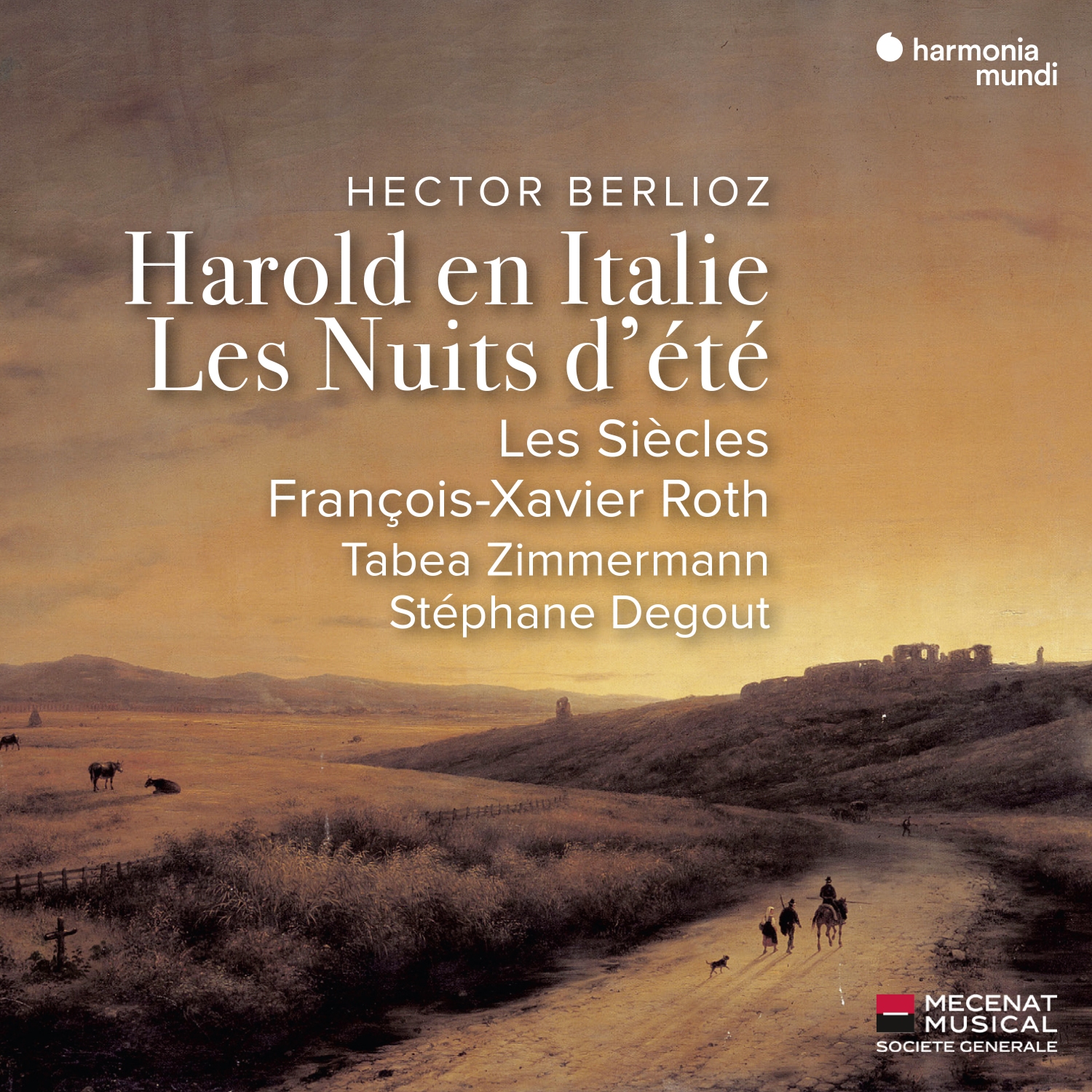
Roth and Les Siècles have recorded Berlioz Harold en Italie with Tabea Zimmermann, recently released by Harmonia Mundi  coupled with an equally individual  Les Nuits d'été op 7 with baritone Stéphane Degout. (Please read more here).

At the Philharmonie de Paris live, to highlight the sense of"things to come" Roth and Les Siècles presented Harold en Italie with a group of Overtures from Benveuto Cellini, from  Le Carnaval Romain op 9, and Béatrice et Bénédict . Curtain raiser after curtain raiser!  Then "Roméo seul" and "Grande fête chez Capulet" from Roméo et Juliette op 17.All performed with Roth's characteristic zest.  A programme that made me think about Berlioz as innovator and man of the theatre in every sense. Music can be thrilling as drama even when it's not attached to an opera or larger work. As an encore,  Roth and Les Siècles concluded with the Hungarian March from Berlioz's The Damnation of Faust op 24, for which Zimmerman sat in with the orchestra’s violists. Catch the livestream on the Philharmonie de Paris website until June 2019.

Friday, 7 December 2018

Berlioz : Harold en Italie, Les Nuits d'été - Roth, Zimmermann, Degout

Hector Berlioz Harold en Italie with François-Xavier Roth and Les Siècles with Tabea Zimmermann,  plus Stéphane Degout in Les Nuits d'été from Hamonia Mundi.  This Harold en Italie op. 16, H 68 (1834) captures the essence of Romantic yearning, expressed in Byron's Childe Harold's Pilgrimage where the hero rejects convention to seek his destiny in  uncharted territory. 

This is what "Romanticism" meant to those who lived in the early and mid 19th century, very different indeed from what "romanticism" has come to mean since the mid 20th century. This helps frame Les Nuits d'été with baritone rather than the more common version for female voice. Berlioz has been a strong presence in the history of Les Siècles virtually since the orchestra was formed. they featurev every year at the Berlioz Festival in La Côte-Saint-André.  Roth established his Berlioz credentials early on, as assistant to Sir Colin Davis at the London Symphony Orchestra, and has also worked with Sir John Eliot Gardiner. "Berlioz", says Roth, "like other innovative orchestrators, brought out the best qualities of the instruments he had at his disposal at the time. He kept up with the latest developments in instrument making and, like a chef, was keen to use the right ingredient to season his musical recipe. It’s really exciting to encounter the original flavours of the instruments of his time because you realise almost instantly what these new combinations of timbres were".  He adds "With Harold en Italie, things are much more complex: the viola is not a concertante soloist, as it would be in a Romantic concerto, but rather a musical character, a narrator, an actor in the story of Harold that is related to us. Berlioz invented a genuinely new role here in the relationship between the soloist and the orchestra.  Roth often compares Harold en Italie to Richard Strauss’s Don Quixote "a symphonic poem with a principal cello which also seems to embody a character".  Perhaps that was why Paganini was at first dismayed, since he had hoped for a vehicle for solo viola. 

In the Romantic aesthetic, heroes are loners in a vast landscape, accentuating the monumental challenges before them. Berlioz's first movement is titled "Harold aux montagnes". Ominous figures loom up in the orchestra, ascendant lines stretching outwards. When Zimmermann enters, her line is quietly confident, garlanded  by harp and winds. Just as the hero engages with the panorama, the viola engages with the orchestra : a good balance here, the soloist not ovewhelmed by larger forces. As Roth himself writes, "Harold’s melody seeks to bring out these specific timbres and rhythms, the grain of the sound. (And here the decision of François-Xavier Roth and Les Siècles to use period instruments once again demonstrates its importance, its necessity.) superimposed on the other orchestral voices, and contrasts with them in tempo and character without interrupting their development". The movement ends with a sense of adventure. In the "Marche des pèlerins",  the understated melodic line in the orchestra suggests the humility of pilgrims, singing as they journey.  Thus the arppegiated chords, the viola beside the orchestra.

In the third movement, the use of period instruments brings out the distinctive timbres and rhytms of folk music in the serenade and saltarello.  The dances become drama in the "Orgie des Brigandes".  Brigands, like gypsies in 19th century folklore, represent "natural" forces, freedom versus inhibition, danger versus comfort.  Thus the quicksilver energy with which Les Siècles brings this movement to  life : even the quieter figure before the entry of the viola bristles with anticipation.  A glorious coda !

Berlioz orchestrated Les Nuits d'été op 7 for different voice types, though they are usually done by female singers, so there is no reason per se why they can't be tackled by men ; tenors have done them fairly frequently in the past.  On this recording, paired with Harold en Italie, a male voice extends the idea of a "hero" bravely venturing forth. In any case,  Stéphane Degout has the range and finesse.    Indeed, a stronger, deeper voice highlights the punching rhythms in "Villanelle", and brings out the erotic allure in the line "Et dis-moi de ta voix si douce :'Toujours'.”  The resonance of Degout's timbre also works well with the more elaboarate orchestration of "Le spectre de la Rose", which includes  prominent parts for cello, clarinet, flute and harp.  Berlioz orchestrated "Sur les lagunes" for baritone, so the fit between voice and the flowing "water" sounds in the orchestra.  A soaring "Ah ! sans    amour s’en aller sur la mer !". "Absence" is followed by a very good "Au Cimetière - Clair de Lune" where Degout restrains the inherent power in his voice, suggesting mystery.  A stylish "L'île inconnue", further proof that it is not so much voice type that makes these songs work, but artistry.  

Thursday, 29 November 2018

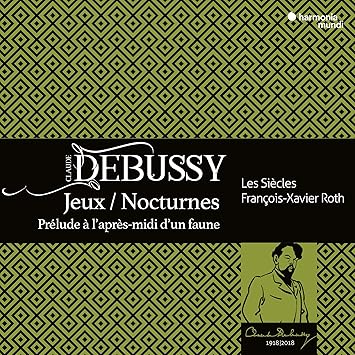
Harmonia Mundi Debussy - FX Roth Les Siècles

The Harmonia Mundi Debussy series continues with François-Xavier Roth and Les Siècles, in Jeux, Nocturnes. and Prélude à l'après-midi d'un faune. 

An extremely fine performance of Jeux, Roth and Les Siècles playing with the tightly-focused poise this piece needs in order to capture the energy of  strategy and exchange. In Jeux the game is, ostensibly, tennis. Or is it ? Two young people are fooling around, but suddenly a ball is thrown onto the court, changing the game. Strange, quivering chords, suggesting tension. Rays of brightness, throwing  the darkness into menacing contrast.  In musical
terms, this means constant flow between points, patterns crossing and recrossing, staccato contrasting with freewheeling liveliness. Like
Boulez, Roth marks the sense of "listening". The players on this court have to be alert and reespond. Perhaps the wild, tantalizing line represents the mysterious ball. Whatever, it has energy and purpose,
unlike the players when they came onto court.  At last a blaze of horns and rising energy in the music. Are they players being "illuminated" ? Suddenly, tantalizingly, the music ends. Instead of closure in the conventional symphonic sense we're left to think for ourselves. I love Jeux because it's open ended and "modern". There may be dangers ahead, the  understated wit in the piece suggests adventure, not doom.
  This performance is good because Les Siècles is grounded in the fundamentals of the baroque, where dance underpinned music : thus the importance of clarity, precision and physical energy.

In the Nocturnes, Debussy seems to illustrate a seascape. The movements have programmatic titles - Nuages, Fêtes, Sirènes - but as always, good music is more than literal depiction.  Waves keep changing shape and position, thus the concept of constant change, figures moving and shifting in myriad ways. In an ocean, motion is controlled by invisible forces, like tides and wind. Thus the concept of musical form which might suggest undercurrents and ideas behind surface appearance.   Roth and Les Siècles shape the first two Nocturnes emphasizing the intricate detail beneath the broad sweep, for these details are like the "brushstrokes" in painting.   But it is in the third Nocturne, Sirènes, where Debussy breaks in even more innovative form.  The women of Les Cris de Paris, vocalize, singing abstract sound instead of words. The shifting patterns, nuances and tones create the concept of a horizon that keeps moving and changing, with infinite variety. From these wonderful cross-currents and multiple textures, the borders of tonality are beginning to fade.

Though we hear it so often, it's bracing to remember that Prélude à l'après-midi d'un faune broke new ground in 1889. Informed by a century of pschological insight, we can interpret the meaning of the central image. The fawn is a wild creature who acts on instinct, defying social restriction. Through symbolism Mallarmé could express emotions too dangerous to be openly expressed. Prélude à l'après-midi d'un faune grows from a tradition of allegory that goes back to the Greeks.  Debussy's music defies categories. Its chromatics stretch tonality, at once rich, yet clean and pure. Think of fin de siècle art with its curving forms, representing an aesthetic of freedom.  Like the fawn, the flute line moves and turns senusously, explicitly erotic. In Vienna, Freud had yet to formulate his ideas on dreams and the subconscious. In the French-speaking world, the symbolists (as early as Baudelaire) were already there.  François-Xavier Roth and Les Siècles bring out the fundamental purity in the piece. Much of the beauty of the piece lies in its mysterious ambiguity and the multi-level interaction between the flute and lower-voiced winds, strings and harps. The flute represents Pan, the fawn his disciple. This in itself is symbolic, for in ancient Arcadia, lone musicians sing in landscapes where the rules of society do not apply.  Here, the flute stood out, highly individual, enhanced by but not overpowered by the luxuriant background, lush strings and resonant winds. Roth and Les Siècles are aware of the "classical" as well as modern allusions in this remarkable work : the horns are natural, gently muffled as if heard from a distance. An important reminder that the fawn will be hunted down and killed. Prélude à l'après-midi d'un faune is not at all "romantic"  Beneath the exotic surface lurks danger.  The Prélude lends itself to dance because it flows gracefully, yet is also lucidly disciplined : keynotes of French style since Lully and Rameau. 
Please also see my review of  François-Xavier Roth and Les Siècles in Ravel for Harmonia Mundi. and Pablo Heradas Casado Debussy with a Le Martyre de saint Sébastien but where Prélude à l'après-midi d'un faune is nowhere near as well performed as on this new Roth/Les Siècles disc. 

Thursday, 14 June 2018

Magical Ravel Ma mère l'Oye. Le Tombeau de Couperin - FX Roth Les Siècles

François-Xavier Roth and Les Siècles Ravel Ma mère l'Oye, coupled with Le Tombeau de Couperin with Shéhérazade between them, latest in Les Siècles's Ravel series for Harmonia Mundi which began with their Daphnis et Chloé, so exquisitely beautiful that it remains by my desk for frequent listening.  This new disc focuses on two main works initially published for piano, but conceived with potential for orchestra. "To orchestrate, for Ravel" said Emile Vuillermoz, was to "exploit the colour of the istruments , to atch their timbres, to vary and nuance them down to the slightest detail, without ever losing sight of the overall balance". Ideal for Roth and Les Siècles whose forte is clarity and exqusite clarity, clean jewel-like sparkle enlivened by a feel for the passionate imagination that inspired the composer.  Ma mère l'Oye may have been written for children, but its magic is so strong that adults. too, can be drawn under its spell. With Roth and Les Siècles you don't get "kid stuff".  Indeed, the more sophisticated the players, and the more sensitive the listener, the stronger the sense of enchantment.

This performance of the full 1912 ballet version of  Ma mère l'Oye is almost too exquisite to be earthbound,  though it bristles with energy.  The first notes of the Prelude suggest the pipes of Pan, the switrl of flutes, the movement of some mysterious creature. Winds blow, and dizzying strings - spinning wheels - hypnotize us into reverie so we can dream, like the Beauty, sleep in the forest. More shivers and shimmerings, as the Beauty awakes to meet the Beast. the woodwinds sing,  and the lower strings growl : suggesting the Beast whose form is brutish but his soul refined.  In this mysterious realm (tender strings) lives too Le petit Poucet who is small and frail (birdlike woodwinds) but outsmarts the Ogre.  Magical harps, tremulous woodwinds evoke the even more exotic kingdom of Laideronette. Percussion in "oriental" patterns, as angular as the shape of pagodas, building up to elegant, though wistful melody.  Laideronette and her serpent friend are under a spell.  Roth and Les Siècles alternate slow and more agitated passages enhancing the flow. The Apothéose, in the jardin féerique is delicate, yet magnificent.

Thus to Shéhérazade, ouverture de féerie (1898). Although this was to have been part of an opera,  Roth and Les Siècles bring out the tightness of its structure, demonstrating the strength of its design, as purposeful as a ballet. Though Stravinsky would not have known it (it remained unpublished until 1975),  this performance is so well-defined that the piece feels like a prototype for something Diaghilev might have considered for the Ballets Russe.

Roth values the importance of structure in French repertoire, evolving as it did from the baroque, where elaborations are built upon firm, disciplined foundations influenced by dance and formal patterns.  Thus Ravel's Le Tombeau de Couperin, in his four movement orchestration, premiered in 1920. Thus the piece is as much an hommage to French style as a a series of memorials to Ravel's friends who died in the 1914-1918 war.  A vivacious Prélude, with the oboe as lithe and athletic as a creature of the forest (an unexpected link to Ma mère l'Oye). The dance origins of the Forlane are even more evident , a forlane being a folk dance form from Italy which Couperin adapted.  Hence the sprightliness, every "step" in the music sharply articulated and vibrant.  The Minuet is more formal but equally well  presented.  This is what period inspired performance means, not instruments per se but an understanding of repertoire itself.  The Rigaudon here is particularly impressive, combining elegance with boisterousness, and a tinge of sadness. Oboe and strings interact, two voices entwining like partners in a dance, or the two brothers Ravel knew, who went cheerfully to war and were promptly killed, by the same shell.