Showing posts with label Strauss. Show all posts

Sunday, 7 July 2019

Strange Strauss Salomé, Bayerisches Staatsoper


A strange Strauss Salomé from the Bayerisches Staatsoper.  Salomé is a strange opera, whose meaning is elusive and defies easy answers. Strange isn't wrong per se. Sometimes strangeness yields great insight even if it might take a degree of insight to grasp in the first place.  In this case,  strangeness seems to have been done for its own sake, without much thought behind it.  For one thing, this Salomé started not with Strauss but with Mahler. A veiled man appears, apparently singing a song from Kindertotenlieder, though the tessitura is so high it's close to falsetto.  Is Pavol Breslik (Narraboth) singing or mouthing the song of an offstage singer ?  Perhaps Krzysztof Warlikowski wants to make connections between parents and children in the songs, generation conflict in Salomé and the offstage voice of Jochanaan, the idea doesn't fit, or go very far, and isn't developed in the rest of the staging. 

In the palace, the courtiers lounge about like zombies, their body language stylized. They smoke and grasp tiny vials, whose purpose will be revealed later.  Some sort of erotic connection between Hérodias (Michaela Schuster) and the Page (Rachael Wilson), which makes you wonder about the dynamic between mother and daughter, but distracts from the obvious kinkiness of Herodes' (Wolfgang Ablinger-Sperrhacke) feelings from Salomé. (Marlis Petersen). This is a dysfunctional family, in dysfunctional times,  but caricature isn't the way to go.  Jochanaan (Wolfgang Koch) crawls out from the floorboards  A truly Wagnerian apparition. "Heisst ihn herkommen, auf dass er die Stimme Dessen höre, der in den Wüsten und in den Häusern der Könige gekündet hat" delivered with baleful portent. The horns that introduce this passage and the timpani with which it ends are there for a purpose. Perhaps that's why Warlikowski emphasises Salomé's sadistic streak.  She's rewarded for her cruelty by Johannan's curse but the masochistic bitch (not the singer) likes it.  Is he making connections between Wagner, Strauss, and Hitler?  Such connections may or may not be valid but here there's so much going on that they can't be developed beyond superficial shock level. Strauss's opera is much more nuanced, more sympathetic to female sexuality and suffering,  and doesn't lose sight of the fact that Salomé, like Elektra, might not be what she becomes had she not been abused herself.

The banquet in the palace is staged, the guests lined up one side of a long table, an obvious parody of Leonardo da Vinci's The Last Supper, though the connections are dubious. Sure, Christ and his apostles were Jewish, but what does that imply ?  Does a smell of anti-semitism cling to this staging  where cynicism overides humanity ?  Herodes  justhappened to be Jewish : Strauss's opera is about people, not Judaism itself. The introduction to the first dance was gorgeously played- exotic, seductive, elusive.  The dance itself rather more predictable - Salomé in white lace embracing a dancer in a skeleton suit.  As if to distract attention further, a multi coloured backdrop  dominates the scene, with pseudo-medieval figures like lion and unicorn, which might please audiences who want colourful decor at all costs, but isn't really relevant. Any "beauty" in this scene is delusion. When the head of Jochannan is delivered to Salomé, in a box, Petersen alternates sensuality with sharp, brittle flutterings.  Now, for the trick ending. the final scene takes place in another busy, crowded backdrop. Jochannan's back, fullyl restored, having a cigarette with the crowd. Nabbaroth's back, too, holding a gun. Later he hands out treats, like at a party.  What is in those little vials ? Cyanide ? Strange I can cope with, but this confounds me.  Warlikowski generally is a good director but this time he seems to want to channel Barrie Kosky.  Not a good thing ! Wonderful playing though, conducted by Kirill Petrenko, who is, I think, better at opera than in orchestral work. 


Monday, 20 May 2019

Longing for Paradise : Albrecht Mayer, Strauss Oboe Concerto

"Longing for Paradise", oboe concertos by Richard Strauss, Elgar, Ravel and Goosens with Albrecht Mayer, and Jakub Hrůša conducting the Bamberger Symphoniker, new from Deutsche Grammophon.  "How does an emotional, sensitive and romantic composer react when faced with the reality of war and a destroyed homeland"?  writes Mayer, describing the choices on this eclectic programme - Richard Strauss's Oboe Concerto, Elgar's Soliliquy for oboe and orchestra, Eugene Goossens Concerto in One Movement and Ravel's Le tombeau de Couperin.  An intelligently planned programme, executed extremely well, makes this disc a top recommendation.  It soothes my soul and stretches my mind !

Richard Strauss's Concerto for Oboe and small orchestra in D major (AV 144), receives an outstanding performance, Mayer navigating the technical complexities with finesse. The Allegro moderato begins with a tour de force section of 57 bars which focus attention on the oboe. Gradually, orchestral textures build up around the oboe.  If Metamorphosen was written in response to the destruction of war, the Oboe Concerto might represent a reflection on the past and future, the strings in Metamorphosen replaced by the deeper sounds of winds, the oboe supported by flutes, cor anglais, clarinets and bassoons.  The serenity of Mayer's playing has purpose, evoking the balance of an idealised past.  As he notes these beauties are "perhaps an intimation of Paradise". There are no hints of Strauss's typically ambivalent waltzes, no ironic fractures. Instead interpretation requires "maximum effortlessness. Perhaps Strauss himself soared in something like the pure riches oif its euphony when he wrote it". The Andante is exqusite, enhanced by a sense of melancholy, the oboe singing gracefully.  The Vivace-Allegro is lively. With extended solo passages the oboe leads the orchestra in full flow towards the confident conclusion.

Edward Elgar's Soliloquy is also a late work, written in 1930 for oboe and piano for Léon Goossens, though only the second movement was completed.  The arrangement for oboe and small orchestra heard here was made in 1967 by Gordon Jacobs. The oboe line stretches expansively, the orchestra responding with hushed tones, before fading elusively away.  Also originally conceived for oboe and piano, is Eugene Goossens's Concerto in One Movement for oboe and orchestra  (op 45, 1927).  The  piece traverses different styles - pastoral, energetic, and exotic - the oboe part redolent of Prélude à l'après-midi d'un faun or even The Firebird, though with a touch of wry humour.  

Maurice Ravel's Le Tombeau de Couperin, is as much an hommage to French style as a a series of memorials to Ravel's friends who died in the 1914-1918 war.  A vivacious Prélude, with the oboe as lithe and athletic as a creature of the forest. The dance origins of the Forlane are sprightly,  every "step" in the music vivid.  The more formal Minuet and the Rigaudon are vigorous, but beneath this lies sorrow,  Oboe and strings interact, two voices entwining like partners in a dance, an allusion that connects the living and the dead.

Monday, 30 July 2018

Rock solid in every way : Strauss Salomé, Salzburg

Strauss Salomé : Asmik Grigorian (photo Ruth Walz)

Richard Strauss Salomé from the Salzburg Festival, conducted by Franz Welser-Möst, a powerful interpretation of an opera which defies easy answers, performed and produced with such distinction thast it suceeds on every level.  The words "Te saxa Loquuntur" (The stones are speaking to you) are projected onto the stage.  Salzburg regulars will recognize this as a reference to the rock foundations on which part of the city is built, and the traditions the Festival represents. In this opera, the characters talk at cross-purposes, hearing without understanding. The phrase suggests that what might not be explicitly spoken might have much to reveal.

 Behind a gauze sceen, a madonna figure with lace veil and golden crown materializes, laying down her veil.  Dark figures appear, crushing the veil and crown underfoot.   Princess Salomé ( a sensational Asmik Grigorian) enters. "Wie schön ist die Prinzessin Salome heute Nacht!" sings Narraboth (Julien Prégardien, vocally recognizable even beneath the makeup), his lines repeating in different  patterns.   Dark swelling chords surge from the orchestra, Salomé puts on the veil and crown. Like the Madonna she's worshipped (by Narraboth) but later treated as a whore (by Herodes - John Daszak). Horns and trombones call from the pit, heralding the voice of Jochanaan (Gábor Bretz).

This staging (by Romeo Castellucci) manages to depict  the multiple levels in the opera as a coherent whole. Instead of depicting the dungeon as an underground cavern, it uses the simple device of a black hole projected onto the stage, from which Jochanaan emerges, first garbed as a mythic beast hardly visible against the blackness behind him.  The hole is nearly always present, breaking into the marble and mirror glass neatness of the palace. Later it will serve as a technical device disguising quick scene changes.  This is perceptive since the opera itself deals with the way Jochanaan's presence unsettles Salomé, and the way the subconcious intrudes into consciousness. Bretz holds aloft a circular object, like an opaque mirror.

Mirror images abound. Salomé speaks at Jochanaan with images of beauty proliferating in nearly every line, swiftly changing and moving, Grigorian singing with good rhythmic deliberation, almost as though she was already singing the dance of veils. As Salomé moves in on Jochanaan to kiss him, the orchestra wails in horror. "Du bist verflucht." sings Bretz, with malevolent force "Du bist verflucht, Salomé!"  Welser-Möst brings out the strident dissonace, brasses blaring and exhaling - not unlike over-excited human screams.  Then Grigorian dances, slowly, in time to the music, her legs exposed. It's explicitly erotic, though chaste.  Tubas and baleful bassoons announce the entry of Herodes and Herodias (Anna Maria Chiuri) and their retinue, stepping over Narraboth’s corpse, unperturbed. More characters at cross-purposes. "Hört ihr es nicht?" "Ich höre nichts"   Clarity in the singing makes the exchanges bristle with tension. This was particularly effective in the interaction between Herodes and the Jews and Nazarenes.  They too are "dancing" games of non-communication. When the voice of Jochanaan blasts through again, Bretz cuts through, firm and direct.

A monolith marked "Saxa" is shifted, revealing Grigorian, now in a silk shift, looking vulnerable.  But something has changed in her.  Her lines are now fierce, almost monotone, rising to maniacal savagery. Now she's seen in a circle, surounded by white liquid. No whitewash, not milk so much as the symbolism of the moon of which she sang before she encountered Jochannan "Ja, wie die Schönheit einer Jungfrau, die rein geblieben ist." Herodes grows more insistent, and the red paint, covering Daszak’s face like a mask, melts away, staining his clean white shirt.  "Ich will den Kopf des Jochanaan" sings Grigorian, her vouce rising to wild crescendo. Still, Herodes prevaricates, his lines disintegrated into horrified fragments.  Welser-Möst hold nothing back, defining the turbulence with its sharp brass alarums and thunderclaps of percussion.  Grigorian alternates between ferocity and tenderness,  searching lines reaching out, then receding into regret. A tour de force performance, made even more moving by the sensitive filming which picks up the emotion in her expressive face.  The dancing here is in the voice part and the music swirling around it: Grigorian embraces the headless corpse of the prophet, seated like a Babylonian statue, carved in stone.  "Ich habe ihn geküsst, deinen Mund", she sings against a luminous orchestral background which rises to strange, unsettling valediction.  And so Salomé dies, her head poking from a hole in the ground, as if on a silver platter.

This is a production of surreal, esoteric beauty, so full of subtle detail that it will, in time, reveal even more depths.  Kudos to the dramaturge Piersandra Di Matteo.  But it also reveals extremely high levels of musicianship, both in the singing and orchestral playing. Since it is co-sponsored by ORF, 3sat and UNITEL in co-operation with Wiener Philharmoniker and the Salzburg Festival, no doubt a DVD will be forthcoming. In which case grab it. 

Thursday, 14 December 2017

Powerful statement - Rattle Metamorphosen, Das Lied von der Erde


By pairing  Mahler Das Lied von der Erde (Simon O'Neill, Christian Gerhaher) with Strauss Metamorphosen, Simon Rattle and the London Symphony Orchestra were making a truly powerful statement. The Barbican performance last night was no ordinary concert. This performance was extraordinary because it carried a message. Metamorphosen deals with annihilation, the symbolic death of civilisation. Das Lied von der Erde confronts annihilation but offers transcendance, through metamorphosis.  Whether Rattle realized or not, the Massacre of Nanking started on this day, 80 years ago, one incident in a century of horrors. Music doesn't exist in a vacuum. It can enhance our sensitivity to what happens around us.

In Metamorphosen, Strauss overturns the cliché that strings are necessarily "romantic". His strings operate together like a chorale, in which the voices are too numb to articulate except through abstract sound.  Hence the haunted sussurations, generating a haze of sound which both suggests and obscures meaning.  The bombing of German opera houses was, to Strauss, symptomatic of a much wider trauma : the scenes of past triumphs literally going up in smoke. Rattle and the LSO strings defined  the textures so well that the effect was almost claustrophobic : moments when the first violin rose above the density shone, illuminating the background.  Rattle also, suggests how "modern" the piece is, with its subtleties and its Night and Fog ambiguity.

Simon O'Neill and Christian Gerhaher were the soloists in Das Lied von der Erde, an interesting combination since their voices are so different, and a choice which also intensified meaning.  In performance, singers interact with each other, and with the orchestra, so a good choice of singers contributes to interpretation.

O'Neill is a Wagner tenor, capable of great force. He's also a singer who inhabits roles, bringing out the psychology of the characters he portrays. Wagner heroes aren't nice, or romantic, so the metallic quality in O'Neill's timbre works particularly well in suggesting inner conflict.  Some of his keynote roles are Siegmund and Tannhäuser, men who have experienced life to the full.  In Das Trinklied von Jammer der Erde,  the tenor does not want to die, and struggles against Fate. Defiantly, he raises his Gold'nen Pokale to drink himself insensate. Even when O'Neill sang the word "Das Firmament" he laced it with poisoned irony. The harsh truth is that apes will howl on abandoned graves. In Chinese culture where heritage is sacred, this image is horrific : the Id consuming the Ego, barbarity annihilating civilization. When O'Neill sang the words "wild-gespenstische Gestalt", he spat them out with a savagery that showed how well he understood the context.

In complete contrast, Christian Gerhaher sang with serene smoothness,  which worked well with O'Neill's intensity. DasTrinklied vom Jammer der Erde and Der Abschied form two pillars, between which the protagonist reflects upon his life. The voices don't operate in dialogue, but suggest  different parts of the same persona, as does the mirror image of  the half  moon bridge reflected in the pond.  Gerhaher had been singing for years before he shot to international stardom in Tannhäuser with an astonishingly beautiful O du holdes Abendstern, still his signature role.  Wolfram represents purity, the Wartburg tradition where battles are fought by song. Wolfram's a paragon, Tannhäuser raddled and cursed, but Elisabeth chose the bad boy, who had lived.  Gerhaher is one of the finest Wolframs ever, but O'Neill, is an excellent Tannhäuser.  In so many ways, this Das Lied von der Erde could have been Tannhäuser the Rematch, a level of meaning that's essential to understanding.

Das Lied von der Erde represents a traverse from life to sublimated afterlife. The images in this song symphony are pretty, but doomed.  O'Neill established the right emotional tone, while Gerhaher's serenity acted a foil.  The images in the text are pretty, but pointed.   The young men will no longer prance on their horses as they did when young, the friends in the pavilion will part. Gerhaher's calm smoothness reminded me  of Kuan Yin, the Goddess of Mercy, who salves troubled souls. Lotus blossoms dignify Kuan Yin in Chinese mythology. The roots grow in darkness and dirt, but the flowers grow towards the sun. The maidens pluck them because they are edible : a source of nutrition in every sense. Eventually the poet/protagonist is silenced, with only a bird (woodwind) as guide (like Siegfried).  Then in Der Abschied  the journey metamorphosed onto another level altogether.  Gerhaher's singing here was exquisite, well modulated and even paced, the last words "ewig...ewig...ewig" expressed with depth and richness.

This Rattle/LSO Das Lied von der Erde was also outstanding because Rattle understood its structural architecture.  The work is remarkably symmetric, dualities creating internal links within and between each section. The singers’ voices are paralleled by flute and oboe. The repeating refrain "Dunkel ist das Leben ist der Tod" connects to the much more esoteric "ewigs" with which the work ends.  Each song ends with an emphatic break, which Rattle clearly marks, for each song closes a door and moves on. In Der Abschied, there are multiple inner sections, interspersed with orchestral interludes which serve to mark transitions. Whatever is happening now is beyond the realm of words alone: like a kind of transition in which something is gradually distilled into a new plane of existence.  Think about the Purgatorio in what would have been Mahler's tenth. A pulse like a heartbeat throbs in the early songs,  which gradually resolves into the calm almost-breathing stillness in the end.  It may be fashionable in some quarters  to knock Rattle on principle because he's successful and famous, but that overlooks the fact that he has very strong musical instincts.  And the LSO plays for him as if divinely inspired.

Friday, 13 October 2017

Oxford Lieder Festival - a Different Rosenkavalier


As part of the Oxford Lieder Festival's 2017 season, focusing on Mahler and his contemporaries, a very different Der Rosenkavalier, with the Orchestra of the Age of Enlightenmnt, conducted by Thomas Kemp. Not Der Rosenkavalier the opera, as we know it, but a screening of the 1926 film by Robert Wiene, the director of The Cabinet of Dr Caligari (1921) and Genuine the Vampire (1920)  Tickets still, available, book here.

The film was made with the enthusiastic support of Richard Strauss himself, who appreciated the power of the new medium of cinema. The film was  first screened at the Dresden Opera House, where the opera itself had premiered fifteen years previously.  It wasn't an "opera movie" in any modern sense of the word, because it was made when movies were silent. In those days, films were accompanied by live performance, with music adapted to the action on screen. Obviously, the music for the opera would not fit. In any case, what would be the point in a silent movie?  Instead Strauss wrote a new soundtrack, based on an orchestra of 17 parts, which mixed extracts from the opera with snippets from other works  including Arabella, Burleske, Till Eulenspeigel and  Also sprach Zarathustra. He  threw in bits of Wagner and Johann Strauss for further effect. Strauss himself conducted the blend live while the movie screened.

The plot follows the novel from which Hugo von Hofmannsthal  derived the libretto, with extra scenes like the battlefield on which the Feldmarschall rides to victory and an opera bouffe in a small theatre, where the principals watch their dilemma being acted out.live while the movie is screened. How will today's opera snobs react?  Methinks they take themselves too seriously, because the "silent" Rosenkavalier is a heady cocktail of good film and fun. It captures the savage satire while dressing it up with visuals so frothy they border on excess. This in itself is a dig at the materialistic culture that values frills, yet turns fresh young women into commodities in a cynical marriage marketplace. Swoon at the wigs and acres of lace, but this is no costume drama.

The technical film values are very high, as one would expect from the director of Dr Caligari (full download here) and Genuine the Vampire (more here). Scenes are carefully planned so they seem like tableaux in some elegant object of art, designed to distract from the grubbiness around it.  The Marschallin's boudoir suffocates in luxury: one imagines that any man kept like this would lose his masculinity. For all her wealth, the lady isn't happy. She sighs and uses exaggerated gestures and poses: Wiene is satirizing popular theatrical excess. Baron Ochs wears embroidered silks but is a boor. He somersaults, arms and legs akimbo like a broken puppet. Later, when Octavian challenges him to a duel, he collapses  though he's barely been scratched. The camera pans closeup on his face and then his mouth, wide as a grotesque sculpture. We can almost hear the screaming.  

Lots more about this Rosenkavalier some years ago, and also, about Robert Wiene, other Weimar films and music, and of course Mahler and his contemporaries, who are my main thing. This is one of the most comprehensive sites on the internet -I am frequently borrowed from, to put it delicately. So check here first for many things.

Thursday, 31 August 2017

Renée Fleming at the Proms Barber Nielsen Oramo


Prom 61 : Renée Fleming sang Samuel Barber Knoxville: Summer of 1915 and Strauss with Sakari Oramo conducting the Royal Stockholm Philharmonic Orchestra (Konserthuset Stockholm), , in a programme that included  Carl Nielsen's Symphony no 2 "The Four Temperaments" and Andrea Tarrodi's Liguria.  Though the Nielsen was the highlight of the performance - done with great verve - BBC marketing played up the diva, whom most of the audience had come to hear. And rightly so, for Fleming is more than just a singer, she's a personality of such stature that any opportunity to hear her now should be cherished.

For me, the draw was Samuel Barber's Knoxville: Summer of 1915 op 24 (1948), an astonishing beautiful piece which I love dearly. There's nothing quite like it.  It's a stream-of-consciousness reverie, heard through a haze of orchestration, evoking what it feels like to be young and protected, still within the embrace of loved ones.  It is high summer,in Tennessee, inn the cool of the evening after a long, hot day. "...It has become that time of evening when people sit on their porches, rocking gently and talking gently and watching the street and the standing up into their sphere of possession of the trees, of birds' hung havens, hangars."  Note the melody with its sense of slow, rhythmic movement, as if the whole world was a cradle, rocking gently in the breeze.  Nothing much happens, and that's the beauty.  In the quietude, even the tiniest detail is lovingly observed, like the streetcar in this distance,  whose "iron whine rises on rising speed; still risen, faints; halts; the faint stinging bell; rises again, still fainter, fainting, lifting, lifts, faints foregone: forgotten."

Time itself seems to slow down and compress. The moment is so precious that the text lingers on images, trying to make them last as long as possible.  Thus the sudden exaltations, with inventive non-words created spontaneously.  "..They are not talking much, and the talk is quiet, of nothing in particular, of nothing at all. The stars are wide and alive, they seem each like a smile of great sweetness, and they seem very near.".   Eventually even the images shrink to their most instinctive essence. The poet is an infant again, the very idea of Self erased,nestledbackin the womb. .  "All my people have larger bodies than mine". But this nostalgia is doomed. The text takes on the semblance of prayer.  Time cannot stand still. These people will die. It's that sense of fragility and loss that makes Barber's Knoxville 1915 such a special piece.

This also makes it more difficult to perform than might seem at first.  The orchestration is deceptively simple - a  sensual woodwind melody, gentle strings, soft rocking rhythms, which need to be created with restraint yet deep feeling.   Received wisdom suggests that the singer should sound child-like, but I'm not so sure, for the protagonist is clearly someone who has grown old and learned what it means to lose what's closest and dearest.  Somehow the singer has to evoke both perspectives at once : artfulness, but without artifice.  There are many recordings, but very few get it right.  Better, I think, simple sincerity.  More than ten years ago, I heard a performance so self consciously over the top that I still shudder. (NOT Renée Fleming)  So  I'm so glad that Renée Fleming has at last commercially released a recording of  Barber's Knoxville Summer of 1915 (with Oramo and the RSPO) because the gap in the discography needs her.  Now, she's no ingénue and needs effort to project in the Royal Albert Hall. If that means sacrificing clarity of text,, for musical line, that's fine by me. She's  still good value.  She was on more familiar ground with the Transformation scene (Ich komme) from Richard Strauss Daphne.

Carl Nielsen's Symphony no 2 "The Four Temperaments" (Op 16, 1902)  describes the  four temperaments - Choleric, Phlegmatic, Melancholic and Sanguine. An interesting companion  piece to Barber's Knoxville the Summer of 1915.   Nielsen, though, defines each mood with greater expansiveness. With glee, even.  One can imagine Nielsen's exuberant high spirits poking fun at people taking themselves too seriously.  There's a famous set of photos for which Nielsen posed, squirming and grunting, twisting his face in exaggerated emotion.  Please see my post here for more photos)  Sakari Oramo is one of the top Nielsen conductors around.  Indeed, he did the Nielsen symphonies as a group in parallel to a similar set around the same time as did John  Storgårds.  Both conductors are good because they have distinctively individual approaches which highlight aspects of the composer's idiom. Oramo's positive-thinking geniality works extremely well, especially in this symphony where each Temperament needs to be defined with almost anarchic humour.  Earthy playing from the Royal Stockholm players, with lots of mischevious spark.  Definitely the high point of the whole evening ! 


The Prom began with Andrea Tarrodi's Liguria, a world premiere, an atmospheric piece evoking the moods of the landscape or seascape around Liguria. Rich, full bodied sounds, moving on multiple levels at once, as dense and teeming in detail as the ocean is.  A central passage where clarinets, flutes and oboes dance together before lively percussion and pizzicato figures. In a third section, the pace and textures build up before detumesence in sparkling figures, lit by tolling bells.  A very well written piece that deserves to be heard again in a programme that gives it more prominence.

Monday, 13 February 2017

Jonas Kaufmann Barbican £435 ? Sex or art ?


Jonas Kaufmann's Barbican residency, London  Tickets sold out months ago, despite being priced way beyond average. High prices are fair enough for JK, Karita Mattila, Eric Halfvarson and Tony Pappano, but for the piano recital with Helmut Deutsch ? Viagogo advertised one ticket for the last concert at £435, though I've heard a rumour that prices on the black market were much higher.  This is indecent, it's nothing to do with art.  Which raises interesting questions.  Was the series artistic endeavour or celebrity binge ? Or both ?  Why not?  Nothing JK does is "ordinary". Some of my friends, true devotees, travelled for thousands of miles to attend, and had a wonderful time.  Experience of a lifetime!  Most of my friends opted for the Wagner concert, a wise choice, since hardly anyone does Siegmund better than JK, and Mattila was, by all accounts, even more impressive.

The first concert was much less interesting since Kaufmann's done similar programmes before, including at the Wigmore Hall.  Kaufmann's timbre is  quite Italianate, with luscious depth, ideally suited to Britten's Seven Sonnets of Michelangelo  op 22.  Much better than Peter Pears, who sounds like he's singing an alien language. Kaufmann makes the songs breathe sensual richness. Kaufmann's done the Schumann Kerner Lieder op 35 several times, too, as recently in London as 2015.  Nothing obscure about these songs !  Again, they suit Kaufmann's voice. In one of the songs  Stirb'  Lieb’ und Freud”! , a man observes a woman transfixed by religious ecstasy. Beautiful as the image is, it's unnatural to the man, who now can never speak of his love. The tessitura suddenly peaks so high that some singers scrape into falsetto, but no chance of that with Kaufmann, who has the range, and has the technique to make it easy.

It doesn't matter if listeners don't know the songs or who the poet was : the important thing was to pay attention and figure out why Kaufmann likes doing them.  Unfortunately some of the London press tends towards fashion victim. This is a shame, because that does JK no favours. The better audiences understand what he does, and why, the better they'll really value him, but with a press that values hype over substance, how do listeners learn ?.  Schumann's Kerner Lieder are by no means obscure, or difficult to follow.  Think about those images of gold, wine, mystery, lusciousness : JK all over, and making the most of the smoky undertones that make his voice unique.  Read HERE for more about the Kerner Lieder. 

Kaufmann's last concert could well be the most interesting of all, because he's doing something really different, Strauss Vier letzte Lieder, which were written for soprano.  Songs change when they're transposed to a different kind of voice, but there's nothing controversial about that, in principle.  So what Kaufmann will do with them is fascinating. They have been done by men before, even by baritones. But again, I think Kaufmann has the range and stylishness to convince. Moreover, presenting Vier letzte Lieder in the context of other Strauss, and together with Erich Korngold's Schauspeile Overture and Elgar's In the South, also makes a difference.  Again, even if these works are new the challenge is to listen, and appreciate how hearing things in context influences the experience.   Alas, the concert was cancelled at the last minute ! 

There's another concert Feb. 16th 2018, where Kaufmann will sing Hugo Wolf  Italienisches Liederbuch with Diana Damrau.  Tickets reaching £160 !  Again, a wise match between material and voice. Each of these songs tells a little story. While they aren't "operatic", they withstand operatic treatment better than most Lieder.  Kaufmann's voice and Damrau's balance very well, so it's hardly surprising that they've done these songs together before.  Although the Barbican Hall isn't ideal for piano song, it's not bad.  Fischer-Dieskau and Schwarzkopf sold out the Royal Festival Hall when they sang Hugo Wolf, sixty years ago. The RFH is bigger than the Barbican and in those days had a dead acoustic. In the end, it's the quality of listening that counts. 

So Jonas Kaufmann's a sex god ?   Real fans also love him for his art. And for many of us, that's WHY he's so darn sexy !


Friday, 9 September 2016

Thielemann Staatskapelle Dresden Prom 72 Reger Strauss Beethoven


The ghosts of history hung palpably above Prom 72 at the Royal Albert Hall, London.  Christian Thielemann and the Staatskapelle Dresden presented a programme that began with Beethoven Violin Concerto in D major with Nikolaj Znaider, and concluded with an even more intriguing pairing:  Max Reger's Variations and Fugue on a theme by Mozart (Op 132, 1914) and Richard Strauss Till Eulenspiegels lustige Streiche Op 28 (1895).  This combination tells us much more about Thielemann and the musical credentials of the Staatskapelle Dresden than yet another predictable rehash of the Mozart/Bruckner  mini series which has so fixated the media this week.  The Staatskapelle Dresden was founded in 1548, a bit earlier than the Berlin Staatskapelle (1570), and the Leipzig Gewandhausorchester (1748) . A very special perspective. 

Yet again, Reger's Mozart Variations are not rare even if the BBC doesn't seem to know. Reger doesn't need to be discovered - British audiences just need to think in wider European terms.  Fritz Busch, who  conducted the Staatskapelle from 1922 to 1933, made the first recordings of Reger's Mozart Variations in 1920, when it was "new music" and again in 1944, 1949 and 1951, though not with Dresden orchestras.  Karl Böhm, who succeeded Busch, recorded the Mozart Variations with the Staatskapelle Dresden in 1938, and later with the Berlin Philharmonic.  More recently, Jörg-Peter Weigle recorded it with the Dresden Philharmonic, not quite as ancient or as illustrious as the Staatskapelle.  Keilberth, too, who recorded Reger in Bamberg,was also a chief of the Staaatskapelle.

Thus Thielemann connects to a long-standing association between Dresden and Reger. But a tradition revived afresh and reinvigorated.  The opening theme in Reger's Mozart Variations derives from Mozart's Piano Sonata No 11, which itself incorporates variations on a basic concept. Thus Thielemann and the Dresdeners presented it with lucid elegance, emphasizing the intricate proliferation of variation upon variation.  Reger writes with the elaboration favoured by very late 19th century composers, but it's a mistake to assume the piece is Hollywood-style treacle. It's based on Mozart, afetr all ! Romanticism was not "romantic"  and in any case Reger was writing in an era informed by the exoticism of Jugendstil.  Thielemann thus demonstrates  how the textures can shine when sharply defined, so the colours glow as if from the music itself, as they should.  Reger may not be as original as Korngold, Schreker and Zemlinsky, but like them, he was heading forwards, not back.  As Thielemann and the Dresdeners played, I thought of Dresden itself, and the Zwinger, an exquisite roccoco gem which seems to epitomize the ideals of civilized balance.

Unfortunately we know how quickly ideals can be destroyed by mindless mass hysteria.  Thielemann has been excoriated for having said "Wir müssen auf die Fragen hören" when Pergida raised its ugly head in Dresden. That was back in early 2015. Now that populist extremism is proliferating all over the world, to confront it we need to learn.  Mob think thrives on non-knowledge, so it's worth checking at source.  Read in Die Zeit what Thielemann actually said, Text HERE. The "Refugees Welcome" movement now gathering pace also had its origins in Dresden.  

The Staatskapelle, in its home at the Semperoper, has also been closely connected with the development of German opera. Richard Wagner started out at what was then the Hofoper. Richard Strauss is even more closely associated with Dresden. Nine Strauss operas premiered here, including Der Rosenkavalier (Vienna only later).  The Alpine Symphony, though premiered in Berlin, was performed there by the Dresden Hofkapelle, to whom it was dedicated.  Including Till Eulenspiegels lustige Streiche  at this Prom proved a point, quietly. Till Eulenspeigel is a cheeky prankster, and the Dresdeners performed it with charm.  Typical Richard Strauss irreverent humour.  For Till is dangerous. He overturns conventional order and gets hanged.  Thielemann and the Dresdeners know Strauss well enough to realize why the clarinet supersedes the horn. The horn is , well, Wunderhornish, representing folk tradition, while the clarinet's exaggerated howls parody the idea of funeral march. We might laugh, but underneath Strauss's merry jokes lurk darker ironies.  A genuinely idiomatic performance, done with a stylishly nonchalant air, true to the soul of Richard Strauss.  

This Prom began with Beethoven's Violin Concerto in D major with Nikolaj Znaider, which the Dresden Staatskapelle is featuring this season. A performance which I enjoyed well enough, and which was received with rapturous applause by the Royal Albert Hall audience.   .   

Photos top and middle, Staatskapelle Dresden; lower, Roger Thomas

Monday, 29 August 2016

Mordwand ! Bychkov Alpine Symphony Strauss Larcher


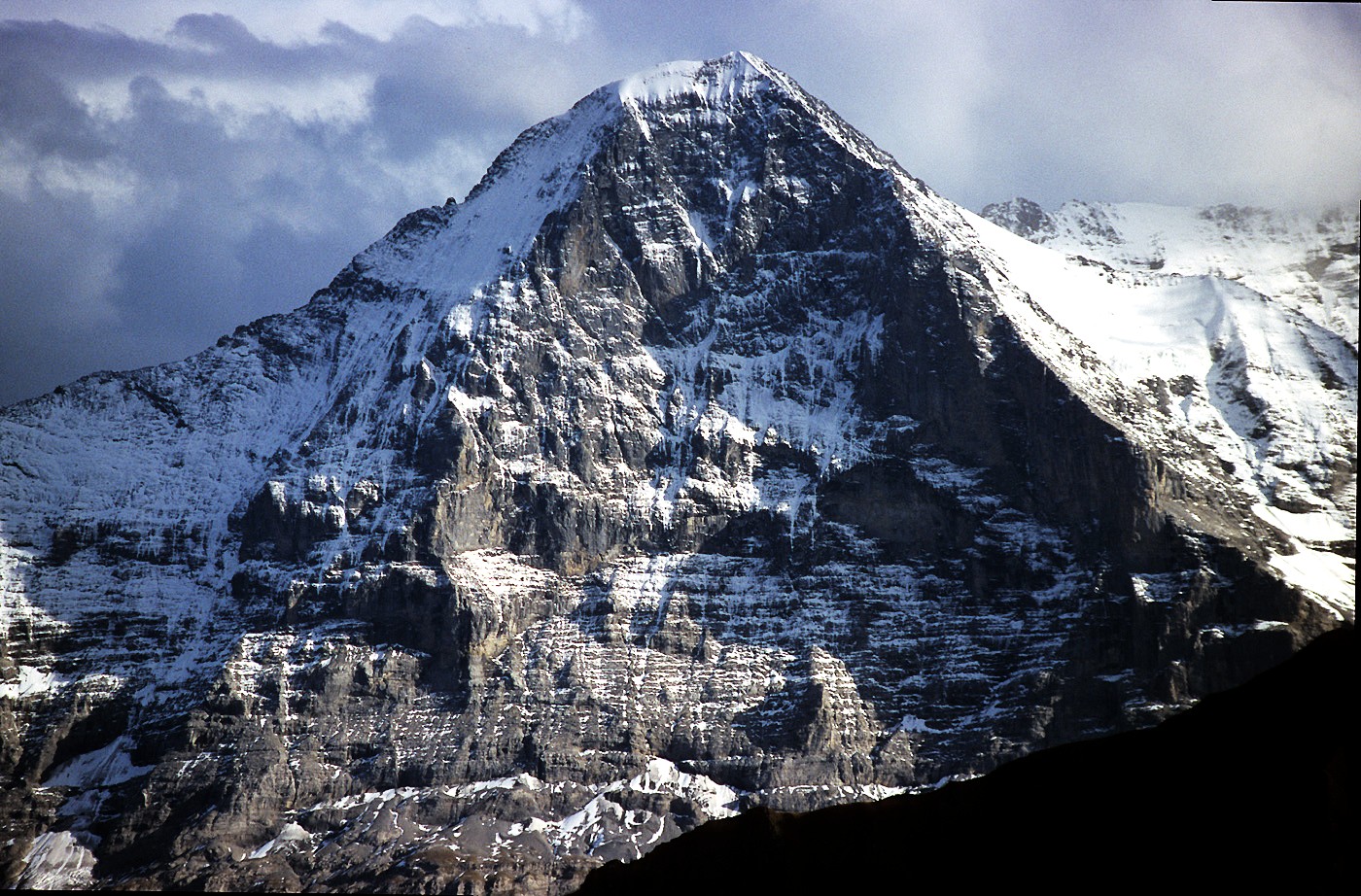
Devastating Strauss Eine Alpensinfonie Op 64 from Semyon Bychkov at Prom 57, majestic yet menacing,  as if inspired by the Mordwand, the "murder wall", pictured above, the north face of the Eiger, which has defied so many who've dared try conquering it.  This was an Alpine Symphony to defy those who don't understand Strauss or his self-deprecating good humour.  "It is a life journey", said Bychov on the re-broadcast, "It's deeply existential, it starts with one coming into the world, travelling through all the things that happen in one's life and then in the end, going back into the night and going into the next existence, whatever it is.... It is something that invokes very powerful images and deals with the entire spectrum of the human condition. For us on the stage it is like living a life in the span of fifty minutes or so.  It is full of tension, it is relentless. The 22 episodes succeed each other, but if one can unite them into one arch, uninterrupted, it gives the feeling of  a journey. It's full of joy, it's full of drama, pain, of suffering - it's everything"

Eine Alpensinfonie a Heldenleben? Mountains as metaphors for life, a subject on which I've written extensively (follow link below on mountains)  Bychkov's strong-minded Strauss could be a companion piece to Mahler's Symphony no 3, which Bychkov has also conducted extremely well.  The Alpine Symphony is shorter, but concise, the ideas more concentrated.   Even Bychkov's Mahler Symphony no 6 (read more here) was infused by this insight into the concept of landscape providing structure for metaphysical ideas.   In the "Nacht" episode, horns call us forwards, and cymbals crash. The "mountains" loom ahead, emerging out of the rumbling darkness into sunlight.   As Boulez used to say "Listen for the trajectory". No waffling here.  Bychkov leads the ascent with urgent, though not rushed purpose.  The lyrical segments use metaphors like forests and brook, but their value isn't merely scenic. The waterfall sparkles with life : the stream originates in a source high above, possibly from beneath the primeval glaciers.  Thus the bright sparkle in the orchestra, as if the music itself were infused by light, the wind instruments, literally suggesting wind, speed and  movement.

The "Erschienung" is a warning.  Elemental mountain spirits haunt alpine lore. In musical terms this introduces mystery, a reminder that getting lost in mountains can get you killed. The "meadows" of calm serve as a looking-back, a pause that highlights the arduous ascent. For a moment, we're rewarded with expansive vistas, the strings shining, the brass suggesting vast scale.  What is this "Vision"? Is it a panorama, or a glimpse of higher spiritual and artistic ideals?  But just as we think we've reached the high point, darker, more elusive elements enter.  In the mountains, storms can appear in sunny skies, as in life.  Bychkov shaped the quieter passages : single, sharp  bowings and pluckings carefully observed.  The timpani crash, the orchestra breaks out in tumult, though a tumult meticulously defined so its colours remain ferociously vivid.  Lose your wits in a mountain storm and you're dead. After the outburst, the music stretches again: elegantly but with affirmation.  Strauss includes celeste and organ for sonority, but also to suggest what might lie behind the transcendance. As Bychkov said, we don't know what lies ahead, but we are not really back at the beginning. though the diminuendos might evoke clouds and nightfall.  In this performance I kept imagining that I heard echoes of other works. including  Mahler 8, but definitely not direct quotes.  As in so many things, the wider your experience, the more you get out of life,  and the more you learn from your "journey", a message which does reflect the firm resolve of Strauss's conception.  Definitely not a "chocolate box" performance!  Bychkov's intelligence and clarity of vision made this an immensely rewarding traverse. 

At first, the connection between Strauss's Alpine Symphony and Thomas Larcher's Symphony no 2 "Cenotaph" might have seemed a stretch. Larcher lives in the Austrian Alps, apparently almost off grid, and much of his output  is mystically contemplative, like his Violin Concerto (more here), his Piano Concerto and his Die Nacht de Verlorenen (more here)  Larcher's Symphony no 2 grew from his anguish over the refugee crisis in the Mediterranean, and the images of drowned children and fleeing migrants.  But don't expect a "programme" or any obvious signposts. Instead, it's a piece which deals with emotional response to crisis: shock, anger, frustration expressed through abstract sound. Thus the large orchestra and multiple voices,  complex cross-rhythms and density, a powerful repetitive theme which pounds fiercely, dissipated only by rising, sharp figures that then explode in an outburst of fast-moving flurries.  A hollow non-melody where the bow of a single violin skitters over wood is absorbed by the orchestra but then emerges once again, after silence.   Vividly angular lines, wind machines, dizzying changes of tempo. The insistent pounding repetitions seems to rise like an insane dance, then disintegrate into shards, followed by an odd but very beautiful quasi-minuet that breaks off after a few bars, then revives in the third  movement, a scherzo where the repetitions become fuller, and more circular.  The lone violin returns for a brief moment, followed hy low drones and then silence.  (Photo of Thomas Larcher above copyright Richard Haughton.)

"I want to explore the forms of our musical past under the light of the (musical and human) developments we have been part of during our lifetime"  Larcher wrote for the premiere this June where Bychkov conducted it with the Vienna Philharmonic Orchestra  "How can we find tonality that speaks in our time? And how can the old forms speak to us? These are questions I often ask myself. This piece is very much about different forms of energy: bundled, scattered, smooth, kinetic or furious."   This Proms season, there have been premieres which have been just awful as music ( Lera Auerbach), barely redeemed by good performance, and work ruined by conductors who think one  size fits all, regardless of genre (no names, but thank goodness one of these is moving on).  Bychkov doesn't conduct much new music, but here he showed what a real conductor can do when he cares enough about music to do it properly.  Larcher's Symphony no 2 is a keeper. If the BBC would programme good new music with good performances, instead of commissioning titbits  and populist crossover, audiences would realize what's really happening in the world. 

Between two pieces of non-programmatic work based on theoretical programmes, Richard Wagner's Wesendonck Lieder in Felix Mottl's orchestration, with soloist Elisabeth Kulman.  Pleasant enough but, for once, Wagner didn't eclipse all else.

Wednesday, 21 October 2015

Chailly Leipzig Gewandhausorchester Barbican Strauss Heldenleben


Riccardo Chailly conducts the Leipzig Gewandhaus Orchestra in three concerts at the Barbican, London, featuring dramatic orchestral works by Richard Strauss. Highlight of the first evening was Ein Heldenleben Op  40 (1898).  At a time when Wagner was fanatically idolized by followers even more extreme than The Master himself, it took guts for a composer still only in his 30's to poke fun at the whole concept of heroism. Cosima  would not have countenanced such impudence at Bayreuth. With his self-deprecating good humour, Strauss undermined  19th century concepts of power and value. In his own way, Strauss was more radical than Mahler.  Now there's a provocative thought!

For my review of the rest of the Chailly Leipzig Gewanndhausorchester Strauss Zyklus see HERE. 

The Hero (represented by solo violin) embarks upon a mission.The references to Siegfried's Journey down the Rhine are clear - glorious, glowing strings   The famous "golden"  Leipzig sound, augmented by Chailly's ear for operas: a wonderful combination that may, if anything, blossom further when Andris Nelsons takes over from Chailly. Characteristically, Strauss undercuts this theme with delicate woodwind flutterings. Perhaps we're hearing the wood dove. But Chailly's musicians played with such definition that I felt that they were highlighting the vulnerability that so many bombastic heroes try to hide. The horns called, but heralded adversity rather than adventure, Chailly didn't hide the underlying dissonance, so the section "Des Helden Gefährtin"  felt more equivocal than  serene. A good insight. Perhaps Strauss was thinking how Siegfried dumps on Brünnhilde, the real hero of the Ring. Siegfried has no fear, but also little depth. Perhaps Strauss was also thinking of himself and  the  tempestuous Pauline de Ahna. His loyalty to her was also an act of quiet, good-natured heroism.

Bearing in mind this dialectic between public display and private good sense, The Hero's Battlefield takes on deeper meaning. Wonderful orchestration employed for maximum effect and played with passion by the huge orchestra: yet also telling details in and around it, like the trumpet solo and the descending "starlight" figures that might recall the woodwinds theme from before, or lead towards the resolution where peace, and perhaps wisdom may lie. Where, earlier, the celli murmured worshipful resonance, now they and the harps evoked a more sophisticated, complex mood.  Now, with the richness and character of their playing, the Leipzig Gewandhaus Orchestra demonstrated the true depth of meaning in this tone poem. The solo violin melody returned, confident and exqusitely beautiful, the full force of the orchestra supporting it. Real heroism , here : no costumes and hunting horns required.

 When Chailly started conducting Concertgebouw Amsterdam, there were voices of dissent because he was different to the conductors they'd had before, because he did "new music" and because his Mahler didn't sound like Mengelberg or Haitink. So? Donald Mitchell loved Chailly's Mahler, which is good enough for me.  I've learned a lot from Chailly's very individual approach. Chailly spent 16 years at the helm of the Concertgebouw, a fact which speaks for itself. When he moved to Leipzig, the chemistry was instant. Right from the start, their partnership felt perfect. The "Chailly era", which has lasted ten years now,will be remembered as legend.  In London, the Leipzig Gewandhaus Orchestra is heard in this country often enough that they feel familiar, like a "house band"  Incredible luxury.

Before that perceptive Ein Heldenleben, Strauss's Don Juan Op 20, written ten years before, which showed how far Strauss had matured, as musician and as a human being. Between very early Strauss and early Strauss, Mozart Piano Concerto No 27 in B flat major, K595, with Maria João Pires.  The piece is elegant; she played with grace. But don't mistake  her delicate touch for weakness. Diminutive but formidably assertive, Pires's playing style is decidedly heroic. 

Sunday, 18 October 2015

Strauss Elektra Goerke Nelsons Boston Symphony Orchestra


Richard Strauss Elektra in Boston with Andris Nelsons and Christine Goerke. Goerke "is" Elektra, like no-one else. She inhabits  the character, using her voice to channel  Elektra's turbulent emotions.  Elektra rejects everything her mother stands for, even if it means going feral. The part is merciless,  driven by wild extremes. Animal-like mutterings give way to howls of frenzied rage.  Yet Goerke takes her cue from the music around her. Even in the frenzy of her final dance, when words fail, Goerke exudes regal dignity. This performance was outstanding, by far the most intense of the three Elektras I've heard her sing.

Let us pray that the Boston Symphony Orchestra finds a way to make the broadcast more widely available, because this will be a kind of landmark. Goerke was amazing, but she was challenged and stimulated by equally exceptional orchestral playing.   Goerke and Nelsons have worked together before, and have a kind of natural chemistry,which is quite unique. When they did Strauss Elektra at the Royal Opera House in 2013, word got round even in early rehearsals that something extraordinary was going to happen. Read my review here. When the production was first done five years previously, it was misunderstood, but Nelsons and Goerke made it work. Some thought the production had changed. It hadn't. Lucky for us, it is being revived, because it's good. Hopefully, we'll get Goerke again. Last night, after the Boston performance, I thought about putting on the Aix production (Salonen/Chereau/Herlitzius) but couldn't face it.

This performance also proved why the Boston Symphony Orchestra wanted to grab Nelsons and hang onto him against all comers.  Just as there is more to singing than making sounds, there is a lot more to conducting than waving a baton. Nelsons is inspirational because he genuinely loves music. As Claudio Abbado said, that kind of love motivates creative people and fires them up to do things that those motivated by hate can't comprehend.  Listen to this interview with Christine Goerke where she explains how she works, and how singers work with conductors. What a personality, down to earth and no fool.

This superlative Elektra showed that  the BSO can rise to the challenge of a conductor who is very different, and who can push them in new  directions. Their  basic technical standards have improved greatly since I last heard them in August. Read my review of their Mahler 6th at the Proms here. (I was a lot less scathing than some.) This Elektra shows what they can do when they go outside their comfort zone. It was even  more visceral than Semyon Bychkov's Elektra with the BBC SO, where Goerke also sang with Gun-Brit Barkmin as Chrysothemis. Read my review here.  Boston Symphony Hall is a smaller place than the Royal Albert Hall, which helps concentrate the impact.
 
Now that Nelsons is taking over the Leipzig Gewandhaus Orchestra, the BSO will embark on a partnership with the oldest and possibly finest orchestra in the world.  This is an unprecedented deal, which raises the bar very, very high indeed. 

Wednesday, 22 October 2014

Very Strange Strauss - Wiener Staatsoper livestream tomorrow


Richard Strauss Ariadne auf Naxos live streamed on the 23rd from Wiener Staatsoper. Be prepared for an adventure. Sven-Eric Bechtolf's realization brings together different versions of Strauss's score together with extra dialogue, some from von Hofmannsthal, some from Molière Le Bourgeois gentilhomme. As an experiment, it's certainly interesting since it develops ideas about the relationship between patrons and artists, between nouveau riche status-seekers and supposedly superior aesthetes, and  between the age of Molière, Mozart and Strauss. In theory, conceptually valid, andf a lot more challenging  than something lumpen, which misses the different levels on which Ariadne auf Naxos operates. This is not an opera that should be taken at face value!  So be prepared for a shock, but be patient. "Ordinary" Ariadnes auf Naxos one can hear anytime. This one probably won't appeal to those who like Strauss coated in sugar, though it's visually delicious and might appeal to those who go mainly for costumes. But it should stimulate those who value the intellect behind Strauss and von Hofmannsthal (who appears "in person").

This cast is different to the one captured on DVD.  Christian Thielemann should be fine, though I loved Daniel Harding's witty, elegant and drily subversive Mozartean touch.  Soile Isokoski sings/speaks the Diva/Ariadne: she should be good as she has a sense of humour. Some divas, I fear, aren't too comfortable with the subtle way Strauss sets up ageing divas while giving them moments of glory. Johan Botha instead of Jonas Kauffmann - definitely a completely different dynamic. Hearing this production first time live is a bit confusing, but DVD lets you listen more than once, so it grows on you.That said, this is an interesting curiosity, rather than something you'd watch for casual entertainment.

More livestreams coming up:
2nd  November: Wagner Tannhäuser (Schneider, Guth)
7th November: Puccini La Bohème (Ettinger,Zefferelli)
21st November: Mussorgsky Khovanschchina (Bychkov, Dodin)
25th November: Mozart Le nozze di Figaro Sascha Goetzel, Jean-Louis Martinoty)
14th December:  Rossini La Cenerentola

18th December: Strauss Arabella , which is also available on theWiener Staatsoper archive

Monday, 1 September 2014

Electrifying Elektra Goerke Bychkov Prom

Electrifying Strauss Elektra at BBC Proms 59 = Semyon Bychkov, Christine Goerke. Amazing on radio asnd even more so live. Indeed, this was one of those rare occasions when you can say, in awe, "I was THERE!". The Royal Albert Hall is a huge barn of a hall.  Six thousand seats placed round a hollow space that rises upwards, culminating in a dome that used to suck up sound until they added those space-age acoustic baffles.  But there's nothing like a Royal Albert Hall Prom. The atmosphere is so intense that the excitement must communicate to performers. If they've not overwhelmed (understandably) they can be challenged to give the performances of their lives.

Yet, despite the size of the Royal Albert Hall, Semyon Bychkov conducted an Elektra so full of intelligent detail that the vast cavern of the building seemed to burst with colour and incident. The BBC SO aren't normally an "opera" orchestra, so perhaps they were responding to Elektra as dramatic orchestral music. Bychkov made the music move, almost as if it were an invisible demonic force. Agamemnon has long been dead, yet his ghostly presence hangs heavy over those he's left behind. In Charles Edwards' production (read my review here) the dead king hovers over proceedings like a shadow. Bychkov's intense, impassioned conducting suggests the psychic havoc the king must have unleashed in his time. Perhaps the savage, pathological genes Elektra and Orestes carry came from him  Their lust for revenge goes far beyond filial love. Maybe Clytemnestra killed him because he wasn't a nice man.

Add caption
Soon after Elektra starts singing, the "dance" theme  bursts out. Dance in this case is a form of madness. Bychkov conducted the circular rhythms so we could feel the obsessiveness percolate. Savage climaxes, the strings screaming and stabbing. The axe lies buried underground but "sings" through the orchestra. Strauss builds maniacal laughter into his music, and  even  the unearthly bright stare some schizophrenics exhibit. Woodwinds played sensually but with morbid undertones. Bychkov's ear for detail is musically informed but also psychologically true. Someone complained that the ROH production wasn't "palatial" or elegant. But for Strauss, and for Bychkov, this palace is a prison of the soul. Andris Nelsons was brilliant at Covent Garden last year, but Bychkov works with the dynamic of the Royal Albert Hall to bring out subtleties often missed, like the parody of waltz and "family values". In the final dance, Bychkov highlights the percussion,  with its intimations of the organized violence of a military society where women like Elektra (or Clytemnestra) can't act other than through men.The lushness of this instrumentation is deceptive. Like the palace, it's poisoned. The savage last chords made me think of Wozzeck.

Christine Goerke has created so many Elektras in recent years that she probably owns the part these days. Her voice is richly resonant, shading into mezzo territory, which allows a remarkable range of emotional expressiveness. Elektra's a killer part, forcing the voice up to the extremes, torturing technique, but Goerke delivers. She's not afraid to let the role dictate the way she sings. When she recognizes Orestes, her voice rises to near-scream, then softens into tenderness. How long it must have been since Elektra felt safe enough to feel human kindness, Goerke's voice warms yet still carries memories of pain.  Through Goerke, we glimpse what Elektra might have been. At the Royal Albert Hall, Goerke displayed a new dimension to her artistry. She wasn't giving an "opera house" performance but enacting the role in such a way that she filled the massive auditorium, not with amplified voice but with amplified personality. Truly remarkable: in all these years of Promming, I can't remember any singer taking control of the RAH like this. She made an impact that felt strikingly personal, up close and human, as if the distance her voice carried meant nothing, and we were one-to-one with Elektra in her isolation.

This warmth in Goerke's voice was paralleled by Gun-Brit Barkmin's Chrysothemis. Little sister wants marriage and babies, not death   Yet the firmness in Barkmin';s timbre, and the assertive confidence in her delivery  brings out the underlying strength in the role. We need to hear more from Barkmin. ROH take note! Chrysothemis is no Barbie Doll image of womanhood. Although Justin Wray is creditted as stage director, there wasn't any evidence of directing (other than use of lighting) until the final scene when Goerke and Barkmin embraced each other. Subtle, but significant.

Much-loved Dame Felicity Palmer sang Clytemnestra, receiving much applause. Although her voice is beginning to show its edges, Palmer's experience in the role paid dividends. When she sang about her fears, she made the chaaracter sympathetic. Cold-blooded killers don't fear bad dreams or, for that matter, fall for toy boys.  Johan Reuter sang Orestes, with Robert Künzli as Aegisthus. Katarina Bradić , Zoryana Kushpler, Hanna Hipp, Marie-Eve Munger, Iris Kupke, Miranda Keys as the maids and their overseer, Ivan Turšić as a young servant  and Jongmin Park as Orestes' tutor completed a fine line-up.

Strauss Elektra Prom 59 - part ONE, part 2 follows

My review, as pronised, is HERE.  Richard Strauss Elektra, BBC Prom 53 – an amazing experience!  Semyon Bychkov, Christine Goerke, Felicity Palmer and a cast who could hardly be faulted.  Christine Goerke "is not one of those Elektras who start the opera as demented and raddled. From the opening she projected youth and a certain rapture in the vocal line. Only gradually did you come to realise that this young woman was unhinged. Goerke had a way of smiling to herself which told volumes. What was refreshing about her performance was that, though certainly a very big sing, she did not seem to need to attack every single phrase. There was some profoundly poignant moments and this was one of the most sympathetic Elektras I have heard in a long time."

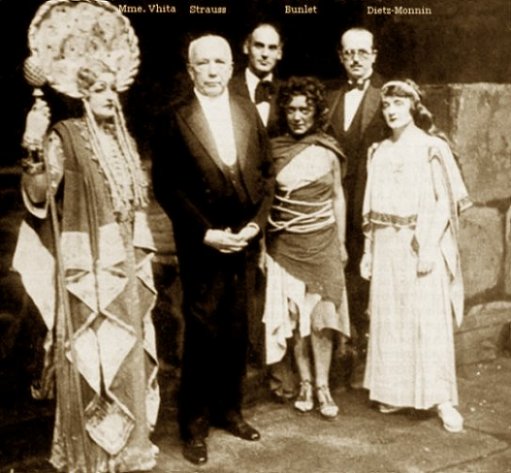
Please read the full review in Opera Today HERE  I'll be writing too about the experience – for an experience it was! The Royal Albert Hall is a vast cavern, but Goerke filled it  so well that she made Elektra feel close up and personal.  Read my review here.Photo above shows Strauss at the premiere. Note costumes. That Clytemestra's not authentic period  Greek!

Operas we can hear in an opera house anytime, but this was no ordinary performance.  I loved the Royal Opera House production in September 2013 (which I reviewed HERE), and so did just about everyone else. I saw the previous  ones too, but 2013 was by far the best.  Goerke and Andris Nelsons, go figure. When this production is revived again, do not miss it as  it's very intelligent and very passionate, which is perhaps why some didn't get it in 2008.

Sunday, 31 August 2014

Stemme's stunning Salome Prom 58

Stunning Nina Stemme Strauss Salome Prom 58.  Full review in Opera Today by Robert Hugill

"The problem with Salome (written in 1905), is that though premiered barely a century ago it dates from an era of different performing styles. Dramatic sopranos had voices which were more lithe, more narrow in focus. Orchestras were generally quieter, with narrower bore brass and gut strings, and the orchestral sound a lot less dense. Production values were more forgiving, Audiences didn't generally worry about whether the heroine looked 16. But early sopranos in the role would probably sound a lot younger, to our ears. Nowadays, both singers and directors frequently move the character into maturity."

 "The remarkable thing about Nina Stemme's account of the title role was the wonderful brightness and freshness that she brought to the vocal line. Singing with a lovely, fluid sense of line, this was a singer who really did link this music to the Strauss of the songs and the later operas. There wasn't a screamed note the whole evening, and she seemed to be able to encompass the whole role whilst preserving focus and flexibility. As Brünnhilde, Stemme does not have a huge voice compared to some of the Brünnhildes of the past, but this is an advantage as Salome.She both looked and sounded young. From the moments of her first entry (throughout she was off the book, and fully acted), it was clear that this was a petulant, selfish teenager. Salome's naivety and inexperience came out in Stemme's voice and her body language. It was wonderful to see and hear the way petulance gave way to desire and more; the typical teenager reaction of becoming obsessed with something you are not allowed to have." 

Read the full review here in Opera Today.
At left, Astrid Varnay's Salome in bra size 60LLL

Friday, 1 August 2014

Strauss Choir and Elgar Symphony Petrenko Prom 19


A Strauss choral work and an Elgar symphony - Vassily Petrenko and the Royal Liverpool Philharmonic Orchestra shook things up with devastating impact at Prom 19.  Strauss's Festival Prelude was written for a grand occasion - the opening of a new concert hall in Vienna in 1913. It's a massive, no-holds-barred piece glorying in drama and excess, ideal for grand surroundings like the Royal Albert Hall  Strauss packs intense power concentrated in a relatively short piece. All those instruments have to make their mark - no room for messing about. Petrenko and his orchestra seemed electrified - taut, energetic tempi, perfect cohesion, every note making an impact. Such vibrant energy,  We know now what Strauss didn't know in 1913. The Hapsburgs  and the gilded magnificence they stood for would be deposed.  Vienna, once capital of a great  empire, would be become capital of a truncated rump. But for a moment, Petrenko made it come alive again. He made us feel the optimism, the bravado, the sense of limitless confidence. This piece is standard Proms fare, but I don't think Ive ever heard it conducted with so much intelligence or purpose.

This set the scene for  Strauss's Deutsche Motette, also from 1913. This piece is even more remarkable, technically, because Strauss does with voices what he does with orchestration. This is a choral piece that defies normal convention. The four basic blocks  of voice type are refined, so the piece operates in 16 parts, blending sounds in a wash of extreme subtlety. Strauss didn't have much time for oratorios and  choral tradition. In Deutsche Motette he redefines the rules. His text is based on Friedrich Rückert's poem Die Schöpfung ist zur Ruh' gegangen,,  (all creation is at rest). The poet describes a panoramic landscape, rendered still in the silence of the night. "Es will der Schlaf auch mich befangen,"  sleep as a form of suspended animation. The balance of voices is essential, for nothing must destabilize this hypnotic magic, lest the spell be broken. A metaphor, too, for the world of 1913, now lost forever.

Exceptionally beautiful singing. This piece is a tour de force requiring great co-operation between singers, though each voice must remain distinct.  Suzanne Shakespeare sang the soprano part, Tara Erraught the mezzo, Adrian Dwyer the tenor and Brindley Sherratt the bass, backed by the BBC Singers.  In a performance as good as this, it would be a bit unfair to pick out exceptional singing but Sherratt and Erraught stood out like stars in the firmament, their lower timbre reinforcing the mystical sensuality at the heart of the piece.

Inger Dam-Jensen was the soloist in Strauss Four Last Songs, also magical songs on the theme of sleep and death. Whoever planned this Prom programme knows their music. Nearly 40 years after the Deutsche Motette, perhaps Strauss was looking back on his life and the world he had known. Although we've all heard more ideal performances of these songs (and the maddeningly superficial Prom with Christine Brewer) , listening to Dam-Jensen with lingering memories of the Deutsche Motette made this a performance to remember fondly.

Liverpool, the Cinderella of British cities, has much to be proud of in Petrenko and the Royal Liverpool Philharmonic Orchestra.  They're a wonderful team. It's a shame we in London don't get to hear enough of them. They're developing a unique sound - vivid and rejuvenating   Petrenko loves Elgar, and hears in him a "Russian soul".  Elgar's Symphony no 2 sounds mysterious with Petrenko. Even the "windflower" motif breezes along elusively. There are many cryptic clues in Elgar's music, many of which will never be solved. Four-square performances may be more common, but Petrenko's approach in many ways gets closer to the magic behind the notes.

Wednesday, 23 July 2014

Der Rosenkavalier BBC Prom 6


Glyndebourne's Der Rosenkavalier came to BBC Prom 6. I was at the premiere (read my review here), captivated by Lars Woldt's unusual but singularly perceptive Baron Ochs. What a pity the Baron Ochs of the media were more focused on whether Octavian was sexually attractive to them, "either as man or woman". Its not up to them. If Ochs is fooled, that's his problem.  (Read my analysis of the interpretation of the role HERE)

The first act of Der Rosenkavalier usually gets most attention because it's luscious. But Strauss satirizes convention and superficial appearances. In the final act, Baron Ochs is shown for the boor he is. It's Octravian who sets him up. At the very end of the opera, the Marschallin renounces her hopes and blesses the young lovers. Quite pointedly, Strauss suggests that wallowing in the past is not good. In the new lies the future.  After Elektra, Der Rosenkavalier might seem a stylistic step backwards, but don't be fooled. Strauss references Mozart but also throws in sly barbs at the Strausses of Vienna, who turned the Mozart ideal into banal pap. The famous tenor aria is cute, but it's commercial, a consumer product like new clothes and hairdos. Baron Ochs likes music, too, but the music he likes is barely above the level of pop.

Just as we should beware of sugar, we should beware of too much sugar-coating in Der Rosenkavalier. Strauss's music and von Hofmannsthal's text savage mindless convention. Richard Jones respects the composers's intention far more astutely than the Ochsen of this world would ever comprehend.

At the Proms, the Glyndebourne Rosenkavalier was not staged. Lars Woldt was unwell, replaced by Franz Hawlata, who sang Ochs for Andris Nelsons in Birmingham last month,. I've loved Hawlata since he was a colleague of Jonas Kaufmann in the stable at the Bayerisches Staatsoper in Munich.  Hawlata's voice is more resonant than Woldt's, more closer to the ox-like heft with which the part is often done. Although I missed Woldt's snake-like wiliness, hearing Hawalata was compensation enough.

Strauss's fondness for sopranos at the height of their fame but almost, not quite, past their prime ensures that the Marschallin is usually cast for a Big Name, thus ensuring box office attention. But strictly speaking, between the first act and the final scenes, The Marschallin doesn't really have much to do, though what she does is pretty remarkable. Kate Royal is a perennial favourite ith the Glyndebourne crowd, and perfectly adequate, but shes not in the ranks of, say, Schwarzkopf, Isoskoski or divas in their class. Still, shes beautiful, whether in evening gown or nude suit, and sang with a nice wry touch, accessing the spirit of the opera with intelligence.

In many ways, Der Rosenkavalier predicates on Octavian, who may only be 17 but has all the nerve and verve of a teenager who's just discovered sex (and cross-dressing). Again, Strausss' music poses a conundrum. Octavian is an extremely demanding part, interpretively as well as vocally. No 17-year-old could do it. Much better that a singer approaches it with youthful exuberance. Tara Erraught brings genuine freshness to the part, singing with sprightly agility. I like the roundness in her timbre, which suits the part. So what if Strauss mentioned that he'd like Octavian to be "willowy". His music suggests otherwise. Anyone familiar with Strauss should expect cryptic clues and contradiction. Erraught is only 27, so she's still to reach her full potential. One day, I suspect, she'll very good indeed. Certainly she impresses German audiences, who know a thing or two. In Birmingham, Alice Coote sang the role: Erraught isn't quite up to Coote's standard, but she could well get there, and deserves respect from those who care about music.

I wish I had been to Birmingham to hear Andris Nelsons conduct Der Rosenkavalier with the CBSO.  Everyone I know who was there loved what he did. Robin Ticciati has only just started his tenure at Glyndebourne. The premere I attended was in fact his first formal day on the job, so to speak. I loved his work with the Scottish Chamber Orchestra. He's also a Glyndebourne insider, a regular conductor of  Glyndebourne Touring Orchestra.  In Der Rosenkavalier , Strauss throws challenges at conductors, too, to test whether they can grasp the tough-minded irony beneath the frothy sugar frosting.  That takes a feel for originality and even quirkiness, which is why, for me, Carlos Kleiber takes the cake. Ticciati has potential but he needs more self confidence.

Louise Alder sang Sophie, more developed and richer  than Teodora Gheorghiu at Glyndebourne. Michael Krauss sang Faninal. Full cast list here. Sarah Fahie directed the Proms semi-staging. She directed movement in the Glyndebourne production, every gesture  expressing character. Definitely a director to watch out for.

Claire Seymour's reveiw  is in Opera Today

photo : Tristram Kenton, courtesy Glyndebourne Festival Opera

Thursday, 26 June 2014

Ariadne auf Naxos - Royal Opera House

Karita Mattila's presence guaranteed success for Strauss's Ariadne auf Naxos at the Royal Opera House. Strauss was a pragmatic man of the theatre, who knew how a Big Name could win audiences. Mattila delivered. Her presence was commanding - every inch the glamour queen the primadonna is meant to be. She had the grand gestures and right amount of theatrical excess. But Ariadne auf Naxos isn't about ancient Greece. It's an opera about an opera, or rather,  as the Composer discovers, about the un-making of an opera. 

The Composer  (Ruxandra Donose) wants to write  about Ariadne, abandoned on an island. Strauss builds in references to Mozart, making wry jokes on the nature of art. If the Composer were really good he wouldn't be imitating someone else.  The Composer disappears after the Prologue, but Mozart lingers eternal. One of the Dryads, Ariadne's handmaidens, is costumed as Mozart. Appropriately, this Dryad is Echo (Kiandra Howarth). But even Mozart can't save things, as the show is taking place in the house of "the richest man in Vienna". His Major Domo (Christopher Quest) clashes with the Music Master (Thomas Allen). The man with the money wants fireworks and comedians and what he wants will happen.

This production, directed by Christof Loy, with designs by Herbert Murauer, emphasizes the duality in the opera. "Upstairs" in the Prologue is elegant but empty, and soon dispensed with. Loy stresses the individuality of each singer, so their purpose can be understood even by those in the audience who aren't familiar with the opera.  This further underlines the concept of multiple realities so fundamental to this opera.  That is the magic of theatre: it's not literal reality. Singers become supernatural maidens, and comic rogues become Commedia dell'arte archetypes. But Ariadne, too,  lives in a strange, unnatural reality . She's been on Naxos since Theseus dumped her there after giving her a kiss to steal the secret of the Minotaur. For years, she's lived in a cave driven half mad by her dreams of love.  It's Bacchus (Roberto Sacca) who brings her deliverance.  And Bacchus, the god of wine, brings intoxication, the illusion of escape.

Visually, the second act glows with jewel colours, emerald and sapphire, lit with details of gold and candlelight. The room is lined with late baroque wallpaper depicting Arcadian scenes, rich European fantasies of wilderness. Because we're seduced by this luxury and beauty, the ultimate tragedy hits even harder.  Ariadne isn't going to find happiness. The future lies with Zerbinetta (Jane Archibald)  Ariadne obsesses about death and misery. Zerbinetta gets on (and gets off), exuberantly, full of vigour and life. Strauss is writing about the making of theatre, but also commenting on music.  Looking backward is all very well, but the nature of true art is originality and creative renewal.

Karita Mattila's Ariadne is courageous. Mattila throws out her notes in the second act with bravado,  diva reborn. but Strauss created the part for an older singer, thoughtfully limiting vocal extremes to flatter voices that are still loved, and function well enough, even if they aren't quite at their peak. Zerbinetta's music, on the other hand, races up and down the scale, demanding great technique and coloratura display  Archibald's  "Grossmächtigen Prinzessin" was done with vigorous zest. Although she doesn't have the finesse of some of the great singers who have done this role, her vivacity compensates. Ariadne  may be comforted by the words, but how discomforting the singing must be for any older singer.

Ruxandra Donose sang a remarkably convincing Composer. It was hard to recognize her costumed as a man, but the distinctive timbre of her voice was unmistakable. What a pity Strauss dismisses the part: Donose makes the composer sound interesting as a person. Very strong singing in the other parts, enhanced by a staging that emphasizes their place in the opera. Markus Werba's Harlequin was superb,, as energetic and as witty as Archibald's Zerbinetta, which is quite saying something. Excellent ensemble work : Werba, Jeremy White, Wynne Evans and Paul Schweinester interacted  with precision, moving as a unit even when they weren't close together. That's good movement direction (Beate Vollack).

Antonio Pappano has been working flat out this week with Manon Lescaut (read my review here). He must have the stamina of a superman. I could have used more "fireworks" at the cataclysmic end of the Prologue. Pappano is a genius Puccini conductor, but he gets the lively gaiety in Strauss quite well.

One big plus : no ritual booing. Booing is a form of intimidation.  Booers have no right to inflict their opinions on others.  Almost inevitably booers don't really know the score and don't have the ability to take on board the simple fact that other people might be allowed different opinions. Booing is vulgar and coercive, a form of expression used by those too ill bred and ill informed to respect anyone other than themselves. Perhaps the penny has dropped that booing inhibits creativity and is fundamentally anti-art.