Showing posts with label Macau. Show all posts

Wednesday, 25 December 2019

Ivory Infant Jesus, 17th century Macau

The Infant Jesus, holding the world in his hands, carved in ivory in the 17th century.  Once ivory objects were made all over Asia and Europe from very early on. Since Africa and India were part of the East-West trade route, smaller religious figures
like these were common in Portuguese communities, all along the route. In Macau, there's a museum of baroque religious art, ivory, silver, gold reflecting the prosperity the city once enjoyed. This particular figure is in Macau, but it's carved in the "Indian" style, Goa being a major centre of religious art.  Japanese and Chinese ivory workers were also involved. Santos were also revered in private homes. My grandparents inherited an heirloom cabinet from the 18th century, big enough that the sons could crawl in to do the cleaning before Holy Days, as part of religious observance.  It was destroyed during the war.  Eventually my Dad started a collection but it was nowhere quite the same. Most of the figures were clothed in hand-embroidered silks and lace, but very few of those garments survived, especially since new garments were regularly made, as a sign of veneration. But the carving is so exquisite that it's a good thing that the figures are now displayed in their natural glory.

Here's a poem written in Macanese patua. Portuguese from Portugal can't follow the grammar or the vocabulary, since it borrows so freely from Asian languages.

Jesus pequinino

Justo ja nace

De frio tremido

Na nga cham di Belem

Filo Divino Di Virgem Maria

Vem-ca nos vai azinha

Vem-ca nos vai azinha

Vem-ca vai azinha adora nosso Rei

Saturday, 21 December 2019

Cycling underwater, upriver

In a dream I was in modern day Macau in a tiny apartment. Below, in the street, was a pedicab driver ,looking for work. Usually they only carry tourists for short distances. "Take me to Califonia" I asked, naming a mall that long ago went bust.  Unperturbed, he pedals on but the pedicab turns into a bicycle and I'm riding pillion like people used to do all the time.  Suddenly, he takes a sharp turn at the Praya Grande and descends straight into the river; now it's built up but in the dream it’s waterfront, the water brown with delta mud and pieces of vegetation from upstream. How can two people cycle up against the flow of the mighty Pearl River, whose source is in the mountains of Yunnan  ? Beneath the water there's a solid path, invisible above but so firm and straight below that the bicycle doesn't even wobble, though the driver and me are immersed to our chests. So we proceed, untroubled, way up the delta, following the shoreline and ancient villages. Eventually we're back in modern Macau near the bus terminus by the Taipa bridge.  Miraculously, I wasn't in the least bit wet or dirty at all, despite wearing a long white cotton gown through the waters of the river, which are so brown and fertile that they support thriving farming and fishing communities. I offer to pay the driver  but he won't take anything, and disappears. What I've learned from this journey is greater than money can buy.  Nowadays people think they can just deny heritage as if it means nothing.  But without foundations, you're nothing.

Sunday, 15 December 2019

Alua - Macau's international Christmas pudding

Alua or Aluar, traditional Christmas delicacy in Macau. As the photo shows, it's now sold in shops as "Western style Nien Go", ie a variant of the Chinese New Year treat Nien Go (cake/pudding that marks the arrival of a new year). Both are made from more or less the same ingredients, glutinous rice, bing tong (slab brown sugar, either Chinese style or what was known as Jagari, from India), coconut milk, nuts, and sometimes lard or butter (Macau style). Heavy duty - you can only eat a sliver at a time, even when it's fried or steamed to soften it. An excuse to wash it down with lots of Chinese tea.  The surface texture was slightly greasy, and the colour usually dark brown, like the sugar, with almonds and extra coconut.  The treat is also supposed to have Indian origins, with Persian, Goanese and Malay versions as well, which isn't so surprising given that these were points on the trade routes between China and theWest from the 16th century.

Making Alua was hard work - the rice had to be ground down fine with mortar and pestle, and the mix steamed for ages. Families  that made it tended to make it in batches, which were then sold throughout the community. Certain cooks were famous, their wares highly sought after : they took bookings well in advance. Read more HERE.  The last time I ate alua was in Macau when I was a teenager, delicious batch from an elderly lady whose family had been making it each season for 250 years.  Calories and cholesterol weren't an issue then, since most of the year people lived on simple fare - vegetables, fish and rice, and religious Fast Days, and abstinence before Mass were strictly observed.  Christmas was a very big thing in the Macanese community because it reinforced Catholic identity, at a time when being a Christian was definitely a minority thing, and the Macanese with their mixed origins and influences, not part of mainstream Portuguese society.  When my Dad was a kid, many y still celebrated in the old Macau style - heaving tables of food, decorated with home made lace doilies and paper flowers, rows of oranges lining cupboards and shelves (oranges also being a Chinese symbol of happiness and hope). You didn't dare miss Mass, you prayed all week in front of the Nativity.  Lots of other festive dishes like giant meatloaf,  cakes and candies like Farté, cookies supposed to represent soft pillows for the Infant Jesus. Aluar represented the hard mattress (hardship) on which he was born, a refugee, fleeing for his life, something that was integral to our understanding of the meaning of Christmas, when God became man. No Coca-Cola Santa ! no commercial tack and excess.You can't in any case overdose on Alua, or your digestion will rebel. 

Macanese home cooking bears little to no relation to what's served in restaurants these days. Beware many of the cookbooks and "guides".  Even the BBC does Macau food, but the recipes are a joke. Things like African Chicken were invented in the early 1960's by professional chefs. Fortunately, families lucky enough to have hand written recipes from way back, are collectingm them and publishing them within the Macanese community.  Still, closely guarded semi-secrets.  HERE is an excellent and authentic community resource.

Sunday, 10 February 2019

Music to Smoke Opium by - Luís de Freitas-Branco Paraísos Artificiais


Luís de Freitas-Branco (1890-1955) Paraísos Artificiais 1910, a symphonic poem inspired by Thomas de Quincey's Confessions of an English Opium Eater.  Swirling lines flow, lit by harps. shapes shifting in and out of focus as if shrouded by smoke. A woodwind theme arises, seductive and sweet like narcotic perfume. The strings surge, breathing expansively. The andante section sparkles with single note flurries (plucked strings, like lutes) with just a hint of exotic temple bells.  But danger intrudes. Darker themes swell up, angular chords, haunted by brooding, somnolent figures. Nonethelss the flute melody meanders on, poised and unpertured by the horn calls of alarm, and the piece dissolves in relative calm.  It's a sophisticated work, as witty as it is subtle, an imaginative work for a composer aged just 19, especially when you consider that Debussy La Mer had premiered barely five years before, and the innovations of the early 20th century were still to come. . 

Freitas-Branco canme from an aristocratic fasmily, wealthy enough that he and his brother Pedro, who became Portgal's most famous conductor, could study music in Paris and Berlin. But in 1908, the King of Portugal and his heir were assassinated, throwing the country into turmoil.  Freitas-Branco had to find his identity in new territory, like so many others in Europe during that period, often searching exotic forms for a way ahead.  Freitas-Branco had an advantage in that his country had five hundred years of non-European form to reference.  He would have known of the Portuguese Orientalists  such as Camillo Pessanha, who lived in Macau, wrote poems about Chinese music and smoked opium on a regular basis (when modernized Chinese disdained it).     

Many years ago, the specialist label Portugalsom Strauss carried a catalogue of several hundred titles, ranging from early music and baroque to mid 20th century works.  Much of this work is equal to much that was happening elsewhere in Euriope, so it’s a real shame it's hardly knoiwn outside Portugal.  Both Luís and Pedro de Freitas-Branco were represented by lots of different discs.  Naxos has relicensed a small fraction of the Portugalsom catalogiue, but it's high time that more of it were made available, and in better recordings and performance. Lucky for me, I was working then where I could accumulate a few, though I didn't have the money or time to get in as deeply as I wished.

Friday, 10 August 2018

Ao longo da viola morosa

Ao longo da viola morosa
Vai adormecendo a parlenda,
Sem que, amadornado, eu atenda
A lengalenga fastidiosa.
Sem que o meu coração se prenda,
Enquanto, nasal, minuciosa,
Ao longo da viola morosa,
Vai adormecendo a parlenda.
Mas que cicatriz melindrosa
Há nele, que essa viola ofenda
E faz que as asitas distenda
Numa agitação dolorosa?
Ao longo da viola, morosa...

Viola Chinesa by
Camillo Pessanha (1867-1926)   Pessanha, a Portuguese poet, who lived
in Macau, acculturating as Chinese, though never fully integrated.  In
this poem he describes a "Chinese viola" playing a nasal yet meticulous
melody which lulls into strange reverie.  What is this "mournful
agitation"  ? Why are foreigners hypnotized by these strange
imaginings?  The poem was dedicated to Wenceslau de Moraes, Pessanha's
friend who lived the same dream, but in Japan, the two of them outsiders
wherever they went.   In the above photograph, Pessanha is dressed as a
Chinese peasant, while sitting in the gardens of the Villa Leitão in
Macau, owned by the Leitão family, once wealthy and powerful in that
city, now dispersed all over the world, the villa itself long gone.  The
photo below shows Pessanha and Moraes on a visit to Hong Kong in 1895.

Pessanha's descedants still live in Macau, and are related to the Jorge family, who are distantly related to my ancestors. One of the Jorges amassed a huge
collection of Chinese antiques, which covered nearly every inch of his
own villa. My grandmother, who visited often, said that real Ming  and Qing 
porcelains covered nearly every surface in the villa, all over the
walls, in even the washrooms.  In the 1860's, the Jorge family rescued
treasures looted from the Summer Palace in Beijing in the Second Opium
War.  They met the troop ships returning from the north, offering the
soldiers beer for the wonders they'd stolen.  The collection was photographed,
catalogued and printed in a book by Vincente Jorge, printed in 1940,
which I found in an antique shop and gave my father.  A limited edition,
the frontispiece hand painted in water colours (sprays of wisteria).  That
book is now lost, too, as is the Jorge collection, supposedly destroyed
when the ship carrying it out of Macau was sunk by pirates in the late
1940's .  The photo below shows the Villa Leitão c.1890, published by  a
family collaterally related to my own.  And so past glories, past dreams, disappearing into nothing......to live for the moment, and to live well, while you can.

Sunday, 9 August 2015

Martyrs of Nagasaki

Seventy years ago today, on August 9th 1945, an atom bomb fell on Nagasaki.Why Nagasaki ? The most westernized city in Japan, the centre of Christianity and of foreign trade, which for centuries had been Japan's window on the world?  Perhaps the man in the photo, staring at the ruins of the Catholic Cathedral, might have pondered the irony. The people of Hiroshima and Nagasaki weren't combatants, but they've fought a greater battle by reminding the world that nuclear war is not a good thing. Nuclear weapons may have proliferated, but - thank God - no nation has been crazy enough to use them.

Thus we should think of the selflessness of the 26 Martyrs of Nagasaki, crucified , like Jesus Christ himself,  in February 1597. Christianity had reached Japan barely 50 years before, when Francis Xavier "Apostle to the Indies" arrived at Kagoshima in 1549. Within a very short time, the Jesuits had made hundreds of thousands of converts, helped in no small part by long-standing  inter-daimyo rivalries.  But the very growth of Christianity posed a threat to stability, so it was suppressed. Thousands escaped to Macau. Japanese craftsmen built Macau's Church of St Paul's (read more here). Quite probably Japanese DNA features in the Macanese community since officially the Chinese government didn't allow Chinese people to remain in Macau overnight.  After the Japanese invasion of China, millions of refugees poured into Macau, a tiny enclave with hardly any resources. The Bishop said God would provide, no-one should be turned away.  Some of the 16th century cannons in the Monte Fort were supposedly sold. Weapons turned, not to plough shares, but to rice.

The Martyrs of Nagasaki were killed to send a political message. Huge crowds were forced to watch their sufferings. Yet they weren't silenced. From their crosses, they sang psalms. Three of the martyrs were Japanese. One was Paul Miki, scion of a samurai family, fearless in the face of death. He's quoted as calling out to the crowd "“I am a Japanese and a brother of the Society of Jesus. I have committed no crime. The only reason I am condemned to die is that I have taught the Gospel of our Lord Jesus Christ. I am happy to die for that and accept death as a great gift from my Lord.”  He asked the crowd if they saw fear on the faces of his companions. He said they didn't fear because they believed in a higher level of existence.

True Christians, like Buddhists, and indeed any people with a moral base, don't hate. They break the vicious cycle. The people of Hiroshima and Nagasaki, by campaigning against nuclear weapons, serve a higher cause.  On 29th October 1943, in Hong Kong, 32 men and one extraordinarily brave woman were beheaded. Reverend Wong Shui Poon was among them. He was 65, a Cambridge graduate and head of the Chinese Christian community. He prayed with all the prisoners, Anglican or not, and stood by them as they were executed. He was the last to die, by which time the swords were blunt. The first cuts didn't sever his head, and he continued to pray.
 

Tuesday, 23 December 2014

Macau home cooking Tacho

Authentic, traditional Macanese home cooking: Tacho, a winter stew made from different cuts of pork, ham and sausage. time consuming and filling, but soul food.  This recipe comes from one of the great ladies who've kept the Macau food tradition going through the diaspora.

2 pork hocks, cut into 2” cubes
Serves about 10 people
2 pork feet, cut into 2” cubes
5 center cut pork chops cut in half
10 pieces chicken 2” size
1 piece of salted pork 3x3 inches cut into 2” cubes
1 piece Lap Yuk cut into cubes
1 package Chinese sausage cut into 1 inch
1 head cabbage cut into quarters and cut quarters in ½
1 package fried pork rind
Boil pork rind once, rinse and set aside
In a big pot put in pork hocks and pork feet. Cover with water and boil
until soft, usually about 2 hours
Skim off all fat and residue that floats to the top
Lightly salt and pepper each side of pork chops and chicken. Add pork
chops to pot. Bring to a boil and then add chicken.
Once it comes to a boil again add the salted pork, lap yuk and Chinese
sausages and boil again
Lastly add your cabbage and pork rind. Bring to a boil.
Serve with rice and Balichão.


Monday, 24 December 2012

Jesus Pequinino - Macau dialect

JESUS PEQUININO (Adeste Fideles)

Jesus pequinino
Justo ja nace
De frio tremido
Na nga cham di Belem
Filo Divino Di Virgem Maria
Vem-ca nos vai azinha
Vem-ca vai azinha adora nosso Rei

NOTE FELIZ (Silent Night)

 Feliz Note di amor
Ja ande Sa Maria-sa
Filo qui vem ilo Santo di
Ceu ja nace
C 'unga mundo di amor
Co-unga mundo di paz
Co-unga mundo di paz!

SINO TA TOCA (Jingle Bells)
Ding, dong, deng, Ding, dong, deng,
Sino ta toca Voz di Ceu ta canta
Tanto gente vem.
Festa di Natal sa pa nos senti
Tanto alegria paz co devosam
Rico, pobre, iqual: tudo logo ouvi
Voz qui vem di Ceu sa voz di corasam.
 Ding, dong, deng, Ding, dong, deng,
Nos quere chapa Nosso voz pa canta
Alegra tamem! Feliz Natal! Alegra!

Poems in the Macanese dialect by Jose de Santos Ferreira

Tuesday, 11 September 2012

Ao longe os barcos de flores

Só, incessante, um som de flauta chora,
Viúva, grácil, na escuridão tranquila,
– Perdida voz que de entre as mais se exila,
– Festões de som dissimulando a hora

Na orgia, ao longe, que em clarões cintila
E os lábios, branca, do carmim desflora...
Só, incessante, um som de flauta chora,
Viúva, grácil, na escuridão tranquila.

E a orquestra? E os beijos? Tudo a noite, fora,
Cauta, detém. Só modulada trila
A flauta flébil... Quem há-de remi-la?
Quem sabe a dor que sem razão deplora?

Só, incessante, um som de flauta chora...

Lone, incessant the sound of a flute weeps/ Widow graceful, in the dark tranquil/ - lost voice seeking exile from others/ - garlands of sound hiding the hour.

And the orchestra? Kisses?  Night outside, cautious, holds everything/ Modulate solo plays the mournful flute/ who to release it? Who to know the pain without reason?

Lone incessant the sound of a flute weeps

Camillo Pessanha (1867-1926) poet of Macau
"Flower Boats" were barges where women sang and played music while men fooled about - a bit like brothels but not so blatant. So the "widow" is a woman who has fallen on hard times, sold into servitude.Pessanha is an interesting man because he strove to cross cultural borders. He went to Macau  where he made a living teaching school, but made a life  as an aesthete. He learned Chinese well enough to read the Classics and write in Chinese, and married a local woman, with whom he had several children. They lived in a small house off Praia Grande. He collected Chinese antiques, but I've seen the photos. Genuine of the period, but not outstanding, as he was not wealthy. He also "went native" to the extent that he became addicted to opium, Think Baudelaire,  and other Europeans who dreamed of exotic places and sensations. There were other Portuguses who did similar things, including a man who lived in Japan and immersed himself in Japanese culture, a great friend of Pessanhas's. I'm not sure who the other man in the photo is but he looks too brown to be European, possibly local Macanese who were a completely mixed race community with customs and langiuage of their own. Pessanha and his son used to fight publicly, but the son died shortly after he did. They're buried together in the cemetery of St Michael in Macau. When I was working in the Macau archives (studying the theatre where Benjamin Britten sang on his visit to Macau in 1957),  I knew Pessanha was buried almost on the other side of the wall, and kept wanting to visit. But it was 35 degrees  C, I was in a hurry and tired and didn't stop by.


Friday, 24 June 2011

Madam Butterfly in real life.

Strictly speaking, Madam Butterfly isn't "about" Japan. Japan is an exotic context, building upon Europe's fascination with things oriental. This fascination with alternatives to mainstrean western culture had a huge impact on the development of western music and art. To Puccini's credit, he took the trouble to find out as much as he could about Japan even though there are things in the opera which aren't historically accurate. It tells little more about real Japanese society than Gilbert and Sullivan. The important thing is that Puccini is psycholgically accurate.

Moreover, Puccini picks up on the basic premise of imperialism that that some cultures are "superior" and have a right to exploit others. Lt. Pinkerton is the ultimate colonialist. For him, the east gives him the freedom to behave in a way he wouldn't dare at home. Ther locals don't matter, nor their culture. They exist for his own use, not as themselves. In the end he takes Butterfly's child, denying her her one comfort and identity as a mother, and foisting a perpetual reminder onto his new wife that she wasn't the mother of his first child. Sexist creep. Few, however, question the assumption that the child might be better off in America. But the fact is that the US was a racist society. Ask blacks and Native Americans. Orientals were seen as The Yellow Peril, almost as non-humans, and a threat to white values. In parts of Canada and the US, intermarriage was forbidden by law. Mixed race kids didn't fit in. So the idea that Pinkerton is somehow redeeming himself isn't true. He's an imperialist who thinks that non-white cultures are inherently inferior, so taking the kid is a further insult.  Any cross culture adoption is fraught with issues, but a man as insentive as Pinkerton will probably never learn. He's even more of blind bigot than the opera portrays.

Non-western cultures were a lot more enlightened than the Pinkertons of this world then and now realize. The Japanese, for example, absorbed change readily. Much of Japanese culture stemmed from China. In the 16th century, hundreds of thousands converted to Christianity. It wassn't just the introduction of Portuguese guns and cannon that interested them. Then the revolution of the Meiji, when Japan transformed from feudal to modern within a few years. The Japanese even adopted colonialism, assuming that if the west could demand concessions from China, so could they. They were nearer, after all, and needed the natural resoures. One of the ironies of the Second World War is that it took the Japanese invasion to end western control of China. Obviously core values don't change but Japanese culture's a lot more adaptive than many.

But not all colonials were Pinkertons. British India isn't typical because British society was exported wholesale. Prior to the arrival of Memsahibs and the High Raj, people mixed. Millions of Madam Butterfly situations that weren't necessarily exploitive, as the number of Anglo-Indians and Luso-Indians indicate. People are people ! From the shores of Africa to the shores of Japan, hundreds of mixed race communities, which developed their own identity and sub-culture. First-generation mixed race had something to turn to, even if it was never easy being different. (that's why anyone who mknows Asia will know there was never, ever an ur-Butterfly).

A while back, there was TV documentary in which a British actor traced his origins. He'd assumed his ancestress in what is now Ghana, was exploited, but it turned out that she was a prosperous businesswoman who'd had a family with a Dutchman. He didn't abandon her and left money in his will to his children. Millions more stories like that, all over Asia and Africa. As one Eurasian super achiever told me, "We have to try harder because we have to prove ourselves". Fundamentally, it's just not true that mixed race situations are prostitution arrangements doomed to failure. That's "colonial thinking" implcitly assuming the inferiority of "lesser breeds" (as they were actually called once) . Obviously there were horrible things, because that's the way the world is. But the idea that non-whites are vaguely inferior, persists. Even now mixed race communities are dismissed by those who think in simplistic black and white terms (sic). It's a throwback to colonial racism, even if it's completely unconscious. Mixed race sub cultures are  important because they show the way ahead in a world that's becoming increasingly mixed. Trouble is, they're not studied properly because they don't fit easy classification.

Click on photo to enlarge. Plenty more on this site about cross culture, yellowface, Japan, mixed culture and stereotypes.

Monday, 6 June 2011

Comizaina Macau


A song about food  You can tell a lot about what a culture is by what they eat. This is a song in Macanese dialect, originally from Macau but spread to Hong Kong from the 1840's. Now almost no-one under age 80 speaks it. But it's so rich ! It's a mix of medieval Portuguese, Malay and Chinese. Likewise the cuisine  and the social networking that goes around communal feeds. While the language is disappearing, the cooking thrives.  They sing about traditional Macanese specialities like minchee and tacho (a kind of stew), but also lots about Cantonese food, one of the finest cusines in the world. Siu Yook! Dau Fu Fa! (Roast meats, tofu jelly). And croquettes called Lorcha, named after lorchas, a ship invented by the Macanese in the 18th century, which were faster and fleeter than traditional Chinese junks. Lorchas enabled the Macanese to trade all round the China coast. Read lots more about Macau, Hong Kong, and  even Macanese food recipes on this site - follow labels.

Thursday, 3 February 2011

Kung Hei Fat Choy - Macau Chinese New Year


First day of Lunar New Year! Kung Hei Fat Choy as they say in South China. "Happiness and Prosperity". Watch full screen for max impact. This is a tour of the famous parts of historic Macau as the city gets ready for the New Year. See the old man at 1.55, he's carrying a bag from the famous Chinese pastry shop just behind him. The clip below shows a parade of lion dancers walking from St Paul's Church ruins, into town, followed by people dressed as animals of the zodiac and other lucky figures, like the god of Longevity. Then, the ultra long dragon! At first it looks like sheets of coloured cloth draped along each of the steps but gradually as the procession progresses, it turns out to be a very, very long dragon, hundreds of men. Interesting mix of Catholic heritage and Chinese tradition. The Jesuits who built the church in the 17th would have loved it. Pity the video's so poor and they don't show the elaborate dancing that happens when they all reach the main square. There's plenty on Macau on this site, so please search.

Thursday, 25 November 2010

500 years ago today

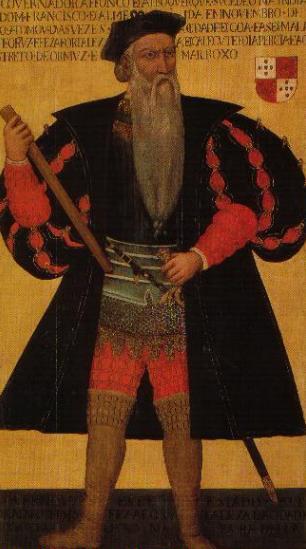
On this day 500 years ago, Alfonso d'Albuquerque (1453-1515) formally laid claim to Goa in India. The Portuguese had been venturing east in search of trade (and adventure) and had already established posts all round the coast of Africa. India was a far bigger prize  but coastal trade was controlled by Arab merchants. It was impossible to keep supply lines between Europe and the East without a regional base. So in 1507, Albuquerque did a deal with the ruler of Hormuz in the Persian Gulf and built a fort which was a springboard for expansion. Exploiting the rivalry between the seaborne Muslims and local Hindu rulers, Albuquerque attacked Goa first in 1509 then again in 1510. Victory was declared on 25th November.

So this day marks 500 years of European presence in Asia. From Goa, the Portuguese went on to conquer Malacca in 1511, also by doing deals between rival local rulers. They first visted the China coast in 1509 and reached Nagasaki in Japan in 1543.  Macau was offically founded in 1557. There were also big "Portuguese" communities in Burma, Thailand, Indonesia, Vietnam etc, not self governing but mercenaries and subjects of the local rulers.

Vasco da Gama (146?-1524) came to Goa several times, setting the city up as the administrative centre of Portuguese activities in the east. From Goa, the Portugese branched out all over India and beyond. If you're ever in Park Crescent, London (next to Regent's Park, on the way to the Wigmore Hall), one of those mansions belonged to a woman whose ancestors came from Goa to Macau. She ended up in London in the 1840's because her husband had business interests everywhere. Probate London, 1844, not Macau. Her descendants went on to marry into the aristocracy, both in England and Portugal. Stonor Park, Stonyhurst, etc all have a Macau connection.

Because white women didn't go East, right from the start the Portuguese in Asia were mixed race, multicultural hybrids. Their empire was coastal, ad hoc, always dependent on local initative and alliances. Guns of course, that was a fact of life then. But the Portuguese empire was nothing like Victorian India and different too from Spanish South America. Unfortunately the best books are no longer in print. The classic references in English are nearly all by Charles Boxer, but copies cost a fortune. There's good work too by an Indian professor, KM Panikkar, who studied both Indian and contemporary Portuguese archives. Impossible to get though. Pity as the Portuguese seaborne empire (as Boxer called it) is an interesting example of Europeans adapting to more powerful Asian nations. Acculturation very much both ways. Indeed, the European baroque might not have flourished as it did without the discovery of new worlds beyond Europe.

Monday, 9 August 2010

Nagasaki Christians Macau War

This picture looks like desert scrub. In fact it's Nagasaki, after the atomic bomb hit on 9th August 1945. In Hiroshima, a torii in a shrine was partly spared the devastation all round it. In Nagasaki, the Catholic Cathedral was the only structure left standing. (that's it on the hillside) Most of its parishioners didn't survive.

"Why Nagasaki?" some asked, for this was a most westernized, liberal city. Nagasaki was where St Francis Xavier preached to the Japanese, converting hundreds of thousands. Nagasaki began trading with the Portuguese in 1543.   Huge vessels sailed from Lisbon carrying silver and weapons in exchange for silk and porcelain. "The Black Ships" inspired Nanban art. From Nagasaki, many Japanese travelled west, to Macau, to Goa and to Europe.

Japanese Christians built Macau's St Paul's Cathedral, Japanese baroque, mixing Asian and western imagery. Read about it here (photos are mine)  Macanese genes are probably more Japanese than anything else. What an irony! When the Japanese invaded South China,  thousands of Macanese, who'd emigrated to Hong Kong, Shanghai and Canton, were forced back to Macau as refugees. So the circle turns.

Japanese Catholics went underground after their religion was banned early in the 17th century, and re-emerged nearly 300 years later, their faith intact. Because Nagasaki was a Christian centre, many Japanese Christians joined the Navy. There is a story that, weeks after the fall of Hong Kong, the Macanese community were worshipping in Rosary Church. In marched a Japanese naval contingent. Everyone panicked. But it turned out that these Japanese were Catholic, and had just come to hear Mass like everyone else. So much for stereotypes and divisions between people.

 Please take time to explore this blog as there is a lot on Nagasaki. Macau, Japanese and Chinese culture, non violence, war, Hiroshima,  multi cultural things like mixed race communities (beyond Puccini!) .Things on this site you will not find elsewhere. Like THIS, a study of a Buddhist response to the madness of violence, in the film Burmese Harp.

Saturday, 24 July 2010

Doci Papiaçám di Macau


Doci Papiaçám di Macau, "The sweet dialect of Macau".This is a famous Portuguese song, but the language isn't Portuguese, but Macanese Patuá (patois). By the time Macau was officially established in 1557, Portuguese seamen had been trading with Asia for over 50 years. Three generations already, since from the start the "Portuguese" abroad became mixed race, multilingual hybrids. Portuguese can't recognize Patuá because it retains medieval expressions, quite alien to modern use, but following Malay and Chinese grammar, spiced with words from India and Japan.  A goldmine for archaeologists of language. Such specialisms exist: Graciete Batalha researched the dialect extensively in the 1970's.

Patuá has been dying out since the 1950's when most Macanese emigrated abroad. But there've been many efforts to preserve it because it's so unusual. It's naturally melodic: like Chinese it's a tonal language, where tenses are expressed by slightly different tones. Words are doubled up for emphasis, and rhythms adapted for elaboration.  Europeans used to disparage its "sing song" nature, but for me that's a strength. Someone really should set Macanese verse to music that capitalizes on its exotic nature.

There are lots of poems, stories and plays in Macanese to choose from. Also tapes of native speakers, so you can hear the way the language moves. The song above is a light hearted lark by Henrique Senna Fernandes, the best known poet in the dialect. Sorry, I can't translate! But the text refers to Macau culture and specialities. FOOD! Enjoy the video, too, with local scenes. Lots more on Macau on this site, please explore. I might also do a recipe for some of the foods mentioned - already posts on balichoa and minchee, the ultimate Macau soulfoods.

Unga casa macaísta vôs olá
Têm carinho na pobréza
Si têm gente batê pórta pôde entrá
Vêm comê cô nos na mêsa
Genti pobre, genti rico sâ gostá
Cativá tudo visita
Ma qui seza unga casita
têm su chiste cô alegria
tudo óra, tudo dia.

Mêsa cô toália bordado
Vaso di fûla na châm
Pisunto china bafado
Têm galinha, têm capám.
Porco balchám tamarinho
Vaca chaucháu maragoso:
Unga caneca cô vinho
Quanto bebinga sábrôso
Unga casa macaísta fazê vista
Sâ fazê vista unga casa macaísta

Siara-siara sabe abrí su coraçám
Lôgo ri pa tudo genti
Na janela sã cherá mangericám
fazê vôs ficá contente.
Tem biscoito cô ôbrêa na fontám
Camalénga feto dóci
Chá-co-sucri dóci-dóci
Tudo óra têm na mesa
Quim querê fazê fineza.

Sunday, 4 April 2010

Why Jesus walks in Macau

This is the statue of Jesus that normally sits in a secret alcove behind the altar in the church of São Augustinho in Macau. He's hidden from public view but those who know enter an unprepossessing opening, and suddenly this magnificent statue in glowing colours appears out of the darkness. Amazingly theatrical. No wonder he's reputed to do miracles.photo credit(see photostream, lots of excellent images)

All over the Catholic world, statues are taken in procession through the streets as an act of faith. The idea is that God shares in the life of the community. It's not "just" for show. This statue is special because there's a legend attached to it. Four hundred years ago, there was a power struggle in the city  between the Augustinian order, the Dominicans and the Jesuits. The statue was taken to the Cathedral, but mysteriously kept returning to São Augustinho. Compromise: each year since then, at the beginning of Lent, the statue is shrouded and taken to the Cathedral in the dead of night. Next day, it's returned to its original church in an elaborate procession, bishop and clergy also dressed in purple, the colour of Lent. Incense, prayers, songs. Everyone follows, or comes to look, believers or not. Chinese do processions, too, of Chinese gods and symbols, so it's a good example of cross-cultural empathy. Nowadays Jesus walks through the city centre, past McDonald's and so on, but that shows that faith for those who follow it is real and alive.

There are many legends connected to this church, which is known as Lung So Miu in Chinese - "Dragon Hair Temple", because the first structure (1589) burned down, but mysteriously, the mat shed roof  collapsed and didn't burn. Proof that the church was protected by a powerful dragon. Then, in 1712  the procession stopped. There was famine in South China. The statue came out again, and the harvest returned.  Macau is full of legends like this, it's part of the mystique of the place. Please look up labels on right. I'll do more as and when I can...

Friday, 25 December 2009

Saudade, Saude, Boas festas de Natal

Last night a dear and cherished friend had a real Macau celebration! His Consoada (Christmas Eve repast) was Sopa de Lacassa. It is "a must for the occasion". "Main ingredients: Mai Fun (translucent noodles), small shrimps, char siu, eggs, green onions, fish stock (chicken stock, even canned ones permissible). That's all. The other repast at Yuletide-time is the New Year Morn (past midnight and onwards) repast of Canja de Frango (that is, Chicken jook or congee)" "Saudade (fond memory), Saude (health), Boas festas de Natal (Good feasts at Christmas)"

This greeting is very precious to me. There are few true Macanese around, so they're treasures. "Sopa de Lacassa" means I think "soup of the Lascars" the ancient name for "moors" which means generic Malay, hence the resemblance to "laksa", Malay noodle soup. Like the Nonyas of Malacca (Chinese/Malay hybrids) the Macanese had their own distinct culture and language, even literature and songs. A lot of poetry, still written today even though only a few hundred people speak the dialect now and they're all over 80. Perhaps the reason for the poetry is that the dialect is naturally melodic with lots of repeat words (like in Malay) and a syntax that follows sound tones (like Chinese) One day perhaps someone will set this poetry to music: it would be unique and very beautiful.

Another Macau Xmas food is Aluar, which is a lot of trouble to make, so is usually bought from ladies who make it in batches, often the same families that make balichão. Aluar is a kind of pudding made from pig lard and Chinese brown slab sugar. You eat it in tiny thin slices, it's very greasy and filling. It's not unlike the Chinese pudding you get at Lunar New Year, which is slightly lighter and is eaten steamed.

Here's a useful link to Macanese culture.

Sunday, 1 November 2009

The story of Balichão

"To be Macanese", they say, "you have to have a bottle of Balichão in the fridge". In the fridge, note, not necessarily in regular use, though once it was as ubiquitous as soy sauce. Balichão is a delicacy of pulverized shrimp, fermented in salt for many months til it becomes a semi-liquid, lilac paste. Those who love it wax lyrical because it adds a certain piquant kick to anything you eat. Often it was used in cooking dishes like Balichão pork. True devotees ate it neat, on rice.

Balichão looks meek but comes with a long heritage. Once it was made in many Macau households but it's a lot of work to make so certain families with the right equipment became suppliers. Shrimps and other crustaceans and I think chili are ground together with salt water and salt in a huge stone urn with a wooden stick. The mix is sealed and left to ferment for many months, then bottled and distributed to friends and relatives. A community project. I met one of the last Balichão makers whose mix was specially prized because it was so good. Her stone urn and mallet had been in use for 300 years.

Then one day the mallet broke. It''s not something you run down to the shops to replace. Eventually, a museum tracked down what the implement was - a worn-down oar from a traditional sampan, those small boats you see in old photos (there aren't many around today). The museum tracked down an old ship maker who managed to identify it as an antique style, obviously made from a better-quality wood than used in his time. Even if a new mallet was carved to order it wouldn't have been quitre the same because something in the wood gave the family Balichão a distinctive flavour no one else c0uld match. Rather like yoghurt gets started with a batch of old culture. Nothing like good bacteria.

Balichão has a long history. Someone once wrote a paper on the Balichãos of Asia, tracing them along trade routes from China to Europe. Haam ha is the Cantonese version. The good ones, I was told, are a thickish purple paste, though now it's more watery and pinker. In Vietnam and Thailand, there are similar versions, which like haam ha are useful substitutes. Apparently the Romans used to make a similar paste, and use it in the same way. That makes sense, as shrimps are plentiful in coastal places, but don't keep unless you preserve them. Who knows when and by whom Balichão was started but when you eat it, it's like linking to other cultures, other times.

Balichão pork is or was Macau soul food. Pieces of pork were marinated with garlic, tamarind and a bit of Balichão which gave it a bite. My father used to make it, it was delicious. It was always served with a glutinous rice cooked with spring onions and pressed into a mould.

The best Macau cookbook is Cecilia Jorge's "Macanese cooking : a journey across generations" ) published by APEM Associcão Promotora da Instrucão dos Macanese. It's hard to find but it's the genuine article, a communal effort but very professionally produced. A collectors' item! This is the gist of the recipe:

300 gr pork belly with skin (use lean if you prefer but it's not so authentic), 1 tbs tamarind paste, 1 slab Chinese slab brown sugar), 2 tbs Balichão, ginger, garlic, etc. (Tamarind and slab sugar can be found in any decent Chinese supermarket, and use haam ha if you can't get Balichão)

Fry the tamarind paste, Balichão, ginger etc and add the pork (cut in strips), then simmer with the Chinese sugar until the meat has absorbed the juices.

Tuesday, 20 October 2009

Mahler Von der Jugend - what the garden tells me

Mitten in dem kleinen Teiche
Steht ein Pavillon aus grünem und aus weißem Porzellan.

This is a pavilion in the Lou Lim Lok Gardens in Macau. It's nothing very special, just a 19th century merchant's, nothing like the fabled classical gardens in Suzhou, some of which date back a thousand years, but it's nice. Many years ago I did a big project there to illustrate Mahler's Das Lied von der Erde, getting shots at dawn, before the tourists came, timed to when the lotuses were in full bloom. And now I can't find the file!

There are many pavilions in the garden, but this is the one in the middle of the lotus lake, reached by a beautiful walkway that curves and bends nine times. The idea is that you approach the pavilion not by a straight route, but one that makes you ponder the different vistas you see on the way. Gradually you shed the cares of the world til you reach the pavilion where you can be at peace. The whole concept of Chinese gardens is that you follow paths that reveal different aspects as you move around. With each turn you see things from different angles, perspectives. You're not supposed to see everything at once.

Each day, different vistas. This photo, by Cody Chan, is probably May, before the lotuses come into flower. Already, though, it's hard to tell that under all that greenery, the ground is not solid, but water. Illusion again. In winter you see the water and the outlines of the lovely walkway, and "landscape rocks" in amazing shapes that look like distant mountains. (you can just spot one of them in the photo on right of walkway). But the lotus roots live on, hidden, under the soil at the bottom of the lake, waiting for spring. So already embedded is the idea Die Welt schläft ein!.

Although Mahler's poem refers to "white porcelain", the glaze used in South China is almost always green, bluey-green, sometimes varied with ochre yellow, but blue green is the colour of nature and renewal.

Auf des kleinen Teiches stiller, Wasserfläche zeigt sich alle, Wunderlich im Spiegelbilde.

Throughout China there are bridges which arch steeply over water, so their reflections form perfect circles like the moon. The idea is a solid structure defying gravity, yet uniting air and water, reality and illusion. So "wunderlich im Spiegelbilde", amazing mirror images, "Alles auf dem Kopfe stehend" Everything stood on its head.

Even as the friends sit happily in the pavilion, drinking and chatting, everything they take for granted is reversed in the reflection in the water. Nothing, however precious, remains unchanged.

Wie ein Halbmond steht die Brücke, umgekehrt der Bogen.

Ten years ago I went to a lot of trouble getting the photos of the garden set up at just the right angles, just the right light and timing. Now they're lost. But I couldn't be writing this now if I hadn't learned then about the metaphysics of Chinese gardens. Besides, losing all that work expresses the spirit of Das Lied von der Erde. Material possessions are ephemeral. What counts is what you carry in your soul.

Please read my other posts on Das Lied von der Erde, especially the one on the literary sources and cultural icons, which is HERE. Eventually I'll try to do more, so what I've learned will help others when ich wandre in die Berge.


photo credit Beijing