Showing posts with label Xmas. Show all posts

Saturday, 8 December 2018

Unusual Christmas concert - songs, poetry and harp !


Unusual Christmas concert - songs, poetry and harp ! with Sarah Minns, Adam Best and Mary Reid at Stoke Newington Old Church


From Roger Thomas


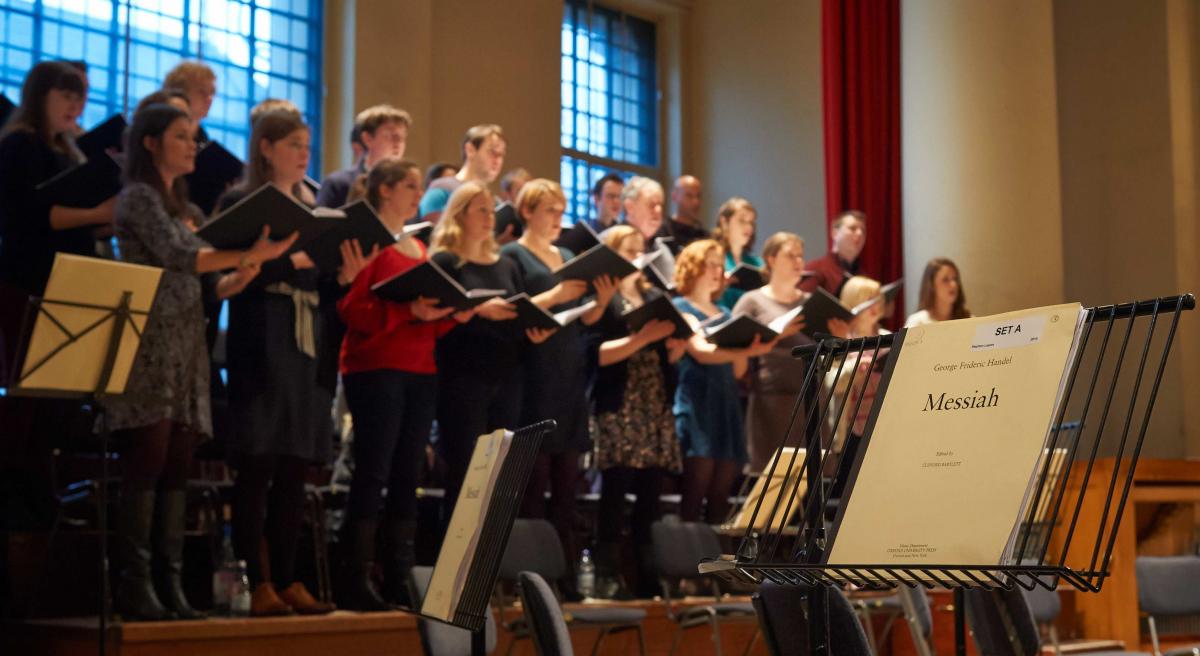
Soprano Sarah Minns's message -- to very loosely paraphrase her introduction to this fascinating OperaUpClose evening concert (December 5) -- was that Christmas is coming, but let's not drown in schmaltzy Xmas musical fare but, rather, examine the season of "hibernations and awakenings". The themes were not followed so closely as to self-destruct but we got the picture. The chilly wet and windy weather helped, as did the venue: Stoke Newington's Old Church (now an arts centre), the only surviving church in London built in the Elizabethan era.

We don't hear enough of Sarah Minns, one of London's most characterful, lively and versatile classical sopranos. The versatility was in full play here; no piano for this recital but harp, played exquisitely by Mary Reid, who had also prepared the harp transcriptions of the vocal works from piano or full orchestral scores. The Old Church cried out for Shakespeare and actor Adam Best was there to add the Bard's own words to Minns's Shakespeare-influenced songs, as well as other poems suited to the season and themes.


But first an aria ("O Sleep, why dost thou leave me") from Handel's Semele, with a libretto based on Congreve's (he -- not, as often believed, Shakespeare -- who wrote "Musick has charms to soothe a savage breast"). Charms indeed from Minns, but above all regret poignantly portrayed as the mortal Semele awakens to the realisation that her dream of the God Jupiter has faded -- only the beginning of her troubles.

In this first group, more regret at an aborted awakening as Adam Best read Emily Dickinson's poem "I thought the train would never come" (/How slow the whistle came/I don't believe a peevish bird/So whimpered for the Spring...) Then, from Minns, three of Aaron Copland's 12 settings of Dickinson poems: a forcefully expressed, soprano-apt "Why do they shut me out of heaven?" (/Did I sing too loud...); "The World feels dusty"; and "Heart we will forget him".


Before we moved into Shakespeare territory Mary Reid refreshed our musical palates with two of Marcel Tournier's evocative Images: the cool and calm of "Au Seuil du Temple" and the multicoloured fluttering of magical birds in "La Volière Magique" -- I expected Stravinsky's Firebird to fly in at any moment.


Shakespeare moved in with Hamlet: Minns sang Elizabeth Maconchy's beautifully simple setting of "Ophelia's Song", mourning the death of her father Polonius, its watery sounds perhaps foretelling Ophelia's own demise.


Then different approaches to Romeo and Juliet. Minns in bel canto mode made the most of Giulietta's lament from her balcony in Bellini's I Capuleti e I Montecchi ("Eccomi in lieta Vesta"). What's to be done to get Juliet out of a marriage she does not want? Adam Best took us back to Shakespeare where Friar Lawrence in Act IV Scene 1 of Romeo and Juliet confidently expounds to Juliet his cunning plan to have her seem dead and thus escape her unwanted marriage and flee with Romeo. But as we in the UK know all to well these days, "cunning plans" engineered to leave marriages often go askew.


Before the interval, Mary Reid played "Improptu Cristatus" a work written for her by Thomas Chevis that had its world premiere in Ripon Cathedral on November 29 in a recital entitled Les Oiseaux. Podiceps cristatus is the great crested grebe, a water-bird noted for its elaborate mating rituals. On the harp, much frantic paddling, splashing and flapping of wings. And the low and harsh call of the male bird, which, Reid warned us, involved some harp technique that worried the Ripon audience who thought the resulting sound was a mistake.


The shorter second half took us gradually towards Christmas but also featured Elizabethan and older texts. Edmund Rubbra's "A Hymn to the Virgin" set a text from c. 1300 and was followed by Adam Best's reading of Shakespeare's Sonnet 43, which grapples with the paradox of seeing his lover more clearly with eyes closed or dreaming than in the light of day-to-day reality (When most I wink, then do mine eyes best see,/For all the day they view things unrespected;/But when I sleep, in dreams they look on thee,/And, darkly bright, are bright in dark directed....)


Then more Elizabethiana: Ivor Gurney's exquisite setting of John Webster's poem "Sleep" from the composer's Five Elizabethan Songs. Gurney's sparse scoring -- not a note too many -- worked just as well on the harp as the piano.


Two of Samuel Barber's 10 Hermit Songs ("The Crucifixion" and "The Desire for Hermitage") based on Irish monks' marginalia, took us back to the 8th to 13th centuries.


We were now on the way to a sophisticated Christmas. The two poems read by Adam Best that framed this final section were ironic, but respectfully so, prompting us to think of new angles on the Nativity. Joseph Brodsky's "Star of the Nativity" takes us to a realistic Bethlehem seen from a newborn's perspective but with Godly intervention (...from the depth of the universe, from its opposite end-the star/was looking into the cave. And that was the Father's stare.). Worth reading in full. For text, see here.) U.A. Fanthorpe's poem "I am Joseph" also takes an oblique view of the Nativity, with Joseph gently lamenting (I wanted an heir, discovered/My wife's son wasn't mine). But he's still deeply in love with Mary and will take things as they are (My lesson for my foster son:/Endure. Love. Give.) (For full text, see here.)


Mary Reid played the harp solo "Interlude" from Britten's Ceremony of Carols, for me distant church bells heard in a snowy landscape.


Max Reger's "The Virgin's Slumber Song", sung in the original German by Minns, draws on a text written in the late 19th century but has a folk-song down-to-earth reality. Mary is a real (loving) mother but is tired and dearly wants her baby to sleep (And soft and sweetly sings/A bird upon a bough: /Ah, baby, dear one,/Slumber now!). The exclamation mark is indicative; it's in the German text too. Mary is far from shouting at the baby, but is frustrated.


Finally, Sarah Minns sang some old favourites: Holst's "In the Bleak Midwinter; Franz Gruber's "Silent Night" (Minns invited the audience to join her in singing this); and Adolph Adams's "O Holy Night". Great work from the trio, with special praise to Sarah Minns for singing her whole lengthy and varied programme from memory, without any back-up scores in sight.

Photos: Roger Thomas

Thursday, 22 November 2018

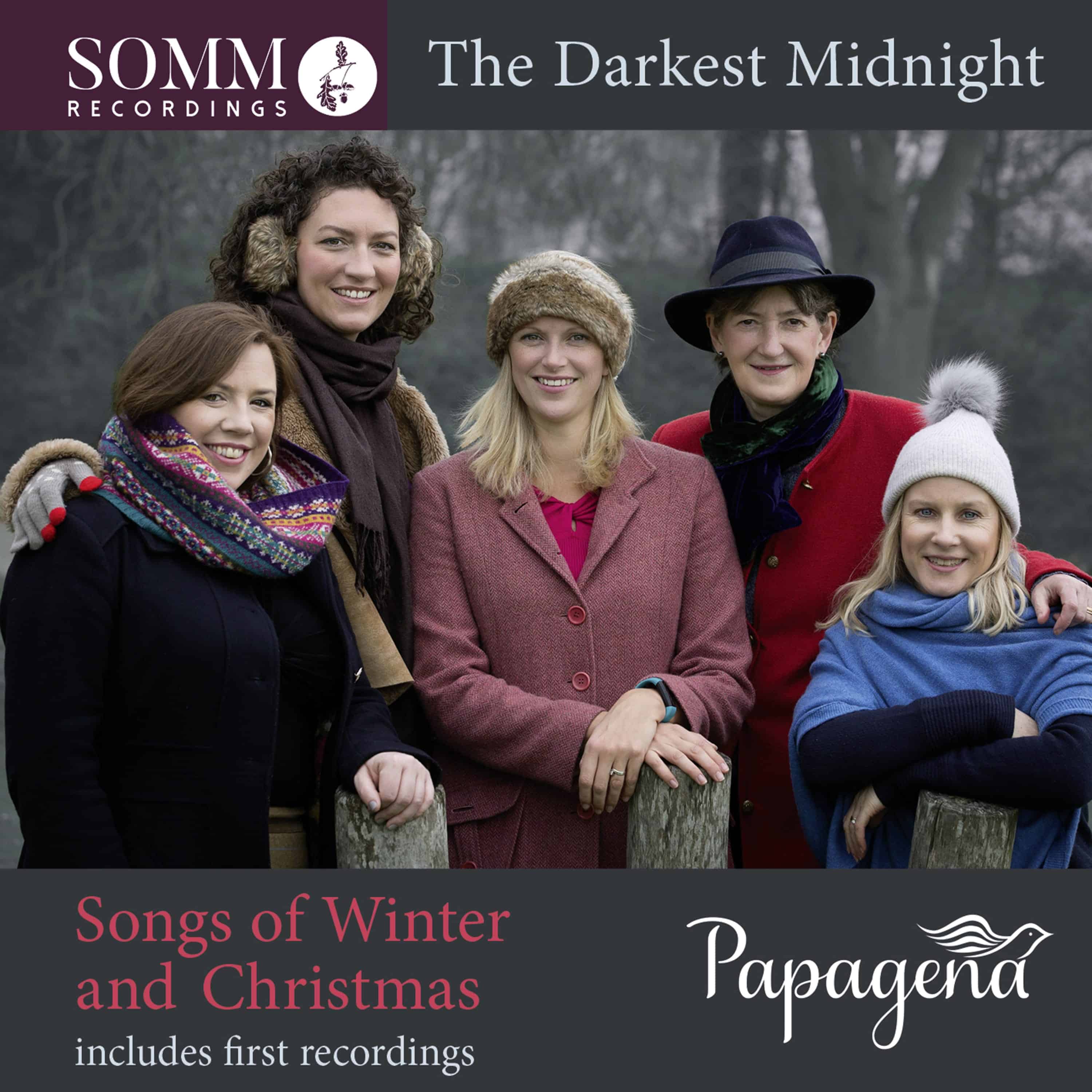
Darkest Midnight - Songs of Winter - Papagena SOMM

Darkest Midnight : Songs of Winter and Christmas - an eclectic collection of acapella songs on the theme of winter - with Papagena, a delightful offering for the Christmas season from SOMM Recordings : so enjoyable that you could listen at any time of the year. With Papagena, there are “No props, no microphones, no gimmicks, just five stunning voices“ who “explore the wealth of music from medieval times to the present day”. Their programmes “defy pigeonholing, drawing richly on traditional folk music and women's working songs as well as classical repertoire and new work commissioned for women's voices, many arrangements made by members of the ensemble. This disc is a rewarding purchase, even if you don't mark the season as a religious festival, but appreciate winter as a time for wonder and good music for its own sake.

Don eiche ud im Beithil (I sing of a night in Bethlehem) is a traditional Irish song with a text by a 16th century Archbishop of Armagh. Here it is heard in an arrangement where the voices blend in radiant polyphony. The sopranos (Elizabeth Drury, Abbi Temple, Suzzie Vango) sing with the purity of trebles, while the altos (Suzie Purkis and Sarah Tenant-Flowers) add warmth and richness. Part lament, part ballad, Maria durch ein Dornwald ging (Mary walked through a wood of thorns) is ideally suited for women's voices, given that it describes the trials of the Virgin Mary, walking through a forest of thorns, which suddenly blossoms as roses because she's carrying the infant Christ – a sacred work song for women, from the Middle Ages ! How refreshing it is to hear the Christmas story told from Mary's perspective ! In Nowell, tidings true there be come new, the voices are accompanied by a simple drum, as medieval songs often were. The text honours “A clean maiden and pure Virgin”. The singing is so delicate that it seems to cast a glow. Exquisite stillness in O Jesulein zart, where the altos sing in rapt adoration, cradling the sopranos.

In John Tavener's setting of W B Yeats' A Nativity, the lines stretch, the unison clear and shimmering. The balance of voices in Shchedryk (Hark How the Bells) creates a refrain with the effect of silvery bells pealing in harmony. Ballulalow is an arrangement made for Papagena of a 16th century Scottish song itself based on a poem by Martin Luther. The main melody is surrounded, like a halo, by tones as pure and bright as light shining through stained glass. Then Papagena springs a surprise – a song by Joni Mitchell, The River, transformed as if it were a modern carol. The alto sounds like Joni Mitchell, only more sophisticated and refined, though she captures the feisty irony that is part of Mitchell's style. Det lisle banet (the Little Child) is a traditional Norwegian ballad that tells of a farmer who leaves a fox in charge of his geese. But the fox kills them. In compensation the fox must make “soulgifts” to the farmer's child. A strange, unworldly parable told with dramatic effect. A single drum beats, at first slowly, then more insistently, adding a note of tension to the women's voices which keen as if they were recounting a primeval saga. There is much to listen to on this recording, which is much more than “Christmas listening”.

Wednesday, 21 November 2018

My Lord has Come - Christmas with Ardingly College - Stone Records

My Lord has Come – Christmas music from Stone Records with Schola Cantorum, Ardingly
College, Sussex, one of the earliest schools in the Anglo-Catholic tradition of the Church of England, with director Richard Stafford. Thus the inclusive character of the music on this recording. Stone Records Christmas offerings are usually a delight, usually livelier than much of the surfeit that floods the commercial market at this time of the year. Stone Records Christmas  offerings make gifts that keep on giving pleasure year after year. One of my favourites is Deck the Halls (A Swedish Christmas) Please read more HERE.

As befits the name “Schola Cantorum”, the choir are a youth ensemble, and the purity of their singing makes this collection a refreshing choice for the season. A maiden most Gentle is a variant of an ancient hymn, which Roman Catholics will instantly recognise as the Ave Maria. The English text is different, dispensing with the explicitly Marian devotion of “Immaculate Mary, Our Hearts are on Fire”, the emphasis changed to Mary's role in the Nativity, though the familiar refrain “Ave Maria” remains the same. Similarly, Bogoroditsye Dyevo is an arrangement of the sixth movement of Sergei Rachmaninoff's All-Night Vigil based on the liturgy of the Russian Orthodox faith. Thus the “nocturnal” hush, where the dynamic level rarely rises above pianissimo : private reverence in communal situation. Closer to the Anglican mainstream, The Truth from Above which Ralph Vaughan Williams found in Hertfordshire and used in his Fantasia on Christmas Carols (1912). John Rutter'sarrangement of the traditional Appalachian song I wonder as I wonder employs a lilting melodic line for solo soprano, with supporting voices in lush harmony. 

  Lux aurumque is by Eric Whitacre, who wrote that “If the tight harmonies are carefully tuned and balanced, they will shimmer and glow”. The version here of The Holly and the Ivy  is by June Nixon, employing the organ to create flowing scalic ideas, bare chords soaring to majors at the end. All Bells and in Paradise is John Rutter’s 2012 adaptation of the Corpus Christii hymn, and the SussexCarol here is a setting by Philip Ledger. Bethlehem Down, perhaps the best known “modern carol” of all had no sacred origin. It was written by Peter Warlock – an agnostic if not rather more – and his drinking companion Bruce Blunt, for a competition in the Daily Telegraph, and used the proceeds for non-pious purposes.

This is the Record of John is an Orlando Gibbons' anthem on the discourse between St John the Baptist and the Jews and Levites, expressed in counterpoint and cadential flourishes. Lully, lulla, Lullay is a modern setting of the Coventry Carol, gentle harmonies leading to soaring descant. To liven things up, Tomorrow is My Dancing Day, where the organ dances, clumsily, to the Cornish folk song, adapted in the 1960's and described then as “medieval Dave Brubeck”. Light hearted humour, just right for the season of goodwill and cheer.

Monday, 19 December 2016

A British Christmas - in Paris!

An all British Christmas concert de Noël - but from Paris, with the Orchestre Philharmonique de Radio France, conducted by Mikko Franck.  Elgar, Britten and RVW, but also Arnold Bax, Frederick Delius and Victor Hely-Hutchinson.. If the BBC SO did a programme as ambitious as this, it would be a major event. But Radio France beat them to it. Aha! Britishness through a non-British prism! OPRF don't sound "English" but the music benefits from being performed "as" music, without baggage.

Adeste Fideles, or O Come, all ye Faithful, started the party, the first of four movements in A Carol Symphony (1929) by Victor Hely-Hutchinson (1901-47)  According to wiki, he died because he wouldn't turn on the heating in his office in the cold winter of 1947. Hopefully, his fellow workers didn't suffer. In contrast, Ralph Vaughan Williams's Fantasia on Christmas Carols (1912) an altogether more original work, not mere transcription, where the carols become part of a larger creation, with suggestions of medieval music and plain chant (baritone Marc Pancek). .  In Frederick Delius Sleigh Ride (no 2 of Three Small Tone Poems) Franck downplayed the obvious "sleigh bells" in the introduction, emphasizing the finesse in the abstract themes that followed.  This approach also enhanced Arnold Bax's Christmas Eve (1912 rev. 1921) , a tone poem with sweeping  lines that might suggest vast nocturnal landscapes, the opacity in the tutti lushness darkness lit by flashes of brass and light.

The youth choir of Radio France returned for several songs from Benjamin Britten A Ceremony of Carols op 26, 1942. Lovely, clear, piping voices with the purity Britten sought. If they had slight French accents, not a problem at all ! That brought out the sense of otherworldliness that makes such a difference in Britten interpretation. The adult choirs assembled Douce Nuit (Silent Night), followed by a new transcription of the carol for solo organ, magical and bizarre at the same time.  Then the Elgar part song, The Snow, op 26/1 1894, for choir, two violins and small orchestra.   More Elgar, "Nimrod" from the Enigma Variations , here played with magisterial elegance.  An excellent choice, reminding me at least of Bax Christmas Eve and Delius and even Holst and Finzi.  Yet again, thoughtful programming, setting the scene for Britten's St Nicholas.(1948). The girl singing the treble part was lovely, as was the tenor (Christophe Poncet) and the full choir striking. Yet even in these grand moments, Britten doesn't really write in the British choral tradition but does his own quirky variation.

But it's Christmas, and party time ! So Vive le vent (Jingle Bells in French). Then the Hallelujah Chorus, written by a German, sung in English by a French choir, conducted by a Finn, who sang along, as did the Paris audience.  Proper Christmas spirit, and dare I say, proper European spirit, too.   Enjoy the concert HERE on arte.tv - better than most things planned in UK this season

Thursday, 31 December 2015

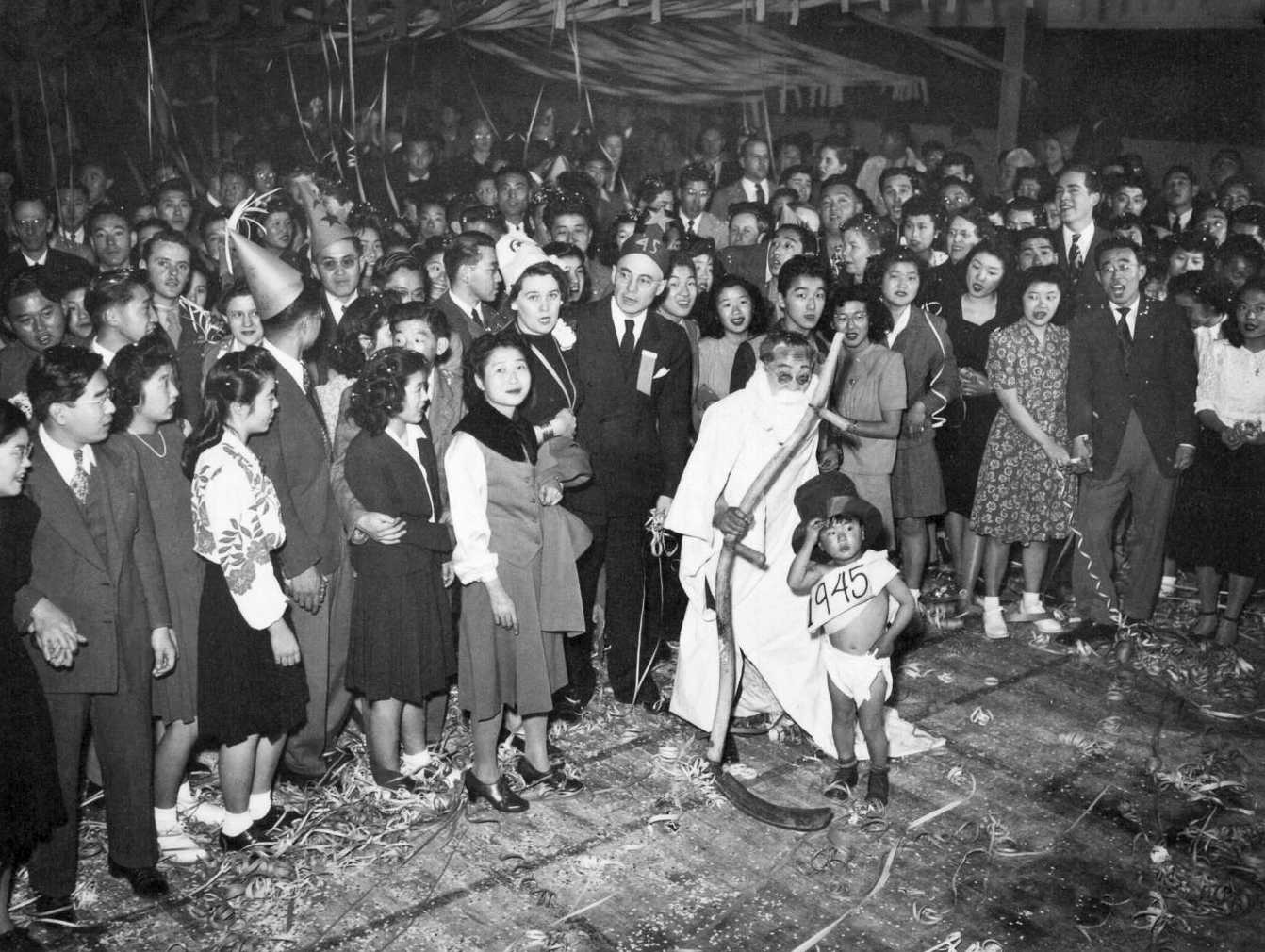
Deceptive New Year's Eve


Japanese Americans celebrating New Year's Eve, 1944-45. Out with the old year, in with the new. Everyone's dressed up, looking good. But remember the date. It's wartime.  These people are in an internment camp, locked up because they're "enemy". Albeit a good camp, where the staff are decent peiople and join in.  Moral: don't judge by surface appearances, don't hate.

Thursday, 24 December 2015

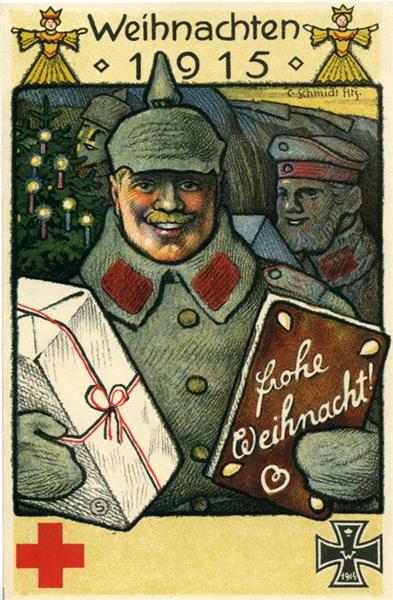
Christmas 1915


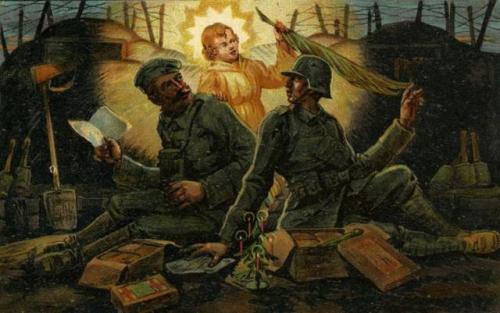
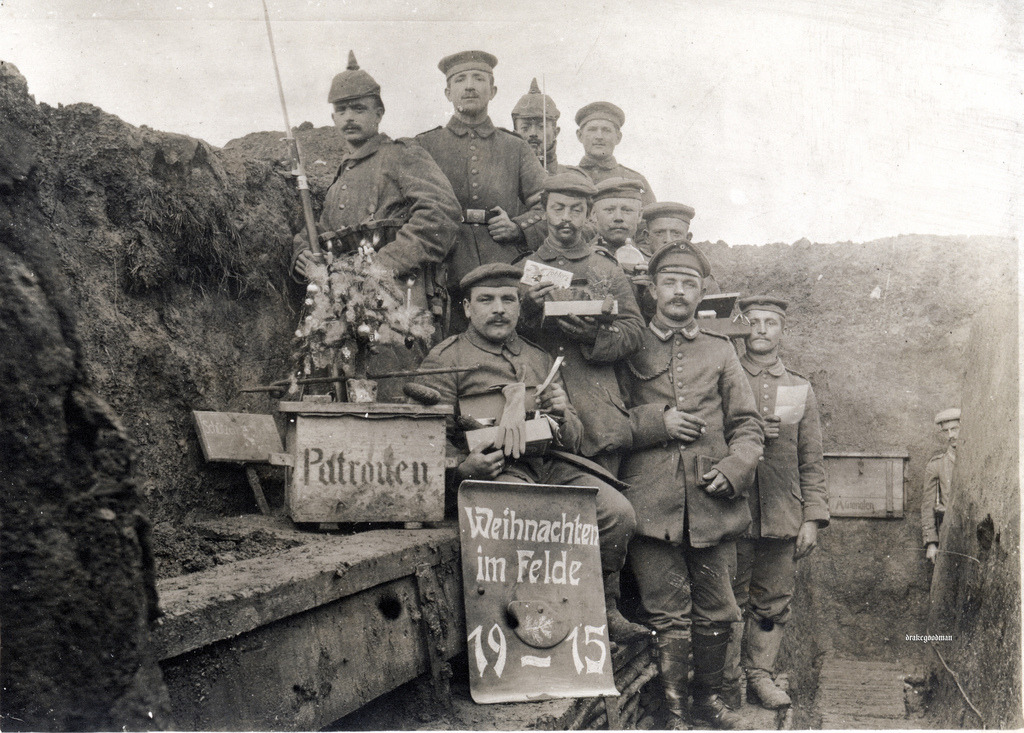
One hundred years ago today, the "ChristmasTruce" when both sides in the trenches stopped fighting, for a while. The event of 1915 is very well documented. Something similar also occurred on the Eastern Front.

I wish it could be said that ordinary people could change the course of events, but we now know, even better than before, how the media shapes and controls how people think. With the internet, social media and mass, often uninformed communication, it's harder than ever to escape media manipulation.


The War on Christmas ?

What's with this "War on Christmas" business?  If  your faith is so weak that it's threatened by what other people do or don't do, then maybe it's time to  question what one really believes in.

Jesus said "love your neighbour as yourself."So, goodwill and forbearance to all, even to those who prefer hate.

The pic shows Krishna, the Hindu god, as an infant. 


Saturday, 19 December 2015

Stalin's Little Helpers


Courtesy of a friend, vintage greetings from a happy surveillance society! And why Stalin ? Because he used Lenin as a front, like the kid with a mask. That's the thing about art in a totalitarian state - read the runes !\The kids are in mid 20th dress but how pinched and miserable they look ! The girl on the left looks like she's on trial  Little babushka looks like she wants to kill. . I didn't think we needed tp point this out, we've all heard Shostakovich.

You better watch out,
You better not cry,
You better not pout,
I'm telling you why:
Santa Claus is coming to town!

He's making a list,
And checking it twice,
Gonna find out who's naughty or nice.
Santa Claus is coming to town!
He sees you when you're sleeping,
He knows when you're awake.
He knows when you've been bad or good,
So be good for goodness sake!

He sees you when you're sleeping,
He knows when you're awake.
He knows when you've been bad or good,
So be good for goodness sake!

Tuesday, 1 December 2015

Christmas at St John's Smith Square


St John's Smith Square presents its 30th annual Christmas Festival. This season is particularly impressive, bringing together fine choirs and baroque ensembles.

First highlight,  Lars Ulrik Mortensen directs the European Union Baroque Orchestra on Thursday, 3 December, with "Music for Feasts and Banquets" -  Biber, Muffat Marcello and Telemann. Then a series of major choirs, starting with the City of London Choir, the Choir  of Christ's College, Cambridge and the Choir of King's College, London. the Choir of Merton College, Oxford, and the Choir of Clare College, Cambridge,.  For me, treats will include the Choir of Christ Church Cathedral, Oxford  on 14 December with a lovely programme of  English carols, and, on 22 December, Stephen Layton leads the Choir of Trinity College, Cambridge, and the Orchestra of the Age of Enlightenment in what promises to be a very fine Bach Mass in B Minor. Alas, it s been  sold out for ages. 

Plenty of other  treats, too. On 12 December, the Chapelle du Roi from Paris bring music from the Chapel Royal Choirs of 16th century England and Spain and on 13 December Siglo De Oro presents a programme of English song, including works by Roderick Williams (as composer), Howells, Warlock and Leighton. On 15 December, Jeffrey Skidmore conducts Ex Cathedra and on 17 December Ensemble Plus Ultra does Praetorius, Victoria and Byrd.  On 21 December, Solomon's Knot returns to SJSS for the fifth year running with Schelle, Kuhnau and Bach.  The Tallis Scholars and Peter Philips have a concert on 19 December. This being Christmas, there's no escaping Handel Messiahs, but  really good Messiah reminds us why it is done so often and by so many, some more earnest than excellent. With Stephen Layton, Polyphony and the Orchestra of the Enlightenment on 23 December, we can be sure of the highest standards, though. Soloists are Katherine Watson, Iestyn Davies, Gwilym Bowen and  Neal Davies no surprise that this has been sold out for ages, too!  The photo above shows Polyphony performing the Messiah at SJSS in recent years.

Celebrations continue into the New Year and culminate with Victoria O magnum mysterium (Mass and Motet) on the Feast of the Epiphany (6 January).  Christmas and the Baroque are closely intertwined. But no-one needs to be religious to enjoy some of the most uplifting music in western civilization. 

Wednesday, 26 December 2012

Drei Könige wandern aus Morgenland


As an alternative to the English language version " Three Kings from Persian Lands Afar". My favourite, though, remains the version for boy alto.

Drei Könige wandern aus Morgenland; Ein Sternlein führt sie zum Jordanstrand. In Juda fragen und forschen die drei, Wo der neugeborene König sei? Sie wollen Weihrauch, Myrrhen und Gold Dem Kinde spenden zum Opfersold.

Und hell erglänzet des Sternes Schein: Zum Stalle gehen die Kön'ge ein; Das Knäblein schaun sie wonniglich, Anbetend neigen die Könige sich; Sie bringen Weihrauch, Myrrhen und Gold Zum Opfer dar dem Knäblein hold.

O Menschenkind! halte treulich Schritt! Die Kön'ge wandern, o wandre mit! Der Stern der Liebe, der Gnade Stern Erhelle dein Ziel, so du suchst den Herrn, Und fehlen Weihrauch, Myrrhen und Gold, Schenke dein Herz dem Knäblein hold!

Monday, 24 December 2012

Sunday, 25 December 2011

Richard Tauber can't sing proper !


Here is a special gift for those who think accents are more important than anything else. This is Richard Tauber singing "White Christmas". At first he's careful to sound like a clipped upper class Englishman of the 30's. But once he warms into the song his natural instincts take over, and the accent goes haywire. So what? He knows how to sing.

Saturday, 1 January 2011

Hong Kong Fireworks, 1/1/11 !


Eight hours ago it was midnight in Hong Kong and this is how they celebrated! By standards of previous years this is pretty sedate (the economy's hurting) but it's also classier and more elegant. Even the 30 metre high Xmas tree in the city centre decorated with Swarovski crystals is pretty understated. If 20 million Swarowski crystals can be discreet, but it's more "designer" than usual.  Which itself is very style-conscious Hong Kong. Puts everywhere else to shame, though Sydney's done a great retro 2000 display. Learn how to countdown in Cantonese and shout Sun Nin Fai Lok! In Hong Kong individual fireworks were banned from 1967 but it's still a good idea because in crowded small spaces, there'd be mayhem. Traditionally, you set off ropes of firecrackers to chase away the bad, but in modern apartment blocks it would bring bad, like broken windows, fires, injuries etc. So instead, massive, elaborate community party, several million people in the street having fun even if they can't see a thing.