Showing posts with label Jordan Philippe. Show all posts

Saturday, 18 January 2020

Massive Beethoven concert from 1808 - Wiener Philharmonker, Philippe Jordan


"Das Konzert ist ein Höhepunkt der Feierlichkeiten zum 250. Jahrestag der Geburt des Komponisten." Philippe Jordan and the Wiener Symphoniker recreate an all Beethoven programme from 22nd December 1808 - 212 minutes - on arte.tv. This is the programme :

Symphonie Nr. 6 F-Dur op. 68 "Pastorale"
"Ah perfido!", Szene und Arie für Sopran mit Orchester op. 65
Messe C-Dur op. 86, II. Gloria (Qui tollis – Quoniam)
Konzert für Klavier und Orchester Nr. 4 G-Dur op. 58
Symphonie Nr. 5 c-moll op. 67
Messe C-Dur op. 86, IV. Sanctus (Benedictus – Osanna)
Fantasie für Klavier op. 77
Fantasie für Klavier, Chor und Orchester c-moll op. 80 "Chorfantasie"


There seeems to be quite a vogue for huge concerts like these now, maybe to counteract the attention deficit of modern listening (which applies to many things, not only music)

Monday, 1 July 2019

Berlioz : Symphonie fantastique and Lélio - Philippe Jordan, Cyrille Dubois

Berlioz Symphonie fantastique and Lélio ou Le retour à la vie, this time with Philippe Jordan conducting the Wiener Symphonker wirh Cyrille Dubois, Florian Sempey and Jean-Philippe Lafont (narrator) with the Wiener Singverein from the Wiener Symphoniker's own recording label. Symphonie fantastique is ubiquitous, with numerous performances and recordings every year. But what is news is that this programme is an "extended" version, so to speak, since the symphony (op 14) and the monologue lyrique (op 14b) were designed on symmetrical principles, with numerous interconnections, forming a kind of mega symphony whose architecture is revealed by hearing the two parts together. There have been earlier recordings - Jean Martinon in 1973 being my particular favourite, but in performance, the pairing is not easy to achieve because the two parts require very different forces.  Colin Davis, for example, recorded Lélio minus the all-important part of Lélio the composer, though his narration is fundamental to the whole structure. The spoken words draw together the vocal and orchestral parts and gives them context. Without narration, cohesion is lost, no matter how good the singing and playing might be.

This recording, with Jordan and an extremely good pair of soloists, would be a top recommendation were it not for the recent Symphonie fantastique and Lélio with François-Xavier Roth and Les Siècles, which sets new standards of excellence. Please read more about that HERE. That said, this new recording, with Jordan and the Wiener Symphoniker  has a great deal going for it.  It's very different from Roth/Les Siècles, but well worth hearing on its own terms.

A very stylish Symphonie fantastique , Jordan making the most of the Wiener Symphoniker's poise and elegance.  In "Rêveries" one might call the keening string lines a "Sensucht" motif : "reverie", or longing, has no national boundaries.  The idéé fixe is thus framed in a context that fits in with the orchestra's strengths, the "sweetness" in the strings laced with melancholy.  As the pace picks up, the sound is fuller, yet still driven by almost manic impulse. The waltz in "Le Bal" is particularly suited to an orchestra based in Vienna : Jordan shapes the figures so they seem to whirl round, the way dancers move gaily, but in strict formation.  Again the idée fixe reminds us that time cannot stand still.  A lovely introduction to the "Scène aux champs", the dialogue between cor anglais and oboe reflecting the sense that fulfilment might be elusive. With modern instruments, the "March au supplice" is perhaps more flashy than macabre, and the "Songe d'une nuit du sabbat" less spooky but suitably dramatic. Nice cheeky woodwinds, above the turbulence in the orchestra : almost cinematic in impact.

Part of the reason that Lélio does not get performed as often as it deserves to be is that the role of Lélio, the composer, is central to its execution. Getting Lélio right is tricky. I've heard the part done in English, with RADA-style self-consciousness, but that didn't work for me, at all. The Shakespeare Berlioz heard in early 19th century Paris wasn't the Shakespeare of late 19th/early 20th century London, but freer, wilder hybrid.  Shakespeare carried no cultural baggage for continental European audiences in Berlioz's time.  Berlioz saw Roméo et Juliette in the Garrick version of the play brought to Paris in 1827 by Charles Kemble, where Berlioz met and became infatuated with Harriet Smithson, who may represent the elusive muse that inspires the artist in Berlioz to extremes of agony and ecstasy. In an age before close-ups and amplification, theatre practice would have to have been more exaggerated than we're used to now.  Perhaps Berlioz, a theatre critic, intuited that good orchestral writing had the potential to express feelings in greater complexity than most actors at the time were able to project, given the technological limitations of the time.

In Lélio, the artist is a composer who, having experienced the annihilation of Symphonie fantastique finds "Le retour à la vie" in a new "Épisode de la vie d'un artiste ... en cinq parties". Since the piece is a dramatic monologue, interspersed by songs and orchestral interludes, more rests on the speaker than  might be in less literary works. Martinon's Lélio was Jean Topart, a French movie star, who delivered his lines effectively. Jordan's Lélio is Jean-Philippe Lafont, an opera singer, which makes a difference, since there is a musical quality in the text, which a narrator with a feel for music can bring out. I still prefer Roth's Michael Fau, who is more uninhibited, closer perhaps to the wild abandon that the highly coloured text seems to inspire, yet also understands the innate musicality in the lines.  Both Jordan and Roth have Florian Sempey for the baritone part, who is excellent, but Jordan has the incomparable Cyrille Dubois, who may not be well known outside Europe but is greatly respected.  Dubois has a clear, high tessitura employed with agility, truly idiomatic in this highly specialized repertoire. Though the tenor part is relatively limited, Dubois steals the show !  This is a good performance all round, but Dubois is so outstanding that this is worth getting just to hear how wonderfully the part can be done.

Saturday, 2 February 2019

Berlioz Les Troyens, Paris - How to kill an opera


Hector Berlioz Les Troyens with Philippe Jordan conducting the Opéra National de Paris.  Since Les Troyens headlined the inauguration of Opéra Bastille 30 years ago, we might have expected something special of this new production. It should have been a triumph, with such a good conductor and some of the best singers in the business. But it wasn't.  Anyone can trot out superficial clichés  about so-called modern productions, but it's far more important to understand why a production works, or doesn't.

The starting point as always is the opera, and the ideas behind it.  Berlioz captured the expansive, extravagant spirit of his time. France was resurgent, colonizing Africa and Asia, obliterating the  defeat of Napoleon with new confidence. Paris was being rebuilt on a grand scale.  Yet Berlioz, never a shrinking violet, intuited the hubris that comes with imperial glory.  Les Troyens is flamboyant, but its backdrop is catastrophe.  Empires are annihilated, nations forced into exile. Berlioz's orchestration reflects this turbulence, with blazing highs and apocalyptic darkness. Though Didon and Enée enjoy an interlude of heady bliss, that happiness is doomed.  That idea of glory cursed by hubris remians powerfully potent today - perhaps even more so now, given what's happening in the world.   Perhaps audiences don't want to be reminded about war in Syria (and Lebanon, where Tyre was) and of the hundreds of thousands of refugees in the Mediterranean, many escaping from the area that was Carthage. Fair enough.  There's no more reason that a production should be set in period costume. In any case, Berlioz wasn't doing history enactment, and the audiences of his time were conditioned to the past as allegory, Classical Antiquity rather than Antiquity Realism. Berlioz's music was audacious, possibly the most advanced and adventurous of its time.  Shock and awe were part of his aesthetic. Les Troyens doesn't have to be pretty - cosiness is decidedly not its message - but at least it should engage the mind.

Dmitri Tcherniakov productions don't generally appeal to me because he tends to decorate rather than engage with what ideas might be in an opera. His Glinka Ruslan and Lyudmila  for the Bolshoi was as inert as a Fabergé egg, (read more here), his Lady Macbeth of Mtsensk for ENO put Shostakovich on mute (more here), his La Traviata for La Scala died in the womb (here) and his Rimsky-Korsakov's Invisible City of Kitezh missed the magic so fundamental to the opera (please read Amsterdam's invisible, risible Kitezh here).   But I loved his Bizet Carmen at the Aix-en-Provence Festival in 2017.   The drama in Carmen isn't the kitsch surface so much as the way the characters act out their motivations to extremes.  Thus Carmen as transaction analysis is not only feasible, but full of insight. Perhaps Tcherniakov was trying to recap that Carmen with Les Troyens, but frankly, he needs to work with a good dramaturge. 

Tcherniakov sets the Troy part of Les Troyens as a fairly typical tin-pot dictatorship, which is not wrong in principle, but there is a lot more to Berlioz's Troy than this. Cassandre is the central character, not Priam and his court, and she is cursed because she can prophesy the future. Stéphanie d'Oustrac was stunning, stealing the show by her vocal presence and instinctive feel for creating character.  I was riveted : she's a force of nature.  But all Tcherniakov had to offer her was a yellow suit , standing out from the blue shades around her, and when the Greeks burst in they hardly seem to figure.  Anyone who didn't get the Horse in David McVicar's Les Troyens for the Royal Opera House should be forced to watch Tcherniakov til they squirm. There is no reason to assume, like the Trojans and Tcherniakov do, that the impending disaster is all in Cassandre's mind. 

D'Oustrac's Cassandre was matched by Stéphane Degout's equally impressive Chorèbe, sung with such depth and conviction that he made the role come alive, so vivid and human :  what a pity that Chorèbe has to die in the First Act !  Luxury casting : D'Oustrac and Dégout interacted so  well, and with such verve that their performance would be memorable on its own terms. 

Carthage here is an anonymous office space, which worked fine in Tcherniakov's Carmen, because it evoked the displaced ennui behind the desperation of Carmen and her companions.  But as the libretto makes clear,  Didon's Carthage is a happy place, where people have built constructive lives.  Didon is a much loved success : she's given others asylum, she's not "in" an asylum, needing help.  Unless you think that being kind to refugees is madness. Had the performances of Brandon Jovanovich and Ekaterina Sementchuk  been on the same level as D'Oustrac and Dégout, one might forgive the banal staging,. Jovanovich and Sementchuk weren't bad, but didn't quite rise to the heights, either.  A rather depressing Royal Hunt and Storm, saved by Jordan's incisive conducting, splendidly luminous in the love scene, and demonic in the storm.  So rewarding, in fact, you could enjoy this Les Troyens as an orchestral exercise.  

Very well cast minor roles -  Véronique Gens as Hécube and Paata Burchulzade as Priam, who can still create character, Thomas Dear as The Ghost of Hector, Aude Extrémo as Anna, Cyrille Dubois as Iopas,Michèle Losier as a very fetching Ascagne, Christian van Horn as Narbal.   At the end D'Oustrac, Dégout, Gens, Burchulzade and Dear return as ghosts, raising the staging from the grave.   With this conductor, this orchestra and most of this cast, this Les Troyens could have been brilliant, but  let's hope we won't have to wait another 30 years for a better production. This staging might be fine in some provincial house,  but Paris is not the place for it.

Saturday, 15 October 2016

Superb Samson et Dalila Saint-Saëns Rachvelishvili Antonenko, Paris


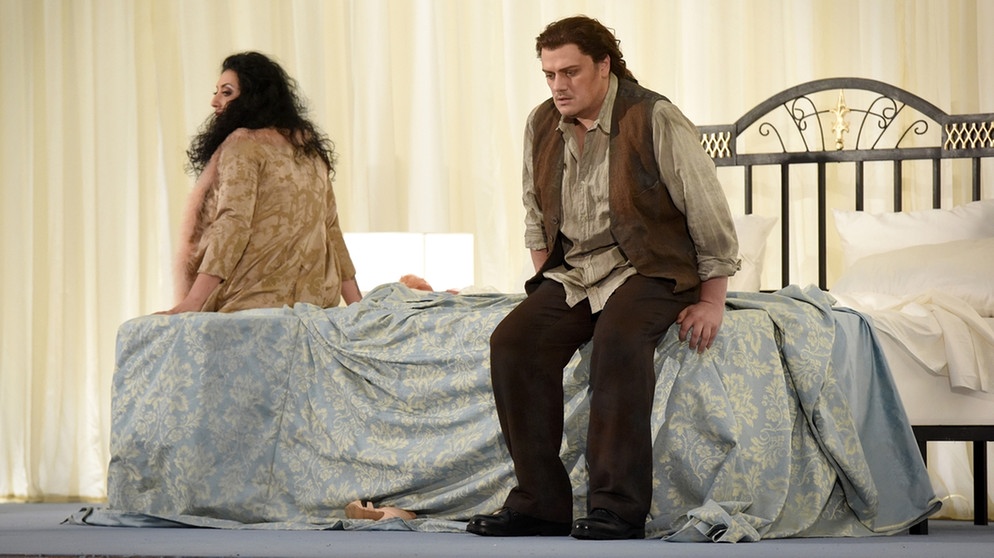
Charles-Camille Saint-Saëns Samson et Dalila op 47 (1877) with Anita Rachvelishvili and  Aleksandrs Antonenko,conducted by Philippe Jordan at the Opéra Nationale de Paris, in a new production by Damiano Michieletto: beautiful and very moving, but best of all, doing justice to the score by enriching the personalities of Samson and Delilah themselves. Saint-Saëns pared down the narrative,  safe in the knowledge that, since audiences would be sufficiently familiar with the biblical original, he could concentrate on the innate emotional drama within. Yes, there are exotic touches, like the pseudo-Levantine tambourine dance, but even that is a clue, since Dalila's performing for show. Her true feelings are hidden.  Instead,  Saint-Saëns wrote music which was in many ways ahead of his era, to the extent that Parisian audiences couldn't really appreciate its merits at first.  Although orientalism had been a part of the French aesthetic since Napoleon, the opera wasn't an immediate hit.  Despite his disavowal of Wagner, Saint-Saëns could hardly escape some influence.  In Samson et Dalila, we can detect Tristan und Isolde in the surging heroic motifs and grand doomed passions  The choruses are particularly rousing.

The Overture begins with a faint suggestion of Hebrew horns, but soon  expands into more abstract sonorities, contrasted with an elusive high string melody. Samson (Aleksandrs Antonenko) sits alone. The chorus, still hidden, intone an ancient chant. On Samson hangs the survival of his nation: he's strong, but is he strong enough? As he looks at his hands, the grille behind him lifts and we see the Hebrews, calling for help.  "Arretez, O mes freres!" Antonenko sings forcefully, but he knows that salvation comes from God not man. The Governor of the Philistines, Abimélech (Nicolas Testé) declares the superiority of his own god. Samson strikes him dead and the High Priest (Egils Silins) orders a massacre. Bodies lie crumpled on the ground, yet the chorus continues singing solemn prayers. Samson, for all his strength, is gentle. With simple white linen, he covers the faces of the dying to protect their modesty and dignity. 

Meanwhile, Dalila (Anita Rachvelishvili) watches, unobserved from inside the Temple. This isn't in the stage directions, but is utterly true to the portayal of her character. She's moved by Samson's kindness.  Rachvelishvili sings lusciously, because it's her job to seduce. Nothing personal.  Even in the palace, surrounded by her handmaidens, she's an object to be pawed and fawned on, guarded by armed men, but  necessarily loved. She's a prisoner of her own situation, which is perhaps why she's touched by Samson's kindness to the dead.  An extremely sympathetic, finely nuanced characterization, for the music suggests  that she's a very complex personality.  Of course she's dangerous, as the Old Hebrew (Nicolas Cavillier) warns.  But she's no automaton. The richness in  Rachvelishvili's singing suggests opulence, yet tinged with half hidden sadness.  Magnificent leaps up the scale to demonstrate power, but  the voice resonates profoundly at the lowest point of her register, Dalila sings of Spring, but the orchestra reminds us of the fundamental chill around her.  In her retreat, Sorek, Dalila is surrounded with luxury, but the High Priest is clearly boss. Silin's body language suggests he's a manipulative abuser rather than a holy man. He paws her, too. Rachvelishvili sings along, but again the tense flurries in the orchestra suggest fear, the tightly controlled vibrato in her voice implying suppressed fear.  Whirring, menacing diminuendos in the orchestra evoke her mental state as she awaits her mission.

Blue shadows cover the golden hues in the bedroom : the "colours" of the Hebrew Chorus invading the Philistine sanctuary, as Samson enters.  There is a frisson, not only in the orchestra but in the way Antonenko and Rachvelishvili interact with each other.  Exceptionally detailed acting is important, because it amplifies meaning, and enhances what is being sung.  Good acting isn't exaggerated semaphore. One of the great benefits of modern opera staging and film is the way singers can extend the impact of their singing through fine detail. Tiny movements in the face and hands flow naturally from the emotion put into singing, placing much less pressure on singers than crude park and bark. In the love scene - for that is what it is - between Samson and Dalila, the music swoons tenderly, the diminuendos now evoke the fluttering of heartbeats. Intimacy not display. Nonetheless, Dalila has to do her duty. As the timpani crash, we hear the "cut" coming. When Rachvelishvili sings that last "Adieu" it's a scream of pain, not triumph.

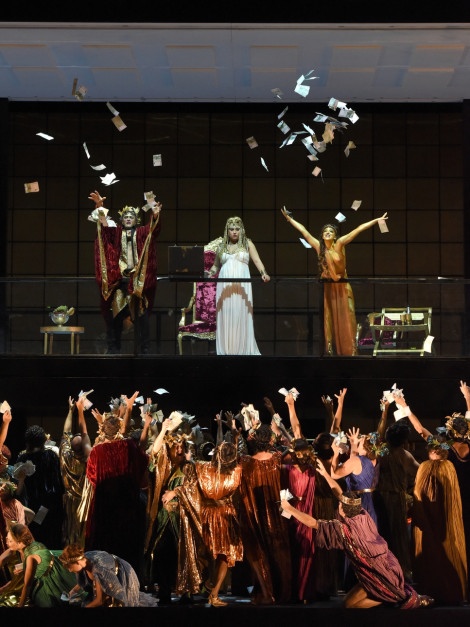
In prison, Antonenko sings Samson's agony, his guilt increased by the sounds of the Hebrew chorus.  Dalila materializes, as if in a dream.  Bachvelishvili doesn't sing, but she moves to the swirling figures in the music, clearly as tortured with guilt as Samson is: a  daring touch on the part of director Michieletto, but extremely perceptive because it shines light on Dalila's personality, and colours the Bacchanale to follow. Now, the Philistines are celebrating; the orchestra breaks into heady rhythms. There are exotic "arabic" flavours but the palette here is much more sophisticated.  Langorous lines suggest drunken dancing - the lines suggest langorous, drunken waltz, cut by violent energetic angles. Plenty of colour, especially gold.  The High Priest throws money to the cheering crowd.  Bachvelishvili wears the golden wig the High Priest gives her, but stands aside, her face acting out what Dalila might be thinking: not pride but disgust.  Samson is beaten up by the mob.  The music gets wilder, then, in a flash, Rachvelishvili pushes through the mob to Antonenko, her face livid. The music changes, the beating stops.   Bachvelishvili dances but her body language suggests that her heart's not in it. Although there's a lot of wine being poured about, at the end  ravaged and guilt ridden, Rachvelishvili pours another fluid: petroleum.  Antonenko calls for God, and Pow! the stage goes up in flames, or rather lurid, sulphuric, blinding light.  A dazzling stroke of theatre!  No need to see columns crashing down.  The invisible God of the Hebrews has spoken.  In any case the music concludes so fiercely that there wouldn't be time.  Brilliant stagecraft from Michieletto, absolutely true to the spirit of  the music and to the meaning of the opera. 

Saturday, 17 March 2012

Paris Pelléas et Mélisande -streaming live

From the Opéra de Paris (Bastille) live streaming of the current production of Debussy Pélleas et Mélisande.  Philippe Jordan conducts, divinely,  feel the sparkling waters in those teasing diminuendos, and the heat rising off the earth  as notes langorously surge upwards. Feel claustrophobic in the damp, sinister caves. But like Pélleas, you might be desperately gasping to escape the staging.

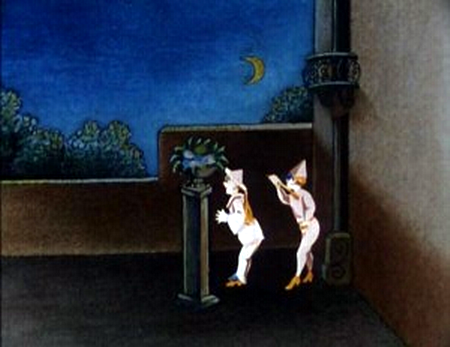
Robert Wilson is the director, so expect neo-classical elegance, a bare stage lit in blue,  black silhouettes suggesting forests and castle. The idea is valid, since Pelléas et Mélisande is a nocturnal fantasy, lit with the strange quirkiness that would inform Pierrot Lunaire. Wilson connects the opera to the psyche from which dream creatures like Pierrot emerge. The picture above comes from the earliest animation of the Pierrot story, made by Émile Reynaud in 1892, using techniques that would be swept away by the advent of film. Watch the streaming on Medici TV HERE and recognize the black and azure.

Maeterlinck's symbolism intuititively revealed the subconscious, years before The Interpretation of Dreams.  Wilson's Personenregie has the singers move in slow, deliberately anti-naturalistic gestures as if they're trapped in a semi-conscious state. But Pelléas et Mélisande works because it's disturbing. The music shifts, unsettling perspectives. The deep well, the high tower, blinding heat, dank odours - all part of the turbulence. The narrative seems imposed upon somethiung infinitely more elusive than mortal minds can grasp. Wilson's frozen stasis doesn't reflect the troubling contrasts in the music, nor really express the hidden, dirty horrors that lie within. We see the dead peasants neatly lying on the ground, but only from the music do we know they starved while trying to escape.

Into this psychological concentration camp, Mélisande appears. What does she represent? Golden rings, golden hair that flows like a waterfall and traps poor Pélleas, eyes like luminous, pure pools. Wilson is right that she's not "innocent" so much as amoral, part of the same nightmare that holds Pélleas and Golaud. The real innocent, Yniold, moves almost like a normal person and wears a bronze doublet. Thus the scene where Golaud upsets Yniold by getting him to betray those he loves is extremely effective. Was Golaud himself once a Yniold? He seems to strike out at the boy, who flinches. The blow is held, suspended mid-air, since it's target isn't the son but the father.

Wilson's stylization reminded me of Herbert Wernicke's Tristan und Isolde where the lovers stood suspended in sterile cubes, while Wagner's passion surged all round them. At the time, I wrote that it was "Tristan und Isolde on Prozac" but psychologically, Wernicke was right. Traumatized people turn in on themselves to escape emotion. It's not that they don't feel, but feeling hurts too much.  So I'm certainly not going to dismiss Wilson's approach, even though it misses so much oif what makes this opera so remarkable. Excellent moments of insight, but three hours of blue, white and black can make you comatose. Maybe that's the point, but it's hard to take without a large cognac. (Another reason for watching the repeat broadcast at home.)

On the other hand, the stylization highlights the music, which is as it should be. There are advantages. Jordan can let the pace unfold, so the shimmering detail in the orchestration can refresh. Debussy is telling us so much in abstract sound that it frees our imagination to create images of our own. The absolute last thing you want in Pelléas et Mélisande is literal hyper-realism. Jordan gets elegance when needed, but doesn't spare the angular brutality when it's hinted at. Golaud's music is specially well defined,  which is important because too often he's treated as stock villain. This opera is Golaud's tragedy, Pelléas and Mélisande the agents that cause his downfall as much as characters in themselves.

Vincent Le Texier is an uncommonly complex Golaud, who commands sympathy. He moves like a statue because that's the staging concept, not his own, but he sings with such resonance that it feels like he's suppressing extreme emotions that will wreck him if he lets them out. The scene where Le Texier's Golaud hits Mélisande growls with deep-felt violence. Again, Wilson shows that the blow doesn't make contact, though Mélisande flinches. Golaud later begs forgiveness, and Le Texier sings as if Golaud were a small boy again connecting to his mother. 

Debussy's writing for Pélleas is transparently beautiful, and  Stéphane Degout sings exqusitely. He's Pelléas as diaphanous ideal, the purity of his timbre luminous. Although the staging is one-dimensional, Degout's singing isn't. He expresses Pelléas's terrors well, the anguish in the voice all the more moving because he's established such refinement in the character. Pelléas may sound like god, but he's trapped like a mortal.  On repeat listening, the depth of Degout's characterization is even more compelling.

Elena Tsallagova sings Mélisande. She looks like a ballerina, and sings with equal grace, but Mélisande is an elusive role, almost impossible to fully interpret. Wilson's non-staging helps Jordan, Le Texier and Degout, but leaves Tsallagova to her own resources, which is is attractive rather than compelling. Anne Sofie von Otter sings Geneviève, and Jérôme Varnier adds personality to the otherwise small part of the Doctor. Franz Josef Selig sounds vigorous and warm as Arkel, which is good - while he lives, there's hope. It's in the plot! Similarly Julie Mathevet's Yniold is vibrant. Her voice is so high that she really sounds like a young boy, but she has the vigour to make Yniold's fears cut. And gosh, does Jordan make the orchestra sound wonderful, in this almost concert performance.

Tuesday, 13 December 2011

Verdi La Forza del Destino - Paris

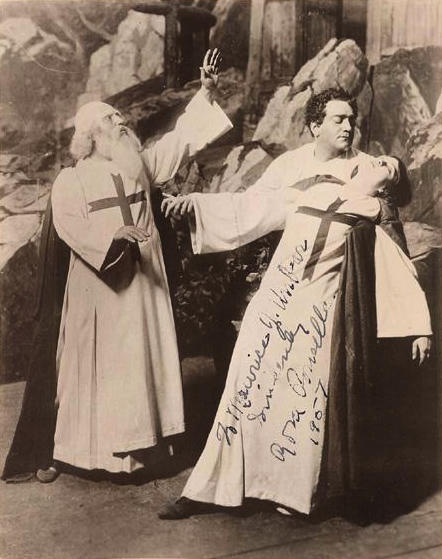
If you, like me, have a weak spot for Verdi's La Forza del Destino, any production is interesting. It's notoriously hard to stage.Too much realism makes this high kitsch tale wackier than it needs to be.  Even Caruso and Ponselle (photo left) make it look camp. But the rousing, hyper-emotional music makes the opera fun.

Please read Jim Sohre's review Drapes 'n' Drops in Paris Forza of the current La Forza del Destino at the Bastille in Paris. Philippe Jordan conducts, brilliantly. Full webcast on Medici TV. Marcelo Alvarez and Violeta Urmana, who has created Leonora several times, and Kwangchul Youn, who must make Fra Melitone an overwhelming figure.  I'm now listening to the medici tv webcast, it's WONDERFUL!  Orchestrally amazing and very good singing - this score is full of killer star turns, and they all come through. I will watch again and again and write up over Xmas  HERE is the link to Jim's review in Opera Today

Monday, 17 October 2011

Faust embastillé par la mise en scène?

"Faust embastillé par la mise en scène?, so writes my friend Dodorock on his unique blog De chez toi.  Thanks to him, we can watch Gounod Faust straight from Paris, Opéra Bastille, (Philippe Jordan, Roberto Alagna) hours after the show on 11th October. and also read a selection of reviews. Controversial, huh? One critic wails that Gounod's been turned into grand Guignol. On the other hand Faust's predicament is the ultimate grand Guignol, for Méphisto is leading Faust into crazier things than he could ever imagine.

Watching the production live and on film are different experiences. This film, directed by François Roussillon is probably clearer, since the camera can pick up on tiny telling details you could easily miss on a big stage. The set (Johann Engels) is panoramic for a good reason : it represents Faust's search for knowledge. Hence bookshelves straight to the top of the stage area, statues, telescopes, astrolabes, and a rhinoceros, like the one Louis XV kept at Versailles. The idea is that the universe is so full of exotic things, we can never stop searching. Faust has realized that he'll never take it all in, which is why he calls on Méphisto to restore the youth he hadn't appreciated when young. Central features: a gigantic crucifix and a glass dome under which a miniature green jungle thrives. A golden calf and huge skeleton. Such abundance, yet Faust knows something's missing. Like Einstein writing on a blackboard, he scrawls "Rien!" on the wall.

Méphisto arrives quietly. Paul Gay looks more than 2 metres tall, elegantly attired, sophisticated. A brief shot of a painting behind him, barely glimpsed, of the traditional Devil in red jumpsuit and pointy tail.  If the Devil, in real life, was so easy to spot, why follow? Why anyone needs to see him as fire spitting demon, I don't know, for the whole point is that mortals choose their own fate. Méphisto merely facilitates.

Remi Corazza sings Old Faust, who transforms into Roberto Alagna's Young Faust. On film, the switch is amazing, as it should be. It's a miracle, by the devil.  Alagna is surprisingly good, though he's more Italianate than Gallic, but that's no problem. Faust is an eternal archetype, German with Goethe, vaguely middle European in Marlowe. Alagna's physicality is superb. His Faust has erotic animal energy, with much moree individual personality than Grigolo at Covent Garden.(please see review HERE) Sex is the life force that motivates Marguerite, too, and Siebel and Marthe. 

At first, Inva Mula as Marguerite, moves like an automaton, singing the King of Thule song as if the slavish loyalty in the song was drilled into her. When she finds the jewel box, she's transforemed. While McVicar had Gheorghiu squeal with delight at fake gemstones, the Paris director, Jean-Louis Martinoty emphasizes Marguerite's inner awakening. Méphisto is with her as she takes off her robe. Mula and Alagna grope each other with  X rated realism. They sing the double duets with real relish, as if both are discovering Eros for the first time.  The film cuts to a shot of the glass dome with the jungle which was there all along side stage. A glimpse of Dürer's Adam and Eve flashes on screen, almost certainly missed live. I'm less convinced by the green light and foliage that now fill the stage but Martinoty is making a valid point. God or Devil, it's humans who make the choices.

The soldiers return from war as walking wounded, which give Gloria immortelle a poignant kick. Like Faust, Marguerite, and Siebel, they've bought into dreams.  From this point, illusions are shattered. Méphisto appears dressed as a red robed bishop, possibly on stilts, as he towers above all.  He tramples on the giant crucifix, which lowers like a drawbridge between Hell and Earth. "Marguerite, sois maudite!" intones Gay, with dark portent. The ancient goddesses rock baby pigs and owls, in a parody of Marguerite rocking her dead baby, and feast on a table that was once the Crucifix. A skeleton descends from the ceiling. "Quel etrange ornement" indeed.

Then crucifix becomes guillotine. On stage, this might have been clumsy. On film, we see the soldiers, townsfolk and sundry  personages parade in a mock religious procession - Gloire immortelle, now kinky and twisted. Then Siebel emerges, carrying Marguerite's head which gets put, not into a tumbril but into the kind of glass case with holy relics you see in hallowed sites.  She gets to Heaven though not quite in the usual way. Méphisto doesn't need to drag Faust  physically down to Hell. He merely points, and Faust meekly follows. What happens in Hades can't be much worse than damnation on earth. No wonder Fench critics weren't comfortable. But it's a valid realization of the plot.

Philippe Jordan conducts the orchestra of L'Opéra Bastille, with sardonic pungency. Definitely a whiff of sulphur here! In the love duets, the orchestra is specially verdant and romantic, but Jordan has a feel for the mad march that underlies the greater arc in the music. From the overture to the end, the pace is brisk, controlled but sharp. Mépghisto's music is particularly vivid. The staccato "footsteps" are deft, almost magical, matching Méphisto's sly, unhumorous  "Ha ! Ha ! Ha !"
 
Here is, thanks to Ddorock, the link to the broadcast  Lots more on Faust, Goethe and other Faust operas/movies on this site too, please explore.

Thursday, 6 October 2011

Philippe Jordan to head Vienna Symphony

Philippe Jordan has been named new Chief Conductor of the Vienna Symphony Orchestra, from 2014/15 when Fabio Luisi steps down. Jordan is the son of Armin Jordan the distinguished Swiss French conductor, but he's made an even bigger name fort himself in recent years. I first heard him conduct Wagner Tristan und Isolde when he was still very young in Switzerland. Terrible production and principals but Jordan saved the show. Since then he's gone on to greater things, conducting everywhere. He can even conduct Mahler with spirit. And he dances too, which makes him elegantly expressive on the podium.
photo : J Ifkovits

Saturday, 1 August 2009

Faust - Ferruccio Busoni Thomas Hampson Goethe


Ferruccio Busoni is a strange figure who doesn't fit into neat boxes. He was a child prodigy, whose virtuostic displays astounded Europe. Privately, he was a polymath, exceptionally well read and thoughtful. Indeed, his real legacy may lie in his ideas, and the way they inspired men whose music in no way resembles his own. No less than Edgard Varėse called him “a figure out of the Renaissance”, who “crystallised my half formed ideas, stimulated my imagination, and determined, I believe, the future development of my music”. Busoni believed that “music was born free and to win freedom is its destiny”, and that it was just in its infancy as an art form.

Busoni deserves a lot more attention than he gets. So read this review of his opera, Doktor Faust, by Jim Zychowicz. This is an excellent performance, as you'd expect with Thomas Hampson in the leading role. Recordings are not thick on the ground. There are two recordings with Dietrich Fischer-Dieskau. Much as I love DFD as a father figure, he's never been the most convincing of opera singers. He doesn't let go enough, he's always DFD singing a role rather than inhabiting the character. Both recordings (Leitner and Nagano) come from the tail end of his career, when he's not quite as unwooden as he might be. So Hampson really is the way to go. He can act, too, wonderfully and is in top form vocally. The staging is very good, and the conductor is Philippe Jordan, son of Armin. Jordan fils is definitely a conductor whose work is worth hearing. He's very clear, precise yet animated and lyrical. He is still barely 40, so will go a long way.

Busoni's Faust is one of the "need to know" operas of the 20th century. This DVD is so good it's also one you want to know. Sadly, this isn't based on the new edition prepared by Anthony Beaumont but instead uses the rushed completion made in 1925 immediately after the composer's death. Busoni did, however, leave enough material to allow a less hurried completion by Anthony Beaumont, based on Busoni's own notes. Beaumont wrote the book, Busoni and his music, still the basic text after 30 years years. He's also the Zemlinsky expert, who cleaned up Zemlinsky scores for new editions. The wonderful, ecstatic score of Zemlinsky's Lyric Symphony is his. See a review of the Eschenbach recording : it's outstanding, nothing else comes remotely close.