Showing posts with label Holt Simon. Show all posts

Monday, 9 October 2017

Unfinished Business: London Sinfonietta 50 years


"Thank goodness for the London Sinfonietta!" (as the London Sinfonietta quotes me on the front page of their website. True, indeed ! without the London Sinfonietta, music in this country would have been dull indeed. The London Sinfonietta were pioneers, much more than "just" an ensemble. They were a powerhouse of creative, innovative thinking, generating a sea change in musical thinking which continues to flourish today.  Thus Unfinished Business, marking the forthcoming 50th anniversary of the London Sinfonietta, which starts Wednesday 11th October at St John’s Smith Square, starts with Hans Werner Henze's iconic Voices. Henze  himself conducted it with the Sinfonietta on their 1978 recording, re-released a few years ago. Please read my summary here.
 
Henze was closely associated with the London Sinfonietta who played a lot of his music, composer and orchestra both defined by the events of 1968.  They hosted a major retrospective to mark his 75th birthday, which is when I  met him.  He was a lion, but kind hearted enough to be nice to a nobody like me.  Henze is dead, but not forgotten. Currently I'm enjoying a new recording of his Neue Volkslieder und Hirtengesänge  and Kammermusik 1958 with Andrew Staples and the Sharoun Ensemble Berlin, conducted by Daniel Harding - it's wonderful, read more here.  This time round, David Atherton conducts Voices.  He's a Sinfonietta veteran too : the concert should be an almost historic occasion. 


Later in the season, Iannis Xenakis, Luciano Berio, Harrison Bitwistle, Gyorgy Ligeti, Wolfgang Rihm, Karlheinz Stockhausen and others, just a few of the numerous composers who have been associated with the ensemble from way back. The London Sinfonietta has a lot to be proud of !   A welcome return to its Glory Days, when it presented excellence with style and commitment.  For a while, it seemed that the ethos had changed. Governments promote the idea that orchestras should make education a priority but that's a political argument, not artistic logic.  If governments really cared about education they';d fund it in the first place, and let orchestras do what they do best., which is make music that inspires listeners to learn.   Excellence itself "is" education.  Please see a few of the numerous concerts and recordings I've covered over the years, including:
Beat Furrer FAMA 2016

Hans Abraham Schnee Simon Holt

George Benjamin Into the Little Hill

Stockhausen Trans und Harmonien

  and loads more ........click on composer names

Monday, 27 March 2017

Simon Holt a table of noises NMC


Simon Holt is one of the really big names in British music, highly regarded by those who listen live and read scores, so this release from NMC, specialists in modern British music, is particularly welcome.  a table of noises follows on from A Book of Colours, Boots of lead, feet of clay and Era Madrugada, all from NMC. Eventually, more of Holt's work will be readily available on disc because it rewards repeat listening. Holt's music isn't noisy. Like good poetry, it reveals itself in quiet, unhurried contemplation.

The title piece, a table of noises, (2007)  refers to the table at which Holt's great uncle Ashworth worked, where he kept tools readily to hand, meticulously organized.  Ashworth was a taxidermist who stuffed birds and small countryside animals. There's something surreal about taxidermy.  It brings the woodland under the control of the parlour.  But can you be decorous with a dead badger in the living room, staring at you through glass eyes, lifelike but immobile?  Taxidermy is  fiddly, messy work and quite unnatural, but strangely obsessive. Great Uncle Ash was disabled so he kept his tools together within easy reach, meticulously organized.  Picture that table in your imagination.  It's a metaphor for Holt's  music. It's strictly defined but the very confinement generates resourceful adaptation. 

Simple means are used for maximum effect. Colin Currie, for whom the piece was commissioned,  plays a variety of small instruments, played in groups of three.  The sound is pared down to essentials, very methodical and down to earth.  Hence the jaunty rhythms and unpretentious sounds. Do we hear a tin whistle in the mix ? Or a squeaky toy?  Currie plays fairly conventional instruments like glockenspiel and xylophone, but the effects are decidedly quirky.  Hammers and chisels clattering as if in a workshop, interspersed by silences and odd rhythmic progressions.  a table of noises is wacky but tightly organized.  It feels like a solemn but vivacious dance. Clog dancing springs to mind. The rhythms are jaunty yet "grounded" since the dancers are possibly drunk and club-footed, and wear heavy boots. Why should athletes have all the fun?  Holt turns rough and ready into art form. 


Flights of fancy, like the piccolos calling above the ensemble, inject a wayward spirit of eccentric freedom.  Why did Victorians preserve dead roadkill and pose them in anthromorphic positions?  Perhaps we are in the lab of a mad scientist whose inventions seem bizarre but might have an inner logic. As Currie hammers away, the orchestra produces equally inventive effects - booming bass trombone and tuba, like the pipes of a funeral organ gone mad. Some of the ten sections have descriptive titles, like "Skennin' Mary", a neighbour whose glass eye spun when she became angry, which would have fascinated a taxidermist who kept collections of glass eyes for his specimens.  Four sections, though, are simply "ghosts", reminding us that what we hear might not be what we assume. Holt's inventive use of sound also reminds me of Third World musicians who make music with whatever comes to hand, like sticks and rocks.  Percussion may be the most ancient form of music.   That's a compliment, since a composer who can work with humble sources understands innately what makes good music.   Holt's a table of noises is also fun. The exact background doesn't matter, since we can feel the sense of adventure in its inventive sounds, and relate to the good natured, if oddball, sense of humour. 

Macabre humour, too, in St Vitus in the Kettle (2008) a brief but tightly structured miniature which begins as a wild dance, whipped by insanely high piccolos,  haunted by dark, sepulchral block chords.  For a moment silence descends but the manic, energetic rhythms return with even greater force.  Do we hear in these bubbling rhythms the sound of  boiling water?  St Vitus in legend was a child martyred by being boiled in a kettle but who leapt unharmed and intact, being saved by faith.  Medieval peasants found cathartic outlet by dancing orgies in his honour, hence the term "St Vitus Dance" to describe derangement. 

St Eulalia of Merida, the ostensible subject of Holt's Witness to a snow miracle (2005) was martyred by the Romans by being buried under hot coals. She rebuked her persecutors to the end, when snow miraculously descended, while her soul ascended to heaven.   Thus the cadenza with which the piece begins, with Chloé Hanslip with wild but determined frenzy.  Does this suggest religious mania or the equally fanatical mania of her persecutors?  Either way, the violin expresses extremes of pitch and tempi, supported by screaming woodwinds  and contrasted with ominous brass and percussion.  Harps  and celeste sparkle, suggesting snowfall, and divine intervention. Eventually the violin soars upwards, as the pounding brass grows muffled. The heat of mania is silenced, under a blanket of snow.  As so often with Holt, textures are built up through meticulous process, every note clearly defined.  Medieval audiences adapted reality into  highly coloured, exaggerated tales like these to suit their own needs.  Simon Holt adapts them into abstract music, but music that connects to human passion and emotion.

The Hallé was conducted by Nicholas Collon. 

Thursday, 8 December 2016

London Sinfonietta : Hans Abrahamsen Simon Holt


Freezing fog on the Thames : suitably atmospheric weather for Hans Abrahamsen's Schnee with the London Sinfonietta at St John's Smith Square, where Abrahamsen's Schnee was heard together witrh Simon Holt's Fool is Hurt and Morgan Hayes' The Kiss.  The London Sinfonietta premiered Schnee as a two-part invention back in 2007, so this concert was a timely reminder that  musicianship is making music. Education programmes tick funding boxes, but, ultimately, excellence in itself "is" education.

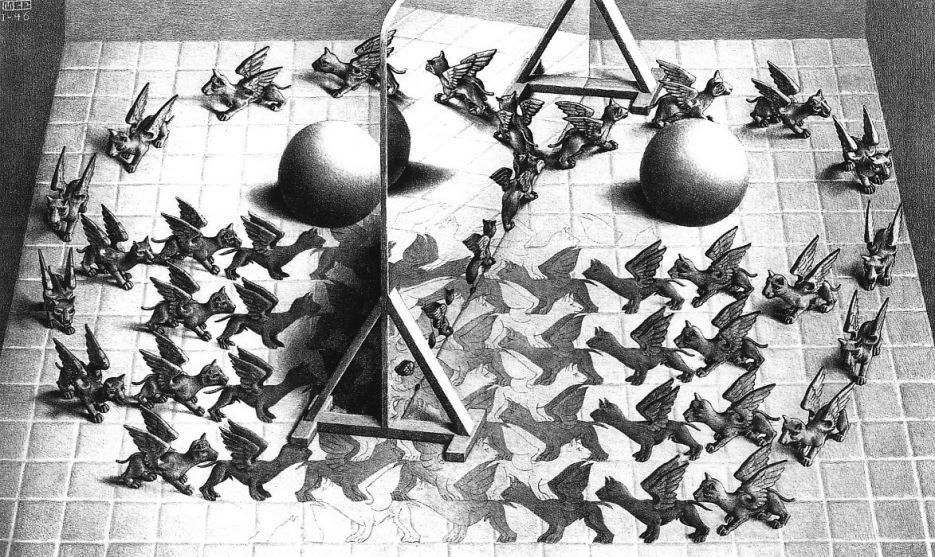
Abrahamsen's Schnee is a tightly constructed perpetual motion machine, where ideas interact and regenerate in ever-transforming variations.  An MC Escher puzzle come alive and moving, propelled by its own inventive momentum.  The first famous chords beat quietly, like a metronome, giving shape to the idea of time. This steady beat runs throughout, ever-changing and sometimes subsumed in the flow, but provides a steady pulse. Abramhamsen's use of canon form intensifies the idea of recurring, reiterative  patterns. Imagine Mandelbrot diagrams coming to vivid life!  Schnee operates on several levels. Its intricate mechanisms are like puzzles operating in parallel. A friend remarked that Schnee felt like watching snow fall. But observe ; snow is water,  Nature's own recycling, uniting the oceans and sky.  Each snowflake is unique, and snowfall myriad individual particles operating together. Hence the title "Schnee"is no accident.

Schnee operates as ten canons in five groups, with three intermezzi at non-regular intervals : the first coming between Canons 2a and 2b. Recurring patterns are taken up by different combinations of instruments, and sometimes all together in free flow. I enjoyed the intimacy of this performance, conducted by Geoffrey Paterson. It was good, too, to hear pianist John Constable, one of the founders of the ensemble, which for me added another level to the ideas of time and space in perpetual motion.  Abrahamsen shot to overnight fame with Let Me Tell You (more here) on the basis of Barbara Hannigan's celebrity status, but quite frankly that piece is not at all typical of Abrahamsen's work. It's disturbing that some fans of LMTY don't actually listen to music.  A bit like assuming Valse Triste "is" Sibelius.  But Schnee will endure because it's infinitely better music, and much more distinctive. 

Although Schnee was the big draw, many of us loyal London Sinfonietta fans came for Simon Holt's new work Fool is Hurt (2015). Holt is one of the most original and distinctive British composers. Although the concert didn't follow the order on the printed programme, it was obvious from the very first chords of Fool is Hurt that this was Simon Holt and could not be anyone else. The title comes from a chance remark in a Fellini film, but it's a reference to the Holy Fool, a meme which pops up throughout European culture: an innocent who finds his own way or doesn't but stands for unsullied integrity. In that sense, Fool is Hurt is vintage Holt, a descendant of Who put Bella in the Wych Elm?  Witness to a Snow Miracle and Centauromachy.  Although the Fool in a tarot deck plays a flute, I've often "heard" it as a piccolo, more vulnerable and simple, as the Fool symbolizes. The piccolo is small but its plaintive way, it's surprisingly strong. Michael Cox's piccolo soared heights way above the dark murmurings of the rest of the ensemble, the clarinets moaning malevolence.  They'll never "get" what the piccolo, and the Fool, mean.  

Incidentally,when the London Sinfonietta premiered Abrahamsen's original Schnee in 2007, they paired that with Simon Holt's Sueños, a song cycle with the ominous portent of a black and white Buñuel film, where elusive melodies for flute and viola floated above earthy orchestration featuring accordion and guitar.  Fool is Hurt is a much more sophisticated piece, even quite elegant in its own individualistic way.  It appealed a lot to me because it feels very personal: really good composers, like Holt and Abrahamsen, don't need bluster to prove a point.  

More patterns of time and form: the programme began with a memorial to the late Paul Parkinson, who did much for new music in his work with the British Council.  His Movements from Wind Quintet (1978) were very much of their time, and music is a continuum.  Morgan Hayes Overture :The Kiss (2016) is part of a series of short pieces totalling altogether 20 minutes  Hayes writes that the "kiss" here is "an extended instrumental technique  which occurs in the chaconne-like section ", clarinet and viola leading sections that correlate.  

Please see my other pieces on Hans Abrahamsen, Simon Holt and the London Sinfonietta by using the labels at right and below.  For Abrahamsen's Left, Alone (with the CBSO) see HERE.

Thursday, 19 March 2015

Poetry beyond words - Nash Ensemble Wigmore Hall


The Nash Ensemble's 50th Anniversary Celebrations at the Wigmore Hall were crowned by a recital that typifies the Nash's visionary mission.  Above, the dearly-loved founder, Amelia Freeman,  a quietly revolutionary figure in  her own way, who has immeasurably enriched the cultural life of this country. Ostensibly, the concert featured some of the best modern British composers, plus Elliott Carter, an honorary Brit, since his music has been so passionately championed in this country.  But a deeper perusal of the programme revealed even greater depths.. "Poetry beyond Words" I thought, since most of the pieces transformed their original sources in text and visual images into exquisitely original works of art. Lieder ohne Worte: an affirmation of the life force that is creativity.

Simon Holt's Shadow Realm  (1983) gets its title from a poem by Magnus Enzensberger (a favourite of Hans Werner Henze).  ".....for a while/ i step out of my shadow/for a while.....".  Holt's music penetrates the elusive mysteries of the text, going beyond the words to express its spirit. It's structured in two halves, "shadowing" one another, but scored for an unusual combination of clarinet, harp and cello, creating a three-way conversation  creating a further shadow around the duality of its conception. It's a miniature, only eight minutes long, but its concision is so elegant that it puts to shame many works which drown in verbose meandering. Holt was only 25 when it was written: a remarkable original achievement by a composer whose self-effacing manner belies a mind of great originality. It says much about the Nash Ensemble that they commissioned it, long before Holt became famous.

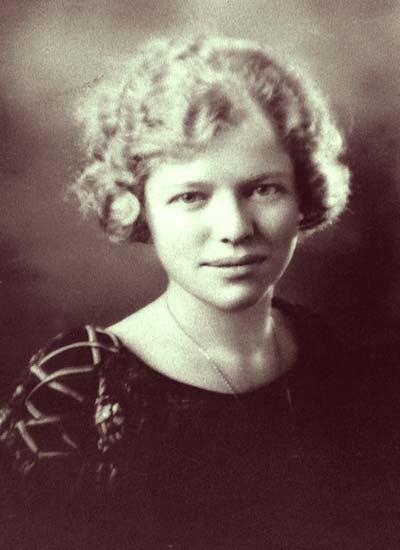
The poems of Lorine Niedecker (1903-1970) pack intense meaning into fragmentary, haiku-like lines, some of which don't even follow grammatical syntax. But therein lies their beauty.(that's her in the photo). Harrison Birtwistle's Nine Settings of Lorine Niedecker (1998-2000), another Nash commission, distils each poem with a kind of almost homeopathic concentration, communicating the spirit of the poems, far more creatively  than mere word-painting.  Claire Booth sings arching lines which reach upwards and outwards, sustaining the legato, while the cello weaves around, without interruption, coming into its own only when the voice falls silent, like an elusive echo, Eventually, the poems seem to move away, beyond human hearing. The music gradually slows down, voice and cello retreating together with melancholy "footsteps", each note expressed with solemn dignity.  Birtwistle recognizes the fundamental structure of Niedecker's text, but emphasizing syllables and single words, rather than phrases. " thru bird/start, wing/drip, weed/drift", though in the text the words are joined. Perhaps this captures the sense of water, dripping quietly in some vast stillness. Yet it's also typically Birtwistlean puzzle-making,  creating patterns within patterns, layers within layers. Beautiful moments linger in the memory, like the "You, ah you, of mourning doves", where the poet plays with the word "you", which sounds like dove call yet also evokes human meaning, while the composer, for once, infuses the word "mourning" drawing its resonance out, like the cooing of the bird.

One of the great joys of Julian Anderson's music is that he's an extraordinarily visual composer. Graphic images inspire his music and enrich its interpretation. His Alhambra Fantasy (2000) was stimulated by Islamic architecture, The Book of Hours (2005) by the miniatures in  Trés riches heures du Duc de Berry, and even Symphony (2003), despite its non-committal title, owes much to the paintings of Sibelius's friend, Axel Gallen-Kallela. Yet again, the Nash Ensemble recognized his unique gift almost from the start.  Poetry Nearing Silence (1997) was inspired by  The Heart of a Humument, a book of paintings by Tom Phillips, where random words from an obscure novel were picked at random, then adventurously illustrated.  See more here.  Just as Phillips transforms words into visuals, Anderson transforms ideas into abstract music. Eight highly individual segments unfold over 12 minutes. Each has a title, borrowed from the book, though the settings as such aren't literal.  In the third segment "my future as the star in a film of my room", one of the violinists plays percussion (a ratchet), which whirrs like the cranking of an old-fashioned camera. In the Wigmore Hall, the sound is decidely disturbing, but that's perhaps Anderson's intention : we can't take what we hear for granted. In theory, the segments travel round Europe - Vienna, Bohemia, Carpathia, Paris. Far away landscapes of the imagination: perhaps we hear references to Janáček's Sinfonietta, crazily buoyant but cheerful. The Nash play at being folk musicians, imitating alphorns and shepherd's pipes.  Everything in joyous transformation!  Gradually, the clarinet (Richard Hosford) draws things together, as silence descends.  Although Anderson doesn't employ voice in this piece, it feels like song, because the instrumentation has such personality.


The recital began with the world premiere of  Richard Causton's Piano  Quintet (2015), dedicated to the Nash. It's lively and inventive. Violins and viola tease cello and piano, provoking and taunting, whiling off in all directions.  Gradually the piano (Tim Horton)  restores harmony with a gracious cantilena.  Peter Maxwell Davies's String Quintet (2014) also received its world premiere. Four movements, each with a different mood and form, the Chacony being the most vivid. Before that, Elliott Carter's Poems of Louis Zukofsky (2008), with Claire Booth and Richard Hosford.  Carter expresses the shape of the poems as they are laid out in print. There are silences in poems which create an impact by the way they look on the page denser scoring where needed, the vocal line calling out into aural space.  Zukofsky's copyright holder issues stern warnings against quotation and use.  A very different attitude to the immensely rewarding creative inter-relationship between different art forms which made this concert so rewarding. 

If I haven't written much about the performances, that's because the Nash Ensemble are always good, and reliable.  The players on this occasion were Tim Horton (piano), Philippa Davies (flute), Richard Hosford (clarinet), David Adams (violin), Michael Gurevich (violin), Lawrence Power (viola), James Boyd (violin), Björg Lewis (cello), Adrian Brendel (cello), Lucy Wakefield (harp) and Claire Booth (soprano), and Lionel Friend (conductor).  This article also appears in Opera Today.

This concert was recorded for broadcast on BBC Radio 3 on 13th June 2015
Wednesday, 10 August 2011

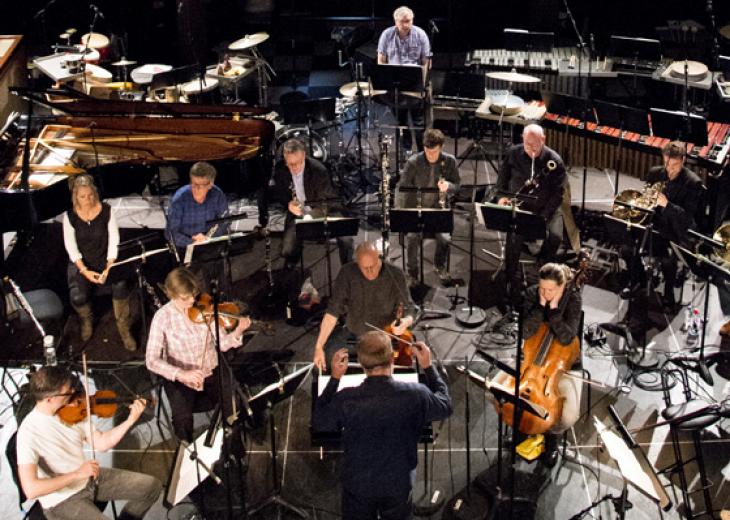
Bridge, Holt, Saint-Saëns Roth Prom 34

Whatever the rationale behind the programme of BBC Prom 34, eclectic François-Xavier Roth conducted BBC NOW with panache. They sound invigorated and inspired. Listen again HERE. 

Frank Bridge's Enter Spring made a wonderful opening statement. Enter Spring is contemporary with Janáček's Sinfonietta. They're inspired by different things, but both reflect the optimism of the late 1920's. That we know what was to come next makes that optimism all the more poignant. Bridge isn't miniaturist or insular. Birds sing in these hedgerows, perhaps, but Bridge's perspective is the boundless sky, the windswept expanses of the Sussex Downs rolling out towards the sea. What glorious freedom! Definitely not "drawing room" or stylized pastoral. You can understand why young Benjamin Britten, at the premiere, was blown away, and never lost sight of wider horizons. It's a sophisticated work - listen to the deft, almost modernist woodwind passages and the way they flow into broader strokes for full orchestra, marching progessively, relentlessly to the finale. Roth cuts the last moment defiantly - no messing about!

Bridge's Blow out, you bugles! is interesting too for it sounds almost more like improbably early Britten or Gerald Finzi. The vocal line is dominant, Bridge observing Rupert Brooke's poetry with great sensitivity. When the trumpets enter, they can't, then, feel triumphant. One chord is held long enough that it contradicts the idea of a bugle calling violently for action. Deeply ironic. Then the voice does a similar leap ("heritage"). No mistaking where Bridge's sympathies lay. Ben Johnson was the tenor.

Simon Holt's Centauromachy received its Proms and London premiere.  It's already created quite a buzz since it was first heard in Cardiff last year. Read what I wrote about that premiere. It's a fascinating piece because it predicates on duality. It's a double concerto. Flugelhorn and clarinet duel, stalking each other and seductively duet. A centaur is half man, half beast, two states that don't resolve. Holt's music is intriguing because he lets the balance hover. Like Bridge, Holt opens outwards into new dimensions. Is man trapped within beast, or beast trapped within man? Holt may be suggesting that there are things we'll never know for sure, but must keep an open mind.

Only in the second half of the Prom did the logic of this programme really emerge. Saint-Saëns' Organ Symphony might have been written for a cathedral and a very academic organist but in some ways, it's an interior "open horizon". The Royal Albert Hall organ is never timid. Here, Thomas Trotter made it sing gloriously, of a spiritual landscape so glorious that it surpasses anything physical. Forget the cliché about Anglo-French Entente Cordiale. Nationality means nothing in the face of the sublime. 

Wednesday, 29 December 2010

Concerts - best of 2010

Hans Werner Henze started the 2010 concert year off well. The Barbican Total Immersion weekend was well planned, several good concerts incl Elogium Musicum and a non-staged performance of Phaedra which I saw first staged in Berlin. I also enjoyed his ballet Ondine but utterly loathed Elegy for Young Lovers at the Young Vic, the most misguided and self pandering production I have ever seen or heard, anywhere, barring the same director's abortion of Sibelius's Luonnotar. Elegy isn't known in its original form in the UK: now Londoners think it's a TV sitcom. Henze's one of my herores. Check out this site - no fewer than 18 main posts about him.

The Barbican delivered yet again in March with a Wolfgang Rihm Total Immersion. Wonderful music, wonderful man. Henze doesn't really qualify as The Greatest Living German Composer since he lives in and identifies with Italy. So the honours go to Wolfgang Rihm. Much that's written in the US about modern music would be changed if there was greater awareness of what modern music in Europe really is like. Fortunately in the UK, we get plenty of Harrison Birtwistle, and many younger composers like Brian FerneyhoughLuke Bedford. and Simon Holt, all of whom merit several concerts and broadcasts this year - use search label for more. Up and coming, I loved Lloyd Moore's Diabolus in musica.

And then, Aldeburgh, the hippest and liveliest creative festival in the UK. With Pierre-Laurent Aimard at the helm, it attracts the best and brightest from Europe and the US but it's completely muisunderstood by the UK mainstream media, who don't even know enough about Benjamin Britten to know what Aldeburgh meant to him and what it stands for. No other site covers Aldeburgh as much as I do, so take time to explore this site. ABSOLUTE highlight this year was Pierre Boulez. Concert with Ensemble Intercontemporain, who played their hearts out, relishing the buzzy but relaxed  Aldeburgh atmosphere. Aimard and Boulez chatted informally, winning over an audience many of whom had come to hear Bach. 

This year's Proms started with a huge celebratory bang, but there were many other solid highlights, such as the Rattle/Berliner Philharmoniker's mega symphony of Schoenberg, Webern and Berg, Metzmacher's DSO Berlin Mahler 7. Well balanced and good value. Although this is Mahler year, all but a very few Mahler concerts (Rattle, Berlin, Abbado Lucerne, Salonen South Bank) have been extremely disappointing. The "new" chocolate coated Mahler may have mass appeal but it make take another 50 years to reverse. Tchaikovsky still hasn't recovered.

Schumann, on the other hand, has benefited from the publicity. All his symphonies were played at the Proms, and in a stimulating way. Recitals, too, have been uniformly good. But if there's one single concert that will live in  my memory it will be Matthias Goerne's second Wigmore Hall recital. This is what Lieder singing really should be like - emotionally intense, intellectual sharp, absolute reverence for the music and poetry. Lieder isn't "easy listening", smooth or superficial, much as the celebrity market would like.

Wednesday, 17 November 2010

Simon Holt BBC NOW Centauromachy premiere

Centauromachy, a major new work by Simon Holt, premiered last night  conducted by François-Xavier Roth, and BBC NOW (National Orchestra of Wales)  It's substantial, five movements over 25 minutes, as ambitious as a symphony.  (Review of the Proms concert is HERE.)

Holt puts Clarinet with Flugelhorn in a double concerto. "It's surprising how two different "species", wind and brass can sound similar", he says. "Centaurs are a species of mythical creature that appear to have the torso of a man joined at the waist to the hind quarters of a horse at where the horse's head and neck would normally be. They are essentially fantastical beasts that combine, simultaneously, two distinct natures in one body. This may account for, on the one hand, their wisdom, making them intelligent teachers, whilst also making them impulsive and lustful, trapped in a kind of limbo between their two inherent natures: wild and yet capable of civilised behaviour."

Clarinet and Flugelhorn at first duet, establishing their individual character in repeating passages. Soaring calls, cross rhythms, each instrument restating the other's theme over a murmuring, dense orchestral background. A primeval forest, perhaps, setting the context. Duality extends in orchestral texture too, shifts between opaque layers and what Holt calls "still centres", moments of near silence, like clearings in a forest, or the way animals observe each other without making sound. Short snatches of very high pitch, fluttering eddies, ostinato like the stamping of hooves.

Holt describes the second movement as "dreaming". It's subdued, mysterious, yet alert. There's a steady rhythmic undercurrent, almost like breathing. Dreams perhaps, but not sleep.  Suddenly the music breaks forth again. Clarinet and flugelhorn acknowledge each other again in animated figures which leap and bound with energy. First clarinet plays with the orchestra, then flugelhorn, each establishing their own territory. Then they hocket. It's like a duel, each instrument grappling with the other for precedence. As Holt has said, "There was once a battle between the Centaurs and the Lapiths and this battle features in the fourth movement".
 
"Centaurs are well known for being heavy drinkers capable of violent and delinquent behaviour." said Holt. But there was one centaur, Chiron, who was intelligent and idealistic. He was an artist, teacher and healer who served mankind. Although half-beast and half-human, he proved his nobility by sacrificing himself to save Prometheus who defied the Gods and brought fire (ie light and civilization) to mortals. The finale is an  Elegeia for Chiron. It grows out of a long silence after the tumult of the fourth movement. It's austere and dignified, extreme stillness. Blaring flugelhorn reminds us of the Centaur's bestial nature, while clarinet (in A) creates soaring high pitches that rise upwards. As flugelhorn and clarinet combine, the music ends with a down to earth blip.

Wonderful, inspired playing by the BBC National Orchestra of Wales. Robert Plane played clarinet,  Philippe Schartz had a golden opportunity to display the richness of the flugelhorn. I haven't hear this orchestra in such excellent form in ages. They sound rejuvenated playing with vigour and crisp precision. Part of this may be the new conductor,  François-Xavier Roth, who is most certainly a "personality" in the best sense, charismatic and eclectic. Could BBC NOW emerge as the hippest orchestra in the BBC fold?  Simon Holt's Centauromachy gets most coverage because it's an important new work, but Roth and the orchestra showed just how good they are together in the rest of the programme. Albert Roussel's Bacchus et Ariadne, Suite No 2 (Monteux) shone, sounding decidedly modern. This performance of Sibelius Symphony No 2 was outstanding. It was tightly shaped and disciplined, so when the outbursts of freedom came they were exhilarating. After digesting Centauromachy, pay special attention to Roth's Sibelius. It's truly inspired, clear sighted and visionary. Wonderful !  Listen to the repeat broadcast HERE.


photo credit : Andrzejj Urbaniak

Wednesday, 18 August 2010

Luke Bedford opera - BCMG 2010/11 season

2010-2011 with the BCMG (Birmingham Contemporary Music Group) looks exciting. Luke Bedford's first opera, Seven Angels, eagerly awaited by all who know how well Bedford writes for voice.

"Seven angels fall through space and time. When they come to rest in a desert landscape they imagine the creation of a legendary garden that once flourished there, and its destruction from greed and neglect". The text, by Glyn Maxwell, is nspired by Paradise Lost. The opera interprets the themes of John Milton’s great epic poem for a modern audience facing the potentially apocalyptic consequences of a changing climate and diminishing resources.

If it is anything like Bedford's Good Dream She has, also inspired by Milton, and adapted by Maxwell, it should be wonderful. Please read more about that by clicking the link. Lots on Bedford on this site!

Featuring seven singers and BCMG players, conducted by Nicholas Collon, Luke Bedford’s music for the opera is "both dark and seductive, tense and lyrical by turns, and integrates solo voices and choral textures", say those who've heard it. If it's anything like Good Dream She Has, wo!

The opera’s post-apocalyptic landscape is realised by Japanese visual artist Tadasu Takamine. Seven Angels is the first collaboration between BCMG and The Opera Group.  They were the team that briought the wonderful George Benjamin Into The Little Hill , so again the prospect looks good. Follow the link and see why.

Seven interesting concerts !. See the BCMG site for more details. Looks like I'm heading for Birmingham on 10th October for Simon Holt, Rolf Hind and Helmut Lachenmann. Lots more coming up - Rebecca Saunders (Visible Traces, read more about her here),  Mark Anthony Turnage, Birtwistle, Morton Feldman, (The viola in my life, a favourite) etc. And Ollie Knussen, too, of course.

Tuesday, 27 July 2010

Zany! Simon Holt Prom 13

Prom 13 gives Simon Holt's a table of noises (lower case) the high profile coverage it  deserves. Highly acclaimed at its 2008 premiere, a table of noises is an anti-percuussion concerto, almost a "miniature" compared with pieces like James Macmillan's Veni, veni Emmanuel, another Colin Currie speciality.

For a review of Simon Holt's latest work, Centauromachy, a commission by BBC NOW please see HERE. 

The "table" refers to the table at which his disabled great uncle worked, all tools readily to hand, meticulously organized. It's a metaphor for the music. It's strictly defined but the very confinement generates inventiveness.

Holt uses simple means for maximum effect. Colin Currie plays a variety of small instruments, played in groups of three. Around him, a brass and woodwind orchestra making equally down to earth sound - is there a tin whistle in the mix? or a squeak toy? Doesn't really matter, the overall impact is down to earth, and jaunty.

Holt's great uncle Ash was a taxidermist who stuffed birds and small countryside animals. There's something surreal about taxidermy. It brings the woodland to the parlour. You can't be decorous with a dead badger in the living room, staring at you thru glass eyes, lifelike but immobile. Like Simon Holt, I too knew a taxidermist (game birds only). It's fiddly, messy work and quite unnatural, but strangely fascinating.

I loved a table of noises. It feels to me like a kind of grave but vivacious dance, maybe a ritual, maybe a celebration in some place or time very different from now. Clog dancing, even, and I thought of third world  musicians who do wonders with simple materials like sticks and barrels. That's a compliment to Holt, because it shows his innate feel for what makes good music. 
 
Those sharp, clattering noises carefully spaced out with silences, those odd rhythmic progressions. Hammers and chisels in a workshop, clattering away. It is so much fun! Currently there's a fashion for saying new music and emotion can't go together. That's irrational. as all music has emotion. Emotion just means different things to different people. a table of noises proves that meticulously well constructed, innovative music can be vigorously free and passionate.


How much fun it was to hear a table of noises together with Richard Strauss Till Eulenspeigel. Both irrepressible, idiosyncrasic creatures that do their own thing, regardless of what the world might think. Performance wise, the best part of this Prom was definitely the latter. BBC NOW under Thierry Fischer aren't the most dynamic of BBC orchestras, so it was probably too much of a stretch  expect them to pull off a concert that ranged from Cherubini to Holt. Holt is their composer-in-residence, which is good though as that expands them. Hopefully when a table of noises is recorded, it will be with a specialist contemporary orchestra. Then we'll really gasp !  This is a work that will last.

Read more about Simon Holt HERE, and also labels on the right, which lead to other pieces he's written, like Centauromachy and Witness to a Snow Miracle.  photo credit (read the commentary, which is important)


Listen to the broadcast HERE  until next Monday.

Wednesday, 14 July 2010

Simon Holt Centauromachy

Simon Holt's new work Centauromachy will be premiered in Cardiff in November (BBC National Orchestra of Wales)  Big event, as Holt's music is dramatically vivid (see other posts on this site, like THIS).

"Centauromachy is a double concerto and takes the two opposing personalities of the mythical centaur as its starting point ", goes the press release. "The intricate internal structures of his works are concealed by a seemingly impulsive nature. During the 1980s he worked primarily in complex soundworlds, while since the 1990s, the dense textures have often been offset by Feldmanesque moments of calm, that Holt refers to as ‘still centres’."

Holt explains “Centauromachy (a double concerto for Clarinet in A and flugelhorn) is based on the idea of centaurs. Centaurs are a species of mythical creature that appear to have the torso of a man joined at the waist to the hind quarters of a horse at where the horse's head and neck would normally be. They are essentially fantastical beasts that combine, simultaneously, two distinct natures in one body. This may account for, on the one hand, their wisdom, making them intelligent teachers, whilst also making them impulsive and lustful, trapped in a kind of limbo between their two inherent natures: wild and yet capable of civilised behaviour. Chiron (who was the teacher of Achilles) is held as the superior of all centaurs and he features in a dreaming state in the second movement. Centaurs are well known for being heavy drinkers capable of violent and delinquent behaviour. Chiron, however, is highly intelligent and kind. There was once a battle between the Centaurs and the Lapiths and this battle features in the fourth movement. The piece ends with an Elegeia for Chiron, who died sacrificing himself in order that man may obtain the use of fire".


PLEASE SEE MY REVIEW OF THE PREMIERE HERE
Because this is a BBC commission, the concert will be broadcast nationally and internationally, and online, for all to hear. Thank God for "socialism", which is no more scary than the idea of providing public service for the benefit of all. Any Holt premiere is important because he's one of the great current British composers. PLENTY MORE ON SIMON HOLT on this site, please search.
(painting by Piero di Cosimo)

Thursday, 22 April 2010

BBC Proms 2010 - seriously hot - July

At last, the BBC Proms 2010 programme is announced. This is my summary for July, there's another on August0-September., and one on Proms Customs, too. Also, coming up, extensive coverage of whole season ! Year after year, the same format, hopelessly predictable. But it's a routine that works. Why change what isn't broken? Planning for an audience of millions, all over the world, isn't easy and it's horrendously difficult to pack so much into one comprehensive series. The really big surprise this year is the sheer quality of the programming.

Of course the season starts with spectacular, and you don't get more spectacular than Mahler 8th. Having heard it at the Royal Albert Hall before, I can assure you that it's the perfect venue. Not so sure with Bělohlávek, though. Much as I love his work, Mahler isn't really his thing. But who cares, this will be a blockbuster.The First Night of The Proms (July 16) is a huge social celebration, and Mahler these days is a fashion statement.

Opera always features in the Proms, even though the stage is small. This year's Wagner must is Meistersinger day - study day and performance together,, and Bryn Terfel, too! And if this isn't enough, next day, it's Verdi Simon Boccanegra with Placido Domingo, Joseph Calleja, Marina Poplavskaya and more. (read my review of the ROH performance HERE)

This first week  is SERIOUSLY HOT.  There will be bloodthirsty fights in the queues and the touts will be out in force flogging tickets at hyper-inflated prices. But wow, will it ever be a knockout first week. Thank goodness the opera houses of the world take summer breaks. Everyone, internationally, will be glued to the radio and internet.broadcasts.  You bet there'll be TV coverage, too.

This year's all day composer is Beethoven on 21st July -  no symphonies til later, piano works first. But again, who cares, when we get pianists of the calibre of Paul Lewis and Maria João Pires.?  On 27th, though, Beethoven symphonies 1 and 5 plus the Violin Concerto in D major, with Hilary Hahn, Paavo Jarvi and the Deutsch Kammer-philharmonie, Bremen.

Luckily, British composer day this year features living composers and some of the best, too. Simon Holt's A Table of Noises gets its London premiere on 26th July, and on 28th, Oliver Knussen conducts the BBCSO in Birtwistle, Colin Matthews and Luke Bedford's Outblaze the Sky. The BBC is supported by taxpayers, but in return, the Proms gives British music such exceptional coverage that the payback is huge. These are important composers, and the world needs to know. For those who need British to mean Victorian, there's Hubert Parry Symphony no 5 which is pretty good. And of course TWO Dr Who Proms days this year.

And that's just the first few weeks in July - two more months coming up next. Looks like £400 will be a minimum outlay. This is one of the best Proms seasons in recent memory for quality. The anti-BBC crowd will be gnashing their teeth in sour rage this year because the Proms are so good. Nothing drives those Alberichs crazier than when the BBC delivers well.

The bad news this year is the booking fee. 2%, of total cost plus extra fees. Many people spend £300-400 for the season which means a whopping £7 on top of an already significant expense. The arena is not an option for many, so it's certainly not a realistic alternative. Poor folks, the disabled, etc just got to realize power lies with money. But perhaps we should be grateful, though. If Rupert Murdoch and his cronies get their way, there'll be no BBC anyway.
PLEASE also see Proms in August and September.  Subscribe or bookmark this site if  you like reading about the Proms.  Each year, I write about 40 or more Proms and hopefully in an original, non-superficial way. So if you want to join the part , please listen -  live, online and on the radio and remember Classical-Iconoclast.

Monday, 7 December 2009

Simon Holt- - Witness to a Snow Miracle

Simon Holt's Witness to a Snow Miracle (23 mins) features on Hear & Now, the BBC Radio 3 new music programme. It's a wonderful, lively, imaginative piece of great emotional depth. Simon Holt's one of the top British new music composers, and everything he does "needs" to be heard, but this piece is one of the his best so far. It uses contrasts: a girl gets burned alive because she won't conform, and suddenly, in Spain and in June, snow falls to ease her agony. And who are the witnesses? The perspective changes, so it's never too obvious or explicit. Listen HERE for the link. It can be heard on the BBC Radio 3 website on demand until late Saturday night GMT.

"Good music doesn't ever get finished," says Holt. Good composers don't stop thinking. Holt's big hit back in 2004 was the music theatre work Who put Bella in the Wych elm? based on a mystery in the 1940's when a woman's corpse was found in a tree associated with witchcraft. The case is still open because it defies solution, it's beyond easy explanation. Was the woman a witch or a sacrifice? A medieval event in modern times. Perhaps that's why it still grows in Holt's creative imagination. The Sharp End of Night refers to the moment the evil deed is done. Exquisite playing by Chloe Hanslip. The violin can sound elusively sensual, seductive, yet evoke demonic madness. No wonder the fiddle is associated with the Devil.

Holt's revision of Syrensong can be heard too, and his very early Minotaur Games. The concept may sound sub-Birtwistle, but musically it's very different. (It was commissioned by Peter Maxwell Davies).

Holt's music has a way of growing on listeners too. I resisted his music theatre piece Sueños a few years ago because it seemed too explicitly a reference to film noir and Buñuel in particular, but it was memorably sung by Roderick Williams, who has taste when it comes to good music. Gradually it fell into place for me and now I'm desperate to hear it again (perhaps without staging). I was less impressed with Troubled Light at the Proms, not every work has to be a masterpiece. Last year, Holt's Disparate was the first piece heard at Kings Place,. Ther building was so new, the builders were still at work, so Melinda Maxwell's solo oboe had unplanned percussion interjection throughout! The delicate elegy was a tribute to Maxwell's mother who had passed away, so in a way the unintended hammers added a note of protest. Good things shouldn't end.

Good in-depth programmes like this are important especially for new music which otherwise doesn't get an audience except live. Composers need exposure to grow and improve. Recordings take years to catch up. In fact, apart from NMC's Boots of Lead, Feet of Clay there isn't all that much even though Holt is a big name. Listen to clips of the music there on the Chester Novello site, and of course the NMC site.