Showing posts with label music for film. Show all posts

Sunday, 21 June 2020

The New Babylon - Kozintsev, Trauberg and Shostakovich

Dimitri Shostakovich's first film score, for the 1929 film by Grigori Kozintsev and Leonid Trauberg, The New Babylon (Novyy Vavilon). The film makers were part of a co-operative known as FEKS (the Factory of the Eccentric Actor) that thrived on the daring new possibilities offered by film as an artistic medium,  thriving on futurism and the avant garde. The subversive spirit of the 1920's squeezed into political orthodoxy.

Like the film makers, Shostakovich was young and idealistic : this was his first commission for the movies. (the score to be played live at screenings). Cinema was a truly innovative art form, in that it appealed to mass audiences who might not otherwise have been drawn to “art”.  By the standards of the day, The New Babylon was daring. By working on it, the youthful Shostakovich was right in the centre of what was artistic avant garde in Soviet terms. He didn’t have the relative luxury composers in the west had, of conducting and teaching. He needed the movies to make a living. What is intriguing is how much film influenced the development of his music.  Thus the brassy militaristic marches, interposed by manic crowd scenes, chreographed to highlight excess and abandon.

The film celebrates the Paris Commune, dutifully showing images of downtrodden workers, capitalist degenerates, effete officers, healthy peasants and other stereotypes. The plot is simple: the downtrodden rise up against the system with some vague idea of “getting rid of the bosses” but are soon crushed by the military. The acting is banal. The heroine uses one pained expression for every purpose. It’s a relief when she suddenly falls out of the plot, her place taken by a minor actress who really can act, so much so that her personality seems to enliven the screen, even if she’s long dead and forgotten.


This being a propaganda film, the plot doesn’t bear analysis. One moment the washerwomen struggle with weariness. Once they’re told they’re free they suddenly wash with such hysterically manic vigour they get soaked through in the process. If only it were that simple….. The climactic scene is one where the communards and the bourgeoisie face each other in a stand-off. Of course the communards are supposed to be expressing contempt for the depraved ways of the capitalist class, proving their moral superiority and ultimate victory. Perhaps it’s the bad acting again, but the distinct impression I got from the scene was that the actors playing the communards would much rather have been enjoying sinful hedonism.  Perhaps the film was banned because it portrayed the degenerate capitalists with too much glee. They may be a drunken lot with rotten teeth, but they sure seem to have a good time. At least they get to do it in satins and lace. Indeed, the decadence is portrayed with such historical detail that in one brief shot, I’ll swear I saw why the Can Can was so scandalous! Mixed messages, then, in this film.


Shostakovich's score is a delightful riot of witty set pieces, such as the Marseillaise and variations thereon, Can Can music and a maudlin Tchaikovsky piano solo to match the onscreen scene where a communard plays an instrument consigned to the barricades. Moreover, there are obvious “scenery” effects, such as gunshots, the trundling of carts, cannonades and so on. Subtle this isn’t. Someone somehow managed to edit film and music in such a way that they are perfectly synchronised.  When I first saw the restored fim, back in 2006, I wasn't too impressed by the cinematography, but re-watching after all these years, I appreciate it a lot more for what it is.  We're all puppets, the film seems to suggest, caughtup in situations beyond our control.

Sunday, 6 October 2019

Jacques Prévert Les feuilles mortes - art poetry, art song

photo : Flemming Christiansen 2008
Everyone loves the song "Autumn Leaves".  It's so famous that its origins are almost forgotten. The poem is by Jacques Prévert, set by Joseph Kosma.  Prévert was one of the great figures in French poetry in his time, and was also involved in the golden age of French cinema. He wrote scripts for Michel Carné, like Les enfants du Paradis, Le jour se lève, two classics whose quality trancends the genre of "movies" : films that are art in their own right.  Les enfants du Paradies help define me.  Prévert's poetry is so evocative that it also transcends cinema.  Prévert worked closely with Joseph Kosma, who studied with Hanns Eisler, who helped define music for cinema as art music in its own right, not just as sound track. Kosma  also worked with Jean Renoir : class ! Lots on Eisler on this site.  So now that autumn's setting in, a chance to indulge in the poem and the song it inspired.  This translation is much closer to the spirit of the poem than the usual English lyrics.

Oh, je voudrais tant que tu te souviennes,  Des jours heureux quand nous étions amis,  Dans ce temps là, la vie était plus belle,  Et le soleil plus brûlant qu'aujourd'hui.

(Oh how I wish that you would remember the happy days when we were friends. At that time, life was beautiful, and the sun more golden than today) 

Les feuilles mortes se ramassent à la pelle,  Tu vois je n'ai pas oublié. Les feuilles mortes se ramassent à la pelle,  Les souvenirs et les regrets aussi, 
 
(The dead leaves were swept away by rakes, you see, I haven't fogotten.  Menories and regrets swept away, too)


 Et le vent du nord les emporte,  Dans la nuit froide de l'oubli. 
Tu vois, je n'ai pas oublié, 
La chanson que tu me chantais. 

 
(And the north wind carries them away  into the cold night, where they're forgotten.  You see, I haven't forgotten  the song you sang to me.) 


C'est une chanson, qui nous resemble,  Toi qui m'aimais, moi qui t'aimais.  Nous vivions, tous les deux ensemble, Toi qui m'aimais, moi qui t'aimais. 


(It was a song that was like the two of us, you who loved me, I who loved you. We lived, two of us together , you who loved me, I who loved you) (notice how Prévert repeats linese as if they would fade away if he didn't, as if he were holding on to the precious memory before it slips away) 

Et la vie sépare ceux qui s'aiment,  Tout doucement, sans faire de bruit.  Et la mer efface sur le sable,  Les pas des amants désunis. 


(Yet life separates those who love each other, so softly without making a sound, as the sea wipes away the footprints in the sand of lovers now apart).

Nous vivions, tous les deux ensemble,  Toi qui m'aimais, moi qui t'aimais.  Et la vie sépare ceux qui s'aiment,  Tout doucement, sans faire de bruit.

 
(We lived, the two of us together,  you who loved me, I who loved you. But life separates those who have loved,  gently making no noise).


Et la mer efface sur le sable  Les pas des amants désunis...  (and the sea wipes from the sand the traces of those torn apart)


 Please also see my translation of Prévert's Barbara, in Kosma's setting HERE
Recommended recording : Francis Le Roux and Jeff Cohen,  Please see what else I've written on Kosma, French poetry, Mélodie and art song of the period.

Friday, 2 August 2019

Filial Piety - The Philosophy Song


In these divided times when it feels like the world is in a tailspin of self destruction, everyone screaming at everyone else, I'm revisiting other  times of upheaval. Tian Lun (天倫} aka The Song of China, or The Heavens) was made in Shanghai in 1935, but as cinema, it's old fashioned, even for its times. But that's part of its charm. It's a silent movie with recorded soundtrack - no dialoque, just solo Chinese instruments with the odd live sound effect. The music was written for the film by Huang Tsu (黄自) (1904-1938), born in Shanghai, who studied western composition at Yale. In the mid 1920's he wrote In Memoriam, the first large scale orchestral piece by a Chinese composer.  He also set up the first all-Chinese orchestra in Shanghai in 1935,  professional orchestras formerly having been dominated by foreigners, who sometimes weren't academically trained.  Most films in China were made exclusively by Chinese for Chinese audiences, but the producers of this film put special emphasis on this and mentioned it in the English language intertitles. The orchestra used was the Wei-chung-lo Orchestra, an early Chinese-instrument orchestra.  This is interesting, because it shows how different intrumental colours and changing rhythms can be used to highlight the action, yet still return to the song theme from time to time.

As so often in the progressive years after the May Fourth Movement, intellectuals and artists worked closely together on the principle that modernization and reform could be achieved through education which included popular entertainment. Huang's music for this film was so iconic that it has lived on, in many incarnations. It's called The Philosophy Song (天倫歌) made famous in a contemprary recording by Lang Yixiu (郎毓秀)(1918-2012).  Enjoy the video below ! (photos are of a different writer of the period and his descendants)   The "philosophy" here means the philosophy expressed in the film. Basic Confucian values - "Grant all children a place in your heart and regard aged as your own" : Values that should shape public life and governance as well as family relationships. "For more than three thousand years" the introduction states, "filial piety has remained the dominant force in China's history and culture".  That's why the Communists hated Confucian thinking,  and many now hate those values, too, but when applied correctly, they still remind us that humilty and basic human kindness matter in this world.

In the opening scene an old herdsman attends his goats in the countryside. Cut to the 1890's in South China, where a rich young dude, who's been abroad, is rushing home on a stallion. Just in time, he gets to his father's deathbed. "May your children live to honour you as you have honoured me", says the old man. "If children must travel, they should travel towards their parents" (ie towards virtue),  Fast forward to the 1920's. The son, played by Zheng Junli (鄭君里), who remained a famous star,  and his wife have grown old, but they're still looking after babies - this time, their grandson, whose parents are too busy partying and going out.  Photo above shows the grandson reading to grandfather - they're very close. Reminds me so much of my own father and my son, which is why I needed to watch the movie again  The little lad likes playing in the fields, making music with a bamboo flute, as the goats gambol around him. The image is universal, though he's not a goatherd, and it shows how the boy connects to society.


Grandfather's big birthday comes up, so the family celebrate with a banquet, "I know you don't like ostentation" says the worldly wise son, "but if we impress guests, it'll help us get ahead". Grandad's not fooled : he knows it will be an excuse for drinking, gambling and waste.  Sure enough, a city guest spots grandad's youngest daughter, who's all dressed up for the occasion, and attempts to seduce her.  In honour of his own father's birthday, Grandfather has set up an orphanage, where he and his wife personally help look after the kids.   The worldly son and his wife head off to Shanghai, taking the grandson. Grandfather's youngest daughter pines for her boyfriend and wants to elope to the city. Then Grandfather becomes ill, not expected to survive.  The kids in the orphanage stand vigil.  But lo! Grandson, now an upright young man, returns, and Grandfather is restored. The school bell rings and the old man tells the kids how blessed he's been to see so many of them grow iup, study and make something of their lives. "But now I am old, I can serve you no longer". As The Philosophy Song starts out, the old man announces that Grandson is taking on the mission. Profligate Son, daughter in law and youngest daughter (now married with a kid of her own), have returned to the countryside. Forgiveness is irrelevant : Love is what brings the family together.  Sure, there's lots wrong with filial values but without kindness, we're nothing.

Friday, 19 July 2019

Gunshots fired at Royal Albert Hall ! Assassination attempt.


Gunshots fired at the Royal Albert Hall ! The broadcast of the performance was suddenly interrupted by a scream, then silence.  What happened ? The BBC made an announcement.. "We have to apologise to listeners for the delay in the broadcast from the Royal Albert Hall. An attempt has been made to assassinate the distinguished European diplomat  Monsieur Ropa, who was attending the concert."  Fortunately, the scream, from a woman in the orchestra stalls, distracted the gunman, whose shot deflected. Mr Ropa was not killed. With chilling sangfroide, the concert resumed, as if nothing had happened.

On the eve of the First Night of the BBC Proms 2019, (read my review here) a visit to the Royal Albert Hall as it was in 1934, when people in boxes wore top hats and tuxedos, with medals, and concert goers in the stalls wore fur coats and evening dress (white tie compulsory?). In Alfred Hitchcock's The Man who Knew Too Much, (available from the British Film Institute) we get to see the RAH as it was then.  The basic structure of stage and stalls hasn't changed much - a bit less cheerful then, maybe.  The circular corridor we know now, then opened onto curved doors, which led straight onto the street, where taxis conveniently lined up, waiting. The movie's also interresting because it shows how Hitchcock and his audiences were "European-minded". Jill Lawrence (played by Edna Best) is a champion sharp shooter who competes on the European circuit. She misses out when her shot is interrupted by a chiming watch, the significance of which is revealed later. Later, her companion is shot, while they dance, but as he dies in her arms, warns her of a plot, and tells her to get her husband Bob to retrieve a note (concealed in a shaving brush in his hotel room) and deliver it to the British Consulate. Meanwhile Jill and Bob's daughter Betty is kidnapped. Though Jill looks about 25, (she was 35), the girl looks 14! (the actress was 17).  So Bob doesn't dare inform the British authorities, either, though the Foreign Office knows what's going on.

Bob and his friend manage to penetrate the den where the assassins hide out, disguised as the Temple of a secret order of initiates who worship the sun.  A send up of the esoteriuc, spiritiaulist cults, so popular from Victorian times.  It's headed by a strange eccentric Englishwoman Nurse Agnes,  and an even stranger man called Abbott, played by Peter Lorre, newly escaped from the Nazis.  He didn't speak English at the time, so delivers his lines phonetically, which adds to the surreal situation. Bob and his friend join in the hymns, singing out of tune. The plotters aren't fooled and hold them captive.  Bob overhears Abbott telling Ramon, the assassin,  to fire when the performance reaches a specific climax. Luckily, there's a scuffle, and Bob's friend gets away to warn Betty, who heads to the Royal Albert Hall.  The music is pretty horrible, a pastiche which vaguely resembles RVW's A Sea Symphony but is suitably loud enough to hide the sound of gunshots.  Jill scans the auditorium, and, being a sharp shooter, spots the gun and screams, throwing the gunman off his target.  Just as, implausibly, Abbott's watch had thrown her off target in Switzerland, so Ramon won the tournament.  Jill follows Ramon to the hideout, followed by the police, who break in and shoot Abbott, when yet again, his watch beeps at an inopportune moment.

Because the plot centres around the device of using loud concert repertoire to conceal an assassination, Hitchcock needed a suitable piece of music which would not have been familiar to real concert goers, to keep them in suspense.  Arthur Benjamin was commissioned to write the piece which he named the Storm Clouds Cantata. It's a pastiche of the piece in the film, complete with high dramatic mezzo soprano and chorus. Since it runs less than 9 minutes, and requires fairly big forces, it's not the easiest piece to programme, except as a novelty.  In the early years of the 20th century, cinema was still a "new" genre, which many recognized as a potentially new form for "serious" art combining visuals, music and storytelling.  Even in the silent era, music was specially composed to be performed live while screening. (Please see my piece on Armas Järnefelt : Song of the Scarlet Flower 1919 HERE and on René Clair, Hanns Eisler, Eisenstein and many more.  Because the genre was so new, there was a learning curve, figuring out different ways to blend music with visuals.  By the very nature of film, narrative tends to take precedence, so music is usually employed, as in theatre, as incidental to drama. In rare cases, notably the works of Hanns Eisler, the music itself is integral to the development of concept.  That's why I have so much respect for Arthur Bliss's music for Alexander Korda's Things to Come.  Please read more here.  Bliss knew the horrors of war first hand and was very much taken by the idea that war might be eradicated. His music wasn't incidental, but integral to the film, where long sequences are shot using state of the art cinematographic techniques, which forward the narrative in the expressionist terms which give the film so much of its power. 

Monday, 15 July 2019

Things to Come - Arthur Bliss and Futurism

What will the next hundred years bring to mankind ?  Time to revisit the British cinema classic Things to Come, based on H G Wells' story The Shape of Things to Come which was a sensation in its time (1936) produced by Alexander Korda, directed by William Cameron Menzies, with music by Arthur Bliss.

In Everytown, which resembles Central London, it's Christmas. Crowds are rushing round fancy shops lit with new-fangled neon lights.  In the sound track, a choir sings the carol "God rest you Merry Gentleman" on the phrase, "May nothing you dismay", the brass fanfares scream and the pace slows to rigid march.  Newspaper headlines warn of war. At a family party, kids play with new toys while their elders discuss progress. "If we don't end war", says young Mr Cabal (Raymond Massey), "war will end us". "War stimulates progress" says his optimistic guest.  Suddenly, bells are heard, ringing.  Not for Christmas, though. Sirens sound, and gunfire. Everytown (and the Battleship Dinosaur) is being bombed.  The country mobilizes for war.  Diagonal shots, people running in different directions, rows of soldiers superimposed on one another.  Nothing new for those used to Fritz Lang's Metropolis (1927 - please read more here) and other futurist films, German, Russian, French and Italian.  Smoke, explosions, bombs, tanks, more aeroplanes together than could fly safely in formation, and poison gas. For Brits, who came to art film later, this must have been thrilling stuff.  Wonderfully discordant music - not what you'd associate with Arthur Bliss. Here's he's wildly uncompromising.  He had, after all, seen war up close. Bliss made a Suite based on the soundtrack, (see below) which premiered before the film was released. Clearly, he knew he was on to something good.

And so the war continues, (to 1970!) the city in ruins, the people reduced to primitive squalor. A  plague "like the Black Death of the Middle Ages" stalks the land. Fearing infection, the healthy turn on the sick.  A man has a car,  but no petrol. It's pulled by horses. Yet even that technology makes him a Chief  (Ralph Richardson) .  Suddenly, a machine lands, a new kind of aeroplane, manned by a man in a black futuristic costume. It's Mr Cabal. He's come from "Wings Over the World". Decades of war have destroyed civilization but WOTW,  "the Brotherhood of Efficiency, the Freemasonry of Science", technocrats pledged to save the world, based in Basra.  Prophetic yet ironic, since strategic control over oil supplies makes much machine-based technology possible. Think of what's happened to modern Iraq.  "We don't approve of independent sovereign states" says Cabal, though his utopia controls the sky (it builds aeroplanes) and seas.  The Chief plays along, helping Cabal, thinking machines will help him with the war, "The Peace of the Strong Arm.... we are warriors, not mechanics ! we have been trained not to think, but to die". Eventually, Cabal gets word to his people and they invade, using a gas that puts people to sleep without killing them, though the Chief drops dead. Thus the Brave New World of Progress, enforced by benevolent  technocrats.More long sequences of machines, production lines, the building of vast machines. Though it's not on the level of Metropolis, this is one of the best sequences in the film, and Bliss's music rises to the occasion - pounding staccato, wailing winds, ferocious brass. Not quite on the level of, say, Antheil's Ballet mécanique or Mosolov's The Iron Foundry or practically anything Varèse, but still....  Had Bliss done more of the same, one wonders where he could have gone. This would have served him well in the brave new world of the Festival of Britain and 1950's progress.

A hundred years after that fateful Christmas, the people of the world live in idealized luxury, under the ground.  Cabal's great-grandson Oswald now heads the Wings Over the World. In this new art deco Paradise there are plans to explore the Moon, using a "Space Gun" (No rockets on the horizon in 1936)  But some things don't change. "What is the point of progress? " cries a new Chief, the demagogue Theotocopulos (Cedric Hardwicke),  his image emblazoned on gigantic screens, preaching to his followers in a chilling foretaste of modern media maipulation, "We demand a halt - the object of life is "happy living" ! ... Let this be the last day of the scientific age - Destroy it ! NOW!"  Whipped up by fear and strange rhetoric,  the crowd roars in assent. Inflamed, they move upon the Space Gun to destroy it and what it stands for, armed with bars of metal, bent on violence.  As the demagogue screams, the mobs march, swarming over the vast machine, like a horde of maddened hornets.  "Beware of the concussion"!" warns Cabal as the Space Gun is fired, to no avail. The capsule heads off towards the moon, in a beam of light. The will to explore cannot be extinguished, "For Man, no rest, no ending...", says Cabal, "til all the laws of mind and matter that restrain him are conquered. For if we are no more than little animals, we must snatch each scrap of happiness .... it is all, or nothing ! which shall it be?"As the screen fades, an unseen choir echoes his words "Which shall it be!" in ringing affirmation.

Please also see my Gunshots fired at the Royal Albert Hall which shows how different Bliss's achievemnt was from "ordinary" music written for film.  In Things to Come, Bliss's music was part of the concept : it was more than music created to provide a soundtrack

Friday, 25 January 2019

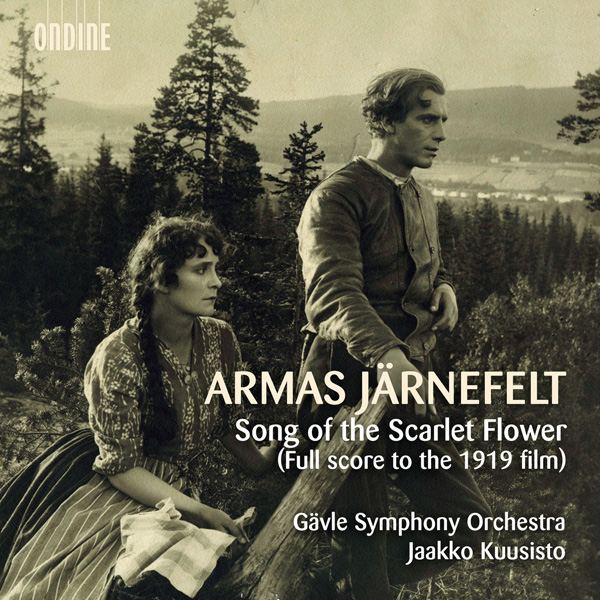
Armas Järnefelt : Song of the Scarlet Flower

Armas Järnefelt : Song of the Scarlet Flower, (Sängen om den eldröda blomman) from Ondine, marks the centenary of the filmn of the same name, and serves as a reminder of the importance of Nordic countries in the history of cinema. It is also a chance to hear the music of Armas Järnefelt , the long-term conductor of the Royal Swedish Opera, and a member of the Järnefelt family who played an important role in the development of Finnish nationalism. Järnefelt's father was General August Järnefelt,  who promoted the Finnish langauge. His brother Eero was a painter, and his sister Aino  married Jean Sibelius.

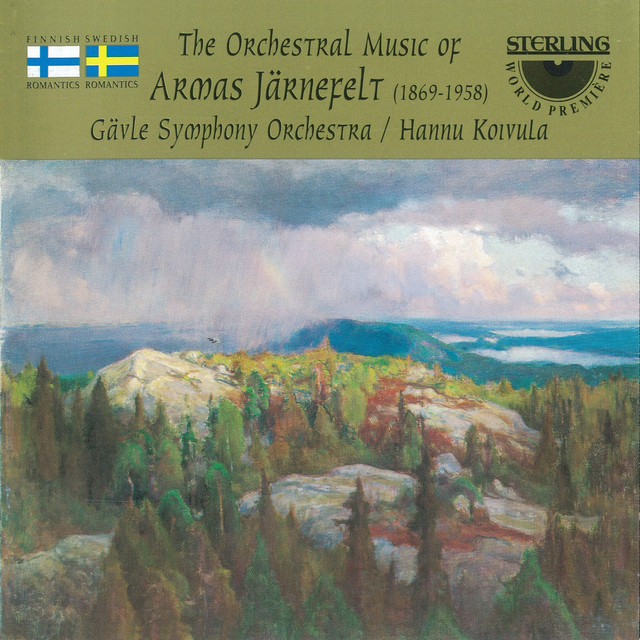
In the first decades of cinema, Scandinavian and Finnish film makers were in the vanguard, paving the way for masters like Viktor Sjöström, Carl Th. Dreyer and later Ingmar Bergman. Song of the Scarlet Flower, directed by Maurice Stiller (1883-1928) was a milestone in Nordic cinema history. Released in April 1919, it was an instant sensation, a box office success that was screened in 40 countries.   It was an ambitious project, the first full-length Swedish film to have music written specially for it.   Though Järnefelt was primarily a conductor, he had trained with Busoni and Massenet and composed, especially in the early years of his career.  Ondine has a set of Järnefelt songs in its catalogue, and  BIS has recorded some of his orchestral works, conducted by Jaakko Kuusisto, who conducts this new recording with the Gävle Symphony Orchestra, who made the seminal recording of Järnefelt's music in 1996, which includes two sections from The Song of the Scarlet Flower.  The score used here is reconstructed from what remains of Järnefelt's original score, discovered in 1988, augmented by Jaakko Kuusisto and Jani Kyllönen.
Järnefelt's experience as a conductor of opera gave him insight into the role of music in drama, but writing for film is very different from writing music as music.  "I had to build it up metre by metre, bit by bit" he said, "I received a list of the principaql scenes of the film and their durations, but that information proved to be quite wrong, as the film was screened at a much faster pace,and I was horrified to discover how poorly music and image went together.  I was obliged to shorten the score. Never in my life had I had to write music in such a way that I was forced to conform to the tempo of events - I, who am used to setting the tempo myself.  In the end, it all worked out". The film has been restored and was screened in 2017 but is not yet on DVD.

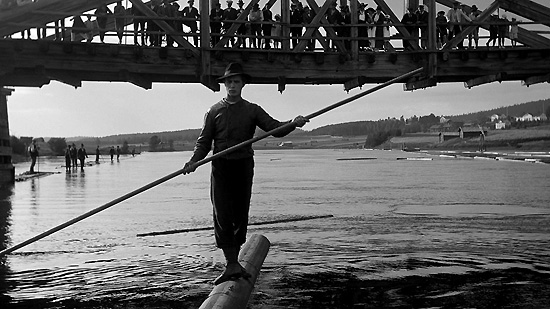
Based on a novel by Johannes Linnankoski, Song of the Scarlet Flower follows the adventures of a young man, Olof, a rebel  who joins a band of loggers, travelling the river from forests to mills.  He chases women, ruining one who becomes a prostitute in the city , but mends his ways and marries well.  The screenplay is set out in seven acts, as was common at the time. The first section "The First Flush of Spring" suggests youth and promise.  Expansive themes (shimmering strings) alternate with lively woodwinds. A vigorous leitmotiv emerges: possibly the young man heading into the world, folkloric references (violin imitating fiddle) evoking the countryside.  In "The Mother's Glance" a jolly mood gives way to a plaintive song for solo violin,  darker notes introduced by woodwinds, over repetitive angular rhythms.  The leitmotiv introduces "Learning Life", develops into cheeky dance and returns again with even more force.  This chapter apparently illlustrates a scene where   Oluf shoots the rapids. The central movement "A Young Man's Daring-do" is brief, but pensive, violin and woodwinds in duet.

With "Kyllikki" folkloric charm meets the "Olof" leitmotiv. Olof and Kyllikki want to marry but her father objects. Thus the brisk conclusion, with outbursts of timpani, the violins reiterating the leitmotif.  "In The Town" is a nocturne, pizzicato suggesting the ticking of a clock.  He's still chasing women as the waltz reference suggests.  But Olof meets his past, in the person of Gazelle, whom he seduced and abandoned. A chill descends. The pizzicato becomes so quiet that it feels haunted.  Suddenly the orchestra bursts forth - angular, discordant figures suggest Olof's horror and guilt.  Rumbling figures suggest Gazelle's suicide. When the Olof motif returns, it's quieter, chastened.  "The Pilgrimage" is introduced by high-pitched winds suggesting horn calls, and a hymn theme (chamber organ) suggests the churchyard where Olof's parents lie dead.   The hymn expands into a serene but affirmative section which may represent values Olof lost when he ran away.  It now shows him a way forward.  Bells ring out !  Having inherited his parents' wealth, Olof claims Kyllikki, and they marry.

Plenty more on this site about early film and music in film. Please explore and also see :
Victor Sjöström's Körkarlen (The Phantom Carriage)
Rasmus Breistein's Brudeferden  i Hardanger,  (Bride oif Hardanger)
Carl Th Dreyer Vampyr
Feminist Finnish Jenůfa, Anna-Liisa 1922
and of course German, French, Chinese and other early film and experimental movies. Plus composers like Hanns Eisler

Saturday, 17 November 2018

Insights into Schreker's compositional processes

Franz Schreker Orchestral Works, from SWR with Christopher Ward conducting the Deutsche Staatsphilharmonie Rheinland-Pfalz, new from Capriccio, continuing their Schreker series, which has so far covered the early operas and a good recording of Der Geburtstag der Infantin and Das Weib des Intaphernes. The disc includes important though less well known works like the Vorspeil zu einer grossen Oper “Memnon”, the mini-song symphony Vom Ewigen Liebe and the short but significant Vier kleine Stucke fur grosses Orchester. Together this collection forms a study of Schreker's compositional development, making this recording far more valuable than many, for anyone seriously interested in the composer and his time.


Ekkehard, Schreker's op 12 from 1902-3 is a symphonic overture. That no opera eventuated hardly matters : it's a tone poem on an operatic subject, a hybrid not unlike Richard Strauss's Don Juan, from the same period, though Schreker's individuality is detectable even at this early stage in his career. Based on a novel popular in the mid 19th century, Ekkehard tells the story of a 10th century monk from St Gallen, who is brought from his monastery as a teacher for a duchess, but falls passionately in love with her. Thus the grand opening chords, horn calls evoking the grandeur of the vision ahead. This theme alternates with a quieter motif which might represent the monk, or his awe at arriving at the palace. Thunderous timpani, crashing cymbals, brass fanfares remind us that the splendour the monk sees around him is built upon military might. A passage for organ, reflecting Ekkehard's true background, is soon overwhelmed by a fierce march, possibly a march into battle. Ekkehard's infatuation is doomed. The overture draws to a close with sadder, darker motifs as Ekkehard returns once more to the mountains. This overture deals with ideas that Schreker would go on to develop with greater sophistication in Der Geburtstag der Infantin and even in Die Gezeichneten : the use of medievalism as cover for modern concerns, the concept that true art isn't based on mass values and above all the contrast between exterior beauty and inner corruption.

The Phantastische Ouverture op 15 (1904) shows how Schreker, in his mid-twenties, was seeking orchestral possibilities from the starting point of drama. There is no programme to this overture. The opening motifs are drawn with ominous power, soon undercut by fast moving, fragmentary figures which hurtle forwards. A new motif emerges, also animated but more sustained, sweeping confidently to the conclusion, where bell-like peals herald exuberant chords.

With Vom ewigen Leben, Schreker has proceeded to different territory. This started as two songs for voice and piano, completed in 1922. Five years later, Schreker orchestrated them into a coherent whole. The texts come from Walt Whitman's Leaves of Grass, used in German translation. The first section, "Wurzeln und Halme sind dies nur" is delicate, silvery percussion mirroring the soprano's high timbre, complemented by strings and restrained woodwinds. The silvery textures blend into the woodwinds of the second part, "Das Gras", where flutes and clarinets circle the soprano (Valda Wilson). This section is nearly three times as long as the first, with extended orchestral interludes. The sophistication of the orchestral writing makes this a true “orchestral art song” much greater than the sum of its parts.

Cinema was the new art form of the 20th century, growing from drama, opera and music. It was as if Wagner's concept of Gesammstkunstwerk had been made possible by new technology. The connections between music and film were clear. Silent films were accompanied by live performance. Many early art films, such as Berlin Symphony of a Great City (1927) used a musical framework on which to pin a non- narrative, semi-symphonic structure. Berlin was one of the most important centres of art film, where masterpieces like The Cabinet of Dr Caligari (1921) were produced. It was natural that creative artists like Schreker would have recognized the connection between film and music . Like Alban Berg and others, Schreker understood the potential of cinema, and the significance of new sound technology. Indeed, Schreker and Schoenberg were in regular contact on the subject of music and film, and in January 1929, Schreker, a Director of the Berlin Academy of the Arts, became responsible for the music section of the new German Society for Sound and Vision. Hanns Eisler, Schreker's contemporary, wrote the first major theoretical work on music for film, and made a good living writing film music without sacrificing art.

Schreker's Vier kleine Stücke fur grosses Orchester (Four little sketches for large orchestra) (1930) is therefore a response by the composer to a new genre, not much different to the way he wrote overtures as experiments for opera. They should not be dismissed as “late works” simply because the composer died three years later, but as the work of a composer still brave enough to explore. Turning to film was not a diminution of his powers but rather a continuation of what he'd done before, but in a new direction.

Schreker's Vier kleine Stucke fur grosses Orchester demonstrates the way in which music could be used to advance drama and work with visuals. Each of these sketches is short but vivid, evoking a mood or emotion to intensify the images shown on screen. Dialogue in silent films was limited, for obvious reasons reduced to minimal intertitles, and voice technology still fairly primitive that “talkies” killed many silent actors, and early film music largely songs and interludes. Timoroso (marked zugend) is not timid so much as tentative, a curtain raiser promising wonders to come. Violente (marked hestig, ungestum) is flamboyant, its zig zag rhythms exotic, setting the scene for “oriental” adventure films so popular at the time. Incalzando (marked Eindringlich) casts haunting mystery, with lines that could adapt to a variety of situations where characters might need to pause for thought. Gradevole (marked Gefallig) alternates dance-like energy with serenity, which again could be adapted to different scenes. Emphatic timpani !

Just as Schreker's Vorspeil zu einer Drama (1913) led to Die Gezeichneten, the Vorspeil zu einer Grossen Oper (Memnon) (1933), Schreker's last completed work, might have been a working model for a truly “grand” opera. We shall never know. In Greek mythology, Memnon was a great warrior, a god king from Ethiopia (ie an outsider like so many Schreker heroes) who came to the aid of others but was killed. Thus exotic sounds, woodwinds imitating Arabic pipes set the scene, strings weaving sensually above a steady pulse which may suggest the tread of a camel caravan. The pace is broken by dissonant chords, ushering cross-currents of sound weaving in different directions. Dramatic, yet disturbing. Though harps introduce a calmer but still oriental mood. The “caravan” motif attempts to return, but is swept back by wild, flying turbulence, underpinned by undertones of almost brutal percussion. Dark, brooding colours emerge, against which lyrical moments seem plaintive, though they persist. Swirling themes, rising perhaps like dust off the desert or distant smoke, are undercut by ominous rumbling. Horns call, and the orchestra surges, before suddenly breaking off and falling silent. Given that this Vorspeil was written effectively in exile, when the Nazis were hounding out “degenerate” modern composers, Schreker didn't have a chance. Vorspeil zu einer Grossen Oper (Memnon) was premiered in March 1958 by Hans Rosbaud, champion of new music, for SWR in Baden-Baden so it is rather moving that SWR sponsored this new recording.
Please also read my other posts on Schreker and on the music of the Weimar period, including Walter Braunfels, Hanns Eisler, Zemlinsky, Schoenberg, Suppressed Composers, Weimar and other silent film etc etc

Monday, 30 October 2017

The Dark Tower - Britten on the Radio

Blythburgh Tower - photo Roger Thomas
The Dark Tower, radio drama from 1945, with texts by Louis MacNeice and music by Benjamin Britten, at Orford Church near Aldeburgh and now on BBC Radio 3.  How we appreciate something new to us says as much about ourselves as it does about what's being experienced.  My friend said, "Quite the best radio drama I’ve heard for a long time” since it's much classier than most radio dramas.  Radio Drama is a curiously English tradition : maybe you need to be immersed in the period culture it reflects.when postwar paranoia bred conformity, and people obeyed the voices emitted from the small box set  which connected households to the wider world.  My friend grew up in postwar Britain when ration books were recent memory, and the wartime mindset of insularity and unquestioning obedience still prevailed.  Since I didn't, I had to get over that cultural barrier first. But I'm glad I made the effort.  What you get depends on what you put in!

The introduction, recorded by Louis MacNeice for the original broadcast on 21st January 1946, gave me the creeps   Such emotional manipulation and doublethink! MacNeice claims he doesn't know what the story's about but he's kidding. He sneers at Reithian values at the BBC but gladly took the money.  Equally culpable.  That kind of deviousness springs from negotiating a world where lies mean more than truth. The very point of The Dark Tower, where everyone’s caught up in games of deceit.  Who's manipulating whom, and why ? Do they ever twig ? People who grow up being manipulated end up abusing others, without knowing why.  Beneath the archly stylized text, there's human feeling, however distorted.

Part of the reason The Dark Tower succeeds is Benjamin Britten, whose music operates on much deeper levels.  It's music on its own terms, far more complex than sound effects illustrating words.  Wonderfully sour passages, which throb menacingly. The Dragon is present even in Roland's childhood.  The Trumpet exists almost as entity, evoking ideas which words cannot express.  My friend thought of Pelléas et Melisande and its unearthly symbolism. As music, The Dark Tower works rather well - pity about the dialogue, some of which is dated. Blind Peter, for example, is a cartoon emigré. But people get screwed up in other places too, like boarding school, Oxbridge, the Church and the military.  Even in the romanticized Englishness of Robert Browning's Childe Roland to the Dark Tower Came. What happened to Blind Peter could happen here, too. 

Compare The Dark Tower to Owen Wingrave, written for TV and broadcast in 1971, when TV was still a relatively new medium, and the media hadn't decided that culture wasn't for the masses.  The original film now feels dated, like Hammer Horror, since so much is made of the costumes and of the set. Get away from that leaden literalism, though, and Owen Wingrave is a much finer work than is sometimes assumed.   Please read HERE what I wrote about the TV Owen Wingrave some years back, There have been at least two new productions in recent years, one with Jacques Imbrailo singing the title role.  Like so many of Britten's other works, such as Curlew River  and the Church Parables (also heard at Orford)  Owen Wingrave works much better presented as stylized music theatre, closer to the spirit of medieval mystery plays than TV costume drama.  It could even  lend itself to sensitive staging, reducing the sourness of the text. 


Thursday, 26 October 2017

Not Hollywood - Eisenstein October LSO Barbican


Tonight at the Barbican the London Symphony Orchestra provides live soundtrack for Sergei Eisenstein's silent movie October - Ten Days that Shook the World presented by Kino Klassik in a new edition of the film made in 2012.  The LSO will be playing the original music, composed by Edmund Meisel (1894-1930), not the better known music by Dmitri Shostakovich written for the revival of the film for the 50th anniversary of the revolution.  This performance is significant because Meisel was an extremely important figure in the very early years of cinema, writing scores for several films, including Eisenstein's Battleship Potemkin and Arnold Fanck's The Holy Mountain and other works still being unearthed.   Hollywood most certainly didn't dominate early film and music, for early film was decidedly not "Hollywood".

Meisel was connected to experimental film makers like Walter Ruttman who created Lichtspiele, using the medium of film as if it were pliable, like painting, to create abstract works. Think Cubism as movie.  See clips of Ruttmann's early work here.   Ruttmann's Lichtspiele were Like music! . They were made in co-operation with Hanns Eisler, who wrote music to be played live as the films were screened.  So again, the concept of music combined with film before the technology to make sound movies was even possible.  Eisler's contribution to music and to film goes much further than agit prop.  Yet again, he's a reminder that there's more to cinema than Hollywood, even in Hollywood.

 Meisel also wrote the music for Ruttmann's Berlin : Symphony of a Great City one of the most important films of its era, still an icon.  Why a symphony of a Great City?  Early film makers thought in terms of music, often describing scnes as "acts" as if music drama.  Ruttmann's film isn't narrative, but literally a portrait of the city, filmed on the streets, real people, real events, lovingly observed. The raw shots were edited and ordered much in the way that the sounds of an orchestra are put together by a composer writing music.  The subject is the city itself, the drama the drama of urban life.   Ruttmann employed innovative techniques  like odd angles and perspectives, expanding the idea of visual expressiveneess.  

Berlin : Symphony of a Great City is more than a movie, it embodies the concepts of modernism in art, film and music. It's not a film in theusual sense of a narrative motion picture.  Multiple, diverse images are used like themes in music.  They're layered and juxtaposed
like musical ideas. The images are grouped in several main "movements"that as a whole follow a trajectory from morning to night. A snapshot of the life of the city. Please read my analysis of this wonderful work HERE, describing the structure and individual images some of which aren't readily obvious.

Early audiences were often more used to music than movies, and several early films unfold as "movements". The full title of Nosferatu is Nosferatu : eine synfonie des Grauens, "a symphony of horrors". But Berlin : Die Sinfonie der Grossstadt develops the idea on a grand scale. Because it's abstract, much more detail is possible, and thus more possibilties of interpretation Truly "modern" art.  

And of Eisenstein's October ? It, too, was innovative, inspired by the new Soviet Union's brief fascination with futurism before Stalinist conservatism froze the tundra of Russian creativity.  Kaput to the dreams of the revolution and ideas of new art !  Shostakovich's score is thrilling, but Meisel's connects more to the spirit of the era,

Like Ruttmann, Eisenstein uses film like painting, creating collages and images applied in  painterly ways.    A statue of the Tsar is seen outlined against the sky. It's torn down by diagonal ropes.  A crowd cheers, arms raised heavenwards. Scythes are seen, en masse. Close ups of soldiers faces, grinning, then suddenly, we're in an ornate palace, with elaborate mosaic floor tiles. Cut to angular shots of heavy machinery, to images of starving children dwarfed by huge columns of stone, to shots of a crowd waiting, at night for a train. "Ulyanov ! It's him !"

Diagonals fill the screen, shaking up flat, "natural" order.  Flags and banners wave, crowds march, individuals lost in orchestrated movement.  Gunshots are fired. Suddenly the tightly packed march disintegrates,figures running wildly across a huge city square.  Cannons, horses fallto the ground, crippled.  The gates of a huge bridge open, magnificent abstract lines : but a horse is impaled in the machinery; the modern age versus the past, in one horrific image. In a palace, the Provisionalgovernment  gathers. Officials walk up and down grand staircases, pre-dating the works of M C Escher.  Hurried footsteps, leading nowhere.When the words "For God and country" appear in subtitles, we see, notOrthodox depictions of God but alien Gods - primitive sculptures,Buddhas, Gods so primitive and atavistic that they can't be identified.Tanks arrive to crush the revolution. What we see are rolling tracks, machines of destruction  terrifying because they are impersonal.  Close ups of guns and individual bullets : the proletariat will fight back.

The bridge across the Neva is raised again,  but a ship- with fourimpressive funnels. We see sailors, and cadets marching, as the massive
gates of an imperial palace are pulled shut.  A  half naked woman cavorts on the billiard table of the Tsar.  What's going on ?  Through a
collage of images,   Eisenstein recreates the tension and uncertainitythat people must have felt in the upheaval.  This is cinematic techniqueas art, not unlike the fractured visuals of Cubist painting.

The Bolsheviks mobilize. Eisenstein shows images of hands operating telegraph machines, of armed men rushing up and down staircases, men with bayonets. swathed in smoke.  A ravaged looking woman looks up at a marble sculpture : without explicit dialogue, is Eisenstein suggesting the idea of redemption through the high ideals that art can symbolize ? Or something completely different ? Because the nature of art is notnecessarily specific, but the opening up of possibilities. Foir all we know, that's why Stalinists needed conservative "realism" where no-one needs to think.

The army declares for Bolshevism: a forest of bayonets. Wheels are turning, the machine surging ahead.  Machine gun clips fire, and
cannons, in such rapid sequence that the images hardly have time toregister.   Troops swarm into the palace, ascending the marble
staircases : we can "hear" the sound of their boots in short, sharp images.  The Revolution is won ! we see the faces of clocks mark the
moment, in Petrograd, in Moscow, around the world.

Wednesday, 6 September 2017

Rappelle-toi Barbara ?

Window rain

Rappelle-toi Barbara ? 
Il pleuvait sans cesse sur Brest ce jour-là 
Et tu marchais souriante 
Épanouie ravie ruisselante 
Sous la pluie 
Rappelle-toi Barbara Il pleuvait sans cesse sur Brest 
Et je t'ai croisée rue de Siam 
Tu souriais 
Et moi je souriais de même 
Rappelle-toi Barbara 
Toi que je ne connaissais pas
Toi qui ne me connaissais pas 
Rappelle-toi Rappelle-toi quand même jour-là 
N'oublie pas
Un homme sous un porche s'abritait 
Et il a crié ton nom Barbara
Et tu as couru vers lui sous la pluie Ruisselante ravie épanouie
Et tu t'es jetée dans ses bras 

Rappelle-toi cela Barbara 
Et ne m'en veux pas si je te tutoie Je dis tu à tous ceux que j'aime 
Même si je ne les ai vus qu'une seule fois Je dis tu à tous ceux qui s'aiment 
Même si je ne les connais pas Rappelle-toi Barbara
N'oublie pas Cette pluie sage et heureuse 
Sur ton visage heureux Sur cette ville heureuse 
Cette pluie sur la mer
Sur l'arsenal 
Sur le bateau d'Ouessant
Oh Barbara 

Quelle connerie la guerre 
Qu'es-tu devenue maintenant 
Sous cette pluie de fer 
De feu d'acier de sang 
Et celui qui te serrait dans ses bras 
Amoureusement Est-il mort disparu ou bien encore vivant 
Oh Barbara 

Il pleut sans cesse sur Brest 
Comme il pleuvait avant
Mais ce n'est plus pareil et tout est abimé 
C'est une pluie de deuil terrible et désolée 
Ce n'est même plus l'orage 
De fer d'acier de sang 

Tout simplement des nuages 
Qui crèvent comme des chiens
Des chiens qui disparaissent 
Au fil de l'eau sur Brest
Et vont pourrir au loin 
Au loin très loin de Brest
 Dont il ne reste rien. 

Poem : Jacques Prévert, set by Joseph Kosma

( Do you remember, Barbara, how it didn't stop raining that day in Brest.  You were smiling radiantly, sunshine flowing from you, despite the rain.  I walked across the Rue du Siam, you smiled, and I smiled back. You whom I didn't know.  And on that same day, there was a man sheltering under a porch. He called your name "Barbara" and you ran towards him in the rain, glowing with joy and threw yourself into his arms.  I use the term "tu" (tutoyer)  though we've never even met.  I say that to those I care about even if I don't know them. Don't forget that wise and happy rain on your face in that happy moment, that rain by the sea by the arsenal, and the boat from Ouessant (in Brittany)

What did you know of the war that has come on us now,  when the rain pounds like gunfire of blood and steel, and he who held you lovingly in his arms - is he dead, missing or still alive ? It still rains non stop in Brest, like before, but it's not the same. Everything has changed. it's an abyss. It's the rain of a terrible, desolated shroud.  Not even the storm of steel and blood. Only the clouds, like roaming dogs, dogs who will disappear in that torrent pouring down on Brest, and will disperse in the distance, very far from Brest, of which nothing remains.) 

Clip below from the CD Joseph Kosma Chansons with Francois Le Roux and Jeff Cohen Decca 2000, reissued in 2016. Prevert and Kosma collaborated many times in art film - Les Enfants du Paradis, no less.  Kosma studied with Hanns Eisler, hence his interest in intelligent music for film, and art song.

Friday, 6 January 2017

Nothing Venture - Surreal Nostalgia England 1948


Nothing Venture, NOT "nothing ventured". What is a "nothing" venture ?  Perhaps the title is meant to be ironic, since the film is a  fantasy. An old man is writing, correcting his words as he goes "It was a lovely day in June, when three boys, funnily enough  named Tom, Dick and Harry were walking across the sand between Penforth and Bywater, looking for adventure"  Out of nowhere the boys pop up. "We heard you were writing a new book and thought you'd like to include us in it again".  So this is a surreal world which exists in the imagination, as if frozen forever in time. So much for the sentimental nostalgia, laid on with a shovel.  It's not reality, even though it resembles an idealized England that a fortunate few were lucky enough to experience, for a time. This film was released in 1948 by British Lion and Elstree Independent, and made in Viking Studios of Kensington. None of which now exist  But boys of a certain vintage will swoon, transported back to childhoods long past. Delicious escapist dreams!

Tom, Dick and Harry were acted by "The Artemus Boys", Philip, Peter and Jackie, who may or may not have been brothers, since they don't look genetically related, and speak with wildly differing  accents  One is  definitely northern, with vowels as wide as the horizon, though the story is set somewhere on the south coast (Penforth and Bywater don't exist in the same vicinity). But Tom, Dick and Harry cycle off on gearless bikes, through a quaint old town, through fields and  up steep hills, to a tower with a view over several counties, approached through Norfolk Island pines   The boys overhear some men discussing "the Boss"  Just as villains in Enid Blyton are easy to spot because they're not white, these men must be villains because they drive a big car. What are they doing in this remote spot?  Is Michael, a "flatfoot" in a trench coat on their trail?  If so, why is he whistling loudly so all can hear ?  Fortuitously, a lady gets knocked off her horse and Michael drives her and the boys back to her place, Diana's extremely wealthy, and a horse breeder, but she and Michael, rather too posh to be a cop, hit it off "This isn't going to turn into a love story? says one of the boys squeamishly.

Michael, Diana and the boys head off to SoutHEMpton (Diana's accent),stopping off first in a fancy hotel,with a dance band. The two older boys wear tuxes They can''t order food – the menu's in French.  The younger boy gets a job as a busboy to spy on the villains, who are staying in the hotel. Next day, they're down at the docks, where the Queen Mary is docking. Great scene, artistically shot, with music that sounds like parody Elgar though it's the best part of the whole soundtrack  The villains are smuggling a secret weapon. The stiff upper lip earnestness is a satire on the militaristic mindset left over from the war that's just ended, but lives on in "boy's magazines". Hence big words are spoken syllable by syllable with histrionic exaggeration.  Diana doesn't turn up at a race meeting but her horse box does. She's been kidnapped by the villains, one of whom has "ways of making people talk", because he ran a concentration camp during the war (I kid you not!)  Diana's Dad is a scientist who knows secret inventions. Luckily one of the boys followed the horsebox and scribbles a clue in chalk for the others to find   Diana and Dad head to a secret underground chamber beneath the tower   Daddy blows up the secret weapon and Diana embraces Michael. "It did turn out a love story after all"  The author reappears "Good bye old chaps, perhaps we'll meet again" The boys are sen walking back towards the horizon at the beach, whence they came.

The Artemus boys made one previous film The Great  Escapade in 1947 for the same director, John Baxter, with a script by the same writer, Geoffrey Orme, and then seem to have disappeared   Perhaps they're still around, in their 80's but they'll remain forever young in Nothing Venture.. The eldest boy  had star quality, and was very personable.  Baxter and Orme had rather longer careers, Orme writing a segment for Dr Who, in the 60's.  I loved Nothing Venture because of its tongue in cheek good humour, and the shots of a lost England,where people cycle through quaint countryside, and class divisions are entrenched, though the Artemus boys, Diana and Michael break down stereotypes  The music was by Kennedy Russell, who wrote for film. Extra ! A genealogist friend ran a search and found that there haven't been any people named "Artemus" in the UK since the mid 19th century. So, clearly a stage entity.  Pity, it would be nice to know what became of them, esp the bright one. (Subsequent thinking : Artemus is almost certainly a fake name because the boys aren't brothers and two of them clearly aren't thespian material. So who was the talented one ? Someone who can act liie should have been in movies. Compare photos of Richard Attenborough in his youth. Think about it !)
 

Sunday, 1 November 2015

George Antheil, Daughter of Horror

George Antheil's Ballet Mécanique (1924)  (read more here) is one of the seminal classics of the avant garde. But what happened to him?  Like just about everyone else, he found work in Hollywood, getting work where he could. But his creative spirit wasn't entirely dimmed. .For Halloween, I watched Daughter of Horror (1953)  for which Antheil wrote the soundtrack. His contribution, though, is huge - there are  hardly any spoken words, no dialogue, or even narrative. The music "is" the story. This isn't your average B horror flick. It's an extended musical work, illustrated with images. And gosh, what music!  Think about Tom Waits music videos.  Or Eraserhead and Twin Peaks. George Antheil got there first, establishing the iconography.  The director and producer was John J Parker, who doesn't seem to have made other movies, which also suggests Antheil's primary role as auteur.

A woman walks into the sea, apparently crushed in the surf. She wakes in a bedroom, feeling anxious. As she walks down the stairs she sees a cop arrest a man for beating up a woman.  The music wails: a long wordless vocalize like an unending scream. This might now seem standard horror movie fare, but Antheil was doing this very early on and very well indeed. The singer, incidentally, is Marni Nixon who also had a career outside Hollywood, making some of the first recordings of Charles Ives songs, for example.  The woman wanders into a street that could come straight out of a Tom Waits set. Drunks hang out in the shadows, moving with strange, contorted griomaces - very Tom Wait !  A newspaper seller holds a up a headline about a murder. The woman seems to think she's guilty. The newspaper seller is a dwarf - another Tom Waits image. As is the flower seller from whom the bent cop buys a carnation. A drunk confronts the woman. Does she stab him? Why does the cop beat the drunk into a pulp? 

The woman enters a nightclub. She looks horribly out of place in her repressed tweed suit and no makeup. Listen to the jazz band though,  African drums and, of all things, a French horn. The woman goes in a cab with a strange man.  Served by a butler, the man gobbles a meal, which disgusts the woman, whom he completely ignores. Is she really there in the room with him? She stabs him with a shiny flick knife. The butler seems totally unperturbed. As he dies the man grabs hold of the woman's ornate pendant necklace, the only thing about her appearance that looks individual. Great shots of the elevator and the magnificent marble staircase she runs down. 

Switch to a bit of cod psychoanalysis.  In a graveyard a faceless man shows the woman her fatrher, a drunken, abusive slob, and her mother, a good time girl but frigid..  The sequence of events hardly matters. Aware that the dead man still has her pendant in his hands, the woman  cuts the man's hands open, watched by faceless observers. The actor who plays the woman's father also appears at the beginning of the film as a grinning man, and again later in the crowd who the woman runs into, who raise their arms, Nazi style, against her. She wakes back in her room. Is it all a dream? She opens a cupborad, and there's the dead man's hand, still grasping her pendant, and moving. All this might seem kitsch but the cinematography is very good. The images are carefully chosen, much in the way that 1920's German expressionist films were made.  And thus the connections with George Antheil's past and his glory days in Paris and with the avant garde scene, and the film makers of that era.  How Antheil might have thrived if he'd been able to stay in Paris! On the other hand, without Antheil in Hollywood, we might not have Tom Waits, and,David Lynch and a whole host of film makers both art and schlock, ever since. 

Monday, 25 May 2015

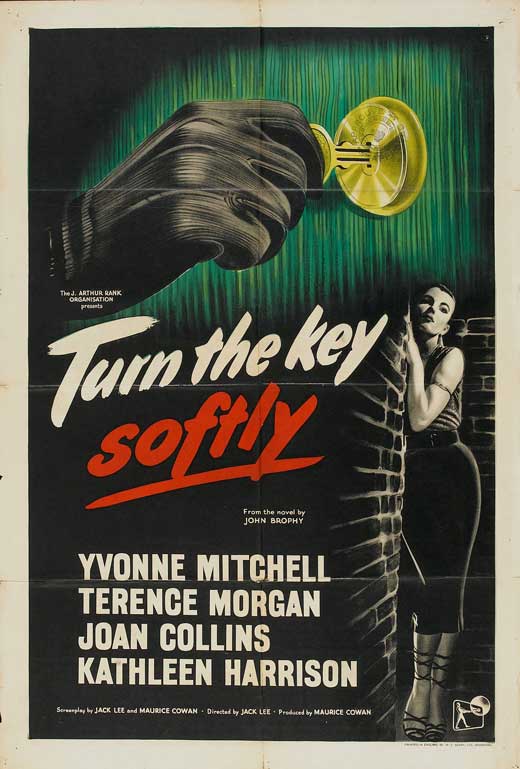
Turn the Key Softly - love poem for London

Not many films start with credits like: "We acknowledge with gratitude the help of the Home Office, The Prison Commissioners and the Governor of HM Prison, Holloway".  Turn the Key Softly begins with a shot of Holloway Prison,  as it was in 1953. It's oddly nostalgic. Veiled in heavy London fog, the prison looks mysterious, almost romantic.,Within minutes though, we're up against reality. Three women prisoners are being released. The scene's filmed inside. The guards are dehumanized - you can almost smell the repression. In prison, the women are anonymous. They collect their belongings to return outside. "Until you see people in their own clothes, you don't realize what you've been mixing with in this place" Who's that familiar face - Joan Collins  aged 19, dolled up in a deliciously bizarre peplum, which sums up the personality of her part, Stella Jarvis, flibbertigibbet good-time girl.

London itself stars in this film. The camera lingers, lovingly, on scenes shot on location. Monica Marsden ( Yvonne Mitchell) goes home to a flat in a terrace near St Mary's, Bryanston Square - nothing has changed in 60 years !  We also see another part of London which has disappeared, though - rooming houses in run down Victorian mansions, seedily keeping up pretensions. The landlady lets Mrs Quilliam (Kathleen Harrison) have her old room back. It's unchanged. The landlady's even looked after Johnny, the dog. Imagine landlords that laidback now.  Onc scene seems to have been filmed in a real pub, not a set.  Few pubs look like that now.  We see the Underground, pristine and spotless, and Trafalgar Square minus tourists. We see the West End, and something of London's future. Mrs Quilliam's daughter is "aspirational". She's escaped the East End for an identikit house in  some outer suburb and shudders at the thought of "lower class". The cinematography is so poetic that this film is a kind of love story for London.

Turn the Key Softly was written, produced and directed by Maurice Cowan and Jack Lee, at Pinewood Studios, when the British film industry was at its artistic peak. Based on a novel by John Brophy, it's a tightly paced drama, with deftly written dialogue, and strong characterizations, even in the minor parts - all of them London "types", lovingly drawn. Stella brags to her prostitute friends that her boyfriend's "in transport". Since the action all takes place within 24 hours, the narrative moves swiftly. Stella loses the £3 her boyfriend gives her to live on for a week, (!!!!) but gets it back by fleecing the stranger who thought he'd arranged a date with Monica. Unlike Stella and Mrs |Quilliam, who are feckless kleptos, Monica has never been in trouble with the law before. She was arrested because her boyfriend David (Terence Morgan) let her take the rap for one of his burglaries. Clearly, she loves him, but sees through his games. Thinking they're going to the theatre, she wears an evening gown. Now, you don't wear yards of tulle, even at Glyndebourne. David, however, has set up another crime. This time, Monica doesn't help. David is trapped on a roof, fighting off the police.  Wonderful cinematography again, worthy of much better known films noir. The camera shows the West End theatre in awkward angular shots. It's a wet night in theatreland : the camera contrasts textures: stone walls, cramped stairwells, metal fire escapes, the machinery with which the police winch themselves onto the roof. each frame adds to the sense of tension and danger.

The tightness of the script is further enhanced  by the clear-sighted anti-sentimentality of the plot. Monica is a strong person, determined not to be dragged down, like poor, dotty Mrs Quilliam, who gets killed by a car as she squeals in delight and relief, having found her lost dog. Stella's getting married, but how long will it be before she goes back to her old ways  Young as she is, she may squander her future and end up like Mrs Quilliam. 

Mischa Spoliansky wrote the soundtrack and conducted the Royal Philharmonic Orchestra, when orchestras did movie work on a regular basis. Spoliansky was a star in German theatre and cabaret, before being forced into exile. In London, he built a successful  new career, writing scores for Norman Wisdom movies, and many others, including Sanders of the River and King Solomon's Mines. In Turn the Key Softly, Spoliansky's wit shines through. Stella sings trashy pop, but Monica's more sophisticated taste is underlined by quotations from Poulenc Les chemins d'amour. 

Saturday, 28 February 2015

Frankenstein and Malcolm Arnold


Sir Malcolm Arnold and Hammer Horror : a marriage made in Heaven  Four-Sided Triangle (1953) is a great classic, from the time that Britain had a thriving cinema industry. Three kids, Bill, Robin and Lena, grow up in Highdene, a perfect village, the epitome of Olde England. It's actually Hambleden in South Oxfordshire, still preserved almost intact because it's owned by a billionaire, the cottages rented to rich yuppies. Delight in the glories of the British countryside, for this is part of the story. The two young men are like twins, they've grown up together and even look alike. But Robin's dada is a millionaire, while Bill's was a feckless ne'er do well. Since Bill managed somehow to go to Cambridge with Robin, perhaps we should admire him, as does the village doctor. Very quietly, beneath this rural idyll, beats angst. Bill will never be Robin. Both love Lena, an impossibly blonde beauty who left the village for the US, but escape didn't help. She's come home to kill herself.

Robin and Bill rig up an elaborate laboratory in a shed, as one does. They're transmutating matter so they can duplicate things like gold, watches and rabbits in their own backyard. As one does.  When Lena agrees to marry Robin, Bill feels he has to square the triangle. So he decides to uses the machine to duplicate Lena. Sure enough, the experiment works. Lena now has a perfect replica Helen.  Bill and Helen go off to Dorset where they sit on the beach at Lulworth Cove. But Helen carries Lena's death wish, further complicated because she knows she's an unnatural creation and, like Lena, does not love Bill. When Helen attempts suicide, Bill tries to fix her in the machine, but it explodes into a ball of fire. Only one woman survives, but which? Fortunately class superiorty reigns, even in sci fi land. Lena and Robin live happily ever after, free of usurpers.

This film is way above the standard of later Hammer Studios horror flicks. The script was by Paul Tabori, who wrote books on the occult, which might explain the undercurrent of perversity which flows beneath this rural idyll. Snappy dialogue, well delivered by a good cast who don't ham for Hammer. The director was Terence Fisher who later made Peter Cushing and Christopher Lee into icons of the genre. Four-Sided Triangle is way above that.  The music was composed by Sir Malcolm Arnold. Muir Mathieson conducted the Royal Philharmonic Orchestra.  The bizarre plot gives Arnold a chance to experiment with sound effects he might never have dared to explore in non-film music. Wonderfully discordant sounds, woven into a background which suggest tension and violence beneath a lyrical surface. The music works particularly well for the mad scientist scenes. "I'm a physicist!" shouts Robin, "not a biologist". The duality in the music reminds us that no right-minded physicist or biologist would be doing stuff as crazy as this.

Friday, 30 May 2014

Opera HD - myths and facts

Audiences for opera broadcasts in the cinema are old. That's news? The survey has gone viral. But here's where genuine local knowledge comes in. The survey  was done by the Guildhall School of Music and Drama. Excellent music and drama students but not necessarily sophisticated pollsters. It was commissioned by English Touring Opera. ETO is a wonderful, innovative company but its business is touring, reaching places outside London, where people might not otherwise experience live opera at all. The ETO is unique, and serves an important public purpose.  But one can understand why they'd be interested in the impact of HD, when anyone can watch the Met, ROH, Salzburg and Munich. Personally I think ETO has a special place !

The story, however, has gone international, raising a lot of questions that don't have much to do with the survey at all. Some have even blamed the  Met's problems on HD. So it's a good time to separate fact from fabrication.  Opera has been filmed almost as early as the technology has been available. In the 1970's Rolf Liebermann at Hamburg pioneered the idea of opera created for film, which resulted in works of genius like Wozzeck and Die Freischütz which combined musical astuteness with visual imagination. Opera films were often broadcast on TV, some even written for TV, like Britten's Owen Wingrave. So why should HD be any different?

Watching live streams is fun, but fundamentally not all that different from watching a DVD. The art itself does not change. Directing an opera is completely different from directing a film: the skills are not usually compatible.  An opera director works through character and motivations: a film director chooses angles which best bring out the intention behind the production. In a good production live, there's often so much to take in at once that it's often easier to watch something through the eyes of a film director. Real opera devotees often catch both the live and filmed broadcast, because the slight shift of perspective adds to knowledge and thus to enjoyment.

Millions of people can watch filmed opera in cinemas and online, who might never otherwise be able to attend in person. What's so wrong with that? People get old and immobile but they should not be written off as human beings. Millions grew up with audio recordings and DVDs. Of course their experience counts, every bit as much as those lucky enough to be in the right place at the right time. Being in a house is exciting, even when you attend many times a week, but the primary aim is opera as music and as art, not the frills, the popcorn or fancy new stilettos. As I've said many times before, there are numerous different audiences, each with different interests. So there's a case for tolerance and inclusivity.

Filming opera is expensive, so it's not a universal panacea, however tempting it might seem. Some smaller houses have been burned. However,the reality is that the potential market for opera is infinitely bigger than house capacity. The Royal Opera House enjoys 95% occupancy, so there's little room for growth in those terms.  Film is an essential part of the business model. In 2013, 675,000 people watched 415 performances in house. Since 2012, over three million have watched a much smaller number of operas in cinemas and online. Go figure. Glyndebourne is a much smaller house - usually packed out - but it's so good that it can do deals with newspapers to broadcast online.  Statistically it just doesn't add up that film bleeds live. Online audiences may not rush out for live tickets, but so what? They are paying attention.

The game changes all over again with digital broadcasting. On 20 May the ROH broadcast La Traviata live on its own youtube channel.  In cost terms, this is more effective than sharing profits with a cinema chain. In Europe, there are online channels that broadcast recent productions as well as old. Siemens pioneered digital screening technology and paid for 3 years of screenings from  Bayreuth.  How do companies make money? Some charge, which is fair enough. If we care for the arts we should be mature enough to realize you can't expect good things for free. But the returns are simply the amount raised by subscription.  The size of the online market shows that the demand for opera is greater than seat sales alone.  There's a huge potential audience out there who are interested enough to care and to learn. Much better such audiences than the kind of boors who think they "know" opera because they can shell out for pricey tickets. Gimmicks like fast food eateries don't help sales,. The South Bank shows how artistic purpose is lost when artistic vision is compromised.  Online and HD grow the audience through education.  When  the Berliner Philharmoniker began its digital concert hall, it became the world's "home" orchestra,. Competition can be good or bad, but raising standards is good for everyone.

LOTS more on film and opera on this site, please explore