Showing posts with label janacek leos. Show all posts

Saturday, 20 August 2016

Janáček The Makropulos Affair Prom 45

Karita Mattila was born to sing Emilia Marty, the diva around whom revolves Leoš Janáček's The Makropulos Affair (Věc Makropulos). At Prom 45, she shone all the more because she was conducted by Jirí Belohlávek and performed alongside a superb cast from the National Theatre, Prague, probably the finest and most idiomatic exponents of this repertoire. For Emilia Marty is much more than a diva. She's the embodiment  of a universal life force that transcends time and place. Emilia Marty is one of Janáček's Dangerous Women (read more here) who live life to the full and change those around them, and who symbolize freedom. Yet, ultimately, freedom comes at a price.

The Overture opens like an expansive panorama. Belohlávek's generous style suggested warm, glowing colours, adding richness to Janáček's energetic rhythms, underlining the contrast with the claustrophobic litigation that's drained the Prus and Gregor clans for centuries. Tense, jerky figures in the orchestra. The lines of Dr Kolenatý (Gustáv Beláček) are long and ponderous; Mattila's timbre is lustrous, but she's astute enough to make Emilia Marty's short, sharp lines bristle, but suddenly softens gently.  She knows more about the forebears of  Albert Gregor (Aleš Briscein) than he does. Mattila's emotional range is as extensive as her vocal range: her singing was extraordinarily subtle. In the Second Act, Mattila manages to convey even more complex feelings. She's tender towards Baron Prus (Svatopluk Sem) and his son Janek (Aleš Vorácek). She understands what Emilia Marty must have felt when she sees how Kristina (Eva Šterbová), the aspiring young singer, fancies Janek. But there's still something in EM that drives men mad. "Ha ha ha", she laughs, as if she didn't care.

The point cannot have been lost on Janáček himself. whose best years came late.  Significantly, Count Hauk-Šendorf (Jan Ježek) is written for the same Fach as the protagonist in The Diary of One who Disappeared, which marked the composer's true creative breakthrough.  Hauk thinks Emilia Marty is the girl he loved 50 years before, a gypsy, an outsider beyond the pale of polite society. "I left everything behind,  everything with her".  The song cycle, the opera and the composer's private life are thus linked.  Kamila Stösslová, Janáček's muse but not mistress, was also a "chula negra" (a dusky beauty).  Hauk sings "It's an ugly business, being old" and wants to run off to Spain with Emilia, since making love keeps you young. Emilia packs her bags, but Hauk's doctor intervenes. Hauk's been insane since he lost his gypsy. Like Emilia, he laughs in hollow, mechanical tones, more tragic than funny.

This throws sinister light on the scene in which EM reveals her past, as Elian Macgregor, as Eugenia Montez, as Ekaterina Myshkin and as Elina Makropulos, whose father invented the potion that's kept her young for 337 years. That's the "Věc  Makropulos", the formula that disrupts the natural cycle of life. The opera ends with a kind of Mad Scene, where Janáček's music explodes into manic, yet oddly logical frenzy.  To EM, the explanation makes perfect sense.  Trumpets blare, the tuba howls, the strings whizz like demons. Emilia blasphemes.  "You believe in humanity, in greatness, in love!", she sings, "There's nothing more we could wish for!".  A small chorus (the men of the BBC Singers) appeared, singing responses in a parody of a Mass. Mattila's too good to screech but manages to show how EM unwinds, like a broken toy.  She wants Kristina to take the formula, and be famous. But Kristina is much too down to earth to fall for it.

Jirí Belohlávek was Chief Conductor of the BBC Symphony Orchestra for many years, concurrently with his role as Chief of the Czech Philharmonic Orchestra, which he brought to London earlier this year for Janáček Jenůfa. (Read my review here.)  The BBC SO rose to the occasion for this Prom, welcoming Belohlávek with wonderfully lively playing. They learned much in their "Belohlávek Years" and haven't forgotten.  His rapport with his singers and players was almost palpable.  None of us will make age 337, but the message, as such, is not so much how long you live but how well you live. As Janáček wrote to Stösslová, after attending the Karel Čapek play on which the opera is based,  "We are happy because we know that our life isn't long. So it's necessary to make use of every moment, to use it properly". Belohlávek is looking frail these days, though his conducting is still full of fire. As I watched, I thought how wonderful it was to be able to hear him again. I hope he realizes how much he's appreciated!

This review with extra photos appears in Opera Today
 

Friday, 25 July 2014

Gergiev Janáček Glagolitic Mass Prom LSO

At  Prom 9 Valery Gergiev conducted the London Symphony Orchestra. The LSO are an excellent orchestra, whose musicians have worked together, and with Gergiev, for many years. Earlier in the week, Gergiev conducted the World Orchestra For Peace, made up of musicians from 75 different ensembles who meet roughly once a year. WOP publicity made much of the fact that many of them were principals in their own orchestras. But there is no way in the world  that 75 orchestra are going to be of the same quality, or have the same standards, even with a few really good musicians among them for strengthening, like the LSO leader.  With the WOP, Gergiev's job was to hold the unwieldy unit together, hoping at least for cohesion.  With the LSO, he can be an artist, with musicians he knows can be challenged to great things. What a difference a good orchestra makes!

If an orchestra is about musicianship, the LSO delivered, superbly. Barry Douglas was the soloist in Brahms Piano Concerto No 1 in D minor. Douglas played with verve, confident that the orchestra would support him. It must have been as much of a joy for Gergiev to conduct this as it was to listen to.

Janáček's Glagolitic Mass was, however, the main draw. The Royal Albert Hall is made for monumental works like this, allowing the performers to throw themselves into its spirit with all the force they can muster. In Czech tradition, thousands would gather at religious festivals to worship by singing together, with the fervour of communal affirmation. No ifs, buts or maybes in such circumstances. "Gospodi pomiluj gospodi pomiluj" the chorus repeat, whipped into delirious frenzy,. It doesn't matter what you believe as long as you believe with intensity. Perhaps that's why Janáček used an ancient Slavonic language no-one actually speaks and used it in a way that would drive scholars crazy. It's the ferocity of belief that matters. Janáček, an atheist who knew all about playing in churches, aimed for something quite specifically non-churchy. His passion for nature and the outdoors inspires the piece. "My cathedral ", he said, was “the enormous grandeur of mountains beyond which stretched the open sky…...the scent of moist forests my incense”.

Wisely, Gergiev chose Paul Wingfield's reconstruction of the original version of the piece, which captures its audacious wildness in all its rough-hewn glory. This isn't nearly as well-known as the more conventional later version. It's shockingly modern, while also accessing the traditions of the Primitive Church. Pierre Boulez conducted it at the Proms in 2008 with the BBC Symphony Orchestra, an  experience etched forever in my memory. The piece is almost as if Janáček's cathedral were being built in sound. Those powerful, pounding brasses, the upward, thrusting rhythms, cascading rivulets of sound sparkling like light through the giant trees in the forest, the chorus intoxicated by faith.

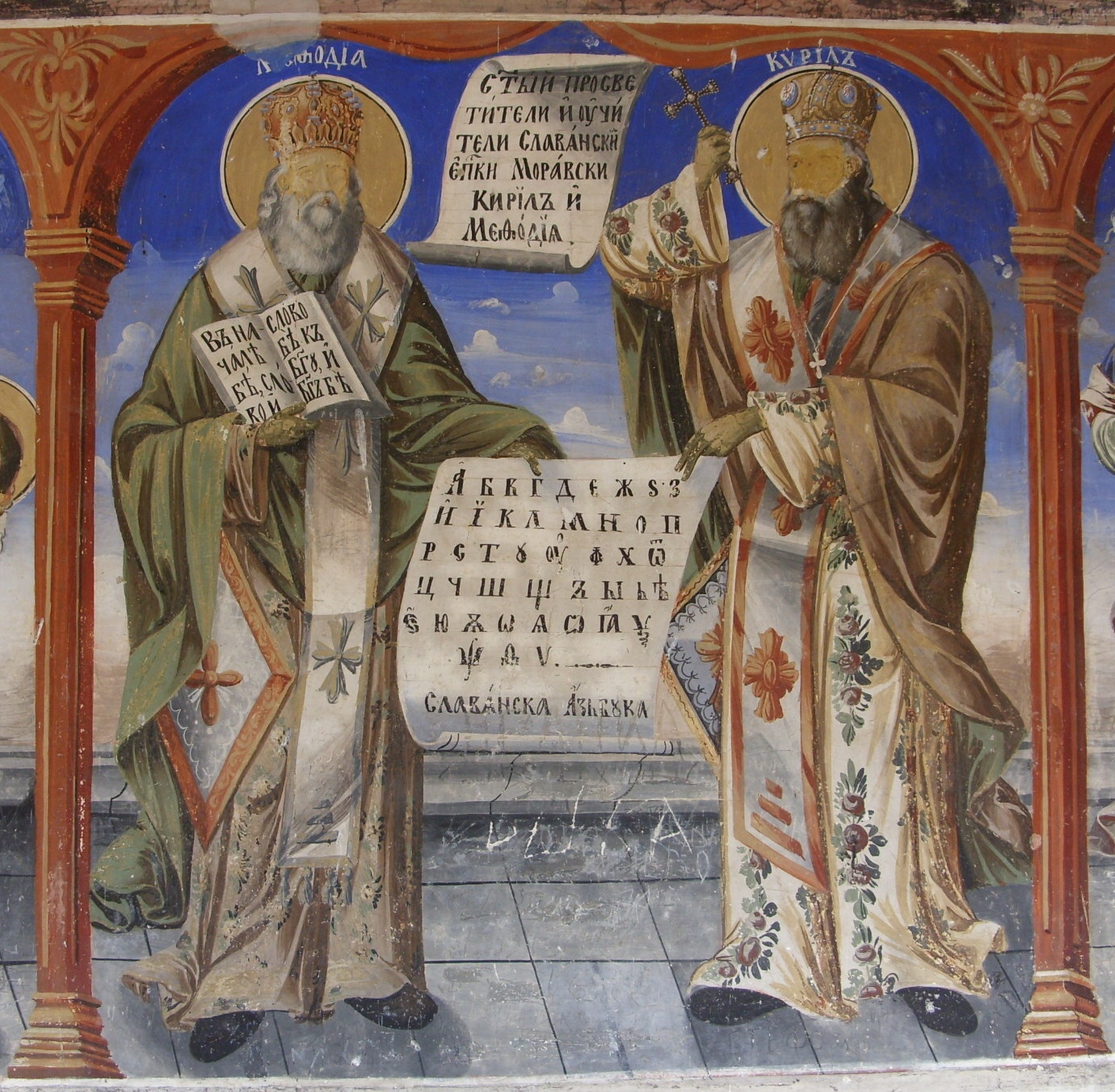
Janáček's Glagolitic Mass suits Gergiev's temperament, too. Boulez articulated the waving, angular cross-rhythms, showing the strength in Janáček's structure, from which firm base the excitement in the singing can emerge. Gergiev goes for a blunter approach, details more muted, but equally strong.. Possibly this way the piece connects more to pan-Slavic tradition and the Russian composers whom Janáček, would have been familiar with. Janáček was so fervently pro-Russian that he placed his beliefs above the welfare of his daughter. The photo shows the saints of the Slavonic Church revealing the gospels.

This interpretation suits the more lyrical passages in the music. The choruses and female soloists (Mlada Khudoley and Yulia Matochkina) produced beautiful sounds, like the "scent of the forest" the composer was referring to. Mikhail Vekua, the tenor, negotiated the extremes of the part nicely. Yuri Vorobiev sang the bass part.  Given the volume of sound around them, the soloists came over clearly. Strain isn't by any means inappropriate in this music given its quasi-savagery. Gergiev, though, adopts a sheen more in keeping with the neo-primitivism of Stravinsky, and the spirit of  much of Janáček's  other music. How I'd like to hear Gergiev conduct The Cunning Little Vixen!  It's a perfectly valid approach,  gentler on the voices, particularly the choruses, though the organ sounded oddly incongruous in context.  Thomas Trotter showed just how powerful the organ part can be, separate from the orchestra.  His Varhany sólo was extraordinarily explosive, yet dignified and controlled. Perhaps the organ is the voice of God, bursting through ? Or the voice of Janáček, the former church organist, who knew the spiritual power of abstract music.

Claire Seymour's review is HERE IN OPERA TODAY

Monday, 26 November 2012

Cunning Vixen and Scheherazade, Sisters: Hrůša BBCSO Barbican

Many performers get attention because their youth excites some sections of the press. But Jakub Hrůša has solid experience without attracting the media circus. He's Music Director of the Prague  Philharmonia and has conducted all over the world. He's recorded extensively for Supraphon. He's Music Director of Glyndebourne Touring Opera, which is a significant force on its own. I first heard Hrůša conduct Mozart Don Giovanni at the Glyndebourne Festival in 2010 and was even more impressed by his Britten Turn of the Screw in 2011   No chance would I miss hearing him conduct the BBC Symphony Orchestra at the Barbican, London.

Surprisingly, publicity for this concert was very low profile, especially given that Hrůša, a Czech music specialist,  was conducting the British premiere of František Jílek's arrangement of the suite of Leoš Janáček's The Cunning Little Vixen. Jílek (1913-93) was one of the important Czech conductors of his time, closely associated with Brno, Janáček's home turf. Jílek and Charles Mackerras were men of the same generation, but Mackerras dominated Janáček performance in the west, and Jílek remained behind the Iron Curtain. Although Talich's orchestral suite on The Cunning Little Vixen is better known, and in the Mackerras revision, Jílek's suite deserves more attention.

Jílek based his suite on the whole opera, whereas  Talich concentrated on the first act. Jílek used Janáček's original orchestrations and concentrated on the non-vocal aspects of the work. Jílek chose carefully, including passages from the scene where the Vixen comes to sexual maturity. If The Cunning Little Vixen was informed by Janáček's relationsips with women, this passage is crucial to meaning. Please read my article Janáček's Dangerous Women and many other articles I've written about this opera, (use labels below). Jílek also emphasizes the transformation music in the finale, where the Forester dies, and is reunited in spirit with the Vixen. This section is in many ways, the whole point of the opera, for it links themes of rebirth, regeneration and the cycle of Nature. The Cunning Little Vixen marks the beginning of the most fertile phase of Janáček's creative career, so Jílek's Suite works as a study of the opera and of the composer himself.

Like most Czech musicians, Jakub Hrůša probably imbibed Janáček from birth, but he's able to assert an individual stamp on his performance. He thrusts the music forward, yet marks the breaks with sharp definition.  This creates a combination of attack and tension, an angular energy that expresses the spirit of the Vixen, an animal who lives by her wits, surrounded by danger.  Conductor body language can often be "read": Hrůša points both hands downwards, fingers angled like a toreador, marking his point so it's unmistakeable. Later, he cups both palms in a rounded gesture, releasing the elegant lyricism in the finale, so it's illuminated like a halo. 

Another reason this concert was interesting was the world premiere of Rolf Hind's most extensive work to date, The Tiniest House of Time, for accordion and orchestra, with James Crabbe as soloist. "The accordion is cast as shaman-magician, party-animal, healer, rabble rouser" says Hind. Hence, perhaps the lively but controlled cacophony, wacky, swaying rhythms. Hollow metal sounds, folk-like bells, deep booming basses and low brass.  Three of the four sections are inspired by Persian poets (Rumi and Kabir), so the suggestion of dervish dance is prescient.  For me, the relationship between accordion and orchestra was paramount.  An accordion functions when air is squeezed through its chambers, shaping and elongating sound. The keys are played like a form of piano. Hind uses wind instruments to extend the idea of breathing, and strings and harmonium to reflect the idea of tinkling keys. Later in the piece, the string players hit the air with their bows, using invisble air just as the accordion does. The sound is only just audible, but the connection is clear. Hind's instrumentation also calls for wind whips, which create whirring noises when they're waved by the percussionists. The concept works fine as sound, but distracts visually.

More vaguely Persian exoticism in Rimsky-Korsakov's Scheherazade op35 (1888) which followed, rather eclipsing Rolf Hind, whose work would have fared better in a more contemporary programme.  Scheherazade is so ubiquitous that everyone knows it, even if only through movies and TV ads.  In the concert hall, this poses a challenge. How to make it sound fresh and original? Hrůša's approach was to conduct it as if it were entirely new, its ideas undimmed by familiarity. Colours are kept scrupulously clean, so they dazzle. Hrůša and the BBCSO bring out the vivacious sparkle in the music. Scheherzade's tales are beautiful, but if she doesn't outwit the Sultan he will kill her, like he's killed so many women before. So the sour note in the woodwinds is perceptive, reminding us that beneath this glamour lies danger.

The solo violin (Stephen Bryant) and harp (Sionead Williams) mingle flirtatiously, but is this a duet or a duel?  Hrůša doesn't stint on the hyper-romantic luxury in the score, but does not muddy it in indulgent swoon. Details are carefully observed, like the military rat-a tat-tat of the small drum, supported by tambourine. These lovely tales unfold against a backdrop of fear.  Hrůša shows that Scheherazade and the Cunning Little Vixen are sisters, both using their charms to survive in dangerous environments.

Listen to this concert on 2nd December at 2 pm and for 7 days after on BBC Radio 3

Saturday, 16 July 2011

First Night of the Proms 2011 Janáček Glagolitic Mass

Fabulous sense of occasion, the First Night of the Proms 2011. "Stars, night, music and light", a wonderful way to start the season. Pity the piece, commissioned specially from Judith Weir, is only 4 minutes and insubstantial but it's a nod to the rote cliché that the Proms don't do enough British and female composers.

This year's star pianist was Benjamin Grosvenor, at 19 already an 8 year veteran of the BBC Young Artists Programme. I enjoyed his Liszt but it's not really my thing. Much sparkier, for me, the Brahms Academic Festival Overture, which when done as well as this shines and adds to the sense of occasion.

But the real substance came with Janáček's Glagolitic Mass. Jiří Bělohlávek's Janáček is distinctive and idiomatic. He's transformed the way Czech music is heard in this country. This was a wonderfully affirmative Glagolitic Mass, full of vigour and energy.

Although the piece takes religious form, the faith Janáček is celebrating is the Slavic soul. Some time before the piece was written, the Papacy had made special dispensation for Mass to be said in Slavonic instead of in Latin as was the norm then. This was hugely symbolic since it gave legiitmacy to Slavic independence at a crucial point in time. Janáček's nationalist instincts were fuelled. The Glagolitic Mass commemorates the ancient roots of Slavic culture, just as the Sinfonietta  celebrates the birth of the modern Czech nation. The Glagolitic script, seen in the painting, dates from the 8th century, long before the Hapsburgs consolidated their grip on Bohemia. This Credo isn't about the "Catholic and Apostolic Church" so much as Janáček's faith in secular and national Resurrection. 

When Pierre Boulez connducted the Glagolitic Mass at the Proms in 2008, he brought out the craggy, uncompromising structure in the piece so it felt rough hewn, as if it were crafted from stone and natural forces, for this is a remarkable piece of music, coming only 15 years after Stravinsky's Rite of Spring. Bělohlávek's approach is much warmer but also firmly unsentimental,  because he knows freedom is hard won.  Hence the lovingly shaped "Janáček:" signatures, star motifs and quirky whips of melody that leap out provocatively, integrating the piece more closely with the composer's earlier work. Bělohlávek shapes the dense angular blocks, so the sudden traceries of brass zip through brightly. At the end of the Slava, the Amin, Amin's are ferocious. Truculent timpani ! The massive Royal Albert Hall organ enters gradually, almost quietly, so whern it bursts forth in the Allegro, it feels explosivce. A mighty force has been biding its time. 

Both Bělohlávek and Boulez bring out the depths of the Glagolitic Mass -- in different ways. Bělohlávek has by far the greater advantage with his singers. No comparison, in fact. Bělohlávek's also a good conductor for voice. Not many are. While Boulez's tenor (Simon O'Neill) faltered, Stefan Vinke for Bělohlávek is a match for the big orchestra, a defiant individual against vast forces. Hibla Gerzmava, Dagmar Pecková and Jan Martinik have all worked with Bělohlávek before, and clearly have the measure of this demanding piece. In fact I can't remember hearing it sung with such committment. The BBC Singers and BBC Symphony Chorus sound inspired, even by their usual extremely high standards  Maybe this will make it to CD, as it deserves to be preserved.

An important note on the edition of bthe Glgolitic Mass used in this performance  "The Glagolitic Mass was given in a new edition by Jiří Zahrádka and Leoš Faltus, which apparently restores passages simplified prior to the first performance in December 1927. According to the programme, the changes included simplification of rhythms, removal of the ‘offstage’ marking for a passage for three clarinets in the ‘Věruju’ (Credo) and cuts to both that movement and the ‘Svet’ (Sanctus). More may be read here concerning the edition, which Zahrádka modestly terms ‘an informative curiosity of sorts’.(Mark Berry in Opera Today and Boulezian)

In the meantime, this Prom can be heard again for seven days from Monday on the BBC listen again facility. It's also on TV, and will be repeated. Please use the BBC Proms button on the list of sites on the right of this site - it gets you straight into the Proms section so you don't need to navigate the whole BBC site.  Lots more coming up, so please keep coming back. In the meantime, here's a link to Rupert Murdoch, eat your heart out, which contrasts the Proms ideal with News International.  Tomorrow, Pappano conducts Rossini William Tell. Here's a link to a full download of the opera from Rome in 1953.

Wednesday, 17 March 2010

Janáček's dangerous women

Is Janácek proto-feminist? Janáček depicts remarkable women from Makropoulos to Málinka, who moves from being a maid to Queen of the Moon in The Excursions of Mr Brouček. None of them meek bimbettes, not even when they're put upon like Katya and Jenůfa. At first, it seems as though he's celebrating feisty women - think of The Cunning Little Vixen who cannot be tamed. Or the gypsy girl who leads the nice boy astray in The Diary of One who Disappeared.

In his personal life, the composer treated women like dirt. He pursued Zdenka when she was only 14, but treated her abusively for the rest of her life. Ironically she was ludicrously loyal. We also know what happened because an observant maid wrote an inside account. Even the servants in Janáček's life weren't illiterate ciphers.

He loved his daughter Olga but sent her off to Russia when she was ill. When she came home to die, he praised her in music. And Zdenka's mother stood by him (and paid the bills), only to be rewarded with mother-in-law from hell portraits like Kabanicha, Mila's mother and (to a lesser extent) Kostelnička. Just as well Kamila Stösslová didn't fall for him, but callously exploited his weaknesses. She refused to sleep with him, because she was "chaste". So he blamed social pressure. "Poor Kamila! Can't let her end up like Katya!"


Janáček's women are vividly characterized. Yet it's not really because he likes them, but because they symbolize something he wants for himself. Even before he met Stösslová he was fantasizing about illicit relationships thwarted by other people. Živný in Osud even meets his wife in a spa (where Janáček later went with Kamila), and spends most of the opera in extended monologue about his own needs. The wife, Mila, spends much of the time dead.

Yet again, The Diary of One who Disappeared is the breakthrough. The gypsy girl is wild, a human Vixen, who lives in the woods and doesn't do houses, She's brown from the sun, She seduces the young man in the open air, among bushes. Eventually he turns his back on civilization, and joins her vagabond ways. Sexually she's extremely proactive, pulling up her skirt in case the lad doesn't get it.

Significantly, Stösslová was very dark, almost gypsy-like though she was hardly a sylph. She flirted but did not yield. For Janáček, the thrill of the chase, the allure of the illicit meant a lot more than the idea of relationships and responsibility. In his correspondence with Kamila (and it was largely an affair by mail) he says he wants kids with her, knowing full well the "children" will be his music. Breaking from convention, for Janáček, meant creative release.

Perhaps that's why he's so interested in wanton women who defy society. It makes them seem racy, wild and free. Quite possibly he wouldn't have coped with modern permissiveness where there's no guilt and fear. Kostelnička's religious, but not puritan. She kills Jenůfa's baby because she wants her stepdaughter to have another chance at life. She kills from misplaced love and accepts she must pay the price.

Kabanicha, on the other hand, is fanatical to the point of obsession. She's not repressed - the Dikoj scene proves. But she's a monomaniacal control freak. That's why she hides the key, insteads of just locking the gate. The scene is the key that unlocks deeper levels of meaning in the opera. Because she's so rich, Kabanicha knows she can manipulate things. So after Katya dies, she thanks people for showing her family respect. She gets away with it because no-one questions wealth. Janáček is saying, "Watch out!"

Money, too, is how Mme Makropoulos has been able to pull strings for centuries. She's almost as cold and cynical as Kabanicha, but significantly, she's learned that power can become a curse. Authority means nothing in itself. Makropoulos is gorgeous, but Janáček has long gone past erotic frisson. Just as in The Excursions of Mr Brouček. he's making trenchant social comment. Janáček was a ratbag and he didn't do authority.

This puts From the House of the Dead into perspective. No women here to provide cover for other ideas. In Dostoyevsky, Janáček has found an outlet for his subversive radicalism.

A few years ago, I heard Jan Smaczny describe Janáček 's brushes with music critics and politicians. One of the men he lampooned eventually became Minister of Culture. No big government grants and publicity for Janáček, then, especially under Communism when his irreverence would not have gone down well. Janáček was Russophile because he didn't like The Austrian Empire (and Zdenka's family were German speaking upper middle class). Had he lived to see Soviet tanks, in 1948 and 1968, his Czech loyalties would have won out. No way was the Communist regime going to risk promoting him too much.

This approach also has implications for performance practice. Janáček spent a lot of time listening to folk melodies, but deliberately didn't write "folk music". In his maturity, he was discovering new means of expression, relevant to the age he was living in, The Czech and Moravian nations were not backward. Think Kafka, or The Good Soldier Švejk, both contemporary. Janáček was no faux naive bucolic. His nationalism wasn't picturesque, but progressive. So it's probably not a good idea to think of Janáček as tourists might, but to approach him as a Czech (Moravian) modernist.

Lots more on Janáček on this site, and come back Saturday, after the Cunning Little Vixen. Tomorrow I'll upload videos of an early Vixen movie !

Wednesday, 13 August 2008

Proms Boulez Janacek


On Friday Pierre Boulez is conducting Janáček's Glagolitic Mass at the Proms. This will be a must as he hasn't officially recorded Janáček, but in the real world musicians do a lot more than what filters down the commercial system. His Janacek Sinfonietta is a wonder to behold, totally making a case for Janáček as a seriously original and ground breaking composer. Last year I was in Amsterdam to hear Boulez conduct From the House of the Dead. This isn't one of the cutesy operas like Cunning Vixen (which could I think benefit from a more incisive approach than it usually gets). In his last years, the composer was entering new territory musically. Who knows where he'd have gone had he lived longer ? Remember, Janáček was the guy who notated chickens in his yard and whose experiments with non western sounds in some ways lean closer to Bartók than Dvórak. Boulez's From the House of the Dead is a revelation! The director was Patrice Chéreau, with whom Boulez created the Wagner Ring that transformed Bayreuth a generation ago. Fantastic experience ! There's a link to the Amsterdam performance below. It's now out on DVD with extras, so GRAB IT.

http://www.musicweb-international.com/sandh/2007/Jan-Jun07/janacek3105.htm


Glagolitic Mass has always been a poser to me, because it's huge and sprawling, and that sort of thing tends to bring out extreme syrup from most conductors. But Boulez doesn't conduct music he hasn't thought carefully about, so I don't think he will serve up stodge.