Showing posts with label Pessoa. Show all posts

Friday, 28 October 2011

Roderick Williams - Sea Pictures???

"I'm not dressed as a mermaid," quipped Roderick Williams. He was singing Elgar's Sea Pictures. Yes! Sea Pictures, mezzo soprano territory, usually heard with full orchestra, but here in the less common piano song version, at the Holywell Music Room, part of the 10th Oxford Lieder Festival. The grand Elgar gestures are still there in the piano part (especially in Sabbath Morning at Sea) but the cycle as piano song is something altogether more immediate and direct. Williams make such a powerful case for Sea Pictures that he raises Elgar's profile as song composer.  This Sea Pictures is so much more distinctive than most of Elgar's other rather more stylized piano songs. At last we might hear programmes of English song with Elgar given due prominence.

Despite its preoccupation with folklore, English song is a 20th century genre, far removed from bucolic pastures. Yet it's not  pretension. Roderick Williams has transformed English song performance practice because he approaches it as music. He's direct, personal and immediate, completely without affectation. He's astounding good technically, lovely burnished timbre, impeccable phrasing. The transpositoin is perfect,  and even when the tessitura leaps, Williams is secure. He communicates as if he's in conversation, telling an interesting story he cares about. "I, the Mother mild" sings Williams, "Hush thee, O my child". We might be thinking Janet Baker, but Williams expresses the spirit of the poem, for Ellfinland exists beyond gender or time. The imagery in these songs is nautical and in some songs the mood is ebullient. But meaning is deeper. "The music seeks and finds me still, and tells me where the corals lie".

Oxford Lieder does rare repertoire well. Until Roderick Williams sang Ralph Vaughan Williams (no relation) Willow-wood, the cycle hadn't been heard since 1903, and was known only to specialists. In 2005, he recorded the version with large orchestra and female choir. The text (Dante Gabriel Rossetti) suggests furtive lovemaking in the woods. In this performance, Williams brought out the unhealthy, even sinister aspects clearly. The orchestral version may be more ambitious, but the piano version is far more expressive.

Charlotte Bray is composer in residence, with three of her works performed at this year's Oxford Lieder Festival.  Her Songs and Sonnets is a key new work, heard here for the first time. The poet is Fernando Pessoa, who turned multiple personality into art form. He's become cultish in recent years because his work is surreal, utterly unique. His perspectives open new dimensions: No wonder he fascinates so many composers. Read more about him here on this site.   In these poems, Pessoa is parodying Os Lusiadas, the Lusiades, the Homeric epic poem by Luis de Camões (1524-80) which is so iconic that it symbolizes Portuguese culture and identity.  Bray's response is interesting. She counteracts Pessoa's florid text with spare, open textures. Often the voice is unaccompanied, and the words declaimed rather than sung. Camões and Pessoa are formidable poets to attempt, so if Bray doesn't focus on structure, her detailed word painting is a reasonable response.

Williams and his pianist, Andrew West, began their programme interspersing songs by Fauré and Duparc with songs by John Ireland. Numerous correlations with the rest of the programme. Exotic images of travel,  songs better known for female voice, even the idea of neurosis if you connect Duparc with Pessoa.

Roderick Williams is perhaps the most original British baritone today, and I do include bigger names, because his voice is so distinctive, and he communicates so powerfully. He 's also adventurous with repertoire. "Next time", he said "I might sing Schumann Frauenliebe und Leben". It has been done before (Matthias Goerne) and brings out new perspectives in the familar cycle. Maybe Oxford Lieder should take him up on his dare.

Read about Roderick Williams in ENO's Rameau Castor and Pollux HERE. It's nice to see Roddy with his clothes on! But he must be covered in bumps and bruises after that production. And read about his Butterworth Complete Songs HERE - amazing !!!!

Monday, 24 January 2011

The Portuguese Nun - Eugène Green

Reactions to The Portuguese Nun (Eugène Green, 2010) say as much about the viewer as the film does. It's fantastic, but at first everything seems to be wrong.

Julie, a French actress (Leonor Baldaque), arrives in Lisbon to shoot a movie, but no-one else has arrived. A tram moves through the city's vertiginously steep cobbled streets. Houses are perched at strange angles, but you're lulled, for Lisbon really is like that. Then you realize something's not right. The streets are completely deserted.  When other people appear they stare directly at the camera, making uncomfortable eye contact. Actors don't do that, nor ordinary folk. Movement is unnaturally stilted, shots held long after they should move on. Then you realize that it's deliberate. You're being nudged into an alternative reality where time and logic don't apply.

Every encounter is extraordinary. A stranger is about to kill himself and changes his mind on meeting Julie. His apartment's lit by candle. Then as mysteriously as he came, he disappears from the story. Julie meets a six-year old boy, Vasco, in a largo (small open square). In a disco, she's picked up by a man whom she decides is the reincarnation of Dom Alfonso, a gay king. Even stranger he agrees. In a streetside chapel a young nun prays in ecstasy, sleeping only between Matins and Lauds.  By now your antenna for logic should be vibrating extreme alarm. Something's definitely very odd..

Then it dawns on you that the movie is like a dream, where things move in slow motion, where every word carries portent, and every incident is pregnant with meaning though it's not rational or followed through. Dreams are like that. Logic is irelevant but they feel intuitively right. Eventually Julie confronts the mystery nun in the chapel. (Julie's playing a nun in the movie, and filming it in the same place). "I am laying a siege on God" says the nun. She prays contemplating ectasy in the full faith that God's mysteries will reveal themselves in their own way even if we don't notice. The original nun Julie's acting about lived in a time when convents were so dissolute that people stopped believing and Portugal was "for once, in the avant garde". So says the nun! Ironically, this is one small detail that's true, woven into the narrative blurring the joins between reality and fantasy.

The dialogue between Julie and the nun in the chapel is utterly surreal, yet, as in the most wonderful dreams, it feels like profound revelation, though it doesn't make logical sense. Yet for Julie, it's a turning point,  and she realizes that the point of life is to do good for others. She adopts Vasco. which might work in a movie but isn't nearly so simple in real life. Julie's clear, unsettling stare and heavy brows remind me of baroque Madonnas - or the children who saw the Virgin at Fatima. There is nothing logical in what they saw, but their miracle - or dream - has still managed to inspire.many, whether or not it's objectively "true".

Then you start to wonder what else there is in this dream fugue where simple things carry such weight? Why does Julie speak fluent Portuguese although her Portuguese mother died when she was a child? How can a child like Vasco exist without papers? And who are the film crew anyway, they're all speaking Portuguese, not French. We know that Eugène Green the director doubles as the film director Eugene Verde,  But who is Eugène Green?. There's a film called The Not So Great Eugène Green but he's not involved in it. The main site with info is called "Little white lies". The man himself doesn't leave much of a paper trail.  The Telegraph critic states outright that he doesn't know Green's work. The Observer critic claims to,  so perhaps  he might explain. Is there a bigger story here than meets the eye?  Is  Eugène Green as mysterious as Julie?. He's fascinating, anyway as he's created an audaciously imaginative movie that will utterly confound those who take things too literally.

"Life is too important to be taken seriously". Humour often disguises wisdom. Then the hints make sense. "I don't like French films" says the hotel clerk, "Too intellectual". This is a French film, yet the key is not to be intellectual but to drift into its gentle, unpretentious good humour. Dreams fall apart when you're too self conscious, but then you lose their magic.  That's why I loved The Portuguese Nun (currently screening at the ICA). In its quirky, understated way it's sending up the whole idea of art as a conscious process, and telling us, perhaps, to stay cool and absorb without always having to be "right". And as for Eugène Green? He reminds me strongly of Fernando Pessoa, whose surname simply means "person". Pessoa created multiple identities who each wrote in individual, distinct styles. Truly amazing personality and work.  Surreal, baroque, Kafka with warmth, wit and colour. Pessoa is a lot like Lisbon itself, operating on many different levels of time and place at once. Hence the film's loving vistas of narrow cobbled streets and dizzying angles, the tower of Belém, and the idea of a nun from the past (based on a novel) and a movie about a movie being made about her. Devious puzzles! Pessoa lives! Get the DVD when it comes out and enjoy it with a bottle of tinto.

Monday, 26 April 2010

Pedro Amaral O Sonho London Sinfonietta

The London Sinfonietta premiered Pedro Amaral's chamber opera O Sonho last night at London's Robin Howard Dance Theatre. It's based on an unfinished play by Fernando Pessoa, the eccentric genius of Portuguese literature (pictured here).  Pessoa's whole life was an art form. He's the Edgard Varèse of literature, pioneering new ways of interpreting reality and identity (see more here)

Dreams exist for a purpose. They mean something, but by their very nature, they don't follow the rules of reason. Yet what is reason? Many cultures use dream as altered reality. As Pessoa shows, it's possible to use dream creatively.

Amaral's approach is robust. His music is highly dramatic, full of assertive character, very much an active protagonist. The English translation is projected onto a backdrop, as if it's materialized straight off Pessoa's ancient typewriter, another invisible "person" operating in another dimension. Still, as in a dream, specific words don't matter so much as the overall emotional impact.

Pessoa (Jorge Vaz de Carvalho) appears. Like a master of ceremonies, he opens the show with the provocative words "I see before me, in the transparent but real space of dream, the faces  and gestures of Caeiro, Ricardo Reis and Alvaro de Campos" (the personalities through which his work was channelled). They flank him, dressed like him but clearly "not" him.

Salome is a role in a play Pessoa's writing, but now she comes alive. Carla Caramujo is a force of nature, her voice adding nuance and individuality to what she sings even if the words don't make much sense. She lives in an enhanced dream state. It's a mystery to her why she's asked for something so gruesome as the head of St John The Baptist, whom she recognizes as a kind of soulmate, for prophets dream of things that have not yet happened.  But is the head she sees (we have to imagine it) that of the saint or a common criminal? Salome's never quite sure,  and that conflict is the essence of her dilemma.

Amaral's  unusual choice of instruments integrates the ideas in the play into the music. He calls it "dédoublement", because this is more than simple shadowing. A disproportionately large number of celli, which in theory might seem unbalanced, but in practice, works beautifully. They are  led by the harp, deepened by double bass, xylophone and marimba. This is Salome's music, shimmering and sensual, but with a strong basic pulse in the harp ((Helen Tunstall). Three flutes add a distinctive second "personality" - some very inventive passages there that might be developed in future works, perhaps. Amaral is still in his 30's but O Sonho is a surprisingly mature, assertive work.  The subject matter may confuse on first hearing, but once you make the conceptual leap that meaning is "beyond" words, the music speaks for itself. One particularly well written passage interplayed conventional singing with long, wordless ululation. It was mysterious, like dream, yet also evoked a sense of the desert that surrounds Salome, where horizons dissolve in haze, and the sands constantly shift their shape.

Amaral's music is very distinctive. It's hard to describe him in terms of others because he sounds so much himself. O Sonho really deserves to be heard again, better publicised and in a bigger hall.  The staging, by Fernanda Lapa, is excellent too, showing how much can be done with minimal resources if the person directing knows what the opera is about.  The whole cast, singing and non singing, on stage and off,  seem passionately committed: this really feels like tight ensemble work.

The Gulbenkian Foundation was created by the Gulbenkian family who were genuine art lovers.  They could have made an impact in anywhere in Europe, but chose Lisbon, where the ambience fitted their cultivated, individualistic values. The Gulbenkians would be proud of what the Foundation does to promote works like O Sonho, iconoclastic but creative and very distinctive.

Thursday, 15 April 2010

London Sinfonietta Pedro Amaral O sonho

 Biggest secret in town! The London Sinfonietta premieres Pedro do Amaral's chamber opera O Sonho (the dream) on 25th April, not in the usual Sinfonietta venues but at the Robin Howard Dance Theatre in Bloomsbury. (book here it's hard to find otherwise, although you might have to phone the box office –– the theatre's online booking is flakey) It's a Sunday, so no congestion charge and relatively easy parking. Multiple good reasons for going. Pedro Amaral's a seriously interesting composer, very much his own man. What's more, the opera's based on Fernando Pessoa's unfinished drama on the theme of Salome.

Full review of the performance is HERE

Fernando Pessoa didn't exist! Or rather he mega existed. in the form of at least four separate identities, each with his own elaborate persona, who corresponded intensely with each other in literary journals. Rather like the trolls that inhabit internet discussion groups, but Pessoa's personas didn't chatter for the sake of chatter. They were erudite and actually had something worth saying!

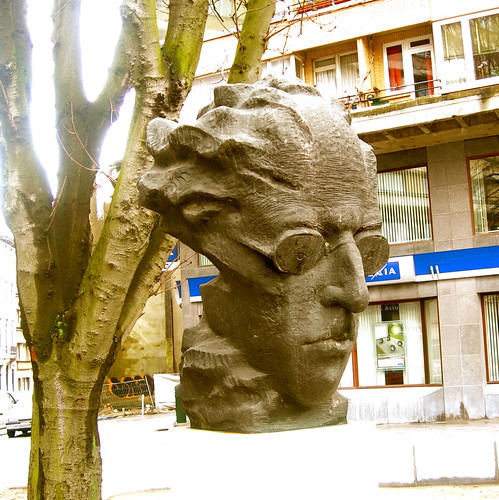
Pessoa inhabited multiple worlds in real life, too. Born in 1888 in Lisbon, he grew up in South Africa. The  experience of living as a European (but not only one type of European) in Africa moulded his ability to skip between different and parallel worlds. When he settled back in Lisbon, he was the epitome of turn of the century European spiv, spending most of his time in coffee shops talking literature. On the surface he was a punctilious bourgeois. Inside a wild, intensely oddball plethora of ideas. His life "was" artistic creation. Imagine Varèse, Salvador Dali, Richard Benjamin, Magritte and Shakespeare all mixed as one. He lived the highly perfumed Portuguese hybrid of baroque and Romanticism, electrified by ultra modern surrealism. No wonder he needed multiple personalities. He continues to inspire multiple interpretations today. The photo here is just civic sculpture, but the photo makes it look like Pessoa's head is flying, disembodied.

What will Pedro Amaral's O Sonho sound like?  He's a quiet, self effacing person (extremely good looking)  but a musician, not a talker. (Get to the show by 6.15 when he's being interviewed).  The first time I heard his music, it was being conducted by Peter Eötvös, (one of Amaral's teachers). It didn't make much sense. The next time I heard the same piece, Amaral himself conducted.  It sounded completely different, vibrant and vivid,  "Crenellations" he had described its quirky up and down rhythms.  To me it felt like a dragon uncurling itself, ready to take off into flight. Here is a sample of Amaral's O Sonho :