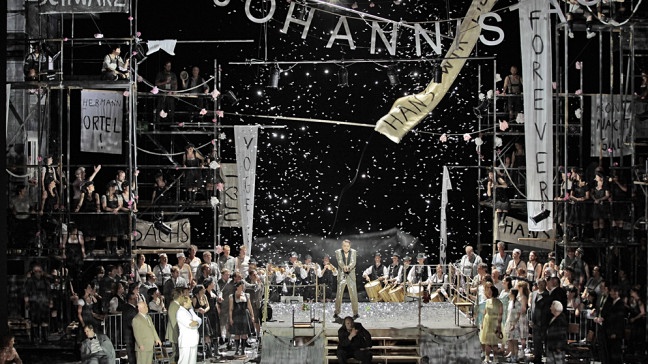
Showing posts with label Wagner Meistersinger. Show all posts

Sunday, 9 October 2016

Die Meistersinger von Nürnberg - Bayerische Staatsoper Munich


Die Meistersinger von Nürnberg from the Bayerische Staatsoper, Munich:  so dark and disturbing that it makes uncomfortable viewing. But truly great works of art operate on many levels, the greater the piece the greater the possibilities.  It is a measure of Wagner's greatness that the ideas he dealt with nearly 150 years ago apply, almost frighteningly,  to the present.  This Meistersinger provokes more questions than it gives answers, exactly what we need at the present when assumptions about art, politics and society are in unprecedented flux.

Who are the Meistersingers? Wagner makes a point of describing them as distinct individuals, with different backgrounds, united more or less by their love for art.  All of them have other day jobs: art is something they choose to place their faith in.  Although Hans Sachs and Sixtus Beckmesser dominate, it is wise to consider the Meistersingers as a group of personalities resolving the inevitable conflicts of diversity through compromise.  Rules help them muddle through by providing a kind of framework in which to regulate their art. But the rules are, in fact, made up ad hoc.  Beckmesser is so obessesed with finding fault that he runs out of space on his marking slate.  He works himself into crazed frenzy. Reality is never quite so extreme.  Yet the Meistersingers, supposedly wise representatives of common sense, get caught up in Beckmesser's hysteria and hate.  How easily civilized society can disintegrate when demagogues take control! Were it not for Hans Sachs and the voice of reason, Walter von Stoltzing, and what he stands for, would have been driven out of Nuremberg forthwith. How easily society descends into mindless, repression and group think.  What kind of society cannot cope with change and must suppress new ideas?

The Meistersingers here are depicted as ordinary men, to whose credit have worked hard to make something of their craft. Ordinary men, who've meant well. They think they're in control, but are easily manipulated into forgetting the very fundamentals of art, that art should enhance life, and must, like Nature itself, constantly refresh. Hence the urban landscape.  Walter learned his art from the birds in the woodland, who are free. Birds don't survive in these grim conditions.  As Wagner clearly stated in his stage directions, angles in the Church are distorted. Something's askew. Eva (Emma Bell) participates in formulaic rituals but recognizes Walter (Robert Künzli) as a fellow free spirit right from the start.  The apprentices, being young, are also still untamed, but how is their energy directed.  Just as each of the Meistersingers is defined as a distinctive personality, this David (Benjamin Bruns) isn't a stereotype but a well-characterized combination of worthiness and weakness, not a youth but not yet an artist until the end.

In the First Act, the staging sets the personalities. In the Second, the staging focuses on the community. Sachs (Wolfgang Koch) operates out of a van marked "Schuhe".  It reminds us that Sachs is out in the open, in the night air. Is he a Wanderer, who sees all yet can't easily intervene?  There's no tree in this square, but a cherry picker crane that can be cranked up and down if needed, a stage idea that's more effective than it looks. Beckmesser can reach great heights, but by artificial means, reflecting the idea of an elder tree and its connotations of delusion.
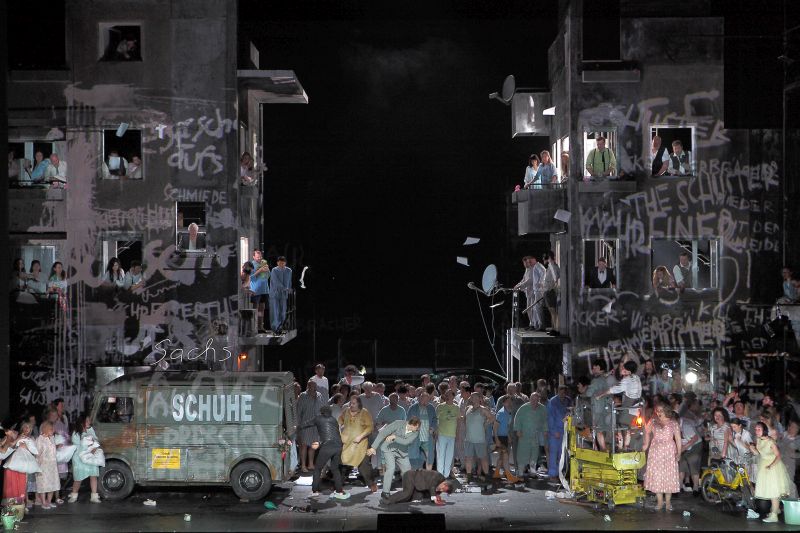
The citizens of this Nuremberg live in anonymous housing blocks, as we'd see in any desolate city where conditions are hard, and expectations are limited.  These are the universal disenfranchised, the kind of people whose horizons are curtailed, and who make easy prey for populist demagogues that make them feel they are "taking control" when they are, in reality, being manipulated.   Given the events of 2016, and the rise of Pegida and other right-wing extremists, it would be easy to make connections with 1933, but David Bösch, the director, deliberately avoids easy answers. He makes us feel sympathy for these dislocated souls, despite the violence with which they express themselves. To counteract such evil we need to understand and analyze, though not condone. Thus Beckmesser gets beaten up, and savagely. Nothing scenic about this brutality. The Nightwatchman (Goran Jurić) is an ordinary German policeman, a symbol of order, but one who cannot reverse the insanity once it's been released. The mob bully him back into his squad car. They wield poles, like knights n the past would have wielded spears : the romance of the past revealed as petty crime.

Similarly, this Beckmesser (Martin Gantner) isn't a caricature, but is interpreted as a weak but opportunistic personality who assumes that playing the right games gets you ahead.  He's very nearly right. Were it not for Sachs, his gold lamé suit and string vest might make him a superstar in some eyes, though his instrument is minute.  Walter, in leathers, looks like a thug but is the true artist, rough edges and all.  David could go either way, meaning well but prone to fudging corners.   Wolfgang Koch's Sachs impressed: although he's grimy (as the real Sachs probably was), intelligence shines out of his eyes. His movements are sharp and he takes in all that's happening around him, as a good Sachs should.  Koch is so experienced that authoritative singing comes naturally to him: no need for exaggerated folksiness.  His "Wahn! Wahn! Überall Wahn!" sounded genuinely perplexed, as if he were trying to make sense of what's going wrong, rather than just sighing in despair.  As he sang, his voice warmed with resolve.  Sachs can, and will, stand up for reason.

No open meadows in the final scene. Perhaps the Pegnitz no longer flows, or has been diverted underground.  We still see flags but these are flags of a more sinister kind. We're indoors, in a closed auditorium, cut off from the real world. On a hot Johannisnacht, the atmosphere would be stifling. And so, perhaps, a commentary on the nature of guilds and competition, of the channeling of diversity into an apparently cohesive celebration. "Brought to you by Pogner", a sign declares, for Pogner (Georg Zeppenfeld) was the agent who created the situation through which Eva was auctioned off to the highest bidder, bringing out the worst in Beckmesser, who might not otherwise have dared  to move. Pogner's white suit isn't as pure as it might seem.  The mob in the square covered the city walls in graffiti. Here, the "promoters" cover the meadow with commercial slogans.  Either way, defacement, and the defacement of culture as sacred mission.
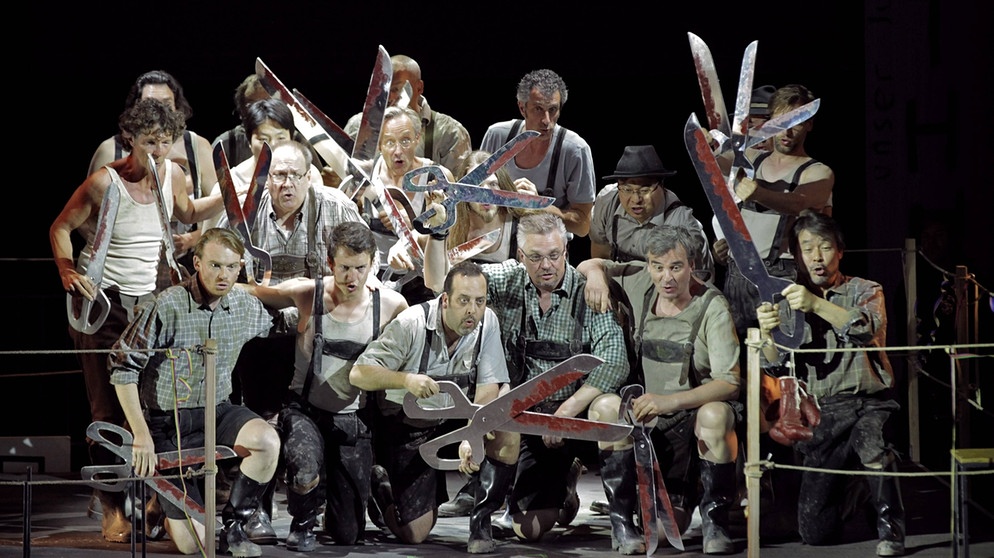
The guilds come together in a show of  unity, but how much of this unity is real, and how much controlled by convention. Each guild flaunts its superiority. Listen to the music: "Streck'! Streck'! Streck'!" and "Beck! Beck! Beck!", violence channelled into ostensibly cheerful chorus. The Tailors hold up the tools of their trade: giant scissors which could cut a man in two, stained with blood.  In some shots the blades of the scissors appear above the tailor's heads as if they were the horns of the devil.  The Prize scene is a Prize Fight, but the wider scene suggests a kind of Party Rally, with the crowds cheering as if on cue. Alas, Nuremberg has yet to live down 1936, even though not all the good folk of the city were participants. But at least the memory serves to remind us how dangerous Party Rallies can be, when people can be manipulated into unthinking frenzy and violence. Even decent, ordinary people who let themselves be fooled by soundbites.  No wonder Walter doesn't want more of the same.  Beckmesser gets beaten yet again, and brutally, this time shooting himself.   Fortunately, though, Walter does win, and wins Eva, the two of them offering hope by renewal.  What Walter will learn from Sachs will determine the direction of Holy German Art.

How much have audiences learned from Wagner, and from Die Meistersinger von Nürnberg, though, I wonder ?  In the dark clouds gathering around us in 2016, have we learned  anything from history?  Can art save civilization? Or is human nature so venal that the ideals of enlightenment must be destroyed in a wave of ever-narrowing bigotry and the resurgence of fascist values?  In this production, the bust of Wagner comes in a box marked "fragile".  Fortunately in Munich, the cheers were louder than the boos, a cause for hope.  Kirill Petrenko conducted a very good cast even without a megastar like Jonas Kaufmann.  For that, I was glad, for Die Meistersinger von Nürnberg is about ordinary people doing extraordinary things.   This production, directed by David Bösch, is finely detailed and will probably reveal its depths as time goes on. It's different, but its insights come from the opera itself.  It's not easy. But the issues it confronts are not easy and need to be confronted with courage and with Hans Sachs's fair minded common sense.  

Sunday, 22 May 2016

Interpreting Meistersinger : Glyndebourne, Munich


Wagner Die Meistersinger von Nürnberg at Glyndebourne. Is it unusual to start a new season with a revival ?  This production premiered on the exact date on which Wagner was born 200 years before.  Fortuitous timing, perhaps, but also a bright start to the 2011 season.  "Sunny but not shallow" I wrote at the time - read my original piece HERE

David McVicar set the production around the time of Wagner's birth, which was appropriate in the composer's anniversary year, but rather less relevant now.  On the plus side, early 19th century designs are easy on the eye.  Perhaps the popularity of this production stems from it being so genteel and non-challenging. But Die Meistersinger isn't about pretty scenery. On the contrary. It says, quite clearly that appearances deceive. The good guy is not the one in the smart black suit.  On the minus side, it gentrified 16th century Nuremburg,  obliterating the context of Reformation and revolt.  It didn't matter so much in 2011 because we were celebrating the start of the season, the production was fresh and it was different. Gerald Finley was a sophisticate, rather than earthy. Because he's a house favourite, it's perfectly reasonable to build a production around him.  There isn't and shouldn't be a "Hans Sachs type" but Finley's voice is on the genteel side, so his Sachs was never going to be gritty or pugnacious.  Hence his Sachs was an Early Romantic poet, from a time when poets were intellectuals, often aristocratic, almost all middle class.  They'd no more make a living fixing shoes than might a hero from Jane Austen. 

True, the Romantic period was a revolution, but the revolution Wagner wrought transformed the music of the past, even if it grew from Romantic values.  I enjoyed the 2011 premiere because Vladimir Jurowski conducted exceptionally well. The orchestra communicated what the set avoided.  There's no reason why Die Meistersinger shouldn't be sunny and gay, in the old sense of the word, because the Nuremburgers are celebrating the survival of their city and the renewalof art.  There is more in the opera, though.  The Meistersingers were happy enough to do as Beckmesser wanted and run Walter out of town, had Sachs not intervened.  Not for nothing, when darkness falls, the townsfolks crap. It's comic but not funny. A crowd can descend into a mob. The Night Watchman is a counterpart to Sachs, restoring sanity.  

And so to  Die Meistersinger von Nürnberg from the Bayerisches Staatsoper in Munich, just down the road from Bayreuth and not far from Nuremburg. Presumably the locals have Die Meistersinger in their DNA, notwithstanding their ancestors' less than worshipful approach to Wagner himself.  Even if they don't, the opera is so familiar that it could be interpreted in a new way, yet still be true to the fundamentals.  Jonas Kaufmann is Munich's greatest asset, and even more popular than Finley is at Glyndebourne. I'm glad I listened to the premiere audio only, in order to get the musical logic behind the interpretation.  Kaufmann is simply head and shoulders above everyone else in the cast, though they are good, and probably better than the Glyndebourne cast.  He's just so good that he changes the balance of the opera.  Jacques Imbrailo did the same with the Glyndebounre  Billy Budd, singing so divinely that some forget that for Britten, the story actually revolves around Captain Vere's moral dilemma.  It's fine to adjust balances in this way because they allow a change of perspective.  Kaufmann's Walter was so good that no one could have mistaken him for an untrained newcomer.  The birds in the woods who taught Kaufmann's Walter must have been pretty amazing.  An interpretation placing more emphasis on Walter than on Sachs would be perfectly valid, if done well, because Walter is the future, as Sachs recognizes.  

Sachs was named after St John the Baptist, who laid the way for Jesus.  Johannisnacht is a Christian festival, but also has connections with prehistory and even the occult.  The tree in the town square, for example is a kind of fertility symbol, and young folk go courting at the fair.  "Holy German Art" was poisoned by Hitler, but it's not actually about Nazism.  The music isn't even demonic, just affirmative, so,playing it up for cheap,thrills is a cop out.  It's time to exorcise that ghost from the opera and from its interpretation. Holy German Art in Hans Sachs's time was an affirmation of native German values, as opposed to the Catholic Church, to the democratization of learning through the printed word.  Before Gutenberg, people didn't have books, and had to believe what they were told.   The real message of Die Meistersinger von Nürnberg  is a lot more radical than some realize. 

Please also read Mills and Boon Wagner -Meistersinger at the Met  and  Stefan Herheim's perceptive Meistersinger, Salzburg and ENO Vindicated : Wagner's prescient warning. 

Wednesday, 18 May 2016

Kaufmann saves Meistersinger, superb Salonen Stravinsky


All quiet on the Live Front, but a glut of good listening links online. For starters :

Wagner Die Meistersinger von Nürnberg - live from Munich :  Jonas Kaufmann is a dream Walter von Stolzing, giving depth and maturity to the role with his now slightly darker timbre.  Definitely an interesting take on the part.   That Prize Song is so ardent that it's not the work of someone new to the game.  Kaufmann is such a singular Walter that this is worth hearing for him alone.  Any new Die Meistersinger is high profile, especially when it is in Munich, so close to Nuremburg and also to Bayreuth, so perhaps I was expecting too much.  At this level, no performance is ever going to be bad, but I would have preferred something less generic. Because Kaufmann is the Bayerisches Staatsoper's greatest asset, you'd think they could have created  the whole thing around him. He's not a typical Walter, but that could have been an ideal opportunity to rethink things musically.  It's not as if the opera is unfamiliar, is it ?  We could cope with something unique, making the most of  Kaufmann's distinctive timbre. Walter Koch is a good Hans Sachs, but everything needs to be stronger and more individual not to be eclipsed by such a powerful Walter.  Despite listening carefully twice over, which takes 10+ hours,  I can't get specially fired up. Meistersinger should be much more than generic. Meistersinger opens the Glyndebourne season on Friday. Munich ought to win hands down; But who knows ? Michael Güttler is conducting. Although he's relatively unknown in the UK, at 50, he is no ingénu and has a reasonably solid background. Please see my latest article Interpreting Meistersinger : Glyndebourne, Munich.

Stravinsky : Myths and Rituals :  Esa Pekka Salonen and the Philharmonia Orchestra continues a fascinating season devoted to Igor Stravinsky.  As usual, Salonen's in-depth explorations with the Philharmonia go far beyond simply presenting "greatest hits". The concert on Sunday May 15th is now available on BBC Radio 3.  It includes Symphonies of Wind Instruments (1947 version). .  Salonen does wonders, bringing out its quirky originality. In the last few weeks I've been immersed in Boulez's recording of the 1920 version. What a joy to compare the two,and with two conductors who really understand.   On the radio, we miss out on the choreography specially commissioned for this performance of Agon, which is a pity since the work is usually heard without the context of dance, but the playing is so vivid, you can use your imagination.  A stunning Rite of Spring, too. On Sunday 21st,  Salonen and the Philharmonia will be doing Oedipus Rex with a good cast and a semi-staging by Peter Sellars.  Not being a Sellars fan, I think I'll stick to the live broadcast.

More to come : Matthias Goerne : Mahler Early Lieder orch.  Berio, Heinrich Schutz from Regensburg, English Song Weekend and much more

Sunday, 8 February 2015

ENO Vindicated - Mastersingers of Nuremberg : Wagner's prescient warning


In Die Meistersinger von Nürnberg, Wagner affirms the importance of the arts in forging cultural identity. This The Mastersingers of Nuremberg at the Coliseum is a timely reminder why the ENO is vital to the creative health of this nation. For Hans Sachs, the arts are an essential part of the identity of his beloved city. Get to this production, which runs until 8th March, if you care about the arts in London.

It is a rare privilege to catch this production, which hasn't been revived since it was first produced by Welsh Natiional Opera in 2010. It was a vehicle for Bryn Terfel, who five years ago was new to the role. (Read my review here.)  The ENO budget doesn't run to Terfel,  who, in any case is busy with Der fliegende Holländer (more here). But it does the next best thing, by bringing Iain Paterson back to this country. Paterson is one of the Wagner singers of choice these days,  but in the early stages of his career he was a company principal at the ENO.  His first fully staged Hans Sachs is a triumphal home-coming. Paterson's characterization of Hans Sachs is refreshingly individual. There's no reason why Sachs should be an old man past his prime. Forty-something  Paterson makes us feel Sachs as a strong and vigorous man who stands up for his principles. In the Act III scene where Sachs encourages Walter, Patterson conveys genuine empathy, showing how maturity is a continuum, a constant process of learning and sharing.  When Paterson sings "Mad, mad, eveything's mad" (Wahn! Überall Wahn), he suggests the way a man of Sachs's wisdom might feel in  a world where basic human values are going awry: ineffably moving. One day, Paterson will be an outstanding Sachs. Hear him now at the ENO, so you can remember his staged debut. 

Gwyn Hughes Jones is an impressive Walter von Stolzing. Although he needs to work on the very top of his range, overall he has an interesting and very fresh voice. He starts singing the Prize Song lying flat on his back,  a handicap  which I think must be deliberate because it's one of the worst positions to sing in,  but his innate lyricism wins over. This Prize Song was illuminated by sincerity, flowing naturally with unforced freedom. Also very impressive was Nicky Spence's David, vibrant, cheeky and irrepressible. Sachs gives David a hard time, but nurtures him so he, too, will take his place as a master craftsman. The significance of apprentices in this opera cannot have been missed by the chorus, not all of whom are young, but who provide firm support., The ENO chorus is excellent. Even those who weren't part of the Harewood scheme seem galvanized by its ideals. The ENO is a great house for developing the singers of the future, providing a unique springboard for English-speaking talent in a business where most work isn't in their native language. Even the relatively small but crucial role of the Night Watchman (Nicholas Crawley) was well delivered, though his costume tried to steal the show.

Andrew Shore sang Sixtus Beckmesser, portrayed in this production as venal rather than evil. Rachel Nicholls made her ENO debut as Eva. She's very young indeed, creating Eva with more enthusiasm than refinement, which fits the part fine. Madeleine Shaw sang Magdalene. The Mastersingers were James Creswell, David Stout (very good), Peter van Hulle, Quentin Hayes, Timothy Robinson, Nicholas Folwell, Richard Roberts, Stephen Rooke, Roderick Earle and Jonathan Lemalu.

Richard Jones's productions, designed here by Paul Steinberg, are bright and upbeat, perfect for comedy, but Jones's work is almost invariably even more astute about music and meaning. The Mastersingers wear identikit uniforms,  the apprentices snappily marching about with the paraphernalia of office. I loved the the giant pretzels, representing the baker's guild. Significantly, Jones doesn't portray the townsfolk as automatons. Buki Schiff's costumes range over a 500-year period, and cover different regional styles and social classes. The mastersingers aren't the only ones who uphold "Holy German Art" : without this community of individuals, Nuremberg might not thrive as it did. For "Holy German Art" flourishes in many forms. The frontcloth shows a montage of German thinkers from Sachs's time to the present. You don't need to identify them all. As in the opera, part of the fun comes from learning afresh.

Sachs's Nuremberg was prosperous, but the Midsummer festival commemorates times of war and famine. The townsfolk go to bed on Midsummer's Eve, but it doesn't take much to rouse them to riot.  As if released by devilry, they swarm over the stage, their arms raised in diagonal salute.  If nice, supposedly artistic people can mindlessly destroy what they have, we cannot be complacent. Beckmesser very nearly got the Mastersingers to kick Walter out of town. Were it not for Hans Sachs and his non-conformist wisdom, where would Walter be, or Nuremberg, or the future of art ? This Mastersingers of Nuremberg at the ENO  gives much fuel for thought.

Please also read my other posts on Wagner, Die Meistersinger, stagecraft etc.  Also, my post on the current situation at the ENO "Radical Rethink". Unlike some, I think it's sickening to "enjoy" seeing people kicked when they are down.

photos : Catherine Ashmore 

Friday, 26 December 2014

Die Meistersinger von Nürnberg, East Berlin 1981

Wagner Die Meistersinger von Nürnberg from the GDR in 1981, when the Deutsches Staastoper was in East Berlin.  This production premiered in May 1968, directed by Werner Kelch.  The film captures just one of numerous performances,  most of them conducted by Otmar Suiner and combinations of the same cast, usually headed by the great Theo Adam. The 1981 version features a very young-sounding David in  Peter Schreier (actually aged 46).  The quality of the singing evidently varied: this Walter, Spas Wenkoff, isn't that great. Yet, despite being a product of the conservative Communist East German regime, it must have been strikingly modern and innovative in its day. The GDR may have repressed poliitcal dissent, but it valued artistic ideals. It understood the meaning of the opera with its message of creative renewal and freedom (though it kept being revived).

The congregation in Act One sit in a darkened church, where we can just make out vaguely Gothic, semi-abstract shapes on the walls towering above. This background is oppressive, but so is the society in which Eva has been brought up. Significantly, this same set serves for the room in which the Meistersingers meet.  They look like they're boxed in, trapped in ancient mahogany. This interplay of solid, dark mass and brightness flows through the whole opera. Black and white, like the half-timber architecture of Nürnberg itself, woven into the whole production, but not merely for decorative effect.  Angles and shadows, subtle gradations created by different perspective: the meaning of the opera expressed visually.  Costumes are more or less medieval, but subdued - 16th century clothing technology didn't support the flashy kitsch that passes for medieval today.  Thus the visual emphasis falls on the apprentices in their black and white outfits, many of whom are played by young women, whose voices  make the choruses particularly perky. Spotlighting the apprentices is critical to interpretation, since it's they who are the future: still lively, rebellious, and not yet blinded by convention. Oddly, the principals all seem to have the same bouffant wigs and exaggerated stage makeup, but I think that's more the fashion of the time than anything else.

With a few minimal extra details, the same set  works for Act Two, where Walter, Eva and Sachs  face their dilemmas, and Beckmessser crawls out of the shadows.  The characters are "be-nighted" in every way. The Nightwatchman thus calls time on the chaos. Thus, when dawn rises on  Johannes Tag, the brightness and freshness feels invigorating.  Sachs's workshop is lit by the morning sun, adding a golden glow. A bright blue curtain adds colour. Strange angles and shadows still, since Beckmesser lurks to steal Sachs's manuscript.  When the curtain rises on the field of celebration, it's high noon.  Now the black and white seems healthy and clean. Gone forever the heavy woodwork. Instead, an open grandstand, through which air circulates. Three golden banners. Simplicity, naturalism, none of the oppressive overcrowding favoured by Otto Schenk and  Third Reich Bayreuth. East German socialists  knew only too well what mobs and mass rallies  could unleash. No flowery meadow needed: the gaiety in the orchestra is matched by the liveliness of the youthful Guildsmen, apprentices and young women in yellow skirts and white lace, dancing (not marching) merrily. Freshness, purity, renewal.  The Meistersingers enter, part of the community, smiling and approachable. Walther sings the Prize Song dressed in white satin, edged with black, like a true son of Nürnberg!

The notion of "traditional" versus "modern" production is nonsense. What really matters in opera is how well a production expresses the meaning of an opera. That involves some basic understanding of the music and what the composer might have meant by it. Some audiences, however, could not care less. They want preconceived expectations fulfilled, even if thiose assumptions run totally against the nature of the opera. "Regie" simply means "directed", in French as in German, without the implications in English of "regimentation". "Concept" merely means joined up thinking, putting ideas into broader context.  Wagner himself famously said "Kinder, macht neu". It was Cosima, with her obssesive personality,  and Winifred, with her friendship with Hitler, that espoused the idea of blind conformity to external values, at the expense of genuine engagement with the composer and his ideas. Does Wagner support Sachs or Beckmesser. ?  Does he support the individual (Walther) against the mob? Is Beckmesser right to cheat, lie and steal  to prevent new ideas and new art?  If even the Communist regime in East Germany could produce a Meistersinger like this, which respects Wagner's values, why do some - not all - modern audiences in supposedly democratic societies still not get what Wagner was about?

Monday, 15 December 2014

Mills & Boon Wagner ? MET Meistersinger


The Met's Wagner Die Meistersinger von Nürnberg broadcast HD.  I listened audio only on BBC Radio 3 (still available online). Last week, someone on the BBC said that Wagner wrote about myths and legends, but Die Meistersinger was "about love".   Has the age of Mills and Boon Wagner arrived? Just as there's a lot more to the Ring than galumphing Gods, there's a whole lot more to Die  Meistersinger  and indeed to Tristan und Isolde than potboiler romance. Most people, I believe, want to learn, but when  the media is a source of over-simplified trivialization, what will they learn?

The better a creative work, the more there is to learn. That could be the philosophy behind  Die Meistersinger,  a work which is as much about art and the making of art as "love interest". Eva and Walter spot each other as strangers.  Maybe it's love at first sight, but maybe more. Walter is an outsider, who believes in ideals but fits in nowhere. Eva is part of the Establishment but a woman can't participate as an equal.  But she can spot a true talent better than the Meistersingers with all their supposed authority. Johan Botha's voice is so exceptionally divine that the Meistersingers must have cloth ears not to notice. Yet for all their supposed wisdom, they're fooled by Beckmesser and would have kicked Walter out but for Sachs's intervention. Therein a parable for our times, when even the wisest believe what authority tells them.  Perhaps it's human nature to need  received wisdom and safe opinions, but this opera makes clear that true artistic breakthroughs come from those who, like Walter, do things differently. The Meistersingers set store on following masters. Walter learned from birds.  Beckmesser's a troll, more interested in destroying nascent talent than doing anything worthwhile himself. Maybe the system lets people like that rise to the top? Eventually Walter decides to stay in Nürnberg to perfect his craft, but fundamentally his nature as an artist stems from creating anew and from being true to himself.

Die Meistersinger is dominated by huge choruses. Each guild has its rules with which to control. Who would dare buck the guilds en masse but a Walter?  The Third Reich made a cult of Die Meistersinger idealizing the values of mob rule and conformity.  Who would dare dissent when 800 people are roaring their take on ""Heilige Deutsche Kunst" with their arms raised in diagonal salute?  As I listened to Michael Volle's firm, assertive Hans Sachs, I thought of  Wilhelm Furtwängler. What really went on in his mind as he conducted at Bayreuth in the midst of the maelstrom? Perhaps, like Hans Sachs, he bided his time quietly, not overtly bucking the regime, but offering music that subverts the anti-intellectual group-think that fears change. 

Hence the pivotal role of the Night Watchman.  Many years ago, Kwangchul Youn made his Bayreuth debut in the role.  He told me that the Night Watchman is a lone figure who intervenes when the townsfolk are rioting and restores sanity. Notice the bassoons and winds around the part.  It has an almost magical authority.  The Night Watchman is a warning against madness. Matthew Rose sang the role at the Met, bringing out its dignity. Beckmesser flaffs about (well characterized by Johannes-Martin Kranzle) but the Night Watchman is steadfast.

Die Meistersinger von Nürnberg supports many different approaches. Read HERE about the groundbreaking Salzburg Meistersinger, with Michael Volle, which developed the connection between Sachs and his art and between Wagner and his time. Maybe it's not entry-level, but anyone can learn. It's a very deep engagement with the ideas in the opera.  Compare the photo of the Otto Schenk production first heard nearly 30 years ago and the still from Bayreuth, 1943.  Tradition is all very well, but true art lies in fresh thinking.

PS If you want to hear the same production but with a REALLY good conductor, listen to the Vienna State Opera performance conducted by Christian Thielemann with Johann Botha and Falk Struckmann


Wednesday, 21 August 2013

Herheim's perceptive Die Meistersinger von Nürnberg Salzburg


Stefan Herheim's Wagner Die Meistersinger von Nürnberg in Salzburg will transfer to the Met. Will audiences collapse in hysteria? Not if they know and care about the opera or about Wagner. Herheim focuses on Hans Sachs himself, as individual and artist, not the "public" displays of civic pride. This Meistersinger is exceptionally werktreue and perceptive. It engages with Wagner's ideas on creativity and the purpose of art.  Herheim deals with the true meaning of "die heil'ge deutsche Kunst" and with Wagner in the context of German tradition.

The Overture unfolds showing Sachs (Michael Volle) in nightcap and gown, surrounded by relics of his long dead family.  Herheim shows us Sachs the man who was once happy with a wife and children. Perhaps that's why he acts as father figure to others. But it also shows how "Wahn, Wahn, überall Wahn" grows from deep emotional scars. Life is short, and unfair. It shouldn't be wasted on things that don't really count. There's nothing silly about seeing Sachs playing with toys. This gives depth to Sachs's personality, and also connects to the idea that creativity is instinctive. References to youth and renewal run throughout the opera. The congregation in church are witnessing a baptism. Herheim's toys remind us to play with our imagination. Beckmesser thinks art comes from rigidly following rules. Sachs doesn't. Do we approach Herheim's Meistersinger as Beckmessers or as Sachs?


Throughout the opera, there are references to craftmanship and the process of creation. "Schuhmacherei und Poeterei", as David says.  Understanding Die Meistersinger von Nürnberg  as a work about art and the making of art can't surely be too difficult a concept to grasp. So there's no need to sneer when the set turns into a giant desk.  So the characters in the narrative spring to life on Sachs's workstation. The Meistersingers make much fuss about proper seating. Herheim has them sit on upturned giant thimbles, which are later revealed as empty buckets. When Walther (Marcus Werba) sings his first "Fanget an!", the Meistersingers collapse like skittles. It's funny but also very apt.

By defining the concept of art as imagination, Herheim is able to release much more esoteric levels. The imagery of sleep is important, too. By day, Sachs is busy making shoes. At night he's alone. Sleep releases the unconscious, creative mind. Sachs solves the dilemmas in his art as a craftsman, just as he fixes shoes so they function properly. In Act Two, the desk is shrouded in darkness. We catch a brief glimpse of the lilac tree through Sach's window, but we don't need to see it again on the desktop "stage". Its fragrance perfumes the music. Johannistag coincides with Mid Summer Night's Eve, the shortest night in the year when magical things can happen. When the townsfolk awake, they're literally surrounded by "Gespenstern und Spuk". Fairy tales, as Bruno Bettlelheim said, mask subconcious fears under a guise of comic figures. Ghosts and spooks would be hard to depict in a more literal staging. We laugh, but take the point. There's even a group of trolls! Herheim's wry sense of humour is deliciously wicked.

These images also bring together several periods of German culture. Herheim's costumes suggest the Early Romantic period, when German intellectuals like the Brothers Grimm, Brentano and von Arnim and Gottfried Herder were rediscovering premodern tradition. Without the Romantics, we might not have the modern world with its interest in the darker side of life, and in creative freedom. Nor would we have Richard Wagner. He knew very well what he was doing when he chose Sachs for his subject, since Sachs lived robustly in the Reformation, another important flowering period of German culture and identity. At Glyndebourne in 2011,  David McVicar's Die Meistersinger von Nürnberg (review here) was set in the period of Wagner's youth but to little effect. It romanticized without connecting to the savage spirit of the Romantiker.There's a huge difference.

Herheim's staging is much more literate, and intelligently thought through. The Romantiker fascination with Nature was often seen through the prism of the drawing room, so Herheim's indoor setting is wittily ironic.Things seen through the imagination are often hyper real. When David sings of "der rote, blau' und grüne Ton" we see wild flowers held aloft. The final scene on the banks of the Pegnitz isn't shown literally. But there's a train! This isn't director whimsy. Without railways, industrialization and the rise of the middle class, modern Europe wouldn't have developed. Trains represent change, just as aristocratic Walther represents change when he joins the good folk of Nuremberg.

The townsfolk are draped in flowers: if these were real their scent would fill the hall. The women wear white aprons, so dazzlingly bright they light the stage. Herheim's having a merry little dig at the idea that costumes "make" an opera. Although there's a lot of detail to reward repeated viewings, the visuals aren't there for their own sake but to intensify the fundemental drama in the music. The critical moments, like the quintet and the Prize Song are shown with simple clarity. Those who hate modern productions on principle often claim that directors should "respect the work". But that argument can be turned completely on its head. A really good opera is strong enough to withstand multiple interpretations, and perceptive interpretations like Herheim's show us how much there is yet to discover. "Verachtet mir die Meister nicht, und ehrt mir ihre Kunst!".

Michael Volle's Hans Sachs is excellent. It helps that he looks like the historic Sachs, and that he himself grew up in the Lutheran tradition. Volle gives the character grit and gravity, mixed with a genuinely warm humanity. Volle's diction highlights the couplets and phrasings so typical of German tradition. When  he sings "ehrt eure deutschen Meister! Dann bannt ihr gute Geister" he infuses the words with positive feelings, banishing  memories of wartime Bayreuth.

Markus Werba's Sixtus Beckmesser quivered with nervous energy. He sings with more colour and charm than we'd expect from Beckmesser, but that enhances his portrayal. Beckmesser's weak rather than evil. He wouldn't be a Meistersinger in the first place if he was incomptent. He just doesn't get it, that true art comes from being original. Werba makes the part sympathetic. This Beckmesser is deluded rather than a troll. Peter Sonn's David is delivered with strength and conviction. This David is no ingénu, and justifies his master's faith in him. Herheim's blocking of ensemble also shows how the apprentices connect to David.

Rather less rewarding were Roberto Saccà's Walther and Anna Gabler's Eva. Saccà's voice finally did him justice in the Prize Song but it was a little late. As for the orchestra ? What was Daniele Gatti doing? The pace kept slackening. Sachs is a cobbler, not a carpenter. Wooden playing like this just doesn't work. When Herheim's  Die Meistersinger von Nürnberg transfers to the Met, with a different cast and conductor, it should be a success.

Tuesday, 20 December 2011

Wagner Die Meistersinger von Nürnberg Royal Opera House

Perhaps it's no accident that Graham Vick's Die Meistersinger von Nürnberg returns to the Royal Opera House for the Christmas season. Red, green, gold, sumptuous colours that warm a long, grey evening.  This Die Meistersinger von Nürnberg is a comedy and here it's presented as the ultimate up-market Xmas show. It's extremely enjoyable, and an ideal introduction to the opera experience. Richard Wagner, though, gets sidelined.

Sir John Tomlinson is a definite reason for catching this revival while you can. The days when he could sing Hans Sachs are past, but he creates an unusually vivid Veit Pogner. Tomlinson plays Pogner powerfully, as if he was a former Sachs, whose reasons for committing his daughter to this bizarre marriage make sense. He's dedicating his daughter to art, not to shabby politics. Luckily for him, and for Eva, Walter von Stolzing arrives in the nick of time. Indeed, Beckmesser very nearly persuades the Meistersingers to drive Walter out of town. Things could so easily have turned out quite differently. Die Meistersinger von Nürnberg may be comic, but it evolves against a background of tension. At any moment anarchy could break out. Unless the Meistersingers adapt, they might not survive.

Wagner builds dissent into the music. The Meistersingers sing at cross-purposes, and in the riot scene the turbulence of the chorus evokes the violence which comes with all revolution. That's why the Night Watchman sings "bewahrt euch vor Gespenstern und Spuk, dass kein böser Geist eu'r Seel' beruck'!"  The music for the apprentice boys is energetic, a warning for those who remember Wagner's protosocialism. This time, however, we're treated to a good-natured Meistersinger, where the apprentices dance with little vigour, and the blows Sachs throws at David have no menace. Antonio Pappano received the longest applause of all on the first night. Most audiences can relate better to joyful Romaticism in music than to Wagner-on-edge, so it's understandable. He clearly enjoys the life-affirming elements in this opera, which come over well. Christmas is not the right time for radical ideas, and this is not a production that would support them.


Graham Vick's riot scene is classic because it's so well imagined. The townsfolk pop out of windows and hang precariously upside down over the stage. One man looks like he's about to lose his footing (this happened in earlier productions, so it was planned)  In their nightshirts the townsfolk look like escapees from an asylum, a good idea but not developed. The Festweise scene is masterfully blocked, so each guild is clearly defined. I liked the acrobats in the background, too. But these scenes aren't for entertainment but emphasize the traumas in Nürnberg's past.(Click photo to enlarge, it's wonderful).

Because John Tomlinson so dominates the first Act, Wolfgang Koch's Hans Sach might be overlooked, but Koch understands the role. Sachs is an observer, who stands apart from the crowd, and who thinks before he acts.  Koch's Sachs is sung with sensitivity, and would be very effective in a more perceptive production which focusses on Sachs and not the scenery. Koch looks and sounds younger than the other Meistersingers and is rather more lyrical than Simon O'Neill's Walther von Stolzing who is more hoch dramatisch than a true Heldentenor. This was the best performance I've ever heard from O'Neill, and he was good, but it's a part better suited to a more luminous timbre. O'Neill was, however, a good match for Emma Bell's Eva, joyfully created though perhaps more Italianate than Wagnerian. In a cheerful, non-idiomatic production like this, it didn't matter, and they conveyed the story. Popular favourite Toby Spence sang a very good David, but he's more public school than roustabout.

It was good to see many teenagers in the audience, another good reason for having a show like this in holiday time. Last week, my friend took his daughter to Kurt Weill's Magical Night at the Linbury, and she was transfixed. She will never forget! We can give kids toys anytime, but the gift of a magical experiernce is beyond compare. And the same goes for adults, new to opera. This Meistersinger may not tell us much about the opera or about Wagner, but it's an excellent night out. More details soon and full cast list in Opera Today.

photos copyright Clive Barda 2011, details embedded, 

Meistersinger von Nürnberg - latterday Lohengrin?


Wagner Der Meistersinger von Nürnberg at the Royal Opera House tonight. Tomorrow, a full review, bookmark this site. .Sir John Tomlinson can't sing Sachs any more but my gosh, is he an amazing Veit Pogner. Usually the past fades into the background, but with Tomlinson, Pogner dominates. The whole balance changes when one singer is this good.

This Meistersinger production, (Graham Vick, revived from way back), is an excellent Xmas show, with psychedelic bright colours, that wonderfully humorous riot scene and the brilliant finale. Great fun, but don't expect anarchic or intellectual challenge. Apart from John Tomlinson, there was more grit at Glyndebourne. Oddly enough  I kept thinking of baptism that runs throughout this opera like an undercurrent.  It starts with the church service, and leads up to the big party on the meadow which celebrates Hans Sachs's nameday. Johannestag, Johannestag! The English translation is misleading. Sure it is midsummer but much more  importantly it is the feast of St John. Significantly, Hans Sachs was named (by his apparently single mother) for St John the Baptist, who foretold the coming of someone greater than himself.

This has big implications on how the role of Walther von Stolzing might be interpreted. Sachs, Pogner and the Meistersingers can be gruff and dramatic, but Walther should stand out in a halo of glory, I think, like a latterday Lohengrin, who saves the girl and rejuvenates her whole community. So I thought, very lyrical true Heldentenor, so beautifully sung he's almost divine. So above, John Botha, in 2008. (comparing anyone much earlier isn't right as styles change, even in the way we speak). Ethereal! Close your eyes as the production is awful, but open your ears.

There is a lot on this site about recent Meistersinger von Nürnberg productions like Glyndebourne Gerald Finley and WNO at the Proms (Bryn Terfel) And of course lots more on Wagner.

Sunday, 10 July 2011

Meistersinger at the Movies - the implications of filmed opera

The Glyndebourne Festival's Wagner Die Meistersinger von Nürnberg reached a world audience within weeks of its live premiere. (read review HERE) Consider the significance. Millions more will have seen this Meistersinger online and in cinemas than will ever see the production live, no matter how manyb times it repeats. What does this imply for the future of opera and indeed of classical music?

Box office receipts don't cover costs, which is why there are so many revivals of safe bets in all houses.  Revivals, DVDs, films and online broadcasts are essential because they bring in extra revenue long after the initial outlay. Without follow-ons, most opera houses couldn't operate as businesses, far less create new work. So we can't complain.

A photograph freezes a moment in time (the term properly used here). A photograph isn't the same as real life experience, and can be completely misleading. (which is why opera photos are supposed to be used with written content). When you watch a film of an opera, you need to realize that you're watching it through a filter. Directors and cameramen decide which angles to shoot, what to emphasize and what to leave out. Sure, you get better close-ups than you'd ever get live, but it's not at all. the same thing.

The filmed Meistersinger worked better than live because the camera was able to omit the oppressive fan-vaulted ceiling which hung over every scene live. Everyone who heard the film thought Gerald Finley sang brilliantly and with real force. Most of those who heard him live thought quite the opposite. In fact, I'd venture that the otherwise pointless updating of period was done in order to complement Finley's voice.He's more convincing as Romantic Poet than as Sachs the earthy, non-conformist cobbler. On film, something's been done to the sound dynamics, so Finley's performance is transformed. As an artistic choice, it's valid because it's a far better experience for the audience.

Every performance is always going to be different. There's an art to assessing singers that's lost these days when we're conditioned to judging things on the basis of performance frozen in time.  In reality, things change depending on many factors. What you hear on recording isn't necessarily true. Decades ago, Albert Remedios sang a concert when he really should have been home in bed. It saved the show but fixed his image in the popular mind to his detriment. Unfortunately some audiences think singers should be gladiators, sacrificed for audience pleasure.So listen to films - and recordings - never forgetting they're just snapshots, not the whole experience.

Walther's song was tentaive to start with, but Sachs was wise enough to see the potential in his abilities and gave him a chance. On the film, Marco Jentszch's Walther was clearly nervous, saving himself for the final Prize Song. In live performance, he was much more natural, so you could hear how interesting his voice really is, and where it might head if he's well nurtured. But you wouldn't know from the film. When assessing singers, don't be a Beckmesser, but a Sachs.

Once, people learned their music from studying scores and playing transcriptions to sing at home. That's why I posted the French In fernem Land HERE. Anyone could play that piano part: the purpose of the exercise was to listen, not to show off.  Recordings changed all that. Nowadays we're conditioned to think in  finite terms, as if a performance were a stand-alone object to be consumed. Beware "comparative recording surveys". Done well, they're useful but you can't ever judge anything by picking out the good bits.

Much (but not nearly enough) has been written about the way the internet is changing the very way we think. We think in twitter sized blips and assume the instant fix of Google is the same as reality. If we get used  to processing input in ever more superficial ways will our brains shrivel? and if not our brains. our psyche? Art challenges sound bite mindsets. What its role in society? Has it been a way to stimulate the mind and open us to new perspectives? Is creative art necessary to human evolution? Just as there are many who would deny evolution, there are probably many who'd deny the role of creative imagination.

But as always, I digress. Evolution conditions us to process visual clues more strongly than sound, unless we're blind. Thus film has the power to fix things in our minds even more than recordings. All the more, we need to be aware of the danger of forgetting that there are many different ways to think, feel and learn.  Film is a wonderfully effective way of reaching out to people, but we do need to think about its longerterm implications. Who does it reach? What does it teach? (Please also see my earlier post on how film changes opera, and other related posts on music on film)

Monday, 27 June 2011

Coming up Butterfly and Meistersinger!

Lots on Madam Butterfly at the Royal Opera House, coming up soon, and on Die Meistersinger from Glyndebourne at the movies. Please click on related posts under Puccini, Chinese stereotypes, Wagner, Wagner Meistersinger

Photo is Macau circa 1900  showing the 16th century fort and the 17th century church beside it. 500 years of mixed race community. So Butterfly isn't "just" an opera to me. My reviews on Meistersinger at Glyndebourne are easy to search, but what's coming next is a piece on the wider impact of film on opera.

Wednesday, 25 May 2011

Glyndebourne Meistersinger - Beckmesser or Sachs?

Thinking further about Wagner Die Meistersinger von Nürnberg at Glyndebourne I was struck by how well Vladimir Jurowski's approach worked in context.  Glyndebourne is set in glorious gardens, with a lake, woods - and a huge meadow. It feels like a place of pilgrimage because it's the oldest and grandest (so far) summer opera festival. People go back year after year to because it's more than opera, it's also social. Isn't that a lot like Act Three, where the townsfolk leave the warren of the city behind and celebrate in the open air? And one of the fundamental themes of the opera - renewal, regrowth, non-urban values.

There's always something new to discover in truly great music. Someone else's interpretation might just bring out levels you hadn't thought about. Jurowski's Meistersinger emphasized the spirit of freedom and openness that is so central to the opera. It connected to the Glyndebourne ethos, with a cheeky wink at status and pretension. Wagner's proto-socialist politics would jar in this context, but it still packs a punch when it's done with a subtle touch. Besides, stupidity afflicts all classes, not just the rich, as the opera shows.

Jurowski and the LPO brought out the energy in  the music, so it felt breezy and energetic - truly the spirit of summer and regrowth. Wagner isn't done at Glyndebourne because the hall is too small. (Tristan und Isolde is an exception because it revolves around two main characters.) Bombast would overwhelm, and emphasise the very aspects of status and display Wagner is seeking to undermine. So Jurowski turns negative to positive, with an unsually bright, lively interpretation that accesses the soul of the opera more perceptively than the image of Bayreuth 1943 that seems imprinted on many people's minds.

David McVicar's staging is woefully dull and bears little relationship to the opera. It dragged so much that it would be easy to assume it was the fault of the music. But no! Jurowski and the LPO played with alert vigour. The music around the apprentices is supposed to burst with rustic quaintness, even suppressed violence. Hence the angular rhythms, which Jurowskiu shaped well. 

Again and again, we fall into the trap of listening through a narrow prism, basing observations on what we're used to, not on what is actually happening in a performance. But no artist is an artist if he/she doesn't find something personal and original.  Always, I think, base observations on the score, separate from performance practice. We have a choice. Walther isn't full formed. But do we listen as Beckmesser or as Sachs? 

HERE is a link to the review in Opera Today. The picture above also contradicts kneejerk thinking. It's a watercolour by Rudolf Bauer (1889-1953), an exact contemporary of Hitler. Bauer was involved with Kandinsky, Franz Marc, Chagall and the Die Sturm group. The picture at first looks traditional, but it's influenced by late art deco, and  more modern values of light and energy. It's not "degenerate" modernism - Nazxis might happily have had this on their walls. In real life, Bauer's friends were Jewish and/or politically suspect. He was imprisoned by the Gestapo. But part of the reason he's forgotten today might be because he was naive in business.

Sunday, 22 May 2011

Glyndebourne Die Meistersinger von Nürnberg - sunny but not shallow

Glorious sunshine at Glyndebourne for Richard Wagner's Die Meistersinger von Nürnberg on the eve of his birthday. The action in this opera takes place on Hans Sach's nameday, which carries huge signifigance. This opera revolves around Sachs and his views on justice and above all Art. Sachs is a cobbler, who sees all men's shoes - the ultimate leveller. He doesn't judge people by status or background but by who they are. He can spot Walther von Stoltzing's true nobility when the Meistersingers ridicule him as an outsider. And that nobility comes from Art.

Hans Sachs isn't fictive invention. He was a real person who lived at a time when Germany was rent apart by religious struggle. Nuremberg was an island of Protestantism in the sea of Catholic Bavaria.  "Heilige Deutsche Kunst" refers quite specifically to the concept of emerging German identity which started with the translation of the Bible into the vernacular and the Reformation. "Should the Holy Roman Empire end", sing the locals, "German values won't end".  Just as Sachs and his peers rejected Rome and what it stood for, Wagner was turning from French and Italian opera, to create anew. So anyone who insists Die Meistersinger  must be Nazi is a fool, who's spent too much time on Monty Python and none on Wagner.

That said, Die Meistersinger is comic, but not comedy. It's subversive. Beckmesser is the Town Clerk, thus symbol of the Establishment and civic status. That's why Pogner's happy to marry his daughter off, and why the Meistersingers obey him when he ridicules Walther, who lives for pure art, which he's learned from nature.  Sachs opposes mob thinking, whether the mob are his fellow Meistersingers, or the townsfolk, fighting mindlessly in the streets. He protects Walther by giving him a chance to express his true talent. Just as Sachs doesn't march to anyone's tune, neither will Walther. If Hitler had had any inkling of what Die Meistersinger really is about, he might not have been quite such a fan.

This production (David McVicar, director,  Vicki Mortimer, designer) is joyful and exuberant. The apprentices are wonderfully energetic and "rude" in the best sense of the word. They leap and dance with the precision of workmen who are mastering their craft. They're the future, just as Walther is. Topi Lehtipuu's David sings with vigour, giving greater depth to the role than it sometimes gets. He acts like he's put upon, but he's a strong personality. Sachs would hardly take on a stupid apprentice, nor promote him to Gesellen. Lehtipuu's David is convincingly the next Sachs in embryo.

But why update to the early 19th century? Perhaps McVicar's making a connection to Beethoven and Goethe, but the connection is remote and adds nothing. Act One is dominated by a huge fan-vaulted ceiling. Perhaps Walther and Eva meet in church, but it's a major misreading of the opera. If anything, this is an opera about the freshness of nature, which is why the tree in the town square and the meadow play an important part. Nuremberg in Sachs's time was a warren, where the community lived in claustrophobic proximity. This elaborate ceiling means that Sachs's workshop becomes something decidedly upper class. which destroys the idea of Sachs as a humble man of the people, who is elevated by his art. Wagner sent the Town Clerk into the cobbler's workshop to show up the contrast in their status.

Hans Sachs isn't a role one might associate with Gerald Finley, so there's no point in comparing him to some of the iconic Sachs's of the past. Finley's voice is in reasonably good shape, so his Sachs is a refined, understated characterization. It emphasizes the poet in Sachs more than the cobbler, but it works well enough. Finley is convincing in the long monologue. Wahn, Wahn, überall Wahn is a sentiment anyone can identify with, whatever the context.

Johannes Martin Kränzle is an effective Sixtus Beckmesser. He's the most elegant man in town, who's always got up in finery, unlike the locals who save it for festive occasions. The part could use more malice, but Kränzle spinned out the curling lines sinuously and moved like a viper. At the end, when he played his lute like an air guitar, it was hilarious. Anna Gabler sang Eva as a charming ingénue, at her best in the final scene where she at last can openly declare her love. The quintet was fabulous, the three central figures haloed by the two lesser roles.

Marco Jentzsch's Walther von Stoltzing was extremely impressive. This is a singer to watch as we desperately need new Heldentenors, or at least tenors with good range and dramatic stage presence. Jentzch is tall and handsome, which helps, but his singing is his greatest asset. The voice is warm but authoritative, and he uses it with intelligent expressiveness. This was Prize Song to cherish, beautifully fresh and pure, yet tinged with committment.  For someone relatively young, he's mature. Walther, after all, is an independent spirit who even when he wins, doesn't want to join a group. "Nein, Meister, nein !" While he looked dazzling in his Hussar costume, it was an interpretive mistake, since Wallther is a ronin, a leaderless wanderer who doen't do status or adhere to outward form. Jentzsch is so good, however, that you focus on the singing, not the suit.  

The very idea of  Die Meistersinger von Nürnberg at Glyndebourne breaks the mould, too. In theory, it's too big for a 1,100 seat hall, but Vladimir Jurowski leads the London Philharmonic Orchestra as if it were a huge chamber ensemble. Gloriously lucid reading, well balanced and clear.  Jurowski brought out the fundamental waywardness in the music, which was refreshing. Heavy handed magnificence we associate with Establishment and power structures. Jurowski understands that the soul of Die Meistersinger is in its open-aired freshness.  He conducts the different blocs (Meistersingers, apprentices, townsfolk) so they knock against each other almost in counterpoint, so you really feel how they jostle together in the plot. No congestion whatever in the riot scene or in the tumult at the Prize Ceremony. Jurowski gives each thread its due. Just as Sachs gives all men equal respect.(even if they turn out to be fools like Beckmesser).

Though this Die Meistersinger von Nürnberg  doesn't plumb the subversive depths of this amazingly rewarding opera, it's exuberant and uplifting, especially in the final scene, where all the threads are drawn together. Wagner and Sachs are much deeper, but in these discordant, polarized times, take heed of the message of this Glyndebourne Die Meistersinger von Nürnberg. Harmony is a lot more difficult to achieve than it seems.  This production may be sunny but it's not shallow. 

A more formal version of this will appear shortly in Opera Today. Click HERE for link.  OT is an international publication, and Glyndebournje is now reaching audiences well beyond the UK. So this is being rewritten for a more international audience. Same conclusions, but more on Jurowski's intelligent approach to Meistersinger in a summer setting. Click HERE for another on why Jurowski's approach worked so well.

When this gets to DVD, get it! There will be screenings in cinemas this summer and on websites. 
Photos copyright Tristram Kenton, (details embedded) courtesy Glyndebourne Opera

Sunday, 18 July 2010

Meistersinger Prom 2 Wagner Terfel


The BBC Proms brought the Welsh National Opera's hit Die Meistersinger von Nürnberg to the Royal Albert Hall and to the world, via broadcast. (follow this link to the full TV version (also links to audio only) (beware though the insufferably smarmy Stephen Fry)

Anything Bryn Terfel appears in will elicit ecstatic praise because he's a national hero. He's iconic: you don't have to be Welsh or British to adore him.  His sheer presence makes Prom 2 unmissable, even if you don't know Wagner. A good introduction to the composer and his music.

Terfel was, of course, magnificent. Hans Sachs is an ideal vehicle for his talents so it's a surprise that this is his first time in the role. Terfel's forceful timbre suits the "public" Hans Sachs, revered Meistersinger and shaper of public opinion. The Meistersingers represent civic pride and power : Wagnerian singing is often cursed by "park and bark".  Fortunately Terfel realizes that there's a lot more to Sachs than public persona. Sachs is a poet after all, and a shoemaker - solitary professions, unlike Town Clerks. Notice how Wagner keeps Sachs in relative reserve until Act One Scene Three.

Terfel's finest moments thus came in moments where Sachs is on his own, in his workshop, relating to others one to one. Was duftet doch der Flieder let Terfel sing quietly. Declamation isn't Sachs's style. Terfel's Wahn! Wahn! Überall Wahn! could have had more world-weary pathos, and more delicacy on words like Der Flieder. The Elder tree after all, is critical to the whole opera, for it means new growth, just as Walther von Stoltzing brings new ideas to the Meistersingers. Johannesnacht is Hans Sachs's name-day, to men of his time a potent symbol.  But perhaps I quibble, because the Proms reaches mass audiences, not necessarily specialists. Better that Terfel inspires audiences to listen more and discover Wagner in their own time.

Terfel looks the part, physically overwhelming Christopher Purves's Beckmesser. Terfel's a big man, but he's nimble on his feet when he has to be, dancing a merry jig around Purves. What a good idea to incorporate this detail from the full staging into concert performance! It's invigorating. Sachs may be old, but he's lively. That's why he sees Walther's potential.

This Beckmesser, though, easily stands muster against Terfel's Sachs. Christopher Purves has a real gift for characater singing. He moves about in quick, tense gestures, which amplify the acid-brightness of his singing. Beckmesser isn't an outsider, he's a Meistersinger and Town Clerk, an "insider" if there ever was one, obsessed with rules and status and keeping newcomers out. Purves's Beckmesser is a fool, but too cheerful to be evil. His "songs" are done as are amusing parody rather than grotesque. The harpist who really plays the tune of the lute make it sound quite beautiful in a quirky way.

There's also a lot more to Die Meistersinger von Nürnberg than the nationalistic overtones shamelessly hijacked by the Third Reich. So much for their "respect" for Wagner. Die heil'gen Deutsche Kunst meant something completely different to Hans Sachs, living as he did during the Reformation, when Germany was being torn apart in the struggle between Lutheran (German) and Catholic (Foreign) values. That's why Sachs was interested in German identity.

Wagner was doing a Luther, too, trying to develop a new kind of music theatre, based on German tradition, as opposed to French and Italian opera.  Germany didn't exist as nation-state until 1871 - several years after Meistersinger was written. It was a concept with many positive aspects, supported by many for its modernizing potential. This makes the rise of the Third Reich even more troubling, for it is a paradigm of society..

Prom 2 Meistersinger from WNO reflected Sachs's concept of Germania, not Hitler's. In the WNO production, images of German cultural heroes through the ages are projected onto the stage, reminding us that "holy German art" goes back a thousand years and has produced men like Bach and Goethe. And Art is holy because of what it is, ultimately greater than nations.

Walther von Stoltzing is the real outsider in Nuremberg, having learned singing from nature, from birds in the woods (though he read Vogelweide, showing he, too, knows tradition).. He's an aristocrat but significantly declassé, a wanderer like Wagner himself. Because Germany was fragmented until very recently, Germany was full of wanderers, especially after the Thirty Years and Napoleanic wars. Wanderers recur throughout the Romantic genre. Stolzing symbolizes the new. Raymond Very's Walther is good, though not transcendantly luminous. The Prize Song is ravishingly beautiful, but Wagner shows how it develops through experience. Walther's first effort isn't great, but he meets Eva,. His art is created through love. When Very sings the words. Eva, im Paradies his voice expands warmly, expressively.

Amanda Roocroft's voice has mellowed and rounded out well. Even if she isn't an ingénue, her Eva is very well realized. This must be one of the crowning moments in her career, immeasurably better than when I last heard her sing Eva about ten years ago. She was spirited, her voice agile and bright. Die Pognerin is too big a role for a babe, which makes casting tricky. Roocroft convinces through her voice. Arguably, Eva doesn't have to be a teen. Magdelena (Anna Burford) is older than David, but she appreciates Walther before he does.

The real discovery in this production is Andrew Tortise's David. He's wonderful. Tortise's huge Act One Scene one arias are a tour de force, but Tortise sustains the inner logic through the different stages,  pacing himself carefully. On top of this, he acts well, too, a fresher, more impudent Walther in the making. It's an intelligent characterization, because under the comic surface of the role, David is a powerful figure. Wagner doesn't write so much for the role for nothing. Like Walther, David is part of the future. Tortise has impressed me several times before in minor parts. Now, with this superb David, Tortise is the future, too.

Brindley Sherratt's Pogner is authoritative as befits someone of his experience and stage personality. Pogner is a more troubling figure than most productions express, because Sherratt makes him sound so firm. Why is he giving his daughter away, against her will, ostensibly for the sake of art? Can people be traded for abstract ideas? Therein lies the dark secret of this opera. 


If art must be controlled through guilds and conformist rules, is it art? Are rules a means of suppression, or bulwarks against dissolution. Implicitly, in the background lurks the idea of a world in constant transition, where standing still means falling back. Perhaps this is why Meistersinger attracts the Far Right, though there's a lot in it to appeal to the Far Left as well.  This set of Meistersingers sang pleasantly, but only Sherratt's Pogner hinted at more unpleasant levels.


The Chorus and Orchestra of Welsh National Orchestra, conducted by Lothar Koenigs, supported the performance solidly.  Any performance at the Proms generates its own excitement, which creates an aura of wonder that's hard to resist. I had a good time, though on purely musical terms this Prom wasn't a match for the great Meistersingers of the past, though it will be fondly remembered by English-speaking audiences..Nonetheless, the Proms aren't about perfection. They're there to get people stimulated, so they have a good time and go on to hear more.
A full review of Prom 2 will appear shortly on Opera Today  (see list at right)
Prom 3 Simon Boccanegra, Domingo (see my review of the Royal Opera House premiere)
PLENTY more on this site about the Proms and other things coming up.  Use "search" button and please keep coming back Please read more about Andrew Tortise HERE