Showing posts with label Britten Peter Grimes. Show all posts

Saturday, 30 November 2019

Britten Peter Grimes - Skelton, Gardner, Bergen Philharmonic Orchestra


Britten's Peter Grimes at the Royal Festival Hall with Stuart Skelton, Edward Gardner conducting the Bergen Philharmonic Orchestra. Exactly the same cast (except for the Boy apprentice) in London as at Bergen in May 2017. What an outstanding performance that was ! How does London compare ?

When "Sexy Ed" Gardner left the ENO for Bergen, many of his fans wept openly, but it was a wise move on his part, since, until that time, his career had been relatively insular. He needed to branch out, both in terms of international exposure and in terms of repertoire. And the Bergen Philharmonic, one of the oldest orchestras in Europe, needed livening up.  A match made in Heaven?

Bergen is sounding better than it has in years, much sparkier and classier, without losing a distinctive flavour.  The cast list was superb - possibly one of the best that can be put together at present - so no surprises there. But what impressed me even more was the Bergen Philharmonic. This Peter Grimes seemed to come to them intuitively: they don't at all have an "English" sound, but that's all to the good.   Though Britten was an Englishman through and through, his music is far too individual to fit pigeonholes.

This Peter Grimes sounded like a force of Nature, surging like a storm blowing across the North Sea. You could feel the pull of the ocean in this playing.  The Bergeners seem to connect  instinctively to how unseen forces might control destiny, just as nature controls tides, winds and waves. Seamen, like Grimes, understand these things, or they don't survive. Grimes doesn't survive, but what happens to him is more than the pettiness of a small provincial community. When he sails out alone, and tips his boat, he's offering himself in a kind of sacrificial atonement.  He may have been abused himself as a boy, forced into a trade he might not have chosen.  His music suggests that there's a sensitive, poetic side to his personality he may have had to repress, even had other choices been open to him.
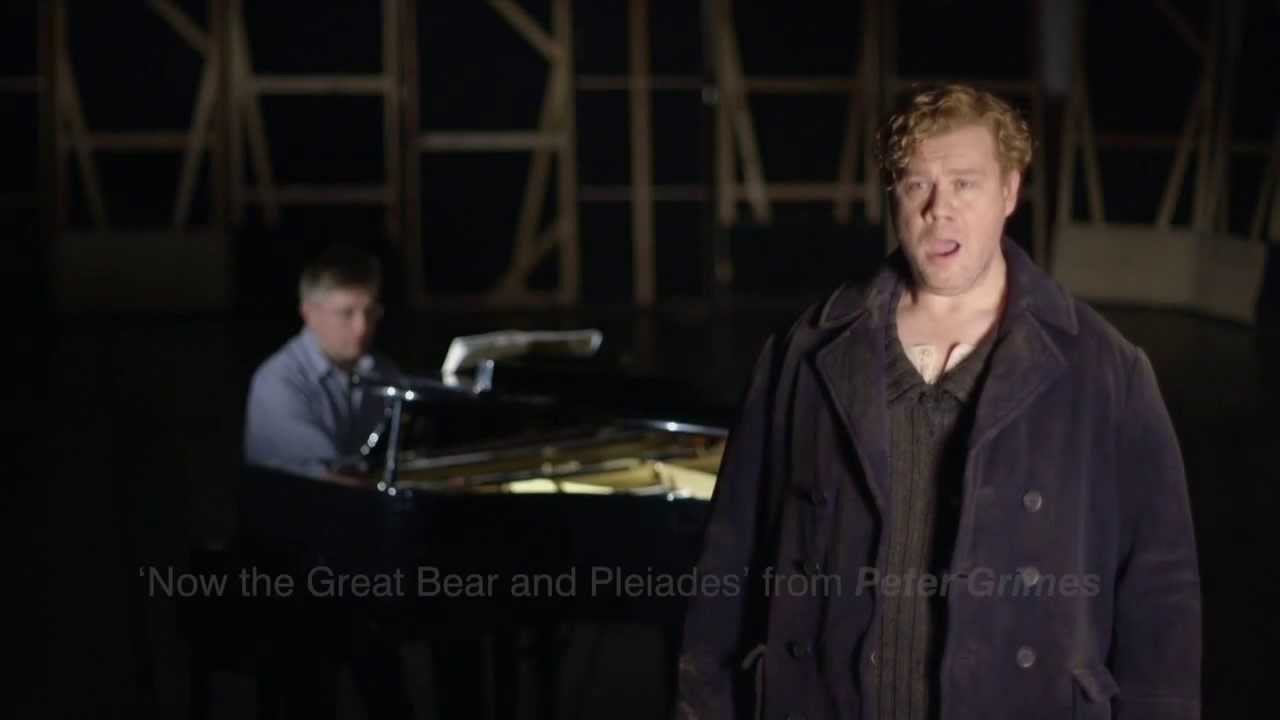
Skelton's been singing the part so long and so well that  he can convey Grimes's personality in myriad nuances. But with the Bergen Philharmonic around him, it's as if the Furies themselves were swirling about him, invisible to us, but in his head.  His "Now the Great Bear and Pleiades" was beautiful, but his long Act Three monologue was haunted, he and the orchestra observing the subtle, but important, changes as Grimes's mind begins to unravel. Now we know why Ellen Orford sets such store in knitting. She needs control, every bit as much as Mrs Sedley and Auntie do in their own ways. Ellen isn't as nice as she thinks she is.  Notice how Britten writes Grand Opera parody into her music, when she decides to shelter the child from Hobson the carrier. On some level, Ellen is a diva, a heroine in her own mind, trapped in a small town with no prospects, like everyone else in this claustrophobic community.  Giselle Allen sings well, but Ellen is, like Grimes, illuminated by the music around her. Because Peter Grimes was Britten's first mature opera, and probably Britain's first mature opera, too, it's tempting to think of it primarily as an opera.  But the orchestral writing is magnificent and highly inventive: not for nothing that the Sea Interludes work so well as stand-alone.  Britten knew the music of his time, and the operas of Alban Berg in particular, where orchestral passages shape the narrative.  In Peter Grimes, the orchestration is huge in comparison to Britten's later works, knitting  the opera together, in a sense.  The swells and surges are huge, but not significantly fulsome in the way that, say, The Flying Dutchman is cataclysmic.  Britten, being English, is too polite. Not all that many detect the way Britten used quirky humour to subvert convention.  But it's there, all right.

Please read my numerous pieces on Peter Grimes, and on  Gloriana HERE and on Albert Herring HERE. Britten is oblique : his targets don't know when they're being got at. Gardner "gets" Britten, so he brought out the undercurrents.  Perhaps there is prostitution in places like Aldeburgh, but it's pretty discreet.  The music in the pub echoes American dance-hall music, which Britten knew from his sojourn in America, and would have included for a purpose. Peter Grimes isn't really set in 18th-century or even 19th-century Suffolk, whatever the origins of the tale.  Auntie, her customers and her Nieces sell out, but Peter Grimes is the one character who doesn't lose his integrity, warped as he may be. Grimes doesn't do games. And so he has to die.

Gardner and the Bergen Philharmonic players are magnificent in the big surging swells. Wonderful percussion, the timpani rumbling like thunder.  Thor, beating his hammer. And why not? The Vikings roamed the North Sea.  Their genes must be part of coastal DNA. Baleful horns, moaning bassoons.   But the quieter passages were even more revealing. Britten observed the world around him. We can hear "star" music andd delicate diminuendoes that glow like phosphoresence over the water at night, or the sparkle of light on a Sunday morning. Outstanding playing from the lead violist, who got a well-deserved curtain call on her own. Beautiful harp playing,and strings that kept together smoothly enough, while still sounding individual and lively, like the choruses, where the variety of voices adds vividness to the impact.

Wednesday, 31 May 2017

Britten in Bergen : Peter Grimes, Edward Gardner


Benjamin Britten in Bergen with Edward Gardner conducting Peter Grimes with the Bergen Philharmonic Orchestra livestreamed from Norway.  Stuart Skelton, the Grimes of  choice these days, headed an ideal cast (details here) and singers from the Bergen Opera.  Is livestream the future?  Not everyone wants to watch opera in a cinema, and most serious listeners have good-quality sound systems linked to their home PCs.  HD is dead. Opera companies and orchestras can now find ways of presenting themselves direct to audiences beyond their physical location.  This livestream didn't repeat, because livestream isn't cheap, but the Bergen Philharmonic Orchestra is bringing Peter Grimes to Edinburgh this August. It should be the highlight of this year's Edinburgh International Festival, if what we heard tonight is anything to go by.

When "Sexy Ed" Gardner left the ENO for Bergen, many of his fans wept openly, but it was a wise move on his part, since until that time, his career had been relatively insular. He needed to branch out, both in terms of international exposure and in terms of repertoire. And the Bergen Philharmonic, one of the oldest orchestras in Europe, needed livening up.  A match made in Heaven?  Bergen is sounding better than it has in years, much sparkier and classier, without losing a distinctive flavour.  The cast list was superb - possibly one of the best that can be put together at present - so no surprises there.

But what impressed me even more was the Bergen Philharmonic. This Peter Grimes seemed to come to them intuitively: they don't at all have an "English" sound, but that's all to the good.   Though Britten was an Englishman through and through, his music is far too individual to fit pigeonholes.  This Peter Grimes sounded like a force of Nature, surging like a storm blowing across the North Sea. You could feel the pull of the ocean in this playing.  The Bergeners seem to connect  instinctively to how unseen forces might control destiny, just as nature controls tides, winds and waves.  Seamen, like Grimes, understand these things, or they don't survive. Grimes doesn't survive, but what happens to him is more than the pettiness of a small provincial community. When he sails out alone, and tips his boat, he's offering himself in a kind of sacrificial atonement.  He may have been abused himself as a boy, forced into a trade he might not have chosen.  His music suggests that there's a sensitive, poetic side to his personality he may have had to repress, even had other choices been open to him.   Skelton's been singing the part so long and so well that  he can convey Grimes's personality in myriad nuances. But with the Bergen Philharmonic around him, it's as if the Furies themselves were swirkling about him, invisible to us, but ringing in his head.  His "Now the Great Bear and Plieades" was beautiful, but his long Act Three monologue was haunted, he and the orchestra observing the subtle, but important changes as Grimes's mind begins to unravel.

Now we know why Ellen Orford sets such store in knitting. She needs control, every bit as much as Mrs Sedley and Auntie do in their own ways. Ellen isn't as nice as she thinks she is.  Notice how Britten writes Grand Opera parody into her music, when she decides to shelter the child from Hobson the carrier. On some level, Ellen is a diva, a heroine in her own mind, trapped in a small town with no prospects, like everyone else in this claustrophobic community.  Giselle Allen sings well, but Ellen is, like Grimes, illuminated by the music around her.

 Because Peter Grimes was Britten's first mature opera, and probably Britain's first mature opera, too, it's tempting think of it primarily as an opera.  But the orchestral writing is magnificent and highly inventive: not for nothing that the Sea Interludes work so well as stand-alone.  Britten knew the music of his time, and the operas of Alban Berg in particular, where orchestral passages shape the narrative.  In Peter Grimes, the orchestration is huge in comparison to Britten's later works, knitting  the opera together, in a sense.  The swells and surges are huge, but not significantly fulsome in the way that, say, The Flying Dutchman is cataclysmic.  Britten, being English, is too polite. Not all that many detect the way Britten used quirky humour to subvert convention.   But it's there, all right. Please read my pieces on Gloriana HERE and on Albert Herring HERE. Britten is oblique : his targets don't know when they're being got at. 

Gardner "gets" Britten, so he brought out the undercurrents.  Perhaps there is prostitution in places like Aldeburgh, but it's pretty discreet.  The music in the pub echoes American dance-hall music, which Britten knew from his sojourn in America, and would have included for a purpose. Peter Grimes isn't really set in 18th-century or even 19th-century Suffolk, whatever the origins of the tale.  Auntie, her customers and her Nieces sell out, but Peter Grimes is the one character who doesn't lose his integrity, warped as he may be. Grimes doesn't do games. And so he has to die.

Gardner and the Bergen Philharmonic players are magnificent in the big surging swells. Wonderful percussion, the timpani rumbling like thunder.  Thor, beating his hammer. And why not? The Vikings roamed the North Sea.  Their genes must be part of coastal DNA. Baleful horns, moaning bassoons.   But the quieter passages were even more revealing.  Britten observed the world around him. We can hear "star" music and delicate diminuendoes that glow like phosphoresence over the water at night, or the sparkle of light on a Sunday morning. Outstanding playing from the lead violists, who got a well-deserved curtain call on her own. Beautiful harp playing,and strings that kept together smoothly enough, while still sounding individual and lively, like the choruses, where the variety of voices adds vividness to the impact.

Please see my other posts on Britten, on Norway, on Peter Grimes, Stuart Skelton  Roderick Williams and James Gilchrisdt etc by follwingbthe labels below

Thursday, 30 January 2014

Classic ENO Peter Grimes Britten

The ENO Benjamin Britten Peter Grimes is outstanding. The cast, headed by Stuart Skelton, is superlative, and the production, created by David Alden, is extremely perceptive. This Peter Grimes is one of the ENO's greatest triumphs. Deservedly, it has been chosen as the ENO's first live HD cinema broadcast on 23rd February.(details here) Live broadcasts are costly, and not necessarily cost effective for a small house like the ENO, but this is so good that it needs to be preserved on film. Do not miss it under any circumstances. This Peter Grimes is a classic. The booing mob may think it's clever to knock the ENO but this Peter Grimes totally vindicates the house and its vision.The booing mob might think it's clever to sneer, but we need the ENO and its courage.

Last night my car was hit by a bus. Luckily I didn't get hurt but is a total write-off but lbecause the other driver didn't stop it's f'd up my insurance.  I missed the show, alas! But I wrote extensively about it in May 2009. Please read my analysis of the intelligent stagecraft HERE and HERE. Claire Seymour will be reviewing the revival as she did in 2009. Read her review of the semi-staged performance at the BBC Proms in 2012. HERE in Opera Today. 

Sunday, 29 September 2013

Jurowski Britten Peter Grimes Skelton RFH

Vladimir Jurowski conducted a fascinating Britten Peter Grimes with the London Philharmonic Orchestra at the Royal Festival Hall. Fascinating, because Jurowski  finds things in Britten other conductors don't get in the first place. Jurowski approaches Britten as a composer,  without the usual baggage of Britishness and Brittenish. Jurowski makes us hear Britten as a composer who knew the music of his era and  had much to say about the times he lived in. Britten was not provincial though he chose to live in Aldeburgh. Peter Grimes is by no means a "heritage museum" in music even if its inspiration was an 18th century text.

Jurowski's Passacaglia and Sea Interludes reveal Britten  as a composer in the wider European context: grand, majestic gestures, as Romantic in the best sense of the word, but emotionally intense with a very modern edge. Peter Grimes was Britten's first mature opera and arguably the first real British opera, so it's important to hear it in this context. Britten knew the music of his time. The orchestration is huge in comparison to Britten's later works. There are even references to American popular music, such as in the Act Three scene in the pub. Britten, who knew more about America than most Suffolk fisherfolk, was obliquely commenting on social change. For change is at the heart of Peter Grimes.

Grimes is persecuted by pious hypocrites, determined to condemn him on principle. All around Aldeburgh, there are ruined churches, destroyed by fanatics in the Reformation. Witch hunts weren't so far in the past. Whatever Grimes may or may not have done, there are those in the Borough  who need  an outlet for the poison in their own souls. Perhaps there are subtexts in this opera linked to Britten's sexuality, or to his relationship with the conservative music establishment (qv Gloriana here) but Peter Grimes is an opera which protests blind obedience to conformity. Anniversary years like this smother genuine knowledge under a fire blanket of banal cliché. All the more reason to respect Jurowski, even though the concert was part of the South Bank's anodyne, dementedly superficial The Rest Is Noise marketing. 

Stuart Skelton's Peter Grimes is a breath of fresh air. Because Grimes is inarticulate, it doesn't mean that the role should be sung with neutral colour. The clarity of Skelton's timbre  suggests Grimes's intelligence. Like his apprentices, he might have been forced into his line of work without choice. Skelton sang "Now the Great Bear and Pleaides" with such elegant purity that I thought of Captain Vere, the real hero of Billy Budd. Strength, for Britten, isn't physical prowess so much as emotional integrity. Audiences might like their Britten characters safer and more comfortable, but Skelton shows where the real potential in the role might lie. 

Some excellent support from Brindley Sherratt (Swallow), whose shimmy with the Nieces ((Malin Christensson and Elizabeth Cragg) was low down and dirty yet hilarious at the same time. Nice to hear levity in a bass. Alan Opie was a good Balstrode and Mark Stone a very convincing Ned Keene. If that leather jacket cost thousands, it gave him an authentic swagger. The main female roles, Ellen Orford (Pamela Armstong), Auntie (Pamela Helen Stephen), and Mrs Sedley (Jean Rigby) could have been done with more bite, but to some extent, Britten wasn't at his best creating women. Mrs Sedley, though, can benefit from being done malevolently. There's vicious camp humour in "Murder most horrid", where trombones slither like snakes. If nothing else in this anniversary year, we should learn to recognize Britten's incisive sense of humour. 

Singers have to show character and interact even in semi-stagings  and concert performances. If anything, good Personenregie is even more important in semi-stagings and concert performances. One of the reasons I like minimal productions is that they focus attention on the performers themselves, not on the decor. The director was Daniel Salter who directed an excellent Die Entführung aus dem Serail at Garsington Opera at Wormsley. (review here) . Alex Doidge-Green's designs were excellent. The LPO were roped in, partly to shield them from the movement of the singers on a cramped stage, but also symbolically. When Skelton rolled up the rope, he released the Peter Grimes, heading towards fate. 

Friday, 12 July 2013

First Night of the BBC Proms 2013

The First Night of the BBC Proms 2013 marks the start of summer. At the Royal Albert Hall, Sakari Oramo, new Chief Conductor of the BBCSO, captured the sense of anticipation. Seldom does Benjamin Britten's Four Sea Interludes get a performance as vivacious as this.  And why not? We all know the piece and its origins in Peter Grimes. So it's good to hear it as a stand-alone celebration of the sea, of wide open horizons : freedom, exhilaration,  adventure. Of course we know what happens to Peter Grimes and his boys, and that the opera is grim. But for a moment we can think ourselves back to 1948 and feel the excitement. Peter Grimes was the "dawn" of modern British opera, and Oramo's bright, optimistic "Dawn" movement sparkled with hope and light. The high violins and flutes suggested soaring seagulls, and the lower strings and brass evoked the swell of the tides. The distinctive clarinet danced, like phosphoresence on waves. Then, woodwinds and brass suggested, well, "wind", stirring, heralding change. Grimes dies, but the sea renews itself with every wave and tide.

"In ceaseless motion comes and goes the tide Flowing it fills the channel broad and wide Then back to sea with strong majestic sweep It rolls in ebb yet terrible and deep".

Stephen Hough was the soloist in Rachmaninov's Variations on a Theme of Paginini. Hough is a Proms regular. I like the maturity of his playing, and his sense of assertiveness, qualities we value on an occasion like The First Night of the Proms. Hearing Rachmaninov after The Four Sea Interludes made me think of the many, fleeting moods of the sea. Hough's hands flew across they keyboard . In my imagination, images of change, energy and renewal. And perhaps, even the image of Paganini, the violinist, remade by Rachmaninov the pianist, and yet again by Witold Lutoslawski the composer. Lutoslawski's Variations  were new to me and thrilling. The familair basics are there,  but this time rejuvenated with a quirky, irreverent flamboyance. Paganini, who sold his soul to the Devil? Hough had been confident before : now he was almost demonic, pulling the orchestra in his wake.

For Ralph Vaughan Williams, A Sea Symphony marked more than a first symphony. (Note it's title "A" symphony, anticipating one of many). RVW lived in London and The Home Counties, unlike Britten who lived literally on the beach at Crag House in Aldeburgh. For RVW, the idea of the seas may have stimulated ideas of voyages of the imagination,  an expanded "Songs of Travel" for nearly 500 voices. It spurred – to use a bad pun – a sea change in his writing. He was making a transition from the safe world of Parry and Stanford into the great unknown. “Behold, the sea itself” could be an allegory for a young composer launching himself into uncharted waters.

RVW's  A Sea Symphony is an extravagant spectacular, ideally suited to the grand treatment it can get at the BBC Proms. A rousing, powerful performance. Roderick Williams sang the baritone part to perfection. His style is direct, almost conversational, yet carries thrust and authority without "period" ponderousness. If anything, he was even better in the quiet second movement "Alone on the Beach" than in the fairly truculent "public" first movement with its reference to imperial power. Even in the cavernous Royal Albert Hall, Williams could convey intimacy and colour. In the turbulent third movement, "The Waves", choirs came to the fore. Oramo's not a specially demonstrative conductor, but he could get the orchestra to deliver on a magnificent scale. You can hear why he was so popular with the CBSO in Birmingham during the Elgar centenary.

Oddly, the mystical final movement "The Explorers" evokes Elgar at his most spiritual. Solo violin, solo viola, solo horn, and Roderick Williams singing at the top of his register, quietly and with hushed reverence, awed by the power of God and of Nature. "O farther sail", Williams, the choirs and Sally Matthews the soprano repeat. The last chords of the orchestra fade slowly, suggesting distance and movement. We are on the way "Toward an Unknown Region".

As so often on The First Night of the Proms, the Prom opened with an extract from a larger work in progress by a leading British composer. This year, Julian Anderson's Harmony, a four minute choral work which may prove interesting on further hearing.

Here's a link to my Proms overview. Usually I listen to and write about 30- 40 Proms a season, so please come back for more.
And look at the SECRET TWINS - Roderick Williams and Benjamin Britten !
 photo:  Yuichi from Morioka, Japan

Thursday, 13 June 2013

Britten, Paul Bunyan and the Idea of America

"It is a Spring morning without benefit of young persons. It is a sky that has never registered weeping or rebellion.............It is America. But Not Yet. 

WANTED: Disturbers of Public Order,. men without foresight or fear 

WANTED:  Energetic Madmen, those who have Thought Themselves a body large enough to devour their dreams 

WANTED: The Lost, those Indestructibles whom Defeat can never Change. Poets of the Bottle, Clergymen of a Ridiculous Gospel, Actors who should have been Engineers, and Lawyers who should have been Sea Captains. Saints of Circumstance, Desperados, and Unsuccessful Wanderers and all who can hear The Invitation of The Earth. America, youngest of her daughters, awaits the Barbarians in marriage"

Announces the Narrator in Benjamin Britten's Paul Bunyan, the opera Britten wrote in America. The words ring out with the false theatricality of a "Wanted" poster in the Wild West. The words are framed by a woodwind melody that might evoke birdsong in a virgin forest. But note its sour tone. This is no Wood Dove. Paul Bunyan may not know fear but he's no Siegfried.

Paul Bunyan is a curious beast. Sometimes it sounds like a parody of a Broadway musical, even less rugged than a Hollywood western. The rhyming couplets are deliberately faux-naive. Britten is Tourist in the Redwoods.  He's not even attempting realism. America, or the idea of America symbolized by the Paul Bunyan myth, meant something different to him from the America that surrounded him when he went there in April 1939, before the outbreak of war, when Britons still believed that Chamberlain could hold Hitler at bay. Britten haters use his sojourn in America to attack him for being unpatriotic, ignoring the fact that he returned at some danger to himself and joined the war effort in other ways than by fighting. So what was Britten searching for when he went to America?

Paul Bunyan isn't a very good opera. Indeed, it's perhaps the worst music Britten ever wrote, even taking into account his juvenilia. But it is worth studying to give insight into Britten's creative development.  For years I've been praising Our Hunting Fathers, arguably Britten's first great masterpiece. It's so raw and passionate that it's hardly surprisng that its premiere in 1936 was met with polite incomprehension. The good burghers of Norwich weren't ready for That Sort of Thing. So, in America, Britten tries to engage with the ideal of America as Arcadia The hokiness is artistic licence. Paul Bunyan is a stylized vision of  "a Forest, full of Innocent Beasts. There are none who blush at the memory of an Ancient Farm, None who hide beneath dyed fabrics a Malicious Art ".

Britten didn't find that nirvana in America. He suffered a debilitating illness of some kind, almost certainly connected to creative and psychological turmoil. Almost certainly it was not merely physical, nor, as Paul Kildea suggests, the onset of syphilis. Significantly, Britten resolved the crisis when, in Escondido, California, he read George Crabbe's The Borough, and rushed back to Aldeburgh and to Peter Grimes.

Please see my other pieces on Britten. More Britten on this site than anywhere else, and original stuff too !

Peter Grimes, Aldeburgh Festival

Claire Seymour, author of The Operas of Benjamin Britten,   the essential text on the subject (which you can buy at Snape Maltings), reviews Britten's Peter Grimes at the Aldeburgh Festival in Opera Today.  "....there was nothing ‘conservative’ or ‘run-of-the-mill’ about the performance, led by a dynamic Steuart Bedford, who urged his instrumentalists and singers through an intense, urgent reading of the score; this may have been a concert performance but there was more drama and concentration than is sometimes found on many an opera house stage." 

A CD is in the offing. The Guardian predictably makes more of the novelty of Peter Grimes on the Beach, the open-air performance this weekend, where the singers will be amplified and the orchestra will be a recording. This ought to be fun because you can't get a more "authentic" staging.  Britten drew inspiration from the natural surroundings. We hear the sea in all its moods in this music, so vividly that we can almost feel the rain and salt spray and smell the algae. Britten lived in Crag House, his study window opening straight onto the sea. At Aldeburgh, the fishing boats are launched straight off the beach from ramps. If you walk on the shingle, as Britten did, you are in among the boats and the fishermen. They aren't isolated in quays and harbours. The North Sea howls onto the beach: no barriers, no protection.  For me, this is the essence of Peter Grimes and indeed of Benjamin Britten. Peter Grimes on the Beach may not be best way to hear the music, but it will be a unique experience.

As for me, I'm at Orford for Curlew River and the other Church Parables. These will also be atmospheric as they were conceived for Orford Church, the setting integral to the operas. Britten's Church Parables will also be performed at Southwark Cathedral as part of the City of London Festival (details here).  In September, Stuart Skelton will be singing Peter Grimes at the Royal Festival Hall. Skelton is a consummate Peter Grimes and has done the role many times. This will be a highlight of the year.

I've beenn thinking a lot about the role. There is no reason Grimes "has" to be old and gruff. Troubled souls can be any age. For all we know, Grimes had been abused as an apprentice. Perhaps he's re-enacting the brutality he received as a child. He knows no other way. Given a choice he might not have been a fisherman at all, but comfortably indoors, knitting and embroidering. Which makes one wonder about the dynamic between Grimes and Ellen Orford (note the name). Who would be the man in the house if they marry? Does Ellen really love Grimes or is she projecting her conventions onto him? Grimes is much more isolated and misunderstood than we think. Maybe he realizes that he's better off dead than with her or with society. We're bound by tradition to expect the role to be played in a certain way, but the score itself suggests we should consider more senitive singers  than the usual type. Musically, too, we'd be much better off. 

photo credit Ian Rees

Thursday, 6 June 2013

Multiple Britten this week

The Aldeburgh Festival starts this weekend, and of course, is packed with Benjamin Britten . He never intended it to be a festival about himself and certainly not a festival of "British music" but in this his centenary year, we should be pushing out the boat. Or perhaps I should use different terms, in view of Peter Grimes....

See HERE for my summary of this year's Aldeburgh Festival. The highlights are important although this year some of the performances are geared towards the "Britten industry". On the other hand, Britten believed that music should be accessible, so perhaps the "anniversary year" side effects might not be as negative as they too often are.

Peter Grimes opens the Aldeburgh Festival on Friday and Sunday at the Maltings, Snape. Steuart Bedford heads a worthy cast. Claire Seymour, who wrote the standard reference book on Britten's operas will be reviewing for Opera Today. She's very astute. Keep reading! Friday's concert is being broadcast live  on BBC Radio 3 at 7.15.

Much more unusual will be  Peter Grimes on the Beach, a unique realization of the opera enacted outdoors, on the beach at Aldeburgh. This could be very good, as open air performances have been a feature at Aldeburgh for many years, and they know how to do these things well. That's not til 17th June, around when the Church Parables will be heard.

This week's Britten actually started last night at The Guildhall School of Music and Drama with Owen Wingrave. GSMD productions are always lively and Owen Wingrave is the kind of opera students can really get their teeth into,. Should be good. Further performances on 7th, 10th and 12th.

Today, Paul Bunyan on BBC Radio 3, available online for a week. This is conducted by Richard Hickox for the Royal Opera House in 1999, when ROH used Sadler's Wells for medium sized productions. The photo above (by Ellin Beltz) shows Bunyan and Babe the Blue Ox in the Bunyan park in Klamath, California. See the man in the corner to get a idea of size ! The park is nestled within a forest of giant Redwoods, so you really feel the grand scale of nature. My son went when he was a toddler, and raved about it for months.

Thursday, 2 May 2013

Powerhouse ENO 2013/14 season analyzed


The Powerhouse fights back! ENO's 2013/14 season suggests we're back to the days when the ENO was London's edgiest opera house. Ten productions new to London next year- that's around one every three weeks. How can they manage that? By linking up with the liveliest houses in Europe, and bringing in the sharpest talent. This is the kind of creative vision that could kickstart a new Powerhouse era.

One huge coup - Pierre Audi! Audi returns at last to London  after 30 years. This is major news because Audi transformed British theatre in the 1980's with the Almeida Theatre. A whole generation has grown up not realizing how radical the Almeida years were, and how it sparked off the ENO's finest years. Peter Brook, David Hare, Harrison Birtwistle, Mark-Anthony Turnage, Steve Reich, the London Sinfonietta: everybody but everybody was part of the buzz. Audi went on to run De Nederlandse Oper,  and later The Holland Festival. His 1999 Amsterdam Wagner Ring is still one of the most striking productions ever. Amsterdam is one of the most exciting music places in Europe and admirably managed, too.

Audi is directing the world premiere of Julian Anderson's Thebans, a saga based on Greek tragedy with a libretto by Frank McGuiness. A brief piece from the Thebans, "Harmony" will be the first item on the First Night of the BBC Proms 2013. Anderson was himself a singer and writes music that's very visual. Anderson's a Proms regular, both on stage and in the Arena. In May 2007, Ed Gardner conducted Anderson's Symphony at the Barbican, in his first high profile concert after being appointed ENO Music Director. So expect good things from the ENO Thebans, and book tickets early though it doesn't start until May 2014.

Here are the other new productions :

Beethoven Fidelio, (from September) directed by Calixto Bieito. whose very name strikes terror into the hearts of those who think that only they know what the composer intended. Yet those who really engage with his work realize that it is quite reasonable. Bieito's Carmen, for example, in a watered down version for British audiences, was a big box office success at the ENO -- one of the big hits of the ENO last November, (reviewed  here and here) which proves ENO audiences are smarter than the reactionary crowd think. Bieito's Fidelio  was first done in Munich in 2010 with Jonas Kaufmann. We'll get Stuart Skelton, who's good and  the production is well worth seeing. Bieito's "prison" is a labyrinth of the mind - click photo to enlarge. Despite his reputation for bums, Bieito is a very deep thinker with a strong politcial conscience, ideal for an opera like Fidelio, which is not meant to be pretty.

Johann Strauss II Die Fledermaus (from September). This is a joint production with the Canadian Opera Company. Here's a link to the COC website with many photos. It looks off the wall! But lots of fun, which arguably is what Strauss II was on about. The director is Christopher Alden, who says "Fledermaus will be fun! It’s a famous, beloved piece and not just because of the totally brilliant and inspired music or that it’s a frivolous New Year’s Eve entertainment, but it’s a wonderful story with great characters and situations.......... It has a lot to say about society, relationships and marriage".

Mozart The Magic Flute, (November) directed by Simon McBurney, whose Complicité brought us A Dog's Heart (reviewed here) which was such theatre-of-genius that the music didn't matter. With Mozart, McBurney has much more to work on. You need magic in the Magic Flute, and Complicité does magic better than most.  This is a co-production with De Nederlandse Opera, Amsterdam, and the Aix-en-Provence Festival : excellent credentials.

Verdi Rigoletto (February 2014), also a Canadian Opera Company production directed by Christopher Alden. It's set in Verdi's time, not Renaissance Mantua, but those who rage that this isn't "historical" should remember that if contemporary stagings were good enough for Shakespeare, they should be good enough for anyone else. And the Met's Las Vegas Rigoletto didn't cause the skies to fall. Another big plus on this one is Quinn Kelsey, the best of all American imports the ENO has brought us. He sang in the original, so should be well settled by the time the show reaches London.

Handel Rodelinda (February). This is major news, because it's the first product of a new relationship between the ENO and the Bolshoi. London gets first dibs. This is the first ever Handel Opera for the Bolshoi, which is quite remarkable, but they'll be getting the best:  Christian Curmyn conducts, and the cast includes John Mark Ainsley, Iestyn Davies and Rebecca Evans. Director is Richard Jones.

Mozart Cosi fan tutte (May 2014) will be done in English because it's the ENO, but not in an ordinary translation. Instead, it's a new text by poet Martin Crimp (Into the Little Hill, Written on Skin). This will be moving on to the Met in NY, which has had a partnership with the ENO for several years (Eugene Onegin and less successfully Two Boys). Ryan Wigglesworth conducts, Katie Mitchell directs.

Berlioz Benvenuto Cellini (June 2014). The ENO is making a big splash with this because it's Terry Gilliam. Presumably the Monty Python crowds will lap this up and box office receipts will clear what's left of any deficit. His Damnation of Faust was entirely based on himself, rather than the opera, the music or composer, yet was wildly popular, proving that self indulgent "Regie" is loved by the masses as long as they don't have to think or listen. .

Bizet The Pearl Fishers (June 2014). Not, strictly speaking, entirely new, but revamped to make more of the breath-taking sequences where bodies "swim" bathed in undulating blues and greens. I loved this production (directed by Penny Woolcock) first time round and would be thrilled to see it again. This time, Sophie Bevan sings Leila, so even if we don't get Quinn Kelsey again, it will be worth hearing, too.

Thomas Adès Powder Her Face (April 2014). New production, new performance space. Joe Hill-Gibbons directs this modern chamber opera classic in AMBIKA P3, a space for contemporary art at the University of Westminster, "converted from the vast former subterranean concrete hall of the School of Engineering, Baker Street". Photos show exactly that, but I can well imagine the story set in that context. The Duchess did not do worse than the men around her yet the society around her was brutal and rigid. The ENO has been using alternative performance spaces outside the Coliseum for years, and for very good reasons: some operas are better suited to smaller scale. If only the Royal Opera House could find a middle sized external theatre and retire the Linbury for all but the smallest shows! 

Jonathan Belper composer/Matthew Barney director River of Fundament. This is based on Norman Mailer's novel Ancient Evenings, describing the journey of a soul after death, a subject which probably lends itself best to a film/music theatre project.

REVIVALS ! Back by popular demand, classic and much loved productions of Philip Glass's Satyagraha (which I want to see for the fourth time), Puccini Madame Butterfly (Minghella) and  ,  Britten Peter Grimes (the luminous David Alden production and the return of Stuart Skelton))

Statistics: the ENO announced financial figures that show the company to be in better shape than the doomsayers would have.  I hope so, because the ENO is critical to the cultural good health of this country. What it does is unique. It also links London to what's happening internationally, which is good long term.. Also good news is that schemes like Opera Undressed have brought in new audiences, a large number of whom planned to come back again.  This year's new scheme is a sort of "ticket lottery" where you're guaranteed a £20 ticket (in the gods) but might get lucky and be upgraded to somewhere in the orchestra stalls (usually £100 plus).  It's a much better business model than selling tickets off for a song at the last moment, and reminds us in the audience that we can't take cheap seats for granted.

Friday, 1 February 2013

Different Britten - Aldeburgh Music Festival 2013


Aldeburgh is a place of pilgrimage if  you're serious about Benjamin Britten.  Perhaps more than most composers, Britten's music connects to the landscape he knew. Among the reed beds at Snape, and by the ocean (especially in winter), you can intuit more about Britten than rational analysis could reveal. Britten's years in America were a kind of creative impasse. Then he read George Crabbe's The Borough. "I suddenly realized where I belonged and what I lacked". Rushing home, he found his creative destiny. Peter Grimes was the immediate result.

Naturally, Peter Grimes is the centrepiece of this centenary year's Aldeburgh Festival of Music and the Arts. The Festival opens with a concert performance of Peter Grimes on Friday 7th June, repeated on Sunday 9th.  Veteran Britten specialist Steuart Bedford conducts.  Although there will be other Peter Grimes productions this year with starrier orchestras and casts, hearing this production at The Maltings in Snape will have extra, non-musical significance, because the opera was written across the road, literally, when Britten lived at the Old  Mill.

What's more, there'll be Peter Grimes on the Beach, a unique realization of the opera enacted outdoors, on the beach at Aldeburgh. This could be very good, as open air performances have been a feature at Aldeburgh for years, and they know how to do these things well.  Tim Albery directs, with sets, costumes, lighting and sound design by Sounds Intermedia. The singing will be live, though the orchestra will be recorded - instruments and weather don't mix. Since the sounds of the sea and shingle permeate the music, it will be atmospheric to feel the wind, smell the ocean, and feel the wild forces of nature engulf the performance.  As night descends, and darkness envelops the plot, the audience will be drawn into the proceedings, just as the townsfolk in the opera are complicit in what happens. If the weather is mild, it might be an anti-climax, but you are never likely to experience anything quite like this again.

hen Britten lived in Crag House, on Crabbe Street, the window in his study opened straight onto the beach. Crag Path itself is a steep, narrow set of steps which the townsfolk in George Crabbe's time would have used frequently to get from the church to their homes and boats. Crag House is five minutes walk from Jubilee Hall, where the first Aldeburgh Music Festival was held 66 years ago. Concerts are still held there, though it's small and unsophisticated. Renovation would ruin the ambience.

Felix Barrett and Punchdrunk Theatre will be  doing a series of events called The Borough, part way between George Crabbe's original poem (entitled The Borough)  and Britten's opera. Punchdrunk is unique in that they merge performance and audience, performance space and "real" surroundings. Small groups will be able to participate on "individual theatrical journeys" around the places Crabbe and Britten knew, blending modern reality with artistic imagination.

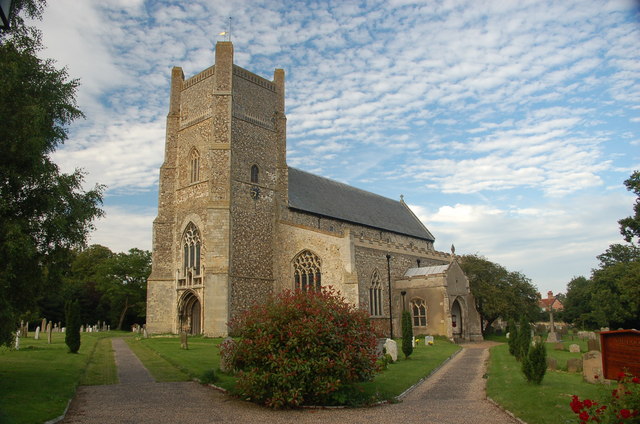
All three of Britten's Church Parables will be performed at Orford, in the church for which they were written. Seating is limited, and parking almost non-existent, but that, I think, is part of what the Parables entail. They aren't "easy", but almost penitential. Theatre in ritualistic form. There are parallels with medieval mystery plays, where spiritual concepts are more important than dramatic narrative. Curlew River is one of the most uncompromising works Britten ever wrote, but also crucial. It's inspired by Noh drama, so it's stylized and orientalist,  but it deals with a theme fundamental to Britten's psyche. The current hysteria about Britten's sex life shows how little his music is understood. Britten's interest in boys wasn't erotic so much as a working out of deep anxieties about identity and loss.  Prurient and small-minded folks should be forced to sit through Curlew River over and over again until they appreciate Britten's passionate protest at the loss of innocence. From this stems his pacifism and his sense of social justice. Miss these thing and you might as well not know Britten at all.

Curlew River is followed by The Burning Fiery Furnace and The Prodigal Son. The church parables are extremely well cast, including James Gilchrist, Lukas Jakobski, Rodney Earl Clarke and Samuel Evans, with Roger Vignoles  as music director. Mahogany Opera (Frederic Wake-Walker) won't be using the oroiginal designs, but those inspired by Mara Amats, an artist based in the region, who had a dramatic life.

Public booking for the Aldeburgh Festival starts 13th February. In the tradition Britten himself established, there will be a lot more than Britten to listen to. Dowland, Bach, Elliott Carter, Henze, Jonathan Harvey and even Stockhausen Kontakte on 15th June. For more, visit the Aldeburgh Festival site HERE.

 photo of Aldeburgh Beach, :Stephen Nunney. Photo of Orford Church : Gary Radford

Tuesday, 21 June 2011

Jane Henschel's wicked Mrs Sedley

“It’s one of the advantages of being a dramatic mezzo rather than a dramatic lyric soprano; I love getting my teeth into these roles, taking an audience by surprise … and I really enjoy playing ‘nasty’ sometimes!”
Britten's Peter Grimes opens today at the Royal Opera House, with Jane Henschel singing Mrs. Sedley. Haha! Now she can do creepy, whiney, laudanum addict who gets her jollies by denouncing those whom she'd just love to be!  Even more sinister than Peter Grimes himself.  Claire Seymour, who wrote The Operas of Benjamin Britten, (Boydell & Brewer 2007), spoke to Henschel about the part and her career. Read the interview in Opera Today.

Monday, 18 May 2009

Peter Grimes ENO stagecraft (part 1)

A friend, who knows more about theatre than I ever will, praised the new production of Peter Grimes at the ENO. “It’s what opera direction has been leading up to for 30 years”. These days opera directors are condemned on autopilot, as if hate were a badge of honour. Of course there are some seriously moronic productions (not all avant garde or German). But operas are staged so their meaning can be enhanced. As stagecraft, this new production, by David Alden, vividly elucidates the essence of Peter Grimes.
The set is spartan. Immediately this is metaphor. Large flat planes cross the stage, like huge panels of weathered timber. Life in fishing villages is tough, the locals exposed to the elements like their surroundings. The bleakness on stage suggests at once the landscape and the desolation of those who live in it. Yet bleached timber can be beautiful. Its texture is irregular and it takes on myriad hues as the light changes.
Wide open spaces are important to the meaning of this opera. Britten contrasts the wild, unpredictability of storms with the ordered ritual in church, the endless horizons with cramped, closed spaces. Thus the courthouse, where Peter is not convicted, is fairly open plan, the crowd penned into a corner, writhing. The pub, The Boar, (a savage animal) is evoked simply by a row of solid over stuffed sofas : immobility and solidity, the illusion of comfort. Yet the storm rages, roads are flooded. The flat planes that enclose the pub careen dangerously as if at any moment they might be blown in by the gale. Auntie doesn’t believe in shutters. Lightning flashes suddenly. No wonder the nieces are scared.
Auntie’s nieces are often depicted as hardened prostitutes, for they are part of the pub's attractions. Although they're obviously complicit, there is ambiguity about their role. Hence their strange twin like behaviour. Little about them is straightforward. Depicting them as very young schoolgirls makes a lot of sense, though, for the suggestion is that they are, like the apprentices, Britten’s quintessential innocents, doomed to be corrupted.
“Is this a Christian country? Are pauper children so enslaved that their bodies go for cash?” cries Boles, when he hears a new apprentice has casually been “purchased”. He has a point. In some productions, the preacher is ridiculed like a comic book nazi or buffoon. Here, though, he’s not unsympathetic. When Swallow tries to “buy” one of the girls, there’s a connection between the nieces and the boys, often lost in less subtle productions.
Alden further reinforces the similarity between the girls and boys by having the nieces smack their toy dolls when they’re upset, as children do when they can’t deal with their own feelings. John the new apprentice also acts like an abused child, rolling up in a foetal position, too terrified to speak.
Then when Peter faces his dilemma in Act 3, Alden doesn’t have him do a wild “mad scene”. Instead, Peter seems to crumble inwards, curled up and rocking himself mindless, just like John did, just like a trapped, tortured animal. It’s incredibly painful to watch, as violent anguish at least is “adult”. The implication is that Peter, too, was an abused child, who treats his boys harshly because he knows no other way to interact. Their vulnerability reminds him of something he’d prefer not to deal with, so he lashes out. Significantly, the only time we see solid looking “brick walls” in this set is in Peter’s hut, where the walls tower like a prison, bathed in eerie green light.
This isn’t a bad rationale for Grimes's behaviour. He is brutal, but it’s directed inward, too. He asks Ellen,“Wrong to try, wrong to live, right to die”. It’s a warning, a sudden but revealing flash of insight. This production implies that Peter’s whole life has been one long, slow suicide, his attempts to better himself a cry for help. When he does face fate, it’s with curiously dignified resignation, as if he’s rehearsed the moment since he, too, perhaps was a boy from the workhouse.
Please see part 2 of this which deals with the more controversial aspects - sex, politics etc. In fact I think it says even more about the staging, the opera and Britten, but then I'm prejudiced, I wrote it. You can find it by scrolling up or looking under the subject labels on right under Britten. Look under "stagecraft" too if you want to read analyses of the stagecraft in other operas. There's more on Britten including some off the wall stuff ! This is a seriously good production, because it brings out so many deeper levels in the opera, often missed. As my friend said, it needs to be seen again and again. And read the score before deriding this production. If it's "not what Britten intended", then someone should get Britten to rewrite the opera, and make Mrs Selby the heroine.