Showing posts with label Welsh National Opera. Show all posts

Sunday, 27 July 2014

Schoenberg in London - WNO Moses und Aron


Arnold Schoenberg's Moses und Aron at last returned to London. The Royal Opera House in fact gave the British premiere of the opera, in 1965.  In the present philistine artistic climate, would they dare value art over stupidity? We need the values of Moses und Aron more than ever.  Thank goodness ROH has sponsored the Welsh National Opera production, which itself dates from 2003. At least we in London get a chance to experience the opera live. House co-operations like this are a boon.
 
John Tomlinson sang Moses in the Met production eleven years ago. Moses, as the text tells us, is a man who doesn't express himself in words, so Tomlinson's powerful presence creates the right impact. Rainer Trost sang Aron, catching the true Sprechstimme cadences well. The opera is a dialectic between Moses and Aron, but the choruses provide ballast and background. Their music is wonderful. Sometimes they represent the voice of god, sometimes the voice of the people. I would have liked sharper, tighter diction but for non-German speakers this was good enough.  Good enough playing, with the WNO orchestra conducted by Lothar Koenigs. Although I hate it when people wail of any performance "It's not like the recording" in this case we have such a choice of outstanding recordings that if we compared like for like, this performance won't come near the top. But never mind. Just getting a chance to engage with Moses und Aron is a privilege.

Please read Mark Berry's review of Schoenberg Moses und Aron in Opera Today. It's the most detailed of all.

The original Stuttgart production looks a little dated now, but it's perfectly acceptable. Although the story comes from The Book of Exodus, when Schoenberg was writing in 1932 he may have been intuiting another kind of exodus. Moses believes in ideals that can't easily be put into words. Aron is his interpreter, much in the way a performer interprets what a composer sets onto paper. No need for tablets made of stone. Pocket scores will suffice.  And even these are meaningless unless the people engage with the content therein. But will the people care, or understand?  Will they prefer cheap thrills and easy answers? Yet, as Moses says, "Ich darf, und ich muss". He cannot compromise or lose his integrity.

There's plenty of nudity and sex in the libretto, but not in the production. The historical-reality crowd might prefer that, but the original directors  Jossi Wieler and Sergio Morabito,adhere to the spirit of that which cannot be expressed in direct images.  The People sit in what looks like a cinema, facing the audience in the auditorium, "watching" the golden calf in their imaginations, having vaguely impersonal orgies when they think they cant be observed. Much better this than gaudy special effects to distract from the moral power of the opera and the music. Indeed, the staging allows us to concentrate on the inner workings of the music. The naked women emerge vocally from the sprawl in the "theatre", their voices ringing out from the throng. So damn what if they're wearing anonymous clothes. Anyone with ears can pick them out clearly.  Moses und Aron is as much an opera about music as it is about faith.

The god of the Hebrews was austere, so holy that his name could not be spoken, whose presence could not be depicted in crass graven images. When Verdi Nabucco was staged last year at the Royal Opera House (read more here) some people went nuts because there wasn't enough gold and decoration. Surely such people must realize that the Hebrews chose the God of Moses, and not the graven images of Babylon? 

Wednesday, 17 April 2013

Welsh National Opera 2013-2014 analysis + touring

The Welsh National Opera 2013-2014 booklet has arrived. All operas can be heard at the Millennium Centre in Cardiff (pictured here, photo courtesy Thomas Deusing, San Antonio).  Although Cardiff is easily reached by train or road, many WNO productions tour, and the booklet's invaluable in tracking down what's on where.

The three Donizetti Tudor operas are being presented together : Anna Bolena, Maria Stuarda and Roberto Devereux. Each is interesting in its own right but hearing them together as a trilogy will enhance their impact. It's a brilliant idea!  It would be pointless for Wales to upstage London in Britten year, someone at WNO deserves great praise. It's much more satisfying, I think, to immerse in depth like this. Besides, the Tudors were originally Welsh, so WNO is connecting to Welsh history even if it's through the ears of an Italian. Tosca is on, too, around the same time, for contrast. The series starts in September in Cardiff, running through October. The Donizetti triology is also touring to Swansea, Oxford, Liverpool, Bristol, Birmingham, Llandudno and Southampton.  It's not coming near London, so Londoners might want to study the Cardiff dates.

In Spring 2014, a series on "Fallen Women" :  Manon Lescaut, La Traviata and much more unusual Hans Werner Henze's Boulevard Solitude. Lothar Koenigs, Music Director at WNO, says "Alongside Britten, Henze is surely the most important representative of opera in the 20th century". Boulevard Solitude (1951) was last heard in the UK at ROH some ten years ago, though it's heard frequently in Germany. There's at least one DVD. The WNO production will, of course, be new. The director is Mariusz Trelinski. Boulevard Soiltude connects to Manon Lescaut because it's a re-telling of the Abbé Prévost story. Henze had grown up during the Third Reich when "modern" music and jazz were banned. Still only in his mid 20's, Henze used the story to explore what to him were still "new" forms. Henze's music is fairly accessible, so even conservative audfiences won't find Boulevard Solitude too difficult. The "fallen women" series travels to Birmingham, Milton Keynes, Southampton, Plymouth, Llandudno,  and Bristol.

Then WNO mounts a real challenge: Arnold Schoenberg's Moses und Aron, in Cardiff from 24th  May 2014, in Birmingham on 7 June and at the Royal Opera House, London, from 25th July. This will be the staging by Jossi Weiler and Sergio Morabito, first heard in Stuttgart ten years ago.  There's an audio recording of a later production. Moses und Aron is being paired with Verdi's Nabucco. The production was first seen in Stuttgart in January 2013, and ended its run last week. The director is Rudolf Frey. It's astute of WNO to pair the two operas because Nabucco is not, as some London critics think, a hymn to false gods and graven images but a statement of faith in an austere, enduring God. Follow this link to more information and production photos. There's a gaudy golden backcloth for those who need glitz. 

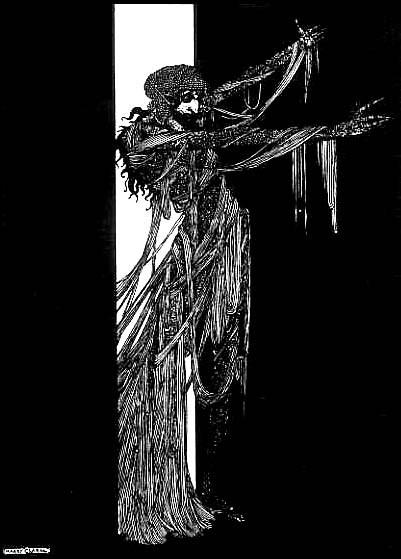
Also intriguing will be the Edgar Allan Poe double bill directed by David Pountney in 2014. Claude Debussy’s unfinished one-act opera The Fall of the House of Usher has been orchestrated by Robert Orledge, using additional material from sketches left by Debussy. It will be heard with Gordon Getty’s Usher House. Both will be presented in San Francisco in 2015. The picture right is Harry Clarke's illustration from an early French edition of Poe's poem. David Pountney directs.

Mark Anthony Turnage's Greek returns in the 2011 Music Theatre Wales production, which will also be heard in London.  In Summer 2013, before the full formal season, the WNO Youth Opera will be doing Britten's Paul Bunyan. This isn't touring for obvious reasons.

Thursday, 28 March 2013

Lulu WNO

It was good that Welsh National Opera brought Alban Berg's Lulu to Milton Keynes on a snowy evening. The colours in this staging were so lurid that the London scene came as a relief. That would be an interesting idea to develop, since in some ways Lulu has been seeking death all along.  A much more obvious reason for the bright colours was that David Pountney and his design team (Johan Engels and Jeanne-Marie Lecca) were being faithful to the circus theme which sets the tone for the opera. "Hereinspaziert in die Menagerie". Actors with realistic looking animal masks filled the stage among uprights that looked like reels of film.  This was a good reference to the theme of cinema, for film, even more so than circus, deals with illusion. And Lulu is an opera about illusion, where nothing is quite what it seems.

"There's so much to look at" exclaimed a lady behind me. "Good " said her husband, "we don't have to listen to that music" Again that's a valid point, for this Lulu was a good way of bringing modern music to audiences who think modern music is dangerous. They loved the show, which proves it was a success. Seduced by the colours, the animals, corpses hanging from meat hooks, girl on girl action and two scenes of in your face full frontal nudity, West End audiences would have loved this too. There's something to be said for that.

Because this Lulu is touring together with Janáček The Cunning Little Vixen and Puccini Madama Butterfly, it's not unreasonable to seek a common thread between the three operas.  In his introduction, Pountney makes his concept clear. Berg and Janáček were writing in the same period, when proto-feminist ideas were gaining ground, and sexual freedom provoked challenge. Certainly this is the case with The Cunning Little Vixen, where Janáček explicitly equates the Vixen's personality with natural urges, justifying his own longing for Camila Stosslova who in real life held him at arm's length.  I've written extensively on Janáček 's Dangerous Women and their subversive challenges. I like my Vixens with fangs! Yet Janáček's heroines are ultimately projections of the composer's own fantasies.

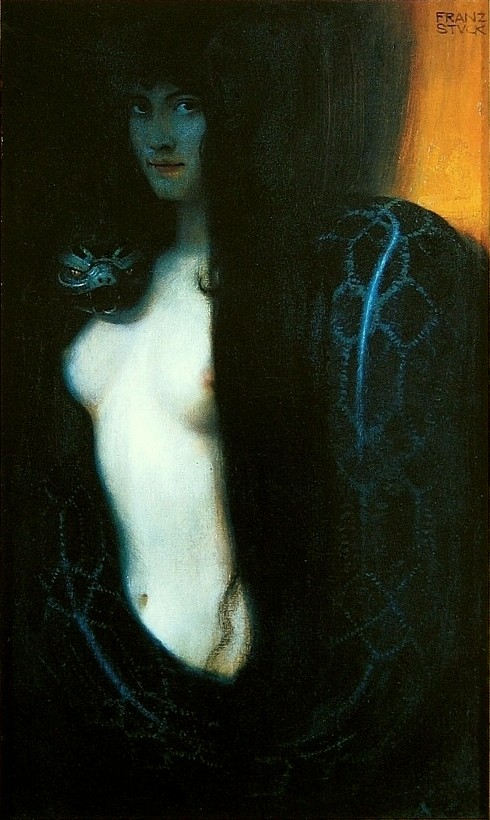
Lulu definitely has a liberation context, for women's rights were very much a part of the Munich Secessionist zeitgeist which was much more radical than the softer focus Viennese Secession. Read about Franziska zu Reventlow and follow the labels below for "Munich" and "women, feisty".  This was the world that inspired Wedekind, Franz von Stuck, and later Strauss and Brecht. Without Munich, we would not have Weimar Berlin. Lots on this site about Weimar, too, and the connections between Brecht and Berg.  Plenty on Weimar film, too, which is relevant in any consideration of Lulu.  See Mädchen in Uniform here. So I'm more than sympathetic with  Pountney's basic approach.

Lulu does say she found herself while she was in prison without men, and Countess Geschwitz talks of studying law and helping women. Berg, whose own sister was a lesbian and a rebel, could have been tongue in cheek quoting quite a few women in that period.  But is Lulu a real person or a projection of other people's fantasies? Is she even a sexual being ? She's had a traumatic life on the streets since she was 12.  She is like an abused child who has learned that sex is a means of survival, not a pleasure. Her seductions are a form of aggression, not lust.  She doesn't trust enough to love.What is her relationship to the decrepit Schilgoch, who like Berg is asthmatic? Not for nothing did the composer double Schilgoch with the Animal Tamer, and write in many references to composing and music.

Given Berg's obsessive compulsive fascination with patterns and secret clues, we can't take anything too literally. Lulu can be interpreted as a cryptic drama arising from musical abstraction.  Krzysztof Warlikowski's recent Lulu with Barbara Hannigan and Christof Loy's much misunderstood ROH production access levels in this amazingly complex opera beyond anything in this WNO production. 

Helene Berg may have guessed at the real danger in Berg's Third Act, which to my mind marks an almost revolutionary new phase in Berg's writing.The Paris scene, for example, starts with the "circus" imagery, but now extends to a wider political sphere. It doesn't depict prostitution per se, but the way society prostitutes itself in pursuit of illusion.  The stock market scenario is central to meaning. Everyone trades, no-one escapes. Lulu is not a free spirit at all.  Some dislike the Paris scene because it's so diverse, but the real meaning is in the music, which spirals in concentric circles.  Is Berg entering new territory where the idea of narrative becomes supplanted by musical drama?  When Berg brings the men back in new guises, he's extending the idea of illusion still further. Jack the Ripper, for example, bears little resemblance to the "real" Jack the Ripper.  The London scene brings Dr Schõn back, which is good symmetry. When I first heard the Third Act soon after its its completion, I couldn't make head or tail of it.  One of the insights of Loy's production is that it takes away the obvious markers in terms of costume, and makes you think about the rarified inner logic. 

The two act version ends with Lulu's escape from prison and her seduction of Alwa on the same sofa on which his father bled to death.  This would have felt right until the full extent of Berg's work was revealed.  According to Douglas Jarman, "Of the 1326 bars only 87 were not fully notated in Berg's short score and with one exception, all these "problematic passages" could be completed with Berg's intentions either by following the indications provided in the score or by doubling the instrumental parts". The exception he mentions is the barrel organ music in scene two, but Jarman says "an indication ...is to be found at the end of the Variation movement of the Symphonic Variations where the first four bars appear...in Berg's own orchestration".  So the Paris scene is true Berg almost in entirety and the barrel organ music is Cerha. Would we reject Mozart's Requiem or Deryck Cooke's performing version of Mahler 10 because they aren't 100% ? Earlier this year Daniel Barenboim conducted a "new" version of Lulu with major cuts, eliminating the Paris scene and the Animal Tamer, and adding spoken texts from Kierkegaard. The WNO production apparently uses a new edition prepared by Eberhard Kloke which changes the Paris Act which was original Berg. The emphasis seems to be to spotlight the prostitution dialogue between Lulu and pimp. Perhaps the WNO Lulu would have worked better in the two act version.

Thursday, 17 January 2013

Moses und Aron - WNO joins ROH

Great news! The Royal Opera House is teaming up with the Welsh National Opera. Starting summer 2014, the WNO will have a residency in London at the ROH. First production will be Schoenberg Moses und Aron which in  itself will be a big event. Then, Richard Ayres’s Peter Pan in 2015 and a new main stage commission in 2016 to mark WNO’s 70th anniversary.

As I've said before, this is a sensible rationalization of opera resources throughout the country. Co-operation rather than fragmentation means companies get greater coverage. Diversifying also preserves the individuality of different houses. Everyone benefits, especially audiences who get better choice. Kaspar Holten and Antonio Pappano are on to a good thing, building upon links with Music Theatre Wales, Scottish Opera, etc etc. The arrangements the ROH had with the Bolshoi and Russian comapnies in the past weren't well received, but WNO is a different prospect.  See my post on WNO's British Firsts series here which mentions Richard Ayres Peter Pan (Cardiff for 2015  as well as ROH) and Unsuk Chin's Alice in Wonderland (Cardiff  2017, and ROH same year, soon after)

WNO’s Chief Executive and Artistic Director David Poutney said:
‘We are thrilled to have the chance to present over the next three years some of our most ambitious programming within the prestigious surroundings of the Royal Opera House – a superb platform for WNO’s work and an enrichment of the ROH repertory. This three-year programme creates artistic gains for both organizations, which are keen to affirm the importance of artistic collaboration and ambition in a time of financial stress’
Director of The Royal Opera Kasper Holten commented:
‘In this era, collaboration is key, and I believe that the more opera companies can collaborate and work together, the stronger case we will all be able to make for opera – and the wider choice of repertory we will be able to offer. I am thrilled about David’s exciting plans for WNO over the next few years, and we are very happy to be able to showcase some of the company’s most exciting projects in three consecutive years.’

Saturday, 13 October 2012

Welsh National Opera British Firsts

Five year series of "British Firsts" at the Welsh National Opera, starting summer 2013, thanks to a £2 million gift from the Getty family, (who are also connected to Garsington Opera at Wormsley)

David Pountney, WNO's Chief Executive and Artistsic Director, says "This series gives us an extraordinary opportunity to re-engage with contemporary opera writing and to transform our perceptions of new music. We hope to dispel the misconception that modern opera is either moribund or incomprehensible to our audiences."

" Nothing could be further from the truth. There is a massive amount of creative energy in the artform and new works are constantly being created all over the world. we can enjoy modern music and modern opera as part of our normal cultural life, just as we enjoy modern cinema, television, books or fashion. It will open the doors to the landscape of the new."

Exciting news, which should shake things up, but nothing dangerously radical. Two of these operas are well known, albeit not in full UK productions.  Jonathan Harvey's Wagner Dream (scheduled for summer 2013) was first heard in 2007 at De Nederlandse Opera. Pierre Audi directed: best possible premiere. When it reached the Barbican in London in January 2012, (semi staged), it was the hottest ticket in town, generating much excitement. Colin Stuart Clarke, a Jonathan Harvey devotee, wrote a thoughtful review for Opera Today, more sympathetic than most. "The vast stretch of Harvey’s available compositional resources was impeccably utilised. Tonal sections made great effect (a lullaby, for example) and yet did not jar in the slightest, instead appearing as just one element in the composer’s palette. The music shares with Wagner’s an ability to take the listener out of temporal time into the composer’s expanded time, and, as with Wagner, the time spent experiencing this piece seemed somehow telescoped, as one became intimately involved with the events and their musical realisation. One one level it felt as if we had been there years; on another, it was a mere moment."

In 2017, WNO will be doing Unsuk Chin's Alice in Wonderland. This, too, was premiered in 2007, in Munich. It was screened at the Barbican London last year. The DVD has been available since 2008. Just as Alice was curious, the opera is curious. Absurdity and silliness can mix well, as Lewis Carroll showed. Chin is highly regarded in some circles, but I felt Alice was too self-indulgent as opera, but was wholly redeemed by Achim Freyer's direction. Alice wears a huge mesh head and meets other giant talking heads-in-boxes. A new edition of the opera was prepared by British composer Lloyd Moore for a US production in 2012. I'm not sure which version we'll hear in Cardiff, but I'm hoping for a tighter orchestration.

More intriguing might be the Edgar Allan Poe double bill directed by David Pountney in 2014. Claude Debussy’s unfinished one-act opera The Fall of the House of Usher has been orchestrated by Robert Orledge, using additional material from sketches left by Debussy. It will be heard with Gordon Getty’s Usher House. Both will be presented in San Franciscxo in 2015. The picture right is Harry Clarke's illustration from an early French edition of Poe's poem.

Quietly under-publicized is Richard Ayres' Peter Pan, planned for 2015. Ayres (b 1965) is a significant British composer but better known in mainland Europe - which is so often the case. Peter Pan is a joint commission between the Komische Oper Berlin, Stuttgart Opera and WNO, which indicates its potential. Peter Pan might well be the surprise hit among these "British Firsts". We shall hope!

photo credit : Thomas Duesing