Sunday, 16 November 2014


Friday, 14 November 2014
"I'm a creative animal" - Barbara Hannigan

Wigmore Hall Pierrot Lunaire Ensemble Intercontemporain

Ensemble Intercontemporain, one of the great new music ensembles, made a welcome return to the Wigmore Hall London, built around Arnold Schoenberg's Pierrot Lunaire,, with Salomé Haller. With characteristic wit, Ensemble Intercontemporain preceded Pierrot Lunaire with Luigi Dallapiccola Due studi (1946-7) and Bruno Mantovani Carnaval for clarinet, piano and cello. (2014), enhancing the multiple connections between them. .
As a very young man, Luigi Dallapiccola heard Arnold Schoenberg conduct Pierrot Lunaire in Florence in 1924. In Due Studi, written 20 years later, Dallapiccola uses twelve-tone rows, but the influence of Pierrot Lunaire is much more subtle. There are two movements, Sarabanda and Fanfara e fuga. Tight dialogue between Hae-Sun Kung (violin) and Hidéki Nagano (piano).

Carnaval connects to Pierrot Lunaire in that it evolves through a series of different, and very individual "tableaux" to express something that can't be articulated in speech but has strikingly vivid dramatic effect. The structure is tightly compressed, intensifying the sense of constant movement and sudden change. Disconcerting, but in a thrilling, satisfying way. Hopefully it will be performed again soon: hardly had the notes trailed off, than I wanted to hear it again, and again. It's that good. Jérôme Comte played the clarinet, Éric-Maria Couturier played the cello and Hidéko Nagano the piano - just three instruments, but they packed a powerful punch.

Pierrot Lunaire can turn the idea of narrative song upside down. In this performance, what struck me was the relationship between voice and instruments that speak without words. Sophie Cherrier's flute sang, as flautists have sung for centuries, from Greek times to the present. When she exchanged flute for piccolo, the sound seemed even more ancient, even more plaintive. This close relationship revealed the complex structure that underpin's Schoenberg's creation. Wandering tonality and elusive images are held together on firm, orderly foundations. The songs don't work together as narrative, but reveal ideas constantly re-forming, and changing perspectives.
Thursday, 13 November 2014
Live aus Wien Bychkov Khovanshchiina Saturday

Wednesday, 12 November 2014
ENO Old Vic and the Myth of Imbalance

Tom Morris of the Old Vic, who would have been directing, said “Bristol Old Vic remains committed to bringing an innovative and accessible production of this exquisite opera to our beautiful theatre and we will continue to explore ways of achieving this within the next couple of years.We are deeply sympathetic to ENO in their current situation and share their frustration in having to postpone their ambition to perform further throughout the UK.” He's wise enough to know that arts organizations should stick together in tough times. Politicians and the public they fool would like nothing better than to divide the arts community.
It's ironic that London organizations get slammed for not reaching out to the regions, yet have their funding slashed so they can't afford to do so when they want to? Crazy logic. The blame lies squarely with the doctrinaire political stance of Arts Council England and its political masters. It's time to challenge the assumption that decentralizing the arts is a good thing. Much is made of the way taxpayers are "forced" to support the arts, and London, and that the "poor" support "the rich'. But that's how the whole system is based, not just the arts. There's more than a whiff about Pork Barrel in the air.The more organizations are pushed to "outreach" the less they have to spend on their core activities.
Last week, a Culture, Media and Sport Select Committee report concluded that the Arts Council's anti-London bias doesn't go far enough, and that there should be more sweeping changes limiting London’s access to National Lottery funding for the arts to its proper per capita share (equal to that of the rest of England) – this idea was originally proposed in Rebalancing our Cultural Capital; earmarking any future increase in ACE’s grant in aid for the English regions beyond the M25 area; a redoubling of efforts at brokering cultural partnerships involving businesses, local authorities, local enterprise partnerships, universities and international organizations, particularly within the EU, which might provide additional funding sources. Furthermore, they recommend that local government organizations should be pushed to do more, even if they have other priorities and needs to address.
The whole foundation of this philosophy is political, and bears no relationship to the realities of arts management. Politicians exploit the notion that the arts are somehow elitist: for the rich and educated and London-based. It's easy capital, since most people outside the arts don't know or care what happens. Marshal the Sun mindset, the universal Luddite, the remains of outmoded class warfare - and bingo! You get votes! As Harriet Harman said, she didn't see her constituents in the audience at the Royal Opera House, so she supports reducing funding to one of the nation's internationally acclaimed flagships of the arts.
The reason why London dominates is simple: there needs to be a critical mass of expertise, below which true excellence can't be reached. London has been the centre of the arts in this country for centuries. London organzations inherit traditions that shouldn't be ignored. Without London, we wouldn't have a world-class cultural heritage. Strangle the centre and the whole body dies.
The reality is that the arts aren't cheap and excellence only comes when there's a critical concentration of effort. Existing London organizations have that critical mass of expertise and excellence. Throwing money at micro organizations simply doesn't make economic sense. It would take billions to redress the balance between London and areas outside London. No matter how worthy smaller organizations are, they can't duplicate what already exists in London. London is the golden goose from which all things flow. It just doesn't make good business sense to kill that goose and assume dozens of mini-geese will arise in its place.
In any case, talent isn't something you can turn on like a tap. Talented people excel when they can bounce off other creatives. Some of course thrive on isolation, but throughout history, arty types have flocked to together (often in big cities) for a reason. In London, people learn their trade from the best in the business, nationally and internationally. Talented people are always going to be a minority, so why not let them thrive together Forced redistribution doesn't work in many aspects of life. Certainly not when the assets are human, intangible and unregimentable.
So the government wants to dictate that local government should pour funds into local arts What's the point of shiny new arts centres when the pressure doesn't come from the people but from above - and from bureaucrats in London. So much for the idea of "redressing imbalance". If there's a solid artistic foundation in any particular area, fair enough, but we don't need more horrors like the National Centre for Popular Music, which cost £15 million nearly 20 years ago, and which folded within 18 months.
Monday, 10 November 2014
Anthem for Doomed Youth - Wilfred Owen 11/11

- Only the monstrous anger of the guns.
- Only the stuttering rifles' rapid rattle
- Can patter out their hasty orisons.
- No mockeries now for them; no prayers nor bells;
- Nor any voice of mourning save the choirs, –
- The shrill, demented choirs of wailing shells;
- And bugles calling for them from sad shires.
- What candles may be held to speed them all?
- Not in the hands of boys but in their eyes
- Shall shine the holy glimmers of goodbyes.
- The pallor of girls' brows shall be their pall;
- Their flowers the tenderness of patient minds,
- And each slow dusk a drawing-down of blinds
 Bent double, like old beggars under sacks,
Knock-kneed, coughing like hags, we cursed through sludge,Till on the haunting flares we turned our backsAnd towards our distant rest began to trudge.
Men marched asleep. Many had lost their boots
But limped on, blood-shod. All went lame; all blind;
Drunk with fatigue; deaf even to the hootsOf tired, outstripped Five-Nines that dropped behind.
Gas! Gas! Quick, boys! – An ecstasy of fumbling,
Fitting the clumsy helmets just in time;
But someone still was yelling out and stumbling,
And flound'ring like a man in fire or lime . . .
Dim, through the misty panes and thick green light,
As under a green sea, I saw him drowning.
In all my dreams, before my helpless sight,
He plunges at me, guttering, choking, drowning.
If in some smothering dreams you too could pace
Behind the wagon that we flung him in,
And watch the white eyes writhing in his face,
His hanging face, like a devil's sick of sin;
If you could hear, at every jolt, the blood
Come gargling from the froth-corrupted lungs,
Obscene as cancer, bitter as the cud
Of vile, incurable sores on innocent tongues,
My friend, you would not tell with such high zest
To children ardent for some desperate glory,
The old Lie; Dulce et Decorum est
Pro patria mori.Wilfred Owen

Rameau Platée comes to London with Paul Agnew

Paul Agnew conducts Rameau Platée with the Early Opera Company on 20th November. My review is HERE.That's Agnew in the photo above, when he was singing Platée in 1999 with Marc Minkowski. Platée is one of Rameau's best-known works, ranking with Les Indes Galantes. More details of the London performance HERE. Agnew defined the part, and has probably sung it more than anyone else. He's also conducted the opera many times in recent years, including Paris, Vienna and New York. So his presence in London will be reason alone to catch the London concert performance next week. He's replacing Christian Curnyn,. the Early Opera Company's much loved regular conductor, but Agnew is mega star billing in Rameau circles.What an opportunity to hear the best of Rameau with one of the best interpreters! This performance marks the beginning of a new relationship between the Early Opera Company and St John's Smith Square.
Platée is a key part of Rameau's canon. Indeed, I don't think it's possible to understand Rameau without appreciating this remarkable work. It has all the key features of Rameau's style – energy, and vivacious dance rhythms, in a fantasy where gods, mortals, and animals mix with imaginative exuberance. Not quite "good" humour though, as Platée was written to entertain Louis XV and his court on the occasion of the Dauphin's marriage in 1745. The bride was a Spanish Infanta, but she was very ugly. Platée is a frog whose realm is a pond in the wilds, the opposite of refined, elegant Versailles. She/he has pretensions: she/he thinks everyone she meets will fall in love with her. The part was written for a travesti, a man pretending to be a woman, which makes the satire rather cruel. The man who sang the original was costumed so he looked as though he was covered in pustules. Yech! Quite possibly the French Court wanted this subject in order to put the Spanish in their place. Dynastic marriages were politically loaded, and had nothing to do with love..
As it happened, the princess died very young and the prince never became king. Yet given what we know of Rameau and the way he had to court the rich, perhaps the laughs are ultimately on the Gods and their abuse of power. Jupiter, Mercury and Juno might misuse Platée as a pawn in their intrigues, but ultimately it's the humble frog who learns the true meaning of love, and finds wisdom. Apart from Platée herself/himself, the pivotal part goes to an extravagant character sometimes L'amour, sometimes La Folie. Love and madness! In the end, Platée returns to the pond, where she/he is in her/his natural element. Presumably the Gods still scrap, but the implication is that Platée is happy.
Please read my piece Frog Kisses Prince HERE a review of the 1999 production filmed in 2002 - absolutely essential viewing!
Saturday, 8 November 2014
Georg Trakl Spiegelspiel Austrian Cultural Forum

On Tuesday November 11th there ;s a special recital at the Auistrian Cultural Forum in London – Georg Trakl: Spiegelspiel, A dramatic song cycle by Austrian composer Louis Mander, who will be conducting an interesting piano quartet and three singers. The texts will be English, from a recent translation of Trakl's poems. Read more HERE.

Below, Trakl's poem Grodek The translation is a new one which I worked out spontaneously last night. A good exercise. Trakl's poetry is idiosyncratic. Seemingly simple images convey opaque meaning. His cadences break off rather like the cadences in some esoteric music, heard from afar. Grammar Nazis will not get this guy. He's best read in German because the sounds of the words make a difference. Like Hölderlin, it feels like Trakl is transcribing "music from another planet".
"In the evening, through autumnal woodlands, come the sounds of death-bringing gunfire, resonating over golden fields and blue lakes, above which the sun sheds a gloomy glow. Night falls around dying soldiers, whose wild screams break forth from shattered mouths. Quietly over the reed beds, blood-red clouds where a Savage God lives, spilled blood flows in the moonlit coldness."
"All roads end in black decay. Under the golden canopy of stars and branches, shadow sisters (valkyrie) stumble through silent groves to greet the ghosts of heroes with bloodied heads, with the soft tones of reed-pipes and the dark flutes .of autumn. O proud suffering! The searing flames of the spirits today will feed a conflagration to curse generations as yet unborn"
Friday, 7 November 2014
What's with the shark ? Mozart Idomeneo Royal Opera House
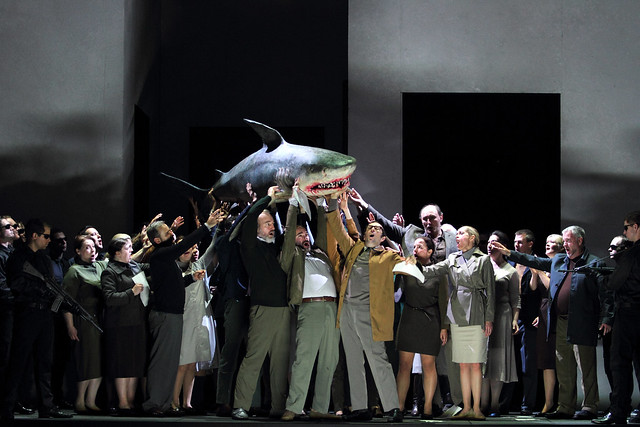
What's the fuss about the shark ? Mozart Idomeneo at the Royal Opera House last night (I was at Boris Godunov on Monday) Very musically satisfying, with Marc Minkowski at the helm. The infamous shark appears for only a few moments, borne aloft by the chorus, yet everyone seems fixated by it. Surely London audiences must be aware that Idomeneo is set on the island of Crete, in the middle of the Mediterranean. Who is the God of the Sea? Neptune (Poseidon), upon whom Crete is utterly dependent. Neptune, being the God of the Sea, is often depicted with fish and with waves. Hence, too "the sign of Pisces" - a fish. The Cretans were bereft when their king was lost at sea. So when he's saved by Neptune, they think it's a miracle. Why shouldn't they hold a religious procession, parading a symbol of their God? Many other Mediterranean cultures do the same today, though the religion is different.
In this production, Neptune doesn't materialize in the midst of a thunderstorm waving a triton, but he haunts Idomeneo throughout the opera. Perhaps the mpst powerful gods are those who are invisible, conjured up in the minds of those who believe. Neptune's presence is felt, invisibly, in the music, its moods as changeable as the ocean. We hear howling winds, ominous clouds and gentle breezes, as soft and sweet as zephyrs. We only have to listen. Marc Minkowski is one of the great Baroque conductors of our time, so the Royal Opera House scored a coup getting him behind this Idomeneo. Although the Royal Opera House orchestra isn't a period instrument ensemble, Minkowski had them playing with a proper period sensitivity. The harpsichord dominates, creating cleaner, leaner sound than one usually hears. Perhaps Idomeneo harks back to an earlier era, to Haydn, rather than to the hurly-burly of Viennese popular theatre. With this aesthetic, it might seem too cool and formal to be one of Mozart's "greatest hits", but for those who care about music, Minkowski's approach was immensely rewarding. Yet when Minkowski took his curtain call, some smartass booed. Some come to opera these days to bully others, not to listen to music.
Given Minkowski's elegant touch, Matthew Polenzani's Idomeneo was very effective. He's done a lot of Mozart, and this is the best yet. Measured, well paced and well balanced, his voice suggested a king not driven to extremes by his own flaws but by the caprices of nature. His interactions with Idamante (Franco Fagioli) felt human, as if they were real life father and son. Very good singing from Sophie Bevan (Ilia) and Malin Byström (Elettra) Please read Claire Seymour's review of the singing HERE in Opera Today.
It is in this musical context that I think Martin Kušej's direction needs to be considered. The minimalism of the staging may enrage some, but it focuses attention on the music. The story itself supports Spartan – oops, Cretan, treatment. The people have been at war, and have suffered. In the First Act, the people are seen in pale-coloured garments, moving in stylized fashion, not unlike sculpture in Greek art. Stark black and white suggest the dilemma Idomeneo has to face. Neptune is not a benevolent god. He demands human sacrifice. Thus the red banners and blood soaked mass that extrudes from a crack in the palace walls. Anyone who's been in a fish market can figure out what that might be. Idomeneo's disembowelled spiritually because he has to kill his own son. So much for religion. Technically, the revolving stage mechanism ) is very effective since it avoids clumsy scene changes. It's much more sophisticated than the series of boxes used in Katie Mitchell's Idomeneo at the ENO (read more here). It manages to suggest the cliffs above the beach and the marble palace in which thr Cretan royal family live. The trouble is, though, it's no fun to look at. Perhaps it shouldn't be, since this isn't a pretty story, but it looks tacky and incomplete. the lighting is a joke./
Kušej has been played up in the media as some kind of monster, often by people who repeat what they've heard about things they haven't seen, but he's more banal than dangerous. .He doesn't take as many liberties with opera as, say, Klaus Guth, whose Die Frau ohne Schatten (more here) changed the whole meaning of the opera, but which was wildly praised by London critics. Kušej's Don Giovanni for Salzburg was better than the soulless Sven-Erik Bechtolf production which replaced it this year (read more here) What matters about any production is not updating as such, but how the ideas reflect the music and the drama. Kušej's Idomeneo isn't his best work, but it's more dull than enraging. Thank goodness for the music!
photo : Catherine Ashmore, 2014, courtesy Royal Opera House
Wednesday, 5 November 2014
Opera Rara Les Martyrs Donizetti Elder OAE

Eagerly anticipated, Opera Rara's Donizetti Les Martyrs delivered magnificently, confirming yet again Opera Rara's reputation for pioneering lesser known treasures in the repertoire. Although Les Martyrs is not unknown (there are several recordings), Opera Rara presented a new critical edition by Dr Flora Willson of King’s College, Cambridge, which restores the opera’s original French text (Eugène Scribe) and reinstates numerous musical passages that have not been heard since its premiere in 1840. Les Martyrs, revealed in all its glory, is a brilliantly dramatic work, combining the delights of Italian bel canto with the exhilarating audacity of French grand style. This performance, conducted by Opera Rara's music director, Sir Mark Elder, was so good that it whetted the appetite for a fully staged production, ideally in a house large enough to give the spectacular treatment it merits.
In 2015, Glyndebourne Festival's gala opening night present Donizetti's Poliuto, written for the Teatro San Carlo in Naples in 1838 but which was promptly banned by the King of Sicily, who objected to the depiction in popular theatres of a subject from Christian history. French audiences could cope with religious subjects being treated as opera. The libretto in both operas was based on a play by Corneille, written two hundred years previously. Donizetti, aware that Paris was the sophisticated centre of the opera world in his time, promptly revised Poliuto and created Les Martyrs. incorporating most of the original but adding elaborate divertissements for ballet, extending the overture, and creating grand choruses and flamboyant new solos for the tenor and soprano.
Even by their usual very high standards, The Orchestra of the Age of Enlightenment were in wonderful form. In the Overture, Donizetti defines the main themes which run through the opera, martial "Roman" motifs contrasting with gentler passages which later connect to love and Christianity.The Romans, like the Devil, get the most striking tunes. Elder and the OAE magnified the dramatic impact of the score by placing horns in a box, and trumpeters arrayed above the rest of the orchestra, which played with ferocious dynamism. Period performance isn't meek.
In Act One, the Christians are cowed, operating in secret, dissidents against an overwhelming regime. When the Governor Félix announces an all-out purge, Brindley Sherratt sang with such profound authority that his voice echoed throughout the Royal Festival Hall. It was as though the might of the whole Roman Empire was behind him. A terrifying star turn, guaranteed to stun listeners into submission. Later, Sherratt showed Félix's gentler, more human side, but the impact of this first passage lingered on. Towatrds the end of the opera, the Romans mass in all their pomp and glory. "Dieu de tonnere.......Maître du monde". sang the choruses, with forcefulness that belied the small number of singers. Thirty years before Verdi, Donnizetti is writing choruses that wouldn't be out of place in Aida.
But as we know, the Christians win. Michael Spyres sang Polyeucte, the leader who becomes an outcast, choosing faith over the material values of society. Utterly relevant, nearly two millennia later. Spyres was a hero himself. Quite possibly, he was somewhat under the weather, as his voice didn't ring with the bell-like ping the part needs ideally, but he paced himself well, and made the notes that mattered. The killer aria, "J'irai" is, thankfully, near the end, and he hit the sudden leap up the scale with such fervour that it felt he'd been injected with a burst of energy from some superhuman power. Absolutely correct in context, as Polyeucte at this point has resolved to defy the world and die for his god. One thing that can be said in favour of concert performances is that singers can risk their voices for a single, wonderful moment without having to worry about the rest of the run.
Joyce El-Khoury sang Pauline, Polyeucte's wife. Her part is blessed with some very beautiful moments, some decorated by superb writing for the two harps, passages which had the ethereal quality of light: divine light, perhaps, because Pauline has to choose against her father, her faith and her place in Roman society. El-Koury (who impressed in Opera Rara's Donizetti Belisaro) negotiated the elaborate trills and passagework that create Pauline's feminine sensibility. Pauline's a very strong personality, though (think about her Dad) so one might, ideally, want more characterization; bel canto is, after all, good singing.
Sévère, Pauline's former beloved, was sung by David Kempster. Sévère is a Roman hard man and hero, but his love for Pauline is so great that he wants to save her. Kempster moderated the force in his singing, creating convincing compassion. Clive Bayley sang Callisthènes and Wynne Evans Néarque, who, at the end, sang beside the chorus, as if among the angels, flanked by the OAE trumpeters. Les Martyrs is written with elegant symmetry. The solo parts, duets and ensemble are neatly patterned, as if the singers were dancing with their voices.
Photo : Russell Duncan
See also Robert Hugill's review in Opera Today.
Tuesday, 4 November 2014
Gergiev Mariinsky Boris Godunov Barbican

From the first cries of the bassoon, it was clear that this performance was going to be a powerful experience. The Mariinsky Orchestra can create the rich, burnished sounds we associate with Russian opera: intoxicating dark strings, resonantly deep brass and winds that sing as if they embodied the ghosts of past masters like Chaliapin. I felt as though we weren't just hearing the players in the here and now, but the spirit of centuries of tradition, remade and created with modern clarity. This is a superlative orchestra, playing with precise economy, aware of the violence behind the surface beauty in the score. The off-stage bells sounded hollow, and cacophonic, a sensitive and thoughtful touch. Gerrgiev's driving tempi created dramatic thrust, like Fate itself. Powerful tutti, suggesting vast hordes, controlled in strict discipline.Yet, most telling were the moments of transient beauty. Gergiev's fingers fluttered with delicacy, moderating volume, allowing flashes of a more luminous, elusive brightness - allusions to peasant music, the rhythms of simple lives, in the fields and in monasteries, the very "soul"of Russia. .
Boris Godunov fascinates because he's a divided character with contradictions and spiritual angst: a thoroughly contemporary personality. His conflicts are relevant to all power-brokers today. Peasants and boyars put so much faith in strong leaders that they get what they want. Some things don't change. Maybe the world isn't ready for leaders who do a different kind of strong. It's to Godunov's credit that he cares about the soul of Russia, and about the Orthodox values that shaped it. Many leaders - all over the world - don't have consciences like that.
Exceptional singing and playing, a balm after the shamefully inept Tannhäuser at the Vienna State Opera on Sunday - no wonder Welser-Möst quit! Silly costumes would have been a distraction in a performance as good as this. For the Mariinsky, Gergiev gets the very best. Even before they started singing, the male singers lined up in front of the orchestra conveyed a remarkable image. Mikhail Kazakov sang Boris. He created the part with such vigour and dignity, suggesting a Tsar who genuinely would be a father to his people but has to play the power games of state to survive. Hence the warmth in Kazakov's voice, and the ferocity with which he responds to Gudonov's dilemma. Kazakov's last big aria will haunt me for a long time., for he sang with exceptional vivid colour and feeling. But I will also remember the way he interacted with the Holy Fool, brilliantly created by Andrey Popov. Popov wails, his voice twitching as if the character had a physical impediment. He whines, he's bullied by children and he's powerless, but he knows that the Virgin Mary won't like it if he sins. Kazakov is such a good actor that he commands the stage even when he's not singing. As Kazakov listens, you hear, inaudibly, that the tsar is shaken.
Mikhail Petrenko, singing Pimen, didn't need to look old and monastic, for his voice carried authority. The effortless elegance in his voice suggested that his God armed him with eternal purity, against which intrigue has no domain., Prince Suisky is a fixer, but Pimen triumphs because he can penetrate past the corridors of power. Evgeny Akimov sang Shuisky, negotiating the tricky twists in the vocal part with aplomb. Sergei Semishkur sang The Pretender with such vocal presence that he stood out clearly from the others in the Inn scne. His pursuers should have spotted him right away because he sang so well. No weak points in this performance at all, even the voices in the crowd, who, suitably, remained in the crowd. The choruses shone as gloriously as the soloists, the female voices particularly lustrous.
Monday, 3 November 2014
Daniel Harding's life-affirming Mahler 6 (video)

From BR Klassik, a concert given earlier this year in Munich. Watch here. Daniel Harding conducts the Bavarian Radio Symphony Orchestra in Henry Purcell Funeral Music for Queen Mary and Mahler Symphonie no 6. What I love about this performance is its vivacity. This wasn't a "special occasion" concert, just part of theBRSO's normal series, yet the orchestra are playing their souls out, taking risks, engaging with the music. Harding has done this programme before (eg in Berlin) because it works surprisingly well. Purcell was writing for a formal State funeral, yet his music seems more a celebration of life than a meditation on death. This Queen Mary and her husband William represented an important stage in the re-establishment of the British monarchy. Mahler's Symphony no 6 is often associated with death too, but is it necessarily gloomy? So many moments that suggest a passionate love of life, which makes the finality of death so painful. The "Alpine" moments are so beautiful that taking leave of them feels almost physically painful. Harding's vigorous interpretation is very perceptive, and in line with how we now understand Mahler's personality. Although the BRSO is not a period instrument orchestra, its Purcell sounds right because Harding approaches the music with the energetic spirit of the baroque. "Historically informed" means exactly that, not some notion of what history "should" be like, but an appreciation that human beings, in whatever era they might be, tend to embrace not death but life. Please read my other posts on Mahler 6, on mountains and Mahler usw.
Sunday, 2 November 2014
Wexford Opera Festival 2014

Claire Seymour is back from the Wexford Opera Festival. Here is a link to her very detailed review in Opera Today : take your time to savour and enjoy - this review feels almost like being there.
Saturday, 1 November 2014
Florian Boesch Wigmore Hall - Liszt Strauss revelations

In Lieder, it's not enough just to sing well. A true Lieder artist conveys meaning not only through words but through the way the music connects to ideas. Composers often set poets who were contemporary or near contemporary. Lieder was an art form for people who were fairly well read and interested in intellectual discourse. Boesch is maturing beautifully. His lower register has a rich, burnished sheen, enhancing the natural agility in his voice. Yet what makes Boesch, for Lieder specialists, the most exciting singer of his generation is the way he combines musical instincts with intelligence.
Liszt's Lieder are the songs of a composer whose true voice lives in the piano. Texts matter, but though they don't fly with the effortlerss glory of Schubert and Schumann. Boesch's commitment to meaning enhances balance. In Ein Fichtenbaum steht einsam (S309/1, c 1855) the piano's sparkling, twinkling figures describe snowfall and starlight, a lovely image. For Liszt, though, the atmosphere is magic, and we marvel in its beauty. Heine's poem, however, is ironic. The spruce is alone, dissociated from its environment, and dreams of a palm tree "fern im Morgenland". How can this be? The unsentimental firmness of Boesch's delivery reminds us that this isn't a "nature" song.
With hardly a pause, Boesch and Martineau began Es muß ein Wunderbares sein (S34 1857). (What a miracle it must be, when two souls are entwined by love.) Oskar von Redwitz, the poet, doesn't have Heine's acerbic bite, but the two songs enhance each other when done as a pair. Like the image of the trees! Boesch and Martineau followed with O Lieb'; so lang du lieben kannst (S298/2 1843-50, Ferdinand Freiligrath).Th3 (O Love, as long as you are able) Liszt's lilting, circular figures suggest continuity, but Boesch doesn't make the pain in the last strophe "Bald ist ein bõsesWortgesat! O gott ! " (pause) "es war bõs gemeint!" (an even more pained pause) "Der ander aber geht und klagt". Boesch sings the word "klagt" so the hard consonants tear, as if the lover's heart is being ripped. The pretty postlude now seems to emphasize the lover's desolation.
Loreley, (S273/11841) is thus enhanced. "Ich weiss nicht, was so esbedeuten" writes Heine "dass ich so traurig bin", when he describes the Lorelei combing her lovely hair with a golden comb, luring boatmen to their deaths. The delicacy of Boesch's singing echoed the maiden's beauty, and made me, at least, wonder if she. too, might be feeling pain: perhaps she doesn't want to kill,perhaps she's doomed, too, if she dreams of love. In Vergiftet sind mein Lieder (S289/1844-9, Heine) (My songs are poisoned), the poet blames his bitterness on his lover who poured poison into his "blühende Leben". Again, the imagery of doomed youth and nature. "Serpents dwell in my heart", the poem continues "und dich, Geliebte mein". The poem is "poisoned" but the beauty of Boesch's singing emphasized the love that inspired it. Boesch and Martineau ended with Über allen Gipfeln ist Ruh' (S306/2 1859, Goethe). The Romantiker turmoil of the earlier songs dissolves into Goethe's image of stillness."warte nur, waste nur, Ruhest du auch". Not so much rest, as death. For an encore, Boesch sang Schubert's setting of the same poem. "So I don't have to learn the same words twice", he said with a grin. Liszt's setting is more solemn than Schubert's. but the words "warte nur" are repeated so often, even accompanied by the tolling of "bells" in the piano part, that the effect is depersonalized. Schubert's Wandrers Nachtlied (D768) is more subtle, more magical,and more mysterious. With this unusual combination, Boesch,and Martineau made a case for Liszt as a composer of true Lieder in the Romantic tradition, yet also made us appreciate Liszt as a pianist who wrote art song.
For their selection of songs by Richard Strauss, Boesch and Martineau restricted themselves to early works from the period 1885-9, with one song from his relative maturity, four years later. Again, heard together, the songs form an unusual set with insight into the development of Strauss as composer of Lieder, as opposed to composer of sublime art songs. Adolphe Friedrich von Schack (1815-94) was a pillar of Munich's artistic establishment. In Breit' über mein Haupt (op 19/2 1888), a beauty lets her dark hair fall over the face of her lover and blocks out the world beyond. Consider the similarities between Schack's poem and Paul Heyse's translation of the Spanish poem, In dem Schatten meinen Locken, set by Brahms and by Hugo Wolf at almost the same time as Strauss set von Schack. Both poets were fascinated by the East and the dreams it symbolized. One can hear what a young Münchener like Strauss would have responded to. This was the era from which the Munich Secesion evolved, with its ethos of exoticism, modernity and freedom. In this song, perhaps one can think ahead to Strauss's collaboration with Hugo von Hofmannsthal.
Boesch and Martineau performed two songs to poems by Hermann von Gilm zu Rosenegg (1812-64), Die Nacht (op 10/3 ) and Allerseelen (op 10/8, 1885). Boesch sang Die Nacht with refinement and brought elegant poise to Allerseelen. Martineau's gentle playing evoked the "duftenden Reseden", the last flowers of summer , and the image of secret, silent glances, amplified by Boesch's immaculate phrasing and hushed tones. In contrast, Boesch and Martineau presented two other songs, All' mein Gedanlen (op 21/1 1889 Felix Dahn) and Ruhe meine Seele! (op 27/1, 1894, Karl Henkell). Strictly speaking All' mein Gedanlen isn't a "new" song but a Minnelied first published in the Lochamer Liederbuch of 1460. Like the more famous version by Johannes Brahms in his 49 Volkslieder (1994), Strauss's version respects the pure, clean lines. Boesch can do simplicity as well as richness.
Strauss's Ruhe, mein Seele (op 27/1 1894, Karl Henkell) is so lovely that it could rank with Wolf, yet is so ahead of its time that we can hear in it the germ of later Strauss. It could be a companion piece to Vier letzte Lieder both in subject and the maturity of its style. A few discreet but emphatic chords from the piano from whence the voice part emerges. The vocal phrases are short, six or eight measures in each line, the piano part equally restrained. Martineau's piano sang short, sparkling figures, describing the sunshine which steals through the dark canopy of leaves in the silent wood, where "nicht ein Lüftchen regt sich leise". In this song. a singer can't hide. Boesch sang with absolute sincerity, each word clear and emotionally direct.
Boesch and Martineau completed their recital with a selection of Schubert Lieder, exquisiitely and intelligently performed, as always. But the real surprises of the evening were the Liszt and Strauss sets, very well chosen and presented, which revealed so much about the composers and their niche in the genre.
This article also appears in Opera Today
Friday, 31 October 2014
Lieder for Halloween - Mendelssohn

Felix Mendelsson's Halloween Lieder, Hexenlied to a poem by Ludwig Hõlty.
Ein schwarzer Bock, Ein Besenstock,
Die Ofengabel, der Wocken,
Reißt uns geschwind, Wie Blitz und Wind,
Durch sausende Lüfte zum Brocken!
Um Beelzebub Tanzt unser Trupp
Und küßt ihm die kralligen Hände!
Ein Geisterschwarm Faßt uns beim Arm
Und schwinget im Tanzen die Brände!
(Armed with pitchforks, broomsticks, and black goats the witches fly through a ragingb thunderstorm up high to the mountain heath of Brocken. They dance round Beelzebub and kiss his cloven hoofs. Witches and the ghosts dance together waving firebrands, )
Strictly speaking the song refers to Walpurgisnacht, the night before May 1st when the witches of the world converge on Brocken mountain to worship the devil in an orgy. Hence the original title of the poem "Anderes Maienlied", an alternative to the usual Mailieds which focus on the coming of spring, purity, innocence, maidens with flowers etc. Witches party, too. Below, my favourite version of the song. The pianist is Karl Engel pounding the ivories with manic glee. A delicious mix of lusciousness and tension in Peter Schreier's singing. .The photo above is a 1930's card of Brocken Mountain showing the modern tourist hotel, encircled by witches. Note the naked maidens.
:
Subscribe to:
Posts (Atom)