Wednesday, 10 July 2019

Terrific, terrifying Garsington Britten Turn of the Screw

Ed Lyon (Peter Quint) and Leo Jemison (Miles) in Garsington Opera’s The Turn of the Screw. Photograph John Snelling
 "Terrific, terrifying" writes Claire Seymour, who wrote the book on the operas of Benjmain Britten.  "One might describe Christopher Oram’s set for Louisa Muller’s new production of The Turn of the Screw at Garsington as ‘shabby chic’ if it wasn’t so sinister......."

"There are no ‘boundaries’: the interior and exterior of Bly diffuse into one another, trickling and infusing deceptively, like the waters of the lake that lap at the forestage shore, where Miles insouciantly sails his paper boat. The open space is, at first, sparsely populated - just a few abandoned children’s toys: a tricycle-rocking horse, a toy theatre, a hoop-and-sticks, the chalky remnants of a game of hopscotch. Innocent pastimes in which we see the children, Flora and Miles, indulge during the instrumental interludes in which the ‘screw’ theme is twisted ever tauter and tenser.  Progressively, though, the shadows deepen and stretch: illumined by guttering candles, a grand piano casts an imposing silhouette which dances disturbingly with the black forms of human figures, a school desk, as the shores of the lake shatter, and a black pool edged with crooked, crumbling paving stones forms: a stagnant, poisonous pit."

Please read the full review here in Opera Today   If only there were more reviewers who could write as informatively, and analytically as this. 

Monday, 8 July 2019

Mystic Trumpeter blasts Brexit bar on Beethoven - Three Choirs Festival


Grand finale to the end of this year's Three Choirs Festival at Gloucester Cathedral  3rd August 2019, with Beethoven's Symphony no 9, with Adrian Partington conducting the Philharmonia Orchestra and the Three Choirs Festival Chorus,  with soloists Ilona Domnich, Catherine Wyn-Rogers, Andrew Staples and David Stout, paired with  Gustav Holst's The Mystic Trumpeter op 18 H 71 (104 rev 1912) and David Matthews's Stars. The Three Choirs Festival always ends with a big choral number, and they don't come much more profound than Beethoven's Ninth. For two centuries The "Ode to Joy" has been loved by millions, all over the world, possibly the most-performed choral piece on the planet.  Suddenly, on the orders of Nigel Farage and the Brexit Party, it must be shunned. They turned their backs on the European Parliament when the anthem was sung, though presumably not on the money to be made from income, pensions, fringe benefits and lobbying.  Like playground bullies refusing to play except on their own rules.  When Wilhelm Furtwängler conducted in front of Hitler in 1942,  Heinrich Goebbels squirmed with inner rage because he knew what "Alle Menschen werden Brüder"meant.  Quietly Furtwängler was making a point since Hitler, who probably didn't understand but liked Beethoven's music.  Now it seems to have been decreed by Brexit supporters that , if thei party Leader doesn't like Beethoven, then no-one else should be allowed to hear it.  There are reports that activists have denounced its inclusion in the Three Choirs Festival (where it's been heard many times over the years).(Read more here).  The Will of the People must be obeyed even if that infringes on other people's rights ! Good for Adrian Partington and the Three Choirs Festival organization for standing up for common sense. And for Christianity, for that matter, since Christain communion is at the core of Three Choirs values. What would Jesus say ?

On pure musical terms (not that such things bother extremists) Beethoven's Ninth and Holst's The Mystic Trumpeter work extremely well together as a programme. Many connections, even if they don't sound the same (which is what Christian communion is about). Beethoven calls on "Freude, schöner Götterfunken Tochter aus Elysium", Joy, that spark of Divinity which brings mankind together in joyous celebration.  Holst's Mystic Trumpeter calls unseen from a vast distance. "Thy song expands my numb'd, imbonded spirit -nthou freest me, launchest me, floating and basking on Heaven's lake" "now pouring, whirling, like a tempest round me, now low, subdued...".  The trumpet calls, its melody echoed by the soprano, whose voice should shimmer with just enough vibrato to suggest cosmic ecstasy, as she follows leaving "the fretting world, the streets, the noisy hours of day" and finds serenity on another plane, the orchestral line expansive behind her as if it, too, were inhaling "grass, most air, and roses".  If  Beethoven included "Turkish"themes, Holst was inspired by Sanskrit concepts, though the text, from Walt Whitman's Leaves of Grass, is equally mystic.  

In his second movement, Holst addresses "no other theme but love - . knitting, enclosing, all-diffusing love". Note the lines, tumbling, flowing, wave after wave, echoed by different sections of the orchestra, the distant trumpet calling still further.   The third movement is darker - drum rolls , trombones and bassoons "conjure war's wild alarums"...."Lo! mid the clouds if dus the glint of bayonets, I see the grim-faced cannoniers ....the crackling of  the guns".   Highly graphic, and dramatic. Beethoven wrote his Ninth when the Naploeanic wars were living memory.  Holst was writing in the tense years before the outbreak of the 1914-18 war, when the probability of war would hav been felt by many.   Holst's finale is a heroic outburst. though it employs cymbals, brass, timpani and strings in full force it is not militaristic.  Thus "exulting, culminating song" is a "Hymn to the Universal God from universal man".  The last section is intoxicated with bliss :"A reborn race appears - a perfect world......war, sorrow, suffering gone - the rank earth purged - nothing but joy!" Somewhere up in the Heavens, Schiller, Beethoven, Whitman and Holst are having a cackle at experts who think The Will of the People is more important than God.   At the Three Choirs Festival in Gloucester, Partington will also conduct David Matthews’s Stars, a new work. More connections - Matthews edited The Mystic Trumpeter for perfomance.   The notes, on the Andrew Davis recording with Susan Gritton as soprano, are by David''s brother Colin.

Sunday, 7 July 2019

Strange Strauss Salomé, Bayerisches Staatsoper


A strange Strauss Salomé from the Bayerisches Staatsoper.  Salomé is a strange opera, whose meaning is elusive and defies easy answers. Strange isn't wrong per se. Sometimes strangeness yields great insight even if it might take a degree of insight to grasp in the first place.  In this case,  strangeness seems to have been done for its own sake, without much thought behind it.  For one thing, this Salomé started not with Strauss but with Mahler. A veiled man appears, apparently singing a song from Kindertotenlieder, though the tessitura is so high it's close to falsetto.  Is Pavol Breslik (Narraboth) singing or mouthing the song of an offstage singer ?  Perhaps Krzysztof Warlikowski wants to make connections between parents and children in the songs, generation conflict in Salomé and the offstage voice of Jochanaan, the idea doesn't fit, or go very far, and isn't developed in the rest of the staging. 

In the palace, the courtiers lounge about like zombies, their body language stylized. They smoke and grasp tiny vials, whose purpose will be revealed later.  Some sort of erotic connection between Hérodias (Michaela Schuster) and the Page (Rachael Wilson), which makes you wonder about the dynamic between mother and daughter, but distracts from the obvious kinkiness of Herodes' (Wolfgang Ablinger-Sperrhacke) feelings from Salomé. (Marlis Petersen). This is a dysfunctional family, in dysfunctional times,  but caricature isn't the way to go.  Jochanaan (Wolfgang Koch) crawls out from the floorboards  A truly Wagnerian apparition. "Heisst ihn herkommen, auf dass er die Stimme Dessen höre, der in den Wüsten und in den Häusern der Könige gekündet hat" delivered with baleful portent. The horns that introduce this passage and the timpani with which it ends are there for a purpose. Perhaps that's why Warlikowski emphasises Salomé's sadistic streak.  She's rewarded for her cruelty by Johannan's curse but the masochistic bitch (not the singer) likes it.  Is he making connections between Wagner, Strauss, and Hitler?  Such connections may or may not be valid but here there's so much going on that they can't be developed beyond superficial shock level. Strauss's opera is much more nuanced, more sympathetic to female sexuality and suffering,  and doesn't lose sight of the fact that Salomé, like Elektra, might not be what she becomes had she not been abused herself.

The banquet in the palace is staged, the guests lined up one side of a long table, an obvious parody of Leonardo da Vinci's The Last Supper, though the connections are dubious. Sure, Christ and his apostles were Jewish, but what does that imply ?  Does a smell of anti-semitism cling to this staging  where cynicism overides humanity ?  Herodes  justhappened to be Jewish : Strauss's opera is about people, not Judaism itself. The introduction to the first dance was gorgeously played- exotic, seductive, elusive.  The dance itself rather more predictable - Salomé in white lace embracing a dancer in a skeleton suit.  As if to distract attention further, a multi coloured backdrop  dominates the scene, with pseudo-medieval figures like lion and unicorn, which might please audiences who want colourful decor at all costs, but isn't really relevant. Any "beauty" in this scene is delusion. When the head of Jochannan is delivered to Salomé, in a box, Petersen alternates sensuality with sharp, brittle flutterings.  Now, for the trick ending. the final scene takes place in another busy, crowded backdrop. Jochannan's back, fullyl restored, having a cigarette with the crowd. Nabbaroth's back, too, holding a gun. Later he hands out treats, like at a party.  What is in those little vials ? Cyanide ? Strange I can cope with, but this confounds me.  Warlikowski generally is a good director but this time he seems to want to channel Barrie Kosky.  Not a good thing ! Wonderful playing though, conducted by Kirill Petrenko, who is, I think, better at opera than in orchestral work. 


Saturday, 6 July 2019

Howells : An English Mass, Cello Concerto, Stephen Cleobury

The Choir of King's College, Cambridge has played a role in the evolution of British music,  This recording honours this heritage and Stephen Cleobury's contribution in particular by focusing on Herbert Howells, who transformed the British liturgical repertoire in the 20th century.

Paul Spicer, who knew Howells well and has championed his music over the years, writes "cathedral music in the Anglican tradition was still haltingly recovering from the doldrums of the Victorian period when standards of performance were often lamentable". As an organist in Gloucester, Howells understood that tradition, but studied at the Royal College of Music in London with mentors like Charles Stanford and Hubert Parry, and imbibed the revival of interest in Tudor and earlier liturgical music. Howells often cited Ralph Vaughan Williams’ Fantasia on a theme by Thomas Tallis as an influence. "All through my life", he said, "I’ve had this strange feeling that I belonged somehow to the Tudor period not only musically but in every way".

When Howells was appointed organist at St. John's, Cambridge, he gained access to the resources the university could provide, stimulating an outpouring of new work.  The Te Deum from 1944, written for King's College, would eventually become part of the Collegium Regale, now known affectionately as "Coll. Reg." Here, it provides a jubilant prelude to Howells' An English Mass, with the Magnificat (in an orchestration by John Rutter) providing a glorious postlude.

This framing enhances the originality of Howells' An English Mass.  Long contrapuntual lines give the Kyrie a brooding, probing quality. The voices are subdued : the quiet ending feels deliberately ambiguous.  "I believe in One God" sings the soloist, unaccompanied, but how far is this a cry of confidence ? The answer may or may not lie in the Sanctus, defined by an assertive, almost exotic  woodwind figure. The instrumentation (flute, oboe, timpani, harp, organ and strings) designed for performance in a small place, adds to a feeling of tense confinement, so the long vocal lines offer a glimmer of hope.  This is reinforced in the Benedictus, with two soloists - wonderfully plangent, as if they belonged in earlier centuries where faith went unquestioned. They are supported by a semichorus, so well parted that the voices seem to shimmer. The final note, in unison, is held for several bars, enhancing the tiny figure for oboe at the end. With the Agnus Dei, a mood of supplication returns : O Lamb of God, with its connotations of sacrifice.  A harp joins the strings, a hint that heaven may be in sight.  "While still highly dissonant", writes Spicer, the Gloria, is exuberant, particularly effective after the restraint that went before.  Now the organ adds powerful affirmation. The final section is distinctive, the tenor reiterating the firmness in the Credo, the choir intoning"Amen". 

If the English Mass highlights Howells's approach to faith, his Cello Concerto might reflect the tragedy that shaped his outlook, from which came the Hymnus Paradisi.  The first movement, completed  in 1937, is monumental, almost twice as long as the other two movements. Coincidentally, the cellist, Guy Johnston,was once a King's chorister.  Christopher Seaman conducts the Britten Sinfonia. "While the movement could be considered a theme and (continuous) variations", writes Spicer, "there are also two large arches to the form where he builds on each successive variation to create a major climax, which then gradually dies away to a central passage of relative calm and stillness; the whole arch-process is then repeated again, this time with greater intensity as he compresses the early variations". The cello enhances Howell's extended lines, so they seem like long-held breaths.  The cello functions like a giant lute, bowed as well as plucked, intensifying the sense of timelessness and melancholy. The concerto wasn't fully completed by Howells. Spicer describes the process in which the piece was prepared for performance. For this reason alone, this recording is significant, since Howells considered the Threnody among his finest, most personal works. It received its premiere in 2016 at the Three Choirs Festival in Gloucester. The second movement is remarkable,combing strong, dark motifs against moments of string refinement , the cello 's long, resonant lines rising plaintively above.   The finale is more angular and energetic, with "a childlike sense of fun".  "Overall, the restless tension and richness of aesthetic seem to match Howells the man so well" says Spicer, who should know better than most,  "transforming the concerto into a soliloquy on grief and the associated mixed emotions".

This recording is completed by Howells' Paean, Master Tallis's Testament and Three Rhapsodies op 17 with Stephen Cleobury on the King's College organ. Altogether a significant contribution to the Herbert Howells legacy.

Wednesday, 3 July 2019

Aldeburgh tribute to Oliver Knussen - Britten Nocturne

Oliver Knussen : photo Clive Barda

Oliver Knussen and Aldeburgh : indelibly connected.  Knussen's presence hovers forever over Aldeburgh.. Like Britten, Knussen started young,. At the age of ten, he was introduced to Britten who was impressed by the lad's interest in adventurous music. Knussen was instrumental in carrying on the mission of Britten and Pears,  under the mantle of the Britten Pears Foundation which provides support for composers and performers.  This is Britten's true legacy : bringing together creative minds in a supportive environment, stimulating the development of generations of musicians.  The Aldeburgh Music Festival is just a two-week celebration of work that goes on all year round.  Knussen dedicated so much to helping others that his own career as composer was sidelined, but his legacy lives on, too, in the way the Britten Pears Foundation has shaped modern music.  This is the heritage that's being honoured by the creation of the Knussen Chamber Orchestra (professionals working together with students ), who gave the first of two concerts at this year’s festival in Knussen's memory., conducted by Ryan Wigglesworth (one of many Britten Pears Foundation beneficiaries).

No single concert could ever do justice to Knussen and the depoth of his interests, but this was a good introduction.  From Knussen's Four Late Poems and an Epigram of Rainer Maria Rilke, (1988) the song Gong, where the unaccompanied voice flows like a solo instrument, at once exotic and elusive.  The word "gong" rings each letter resonating, the way the sound of a gong continues to reesonate after the initial stroke has ended.  A perfect memorial to Knussen and his altruistic ideals. Claire Booth sang. Like Jane Manning, who commissioned the piece, Booth worked closely with Knussen and understands his idiom. It flowed seamlessly into Stravinsky's Septet (1953) for seven instruments - three blown instruments (clarinet, bassoon and horn)and three plucked (violin,  viola and cello), a piano moderating and supporting the groups. This connected to Knussen's Scriabin Settings (1978) which adapt Scriabin's late miniatures for piano for small ensemble, extending the colours without sacrificing transparency : very "Knussen" too,  one composer listening to another with respect.  Then  Toru Takemitsu's How Slow the Wind (1991). Knussen and Takemitsu were very close, both sharing an appreciation for precisely formed miniatures - almost haiku - where light shines through delicate washes of colour.  This is music based on nuance : selflessness achieved through sensitivity.  Takemitsu's influence in Knussen inspired Knussen's O Hototogisu (2017) which employs a fairly large ensemble (23 players plus two soloists) yet has the feel of something intimately observed. In this case, the sound of the hototogisu, a Japanese cuckoo, symbol of spring but also of the next world.  Poignant, given it was Knussen's last complete work before his sudden death last summer.  The flute (Karen Jones) sings alone, unaccompanied except for restrained percussive effects, as if it were being heard, unseen, in natural surroundings. Other atmospheric sounds create an ambiance from which the soprano (Claire Booth, the dedicatee) sings, her voice chirping and trilling,  like a bird.  More "atmospheric" percussion - single notes, low rumbling lines - entice the flute - hitherto facing away from the ensemble - to interact with the voice, which develops long, keening lines in imitation of the flute.  Profoundly beautiful.

This concert ended with Schubert Symphony no 5, Schubert being one of Britten's favourite composers -  but for me the highlight was Britten's Nocturne ( Op 60, 1958) with soloist Mark Padmore, which inspired Knussen as a child.  What would a child know of  the mysteries of the night, especially of the subconcious and metaphysical ? But Knussen must have been an unusually perceptive child, responding instinctively to musical undercurrents which many adults still can't comprehend.  This is a  difficult piece and highly unorthodox. The scope is ambitious - eight very varied settings by Shelley, Tennyson, Coleridge, Middleton, Wordsworth, Owen, Keats and Shakespeare - put together with structural cohesion that's panoramic in scale though scored for only seven instruments and soloist. The ensemble is unobtrusive, commenting on and extending the vocal line. The voice part itself seems to reflect the sounds of an instrument, twisting and shape shifting, like an exotic oboe or clarinet, weaving and curling. The effect is like a seamless dialogue between human and non-human sounds, absolutely of the essence in  texts that address strange, otherworldy concepts where things might not be what they seem to be.

"On a poet's lips I slept/Dreaming like a love-adept"  is just the starting point as we enter this phantasmographic journey "Nor heed nor see, what things they be;But from these create he can Forms more real than living man, Nurseling of immortality!" - the word "nurseling" twisting and turning, very different froim the cadence of normal speech. In the second song, we encounter the Kraken,  a monster that sleeps in the ocean depths in "ancient, dreamless, uninvaded sleep" until summoned by the bassoon, which lumbers and coils like the mythical beast, aroused. As he rises to the surface, wind instruments evoke "bubbles". But the kraken dissolves as he reaches light,. the last word "Die" is clipped, strangled mid-note.  The third song describes a young boy, alone beguiled by the night. The lines of the text curve, round and round : almost circular breathing for voice. The effect is claustrophobic.

"Midnight's bell goes ting, ting, ting, ting"  a pause betweeen each"ting" so the ensemble murmurs around it. Dogs howl, but the nightingale sings "twit, twit, twit" and the nibbling mouse goes "peep, peep, peep, peep". Britten plays with this text to enhance the individuality of each creature's expressiveness. The “mew, mew, mew” of the cats is plausibly feline, yet also surreal. Indeed, it  reflects the bizarre setting of the word "be-au-u-teous boy" in the previous song, suggesting that the doomed boy may be prey, to be hunted down.  Here this had me thinking of the young Knussen, and of the composer grown up, but still fascinated by "Where the Wild Things Are".

The fifth, sixth and seventh songs form an internal group. Ominous drumrolls introduce "But that night, when on my bed I lay", where the voice projects, like a trumpet, as if the protagonist were trying to be brave. The ensemble rises around him,with hard staccato chords. The final cry "Weep no more!" may be cried in vain. In the setting of Wilfred Owen, "She sleeps on soft last breaths" the drumstrokes are muffled like a heartbeat, a clarinet calling in the background.  The pace is steady,like breathing, but the voice and its wind counterpart curve long lines.  Peace is an illusion.  When the voice falls silent,  the ensemble continues, murmuring without words, "The Kind Ghosts" of Britten's title.   The Shakespeare sonnet "What is more gentle than a wind in summer" dances gaily, but what is Britten's intent? When the sleeper wakes, will the nightmare end ?  The ensemble surges, menacingly, the voice ending on a very high note, held as silence falls.  Britten's Nocturne is such a strange beast that interpretation is tricky.  Peter Pears's instrument wasn't beautiful but he intuited Britten's possible meaning.  The English tenor voice, which Britten understood so well, is unique in that it can express otherwise inexpressible undercurrents that lie hidden beneath the words and sounds.  When Ian Bostridge had this in his regular repertoire, he could bring out the depths that make an idiomatic performance so rewarding.  Padmore has done it many times, too, but he's sometimes too genteel. 

Tuesday, 2 July 2019

Sunshine, mists and magic : Mein Wagen rollet langsam


From Heinrich Heine Buch der Lieder 1827, this lovely song by Robert Schumann Mein Wagen rollet Langsam op142/4 (1840) from Vier Gesänge .

Mein Wagen rollet langsam 

Durch lustiges Waldesgrün, 

Durch blumige Taler, die zaubrisch 

Im Sonnenglanze blühn.
 

(My carriage rolls along slowly through the glorious green of the woods,through flower-stren valleys that bloom, like magic in the sunshine)
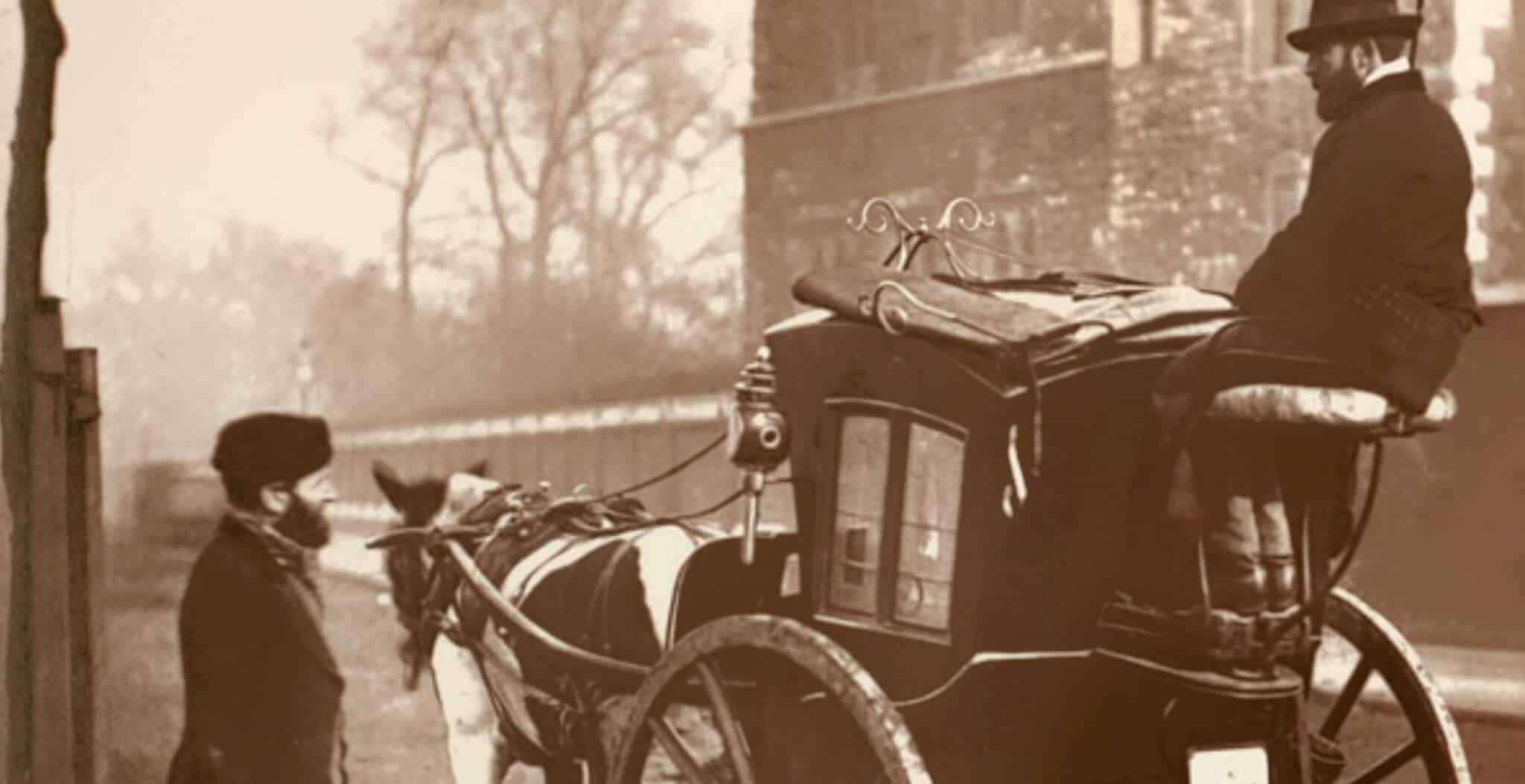
The poet's sitting in a horsedrawn carriage, not a horsecart, he's not a farmer. So he can daydream and nod off.  The piano sparkles, as if enchanted by the "magic" in the sunny haze. Suddenly, the pace changes. It becomes hesistant, as if the horses are plodding, maybe up a steep slope.

Ich sitze und sinne und träume, 

Und denk' an die Liebste mein; 

(I sit, and ponder and dream and think of my beloved) . 

Da grüßen drei Schattengestalten 

Kopfnickend zum Wagen herein. 

(Outside the windows, three shadowy spirits rise up to greet me, shaking their heads.

Sie hüpfen und schneiden Gesichter, 

So spöttisch und doch so scheu, 

Und quirlen wie Nebel zusammen,

Und kichern und huschen vorbei. 

(They hop, and pull faces, at once mocking yet elusive, and twist themselves (quirlen) so they disappear into the mists (which have suddenly materialized) and cackle and slip away. The lines seem so smooth and lyrical that the vision passes almost unoticed. In the long postlude the piano sparkles again, as if the interruption were just a dream. Or not - maybe the poet's been spirited away, too. Below,  the wonderful André Schuen with Daniel Heide.

Monday, 1 July 2019

Berlioz : Symphonie fantastique and Lélio - Philippe Jordan, Cyrille Dubois

Berlioz Symphonie fantastique and Lélio ou Le retour à la vie, this time with Philippe Jordan conducting the Wiener Symphonker wirh Cyrille Dubois, Florian Sempey and Jean-Philippe Lafont (narrator) with the Wiener Singverein from the Wiener Symphoniker's own recording label. Symphonie fantastique is ubiquitous, with numerous performances and recordings every year. But what is news is that this programme is an "extended" version, so to speak, since the symphony (op 14) and the monologue lyrique (op 14b) were designed on symmetrical principles, with numerous interconnections, forming a kind of mega symphony whose architecture is revealed by hearing the two parts together. There have been earlier recordings - Jean Martinon in 1973 being my particular favourite, but in performance, the pairing is not easy to achieve because the two parts require very different forces.  Colin Davis, for example, recorded Lélio minus the all-important part of Lélio the composer, though his narration is fundamental to the whole structure. The spoken words draw together the vocal and orchestral parts and gives them context. Without narration, cohesion is lost, no matter how good the singing and playing might be.

This recording, with Jordan and an extremely good pair of soloists, would be a top recommendation were it not for the recent Symphonie fantastique and Lélio with François-Xavier Roth and Les Siècles, which sets new standards of excellence. Please read more about that HERE. That said, this new recording, with Jordan and the Wiener Symphoniker  has a great deal going for it.  It's very different from Roth/Les Siècles, but well worth hearing on its own terms.

A very stylish Symphonie fantastique , Jordan making the most of the Wiener Symphoniker's poise and elegance.  In "Rêveries" one might call the keening string lines a "Sensucht" motif : "reverie", or longing, has no national boundaries.  The idéé fixe is thus framed in a context that fits in with the orchestra's strengths, the "sweetness" in the strings laced with melancholy.  As the pace picks up, the sound is fuller, yet still driven by almost manic impulse. The waltz in "Le Bal" is particularly suited to an orchestra based in Vienna : Jordan shapes the figures so they seem to whirl round, the way dancers move gaily, but in strict formation.  Again the idée fixe reminds us that time cannot stand still.  A lovely introduction to the "Scène aux champs", the dialogue between cor anglais and oboe reflecting the sense that fulfilment might be elusive. With modern instruments, the "March au supplice" is perhaps more flashy than macabre, and the "Songe d'une nuit du sabbat" less spooky but suitably dramatic. Nice cheeky woodwinds, above the turbulence in the orchestra : almost cinematic in impact.

Part of the reason that Lélio does not get performed as often as it deserves to be is that the role of Lélio, the composer, is central to its execution. Getting Lélio right is tricky. I've heard the part done in English, with RADA-style self-consciousness, but that didn't work for me, at all. The Shakespeare Berlioz heard in early 19th century Paris wasn't the Shakespeare of late 19th/early 20th century London, but freer, wilder hybrid.  Shakespeare carried no cultural baggage for continental European audiences in Berlioz's time.  Berlioz saw Roméo et Juliette in the Garrick version of the play brought to Paris in 1827 by Charles Kemble, where Berlioz met and became infatuated with Harriet Smithson, who may represent the elusive muse that inspires the artist in Berlioz to extremes of agony and ecstasy. In an age before close-ups and amplification, theatre practice would have to have been more exaggerated than we're used to now.  Perhaps Berlioz, a theatre critic, intuited that good orchestral writing had the potential to express feelings in greater complexity than most actors at the time were able to project, given the technological limitations of the time.

In Lélio, the artist is a composer who, having experienced the annihilation of Symphonie fantastique finds "Le retour à la vie" in a new "Épisode de la vie d'un artiste ... en cinq parties". Since the piece is a dramatic monologue, interspersed by songs and orchestral interludes, more rests on the speaker than  might be in less literary works. Martinon's Lélio was Jean Topart, a French movie star, who delivered his lines effectively. Jordan's Lélio is Jean-Philippe Lafont, an opera singer, which makes a difference, since there is a musical quality in the text, which a narrator with a feel for music can bring out. I still prefer Roth's Michael Fau, who is more uninhibited, closer perhaps to the wild abandon that the highly coloured text seems to inspire, yet also understands the innate musicality in the lines.  Both Jordan and Roth have Florian Sempey for the baritone part, who is excellent, but Jordan has the incomparable Cyrille Dubois, who may not be well known outside Europe but is greatly respected.  Dubois has a clear, high tessitura employed with agility, truly idiomatic in this highly specialized repertoire. Though the tenor part is relatively limited, Dubois steals the show !  This is a good performance all round, but Dubois is so outstanding that this is worth getting just to hear how wonderfully the part can be done.

Thursday, 27 June 2019

Berlioz, Grand Symphonie Funèbre et triomphale - François-Xavier Roth, Les Siècles

Jean-Victor Schnetz: Combat devant l'hôtel de ville, 1830
Berlioz  Grand Symphonie Funèbre et triomphale, with François-Xavier Roth, and Les Siècles, continuing their Concert Monstre at the Pierre Boulez Salle of the Philharmonie de Paris. For Part One, "Blazing Liberté" please read my review here.  The two parts of the programme worked together well, the revolutionary visions of the first part reinforced by the solemnity of the second. Ideals are not won easily, and cannot be taken for granted.  The symphony was written in 1840, marking the anniversary of the July Revolution of 1830.  Just eight years later, the February Revolution of 1848 would change things yet again, ushering in the Second Republic.  
Berlioz's  Grand Symphonie Funèbre et triomphale reflects older traditions than modern symphonic form.  It is a ceremonial march, scored for wind instruments and percussion, instruments which would have been used in military situations. Berlioz initially used the term "Symphonie militaire", adapting it for the occasion of the re-interment of the remains of those killed in the July Revolution.  Though members of Les Siècles remain seated, the instruments they play are mobile, and could have been carried and played while marching. Period instruments, with their more natural, earthy sounds, give performance a human touch, and underline the sense of forward movement that propels the symphony towards its glorious conclusion.  

The Marche funèbre flowed with a powerful, affirmative pulse, drumstrokes and the wail of ophecliedes to the fore, lower brass followed by higher winds, as if marching in military formation. The second theme, (flutes, oboes, clarinets) offered brief retrospective before fiercely dominant chords introduced the next section, bassoons, trombones, ophecliedes, marching at a pace that increases in depth and intensity as it proceeds, punctuated by steady drumstrokes, the surge crowned with the crash of cymbals. In the Oraison funèbre, a fanfare - nine trombones in phalanx - supported by horns and trumpets, the trombone soloist above them as orator, positioned so his instrument could call out as if into vast distance, echoed at times by lighter winds.  Fragments of Berlioz's unfinished opera Les Francs-Juges were used in this movement, so the "oratory" quality of the trombone solo may have its origins in music for voice.  The trombone may be wordless, but its expressiveness is deeply poignant.

The final movement, the Apothéose, rises seamlessly from what has gone before. A march picks up, now brighter and faster paced, a march of exuberant triumph.  Berlioz used the pavilion chinois, a version of the Turkish crescent, but more elaborate, with rolls of bells under a cap (shaped like a pagoda) to further concentrate the sound.  Most orchestras use simpler versions which aren't nearly so impressive. These instruments symbolized victory, the incorporation of foreign elements by conquest.  In this version of the symphony, Roth uses the option of a second orchestra, (the Jeune Orchestre Européen Hector Berlioz) addding string colour, expanding the symphony still further from military form.  Roth  also utilizes the choirs, who served so well in the first part ofthis Concert monstre.  The voices burst forth in unison, with such precision that the effect was explosive, like a canonnade in sound.  "Gloire! Gloire ! Gloire et triomphe!". Not for nothing is this finale an apotheosis, and in this performance it was positively ablaze. It doesn't last nearly long enough. Roth and his forces repeated it as an encore. 

Tuesday, 25 June 2019

Liberté ! - Berlioz Concert Monstre - F X Roth, Les Siècles Part One


Berlioz Concert Monstre with François-Xavier Roth, and Les Siècles and a cast of hundreds, livestreamed from the Philharmonie de Paris (link here). "Concert Monstre" was the title of a concert Berlioz presented in 1844, where performers (over 100) outnumbered the audience.  Roth's Concert Monstre employs closer to 500, with two orchestras and six choirs but the acoustic of the Pierre Boulez Salle handles such forces well, even at full volume.  But this was a "Concert Monstre" in another sense, too,  since it was a grand extravaganza designed for maximum impact. In the first half, spectacular paeans to progress and liberty - L'Impériale, Chant de chemins de fer, Le Temple universal, topped by the Hymne Marseillaise. In the second half, the Grand Symphonie Funèbre et triomphale.

"Du peuple entier, les âmes triomphantes ont tressailli comme au cri du destin !" - the choirs sang, getting L'Impériale (H129, 185) off with a blazing start. Ostensibly, the  text celebrates the revival of the imperial dynasty under Napoléan III, but this is an empire with roots in revolution : the real hero here is the French nation itself, and its people. This "Concert Monstre" was also hommage to Berlioz himself. Berlioz was literary : he loved words on the page as much as in the theatre. When he used text, it was often integral to his music.  The concert included spoken quotations from Berlioz's own writings, and commentary.  The speakers were clearly heard, again demonstrating the merits of the Pierre Boulez Salle. 

Thus the Chant de chemins de fer (H110, 1850), a cantata for voice, orchestra and chorus, with tenor Julien Dran.  The text, by Jules Janin, expresses the exhilration of new technology, the coming of railways and the "merveilles de l’industrie". Berlioz wrote the piece very rapidly, taking time off from working on Le Damnation de Faust. Perhaps there are connections : just as Faust flies through the skies, trains carried people through the landcape at what were then almost unimaginable speeds.  Even more pertinently,  Goethe's Faust made his pact with Méphistofeles in order to gain knowledge which might save mankind. This creates a sub-context for the cantata, connecting it to Berlioz's interest in Saint-Simonian ideology, and to the idea of progress through an economic order based on industry.  To Berlioz, phrases like "Pour vous, ouvriers, La couronne est prête" would have had extra meaning. This intensifies the sense of excitement which Berlioz builds into the setting. The rhythms may replicate the chugging of motors and movement of wheels, but the strong sense of forward propulsion might also evoke the thrill of social revolution. One might even detect faint echoes of the Marseillaise. "Que de montagnes effacées! Que de rivières traversées! Travail humain, fécondante sueur!". In the strophe which mentions". The lines grow hushed, the choruses singing of spirits descending into tombs, as they greet the dawn of a new age. Thus the chorus repeats each word of the soloist : "La Paix ! le Roi! L'ouvrier! La patrie", with a fervour that's almost religious. On this happy day, the laurels go to the "Soldats de la paix, C’est votre victoire; C’est à vous la gloire De tant de bienfaits." The final strophe was delivered with almost explosive force, Dran's voice ringing out like shining clarion. 

In Le Temple universal (H137, op 28, before 1861)  Berlioz returns, towards the end of his life, to idealism. In this orchestration, by Yves Chauris, male and female choruses combine, reinforcing the concept that an enlightened Europe should unite, beyond frontiers, to embrace "Le grand hymne de notre liberté!"  An appropriate hymn for present times !  Roth is no fool : He has often shown courage when expressing his convictions. To press the point still further, Berlioz's orchestration for large orchestra, soloist and chorus of the Marseillaise (H 51a), written in the wake of the July Revolution of 1830.  What an experiece this must have been in the Pierre Boulez Salle ! Everyone standing who could - the orchestra, the chorus, the audience. When Dran sang the solo passage, the orchestra seemed to well around him. The Choeurs et orchestres des Grandes Ecoles,Choeur Sorbonne Université, Choeur de la Cité Internationale Universitaire de Paris,Choeur CalligrammesChoeur des Universités de Paris, and Choeur InChorus (Chorus master Frédéric Pineau) were joined by informal singers in the choir stalls, ordinary people, some singing from memory, and no doubt a few in the audience.  That is what a Marseillaise should be about - drawing the people together. "Amour sacré de la Patrie, Conduis, soutiens nos bras vengeurs
Liberté, Liberté eg tes défenseurs ! Combats
avec tes défenseurs!".  At this point in history, it seems that the forces of freedom, liberty and genuine democracy are being destroyed, by technological manipulation,  intolerance, and pig-headed stupidity.  We need the Marseillaise. I played this over and over, loudly. My son popped in. "Wow!", he said "That's fantastic!"  

My review of Part 2 of this Concert Monstre when François-Xavier Roth and Les Siècles do Grand Symphonie Funèbre et triomphale  is HERE! Please enjoy

Saturday, 22 June 2019

Under Hong Kong's Roof - madness in life, madness in opera

Under Hong Kong's Roof 香港屋簷下. On the surface, a family tragedy, but beneath the surface. "Under Hong Kong's roof",  sinister forces are brewing.  This film, from 1964, is one of Ng Chor Fan's (吳楚帆 ) masterpieces, in which he portrays the mental disintegration of a good man. It's also an allegory, a commentary on the "golden" years of Hong Kong when everything seemed perfect as long as you were cocooned from reality by privilege. As so often in Cantonese movies of the period,  it begins with shots of the city - the  central business district, its skyscrapers like fortresses of power.  Ng Chor Fan plays Chu Wai Yan, a businessman.  A luxury banquet has been arranged  to announce the engagement of Chu's daughter (Mui Kam Fung 苗金鳳 ) to Willy, the son of Tong Po Fat, who was once Chu's assistant but now an even more powerful businessman. The party is in fact a summit meeting of the rich.  The men are dressed in white tuxedos, the ladies bejewelled.  But as Yan Yan and her fiancé enter, the band is playing loud and discordant Chinese music. Something's not right here but no-one notices, even though the entertainment for the evening is a western-style dance band playing soothing tunes.

The other businessmen are gossiping. Though Tong and Chu go back to when they were both young, Tong's a dodgy character, and Chu's position is dodgy.  Chu's invited Mr Hong, a mutual a friend from youth, to the horror ofTong, since Hong is poor and old fashioned (a reminder that not everyone prospers). As Hong enters, the Chinese band appears again, also unnoticed. Somehow, couples are dancing....  Hong warns Chu that Tong is up to something bad but Chu doesn't believe it. Mysteriously, the guest of honour, Mr Yeung, the richest guy of all, doesn't turn up. Ominous. Suddenly, the glamorous singer of the band seems to be singing Cantonese opera. She looks her normal self but her voice becomes masculine, demonic, threatening death.

The banks have foreclosed on Mr Chu and his guarantors, Tong and banker Yeung aren't backing him up.  No matter how he begs, Chu is on his own.  Overnight, he loses his business and home.. The servants have to go. Many have worked for the family for years. "You can't swim back to your native village", says Chu, offering them money. But they demur, from a sense of loyalty.  The bailiffs arrive.  The furniture gets auctioned. An old oil painting, a portrait of Mr Chu, comes up for sale. It's shabby. No-one can understand why there's a sudden bidding war between a poor woman  (Mrs Lai, aka Tai Sum, ie "elder aunt", played by Lee Yuet ching 李月清) and a young merchant navy officer, Chiu Chung. Chiu was taken in by Chu when he was orpaned as a child. The old woman seems to know this, so she gives him the painting, and tells him where the Chu family  have moved to — a crumbling hovel in a squatter settlement.  Chiu Chung is shocked to see Chu, now dressed in traditional underclothes.  Chu smiles as if he's happy. "Eat a bowl of rice, turn it upside down". (a proverb). He recounts the story behind the painting. Years ago, he took pity on a vagrant who came begging for food. He never saw the man again but a few years later, the painting arrived.  Chu understood what the painting meant,to himself and to the man who painted it. Mrs Lai knows the story, too,which is why she spent thousands bidding for it. Who is she ? She says she's just an itinerant worker, moving from place to place but in this story, she's a force of unconditional goodness.

Willy Tong arrives at the shack to end the engagement. "This place is like a pigsty, it smells and you can't even reach it by car!" Yan Yan collapses. She confesses that she's pregnant.  Willy says it's Mr Chu's fault in the first place for pushing his daughter to marry money. Maddened with grief, Chu picks up a stick to beat Willy (who escapes with his chauffeur) and in the process, falls over and smashes his head. Chu's wife has a seizure.  Both are in hospital, but Mrs Chu dies of a heart attack.  Young Mr Chiu confronts the Tong family and gets beaten up by their thugs.  But he's the one who gets arrested ! When Mr Chu comes home, head bandaged, it's clear that his wounds go much deeper. He acts out scenes from an imaginary Cantonese opera, making dramatic gestures, swinging a stick like a sword, singing madly.  He runs into the main street where he goes berserk, smashing the fish tanks outside a restaurant. This, too, is a symbol on several different levels. Chu gets arrested and put into a psychiatric hospital. He doesn't recognize his kids, but mumbles the phrase "eat rice from a bowl, then turn it over".  Yan Yan gets evicted form the sqautter hut. She tries to kill herself, but miraculously Mrs Lai appears and stops her, slapping her in the face.  "Consider your dead mother, your sick father, your young siblings  and your unborn child!", she says, "what right do you have to put yourself above them !" A concept that might not mean much in the west but matters in traditional values.

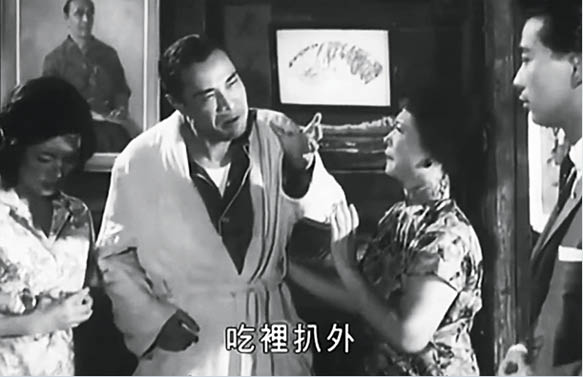
Yan Yan goes into labour. At the same time Willy Tong and new girfriend go speeding in a sports car which crashes. Mrs Lai takesYan Yan, her baby and siblings into her home.  "You are our guardian angel".   So Yan Yan gets a job, singing in a nightclub - an interesting detail, since it was in a nightclub where her Dad had his first psychotic delusion.  Seaman Chiu tracks her down, orders Chinese tea - not alcohol - and asks to see her "You're crazy", says the waiter, "she doesn't talk to customers".  Chiu visits Mrs Lai's home in a squatter village, where all the neighbours crowd in, looking.  The younger kids have started school again, and Mr Chu is at last well enough to go home.  Again Mrs Lai intervenes, she says that Yan Yan and Mr Chiu should be "like ox and cow". What's that mean, say the kids.  Mr Chiu's been offered a management job on land paying $700, a fortune in those days. But all's not well, yet. The baby is called "Tong Tong" ie "sweetie" but as Yan Yan says, his past is as bitter as bitter gourd.  Yan Yan thinks no-one will marry a fallen woman, but Mr Chiu proposes. He's carried the engagement ring around with him for years. Suddenly, though the baby diappears.  He's been kidnapped by the Tong family, whose son survived the car crash but can't have children. the Tongs think they can get away with it since Yan Yan is "just a bargirl".  They announce the child as their own, though people gossip.  Mr Chu breaks into the announcement party, re-enacting the mania in which he becomes a character from opera, screaming, shouting and throwing things (see top photo) The Chus are ejected, returning home in a thunderstorm, crying for the lost child. Yet again Mrs Lai appears, the baby hidden under her coat. "If they can steal the child, I can steal it back!" . This time, the Tongs won't win. Mr Tong's been arrested for major fraud.  Mr Chu bursts out laughing.  "Who's crazy now" he says, "let's fill our bowls and eat again".

Friday, 21 June 2019

Hubert Parry Piano Quartet and Piano Trio no 2 : Leonore Piano Trio


The Leonore Piano Trio continue their traverse through the piano works of Sir Charles Hubert Parry for Hyperion Records with  Parry's Piano Trio no 2 and the Piano Quartet in A flat minor.  This disc complemeents their first recording, with Parry's Piano Trios nos.1 and 3 and the Partita for piano and violin . (please read more here).  The Piano Quartet was completed in January 1879 and premiered soon after at the home of Parry's friend and mentor, Edward Dannreuter. Despite its complexities, it received many performances in the years therafter.. A critic of the time wrote that "It is something to have an English musician who is not afraid to obey the dictates of his inner conciousness, notwithstanding that by doing so he is sacrificing immediate popularity and critical approval".  In The Times, Parry's originality drew praise. "Of what special school Parry is a steadfast disciple needs not to be told.  He is no timid believer, but a proselyte through intimate persuasion".  
Parry's Piano Quartet in which the Leonore Piano Trio are joined by Rachel Roberts (viola), begins as if were overture, a Lento where sedate cello, viola and violin lines develop into a lively central section where piano leads the strings on inventive adventures, before subsiding into reverie.  "Rhythmically dynamic" Parry scholar Jeremy Dibble writes of the secoind movement. Of the second movement, Dibble writes that "it combines fugitive moments of melody with a relentless, acerbic energy." A "more euphonious waltz in the trio" (with delicate piano tracery) provides contrast before a concluding coda of "even greater demonic impetus".  In the Andante, the strings develop the piano melody in more tonally ambiguous manner, recapturing the sense of mystery with which the Quartet began. The Finale is highly dramatic, the vividness of the scherzo now channelled with assertive vigour. The piano introduces the second figure with its overtones of Wagner (specifically Die Meistersinger von Nürnberg) . If Parry references Wagner, Brahms and Schumann, why not ?  By incorporating them into music distinctively his own, he is making a statement.  The coda functions, as Dibble says "as an apotheosis of the work as a cyclical whole" in that Parry reworks the ideas in the Lento with the "demonic" Scherzo "incorporated into the bravura display of the virtuoso-driven coda", which ends with exuberant flourish. 

Charles Villiers Stanford disliked Parry's Piano Trio no 2 in B Flat minor, from 1884, claiming that the first movement was "quite unintelligible" and the last "too restless and foggy in sound".  Stanford's views on Parry were somewhat coloured.  Nonetheless, this is the most ambitious of the three piano trios, running at 32 minutes, neatly balancing the substance of the Piano Quartet.  The Maestoso defines the subjects that follow with elegaic sweep, the allegro con fuoco bursting forth intense passion.  Parry's structure of this movement owes much to Brahms, but, writes Dibble, "the Schwung of his ideas - the fury of the first subject, the characteristic falling sevenths of the transition,  the poetry of the second subject , the unusual reverie of the development and the dreamlike conclusion in  B major - is more illustrative of Parry's Dionysian headiness than of his Apollonian rationalism".  The Lento expands the "poetry" of the second subject, piano, cello and violin in elegant poise, the richness in the cello evoking darker undercurrents, underlining the contrast with the Allegretto vivace, which zips along with spirited élan - there's even a hint of  stylish dance.  Parry's mastery of structural form is displayed in the finale, where the stateliness of the first movements is reiterated, the central section marked by a violin idea  that "subtly refuses to settle unequivocally in the tonic key of B minor" until the final section, where a coda con moto replaces the con fuoco that went before. Altogether a more substantial and satisying programme than the first release, though equally well performed.

Sunday, 16 June 2019

Mieczysław Weinberg Symphony no 21 "Kaddish" Gražinytė-Tyla, Gideon Kremer, Kremerata Baltica

At last on CD, Mieczysław Weinberg's Symphony no 21 "Kaddish"  (op 152, 1991) with Mirga Gražinytė-Tyla conducting the City of Birmingham Symphony Orchestra, and Gidon Kremer and the Kremerata Baltica,  from the acclaimed live performance, part of the in-depth CBSO Weinberg series in November 2018. The symphony is a deeply personal statement. Weinberg witnessed the Holocaust first hand. He survived, though millions didn't, including his family.  Yet its musical qualities are such that they make it a milestone in modern repertoire.   Though the symphony does get performed and has been recorded once before, this performance is exceptionally idiomatic as it is made by the finest specialists in the field, Gidon Kremer and Kremerata Baltica, supported by Gražinytė-Tyla and the City of Birmingham Symphony Orchestra, in top form.  With these impeccable forces, it is unlikely that this performance will be surpasssed for some time. This belongs in every collection, Weinberg-focused or not.

The combination of chamber orchestra, soloists and large orchestra is fundamental to structure and meaning. Embedding the ensemble and soloists within the orchestra shapes highlights individual voices against a wider background. In the apocalyptic tumult of the Holocaust, personal utterances must not be overlooked. This also extends  the forces Weinberg can bring to bear in this panoramic landscape. "It is hard to string this bow", said Gražinytė-Tyla of the interaction between ensemble and orchestra. "The reason is that long passages are dominated entirely by a solo voice and various chamber ensembles while the gigantic orchestral apparatus of almost 100 musicians sits on the stage" resurfacing at different points.

The Largo opens with  the plaintive sound of Kremer's violin, singing, poignantly, alone. Weinberg could be referencing many sources - the role of violinists in Eastern European culture, community fiddlers as well as trained virtuosi.  On an autograph manuscript, Weinberg quoted the title of Mahler's song Das irdische leben where a child cries out for bread, but is ignored, and dies. There are also quotes from Chopin's Ballade no 1 in G minor, op 23, further anchoring the Polish context in which Weinberg grew up. With muffled timpani, darker forces enter. There are moments when Kremer deliberately hardens the tone. But the violin soars upward, supported by the strings in the orchestra, before being silenced by a single, harsh drumstroke. The violin resumes reaching a very high tessitura above the steady pulse in the orchestra, before quietly subsiding as the orchestra shapes tranparent, ethereal textures. The Allegro molto shatters any illusion of peace. This is graphic music. Ferocious chords and turbulent cross-currents, interrupted by "gunfire" (percussion) and sudden, sharp outbursts of violence. The Largo is built around a chorale-like anthem.  Tense, quiet passages alternate with more expansive motifs.  Kremer's violin re-emerges, bold, klezmer-like figures taunting strident, low-voiced brass.  The Presto is manic, screaming alarums and  madcap grotesquerie. Yet Kremer's violin will not be stilled, its melody restrained but uncowed. As it fades, the Andantino rises, single notes plucked on violin, answered by the orchestra.  This section is exquisite, executed with great poise, a reminder of  civilized values.

In the Lento, the panoramic landscape of the Largo is redrawn. The violin is plucked, quietly, against a wash of high-pitched  winds - winds suggesting movement and change - bells ringing against ostinato discord, and a soprano voice is heard, singing a wordless plaint. The soprano is Gražinytė-Tyla herself, who trained as a singer and came from a music background.  She knows how to carry a line, and the purity of her tone fits perfectly with what the voice might signify.  The part is substantial and quotes passages that Kremer and the other soloists had played before.  At moments her voice deepens richly before soaring upwards before the piano (Georgijs Osokins), clarinet (Oliver Janes), violin (Kremer) and double bass (Iurii Gavryliuk) return, the ensemble raised from the dead, so to speak, reunited with Gražinytė-Tyla's song, growing with even greater affirmation than before. The symphony ends with a mysterious  glow in this extraordinarily sensitive performance.  This is a symphony of such multi-layered depth and subtlety that it rewards attentive listening.

Weinberg's Symphony no 2 op 30 (1946)  may have been written closer to the time the events described in Symphony no 21, but traumas like that need time to process. In any case, Weinberg had to contend with Stalin and the Soviet authorities. Written for string orchestra, the textures are lighter, Gražinytė-Tyla conducting the Kremerata Baltica so the lines flow gracefully. The part for solo violin dominates, leading the ensemble forth.  In the Adagio the violin takes flight. The higher strings follow but are met by a hushed section for lower strings. The Allegretto is lively : brightly poised and nicely defined.

Thursday, 13 June 2019

Monumental Josef Suk : Asrael Symphony, Jiří Bělohlávek, Czech Philharmonic Orchestra

The Czech Philharmonic Orchestra's tribute to Jiří Bělohlávek continues with Josef Suk's Asrael. a symphony for large orchestra in C minor, Op. 27 (1905-6) and Pohádka, Op. 16 (Fairy Tale). Bělohlávek conducted the Asrael symphony many times and recorded it at least twice,with the Czech Philharmonic in 1992 and with the BBC Symphony Orchestra at the Prague Spring Festival in 2008. This latest release was recorded at the Rudolfinium, Prague, in October 2014.  This Pohádka comes from a performance in October 2015. These give us Bělohlávek's most recent, and probably most mature takes on the music of Josef Suk, overshadowed to some extent in the west by Antonin Dvořàk and later by Leoš Janáček. As Bělohlávek demonstrates, Suk's music is distinctive and original, with great character.  Hopefully, the Czech Philharmonic will have in its archives tapes of Suk's Zrání, (The Ripening) op 34 (which Bělohlávek recorded with the BBC SO) since it is a companion piece to Asrael.

Antonin Dvořàk, Suk's father-in-law and mentor, died in May 1904  after which Suk began writing the symphony. In July 1905, Suk's wife, Ottilie, died, aged only 27,  shortly after the birth of their son. Asrael was a way in which Suk sought to exorcise the shock of losing the two people dearest to him by challenging trauma through music. "Such a misfortune either destroys a man or brings to the surface all the powers dormant in him", he wrote, "Music saved me."

The symphony is built on two huge sections like the pillars of a monument.  This architecture is paramount. The first two movements, both andantes, represent Dvořàk, while the last two movements, both adagios, represent Ottilie.  A vivace forms a bridge between the first "pillar"  and the second.  Bělohlávek's definition of this structure intensifies impact, enhancing the emotional depth of the piece.  The first andante, begins mutely, as if the orchestra were numbed by grief.  Muffled timpani give way to strings, lines initially jagged but gradually absorbed by expansive developments involving full orchestra, which blaze into passionate crescendo before the poignant diminuendo.  The second andante, more austere and restrained, is shaped with deliberate purpoise. Individual isntruments - winds, trumpets, celli, bassoons, basses - lament against a chorus of strings. Every voice counts, as if the orchestra were singing a Requiem.  In the vivace, Bělohlávek's tempi are swft, emphasizing vitality, so the chill that sets in midway marks a turning point.  The vivace itself mirrors the two "pillars", the first part remembering past happiness, the second a reminder that loss cannot be reversed. When the pace picks up,  it is propelled by urgent momentum before it is cut off abruptly.

The second "pillar", written after the death of Ottilie, balances the first "pillar".  While the andantes that went before were solemn, the adagios that follow are gentler, reflecting the different personalities of Ottilie and her father.  Again, Bělohlávek emphasizes the symmetry in the structure. The first adagio, like the second andante, is restrained, mournful winds calling over a backdrop of low-timbred strings.   The solo violin melody may represent Suk himself, who was an accomplished violinist, as his grandson, the second Josef Suk, would become. It is answered by celli, possibly sugggesting a dialogue between Suk and his departed wife. Gradually the orchestra falls quiet, celli and violin singing together in intimate harmony. The second adagio, marked maestoso, reflects the andante sostenuto with which the symphony began.  Again, Bělohlávek captures the forward momentum beneath the turbulence.  After a brief respite, when the celli and violins interact one last time, the pace resumes with even greater force. Woodwinds pull the movement forward, answered by harps.  Only now do the big brass return, softened by winds, celli and horns. A melody on alto flute is answered by bass flute : warm, bright sounds rising heavenwards as the symphony reaches its conclusion. The mood is elegaic, comforting rather than strident.  In the Bible, Asrael is the Angel of Death, but that's not solely negative, the implication being  that the dead are beyond suffering, "happy with God".

Suk's Pohádka, (Fairy Tale), op. 16 (1899-1900, rev 1912) is a suite based on incidental music Suk wrote for a play about mythological lovers, Radúz and Mahulena. The first movement depicts an idyllic setting : an extended violin melody suggests pastoral bliss. The two inner movements contrast. In the first intermezzo, the lovers play with peacocks and swans, but in the second,the strings inject a note of foreboding, extended by low-timbred brass and winds, suggesting a funeral march.  Luckily,  love breaks the curse and the lovers are restored. The score harks back to Smetana and folkloric tradition, with a glaze of romantic colou. A lovely part for the violin leader. 

Monday, 10 June 2019

Opera star endorses smoking

Opera Star endorses smoking ! A cigarette brand from 1928 (notice the round jar)  named after Mei Lan Fang, the Beijing opera star.  That was when smoking was trendy and modern. Thank goodness it's not now. (Big thank you to my friend who sent this)

Friday, 7 June 2019

The Diary of One who Disappeared - Linbury


Leoš Janáček's The Diary of One who Disappeared is pretty much basic repertoire,  yet so intriguing that it invites thoughtful interpretation.  Ed Lyon's sung the part before, and he's good. What was "news" however was the staging. Nothing new about staging the piece - it's been done before and the Linbury is part of the Royal Opera House. Why do people still read the broadsheets ?  So it's a good idea to read a n analysis by someone who actually knows the work and its background enough to assess the performance.  Here is a link to Claire Seymour's review in Opera Today :
"....;.....At the close of van Hove’s realisation, the seated figure of Wim van der
Grijn reads and then burns his letters to Stösslova, dropping the flaming
pages into a waste-paper bin. His unfulfilled dreams now ashes, he climbs
into the small bed, presumably ready for death. But, The Diary
ends in defiance and hope, not despair. Originally the vocal climax came in
song 14, the height of Janíček’s desolation and hopelessness, “Oh what have
I lost!” But, Janáček’s revisions shifted the emotional peak to the final
song, which rises to a top C: “All that is left is for me to say goodbye
forever.” And, with a farewell to his father, mother and little sister,
“the apple of my eye”, Janíček departs: “Zefka is waiting for me with our
son in her arms!”