Sunday, 24 July 2016

Three Choirs Festival Gloucester Elgar Parry


The Three Choirs Festival 2016 launched in glory at Gloucester Cathedral with Parry's Jerusalem and Elgar's The Kingdom. The "Holy City and The Heavenly Kingdom", a brilliant pairing which expresses what the Three Choirs Festival represents.  For three hundred years, the Three Choirs Festival has stood not only for musical excellence but also for communion, in the deepest sense of the word, bringing people together in the celebration of a glorious ideal.  

This wasn't the usual Jerusalem in its famous setting by Elgar but Parry's original, believed lost for decades until uncovered by Jeremy Dibble, whose 1992 biography of Parry restored Parry's status and reputation – essential reading.  Parry's orchestration isn't as lush as Elgar's, but the original is worth hearing for that very fact: Parry focuses on the questioning and on the irony in Blake's visionary poem. By setting the first verse for a single singer, Parry's setting emphasizes the provocative nature of Blake's conception. "And did those feet in ancient time walk upon England's mountains green?".  In the full choral version, we get so carried away by crowd enthusiasm that we don't question. In Parry's version, however, Blake's irony is made more clear.  And was Jerusalem builded here, among these dark Satanic Mills?" Bluntly, the answer is "No" So much for simplistic certainties. We may not get the glorious flourishes of Elgar's orchestration, but we do get an insight into Parry. Please read my piece on Jerusalem HERE.

In  Elgar's The Kingdom, the apostles are about to embark on their journey which still continues 2000 years later. For all the grandeur and vast forces involved, at its heart,  the piece is humble though assertive. The apostles are ordinary men serving a higher cause. Saints aren't superhuman beings but human beings inspired to do extraordinary things, inspired by faith and love.

Elgar dreamed of writing a trilogy of oratorios examining the nature of Christianity as Jesus taught his followers, using the grand context of the Edwardian taste. In The Apostles, Jesus sets out his beliefs in simple, human terms. Judas doubts him and is confounded. In The Kingdom, the focus is more diffuse. The disciples are many and their story unfolds through a series of tableaux, impressive set pieces, but with less obvious human drama. The final part would have been titled The Last Judgement, when World and Time are destroyed and the faithful of all ages are raised from the dead, joining Jesus in Eternity. The sheer audacity of that vision may have stymied Elgar, much in the way that Sibelius's dreams for his eighth symphony inhibited realization. Fragments of The Last Judgement made their way into drafts for what was to be Elgar's third and final symphony, which we now know in Anthony Payne's performing version.  There are familiar themes from The Apostles in The Kingdom, so context helps. But the fact that the trilogy wasn't completed is in itself a refection on the fact the mission isn't complete and won't be until the End of Time, hopefully not in the foreseeable future, though things might not quite seem that way sometimes.  Please read  HERE about The Apostles at the Three Choirs in Worcester in 2014.

The Kingdom unfolds in a dignified procession, a series of tableaux each savoured witha measured pace, the intervals between them providing pauses for contemplation.   Interestingly, The Kingdom focuses on female figures. Does this reflect Elgar's Catholicism, and his personal beliefs? The contralto has lovely passages, and the soprano has the glorious "The sun goeth down" and dialogues with the solo violin.

At Gloucester Cathedral last night Adrian Partington conducted the combined choruses of the Three Choirs, the Philharmonia Orchestra with soloists Claire Rutter, Sarah Connolly, Ashley Riches, and the youthful Magnus Walker, replacing James Oxley at short notice.  I booked my tickets months ago, but unexpectedly couldn't attend. You'd think ticket returns would be as valuable as gold, but I was so fortunate to be able to give mine to very cherished friends, not Elgar aficionados, but good and decent people, who had a wonderful time. For me, sharing the gift of the Three Choirs is almost as good as being there! 

Thursday, 21 July 2016

Cubist Baroque Prom 7 Minkowski Poulenc Stravinsky Fauré

At Prom 7, Marc Minkowski conducted  the BBC Symphony Orchestra in a programme that demonstrated just how insular some British audiences can be. French style is different and needs to be understood on its own terms. Minkowski's punchy, vigorous approach underlines the importance of understanding the roots of idiom. Historically informed performance isn't about quaint instruments, it's about the spirit of music which refreshes itself in creative performance.  Minkowski, like so many conductors of his generation and before, learned from  baroque and early music that all music was once "new" and can still be new, performed with intelligence and with a sense of context.

Gabriel Fauré's Shylock Suite (1889) for example is about as true to Shakespeare as Ambroise Thomas's Hamlet or Berlioz's Roméo et Juliette.   Not "English" but endearing. Urbane and cosmopolitan, this Shylock's a man of the world, not a villain.   Minkowski began with the Entr'acte, with its striking brass fanfare from which emerges a seductive violin melody, introducing the Chanson and then the Madrigal, both lovely songs for tenor Julien Behr. We're in magical night-time Venice where troubadours serenade ladies in the moonlight. Dancing figures evoke starlight, or the play of light on water, and the Finale ends with a bright, cheerful flourish.

Minkowski describes Stravinsky's Pulchinella Suite (1922) as  "Bonsai....a miniature Rite of Spring" emphasizing its modernity. Though the ballet connects to baroque and commedia dell'arte memes, it was absolutely of its time, choreographed by Diaghilev, with designs by Picasso.  In an orchestral suite, dance imperatives aren't quite as central as in the ballet, but the idea of form and precision remains.  Minkowski gets articulate balance from the BBCSO. Fast flurries suggest movement and energy, violins are strummed like guitars, and bowed with angular zing.  "Gentle arrogance" says Minkowski on the BBC rebroadcast.  Listen to the trio where the bassoon blows sassy raspberries - this is Cubist baroque !  Stravinsky's neo-classicism was poised but very individual.  Yet again, the connection between period-inspired performance and modern music.

Minkowski made the point further by following Stravinsy Pulchinella with Francis Poulenc Stabat Mater (1950), inspired, in part by the Black Madonna of Rocamadour. How angular it is, worlds away from Michelangelo's Pietà in its Vatican splendour. It's much closer in spirit to the "primitivism" of the Fauves, Cubists and the avant garde of Poulenc's youth.  Ancient and modern, yet again. There are odd quirks, here, even the suggestion of medieval music  and the harsh terrain of the Languedoc.  As a meditation upon loss, Poulenc's Stabat Mater is unsentimental. Faith proves itself when it is tested, and in this lies its strength as Dialogues des Carmélites demonstrates. The tenderness of the quiet passages, and those in which the soprano (Julie Fuchs) sings. This tenderness offers a degree of solace, but also serves to underline the inevitable fate that lies ahead for all.  In the final moments of the Quando Corpus, though, the soprano's voice blazes upwards, joined by the choir and orchestra, reminding us that for the devout, there is hope.  Personally I'd prefer a craggier performance, which Minkowski could deliver well, but the refinement the BBC Singers and BBCSO produced was very moving.  Please see also my piece on Stravinsky's late works and musings on the nature of Faith.

Wednesday, 20 July 2016

Elgar Remastered unissued rarities released on SOMM


New from SOMM Records, specialists in British music, Elgar Remastered, valuable pressings from Sir Edward Elgar's personal library.It contains hitherto unheard discs, virtually the complete 1928 studio sessions of the Cello Concerto with Beatrice Harrison as well as many unused takes of major orchestral works and famous miniatures. Above the famous photograph of Elgar and Harrison in the studio in 1919.  Now you can hear them in a new, clean  remastering by Lani Spahr, using originals from the collection of  Arthur Reynolds, Chairman of the North American Branch of the Elgar Society, which has been described as an "Aladdin's Cave" of rare and unpublished material.

Indeed, there are no less than eight versions of the Cello  Concerto in this set, from previously unissued takes and private recordings. Elgar was fascinated by recording technology and very much "hands on" in the studio, so this is an opportunity for Elgar devotees to study the process.  There are   detailed notes and musical examples by cellist Terry King, who compares the Cello Concerto's earlier 1919 recording with Beatrice Harrison to her later 1928 recording with some fascinating insights into each, regarding cuts by the composer, choice of tempi and differences in performance.

Most of Elgar's early recordings are included, acoustically optimized   Some are well known, such as The Prelude to the Kingdom, but acoustically optimized, and some never before available, like the alternative takes of Symphony no 1 (never previously available)  and 2. Caractacus and the entire Violin Concerto. Many obscure rarities and miniatures are included, too, making this SOMM set a collector's treasure trove.  Elgar Remastered is now available for preorder direct from SOMM or on amazon.

SOMM Records gives more detail of the remastering : "Reynolds' collection. This valuable collection included copies of all Elgar's recordings which he had conducted for HMV from 1914 to 1933. It all began when Lani persuaded the late Fred Maroth, owner of Music & Arts to allow him to prepare new transfers of Elgar's acoustic recordings riginally issued by Pearl on seven LPs, c. 1975 and later on CD. In Lani's view, while a valuable document, they left much to be desired considering the large advances in audio processing which had taken place in the intervening years. In 2011 Music & Arts issued Elgar conducts Elgar. The complete acoustic recordings 1914-1925 with Lani's transfers from Arthur's (and Elgar's) discs. In addition to the published HMV discs in Arthur's possession, there were also six sides of unpublished takes from the Wand of Youth Suites and these existed as test pressings that Elgar had kept"

"After finishing the acoustic recordings (Spahr) asked Arthur if he could be allowed to digitise the electric recordings for archival purposes. Among the first group Lani brought to his studio was the 1928 recording of the Elgar Cello Concerto with Beatrice Harrison as soloist. Arthur had a set of published HMV discs with her signature plus several boxes of test pressings. From this he discovered that there was nearly a complete set of takes from the two sessions in which the Concerto was set down. Whilst excited at the prospect of issuing several different versions, all taken from alternative takes, Lani became confused with the matrix numbering. He discovered that for the same material indicated by a suffix number, (e.g. CRI 1754-2) there was another matrix number, CRI 1754-2A. After a cursory listen he found that both these seemed identical! It wasn't until he listened to the Naxos recording of Elgar's Enigma Variations, Cockaigne Overture etc. engineered by Mark Obert-Thorn that he came across a Bonus Track of the Cockaigne Overture in "Accidental Stereo". The explanatory note referred to the frequent habit of engineers having two turntables running during the cutting of wax recording master discs, presumably for back-up purposes and in several instances even two different microphones, one to feed each turntable. Without going into further detail here, (Spahr's booklet notes give full explanations), Lani discovered that various HMV sessions were possibly recorded with a completely separate microphone/cutter arrangement. "

"We now not only have an insight into the sessions themselves but are also provided with astonishing sound, revealing a new depth not only to the existing issued recordings, but to new performances of various miniatures and, more importantly, the Cello Concerto and Symphony No. 1 assembled from previously unheard test pressings. We can only be thankful to Lani for his remarkable talent, tenacity and restless, searching spirit which allows us to appreciate anew these unique performances in sound unimaginable to Elgar and those who made the recordings more than 80 years ago."

Tuesday, 19 July 2016

Gergiev smiles Prom 4 Ravel Ustvolskaya

Valery Gergiev in a happy, sunny mood at BBC Prom 4.  Gergiev always springs surprises but this was a surprise beyond expectation. When Gergiev is good, he's very good but when he's bad, he's very, very bad.  This "new" Gergiev should come out more often.


The programme was fairly standard - Ravel, Rachmaninov, Strauss and Ustvolskaya, but Gergiev animated it by emphasizing each composer's individuality.  Fidelity to idiom does matter!  Gergiev is musician enough to know that the score does count, however his  more extremist fans might think.  Thus the discipline with which he conducted Ravel Boléro, observing the progressions as they unfold.  New elements enter as the music builds up until it reaches its climax. Each element adds new flavours, but fundamentally the traverse is defined by the steady beat of the drum, reflected in the strumming pizzicato. In flamenco, rigid rhythmic discipline is part of the style,  creating a ritualized tension that makes the brief flourishes seem even more like explosive release.  As the piece progresses, the energy builds up as a natural result of what's gone before. Just as dancers and athletes train hard to build muscle, Gergiev shows how disciplined conducting serves music much better than fake, flashy "excitement".

Rachmaninov Piano Concerto no 3 has a reputation for flamboyant display, but its wonders lie in the piano part. Gergiev wisely gave Behzod Abduraimov pride of place. Abduraimov isn't the most spectacular of players, so the restraint Gergiev brought to the orchestra was sensitive, supporting the soloist.

Galina Ustvolskaya's Symphony no 3 Jesus Messiah, save us!  is based on the life of an 11th-century monk, Hermann of Reichenau, aka "Hermann the cripple" who was born with so many birth defects that he lived in constant pain and had speech defects. Nonetheless, he became a theologian, an astronomer, a mathematician and wrote a treatise on the science of music. He lived to age 44, ancient by the standards of the time and was canonized in 1863.  A paralysed musician without a voice? What a metaphor for a composer in the Soviet era ! 

Ustvolskaya's music is certainly very different from conventional Soviet music, but it does have deeper antecedents and connections.  Pounding blocks of form, percussion-led  rough-hewn sounds and spoken narrative that speaks fire and brimstone (speaker Alexei Petrenko)   Its "primitivism" is deliberate for it evokes the idea of  strength in times of hardship. Petrenko recites so forcefully that it hardly matters whether you speak Russian or not: you can imagine the monk/saint defying the odds stacked against him, firm in his faith in God. 

Ustvolskaya didn't fit in with Soviet convention but her music does have antecedents. She may or may not have known Janáček's Glagolitic Mass but she would have known Stravinsky's Rite of Spring which evokes even older beliefs. She would also have known of Orthodox Church music and the Russian hermit tradition. The "primitivism" in this symphony also connects to Futurism, which flourished in the early years after the Revolution, and produced works like Alexander Mosolov's The Iron Foundry (1925-6) and also influenced film makers like Sergei Eisenstein.  By 1983, when this symphony was written, Ustvolskaya would also have been aware of music in the west,, particularly Messiaen, who also had a thing for huge blocks of rock-solid sound and ecstatic visions of the glory of God.  Ustvolskaya's Third Symnphony is highly individual, and shows that Shostakovich was by no means the only modernist in town

Gergiev still lives in one of the several oligarch enclaves in London, from which he can jetset with ease. Munich is a smaller city,  so chances are he'll spend even less time with the Munich Philharmonic than he did with the LSO, but if he has good rehearsal conductors and musicians he can add the finishing touches.  Like the LSO,the Munich Philharmonic is one of several top notch orchestras working in close proximity and stimulating each other.  In recent years it's been somewhat outshone, but if this prom with Gergiev is anything to go by, good things lie ahead.  And judging from their performance of this Suite from Richard Strauss Der Rosenkavalier, they are teaching Gergiev to be lyrical.

Monday, 18 July 2016

Spaniens Himmel - Chinese volunteers in the Spanish Civil War


This week marks the beginning of the Spanish Civil War in 1936, the Overture to the Second World War. The war in Spain was an international war, though contained in a relatively small space, since both sides in the conflict were backed by support from abroad.   The International Brigades are extremely well known, since they attracted so many artists, thinkers and idealists from all round the world, including black Americans.  Less well known, though, is the involvement of some 100 Chinese volunteers.

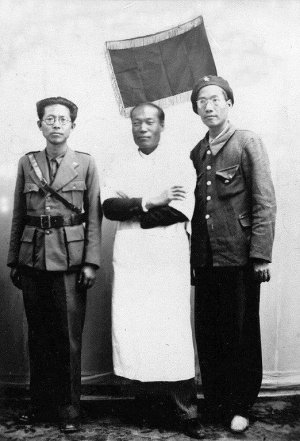
The three men in the photo are Xie Weijin, Lui Huan feng and Zhang Ji, proudly standing in front of a Spanish banner.  Lui, who was born in 1890, came from Shandong in North China, which supplied many of the 150,000 men who were hired to work on the western front in the First World War.  Nearly all those men were peasants signing up to escape dire poverty at home, with no concept of life in the west. In France, their graves fill whole cemeteries.  Most did not return.  Read China and the Great War : China's pursuit of a new national identity and internationalism by Xu Gouqi (2005) the classic work, details here. Highly authoritative, the best in the field.  Men from Shandong are tall and sturdy: in photos and films taken on the western front, we can see them wrestling and doing feats of strength like lifting weights, grinning for the camera.

But by no means were the Chinese volunteers in Spain all dislocated peasants. Zhang Ji, for example, born 1900 in a wealthy family in Hunan, had gone to the US, graduating from the University of Minnesota in 1923.  Like so many others in the Depression, he became disillusioned with capitalism, and went to Spain with other Americans, joining the International Brigades.  Zhang was last heard of in Hong Kong at the start of the second wave of the Japanese invasion.

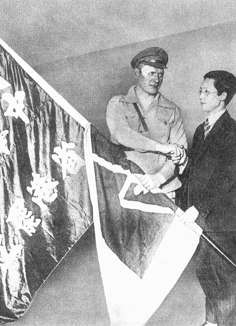
Xie Weijin(谢唯进 b 1899, Sichaun, died 1968, Sichaun) was involved with the waves of strikes and conflicts that erupted in South China between 1925 and 1927, which paralyzed the region, jeopardizing western business interests and their political hegemony.  In the brutal suppression that followed, Xie fled to Berlin, where he was photographed with Ernst Thälmann, head of the German Communist Party with a banner showing the support of the workers of Hong Kong and Kowloon, who had played an integral part in the General Strikes in the Guandong region. Please read more about him here. 

The Comintern, under an agent codenamed Borodin, were involved in the 1925-7 uprisings, though they were very much a Chinese response to specifically Chinese situations. But we can see why Xie looks quite comfortable the in his Republican uniform and pointed cap. Xie served in the Austrian Brigade as a machine gunner until he was shot in the leg.  It's possible that he may have known Hanns Eisler's elder brother, an Austrian who had been a Comintern agent in China in the 1920's. After Franco defeated the Republicans, Xie was imprisoned in a notorious camp in France, before returning to China where he served in the elite Chinese Air Force before falling victim to Mao's purges.  Irony, indeed.

A similar fate lay in store for Bi Dao wen (Tio Oen Bik), a Chinese doctor from Java,who was involved with the "Spanish doctors",a group of medical personnel who came from places like Hungary, Germany, Poland and Austria, who, being socialist and often Jewish, couldn't return home after Hitler. . Bi eventually went back to Java where he seems to have been killed in Suharto's massacres of Chinese people in Indonesia.  Read more here on recent research.  There's another study of the Chinese in the International Brigades from 2004 which I haven't read.

Nearly 20 years ago, I found a file in the British military archives about these men and women, who became stateless since they couldn't very well return home after Spain since they were socialists and often Jewish, too.  One of my uncle's friends  (Dr Gerald Abraham) was still around at that time, in his 90's, so I asked him about them.  He knew them personally !  He was the only son of wealthy Jewish family long resident in Hong Kong, but on graduation from HK university, didn't go into practice like the rest of the class. Instead, he volunteered to serve in China with the Quaker medical unit.  (Friends Ambulance) Given the difficult conditions at the front in China from 1938, that was a  baptism of fire for a young man who'd only until then known comfort. But all the more honour to him.  Thanks to him I traced the Friends Ambulance Unit in China, who were very unfairly treated and hounded out of China for not being neutral ! But neutrality is the Quaker way, and non violence. In China, the "Spanish" doctors were dispersed, going where needed. Some joined the Communist underground, others the Chinese Nationalist Army, against the Japanese. At least two ended up in Hong Kong after the war. My uncle's friends, doctors who'd started out in Roumania.  Small world.

And, as ever, Ernst Busch tells us like it was. Below, a clip from a live performance when he marks the date "July 1936" and sings Mamita Mia, merging into the anthem Thälmann,Kolonne, aka Spaniens Himmel, (composer Paul Dessau) with its refrain

Die Heimat ist weit, doch wir sind bereit.
Wir kämpfen und siegen für dich: Freiheit! 
(Our homeland is far away, but we are ready to serve :  we fight and will win for you, Freedom !)


Sunday, 17 July 2016

Bryn Terfel nails Boris Godunov Prom 2

Bryn Terfel, astonishingly persuasive as Boris Godunov, in Prom 2 a semi-staged reprise of the Royal Opera House production this March.  Bad Guys in history fascinate, for some reason, but  Terfel's portrayal suggests that Boris (Godunov, that is) was perhaps more sympathetic than tabloid villain.  Can anyone who can sing with such richness be entirely bad  Haha ! But much of the appeal of Mussorgsky's Boris Godunov lies in the extreme contrast between power and tragedy. Whether the historical Boris killed the historical Dimitri, we shall never know, but the Tsar, despite his power, is haunted.  Terfel's singing is magisterial. so authoritative that that you're glad you're not standing too close. Tsars recognized that a dominant persona was a political weapon.  Yet  Terfel can create such nuance, such subtle shades of expression that he makes you feel close to the "inner Boris" behind the fearsome imagethat  boyars and peasants cannot see through.  

A performance as intense and as intelligent as this confirms the merits of the original 1869 version of the opera, almost certainly Mussorgsky's primary interest.  But in Tsarist times it wasn't smart to question the sanctity of Tsardom. The revision thus gave the censors, and the public, what they wanted: circuses and smokescreen diversions.We lose some good music in the process, but there';s no reason why we can't enjoy Boris Godunov as opera and listen to the extras in orchestral concerts where they can be heard without competition from the central drama.  

Terfel was supported by excellent singing all round him, if the orchestral playing was a shade overwhelmed in the Royal Albert Hall.  Special praise for Ain Anger's Pimen. The stronger a Boris, the stronger Pimen needs to be to stand as counterfoil. Also praise for the small comic roles, like Varlaam (Andrii Goniukov), Missail ( Harry Nicoll), Dimitri (David Butt Philip) and Yurodivy (Andrew Tortise).  In a performance as intense as this, these characters are important, serving to remind us that the shennaigans of the rich and famous reflect the foibles of human nature on a more humble scale.  Please read the review of the Royal Opera House performance HERE and my background piece HERE.


Friday, 15 July 2016

Dangerous ! BBC First Night of the Proms 2016


The Marseillaise on the First Night of the Proms 2016, a powerful start to the BBC Proms season, acknowledging the atrocities in France. Most of the Royal Albert Hall audience stood up in tribute.  Terrorism is a global issue even when perpetrators act alone. Nations united are stronger than nations alone. Perhaps that message is lost on some, and the BBC will get it in the neck from vested interests who'd like to replace public services with commercial control, who look for any excuse to accuse the BBC of "bias" real or imagined.  Tonight, the BBC placed humanity above political manipulation. The BBC is a more effective ambassador for British integrity than schemers and selfish policies ever could be.

This First Night of the Proms was obviously planned ages ago, but we cannot but reflect on how it relates to current events.  Music doesn't exist in isolation, and we'd be much lesser people if we didn't care. Hate and division have always been part of the human condition. In Romeo and Juliet, Shakespeare wrote about implacable rivalries, and the pointless waste of young life.  Beautiful as it is, Tchaikovsky's Fantasy Overture ' Romeo and Juliet' would be nothing if we overlooked the tragedy behind  Especially niot after that Marseillaise and the images of dead bodies we've been seeing today.

The image of Elgar as jingoist persists even though from what we know of the composer, the image is far from the truth. Elgar's Cello Concerto is anything but "pomp and circumstance";  it's poignant and deeply felt. It was written after the death of Alice, his wife and muse, but also after the end of the First World War, in which millions of others were killed, not only in war but through famines, epidemics and ethnic cleansing. In those circumstances victory could not but be tinged with sorrow, In any case 1914-1918 was the beginning of a much wider, global conflict that didn't end until 1945, and a radical new approach to ending conflict. Perhaps we should reflect more on the years of idealism after 1945 than on endless squabbles.  In this performance, with Sol Gabetta as soloist, I was particularly moved by the quieter moments, ie the lento, which "spoke" with more depth than a short movement usually gets.

First Nights of the Proms often feature blockbusters, since their size suits the cavern that is the Royal Albert Hall. Prokofiev's Cantata Alexander Nevsky was ideal material, featuring as it does massed forces of a scale that the Soviet Union could produce when it needed to make major propaganda impact.  I've written extensively on Sergei Eisenstein's monumental film Alexander Nevsky and the role Prokofiev's music played in it. Please see HERE and HERE for more.  In this performance, Sakari Oramo, the BBC SO, the BBC Symphony Chorus, the BBC National Chorus of Wales and soloist Olga Borodina let rip with intense ferocity.  Perhaps a little on the wild side, but rightly so, because this is impassioned music.  The Russians under Alexander Nevsky were fighting for their very existence. In 1938, when the film was made, the irony of the plot was not lost.  The Soviet Union didn't trust the Nazis any more than Nevsky trusted the Crusaders.  Although the forces used in the Battle on the Ice were small by modern standards, the conflict was epic, a fight to the death with Nature itself creating havoc. Human history isn't pretty but if we don't learn, we're lost.

Thursday, 14 July 2016

1933 the remake ? Krenek Karl V prophetic

Are we witnessing live 1933 the remake?  Is history repeating itself? The premiere of Ernst Krenek's Karl V, scheduled for 1934, was overtaken by events. Now more than ever we must take heed of this opera and its horrifying prophecy.

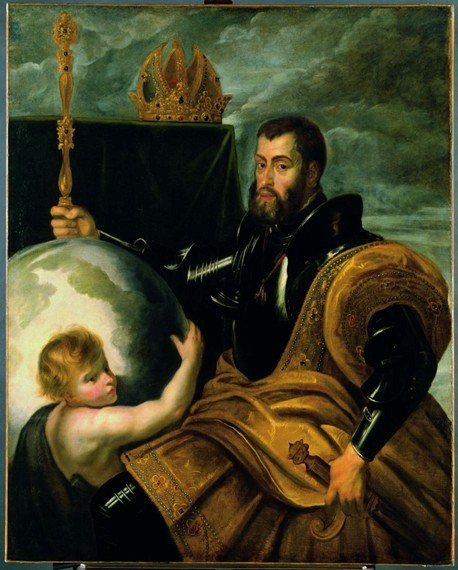
Krenek's Karl V Op 73 is based on the life of Charles V, Hapsburg King of Spain and the Americas, Holy Roman Emperor and conqueror of the Turks: the first multi -national world empire, which easily surpassed in scale the original Roman Empire.  The grandest monarch in European history lies dying, preparing himself for judgement before God.  Priests and bishops are praying,  but the king turns to his youthful confessor, Juan de Regla, precisely because  he's objective and hasn't yet  been sucked into the morass of intrigue that curses the corridors of power.

Karl V unfolds through a series of vignettes. Structurally the opera operates on multiple levels and multiple dimensions, constantly moving back and forwards in time. Since Karl V predates Berg's Lulu by several years, Krenek could have invented opera as cinema. Certainly he, like Berg, was interested in modern art, modern ideas and the movies.  Just as in film, orchestral music  occurs mainly at critical junctures where voices are stilled, such as the beginning of the final act.  Mysteriously beautiful, searching sounds suggest that, while Charles V's body is in a comatose state, his soul is traversing the universe.  Krenek also employs Sprechstimme throughout to emphasize philosophic ideas. Singing, in the normal sense, would distract, and normal speech would be too mundane.  Eventually your ears adjust and the Sprechstimme becomes effortlessly natural.


In Charles V's time,  Protestantism challenged Catholic Europe. Unlike earlier schismistic movements, it took root and morphed into politics, partly because  Charles V allowed a level ,of religious toleration, but the genie of nationalism was let out f the bottle. Eventually Charles V's mercenary German armies attack Rome,  calling the Pope the Anti Christ.  Meanwhile the Conquistadors were annihilating the Incas. Charles V knows that the gold Pizarro brings back is tainted with blood.   Yet another battle between empires raged in the Mediterranean and Africa.  Charles V visualized a Christian Europe strong enough to repel Islam, which, as he knew, had once occupied Spain.  But is Charles V cursed? Four Spirits appear in his dreams, the first the Curse of the Pope. The second represents the indifference of the French Court. Charles imprisons Francis, the King of France, with whom Charles's own sister Eleanor falls in love. Seeking peace, Charles sets Francis free to return to Paris with Eleanor as Queen. The third fury represents German nationalism, an issue that greatly vexed Krenek himself, who understood the danger that Nazism would bring as early as the mid 1920's. Just as in Krenek's Jonny speilt auf, there's a black man in Charles V, a deliberate taunt at the Nazis. The fourth spirit connects to the king's personal life.  Please see my articles on Krenek's Reisebuch aus den österreichischen Alpen HERE and HERE

Charles's vision of  Europe united in a new Pax Romana falls apart. The Church resents his power and can't handle the Protestant threat.  Francis proves no ally and breaks Eleanor's heart.  What hope has Charles of beating the Turks when he can't count on fellow Catholics?  Treachery and intrigue everywhere, Moritz of Saxony, Charles's protégé, betrays him by leading  Protestant insurrection.  Even on his deathbed, Charles is taunted by his supposed friend Francesco Borgia. Only Eleanor offers mercy.

Charles was vilified because few understood his motivations, which were ultimately altruistic. "I did not want to make the State a new tin God", he says, . "True unity lies in a belief in the Eternal. Everything earthly is an elusive bond".  Moritz of Saxony sneers that the King lives in a bygone age. But Krenek also adds the phrase "or maybe he lives 400 years in the future". The German choruses chant "We don't want to be citizens of the world!" Wearied and sick at heart, Charles V abdicates and retreats to a monastery.  An Emperor choosing to live like a monk (albeit one with Titian as wallpaper).  Charles V's core values were not those of the petty, selfish world around him.  A Turkish astrologer sees a star disintegrate. "A good omen" chuckles the Sultan. "The people of Europe are free, and they will use this freedom to fight among themselves even more brutally." The dying Charles holds a crystal globe in one hand and a crucifix in the other. He had not dreamed of peace for his own sake, but in the name of God. "But an impulse from within has corroded the globe with venom."  Photo shows Dietrich Henschel as Charles V, in the production by Uwe Eric Laufenberg, who directs the new Bayreuth Parsifal.

For Krenek danger came from Germany. Now things are a bit different but the scenario isn't so far off. Please click here to see my post London Belongs to Me, Richard Attenborough's prophetic film  

Tuesday, 12 July 2016

Serpent Lady ! Alfredo Casella : La donna serpente


This April, Teatro Regio di Torino honoured Alfredo Casella, born in Turin in 1883, with a  a staging of his opera La donna serpente, 1928/9, first staged in Rome in 1932, conducted by the composer himself.   Casella was cosmopolitan; in his capacity as pianist and concert performer he travelled extensively. He was very much a modernist, well aware of the creative ferment in his times like Futurism, and modern art in general. With Malipiero and D'Annunzio, Casella founded the Corporazione delle Nuove Musiche

La donna serpente thus emerged from the heady background of the 1920's: think Ravel and Stravinsky rather than Puccini. Indeed La donna serpente sends Puccini up. The plot is ludicrous, even Dada, though it is based on an 18th century play by Carlo Gozzi  Miranda. A fairy princess falls in love with Altidor, the King of Teflis. The catch is that, should she ever upset her husband, she'll be destroyed. Wagner adapted the same original for Die Feen (read more here), setting it relatively literally as an early Romantic fantasy. For Casella, however, fantasy provides cover for riotous adventure.  Things go wrong in the kingdom of Teflis, large crowds march, sometimes cheering, sometimes rebellious, Altidor believes his wife has killed their kids,  activating the curse that turns her into a snake lady. Nothing verismo about La donna serpente! There are lovely set piece arias and duets, and parodies of commedia dell'arte, fake oriental potentates,  and gloriously lush choruses, but this is most definitely a "modern" opera. Given that it was written while Mussolini controlled Italy, its anarchic energy is also subversive, hiding its kick beneath exuberant good humour.  The orchestral passages are vividly dramatic: in many ways they "tell" the story more pointedly than the vocal hijinks.  The overture to the third act, for example, describes Miranda as serpent, slithering like a snake. Her legs have been taken away with her identity.  After the many beautiful passages suggesting "fairy" lights and sumptuous luxury, the music is sinister, but we feel sympathy for Miranda, destroyed through no fault of her own.   In the end, Miranda is restored, and the crowds sing "Liberta!" but it's a near thing.  Fairy tales, indeed.
 
The staging in Turin was simple, with strong angular outlines suggesting Cubist and Futurist influences,  illuminated with intense, jewel-like colours. A light show, in many ways.  Gianandrea Noseda conducted.   He's billed as a Casella champion, because he's recorded the orchestral interludes to the opera, and the symphonies,  but if you want a much livelier, punchier performance all round, track down the recording from 1959 in Milan, conducted by Fernando Previtali. 

Sunday, 10 July 2016

Shangri-la Finborough Theatre - more than just a play


“You like your minorities like your pandas – picturesque, cuddly, endangered, helpless. But I refuse to be a panda. I refuse to go extinct. I want to live, to live well, to live like them.”

More than just a new play,  Shangri-la is a play that connects to issues rarely discussed but that need to be addressed.  It runs at the Finbourough Theatre from 12th July to 5th August.

"Bunny, a young indigenous woman, has witnessed her family’s livelihood destroyed by mass tourism. She dreams of escape — as a globe-trotting photographer. Nelson, her liberal Chinese boss, dreams of a new kind of tourism that's sustainable and enables genuine cultural exchange. Their white Western clients yearn for escape, for the touch of something authentic.........What happens when the only thing you have to sell is your culture? When the only way to free yourself is to betray your roots?"

Does tourism destroy the very culture it seeks to promote ?  Shangri-la is written by Amy Ng who has personal experience of the westernmost regions of China and Tibet. A historian by training (Yale and Oxford), she understands the wider issues  that impact on societies "opened" to western tourism  READ MORE HERE and especially read about the discussion forums that are taking place with the play.

Friday, 8 July 2016

Pelléas et Mélisande Aix - dream but not a dream


Pelléas et Mélisande at Aix en Provence : orchestrally stunning and vocally top notch. But something was missing.  Debussy understood Maeterlinck's use of symbols : images deliberately created to unsettle and disorient, to deflect attention away from the surface to things unseen, lurking in the depths. Hence the references to towers and dizzying heights above the ground, and to silent ponds and open oceans, to caves and underground passages, to death and to constant danger.  Pelléas et Mélisande fascinates because it's elusive. This production will appeal to many because it's lovely to look at but it's not Pelléas et Mélisande, but Mélisande The Opera.

But who is  Mélisande, and why is she in Allemonde ?  Barbara Hannigan is such a celebrity these days that the whole production seems designed around her, which is fair enough. She has remarkable strengths, and it would be a waste not to make the most of them.  Hannigan's Mélisande is feisty, physical and extremely strong,  a manifestation of female sexuality, which is indeed, a part of the role : those towers and caves are there for a purpose !  Hannigan's looks also play a part, and she gets to disrobe and romp about in nude coloured undies an awful lot : hers is a body that works out a lot in the gym, and is almost androgynous, like Diana, the goddess of the hunt and of the moon, another of the many symbols in Maeterlinck's original play.  Mélisande as hunter and killer: the dramaturge, Martin Crimp is onto something more complex than Mélisande wan and wraithlike as a child of the moon.  Nearly ten years ago. at the Royal Opera House,  Angelika Kirchschlager portayed Mélisande in much the same way and was the saving grace of an unevenly focused production from Salzburg that was never revived.  But there's a lot more to Mélisande than this production suggests. I loved Martin Crimp's Into the Little Hill and Written on Skin for George Benjamin (more HERE and HERE), so I have a lot of respect for his insight into this opera. But this time the balance between poetic fantasy and literal narrative goes awry.

Pelléas et Mélisande isn't an opera in the usual sense. It's deliberately non-naturalistic, and the narrative non-literal.  Katie Mitchell directs the opera as if it were a dream sequence in which Mélisande acts out sexual fantasies. Hence the wedding gown in which she appears in the first scene.   But those who do know the opera would focus more on the greenery that surrounds the bedroom.  Golaud is out hunting, when he spots Mélisande  alone, in the middle of the forest, by a pool.  Anyone up to speed with mythology would recognize she's a variation of the eternal Loreley. And Loreleys don't wreak havoc. It's not personal.  Perhaps Mélisande loves Pelléas, but the libretto  fairly explicitly suggests that their relationship is more  a pact between innocents.  Stéphane Degout is probably the best Pelléas around these days, so wonderful in this role that it is a shame that he, too, is reduced to a prop in order to emphasize the role of Mélisande and her dreams.  There's a charge between them but it isn't necessarily sexual. The libretto suggests that Pelléas needs to get well away from Allemonde if he wants any sort of future, and Mélisande represents the world beyond, and the unknown.

Golaud gets jealous because he doesn't have the wit to understand that not all relationships are self gratification; things might not be the way he assumes.  Laurent Naouri has done Golaud so often that he's brilliant, authoritative yet also sympathetic, much too complex a personality to be a mere figment of Mélisande's imagination.  When Golaud and Pelléas descend into the suffocating caves beneath the castle, they are undergoing psychological trauma.  We know from the script that the sea lies beyond, but in this production Degout and Naouri are trapped in the bowels of the castle.  The staircase, nonetheless is a good visual image, for it's twisted, rickety and possibly unsafe, so the set makes the point quite effectively. For Pelléas, there is no escape.


Allemonde is not so much a castle as a state of mind: It's cut off from its hinterland, the peasants are starving and roaming about in revolt, Yniold is terrified when he ventures out to play. None of which we see in this production, though  Esa-Pekka Salonen and the Philharmonia Orchestra are brilliant at creating non-visual imagery, for those in the audience who pay attention to music.  Under Salonen, the orchestra has developed way beyond the usual parameters of a symphony orchestra. The challenge of opera serves them well. This was a performance so vivid and impassioned that I was glad to listen, since the playing spoke much more expressively than the staging.  Degout and Naouri have the parts so fully characterized that they acted properly, their bodies extensions of their voices.  Mitchell directed Hannigan to move in trance-like  stylization, valid enough in theory, but deadening in practice. The silly eyeliner Hannigan had to wear didn't help, either, suggesting slut rather than half-human vixen.

Franz Josef Selig sang an excellent, virile Arkel,  and Sylvie Brunet-Gruppuso sang a nicely down to earth Geneviève, both of them common sense counterfoils that emphasised the bizarre nature of this Mélisande's dream world.  Altogether a very good Pelléas et Mélisande despite the one-dimensional interpretation and over-emphasis on Hannigan's thing for nudity which is wearing thin these days. She can sing, so she really doesn't need to make an exhibition.  The dream concept might be valid but it doesn't do the opera, and other singers, justice.  Less sex, please, but more mystery.

See also the review in Opera Today by Michael Milenski.

Thursday, 7 July 2016

Mahler Zu Straßburg auf der Schanz : its context

Zu Straßburg auf der Schanz, an early song by Gustav Mahler from Lieder und Gesänge, vol. 3: a song with an interesting background. The text comes from Des Knaben Wunderhorn. Clemens and Brentano used the original title Der Schweizer, which is significant to meaning, since, in medieval times, Swiss peasants were so poor that men were forced to volunteer as mercenaries. To this day, the Pope is protected by Swiss soldiers in fancy Renaissance costumes. (Please see my article Arnold Schoenberg and the Swiss Guards)  Pageantry apart,  reality for most Swiss mercenaries was grim. Often living  under harsh conditions, they fought and died in distant lands, never to return home.  The term  Der Schweizer thus refers to a soldier who doesn't "belong", an outsider whose deepest loyalties  cannot be fulfilled, and one who cannot be trusted or integrated into the mainstream.   Not a "romantic" ditty.

The poem, which dates from at least the 17th century, sets the action in Strassburg, a fortress on a river, in territory disputed by French and Germans. In the Franco Prussian War, in the First World War and in the occupation that followed, exploited by Hitler, the people of Alsace-Lorraine  knew only too well what nationalist blustering could bring.  Never again, one hopes.  Strassburg is symbolic : It's the home of the Council of Europe and the European Court of Human Rights, and the official home of the European Parliament being there shows that the EU is not centralized in Brussels. The photo above comes from a set illustrating each verse of the poem, amended with references to France and Prussia.  The sequence also emphasizes the religious context of the original poem, where the deserter is redeemed by his faith in God. (Read the verse above which is in Wunderhorn, but which Mahler did not set)

Mahler, being a composer,  was more influenced by the musical context.  The Swiss man's problems come to a head when "Das Alphorn hört ich drüben wohl anstimmen, Ins Vaterland mußt ich hinüber schwimmen"  Thus the magical introduction, which suggests an alpenhorn calling out over long distances. Perhaps thee soldier was hearing military trumpets, but his mind connected to the Alps, the source of the river which flows through the city of Strassburg.  Switzerland - so near and yet so far.  The voice rises from the word "Alpenhorn" as if the man is looking upwards, searching for distant peaks.  But notice how the piano line suggests drum rolls, and military ritual.  The man knows what's coming and the "drums" dominate. In the song, the short final line is repeated, like a hollow death knell.

But then the man thinks of his "brothers" his fellow mercenaries, who've become like brothers to him, and of "Der Hirtenbub ist doch nur Schuld daran, Das Alphorn hat mir solches angethan, Das klag ich an".  He's a simple shepherd boy, he can't help being mesmerized by the sound of an alpenhorn. Thus the piano sings,  trilling and elusive. A really good pianist (like Daniel Barenboim) can make the piano echo so the sounds hover in the air.  But then the music ends abruptly with two final chords. Like gunshot.

Please see also my other posts on Mahler, Lieder and Not Funny, Des Antonius von Padua Fischpredigt and especially Die Gedanken sind Frei  the background to Mahler's Lied des Verfolgten im Turm. 

Tuesday, 5 July 2016

Lieder as Social Comment? Boesch Wigmore Hall

Wigmore Hall Monday Afternoon  recitals differ from evening concerts because they're shorter and more relaxed. Florian Boesch and Malcolm Martineau proved that "relaxed" does not in any way mean lowering of standards.  They presented a strong programme of Schumann and Wolf with refreshing panache.  ,For example, Die beiden Grenadiere, Op.49 No.1 where they seemed to create the physical presence of two tough soldiers, still marching defiantly in defeat.  One man thinks of home, but the other is still truculent, the strains of the Marseillaise ringing in his ears.   More Heine, with  Abends am Strand, Op.45 No.3  Another pair watch a fishing boat, and chat about  distant lands "und von den seltsamen Menschen". They don't like dirty foreigners (literally) !  "In Lappland sind schmutzige Leute,Plattköpfig, breitmäulig, klein; Sie kauern ums Feuer und backen Sich Fische, und quäken und schrein.seltsammen Sitten  dort". So they sit, unmoved, on the beach, on the fringes of life,  as darkness envelops them, in every sense.

Die feindlichen Brüder, Op.49  yet another pair of men fight a battle so cataclysmic that they and their castle are destroyed, and their ghosts continue to struggle, for centuries  after. Boesch and Martineau would have compiled this programme ages ago, but Heine feels remarkably prescient in the light of recent events.  

For a breather, Boesch and Martineau then switched to Schumann's settings of Chamisso, Op 40, where they did all four songs in the set to telling effect. The first two songs, Märzvielchen Op 40/1 and Muttertraum Op 40/2, are relatively gentle but Der Soldat  Op40//3 ends in sheer horror.  A man loves another more dearly than anyone else in the world, But what's happening ? His pal is being executed. And by whom, and in what circumstances ? The psychological levels are complex. This is an extremely disturbing song, despite the steady march pace.   In comparison even Der Spielmann Op 40/4  might seem conventional.  since it connects to ancient traditions connecting fiddlers with death  In a macabre twist, Schumann set this poem about a cursed  wedding on the eve of his marriage to Clara.  

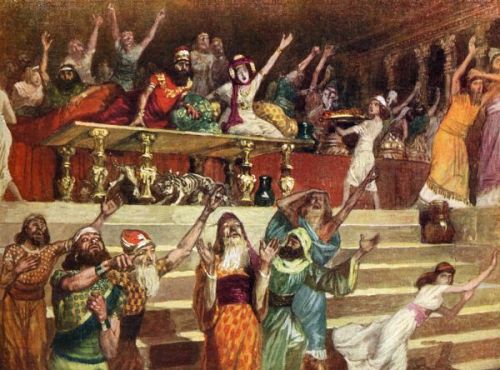
Eight songs by Hugo Wolf, including the less ubiquitous Wolf settings of Goethe's Harfenspeiler songs, then back to Schumann and Heine for Belsatzar op 54.  In the piano part, the music reels riotously, as if at a drunken orgy.  "Ich bin der Kõnig von Babylon!", sang Boesch, just slightly off kilter so you could imagine the King puffed up but wobbly. At his moment of triumph, the King is struck down  Heed the Writing on the Wall, puffed-up would-be leaders of men.

"The Twitter of the 19th century", announced Boesch before commencing  another Schumann setting of Chamisso,  Verratene Lieder . Two lovers kiss in secret but the stars pass it on, and soon everyone is in on the act.   Let no one think that Lieder is not cutting-edge social observation.  Listen again here on BBC Radio 3.


Saturday, 2 July 2016

BBC on the Somme Delius Requiem, In Parenthesis and more


Like poppies sprouting from ravaged farmland, the centenary of the Battle of the Somme  has yielded a crop of music.  Some healthy plants,  some weeds. Frederick Delius's Requiem was the culminating point of last night's commemorative concert with the BBC National Orchestra of Wales conducted by Adrian Partington.  Delius's Requiem was dismissed in its own time, even by his strongest advocates. We can hear why: it's not pastoral, not Requiem-like  and quite un-English. In the triumphant confidence that followed Britain's victory over Germany, Delius's vision of Nietzsche must have seemed a bizarre anachronism.  Perhaps now we've seen what happened to Europe, and to Britain, in the century that followed, we can better appreciate its quirky iconoclasm.  Partington let the piece unfold on its own terms. The Mass of Life fits more easily into grand choral tradition, but the Requiem is wilder and crazier, less prolix and more focused.  Although there are several classic recordings of Delius's Requiem, this one comes at a time when we can better appreciate its context, and value its individuality. Mark Stone sang with forceful conviction, yet also managed to suggest the wayward edginess that makes this piece so individual.  With its shimmering chromatics, the finale suggests a Debussy New Dawn, reminding us how cosmopolitan Delius really was.  Even the instrumentation harks forward - celeste, harp and glockenspiel.   Perfectly appropriate, given that this Requiem is more about the future than the past.  Incidentally, check out Mark Stone's recordings of the complete songs for voice and piano HERE  and HERE.

Also on Partington's BBC NOW concert, Butterworth's A Shropshire Lad Rhapsody,  Albert Roussel  Pour une fête de printemps, Herbert Howells' beautiful Elegy for String quartet, Viola and Orchestra.  (Philip Dukes, soloist). and the slow second movement of Gordon Jacob's First Symphony, written in memory of his brother, killed in 1916.  Jacob (1895-1984) conducted this movement himself at the Three Choirs Festival in 1934. It's hard to judge anything by a fragment like this, but the piece is worth hearing  as part of a wider programme in memorial.   Howells'Elegy, for example, sounds even more distinctive in comparison. 

Also yesterday a concert of choral songs by Parry, Gurney, Holst, W Denis Browne, Cras  and Reger with the BBC Singers conducted by Paul Brough. Two new pieces too, Colin Skinner's Before Action, setting a poem by William Noel Hodgson,who was killed on the first day of the battle of the Somme, and David Bednall's Three Songs of Remembrance.   The BBC also re-broadcast earler concerts such as Arthur Bliss Morning Heroes -with Andrew Davis (my review here) and Cecil Coles Behind the Lines  with Martyn Brabbins (my review here

Tonight the BBC broadcasts Iain Bell's In Parenthesis.  You can watch the full video here on Opera Platform.  Everything about this new opera presses the right buttons - it's topical,  it's patriotic, since it sets a poem by the Welsh composer  David Jones who fought in the First World War, and it's non-demanding, despite the subject.  Guaranteed to attract funding and commissions.  Except that, as music and as drama it's not very good.  Jones's poem is mystical and elegaic . Could one do justice setting The Waste Land as narrative?  The opera doesn't much engage with insight, but unfolds in a series of numbers, much like a musical. A bit like Oh what a Lovely War without  punch.  It does  however do what it says in the title "in parenthesis" , nice punctuation but blank between the brackets.


Friday, 1 July 2016

The Battle of the Somme - was it in vain ?


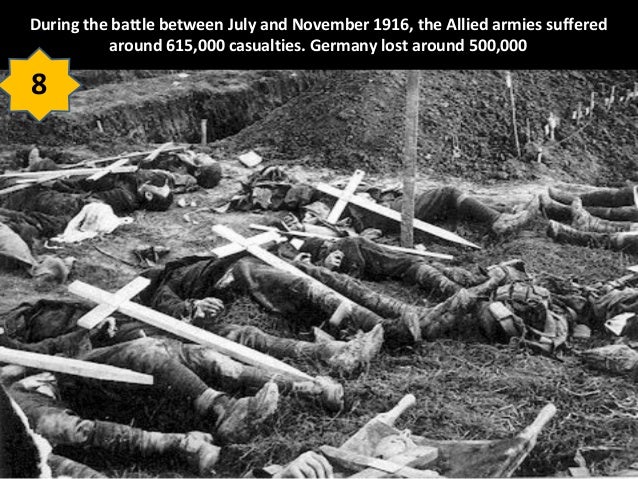
The Battle of the Somme began one hundred years ago today. An offensive that destroyed more than a million men, not counting other lives blighted by their loss., sacrificed for six miles of ruined farmland.  And what have we learned ?  The French and Germans took heed. The European Union is an unprecedented symbol that there could be alternatives to war.  Of course it's not perfect. But consider what might happen if it is torn apart ?  Extremists, whether ISIS or Neo Nazi have plenty to look forward to if the EU collapses.  So much for "taking control". By whom, how and for what purpose ? Hstory will repeat, lest we forget.

Read THIS TOO   !Nationalism is once again stalking Europe, there is no shortage of potential flashpoints, and the safety net is fraying"