
Friday, 15 January 2016
Liszt and Loewe Lieder RAM Song Circle


Thursday, 14 January 2016
Boulez, Birtwistle and Max - the famed Boulez at 80 concert

Now available on BBC I player, the famous concert "Boulez at 80" where Boulez, Harrison Birtwistle and Peter Maxwell Davies all met together on stage at the Barbican, London, when Boulez was presented with a medal from the British Association of Composers. Birtwistle spoke of how he had, as a young man, seen Boulez’s score for Le marteau sans maître. He’d seen nothing like it before, and it became his “rite of passage” musically. Boulez was an “immaculately uncompromising” composer and conductor whose example showed the paucity of populist, surface-level music. “A concert hall is not a museum”, he added, for music like Boulez’s “propels us into the future”. Then Boulez, humbly and simply, went back to work.
Boulez and Birtwistle go way back: Boulez's recordings of Birtwistle, like Theseus Games, are the absolute benchmarks. Birtwistle and Maxwell Davies go back a long way too but for decades they weren't on the best of terms, though, subsequently, the huge revival of interest in Birtwistle has brought Max into the spotlight, too.
This film is also important for the interview at 53 minutes in where Boulez explodes some of the myths said about him (direct link here). He explains the context of the story about blowing up opera houses. This came from his frustration at the way opera houses were managed, where a conductor didn't know who the orchestral players or evern the cast might be. As he says, Mahler said much the same thing, and so does Christoph von Dohnanyi (more HERE). He also explains the famous quote "I sleep faster", which was a bon mot about how he managed to cram so much into his days. He didn't sleep 2 hours a night! On ideologies "You have to find your discipline in order to break it. If you are constantly constrained by your discipline you become sterile. Ideologies are very interesting, at one point, when they are forging something, but when they are not forging something, when they are empty, then that is detrimental to your capacity of inventing" It's pertinent that Boulez's own music soon went way beyond serialism, in no small part due to John Cage's ideas on chance. Boulez likes modertn music but that's not "ideology". There are composers obsessed with formula but not him.
Charles Hazlewood talks about discipline in conducting. Maybe because I am a composer", says Boulez, " I think the composer is more important than the performer.. not too much of an ego, simply that. But I try to understand what the composer is tryingb to say, and when you see how carefully he has written a score, then you try to be as careful as he was. So then I'm careful about the balance, the style, the dynamic, the exactitude (which in the French meaning of the word has different connotations to English). On Le soleil des eaux, he speaks of the way he wrote the original before he became estabhished as a conductor, but when he conducted it with the BBC in the early 1960's he could see, from a conductor's perspective , how it could be improved. As to his legacy "I don't care, I won't be around!< he grins. "Each generation takes from its past and goes ahead."
In was at this concert, back in November 2005. Look who else was in the audience ! I'm in frame, too, but a blurred dot. Everyone looks so young. Some are no longer with us. Below my notes then on Le soleil des eaux.
Le soleil des eaux was written in 1948, when Boulez was barely 23. Already, though, it shows his distinctive personality, and still sounds strikingly original some sixty years later. René Char was a surrealist, and a member of the French Resistance. These poems come from a post-war political protest and were published barely a year before Boulez set them. Here attention is on the voice, which leaps up the scale, and turns capriciously, like the goldfinch’s darting movements. Boulez observes nature clearly – Messiaen taught him well. [Elizabeth] Atherton was in her element now, gloriously. The high timbre suited her well and she shaped the languor of the lines. Drama is added with sudden flashes of orchestral interjection, which the vocal part complements. “L’homme fusille”, sings Atherton “cache-toi!” (man is armed, hide!), with emphasis on the urgent “cache-toi!”. The second song, La Sorgue, Chanson pour Yvonne, is a much larger work, its powerful imagery condensed into barely five minutes.
The piece starts with a delicate otherworldly weaving of wordless soprano singing, harp and vibraphone. Then the orchestra and large chorus surge in, with the power of a mighty river unleashed. The choral writing is so finely textured that individual voices spread across the spectrum. The idea isn’t that specific words should stand out, but rather the impressionistic effect of multi-layered sound. This really is vocal writing as instrumental, where the total image matters. It’s emphasised by the regular cries of “Rivière!” when the choir pulls as one, before relaunching into the flow. Also reversed is the conventional role of soloist: the soprano’s contribution is to soar over and around the massed voices, singing a line that is literally “beyond” words. Boulez chose this piece, seldom performed live because of its personnel demands, as his own tribute to the BBC Symphony and Singers, who have made it one of their specialities."
Wednesday, 13 January 2016
Benjamin Appl Schubert Wigmore Hall

Luca Pisaroni and Wolfram Rieger were due to give the latest installment in the Wigmore Hall's complete Schubert songs series, but both had to cancel at short notice. Fortunately, the Wigmore Hall rises to such contingencies, and gave us Benjamin Appl and Jonathan Ware. Since there's a huge buzz about Appl, this was an opportunity to hear more of what he can do.
Being a BBC New Generation Artist guarantees high level coverage. Careers are launched, though in some cases one wonders if marketability isn't part of success. Benjamin Appl, though, is probably the real thing. Several of my friends, some of whom go to dozens of Lieder recitals each year, certainly think he has the potential. He has a very good "instrument", to use a rather unpleasant term, as if voice exists disembodied. Many successful careers have been based on sounding good, but in Lieder, the paramount virtue is Innigkeit, the expression of "inward" nuance, often subtle and complex. The Romantic revolution - upper case "R" not lower case - transformed European culture, and Lieder was part of the vanguard. If Appl takes more risks and captures its spirit, he has the potential to be not just good, but great.
But what pressures that creates! Appearing for the first time in a high-profile evening recital at the Wigmore Hall, with its formidable reputation, especially in place of Pisaroni, must be quite overwhelming. Sensitivity is essential in a good artist, but it has its downsides, too. Once Appl settled in, he seemed much more at home. The gentle An die Apfelbäume, wo ich Julien erblickte D 197 (1815), allowed Appl's singing to gently unfold, like the "heilig Säuseln" in Holty's poem, where the poet uses outward images to allude to feelings he can't articulate. It's possible that the lovers have been separated by death: these perfumed memories are spookier than they seem. The mood continued with An den mond D193 (1815), a far more sophisticated setting of Holty. Nice pairing, which indicates that Appl knows what he's doing when he compiles a programme.
Appl was accompanied by Jonathan Ware, who has worked with Appl (and Pisaroni) before. He's very assertive, even forceful, which can be a good thing. He challenged Appl, pushing him to give his best. The pace was, at times, quite frantic, but well judged. In Der Musensohn D764 (1822), the son of the muses flies along swiftly, like the turbulent winds of early Spring, awakening the world. Yet the Musensohn is driven by forces greater than himself. "Wann ruh' ich am Busen, auch endlich weider aus? ". Last week, in his recital of Eichendorff settings at the Wigmore Hall, (Read my review here) Appl was accompanied by Graham Johnson, the doyen of Schubert accompanists, but the partnership between Ware and Appl might be more stimulating in the long term.
Viola D 786 (1823) made a good contrast to Erlkönig D328 (1815). Goethe and Mayrhofer were very different poets. Viola, a long strophic ballad, can be rather twee, with its images of flowers talking to one another. But consider its deeper meaning. Those that come out before their time deserve respect. The song works best when performed with equal daring. Appl and Ware followed this with another good pairing, Totengräberlied D 44 (1813) and Totengräbers Heimweh D842 (1825), the latter a masterpiece. Read more here. It's a song so strong that it can support a far more powerful interpretation than it received here. That's a direction in which Appl should be heading.
Appl and Ware then performed a selection of classics: Der Wanderer an den Mond D870 (1826, Seidl), Abendstern D806 (Mayrhofer), Der Wanderer D489 (1816 Schmidt von Lübeck) and Nachstück D672 (1819 Mayrhofer) . Schubert's finest songs worked their magic.
A version of this review appears in Opera Today.
Tuesday, 12 January 2016
Boulez Mass

Announced in the French press: "Un hommage sera rendu jeudi à 16H00 en l'église Saint-Sulpice à Paris au compositeur et chef d'orchestre français Pierre Boulez, décédé mardi dernier à 90 ans à Baden-Baden en Allemagne, a annoncé lundi sa famille."
Below, a clip from Messiaen's Le Banquet celeste, played by the chief organist Marcel Dupré, a contemporary of the composer. I don't know whether there will be a full Mass or a memorial, but I suspect it will be a Mass, and it's a good place to remember StTrinité is smaller and won'tfir enough people. Pierre Boulez. Please see my post on the relationship between Messiaen and Boulez, and the church of Sainte Trinité.
St. Sulpice Paris Pipe Organ Dupré Plays Messiaen by DeliaStephens
Monday, 11 January 2016
Camping out with Franz Schubert

Before Benjamin Appl's Schubert recital at the Wigmore Hall tonight, a bit of fun. Franz Schubert at the movies! That's Richard Tauber on the left, playing Schubert in "Blossom Time", a 1934 British musical which bears little relation to what we know about the composer. The film is itself based on an earlier German film (and operetta) with apparently even less factual content. I haven't seen the notorious Blossom Time since I was a kid but even then I thought it was odd. Tauber, one of the great tenors of his time, loved doing crossover and made many strange quasi-musical movies, including one with Jimmy Durante, which is surprisngly good (READ MORE HERE).
Because Blossom Time was an English movie, Tauber sings and plays the piano at the same time, like Mrs Mills: the performances, have camp theatrical final flourishes, and the piano is clearly being played from a distance! Blossom Time was remade in 1946 apparently with even more liberties taken.
Sunday, 10 January 2016
Star Wars Pelléas et Mélisande - Rattle
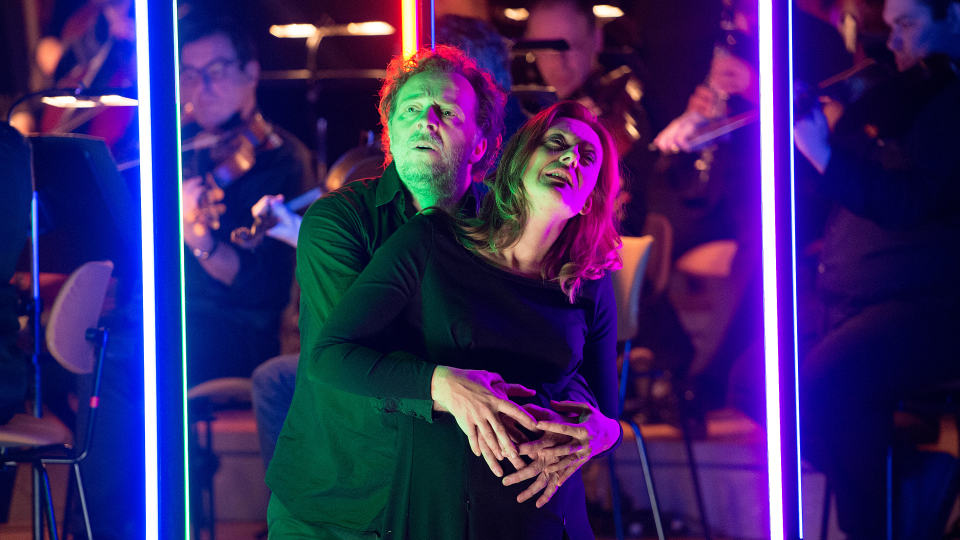
Simon Rattle brought Debussy Pelléas et Mélisande to London tonight, at the Barbican Hall instead of the Philharmonie, Berlin, and with the LSO instead of the Berliner Philharmoniker. This new production has been called the Star Wars Pelléas et Mélisande because there are columns of light, like the light sabres. That's not inappropriate since the opera is in a sense a cosmic battle between avatars.
The opera deals with real emotions, like insecurity and jealousy, but the situation is anything but realistic. Who is Mélisande? Why does she go from man to man, repelled by them yet submissive Is she human at all, or a projection of the fantasies of those around her? The emotions this opera deals with are real enough but Allemonde is a dream state rather than reality. What is Allemonde? Is it a kingdom or a state of mind? Yniold is scared of the starving peasants, but why is he out on his own playing with a golden ball? The tower, the pool and the impossibly long hair are all symbols of sexual portent. The contrasts between debiltating heat and suffocating darkness suggest psychological responses to physical states. For all we know, Allemonde is the subconscious, and we are the blind men.
So, in principle, no objection to Pelléas et Mélisande as Star Wars. Peter Sellars' semi-staging was designed around the performing space that is the Philharmonie, making use of the wide wings around the main stage, and using the different levels to depict the unsettling heights and depths in the narrative. Centre stage, Magdalena Kožená and Christian Gerhaher lie on a black plinth which serves as pondside and tower. Gerhaher and Gerald Finley climb an unsteady angle lit in green light when they descend into the caverns beneath the castle. The Philharmonie and the Barbican, however, are very different structures, so the Berlin staging can't really be replicated at the Barbican. The acting can, though it was a problem since it consists mainly of stylized gesture. Close up it bordered on ham acting, which these singers would not otherwise do, since they're all natural stage animals. Maybe Sellars thinks the characters are drugged? Again, in principle, this is fine, reflecting the stylization inherent in the plot, but I didn't like it.
Maybe the idea is to enhance the sense of non-reality so we can focus on the music? Although I haven't listened to my old tapes of Rattle's earlier performances of Pelléas et Mélisande, this time I felt the pace seemed drawn out, as if the languors in the text were affecting the orchestra. Still, the Berliner Philharmoniker doesn't ever play badly, and it was good to listen to the details of colour and light. Those who oppose a world-class concert hall for London need to hear what a difference a really good hall makes. The Barbican just isn't Philharmonie class. Rattle is most certainly not thinking in terms of vanity project but common sense.
When Rattle conducted Pelléas et Mélisande in Berlin ten years ago, with Simon Keenlyside in his prime, the performance was wonderful, much better than at the Royal Opera House. This time around, Gerald Finley sings Golaud as he did before, his voice darker and possibly closer to Golaud's gruff personality. Magdalena Kožená sang Mélisande as she did in Berlin in 2008 and Christian Gerhaher sings Pelléas, somewhat disengaged. Perhaps the roles are supposed to be that way, but a bit more engagement might have livened things up. I don't like the current fashion for Kožená-baiting, reminiscent of the hate campaigns against Callas and Schwarzkopf. She's not in their league but she's not bad. Mélisande sits a little too close to Lulu for her, but she's done amazing Martinu Juliettas. Bernarda Fink sang Geneviève and Franz Josef Selig sang a sprightly Arkel. I bought a ticket to the Barbican when they went on sale last year, but didn't go at the last moment. Much as I love the LSO and the Barbican, I want to remember the Philharmonie and the Berliner Philharmoniker.
Saturday, 9 January 2016
Boulez Mahler 2, informed by Messiaen

Pierre Boulez stands, in silence, after the conclusion of his Mahler Symphony no 2 at the Philharmonie, Berlin, in 2005. Look at Boulez's expression. The music hasn't ended simply because the notes have faded away. the symphony ends gloriously but victory hasn't been reached without struggle. Der Mensch liegt in größter Not! Der r Mensch liegt in größter Pein! Not even angels can turn the soul away from God. Boulez's approach in this performance, with the Staatskapelle Berlin, is steely, craggy and utterly determined. He understands the significance of the first movement and the stages through which the soul goes on its journey. A quiet but intense reading, absolutely true to the composer and to his work as a whole entity.
Today, listening after Boulez's own death this week, what struck me is the relationship this performance has to Messiaen's Et exspecto resurrectionem mortuorum. Mahler isn't writing about the death of one man but about mankind's search for meaning. Et exspecto resurrectionem mortuorum refers to the End of Time, when an angel shall sound a trumpet asnd the earth will be rent asunder. Cataclysmic stuff, bringing from Messiaen music that's almost geological in its cragginess - no strings, only percussion and winds, Boulez's interpretation is informed by his knowledge of Messiaen and perhaps, too, by his own formidable knowledge of music history. When the trombones blast, and the distant trumpets are heard, we think of the Angel of the Book of Revelation, as Mahler almost certainly did, and when we hear the piccolo details, we can figure better what they might mean. Obviously my appreciation of this performance is informed by my fascination with Messiaen and with Et Exspecto resurrectionum mortuorum and the Quartet for The End of Time. Read some of what I've written before HERE and HERE.and much more.


Friday, 8 January 2016
Boulez - the last interview

Doubt? The very concept of doubt no longer has meaning these days. For Boulez, culture meant being open to possibilities. All too often, the less someone knows the more certain they are that no-one else can know. That's why Boulez is dangerous. He thinks. I cannot use the past tense for a man so mentally and creatively alive. Boulez didn't suppress anyone who wasn't already suppressed in themselves. Since opinions are controlled by wide market forces, society itself creates suppression. It's nuts to project that resentment onto someone who represents the opposite of groupthink. Doubt is the antidote to mindless assumptions, to demagogue groupthink. No wonder so many defer to supposedly Holy Writ. Doubt and provocation, the engines that drive the eternal quest for wisdom and knowledge, growth and renewal. If that's scary, so then is the whole concept of civilization.
Thursday, 7 January 2016
Pierre Boulez - a personal tribute

Tributes pour in all round for Pierre Boulez, who died on Tuesday after a long illness. So many wonderful tributes - Paul Griffiths (thank goodness) in the New York Times, Le Monde, Roger Nichols in the Guardian, the Telegraph, the LSO, France Musique and many others - more to come, no doubt. These are the best informed.
There's also an all day broadcast from France Musique, video of Répons with Ensemble Intercontemporain on arte.tv, and a selection of videos on medici.tv.
So what I'll add is something you won't get anywhere else - personal, first-hand memories.
I was at the last concert in the Pli selon pli tour with Ensemble Intercontemporain in 2011 at the Royal Festival Hall. Boulez looked fragile, ashen: I thought he was exhausted after doing 20 concerts in the space of a month. He kept changing his glasses, and finally gave up, conducting by instinct. He knew each of those musicians well enough that he could hear them, and they knew him well enough that they could figure out what he wanted. If, at times, the performance seemed tentative, it was extremely moving because we could feel the rapport betwenn conductor and orchestra . That night I stood outside in the rain, waiting as the players went back to their hotels, or for dinner. Boulez didn't show but I was glad because I thought he needed a rest. As it turned out, that was the last concert he ever conducted. I much preferred the original recording with Christine Schafer, whose voice was more ethereal and magical, but I'm so glad I was there. Read more here.
In Berlin in 2007, Boulez conducted Mahler Symphony no 8 at the Philharmonie (my review here), a powerful performance that really brought out the meaning of the many references to light and enlightenment. Accende lumen sensibus! The difference between a good conductor and a very, very good conductor is that he can access meaning.. Here's what i wrote in 2009. It was such a performance that its memory will live with me forever.
At Aldeburgh, Boulez was giving a masterclass on Incises for Piano, Sonatina for Flute and Piano when a busload of daytrippers popped in. They'd come for the Bach Masss later that evening but for some reason had arrived hours too early, so they sat in on Boulez. To welcome them, he chatted about the early post war years and how hard it was to get hold of musical scores. They could relate to that, since they were mostly his own age. That explained why he was so into the 12 tone system in those years. ,It wasn't "ideology" just something that stimulated him. They'd been so deprived during the war that they were catching up on years of drought. In his youth, Boulez conducted Rameau. He knew his Bach. So the Bach Mass crowd were won over. They stayed for the class and for the performance. They liked the man and were prepared to hear what he had to say. None of that bigoted prejudice we get too much of now.
The most touching moment wasn't public at all. We were at a private party in Paris, where a young clarinettist played a difficult new work that involved a lot of circular breathing and flawless technique. The player was young. It was the biggest gig of his lifetime. Only 100 people in the audience but Boulez was Guest of Honour, seated right in front. Afterwards, I chatted with the young player. We weren't in the main room, but in a kind of alcove off the side. Who should join us? Boulez, who had made time to seek out the young man. "You're good" he told him, and gave him words of encouragement. No-one was present, it was entirely personal and sincere. The player was speechless. I almost had to pick him off the floor.
Boulez was a man of integrity and taste, for whom art was paramount, not self. Of course he was cerebral but what's wrong with that? He was deep. He didn't do "emotional diarrhoea" . So what if others didn't get him, and projected their hang-ups on him ? He was his own person.
Tuesday, 5 January 2016
Open Up the Royal Opera House
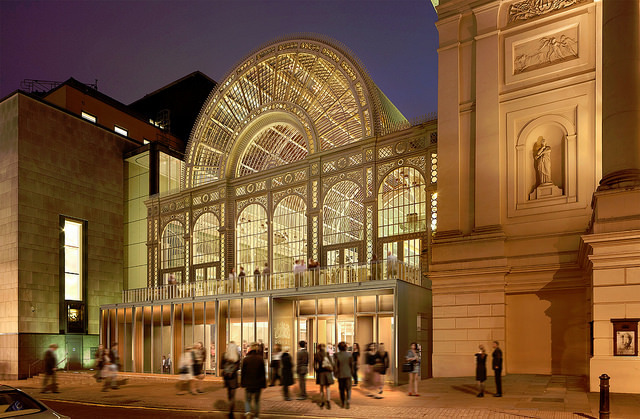
The Royal Opers House Open Up project starts in May. Plans were announced ages ago and now, a new section on the ROH website gives more detail. Open Up addresses the use of space within a historic site hemmed in on one side by the Covent Garden Piazza and on the other by Bow Street.
Thankfully, the revolving doors on both sides will go. They slow down entry and exit. The Bow Street facade will be enlarged and glazed over, to make more space inside. it's good that they're improving the Bow Street entrance. It's a primary point of access, so it would be extremely inconvenient to force patrons into the overcrowded Piazza area, when they might avoid it altogether. The ROH doesn't necessarily cater for the tourist and busker crowd! Intelligent use of wasted space on Bow Street and a nice new terrace above. Hopefully there will be more places to sit when waiting, though I appreciate that nonticket holders can colonize them, the way the old Box Office toilets became public use.
More urgently, there'll be a revamp of the Linbury Studio Theatre, which is so cramped that it's a no-go area for many. Like the Sadler's Wells Theatre it was built for dancers. Which is fine if you're under 30 and as flexible as a dancer. Most of us aren't. The seats in the present Linbury are so cramped that they drive away patrons who might otherwise enjoy being part of the audience. The industrial metal fittings will go, too, to be replaced by more acoustic-friendly wood. Hopefully capacity will be improved, too.
More controversial is the suggestion that part of the Ampitheatre terrace will be enclosed to extend the restaurant. But isn't Covent Garden already packed with restaurants? What will a few extra covers add? And at what cost to opera-goers If ROH restaurant goers don't like mixing with hoi polloi who go for music, that's their problem. Unfortunately, the rich expect privileges, but not all of them are actually opera lovers and many won't turn into donors. In any case giving in to that kind of donor is dangerous. One of the mantras in arts admin is the idea that cafés are more important than performance space, hence the idea of turning the Coliseum foyer into a sandwich shop. It's a silly short-term notion, into which companies are forced because funding bodies don't understand that the cost benefits of art don't lie simply in balance sheets.
Benjamin Appl Eichendorff Lieder Wigmore Hall
-480.jpg)
Eager anticipation for Benjamin Appl's recital with Graham Johnson at the Wigmore Hall , since Appl is one of the most promising young singers around. Being a BBC New Generation Artist automatically rockets any performer to star status, though some have appealed more for their looks, youth and marketability than for their talent. Appl, though, is one of the genuine discoveries. He has real potetial.
For his Wigmore Hall recital, Appl sang an interesting programme of settings of poems by Joseph Freiherr von Eichendorff (1788-1853). Taken out of context, some of Eichendorff's poetry might seem simplistic, as the BBC continuity suggests, but Eichendorff was a highly influential thinker whose ideas shaped the spirit of the Romantic era. Nature, for the Romantics, wasn't an escape into Disneyesque fantasy. but an affirmation of elemental forces beyond the control of conventional ordered civilization. Eichendorff's respect for pure, unspoiled Nature also reflected his spiritual beliefs. Eichendorff was a devout Catholic, a member of a minority in the Prussian state. As a social reformer, Eichendorff was a progressive who revamped the Prussian education system, making it more open to all. Most definitely not a small "r" romantic daydreamer ! Throughout his writings run deep themes like spirituality, tolerance and respect for humble yet genuinely noble values. How I wish this programme had included Verschweigene Liebe, one of Eichendorff's most magical poems, with its refrain that clarion call of the Romantic age, "Gedanken sind Frei!"
 Much better, I think, a recital that deals with a single poet in relative depth than the usual sampler programmes that demonstrate a young singer's vocal range rather than his or her understanding of the underlying principles of the repertoire. Appl began with three Schumann Eichendorff settings Frühlingsfahrt (Op 45/2) Der Einsiedler (Op 77/1) and Der frohe Wandersmann Op 83/3).
 In Eichendorff's Fruhlingsfahrt, two sturdy youths set forth, both striving for lofty things. One finds happiness in simple things. The other is seduced by the sirens of the deep and ends up a shattered wreck. Both Fruhlingsfahrt and Der frohe Wandersman show that Eichendorff was fascinated by wilder shores even while he praises domesticity. His homilies to God are talismanic, for he intuits that creativity can be dangerous. An artist is driven by something greater than his own free will. Happy Wanderer? No way.
Graham Johnson's accompaniment was steady rather than spectacular, giving Appl decent support. Appl's voice is naturally interesting. . I've heard very vivid singing from him before, full of character and intelligence, so I hoped he'd take more risks with less-familiar repertoire. The Mendelssohn Eichendorff settings are delicately refined and need expressiveness to bring out the innate strength beneath the surface elegance. Appl's Pagenlied moved thoughfully from noon-day meadow to evening serenade, and his Nachtlied responded to the liveliness in the paino part, and the text. Truly "Will keiner mit mir munter sein?". Wanderlied burst with vigorous spirit.
It was good, too, to hear Brahms's settings of In der Fremde and Mondnacht for a change isntead of Schumann, for they illustrate the differences between the two composers. Schumann's settings are effervescent,but Appla and Graham Johnson showed how Brahms's more down to earth approach gives them solidity. More characteristically "Brahmsian" were Parole and Anklänge, which reminded me of Brahms's Liebeslieder Walzer. Perhaps the more "folksy" element in the poems appealed to the composer, who wasn't as acutely attuned to literature as Schumann was.

"Dunkel Giebel, hohe Fenster,
Türme wie aus Nebel sehn.
Bleiche Statuen wie Gespenster
Lautlos an den Türen stehn."
Pfitzner's murky tone-painting colours the scene as if it were a painting from Caspar David Friedrich so effectively that it captures the discreetly hidden punchline embedded within the text :"Nur des Meeres fernes Rauschen.Wunderbare Einsamkeit!" Typically of Eichendorff this portrait of the city is psychological rather than purely physical. The poem dates from 1842. Eichendorff almost certainly knew Heinrich Heine's mysterious Die Stadt, and Pfitzner must have known the masterpiece setting thereof. Similazrly, Pfitzner's setting of Zum Abschied meiner Tochter describes a physical situation, the autumnal images in the poem nicely translated into sound, Yet again, though, Pfitzner underestimates the horror in the final strophe, disguised by mechanical images:
"Die Gassen schauen nochnächtlich,
Es rasselt der Wagen bedächtig –
Nun plötzlich rascher der Trott
Durchs Tor in die Stille der Felder,
Da grüßen so mutig die Wälder,
Lieb Töchterlein, fahre mit Gott!
Probably no other composer set Eichendorff as brilliantly as Hugo Wolf (though I wouldn't, couldn't be without Schumann). Wolf was so intent on expressing poems through music that he called his songs "poems", and wrote in bursts of frenzied inspiration. Appl and Johnson could have devoted a whole recital to Wolf's Eichendorff songs, but they chose just five - Nachruf; Das Ständchen; Der Musikant; Der Scholar; and Der Freund. Perhaps they knew we'd heard these so many times that we'd be more interested in Mendelssohn, Brahms and Pfitzner for a change, and put their best efforts into creating their best performances there. Appl does have the voice, and the intelligence, to do great things. I'd like to hear him be more daring, connecting to the intensity inherent in this poetry. I think he's got what it takes, but he needs to take risks. The Romantic Revolution broke boundaries: we should heed its audacity.
"Die Gassen schauen nochnächtlich,
Es rasselt der Wagen bedächtig –
Nun plötzlich rascher der Trott
Durchs Tor in die Stille der Felder,
Da grüßen so mutig die Wälder,
Lieb Töchterlein, fahre mit Gott!
Probably no other composer set Eichendorff as brilliantly as Hugo Wolf (though I wouldn't, couldn't be without Schumann). Wolf was so intent on expressing poems through music that he called his songs "poems", and wrote in bursts of frenzied inspiration. Appl and Johnson could have devoted a whole recital to Wolf's Eichendorff songs, but they chose just five - Nachruf; Das Ständchen; Der Musikant; Der Scholar; and Der Freund. Perhaps they knew we'd heard these so many times that we'd be more interested in Mendelssohn, Brahms and Pfitzner for a change, and put their best efforts into creating their best performances there. Appl does have the voice, and the intelligence, to do great things. I'd like to hear him be more daring, connecting to the intensity inherent in this poetry. I think he's got what it takes, but he needs to take risks. The Romantic Revolution broke boundaries: we should heed its audacity.
Sunday, 3 January 2016
New Year New Music Stockhausen Hymnen

New Year New Music! Hooray for BBC Radio 3 starting 2016 with a celebration of Karlheinz Stockhausen! The party started on New Year's Day itself with a unique broadcast of Hymnen, part from the original tapes made for WDR and a performance a few weeks ago conducted by Wolfgang Lischke with the London Sinfonietta, the RAM Ensemble, the Manson Ensemble and Sounds Intermedia. The broadcast is available in stereo and also surround sound, but you should also use your imagination, which is very much part of the creative process. I've heard Hymnen live in a concert hall, but its freakiness works better I think, in a kind of isolation chamber where you aren't inhibited by the presence of "normal" people. This time I listened alone, in the dark, to get the full surround-sound experience, and what a blast it was!
The title "Hymnen" refers to national anthems, which Stockhausen collected, mixing and changing the sounds so they form a vast universe of strange, conflicting harmonies. At around the time Hymnen was written, I used to play around with long and shortwave radio, switching stations in and out, in many different languages, some being deliberately jammed by others. People forget what the Cold War was like, but that context does bear heavily on what Hymnen might be about. Maybe I was preordained to understand Hymnen as a composite of soundwaves beamed off our planet by aliens in Outer Space. The star Sirius, of course, in Stockhausen terms. Absolutely pertinent on New Year's Day when people watch fireworks displays in succession all over the globe and singing Auld Lang Syne, in a strange dialect hardly anyone actually speaks.

Stockhausen is this week's Radio 3 Composer of the Week
Luciano Berio Sinfonia "For the unexpected is always with us"
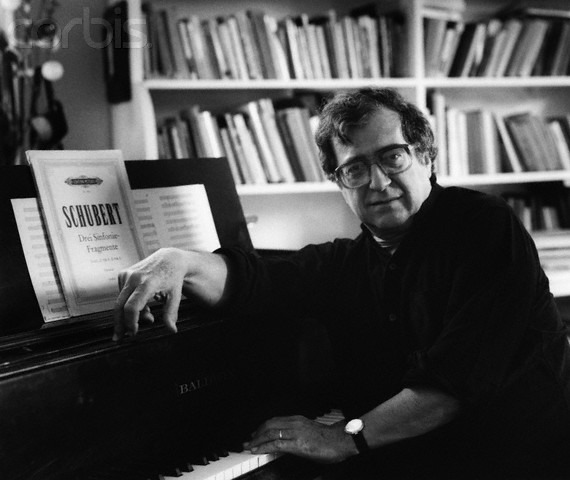 Luciano Berio, right, with Schubert. An apt point on which to start discussing Berio's Sinfonia (1968), a key work of modern times. Today I watched again Frank Scheffer's film A Voyage to Cythera, which was ground breaking on first release. It remains fresh and challenging sixteen years later, an absolute must for anyone interested in the way artists absorb influences to enrich their own creative imaginations. There are composers who do pick and mix, (one whom I shan't name) -- a symphony in one style, an opera in another, but being derivative is a dead end. Beware plagiarism, almost inevitably the mark of mediocrity.
 Good composers internalize and learn. Cythera in mythology was the home of the goddess of renewal and regeneration. Thus the film starts with shots of a strange primordial-looking landscape out of which arise strains of Mahler’s Symphony no 2, a "Resurrection" in the deepest sense. Berio's Sinfonia is no mere collage but a strikingly original new work that defies conventional ideas of what a symphony "should" be.
Berio describes the Sinfonia as an "internal monologue" which makes a "harmonic journey". It flows, like a river, bringing in its wake the streams and springs which have enriched it, adapting them and changing them, surging ever forwards towards the freedom of the ocean. Like Mahler himself, Berio was cerebral. Berio is seen in his study, surrounded by scores and books, with a model ship on display. Riccardo Chailly, also highly focused and erudite, talks about Stravinsky and Schoenberg, who, in their different ways, progressed the direction of modern music. Composers don't operate in "schools". Schoenberg's great achievement was to opens tonality outwards so others could develop things further. In Sinfonia, there are references to at least 15 different composers, some quite subtle. There's a quotation from Don, the first movement of Boulez's Pli selon Pli (fold upon fold). It's a "gift" from one master to another, both of them fascinated by multi-dimensional levels and perspectives, ever-changing flurries and eddies. Incidentally one of the best recordings of the Sinfonia was conducted by Boulez, who relished the wit.
"For the unexpected is always upon us" as a phrase rings out clearly, illuminating the deliberately obscurantist miasma of the text, partly based on Samuel Beckett, though there are also phrases from
Claude Lévi-Strauss, the anthropologist of myth. The style is often almost conversational. so you're drawn into what's being spoken, only to be confronted by something elusively confusing. You navigate, as on the rapids of a river, by paying attention and being intutitive,. Take nothing for granted: meaning operates on many levels. Once I heard an anecdote about someone who built a formidable machine that could invent music, electronically. Along came Berio, who twiddled a few knobs and buttons and created something genuinely interesting. He made real music by not being too up himself.
Berio had a quiet sense of humour. When he quotes Mahler's Des Antonius von Paduas Fischpredikt (read more here) , he knows the fish don't understand and will keep fighting. Perhaps Berio knew that some folk would never "get" Sinfonia, but so what as long as a few do. Traditionally -- if that's a word which can apply to someone as lively as Berio -- the texts have been semi-spoken at odd pitches, using tuning forks and impossibly clipped British accents, which adds to the sense of quixotic unreality. At the end, the performers name and thank each other -- reality playing tricks with art. No performance of Berio's Sinfonia is ever quite the same, and you get something different each time. "For the unexpected is always upon us".
Friday, 1 January 2016


Subscribe to:
Posts (Atom)